




 Servicios personalizados
 Inglés (pdf)
 Articulo en XML
 Referencias del artículo
 Traducción automática
 Enviar articulo por email
 Citado por SciELO
  Citado por Google
  Similares en
SciELO
Similares en
SciELO  Similares en Google
 Permalink
Introduction
Higher education (HE) has an important role in the empowerment of human capital, innovation, and society’s social, cultural, and environmental development (OECD, 2018; UNESCO, 2017). The contribution of HE has been increasingly valued in recent years, which can be seen in the growing numbers of institutions and students. This expansion of HE also promotes access for a more diverse and non-traditional student population with a broader mix of characteristics, expectations, and goals (Adabaş & Kaygin, 2016; Tight, 2019).
Although most students experience entering HE as a life achievement, the adaptation period to this new stage of life is very demanding (Almeida et al., 2012; Naylor et al., 2017). Some students may experience difficulties in overcoming the challenges of being a HE student, which include the personal, social, and academic requirements posed by HE institutions mission. These difficulties in students’ transition and adjustment are associated with academic failure and dropout, the rates of which tend to be higher in first-year students (Casanova, Cervero, Núñez, et al., 2018; García-Ros et al., 2018; van Rooij et al., 2018).
Given that HE must present challenges for development and training, it is important to identify the variables related to difficulties in adaptation, and to create support services to help students develop resilience and skills to autonomously manage their academic day-to-day lives (Casanova et al., 2022). Although academic failure and dropout can be related to infrastructure and institutional climate, teaching methods and evaluation processes, and to course and curriculum structure, our study is essentially focused on students’ personal variables related to the academic adjustment process.
HE is a context that has great transformative potential for students (Harman, 2017), so the quality of academic adaptation is an important issue for research. Several personal and contextual variables are involved in this adjustment process. Students' socio-cultural backgrounds, for example, are a strong determinant of what difficulties they will experience, and to what extent. Students from families with no tradition of HE (first generation students), or from minorities and socio-culturally disadvantaged groups, may have poorer language and math skills, poorer study habits, lower academic expectations, and lower perceptions of efficacy (Aina et al., 2019; Stinebrickner & Stinebrickner, 2014). They may also do HE modalities and courses with lower social prestige. Because their (less favoured) paths through primary and secondary education leave them with fewer academic resources, these students are less involved in the relationships with teachers, services, and classmates, avoiding experiencing frustrations. According to Bandura (1996), students with lower self-efficacy have more difficulties persisting in more challenging, difficult tasks, which explains the notable impact of self-efficacy on academic performance in first-year students (De Clercq et al., 2011; Richardson et al., 2012). In an unfavourable context, those students experience difficulties in their academic adaptation, which has a negative impact on academic achievement (Bailey & Phillips, 2016; Pascarella & Terenzini, 2005) and persistence (Kuh et al., 2006) during their first year.
One variable that is important in explaining academic success and associated with students’ socioeconomic backgrounds is their grade point average (GPA) for entering HE, despite some studies not finding such a relationship (Merritt & Buboltz, 2015; Palardy, 2013). The GPA, where secondary education grades and university entrance exams converge depending on the institution and course, reflects the students’ previous education and their levels of subject knowledge and competencies (Richardson et al., 2012; Schneider & Preckel, 2017). GPA appears to be the best sole predictor of academic achievement during the first year of HE (Ferrão & Almeida, 2019; García-Ros et al., 2018; Van den Broeck et al., 2018), although its impact is different depending on the nature of the course and content. Courses with curricula in the first year that are structured as a continuation of secondary education courses (e.g., mathematics, physics) demonstrate a greater impact of GPA compared to courses in which the content is novel (e.g., psychology, public administration). Because GPA is a set of variables related to cognitive development, curricular learning, academic motivation, and study methods, along with levels of engagement and self-efficacy in prior learning, its importance in explaining academic performance in the first year of HE is relatively easy to understand (Casanova et al., 2021; Denovan et al., 2020; Rodríguez-Muñiz et al., 2019).
Students’ gender and age are two other personal variables that appear to be associated with first-year academic performance, although some studies have failed to find a statistically significant impact on performance (García-Ros et al., 2018). In general, women perform better, which is explained by higher levels of involvement and organization in curricular learning and course related tasks (Diniz et al., 2018; Dwyer et al., 2013). Women tend to have better study methods and deeper approaches to learning while men are more concerned with their professional careers and employment after graduation and may even have better perceptions of self-efficacy in academic activities (McNabb et al., 2002; Wells et al., 2013). In addition, women miss fewer classes and are more punctual, participate more actively in classes, organize their study better, and seek learning help from teachers and colleagues when they need to. Where HE institutions continue to make a lot of use of exams at the end of the semester, women tend to be more self-regulated in their learning throughout the semester, compared to men, who more frequently cram or study closer to test time. Despite this, women are more vulnerable and are more likely to drop out when confronted with insufficient achievement (Casanova, Cervero, Núñez, et al., 2018).
When it comes to age, older students tend to have lower academic performance in their first year at HE and are more likely to dropout (Figuera et al., 2015; Lassibille & Gómez, 2009; Tinto, 2010). There are several explanatory factors behind this. Students who enter HE a few years after completing secondary education or after having dropped out frequently present higher levels of stress due to lower academic self-regulation skills, difficulties in creating study routines, or even learning difficulties and lower performance levels (Fanelli & Deane, 2015). In addition, older female students have more professional and family responsibilities, which makes it difficult to reconcile those responsibilities with academic tasks, such as attending class and doing group work (Belloc et al., 2011; Stratton et al., 2008; Venegas-Muggli, 2019). With less time to study, there is also less involvement in academic life, less access to services, and less socializing with colleagues, especially for women with greater family commitments, such as children or illness in the family (Casanova et al., 2021; González-Ramírez & Pedraza-Navarro, 2017; Severiens & ten Dam, 2012). In this context, both male and female older students may develop lower perceptions of academic self-efficacy compared to younger peers, and this factor may also have a negative impact on their academic performance. In addition, their comparatively reduced institutional engagement in and outside classes tends to be associated with lower levels of achievement and permanence (French et al., 2005; Tinto, 2010).
Another focus of study is academic self-efficacy, a set of personal beliefs that individuals build based on their life experiences, which influences the type of motivational, cognitive, and affective responses in the context of learning and realization (Bandura, 1996; Criollo et al., 2017; Polydoro & Guerreiro-Casanova, 2010). In the specific domain of HE, academic self-efficacy is a students’ confidence or belief that they can successfully accomplish tasks and achieve goals (Azzi & Polydoro, 2007). Students’ perceptions of self-efficacy are mediated by academic experiences and have an impact on setting goals and objectives in HE. Perceptions of self-efficacy are also related to academic engagement, self-regulation, and academic performance, which are also related to coping with difficulties and stressors (Ambiel et al., 2016; Bernardo et al., 2017). Students who are more academically engaged are more focused on the learning process, participate more and make more effort in academic tasks, have better self-regulation skills, deeper learning approaches, and more positive perceptions of self-efficacy (Soares et al., 2015). This means that academic engagement is related to positive academic and social outcomes (Klem & Connell, 2004; Wonglorsaichon et al., 2014), self-efficacy (Coetzee & Oosthuizen, 2012), and to reduced achievement problems, burnout and dropout (Fredricks, 2011; Fredricks & McColskey, 2012), even the impact of burnout on dropout intention (Abreu Alves et al., 2022).
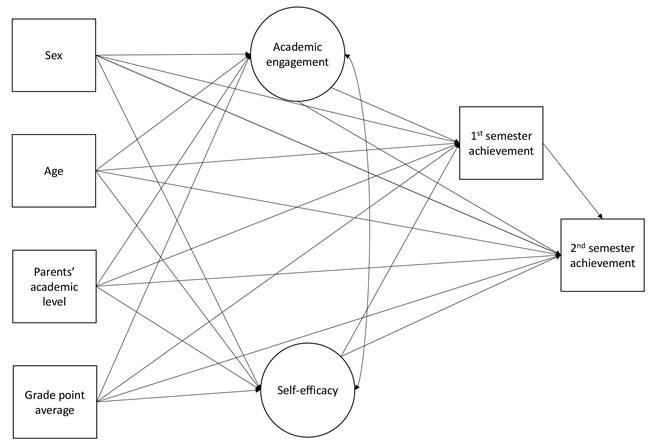
This study aims to analyse some predictors of academic achievement in first-year students. We incorporate variables such as gender, age, parents’ academic level, and GPA from secondary education and university entrance exams in a prediction model to explain students’ academic achievement at the end of the first and second semesters (Figure 1). In addition, after a few weeks of the adaptation process to university, the levels of students’ academic engagement and self-efficacy are added to the model. Finally, we also include academic achievement in the first semester as a predictor of academic achievement in the second semester.
Method
Sample
A convenience sample (non-probability sampling) was obtained comprising 447 first-year university students from a public university in the north of Portugal. The mean age of the students was 19.35 years old (SD = 4.45, Mdn = 18.00, Min-Max = 16-58 years), and the majority were women (64.5%). In terms of parental educational attainment: 42.4% of students had both parents with only basic educational qualifications, 33.1% of students had at least one parent with secondary education; 13.8% of students had at one parent with tertiary education, and 10.7% had both parents with tertiary education. Most of the students were doing their first-choice course (65.2%) and attending their first-choice university (77.4%), while 37% of the students reported leaving home to attend higher education. The students were enrolled in courses from various subject areas: 33.8% were studying Law and Economics, 31.5% were studying Social Sciences and Humanities, and 34.7% were studying Science and Engineering.
Psychometric Instruments
University Student Engagement. First-year students’ academic engagement was assessed via the University Student Engagement Inventory - USEI (Marôco et al., 2016; Sinval et al., 2021). The USEI defines academic engagement as a second-order latent variable, which comprises three first-order dimensions: behavioral engagement, emotional engagement, and cognitive engagement. Each first-order dimension has five items, the students are asked to rate from 1 - “Never” to 5 - “Always”. The dimensionality of the USEI is stable, the group of 15 items presented acceptable to good factor loadings, as did the structural weights from the second-order latent variable to the first-order factors (Marôco et al., 2016). The second-order dimension showed good values for reliability in terms of internal consistency, together with measurement invariance between gender and knowledge area (Sinval et al., 2021).
Self-efficacy in higher education. Self-efficacy was measured with the Self-Efficacy in Higher Education scale - SSHE (Vieira et al., 2017). The SSHE comprises 20 items answered via an ordinal scale (1 - “Not confident” to 6 - “Totally confident”) which are distributed in three first-order factors (i.e., academic self-efficacy, seven items; self-efficacy in regulation of education, seven items; self-efficacy in social interactions, six items). A second-order latent factor (i.e., self-efficacy) tends to be found (Casanova, Cervero, Nuñez, et al., 2018).
Academic data. The students’ average weighted grades for the first and second semesters were obtained from the academic services office, together with the grade point average on entering HE, and whether the course and university were their first choice.
Sociodemographic data. We also requested the participants’ age in years, sex (0 - female, 1 - male), and information about their parents’ educational levels (1 - both parents with basic education, 2 - at least one of the parents with tertiary education, 3 - one of the parents with tertiary education, 4 - both parents with tertiary education).
Procedures
The study adhered to the ethical standards of research with human beings, following the guidelines of the Declaration of Helsinki and the Oviedo Convention and was approved by the Ethics Council of the HE institution (CEICSH 035/2019). The cross-sectional survey was conducted in the classroom, using a pencil and paper format. Students were informed about the study objectives and gave their free, informed consent in writing. We also requested authorization from institutional services for access to data on academic achievement at the end of the academic year. The confidentiality of the data was guaranteed, and students were able to decline to participate, or to drop out of the study at any time.
Data Analysis
All the statistical analyses were performed with R (R Core Team, 2021) using the integrated development environment, RStudio (R Core Team, 2021). The descriptive statistics were produced using the skimr package (McNamara et al., 2018), the coefficient of variation (CV) was calculated through the sjstats package (Lüdecke, 2019), the standard error of the mean (SEM) was estimated by the plotrix package (Lemon, 2006), and the mode was calculated with the DescTools package (Signorell et al., 2019). Severe univariate normality violations were considered for absolute values of |sk| > 3 and |ku| > 7 (Finney & DiStefano, 2013; Marôco, 2021). To assess the validity evidence based on the internal structure, the dimensionality and reliability of the measurement model were evaluated. The dimensionality was evaluated with confirmatory factor analysis (CFA) via the lavaan package (Rosseel, 2012) using the weighted least squares, mean and variance adjusted (WLSMV) estimator (Muthén, 1983). The goodness-of-fit indices were the TLI (Tucker Lewis Index), IFI (Incremental Fit Index), χ2/df (ratio chi-square and degrees of freedom), CFI (comparative fit index), the RMSEA (root mean square error of approximation), and the SRMR (Standardized Root Mean Square Residual). The fit of the model was considered good for values of χ2/df < 5, values of CFI, NFI and TLI > 0.95, values of SRMR < 0.08, and RMSEA < 0.08 (Boomsma, 2000; Byrne, 2012; Hoyle, 1995; McDonald & Ho, 2002). The reliability of the scores was assessed with estimates of internal consistency ω (Raykov, 2001); using the semTools package (Jorgensen et al., 2021), where higher values are indicative of better internal consistency.
The structural model was analyzed through structural equation modelling using the lavaan package (Rosseel, 2012), with a two‐step approach (Marôco, 2021). The mediation analysis was produced to estimate indirect, direct, and total effects of the potential mediators.
Results
Measurement Model
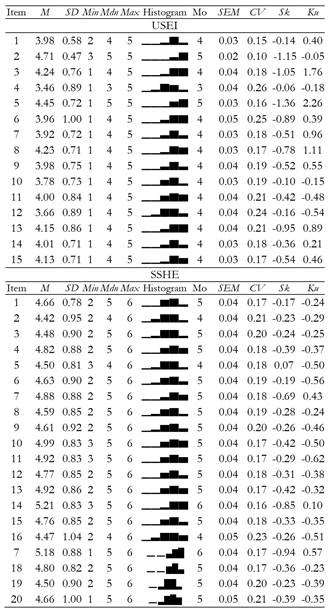
The descriptive statistics of the items are presented in Table 1. The USEI items demonstrated acceptable evidence in terms of psychometric sensitivity, without severe univariate normality violations (Finney & DiStefano, 2013; Marôco, 2021). However, two items (item 1 and item 2) did not have the full range of possible answers (i.e., 1 to 5).
The USEI second-order model demonstrated a good fit to the data (χ2(87) = 183.218, p < .001, n = 447, χ2 /df = 2.106, IFI = .988, CFI = .988, TLI = .986, SRMR = .060, RMSEA = .050, P(RMSEA ≤ .05) = .498, 90% CI (.040; .060)). The minimum factor loading was acceptable (λi ≥ .47), and no modification indices were added. Finally, internal consistency estimates for the second-order latent variable academic engagement in the USEI were good (ωL1 = .70; ωL2 = .82; ωpartial L1 = .87).
The descriptive statistics for items in the Self-Efficacy Scale in Higher Education (SSHE) are given in Table 1. Only two items (item 17 and item 20) presented the maximum possible range of values (i.e., 1 to 6). Analysis of the sk and ku values suggested the absence of severe univariate normality violations (Finney & DiStefano, 2013; Marôco, 2021).
The SSHE model demonstrated a good fit to the data (χ2(168) = 636.957, p < .001, n = 447, χ2 /df = 3.791, IFI = .991, CFI = .991, TLI = .989, SRMR = .060, RMSEA = .079, P(RMSEA ≤ .05) < .001, 90% CI (.073; .086)). The indicator with minimum factor loading was satisfactory (λi ≥ .66) and no modification indices were added. The internal consistency estimates for the second-order latent variable self-efficacy demonstrated good evidence (ωL1 = .91; ωL2 = .95; ωpartial L1 = .96).
Structural Model
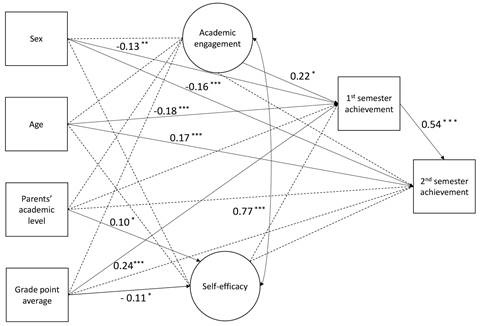
The structural model (Table 2) presented an acceptable fit to the data (χ2(751) = 1,648.393, p < .001, χ2/df = 2.195, n = 447, IFI = .987, CFI = .987, TLI = .988, SRMR = .060, RMSEA = .052, P(RMSEA ≤ .05) = .193, 90% CI (.048; .055)). The regression path of the GPA to 1st semester achievement was statistically significant (β1SA<-GPA = 0.238; p < .001). Parents’ academic level had a statistically significant path to the perception of self-efficacy (βSE<-PAL = 0.104; p = .042). Sex and age had a statistically significant path to both 1st semester achievement (β1st SA ← sex = -0.128; p = .008; β1st SA ← age = -0.182; p < .001) and 2nd semester achievement (β2nd SA ← sex = -0.162; p < .001; β2st SA ← age = 0.170; p < .001). Students’ academic engagement had a statistically significant path to 1st semester achievement (β1st SA ← AE = 0.220; p = .019), while 1st semester achievement had a significant path to 2nd semester achievement (β2nd SA ← 1st SA = 0.542; p < .001) and was the strongest of all the paths. The indirect effect of student academic engagement on 2nd semester achievement was statistically significant (β1st SA ← AE × 2nd SA ← 1st SA = 0.119; p = .021), while the total effect was not statistically significant (β2nd SA ← AE + (1st SA ← AE × 2nd SA ← 1st SA) = 0.117 p = .239). The indirect effect of perceived self-efficacy on 2nd semester achievement was not statistically significant (β1st SA ← SE × 2nd SA ← 1st SA = -0.060; p = .184), nor was the total effect statistically significant (β2nd SA ← SE + (1st SA ← SE × 2nd SA ← 1st SA) = -0.067 p = .437). Finally, the correlation between the second-order latent variables academic engagement and self-efficacy was positive, strong, and statistically significant (r AE, SE = .780; p < .001). The model explained 35.2% of the the 2nd semester achievement variance (r22nd SA = .352) and 15.0% of the first semester achievement variance (r21st SA = .150). Table 2 shows the standardized regression coefficients (β) and their 95% confidence intervals.
Table 2. Structural model paths.
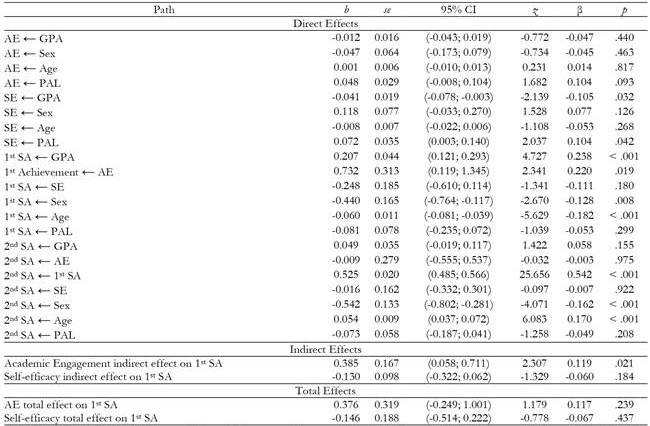
Note.1st SA — 1 st semester achievement; 2nd SA — 2nd semester achievement; AE — academic engagement; GPA — grade point average; SE — self-efficacy; PAL — Parents’ Academic Level.
Figure 2 shows the path diagram with all the standardized regression coefficients (β) of all statistically significant paths in the tested structural model.
Discussion
With this study, we aimed to analyse some predictors of academic achievement in first-year students. In order to explain academic achievement at the end of the 1st and 2nd semesters, we included variables such as sex, age, parental educational level, and grade point average to enter HE in the prediction model. In addition, we included students’ academic engagement and self-efficacy in the model, measured after some weeks at university, and academic achievement in the 1st semester as a predictor of academic achievement in the 2nd semester.
The results show that personal variables such as age and sex had a statistically significant path to 1st semester academic achievement, and showed that younger students and female students demonstrated better academic performance. These results are in line with the literature, where female students are often described as having better levels of engagement in academic activities, better attendance, higher levels of participation in class, and better study methods or deeper approaches to learning (Diniz et al., 2018; Dwyer et al., 2013). Older students tend to have lower academic performance in their 1st year in HE and are more likely to dropout (Figuera et al., 2015; Lassibille & Gómez, 2009; Tinto, 2010). Older students often have some years without studying, and could have an academic background marked by failure or even dropout. They have been found to present lower levels of academic self-regulation skills, difficulties in creating study routines, and even learning difficulties and lower performance levels (Fanelli & Deane, 2015).
It is worth noting that the regression path of GPA to 1st semester achievement was statistically significant but not GPA to 2nd semester achievement. Academic background, expressed in the GPA on entering HE, gives us some information about students’ academic experience and, although there is some discontinuity from secondary to tertiary education, it provides information about their academic knowledge and skills, study habits, and academic self-regulation (Bártolo-Ribeiro et al., 2020; Ferrão & Almeida, 2019). Nonetheless, GPA did not predict 2nd semester achievement, indicating progressive changes in the learning process that students have to deal with to meet the challenges of HE.
Parents’ educational levels, associated with students’ sociocultural backgrounds, is an important variable to be aware of in the initial period of HE. This is because, on the one hand, parents with lower academic qualifications may be less aware of the challenges and opportunities represented by HE. On the other hand, lower parental educational levels may represent less advantaged sociocultural contexts, and students may have poorer skills, poorer study habits, and poorer critical thinking abilities, which have a negative impact on their motivation and academic achievement, increasing the risk of dropout (Aina, 2013; Araque et al., 2009; Stinebrickner & Stinebrickner, 2014). In our study, the parents’ educational level was not significant in predicting academic achievement in the 1st or 2nd semesters. It is possible that despite lower academic qualifications, parents may provide higher levels of support and the incentive to pursue the goal of graduation. This could support the statistically significant path to the students’ perceptions of self-efficacy, namely students with lower HE access GPA had higher perceptions of self-efficacy. Because self-efficacy was measured in the middle of the 1st semester, it is possible that this perception was not based on academic results but could also be explained by students with higher levels of personal resilience for facing challenges.
It is important to note that the correlation between academic engagement and self-efficacy was positive and statistically significant. The perception of self-efficacy, students’ confidence that they can deal with and successfully accomplish tasks, has an important impact on academic performance in 1st year students (Azzi & Polydoro, 2007; Casanova et al., 2021; Richardson et al., 2012). This also contributes to higher levels of engagement in academic activities and the learning process, with students demonstrating more effort engagement, better self-regulation skills and deeper learning approaches (Coetzee & Oosthuizen, 2012; Klem & Connell, 2004; Soares et al., 2015; Wonglorsaichon et al., 2014).
Finally, students’ academic engagement had a statistically significant path to 1st semester achievement while 1st semester achievement had a significant path to 2nd semester achievement, demonstrating the strongest effect. These findings are important for creating and implementing strategies to monitor students’ academic progress in a timely manner in order to prevent behaviors related to disconnection, non-participation, burnout, failure, and dropout (Denovan et al., 2020; Fredricks & McColskey, 2012; Gilardi & Guglielmetti, 2011).
Limitations and further research
This study reports results from a study with a sample of first-year students from a public university, analysing direct and indirect effects of different personal and academic variables, self-efficacy, and academic engagement on academic achievement in the 1st and 2nd semesters. For future research it will be important to broaden the sample with students from different HE institutions to get more heterogeneous sample. In addition, selecting a sample to monitor through the different academic years up to graduation will allow us to understand how perceptions of self-efficacy and academic engagement change over time, and to examine differences between degree subject areas (e.g., using latent growth curves). Another important development will be the inclusion of pedagogical variables such as teaching, and evaluation methodologies differentiated by knowledge areas where the students’ grades tend to vary.

