<?xml version="1.0" encoding="ISO-8859-1"?><article xmlns:mml="http://www.w3.org/1998/Math/MathML" xmlns:xlink="http://www.w3.org/1999/xlink" xmlns:xsi="http://www.w3.org/2001/XMLSchema-instance">
<front>
<journal-meta>
<journal-id>1130-0108</journal-id>
<journal-title><![CDATA[Revista Española de Enfermedades Digestivas]]></journal-title>
<abbrev-journal-title><![CDATA[Rev. esp. enferm. dig.]]></abbrev-journal-title>
<issn>1130-0108</issn>
<publisher>
<publisher-name><![CDATA[Sociedad Española de Patología Digestiva]]></publisher-name>
</publisher>
</journal-meta>
<article-meta>
<article-id>S1130-01082004000500003</article-id>
<title-group>
<article-title xml:lang="en"><![CDATA[Biliopancreatic tumors: patient survival and quality of life after palliative treatment]]></article-title>
<article-title xml:lang="es"><![CDATA[Tumores biliopancreáticos: supervivencia y calidad de vida de los pacientes sometidos a tratamiento paliativo]]></article-title>
</title-group>
<contrib-group>
<contrib contrib-type="author">
<name>
<surname><![CDATA[García Sánchez]]></surname>
<given-names><![CDATA[M. V.]]></given-names>
</name>
<xref ref-type="aff" rid="A01"/>
</contrib>
<contrib contrib-type="author">
<name>
<surname><![CDATA[López Vallejos]]></surname>
<given-names><![CDATA[P.]]></given-names>
</name>
<xref ref-type="aff" rid="A01"/>
</contrib>
<contrib contrib-type="author">
<name>
<surname><![CDATA[Pérez de Luque]]></surname>
<given-names><![CDATA[D.]]></given-names>
</name>
<xref ref-type="aff" rid="A01"/>
</contrib>
<contrib contrib-type="author">
<name>
<surname><![CDATA[Naranjo Rodríguez]]></surname>
<given-names><![CDATA[A.]]></given-names>
</name>
<xref ref-type="aff" rid="A01"/>
</contrib>
<contrib contrib-type="author">
<name>
<surname><![CDATA[Hervás Molina]]></surname>
<given-names><![CDATA[A.]]></given-names>
</name>
<xref ref-type="aff" rid="A01"/>
</contrib>
<contrib contrib-type="author">
<name>
<surname><![CDATA[González Galilea]]></surname>
<given-names><![CDATA[A.]]></given-names>
</name>
<xref ref-type="aff" rid="A01"/>
</contrib>
<contrib contrib-type="author">
<name>
<surname><![CDATA[Calero Ayala]]></surname>
<given-names><![CDATA[B.]]></given-names>
</name>
<xref ref-type="aff" rid="A01"/>
</contrib>
<contrib contrib-type="author">
<name>
<surname><![CDATA[Padillo Ruiz]]></surname>
<given-names><![CDATA[J.]]></given-names>
</name>
<xref ref-type="aff" rid="A01"/>
</contrib>
<contrib contrib-type="author">
<name>
<surname><![CDATA[Solórzano Peck]]></surname>
<given-names><![CDATA[G.]]></given-names>
</name>
<xref ref-type="aff" rid="A01"/>
</contrib>
<contrib contrib-type="author">
<name>
<surname><![CDATA[Dios Vega]]></surname>
<given-names><![CDATA[J. F. de]]></given-names>
</name>
<xref ref-type="aff" rid="A01"/>
</contrib>
</contrib-group>
<aff id="A01">
<institution><![CDATA[,Hospital Universitario Reina Sofía Service of Digestive Diseases ]]></institution>
<addr-line><![CDATA[Córdoba ]]></addr-line>
<country>Spain</country>
</aff>
<pub-date pub-type="pub">
<day>00</day>
<month>05</month>
<year>2004</year>
</pub-date>
<pub-date pub-type="epub">
<day>00</day>
<month>05</month>
<year>2004</year>
</pub-date>
<volume>96</volume>
<numero>5</numero>
<fpage>305</fpage>
<lpage>314</lpage>
<copyright-statement/>
<copyright-year/>
<self-uri xlink:href="http://scielo.isciii.es/scielo.php?script=sci_arttext&amp;pid=S1130-01082004000500003&amp;lng=en&amp;nrm=iso"></self-uri><self-uri xlink:href="http://scielo.isciii.es/scielo.php?script=sci_abstract&amp;pid=S1130-01082004000500003&amp;lng=en&amp;nrm=iso"></self-uri><self-uri xlink:href="http://scielo.isciii.es/scielo.php?script=sci_pdf&amp;pid=S1130-01082004000500003&amp;lng=en&amp;nrm=iso"></self-uri><abstract abstract-type="short" xml:lang="en"><p><![CDATA[Objectives: to analyse survival and quality of life of patients with malignant obstructive jaundice after palliative treatment, comparing endoscopic stent insertion and palliative surgical (pallative resection and bypass surgical). Patients and method: eighty and seven patients were included in a trial. They were distributed to endoscopic stent (50) and palliative surgical (37). It analysed survival, quality of life and comfort index of jaundiced patients. The good quality of life was defined by absence of jaundice, pruritus and cholangitis after the initial treatment. Results: the median survival of the patients treated to endoscopic stent was 9,6 months whereas the patients to surgical treatment survived a median of 17 months. The time free of disease was 4 months in stented patients and 10,5 months in surgical patients. There was no significant difference in comfort index between the two groups (stented 34%, surgical 42,5%). Neither was there significant difference in survival and quality of life between palliative resection and bypass surgery. Conclusions: despite the survival and time free of disease being better in surgical patients, there was no significant difference in overall quality of life between the two groups. The survival and quality of life are the same after palliative resection as after bypass surgery, for this should not be performed routinely or to justify resection as a debulking procedure.]]></p></abstract>
<abstract abstract-type="short" xml:lang="es"><p><![CDATA[Objetivos: analizar la supervivencia y calidad de vida de los pacientes con ictericia obstructiva maligna sometidos a tratamiento paliativo, y comparar estos resultados en función de la alternativa terapéutica aplicada (prótesis biliar endoscópica frente a cirugía paliativa de resección o derivación biliodigestiva). Pacientes y método: ochenta y siete pacientes fueron incluidos en el estudio que se distribuyeron en dos grupos: a) 50 sometidos a drenaje biliar endoscópico con colocación de endoprótesis; y b) 37 intervenidos quirúrgicamente. Se analizó la supervivencia y calidad de vida del enfermo, entendiendo como buena calidad de vida la ausencia de ictericia, prurito y colangitis tras el primer abordaje terapéutico. Se calculó el índice de confort según el cual el periodo de buena calidad de vida se expresa como porcentaje de supervivencia. Resultados: el tiempo medio de supervivencia fue de 9,6 meses en los enfermos drenados por vía endoscópica frente a 17 meses en los intervenidos quirúrgicamente. El tiempo asintomático de enfermedad fue de 4 meses frente a 10,5 meses, respectivamente. No hubo grandes diferencias en cuanto al índice de confort entre ambos grupos terapéuticos (34 vs 42,5%). Tampoco se encontraron diferencias llamativas entre la supervivencia y calidad de vida analizando la cirugía de resección frente a la cirugía derivativa. Conclusiones: a pesar de que la cirugía consigue una mayor supervivencia y tiempo asintomático de enfermedad, no mejora la calidad de vida frente al drenaje biliar endoscópico. En cuanto al tipo de tratamiento quirúrgico, la cirugía de derivación y la de resección ofrecen los mismos porcentajes de supervivencia y calidad de vida, por lo que por el momento, no podemos recomendar de forma rutinaria la resección paliativa en este tipo de tumores.]]></p></abstract>
<kwd-group>
<kwd lng="en"><![CDATA[Malignant bile duct obstruction]]></kwd>
<kwd lng="en"><![CDATA[Quality of life]]></kwd>
<kwd lng="en"><![CDATA[Endoprostheses]]></kwd>
<kwd lng="en"><![CDATA[Bypass surgical]]></kwd>
<kwd lng="en"><![CDATA[Palliative treatment]]></kwd>
<kwd lng="es"><![CDATA[Ictericia obstructiva maligna]]></kwd>
<kwd lng="es"><![CDATA[Calidad de vida]]></kwd>
<kwd lng="es"><![CDATA[Endoprótesis biliar]]></kwd>
<kwd lng="es"><![CDATA[Cirugía biliar]]></kwd>
<kwd lng="es"><![CDATA[Tratamiento paliativo]]></kwd>
</kwd-group>
</article-meta>
</front><body><![CDATA[ <div align="center">       <center>   <table border="1" width="30%">     <tr>       <td width="100%" align="center"><font face="Arial"><b>ORIGINAL PAPERS</b></font></td>     </tr>   </table>   </center> </div>     <p>    <br> <b><font size=5>Biliopancreatic tumors: patient survival and quality of life after palliative treatment</font></b></p>     <p><b>M. V. Garc&iacute;a S&aacute;nchez, P. L&oacute;pez Vallejos, D. P&eacute;rez de Luque, A. Naranjo Rodr&iacute;guez, A. Herv&aacute;s Molina, A. Gonz&aacute;lez Galilea,    <br> B. Calero Ayala, J. Padillo Ruiz, G. Sol&oacute;rzano Peck and J. F. de Dios Vega</b></p>     <p><i>Service of Digestive Diseases. Hospital Universitario Reina Sofía. Córdoba, Spain</i></p>     <p>&nbsp;</p>     <p><b>ABSTRACT</b></p>     <p><font face="Arial" size="2"><b>Objectives:</b> to analyse survival and quality of life of patients with malignant obstructive jaundice after palliative treatment, comparing endoscopic stent insertion and palliative surgical (pallative resection and bypass surgical).<b>    ]]></body>
<body><![CDATA[<br> Patients and method:</b> eighty and seven patients were included in a trial. They were distributed to endoscopic stent (50) and palliative surgical (37). It analysed survival, quality of life and comfort index of jaundiced patients. The good quality of life was defined by absence of jaundice, pruritus and cholangitis after the initial treatment.<b>    <br> Results:</b> the median survival of the patients treated to endoscopic stent was 9,6 months whereas the patients to surgical treatment survived a median of 17 months. The time free of disease was 4 months in stented patients and 10,5 months in surgical patients. There was no significant difference in comfort index between the two groups (stented 34%, surgical 42,5%). Neither was there significant difference in survival and quality of life between palliative resection and bypass surgery.<b>    <br> Conclusions:</b> despite the survival and time free of disease being better in surgical   patients, there was no significant difference in overall quality of life between the two   groups. The survival and quality of life are the same after palliative resection as after bypass   surgery, for this should not be performed routinely or to justify resection as a debulking procedure.</font></p>     <p><font face="Arial" size="2"><b>Key words:</b> Malignant bile duct obstruction. Quality of life. Endoprostheses. Bypass surgical. Palliative treatment.</font></p> <hr>     <p><font size="2"><i>Garc&iacute;a S&aacute;nchez MV, L&oacute;pez Vallejos P, P&eacute;rez de Luque D, Naranjo Rodr&iacute;guez A, Herv&aacute;s Molina A, Gonz&aacute;lez Galilea A, Calero Ayala B, Padillo Ruiz J, Sol&oacute;rzano Peck G, de Dios Vega JF. Biliopancreatic tumors: patient survival and quality of life after palliative treatment. Rev Esp Enferm Dig 2004; 96: 305-314.</i></font></p> <hr>     <p><font size="2"><i>Recibido: </i>02-09-03.    <br> <i> Aceptado:</i> 19-11-03.</font></p>     <p><font size="2"><i>Correspondencia:</i> María del Valle García Sánchez. Secretaria de Aparato Digestivo. Hospital Universitario Reina Sofía. Avda. Menéndez Pidal, s/n. 14004 Córdoba. Tel.: 957 01 02 05. e-mail: <a href="mailto:vallegarcia@supercable.es">vallegarcia@supercable.es</a></font></p>     <p>&nbsp;</p>     <p><b>INTRODUCTION</b></p>     ]]></body>
<body><![CDATA[<p>The main causes of malignant obstruction of the main biliary duct are ampullary carcinoma, adenocarcinoma of the pancreatic head, cholangiocarcinoma and vesicular cancer (1).</p>     <p>Although surgery is still the only treatment to cure these neoplasias, on most occasions it is not possible. On the one hand, the generally advanced age of these patients usually leads to the association with serious diseases, making surgery unadvisable or significantly increasing postoperative morbidity and mortality (2,3). On the other hand, the evolutionary stage of these tumors at the time of diagnosis makes them non-resectable in many cases (2-4). These two facts explain why over 75% of these patients only receive palliative treatment (2,4,5).</p>     <p>The palliative alternatives currently available for alleviating biliary duct obstruction are endoscopic or percutaneous biliary drainage by stenting and biliodigestive bypass surgery with non-curative resection. Up to the mid-1980s, these patients underwent surgery to attempt resection or, in most cases, palliative biliary drainage (6). From the 1980s onwards, percutaneous drainage began to be used, though the morbidity linked to the technique led to its being relegated in favor of endoscopic drainage (7). Despite multiple trials suggesting endoscopic stenting is a safe and effective technique with a low rate of perioperative complications and mortality, its superiority over bypass surgery has yet to be demonstrated (8,13). On the other hand, the purpose of these treatments is not only to palliate jaundice and increase patient survival, but also to increase the disease-free survival between diagnosis and patient death. In this sense, studies exist demonstrating an improvement in quality of life in patients with malignant obstruction of the biliary duct following endoscopic stenting (14,15), but very few have contrasted results between this therapy and palliative surgery. The main objective of our study, therefore, is to analyze survival and quality of life resulting from endoscopic stenting and palliative surgery in patients with malignant obstructive jaundice of the main biliary duct.</p>     <p><b>PATIENTS AND METHOD</b></p>     <p>A retrospective study was carried out of 87 patients with malignant obstruction of the biliary duct receiving palliative treatment who were admitted to hospital between January 1998 and December 2001. Only patients with a malignant histological diagnosis or cholangiography and at least one other compatible image technique (ultrasound, CAT or cholangio-MRI), and who followed a clinical evolution of malignant disease, were included. Patients with a prior history of another neoplastic disease during the 5 previous years were excluded, as were those with difficult endoscopic access to the papilla (e.i. Billroth II gastrectomy) and those who received percutaneous stenting by means of transhepatic cholangiography.</p>    <p>Patients were divided into two groups according to palliative treatment applied. Group 1 included 50 patients who received endoscopic stenting. Group 2 contained 37 patients who underwent surgical treatment.</p>    <p>The procedure was considered satisfactory when, besides correct stent insertion or surgical biliodigestive anastomosis, the patient's clinical evolution was favorable (pruritus improvement and a drop in serum bilirubin levels of at least 30%, five days after drainage) and ultrasound controls showed a decrease in duct caliber. Drainage was considered ineffective if these criteria were not met.</p>    <p>All patients were monitored until their death, with a revision 30 days after drainage and then quarterly, including analysis and abdominal ultrasound on each visit.</p>    <p>The following clinical and analytical variables were gathered: age, sex, presence of associated medical diseases, tumor type, leukocyte count, hemoglobin, serum creatinine, bilirubin and alkaline phosphatase levels.</p>    <p>Complications and mortality in the first 30 days after treatment were defined as early morbidity and mortality, respectively. The hospital stay was registered after surgery or initial stent insertion, the number and causes of readmissions, and the need for new surgery on the biliary or digestive ducts. Patient survival and quality of life were analyzed, with good quality of life defined as absence of jaundice, pruritus and cholangitis after initial treatment. The comfort index was calculated so that the period of good quality of life is expressed as a survival percentage (16).</p>    ]]></body>
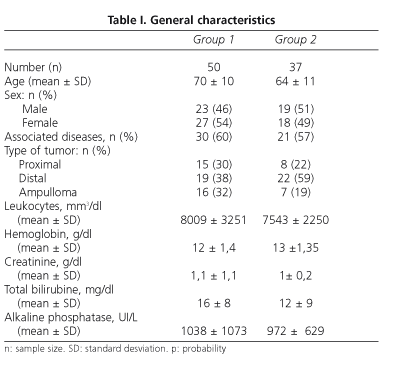
<body><![CDATA[<p align="center">Good quality of life (months) Comfort index: x 100   Survival (months)</p>    <p>Endoscopic biliary drainage was performed under sedation with midazolam i.v., using Olympus TJF-10 and TJF-130 duodenoscopes with a 4.2 mm channel. Following dilatation, Amsterdam (Izasa-GIP Medizintech-nik) or Pig-Tail (Baston Scientific/Microvasive) polyethylene stents were inserted using, in almost all cases, a 10 F caliber which varied in length depending on the state of the stenosis. Palliative surgery was decided upon by the team of surgeons responsible for the patient. A palliative resection was performed in 20 patients, while 17 underwent biliodigestive bypass surgery by means of choledochoduodenostomy, cholecystostomy or gastroenterostomy. No patient received complementary radiochemotherapy.</p>    <p>A descriptive study was made of the variables gathered for each group, and a Kaplan-Meier curve was used to analyze survival and disease-free survival.</p>    <p><b>RESULTS</b></p>    <p>Mean age was 70.6 years (range 37-92), 42 were male, and 51 had serious associated chronic diseases. <a href="#t1"> Table I</a> shows the general characteristics of each group.</p>     <p align="center"><a name="t1"><img src="/img/diges/v96n5/images/original2_tabla1.gif" width="393" height="373"></a></p>     <p>    <br> The level of obstruction was located in the proximal biliary duct in 23 patients (26%), in the distal biliary duct in 41 subjects (48%), and in 23 (26%) cases it was due to an ampullary tumor. <a href="#t2">Table II</a> shows series distribution by neoplasm location.</p>     <p align="center"><a name="t2"><img src="/img/diges/v96n5/images/original2_tabla2.gif" width="434" height="189"></a></p>     <p>    ]]></body>
<body><![CDATA[<br> <a href="#t3">Tables III</a> and <a href="#t4">IV</a> show the results of the prognostic variables according to type of palliative treatment applied (endoscopic, surgical), and surgical technique used (palliative resection, bypass surgery).</p>     <p align="center"><a name="t3"><img src="/img/diges/v96n5/images/original2_tabla3.gif" width="434" height="306"></a></p>     <p align="center"><a name="t4"><img src="/img/diges/v96n5/images/original2_tabla4.gif" width="434" height="255"></a></p>     <p><a href="#t5">    <br> Table V</a> shows disease-free survival, survival and comfort index by tumor location and type of palliative treatment used. We found that the result for these variables was better after surgery, though not significantly. Ampulloma was the tumor with the best prognosis, and vesicular carcinoma received the  worst prognosis.</p>     <p align="center"><a name="t5"><img src="/img/diges/v96n5/images/original2_tabla5.gif" width="434" height="282"></a></p>     <p>    <br> Endoscopic drainage was achieved satisfactorily in 47 patients (94%), and biliodigestive anastomosis in 35 (95%). Early morbidity occurred in 16 patients, 32% in the surgery group and 8% in the endoscopy group. The most frequent complications were those resulting from a dehiscence of the anastomosis (6), followed by respiratory complications (3), renal insufficiency (3), infections (2), cardiac decompensation (1) and upper gastrointestinal bleeding (1). Early mortality was similar in both groups, in 6 cases due to the advanced state of the neoplastic disease, and in another 4 following complications in the biliary drainage (2 after endoscopic drainage and 2 after surgical drainage).</p>     <p>Although the number of readmissions was higher in the endoscopically drained group than the surgical group (14/50 and 5/37,   respectively), no significant difference was found in the need for repeat endoscopies or surgery (11/50 and 5/37). Eleven patients from the endoscopy group required subsequent repeat   treatment, 10 due to obstruction of the stent, which was replaced (it was replaced once in 5   patients, twice in 4, and four times in 1), and one for bypass surgery due to duodenal obstruction secondary to tumor   growth. Surgical reintervention was required in the 5 patients in group 2 due to suture dehiscence at the anastomosis. Mean hospital stay after the initial procedure was greater in the surgery group than in the endoscopy group.</p>     <p>Higher rates of survival and disease-free survival were higher in the patients who received surgery than in those who underwent endoscopic drainage (<a href="#f1">Figs. 1</a> and <a href="#f2">2</a>), though no significant differences were found in the comfort index between the two   procedures.</p>      ]]></body>
<body><![CDATA[<p align="center"><a name="f1"><img src="/img/diges/v96n5/images/original2_fig1.gif" width="393" height="362"></a></p>      <p align="center"><a name="f2"><img src="/img/diges/v96n5/images/original2_fig2.gif" width="353" height="354"></a></p>        <p>    <br>  Survival, disease-free survival and comfort index ratio were greater in the group who received resection surgery than in the patients undergoing bypass surgery  (<a href="#t4">Table IV</a>), with no significant differences in the rest of the prognostic variables.</p>        <p><b>DISCUSSION</b></p>        <p>Endoscopic biliary drainage and palliative surgery are accepted options in malignant obstructive  jaundice, with a success rate of over 90% and no significant differences between the two (17,18). Effectiveness in our series was 94% in the group who underwent endoscopic biliary  drain-age, and 95% in the group receiving surgery.</p>        <p>Early mortality in our patients was similar to that in other series published to date, which is around 8-24% (17-21).   However, previous studies have suggested that the development of perioperative complications is more frequent in the surgery group than in the endoscopy group (17-19). The randomized trial by Smith et al (17), which considers and defines early morbidity in a very similar way to that of our   study, obtained 29% of complications with surgery, compared with 11% after endoscopic stent   insertion. In our series, morbidity was 32% after surgery and 8 after endoscopic  stenting.</p>    <p>Three studies (18,20,21), one of which was randomized (18), have also shown that endoscopic palliative treatment lowers the number of days in hospital when compared to   surgery. In our series, patients who received endoscopic biliary drainage stayed in hospital for 12.5   days, compared with 35 days for patients undergoing palliative surgery.</p>        <p>One of the main inconveniences of endoscopic treatment <i> versus</i> surgery is a higher percentage of readmissions after the initial   operation. These results have been published in various clinical trials, though statistical significance tests have not been reported (18,20,21). In our series, 28% of the endoscopically drained patients were readmitted to hospital, compared to 8% from the surgery   group. The development of jaundice, in some cases with cholangitis and even sepsis, was the most frequent cause of   readmission, and the need for stent replacement the main reason for reintervention on the biliary   duct. It has been stated that 37% of plastic stents occlude despite preventive measures   (biliary salts), as a consequence of the deposit of amorphous material on the inner   surface, and in these cases the stent must be replaced (17,22). In our series, the percentage was somewhat higher at 41%, and the mean number of stents per patient was 1.7, a similar figure to that published by Raiker et al (20).</p>        <p>In the analysis of survival in patients with malignant obstructive jaundice, in terms of the palliative treatment   applied, no significant differences are found in the studies published to date (17,19-21).   However, in our series, patient survival was 17 &plusmn; 19 months in the surgery   group, and 9.6 &plusmn; 10.6 months in the endoscopy group. The discrepancy with regard to previous studies is probably due to various   factors. On the one hand, patient selection type for each treatment group must be taken into   account. As <a href="#t1">table I</a> shows, the patients in group 1 have a greater frequency of the clinical and laboratory risk factors put forward by Pitt et al (23), which define patients with a greater probability of   post-procedure complications of the biliary duct than patients in the surgery   group. Thus, age, number of leukocytes, hemoglobinemia, serum levels of creatinine and alkaline phosphotase are greater in the first group than in the second  group.</p>        ]]></body>
<body><![CDATA[<p>On the other hand, another factor to take into account is the high proportion of patients who underwent more aggressive surgery with ample palliative   resections. In our series, of 37 patients operated on, palliative resection was performed on 20, and 17 underwent biliodigestive bypass   exclusively. Despite a lack of randomized trials showing better results for resection when compared with bypass   surgery, results obtained for resection from retrospective studies are better than or at least equal to those published for bypass surgery (24,25). Two recent works compare the prognostic parameters of the two surgical procedures (26,27), concluding that perioperative morbidity and mortality after palliative resection is acceptable and similar to bypass   surgery, with complication figures for resection between 42-44%, and 32-33% after bypass   surgery, with a mortality rate of 2 and 1%, respectively. Survival in both studies was greater after palliative resection than after bypass   surgery. In the series by Lillamoe et al. (26), survival after 2 years was 16 against 8%, and Reider et al. (27) found 24 against 2%,   respectively. These facts have led to a change in treatment strategies by specialist   centers, where surgeons experienced in this field prefer to perform tumor   resections. In our series (<a href="#t4">Table IV</a>), the mean survival obtained after palliative resection is higher than that of bypass  surgery.</p>        <p>As stated previously, the purpose of applying palliative treatment to a patient with malignant obstructive jaundice is not only to increase   long-term survival, but also to maintain good quality of life during the period of time between the diagnosis of the disease and the patient's   death. Symptoms that have proved to be related to good quality of life include mainly   pruritus, anorexia, dyspepsia, diarrhea and malaise, as well as jaundice. Two clinical studies (14,15) which used protocolized questionnaires and were approved by the European Organization for Research and Treatment of   Cancer, show a significant improvement of these symptoms in patients with malignant biliary obstruction undergoing endoscopic biliary drainage by means of stent   insertion. Only one randomized study (19) compares the two treatment procedures referring to quality of   life. The period of good quality of life is defined as the mean survival percentage of time during which the patient can carry out a normal physical   activity. The mean survival percentage of patients with a normal activity without the need for help was 57% for those treated with endoscopic biliary   drainage, and 51% for those undergoing surgical treatment, with no significant   differences. In our series, good quality of life is defined as absence of   jaundice, pruritus and cholangitis; disease-free survival after the operation was analyzed and the comfort index was   calculated, both as measures which express, simply and objectively, the quality of life of these   patients. Disease-free survival was 10.5 months in the surgery group, and 4 months in the endoscopy   group, though the comfort index was similar in both groups, at 34 and 42.5%,   respectively. With these results it may be stated that the quality of life provided by both palliative treatment procedures is similar in patients with malignant obstruction of the biliary  duct.</p>    <p>It may be concluded that endoscopic biliary drainage by means of stent insertion and palliative surgery are effective treatments for malignant obstructive   jaundice, with the same perioperative mortality rate and subsequent retreatment   requirements. However, in our group of patients, surgery offers increased survival and   disease-free survival, despite not influencing the comfort index. This fact implies that the type of procedure applied offers proportionally the same quality of life in this   disease. In any case, quality of life is a prognostic variable that has not been evaluated in controlled and randomized   studies, and it would be necessary to define it accurately and analyze which is the best treatment option in order to offer the patient a healthier and more comfortable survival   period. Regarding surgical treatment, the results from our series and from other trials do not currently allow recommending routine palliative   resection, nor do they justify the operation as a reductive process of tumor   mass. However, further studies are required including greater numbers of patients in order to obtain more conclusive results.</p>        <p><b>REFERENCES</b></p>     <!-- ref --><p>1. Naranjo A, Herv&aacute;s A, Mi&ntilde;o G. Drenaje biliar endosc&oacute;pico de las ictericias obstructivas malignas. En: Naranjo A, Herv&aacute;s A, Mi&ntilde;o G, eds. Drenaje biliar endosc&oacute;pico. Indicaciones y resultados. Madrid, 1998. p. 41-73. &nbsp;&nbsp;&nbsp;&nbsp;&nbsp;&nbsp;&nbsp;&nbsp;[&#160;<a href="javascript:void(0);" onclick="javascript: window.open('/scielo.php?script=sci_nlinks&ref=5205591&pid=S1130-0108200400050000300001&lng=','','width=640,height=500,resizable=yes,scrollbars=1,menubar=yes,');">Links</a>&#160;]<!-- end-ref --><!-- ref --><p> 2. Cello JP. Carcinoma of pancreas. En: Sleisinger MH. Fordtran JS, ed. Gastrointestinal disease. Pathophysiology, diagnosis, management. Philadelphia: Saunders, 1998. p. 1682-94.&nbsp;&nbsp;&nbsp;&nbsp;&nbsp;&nbsp;&nbsp;&nbsp;[&#160;<a href="javascript:void(0);" onclick="javascript: window.open('/scielo.php?script=sci_nlinks&ref=5205592&pid=S1130-0108200400050000300002&lng=','','width=640,height=500,resizable=yes,scrollbars=1,menubar=yes,');">Links</a>&#160;]<!-- end-ref --><!-- ref --><p> 3. Kozarek RA. Endoscopy in the management of pancreatic cancer. Sociedad Espa&ntilde;ola de Patolog&iacute;a Digestiva y American Society for Gastrointestinal Endoscopy. Curso de Postgraduados en Avances y Actualizaci&oacute;n de Endoscopia Digestiva. Madrid, 1997. p. 19-29.&nbsp;&nbsp;&nbsp;&nbsp;&nbsp;&nbsp;&nbsp;&nbsp;[&#160;<a href="javascript:void(0);" onclick="javascript: window.open('/scielo.php?script=sci_nlinks&ref=5205593&pid=S1130-0108200400050000300003&lng=','','width=640,height=500,resizable=yes,scrollbars=1,menubar=yes,');">Links</a>&#160;]<!-- end-ref --><!-- ref --><p> 4. Gores GJ. Clinicopathologic features of neoplastic cholangiopaties. American Association for the study of liver diseases. Postgraduate course. Diseases of the bile ducts: pathogenesis, pathology and practice. Chicago, 1996. p. 197-204.&nbsp;&nbsp;&nbsp;&nbsp;&nbsp;&nbsp;&nbsp;&nbsp;[&#160;<a href="javascript:void(0);" onclick="javascript: window.open('/scielo.php?script=sci_nlinks&ref=5205594&pid=S1130-0108200400050000300004&lng=','','width=640,height=500,resizable=yes,scrollbars=1,menubar=yes,');">Links</a>&#160;]<!-- end-ref --><!-- ref --><p> 5. Malfertheiner P, Ebert M, Dom&iacute;nguez-Mu&ntilde;oz J. Progress and update in pancreatology, 1995. European Association for Gastroenterology Postgraduate course. Berlin, 1995.&nbsp;&nbsp;&nbsp;&nbsp;&nbsp;&nbsp;&nbsp;&nbsp;[&#160;<a href="javascript:void(0);" onclick="javascript: window.open('/scielo.php?script=sci_nlinks&ref=5205595&pid=S1130-0108200400050000300005&lng=','','width=640,height=500,resizable=yes,scrollbars=1,menubar=yes,');">Links</a>&#160;]<!-- end-ref --><!-- ref --><p> 6. Waranapa P, Williamson RCN. Surgical palliation for pancreatic cancer: developments during the past two decades. Br J Surg 1992; 79: 8-20.&nbsp;&nbsp;&nbsp;&nbsp;&nbsp;&nbsp;&nbsp;&nbsp;[&#160;<a href="javascript:void(0);" onclick="javascript: window.open('/scielo.php?script=sci_nlinks&ref=5205596&pid=S1130-0108200400050000300006&lng=','','width=640,height=500,resizable=yes,scrollbars=1,menubar=yes,');">Links</a>&#160;]<!-- end-ref --><!-- ref --><p> 7. Speer A, Cotton PB, Russell RCG. Randomized trial of endoscopic versus perccutaneous stent insertion in malignant obstructive jaundice. Lancet 1987; 2: 57-62.&nbsp;&nbsp;&nbsp;&nbsp;&nbsp;&nbsp;&nbsp;&nbsp;[&#160;<a href="javascript:void(0);" onclick="javascript: window.open('/scielo.php?script=sci_nlinks&ref=5205597&pid=S1130-0108200400050000300007&lng=','','width=640,height=500,resizable=yes,scrollbars=1,menubar=yes,');">Links</a>&#160;]<!-- end-ref --><!-- ref --><p> 8. Sonnenfeld T, Gabrielsson N, Granqvist S, Perbeck L. Nonresectable malignant bile Duct obstruction. Surgical bypass or endoprosthesis? Acta Chir Scand 1986; 152: 297-300.&nbsp;&nbsp;&nbsp;&nbsp;&nbsp;&nbsp;&nbsp;&nbsp;[&#160;<a href="javascript:void(0);" onclick="javascript: window.open('/scielo.php?script=sci_nlinks&ref=5205598&pid=S1130-0108200400050000300008&lng=','','width=640,height=500,resizable=yes,scrollbars=1,menubar=yes,');">Links</a>&#160;]<!-- end-ref --><!-- ref --><p> 9. Pasanen P, Partanen K, Pikkarainen P, Alhava E, Pirinen A, Janatuinen E. Complications of endoscopic retrograde cholangiopancreatography in jaundiced and cholestasic patients. Ann Chir Gynaecol 1992; 81: 28-31.&nbsp;&nbsp;&nbsp;&nbsp;&nbsp;&nbsp;&nbsp;&nbsp;[&#160;<a href="javascript:void(0);" onclick="javascript: window.open('/scielo.php?script=sci_nlinks&ref=5205599&pid=S1130-0108200400050000300009&lng=','','width=640,height=500,resizable=yes,scrollbars=1,menubar=yes,');">Links</a>&#160;]<!-- end-ref --><!-- ref --><p>   10. Costamagna G, Gabriella A, Mutignani M, Perri V, Buononato M, Crucitti F. Endoscopic diagnosis and treatment of malignant biliary   strictures: review of 505 patients. Acta Gastroenterol Belg 1993; 56: 201-6.&nbsp;&nbsp;&nbsp;&nbsp;&nbsp;&nbsp;&nbsp;&nbsp;[&#160;<a href="javascript:void(0);" onclick="javascript: window.open('/scielo.php?script=sci_nlinks&ref=5205600&pid=S1130-0108200400050000300010&lng=','','width=640,height=500,resizable=yes,scrollbars=1,menubar=yes,');">Links</a>&#160;]<!-- end-ref --><!-- ref --><p>   11. Karsten TM, Coene PLO, van Gulik TM, Bosma A, van Marle J, James J. Morphologic changes of extrahepatic bile ducts during obstrucction and subsequent decompression by   endoprosthesis. Surgery 1992; 111: 562-8.&nbsp;&nbsp;&nbsp;&nbsp;&nbsp;&nbsp;&nbsp;&nbsp;[&#160;<a href="javascript:void(0);" onclick="javascript: window.open('/scielo.php?script=sci_nlinks&ref=5205601&pid=S1130-0108200400050000300011&lng=','','width=640,height=500,resizable=yes,scrollbars=1,menubar=yes,');">Links</a>&#160;]<!-- end-ref --><!-- ref --><p>   12. Armitage E, Rhodes M, Puntis M, Lawrie B. Endoscopic or surgical management for jaundice caused by carcinoma of the   pancres. Gastroenterology 1994; 106: A284.&nbsp;&nbsp;&nbsp;&nbsp;&nbsp;&nbsp;&nbsp;&nbsp;[&#160;<a href="javascript:void(0);" onclick="javascript: window.open('/scielo.php?script=sci_nlinks&ref=5205602&pid=S1130-0108200400050000300012&lng=','','width=640,height=500,resizable=yes,scrollbars=1,menubar=yes,');">Links</a>&#160;]<!-- end-ref --><!-- ref --><p>   13. Wilson C, van Wyck MEC, Funnell I, Krige JEJ, Bornman PC, Terblanche J. Pancreatic carcinoma: an audit of   treatment, survival and quality of life. Inaugural World Congress of Internantional   Hepato-Pancreato-Biliary Association, Boston, Ma, June 1, 1994: 138A.&nbsp;&nbsp;&nbsp;&nbsp;&nbsp;&nbsp;&nbsp;&nbsp;[&#160;<a href="javascript:void(0);" onclick="javascript: window.open('/scielo.php?script=sci_nlinks&ref=5205603&pid=S1130-0108200400050000300013&lng=','','width=640,height=500,resizable=yes,scrollbars=1,menubar=yes,');">Links</a>&#160;]<!-- end-ref --><!-- ref --><p>   14. Luman W, Cull A, Palmer KR. Quality of life in patient stented for malignant biliary   obstructions. Eur J Gastoenterol Hepatol 1997; 9: 481-4.&nbsp;&nbsp;&nbsp;&nbsp;&nbsp;&nbsp;&nbsp;&nbsp;[&#160;<a href="javascript:void(0);" onclick="javascript: window.open('/scielo.php?script=sci_nlinks&ref=5205604&pid=S1130-0108200400050000300014&lng=','','width=640,height=500,resizable=yes,scrollbars=1,menubar=yes,');">Links</a>&#160;]<!-- end-ref --><!-- ref --><p>   15. Ballinger AB, McHugh M, Catnach SM, Alstead EM, Clark ML. Symptom relief and quality of life after stenting for malignant bile duct   obstruction. Gut 1994; 35: 467-70.&nbsp;&nbsp;&nbsp;&nbsp;&nbsp;&nbsp;&nbsp;&nbsp;[&#160;<a href="javascript:void(0);" onclick="javascript: window.open('/scielo.php?script=sci_nlinks&ref=5205605&pid=S1130-0108200400050000300015&lng=','','width=640,height=500,resizable=yes,scrollbars=1,menubar=yes,');">Links</a>&#160;]<!-- end-ref --><!-- ref --><p>   16. Bismuth H, Castaing D, Traymor O. Resection or palliation: priority of surgery of disease classification   system. Crit Care Med 1985; 13: 818-29.&nbsp;&nbsp;&nbsp;&nbsp;&nbsp;&nbsp;&nbsp;&nbsp;[&#160;<a href="javascript:void(0);" onclick="javascript: window.open('/scielo.php?script=sci_nlinks&ref=5205606&pid=S1130-0108200400050000300016&lng=','','width=640,height=500,resizable=yes,scrollbars=1,menubar=yes,');">Links</a>&#160;]<!-- end-ref --><!-- ref --><p>   17. Smith AC, Dowsett JF, Russell RC, Hatfield AR, Cotton PB. Randomised trial of endoscopic stenting versus surgical bypass in malignant low bile duct   obstruction. Lancet 1994; 344: 1655-60.&nbsp;&nbsp;&nbsp;&nbsp;&nbsp;&nbsp;&nbsp;&nbsp;[&#160;<a href="javascript:void(0);" onclick="javascript: window.open('/scielo.php?script=sci_nlinks&ref=5205607&pid=S1130-0108200400050000300017&lng=','','width=640,height=500,resizable=yes,scrollbars=1,menubar=yes,');">Links</a>&#160;]<!-- end-ref --><!-- ref --><p>   18. Sherherd HA, Royle G, Ross AP, Diba A, Arthur M, Colin-Jones D. Endoscopic biliary endoprosthesis in the palliation of malignant obstruction of distal common bile   Duct: a randomized trial. Br J Surg 1988; 75: 1166-8.&nbsp;&nbsp;&nbsp;&nbsp;&nbsp;&nbsp;&nbsp;&nbsp;[&#160;<a href="javascript:void(0);" onclick="javascript: window.open('/scielo.php?script=sci_nlinks&ref=5205608&pid=S1130-0108200400050000300018&lng=','','width=640,height=500,resizable=yes,scrollbars=1,menubar=yes,');">Links</a>&#160;]<!-- end-ref --><!-- ref --><p>   19. Andersen JR, Sorensen SM, Kruse A, Rokkkjaer M, Matzen P. Randomised trial of endoscopic endoprosthesis versus operative bypass in malignant obstructive   jaundice. Gut 1989; 30: 1132-5.&nbsp;&nbsp;&nbsp;&nbsp;&nbsp;&nbsp;&nbsp;&nbsp;[&#160;<a href="javascript:void(0);" onclick="javascript: window.open('/scielo.php?script=sci_nlinks&ref=5205609&pid=S1130-0108200400050000300019&lng=','','width=640,height=500,resizable=yes,scrollbars=1,menubar=yes,');">Links</a>&#160;]<!-- end-ref --><!-- ref --><p>   20. Raikar GV, Melin MM, Ress A, Lettieri SZ, Poterucha JJ, Nagorney DM.   Cost-effective analisis of surgical palliation versus endoscopic stenting in the management of unresectable pancreatic   cancer. Ann Surg Oncol 1996; 3: 470-5.&nbsp;&nbsp;&nbsp;&nbsp;&nbsp;&nbsp;&nbsp;&nbsp;[&#160;<a href="javascript:void(0);" onclick="javascript: window.open('/scielo.php?script=sci_nlinks&ref=5205610&pid=S1130-0108200400050000300020&lng=','','width=640,height=500,resizable=yes,scrollbars=1,menubar=yes,');">Links</a>&#160;]<!-- end-ref --><!-- ref --><p>   21. Leung LWC, Emergy R, Cotton PB, Russell RC, Vallon AG, Mason RR. Management of malignant obstructive jaundice at the Middlesex hospital. Br J Surg 1983; 70: 584-6.&nbsp;&nbsp;&nbsp;&nbsp;&nbsp;&nbsp;&nbsp;&nbsp;[&#160;<a href="javascript:void(0);" onclick="javascript: window.open('/scielo.php?script=sci_nlinks&ref=5205611&pid=S1130-0108200400050000300021&lng=','','width=640,height=500,resizable=yes,scrollbars=1,menubar=yes,');">Links</a>&#160;]<!-- end-ref --><!-- ref --><p>   22. Naranjo A, Puente J, Herv&aacute;s A, de Dios FJ, Monrobel A, Gonz&aacute;lez A, et al. Drenaje endosc&oacute;pico mediante pr&oacute;tesis de polietileno de la ictericia obstructiva maligna. Gastroenterol Hepatol 1999; 22: 391-7.&nbsp;&nbsp;&nbsp;&nbsp;&nbsp;&nbsp;&nbsp;&nbsp;[&#160;<a href="javascript:void(0);" onclick="javascript: window.open('/scielo.php?script=sci_nlinks&ref=5205612&pid=S1130-0108200400050000300022&lng=','','width=640,height=500,resizable=yes,scrollbars=1,menubar=yes,');">Links</a>&#160;]<!-- end-ref --><!-- ref --><p>   23. Pitt HA, Cameron JL, Postier RG, Gadacz TR. Factors affecting mortality in biliary tract   surgery. Am J Surg 1981; 141: 66-72.&nbsp;&nbsp;&nbsp;&nbsp;&nbsp;&nbsp;&nbsp;&nbsp;[&#160;<a href="javascript:void(0);" onclick="javascript: window.open('/scielo.php?script=sci_nlinks&ref=5205613&pid=S1130-0108200400050000300023&lng=','','width=640,height=500,resizable=yes,scrollbars=1,menubar=yes,');">Links</a>&#160;]<!-- end-ref --><!-- ref --><p>   24. Gouma DJ, van Geenen R, van Gulik T, de Wit LT, Obertop H. Surgical palliative treatment in   biliary-pancreatic malignancy. Ann Oncol 1999; 10: 269-72.&nbsp;&nbsp;&nbsp;&nbsp;&nbsp;&nbsp;&nbsp;&nbsp;[&#160;<a href="javascript:void(0);" onclick="javascript: window.open('/scielo.php?script=sci_nlinks&ref=5205614&pid=S1130-0108200400050000300024&lng=','','width=640,height=500,resizable=yes,scrollbars=1,menubar=yes,');">Links</a>&#160;]<!-- end-ref --><!-- ref --><p>   25. Gouma DJ, van Dijkum N, van Geenen RCI, van Gulik TM. Are there indications for palliative resection in pancreatic   cancer? World J Surg 1999; 23: 954-9.&nbsp;&nbsp;&nbsp;&nbsp;&nbsp;&nbsp;&nbsp;&nbsp;[&#160;<a href="javascript:void(0);" onclick="javascript: window.open('/scielo.php?script=sci_nlinks&ref=5205615&pid=S1130-0108200400050000300025&lng=','','width=640,height=500,resizable=yes,scrollbars=1,menubar=yes,');">Links</a>&#160;]<!-- end-ref --><!-- ref --><p>   26. Lillemoe KD, Cameron JL, Yeo CJ, Sohn TA, Nakeeb A, Sauter PK, et al.   Pancreaticoduodenectomy: does it have a role in the palliation of pancreatic   cancer. Ann Surg 1996; 223: 718-22.&nbsp;&nbsp;&nbsp;&nbsp;&nbsp;&nbsp;&nbsp;&nbsp;[&#160;<a href="javascript:void(0);" onclick="javascript: window.open('/scielo.php?script=sci_nlinks&ref=5205616&pid=S1130-0108200400050000300026&lng=','','width=640,height=500,resizable=yes,scrollbars=1,menubar=yes,');">Links</a>&#160;]<!-- end-ref --><!-- ref --><p>   27. Reinders ME, Allema JH, van Gulik TM, Karsten TM, de Wit LT, Verbeek PCM, et al. Outcome of microscopically   nonradical, subtotal pancreaicoduodenectomy (Whipple's resection) for treatment of pancreatic head   tumors. World J Surg 1995; 19: 410-4.&nbsp;&nbsp;&nbsp;&nbsp;&nbsp;&nbsp;&nbsp;&nbsp;[&#160;<a href="javascript:void(0);" onclick="javascript: window.open('/scielo.php?script=sci_nlinks&ref=5205617&pid=S1130-0108200400050000300027&lng=','','width=640,height=500,resizable=yes,scrollbars=1,menubar=yes,');">Links</a>&#160;]<!-- end-ref --> ]]></body><back>
<ref-list>
<ref id="B1">
<label>1</label><nlm-citation citation-type="">
<person-group person-group-type="author">
<name>
<surname><![CDATA[Naranjo]]></surname>
<given-names><![CDATA[A]]></given-names>
</name>
<name>
<surname><![CDATA[Hervás]]></surname>
<given-names><![CDATA[A]]></given-names>
</name>
<name>
<surname><![CDATA[Miño]]></surname>
<given-names><![CDATA[G]]></given-names>
</name>
</person-group>
<person-group person-group-type="editor">
<name>
<surname><![CDATA[Naranjo]]></surname>
<given-names><![CDATA[A]]></given-names>
</name>
<name>
<surname><![CDATA[Hervás]]></surname>
<given-names><![CDATA[A]]></given-names>
</name>
<name>
<surname><![CDATA[Miño]]></surname>
<given-names><![CDATA[G]]></given-names>
</name>
</person-group>
<source><![CDATA[Drenaje biliar endoscópico: Indicaciones y resultados]]></source>
<year>1998</year>
<page-range>41-73</page-range><publisher-loc><![CDATA[Madrid ]]></publisher-loc>
</nlm-citation>
</ref>
<ref id="B2">
<label>2</label><nlm-citation citation-type="book">
<person-group person-group-type="author">
<name>
<surname><![CDATA[Cello]]></surname>
<given-names><![CDATA[JP]]></given-names>
</name>
</person-group>
<article-title xml:lang="en"><![CDATA[Carcinoma of pancreas]]></article-title>
<person-group person-group-type="editor">
<name>
<surname><![CDATA[Sleisinger]]></surname>
<given-names><![CDATA[MH]]></given-names>
</name>
<name>
<surname><![CDATA[Fordtran]]></surname>
<given-names><![CDATA[JS]]></given-names>
</name>
</person-group>
<source><![CDATA[Gastrointestinal disease: Pathophysiology, diagnosis, management]]></source>
<year>1998</year>
<page-range>1682-94</page-range><publisher-loc><![CDATA[Philadelphia ]]></publisher-loc>
<publisher-name><![CDATA[Saunders]]></publisher-name>
</nlm-citation>
</ref>
<ref id="B3">
<label>3</label><nlm-citation citation-type="book">
<person-group person-group-type="author">
<name>
<surname><![CDATA[Kozarek]]></surname>
<given-names><![CDATA[RA]]></given-names>
</name>
</person-group>
<source><![CDATA[Endoscopy in the management of pancreatic cancer]]></source>
<year>1997</year>
<page-range>19-29</page-range><publisher-loc><![CDATA[Madrid ]]></publisher-loc>
<publisher-name><![CDATA[Sociedad Española de Patología DigestivaAmerican Society for Gastrointestinal Endoscopy]]></publisher-name>
</nlm-citation>
</ref>
<ref id="B4">
<label>4</label><nlm-citation citation-type="">
<person-group person-group-type="author">
<name>
<surname><![CDATA[Gores]]></surname>
<given-names><![CDATA[GJ]]></given-names>
</name>
</person-group>
<article-title xml:lang="en"><![CDATA[Clinicopathologic features of neoplastic cholangiopaties]]></article-title>
<source><![CDATA[Diseases of the bile ducts: pathogenesis, pathology and practice]]></source>
<year>1996</year>
<page-range>197-204</page-range><publisher-loc><![CDATA[Chicago ]]></publisher-loc>
</nlm-citation>
</ref>
<ref id="B5">
<label>5</label><nlm-citation citation-type="book">
<person-group person-group-type="author">
<name>
<surname><![CDATA[Malfertheiner]]></surname>
<given-names><![CDATA[P]]></given-names>
</name>
<name>
<surname><![CDATA[Ebert]]></surname>
<given-names><![CDATA[M]]></given-names>
</name>
<name>
<surname><![CDATA[Domínguez-Muñoz]]></surname>
<given-names><![CDATA[J]]></given-names>
</name>
</person-group>
<source><![CDATA[Progress and update in pancreatology, 1995]]></source>
<year>1995</year>
<publisher-loc><![CDATA[Berlin ]]></publisher-loc>
<publisher-name><![CDATA[European Association for Gastroenterology]]></publisher-name>
</nlm-citation>
</ref>
<ref id="B6">
<label>6</label><nlm-citation citation-type="journal">
<person-group person-group-type="author">
<name>
<surname><![CDATA[Waranapa]]></surname>
<given-names><![CDATA[P]]></given-names>
</name>
<name>
<surname><![CDATA[Williamson]]></surname>
<given-names><![CDATA[RCN]]></given-names>
</name>
</person-group>
<article-title xml:lang="en"><![CDATA[Surgical palliation for pancreatic cancer: developments during the past two decades]]></article-title>
<source><![CDATA[Br J Surg]]></source>
<year>1992</year>
<volume>79</volume>
<page-range>8-20</page-range></nlm-citation>
</ref>
<ref id="B7">
<label>7</label><nlm-citation citation-type="journal">
<person-group person-group-type="author">
<name>
<surname><![CDATA[Speer]]></surname>
<given-names><![CDATA[A]]></given-names>
</name>
<name>
<surname><![CDATA[Cotton]]></surname>
<given-names><![CDATA[PB]]></given-names>
</name>
<name>
<surname><![CDATA[Russell]]></surname>
<given-names><![CDATA[RCG]]></given-names>
</name>
</person-group>
<article-title xml:lang="en"><![CDATA[Randomized trial of endoscopic versus perccutaneous stent insertion in malignant obstructive jaundice]]></article-title>
<source><![CDATA[Lancet]]></source>
<year>1987</year>
<volume>2</volume>
<page-range>57-62</page-range></nlm-citation>
</ref>
<ref id="B8">
<label>8</label><nlm-citation citation-type="journal">
<person-group person-group-type="author">
<name>
<surname><![CDATA[Sonnenfeld]]></surname>
<given-names><![CDATA[T]]></given-names>
</name>
<name>
<surname><![CDATA[Gabrielsson]]></surname>
<given-names><![CDATA[N]]></given-names>
</name>
<name>
<surname><![CDATA[Granqvist]]></surname>
<given-names><![CDATA[S]]></given-names>
</name>
<name>
<surname><![CDATA[Perbeck]]></surname>
<given-names><![CDATA[L]]></given-names>
</name>
</person-group>
<article-title xml:lang="en"><![CDATA[Nonresectable malignant bile Duct obstruction: Surgical bypass or endoprosthesis?]]></article-title>
<source><![CDATA[Acta Chir Scand]]></source>
<year>1986</year>
<volume>152</volume>
<page-range>297-300</page-range></nlm-citation>
</ref>
<ref id="B9">
<label>9</label><nlm-citation citation-type="journal">
<person-group person-group-type="author">
<name>
<surname><![CDATA[Pasanen]]></surname>
<given-names><![CDATA[P]]></given-names>
</name>
<name>
<surname><![CDATA[Partanen]]></surname>
<given-names><![CDATA[K]]></given-names>
</name>
<name>
<surname><![CDATA[Pikkarainen]]></surname>
<given-names><![CDATA[P]]></given-names>
</name>
<name>
<surname><![CDATA[Alhava]]></surname>
<given-names><![CDATA[E]]></given-names>
</name>
<name>
<surname><![CDATA[Pirinen]]></surname>
<given-names><![CDATA[A]]></given-names>
</name>
<name>
<surname><![CDATA[Janatuinen]]></surname>
<given-names><![CDATA[E]]></given-names>
</name>
</person-group>
<article-title xml:lang="en"><![CDATA[Complications of endoscopic retrograde cholangiopancreatography in jaundiced and cholestasic patients]]></article-title>
<source><![CDATA[Ann Chir Gynaecol]]></source>
<year>1992</year>
<volume>81</volume>
<page-range>28-31</page-range></nlm-citation>
</ref>
<ref id="B10">
<label>10</label><nlm-citation citation-type="journal">
<person-group person-group-type="author">
<name>
<surname><![CDATA[Costamagna]]></surname>
<given-names><![CDATA[G]]></given-names>
</name>
<name>
<surname><![CDATA[Gabriella]]></surname>
<given-names><![CDATA[A]]></given-names>
</name>
<name>
<surname><![CDATA[Mutignani]]></surname>
<given-names><![CDATA[M]]></given-names>
</name>
<name>
<surname><![CDATA[Perri]]></surname>
<given-names><![CDATA[V]]></given-names>
</name>
<name>
<surname><![CDATA[Buononato]]></surname>
<given-names><![CDATA[M]]></given-names>
</name>
<name>
<surname><![CDATA[Crucitti]]></surname>
<given-names><![CDATA[F]]></given-names>
</name>
</person-group>
<article-title xml:lang="en"><![CDATA[Endoscopic diagnosis and treatment of malignant biliary strictures: review of 505 patients]]></article-title>
<source><![CDATA[Acta Gastroenterol Belg]]></source>
<year>1993</year>
<volume>56</volume>
<page-range>201-6</page-range></nlm-citation>
</ref>
<ref id="B11">
<label>11</label><nlm-citation citation-type="journal">
<person-group person-group-type="author">
<name>
<surname><![CDATA[Karsten]]></surname>
<given-names><![CDATA[TM]]></given-names>
</name>
<name>
<surname><![CDATA[Coene]]></surname>
<given-names><![CDATA[PLO]]></given-names>
</name>
<name>
<surname><![CDATA[van Gulik]]></surname>
<given-names><![CDATA[TM]]></given-names>
</name>
<name>
<surname><![CDATA[Bosma]]></surname>
<given-names><![CDATA[A]]></given-names>
</name>
<name>
<surname><![CDATA[van Marle]]></surname>
<given-names><![CDATA[J]]></given-names>
</name>
<name>
<surname><![CDATA[James]]></surname>
<given-names><![CDATA[J]]></given-names>
</name>
</person-group>
<article-title xml:lang="en"><![CDATA[Morphologic changes of extrahepatic bile ducts during obstrucction and subsequent decompression by endoprosthesis]]></article-title>
<source><![CDATA[Surgery]]></source>
<year>1992</year>
<volume>111</volume>
<page-range>562-8</page-range></nlm-citation>
</ref>
<ref id="B12">
<label>12</label><nlm-citation citation-type="journal">
<person-group person-group-type="author">
<name>
<surname><![CDATA[Armitage]]></surname>
<given-names><![CDATA[E]]></given-names>
</name>
<name>
<surname><![CDATA[Rhodes]]></surname>
<given-names><![CDATA[M]]></given-names>
</name>
<name>
<surname><![CDATA[Puntis]]></surname>
<given-names><![CDATA[M]]></given-names>
</name>
<name>
<surname><![CDATA[Lawrie]]></surname>
<given-names><![CDATA[B]]></given-names>
</name>
</person-group>
<article-title xml:lang="en"><![CDATA[Endoscopic or surgical management for jaundice caused by carcinoma of the pancres]]></article-title>
<source><![CDATA[Gastroenterology]]></source>
<year>1994</year>
<volume>106</volume>
<page-range>A284</page-range></nlm-citation>
</ref>
<ref id="B13">
<label>13</label><nlm-citation citation-type="confpro">
<person-group person-group-type="author">
<name>
<surname><![CDATA[Wilson]]></surname>
<given-names><![CDATA[C]]></given-names>
</name>
<name>
<surname><![CDATA[van Wyck]]></surname>
<given-names><![CDATA[MEC]]></given-names>
</name>
<name>
<surname><![CDATA[Funnell]]></surname>
<given-names><![CDATA[I]]></given-names>
</name>
<name>
<surname><![CDATA[Krige]]></surname>
<given-names><![CDATA[JEJ]]></given-names>
</name>
<name>
<surname><![CDATA[Bornman]]></surname>
<given-names><![CDATA[PC]]></given-names>
</name>
<name>
<surname><![CDATA[Terblanche]]></surname>
<given-names><![CDATA[J]]></given-names>
</name>
</person-group>
<article-title xml:lang="en"><![CDATA[Pancreatic carcinoma: an audit of treatment, survival and quality of life]]></article-title>
<source><![CDATA[]]></source>
<year></year>
<conf-name><![CDATA[ Inaugural World Congress of Internantional Hepato-Pancreato-Biliary Association]]></conf-name>
<conf-date>June 1, 1994</conf-date>
<conf-loc>Boston Ma</conf-loc>
<page-range>138A</page-range></nlm-citation>
</ref>
<ref id="B14">
<label>14</label><nlm-citation citation-type="journal">
<person-group person-group-type="author">
<name>
<surname><![CDATA[Luman]]></surname>
<given-names><![CDATA[W]]></given-names>
</name>
<name>
<surname><![CDATA[Cull]]></surname>
<given-names><![CDATA[A]]></given-names>
</name>
<name>
<surname><![CDATA[Palmer]]></surname>
<given-names><![CDATA[KR]]></given-names>
</name>
</person-group>
<article-title xml:lang="en"><![CDATA[Quality of life in patient stented for malignant biliary obstructions]]></article-title>
<source><![CDATA[Eur J Gastoenterol Hepatol]]></source>
<year>1997</year>
<volume>9</volume>
<page-range>481-4</page-range></nlm-citation>
</ref>
<ref id="B15">
<label>15</label><nlm-citation citation-type="journal">
<person-group person-group-type="author">
<name>
<surname><![CDATA[Ballinger]]></surname>
<given-names><![CDATA[AB]]></given-names>
</name>
<name>
<surname><![CDATA[McHugh]]></surname>
<given-names><![CDATA[M]]></given-names>
</name>
<name>
<surname><![CDATA[Catnach]]></surname>
<given-names><![CDATA[SM]]></given-names>
</name>
<name>
<surname><![CDATA[Alstead]]></surname>
<given-names><![CDATA[EM]]></given-names>
</name>
<name>
<surname><![CDATA[Clark]]></surname>
<given-names><![CDATA[ML]]></given-names>
</name>
</person-group>
<article-title xml:lang="en"><![CDATA[Symptom relief and quality of life after stenting for malignant bile duct obstruction]]></article-title>
<source><![CDATA[Gut]]></source>
<year>1994</year>
<volume>35</volume>
<page-range>467-70</page-range></nlm-citation>
</ref>
<ref id="B16">
<label>16</label><nlm-citation citation-type="journal">
<person-group person-group-type="author">
<name>
<surname><![CDATA[Bismuth]]></surname>
<given-names><![CDATA[H]]></given-names>
</name>
<name>
<surname><![CDATA[Castaing]]></surname>
<given-names><![CDATA[D]]></given-names>
</name>
<name>
<surname><![CDATA[Traymor]]></surname>
<given-names><![CDATA[O]]></given-names>
</name>
</person-group>
<article-title xml:lang="en"><![CDATA[Resection or palliation: priority of surgery of disease classification system]]></article-title>
<source><![CDATA[Crit Care Med]]></source>
<year>1985</year>
<volume>13</volume>
<page-range>818-29</page-range></nlm-citation>
</ref>
<ref id="B17">
<label>17</label><nlm-citation citation-type="journal">
<person-group person-group-type="author">
<name>
<surname><![CDATA[Smith]]></surname>
<given-names><![CDATA[AC]]></given-names>
</name>
<name>
<surname><![CDATA[Dowsett]]></surname>
<given-names><![CDATA[JF]]></given-names>
</name>
<name>
<surname><![CDATA[Russell]]></surname>
<given-names><![CDATA[RC]]></given-names>
</name>
<name>
<surname><![CDATA[Hatfield]]></surname>
<given-names><![CDATA[AR]]></given-names>
</name>
<name>
<surname><![CDATA[Cotton]]></surname>
<given-names><![CDATA[PB]]></given-names>
</name>
</person-group>
<article-title xml:lang="en"><![CDATA[Randomised trial of endoscopic stenting versus surgical bypass in malignant low bile duct obstruction]]></article-title>
<source><![CDATA[Lancet]]></source>
<year>1994</year>
<volume>344</volume>
<page-range>1655-60</page-range></nlm-citation>
</ref>
<ref id="B18">
<label>18</label><nlm-citation citation-type="journal">
<person-group person-group-type="author">
<name>
<surname><![CDATA[Sherherd]]></surname>
<given-names><![CDATA[HA]]></given-names>
</name>
<name>
<surname><![CDATA[Royle]]></surname>
<given-names><![CDATA[G]]></given-names>
</name>
<name>
<surname><![CDATA[Ross]]></surname>
<given-names><![CDATA[AP]]></given-names>
</name>
<name>
<surname><![CDATA[Diba]]></surname>
<given-names><![CDATA[A]]></given-names>
</name>
<name>
<surname><![CDATA[Arthur]]></surname>
<given-names><![CDATA[M]]></given-names>
</name>
<name>
<surname><![CDATA[Colin-Jones]]></surname>
<given-names><![CDATA[D]]></given-names>
</name>
</person-group>
<article-title xml:lang="en"><![CDATA[Endoscopic biliary endoprosthesis in the palliation of malignant obstruction of distal common bile Duct: a randomized trial]]></article-title>
<source><![CDATA[Br J Surg]]></source>
<year>1988</year>
<volume>75</volume>
<page-range>1166-8</page-range></nlm-citation>
</ref>
<ref id="B19">
<label>19</label><nlm-citation citation-type="journal">
<person-group person-group-type="author">
<name>
<surname><![CDATA[Andersen]]></surname>
<given-names><![CDATA[JR]]></given-names>
</name>
<name>
<surname><![CDATA[Sorensen]]></surname>
<given-names><![CDATA[SM]]></given-names>
</name>
<name>
<surname><![CDATA[Kruse]]></surname>
<given-names><![CDATA[A]]></given-names>
</name>
<name>
<surname><![CDATA[Rokkkjaer]]></surname>
<given-names><![CDATA[M]]></given-names>
</name>
<name>
<surname><![CDATA[Matzen]]></surname>
<given-names><![CDATA[P]]></given-names>
</name>
</person-group>
<article-title xml:lang="en"><![CDATA[Randomised trial of endoscopic endoprosthesis versus operative bypass in malignant obstructive jaundice]]></article-title>
<source><![CDATA[Gut]]></source>
<year>1989</year>
<volume>30</volume>
<page-range>1132-5</page-range></nlm-citation>
</ref>
<ref id="B20">
<label>20</label><nlm-citation citation-type="journal">
<person-group person-group-type="author">
<name>
<surname><![CDATA[Raikar]]></surname>
<given-names><![CDATA[GV]]></given-names>
</name>
<name>
<surname><![CDATA[Melin]]></surname>
<given-names><![CDATA[MM]]></given-names>
</name>
<name>
<surname><![CDATA[Ress]]></surname>
<given-names><![CDATA[A]]></given-names>
</name>
<name>
<surname><![CDATA[Lettieri]]></surname>
<given-names><![CDATA[SZ]]></given-names>
</name>
<name>
<surname><![CDATA[Poterucha]]></surname>
<given-names><![CDATA[JJ]]></given-names>
</name>
<name>
<surname><![CDATA[Nagorney]]></surname>
<given-names><![CDATA[DM]]></given-names>
</name>
</person-group>
<article-title xml:lang="en"><![CDATA[Cost-effective analisis of surgical palliation versus endoscopic stenting in the management of unresectable pancreatic cancer]]></article-title>
<source><![CDATA[Ann Surg Oncol]]></source>
<year>1996</year>
<volume>3</volume>
<page-range>470-5</page-range></nlm-citation>
</ref>
<ref id="B21">
<label>21</label><nlm-citation citation-type="journal">
<person-group person-group-type="author">
<name>
<surname><![CDATA[Leung]]></surname>
<given-names><![CDATA[LWC]]></given-names>
</name>
<name>
<surname><![CDATA[Emergy]]></surname>
<given-names><![CDATA[R]]></given-names>
</name>
<name>
<surname><![CDATA[Cotton]]></surname>
<given-names><![CDATA[PB]]></given-names>
</name>
<name>
<surname><![CDATA[Russell]]></surname>
<given-names><![CDATA[RC]]></given-names>
</name>
<name>
<surname><![CDATA[Vallon]]></surname>
<given-names><![CDATA[AG]]></given-names>
</name>
<name>
<surname><![CDATA[Mason]]></surname>
<given-names><![CDATA[RR]]></given-names>
</name>
</person-group>
<article-title xml:lang="en"><![CDATA[Management of malignant obstructive jaundice at the Middlesex hospital]]></article-title>
<source><![CDATA[Br J Surg]]></source>
<year>1983</year>
<volume>70</volume>
<page-range>584-6</page-range></nlm-citation>
</ref>
<ref id="B22">
<label>22</label><nlm-citation citation-type="journal">
<person-group person-group-type="author">
<name>
<surname><![CDATA[Naranjo]]></surname>
<given-names><![CDATA[A]]></given-names>
</name>
<name>
<surname><![CDATA[Puente]]></surname>
<given-names><![CDATA[J]]></given-names>
</name>
<name>
<surname><![CDATA[Hervás]]></surname>
<given-names><![CDATA[A]]></given-names>
</name>
<name>
<surname><![CDATA[de Dios]]></surname>
<given-names><![CDATA[FJ]]></given-names>
</name>
<name>
<surname><![CDATA[Monrobel]]></surname>
<given-names><![CDATA[A]]></given-names>
</name>
<name>
<surname><![CDATA[González]]></surname>
<given-names><![CDATA[A]]></given-names>
</name>
</person-group>
<article-title xml:lang="es"><![CDATA[Drenaje endoscópico mediante prótesis de polietileno de la ictericia obstructiva maligna]]></article-title>
<source><![CDATA[Gastroenterol Hepatol]]></source>
<year>1999</year>
<volume>22</volume>
<page-range>391-7</page-range></nlm-citation>
</ref>
<ref id="B23">
<label>23</label><nlm-citation citation-type="journal">
<person-group person-group-type="author">
<name>
<surname><![CDATA[Pitt]]></surname>
<given-names><![CDATA[HA]]></given-names>
</name>
<name>
<surname><![CDATA[Cameron]]></surname>
<given-names><![CDATA[JL]]></given-names>
</name>
<name>
<surname><![CDATA[Postier]]></surname>
<given-names><![CDATA[RG]]></given-names>
</name>
<name>
<surname><![CDATA[Gadacz]]></surname>
<given-names><![CDATA[TR]]></given-names>
</name>
</person-group>
<article-title xml:lang="en"><![CDATA[Factors affecting mortality in biliary tract surgery]]></article-title>
<source><![CDATA[Am J Surg]]></source>
<year>1981</year>
<volume>141</volume>
<page-range>66-72</page-range></nlm-citation>
</ref>
<ref id="B24">
<label>24</label><nlm-citation citation-type="journal">
<person-group person-group-type="author">
<name>
<surname><![CDATA[Gouma]]></surname>
<given-names><![CDATA[DJ]]></given-names>
</name>
<name>
<surname><![CDATA[van Geenen]]></surname>
<given-names><![CDATA[R]]></given-names>
</name>
<name>
<surname><![CDATA[van Gulik]]></surname>
<given-names><![CDATA[T]]></given-names>
</name>
<name>
<surname><![CDATA[de Wit]]></surname>
<given-names><![CDATA[LT]]></given-names>
</name>
<name>
<surname><![CDATA[Obertop]]></surname>
<given-names><![CDATA[H]]></given-names>
</name>
</person-group>
<article-title xml:lang="en"><![CDATA[Surgical palliative treatment in biliary-pancreatic malignancy]]></article-title>
<source><![CDATA[Ann Oncol]]></source>
<year>1999</year>
<volume>10</volume>
<page-range>269-72</page-range></nlm-citation>
</ref>
<ref id="B25">
<label>25</label><nlm-citation citation-type="journal">
<person-group person-group-type="author">
<name>
<surname><![CDATA[Gouma]]></surname>
<given-names><![CDATA[DJ]]></given-names>
</name>
<name>
<surname><![CDATA[van Dijkum]]></surname>
<given-names><![CDATA[N]]></given-names>
</name>
<name>
<surname><![CDATA[van Geenen]]></surname>
<given-names><![CDATA[RCI]]></given-names>
</name>
<name>
<surname><![CDATA[van Gulik]]></surname>
<given-names><![CDATA[TM]]></given-names>
</name>
</person-group>
<article-title xml:lang="en"><![CDATA[Are there indications for palliative resection in pancreatic cancer?]]></article-title>
<source><![CDATA[World J Surg]]></source>
<year>1999</year>
<volume>23</volume>
<page-range>954-9</page-range></nlm-citation>
</ref>
<ref id="B26">
<label>26</label><nlm-citation citation-type="journal">
<person-group person-group-type="author">
<name>
<surname><![CDATA[Lillemoe]]></surname>
<given-names><![CDATA[KD]]></given-names>
</name>
<name>
<surname><![CDATA[Cameron]]></surname>
<given-names><![CDATA[JL]]></given-names>
</name>
<name>
<surname><![CDATA[Yeo]]></surname>
<given-names><![CDATA[CJ]]></given-names>
</name>
<name>
<surname><![CDATA[Sohn]]></surname>
<given-names><![CDATA[TA]]></given-names>
</name>
<name>
<surname><![CDATA[Nakeeb]]></surname>
<given-names><![CDATA[A]]></given-names>
</name>
<name>
<surname><![CDATA[Sauter]]></surname>
<given-names><![CDATA[PK]]></given-names>
</name>
</person-group>
<article-title xml:lang="en"><![CDATA[Pancreaticoduodenectomy: does it have a role in the palliation of pancreatic cancer]]></article-title>
<source><![CDATA[Ann Surg]]></source>
<year>1996</year>
<volume>223</volume>
<page-range>718-22</page-range></nlm-citation>
</ref>
<ref id="B27">
<label>27</label><nlm-citation citation-type="journal">
<person-group person-group-type="author">
<name>
<surname><![CDATA[Reinders]]></surname>
<given-names><![CDATA[ME]]></given-names>
</name>
<name>
<surname><![CDATA[Allema]]></surname>
<given-names><![CDATA[JH]]></given-names>
</name>
<name>
<surname><![CDATA[van Gulik]]></surname>
<given-names><![CDATA[TM]]></given-names>
</name>
<name>
<surname><![CDATA[Karsten]]></surname>
<given-names><![CDATA[TM]]></given-names>
</name>
<name>
<surname><![CDATA[de Wit]]></surname>
<given-names><![CDATA[LT]]></given-names>
</name>
<name>
<surname><![CDATA[Verbeek]]></surname>
<given-names><![CDATA[PCM]]></given-names>
</name>
</person-group>
<article-title xml:lang="en"><![CDATA[Outcome of microscopically nonradical, subtotal pancreaicoduodenectomy (Whipple's resection) for treatment of pancreatic head tumors]]></article-title>
<source><![CDATA[World J Surg]]></source>
<year>1995</year>
<volume>19</volume>
<page-range>410-4</page-range></nlm-citation>
</ref>
</ref-list>
</back>
</article>
