<?xml version="1.0" encoding="ISO-8859-1"?><article xmlns:mml="http://www.w3.org/1998/Math/MathML" xmlns:xlink="http://www.w3.org/1999/xlink" xmlns:xsi="http://www.w3.org/2001/XMLSchema-instance">
<front>
<journal-meta>
<journal-id>1130-1473</journal-id>
<journal-title><![CDATA[Neurocirugía]]></journal-title>
<abbrev-journal-title><![CDATA[Neurocirugía]]></abbrev-journal-title>
<issn>1130-1473</issn>
<publisher>
<publisher-name><![CDATA[Sociedad Española de Neurocirugía]]></publisher-name>
</publisher>
</journal-meta>
<article-meta>
<article-id>S1130-14732009000300003</article-id>
<title-group>
<article-title xml:lang="en"><![CDATA[Bioabsorbable osteofixation devices in craniosynostosis: Clinical experience in 216 cases]]></article-title>
<article-title xml:lang="es"><![CDATA[Sistemas bioabsorbibles de fijación ósea en craneosinostosis: Experiencia clínica en 216 casos]]></article-title>
</title-group>
<contrib-group>
<contrib contrib-type="author">
<name>
<surname><![CDATA[Muñoz-Casado]]></surname>
<given-names><![CDATA[M.J.]]></given-names>
</name>
<xref ref-type="aff" rid="A01"/>
</contrib>
<contrib contrib-type="author">
<name>
<surname><![CDATA[Romance]]></surname>
<given-names><![CDATA[A.I.]]></given-names>
</name>
<xref ref-type="aff" rid="A02"/>
</contrib>
<contrib contrib-type="author">
<name>
<surname><![CDATA[García-Recuero]]></surname>
<given-names><![CDATA[J.I.]]></given-names>
</name>
<xref ref-type="aff" rid="A02"/>
</contrib>
</contrib-group>
<aff id="A01">
<institution><![CDATA[,Hospital Universitario 12 de Octubre Unidad de Cirugía Craneofacial Servicio de Neurocirugía]]></institution>
<addr-line><![CDATA[ ]]></addr-line>
</aff>
<aff id="A02">
<institution><![CDATA[,Hospital Universitario 12 de Octubre Unidad de Cirugía Craneofacial Servicio de Cirugía Maxilofacial]]></institution>
<addr-line><![CDATA[Madrid ]]></addr-line>
</aff>
<pub-date pub-type="pub">
<day>00</day>
<month>06</month>
<year>2009</year>
</pub-date>
<pub-date pub-type="epub">
<day>00</day>
<month>06</month>
<year>2009</year>
</pub-date>
<volume>20</volume>
<numero>3</numero>
<fpage>255</fpage>
<lpage>261</lpage>
<copyright-statement/>
<copyright-year/>
<self-uri xlink:href="http://scielo.isciii.es/scielo.php?script=sci_arttext&amp;pid=S1130-14732009000300003&amp;lng=en&amp;nrm=iso"></self-uri><self-uri xlink:href="http://scielo.isciii.es/scielo.php?script=sci_abstract&amp;pid=S1130-14732009000300003&amp;lng=en&amp;nrm=iso"></self-uri><self-uri xlink:href="http://scielo.isciii.es/scielo.php?script=sci_pdf&amp;pid=S1130-14732009000300003&amp;lng=en&amp;nrm=iso"></self-uri><abstract abstract-type="short" xml:lang="en"><p><![CDATA[Introduction. The pursuit of bone fixation systems capable of affording appropriate stability for osteosynthesis has gone through several stages from the use of metal wires, plates, and screws to the current stage of bioabsorbable systems. In our Pediatric Neurosurgery Service and Craniofacial Surgery Unit we began employing these systems in June 1997. The object of this paper is to present a review of the bioabsorbable materials most commonly used in pediatric age, and more specifically in treating craniosynostosis, to describe the characteristics of each one of them and our experience. Patients and methods. From June 1997 to May 2006 we implanted bioabsorbable fixation systems in 216 patients diagnosed with craniosynostosis. Age at treatment ranged between 4 and 24 months (mean age 6, 38 months). Brain computed tomography (CT) scans, and three-dimensional (3-D) reconstruction of CT scans were performed before and after treatment. An 82: 18 L-lactic acid: glycolic acid copolymer was used in 92.2% of these cases, and a 70:30 L-lactic acid: D-lactic acid copolymer was used in the remaining 7.8% of cases. The follow-up of the patients ranged between six months and five years. Results. There was no displacement of bioabsorbable plates or screws in any case. In one case (0.46%), radiological imaging revealed osteolysis underneath the implant eight months after the surgical procedure. Prominences caused by the plates and screws employed were visible in two cases (0.93%). We found fractures in the osteosynthesis mesh in two patients (0.93%). Four patients (1.85%) presented local inflammation. No alterations of cranial morphology secondary to inadequate stability were observed. Conclusions. 1) Bioabsorbable fixation systems provide excellent stability during the bone "healing" period, without a higher complication rate than with other systems. 2) They help the bone grafts keep their remodeled shape. 3) They promote reossification by preventing the bone grafts from moving after osteosynthesis. 4) No interference with normal growth of the cranial vault has been observed.]]></p></abstract>
<abstract abstract-type="short" xml:lang="es"><p><![CDATA[Introducción. La búsqueda de sistemas de fijación ósea que proporcionen la estabilidad adecuada para favorecer una osteosíntesis, ha dado lugar a diferentes etapas. Desde la utilización de hilos de alambre, placas y tornillos metálicos hasta la etapa actual en la que se utilizan sistemas bioabsorbibles. En nuestro Servicio de Neurocirugía Pediátrica y Unidad de Cirugía Craneofacial comenzamos a utilizar estos sistemas en Junio de 1997. El objetivo de este trabajo es realizar una revisión de los materiales bioabsorbibles utilizados en la edad pediátrica, concretamente en craneosinostosis, aportando información sobre las características de cada uno de ellos y nuestra experiencia. Pacientes y métodos. Desde Junio de 1997 a Mayo de 2006, hemos utilizado sistemas de fijación bioabsobible en 216 pacientes diagnosticados de craneosinostosis. Las edades oscilaron entre 4 y 24 meses cuando se realizó el tratamiento (la edad media fue 6,38 meses). Todos los casos fueron estudiados con escáner cerebral y reconstrucción tridimensional antes y después del tratamiento. En el 92,2% de los casos el copolímero utilizado fue el formado por los ácidos L-Láctico y Glicolico en las proporciones de 82/18 y en el 7,8% restante el sistema formado por el copolímero de los ácidos L-Láctico y D-Láctico en la proporción de 70/30. El período de seguimiento ha oscilado entre 6 meses y 5 años. Resultados. No hubo desplazamientos de placas o tornillos bioabsorbibles en ningún caso. En un caso (0.46%), 8 meses después de la intervención se diagnosticó radiológicamente una imagen de osteolísis subyacente al implante. En dos pacientes (0.93%) se apreciaron relieves cutáneos debidos a las placas y tornillos utilizados. En dos casos (0.93%) fueron visibles a nivel frontal, prominencias por fracturas de las mallas de osteosíntesis. En cuatro ocasiones (1.85%) se apreciaron zonas de inflamación cutánea local. En ningún caso hemos observado alteraciones de la morfología craneal secundarias a una insuficiente estabilidad. Conclusiones. 1) Los sistemas de fijación bioabsorbibles proporcionan una estabilidad ideal durante la fase de "curación" ósea sin aumentar el porcentaje de complicaciones con respecto a los sistemas que previesen nuestra experiencia. 2) Favorecen el mantenimiento de la forma dada a los fragmentos óseos en la remodelación. 3) Facilitan la reosificación al impedir los movimientos de los fragmentos óseos una vez realizada la osteosíntesis. 4) No se han detectado interferencias con el crecimiento normal de la bóveda craneal.]]></p></abstract>
<kwd-group>
<kwd lng="en"><![CDATA[Osteosynthesis]]></kwd>
<kwd lng="en"><![CDATA[Bioabsorbable systems]]></kwd>
<kwd lng="en"><![CDATA[Craniosynostosis]]></kwd>
<kwd lng="en"><![CDATA[Rigid fixation]]></kwd>
<kwd lng="en"><![CDATA[Polylactic]]></kwd>
<kwd lng="en"><![CDATA[Polyglycolic]]></kwd>
<kwd lng="es"><![CDATA[Osteosíntesis]]></kwd>
<kwd lng="es"><![CDATA[Sistemas bioabsorbibles]]></kwd>
<kwd lng="es"><![CDATA[Craneosinostosis]]></kwd>
<kwd lng="es"><![CDATA[Fijación rígida]]></kwd>
<kwd lng="es"><![CDATA[Poliláctico]]></kwd>
<kwd lng="es"><![CDATA[Poliglicolico]]></kwd>
</kwd-group>
</article-meta>
</front><body><![CDATA[ <p>&nbsp;</p>     <p><b><font face="Verdana" size="2"><a name="top"></a></font><font face="Verdana" size="4">Bioabsorbable osteofixation devices in craniosynostosis. Clinical experience in 216 cases</font></b></p>     <p><b><font face="Verdana" size="4">Sistemas bioabsorbibles de fijaci&oacute;n &oacute;sea en craneosinostosis: Experiencia cl&iacute;nica en 216 casos</font></b></p>      <p>&nbsp;</p>      <p>&nbsp;</p>      <p><b><font face="Verdana" size="2">M.J. Mu&ntilde;oz-Casado; A.I. Romance* y J.I. Garc&iacute;a-Recuero*</font></b></p>      <p><font face="Verdana" size="2">Unidad de Cirug&iacute;a Craneofacial (Servicio de Neurocirug&iacute;a Pedi&aacute;trica y Cirug&iacute;a Maxilofacial*). Hospital Universitario 12 de Octubre. Madrid.</font></p>      <p><font face="Verdana" size="2"><a href="#back">Correspondence</a></font></p>      <p>&nbsp;</p>      <p>&nbsp;</p>  <hr size="1">      ]]></body>
<body><![CDATA[<p><b><font face="Verdana" size="2">SUMMARY</font></b></p>     <p><font face="Verdana" size="2"><b>Introduction.</b> The pursuit of bone fixation systems capable of affording appropriate stability for osteosynthesis has gone through several stages from the use of metal wires, plates, and screws to the current stage of bioabsorbable systems. In our Pediatric Neurosurgery Service and Craniofacial Surgery Unit we began employing these systems in June 1997. The object of this paper is to present a review of the bioabsorbable materials most commonly used in pediatric age, and more specifically in treating craniosynostosis, to describe the characteristics of each one of them and our experience.    <br> <b>Patients and methods.</b> From June 1997 to May 2006 we implanted bioabsorbable fixation systems in 216 patients diagnosed with craniosynostosis. Age at treatment ranged between 4 and 24 months (mean age 6, 38 months). Brain computed tomography (CT) scans, and three-dimensional (3-D) reconstruction of CT scans were performed before and after treatment. An 82: 18 L-lactic acid: glycolic acid copolymer was used in 92.2% of these cases, and a 70:30 L-lactic acid: D-lactic acid copolymer was used in the remaining 7.8% of cases. The follow-up of the patients ranged between six months and five years.    <br> <b>Results.</b> There was no displacement of bioabsorbable plates or screws in any case. In one case (0.46%), radiological imaging revealed osteolysis underneath the implant eight months after the surgical procedure. Prominences caused by the plates and screws employed were visible in two cases (0.93%). We found fractures in the osteosynthesis mesh in two patients (0.93%). Four patients (1.85%) presented local inflammation. No alterations of cranial morphology secondary to inadequate stability were observed.    <br> <b>Conclusions.</b> 1) Bioabsorbable fixation systems provide excellent stability during the bone "healing" period, without a higher complication rate than with other systems. 2) They help the bone grafts keep their remodeled shape. 3) They promote reossification by preventing the bone grafts from moving after osteosynthesis. 4) No interference with normal growth of the cranial vault has been observed.</font></p>     <p><font face="Verdana" size="2"><b>Key words:</b> Osteosynthesis. Bioabsorbable systems. Craniosynostosis. Rigid fixation. Polylactic. Polyglycolic.</font></p> <hr size="1">     <p><b><font face="Verdana" size="2">RESUMEN</font></b></p>     <p><font face="Verdana" size="2"><b>Introducci&oacute;n.</b> La b&uacute;squeda de sistemas de fijaci&oacute;n &oacute;sea que proporcionen la estabilidad adecuada para favorecer una osteos&iacute;ntesis, ha dado lugar a diferentes etapas. Desde la utilizaci&oacute;n de hilos de alambre, placas y tornillos met&aacute;licos hasta la etapa actual en la que se utilizan sistemas bioabsorbibles. En nuestro Servicio de Neurocirug&iacute;a Pedi&aacute;trica y Unidad de Cirug&iacute;a Craneofacial comenzamos a utilizar estos sistemas en Junio de 1997. El objetivo de este trabajo es realizar una revisi&oacute;n de los materiales bioabsorbibles utilizados en la edad pedi&aacute;trica, concretamente en craneosinostosis, aportando informaci&oacute;n sobre las caracter&iacute;sticas de cada uno de ellos y nuestra experiencia.    <br> <b>Pacientes y m&eacute;todos.</b> Desde Junio de 1997 a Mayo de 2006, hemos utilizado sistemas de fijaci&oacute;n bioabsobible en 216 pacientes diagnosticados de craneosinostosis. Las edades oscilaron entre 4 y 24 meses cuando se realiz&oacute; el tratamiento (la edad media fue 6,38 meses). Todos los casos fueron estudiados con esc&aacute;ner cerebral y reconstrucci&oacute;n tridimensional antes y despu&eacute;s del tratamiento. En el 92,2% de los casos el copol&iacute;mero utilizado fue el formado por los &aacute;cidos L-L&aacute;ctico y Glicolico en las proporciones de 82/18 y en el 7,8% restante el sistema formado por el copol&iacute;mero de los &aacute;cidos L-L&aacute;ctico y D-L&aacute;ctico en la proporci&oacute;n de 70/30. El per&iacute;odo de seguimiento ha oscilado entre 6 meses y 5 a&ntilde;os.    <br> <b>Resultados.</b> No hubo desplazamientos de placas o tornillos bioabsorbibles en ning&uacute;n caso. En un caso (0.46%), 8 meses despu&eacute;s de la intervenci&oacute;n se diagnostic&oacute; radiol&oacute;gicamente una imagen de osteol&iacute;sis subyacente al implante. En dos pacientes (0.93%) se apreciaron relieves cut&aacute;neos debidos a las placas y tornillos utilizados. En dos casos (0.93%) fueron visibles a nivel frontal, prominencias por fracturas de las mallas de osteos&iacute;ntesis. En cuatro ocasiones (1.85%) se apreciaron zonas de inflamaci&oacute;n cut&aacute;nea local. En ning&uacute;n caso hemos observado alteraciones de la morfolog&iacute;a craneal secundarias a una insuficiente estabilidad.    ]]></body>
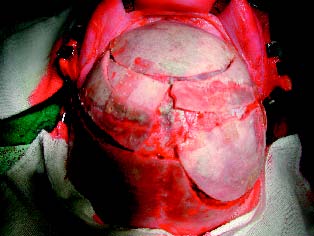
<body><![CDATA[<br> <b>Conclusiones.</b> 1) Los sistemas de fijaci&oacute;n bioabsorbibles proporcionan una estabilidad ideal durante la fase de "curaci&oacute;n" &oacute;sea sin aumentar el porcentaje de complicaciones con respecto a los sistemas que previesen nuestra experiencia. 2) Favorecen el mantenimiento de la forma dada a los fragmentos &oacute;seos en la remodelaci&oacute;n. 3) Facilitan la reosificaci&oacute;n al impedir los movimientos de los fragmentos &oacute;seos una vez realizada la osteos&iacute;ntesis. 4) No se han detectado interferencias con el crecimiento normal de la b&oacute;veda craneal.</font></p>     <p><font face="Verdana" size="2"><b>Palabras clave:</b> Osteos&iacute;ntesis. Sistemas bioabsorbibles. Craneosinostosis. Fijaci&oacute;n r&iacute;gida. Polil&aacute;ctico. Poliglicolico.</font></p>  <hr size="1">      <p>&nbsp;</p>      <p><b><font face="Verdana" size="2">Introduction</font></b></p>     <p><font face="Verdana" size="2">The pursuit of internal bone fixation systems to replace existing systems without giving rise to the complications described in the literature<sup>6,7 </sup>and then disappear after osteosynthesis without need of reintervention got under way some 30 years ago. The first experience with a bioabsorbable material to stabilize facial bones was carried out by Cutright, and Hunssuck in 1971<sup>1</sup>. Significant advances have been made since that time, culminating in the emergence of the first bioabsorbable fixation system for pediatric craniofacial surgery in 1996<sup>2,6,7</sup>. These systems afford suitable rigidity during the reossification process, thereby helping to stabilize osteotomized bone grafts in the skull, while no migration of the materials or restriction of cranial growth has been described. The first bioabsorbable system for pediatric craniofacial surgery approved in the United States was and 82:18 lactic acid: glycolic acid copolymer<sup>2</sup>. In vitro tests have shown that 70% of copolymer rigidity has been lost after six to eight weeks. In vivo histological studies have demonstrated virtually complete disappearance of the system approximately one year after implantation<sup>2,9,10,13</sup>. The ability to manage degradation time and complete elimination have made these systems ideal for stable osteosynthesis. We have been using bioabsorbable fixation systems since June 1997. There is no doubt that during these years we have not only tested the properties of the bioabsorbables material but also the technical difficulties derived from a relatively young craniofacial surgery, difficulties which we have overcome through experience.</font></p>      <p>&nbsp;</p>      <p><b><font face="Verdana" size="2">Patients and methods</font></b></p>      <p><font face="Verdana" size="2">From June 1997 to May 2006 we have used bioabsorbable fixation systems in    216 pediatric patients with the following diagnosis: 51 with unilateral coronal    synostosis, 68 with metopic synostosis, 49 with sagittal synostosis, 9 with    brachycephaly, and 39 with multiple synostosis. Patient age ranged from 4 to    24 months at the time of treatment (mean age 6,38 months). Brain computed tomography    (CT) scan, and three-dimensional (3-D) reconstruction of CT scans were taken    in all the patients before and after treatment. The antibiotic prophylaxis was    the currently used in transcranial surgery. A specific prophylaxis related to    the material used was not employed. During the postoperative period we perform    clinical exploration and radiological studies of the skull in all cases. The    postoperative follow up evaluated clinical signs of infection or local inflammation,    visibility of plates through the skin, instability, and reoperation.</font></p>      <p><font face="Verdana" size="2">Use of bioabsorbable systems. A copolymer consisting of 82:18 L-lactic acid:    glycolic acid was used in 92.2% (Lactosorb<sup>&reg;</sup>) of the cases on the basis of    patient age and pathology. We typically employed 50x50 mesh and 1.5x5 screws,    both previously shaped and sized to the areas of the skull where they were going    to be attached. The mesh was shaped by applying dry heat so that it would soften    and become moldable for a short time. For the L-lactic acid: Dlactic acid copolymer,    shaping was done by hand. The mesh was cut using surgical scissors and the screws    with small chisels. Perforations in the bone were made perpendicular to the    surface so that the screws could be inserted perpendicularly, so that they would    not break (<a href="/img/revistas/neuro/v20n3/3_1.jpg" target="_blank">fig 1</a>). Surgical Techniques (<a href="/img/revistas/neuro/v20n3/3_t1.jpg" target="_blank">table I</a>) (figures <a href="#f2">2</a>, <a href="/img/revistas/neuro/v20n3/3_3.jpg" target="_blank">3</a>, <a href="/img/revistas/neuro/v20n3/3_4.jpg" target="_blank">4</a>, <a href="#f5">5</a>, <a href="#f6">6</a>, <a href="#f7">7</a>).    1) Frontal-orbital remodelation: We have performed a bifrontal craniotomy with    remodelation of the frontal bone and repositioning on the fronto- orbital bar,    or transposition of a new frontal from the parietal region. 2) Holocranial dismantling:    In those with deformities of the skull cavity important, the remodelation intailed    a modification of the three diameters of the skull cavity. 3) Occipital remodelation:    performed on patients who needed a complete remodelation of the skull cavity,    requiring a occipital craniotomy, remodelling later the bone or rotating the    hanging osseous for later fixation with osteosynthesis.</font></p>     <p align="center"><font face="Verdana" size="2"><a name="f2"><img src="/img/revistas/neuro/v20n3/3_2.jpg" width="308" height="231"></a></font></p>     ]]></body>
<body><![CDATA[<p align="center"><font face="Verdana" size="2">Figure 2. <i> Fronto-orbital remodeling with bar.    <br> The forehead and fronto-orbital bar are fixated    <br> with bioabsorbable system.</i></font></p>     <p align="center"><font face="Verdana" size="2"><a name="f5">    <br> <img src="/img/revistas/neuro/v20n3/3_5.jpg" width="314" height="236"></a></font></p>     <p align="center"><font face="Verdana" size="2">Figure 5. <i> Scaphocephaly. Holocranial dismantling</i></font></p>     <p align="center"><font face="Verdana" size="2"><a name="f6">    <br> <img src="/img/revistas/neuro/v20n3/3_6.jpg" width="314" height="236"></a></font></p>     <p align="center"><font face="Verdana" size="2">Figure 6. <i> Patient with bilateral frontal prominences.</i></font></p>     <p align="center"><font face="Verdana" size="2"><a name="f7">    ]]></body>
<body><![CDATA[<br> <img src="/img/revistas/neuro/v20n3/3_7.jpg" width="314" height="236"></a></font></p>     <p align="center"><font face="Verdana" size="2">Figure 7. <i> Intraoperative view. Frontal remodeling.    <br> Bilateral frontal prominences of patient in figure 6.</i></font></p>      <p>&nbsp;</p>      <p><b><font face="Verdana" size="2">Results</font></b></p>      <p><font face="Verdana" size="2">Follow-up lasted from six months to five years. Clinical examination and neuroimaging showed osteosynthesis to be stable in all the cases. No displacement occurred in those cases in which frontoorbital and occipital advancement was performed. In two patients (0.92%), diagnosed with brachycephaly and frontal plagiocephaly, frontal bone prominences were observed as a result of fracture of the osteosynthesis mesh, and additional interventions were carried out to remove the implants (0,3% Eppley<sup>5</sup>). Mesh breakage may have been due to the mechanical traction that is necessary when suturing the coronal cutaneous incision. In four cases (1.85%) in which 10x25 meshes were used for to perform osteosynthesis, we detected cutaneous inflammatory reaction over the are of the mesh in conjunc-tion with rising body temperature, moderate leucocytosis, sterile blood cultures, and normal C-reactive protein levels (0,7%, Eppley<sup>2,5</sup>, 1,36% Habal<sup>10</sup>). These symptoms remitted without treatment some four or five days after onset<sup>5</sup>.</font></p>     <p><font face="Verdana" size="2">An osteolytic lesion (0,46%) at the level of the osteosynthesis was diagnosed radiologically in a single case eight months after the procedure. Clinically this patient had local pain and swelling which remitted spontaneously. Frontal prominences (figures <a href="#f6">6</a>, <a href="#f7">7</a>) were observed in two patients (0,92%) during the first six months (1,36% Habal<sup>10</sup>). These were caused by the plates and screws employed and the need to insert the implants at an angle to achieve an anatomical curve in the frontoparietal reconstruction. Subsequent clinical and radiological evolution was satisfactory.</font></p>      <p>&nbsp;</p>      <p><b><font face="Verdana" size="2">Discussion</font></b></p>      <p><font face="Verdana" size="2">Since the first operations on patients suffering from alterations in cranial morphology, techniques have evolved seeking not just normalization of the three dimensions of the cranial vault but esthetic improvement as well<sup>6,14</sup>. Craniotomies and replacing bone grafts in the desired positions calls for the implantation of osteosynthesis materials to provide adequate stability<sup>4,10,12</sup>. The initial approach to these materials involved external systems that had to remain in place for substantial periods of time, but after removal there was nothing to keep the remodeled bone from destabilizing<sup>7</sup>. These materials fell out of use some years ago but have come back as osteogenic distraction systems. The second stage was sterile metallic wires, but because of the nature of the bone in very young patients, they failed to achieve proper fixation. Titanium plates and screws were the third stage. These systems, still in use today, provide rigid fixation throughout the entire ossification period. However, they restrict growth, and certain complications such as migration of the plates towards the skull cavity, sores, and prominences underneath the skin have been described<sup>6,7</sup>. Metal systems of this kind require a second intervention to remove the plates and interfere with radiological scans and certain cancer treatments. What might be regarded as the fourth but perhaps not the last stage began in 1996 with the introduction of synthetic bioabsorbable materials for craniofacial surgery.</font></p>     ]]></body>
<body><![CDATA[<p><font face="Verdana" size="2">All the systems previous to bioabsorbable systems had unwanted effects. When seeking to develop a system free from adverse factors, it helps to posit the features that would make up an ideal system<sup>10,12,13</sup>. Such systems should a) afford stability similar to that provided by titanium during the first six weeks, regarded as the reossification period; b) not compromise bone growth; c) reduce complication rates as compared to other systems; d) not interfere with radiological examinations and/or cancer treatments; e) avoid the need for reintervention to remove the fixation system components when they have finished their job; f) offer complete, programmable and natural reabsorption<sup>16</sup>.</font></p>     <p><font face="Verdana" size="2">Bioabsorbable materials, consisting of polymers made up of long chains of macromolecules, have all these ideal attributes. When all the molecules are the same, they are called homopolymers, and when the chains are formed from different types of molecules, they are called copolymers. Implant rigidity, the degradation process, and degradation time all depend on polymer type and proportions in the copolymer blend<sup>2,3,4,5,16</sup>. The three-dimensional organization of the polymer molecules gives rise to a crystalline structure.</font></p>     <p><font face="Verdana" size="2">Degradation takes place in two stages in all systems (<a href="/img/revistas/neuro/v20n3/3_t2.jpg" target="_blank">table II</a>). In the first    stage, internal degradation brought about by hydrolysis leads to a predictable    reduction in strength independently of plate size. This is the result of penetration    of water from the tissues surrounding the implant, giving rise to micro-fragmentation    and a reduction in the molecular weight or weights of the polymer or copolymer.    In the second stage, surface resorption of the fragmented polymers takes place    as a result of phagocytosis by macrophages. The breakdown products are metabolized    to water and carbon dioxide, eliminated by respiration in the case of lactic    acid and glycolic acid and excreted by the kidneys in the case of polydioxane.    Implant size does have a bearing in this second stage, with formation of a capsule    around the breakdown products. Such polymer attributes as size, molecular weight,    and the degree of crystalline structure all influence degradation, along with    other patient-related factors such as age, implantation site, and vascularization.    Before the chains that make up crystalline polymers begin to lose their rigidity,    the molecules forming the chains have to undergo a high degree of fragmentation,    thereby slowing down the elimination of the bioabsorbable materials. The polymers    that are currently available<sup>12,15,16 </sup>and hence are most commonly    used in blending copolymers are 1) poly(L-lactic acid), 2) polyglycolic acid,    and 3) polydioxane. Poly (L-lactic acid) has the highest mechanical strength    of all existing polymers and thus is the one most commonly used. The loss of    strength is quite slow, only 25% over the first three months, and 100% at one    year. Because it is hydrophobic and highly crystalline, complete degradation    does not take place until four to five years after implantation. As a result    of the aforesaid chemical properties, thick plates may cause local inflammatory    reactions and even sterile abscesses. At the present time copolymers of L-lactic    acid and D-lactic acid are used to reduce these undesirable effects. Another    polymer currently available is a derivative of polyglycolic acid. Because it    is semicrystalline and degrades very quickly, accumulations of breakdown products    from metabolization of this polymer outpace the body's ability to eliminate    them, and this can be a source of such adverse reactions as local inflammation    and sometimes osteolysis. This material is not used in its pure form. Polydioxane    can cause transitory osteolytic reactions in the area around the implant. It    loses 20% to 40% of its strength in six to eight weeks and degrades completely    in six months.</font></p>     <p><font face="Verdana" size="2">Blending appropriate proportions of these polymers yields copolymers with    known rigidity and resorption rates that can be tailored to requirements. At    the present time several different copolymer blends are in use, namely, a) 82:18    L-lactic acid:glycolic acid (Lactosorb<sup>&reg;</sup>), which loses 70% of its rigidity    after six to eight weeks and disappears completely 12 to 15 months after implantation;    b) a self-reinforcing lactic acid/glycolic acid copolymer<sup>11,16,17 </sup>(Biosorb-PDX<sup>&reg;</sup>),    which loses its rigidity after six to eight weeks and is reabsorbed in one year;    c) self-reinforcing 70: 30 L-lactic acid: DL-lactic acid (Biosorb<sup>&reg;</sup>), which    gradually loses strength over a period of between 18 and 36 weeks and is completely    degraded in two to three years; and d) a copolymer composed of DL-lactic acid    70:30 (providing strength), D-lactic acid (moldable), (PoliMax<sup>&reg;</sup>).</font></p>      <p><font face="Verdana" size="2">The choice of system to be employed depends on patient age and the condition    being treated. One of the main and perhaps the most important requirements in    pediatric craniofacial surgery is for fixation systems not to interfere with    bone growth. Alteration of cranial morphology secondary to craniosynostosis    is the condition most commonly treated by surgery<sup>5,6,7,14</sup>, and entails    significant remodeling of the cranial vault. Achieving stability of the bone    grafts has represented a challenge because of both the high degree of disassembly    and the nature of the bone. The bone making up the cranial vault in these patients    is quite thin, which means that the screws inserted to hold the mesh in place    can be unstable in certain areas<sup>8</sup>. We have solved this problem by    laying down a small piece of bone to increase bone thickness. Other solutions    have entailed using bioabsorbable sutures or dispensing with mesh entirely and    fixing the bone grafts in place with bioabsorbable screws. Another drawback    is the visible outline of the plates frontally, which has esthetic repercussions    until they degrade. This problem has been addressed by reducing plate thickness    and by performing endocranial osteosynthesis procedures<sup>17</sup>. The latter    procedure may pose problems by reason of potential difficulties in removing    the implants should reintervention be required. Our practice when a patient    has needed surgical reintervention on account of wound infection is to remove    the bioabsorbable system, and we resort to endocranial placement only for esthetic    reasons when implants are visible. The loss of rigidity over the course of the    early weeks is a very important property of pediatric bioabsorbable materials,    making them a good choice for use in patients who need enlargement of the anterior    cranial fossa, for instance in brachycephaly, and use of these systems enables    us to perform frontoorbital advancement while avoiding excessive, unsightly    correction.</font></p>      <p>&nbsp;</p>      <p><b><font face="Verdana" size="2">Conclusions</font></b></p>      <p><font face="Verdana" size="2">1. Bioabsorbable fixation systems afford excellent stability during the bone "healing" stage following surgical intervention and prevent displacement in the case of frontoorbital advancement.</font></p>     <p><font face="Verdana" size="2">2. They help the bone grafts keep their remodeled shape.</font></p>     <p><font face="Verdana" size="2">3. They promote reossification by preventing the bone grafts from moving after osteosynthesis.</font></p>     ]]></body>
<body><![CDATA[<p><font face="Verdana" size="2">4. No interference with normal growth of the cranial vault has been observed.</font></p>      <p><font face="Verdana" size="2">5. There has been no increase in morbidity.</font></p>      <p>&nbsp;</p>      <p><b><font face="Verdana" size="2">References</font></b></p>      <!-- ref --><p><font face="Verdana" size="2">1. Cutright, D.F., Hunssuck, E.E., Beasley, J.D.: Fracture reduction using a biodegradable material, polylactic acid. J Oral Surg 1971; 29-393.</font>&nbsp;&nbsp;&nbsp;&nbsp;&nbsp;&nbsp;&nbsp;&nbsp;[&#160;<a href="javascript:void(0);" onclick="javascript: window.open('/scielo.php?script=sci_nlinks&ref=3375341&pid=S1130-1473200900030000300001&lng=','','width=640,height=500,resizable=yes,scrollbars=1,menubar=yes,');">Links</a>&#160;]<!-- end-ref --><!-- ref --><p><font face="Verdana" size="2">2. Eppley, B.L., Sadove, A.M., Havlik, R.J.: Resorbable plate fixation in pediatric craneofacia surgery. Plast Reconstr Surg 1997; 100: 1-7.</font>&nbsp;&nbsp;&nbsp;&nbsp;&nbsp;&nbsp;&nbsp;&nbsp;[&#160;<a href="javascript:void(0);" onclick="javascript: window.open('/scielo.php?script=sci_nlinks&ref=3375342&pid=S1130-1473200900030000300002&lng=','','width=640,height=500,resizable=yes,scrollbars=1,menubar=yes,');">Links</a>&#160;]<!-- end-ref --><!-- ref --><p><font face="Verdana" size="2">3. Eppley, B.L., Reilly, M.: Degradation characterstic of PLLA-PGA bone fixation devices. J Craniofac Surg 1997; 2: 116-120.</font>&nbsp;&nbsp;&nbsp;&nbsp;&nbsp;&nbsp;&nbsp;&nbsp;[&#160;<a href="javascript:void(0);" onclick="javascript: window.open('/scielo.php?script=sci_nlinks&ref=3375343&pid=S1130-1473200900030000300003&lng=','','width=640,height=500,resizable=yes,scrollbars=1,menubar=yes,');">Links</a>&#160;]<!-- end-ref --><!-- ref --><p><font face="Verdana" size="2">4. Eppley, B.L: Potencial for guided bone regenetation and bone graft fixation with resorbable memebranes in pediatric craniofacial surgery. J Craniofac Surg 1997;2: 127-128.</font>&nbsp;&nbsp;&nbsp;&nbsp;&nbsp;&nbsp;&nbsp;&nbsp;[&#160;<a href="javascript:void(0);" onclick="javascript: window.open('/scielo.php?script=sci_nlinks&ref=3375344&pid=S1130-1473200900030000300004&lng=','','width=640,height=500,resizable=yes,scrollbars=1,menubar=yes,');">Links</a>&#160;]<!-- end-ref --><!-- ref --><p><font face="Verdana" size="2">5. Eppley, BL., Morales, L., Word, R., et al.: Resorbable PLLA-PGA and screw fixation in Pediatric Craniofacial Surgery: Clinical Experience in 1883 patiens. Plast Reconstr Surg 2004; 4: 850-856.</font>&nbsp;&nbsp;&nbsp;&nbsp;&nbsp;&nbsp;&nbsp;&nbsp;[&#160;<a href="javascript:void(0);" onclick="javascript: window.open('/scielo.php?script=sci_nlinks&ref=3375345&pid=S1130-1473200900030000300005&lng=','','width=640,height=500,resizable=yes,scrollbars=1,menubar=yes,');">Links</a>&#160;]<!-- end-ref --><!-- ref --><p><font face="Verdana" size="2">6. Esparza, J., Mu&ntilde;oz, M.J., Hinojosa, J., Romance, A., Mu&ntilde;oz, A., Mendez, D: The operative treatment of the anterior synostosis plagiocephaly. Analysis of 45 cases. Childs Nerv Syst 1998; 14: 448-454.</font>&nbsp;&nbsp;&nbsp;&nbsp;&nbsp;&nbsp;&nbsp;&nbsp;[&#160;<a href="javascript:void(0);" onclick="javascript: window.open('/scielo.php?script=sci_nlinks&ref=3375346&pid=S1130-1473200900030000300006&lng=','','width=640,height=500,resizable=yes,scrollbars=1,menubar=yes,');">Links</a>&#160;]<!-- end-ref --><!-- ref --><p><font face="Verdana" size="2">7. Fearon, J.A., Munro, I.R., Chir, B., Bruce, A.D.: Observations on the use of rigid fixation for craniofacial deformities in infants and young children. Plast Reconstr Surg 1995; 95: 634-637.</font>&nbsp;&nbsp;&nbsp;&nbsp;&nbsp;&nbsp;&nbsp;&nbsp;[&#160;<a href="javascript:void(0);" onclick="javascript: window.open('/scielo.php?script=sci_nlinks&ref=3375347&pid=S1130-1473200900030000300007&lng=','','width=640,height=500,resizable=yes,scrollbars=1,menubar=yes,');">Links</a>&#160;]<!-- end-ref --><!-- ref --><p><font face="Verdana" size="2">8. Godstein, J.A., Quershy, F.A., Choen, A.R.: Early experience with biodegradable fixation for congenital pediatric craneofacial surgery. J Craniofac Surg 1997; 2 : 110-115.</font>&nbsp;&nbsp;&nbsp;&nbsp;&nbsp;&nbsp;&nbsp;&nbsp;[&#160;<a href="javascript:void(0);" onclick="javascript: window.open('/scielo.php?script=sci_nlinks&ref=3375348&pid=S1130-1473200900030000300008&lng=','','width=640,height=500,resizable=yes,scrollbars=1,menubar=yes,');">Links</a>&#160;]<!-- end-ref --><!-- ref --><p><font face="Verdana" size="2">9. Habal, M.B.: Absorbable, invisible, and flexibleplating system for the craniofacial skeleton. J Craniofac Surg 1997; 2: 121-126.</font>&nbsp;&nbsp;&nbsp;&nbsp;&nbsp;&nbsp;&nbsp;&nbsp;[&#160;<a href="javascript:void(0);" onclick="javascript: window.open('/scielo.php?script=sci_nlinks&ref=3375349&pid=S1130-1473200900030000300009&lng=','','width=640,height=500,resizable=yes,scrollbars=1,menubar=yes,');">Links</a>&#160;]<!-- end-ref --><!-- ref --><p><font face="Verdana" size="2">10. Habal, M.B., Pietrzak, W.S.: Key points in the fixation of the craniofacial skeleton with absorbable biomaterial. J Craniofac Surg 1999; 6: 491-499.</font>&nbsp;&nbsp;&nbsp;&nbsp;&nbsp;&nbsp;&nbsp;&nbsp;[&#160;<a href="javascript:void(0);" onclick="javascript: window.open('/scielo.php?script=sci_nlinks&ref=3375350&pid=S1130-1473200900030000300010&lng=','','width=640,height=500,resizable=yes,scrollbars=1,menubar=yes,');">Links</a>&#160;]<!-- end-ref --><!-- ref --><p><font face="Verdana" size="2">11. Hears, P.E., Sailer, H.F: Biodegradable self-reinforced poly L/DL lactide plates and screws in bimaxillary orthognathic surgery: short term skeletal stability and material related failures. J Cranio-maxilofacial Surg 1998; 26: 363-372.</font>&nbsp;&nbsp;&nbsp;&nbsp;&nbsp;&nbsp;&nbsp;&nbsp;[&#160;<a href="javascript:void(0);" onclick="javascript: window.open('/scielo.php?script=sci_nlinks&ref=3375351&pid=S1130-1473200900030000300011&lng=','','width=640,height=500,resizable=yes,scrollbars=1,menubar=yes,');">Links</a>&#160;]<!-- end-ref --><!-- ref --><p><font face="Verdana" size="2">12. Kumar, A., Staffenberg, A., Petronio, A., Wood, J.: Bioabsorbibles Plate and Screws in Pediatrc Craniofacial Surgery: A revision of 22 cases . J Craniofac Surg 1997; 8: 97-99.</font>&nbsp;&nbsp;&nbsp;&nbsp;&nbsp;&nbsp;&nbsp;&nbsp;[&#160;<a href="javascript:void(0);" onclick="javascript: window.open('/scielo.php?script=sci_nlinks&ref=3375352&pid=S1130-1473200900030000300012&lng=','','width=640,height=500,resizable=yes,scrollbars=1,menubar=yes,');">Links</a>&#160;]<!-- end-ref --><!-- ref --><p><font face="Verdana" size="2">13. Montag, M., Morales, L., Dane, S.: Bioabsorbibles: Their use in Pediatric Craniofacial Surgery. J Craniofac Surg 1997; 8: 100-102.</font>&nbsp;&nbsp;&nbsp;&nbsp;&nbsp;&nbsp;&nbsp;&nbsp;[&#160;<a href="javascript:void(0);" onclick="javascript: window.open('/scielo.php?script=sci_nlinks&ref=3375353&pid=S1130-1473200900030000300013&lng=','','width=640,height=500,resizable=yes,scrollbars=1,menubar=yes,');">Links</a>&#160;]<!-- end-ref --><!-- ref --><p><font face="Verdana" size="2">14. Mu&ntilde;oz, M.J., Esparza, J., Hinojosa, J., Salv&aacute;n, R., Romance, A., Mu&ntilde;oz, A.: Fronto-orbital remodeling without orbito-naso-frontal bandeau. Childs Nerv Syst 2003; 19: 353-358.</font>&nbsp;&nbsp;&nbsp;&nbsp;&nbsp;&nbsp;&nbsp;&nbsp;[&#160;<a href="javascript:void(0);" onclick="javascript: window.open('/scielo.php?script=sci_nlinks&ref=3375354&pid=S1130-1473200900030000300014&lng=','','width=640,height=500,resizable=yes,scrollbars=1,menubar=yes,');">Links</a>&#160;]<!-- end-ref --><!-- ref --><p><font face="Verdana" size="2">15. Pensler, J.M.: Role of resorbable plates and screws in craniofacial surgery. J Craniofac Surg 1997; 2: 129-134.</font>&nbsp;&nbsp;&nbsp;&nbsp;&nbsp;&nbsp;&nbsp;&nbsp;[&#160;<a href="javascript:void(0);" onclick="javascript: window.open('/scielo.php?script=sci_nlinks&ref=3375355&pid=S1130-1473200900030000300015&lng=','','width=640,height=500,resizable=yes,scrollbars=1,menubar=yes,');">Links</a>&#160;]<!-- end-ref --><!-- ref --><p><font face="Verdana" size="2">16. Pietrzak, W.S., Sarver, D.R., Verstynen, M.L.: Biodegradable Polymer science for the practicing surgeon. J Craniofac Surg 1997; 2: 87-91.</font>&nbsp;&nbsp;&nbsp;&nbsp;&nbsp;&nbsp;&nbsp;&nbsp;[&#160;<a href="javascript:void(0);" onclick="javascript: window.open('/scielo.php?script=sci_nlinks&ref=3375356&pid=S1130-1473200900030000300016&lng=','','width=640,height=500,resizable=yes,scrollbars=1,menubar=yes,');">Links</a>&#160;]<!-- end-ref --><!-- ref --><p><font face="Verdana" size="2">17. Serlos, W., Ashammakhi, N., T&ouml;rm&auml;l&auml;, P., Waris, T.: A new technique for correction of trigonocephaly in an infant: application of an absorbable endocranial plate. Child Nerv Syst 2000; 16: 595-597.</font>&nbsp;&nbsp;&nbsp;&nbsp;&nbsp;&nbsp;&nbsp;&nbsp;[&#160;<a href="javascript:void(0);" onclick="javascript: window.open('/scielo.php?script=sci_nlinks&ref=3375357&pid=S1130-1473200900030000300017&lng=','','width=640,height=500,resizable=yes,scrollbars=1,menubar=yes,');">Links</a>&#160;]<!-- end-ref --><p>&nbsp;</p>      <p>&nbsp;</p>      <p><font face="Verdana" size="2"><b><a href="#top"><img border="0" src="/img/revistas/neuro/v20n3/seta.gif" width="15" height="17"></a><a name="back"></a>Correspondence:</b>    <br> Mar&iacute;a Jes&uacute;s Mu&ntilde;oz Casado.    <br> Servicio de Neurocirug&iacute;a Pedi&aacute;trica.    <br> Hospital Universitario 12 de Octubre.    <br> Avenida de C&oacute;rdoba s/n.    <br> 28041 Madrid</font></p>      <p><font face="Verdana" size="2">Received: 22-05-08.    ]]></body>
<body><![CDATA[<br> Accepted: 9-07-08.</font></p>       ]]></body><back>
<ref-list>
<ref id="B1">
<label>1</label><nlm-citation citation-type="journal">
<person-group person-group-type="author">
<name>
<surname><![CDATA[Cutright]]></surname>
<given-names><![CDATA[D.F.]]></given-names>
</name>
<name>
<surname><![CDATA[Hunssuck]]></surname>
<given-names><![CDATA[E.E.]]></given-names>
</name>
<name>
<surname><![CDATA[Beasley]]></surname>
<given-names><![CDATA[J.D.]]></given-names>
</name>
</person-group>
<article-title xml:lang="en"><![CDATA[Fracture reduction using a biodegradable material, polylactic acid]]></article-title>
<source><![CDATA[J Oral Surg]]></source>
<year>1971</year>
<page-range>29-393</page-range></nlm-citation>
</ref>
<ref id="B2">
<label>2</label><nlm-citation citation-type="journal">
<person-group person-group-type="author">
<name>
<surname><![CDATA[Eppley]]></surname>
<given-names><![CDATA[B.L.]]></given-names>
</name>
<name>
<surname><![CDATA[Sadove]]></surname>
<given-names><![CDATA[A.M.]]></given-names>
</name>
<name>
<surname><![CDATA[Havlik]]></surname>
<given-names><![CDATA[R.J.]]></given-names>
</name>
</person-group>
<article-title xml:lang="en"><![CDATA[Resorbable plate fixation in pediatric craneofacia surgery]]></article-title>
<source><![CDATA[Plast Reconstr Surg]]></source>
<year>1997</year>
<volume>100</volume>
<page-range>1-7</page-range></nlm-citation>
</ref>
<ref id="B3">
<label>3</label><nlm-citation citation-type="journal">
<person-group person-group-type="author">
<name>
<surname><![CDATA[Eppley]]></surname>
<given-names><![CDATA[B.L.]]></given-names>
</name>
<name>
<surname><![CDATA[Reilly]]></surname>
<given-names><![CDATA[M.]]></given-names>
</name>
</person-group>
<article-title xml:lang="en"><![CDATA[Degradation characterstic of PLLA-PGA bone fixation devices]]></article-title>
<source><![CDATA[J Craniofac Surg]]></source>
<year>1997</year>
<volume>2</volume>
<page-range>116-120</page-range></nlm-citation>
</ref>
<ref id="B4">
<label>4</label><nlm-citation citation-type="journal">
<person-group person-group-type="author">
<name>
<surname><![CDATA[Eppley]]></surname>
<given-names><![CDATA[B.L]]></given-names>
</name>
</person-group>
<article-title xml:lang="en"><![CDATA[Potencial for guided bone regenetation and bone graft fixation with resorbable memebranes in pediatric craniofacial surgery]]></article-title>
<source><![CDATA[J Craniofac Surg]]></source>
<year>1997</year>
<volume>2</volume>
<page-range>127-128</page-range></nlm-citation>
</ref>
<ref id="B5">
<label>5</label><nlm-citation citation-type="journal">
<person-group person-group-type="author">
<name>
<surname><![CDATA[Eppley]]></surname>
<given-names><![CDATA[BL.]]></given-names>
</name>
<name>
<surname><![CDATA[Morales]]></surname>
<given-names><![CDATA[L.]]></given-names>
</name>
<name>
<surname><![CDATA[Word]]></surname>
<given-names><![CDATA[R.]]></given-names>
</name>
</person-group>
<article-title xml:lang="en"><![CDATA[Resorbable PLLA-PGA and screw fixation in Pediatric Craniofacial Surgery: Clinical Experience in 1883 patiens]]></article-title>
<source><![CDATA[Plast Reconstr Surg]]></source>
<year>2004</year>
<volume>4</volume>
<page-range>850-856</page-range></nlm-citation>
</ref>
<ref id="B6">
<label>6</label><nlm-citation citation-type="journal">
<person-group person-group-type="author">
<name>
<surname><![CDATA[Esparza]]></surname>
<given-names><![CDATA[J.]]></given-names>
</name>
<name>
<surname><![CDATA[Muñoz]]></surname>
<given-names><![CDATA[M.J.]]></given-names>
</name>
<name>
<surname><![CDATA[Hinojosa]]></surname>
<given-names><![CDATA[J.]]></given-names>
</name>
<name>
<surname><![CDATA[Romance]]></surname>
<given-names><![CDATA[A.]]></given-names>
</name>
<name>
<surname><![CDATA[Muñoz]]></surname>
<given-names><![CDATA[A.]]></given-names>
</name>
<name>
<surname><![CDATA[Mendez]]></surname>
<given-names><![CDATA[D]]></given-names>
</name>
</person-group>
<article-title xml:lang="en"><![CDATA[The operative treatment of the anterior synostosis plagiocephaly: Analysis of 45 cases]]></article-title>
<source><![CDATA[Childs Nerv Syst]]></source>
<year>1998</year>
<volume>14</volume>
<page-range>448-454</page-range></nlm-citation>
</ref>
<ref id="B7">
<label>7</label><nlm-citation citation-type="journal">
<person-group person-group-type="author">
<name>
<surname><![CDATA[Fearon]]></surname>
<given-names><![CDATA[J.A.]]></given-names>
</name>
<name>
<surname><![CDATA[Munro]]></surname>
<given-names><![CDATA[I.R.]]></given-names>
</name>
<name>
<surname><![CDATA[Chir]]></surname>
<given-names><![CDATA[B.]]></given-names>
</name>
<name>
<surname><![CDATA[Bruce]]></surname>
<given-names><![CDATA[A.D.]]></given-names>
</name>
</person-group>
<article-title xml:lang="en"><![CDATA[Observations on the use of rigid fixation for craniofacial deformities in infants and young children]]></article-title>
<source><![CDATA[Plast Reconstr Surg]]></source>
<year>1995</year>
<volume>95</volume>
<page-range>634-637</page-range></nlm-citation>
</ref>
<ref id="B8">
<label>8</label><nlm-citation citation-type="journal">
<person-group person-group-type="author">
<name>
<surname><![CDATA[Godstein]]></surname>
<given-names><![CDATA[J.A.]]></given-names>
</name>
<name>
<surname><![CDATA[Quershy]]></surname>
<given-names><![CDATA[F.A.]]></given-names>
</name>
<name>
<surname><![CDATA[Choen]]></surname>
<given-names><![CDATA[A.R.]]></given-names>
</name>
</person-group>
<article-title xml:lang="en"><![CDATA[Early experience with biodegradable fixation for congenital pediatric craneofacial surgery]]></article-title>
<source><![CDATA[J Craniofac Surg]]></source>
<year>1997</year>
<volume>2</volume>
<page-range>110-115</page-range></nlm-citation>
</ref>
<ref id="B9">
<label>9</label><nlm-citation citation-type="journal">
<person-group person-group-type="author">
<name>
<surname><![CDATA[Habal]]></surname>
<given-names><![CDATA[M.B.]]></given-names>
</name>
</person-group>
<article-title xml:lang="en"><![CDATA[Absorbable, invisible, and flexibleplating system for the craniofacial skeleton]]></article-title>
<source><![CDATA[J Craniofac Surg]]></source>
<year>1997</year>
<volume>2</volume>
<page-range>121-126</page-range></nlm-citation>
</ref>
<ref id="B10">
<label>10</label><nlm-citation citation-type="journal">
<person-group person-group-type="author">
<name>
<surname><![CDATA[Habal]]></surname>
<given-names><![CDATA[M.B.]]></given-names>
</name>
<name>
<surname><![CDATA[Pietrzak]]></surname>
<given-names><![CDATA[W.S.]]></given-names>
</name>
</person-group>
<article-title xml:lang="en"><![CDATA[Key points in the fixation of the craniofacial skeleton with absorbable biomaterial]]></article-title>
<source><![CDATA[J Craniofac Surg]]></source>
<year>1999</year>
<volume>6</volume>
<page-range>491-499</page-range></nlm-citation>
</ref>
<ref id="B11">
<label>11</label><nlm-citation citation-type="journal">
<person-group person-group-type="author">
<name>
<surname><![CDATA[Hears]]></surname>
<given-names><![CDATA[P.E.]]></given-names>
</name>
<name>
<surname><![CDATA[Sailer]]></surname>
<given-names><![CDATA[H.F]]></given-names>
</name>
</person-group>
<article-title xml:lang="en"><![CDATA[Biodegradable self-reinforced poly L/DL lactide plates and screws in bimaxillary orthognathic surgery: short term skeletal stability and material related failures]]></article-title>
<source><![CDATA[J Cranio-maxilofacial Surg]]></source>
<year>1998</year>
<volume>26</volume>
<page-range>363-372</page-range></nlm-citation>
</ref>
<ref id="B12">
<label>12</label><nlm-citation citation-type="journal">
<person-group person-group-type="author">
<name>
<surname><![CDATA[Kumar]]></surname>
<given-names><![CDATA[A.]]></given-names>
</name>
<name>
<surname><![CDATA[Staffenberg]]></surname>
<given-names><![CDATA[A.]]></given-names>
</name>
<name>
<surname><![CDATA[Petronio]]></surname>
<given-names><![CDATA[A.]]></given-names>
</name>
<name>
<surname><![CDATA[Wood]]></surname>
<given-names><![CDATA[J.]]></given-names>
</name>
</person-group>
<article-title xml:lang="en"><![CDATA[Bioabsorbibles Plate and Screws in Pediatrc Craniofacial Surgery: A revision of 22 cases]]></article-title>
<source><![CDATA[J Craniofac Surg]]></source>
<year>1997</year>
<volume>8</volume>
<page-range>97-99</page-range></nlm-citation>
</ref>
<ref id="B13">
<label>13</label><nlm-citation citation-type="journal">
<person-group person-group-type="author">
<name>
<surname><![CDATA[Montag]]></surname>
<given-names><![CDATA[M.]]></given-names>
</name>
<name>
<surname><![CDATA[Morales]]></surname>
<given-names><![CDATA[L.]]></given-names>
</name>
<name>
<surname><![CDATA[Dane]]></surname>
<given-names><![CDATA[S.]]></given-names>
</name>
</person-group>
<article-title xml:lang="en"><![CDATA[Bioabsorbibles: Their use in Pediatric Craniofacial Surgery]]></article-title>
<source><![CDATA[J Craniofac Surg]]></source>
<year>1997</year>
<volume>8</volume>
<page-range>100-102</page-range></nlm-citation>
</ref>
<ref id="B14">
<label>14</label><nlm-citation citation-type="journal">
<person-group person-group-type="author">
<name>
<surname><![CDATA[Muñoz]]></surname>
<given-names><![CDATA[M.J.]]></given-names>
</name>
<name>
<surname><![CDATA[Esparza]]></surname>
<given-names><![CDATA[J.]]></given-names>
</name>
<name>
<surname><![CDATA[Hinojosa]]></surname>
<given-names><![CDATA[J.]]></given-names>
</name>
<name>
<surname><![CDATA[Salván]]></surname>
<given-names><![CDATA[R.]]></given-names>
</name>
<name>
<surname><![CDATA[Romance]]></surname>
<given-names><![CDATA[A.]]></given-names>
</name>
<name>
<surname><![CDATA[Muñoz]]></surname>
<given-names><![CDATA[A.]]></given-names>
</name>
</person-group>
<article-title xml:lang="en"><![CDATA[Fronto-orbital remodeling without orbito-naso-frontal bandeau]]></article-title>
<source><![CDATA[Childs Nerv Syst]]></source>
<year>2003</year>
<volume>19</volume>
<page-range>353-358</page-range></nlm-citation>
</ref>
<ref id="B15">
<label>15</label><nlm-citation citation-type="journal">
<person-group person-group-type="author">
<name>
<surname><![CDATA[Pensler]]></surname>
<given-names><![CDATA[J.M.]]></given-names>
</name>
</person-group>
<article-title xml:lang="en"><![CDATA[Role of resorbable plates and screws in craniofacial surgery]]></article-title>
<source><![CDATA[J Craniofac Surg]]></source>
<year>1997</year>
<volume>2</volume>
<page-range>129-134</page-range></nlm-citation>
</ref>
<ref id="B16">
<label>16</label><nlm-citation citation-type="journal">
<person-group person-group-type="author">
<name>
<surname><![CDATA[Pietrzak]]></surname>
<given-names><![CDATA[W.S.]]></given-names>
</name>
<name>
<surname><![CDATA[Sarver]]></surname>
<given-names><![CDATA[D.R.]]></given-names>
</name>
<name>
<surname><![CDATA[Verstynen]]></surname>
<given-names><![CDATA[M.L.]]></given-names>
</name>
</person-group>
<article-title xml:lang="en"><![CDATA[Biodegradable Polymer science for the practicing surgeon]]></article-title>
<source><![CDATA[J Craniofac Surg]]></source>
<year>1997</year>
<volume>2</volume>
<page-range>87-91</page-range></nlm-citation>
</ref>
<ref id="B17">
<label>17</label><nlm-citation citation-type="journal">
<person-group person-group-type="author">
<name>
<surname><![CDATA[Serlos]]></surname>
<given-names><![CDATA[W.]]></given-names>
</name>
<name>
<surname><![CDATA[Ashammakhi]]></surname>
<given-names><![CDATA[N.]]></given-names>
</name>
<name>
<surname><![CDATA[Törmälä]]></surname>
<given-names><![CDATA[P.]]></given-names>
</name>
<name>
<surname><![CDATA[Waris]]></surname>
<given-names><![CDATA[T.]]></given-names>
</name>
</person-group>
<article-title xml:lang="en"><![CDATA[A new technique for correction of trigonocephaly in an infant: application of an absorbable endocranial plate]]></article-title>
<source><![CDATA[Child Nerv Syst]]></source>
<year>2000</year>
<volume>16</volume>
<page-range>595-597</page-range></nlm-citation>
</ref>
</ref-list>
</back>
</article>