<?xml version="1.0" encoding="ISO-8859-1"?><article xmlns:mml="http://www.w3.org/1998/Math/MathML" xmlns:xlink="http://www.w3.org/1999/xlink" xmlns:xsi="http://www.w3.org/2001/XMLSchema-instance">
<front>
<journal-meta>
<journal-id>1698-6946</journal-id>
<journal-title><![CDATA[Medicina Oral, Patología Oral y Cirugía Bucal (Internet)]]></journal-title>
<abbrev-journal-title><![CDATA[Med. oral patol. oral cir.bucal (Internet)]]></abbrev-journal-title>
<issn>1698-6946</issn>
<publisher>
<publisher-name><![CDATA[Sociedad Española de Medicina Oral]]></publisher-name>
</publisher>
</journal-meta>
<article-meta>
<article-id>S1698-69462007000300014</article-id>
<title-group>
<article-title xml:lang="en"><![CDATA[Diagnostic efficacy of sentinel node biopsy in oral squamous cell carcinoma: Cohort study and meta-analysis]]></article-title>
</title-group>
<contrib-group>
<contrib contrib-type="author">
<name>
<surname><![CDATA[Alvarez Amézaga]]></surname>
<given-names><![CDATA[Julio]]></given-names>
</name>
<xref ref-type="aff" rid="A01"/>
</contrib>
<contrib contrib-type="author">
<name>
<surname><![CDATA[Barbier Herrero]]></surname>
<given-names><![CDATA[Luis]]></given-names>
</name>
<xref ref-type="aff" rid="A01"/>
<xref ref-type="aff" rid="A02"/>
</contrib>
<contrib contrib-type="author">
<name>
<surname><![CDATA[Pijoan del Barrio]]></surname>
<given-names><![CDATA[José I.]]></given-names>
</name>
<xref ref-type="aff" rid="A03"/>
</contrib>
<contrib contrib-type="author">
<name>
<surname><![CDATA[Martín Rodríguez]]></surname>
<given-names><![CDATA[Jesús C.]]></given-names>
</name>
<xref ref-type="aff" rid="A01"/>
</contrib>
<contrib contrib-type="author">
<name>
<surname><![CDATA[Romo Simón]]></surname>
<given-names><![CDATA[Laura]]></given-names>
</name>
<xref ref-type="aff" rid="A01"/>
</contrib>
<contrib contrib-type="author">
<name>
<surname><![CDATA[Genolla Subirats]]></surname>
<given-names><![CDATA[José]]></given-names>
</name>
<xref ref-type="aff" rid="A01"/>
</contrib>
<contrib contrib-type="author">
<name>
<surname><![CDATA[Rios Altolaguirre]]></surname>
<given-names><![CDATA[Gonzalo]]></given-names>
</name>
<xref ref-type="aff" rid="A01"/>
</contrib>
<contrib contrib-type="author">
<name>
<surname><![CDATA[Ríos]]></surname>
<given-names><![CDATA[Antonio de los]]></given-names>
</name>
<xref ref-type="aff" rid="A01"/>
</contrib>
<contrib contrib-type="author">
<name>
<surname><![CDATA[Arteagoitia Calvo]]></surname>
<given-names><![CDATA[Icíar]]></given-names>
</name>
<xref ref-type="aff" rid="A02"/>
</contrib>
<contrib contrib-type="author">
<name>
<surname><![CDATA[Landa Llona]]></surname>
<given-names><![CDATA[Salvador]]></given-names>
</name>
<xref ref-type="aff" rid="A04"/>
</contrib>
<contrib contrib-type="author">
<name>
<surname><![CDATA[Arruti González]]></surname>
<given-names><![CDATA[Jose A.]]></given-names>
</name>
<xref ref-type="aff" rid="A05"/>
</contrib>
<contrib contrib-type="author">
<name>
<surname><![CDATA[López Cedrún]]></surname>
<given-names><![CDATA[José]]></given-names>
</name>
<xref ref-type="aff" rid="A06"/>
</contrib>
<contrib contrib-type="author">
<name>
<surname><![CDATA[Santamaría Zuazua]]></surname>
<given-names><![CDATA[Joseba]]></given-names>
</name>
<xref ref-type="aff" rid="A01"/>
</contrib>
</contrib-group>
<aff id="A01">
<institution><![CDATA[,Servicio Vasco de Salud Hospital de Cruces ]]></institution>
<addr-line><![CDATA[Bilbao ]]></addr-line>
</aff>
<aff id="A02">
<institution><![CDATA[,Universidad del País Vasco Departamento de Estomatología ]]></institution>
<addr-line><![CDATA[ ]]></addr-line>
</aff>
<aff id="A03">
<institution><![CDATA[,Servicio Vasco de Salud Hospital de Cruces Unidad de Epidemiología]]></institution>
<addr-line><![CDATA[Bilbao ]]></addr-line>
</aff>
<aff id="A04">
<institution><![CDATA[,Servicio Vasco de Salud Hospital de Basurto ]]></institution>
<addr-line><![CDATA[ ]]></addr-line>
</aff>
<aff id="A05">
<institution><![CDATA[,Servicio Vasco de Salud Complejo Hospitalario Donostia ]]></institution>
<addr-line><![CDATA[Donostia ]]></addr-line>
</aff>
<aff id="A06">
<institution><![CDATA[,Servicio Gallego de Salud Complejo Hospitalario de La Coruña ]]></institution>
<addr-line><![CDATA[A Coruña ]]></addr-line>
</aff>
<pub-date pub-type="pub">
<day>00</day>
<month>05</month>
<year>2007</year>
</pub-date>
<pub-date pub-type="epub">
<day>00</day>
<month>05</month>
<year>2007</year>
</pub-date>
<volume>12</volume>
<numero>3</numero>
<fpage>235</fpage>
<lpage>243</lpage>
<copyright-statement/>
<copyright-year/>
<self-uri xlink:href="http://scielo.isciii.es/scielo.php?script=sci_arttext&amp;pid=S1698-69462007000300014&amp;lng=en&amp;nrm=iso"></self-uri><self-uri xlink:href="http://scielo.isciii.es/scielo.php?script=sci_abstract&amp;pid=S1698-69462007000300014&amp;lng=en&amp;nrm=iso"></self-uri><self-uri xlink:href="http://scielo.isciii.es/scielo.php?script=sci_pdf&amp;pid=S1698-69462007000300014&amp;lng=en&amp;nrm=iso"></self-uri><abstract abstract-type="short" xml:lang="en"><p><![CDATA[Objectives: To evaluate the efficacy of sentinel node biopsy (SNB) in oral squamous cell carcinoma (OSCC). Design: A prospective study of a cohort of 25 consecutive patients with OSCC anatomopathological confirmation through biopsy, without oncological pre-treatment, in clinical stage T1-T4N0, of these 25 patients 14 were T1-T2N0. The absence of regional disease (N0) was determined by means of clinical exploration and cervical tomography (CT). To establish the overall sensitivity of the technique, a meta-analysis was carried out of 10 series published to February 2005 where SNB had been applied to head and neck cancer, adding our 14 T1-T2N0 cases, thus making a total of 260 patients. Results: Identification by SNB was accurate in 96% of the 25 cases, with a sensitivity of 66.7%. Analyzing only the T1-T2N0 cases (n=14), the accuracy was 100% with a sensitivity of 1 (CI 95%, 0.29-1.00). The overall sensitivity was 93%. The accuracy in identifying the sentinel node varied between 66% and 100%. The SN was identified in 251 of 260 cases, of those, 71 were true positive, 5 false negative and 175 true negative. The overall sensitivity was 93.4% (CI 95%, 85.3-97.8), with a specificity of 100% (CI 95%, 0.98-100). The weighted negative probability quotient was 0.176 (CI 0.103-0.301) and that of positive probability 24.75 (CI 95%, 10.8-56.71). The weighted diagnostic odds ratio was 183.71 (CI 95%, 59.36-568.56). If we accept that the prevalence of hidden regional disease is 30%, a negative sentinel node has 5% possibility of having hidden disease. Conclusions: Our data provide a certain degree of evidence that, due to its high sensitivity, the SNB procedure can be applied to the initial stages of OSCC.]]></p></abstract>
<abstract abstract-type="short" xml:lang="es"><p><![CDATA[Objetivos: Evaluar la efectividad de la biopsia del ganglio centinela (BGC) en el carcinoma oral de células escamosas (COCE). Diseño: Estudio prospectivo, de una cohorte consecutiva de 25 pacientes con COCE confirmado anatomopatológicamente mediante biopsia, sin tratamiento oncológico previo, en estadiaje clínico T1-T4N0, de estos 25 pacientes 14 fueron T1-T2N0. La ausencia de enfermedad regional (N0) se determinó mediante exploración clínica y TC cervical. Para establecer globalmente la sensibilidad de la técnica se ha realizado un estudio con técnicas de metaanálisis de 10 series publicadas hasta febrero de 2005, que han aplicado BGC en el cáncer de cabeza y cuello, a la que hemos sumado nuestros 14 casos T1-T2N0 lo que hace un total de 260 pacientes. Resultados: En los 25 casos la exactitud en la identificación del BCG fue del 96% con una sensibilidad del 66.7%. Si únicamente analizamos los casos T1-T2N0 (n=14), nuestra exactitud en la identificación fue del 100% siendo la sensibilidad de 1 (IC 95%, 0.29-1.00). La sensibilidad global fue del 93%. La exactitud en la identificación del ganglio centinela varió entre el 66% y 100%. Se identifico el GC en 251 de 260 casos, de los que 71 fueron verdaderos positivos, 5 falsos negativos y 175 verdaderos negativos. La sensibilidad global fue del 93,4% (IC 95%, 85,3-97,8) con una especificidad de 100% (IC 95%, 0,98 -100). El cociente de probabilidad negativo ponderado fue de 0,176 (IC 0,103-0,301) y el de probabilidad positivo fue de 24,75 (IC 95%, 10,8- 56,71). La odds ratio diagnóstica ponderada fue de 183,71 (IC 95%, 59,36-568,56). Si aceptamos que la prevalencia de enfermedad regional oculta es del 30%, un ganglio centinela informado como negativo tiene un 5% de posibilidades de tener enfermedad oculta. Conclusiones: Nuestros datos aportan un cierto nivel de evidencia que el BGC es un procedimiento que por su elevada sensibilidad, puede ser aplicada en los estadios iniciales del COCE.]]></p></abstract>
<kwd-group>
<kwd lng="en"><![CDATA[Sentinel node biopsy]]></kwd>
<kwd lng="en"><![CDATA[oral squamous cell carcinoma]]></kwd>
<kwd lng="en"><![CDATA[cohort study]]></kwd>
<kwd lng="en"><![CDATA[meta-analysis]]></kwd>
<kwd lng="es"><![CDATA[Biopsia ganglio centinela]]></kwd>
<kwd lng="es"><![CDATA[carcinoma oral de células escamosas]]></kwd>
<kwd lng="es"><![CDATA[estudio de cohortes]]></kwd>
<kwd lng="es"><![CDATA[metaanálisis]]></kwd>
</kwd-group>
</article-meta>
</front><body><![CDATA[ <p>&nbsp;</p>     <p>&nbsp;</p>     <p><B><font size="4" face="Verdana"><a name="top"></a>Diagnostic efficacy of sentinel node biopsy in oral squamous cell carcinoma. Cohort study and meta-analysis</font></B></p>     <p>&nbsp;</p>     <p>&nbsp;</p>     <p><font face="Verdana"><B><font size="2">Julio Alvarez Amézaga<sup>1</sup>, Luis Barbier Herrero<sup>2</sup>, José I. Pijoan del Barrio<sup>3</sup>, Jesús C. Martín Rodríguez<sup>1</sup>, Laura Romo Simón<sup>1</sup>, José Genolla Subirats<sup>4</sup>, Gonzalo Rios Altolaguirre<sup>4</sup>, Antonio de los Ríos<sup>5</sup>, Icíar Arteagoitia Calvo<sup>6</sup>, Salvador Landa Llona<sup>7</sup>, Jose A. Arruti González<sup>8</sup>, José López Cedrún<sup>9</sup>, Joseba Santamaría Zuazua</font><sup><font size="2">10</font></sup></B></font></p>      <p><font size="2" face="Verdana">(1) Cirujano Maxilofacial. Facultativo Especialista de Área. Hospital de Cruces. Servicio Vasco de Salud. Osakidetza. Bilbao    <br> (2) Cirujano Maxilofacial. Facultativo Especialista de Área. Hospital de Cruces. Servicio Vasco de Salud/Osakidetza. Bilbao. Profesor Titular de Universidad. Departamento de Estomatología. Universidad del País Vasco/Euskal Herriko Unibertsitatea    <br> (3) Facultativo Especialista de Área. Unidad de Epidemiología. Hospital de Cruces. Servicio Vasco de Salud/Osakidetza. Bilbao    <br> (4) Especialista en Medicina Nuclear. Facultativo Especialista de Área. Hospital de Cruces. Servicio Vasco de Salud/Osakidetza. Bilbao    ]]></body>
<body><![CDATA[<br> (5) Especialista en Anatomía Patológica. Jefe Clínico. Hospital de Cruces. Servicio Vasco de Salud/Osakidetza. Bilbao    <br> (6) Médico Estomatólogo. Profesora Asociada de Universidad. Departamento de Estomatología. Universidad del País Vasco/Euskal Herriko Unibertsitatea    <br> (7) Cirujano Maxilofacial. Jefe de Servicio. Hospital de Basurto. Servicio Vasco de Salud. Osakidetza. Bilbao. Profesor Titular de Universidad. Departamento de Estomatología. Universidad del País Vasco/Euskal Herriko Unibertsitatea    <br> (8) Cirujano Maxilofacial. Jefe de Servicio. Complejo Hospitalario Donostia. Servicio Vasco de Salud/Osakidetza. Donostia    <br> (9) Jefe de Servicio. Complejo Hospitalario. La Coruña. Servicio Gallego de Salud. A Coruña    <br> (10) Cirujano Maxilofacial. Jefe del Servicio. Hospital de Cruces. Servicio Vasco de Salud. Osakidetza. Bilbao. Catedrático de Universidad. Departamento de Estomatología. Universidad del País Vasco/Euskal Herriko Unibertsitatea</font></p>      <p><font face="Verdana" size="2"><a href="#back">Correspondence</a></font></p>     <p>&nbsp;</p>     <p>&nbsp;</p>  <hr size="1">      <p><b><font size="2" face="Verdana">ABSTRACT</font></b></p>     ]]></body>
<body><![CDATA[<p><font face="Verdana"><B><font size="2">Objectives:</font></B><font size="2"> To evaluate the efficacy of sentinel node biopsy (SNB) in oral squamous cell carcinoma (OSCC).    <BR><B>Design:</B> A prospective study of a cohort of 25 consecutive patients with OSCC anatomopathological confirmation through biopsy, without oncological pre-treatment, in clinical stage T1-T4N0, of these 25 patients 14 were T1-T2N0. The absence of regional disease (N0) was determined by means of clinical exploration and cervical tomography (CT). To establish the overall sensitivity of the technique, a meta-analysis was carried out of 10 series published to February 2005 where SNB had been applied to head and neck cancer, adding our 14 T1-T2N0 cases, thus making a total of 260 patients.    <BR><B>Results:</B> Identification by SNB was accurate in 96% of the 25 cases, with a sensitivity of 66.7%. Analyzing only the T1-T2N0 cases (n=14), the accuracy was 100% with a sensitivity of 1 (CI 95%, 0.29-1.00). The overall sensitivity was 93%. The accuracy in identifying the sentinel node varied between 66% and 100%. The SN was identified in 251 of 260 cases, of those, 71 were true positive, 5 false negative and 175 true negative. The overall sensitivity was 93.4% (CI 95%, 85.3-97.8), with a specificity of 100% (CI 95%, 0.98-100). The weighted negative probability quotient was 0.176 (CI 0.103-0.301) and that of positive probability 24.75 (CI 95%, 10.8-56.71). The weighted diagnostic odds ratio was 183.71 (CI 95%, 59.36-568.56). If we accept that the prevalence of hidden regional disease is 30%, a negative sentinel node has 5% possibility of having hidden disease.    <BR><B>Conclusions:</B> Our data provide a certain degree of evidence that, due to its high sensitivity, the SNB procedure can be applied to the initial stages of OSCC.</font></font></p>     <p><font face="Verdana"><b><font size="2">Key words:</font></b><font size="2"> Sentinel node biopsy, oral squamous cell carcinoma, cohort study, meta-analysis.</font></font></p>   <hr size="1">       <p><B><font size="2" face="Verdana">RESUMEN</font></B></p>     <p><font face="Verdana"><B><font size="2">Objetivos:</font></B><font size="2"> Evaluar la efectividad de la biopsia del ganglio centinela (BGC) en el carcinoma oral de células escamosas (COCE).     <BR><B>Diseño:</B> Estudio prospectivo, de una cohorte consecutiva de 25 pacientes con COCE confirmado anatomopatológicamente mediante biopsia, sin tratamiento oncológico previo, en estadiaje clínico T1-T4N0, de estos 25 pacientes 14 fueron T1-T2N0. La ausencia de enfermedad regional (N0) se determinó mediante exploración clínica y TC cervical. Para establecer globalmente la sensibilidad de la técnica se ha realizado un estudio con técnicas de metaanálisis de 10 series publicadas hasta febrero de 2005, que han aplicado BGC en el cáncer de cabeza y cuello, a la que hemos sumado nuestros 14 casos T1-T2N0 lo que hace un total de 260 pacientes.    <BR><B>Resultados:</B> En los 25 casos la exactitud en la identificación del BCG fue del 96% con una sensibilidad del 66.7%. Si únicamente analizamos los casos T1-T2N0 (n=14), nuestra exactitud en la identificación fue del 100% siendo la sensibilidad de 1 (IC 95%, 0.29-1.00). La sensibilidad global fue del 93%. La exactitud en la identificación del ganglio centinela varió entre el 66% y 100%. Se identifico el GC en 251 de 260 casos, de los que 71 fueron verdaderos positivos, 5 falsos negativos y 175 verdaderos negativos. La sensibilidad global fue del 93,4% (IC 95%, 85,3-97,8) con una especificidad de 100% (IC 95%, 0,98 -100). El cociente de probabilidad negativo ponderado fue de 0,176 (IC 0,103-0,301) y el de probabilidad positivo fue de 24,75 (IC 95%, 10,8- 56,71). La odds ratio diagnóstica ponderada fue de 183,71 (IC 95%, 59,36-568,56). Si aceptamos que la prevalencia de enfermedad regional oculta es del 30%, un ganglio centinela informado como negativo tiene un 5% de posibilidades de tener enfermedad oculta.    <BR><B>Conclusiones:</B> Nuestros datos aportan un cierto nivel de evidencia que el BGC es un procedimiento que por su elevada sensibilidad, puede ser aplicada en los estadios iniciales del COCE.</font></font></p>     ]]></body>
<body><![CDATA[<p><font face="Verdana"><B><font size="2">Palabras clave:</font></B><font size="2"> Biopsia ganglio centinela, carcinoma oral de células escamosas, estudio de cohortes, metaanálisis.</font></font></p>  <hr size="1">      <p>&nbsp;</p>     <p><B><font face="Verdana">Introduction</font></B></p>     <p><font size="2" face="Verdana">The treatment of the oral squamous cell carcinoma (OSCC), and  of head and neck cancer in general, when clinically presenting without regional  disease (cNO) is controversial. Sentinel node biopsy (SNB) is a diagnostic  technique that may contribute towards changing the management of this pathology.  Accepted in breast cancer and melanoma, it remains to be validated in OSCC.</font></p>     <p><font size="2" face="Verdana">The prevalence of hidden regional metastasis in OSCC is  considered to be around 30%. The most exact method of detecting hidden regional  metastasis (cN+), is the anatomopathological study of the cervical lymph nodes,  thus, radical cervical lymph node dissection, modified dissection, and in recent  years even more selective dissections have been recommended.</font></p>     <p><font size="2" face="Verdana">Sentinel node biopsy can be considered the most selective  dissection, since, theoretically, it would suppose the dissection of the first  drainage node where a solid tumor metastasizes. The validity of the concept is  based on the fact that if the sentinel node is free of metastasis, then other  more distal nodes are also disease free.</font></p>     <p><font size="2" face="Verdana">Following the first application of sentinel node biopsy in  epidermoid carcinoma of the head and neck (1), Pitman (2) using vital dyes on  sixteen patients did not identify any sentinel node. Koch (3) reported 60%  success in identification of the sentinel node using lymphoscintigraphy and  intraoperative probes. Shoaib (4) carried out the sentinel node procedure with  lymphoscintigraphy, intraoperative probes and vital dye, obtaining a high  sensitivity. Other authors (5-6) established results in head and neck cancer,  although in series of small samples; it being Shoaib (7) who presented results  with a high sensitivity in a sample of 40 cases of head and neck cancer.</font></p>     <p><font size="2" face="Verdana">Our objective is to offer clinical and statistical results of  the technique, presenting our experience in stage T1-2N0 OSCC as well as a meta-analysis  of the series of cases published until February 2005.</font></p>     <p>&nbsp;</p>     <p><B><font face="Verdana">Material and methods</font></B></p>     ]]></body>
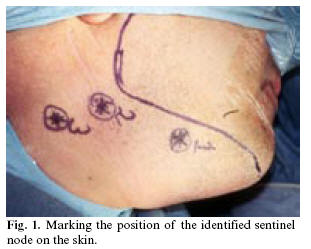
<body><![CDATA[<p><font size="2" face="Verdana">In order to evaluate the efficacy of SNB and to determine the  existence or otherwise of regional disease in OSCC, a prospective clinical study  of a cohort of patients consecutively diagnosed with OSCC by anatomopathological  study was designed. The study was approved by the Ethical Board of our hospital  and carried out in accordance with the Helsinki Declaration 1983. All the  patients who agreed to enroll in the study were informed verbally and in writing,  and signing an informed consent document.</font></p>     <p><font size="2" face="Verdana">The inclusion criteria included patients with primary OSCC of  the oral cavity and oropharynx with anatomopathological confirmation through  biopsy of the lesion, without oncological pre-treatment, in clinical stage T1-T4  and with no clinical evidence of regional disease (N0). Twenty-five patients  were recruited, 14 of whom were T1-T2 N0 (these 14 cases are those included in  the meta-analytical study). The absence of regional (N0) disease was determined  by means of clinical exploration and cervical CT. Patients with relapses or who  had had some type of previous treatment on the anterior cervical lymph node  chains were excluded.</font></p>     <p><font size="2" face="Verdana">In our 25 cases, in order to facilitate identification of the  sentinel node, the triple injection procedure with lymphoscintigraphy, vital dye  and gamma probe (Europrobe) was used. The day prior to surgery, the patients  were infiltrated peri-tumorally at submucosal level with human colloidal  seralbumin (Hazards, Nycomed Amersham-Sorin, Vercelli, Italy) labeled with 30-40  MBq 99Te, in 1 ml of saline serum.</font></p>     <p><font size="2" face="Verdana">The patient was immediately transferred to the nuclear medicine service where a static lymphoscintigraphy was carried out, marking the position of the identified sentinel node on the skin. (<a href="#f1">Fig. 1</a>) Eighteen hours later, and with the patient already anesthetized, 1 ml of blue dye (Patent Blue V, Guerbet laboratories, Cedex, France) was infiltrated in the same points. The sentinel nodes were located using a gamma probe, and identified by level. Once the sentinel node or nodes had been extracted, an elective dissection of stages I-II-III (supraomohyoid) or modified radical type III (levels I to V) was made as control in those cases where the lymphoscintigraphy showed involvement at lower levels.</font></p>     <p align="center"><font size="2" face="Verdana"><a name="f1"><img border="0" src="/img/revistas/medicorpa/v12n3/14_medora85.jpg" width="311" height="249"></a></font></p>      <p><font size="2" face="Verdana">The anatomopathological examination of the cervical  dissection specimens was carried out via bi-dissection. In the case of a  sentinel node the multi-section technique was carried out and in negative cases  immunohistochemical techniques for cytokeratin were carried out.</font></p>     <p><font size="2" face="Verdana">The second part of our study is a meta-analysis of an  independent review of ten series published to February of 2005 (5,6,8-15) on  sentinel node biopsy applied to head and neck cancer. Each of the series  included more than fifteen cases. In addition, the 14 T1-T2NO cases of our study  were also included in the analysis. The Cochrane, Database and MEDLlNE databases  were used to select the series for the meta-analytical study. In those cases  where an article, could not be accessed, the principal investigator was  contacted. Complete information was not obtained for three published articles  (16-18), thus forcing their exclusion from the study.</font></p>     <p><font size="2" face="Verdana">Series containing homogeneous information for comparison and sufficient data to extrapolate only cases T1-T2 were selected. All the series used lymphogammagraphy prior to the surgical intervention and intraoperative radio-localization using a gamma probe. Six of the series (5,6,8-10,14) used vital dye.</font></p>     <p><font size="2" face="Verdana">All the series used an elective cervical or supraomohyoid, or radical modified type III dissection as control. Ross (9) carried out radical dissection as control. The follow up of the patients varied between 9 and 32 months.</font></p>     <p><font size="2" face="Verdana">Regarding the statistical analysis, basing ourselves on the Bayes theorem, instead of providing predictive values for each individual study, we have preferred to show probability quotients that operate more efficiently in the diagnostic probability calculations. For each individual study we have calculated the following diagnostic values: sensitivity, positive probability quotient, negative probability quotient and diagnostic odds ratio, with a confidence interval of 95%.</font></p>     ]]></body>
<body><![CDATA[<p><font size="2" face="Verdana">The sum of the ROC curve was used to estimate the general accuracy of SNB. The study was carried out using the ‘Metadisc’ program (Meta-analysis of diagnostic and screening tests. Zamora J, Muriel A, Abraira V. Clinical  Biostatistics Unit. Hospital Ramón y Cajal, Madrid).</font></p>     <p>&nbsp;</p>     <p><B><font face="Verdana">Results</font></B></p>     <p><font size="2" face="Verdana">Our series consists of 25 consecutively-enroled patients with  OSCC stages T1-T4NO and to whom the sentinel node technique was applied between  January 2001 and November 2002. Of the 25 patients, 14 were T1-T2NO and were  included in the meta-analysis. The mean age was 65.9 years, SD=13.7. The male/female  ratio was 17/8. The location of the primary lesion is described in  <a target="_blank" href="/img/revistas/medicorpa/v12n3/14_medora86.gif">Table 1</a>. As  control, a total of 28 selective cervical dissections were carried out (in three  patients a cervical bilateral dissection was carried out due to the proximity of  the primary tumor to the mid line and bilateral lymph node marked in the  lymphoscintigraphy.</font></p>     <p><font size="2" face="Verdana">In 19 of the 25 cases, control of the stage of the cervical  disease was made by selective dissection of the node levels I-II-III,and in six  cases levels IV-V were included because the sentinel node was identified at  those levels in the lymphogammagraphy.</font></p>     <p><font size="2" face="Verdana">SNB in our series was effective in 24 of 25 cases, accurately  identifying the sentinel node in 96% of the cases. The technique could not be  applied in one case as it was not possible to locate the sentinel node, so an  elective cervical dissection was made, and the case was not included in the  statistical analysis.</font></p>     <p><font size="2" face="Verdana">One or more sentinel nodes were identified, with an average  of 3.2 per patient. The average length of the procedure, from the moment of  incision to obtaining the sentinel node, was between 30 and 45 minutes.</font></p>     <p><font size="2" face="Verdana"> <a target="_blank" href="/img/revistas/medicorpa/v12n3/14_medora87.gif">Table 2</a> details the positive cases, location and distribution  of the sentinel node by level, both positive and negative, the number of cases  and areas of positive drainage. Of the 6 positive nodes, 2 were in level I, 2 in  level II and the other 2 in level III. We did not find any positive sentinel  node in levels IV - V.</font></p>     <p><font size="2" face="Verdana">The lymphoscintigraphy demonstrated that 5 (20.8%) of our  cases had bilateral drainage. One of these, lingual, T1, presented bilateral  positive sentinel nodes, an ipsilateral node in level I and two nodes with  disease (N+)on the contralateral side in level III. Of the five cases with  bilateral drainage to our tracers one was positive to disease, meaning that 20%  of our cases with bilateral drainage presented contralateral metastasis. We  identified another three cases in our series with drainage at unexpected node  levels, without invasion node levels I-II. Two cases of primary tumors located  in the anterior lingual third at stage T1 and one case in the gingiva at stage  T1. These eight cases with unexpected drainage constitute 33.3% of our series.</font></p>     <p><font size="2" face="Verdana">Of the 24 cases included in our series, 18 turned out to be  true negative, four true positive cases and 2 false negative cases. This  represents a sensitivity of 66.6%for the technique (CI 0.22-0.96) and a  specificity of 1 (CI 0.81-1).</font></p>     ]]></body>
<body><![CDATA[<p><font size="2" face="Verdana">The negative probability quotient was 0.37 (CI 0.14-0.999)  (<a target="_blank" href="/img/revistas/medicorpa/v12n3/14_medora89.jpg">Fig. 2</a>) and the positive 24.43 (CI 1.5-397.83). The diagnostic odds ratio was  66.6 (CI 2.6-1644.3).</font></p>     <p><font size="2" face="Verdana">Four nodes (16%), clinically considered as N0 before the  intervention, revealed hidden micrometastases diagnosed by immunohistochemistry  and not by anatomopathological bi-dissection. (<a target="_blank" href="/img/revistas/medicorpa/v12n3/14_medora87.gif">Table 2</a>). Of these two false  negatives, one was a tumor (T3) at the base of the tongue, where a sentinel node  was indicated as negative in level V and the control cervical dissection  contained a positive node in level III.</font></p>     <p><font size="2" face="Verdana">The second case was in the jugal mucosa (T3) where a node of  10mm in diameter (obtained in level I) did not take up either radiotracer, or  dye and was given as positive. Both the cervical dissection and the two sentinel  nodes obtained were indicated as negative to disease.</font></p>     <p><font size="2" face="Verdana">Lymph node metastases were found in levels I, IIA, IIIA and  IIIB, however the nodes obtained in levels IV and V were disease free. (<a target="_blank" href="/img/revistas/medicorpa/v12n3/14_medora86.gif">Tables 1</a> and <a target="_blank" href="/img/revistas/medicorpa/v12n3/14_medora87.gif">2</a>)</font></p>     <p><font size="2" face="Verdana">Regarding the meta-analysis, ten series published (5,6,8-15)  on sentinel node biopsy in epidermoid carcinoma of head and neck were included  in addition to our series. All the series included more than 15 cases,  comprising a total of 260 SNB procedures. The basic descriptive information of  the series is shown in  <a target="_blank" href="/img/revistas/medicorpa/v12n3/14_medora88.gif">Table 3</a>, including our 14 T1-T2 cases.</font></p>     <p><font size="2" face="Verdana">From the analysis of these series, a similar incidence of  false negatives can be deduced. We did not find any significant differences  between the series that analyze cases in initial stages T1-T2 and those that  include cases T1-T4 (p&gt;0.05).</font></p>     <p><font size="2" face="Verdana">The accuracy of the technique in identifying the sentinel  node varies between the 66 and 100%, with 251 of the 260 cases identified  (96.5%). The results show 71 true positive cases, 5 false negatives and 175 true  negative cases. This constitutes an overall sensitivity for the technique of  93.4% (CI 85.3-97.8) with a specificity of 100%, (CI 0.98-100). The negative  weighted probability quotient is 0.176 (CI 0.103-0.301). (Fig 3). The positive  probability quotient is 24.75 (CI 10.8-56.71). The weighted diagnostic odds  ratio is of 183.71 (CI 59.36-568.56). No statistically significant evidence  exists (p=0.16) for the threshold effect shown in the regression curve by Moses (19,20). In  <a target="_blank" href="/img/revistas/medicorpa/v12n3/14_medora90.jpg">Fig 3</a> it can be seen that the area under  the ROC curve was 0.989 (standard error 0.0059).</font></p>     <p>&nbsp;</p>     <p><B><font face="Verdana">Discussion</font></B></p>     <p><font size="2" face="Verdana">Although diagnostic tools have developed significantly, we  have no effective procedures available to identify hidden metastatic disease in  the cervical lymph nodes of patients with OSCC. The incidence is situated at  around 30%, a high percentage, and the presence of regional disease is the cause  of the death of one of every two patients. (21, 22).</font></p>     ]]></body>
<body><![CDATA[<p><font size="2" face="Verdana">The recommendation to carry out an elective cervical  dissection when the probability of hidden cervical metastasis is higher than 20%  persists (23-25), for this reason the use of elective dissections and its  variants is common practice in the staging of regional disease in OSCC (26-32).</font></p>     <p><font size="2" face="Verdana">Analyzing less invasive procedures, the application of SNB  has been demonstrated to be very useful in other types of cancer (33,34) and for  this reason we have studied its application in primary OSCC, presenting the  results of a series of 25 patients and a meta-analytical study, in an attempt to  determine if SNB is a useful technique in the diagnosis of regional metastasis.</font></p>     <p><font size="2" face="Verdana">In our series it was possible to apply the technique in 96%  of the patients, a very similar percentage to other contrasted series. The  technique is quickly applied in comparison with cervical staging dissections.</font></p>     <p><font size="2" face="Verdana">It remains to be determined if the absence of lymphatic  drainage, demonstrated by a lymphoscintigraphy has any diagnostic significance  in itself, since it could indicate some blockage of the lymphatic system by the  disease.</font></p>     <p><font size="2" face="Verdana">We center the present study on T1-T2 cases aiming to  prioritize the homogeneity of the study. Our results do not reveal any  heterogenetic significance in the diagnostic indicators among the studies  analyzed in these cases.</font></p>     <p><font size="2" face="Verdana">The overall sensitivity of 93.4% with a negative probability  quotient of 0.176% makes sentinel node biopsy a diagnostic tool able to  substantially reduce the uncertainty over regional staging, demonstrating a DOR  of 183.71 with an area under the curve of 0.989. Instead of providing predictive  values, we have preferred to show probability quotients, since the former are  strongly dependent of the prevalence of the disease and the latter allow a more  simple application of the Bayesian theory of diagnostic probability estimation.  Supposing an estimation of 30% hidden metastasis (the general prevalence in our  study is 24.8%), the post-test probabilities would be 88% for a positive test  result and almost 5% for a negative test result. This supposes that a sentinel  node biopsy, when technically possible could significantly alter the diagnosis  in cases without clinical regional disease, since the possibility of hidden  disease with a negative test result is lower than 5%.</font></p>     <p><font size="2" face="Verdana">SNB revealed hidden metastasis in four of the cases  considered clinically to be free of disease, equal to 16% of our series. (<a target="_blank" href="/img/revistas/medicorpa/v12n3/14_medora86.gif">Table  1</a>) Two of these cases being identified by immunohistochemistry only. If we  consider the results obtained only by anatomopathological bi-dissection, we  would have improved the staging in only two cases (8% of cases). This is another  of the benefits to be gained from the application of the sentinel node concept.</font></p>     <p><font size="2" face="Verdana">Another advantage supposes the possibility of applying  advanced anatomopathological study techniques to a very reduced number of lymph  nodes (72 sentinel nodes in 22 patients with a mean of 3.2 per case), against an  entire regional dissection, usually with more than 10 nodes, thus allowing an  increase in the staging sensitivity. Our results are similar to those of Van  Brekel (35) and Czerniecki (36) who using multi-slicing techniques and  immunohistochemistry find optimized positive sentinel node identification in 21%  and 10% of cases respectively.</font></p>     <p><font size="2" face="Verdana">Among those factors that may influence the sensitivity of the  anatomopathological study of these adenopathies are those attributable to errors  in taking the sample which will depend on the size and location of the  metastasis, the size of the adenopathy, on the orientation within their section  and on the number of sections evaluated.</font></p>     <p><font size="2" face="Verdana">A recent multicenter study (37), in which we took part, shows  that applying immunohistochemical procedures in SN optimizes staging by 17%,  (59/348) against 6% (67/1180) if the anatomopathological study is carried out  using bi-dissection and hematoxylin-eosin staining.</font></p>     ]]></body>
<body><![CDATA[<p><font size="2" face="Verdana">Ross (9) using multi-section techniques and  immunohistochemical marking, identified hidden metastasis in 5 of 27 patients  (19%), the other 22 patients were confirmed with standard bi-dissection  techniques and hematoxylin-eosin staining.</font></p>     <p><font size="2" face="Verdana">These data suggest that multi-section and immunohistochemical  techniques should be applied systematically in SN, since they significantly  increase the sensitivity of the anatomopathological study. Another subject to  mention is the cervical drainage pattern of the metastasis: is it predictable?  In the lymphoscintigraphy, 12.5% (3/24) of our cases that did not involve the  mid-line presented bilateral drainage. We found another three cases in our  series with drainage in unexpected lymph node levels, in that the node stages I-II  were skipped. These unexpected drainages constituted 20.8% of our cases. With  these data one might ask if the lymphatic route of regional metastasis in OSCC  is predictable. Kowalski (38) in a review of 513 patients found that in high  risk patients the possibility of presenting contralateral metastasis is greater  than 20%. Byers (39) in a review of lingual tumors at stage T1 to T2 found 16%  of cases with an unpredictable or disordered drainage and were defined as &quot;skip  metastases&quot; and which we have named jump metastases. Other authors such as  Woolgar (40) found a 10% incidence in 154 patients.</font></p>     <p><font size="2" face="Verdana">Why does this occur? Do aberrant lymphatic canals or paths  exist that become permeable under special circumstances? Among the possible  answers it has been suggested that a primary tumor drains to a node defined by  the immune system. It is not clear if the tumor cells stimulate the immune  system inside the lymph nodes, increasing the uptake of the metastatic cells, or  if they do this by suppressor T cells induced by the tumor that limit the action  of the cytotoxic T cells, allowing the implantation of the metastatic cells in  the lymph nodes. Schuller (41) attempting to evaluate regional immunity in head  and neck cancer, put lymphocytes extracted from the same patient’s lymph nodes  in contact with the tumor and observed that the immune system is regionally  active. Is it the metastatic node that activates the response or is this  immunostimulated by the tumor? This same author (42) with non-specific  stimulants of the immune system found an intrinsic response from the lymph node.  Chu (43) suggests that the tumor stimulates the T helper lymphocytes through  antigen carrier cells that circulate from the tumor toward the lymph node  containing the antigen-specific T cells (the sentinel node).</font></p>     <p><font size="2" face="Verdana">Cochran (44) demonstrates a reduction in the paracortical  area, and of dendritic cells in sentinel nodes in melanoma resulting from  immunosuppression factors liberated by the tumor. These data suggest more an  immune and histopathological justification of the sentinel node concept than the  classic system of stratified lymph node stations that would partly explain the  so-called &quot;skip metastases&quot; or &quot;jump metastases&quot;.</font></p>     <p>&nbsp;</p>     <p><B><font face="Verdana">Conclusions</font></B></p>     <p><font size="2" face="Verdana">Our study contributes a certain degree of evidence that in  T1-T2N0 OSCC, SNB should be considered a highly sensitive diagnostic procedure,  thus it is a valid alternative to elective stage dissection. It reduces both  time spent in surgery and postoperative morbidity. The technique should be  carried out using lymphoscintigraphy, vital dye and an intraoperative gamma  probe.</font></p>     <p>&nbsp;</p>     <p><B><font face="Verdana">References</font></B></p>     <!-- ref --><p><font size="2" face="Verdana">1. Alex JC, Krag DN. Gamma-probe-guided localization of lymph nodes. Surg Oncol 1993;2: 137-44.</font>&nbsp;&nbsp;&nbsp;&nbsp;&nbsp;&nbsp;&nbsp;&nbsp;[&#160;<a href="javascript:void(0);" onclick="javascript: window.open('/scielo.php?script=sci_nlinks&ref=2973014&pid=S1698-6946200700030001400001&lng=','','width=640,height=500,resizable=yes,scrollbars=1,menubar=yes,');">Links</a>&#160;]<!-- end-ref --><!-- ref --><p> <font size="2" face="Verdana">2. Pitman KT, Johnson JT, Edington H, Barnes L, Day R, Wagner RL et al. Lymphatic mapping with isosulfan blue dye in squamous cell carcinoma of the head and neck. Arch Otolaryngol Head Neck Surg 1998;124:790-3.</font>&nbsp;&nbsp;&nbsp;&nbsp;&nbsp;&nbsp;&nbsp;&nbsp;[&#160;<a href="javascript:void(0);" onclick="javascript: window.open('/scielo.php?script=sci_nlinks&ref=2973015&pid=S1698-6946200700030001400002&lng=','','width=640,height=500,resizable=yes,scrollbars=1,menubar=yes,');">Links</a>&#160;]<!-- end-ref --><!-- ref --><p> <font size="2" face="Verdana">3. Koch WM, Choti MA, Civelek C, Eisele DW, Saunders JR. Gamma probe directed biopsy of the sentinel node in oral squamous cell carcinoma. Arch Otolaryngol Head Neck Surg 1998; 124:455-9.</font>&nbsp;&nbsp;&nbsp;&nbsp;&nbsp;&nbsp;&nbsp;&nbsp;[&#160;<a href="javascript:void(0);" onclick="javascript: window.open('/scielo.php?script=sci_nlinks&ref=2973016&pid=S1698-6946200700030001400003&lng=','','width=640,height=500,resizable=yes,scrollbars=1,menubar=yes,');">Links</a>&#160;]<!-- end-ref --><!-- ref --><p> <font size="2" face="Verdana">4. Shoaib T, Soutar DS, Prosser JE, Dunaway DJ. A suggested method for sentinel node biopsy in squamous cell carcinoma of the head and neck. Head Neck 1999;21:728-33.</font>&nbsp;&nbsp;&nbsp;&nbsp;&nbsp;&nbsp;&nbsp;&nbsp;[&#160;<a href="javascript:void(0);" onclick="javascript: window.open('/scielo.php?script=sci_nlinks&ref=2973017&pid=S1698-6946200700030001400004&lng=','','width=640,height=500,resizable=yes,scrollbars=1,menubar=yes,');">Links</a>&#160;]<!-- end-ref --><!-- ref --><p> <font size="2" face="Verdana">5. Mozzillo N, Chiesa F, Botti G, Caraco C, Lastoria S, Giugliano G, et al. Sentinel node biopsy in head and neck cancer. Ann Surg Oncol 2001;8:103-5.</font>&nbsp;&nbsp;&nbsp;&nbsp;&nbsp;&nbsp;&nbsp;&nbsp;[&#160;<a href="javascript:void(0);" onclick="javascript: window.open('/scielo.php?script=sci_nlinks&ref=2973018&pid=S1698-6946200700030001400005&lng=','','width=640,height=500,resizable=yes,scrollbars=1,menubar=yes,');">Links</a>&#160;]<!-- end-ref --><!-- ref --><p> <font size="2" face="Verdana">6. Stoeckli SJ, Steinert H, Pfaltz M, Schmid S. Sentinel lymph node evaluation in squamous cell carcinoma of the head and neck. Otolaryngol Head Neck Surg 2001;125:221-6.</font>&nbsp;&nbsp;&nbsp;&nbsp;&nbsp;&nbsp;&nbsp;&nbsp;[&#160;<a href="javascript:void(0);" onclick="javascript: window.open('/scielo.php?script=sci_nlinks&ref=2973019&pid=S1698-6946200700030001400006&lng=','','width=640,height=500,resizable=yes,scrollbars=1,menubar=yes,');">Links</a>&#160;]<!-- end-ref --><!-- ref --><p> <font size="2" face="Verdana">7. Shoaib T, Soutar DS, MacDonald DG, Camilleri IG, Dunaway DJ, Gray HW, et. al. The accuracy of head and neck carcinoma sentinel node biopsy in the clinically N0 neck. Cancer 2001;91:2077-83.</font>&nbsp;&nbsp;&nbsp;&nbsp;&nbsp;&nbsp;&nbsp;&nbsp;[&#160;<a href="javascript:void(0);" onclick="javascript: window.open('/scielo.php?script=sci_nlinks&ref=2973020&pid=S1698-6946200700030001400007&lng=','','width=640,height=500,resizable=yes,scrollbars=1,menubar=yes,');">Links</a>&#160;]<!-- end-ref --><!-- ref --><p> <font size="2" face="Verdana">8. Hyde NC , Prvulovich E, Newman L, Waddington WA, Visvikis D, Ell P. A new approach to pre-treatment assessment of the N0 neck in oral squamous cell carcinoma: the role of sentinel node biopsy and positron emission tomography. Oral Oncol 2003;39:350-60.</font>&nbsp;&nbsp;&nbsp;&nbsp;&nbsp;&nbsp;&nbsp;&nbsp;[&#160;<a href="javascript:void(0);" onclick="javascript: window.open('/scielo.php?script=sci_nlinks&ref=2973021&pid=S1698-6946200700030001400008&lng=','','width=640,height=500,resizable=yes,scrollbars=1,menubar=yes,');">Links</a>&#160;]<!-- end-ref --><!-- ref --><p> <font size="2" face="Verdana">9. Ross GL, Soutar DS, MacDonald DG, Shoaib T, Camilleri IG, Robertson AG. Improved staging of cervical metastases in clinically node-negative patients with head and neck squamous cell carcinoma. Ann Surg Oncol 2004;11:213-8.</font>&nbsp;&nbsp;&nbsp;&nbsp;&nbsp;&nbsp;&nbsp;&nbsp;[&#160;<a href="javascript:void(0);" onclick="javascript: window.open('/scielo.php?script=sci_nlinks&ref=2973022&pid=S1698-6946200700030001400009&lng=','','width=640,height=500,resizable=yes,scrollbars=1,menubar=yes,');">Links</a>&#160;]<!-- end-ref --><!-- ref --><p> <font size="2" face="Verdana">10. Pastore A, Turetta GD, Tarabini A, Turetta D, Feggi L, Pelucchi S. Sentinel lymph node analysis in squamous carcinoma of the oral cavity and oropharynx. Tumori 2002;88:58-60.</font>&nbsp;&nbsp;&nbsp;&nbsp;&nbsp;&nbsp;&nbsp;&nbsp;[&#160;<a href="javascript:void(0);" onclick="javascript: window.open('/scielo.php?script=sci_nlinks&ref=2973023&pid=S1698-6946200700030001400010&lng=','','width=640,height=500,resizable=yes,scrollbars=1,menubar=yes,');">Links</a>&#160;]<!-- end-ref --><!-- ref --><p> <font size="2" face="Verdana">11. Barzan L, Sulfaro S, Alberti F, Politi D, Marus W, Pin M. Gamma probe accuracy in detecting the sentinel lymph node in clinically N0 squamous cell carcinoma of the head and neck. Ann Otol Rhinol Laryngol 2002;111:794-8.</font>&nbsp;&nbsp;&nbsp;&nbsp;&nbsp;&nbsp;&nbsp;&nbsp;[&#160;<a href="javascript:void(0);" onclick="javascript: window.open('/scielo.php?script=sci_nlinks&ref=2973024&pid=S1698-6946200700030001400011&lng=','','width=640,height=500,resizable=yes,scrollbars=1,menubar=yes,');">Links</a>&#160;]<!-- end-ref --><!-- ref --><p> <font size="2" face="Verdana">12. Pitman KT, Johnson JT, Brown ML, Myers EN. Sentinel lymph node biopsy in head and neck squamous cell carcinoma. Laryngoscope 2002;112:2101-13.</font>&nbsp;&nbsp;&nbsp;&nbsp;&nbsp;&nbsp;&nbsp;&nbsp;[&#160;<a href="javascript:void(0);" onclick="javascript: window.open('/scielo.php?script=sci_nlinks&ref=2973025&pid=S1698-6946200700030001400012&lng=','','width=640,height=500,resizable=yes,scrollbars=1,menubar=yes,');">Links</a>&#160;]<!-- end-ref --><!-- ref --><p> <font size="2" face="Verdana">13. Civantos FJ, Gomez C, Duque C, Pedroso F, Goodwin WJ, Weed DT, et al. Sentinel node biopsy in oral cavity cancer: correlation with PET scan and immunohistochemistry. Head Neck 2003;25:1-9.</font>&nbsp;&nbsp;&nbsp;&nbsp;&nbsp;&nbsp;&nbsp;&nbsp;[&#160;<a href="javascript:void(0);" onclick="javascript: window.open('/scielo.php?script=sci_nlinks&ref=2973026&pid=S1698-6946200700030001400013&lng=','','width=640,height=500,resizable=yes,scrollbars=1,menubar=yes,');">Links</a>&#160;]<!-- end-ref --><!-- ref --><p> <font size="2" face="Verdana">14. Kontio R, Leivo I, Leppanen E, Atula T. Sentinel lymph node biopsy in oral cavity squamous cell carcinoma without clinically evident metastasis. Head Neck 2004;26:16-21.</font>&nbsp;&nbsp;&nbsp;&nbsp;&nbsp;&nbsp;&nbsp;&nbsp;[&#160;<a href="javascript:void(0);" onclick="javascript: window.open('/scielo.php?script=sci_nlinks&ref=2973027&pid=S1698-6946200700030001400014&lng=','','width=640,height=500,resizable=yes,scrollbars=1,menubar=yes,');">Links</a>&#160;]<!-- end-ref --><!-- ref --><p> <font size="2" face="Verdana">15. Hoft S, Maune S, Muhle C, Brenner W, Czech N, Kampen WU, et al. Sentinel lymph-node biopsy in head and neck. Br J Cancer 2004;91:124-8.</font>&nbsp;&nbsp;&nbsp;&nbsp;&nbsp;&nbsp;&nbsp;&nbsp;[&#160;<a href="javascript:void(0);" onclick="javascript: window.open('/scielo.php?script=sci_nlinks&ref=2973028&pid=S1698-6946200700030001400015&lng=','','width=640,height=500,resizable=yes,scrollbars=1,menubar=yes,');">Links</a>&#160;]<!-- end-ref --><!-- ref --><p> <font size="2" face="Verdana">16. Werner JA, , Dunne AA, Ramaswamy A, Dalchow C, Behr T, Moll R, et al. The sentinel node concept in head and neck cancer: solution for the controversies in the N0 neck. Head Neck 2004;26:603-11.</font>&nbsp;&nbsp;&nbsp;&nbsp;&nbsp;&nbsp;&nbsp;&nbsp;[&#160;<a href="javascript:void(0);" onclick="javascript: window.open('/scielo.php?script=sci_nlinks&ref=2973029&pid=S1698-6946200700030001400016&lng=','','width=640,height=500,resizable=yes,scrollbars=1,menubar=yes,');">Links</a>&#160;]<!-- end-ref --><!-- ref --><p> <font size="2" face="Verdana">17. Hyde NC, Prvulovich E, Newman L, Waddington WA, Visvikis D, Ell P. A new approach to pre-treatment assessment of the N0 neck in oral squamous cell carcinoma: the role of sentinel node biopsy and positron emission tomography. Oral Oncol 2003;39:350-60.</font>&nbsp;&nbsp;&nbsp;&nbsp;&nbsp;&nbsp;&nbsp;&nbsp;[&#160;<a href="javascript:void(0);" onclick="javascript: window.open('/scielo.php?script=sci_nlinks&ref=2973030&pid=S1698-6946200700030001400017&lng=','','width=640,height=500,resizable=yes,scrollbars=1,menubar=yes,');">Links</a>&#160;]<!-- end-ref --><!-- ref --><p> <font size="2" face="Verdana">18. Alex JC. The application of sentinel node radiolocalization to solid tumors of the head and neck: a 10-year experience. Laryngoscope 2004;114:2-19.</font>&nbsp;&nbsp;&nbsp;&nbsp;&nbsp;&nbsp;&nbsp;&nbsp;[&#160;<a href="javascript:void(0);" onclick="javascript: window.open('/scielo.php?script=sci_nlinks&ref=2973031&pid=S1698-6946200700030001400018&lng=','','width=640,height=500,resizable=yes,scrollbars=1,menubar=yes,');">Links</a>&#160;]<!-- end-ref --><!-- ref --><p> <font size="2" face="Verdana">19. Moses LE, Shapiro D, Littenberg B. Combining independent studies of a diagnostic test into a summary ROC curve: data-analytic approaches and some additional considerations. Stat Med 1993;12:1293-316.</font>&nbsp;&nbsp;&nbsp;&nbsp;&nbsp;&nbsp;&nbsp;&nbsp;[&#160;<a href="javascript:void(0);" onclick="javascript: window.open('/scielo.php?script=sci_nlinks&ref=2973032&pid=S1698-6946200700030001400019&lng=','','width=640,height=500,resizable=yes,scrollbars=1,menubar=yes,');">Links</a>&#160;]<!-- end-ref --><!-- ref --><p> <font size="2" face="Verdana">20. Deeks JJ. Systematic reviews of evaluations of diagnostic and screening tests. En Egger M, Smith GD, Altman DG, eds. Systematic reviews in health care. Meta-analysis in context. Londres: BMJ Books; 2001.p.248-82.</font>&nbsp;&nbsp;&nbsp;&nbsp;&nbsp;&nbsp;&nbsp;&nbsp;[&#160;<a href="javascript:void(0);" onclick="javascript: window.open('/scielo.php?script=sci_nlinks&ref=2973033&pid=S1698-6946200700030001400020&lng=','','width=640,height=500,resizable=yes,scrollbars=1,menubar=yes,');">Links</a>&#160;]<!-- end-ref --><!-- ref --><p> <font size="2" face="Verdana">21. Don DM, Anzai Y, Lufkin RB, Calcaterra TC. Evaluation of cervical lymph node metastasis in squamous carcinoma of the head and neck. Laryngoscope 1995;105:669-74.</font>&nbsp;&nbsp;&nbsp;&nbsp;&nbsp;&nbsp;&nbsp;&nbsp;[&#160;<a href="javascript:void(0);" onclick="javascript: window.open('/scielo.php?script=sci_nlinks&ref=2973034&pid=S1698-6946200700030001400021&lng=','','width=640,height=500,resizable=yes,scrollbars=1,menubar=yes,');">Links</a>&#160;]<!-- end-ref --><!-- ref --><p> <font size="2" face="Verdana">22. Leemans CR, Tiwari R, Van der Waal I, Karim ABMF, Nauta JP, Snow GB. The efficacy of comprehensive neck dissection with or without postoperative radiotherapy in nodal metastases of squamous cell carcinoma of the upper respiratory and digestive tracts. Laryngoscope1990; 100:1194-8.</font>&nbsp;&nbsp;&nbsp;&nbsp;&nbsp;&nbsp;&nbsp;&nbsp;[&#160;<a href="javascript:void(0);" onclick="javascript: window.open('/scielo.php?script=sci_nlinks&ref=2973035&pid=S1698-6946200700030001400022&lng=','','width=640,height=500,resizable=yes,scrollbars=1,menubar=yes,');">Links</a>&#160;]<!-- end-ref --><!-- ref --><p> <font size="2" face="Verdana">23. Weiss MH, Harrison LB, Isaacs RS. Use of decision analysis in planning a management strategy for the stage No neck. Arch Otolaryngol Head Neck Surg 1994;120:699-702.</font>&nbsp;&nbsp;&nbsp;&nbsp;&nbsp;&nbsp;&nbsp;&nbsp;[&#160;<a href="javascript:void(0);" onclick="javascript: window.open('/scielo.php?script=sci_nlinks&ref=2973036&pid=S1698-6946200700030001400023&lng=','','width=640,height=500,resizable=yes,scrollbars=1,menubar=yes,');">Links</a>&#160;]<!-- end-ref --><!-- ref --><p> <font size="2" face="Verdana">24. Pillsbury III HC, Clark MA. A rationale for therapy of the No neck. Laryngoscope 1997;107: 1294-315.</font>&nbsp;&nbsp;&nbsp;&nbsp;&nbsp;&nbsp;&nbsp;&nbsp;[&#160;<a href="javascript:void(0);" onclick="javascript: window.open('/scielo.php?script=sci_nlinks&ref=2973037&pid=S1698-6946200700030001400024&lng=','','width=640,height=500,resizable=yes,scrollbars=1,menubar=yes,');">Links</a>&#160;]<!-- end-ref --><!-- ref --><p> <font size="2" face="Verdana">25. NCCN practice guidelines for cancer of the head and neck. Version 1. The National Comprehensive Cancer Network. Inc eds. Rockville:2000.</font>&nbsp;&nbsp;&nbsp;&nbsp;&nbsp;&nbsp;&nbsp;&nbsp;[&#160;<a href="javascript:void(0);" onclick="javascript: window.open('/scielo.php?script=sci_nlinks&ref=2973038&pid=S1698-6946200700030001400025&lng=','','width=640,height=500,resizable=yes,scrollbars=1,menubar=yes,');">Links</a>&#160;]<!-- end-ref --><!-- ref --><p> <font size="2" face="Verdana">26. Kowalski LP, Magrin J, Waksman G, Santo GF, Lopes ME, de Paula RP, Pereira RN, Torloni H. Supraomohyoid neck dissection in the treatment of head and neck tumors. Survival results in 212 cases. Arch Otolaryngol Head Neck Surg 1993 ;119:958-63.</font>&nbsp;&nbsp;&nbsp;&nbsp;&nbsp;&nbsp;&nbsp;&nbsp;[&#160;<a href="javascript:void(0);" onclick="javascript: window.open('/scielo.php?script=sci_nlinks&ref=2973039&pid=S1698-6946200700030001400026&lng=','','width=640,height=500,resizable=yes,scrollbars=1,menubar=yes,');">Links</a>&#160;]<!-- end-ref --><!-- ref --><p> <font size="2" face="Verdana">27. Pitman KT, Johnson JT, Myers EN. Effectiveness of selective neck disection for management of the clinically negative neck. Arch Otolaryngol Head Neck Surg 1997;123:917- 22.</font>&nbsp;&nbsp;&nbsp;&nbsp;&nbsp;&nbsp;&nbsp;&nbsp;[&#160;<a href="javascript:void(0);" onclick="javascript: window.open('/scielo.php?script=sci_nlinks&ref=2973040&pid=S1698-6946200700030001400027&lng=','','width=640,height=500,resizable=yes,scrollbars=1,menubar=yes,');">Links</a>&#160;]<!-- end-ref --><!-- ref --><p> <font size="2" face="Verdana">28. Medina JE, Byers RM. Supraomohyoid neck dissection: rationale, indications and surgical technique. Head Neck 1989;11:111-22.</font>&nbsp;&nbsp;&nbsp;&nbsp;&nbsp;&nbsp;&nbsp;&nbsp;[&#160;<a href="javascript:void(0);" onclick="javascript: window.open('/scielo.php?script=sci_nlinks&ref=2973041&pid=S1698-6946200700030001400028&lng=','','width=640,height=500,resizable=yes,scrollbars=1,menubar=yes,');">Links</a>&#160;]<!-- end-ref --><!-- ref --><p> <font size="2" face="Verdana">29. Henick DH, Silver CE, Heller KS, Shasha AR, Har El G, Wolk DP. Supraomohyoid neck dissection as a staging procedure for squamous cell carcinomas of the oral cavity and oropharynx. Head Neck 1995;17:119-23.</font>&nbsp;&nbsp;&nbsp;&nbsp;&nbsp;&nbsp;&nbsp;&nbsp;[&#160;<a href="javascript:void(0);" onclick="javascript: window.open('/scielo.php?script=sci_nlinks&ref=2973042&pid=S1698-6946200700030001400029&lng=','','width=640,height=500,resizable=yes,scrollbars=1,menubar=yes,');">Links</a>&#160;]<!-- end-ref --><!-- ref --><p> <font size="2" face="Verdana">30. Davidson J, Khan Y, Gilbert R, Birt BD, Balogh J, MacKenzie R. Is selective dissection sufficient treatment for the No/Np+ neck?. J Otolaryngol 1997;26:229-31.</font>&nbsp;&nbsp;&nbsp;&nbsp;&nbsp;&nbsp;&nbsp;&nbsp;[&#160;<a href="javascript:void(0);" onclick="javascript: window.open('/scielo.php?script=sci_nlinks&ref=2973043&pid=S1698-6946200700030001400030&lng=','','width=640,height=500,resizable=yes,scrollbars=1,menubar=yes,');">Links</a>&#160;]<!-- end-ref --><!-- ref --><p> <font size="2" face="Verdana">31. Shah JP, Candela FC, Poddar AK. The patterns of cervical lymph node metastases from squamous carcinoma of the oral cavity. Cancer 1990;66:109-13.</font>&nbsp;&nbsp;&nbsp;&nbsp;&nbsp;&nbsp;&nbsp;&nbsp;[&#160;<a href="javascript:void(0);" onclick="javascript: window.open('/scielo.php?script=sci_nlinks&ref=2973044&pid=S1698-6946200700030001400031&lng=','','width=640,height=500,resizable=yes,scrollbars=1,menubar=yes,');">Links</a>&#160;]<!-- end-ref --><!-- ref --><p> <font size="2" face="Verdana">32. Shah JP, Andersen PE. The impact of patterns of nodal metastasis on modifications of neck dissection. Ann Surg Oncol 1994;1:521-32.</font>&nbsp;&nbsp;&nbsp;&nbsp;&nbsp;&nbsp;&nbsp;&nbsp;[&#160;<a href="javascript:void(0);" onclick="javascript: window.open('/scielo.php?script=sci_nlinks&ref=2973045&pid=S1698-6946200700030001400032&lng=','','width=640,height=500,resizable=yes,scrollbars=1,menubar=yes,');">Links</a>&#160;]<!-- end-ref --><!-- ref --><p> <font size="2" face="Verdana">33. Lyman GH, Giuliano AE, Somerfield MR, Benson AB 3rd, Bodurka DC, Burstein HJ, et. al. American Society of Clinical Oncology. Guideline recommendations for sentinel lymph node biopsy in early-stage breast cancer. J Clin Oncol 2005;23:7703-20.</font>&nbsp;&nbsp;&nbsp;&nbsp;&nbsp;&nbsp;&nbsp;&nbsp;[&#160;<a href="javascript:void(0);" onclick="javascript: window.open('/scielo.php?script=sci_nlinks&ref=2973046&pid=S1698-6946200700030001400033&lng=','','width=640,height=500,resizable=yes,scrollbars=1,menubar=yes,');">Links</a>&#160;]<!-- end-ref --><!-- ref --><p> <font size="2" face="Verdana">34. Morton DL, Cochran AJ, Thompson JF, Elashoff R, Essner R, Glass EC et al. Multicenter selective lymphadenectomy trial group. Sentinel node biopsy for early-stage melanoma: accuracy and morbidity in MSLT-I, an international multicenter trial. Ann Surg 2005;242:302-11.</font>&nbsp;&nbsp;&nbsp;&nbsp;&nbsp;&nbsp;&nbsp;&nbsp;[&#160;<a href="javascript:void(0);" onclick="javascript: window.open('/scielo.php?script=sci_nlinks&ref=2973047&pid=S1698-6946200700030001400034&lng=','','width=640,height=500,resizable=yes,scrollbars=1,menubar=yes,');">Links</a>&#160;]<!-- end-ref --><!-- ref --><p> <font size="2" face="Verdana">35. Van den Brekel MW, Stel HV, Van der Valk P, Van der Waal I, Meyer CJM, Snow GB. Micrometastasis from squamous cell carcinoma in neck dissection specimens. Eur Arch Otorhinolaryngol 1992;249:349-53.</font>&nbsp;&nbsp;&nbsp;&nbsp;&nbsp;&nbsp;&nbsp;&nbsp;[&#160;<a href="javascript:void(0);" onclick="javascript: window.open('/scielo.php?script=sci_nlinks&ref=2973048&pid=S1698-6946200700030001400035&lng=','','width=640,height=500,resizable=yes,scrollbars=1,menubar=yes,');">Links</a>&#160;]<!-- end-ref --><!-- ref --><p> <font size="2" face="Verdana">36. Czerniecki BJ, Scheff AM, Callans LS, Spitz FR, Bedrosian I, Conant EF et al. Inmunohistochemistry with pancytokeratins improves the sensitivity of sentinel lymph node biopsy in patients with breast carcinoma. Cancer 1999;85:1098-103.</font>&nbsp;&nbsp;&nbsp;&nbsp;&nbsp;&nbsp;&nbsp;&nbsp;[&#160;<a href="javascript:void(0);" onclick="javascript: window.open('/scielo.php?script=sci_nlinks&ref=2973049&pid=S1698-6946200700030001400036&lng=','','width=640,height=500,resizable=yes,scrollbars=1,menubar=yes,');">Links</a>&#160;]<!-- end-ref --><!-- ref --><p> <font size="2" face="Verdana">37. Ross GL, Soutar DS, Gordon MacDonald D, Shoaib T, Camilleri I, Roberton AG et al. Sentinel node biopsy in head and neck cancer: preliminary results of a multicenter trial. Ann Surg Oncol 2004;11:690-6.</font>&nbsp;&nbsp;&nbsp;&nbsp;&nbsp;&nbsp;&nbsp;&nbsp;[&#160;<a href="javascript:void(0);" onclick="javascript: window.open('/scielo.php?script=sci_nlinks&ref=2973050&pid=S1698-6946200700030001400037&lng=','','width=640,height=500,resizable=yes,scrollbars=1,menubar=yes,');">Links</a>&#160;]<!-- end-ref --><!-- ref --><p> <font size="2" face="Verdana">38. Kowalski LP, Bagietto R, Lara JR, Santos RL, Tagawa EK, Santos IR. Factors influencing contralateral lymph node metastasis from oral carcinoma. Head Neck 1999;21:104-10.</font>&nbsp;&nbsp;&nbsp;&nbsp;&nbsp;&nbsp;&nbsp;&nbsp;[&#160;<a href="javascript:void(0);" onclick="javascript: window.open('/scielo.php?script=sci_nlinks&ref=2973051&pid=S1698-6946200700030001400038&lng=','','width=640,height=500,resizable=yes,scrollbars=1,menubar=yes,');">Links</a>&#160;]<!-- end-ref --><!-- ref --><p> <font size="2" face="Verdana">39. Byers RM, Weber RS, Andrews T, McGill D, Wolf P. Frequency and therapeutic implications of &quot;skip metastases&quot; in the neck from squamous cell carcinoma of the oral tongue. Head Neck 1997;19:14-9.</font>&nbsp;&nbsp;&nbsp;&nbsp;&nbsp;&nbsp;&nbsp;&nbsp;[&#160;<a href="javascript:void(0);" onclick="javascript: window.open('/scielo.php?script=sci_nlinks&ref=2973052&pid=S1698-6946200700030001400039&lng=','','width=640,height=500,resizable=yes,scrollbars=1,menubar=yes,');">Links</a>&#160;]<!-- end-ref --><!-- ref --><p> <font size="2" face="Verdana">40. Woolgar JA. Pathology of the N0 neck. Br J Oral Maxillofac Surg 1999;37:205-9.</font>&nbsp;&nbsp;&nbsp;&nbsp;&nbsp;&nbsp;&nbsp;&nbsp;[&#160;<a href="javascript:void(0);" onclick="javascript: window.open('/scielo.php?script=sci_nlinks&ref=2973053&pid=S1698-6946200700030001400040&lng=','','width=640,height=500,resizable=yes,scrollbars=1,menubar=yes,');">Links</a>&#160;]<!-- end-ref --><!-- ref --><p> <font size="2" face="Verdana">41. Schuller DE. An assessment of neck node immunoreactivity in head and neck cancer. Laryngoscope 1984;94:1-35.</font>&nbsp;&nbsp;&nbsp;&nbsp;&nbsp;&nbsp;&nbsp;&nbsp;[&#160;<a href="javascript:void(0);" onclick="javascript: window.open('/scielo.php?script=sci_nlinks&ref=2973054&pid=S1698-6946200700030001400041&lng=','','width=640,height=500,resizable=yes,scrollbars=1,menubar=yes,');">Links</a>&#160;]<!-- end-ref --><!-- ref --><p> <font size="2" face="Verdana">42. Schuller DE, Libby DH, Rinehart JJ, Milo GG, Koolemans-Beynen A. Immunomodulation of nodal lymphocytes in head and neck cancer. Arch Otolaryngol 1985;111:465-8.</font>&nbsp;&nbsp;&nbsp;&nbsp;&nbsp;&nbsp;&nbsp;&nbsp;[&#160;<a href="javascript:void(0);" onclick="javascript: window.open('/scielo.php?script=sci_nlinks&ref=2973055&pid=S1698-6946200700030001400042&lng=','','width=640,height=500,resizable=yes,scrollbars=1,menubar=yes,');">Links</a>&#160;]<!-- end-ref --><!-- ref --><p> <font size="2" face="Verdana">43. Chu Y, Hu HM, Winter H, Woods WJ, Doran T, Lashley D, et al. Examining the immune response in sentinel lymph nodes of mice and men. Eur J Nucl Med 1999;26:S50-S3.</font>&nbsp;&nbsp;&nbsp;&nbsp;&nbsp;&nbsp;&nbsp;&nbsp;[&#160;<a href="javascript:void(0);" onclick="javascript: window.open('/scielo.php?script=sci_nlinks&ref=2973056&pid=S1698-6946200700030001400043&lng=','','width=640,height=500,resizable=yes,scrollbars=1,menubar=yes,');">Links</a>&#160;]<!-- end-ref --><!-- ref --><p> <font size="2" face="Verdana">44. Cochran AJ, Morton DL, Stern S, Lana AM, Essner R, Wen DR. Sentinel lymph nodes show profound downregulation of antigen-presenting cells of the paracortex: implications for tumour biology and treatment. Mod Pathol 2001;14:604-8.</font>&nbsp;&nbsp;&nbsp;&nbsp;&nbsp;&nbsp;&nbsp;&nbsp;[&#160;<a href="javascript:void(0);" onclick="javascript: window.open('/scielo.php?script=sci_nlinks&ref=2973057&pid=S1698-6946200700030001400044&lng=','','width=640,height=500,resizable=yes,scrollbars=1,menubar=yes,');">Links</a>&#160;]<!-- end-ref --><p> &nbsp;</p>     <p> &nbsp;</p>     <p> <font face="Verdana"><B><font size="2"><a href="#top"><img border="0" src="/img/revistas/medicorpa/v12n3/seta.gif" width="15" height="17"></a><a name="back"></a>Correspondence:</font></B><font size="2">    <BR>Prof. Joseba Santamaría Zuazua    <BR>Hospital de Cruces.    <br> Servicio de Cirugía Maxilofacial    <BR>Plaza de Cruces s/n    ]]></body>
<body><![CDATA[<BR>48903 Barakaldo (Bizkaia)    <BR>E-mail:  <a href="mailto:jsz@clinicaimd.com">jsz@clinicaimd.com</a></font></font></p>     <p> <font size="2" face="Verdana">Received: 28-04-2006    <BR>Accepted: 10-12-2006</font></p>       ]]></body><back>
<ref-list>
<ref id="B1">
<label>1</label><nlm-citation citation-type="journal">
<person-group person-group-type="author">
<name>
<surname><![CDATA[Alex]]></surname>
<given-names><![CDATA[JC]]></given-names>
</name>
<name>
<surname><![CDATA[Krag]]></surname>
<given-names><![CDATA[DN]]></given-names>
</name>
</person-group>
<article-title xml:lang="en"><![CDATA[Gamma-probe-guided localization of lymph nodes]]></article-title>
<source><![CDATA[Surg Oncol]]></source>
<year>1993</year>
<volume>2</volume>
<page-range>137-44</page-range></nlm-citation>
</ref>
<ref id="B2">
<label>2</label><nlm-citation citation-type="journal">
<person-group person-group-type="author">
<name>
<surname><![CDATA[Pitman]]></surname>
<given-names><![CDATA[KT]]></given-names>
</name>
<name>
<surname><![CDATA[Johnson]]></surname>
<given-names><![CDATA[JT]]></given-names>
</name>
<name>
<surname><![CDATA[Edington]]></surname>
<given-names><![CDATA[H]]></given-names>
</name>
<name>
<surname><![CDATA[Barnes]]></surname>
<given-names><![CDATA[L]]></given-names>
</name>
<name>
<surname><![CDATA[Day]]></surname>
<given-names><![CDATA[R]]></given-names>
</name>
<name>
<surname><![CDATA[Wagner]]></surname>
<given-names><![CDATA[RL]]></given-names>
</name>
</person-group>
<article-title xml:lang="en"><![CDATA[Lymphatic mapping with isosulfan blue dye in squamous cell carcinoma of the head and neck]]></article-title>
<source><![CDATA[Arch Otolaryngol Head Neck Surg]]></source>
<year>1998</year>
<volume>124</volume>
<page-range>790-3</page-range></nlm-citation>
</ref>
<ref id="B3">
<label>3</label><nlm-citation citation-type="journal">
<person-group person-group-type="author">
<name>
<surname><![CDATA[Koch]]></surname>
<given-names><![CDATA[WM]]></given-names>
</name>
<name>
<surname><![CDATA[Choti]]></surname>
<given-names><![CDATA[MA]]></given-names>
</name>
<name>
<surname><![CDATA[Civelek]]></surname>
<given-names><![CDATA[C]]></given-names>
</name>
<name>
<surname><![CDATA[Eisele]]></surname>
<given-names><![CDATA[DW]]></given-names>
</name>
<name>
<surname><![CDATA[Saunders]]></surname>
<given-names><![CDATA[JR]]></given-names>
</name>
</person-group>
<article-title xml:lang="en"><![CDATA[Gamma probe directed biopsy of the sentinel node in oral squamous cell carcinoma]]></article-title>
<source><![CDATA[Arch Otolaryngol Head Neck Surg]]></source>
<year>1998</year>
<volume>124</volume>
<page-range>455-9</page-range></nlm-citation>
</ref>
<ref id="B4">
<label>4</label><nlm-citation citation-type="journal">
<person-group person-group-type="author">
<name>
<surname><![CDATA[Shoaib]]></surname>
<given-names><![CDATA[T]]></given-names>
</name>
<name>
<surname><![CDATA[Soutar]]></surname>
<given-names><![CDATA[DS]]></given-names>
</name>
<name>
<surname><![CDATA[Prosser]]></surname>
<given-names><![CDATA[JE]]></given-names>
</name>
<name>
<surname><![CDATA[Dunaway]]></surname>
<given-names><![CDATA[DJ]]></given-names>
</name>
</person-group>
<article-title xml:lang="en"><![CDATA[A suggested method for sentinel node biopsy in squamous cell carcinoma of the head and neck]]></article-title>
<source><![CDATA[Head Neck]]></source>
<year>1999</year>
<volume>21</volume>
<page-range>728-33</page-range></nlm-citation>
</ref>
<ref id="B5">
<label>5</label><nlm-citation citation-type="journal">
<person-group person-group-type="author">
<name>
<surname><![CDATA[Mozzillo]]></surname>
<given-names><![CDATA[N]]></given-names>
</name>
<name>
<surname><![CDATA[Chiesa]]></surname>
<given-names><![CDATA[F]]></given-names>
</name>
<name>
<surname><![CDATA[Botti]]></surname>
<given-names><![CDATA[G]]></given-names>
</name>
<name>
<surname><![CDATA[Caraco]]></surname>
<given-names><![CDATA[C]]></given-names>
</name>
<name>
<surname><![CDATA[Lastoria]]></surname>
<given-names><![CDATA[S]]></given-names>
</name>
<name>
<surname><![CDATA[Giugliano]]></surname>
<given-names><![CDATA[G]]></given-names>
</name>
</person-group>
<article-title xml:lang="en"><![CDATA[Sentinel node biopsy in head and neck cancer]]></article-title>
<source><![CDATA[Ann Surg Oncol]]></source>
<year>2001</year>
<volume>8</volume>
<page-range>103-5</page-range></nlm-citation>
</ref>
<ref id="B6">
<label>6</label><nlm-citation citation-type="journal">
<person-group person-group-type="author">
<name>
<surname><![CDATA[Stoeckli]]></surname>
<given-names><![CDATA[SJ]]></given-names>
</name>
<name>
<surname><![CDATA[Steinert]]></surname>
<given-names><![CDATA[H]]></given-names>
</name>
<name>
<surname><![CDATA[Pfaltz]]></surname>
<given-names><![CDATA[M]]></given-names>
</name>
<name>
<surname><![CDATA[Schmid]]></surname>
<given-names><![CDATA[S]]></given-names>
</name>
</person-group>
<article-title xml:lang="en"><![CDATA[Sentinel lymph node evaluation in squamous cell carcinoma of the head and neck]]></article-title>
<source><![CDATA[Otolaryngol Head Neck Surg]]></source>
<year>2001</year>
<volume>125</volume>
<page-range>221-6</page-range></nlm-citation>
</ref>
<ref id="B7">
<label>7</label><nlm-citation citation-type="journal">
<person-group person-group-type="author">
<name>
<surname><![CDATA[Shoaib]]></surname>
<given-names><![CDATA[T]]></given-names>
</name>
<name>
<surname><![CDATA[Soutar]]></surname>
<given-names><![CDATA[DS]]></given-names>
</name>
<name>
<surname><![CDATA[MacDonald]]></surname>
<given-names><![CDATA[DG]]></given-names>
</name>
<name>
<surname><![CDATA[Camilleri]]></surname>
<given-names><![CDATA[IG]]></given-names>
</name>
<name>
<surname><![CDATA[Dunaway]]></surname>
<given-names><![CDATA[DJ]]></given-names>
</name>
<name>
<surname><![CDATA[Gray]]></surname>
<given-names><![CDATA[HW]]></given-names>
</name>
</person-group>
<article-title xml:lang="en"><![CDATA[The accuracy of head and neck carcinoma sentinel node biopsy in the clinically N0 neck]]></article-title>
<source><![CDATA[Cancer]]></source>
<year>2001</year>
<volume>91</volume>
<page-range>2077-83</page-range></nlm-citation>
</ref>
<ref id="B8">
<label>8</label><nlm-citation citation-type="journal">
<person-group person-group-type="author">
<name>
<surname><![CDATA[Hyde]]></surname>
<given-names><![CDATA[NC]]></given-names>
</name>
<name>
<surname><![CDATA[Prvulovich]]></surname>
<given-names><![CDATA[E]]></given-names>
</name>
<name>
<surname><![CDATA[Newman]]></surname>
<given-names><![CDATA[L]]></given-names>
</name>
<name>
<surname><![CDATA[Waddington]]></surname>
<given-names><![CDATA[WA]]></given-names>
</name>
<name>
<surname><![CDATA[Visvikis]]></surname>
<given-names><![CDATA[D]]></given-names>
</name>
<name>
<surname><![CDATA[Ell]]></surname>
<given-names><![CDATA[P]]></given-names>
</name>
</person-group>
<article-title xml:lang="en"><![CDATA[A new approach to pre-treatment assessment of the N0 neck in oral squamous cell carcinoma: the role of sentinel node biopsy and positron emission tomography]]></article-title>
<source><![CDATA[Oral Oncol]]></source>
<year>2003</year>
<volume>39</volume>
<page-range>350-60</page-range></nlm-citation>
</ref>
<ref id="B9">
<label>9</label><nlm-citation citation-type="journal">
<person-group person-group-type="author">
<name>
<surname><![CDATA[Ross]]></surname>
<given-names><![CDATA[GL]]></given-names>
</name>
<name>
<surname><![CDATA[Soutar]]></surname>
<given-names><![CDATA[DS]]></given-names>
</name>
<name>
<surname><![CDATA[MacDonald]]></surname>
<given-names><![CDATA[DG]]></given-names>
</name>
<name>
<surname><![CDATA[Shoaib]]></surname>
<given-names><![CDATA[T]]></given-names>
</name>
<name>
<surname><![CDATA[Camilleri]]></surname>
<given-names><![CDATA[IG]]></given-names>
</name>
<name>
<surname><![CDATA[Robertson]]></surname>
<given-names><![CDATA[AG]]></given-names>
</name>
</person-group>
<article-title xml:lang="en"><![CDATA[Improved staging of cervical metastases in clinically node-negative patients with head and neck squamous cell carcinoma]]></article-title>
<source><![CDATA[Ann Surg Oncol]]></source>
<year>2004</year>
<volume>11</volume>
<page-range>213-8</page-range></nlm-citation>
</ref>
<ref id="B10">
<label>10</label><nlm-citation citation-type="journal">
<person-group person-group-type="author">
<name>
<surname><![CDATA[Pastore]]></surname>
<given-names><![CDATA[A]]></given-names>
</name>
<name>
<surname><![CDATA[Turetta]]></surname>
<given-names><![CDATA[GD]]></given-names>
</name>
<name>
<surname><![CDATA[Tarabini]]></surname>
<given-names><![CDATA[A]]></given-names>
</name>
<name>
<surname><![CDATA[Turetta]]></surname>
<given-names><![CDATA[D]]></given-names>
</name>
<name>
<surname><![CDATA[Feggi]]></surname>
<given-names><![CDATA[L]]></given-names>
</name>
<name>
<surname><![CDATA[Pelucchi]]></surname>
<given-names><![CDATA[S]]></given-names>
</name>
</person-group>
<article-title xml:lang="en"><![CDATA[Sentinel lymph node analysis in squamous carcinoma of the oral cavity and oropharynx]]></article-title>
<source><![CDATA[Tumori]]></source>
<year>2002</year>
<volume>88</volume>
<page-range>58-60</page-range></nlm-citation>
</ref>
<ref id="B11">
<label>11</label><nlm-citation citation-type="journal">
<person-group person-group-type="author">
<name>
<surname><![CDATA[Barzan]]></surname>
<given-names><![CDATA[L]]></given-names>
</name>
<name>
<surname><![CDATA[Sulfaro]]></surname>
<given-names><![CDATA[S]]></given-names>
</name>
<name>
<surname><![CDATA[Alberti]]></surname>
<given-names><![CDATA[F]]></given-names>
</name>
<name>
<surname><![CDATA[Politi]]></surname>
<given-names><![CDATA[D]]></given-names>
</name>
<name>
<surname><![CDATA[Marus]]></surname>
<given-names><![CDATA[W]]></given-names>
</name>
<name>
<surname><![CDATA[Pin]]></surname>
<given-names><![CDATA[M]]></given-names>
</name>
</person-group>
<article-title xml:lang="en"><![CDATA[Gamma probe accuracy in detecting the sentinel lymph node in clinically N0 squamous cell carcinoma of the head and neck]]></article-title>
<source><![CDATA[Ann Otol Rhinol Laryngol]]></source>
<year>2002</year>
<volume>111</volume>
<page-range>794-8</page-range></nlm-citation>
</ref>
<ref id="B12">
<label>12</label><nlm-citation citation-type="journal">
<person-group person-group-type="author">
<name>
<surname><![CDATA[Pitman]]></surname>
<given-names><![CDATA[KT]]></given-names>
</name>
<name>
<surname><![CDATA[Johnson]]></surname>
<given-names><![CDATA[JT]]></given-names>
</name>
<name>
<surname><![CDATA[Brown]]></surname>
<given-names><![CDATA[ML]]></given-names>
</name>
<name>
<surname><![CDATA[Myers]]></surname>
<given-names><![CDATA[EN]]></given-names>
</name>
</person-group>
<article-title xml:lang="en"><![CDATA[Sentinel lymph node biopsy in head and neck squamous cell carcinoma]]></article-title>
<source><![CDATA[Laryngoscope]]></source>
<year>2002</year>
<volume>112</volume>
<page-range>2101-13</page-range></nlm-citation>
</ref>
<ref id="B13">
<label>13</label><nlm-citation citation-type="journal">
<person-group person-group-type="author">
<name>
<surname><![CDATA[Civantos]]></surname>
<given-names><![CDATA[FJ]]></given-names>
</name>
<name>
<surname><![CDATA[Gomez]]></surname>
<given-names><![CDATA[C]]></given-names>
</name>
<name>
<surname><![CDATA[Duque]]></surname>
<given-names><![CDATA[C]]></given-names>
</name>
<name>
<surname><![CDATA[Pedroso]]></surname>
<given-names><![CDATA[F]]></given-names>
</name>
<name>
<surname><![CDATA[Goodwin]]></surname>
<given-names><![CDATA[WJ]]></given-names>
</name>
<name>
<surname><![CDATA[Weed]]></surname>
<given-names><![CDATA[DT]]></given-names>
</name>
</person-group>
<article-title xml:lang="en"><![CDATA[Sentinel node biopsy in oral cavity cancer: correlation with PET scan and immunohistochemistry]]></article-title>
<source><![CDATA[Head Neck]]></source>
<year>2003</year>
<volume>25</volume>
<page-range>1-9</page-range></nlm-citation>
</ref>
<ref id="B14">
<label>14</label><nlm-citation citation-type="journal">
<person-group person-group-type="author">
<name>
<surname><![CDATA[Kontio]]></surname>
<given-names><![CDATA[R]]></given-names>
</name>
<name>
<surname><![CDATA[Leivo]]></surname>
<given-names><![CDATA[I]]></given-names>
</name>
<name>
<surname><![CDATA[Leppanen]]></surname>
<given-names><![CDATA[E]]></given-names>
</name>
<name>
<surname><![CDATA[Atula]]></surname>
<given-names><![CDATA[T]]></given-names>
</name>
</person-group>
<article-title xml:lang="en"><![CDATA[Sentinel lymph node biopsy in oral cavity squamous cell carcinoma without clinically evident metastasis]]></article-title>
<source><![CDATA[Head Neck]]></source>
<year>2004</year>
<volume>26</volume>
<page-range>16-21</page-range></nlm-citation>
</ref>
<ref id="B15">
<label>15</label><nlm-citation citation-type="journal">
<person-group person-group-type="author">
<name>
<surname><![CDATA[Hoft]]></surname>
<given-names><![CDATA[S]]></given-names>
</name>
<name>
<surname><![CDATA[Maune]]></surname>
<given-names><![CDATA[S]]></given-names>
</name>
<name>
<surname><![CDATA[Muhle]]></surname>
<given-names><![CDATA[C]]></given-names>
</name>
<name>
<surname><![CDATA[Brenner]]></surname>
<given-names><![CDATA[W]]></given-names>
</name>
<name>
<surname><![CDATA[Czech]]></surname>
<given-names><![CDATA[N]]></given-names>
</name>
<name>
<surname><![CDATA[Kampen]]></surname>
<given-names><![CDATA[WU]]></given-names>
</name>
</person-group>
<article-title xml:lang="en"><![CDATA[Sentinel lymph-node biopsy in head and neck]]></article-title>
<source><![CDATA[Br J Cancer]]></source>
<year>2004</year>
<volume>91</volume>
<page-range>124-8</page-range></nlm-citation>
</ref>
<ref id="B16">
<label>16</label><nlm-citation citation-type="journal">
<person-group person-group-type="author">
<name>
<surname><![CDATA[Werner]]></surname>
<given-names><![CDATA[JA]]></given-names>
</name>
<name>
<surname><![CDATA[Dunne]]></surname>
<given-names><![CDATA[AA]]></given-names>
</name>
<name>
<surname><![CDATA[Ramaswamy]]></surname>
<given-names><![CDATA[A]]></given-names>
</name>
<name>
<surname><![CDATA[Dalchow]]></surname>
<given-names><![CDATA[C]]></given-names>
</name>
<name>
<surname><![CDATA[Behr]]></surname>
<given-names><![CDATA[T]]></given-names>
</name>
<name>
<surname><![CDATA[Moll]]></surname>
<given-names><![CDATA[R]]></given-names>
</name>
</person-group>
<article-title xml:lang="en"><![CDATA[The sentinel node concept in head and neck cancer: solution for the controversies in the N0 neck]]></article-title>
<source><![CDATA[Head Neck]]></source>
<year>2004</year>
<volume>26</volume>
<page-range>603-11</page-range></nlm-citation>
</ref>
<ref id="B17">
<label>17</label><nlm-citation citation-type="journal">
<person-group person-group-type="author">
<name>
<surname><![CDATA[Hyde]]></surname>
<given-names><![CDATA[NC]]></given-names>
</name>
<name>
<surname><![CDATA[Prvulovich]]></surname>
<given-names><![CDATA[E]]></given-names>
</name>
<name>
<surname><![CDATA[Newman]]></surname>
<given-names><![CDATA[L]]></given-names>
</name>
<name>
<surname><![CDATA[Waddington]]></surname>
<given-names><![CDATA[WA]]></given-names>
</name>
<name>
<surname><![CDATA[Visvikis]]></surname>
<given-names><![CDATA[D]]></given-names>
</name>
<name>
<surname><![CDATA[Ell]]></surname>
<given-names><![CDATA[P]]></given-names>
</name>
</person-group>
<article-title xml:lang="en"><![CDATA[A new approach to pre-treatment assessment of the N0 neck in oral squamous cell carcinoma: the role of sentinel node biopsy and positron emission tomography]]></article-title>
<source><![CDATA[Oral Oncol]]></source>
<year>2003</year>
<volume>39</volume>
<page-range>350-60</page-range></nlm-citation>
</ref>
<ref id="B18">
<label>18</label><nlm-citation citation-type="journal">
<person-group person-group-type="author">
<name>
<surname><![CDATA[Alex]]></surname>
<given-names><![CDATA[JC]]></given-names>
</name>
</person-group>
<article-title xml:lang="en"><![CDATA[The application of sentinel node radiolocalization to solid tumors of the head and neck: a 10-year experience]]></article-title>
<source><![CDATA[Laryngoscope]]></source>
<year>2004</year>
<volume>114</volume>
<page-range>2-19</page-range></nlm-citation>
</ref>
<ref id="B19">
<label>19</label><nlm-citation citation-type="journal">
<person-group person-group-type="author">
<name>
<surname><![CDATA[Moses]]></surname>
<given-names><![CDATA[LE]]></given-names>
</name>
<name>
<surname><![CDATA[Shapiro]]></surname>
<given-names><![CDATA[D]]></given-names>
</name>
<name>
<surname><![CDATA[Littenberg]]></surname>
<given-names><![CDATA[B]]></given-names>
</name>
</person-group>
<article-title xml:lang="en"><![CDATA[Combining independent studies of a diagnostic test into a summary ROC curve: data-analytic approaches and some additional considerations]]></article-title>
<source><![CDATA[Stat Med]]></source>
<year>1993</year>
<volume>12</volume>
<page-range>1293-316</page-range></nlm-citation>
</ref>
<ref id="B20">
<label>20</label><nlm-citation citation-type="book">
<person-group person-group-type="author">
<name>
<surname><![CDATA[Deeks]]></surname>
<given-names><![CDATA[JJ]]></given-names>
</name>
</person-group>
<article-title xml:lang="en"><![CDATA[Systematic reviews of evaluations of diagnostic and screening tests]]></article-title>
<person-group person-group-type="editor">
<name>
<surname><![CDATA[Egger]]></surname>
<given-names><![CDATA[M]]></given-names>
</name>
<name>
<surname><![CDATA[Smith]]></surname>
<given-names><![CDATA[GD]]></given-names>
</name>
<name>
<surname><![CDATA[Altman]]></surname>
<given-names><![CDATA[DG]]></given-names>
</name>
</person-group>
<source><![CDATA[Systematic reviews in health care: Meta-analysis in context]]></source>
<year>2001</year>
<page-range>248-82</page-range><publisher-loc><![CDATA[Londres ]]></publisher-loc>
<publisher-name><![CDATA[BMJ Books]]></publisher-name>
</nlm-citation>
</ref>
<ref id="B21">
<label>21</label><nlm-citation citation-type="journal">
<person-group person-group-type="author">
<name>
<surname><![CDATA[Don]]></surname>
<given-names><![CDATA[DM]]></given-names>
</name>
<name>
<surname><![CDATA[Anzai]]></surname>
<given-names><![CDATA[Y]]></given-names>
</name>
<name>
<surname><![CDATA[Lufkin]]></surname>
<given-names><![CDATA[RB]]></given-names>
</name>
<name>
<surname><![CDATA[Calcaterra]]></surname>
<given-names><![CDATA[TC]]></given-names>
</name>
</person-group>
<article-title xml:lang="en"><![CDATA[Evaluation of cervical lymph node metastasis in squamous carcinoma of the head and neck]]></article-title>
<source><![CDATA[Laryngoscope]]></source>
<year>1995</year>
<volume>105</volume>
<page-range>669-74</page-range></nlm-citation>
</ref>
<ref id="B22">
<label>22</label><nlm-citation citation-type="journal">
<person-group person-group-type="author">
<name>
<surname><![CDATA[Leemans]]></surname>
<given-names><![CDATA[CR]]></given-names>
</name>
<name>
<surname><![CDATA[Tiwari]]></surname>
<given-names><![CDATA[R]]></given-names>
</name>
<name>
<surname><![CDATA[Van der Waal]]></surname>
<given-names><![CDATA[I]]></given-names>
</name>
<name>
<surname><![CDATA[Karim]]></surname>
<given-names><![CDATA[ABMF]]></given-names>
</name>
<name>
<surname><![CDATA[Nauta]]></surname>
<given-names><![CDATA[JP]]></given-names>
</name>
<name>
<surname><![CDATA[Snow]]></surname>
<given-names><![CDATA[GB]]></given-names>
</name>
</person-group>
<article-title xml:lang="en"><![CDATA[The efficacy of comprehensive neck dissection with or without postoperative radiotherapy in nodal metastases of squamous cell carcinoma of the upper respiratory and digestive tracts]]></article-title>
<source><![CDATA[Laryngoscope]]></source>
<year>1990</year>
<volume>100</volume>
<page-range>1194-8</page-range></nlm-citation>
</ref>
<ref id="B23">
<label>23</label><nlm-citation citation-type="journal">
<person-group person-group-type="author">
<name>
<surname><![CDATA[Weiss]]></surname>
<given-names><![CDATA[MH]]></given-names>
</name>
<name>
<surname><![CDATA[Harrison]]></surname>
<given-names><![CDATA[LB]]></given-names>
</name>
<name>
<surname><![CDATA[Isaacs]]></surname>
<given-names><![CDATA[RS]]></given-names>
</name>
</person-group>
<article-title xml:lang="en"><![CDATA[Use of decision analysis in planning a management strategy for the stage No neck]]></article-title>
<source><![CDATA[Arch Otolaryngol Head Neck Surg]]></source>
<year>1994</year>
<volume>120</volume>
<page-range>699-702</page-range></nlm-citation>
</ref>
<ref id="B24">
<label>24</label><nlm-citation citation-type="journal">
<person-group person-group-type="author">
<name>
<surname><![CDATA[Pillsbury]]></surname>
<given-names><![CDATA[III HC]]></given-names>
</name>
<name>
<surname><![CDATA[Clark]]></surname>
<given-names><![CDATA[MA]]></given-names>
</name>
</person-group>
<article-title xml:lang="en"><![CDATA[A rationale for therapy of the No neck]]></article-title>
<source><![CDATA[Laryngoscope]]></source>
<year>1997</year>
<volume>107</volume>
<page-range>1294-315</page-range></nlm-citation>
</ref>
<ref id="B25">
<label>25</label><nlm-citation citation-type="book">
<source><![CDATA[NCCN practice guidelines for cancer of the head and neck: Version 1. The National Comprehensive Cancer Network]]></source>
<year>2000</year>
<publisher-name><![CDATA[Rockville]]></publisher-name>
</nlm-citation>
</ref>
<ref id="B26">
<label>26</label><nlm-citation citation-type="journal">
<person-group person-group-type="author">
<name>
<surname><![CDATA[Kowalski]]></surname>
<given-names><![CDATA[LP]]></given-names>
</name>
<name>
<surname><![CDATA[Magrin]]></surname>
<given-names><![CDATA[J]]></given-names>
</name>
<name>
<surname><![CDATA[Waksman]]></surname>
<given-names><![CDATA[G]]></given-names>
</name>
<name>
<surname><![CDATA[Santo]]></surname>
<given-names><![CDATA[GF]]></given-names>
</name>
<name>
<surname><![CDATA[Lopes]]></surname>
<given-names><![CDATA[ME]]></given-names>
</name>
<name>
<surname><![CDATA[de Paula]]></surname>
<given-names><![CDATA[RP]]></given-names>
</name>
<name>
<surname><![CDATA[Pereira]]></surname>
<given-names><![CDATA[RN]]></given-names>
</name>
<name>
<surname><![CDATA[Torloni]]></surname>
<given-names><![CDATA[H]]></given-names>
</name>
</person-group>
<article-title xml:lang="en"><![CDATA[Supraomohyoid neck dissection in the treatment of head and neck tumors: Survival results in 212 cases]]></article-title>
<source><![CDATA[Arch Otolaryngol Head Neck Surg]]></source>
<year>1993</year>
<volume>119</volume>
<page-range>958-63</page-range></nlm-citation>
</ref>
<ref id="B27">
<label>27</label><nlm-citation citation-type="journal">
<person-group person-group-type="author">
<name>
<surname><![CDATA[Pitman]]></surname>
<given-names><![CDATA[KT]]></given-names>
</name>
<name>
<surname><![CDATA[Johnson]]></surname>
<given-names><![CDATA[JT]]></given-names>
</name>
<name>
<surname><![CDATA[Myers]]></surname>
<given-names><![CDATA[EN]]></given-names>
</name>
</person-group>
<article-title xml:lang="en"><![CDATA[Effectiveness of selective neck disection for management of the clinically negative neck]]></article-title>
<source><![CDATA[Arch Otolaryngol Head Neck Surg]]></source>
<year>1997</year>
<volume>123</volume>
<page-range>917- 22</page-range></nlm-citation>
</ref>
<ref id="B28">
<label>28</label><nlm-citation citation-type="journal">
<person-group person-group-type="author">
<name>
<surname><![CDATA[Medina]]></surname>
<given-names><![CDATA[JE]]></given-names>
</name>
<name>
<surname><![CDATA[Byers]]></surname>
<given-names><![CDATA[RM]]></given-names>
</name>
</person-group>
<article-title xml:lang="en"><![CDATA[Supraomohyoid neck dissection: rationale, indications and surgical technique]]></article-title>
<source><![CDATA[Head Neck]]></source>
<year>1989</year>
<volume>11</volume>
<page-range>111-22</page-range></nlm-citation>
</ref>
<ref id="B29">
<label>29</label><nlm-citation citation-type="journal">
<person-group person-group-type="author">
<name>
<surname><![CDATA[Henick]]></surname>
<given-names><![CDATA[DH]]></given-names>
</name>
<name>
<surname><![CDATA[Silver]]></surname>
<given-names><![CDATA[CE]]></given-names>
</name>
<name>
<surname><![CDATA[Heller]]></surname>
<given-names><![CDATA[KS]]></given-names>
</name>
<name>
<surname><![CDATA[Shasha]]></surname>
<given-names><![CDATA[AR]]></given-names>
</name>
<name>
<surname><![CDATA[Har El]]></surname>
<given-names><![CDATA[G]]></given-names>
</name>
<name>
<surname><![CDATA[Wolk]]></surname>
<given-names><![CDATA[DP]]></given-names>
</name>
</person-group>
<article-title xml:lang="en"><![CDATA[Supraomohyoid neck dissection as a staging procedure for squamous cell carcinomas of the oral cavity and oropharynx]]></article-title>
<source><![CDATA[Head Neck]]></source>
<year>1995</year>
<volume>17</volume>
<page-range>119-23</page-range></nlm-citation>
</ref>
<ref id="B30">
<label>30</label><nlm-citation citation-type="journal">
<person-group person-group-type="author">
<name>
<surname><![CDATA[Davidson]]></surname>
<given-names><![CDATA[J]]></given-names>
</name>
<name>
<surname><![CDATA[Khan]]></surname>
<given-names><![CDATA[Y]]></given-names>
</name>
<name>
<surname><![CDATA[Gilbert]]></surname>
<given-names><![CDATA[R]]></given-names>
</name>
<name>
<surname><![CDATA[Birt]]></surname>
<given-names><![CDATA[BD]]></given-names>
</name>
<name>
<surname><![CDATA[Balogh]]></surname>
<given-names><![CDATA[J]]></given-names>
</name>
<name>
<surname><![CDATA[MacKenzie]]></surname>
<given-names><![CDATA[R]]></given-names>
</name>
</person-group>
<article-title xml:lang="en"><![CDATA[Is selective dissection sufficient treatment for the No/Np+ neck?]]></article-title>
<source><![CDATA[J Otolaryngol]]></source>
<year>1997</year>
<volume>26</volume>
<page-range>229-31</page-range></nlm-citation>
</ref>
<ref id="B31">
<label>31</label><nlm-citation citation-type="journal">
<person-group person-group-type="author">
<name>
<surname><![CDATA[Shah]]></surname>
<given-names><![CDATA[JP]]></given-names>
</name>
<name>
<surname><![CDATA[Candela]]></surname>
<given-names><![CDATA[FC]]></given-names>
</name>
<name>
<surname><![CDATA[Poddar]]></surname>
<given-names><![CDATA[AK]]></given-names>
</name>
</person-group>
<article-title xml:lang="en"><![CDATA[The patterns of cervical lymph node metastases from squamous carcinoma of the oral cavity]]></article-title>
<source><![CDATA[Cancer]]></source>
<year>1990</year>
<volume>66</volume>
<page-range>109-13</page-range></nlm-citation>
</ref>
<ref id="B32">
<label>32</label><nlm-citation citation-type="journal">
<person-group person-group-type="author">
<name>
<surname><![CDATA[Shah]]></surname>
<given-names><![CDATA[JP]]></given-names>
</name>
<name>
<surname><![CDATA[Andersen]]></surname>
<given-names><![CDATA[PE]]></given-names>
</name>
</person-group>
<article-title xml:lang="en"><![CDATA[The impact of patterns of nodal metastasis on modifications of neck dissection]]></article-title>
<source><![CDATA[Ann Surg Oncol]]></source>
<year>1994</year>
<volume>1</volume>
<page-range>521-32</page-range></nlm-citation>
</ref>
<ref id="B33">
<label>33</label><nlm-citation citation-type="journal">
<person-group person-group-type="author">
<name>
<surname><![CDATA[Lyman]]></surname>
<given-names><![CDATA[GH]]></given-names>
</name>
<name>
<surname><![CDATA[Giuliano]]></surname>
<given-names><![CDATA[AE]]></given-names>
</name>
<name>
<surname><![CDATA[Somerfield]]></surname>
<given-names><![CDATA[MR]]></given-names>
</name>
<name>
<surname><![CDATA[Benson]]></surname>
<given-names><![CDATA[AB 3rd]]></given-names>
</name>
<name>
<surname><![CDATA[Bodurka]]></surname>
<given-names><![CDATA[DC]]></given-names>
</name>
<name>
<surname><![CDATA[Burstein]]></surname>
<given-names><![CDATA[HJ]]></given-names>
</name>
</person-group>
<article-title xml:lang="en"><![CDATA[American Society of Clinical Oncology: Guideline recommendations for sentinel lymph node biopsy in early-stage breast cancer]]></article-title>
<source><![CDATA[J Clin Oncol]]></source>
<year>2005</year>
<volume>23</volume>
<page-range>7703-20</page-range></nlm-citation>
</ref>
<ref id="B34">
<label>34</label><nlm-citation citation-type="journal">
<person-group person-group-type="author">
<name>
<surname><![CDATA[Morton]]></surname>
<given-names><![CDATA[DL]]></given-names>
</name>
<name>
<surname><![CDATA[Cochran]]></surname>
<given-names><![CDATA[AJ]]></given-names>
</name>
<name>
<surname><![CDATA[Thompson]]></surname>
<given-names><![CDATA[JF]]></given-names>
</name>
<name>
<surname><![CDATA[Elashoff]]></surname>
<given-names><![CDATA[R]]></given-names>
</name>
<name>
<surname><![CDATA[Essner]]></surname>
<given-names><![CDATA[R]]></given-names>
</name>
<name>
<surname><![CDATA[Glass]]></surname>
<given-names><![CDATA[EC]]></given-names>
</name>
</person-group>
<article-title xml:lang="en"><![CDATA[Multicenter selective lymphadenectomy trial group. Sentinel node biopsy for early-stage melanoma: accuracy and morbidity in MSLT-I, an international multicenter trial]]></article-title>
<source><![CDATA[Ann Surg]]></source>
<year>2005</year>
<volume>242</volume>
<page-range>302-11</page-range></nlm-citation>
</ref>
<ref id="B35">
<label>35</label><nlm-citation citation-type="journal">
<person-group person-group-type="author">
<name>
<surname><![CDATA[Van den Brekel]]></surname>
<given-names><![CDATA[MW]]></given-names>
</name>
<name>
<surname><![CDATA[Stel]]></surname>
<given-names><![CDATA[HV]]></given-names>
</name>
<name>
<surname><![CDATA[Van der Valk]]></surname>
<given-names><![CDATA[P]]></given-names>
</name>
<name>
<surname><![CDATA[Van der Waal]]></surname>
<given-names><![CDATA[I]]></given-names>
</name>
<name>
<surname><![CDATA[Meyer]]></surname>
<given-names><![CDATA[CJM]]></given-names>
</name>
<name>
<surname><![CDATA[Snow]]></surname>
<given-names><![CDATA[GB]]></given-names>
</name>
</person-group>
<article-title xml:lang="en"><![CDATA[Micrometastasis from squamous cell carcinoma in neck dissection specimens]]></article-title>
<source><![CDATA[Eur Arch Otorhinolaryngol]]></source>
<year>1992</year>
<volume>249</volume>
<page-range>349-53</page-range></nlm-citation>
</ref>
<ref id="B36">
<label>36</label><nlm-citation citation-type="journal">
<person-group person-group-type="author">
<name>
<surname><![CDATA[Czerniecki]]></surname>
<given-names><![CDATA[BJ]]></given-names>
</name>
<name>
<surname><![CDATA[Scheff]]></surname>
<given-names><![CDATA[AM]]></given-names>
</name>
<name>
<surname><![CDATA[Callans]]></surname>
<given-names><![CDATA[LS]]></given-names>
</name>
<name>
<surname><![CDATA[Spitz]]></surname>
<given-names><![CDATA[FR]]></given-names>
</name>
<name>
<surname><![CDATA[Bedrosian]]></surname>
<given-names><![CDATA[I]]></given-names>
</name>
<name>
<surname><![CDATA[Conant]]></surname>
<given-names><![CDATA[EF]]></given-names>
</name>
</person-group>
<article-title xml:lang="en"><![CDATA[Inmunohistochemistry with pancytokeratins improves the sensitivity of sentinel lymph node biopsy in patients with breast carcinoma]]></article-title>
<source><![CDATA[Cancer]]></source>
<year>1999</year>
<volume>85</volume>
<page-range>1098-103</page-range></nlm-citation>
</ref>
<ref id="B37">
<label>37</label><nlm-citation citation-type="journal">
<person-group person-group-type="author">
<name>
<surname><![CDATA[Ross]]></surname>
<given-names><![CDATA[GL]]></given-names>
</name>
<name>
<surname><![CDATA[Soutar]]></surname>
<given-names><![CDATA[DS]]></given-names>
</name>
<name>
<surname><![CDATA[Gordon MacDonald]]></surname>
<given-names><![CDATA[D]]></given-names>
</name>
<name>
<surname><![CDATA[Shoaib]]></surname>
<given-names><![CDATA[T]]></given-names>
</name>
<name>
<surname><![CDATA[Camilleri]]></surname>
<given-names><![CDATA[I]]></given-names>
</name>
<name>
<surname><![CDATA[Roberton]]></surname>
<given-names><![CDATA[AG]]></given-names>
</name>
</person-group>
<article-title xml:lang="en"><![CDATA[Sentinel node biopsy in head and neck cancer: preliminary results of a multicenter trial]]></article-title>
<source><![CDATA[Ann Surg Oncol]]></source>
<year>2004</year>
<volume>11</volume>
<page-range>690-6</page-range></nlm-citation>
</ref>
<ref id="B38">
<label>38</label><nlm-citation citation-type="journal">
<person-group person-group-type="author">
<name>
<surname><![CDATA[Kowalski]]></surname>
<given-names><![CDATA[LP]]></given-names>
</name>
<name>
<surname><![CDATA[Bagietto]]></surname>
<given-names><![CDATA[R]]></given-names>
</name>
<name>
<surname><![CDATA[Lara]]></surname>
<given-names><![CDATA[JR]]></given-names>
</name>
<name>
<surname><![CDATA[Santos]]></surname>
<given-names><![CDATA[RL]]></given-names>
</name>
<name>
<surname><![CDATA[Tagawa]]></surname>
<given-names><![CDATA[EK]]></given-names>
</name>
<name>
<surname><![CDATA[Santos]]></surname>
<given-names><![CDATA[IR]]></given-names>
</name>
</person-group>
<article-title xml:lang="en"><![CDATA[Factors influencing contralateral lymph node metastasis from oral carcinoma]]></article-title>
<source><![CDATA[Head Neck]]></source>
<year>1999</year>
<volume>21</volume>
<page-range>104-10</page-range></nlm-citation>
</ref>
<ref id="B39">
<label>39</label><nlm-citation citation-type="journal">
<person-group person-group-type="author">
<name>
<surname><![CDATA[Byers]]></surname>
<given-names><![CDATA[RM]]></given-names>
</name>
<name>
<surname><![CDATA[Weber]]></surname>
<given-names><![CDATA[RS]]></given-names>
</name>
<name>
<surname><![CDATA[Andrews]]></surname>
<given-names><![CDATA[T]]></given-names>
</name>
<name>
<surname><![CDATA[McGill]]></surname>
<given-names><![CDATA[D]]></given-names>
</name>
<name>
<surname><![CDATA[Wolf]]></surname>
<given-names><![CDATA[P]]></given-names>
</name>
</person-group>
<article-title xml:lang="en"><![CDATA[Frequency and therapeutic implications of "skip metastases" in the neck from squamous cell carcinoma of the oral tongue]]></article-title>
<source><![CDATA[Head Neck]]></source>
<year>1997</year>
<volume>19</volume>
<page-range>14-9</page-range></nlm-citation>
</ref>
<ref id="B40">
<label>40</label><nlm-citation citation-type="journal">
<person-group person-group-type="author">
<name>
<surname><![CDATA[Woolgar]]></surname>
<given-names><![CDATA[JA]]></given-names>
</name>
</person-group>
<article-title xml:lang="en"><![CDATA[Pathology of the N0 neck]]></article-title>
<source><![CDATA[Br J Oral Maxillofac Surg]]></source>
<year>1999</year>
<volume>37</volume>
<page-range>205-9</page-range></nlm-citation>
</ref>
<ref id="B41">
<label>41</label><nlm-citation citation-type="journal">
<person-group person-group-type="author">
<name>
<surname><![CDATA[Schuller]]></surname>
<given-names><![CDATA[DE]]></given-names>
</name>
</person-group>
<article-title xml:lang="en"><![CDATA[An assessment of neck node immunoreactivity in head and neck cancer]]></article-title>
<source><![CDATA[Laryngoscope]]></source>
<year>1984</year>
<volume>94</volume>
<page-range>1-35</page-range></nlm-citation>
</ref>
<ref id="B42">
<label>42</label><nlm-citation citation-type="journal">
<person-group person-group-type="author">
<name>
<surname><![CDATA[Schuller]]></surname>
<given-names><![CDATA[DE]]></given-names>
</name>
<name>
<surname><![CDATA[Libby]]></surname>
<given-names><![CDATA[DH]]></given-names>
</name>
<name>
<surname><![CDATA[Rinehart]]></surname>
<given-names><![CDATA[JJ]]></given-names>
</name>
<name>
<surname><![CDATA[Milo]]></surname>
<given-names><![CDATA[GG]]></given-names>
</name>
<name>
<surname><![CDATA[Koolemans-Beynen]]></surname>
<given-names><![CDATA[A]]></given-names>
</name>
</person-group>
<article-title xml:lang="en"><![CDATA[Immunomodulation of nodal lymphocytes in head and neck cancer]]></article-title>
<source><![CDATA[Arch Otolaryngol]]></source>
<year>1985</year>
<volume>111</volume>
<page-range>465-8</page-range></nlm-citation>
</ref>
<ref id="B43">
<label>43</label><nlm-citation citation-type="journal">
<person-group person-group-type="author">
<name>
<surname><![CDATA[Chu]]></surname>
<given-names><![CDATA[Y]]></given-names>
</name>
<name>
<surname><![CDATA[Hu]]></surname>
<given-names><![CDATA[HM]]></given-names>
</name>
<name>
<surname><![CDATA[Winter]]></surname>
<given-names><![CDATA[H]]></given-names>
</name>
<name>
<surname><![CDATA[Woods]]></surname>
<given-names><![CDATA[WJ]]></given-names>
</name>
<name>
<surname><![CDATA[Doran]]></surname>
<given-names><![CDATA[T]]></given-names>
</name>
<name>
<surname><![CDATA[Lashley]]></surname>
<given-names><![CDATA[D]]></given-names>
</name>
</person-group>
<article-title xml:lang="en"><![CDATA[Examining the immune response in sentinel lymph nodes of mice and men]]></article-title>
<source><![CDATA[Eur J Nucl Med]]></source>
<year>1999</year>
<volume>26</volume>
<page-range>S50-S3</page-range></nlm-citation>
</ref>
<ref id="B44">
<label>44</label><nlm-citation citation-type="journal">
<person-group person-group-type="author">
<name>
<surname><![CDATA[Cochran]]></surname>
<given-names><![CDATA[AJ]]></given-names>
</name>
<name>
<surname><![CDATA[Morton]]></surname>
<given-names><![CDATA[DL]]></given-names>
</name>
<name>
<surname><![CDATA[Stern]]></surname>
<given-names><![CDATA[S]]></given-names>
</name>
<name>
<surname><![CDATA[Lana]]></surname>
<given-names><![CDATA[AM]]></given-names>
</name>
<name>
<surname><![CDATA[Essner]]></surname>
<given-names><![CDATA[R]]></given-names>
</name>
<name>
<surname><![CDATA[Wen]]></surname>
<given-names><![CDATA[DR]]></given-names>
</name>
</person-group>
<article-title xml:lang="en"><![CDATA[Sentinel lymph nodes show profound downregulation of antigen-presenting cells of the paracortex: implications for tumour biology and treatment]]></article-title>
<source><![CDATA[Mod Pathol]]></source>
<year>2001</year>
<volume>14</volume>
<page-range>604-8</page-range></nlm-citation>
</ref>
</ref-list>
</back>
</article>
