Servicios personalizados
 Inglés (pdf)
 Articulo en XML
 Referencias del artículo
 Traducción automática
 Enviar articulo por email
 Citado por SciELO
  Citado por Google
  Similares en
SciELO
Similares en
SciELO  Similares en Google
 Permalink
INTRODUCTION
The COVID-19 pandemic has caused an unprecedented health and economic crisis on a global scale. Spain was among the countries most affected in the early stages of this crisis. The stressors associated with the lockdown include its prolonged duration, fear of the virus itself, lack of information, economic or work-related concerns, and uncertainty about the future (1,2). So far, research published on the impact of such confinement on health habits and indicators show that habits have been significantly modified. On the one hand, lockdown has been associated with weight increases (3,4), especially in people who were already obese (5). Some of the explanations put forward in this regard point to inadequate sleep, a reduction in physical activity, as well as a food intake linked to the stress suffered during confinement (6). Regarding eating habits, these have been significantly modified during lockdown (7). In particular, an increase in intake has been found (8) associated with higher levels of anxiety during this period (9), although the findings of some studies show a greater dietary restriction (10). In addition, most studies related to physical activity carried out during confinement have found that practice has sharply decreased (6,11,12) while others found an increase, albeit to a small extent (3). These contradictory data were also found in relation to the quantity and quality of sleep. Whereas some studies point to a higher incidence of sleep disturbances (13), which in turn would explain the variations in those daily routines related to the circadian cycle and increased levels of stress and anxiety, others have found a better quality of sleep during lockdown (12).
The present study aims to explore the health habits of the adult Spanish population during the period of lockdown due to the COVID-19 pandemic. Specifically, to analyze whether the following health dimensions were affected and if they were related to each other: a) the weight of the participants, both objectively assessed using a scale, and subjectively based on the self-assessments of respondents; b) the overall eating habits as well as the variety and nutritional quality of the intake, the quantity ingested, the meal times and the possible effect of anxiety on these habits; c) physical activity (weekly frequency and number of hours dedicated to physical exercise); and d) sleeping quality (occurrence of sleep problems) and quantity (sleep hours). It was hypothesized that the body weight of a significant percentage of the participants would have increased, associated with the worsening of their eating, physical activity and sleeping habits during lockdown.
METHODS
A cross-sectional study was carried out. The sample consisted of 2,834 Spanish subjects aged between 19 and 76 years (mean age: 41.36 ± 10.5), 69.3 % of whom were women. Of the sample, 32.5 % were aged 19 to 35, 44.7 % were aged 36 to 49, and 22.8 % 50 or older; 86.7 % held university degrees or had attended college. Participation in the study was voluntary and anonymous; participants were not asked to provide any identification information on the forms they filled out.
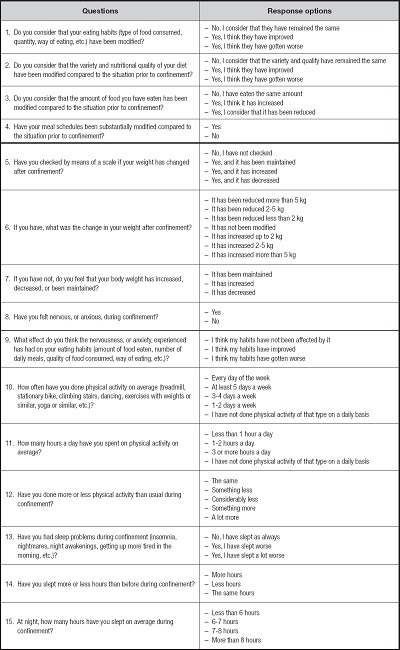
An on-line survey was developed specifically for the present study to collect sociodemographic data on the participants as well as information about their weight and changes in their eating habits, physical activity, and sleep (Annex 1).After getting authorization to proceed with this research from the Ethics Committee of the Faculty of Health Sciences and Education of the Madrid Open University (UDIMA), the survey was distributed to the university community. It was expressly stated that participation was voluntary, and that the information collected would be confidential, in accordance with the Spanish Law 3/2018 on the Protection of Personal Data and Guarantee of Digital Rights. Responses were coded anonymously using individual identification numbers. Only those who provided informed consent were able to access the form. No participants were paid or received any academic benefit for their participation. After the questionnaire was completed, the data were coded and analyzed.
Descriptive and inferential analyses were performed using cross-sectional methodology. Percentages were calculated to determine the distribution within the sample of sociodemographic variables and health habits during lockdown. The Chi-squared test was used to identify relationships between variables, while Cramer’s V was used to determine the strength of the associations found. The analyses were carried out using version 20.0 of the SPSS software package.
RESULTS
WEIGHT AND BODY MASS INDEX OF THE SAMPLE DURING LOCKDOWN
Following the World Health Organization (WHO) cut-off points for categorizing body mass index (BMI), participants were divided into these four categories: underweight (below 18.5), normal weight (18.5-24.9), overweight (25-29.9), and obese (above 30). The classification of the sample according to its BMI can be seen in table I. The distribution according to sex was as follows: men (0.9 % underweight, 39.6 % normal weight, 46.1 % overweight, 13.4 % obesity); women (5.2 % underweight, 67.8 % normal weight, 20 % overweight, 7 % obesity). Therefore, most of the participants presented normal weight at the time of the evaluation, especially the group of women, and to a lesser extent, overweight, mainly the group of men. The percentage of subjects with obesity was low, especially in the group of women, and the proportion of subjects with underweight was very low, especially among men.
Table I. Modification of body weight during lockdown according to the participants’ BMI.
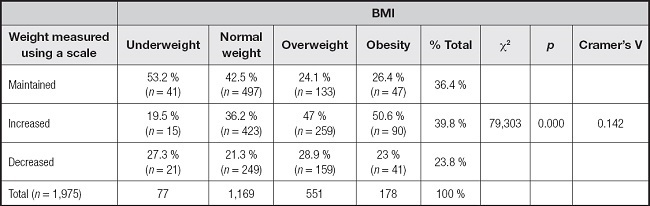
The World Health Organization cut-off points for categorizing body mass index (BMI): under-weight = below 18.5; normal-weight = 18.5-24.9; overweight = 25-29.9; and obesity = above 30.
Of those who did not have a scale and therefore self-assessed their body weight, 44.1 % considered that it had increased during lockdown, while 40.4 % considered that their weight had been maintained in the said period, and only 15.5 % believed that it had decreased. In relation to the weight measured using a scale, there seems to be a statistically significant link between the subjects’ BMI and the change in their weight during lockdown. A significantly higher proportion of overweight and obese subjects reported an increase in their weight, while the percentages of weight maintenance were statistically higher in those subjects with normal weight and underweight (Table I). It must be highlighted that the reported weight gains were smaller than 5 kg, and so were most of the weight losses reported by the participants. Specifically, 22 % of the subjects indicated that their weight had increased up to 2 kg, 15.6 % that they had increased between 2-5 kg, and none that their weight had increased more than 5 kg. Regarding weight losses, 13.7 % of the sample reported that their weight had been reduced by up to 2 kg and 8 % that it had been reduced between 2-5 kg, considering only 5.4 % of the participants that their weight had been reduced by more than 5 kg.
EATING HABITS OF THE SAMPLE DURING LOCKDOWN
Regarding general eating habits (quantity and type of food, way of eating, etc.), 41.4 % of the surveyed sample considered that they had maintained their previous habits and 26.3 % that these had worsened during lockdown. Besides, 45.6 % of the participants believed that the variety and nutritional quality of their intake had also been maintained, and only 18.6 % of the subjects considered that these parameters had got worse during lockdown. In relation to the amount of food eaten during the period under study, 43.8 % of the sample reported that the amount of food eaten during meals had increased and only 16.9 % indicated that said amount had been reduced. Likewise, 63.1 % of the participants reported that they had not modified their meal times in that period. Regarding the nervousness or anxiety experienced during lockdown, 63.4 % of the participants confirmed having presented such symptoms; of these, 45.9 % considered that their eating habits had not been affected by these symptoms, while 45.8 % considered that they had worsened.
PHYSICAL ACTIVITY OF THE SAMPLE DURING LOCKDOWN
Regarding the frequency of physical activity (treadmill, stationary bicycle, climbing stairs, dancing, exercising with weight, doing yoga or similar activities), 25.3 % of the sample reported not having carried out any physical activity during lockdown, whereas 24.3 % exercised one or two days a week, 20 % three or four days a week, 16.8 % at least five days a week and only 13.6 % carried out physical activity daily. As far as the number of hours dedicated to physical activity is concerned, 42.4 % of the participants indicated that they had exercised less than one hour a day, 29.1 % reported one or two hours of physical activity a day, only 0.7 % stated that they had exercised three hours or more a day during lockdown, and 27.7 % indicated that they had not carried out such activities on a daily basis. In comparison with the physical activity carried out previously, 36.8 % of the participants considered that during the lockdown they performed considerably less physical activity than usual and 22.2 % somewhat less than usual, while 13.1 % indicated having performed the same level of physical activity as before. On the contrary, 19.9 % of the subjects reported that they had exercised more than usual and only 8.1 % that the level of activity had been significantly higher in the confinement stage.
SLEEP HABITS OF THE SAMPLE DURING LOCKDOWN
In relation to the quantity and quality of sleep of the sample during the period under study, 44.1 % of the participants considered that they had slept as usual, 38.8 % that they had slept somewhat worse than before lockdown, and 17.1 % that they had slept much worse than before. Likewise, 36.3 % of the subjects indicated that they had slept the same number of hours as before lockdown, 31.4 % fewer hours than before, and 32.3 % considered that they had slept more hours than before. Specifically, 39.7 % of the participants reported having slept between six and seven hours during lockdown, 35.1 % between seven and eight hours, 15.9 % less than six hours, and only 9.4 % more than eight hours.
RELATIONSHIP BETWEEN DIFFERENT HEALTH HABITS AND BODY WEIGHT DURING LOCKDOWN
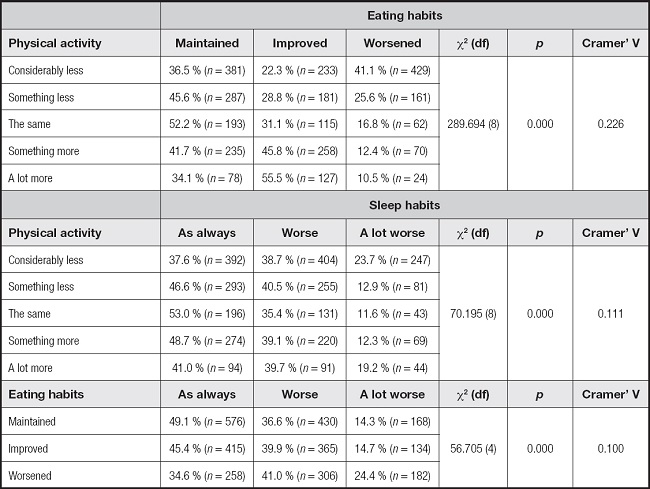
As can be seen in table II, there was a statistically significant relationship between the different health habits of the participants in the present study. This association was low between sleeping and both eating habits and physical activity, while it was moderate with respect to the link between eating habits and physical activity. Specifically, those who reported having carried out somewhat (or considerably) less physical activity than usual during lockdown, also considered that their eating habits had worsened in a greater percentage than those who had maintained or increased their level of physical activity. Although the effect size of the relationship between sleeping habits and other health-related habits was small, it was observed that those who considered that during lockdown had slept significantly worse than usual were mainly those who had exercised less than usual and those who reported a worsening of their eating habits during this period.
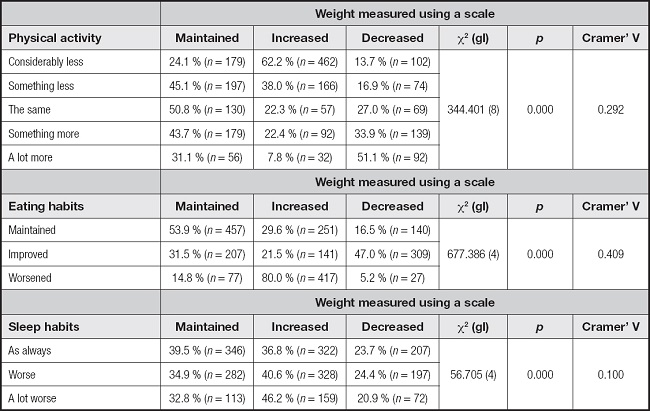
The results showed a statistically significant relationship between the participants’ weight measured using a scale and the different health habits under analysis during lockdown. The effect size of the associations was moderate in relation to the participants’ eating habits and physical activity, and small regarding their sleeping habits. Specifically those participants who considered that their eating habits had worsened during lockdown were those who had also increased their weight in a significantly greater proportion (Table III). Likewise, those who exercised somewhat (or considerably) less during lockdown were those who had increased their weight in a higher percentage, compared to those who had maintained or increased their levels of physical activity. Finally, those who considered that they had slept somewhat (or considerably) worse during lockdown were also those who experienced weight gain in a slightly higher proportion than those who indicated having slept as usual, especially those who reported sleep habits considerably worse than prior to the pandemic lockdown.
DISCUSSION
The high percentage in this study of subjects who reported an increase in weight measured by a scale after the confinement period (39.8 %) is in line with the results obtained in other European countries (4,6). However, there are also studies in which the percentage of people who consider that their weight has increased is lower than that obtained in the present study, such as the 30 % found in a study in Poland (8) or quite lower, as in the study carried out in Italy (9), in which the percentage of subjects who considered that their weight had increased was 19.5 %. The figures are even higher when the self-assessed weight is considered, as percentages of estimation of weight gain in the present sample were 44.1 %, very similar to those found in other studies even reaching 48.6 % of the surveyed population (3).
The results are also consistent with those investigations that have found that a significantly higher proportion of overweight and obese people report weight gain (5,8), compared to normal weight subjects. On the contrary, the latter report maintaining their weight in a higher percentage than the rest of the BMI groups. This may be due, among other reasons, to a greater increase in the intake of the overweight and obese subjects as found in some studies (8). In fact, weight gain is often associated with an increased intake and a poorer quality of the food consumed, as well as a reduction in physical activity and other additional factors, such as insufficient rest due to inadequate sleep (6). All these factors have been detected in the current study which may explain the high percentage of subjects whose weight was increased during lockdown. It should also be considered that during confinement there was a greater tendency for the population to store food, accompanied by an increase in the consumption of canned foods and ultra-processed products due to their greater ease of storage and preparation (14). Likewise, frequent snacks were made, and the consumption of carbohydrates increased, especially those with a high glycemic index (4). Therefore, the significant increase in weight in the participants of this study could be due to a combination of factors that took place during lockdown, and not only to increased intake as a response to stress (15), resulting in consumption of such foods as chocolate, ice cream, desserts, or salty snacks (9).
The results confirm the findings of various previous studies in relation to changes in eating habits due to confinement (7,9). Among other aspects, a high percentage of subjects considered that the amount of food consumed had increased, as similar investigations found also (9,16). Although various studies have analyzed the type of food whose intake was increased or decreased during lockdown, few have studied the subjective assessment of the respondents in relation to the nutritional quality or variety of their diet. In this study, most of the participants consider that these aspects remained stable with respect to the stage prior to confinement, and only 18.6 % believe that the quality of their intake worsened. Therefore, the modifications in relation to eating habits seem to have affected the quantity more than the quality of the intake. Another factor that had not been previously studied is that of mealtimes during lockdown. Slightly over a third of the sample thought that their mealtimes were altered in that period (36.9 %). This is a fact to be considered since the interruption of routines has been associated with alterations in eating, exercise and sleep patterns (17), which can ultimately promote weight gain among other consequences.
As it was found in a study in the Italian population (9), almost half of the present sample considers that the increase in intake during lockdown is attributed to the anxiety levels experienced in that period; in fact, 63.4 % of the participating sample reported having experienced nervousness or anxiety. This result is in line with the literature on so-called emotional eating, which associates inadequate intake with the presence of emotions, including stress, anxiety, anger, boredom, and depression (18,19), all of which were present to a certain extent during confinement.
Unlike the findings of another study with Spanish population on the increase in physical activity in confined persons (12), six out of ten subjects in the present study believed that they exercised somewhat or considerably less during lockdown than before. This subjective perception is consistent with the data related to the weekly frequency and number of daily hours that the subjects indicated that they dedicated to physical activity. It seems that strict lockdown made it difficult for the population to exercise and it increased screen time exposure (12), which in turns promoted sedentary lifestyle and prevented reaching the recommendation established by the WHO (20) as minimum amount of physical activity necessary to maintain adequate health and fitness in adults. Only 28 % of the subjects reported that they had done some or considerably more physical activity during the period under study, far from the figures obtained in other studies in nearby countries, such as Italy, where a slight increase in activity was observed in 38.3 % of the participants (3).
Limited physical activity has been associated not only with a broad spectrum of unfavorable metabolic effects that would dramatically increase the risk of serious and disabling diseases, such as diabetes, cancer, osteoporosis, and cardiovascular disease, but also with impaired mental health and potentiation of emotions such as sadness, anger, frustration, and irritation (11), which in turn influence eating habits promoting for instance an increase in the intake (18). In fact, it seems that one of the risk factors for weight gain during lockdown was the reduction in physical activity (6).
Among healthy habits, sleep plays a fundamental role for physical and mental health. Adequate sleep duration and quality are essential to cope with major events, such as a pandemic and subsequent confinement. In the present study, contrary to what was found in another study in the Spanish population (12), the quality of sleep not only did not improve but results confirmed the occurrence of sleep disturbances, such as those found in the research by Morin et al. (13). These authors considered that in addition to stress and anxiety, which were found in a high percentage of participants in the current research, other factors may have contributed to increasing sleep problems during the pandemic. These factors comprise changes in daily schedules and routines, such as work, eating or exercise, also present in the participating sample, which could have altered their sleep-wake cycles. Unhealthy eating habits have also been associated with sleep disturbances (21), so the perception of those who reported having slept worse or considerably worse during lockdown may be due to increased food intake and worsening of the nutritional quality and variety of the diet.
CONCLUSIONS
This study has analyzed some of the health consequences of the imposed and strict confinement of the population in one of the countries most affected by the COVID-19 pandemic. The response of people to stressful and prolonged events, in addition to mandatory social distancing, isolation at home and sedentary lifestyle, seem to have modified their lifestyle and health habits. The worsening of each of these habits seems to have worsen the others, and that situation led to weight gain in a significant percentage of the sample under study. Therefore, the hardships of carrying out physical activities and the stress experienced could have resulted for example in the intake of higher amounts of food and an increase in weight. This, in addition to a decreased physical activity and poorer quality of sleep, seems to have worsened previous situations of overweight or obesity, and probably favored the development of the said health conditions related to BMI.
This research has made it possible to deepen our understanding of the impact that confinement due to COVID-19 had on the habits of the Spanish adult population. Likewise, as most studies on health in times of pandemic, it did not only focus on objective variables (food consumed, frequency of physical activity, hours of sleep) but also on the subjective experience of the health habits, which influence the perception of one’s own quality of life and the promotion of healthy habits, or on the contrary, in keeping the previous ones as a result of learned helplessness together with certain disinformation. Besides, relevant variables have been analyzed: changes in routines such as mealtimes, which had rarely been assessed in prior studies on confinement, the possible effect of psychological variables such as anxiety on eating habits, as well as the interrelation of the different health habits in lockdown situations. The results obtained will allow the development of prevention plans for prolonged confinements, which may occur as a consequence not only of a pandemic but of any other situation associated with high levels of stress. Specifically, public health campaigns should promote a healthy diet appropriate to each evolutionary stage, to avoid overeating and to inform not only about the dangers of overeating but also on those arising from the consumption of certain hypercaloric foods in periods in which doing physical activity is more difficult, and then body weight control decreases. Exercise should also be promoted by means of the new technologies adjusted to the different age groups, to fight sedentary lifestyle in periods of confinement. Likewise, it would be convenient to design specific campaigns for risk groups, as it seems that such confinement affects to a greater extent the health habits of those overweight or obese, who tend to suffer higher rates of diseases associated with worse prognosis like COVID-19. Along with promoting physical activity, campaigns in these periods should also raise awareness about the importance of a good rest and its effect on people’s overall health.
Among the limitations of the present study is a possible social desirability bias, as well as the bias linked to the recalling of health habits. It was attempted to solve these biases based, on the one hand, in requesting anonymous participation, and on the other, by the use of objective inputs such as body weights measured on scales, although only 44 % of the sample could measure their weight using a scale. Likewise, since it is a convenience sample made up mostly of young adults with a high educational level, the results cannot be extrapolated to the whole of Spain’s population. For all these reasons, additional longitudinal research is needed with large and representative samples that encompass the entire territory of Spain and employ additional objective measures for health habits.
INSTITUTIONAL REVIEW BOARD STATEMENT
This study was approved by the Ethics Committee of the Faculty of Health Sciences and Education of the Madrid Open University (UDIMA) on May 18, 2020. All procedures have been carried out in accordance with the ethical standards of the Madrid Open University and the Spanish Organic Law 3/2018, of December 5, on the Protection of Personal Data and Guarantee of Digital Rights (LOPDGDD), as well as the latest amendments to the Declaration of Helsinki of 1964.