

SciELO - Scientific Electronic Library Online

 
vol.41 número3Experiencia clínica en pacientes con fallo intestinal: estudio de cohorte en un hospital de referenciaFactores asociados al desarrollo de malnutrición por exceso en niños índice de autoresíndice de materiabúsqueda de artículos
Home Pagelista alfabética de revistas  

Servicios Personalizados

Revista

Articulo

Indicadores

Links relacionados

  • En proceso de indezaciónCitado por Google
  • No hay articulos similaresSimilares en SciELO
  • En proceso de indezaciónSimilares en Google

Compartir


Nutrición Hospitalaria

versión On-line ISSN 1699-5198versión impresa ISSN 0212-1611

Nutr. Hosp. vol.41 no.3 Madrid may./jun. 2024  Epub 18-Sep-2024

https://dx.doi.org/10.20960/nh.04931 

ORIGINAL PAPERS

Stability of individualized neonatal parenteral nutrition admixtures with fish oil and high calcium content

Estabilidad de mezclas individualizadas de nutrición parenteral neonatal con omega 3 y alto contenido de calcio

Diana Escuder-Vieco1  2  3  , investigation, validation, data curation, approving of the submitted version; Pilar Gomis-Muñoz4  , conceptualization, methodology, supervision, approving of the submitted version; José Antonio Hernández-Ramos4  , resources, approving of the submitted version; Miguel Ángel Bruni-Montero4  , resources, approving of the submitted version; Elena Bergón-Sendín1  2  3  , resources, approving of the submitted version; Javier de la Cruz-Bértolo1  2  3  , formal analysis, methodology, approving of the submitted version; Gerardo Bustos-Lozano1  2  3  5  , conceptualization, methodology, investigation, data curation, supervision, writing original draft, approving of the submitted version

1Neonatology Department. Hospital Universitario 12 de Octubre. Madrid, Spain

2Health Research Institute (i+12). Hospital Universitario 12 de Octubre. Madrid, Spain

3RETICS Maternal and Child Health and Development Network, SAMID Network, Ref. RD16/0022. Instituto de Salud Carlos III. Ministerio de Ciencia, Innovación y Universidades. Gobierno de España. Madrid, Spain

4Department of Pharmacy. Hospital Universitario 12 de Octubre. Madrid, Spain

5Facultad de Medicina. Universidad Complutense de Madrid. Madrid, Spain

Abstract

Introduction:

the stability of total parenteral nutrition admixtures for neonates (TPNAn) has been questioned in relation to the interaction between calcium and fish oil emulsions.

Aim:

the aim of this study was to check the stability (particle size < 1 μm) of different individualized TPNAn prepared with fish-oil emulsion and containing calcium at concentrations ranging from 10 to 20 mmol/L.

Methods:

admixtures analyzed: twelve different formulations with SMOFlipid® 20 % (conserved for 24 h and for 96 h), three formulations with Lipoplus® 20 % (conserved for 96 h) and three formulations with SMOFlipid® 20 % with Multi-12K1® Pediatric (conserved for 96 h). Two bags were compounded for each formulation and conservation period. Measurements on each admixture bag: particle standardized diameter by laser diffraction technique and pH by a calibrated pH-meter. Data analysis with mixed linear regression models.

Results:

maximum particle size was < 0.8 μm for all investigated admixtures. Lipid concentration of 5 g/L and sodium and potassium concentration of 100 mmol/L slightly increased the proportion of particles > 0.6 μm. Ninety six hours storage also increased the percentage of particles > 0.6 μm (+0.143 ± 0.07; p = 0.038) but did not influence other parameters. No association with calcium composition was observed. Amino acid content was inversely correlated with pH (-0.83; p < 0.0001).

Conclusions:

the studied individualized parenteral nutrition admixtures for newborns that contain fish oil emulsions and meet cation requirements are stable for at least 96 hours.

Keywords: Neonatal parenteral nutrition admixture; Stability; Individualized neonatal parenteral nutrition; Calcium; Fish oil; Laser diffraction technique

Resumen

Introducción:

existe controversia sobre la estabilidad de las mezclas de nutrición parenteral total para recién nacidos (TPNAn) con emulsiones de omega-3 y alto contenido en calcio.

Objetivo:

estudiar la estabilidad (tamaño de partículas < 1 μm) de diferentes TPNAn individualizadas preparados con una emulsión lipídica que contiene omega-3 y concentraciones de calcio entre 10 y 20 mmol/L.

Métodos:

se analizaron doce formulaciones diferentes con SMOFlipid® 20 % (conservadas durante 24 h y por 96 h), tres formulaciones con Lipoplus® 20 % (conservadas durante 96 h) y tres formulaciones con SMOFlipid® 20 % con Multi-12K1® Pediatric (conservadas durante 96 h). Se prepararon dos bolsas por cada formulación y período de conservación. Se midieron el diámetro de partícula estandarizado mediante técnica de difracción láser y el pH con un pH-metro calibrado. Análisis de datos con modelos de regresión lineal mixta.

Resultados:

el tamaño máximo de partícula fue < 0,8 μm para todas las mezclas investigadas. La concentración de lípidos de 5 g/L y la concentración de sodio y potasio de 100 mmol/L aumentaron ligeramente la proporción de partículas > 0,6 μm. El almacenamiento de noventa y seis horas también aumentó el porcentaje de partículas > 0,6 μm (+0,143 ± 0,07; p = 0,038) pero no influyó en otros parámetros. No se observó asociación con la concentración de calcio. El contenido de aminoácidos se correlacionó inversamente con el pH (-0,83; p < 0,0001).

Conclusiones:

las TPNAn individualizadas estudiadas con emulsiones de omega-3 que incluyen los requerimientos de cationes son estables durante al menos 96 horas.

Palabras clave: Mezcla de nutrición parenteral neonatal; Estabilidad; Nutrición parenteral neonatal individualizada; Calcio; Aceite de pescado; Técnica de difracción láser

INTRODUCTION

Total parenteral nutrition admixtures for neonates (TPNAn) should be tailored and adapted to immaturity, body weight, age, metabolic needs and co-existing diseases. The stability of these admixtures is a critical issue due to the high nutritional requirements involved (1-3). One of the major stability criteria is the particles size (4-6). It is recommended that admixtures should include less than 0.05 % of droplets of fat larger than 5 μm although a safer profile has set the criteria of instability (7) at a maximum droplet size of 1 μm (8,9). Since instability of lipid emulsion is related to high concentration of cations (10), some authors considered TPNAn unsuitable (11-13). Forchielli et al. (8,9) described over the last decade that admixtures for neonates are stable, except for those with fish oil emulsions and exceeding 4.5 mmol/L, where they observed that 12 % of lipid droplets exceeded 1 μm and 2 % exceeded 5 μm. The authors concluded that the interaction between fish oil and calcium strongly suggested an incontrovertible effect on droplet dimension, limiting their use with in order to prevent hepatic toxicity (14). Notwithstanding, the stability of admixtures with fish oil has been confirmed for admixtures with calcium concentration from 6.5 to 12.2 mmol/L in the pediatric age (13,15) and recently in adults (6).

Our Hospital Pharmacy Department compounds every year more than 2500 admixtures with fish oil emulsion and high content of calcium gluconate for a reference neonatal intensive care unit having 42 beds (16). Based on a detailed scientific literature review and on extensive clinical experience as well as practice evaluation, we hypothesized that every individualized admixture prepared with fish-oil emulsion and containing calcium at concentrations ranging from 10 to 20 mmol/L would reveal a distribution of droplet size matching the recommended safety profile for TPNAn.

The aim of this study was to check the stability (particles size < 1 μm) of different individualized TPNAn prepared with fish-oil emulsion and containing calcium at concentrations ranging from 10 to 20 mmol/L.

METHOD

The study material were samples of TPNAn prepared and tested for different storage periods at Madrid University Hospital 12 Octubre, Spain. The study protocol was approved by the reference Clinical Research Ethics Committee (CEIm 21/202).

ADMIXTURES

TPNAn were prepared in horizontal laminar flow hood following the protocols for the preparation of parenteral nutrition of the Hospital Pharmacy Department. Multi-layer ethylene-vinyl acetate bags and photoprotection overbags from Bexen Medical® were used. The sequence of compounding was as follows: amino acids, calcium gluconate, glucose, lipids, vitamins, magnesium sulfate, sodium and potassium salts, zinc, multi-trace element, sodium glycerophosphate.

We tested three types of admixtures:

Twelve different TPNAn formulations with SMOFlipid® 20 % (Fresenius, soybean-olive-fish oil LCT + MCT) and calcium content from 10 to 20 mmol/L (F1 to F12, Table I). These 12 admixtures vary in the amount of amino acids (Primene® 10 %, Baxter), lipids (SMOFlipid 20 %® Fresenius), sodium, potassium, chloride, phosphate and calcium gluconate. The same amount of dextrose, trace elements (Peditrace® Fresenius-Kabi), vitamins (Soluvit® + Vitalipid Infantil®, Fresenius-Kabi), zinc (Meinsol-oligozinc®, Fresenius-Kabi), magnesium (Sulfato de magnesio Altan® 150 mg/mL, Altan) were added to every admixture.

Table I. Composition of the TPNAn formulations under investigation (n = 18). 
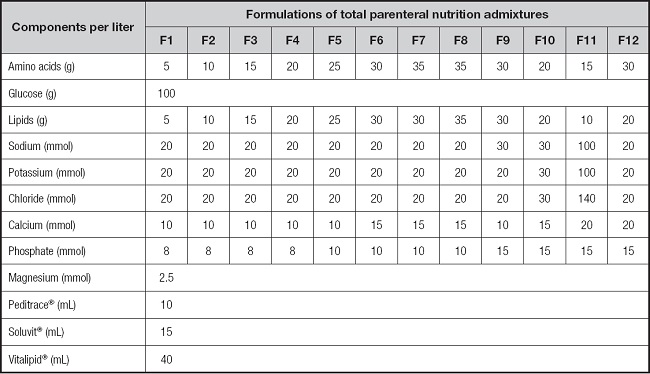
Formulations F1 to F12 (n = 12); and additionally, F1, F7 and F11 were also tested with Lipoplus® 20 % (n = 3) in substitution of SMOF Lipid® 20 % (F1-L, F7-L and F11-L), and with SMOF Lipid® 20 % + Multi-12/K1® Pediatric (F1-M, F7-M and F11-M) 15 mL/L (n = 3) in substitution of Soluvit® + Vitalipid®.

Two different bags of these 12 admixtures were stored at 4 oC for 24 h and two at 4 oC for 96 h. Two samples per bag were tested.

TPNAn F1, F7 and F11 with Lipoplus® 20 % (PN-L), (Braun, soybean-fish oil LCT + MCT) instead of SMOFlipid® 20 % (F1-L, F7-L & F11-L). Two samples per bag were tested after 96 h of conservation.

TPNAn F1, F7 and F11 with SMOF Lipid 20 % and Multi-12/K1® Pediatric (Sandoz-Novartis) (F1-M, F7-M & F11-M), instead of Soluvit® + Vitalipid Infantil®. Two samples per bag were tested after 96 h of conservation.

All bags were checked for color changes, creaming, coalescence or cracking. The samples were obtained directly from bags to sterile syringes after agitationat room temperature, and immediately checked for pH and particle size.

LIPID PARTICLE SIZE

Particle standardized diameter was measured by a laser diffraction technique (Mastersizer 3000® Malvern Panalytical, ISO 13320 certified) in the IESMAT laboratory (www.iesmat.com) with a range of optimal measurement from 0.01 to 100 μm. The technique included dispersion in distilled water with homogenization at 2200 rpm (Hydro EV®, Malvern Panalytical). We analyzed the sample volume required to obtain a laser overshadow between 6 % and 8 %. A refractive index of 1.529 and absorption of 0.01 were applied, following recommendation by ISO13320 for very small particles (17).

PH MEASUREMENT

The pH of every admixture bag was measured with a calibrated pH meter (pH-Meter BASIC 20®, Crison, Barcelona, Spain) equipped with a glass electrode (5011T; Crisol, Barcelona, Spain). The sensitivity value of this technique is 0.01.

DATA ANALYSIS

The particles size distribution was described with the following outcome parameters: 10th percentile (D10), median (D50), 90th percentile (D90), proportion of particle size > 0.6 μm and maximum size. Data were analyzed with mixed linear regression models where each bag was considered as a class to take into account the non-independence of the samples measurements from the same bag. Models included storage time and admixture components as covariates. The data analysis for this paper was generated using SAS/STAT 14.2 software, Version 9.4 of the SAS System by SAS Institute Inc., Cary, NC, USA.

RESULTS

PARTICLE SIZE DATA

We performed 108 measurements on 54 bags. None of the investigated bags showed color alteration, creaming or coalescence with phase separation. The values obtained in each formulation at 24 and 96 h of conservation are presented in figure 1 and table II. Maximum particle size was < 0.8 μm for all investigated admixtures. The largest particle size detected in any of the mixtures was 0.767 μm (F1 at 24 h and F1, F2 and F11 at 96 h with SMOF®; F1 and F11 at 96 h with Lipoplus®) (Fig. 1). The percentage of particles > 0.6 μm only exceeded 0.5 % in the mixtures with 5 g/L of lipids (F1).

Figure 1. Particles size of all investigated admixtures ((▲) maximum size detected; average of (○) D10, (●) D50 and (○) D90. A. Admixtures stored for 24 h; B. Admixtures stored for 96 h. Standard deviations have a magnitude of 10-3 μm and are not represented. 
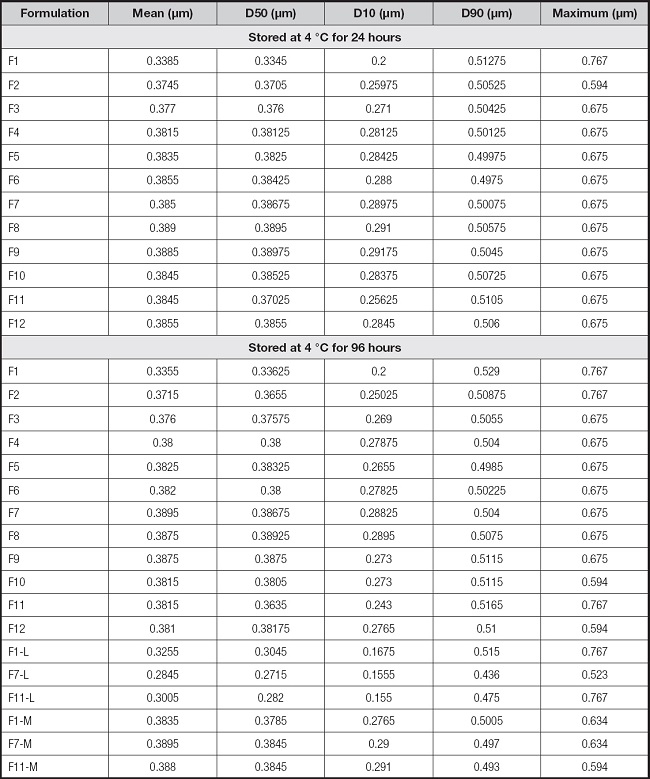
Table II. Laser diffraction analysis for each formulation conserved at 4 °C for 24 and 96 hours. 

Particle size was determined by laser diffraction and expressed as mean values from a duplicate analysis.

EFFECT OF STORAGE TIME ON PARTICLE SIZE

Storage for 96 h increased the percentage of particles > 0.6 μm (+0.143 ± 0.07; p = 0.038), but did not impact other parameters (Fig. 2).
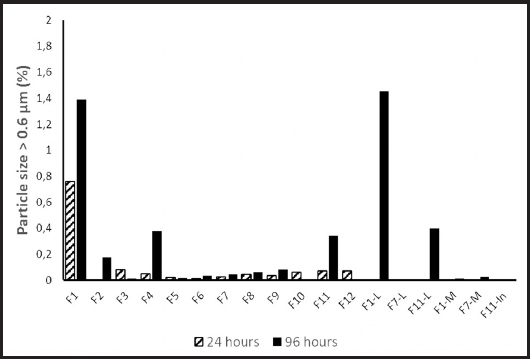
Figura 2. Proportion (percentage) of particles > 0.6 μm by admixture type and storage time (hatched bars: 24 h; solid bars: 96 h). 

EFFECT OF COMPONENTS ON PARTICLE SIZE

The effect of different components from admixture bags on particle size are reported in table III. Low lipid concentration (5 g/L vs. ≥ 1) significantly increased the proportion of particles > 0.6 μm and D90, although D50 and D10 decreased. No association with calcium composition was observed. Sodium and potassium concentrations of 100 mmol/L slightly increased the proportion of particles > 0.6 μm, and D50 and slightly decreased D10 (Table III).
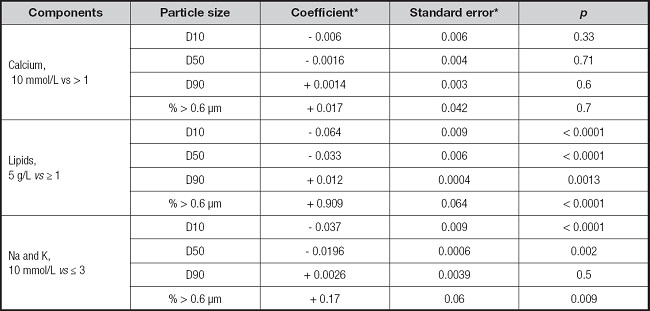
Table III. Effect of components on particle size distribution (D10, D50, D90 and percentage of particles > 0.6 μm). 

*Mixed lineal regression analysis.

PH DATA

Mean pH of the investigated admixtures at 24 h and at 96 h was 5.90 ± 0.23 and 5.92 ± 0.25 respectively (p = 0.6). Extreme pH values were recorded in F1 (6.54) and F 12 (5.62) after 96 h of conservation. The pH was inversely correlated with the amino acid content (-0.83; p < 0.0001).

DISCUSSION

We provided strong evidence that calcium concentrations from 10 to 20 mmol/L and individual monovalent cations up to 10 mmol/L are compatible with individualized admixtures for neonates containing emulsions with fish oil and that these TPNAn remain stable up to 96 h after preparation. Previous studies demonstrate stability of other components of TPNAn (8,18).

The investigated admixtures were designed to meet the requirements of newborns including preterm infants. No relation was found between particle size and calcium content between 10 and 20 mmol/L. Size distribution consistency between different admixtures also supports the stability of our formulations. Only admixtures with a minimum amount of lipids (5 g/L) or maximum cations content (calcium 20 mmol/L, sodium 10 mmol/L and potassium 10 mmol/L) showed wide particle size distribution with a small but significant proportion of particles > 0.6 μm, but also with maximum size < 0.8 μm.

The three additional formulations investigated had a standard composition for the first day of life, complete parenteral nutrition and admixtures with high cations content. No significant differences were observed between SMOFlipid® 20 % and Lipoplus® 20 % formulations at 96 h of storage. The substitution of vitamins source from separate water-soluble and fat-soluble to complete vitamins mixture did not modify particle size.

The differences in pH were inversely related to the concentration of amino acids. The storage time had a limited influence and the glucose content was not analyzed because all the mixtures were dosed with the same amount.

These results support the safe use of fish oil emulsions with concentrations of cations that meet the usual requirements of newborns, including premature infants, as described also in the admixtures for children and adults (6,13,15).

Although the number of samples is limited, it represents the spectrum of common formulations for newborns, specifically in terms of lipids and cation content.

In conclusion, the studied individualized parenteral nutrition admixtures for newborns that contain emulsions with fish oil and meet cation requirements are stable for at least 96 hours.

Acknowledgments:

we would like to thank Jesús Carlos Puebla Sánchez (Commercial Director of IESMAT and expert on characterization of particles and emulsions) for his excellent technical support with Mastersizer 3000® Malvern Panalytical.

REFERENCES

1. Mihatsch WA, Braegger C, Bronsky J, Cai W, Campoy C, Carnielli V, et al. ESPGHAN/ESPEN/ESPR/CSPEN guidelines on pediatric parenteral nutrition. Clinical nutrition 2018;37(6 Pt B):2303-5. DOI: 10.1016/j.clnu.2018.05.029 [ Links ]

2. Van Gossum A, Cabre E, Hébuterne X, Jeppesen P, Krznaric Z, Messing B, et al. ESPEN Guidelines on Parenteral Nutrition: gastroenterology. Clin Nutr 2009;28:415-27. DOI: 10.1016/j.clnu.2009.04.022 [ Links ]

3. Czech-Kowalska J. Mineral and nutritional requirements of preterm infant. Semin Fetal Neonatal Med 2020;25:101071. DOI: 10.1016/j.siny.2019.101071 [ Links ]

4. Driscoll DF, Nehne J, Peterss H, Klutsch K, Bistrian BR, Niemann W. Physical assessments of lipid injectable emulsions via microscopy: a comparison to methods proposed in United States pharmacopeia chapter 729. Int J Pharm Compd 2006;10:309-15. [ Links ]

5. Driscoll DF, Bhargava HN, Li L, Zaim RH, Babayan VK, Bistrian BR. Physicochemical stability of total nutrient admixtures. Am J Health Syst Pharm 1995;52:623-34. DOI: 10.1093/ajhp/52.6.623 [ Links ]

6. Zhao B, Gao R, Jiao L, Zhang F, Wang B, Mei D. Physical Stability of Medium-Chain Triglyceride/Long-Chain Triglyceride Emulsion Injections From 5 Manufacturers in High-Concentration Electrolyte-Based Total Nutrient Admixtures. JPEN J Parenter Enteral Nutr 2021;45:1275-84. DOI: 10.1002/jpen.20094 [ Links ]

7. Klang MG. PFAT5 and the Evolution of Lipid Admixture Stability. JPEN J Parenter Enteral Nutr 2015;39:67S-71S. DOI: 10.1016/j.clnu.2013.12.011 [ Links ]

8. Forchielli ML, Bonoli A, Preite I, Stancari A, Maselli S, Guarguaglini AM, et al. Parenteral nutrition admixtures for pediatric patients compounded with highly refined fish oil-based emulsion: assessment of physicochemical stability. Clin Nutr 2014;33:1127-31. DOI: 10.1016/j.clnu.2013.12.011 [ Links ]

9. Forchielli ML, Bonoli A, Stancari A, Bruno LL, Piro F, Piazza G, et al. Do carnitine and extra trace elements change stability of paediatric parenteral nutrition admixtures? Clin Nutr 2019;38:2369-74. DOI: 10.1016/j.clnu.2018.10.016 [ Links ]

10. Corriol O, Crauste-Manciet S, Arnaud P, Brion F, Brossard D, Causse R, et al. Recommendations for the preparation of parenteral nutrition mixtures. Nutr Clin Metab 2005;19:30-55. DOI: 10.1016/j.nupar.2005.01.003 [ Links ]

11. Deitel M, Friedman KL, Cunnane S, Lea PJ, Chaiet A, Chong J, et al. Emulsion stability in a total nutrient admixture for total parenteral nutrition. J Am Coll Nutr 1992;11:5-10. DOI: 10.1080/07315724.1992.10718188 [ Links ]

12. Cober MP, Gura KM. Enteral and parenteral nutrition considerations in pediatric patients. Am J Health Syst Pharm 2019;76:1492-510. DOI: 10.1093/ajhp/zxz174 [ Links ]

13. Lombardi J, Semama DS. Stabilité physico-chimique des nutritions parentérales individualisées en néonatologie [Physicochemical stability of individualized parenteral nutrition in neonatal period]. Ann Pharm Fr 2018;76:154-62. DOI: 10.1016/j.pharma.2018.01.001 [ Links ]

14. Wales PW, Allen N, Worthington P, George D, Compher C;American Society for Parenteral and Enteral Nutrition, et al. A.S.P.E.N. clinical guidelines: support of pediatric patients with intestinal failure at risk of parenteral nutrition-associated liver disease. JPEN J Parenter Enteral Nutr 2014;38:538-57. DOI: 10.1177/0148607114527772 [ Links ]

15. Watrobska-Swietlikowska D, Kwidzynska A, Szlagatys-Sidorkiewicz A, Sznitowska M, Klek S. Finding new solutions in pediatric parenteral admixtures:how to improve quality and to deal with shortages. Nutr Hosp 2014;30:84-93. DOI: 10.3305/nh.2014.30.1.7500 [ Links ]

16. Bustos Lozano G, Soriano-Ramos M, Pinilla Martín MT, Chumillas Calzada S, García Soria CE, Pallás-Alonso CR. Early Hypophosphatemia in High-Risk Preterm Infants: Efficacy and Safety of Sodium Glycerophosphate From First Day on Parenteral Nutrition. JPEN J Parenter Enteral Nutr 2019;43:419-25. DOI: 10.1002/jpen.1426 [ Links ]

17. ISO 13320:2020 Particle size analysis — Laser diffraction methods. [Accessed May 31, 2021]. Available from: https://www.iso.org/standard/69111.htmlLinks ]

18. Mihatsch W, Fewtrell M, Goulet O, Molgaard C, Picaud JC, Senterre T, et al. ESPGHAN/ESPEN/ESPR/CSPEN guidelines on pediatric parenteral nutrition: Calcium, phosphorus and magnesium. Clin Nutr 2018;37(6 Pt B):2360-5. DOI: 10.1016/j.clnu.2018.06.950 [ Links ]

Funding:this research did not receive any specific grant from funding agencies in the public, commercial, or not-for-profit sectors.

Artificial intelligence:the authors declare not to have used artificial intelligence (AI) or any AI-assisted technologies in the elaboration of the article.

Escuder-Vieco D, Gomis Muñoz P, Hernández Ramos JA, Bruni Montero MA, Bergón Sendín E, de la Cruz Bértolo J, Bustos Lozano G. Stability of individualized neonatal parenteral nutrition admixtures with fish oil and high calcium content. Nutr Hosp 2024;41(3):547-553 DOI: http://dx.doi.org/10.20960/nh.04931

Received: September 14, 2023; Accepted: January 05, 2024

Correspondence: Pilar Gomis Muñoz. Department of Pharmacy. Hospital Universitario 12 de Octubre. Av. de Córdoba, s/n. 28041 Madrid, Spain e-mail: pilar.gomis@salud.madrid.org

Conflicto de intereses:

the authors declare that the research was conducted in the absence of any commercial or financial relationships that could be construed as a potential conflict of interest.

Author´s contributions:

DEV: investigation, validation and data curation. PGM: conceptualization, methodology, and supervision. JAHR, MABM and EBS: resources. JCB: formal analysis and methodology. GBL: conceptualization, methodology, investigation, data curation, supervision, writing original draft. All authors contributed to the article and approved the submitted version.

Creative Commons License This is an open-access article distributed under the terms of the Creative Commons Attribution License