




 Servicios personalizados
 Inglés (pdf)
 Articulo en XML
 Referencias del artículo
 Traducción automática
 Enviar articulo por email
 Citado por SciELO
  Citado por Google
  Similares en
SciELO
Similares en
SciELO  Similares en Google
 Permalink
INTRODUCTION
Gastric cancer is a common malignancy around the world. In 2020, there were approximately 1.1 million new cases of gastric cancer globally, with about 770,000 deaths. This trend is expected to increase, with projections indicating that by 2040, the global burden of gastric cancer could reach around 1.8 million new cases and 1.3 million deaths annually (1). The burden is especially high in East Asia, where China has the highest incidence and mortality rates. The most recent data shows that gastric cancer continues to be a major health concern in China, accounting for 42.6 % of new cases and 48.6 % of global gastric cancer-related deaths (2). Gastric cancer frequently occurs at the age of 40-60 years, which is closely related to the region, dietary habits, environmental pollution and heredity (3). Due to insidious onset, most patients have been in the advanced stage once diagnosed. Surgical resection is the only possible cure for gastric carcinoma, with an overall survival (OS) rate of less than 50 % in 5 years (4). Therefore, for the purpose of enhancing the long-term efficacy of radical gastrectomy, multiple measures such as minimally invasive/robotic surgery, postoperative enhanced recovery, chemotherapy, and radiotherapy have been explored by clinicians.
The survival rate plus prognosis of gastric cancer sufferers after operation are determined by host-specific factors in addition to tumor-related factors (5,6). Body mass index (BMI) is an indicator that measures the degree of obesity based on an individual's weight and height. Obesity is a pathogenic factor for cancer development, but the influence of BMI on the survival rate remains controversial (7). An increased BMI is associated with higher risks of disease recurrence and death in breast cancer (8). However, the 5-year overall survival rate of patients with non-metastatic gastric cancer, who have high BMI, exceeds that of the cases with low BMI (9). Besides, prognostic nutritional index (PNI) serves as a sign of host immunity and nutritional status, which is calculated from the peripheral lymphocyte count and serum albumin content. PNI has witnessed extensive application over the years in the evaluation of nutritional status in people suffering from gastrointestinal diseases as well as the assessment of prognosis, living quality after operation, and complications of other patients (10). PNI has also been used to predict the gastric cancer patients at increased risk of postoperative morbidity and mortality (11). Moreover, the C-reactive protein to prealbumin ratio (CRP/PA) is a new inflammatory indicator that combines inflammatory responses and nutritional status, often used to evaluate the outcomes of various cancers (12). A high CRP/PA ratio is an independent prognostic factor in gastric cancer patients, with elevated values associated with poorer overall survival (13).
In this study, the significance of BMI, PNI and CRP/PA in assessing the prognosis of patients undergoing radical gastrectomy was systematically explored, aiming to provide more accurate tools for prognostic evaluation.
METHODS
GENERAL DATA
One hundred subjects treated with radical gastrectomy in our hospital by the same team from August 2015 to January 2018 were enrolled. The inclusion criteria involved 1) patients diagnosed with gastric cancer based on the clinical diagnostic criteria (14), and pathologically diagnosed with gastric cancer at the first visit; 2) those without chronic liver/kidney dysfunction, infectious diseases and immune system diseases; 3) those without using anti-infective drugs before operation; 4) those without distant metastasis; 5) those with indications of radical gastrectomy; and 6) those with complete clinical data and follow-up data.
The exclusion criteria included: 1) patients who could not tolerate radical gastrectomy, 2) those presenting distant metastasis and/or extensive peritoneal seeding, 3) those complicated with other serious diseases or distant metastasis, 4) those with severe diabetes, coronary heart disease, or hepatic/renal insufficiency, 5) those with malignant tumors at other sites, or 6) those undergoing combined resection of other organs intraoperatively.
EVALUATION OF OUTCOMES
Height and weight were obtained for the calculation of BMI: weight (kg)/height (m)2. Fasting venous blood was drawn in the morning the next day after admission, and the blood lymphocyte count, serum albumin and serum PA were detected using an automatic biochemical analyzer. Then serum albumin (g/L) + [5 × blood lymphocyte count (× 102/L)] was adopted for PNI calculation. The CRP level was detected via enzyme-linked immunosorbent assay, with CRP/PA calculated.
The cut-off values of BMI, PNI and CRP/PA on the receiver operating characteristic (ROC) curves were obtained, which were utilized for grouping of patients. Then corresponding intergroup comparisons were performed on the clinicopathological features (age, invasion depth, gender, lymph node metastasis, tumor diameter, differentiation degree, clinical stage, and presence or absence of postoperative adjuvant therapy).
Follow-up was performed until January 2023 on the patients' survival status by telephone or outpatient service, and overall survival was recorded.
STATISTICAL ANALYSIS
The SPSS 23.0 software was used for the statistical analysis. Mean ± standard deviation (x ± s) and the t-test were employed to express the measured data. Percentage [n (%)] together with the χ2 test were utilized for the count data. Kaplan-Meier survival curves were plotted to explore the associations of BMI, PNI and CRP/PA with the prognosis of patients undergoing radical gastrectomy. A p < 0.05 meant a difference of statistical significance.
RESULTS
ROC CURVES
The mean BMI of all patients was (20.25 ± 2.08) kg/m2. The ROC curve of 5-year BMI was plotted, with an AUC of 0.709 (95 % CI: 0.635-0.783). Under the optimal cut-off value of 20.88 kg/m2 for BMI, the Youden index was the highest, the sensitivity was 63.39 %, and the specificity reached 72.26 % (p < 0.001) (Fig. 1A). Next, low (n = 46) and high (n = 54) BMI groups were set up for the patients according to the cut-off value of BMI.
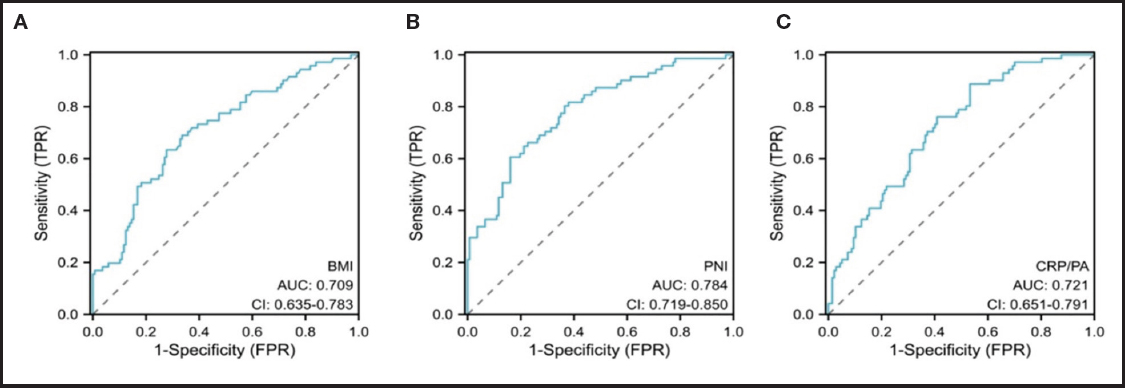
Figure 1. ROC curves of BMI, PNI and CRP/PA in patients with gastric cancer. A. ROC curve of BMI. B. ROC curve of PNI. C. ROC curve of CRP/PA.
The mean PNI of all patients was (43.54 ± 5.74). The ROC curve of 5-year PNI was plotted, and the AUC reached 0.784 (95 % CI: 0.719-0.850). The Youden index was the highest in the case of the optimal cut-off value of PNI at 44.20, with the sensitivity plus specificity of 60.56 % and 83.94 %, respectively (p < 0.001) (Fig. 1B). Later, a low PNI group (n = 48) and a high PNI group (n = 52) were built for patient allocation as per the cut-off value of PNI.
The mean CRP/PA of all patients was (283.52 ± 90.33). The ROC curve of CRP/PA was plotted, with the AUC being 0.721 (95 % CI: 0.651-0.791). The highest Youden index was obtained from 305.26 as the optimal cut-off value of CRP/PA, and the sensitivity of 88.73 % and specificity of 46.72 % were acquired (p < 0.001) (Fig. 1C). The cut-off value of CRP/PA was applied to assign the patients to a low (n = 57) or high (n = 43) CRP/PA group.
ASSOCIATIONS BETWEEN DIFFERENT BMI AND CLINICOPATHOLOGICAL FEATURES
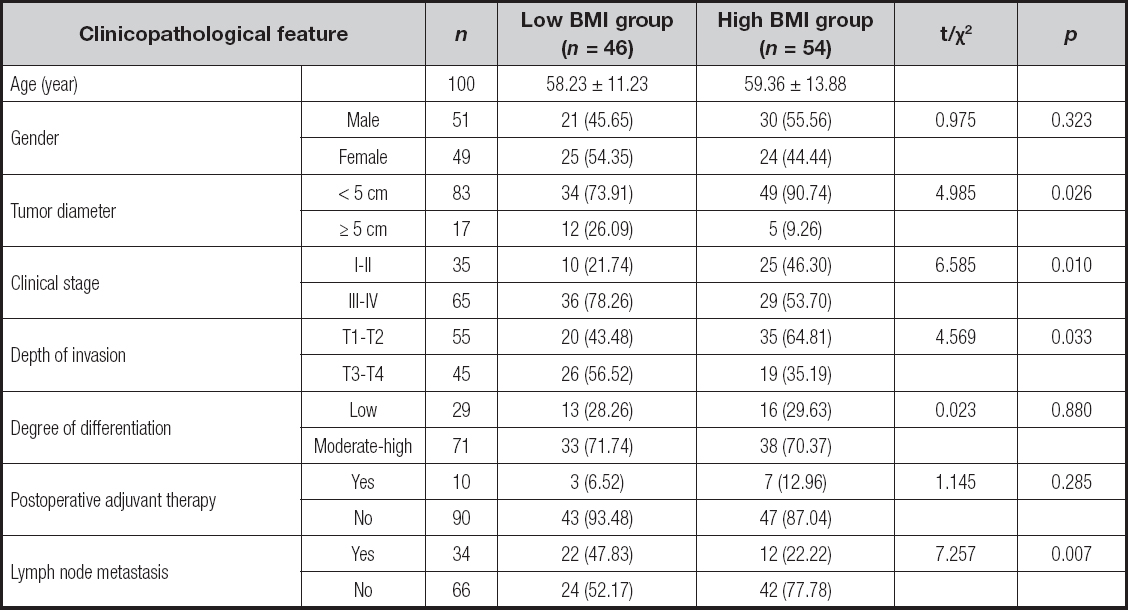
Through comparing the low BMI group with the high BMI group, there were differences in the tumor diameter, lymph node metastasis status, clinical stage, and invasion depth (p < 0.05) (Table I).
ASSOCIATIONS BETWEEN DIFFERENT PNI AND CLINICOPATHOLOGICAL FEATURES
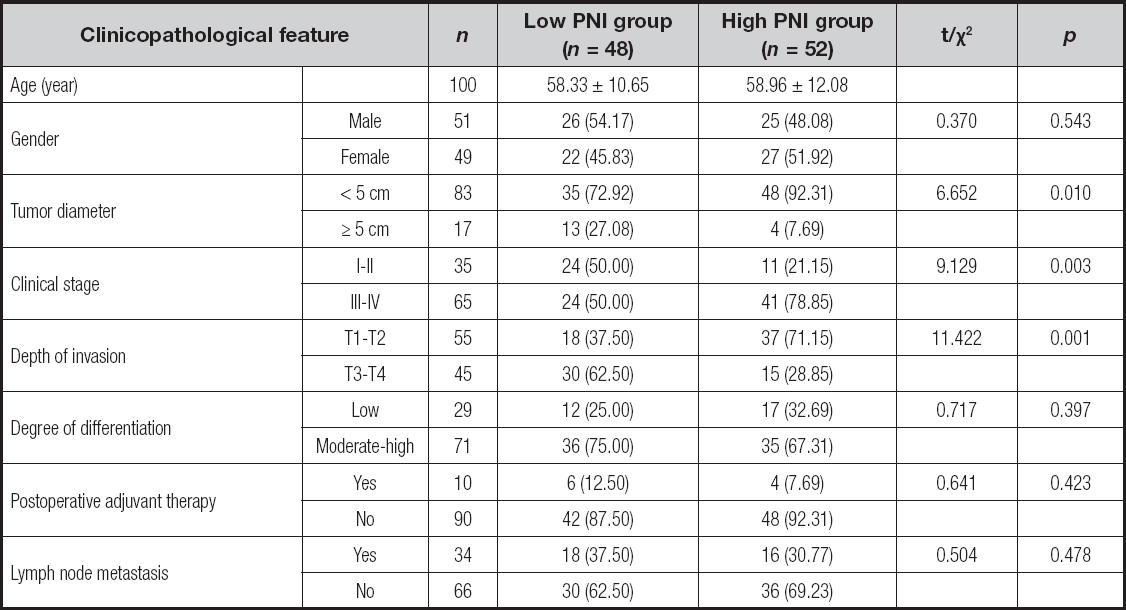
The tumor diameter, clinical stage and depth of invasion in the low PNI group were different from those in the high PNI group (p < 0.05) (Table II).
ASSOCIATIONS BETWEEN DIFFERENT CRP/PA AND CLINICOPATHOLOGICAL FEATURES
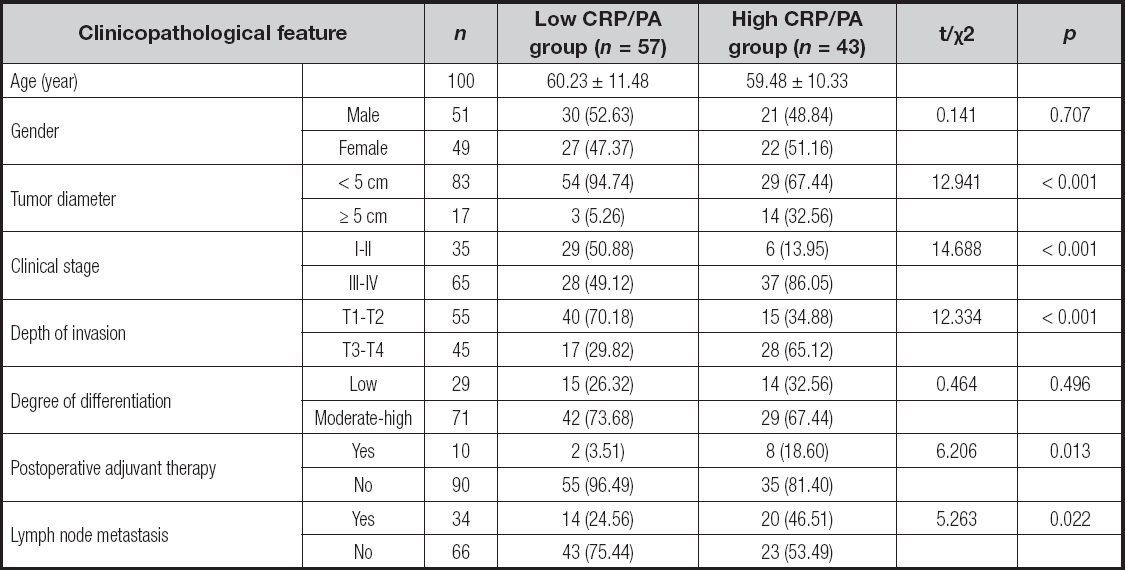
Differences were found in the invasion depth, tumor diameter, clinical stage, lymph node metastasis status and postoperative adjuvant therapy in the low CRP/PA group compared with the high CRP/PA group (p < 0.05) (Table III).
ASSOCIATIONS OF BMI, PNI, AND CRP/PA WITH PROGNOSIS OF GASTRIC CANCER SUBJECTS
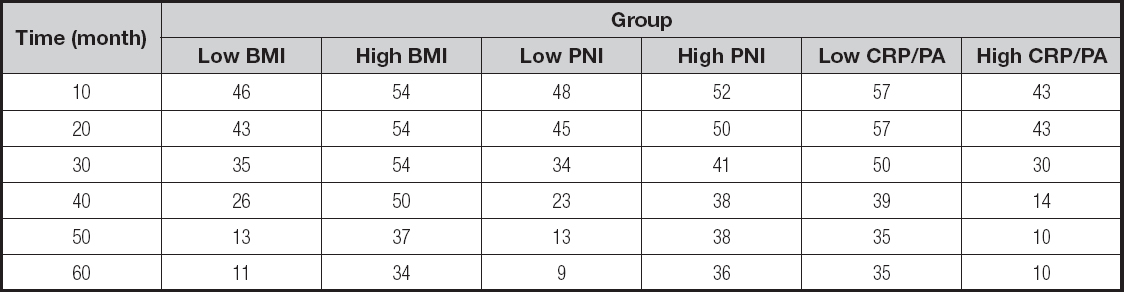
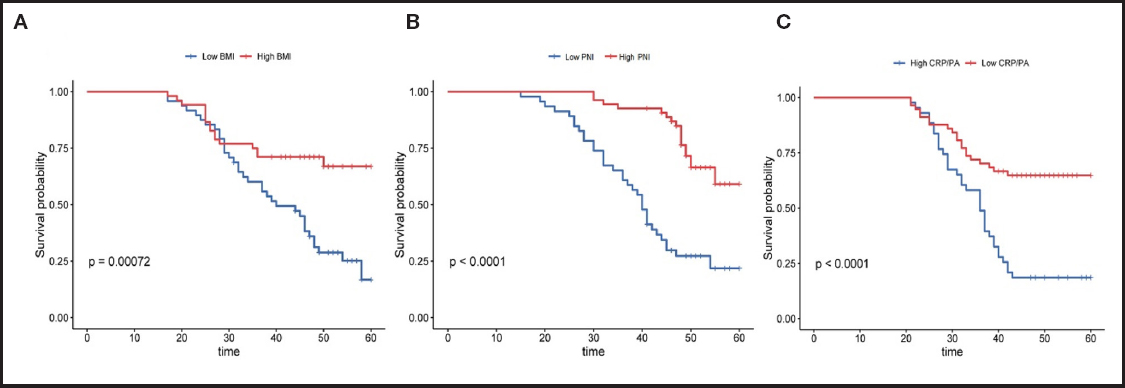
The survival rate of all patients was 45.00 % (45/100) during the 5 years of follow-up. According to the Kaplan-Meier survival analysis, the low BMI group, low PNI group and high CRP/PA group had significantly reduced OS rates compared to those of the high BMI group, high PNI group and low CRP/PA group, respectively (p < 0.05) (Fig. 2 and Table IV).
DISCUSSION
A preoperative abnormal BMI, slightly higher or lower, serves as a risk factor independently affecting the prognosis following operation (including resection of liver cancer, gastrointestinal cancer, and other digestive system tumors) (15). Weight loss not only affects the patients' tolerance and efficacy of treatment, but also increases complications such as infections, resulting in a decline in quality of life and an increase in treatment costs (16). In a recent study exploring the correlation between BMI and prognosis of mantle cell lymphoma (MCL), a low BMI group together with a high BMI group was created to enroll the patients based on the critical value (24 kg/m2), and they all underwent combined chemotherapy (17). The high BMI group, in comparison to the low BMI group, exhibited a lower death rate and longer OS and progression-free survival, suggesting that high BMI is a protective factor for the prognosis of MCL patients. At present, diversified carcinomas covering gastric cancer (18), renal carcinoma and breast carcinoma have been researched to verify how PNI influences the prognosis (19,20). CRP is an acute phase-reactive protein synthesized by the liver. In the case of inflammatory infection, trauma, stress reaction and fever, CRP generally increases within 2 h, and it enhances the phagocytic function and activates complement during inflammatory responses, which is one of the commonly used inflammatory indicators. Some studies have pointed out that CRP increases to different degrees in patients with malignancies, whose mechanism is related to tumor cell reproduction and division and activation of inflammatory cells and related inflammatory factors. In terms of the underlying mechanism, CRP accelerates angiogenesis by raising interleukin and angiogenic factors in carcinoma sufferers at the circulating level (21). In addition, PA, as a commonly used assessment indicator for nutritional status in clinic, has an intimate relation to the poor outcome of various malignant tumors (22). CRP/PA combines inflammatory responses and nutritional status, and the former is a crucial player in the occurrence and progression of gastric cancer (23).
The cut-off values of BMI, PNI and CRP/PA on the ROC curve were obtained, and the associations of different BMI, PNI and CRP/PA with clinicopathological features of subjects with gastric carcinoma were explored in the present research. It was revealed that BMI was related to the tumor diameter, lymph node metastasis status, invasion depth and clinical stage, PNI was associated with the tumor diameter, clinical stage and invasion depth, and CRP/PA was related to the invasion depth, tumor diameter, lymph node metastasis status, clinical stage, and adjuvant chemotherapy. It can be seen that BMI, PNI and CRP/PA may be involved in gastric carcinoma from the aspect of incidence and progression. BMI reflects the body weight of patients, PNI reflects the nutrition condition in patients, and CRP/PA shows the inflammation severity. The aforementioned three indicators jointly display the physiological conditions of patients, thereby affecting the post-transplant prognosis. In practical clinical work, therefore, the comprehensive evaluation of BMI, PNI and CRP/PA can help improve the accuracy of prognostic prediction for patients undergoing radical gastrectomy. In addition, the OS rate rose prominently in the low BMI group, low PNI group and high CRP/PA group by contrast to that in the high BMI group, high PNI group and low CRP/PA group (p < 0.05), according to the Kaplan-Meier survival analysis. BMI may affect the prognosis of patients by affecting their immune function plus nutrition condition, and a higher BMI may indicate better nutritional status, benefitting the prognosis. PNI may affect the immune function of patients, and CRP/PA may reflect the inflammatory responses and immune function of patients, thereby influencing the prognosis.
In conclusion, BMI, PNI and CRP/PA have important predictive value for the prognosis of patients undergoing radical gastrectomy, which can not only provide an effective basis for curing gastric carcinoma in clinic, but also help improve patients' survival rate. These indicators can help clinicians to more accurately assess the prognosis of patients undergoing radical gastrectomy and provide personalized treatment plans for patients. However, it is necessary to further expand the sample size in the future to validate the reliability and practicability of the combined prediction model.

