




 Servicios personalizados

 Inglés (pdf)
 Articulo en XML
 Referencias del artículo

 Traducción automática
 Enviar articulo por email
 Citado por SciELO
 Citado por Google
 Similares en
SciELO
 Similares en Google

 Permalink

INTRODUCTION
Chronic non-communicable diseases (CNCDs) account for most deaths worldwide. According to the World Health Organization (WHO), CNCDs represent 74 % of all global deaths (1). Obesity is recognized as a risk factor for various CNCDs, carrying significant clinical implications. Between 1975 and 2016, the global prevalence of obesity nearly tripled, with 39 % of the adult population classified as overweight and 13 % as obese by 2016 (2). In Brazil, as of 2019, 61.7 % of adults aged 18 and over were overweight, with 25.9 % classified as obese (3).
An analysis of the impact of elevated BMI on global mortality and disability-adjusted life years (DALYs), based on data from the 2021 Global Burden of Disease (GBD) study, estimated that from 1990 to 2021, global deaths and DALYs attributable to high BMI more than doubled for both men and women. However, age-standardized mortality rates remained stable for women while increasing by 15 % for men (4).
Obesity triggers a state of chronic low-grade inflammation. This metabolic inflammatory condition affects adipose tissue and disrupts the function of organs such as the liver, muscles, and pancreas, as well as contributing to cardiovascular dysfunction. In these tissues, a shift in cell population is observed, with increased macrophage infiltration in peripheral tissues. Obesity induces an inflammatory response by activating the toll-like receptor 4 (Toll-4) signaling pathway, which responds to increased exposure to saturated fatty acids (5,6).
Food itself possesses both inflammatory and anti-inflammatory properties, with one or the other prevailing based on the combination of foods consumed. Various strategies have been developed to assess this inflammatory potential, including the recently validated Empirical Dietary Inflammation Pattern (EDIP-SP) in Brazil (7).
Identifying a diet as inflammatory or anti-inflammatory allows for educational interventions that promote anti-inflammatory dietary habits. Such interventions can help modulate the low-grade chronic inflammation associated with certain health conditions such as obesity, and can directly prevent the onset of this type of inflammation (8,9).
In this context, college students, particularly those in health-related fields, may represent a population at risk for poor dietary habits, characterized by inflammatory tendencies and increased obesity risk. This period in life is marked by significant lifestyle changes, including limited free time and restricted access to quality food and adequate physical activity (10,11). Therefore, this study aimed to explore whether there is an association between the empirical pattern of dietary inflammation and the nutritional status of college students.
METHODOLOGY
This cross-sectional study employed a quantitative and analytical approach as part of a Brazilian cohort entitled the “Nutritionist Health Study - NutriHS”, conducted between 2019 and 2020 in Fortaleza, Ceará, Brazil. The study involved undergraduate nutrition students and licensed nutritionists, with the primary objective of examining the relationship between diet and cardiovascular risk. All participants were informed about the study's objectives and provided prior consent by signing an informed consent form. The study was approved by the Ethics Committee of Ceará State University under opinion number 3.528.417.
The study population consisted of undergraduate nutrition students. A convenience sample of 97 students from public and private Higher Education Institutions (HEIs) in Fortaleza, Ceará, was included. Eligible participants were college students of both genders, aged 18 or older, and enrolled in any term of the nutrition program. Pregnancy was an exclusion criterion. The data represents a subset collected during the early and pre-pandemic period of COVID-19. The intended sample size was limited by data collection suspension due to social isolation measures that began in Brazil in March 2020.
Demographic, socioeconomic, lifestyle, anthropometric, and dietary intake data were collected from participants. Demographic and socioeconomic data included gender, age, type of HEI attended, monthly family income, and self-reported race/ethnicity. Lifestyle data encompassed smoking status and physical activity, the latter assessed through the short form of the International Physical Activity Questionnaire (IPAQ), validated for the Brazilian population (12,13).
Anthropometric data, including weight, height, and waist circumference, were collected following the World Health Organization protocol (14). Nutritional status was determined by calculating BMI (weight (kg) / height (m)²) and categorized based on the following cutoffs: ≤ 18.5 kg/m² for underweight, 18.5 to 24.99 kg/m² for normal weight (eutrophy), 25 kg/m² to 29.99 kg/m² for overweight, and ≥ 30 kg/m² for obesity. Waist circumference (WC) (14) was also classified as follows: < 88 cm as adequate and ≥ 88 cm as high for women; < 102 cm as adequate and ≥ 102 cm as high for men.
Dietary intake information was collected using a Food Frequency Questionnaire (FFQ) (15), with quantities reported in household measurements and subsequently converted into daily amounts (grams or milliliters) to estimate each participant's Empirical Dietary Inflammation Pattern (EDIP-SP) score.
The EDIP-SP (7) comprises six dietary components divided into three groups: rice and beans; fruits, vegetables, and greens; and processed meats (e.g., sausage, nuggets, bacon, ham, mortadella, salami, and roast beef). The authors established standard amounts for the calculation: 180 g for rice and beans (in a 5:1 ra- tio), 90 g for fruits, vegetables, and greens (45 g fruit; 45 g vegetables/greens), and 40 g for processed meats. Processed meats are classified as pro-inflammatory, while the other two groups are anti-inflammatory. For EDIP-SP calculation, weights of -0.27 and -0.12 were assigned to the anti-inflammatory groups of rice and beans, and fruits, vegetables and greens, respectively, whereas a weight of +0.27 was assigned to the pro-inflammatory processed meats group.
For enhanced data analysis, select variables were dichotomized: age (≤ 25 years; > 25 years), nutritional status (not overweight; overweight), physical activity (yes; no), and smoking status (yes; no). Normality of variable distribution was assessed using the Kolmogorov-Smirnov test. Statistical analysis involved calculating means and standard deviations for continuous variables and frequencies and percentages for categorical variables. Spearman's correlation test (r) was used to examine the association between the inflammatory score and nutritional status indicators (BMI and WC). A p-value < 0.05 was considered statistically significant across all inferential tests.
RESULTS
The sample was predominantly female (74 %; 76.29 %). Most participants were enrolled in private HEIs (73 %; 75.26 %) and were under 25 years of age (72 %; 74.23 %). Over half of the participants reported a monthly family income of up to five minimum wages (54 %; 55.67 %) and identified as non-white (57 %; 58.76 %). None of the participants smoked, and more than half engaged in physical activity (51.55 %) (Table I).
Table I. Socioeconomic, demographic and lifestyle categorization of the evaluated college students (n = 97) according to gender. Fortaleza, Ceará, Brazil 2022

Table II presents the categorization of the students' nutritional status. The majority were not classified as overweight (58 %; 59.79 %) and had adequate waist circumference (89 %; 91.75 %), with no statistically significant differences by gender. However, a notable proportion of participants were classified as overweight (40.21 %).
Table II. Categorization of nutritional status and waist circumference of the college students evaluated (n = 97) according to gender. Fortaleza, Ceará, Brazil 2022

*Body mass index (BMI): not overweight (BMI < 25 kg/m²); overweight (BMI ≥ 25 kg/m²), according to World Health Organization (2000). †Chi-square test. ‡Fisher's exact test (p < 0.05 as significant).
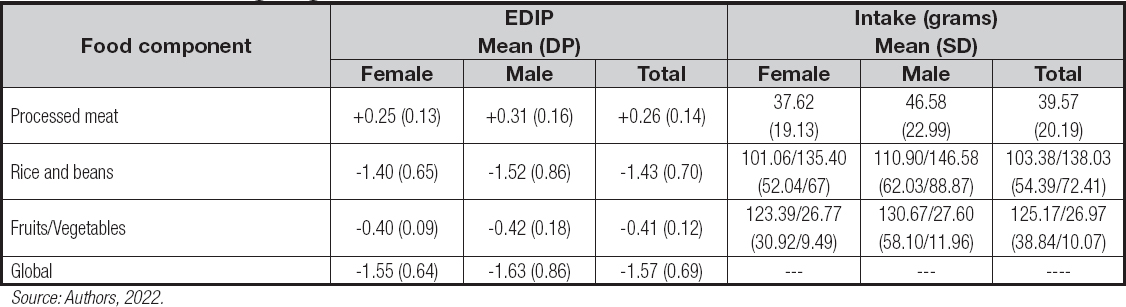
Table III provides the mean EDIP-SP score of the students, overall and by food group, as well as the mean intake (in grams) of the food groups that constitute the index, disaggregated by gender. The overall EDIP-SP score indicated an anti-inflammatory diet (-1.57). Based on the average intake of the students, the proportions among components of the rice/peas and fruits/vegetables food groups did not align with the standard set for EDIP-SP, as bean intake was higher in the rice/peas mix, and fruit intake was greater in the fruits/vegetables mix.
Table III. Mean values, per component and overall, of the Empirical Dietary Pattern of Inflammation (EDIP-SP), and mean consumption of the components by the evaluated college students, according to gender, with standard deviation (SD). Fortaleza, Ceará, Brazil 2022
Source: Authors, 2022.
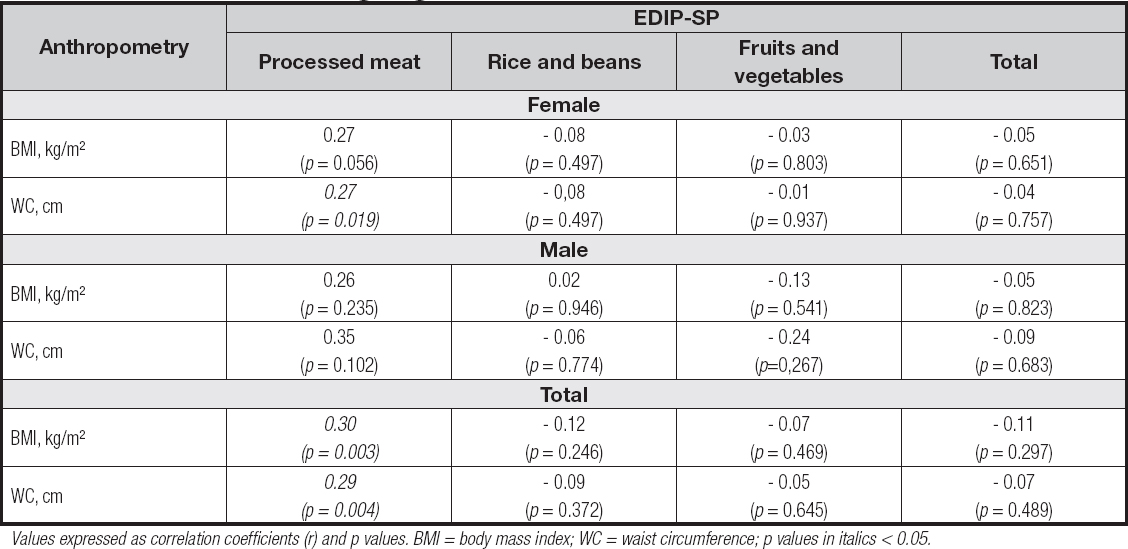
Regarding the correlation analysis between EDIP-SP score and anthropometric data, table IV displays the results, suggesting no significant correlation between these variables. However, when analyzing the correlation between the EDIP-SP score for processed meats and anthropometric data, a statistically significant, though weak, positive correlation was observed with waist circumference (p = 0.019) in females, and with both waist circumference (p = 0.004) and BMI (p = 0.003) across the entire sample.
Table IV. Correlation between the Empirical Dietary Pattern of Inflammation - EDIP-SP (components and total) and anthropometric data of college students evaluated (n = 97) according to gender. Fortaleza, Ceará, Brazil, 2022
Values expressed as correlation coefficients (r) and p values. BMI = body mass index; WC = waist circumference; p values in italics < 0.05.
DISCUSSION
This study aimed to assess the association between an inflammatory dietary pattern and anthropometric markers in undergraduate nutrition students. Most participants displayed a eutrophic nutritional status with no excess abdominal fat. The group studied is relatively young, with the majority aged up to 25, and around half reported engaging in physical activity. Given these factors, along with their background as nutrition students, a lower proportion of overweight individuals than observed (40.21 %) might be expected.
Data from the Surveillance of Risk and Protective Factors for Chronic Diseases by Telephone Survey, considering the age range of 18 to 24 — the closest range to that of most students assessed in this study — indicates an overweight prevalence of 30.6 %, with 29.2 % among men and 32.3 % among women. These figures are lower than those found in the present study.
The majority of students in the sample were from private institutions. There is only one public Higher Education Institution (HEI) offering a Nutrition program in the capital studied. This distribution may have influenced the findings regarding monthly family income, which is likely higher than that typically observed in this population group across Brazil. Data from the Higher Education Map of Brazil, developed by the Esmes Institute, indicate that most Brazilian university students come from low-income families and reveal that 90 % of young people entering college have a family income of up to three minimum wages (16).
Some findings from studies conducted with college students are presented below to allow for comparison with the group investigated here, particularly regarding nutritional status. A study conducted with undergraduate students across various faculties and class years, aged up to 25, at Hashemite University in Zara, Jordan, found similar results to those in the present study, with a predominance of females (65.9 %) and a majority with no overweight status (63.9 %). However, the Jordanian study reported a higher prevalence of smokers (15.4 %) and a greater proportion of physically active students (89.4 %) (17).
The trend of unhealthy lifestyle choices and eating behaviors is observed globally. In Arab countries, there is a marked shift toward dietary and lifestyle transitions, marked by the replacement of traditional diets (rich in vegetables and whole grains) with a more Westernized pattern. Nevertheless, there is insufficient data on dietary patterns, especially among young women in the Middle East. Factors such as altered eating patterns, meal skipping, a preference for fast food, and reduced intake of fruits and vegetables are increasingly common in the daily lives of this population (17).
In a public university in Recife, northeastern Brazil, a cross-sectional study was conducted based on data from a cohort of Nutrition students of both genders, in which 131 college students aged 18 years or older participated. They also found a predominance of females (83.2 %), 56.5 % of respondents with physical inactivity, 3.1 % smokers, and overweight in 11 % of women and 36.4 % of men. High WC was detected in 7.3 % of women and 13.6 % of men (18). Therefore, only regarding excess abdominal adiposity among men, there was a worse nutritional status when compared to the present study, which was also conducted with university students from the northeast of Brazil.
Based on the brief profile presented, it can be observed that the nutritional status of young university students is predominantly marked by the absence of excess weight. It is essential to conduct further comparative and up-to-date studies with robust samples, examining the nutritional status of students in health-related fields and other disciplines, and investigating factors associated with the findings observed. Another aspect evaluated in this study was the empirical pattern of dietary inflammation, which indicated that students maintained an anti-inflammatory dietary pattern. This variable remains understudied in this population, despite other dietary intake assessments being more commonly explored. Some merit further discussion due to their relevance to the dietary components included in the EDIP-SP calculation.
Some studies evaluate the effects of healthy and unhealthy dietary patterns and their outcomes. Adherence to an energy-dense dietary pattern with low nutrient density may contribute to changes in nutritional status and increase the risk of developing chronic diseases (20,21). Studies have reported an association between an inflammatory dietary profile and the etiology of several chronic diseases. Since habitual eating patterns can influence inflammation regulation, Western dietary patterns are linked to higher inflammation levels, while evidence suggests that plant-based diets are associated with lower inflammation levels (19).
In a study conducted at a public institution in southern Brazil, nutritional status and food consumption were assessed (22). The authors observed greater adherence to a traditional Brazilian dietary pattern, characterized by low processed food intake. This consumption pattern was likely influenced by students taking part of their daily meals at the university cafeteria, where fresh and minimally processed foods predominated. Such a pattern fosters a less favorable environment for inflammation (23). Although not assessed in this study, the Dietary Inflammatory Index (DII) is a valuable tool for quantifying the inflammatory potential of different dietary patterns (24).
The traditional Brazilian dietary pattern, as well as the prudent dietary pattern, typically includes beans, with fruits and vegetables also frequent in the prudent pattern (25). Both of these food groups are components in the calculation of EDIP-SP and are considered anti-inflammatory (7). According to the 2017-2018 Household Budget Survey (HBS) (26), foods with the highest average daily per capita consumption in Brazil include beans (142.2 g/day) and rice (131.4 g/day), indicating a diet centered on rice and beans, a combination of good nutritional quality. Participants in this study showed similar consumption averages, as shown in table III (beans 138.03 g/day and rice 103.38 g/day).
Since EDIP-SP validation is recent, there are few published studies evaluating this index in Brazil. Araújo et al. (2022) (27) found no association between an inflammatory diet, according to EDIP-SP, and sleep quality in this same population group. Another study by Cardoso Neto et al. (2023) (28), although involving a different population group of 229 patients with type 2 diabetes mellitus, assessed the relationship between EDIP-SP and nutritional status and also found no association between these variables.
Conversely, to allow for some comparisons, it is valuable to examine studies that have evaluated the dietary inflammatory potential using other indices. The Dietary Inflammatory Index (DII) is an important tool to quantify a diet's inflammatory potential, classifying diets as anti-inflammatory or inflammatory based on the intake of foods, nutrients, bioactive compounds, and spices. One study evaluated the association of this index with annual weight changes over a two-year period within a 10-year follow-up, as well as with the incidence of overweight and obesity, in a prospective cohort of graduates from the University of Navarra, Spain (29). The study found that a more inflammatory diet was significantly associated with a greater risk of clinically relevant weight gain (> 3 kg or > 5 kg) and with a higher mean annual weight gain. Additionally, annual weight gain was higher in the group consuming a more inflammatory diet (+264.5 g) compared to those following a more anti-inflammatory diet (+207.2 g). A diet with higher inflammatory potential was associated with an increased risk of overweight or obesity compared to those in the lowest quartile of DII, indicating consumption of an anti-inflammatory diet.
In a cross-sectional study conducted with a Brazilian cohort of alumni (undergraduate and graduate) from universities in Minas Gerais (UMG), with a mean age of 36.3 years (± 9.4), food intake was analyzed to estimate the energy-adjusted Dietary Inflammatory Index (E-DII) and assess its association with overweight and obesity. The study found that the fourth quartile of E-DII was associated with a higher prevalence of overweight and obesity in both men (PR = 1.35; 95 % CI, 1.17-1.65) and women (PR = 1.95; 95 % CI, 1.31-2.90). One conclusion drawn by the authors was that an inflammatory eating pattern, combined with other unhealthy lifestyle habits and an obesogenic diet, represents a risk factor for obesity and chronic diseases (30).
A study conducted with university students in Tehran, which investigated IID and its relationship with obesity, obtained findings like those of this study. The authors identified a predominance of females, with a low percentage of overweight and obesity participants and low prevalence of high WC. However, there was no association between anthropometric markers and DCI (31). Researchers evaluated Iranian female university students and found no significant association between dietary inflammatory index and obesity (32). In the present study, the findings justify the absence of correlation found, since they are eutrophic individuals and all were on a non-inflammatory diet, although with anti-inflammatory values.
It is noteworthy that the proportion of food components used for EDIP-SP in this study differs from that proposed by the authors who validated the instrument. The validation study specifies a proportion of five parts rice to one part beans, totaling 180 g; a 1:1 ratio of fruits to vegetables, totaling 90 g; and 40 g of processed meats. However, no instructions are provided on how to proceed when these proportions and/or amounts are not met (7). Therefore, the diets assessed may differ in inflammatory content from that suggested by this methodology. As shown in table III, the proportions of rice/peas and fruits/vegetables were not aligned with those used in the EDIP-SP validation. Despite this, the low intake of processed meats, the only inflammatory component of EDIP-SP, may explain the study's findings. Not assessing the specific rice/beans and fruits/vegetables proportions represents a limitation of this study, which future research could address by exploring different consumption proportions.
Although processed meat consumption was low, a weak direct association was observed between this component and waist circumference in women, and with waist circumference and BMI in the overall group. It is possible that studies involving more heterogeneous samples regarding EDIP-SP component intake would yield additional associations. One advantage of using EDIP-SP in Brazilian studies is its validation and adaptation to the Brazilian context. This study also highlights the need for research comparing EDIP-SP data with various dietary patterns to determine whether significant relationships exist between healthy patterns and their anti-inflammatory or inflammatory effects.
Another limitation of this study is the sample size, which is not representative of the population of higher education students in the state where the research was conducted, a constraint influenced by the COVID-19 pandemic, as previously mentioned. A larger sample might have been more heterogeneous in terms of EDIP-SP scores, including a higher proportion of individuals consuming inflammatory diets, which could allow for comparisons between nutritional profiles and inflammatory diet presence.
In conclusion, the sample of undergraduate nutrition students assessed demonstrated an adequate nutritional status and followed an anti-inflammatory diet, according to the EDIP-SP. No correlation was found between nutritional status and the empirical inflammatory pattern of the diet, although processed meat intake showed a weak direct correlation with waist circumference in women, as well as with waist circumference and BMI in the overall group.

