




 Servicios personalizados
 Inglés (pdf)
 Articulo en XML
 Referencias del artículo
 Traducción automática
 Enviar articulo por email
 Citado por SciELO
  Citado por Google
  Similares en
SciELO
Similares en
SciELO  Similares en Google
 Permalink
INTRODUCTION
Chronic kidney disease (CKD) affects approximately 8-16 % of the population (1). In 2017, over 1 million people died from CKD, with global mortality increasing by 41.5 % since 1990 (2,3). As diabetes, hypertension, and obesity become more prevalent, along with an aging global population, CKD has reached epidemic proportions (4), posing a significant public health concern.
As workplaces evolve and transportation and the internet become more widespread, sedentary lifestyles are becoming increasingly common globally. Defined as any waking activity with energy expenditure ≤ 1.5 metabolic equivalents (METs) while sitting or reclining (5), prolonged sedentary behavior poses a growing health risk. The effects of sedentary behavior on health are cumulative and long-lasting, increasing the risk of chronic non-communicable diseases, such as cardiovascular disease (CVD), metabolic disorders, musculoskeletal disorders (6-8), and CKD (9-11). However, these studies have focused primarily on middle-aged or older adults. Moreover, Lynch et al. found no significant relationship between the highest television viewing time and reduced estimated glomerular filtration rate (eGFR) levels after adjusting for covariates (12). Therefore, understanding the impact of sedentary behavior on CKD risk is crucial as it is a lifestyle that can be modified.
Plant-based diets comprise primarily plant-based foods with or without small amounts of meat. Hence, the protein source is plant-based. Increasing evidence suggests that these diets are beneficial for myriad conditions, including CVD, diabetes, metabolic syndrome, and various cancers (13-15). Moreover, many studies have shown that plant-based diets can slow CKD progression and delay dialysis (16), with higher plant-based protein intake associated with lower mortality in patients with CKD (17). Despite the growing attention to these individual factors, research on the combined impact of sedentary behavior and plant protein intake on CKD risk is limited.
This study investigates the relationship between sedentary behavior and CKD risk in the US population. Additionally, it explores the effect of plant protein intake on CKD incidence in individuals with a sedentary lifestyle.
METHODS
STUDY POPULATION
This study utilized data from the National Health and Nutrition Examination Survey (NHANES) database, which assesses health and nutritional data for adults and children throughout the US. Survey data covering six cycles between 2007 and 2018 were extracted from the Continuous NHANES.
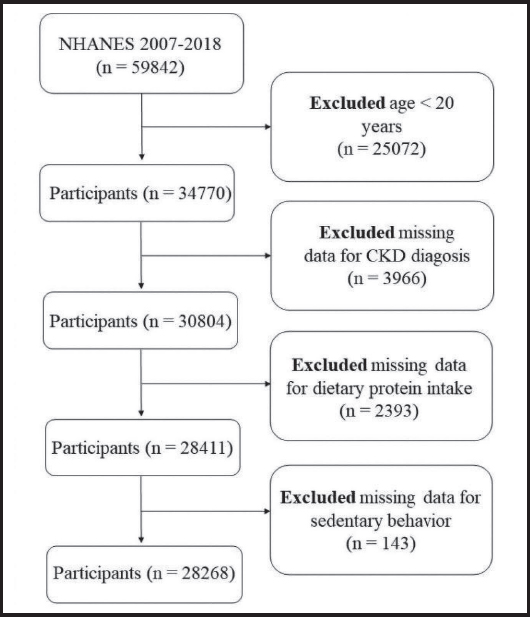
A total of 59,842 individuals were enrolled in the NHANES cohort between 2007 and 2018. After excluding individuals who did not meet the eligibility criteria, as outlined in figure 1, 28,268 participants were included in the final analysis.
DAILY SITTING TIME, PHYSICAL ACTIVITY, DIETARY ASSESSMENT
The NHANES study assessed daily sitting time using physical activity questionnaires. Daily sitting time was determined by asking participants about time spent at work, home, school, with friends, commuting, or engaging in recreational activities (e.g., playing cards, watching TV, and using computers) throughout a typical day. This total daily sitting time is recorded as PAD680, a variable in the NHANES dataset that quantifies self-reported sedentary behavior.
Dietary intake data were evaluated using the first 24-h dietary recall interviews conducted by NHANES’s highly trained staff at mobile examination center. The United States Department of Agriculture’s (USDA) automated multiple-pass method was used to estimate food intake. The Food Patterns Equivalent Database (FPED), associated with NHANES for dietary research purposes, converts American food and beverage intake from NHANES participants into 37 USDA Food pattern components. The intake levels of total protein, animal protein, and plant protein were obtained from the FPED.
DEFINITIONS
In the Continuous NHANES, serum and urinary creatinine levels were assessed using the Jaffe rate method, while urinary albumin was measured using a solid-phase fluorescent immunoassay. The eGFR was calculated using the CKD Epidemiology Collaboration (EPI) equation based on serum creatinine levels (18). ACR is the ratio of urinary albumin to urinary creatinine (19). Patients with CKD were defined by an eGFR < 60 mL/min/1.73 m2 or ACR ≥ 30 mg/g (19). A sedentary time over 6 h/day is more likely to cause adverse health conditions than less than 6 h/day (20). Therefore, sedentary behavior was defined as high (≥ 6 h/day) or low (< 6 h/day). Total protein intake was the sum of the plant and animal proteins, while the plant–protein ratio was defined as the ratio of plant protein intake to total protein intake.
COVARIATES
Covariates were collected with a structured questionnaire, including age, sex, ethnicity, education level, family income (poverty index ratio [PIR]), marital status, and total calories. Smoking status was classified as a former smoker, non-smoker, or current smoker. Alcohol consumption was defined as former, heavy, moderate, mild, or never (21). Physical activity levels were defined as active (≥ 500 MET min/week), somewhat active (> 0 to < 500 MET min/week), or inactive (no reported physical activity data) (22). The body mass index (BMI) was determined using the height and weight of participants. Diabetes was defined as a self-reported diagnosis of diabetes and/or the use of antidiabetic medication. Hypertension was defined as mean systolic blood pressure ≥ 140 mmHg and/or diastolic blood pressure ≥ 90 mmHg, a self-reported diagnosis of hypertension, and/or the use of antihypertensive medication. Stroke and CVD were defined based on self-reported medical history.
STATISTICAL ANALYSIS
The sample weight recommended by NHANES was adopted, specifically the sample weight on a dietary day, with the selected weight record (WTDRD1). Since NHANES employs a complex probability sample design, individual sample weights were calculated as 1/6 × WTDRD1, covering six cycles from 2007 to 2018. Continuous variables were expressed as mean ± standard deviation (SD) when analyzing the baseline characteristics; those conforming to a normal distribution were compared using an independent sample t-test. Categorical variables were expressed as frequencies (percentages) and analyzed using the Chi-square test.
Weighted binary logistic regression was used to investigate the associations between sedentary behavior and CKD risk. Additionally, the relationship between plant protein intake and CKD risk was assessed in participants with high sedentary behavior. Plant protein ratio was included as a continuous variable in the continuous models, providing odds ratios (ORs) and 95 % confidence intervals (CIs). The plant protein ratio was transformed into a categorical variable by quartiles, and the p-value for the trend was calculated. Four models were applied: the crude model was not adjusted for confounding variables; Model 1 was adjusted for age, ethnicity, sex, educational level, PIR, and marital status; Model 2 was further adjusted for BMI, physical activity, smoking status, and alcohol consumption; Model 3 was adjusted for diabetes, hypertension, stroke, and CVD based on Model 2. A restricted cubic spline explored the non-linear association between the plant protein ratio and CKD in high sedentary behavior.
Sensitivity analysis was conducted by modifying the outcome indicators. Weighted ordinal logistic regression was performed using CKD progression risk as the outcome. CKD progression was assessed based on eGFR and albuminuria categories, divided into low risk, moderately increased risk, high risk, and very high risk. The graphical method recommended by Harrell was used to assess the parallel slope assumption in constructing the ordinal logistic regression. All analyses were performed using R version 4.2.1, and statistical significance was determined using a two-sided p-value < 0.05.
RESULTS
BASELINE CHARACTERISTICS OF THE STUDY POPULATION
In total, 28,268 participants (male: female, 13,812: 14,456) were included in the study, with a mean age of 47.449 ± 0.253 years; 5003 (17.698 %) had CKD. Additionally, 13,448 participants (51.263 %) reported a sedentary time of ≥ 6 h/day (Table I).
Table I Baseline characteristics of the study participants
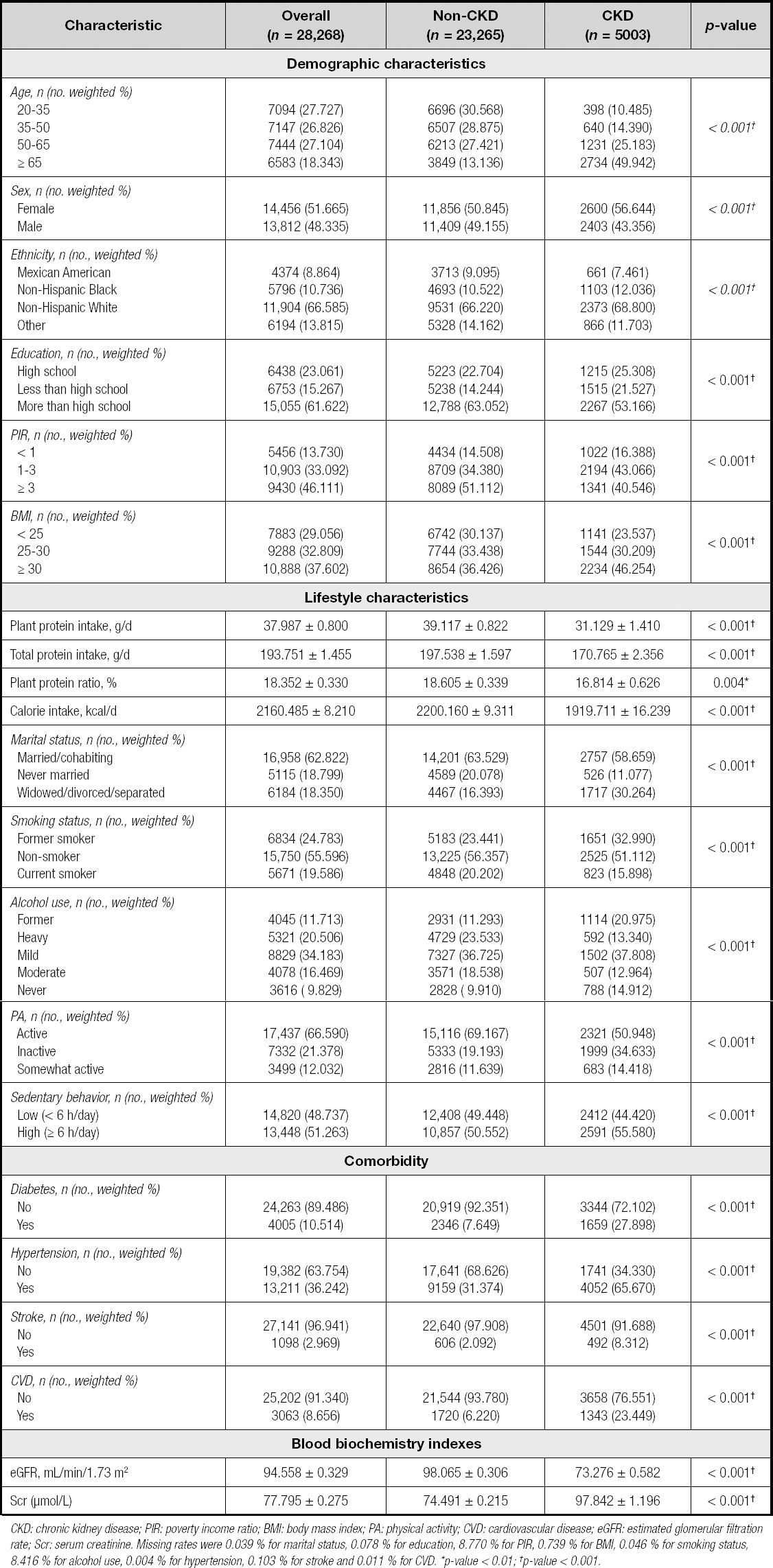
CKD: chronic kidney disease; PIR: poverty income ratio; BMI: body mass index; PA: physical activity; CVD: cardiovascular disease; eGFR: estimated glomerular filtration rate; Scr: serum creatinine. Missing rates were 0.039 % for marital status, 0.078 % for education, 8.770 % for PIR, 0.739 % for BMI, 0.046 % for smoking status, 8.416 % for alcohol use, 0.004 % for hypertension, 0.103 % for stroke and 0.011 % for CVD. *p-value < 0.01; †p-value < 0.001.
SEDENTARY BEHAVIOR AND CHRONIC KIDNEY DISEASE INCIDENCE
Three binary logistic regression models (weighted) were constructed. The fully adjusted model identified a positive relationship between sedentary behavior and CKD (OR = 1.130, 95 % CI = 1.009-1.265). Participants with high sedentary behavior were more prone to develop CKD, with a likelihood 1.13 times that of participants with low sedentary behavior (Table II).
Table II Weighted binary logistic regression for the association between sedentary behavior and CKD risk
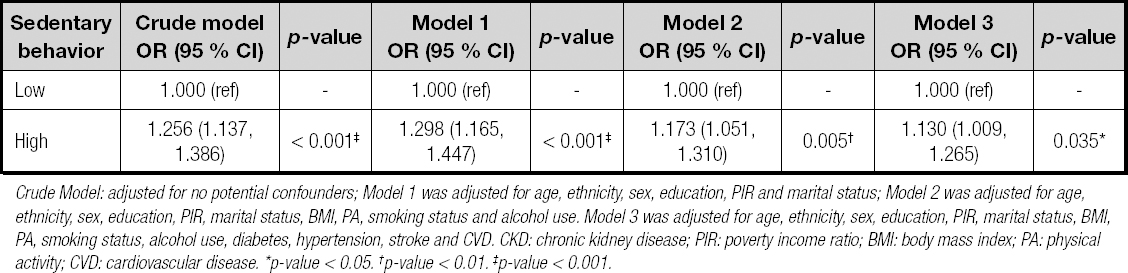
Crude Model: adjusted for no potential confounders; Model 1 was adjusted for age, ethnicity, sex, education, PIR and marital status; Model 2 was adjusted for age, ethnicity, sex, education, PIR, marital status, BMI, PA, smoking status and alcohol use. Model 3 was adjusted for age, ethnicity, sex, education, PIR, marital status, BMI, PA, smoking status, alcohol use, diabetes, hypertension, stroke and CVD. CKD: chronic kidney disease; PIR: poverty income ratio; BMI: body mass index; PA: physical activity; CVD: cardiovascular disease. *p-value < 0.05. †p-value < 0.01. ‡p-value < 0.001.
SEDENTARY BEHAVIOR, PLANT PROTEIN INTAKE, AND CHRONIC KIDNEY DISEASE INCIDENCE
In participants with high sedentary behavior, increased plant protein ratio was associated with a reduced risk of CKD. In a continuous model, each 10 % increase in plant protein ratio reduced the risk of CKD by 35.4 % (OR, 0.646; 95 % CI, 0.465-0.899) after adjusting for all considered covariates (Table III). Binary logistic regression analysis was conducted on the quartile of the plant protein ratio. Compared with the lowest quartile, the OR (95 % CIs) for the highest quartiles was 0.740 (95 % CI, 0.614-0.893; Table III). The inverse trend of the plant protein ratio with CKD risk was statistically significant in the fully adjusted model for all covariates (p-trend < 0.05).
Table III Weighted binary logistic regression for the association between plant protein and CKD risk in high sedentary behavior participants
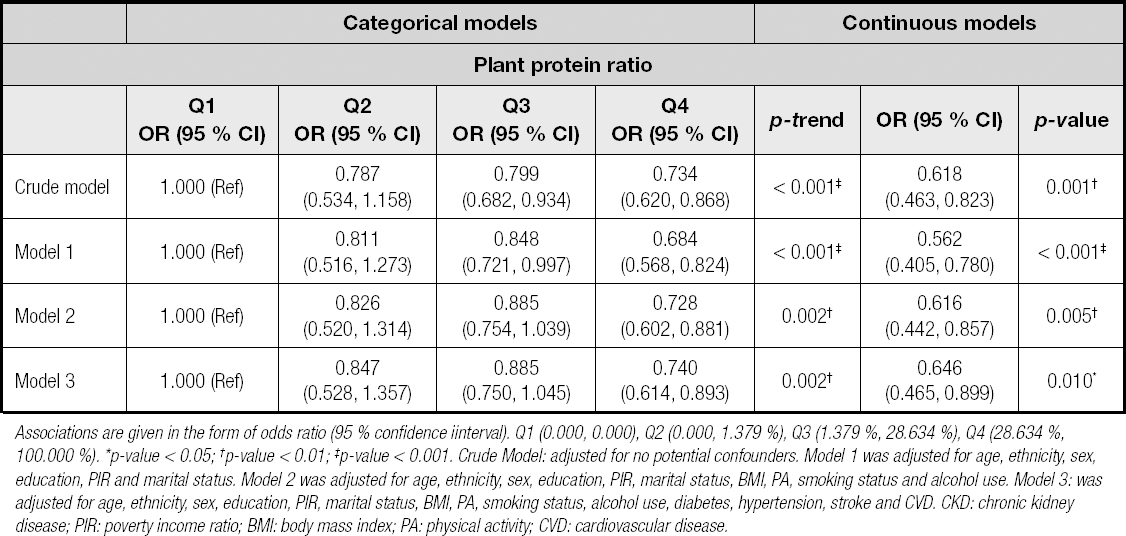
Associations are given in the form of odds ratio (95 % confidence iinterval). Q1 (0.000, 0.000), Q2 (0.000, 1.379 %), Q3 (1.379 %, 28.634 %), Q4 (28.634 %, 100.000 %). *p-value < 0.05; †p-value < 0.01; ‡p-value < 0.001. Crude Model: adjusted for no potential confounders. Model 1 was adjusted for age, ethnicity, sex, education, PIR and marital status. Model 2 was adjusted for age, ethnicity, sex, education, PIR, marital status, BMI, PA, smoking status and alcohol use. Model 3: was adjusted for age, ethnicity, sex, education, PIR, marital status, BMI, PA, smoking status, alcohol use, diabetes, hypertension, stroke and CVD. CKD: chronic kidney disease; PIR: poverty income ratio; BMI: body mass index; PA: physical activity; CVD: cardiovascular disease.
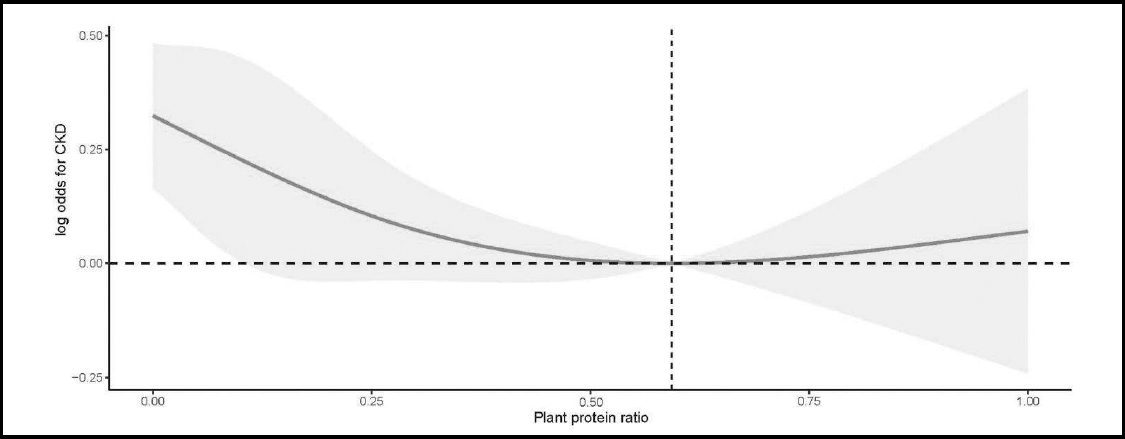
The restricted cubic spline model indicated a non-linear association between plant protein ratio and CKD risk (Fig. 2). The optimal intake ranges for plant protein ratios were 0.000-59.296 %, which could reduce the risk of CKD.
SENSITIVITY ANALYSIS
In sensitivity analysis, the robustness of the results was confirmed when CKD prognosis was used in place of CKD risk (Table IV).
Table IV Weighted ordinal logistic regression for the association between plant protein ratio and CKD prognosis in high sedentary behavior participants
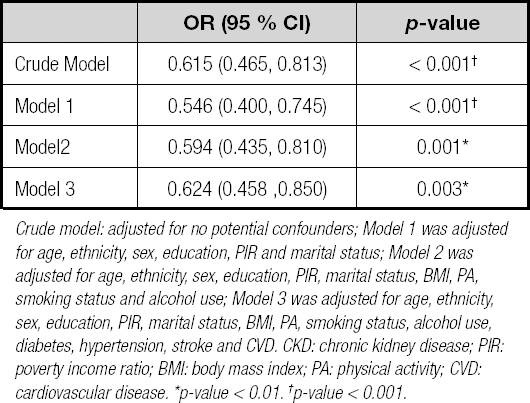
Crude model: adjusted for no potential confounders; Model 1 was adjusted for age, ethnicity, sex, education, PIR and marital status; Model 2 was adjusted for age, ethnicity, sex, education, PIR, marital status, BMI, PA, smoking status and alcohol use; Model 3 was adjusted for age, ethnicity, sex, education, PIR, marital status, BMI, PA, smoking status, alcohol use, diabetes, hypertension, stroke and CVD. CKD: chronic kidney disease; PIR: poverty income ratio; BMI: body mass index; PA: physical activity; CVD: cardiovascular disease. *p-value < 0.01. †p-value < 0.001.
DISCUSSION
To our knowledge, this is the first study to examine how sedentary behavior and plant protein intake affect CKD risk in a nationally representative adult population (> 20 years old). A relationship was identified between sedentary behavior and CKD risk, as well as between plant protein intake and CKD risk in participants with high sedentary behavior.
The global rise of chronic non-communicable diseases and the aging population has made CKD the twelfth leading cause of mortality worldwide (23). Given that CKD is a progressive and irreversible disease, an urgent need exists to identify at-risk individuals early and implement interventions. A sedentary lifestyle, recognized as a risk factor for various diseases (24), is associated with increased CKD risk (9). This aligns with the current study results. CKD is defined by decreased renal function (eGFR < 60 mL/min/1.73 m2) and kidney damage (albuminuria ≥ 30 mg/24 h. Sedentary behavior may cause extensive endothelial dysfunction and capillary rarefaction (25). It is also associated with adverse health outcomes, including higher blood pressure, larger waist circumference, higher BMI, higher levels of triglyceride and glucose levels, and metabolic syndrome, which individually or collectively strain the kidneys and increase CKD risk.
The daily diet of patients with CKD has been extensively researched to identify patterns conducive to optimal kidney health. High salt intake exacerbates a decrease in kidney function by negatively affecting blood pressure and blood vessels (26). However, due to prolonged observation periods and strict dietary interventions during trials, no randomized controlled studies have specifically sought to prevent CKD among healthy individuals.
Consumption of red and processed meat is associated with an increased risk of developing CKD among Iranian and US participants (27,28). Conversely, legume and nut consumption is linked to a lower risk of CKD development (27). In individuals with normal renal function, diets rich in plant-based sources are associated with decreased production of uremic toxins, such as p-cresyl sulfate and indoxyl sulfate (29). Uremic toxins are linked to the progression of kidney disease, inflammation, and CVD (30). Furthermore, dietary patterns that tend to be plant-based, such as the Mediterranean diet and the Dietary Approaches to Stop Hypertension (DASH), have garnered widespread attention. Adherence to these diets is associated with a lower risk of developing CKD and can decelerate its progression (31-34). This emphasizes the benefits of plant-derived protein over animal-derived protein for kidney health. Moreover, a recent longitudinal study of participants with no history of CKD reported that greater dietary plant protein intake is inversely related to incident CKD (35). However, no study has examined the protective effect of plant protein on kidney health in sedentary individuals.
In the current study, a high plant protein ratio was associated with a lower risk of CKD in individuals with high sedentary behavior (≥ 6 h/d). Furthermore, the restricted cubic spline model was used to explore the optimal range of plant protein intake, revealing that, in sedentary individuals, a dietary plant protein ratio between 0.000 and 59.296 % was associated with a reduced risk of incident CKD. Various mechanisms have been proposed to explain the benefits of plant protein intake on kidney health. Hypertension, type 2 diabetes mellitus, and obesity all contribute to kidney disease. Meanwhile, compared to animal proteins, plant-based food intake is linked to lower blood pressure, weight loss, and a lower risk of type 2 diabetes mellitus (36,37). A study of ten healthy individuals who consumed an equivalent amount of animal or plant protein for 3 weeks showed that plant protein intake decreased renal plasma flow, fractional clearance of albumin, and IgG while increasing renal vascular resistance (38). The variation in amino acid consumption from plant versus animal proteins could explain their differing effects on kidney health (39,40).
This study has certain limitations. First, NHANES is a cross-sectional survey, preventing causal relationships from being determined. Second, the dietary data were based on self-reported first 24-h dietary recall, which may not reflect normal or long-term dietary behavior and may be influenced by memory bias. Finally, although the models adjusted for numerous potential confounding factors, residual confounding factors cannot be fully excluded.

