




 Servicios personalizados
 Inglés (pdf)
 Articulo en XML
 Referencias del artículo
 Traducción automática
 Enviar articulo por email
 Citado por SciELO
  Citado por Google
  Similares en
SciELO
Similares en
SciELO  Similares en Google
 Permalink
INTRODUCTION
Osteoporosis (OP), a chronic metabolic bone disease, is pathologically defined by reduced bone mass and microarchitectural deterioration, leading to diminished bone mineral density (BMD) and compromised biomechanical integrity. This condition clinically manifests as elevated fracture susceptibility, representing a global public health challenge of substantial magnitude (1). Epidemiological data indicate approximately 33 % of women and 20 % of men aged ≥ 50 years face OP-related complications (2,3). Furthermore, demographic aging trends predict exponential growth in OP prevalence, with profound socioeconomic implications for healthcare systems and societal economic frameworks (4). Given these projections, systematic identification of modifiable risk factors constitutes a critical priority for developing targeted preventive strategies (5).
Emerging evidence underscores the intricate association between dietary nutrients and skeletal homeostasis, particularly in bone development and preservation (6). Niacin (vitamin B3), predominantly sourced from red meat, poultry, fish, dairy products, nuts, whole grains, and legumes or through dietary supplementation, serves as the biochemical precursor for nicotinamide adenine dinucleotide (NAD+) and nicotinamide adenine dinucleotide phosphate (NADP+) (7). Beyond its classical roles, niacin exhibits anti-inflammatory and antioxidant properties, maintains genetic stability via NAD(P)-dependent epigenetic enzyme activity, regulates metabolism and aging through epigenetic mechanisms, and influences diverse diseases pathological processes including cancer, aging, metabolic disorders and cardiovascular diseases (8,9). In bone metabolism, animal studies highlight niacin’s dual mechanisms of action. First, niacin supplementation enhances SIRT-1 activity and substrate availability, promoting the deacetylation of transcription factors such as RUNX2 to activate osteoblast differentiation genes, thereby stimulating bone formation (10,11). Second, Additionally, niacin receptor 1 (NIACR1/GPR109A), an anti-inflammatory receptor critical for balancing osteogenesis and osteoclastogenesis, mediates further bone-protective effects (12). Research by C et al. revealed that GPR109A activation by hippuric acid inhibits osteoclast differentiation and bone resorption, alleviating ovariectomy-induced osteoporosis (13). As a natural GPR109A ligand, niacin likely triggers similar downstream pathways to suppress osteoclast activity. Furthermore, NIACR1 activation reduces lipotoxic substance accumulation (e.g., free fatty acids, oxidized LDL) in the bone microenvironment by inhibiting lipolytic enzymes, thereby protecting bone cells (11,14). However, high-dose niacin supplementation may adversely affect bone health by stimulating prostaglandin D2 (PGD2) and peripheral serotonin release, which negatively impact bone tissue (15). Given osteoporosis’s multifactorial nature—influenced by metabolic variability, dietary patterns, hormonal status, and gut microbiota—niacin’s effects require careful evaluation in specific subgroups.
Although previous studies have explored the association between niacin intake and BMD, their conclusions remain inconsistent. An epidemiological study involving 1,883 postmenopausal women (average dietary niacin intake: 19.4 mg/day) reported an inverse relationship between niacin intake and fracture risk, where each additional 13 mg/day of dietary niacin was associated with a 10 % reduction in osteoporosis risk (16). In contrast, a study by Laura D. Carbone et al. observed a U-shaped relationship between niacin intake and hip fracture risk. This study enrolled 5,201 African American and White men and women aged ≥ 65 years (average niacin intake: 32.6 mg/day) between 1989 and 1990, with BMD assessments conducted during follow-up in 1994-1995. The findings suggested that excessive niacin intake might elevate fracture risk, highlighting potential harm at higher doses (15). These discrepancies may arise from differences in study populations (e.g., age, baseline niacin intake), measurement methods, or design limitations, emphasizing the need for further research to clarify niacin’s dose-response relationship with osteoporosis (OP) risk. To address these inconsistencies, the current study focuses on U.S. adults aged ≥ 50 years and investigates sex-specific differences. Notably, the recommended dietary allowance (RDA) for niacin in adults is 14-16 mg/day, with a tolerable upper intake level (UL) of 35 mg/day (17). However, excessive intake (> 50 mg/day) may induce adverse effects such as vasodilation (18). Given these thresholds and the conflicting epidemiological evidence, identifying the optimal niacin intake range for OP prevention—balancing efficacy and safety—remains a critical public health priority.
In this study, we re-examined the relationship between niacin intake and osteoporosis by expanding the sample size and establishing new quartile intervals, aiming to reconcile inconsistencies in prior research and provide clearer guidance for future investigations. First, while earlier studies predominantly focused on populations aged over 65 or postmenopausal women, our analysis highlights that age 50 itself marks a critical high-risk period for osteoporosis onset. This phase is characterized by declining estrogen levels in women and rapid reductions in testosterone levels in men, both of which heighten osteoporosis risk across genders. Additionally, Study C et al. utilized data from two decades ago, a period when overall niacin intake levels were significantly higher. Given evolving dietary patterns and potential shifts in niacin consumption, updated data are essential for robust analysis. To address this, our study incorporated the latest NHANES data (2007-2018), first revealing a nonlinear inverted U-shaped association between dietary niacin intake and osteoporosis risk in U.S. adults aged ≥ 50 years. This finding fills a critical research gap by delineating dose-response characteristics in middle-aged and elderly populations during this period, offering early preventive insights for osteoporosis in this demographic. Furthermore, this study innovatively employed Restricted Cubic Spline (RCS) models to identify gender-specific inflection points, demonstrating for the first time that gender significantly moderates the niacin-osteoporosis association. This finding offers a novel perspective on the complex interactions between niacin intake and OP. We hope this research will yield stronger evidence for the role of niacin in OP prevention.
MATERIALS AND METHODS
DATA SOURCES
This cross-sectional observational study used data from NHANES (2007-2010, 2013-2014, and 2017-2018). NHANES is a multistage, large-scale, stratified, and nationally representative survey of the U.S. population, incorporating household interviews conducted in participants’ homes and health screenings performed in mobile examination centers. Detailed information on demographic, socioeconomic, dietary and health information is collected through questionnaires, medical examinations and laboratory tests (19) NHANES employs a randomized, stratified, multistage probability cluster sampling design to assess the health and nutritional status of the non-institutionalized U.S. population, with data updated biennially. The NHANES protocol was approved by the National Center for Health Statistics (NCHS) Research Ethics Review Board, and written informed consent was obtained from all participants. As this study utilized publicly available data for secondary analysis, additional institutional review board approval was not required.
For this study, individuals aged 50 years and older were selected as the target population. Evidence indicates a marked increase in osteoporosis risk after age 50, with approximately one-third of women and one-fifth of men in this age group facing osteoporosis-related risks. Setting the lower age limit at 50 years ensures both representativeness of the study population and a focus on the age cohort with the highest osteoporosis incidence. This selection enhances the practicality and relevance of the study findings, offering valuable insights for early osteoporosis screening and intervention.
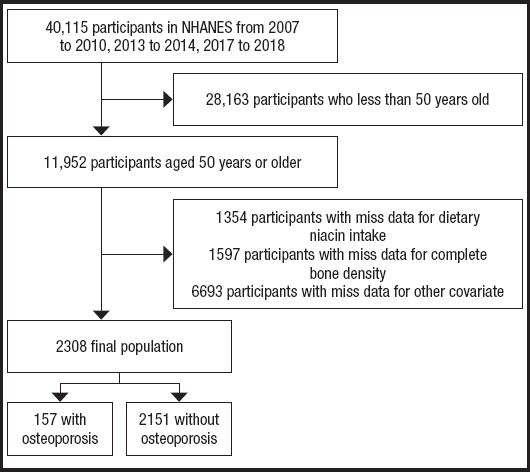
To ensure data integrity and reliability, participants meeting any of the following criteria were excluded: 1) age < 50 years (n = 28,163), 2) missing BMD information (n = 1,597), 3) incomplete dietary niacin intake data (n = 2354), or 4) missing osteoporosis-related covariate information (n = 6693). Ultimately, 2,308 participants were included in the final analysis (Fig. 1).
DIAGNOSIS OF OSTEOPOROSIS
All participants included in the final analysis underwent BMD assessment via dual-energy X-ray absorptiometry (DXA) using a Hologic QDR-4500A fan-beam densitometer (Hologic Inc., Bedford, MA, USA). DXA data were processed through Hologic APEX software (v. 4.0), with procedural details publicly accessible on the NHANES official platform. Using the mean BMD of White women aged 20-29 years from the U.S. NHANES III database as the reference value, BMD levels for the total femur, femoral neck, and lumbar spine (L1-L4) were converted into T-scores. Diagnostic classifications were defined as follows: OP: T-score ≤ -2.5; osteopenia: -2.5 < T-score ≤ -1.0; normal bone density: T-score > -1.0. Non-OP status encompassed both osteopenic and normodense classifications.
ASSESSMENT OF NIACIN INTAKE
Dietary intake data were collected by trained dietary interviewers using the NHANES Computer Assisted Dietary Interview (CADI) system. The diet interview segment, called “What We Eat in America” (WWEIA), was conducted in partnership with the U.S. Department of Agriculture (USDA) and the U.S. Department of Health and Human Services (DHHS) (20). Each Mobile Inspection Center (MEC) dietary interview room follows a standardized set of measurement guidelines that are agreed upon by experts in regular workshops and are specifically designed for the current NHANES environment.
The database uses a multi-channel recall method to collect food information, all reflecting the intake over a 24-hour period. The initial meal recall was conducted in person at the Mobile Inspection Center (MEC), and subsequent recalls were conducted by telephone interview approximately 3-10 days later (18). Use the USDA Dietary Research Food and Nutrition Database (FNDDS) to calculate the nutrient content and food composition in all foods. To ensure the accuracy of the data, the participants’ daily niacin intake was determined by calculating the average of their two dietary recalls. Niacin in this study refers to niacin in the diet and does not include niacin supplements.
COVARIATES EVALUATION
Based on previous literature, we evaluated a variety of confounding factors that may influence the association between dietary niacin intake and OP. Continuous variables included age, vitamin D, serum calcium, serum phosphor, serum magnesium, bone mineral density, total energy, protein consumption, fat consumption, fiber intake, vitamin B1 intake, vitamin B2 intake, folic acid intake, and dietary niacin intake. The categorical variables included race (black, white, Mexican, and others), sex (female, male), marital status (unmarried, married/cohabiting, widowed/divorced/separated), high blood pressure (No/Yes), diabetes (No/Yes), smoking status (never smoker, current smoker, and former smoker), alcohol consumption (light, moderate, heavy), and physical activity (inactive, active), education level (below 9th grade, 9-11 grade, some college, college graduate or above), personal history of bone fracture (No/Yes), parental history of bone fracture (No/Yes), household income to poverty ratio (PIR, low income ≤ 1.3; 1.3 ≤ middle income < 3.5; high income > 3.5), body mass index (BMI < 30, BMI ≥ 30). Smoking status was divided into never smokers (defined as smoking less than 100 cigarettes in a lifetime), current smokers (defined as smoking more than 100 cigarettes in a lifetime), and former smokers (defined as smoking more than 100 cigarettes in a lifetime and having quit). According to the Centers for Disease Control and Prevention’s Physical Activity Guidelines for Americans, participants are classified as physically active if they engage in at least 150 minutes of moderate-to-vigorous physical activity per week, otherwise, they are considered inactive. Information on physician-diagnosed high blood pressure, high cholesterol, diabetes and parental fracture history was obtained through self-report. Body mass index (BMI) is calculated by dividing weight (kg) by the square of height (m2). The total energy, protein consumption, fat consumption, fiber intake, vitamin B1 intake, vitamin B2 intake, folic acid intake values were obtained through dietary recall.
STATISTICAL METHOD
NHANES ‘complex survey design factors, including weighting, clustering, and stratification, were considered according to the NCHS normative analysis criteria. Dietary niacin intake was analyzed as a continuous variable and a categorical variable respectively. We report continuous data as mean with standard deviation or median with interquartile spacing, and categorical data as counts and percentages. logistic regression analysis was performed to investigate the relationship between dietary niacin intake and the risk of osteoporosis. To evaluate the contributions of distinct variable sets to the model, we constructed four sequential covariate-adjusted models by progressively introducing covariates. This hierarchical approach was designed to analyze the association between dietary niacin intake and osteoporosis risk while mitigating over-adjustment bias, thereby enhancing the validity of exposure-effect estimation. crude model, unadjusted variable; model 1, adjusting for sex, age, ethnicity, marital status, education level; model 2, further adjusted for BMI, smoke, drink, physical activity, hypertension, diabetes and high cholesterol; model 3, further adjusted for serum calcium, serum phosphorus, protein consumption, fat consumption, vitamin B1 intake, vitamin B2 intake, folic acid intake. The regression results were expressed as OR and 95 % CI. The restricted cubic spline function was used to describe the nonlinear relationship between niacin intake and OP risk. In addition, to increase the confidence of the results, we performed subgroup analyses by sex, race, marital status, education, PIR, smoking, drinking, BMI, hypertension, diabetes, and calculated interactions to explore the effects of niacin intake on different subgroup outcomes. A p < 0.05 was considered statistically significant.
RESULTS
POPULATION CHARACTERISTICS
The study initially identified 40,115 potential participants from NHANES database across survey cycles spanning 2007-2010, 2013-2014, and 2017-2018. After excluding 28,163 individuals aged below 50 years, subsequent exclusions were applied for missing BMD measurements (n = 1,579), incomplete dietary niacin intake data (n = 1,354), and missing covariates (n = 6,693). The final analytical cohort comprised 2,308 eligible participants derived from the NHANES. A flowchart of theinclusion and exclusion process is provided in figure 1.
BASELINE CHARACTERISTICS OF THE STUDY POPULATION
The sample characteristics are summarized in table I. After applying inclusion and exclusion criteria, 2,308 participants were included in the study, who were divided into the OP group (157 people) and Non-OP group (2,151 people), with an OP prevalence of 7.7 %. The mean age of the participants was 61.29 ± 0.26 years, of which 1,227 (54.05 %) were female. The majority of the population is white (71.91 %), with smaller percentages of blacks, Mexicans and people of other ethnic backgrounds (10.16 %, 5.73 %, 12.20 %). The overall level of education was high, with more than half (84.44 %) of the participants having a university degree or above. The average daily intake of niacin in 24 hrs was 24.41 ± 0.37 mg. It is worth noting that patients in the OP group were more female, older and had lower niacin intake (p < 0.05). In addition, there were differences in PIR, BMI, race, marital status, serum phosphorus, protein consumption, vitamin B1 intake, vitamin B2 intake, folic acid intake between the two groups (p < 0.05), while there were no significant differences in education, smoking and drinking status, diabetes and hypertension.
Table I Basic characteristics of the OP and non-OP populations of NHANES
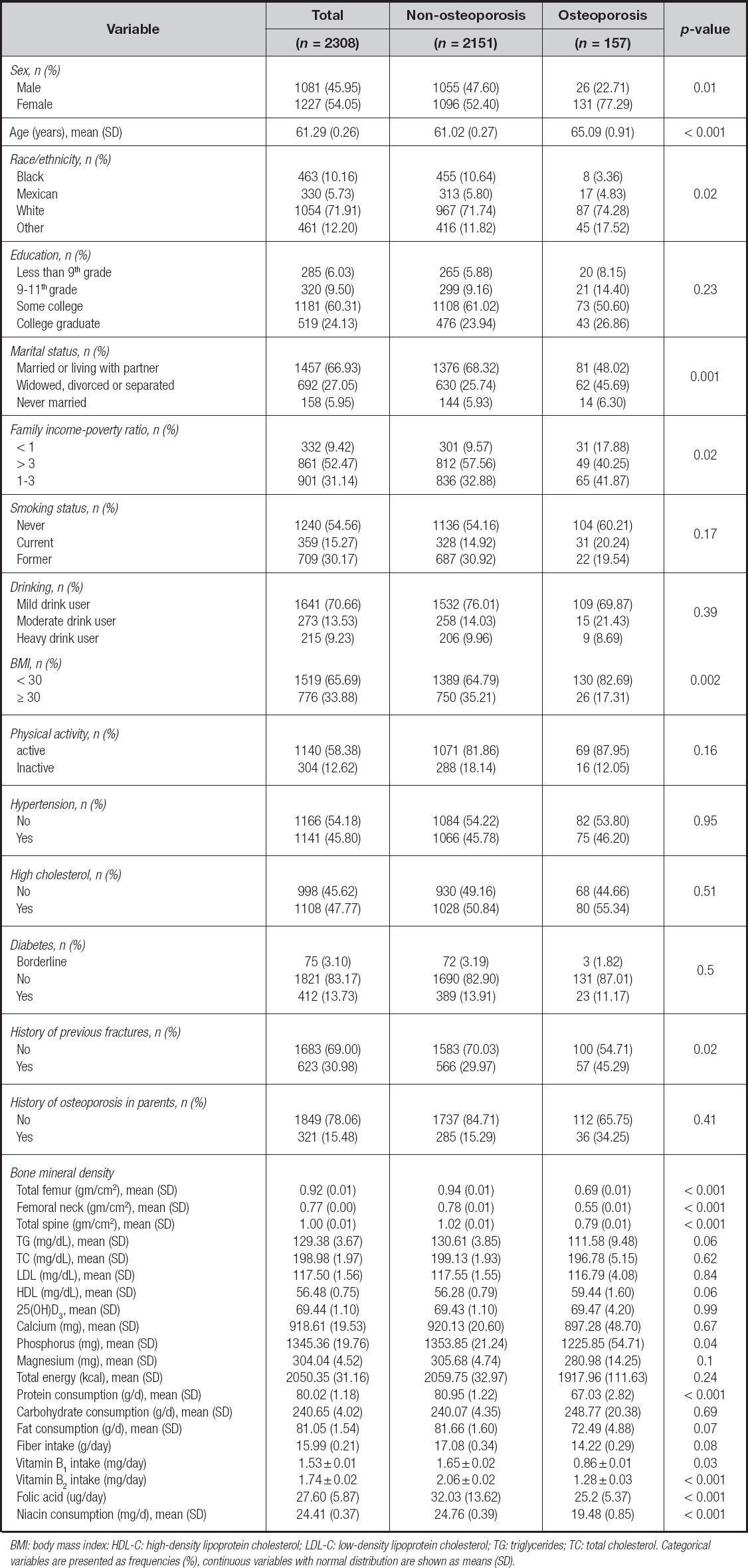
BMI: body mass index: HDL-C: high-density lipoprotein cholesterol; LDL-C: low-density lipoprotein cholesterol; TG: triglycerides; TC: total cholesterol. Categorical variables are presented as frequencies (%), continuous variables with normal distribution are shown as means (SD).
DIETARY NIACIN INTAKE AND THE RISK OF OSTEOPOROSIS
Multivariate logistic regression analysis found a significant negative correlation between dietary niacin intake and OP (Table II). In analyses with niacin intake as a continuous variable, it was found that for every 1 mg/day increase in niacin intake, the risk of OP was reduced by 4 % and the OR was 0.96 (95 % CI: 0.93-0.99, p = 0.04). Subsequently, analyzing niacin intake as a quartile categorical variable, we observed that Q4 group had a lower risk of OP compared with Q1 group in the unadjusted model, the OR of developing OP was 0.69 (95 % CI: 0.08, 0.37, p < 0.001). After adjusting for uncontrollable demographic characteristics variables (sex, age, ethnicity, marital status and education level) in model 1, the negative association between dietary niacin and OP risk did not change, and the difference was still statistically significant, OR was 0.72 (95 % CI: 0.12-0.75, p = 0.01). In model 2, after further adjustment for BMI, smoking, drinking, physical activity, hypertension, diabetes and high cholesterol, dietary niacin was still negatively associated with OP risk, the OR was 0.75 (95 % CI: 0.10-0.91, p = 0.03). Serum calcium, serum phosphorus, protein consumption, fat consumption, vitamin B1 intake, vitamin B2 intake and folic acid intake were added to model 3, and after comprehensive adjustment of covariates, the negative association between dietary niacin acid and OP risk remained stable, OR was 0.81 (95 % CI: 0.68-0.84, p = 0.03), p for trend = 0.04. It is of particular interest that he second quartile of niacin increased the risk of OP, while the third and fourth quartile reduced the risk of OP, implying a potential threshold effect. There is a nonlinear relationship between niacin and OP risk in the elderly.
Table II Logistic regression analysis of the association between dietary niacin intake and osteoporosis risk
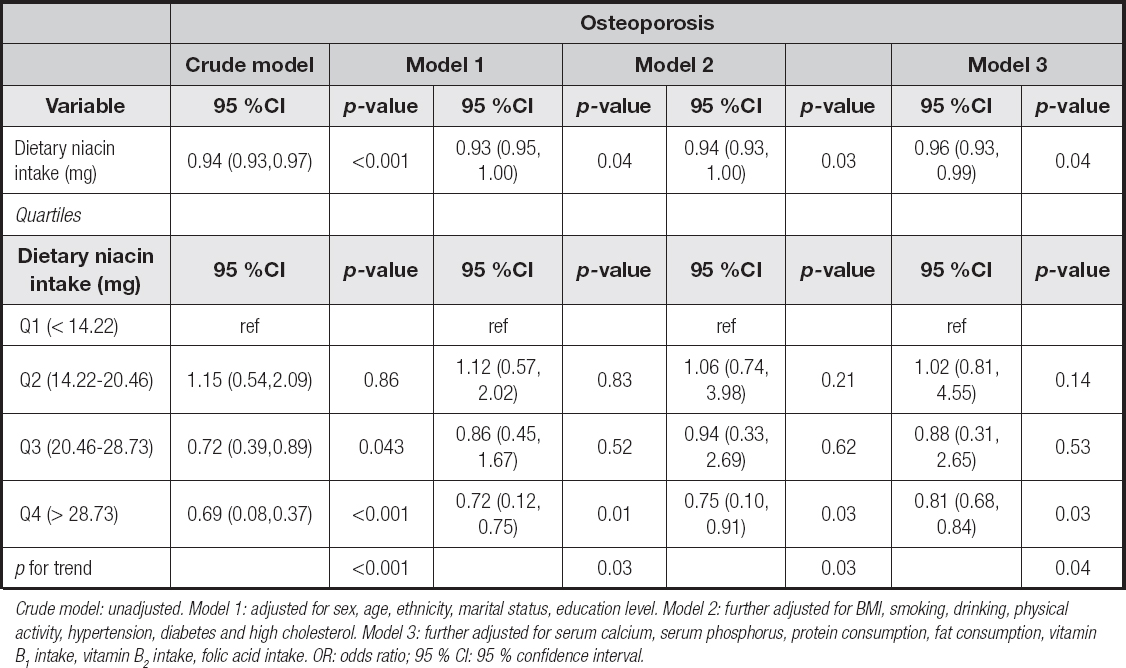
Crude model: unadjusted. Model 1: adjusted for sex, age, ethnicity, marital status, education level. Model 2: further adjusted for BMI, smoking, drinking, physical activity, hypertension, diabetes and high cholesterol. Model 3: further adjusted for serum calcium, serum phosphorus, protein consumption, fat consumption, vitamin B1 intake, vitamin B2 intake, folic acid intake. OR: odds ratio; 95 % CI: 95 % confidence interval.
RESTRICTED CUBIC SPLINE BETWEEN DIETARY NIACIN INTAKE AND OSTEOPOROSIS RISK
To explore the potential association between dietary niacin intake and the prevalence of OP, we conducted a comprehensive multivariate analysis. Employing RCS analysis, we found a inverted U-shaped association between the intake of niacin and OP risk, characterized by a distinct non-linear trend (p for non-linear trend<0.001). When niacin intake was 18.62mg, OR reached its highest point of 1.03 (95 % CI: 0.87, 1.21). Subsequently, as niacin intake increased, the risk of OP showed a decreasing trend. In addition, we observed that the risk of OP reached a plateau when niacin intake was about 50 mg/day (Fig. 2).
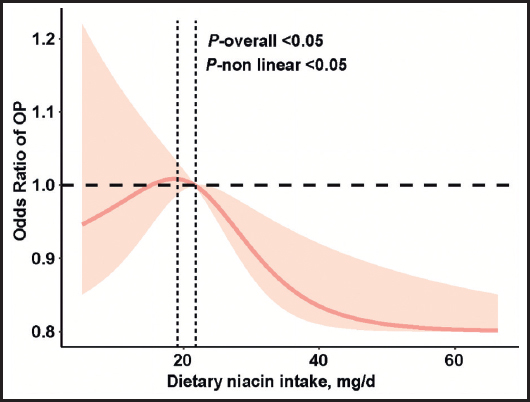
Figure 2 The RCS analysis showed a nonlinear dose-response relationship between dietary niacin intake and OP (adjusted model: adjusted for sex, age, ethnicity, marital status, education level, BMI, smoking, drinking, physical activity, hypertension, diabetes and high cholesterol, serum calcium, serum phosphorus, protein consumption, fat consumption, vitamin B1 intake, vitamin B2 intake and folic acid intake. p-Overall = 0.018, p-nonlinear = 0.041).
SUBGROUP ANALYSIS
To determine whether the association between dietary niacin intake and OP risk was consistent across subgroups, we divided participants into subgroups based on sex, race, marital status, BMI, alcohol consumption, smoking status, and comorbidities to assess the association between niacin intake and OP in different subgroups. Gender was observed to interact in the association between niacin intake and OP (p interaction = 0.027), however, no significant interaction was found between dietary niacin intake and other stratified variables of OP (Fig. 3). Next, gender subgroup analysis of RCS was conducted, and it was found that niacin intake and different gender groups still showed an inverted U-shaped relationship, but the inflection point of this non-linear relationship was different between men and women, in the female group, the inflection point was 15.83 mg/d, while in the male group, the inflection point was 21.64 mg/d (Fig. 4).
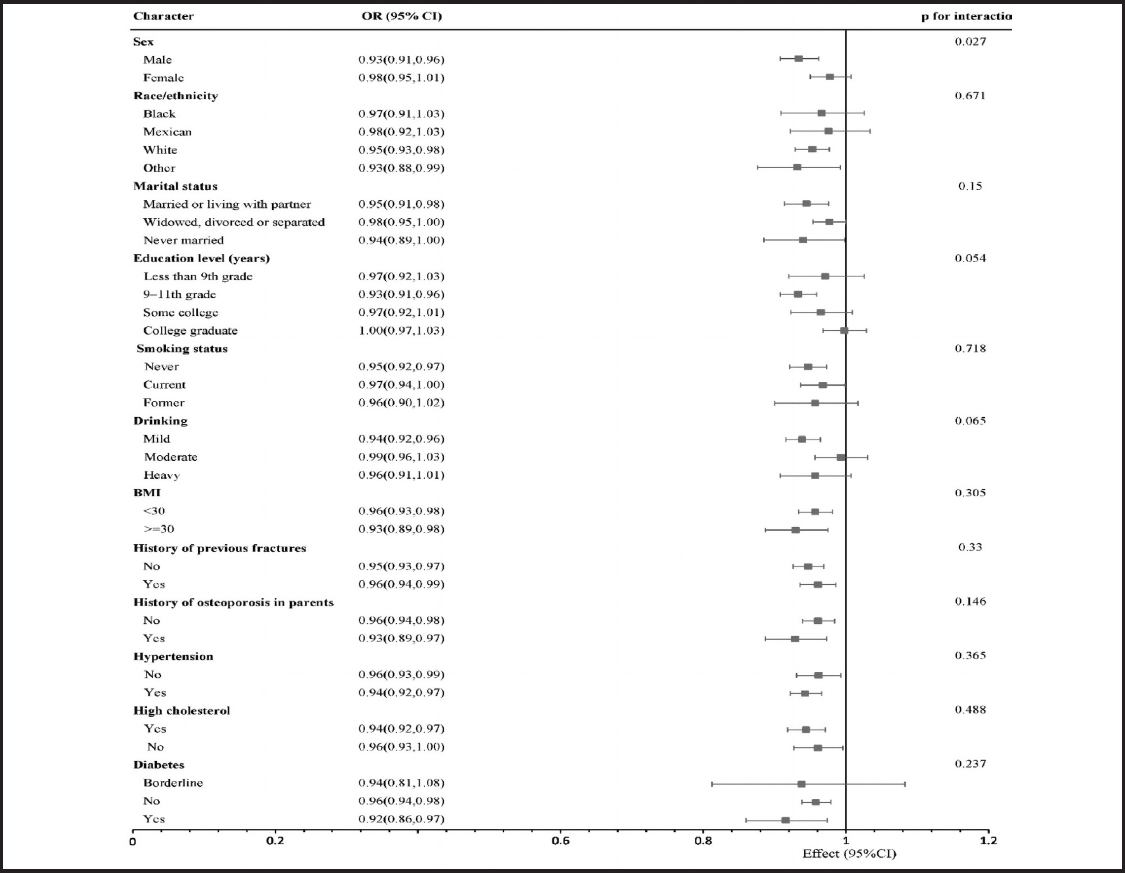
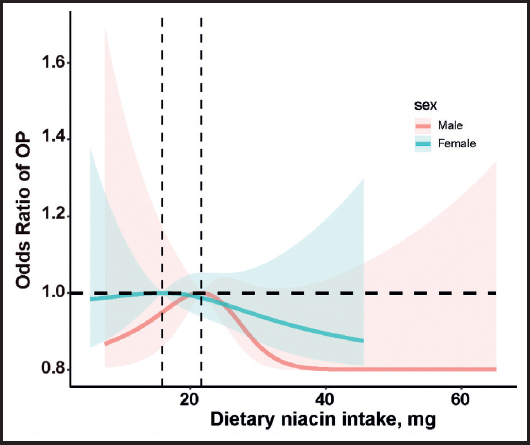
Figure 4 RCS analysis showed the relationship between dietary niacin intake and OP in men and women, respectively (adjusted model: adjusted for sex, age, ethnicity, marital status, education level, BMI, smoking, drinking, physical activity, hypertension, diabetes and high cholesterol, serum calcium, serum phosphorus, protein consumption, fat consumption, vitamin B1 intake, vitamin B2 intake and folic acid intake. p-Overall = 0.024, p-nonlinear = 0.049).
DISCUSSION
Our study evaluated the dose-response relationship between dietary niacin intake and risk of OP risk among U.S. adults aged ≥ 50 years. Data aggregated from four NHANES cycles demonstrated a significant inverse association between niacin intake and OP risk after adjusting for potential confounders, whether analyzed as continuous or categorical variables. Further analysis revealed a nonlinear relationship characterized by an inverted U-shaped curve. Notably, protective effects against OP emerged when niacin intake exceeded 18.62 mg/day. Subgroup analysis identified significant interaction effects of sex on the association between dietary niacin intake and OP risk (p-interaction = 0.027), while age, race, and complications exhibited no significant effect modification.
Adequate nutrition plays a vital role in maintaining bone structural stability. Niacin, an essential nutrient, critically contributes to metabolism, DNA repair, antioxidants activity, nervous system function, and mitochondrial metabolism (10,21). While studies indicate a connection between niacin and bone health, current conclusions remain inconsistent. In a cross-sectional sarcopenia study, Xiang S et al. identified a positive correlation between niacin intake and total bone mineral content/muscle mass, particularly in female participants (22). Additionally, niacin supplementation has been shown to stimulate osteogenic differentiation and enhance cellular antioxidant capacity via SIRT1 induction, thereby protecting bone mass and mineral density from iron overload-induced damage (10). Contrastingly, Carbone et al. utilized spline regression models in a Cardiovascular Health Study (CHS)-based cohort, demonstrated a U-shaped association between dietary niacin intake and elevated hip fracture risk, potentially mediated by niacin metabolites (15,23-25). However, our study found an inverted U-shaped relationship between niacin intake and OP. When niacin intake reached 18.62 mg/d, the protective effect on OP became evident: the risk of OP decreased with increasing niacin intake and plateaued when intake reached 50 mg/d. These findings suggest that niacin intake within 18.62-50 mg/d could reduce OP risk, confirming a dose-response relationship. However, current guidelines recommended 14-16 mg/d as the dietary niacin intake for adults, with 35 mg/d as the tolerable upper limit—values diverging from our findings (26). Consequently, practical applications of our derived thresholds should account for toxicity risks at supratherapeutic doses.
At present, the potential mechanism underlying the inverse association between niacin and OP remains incompletely understood, however, evidence from prior studies suggests biologically plausible pathways. First of all, excessive oxidative stress promotes osteoclastogenesis, a key pathogenic mechanism in OP (27). As a classic antioxidant, niacin mitigates iron overload-induced OP in vitro: in MC3T3-E1 and RAW264.7 cells cultured with ferric ammonium citrate (FAC), niacin treatment upregulated osteogenic markerswhile regulating intracellular reactive oxygen species (ROS) levels (10). Additionally, niacin alleviates endothelial oxidative stress by modulating NADP content and glutathione homeostasis (28,29). Secondly, systemic immune-inflammatory states contribute to OP pathogenesis through direct/indirect effects of immune cells on bone physiology. Niacin exerts anti-inflammatory effects via the SIRT1/PARP-1/NLRP3 cascade, potentially attenuating OP progression (30). Third, mitochondrial dysfunction is implicated in age-related degenerative diseases such as OP. Niacin, a critical cofactor for mitochondrial oxidative phosphorylation, enhances mitochondrial integrity (31). Gomes et al. demonstrated that elevating NAD+ levels in sged mice restored mitochondrial function to youthful states (32). Another animal study corroborated these findings, demonstrating that 12-months NMN supplementation in normally aging mice significantly enhanced energy metabolism and physical activity while improving insulin sensitivity and lipid homeostasis (33). While these biological mechanisms may explain niacin’s osteoprotective effects, further validation through animal studies and large-scale clinical trials is imperative to clarify its molecular targets, therapeutic potential, and prophylactic utility against OP.
Our study identified a significant interaction effect of sex on the association between dietary niacin intake and OP. Specifically, higher niacin intake demonstrated a stronger association with reduced OP risk in male individuals, indicating potentially enhanced anti-osteoporotic effects of niacin in males. This phenomenon may be attributed to male-specific hormones such as testosterone. previous studies indicate that niacin intake may elevate circulating testosterone levels, which could mitigate OP risk through anti-inflammation and antioxidative mechanisms (20). Thus, niacin might reduce OP risk in males via synergistic interactions with testosterone. Additionally, sample size limitations must be considered. In this study, non-OP classification encompassed both osteopenia and normal bone density, while the limited number of male OP cases (due to lower prevalence) may have reduced statistical power to reliably detect sex-specific interactions in subgroup analyses. Therefore, prospective studies are required to validate whether the protective effects of niacin against OP differ significantly between sexes. Further investigations should also explore the dose-response relationship between dietary niacin and OP risk across diverse cohorts.
Although our analysis did not identify race as a significant confounding factor, the genetic polymorphisms of the niacin receptor (GPR109A/NIACR1), which have been investigated in other diseases, warrant further discussion. The GPR109A gene may harbor single nucleotide polymorphisms (SNPs) across different ethnic groups, potentially influencing receptor expression levels, ligand-binding affinity, or signal transduction efficiency. For example, Sony Tuteja et al. examined the genetics of niacin response by sequencing the single exon of the HCAR2 gene (encoding GPR109A) and genotyping SNPs in 192 European-ancestry and 102 African-ancestry healthy participants. They found that niacin’s lipid-lowering effects were independent of HCAR2 receptor activity, suggesting that genetic polymorphisms do not compromise niacin’s efficacy in reducing lipid levels (13). However, Christopher W. Knouff et al. reported contrasting conclusions, demonstrating that GPR109A polymorphisms alter receptor responsiveness to niacin, thereby affecting sensitivity to lipid-lowering therapies (11). Additionally, epigenetic modifications, such as DNA methylation, may regulate GPR109A expression and function (14). These genetic variations could modulate receptor functionality and responses to interventions. Future studies should incorporate analyses of GPR109A polymorphisms and other genetic/epigenetic markers to elucidate their potential impacts on study outcomes. On the other hand, female hormonal factors may serve as critical confounders in the relationship between niacin and OP. Declining estrogen levels, a major risk factor for postmenopausal osteoporosis, likely contribute to this interplay. Although we adjusted for sex and age in our analyses, residual confounding by hormonal fluctuations cannot be entirely excluded. Future research should integrate menopausal status data to evaluate the potential influence of female hormones on the niacin-OP association.
This study has several notable strengths. First, the primary advantage lies in its utilization of data from the well-characterized NHANES database, which offers a sufficiently large, nationally representative sample. Second, unlike previous osteoporosis studies that focused on individuals aged ≥ 65 years or postmenopausal women, this investigation targeted the ≥ 50-year-old population, addressing the research gap in the 50-65 age group and providing earlier evidence for osteoporosis prevention. Additionally, we adjusted for numerous critical confounding factors and conducted subgroup analyses based on age, sex, marital status, race, and other variables. Notably, sex was found to influence the relationship between niacin and osteoporosis, with varying inflection points in the RCS curves across subgroups—a finding that may guide the clinical application of niacin. However, the study also has limitations. First, as a cross-sectional design, it can only establish associations between dietary niacin intake and outcomes rather than causality. Second, dietary niacin intake was derived from 24-hour dietary recalls, which are subject to recall bias and may not fully capture participants’ habitual dietary patterns. Furthermore, tryptophan, an essential amino acid, can be metabolized into niacin, potentially influencing overall niacin levels. The lack of tryptophan data in our study limits our ability to account for interactions between dietary intake and niacin metabolism. Future research should integrate measurements of both tryptophan and niacin intake to more accurately assess their interplay and effects on OP. Another intriguing point is that prior studies have linked carbonated beverage and junk food consumption to bone density alterations. However, due to high rates of missing data, we only broadly adjusted for energy and general dietary factors. Future investigations could incorporate detailed dietary records and biomarkers to explore how carbonated beverages, junk food, and other specific dietary components modulate the relationship between niacin and OP, thereby enabling a more comprehensive evaluation of diet’s impact on skeletal health.
CONCLUSION
Our study incorporated the latest data from 2007-2018, first revealing a nonlinear inverted U-shaped association between dietary niacin intake and osteoporosis risk in the U.S. population aged ≥ 50 years. This fills the research gap on dose-response characteristics in middle-aged and elderly populations during this period and provides early preventive evidence for osteoporosis in this demographic. Furthermore, this study innovatively employed RCS models to identify gender-specific inflection points, demonstrating for the first time the significant moderating effect of gender on the niacin-osteoporosis association. Future studies should further investigate the mechanisms of niacin’s action across diverse populations and refine intake thresholds to maximize its protective effects. However, due to the inherent limitations of cross-sectional study designs, caution is warranted in interpreting the findings, as causality or long-term impacts cannot be established. Thus, validation through large-scale prospective cohort studies is necessary.
ACKNOWLEDGEMENTS
The authors acknowledge the data from the National Health and Nutrition Examination Survey (NHANES).
FUNDING
His study was supported by National Natural Science Foundation of China (No: 82460178) and Gansu Provincial Joint Research Fund (No: 23JRRA1499).
AUTHOR DISCLOSURES
We did not use artificial intelligence or other AI-assisted technologies in the writing process. All authors participated in the conception and design of the study. They declare that they have no known competing financial interests or personal relationships that could have appeared to influence the work reported in this paper.

