




 Servicios personalizados
 Inglés (pdf)
 Articulo en XML
 Referencias del artículo
 Traducción automática
 Enviar articulo por email
 Citado por SciELO
  Citado por Google
  Similares en
SciELO
Similares en
SciELO  Similares en Google
 Permalink
INTRODUCTION
According to the European Society for Clinical Nutrition and Metabolism (ESPEN) and the American Society for Enhanced Recovery (ASER) guidelines, nutritional deficiencies in individuals with indication for surgery appears as an independent risk factor for the occurrence of postoperative complications such as infection, increase in the recovery time, length of hospital stay, mortality and hospital costs (1-3).
Based on the approach developed and accepted within the past two decades, apart from the standard nutrition, an enriched nutrition formula with some key nutrients is used to enhance patients’ immunity (4). Nutrients such as arginine, nucleotides, and omega-3 fatty acids are known to play a key role in these steps within the complex structure of the inflammatory response (5). Several studies have shown that the immunonutrition improves immune responses, controls inflammatory changes, modulates the synthesis of acute-phase proteins, increases the intestinal oxygenation and barrier function after injury; furthermore, it also reduces septic morbidity and length of hospital stay (6,7).
The ESPEN guideline, published in 2021, recommends perioperative immunonutrition in patients with malnutrition and in those at nutritional risk. Perioperative immunonutrition should also be initiated if it is anticipated that the patient will be unable to eat for more than five days in the perioperative period. It is also indicated in patients expected to have low oral intake and who cannot maintain above 50 % of the recommended intake for more than seven days. Patients at severe nutritional risk shall receive immunonutrition prior to major surgery even if operations including those for cancer has to be delayed. A period of 7-14 days may be appropriate. Immune-modulating oral nutritional supplements including arginine, omega-3 fatty acids and nucleotides can be preferred and administered for five to seven days preoperatively preferably for malnourished individuals, but guideline does not contraindicate the practice for those at nutritional risk (1).
The impact of oral or enteral immunonutrition in patients undergoing major surgery for gastrointestinal cancer was previously assessed in several meta-analysis, the last one conducted by Adiamah et al. (2019) (8-10). Preoperative immunonutrition significantly reduces infectious complications and leads to a shorter length of stay (8). In addition, the use of immunonutrition among patients undergoing surgical procedures, used either as pre, peri or postoperative strategy, shows to be cost-effective and able to reduce resource utilization and costs (11-15). Considering patients with the diagnosis of gastrointestinal neoplasms, the strategy has also shown to be cost-effective, however, only one study has assessed specifically the use of preoperative immunonutrition to date (11-13,16).
Gastrointestinal cancers impose an important burden to the whole society. For the triennium 2023-2025, it was estimated that 483,000 new cases of cancer, excluding non-melanoma, will occur in Brazil, of which at least 12 % will be gastrointestinal neoplasms (17). Torres et al. (2010) conducted a study to estimate hospital admission rates for colorectal cancer in the Brazilian Public Health System. Considering the 1996-2008 period, hospitalization costs rose from 16.5 million American dollars (USD) to 33.5 million USD (31.870.225 euros [EUR]) (18).
Given the burden of gastrointestinal cancer and the clinical benefits of the use of immunonutrition in this group, understanding the economic impact of its use seems to be meaningful for the decision-making process. Hence, we conducted a cost-effectiveness study of 5-day preoperative enteral or oral immunonutrition in patients undergoing major surgery for gastrointestinal cancer. In addition, a budget impact analysis under the perspective of Brazilian Unified Health System (Sistema Único de Saúde – SUS) was performed.
MATERIALS AND METHODS
STUDY DESIGN
An economic evaluation was conducted aiming to determine the cost-effectiveness of 5-day preoperative enteral or oral immunonutrition in patients undergoing major surgery for gastrointestinal cancer, including the upper and lower digestive tract, under the perspective of the SUS. Efficacy was assessed using data from the meta-analysis published by Adiamah et al. (2019), while costs were estimated through specialist physician’s opinion and available price sources (8). The need for appreciation by an ethics committee or an informed consent was waived for this study since only previously published and publicly available data was used.
EFFECTIVENESS DATA AND META-ANALYSIS
The study was conducted based on the meta-analysis published by Adiamah et al. (2019). In the published review, the authors conducted searches at Embase, Cochrane Collaboration and Medline between 2000 and 2018 and included prospective randomized controlled trials reporting at least one relevant clinical outcomes in adults undergoing surgical procedure for gastrointestinal cancer (8). Considering that our aim was to assess cost-effectiveness of 5-day preoperative immunonutrition, the studies assessing such period were selected and combined estimates for the occurrence of infectious complications, non-infectious complications, length of stay, and 30-day mortality were calculated. Thus, the number of patients presenting each outcome in the groups of interest, as well as mean length of stay, was extracted from the studies included in the review.
To ensure that all relevant studies were included, electronic searches were carried out until August/2020 in the following databases: MEDLINE/PubMed, The Cochrane Library, Latin American and Caribbean Health Sciences Literature (LILACS), and Centre for Reviews and Dissemination (CRD). Further, they were complemented through manual searches of references from the originally identified articles and grey literature search. The complete search strategies used for each database are shown in the supplementary material (Suppl. Table I - https://www.nutricionhospitalaria.org/files/9272/ADMA1-05553-03.pdf). No additional eligible studies were found.
For the meta-analysis, continuous outcomes were summarized as weighted mean differences (WMDs), while dichotomous outcomes were summarized as odds ratios (ORs), with 95 % confidence intervals (CIs). The heterogeneity was assessed using I² statistic, defined as low (0-40 %), moderate (40-75 %) and high (> 75 %). The risk of bias of individual studies was assessed using the risk of bias 2 assessment form (Suppl. Fig. 1 - https://www.nutricionhospitalaria.org/files/9272/ADMA1-05553-03.pdf) and publication bias was assessed by the symmetry of the funnel plots for all outcomes. A random effects model was used, considering a more conservative approach (19). The analysis was performed using the software RevMan, version 5.4 (20).
MODEL CHARACTERISTICS
A cost-effectiveness analysis was performed to compare enteral or oral immunonutrition with the standard diet of patients undergoing major gastrointestinal cancer surgery. The standard diet was defined as a preoperative diet without supplementation or with isocaloric and isonitrogen supplementation. The model was defined as a decision tree in which patients undergoing major procedures could receive immunonutrition or a standard diet. These patients were evaluated for infectious complications 30 days after surgery (Suppl. Fig. 2 - https://www.nutricionhospitalaria.org/files/9272/ADMA1-05553-03.pdf). A time horizon of 5 + 30 days was considered, with five days for pre-surgical enteral/oral immunonutrition and up to 30 days after surgery to assess the occurrence of complications. There was no need to apply a discount rate as the time horizon was less than one year. The economic evaluation was conducted from the SUS perspective.
OUTCOME MEASUREMENT
The occurrence of infectious complications was defined as the primary study outcome. Secondary outcomes were non-infectious complications, length of stay, and 30-day mortality. Economic outcomes considered direct medical costs, including medical resources used directly for patient care, immunonutrition costs, and infectious complications treatment. Indirect costs, such as those related to patient productivity loss because of the illness, were not considered in this analysis, as they are not consistent with the adopted perspective. Treatment strategies were compared using the incremental cost-effectiveness ratio (ICER), defined as the ratio of the difference in costs to the difference in effectiveness between treatment strategies (Equation I).

RESOURCES AND COST ESTIMATION
A dosage of 1000 mL per day for five days was adopted to calculate the immunonutrition cost. The price for 1000 mL of the product was defined according to the expected reimbursement value for the Brazilian public market, its variation was evaluated in sensitivity analysis. The comparator, standard diet, has no cost, as there is currently no reimbursement for pre-surgical supplementation with immunonutrition or any other specific diet in the universal health system in Brazil. The microcosting strategy defined infectious complications cost, as detailed reported in supplementary table II (https://www.nutricionhospitalaria.org/files/9272/ADMA1-05553-03.pdf). The use of resources was defined base on a specialist physician’s opinion and precified using public reimbursement tables from the Brazilian universal health system (Brazilian Universal Health System’s Table of Procedures, Medications and Special Materials – SIGTAP) — the great uncertainties in this cost definition led to its evaluation by sensitivity analysis. The analysis included only the relevant costs that could differ between treatment groups (nutritional intervention and infectious complication costs). Other costs, such as hospitalization costs or non-infectious complications, were assumed to be the same between groups and were not considered in the analysis. All costs were reported in Brazilian Real (BRL) and Euro (EUR), considering an exchange rate of 1 EUR = 6.15 BRL (average rate between September 6, 2024, and December 2, 2024).
ANALYTICAL METHODS
The economic evaluation was defined from a decision tree modelling (Suppl. Fig. 2 - https://www.nutricionhospitalaria.org/files/9272/ADMA1-05553-03.pdf). Deterministic and probabilistic sensitivity analyses evaluate the model’s uncertainties. These methods assess how changes in input parameters affect the model’s results, either one at a time (deterministic) or simultaneously based on probability distributions (probabilistic). In the deterministic sensitivity analysis, the respective CIs were considered for the efficacy parameters, while a variation range of plus or minus 20 % from the baseline value was used for cost parameters. In the probabilistic sensitivity analysis, a gamma distribution was adopted for costs, as it is non-negative, and a beta distribution was used for efficacy parameters, as it is limited to values between 0 and 1 (21). All parameters of the decision tree model were evaluated in both deterministic and probabilistic sensitivity analysis. The economic analysis was conducted using Microsoft Excel, version 365 (2021).
BUDGET IMPACT ANALYSIS
A 5-year budget impact analysis was performed to understand the impact of the 5-day preoperative enteral or oral immunonutrition use for the Brazilian public healthcare system. Eligible population was estimated using an epidemiological approach and the number of patients undergoing major gastrointestinal oncologic surgeries was extracted from the public database, according to procedures described in supplementary table III (https://www.nutricionhospitalaria.org/files/9272/ADMA1-05553-03.pdf) (22). The number of hospitalizations for such procedures between 2015 and 2019 was used to project the estimated procedure volume for the period from 2021 to 2025 through a linear relationship between the number of procedures and the total Brazilian population (22,23) (Suppl. Table IV - https://www.nutricionhospitalaria.org/files/9272/ADMA1-05553-03.pdf). To determine the market share, the premise of a gradual increase in the use of oral/enteral immunonutrition was adopted after its incorporation, starting from 10 % of patients in the first year until reaching 50 % of patients in the fifth year. Costs were extracted from the economic model.
RESULTS
EFFECTIVENESS DATA
The study published by Adiamah et al. (2019) included a total of sixteen studies that assessed the use of preoperative immunonutrition among patients undergoing major gastrointestinal surgeries, seven of them considering a 5-day period. Such studies were selected to compose this analysis and main information is shown in supplementary table V (https://www.nutricionhospitalaria.org/files/9272/ADMA1-05553 -03.pdf).
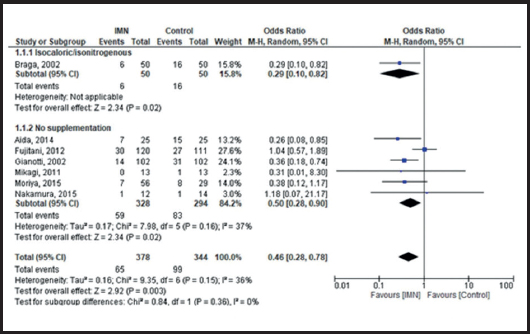
Data related to the outcomes of interest, extracted from these seven studies, were combined and results are shown in table I. The primary outcome, infectious complications, was used to conduct the economic analysis. All studies provided data regarding infectious complications (7,24-29). The event rates of infectious complications were 17.2 % (65/378) and 28.8 % (99/344) for the immunonutrition and the control group, respectively. The pooled ORs for infectious complications after 5 days of preoperative treatment with immunonutrition was 0.46 (95 % CI, 0.28-0.78; p = 0.003; I² = 36 %; Fig. 1). The infectious complications OR was also evaluated according to the choice of control. When control arms received isocaloric isonitrogenous supplement (29), the OR was 0.29 (95 % CI, 0.10-0.82; p = 0.02; I² = not applicable) and for those receiving no supplementation the OR was 0.50 (95 % CI, 0.28-0.90; p = 0.02; I² = 37 %) (7,24-28).

PARAMETERS OF THE COST-EFFECTIVENESS STUDY
The parameters, the references, the range (for the deterministic sensitivity analysis), the probability distribution, and the standard error (for the probabilistic sensitivity analysis) used in this analysis are reported in supplementary table VI (https://www.nutricionhospitalaria.org/files/9272/ADMA1-05553-03.pdf). The incidence of infectious and non-infectious complications and mortality within 30 days were calculated by the mean of events over the population of interest. Length of stay (mean days) was based on the WMD extracted from the meta-analysis.
INCREMENTAL COSTS AND OUTCOMES
Enteral/oral immunonutrition was dominant in relation to the standard diet (Table II). The deterministic sensitivity analysis (Fig. 2) identified the infectious complication cost and the incidence of complications in the “standard diet” group as the two main parameters influencing the analysis results. However, there is no potential to significantly modify the result presented in the analysis baseline scenario (dominance of immunonutrition compared to the standard diet).
Table II Cost-effectiveness analysis results
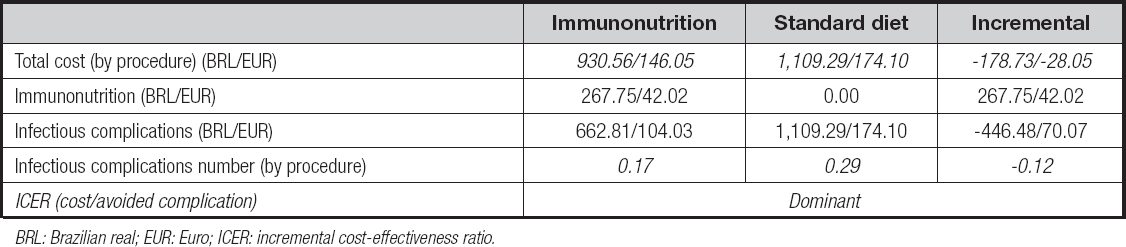
BRL: Brazilian real; EUR: Euro; ICER: incremental cost-effectiveness ratio.
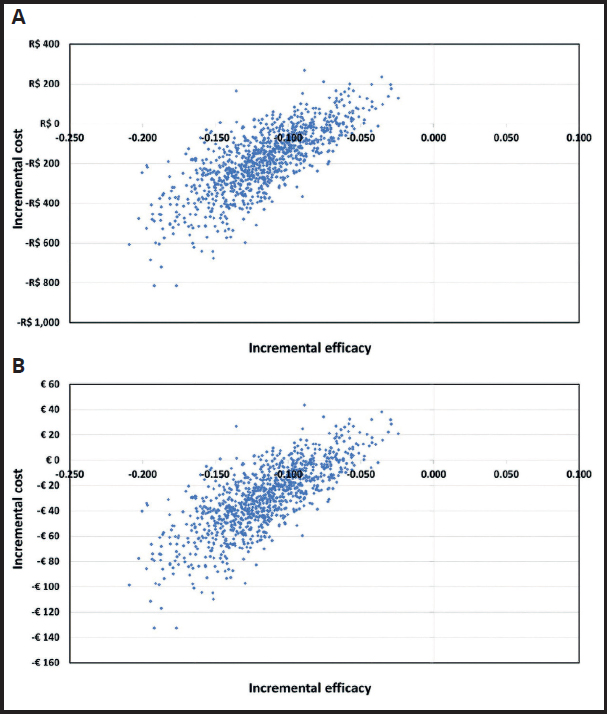
Figure 2 Tornado diagram. A. Values presented in Brazilian reals (BRL). B. Values presented in euros (EUR).
Probabilistic sensitivity analysis (Fig. 3) estimated 88 % of iterations in quadrant III, in which there is lower cost and greater effectiveness. The rest of the iterations (12 %) were in quadrant II (higher cost and greater effectiveness). The most effective quadrants are quadrants II and III for this analysis, as the outcome considers the reduction of infectious complications and assumes negative values when there is greater effectiveness.
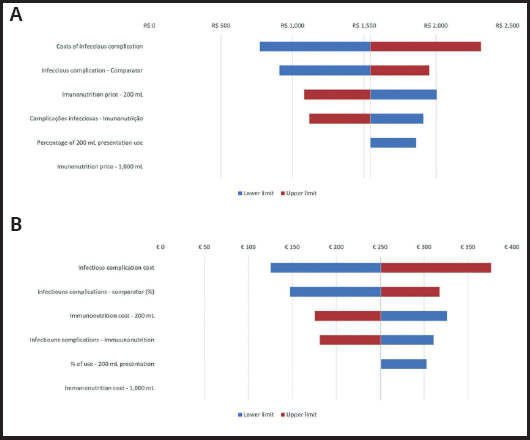
Figure 3 Incremental cost-effectiveness plan — infectious complications avoided. A. Values presented in Brazilian reals (BRL). B. Values presented in euros (EUR).
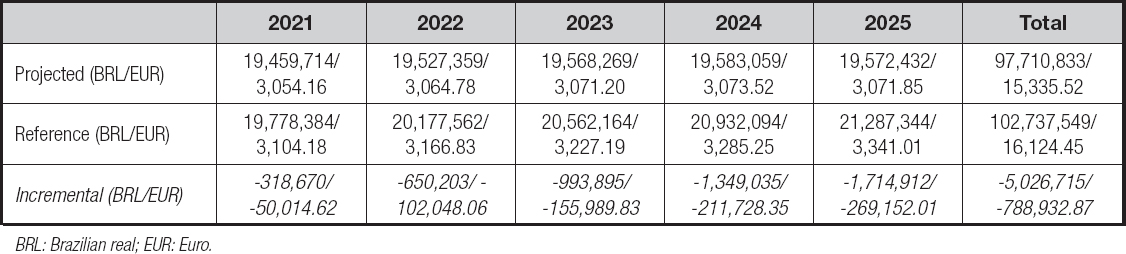
Table III shows the results of the budget impact analysis. The projected scenario considers the gradual conversion of procedures to enteral/oral immunonutrition, considering the proposed market share. Meanwhile, the reference scenario assumes that all patients do not receive a specific diet as preparation for the surgical procedure. The results indicate savings of approximately 320,000 BRL (51,816 EUR) in the first year after incorporation and a total accumulated savings over 5 years of approximately 5 million BRL (817,352 EUR). The base case scenario could vary between savings of 2.5 million and 7.5 million BRL (408,991 EUR and 1,225,713 EUR, respectively).
DISCUSSION
This analysis was performed aiming to assess the cost-effectiveness of 5-day preoperative enteral or oral immunonutrition in patients undergoing major surgery for gastrointestinal cancer. In addition, a budget impact analysis under the SUS perspective was performed. In a context of increasing costs due to the launch of new technologies in the market, there is a need to understand the relationship between costs and benefits of its use.
Initially, to support the cost-effectiveness analysis, a meta-analysis using data reported by Adiamah et al. (2019) was conducted to determine the efficacy of a prespecified period of enteral or oral immunonutrition use (8). The last ESPEN guideline, published in 2021, recommends immunonutrition, including arginine, omega-3 fatty acids and nucleotides, for five to seven days in the preoperative period, preferably for malnourished individuals but not excluding those at nutritional risk (30). The previously published review included studies that considered different durations of preoperative immunonutrition, ranging from 3 to 8 days (8). In the present analysis, the 5-day period was chosen to accomplish the ESPEN recommendation within the shortest timeframe, based on the hypothesis of a lower associated cost. Alternative durations were not assessed and should be explored in future cost-effectiveness studies.
In the present analysis, 5-day preoperative enteral or oral immunonutrition significantly reduced the occurrence of infectious complications and length of hospital stay, but statistically significant results were not found to the other outcomes (non-infectious complications and mortality). These results are similar to those reported by Adiamah et al. (2019) and also corroborate findings reported by previous meta-analyses performed to understand the impact of immunonutrition use on patients undergoing major gastrointestinal cancer surgery (8,31,32). Thus, it supports the use of immunonutrition for five days before surgical procedure.
Adiamah et al. (2019) included studies characterized as prospective randomized controlled trials that reported at least one outcome of interest in individuals aged 18 years or older undergoing surgical intervention for gastrointestinal cancer. Trials evaluating only individual components of immunonutrition, as well as those involving perioperative or postoperative administration, were excluded. No language restrictions were applied in the study (8). Furthermore, an updated literature search did not identify new evidences, supporting the assumption that all relevant studies were included in the analysis.
Only one study used standard supplementation, while most studies compared immunonutrition to a standard diet without supplements (Suppl. Table VI - https://www.nutricionhospitalaria.org/files/9272/ADMA1-05553-03.pdf). This difference may have affected the results. Therefore, it’s important to consider these limitations when interpreting the findings, underscoring the need for further studies to validate these observations.
The cost-effectiveness analysis showed that enteral/oral immunonutrition was dominant in relation to the standard diet. Braga & Gianotti (2005) conducted an analysis to determine whether preoperative immunonutrition leads to cost savings in the care of patients undergoing major elective surgery to treat gastrointestinal tract neoplasms. The authors reported a mean cost of complication of 6,178 EUR in the conventional group, while this value in the group that used oral immunonutrition for 5 days before surgical procedure was 4,639 EUR. In this context, preoperative immunonutrition for 5 days has shown to be cost-effective, which is corroborated by our results (13). Ambrosio et al. (2023) analyzed the tumor microenvironment and indicators related to immune function in 100 patients in addition to a cost-benefit analysis. They showed that immunonutrition for 14 days before surgery and 2 days after is a cost-effective strategy. The study reported that regardless of nutritional status, the immunonutrition, according to the recommendations, represented a resource after colorectal cancer surgery with an average net savings of 117,011 EUR (33). This analysis was conducted under the perspective of the SUS. To the best of authors’ knowledge, this is the first study to describe the outcome considering the pre-operative period in Brazil.
Sensitivity analysis showed that infectious complication cost and the incidence of complications in the “standard diet” group are the two main parameters influencing the analysis results and that there is no potential to significantly modify the dominance of immunonutrition compared to the standard diet. Indeed, infectious complications represent an important source of cost among patients undergoing surgical treatment to manage gastrointestinal neoplasm. Zogg et al. (2018) reported, in a nationwide inpatient sample from the United States, that infectious complications was the most significant driver of increased hospital cost among patients undergoing major resections from 2001 to 2014 (34). In a recent analysis conducted in France including patients undergoing major digestive cancer surgery, individuals with infectious complications had higher hospital length of stay and cost per stay when compared to those without complications and those with other events (mean length of stay: 25.5 vs. 11.7 vs. 17.8 days; cost per stay: 18,720 EUR vs. 10,641 EUR vs. 14,636 EUR) (35).
Budget impact analysis suggests that the use of a 5-day preoperative enteral/oral immunonutrition would be able to promote savings to Brazilian healthcare system. To the best of authors’ knowledge, this is the first study assessing the Brazilian context and further analysis are needed to confirm the finding. Brunton & Kerr (2022) reported that the use of perioperative immunonutrition among surgical oncology patients would be able to save about 5 million USD with a total of 100 individuals, only related to length of hospital stay (36). In the present analysis, the main effectiveness outcome used was the occurrence of infectious complications, thus savings could be even higher if other variables such as length of hospital stay were considered.
The cost-effectiveness related to immunonutrition use was also assessed in different non-oncologic settings. The use of perioperative immunonutrition has proven to be a cost-effective strategy among patients undergoing surgical procedures. Gianotti et al. (2000) reported a net saving of 2,386 EUR per complication avoided (37). Among critically ill patients, the use of immunonutrition has shown a reduction in the occurrence of nosocomial pneumonia and by reducing intensive care unit stay, a cost saving of at least 193,350.00 USD (38).
In spite of these important contributions, our study has limitations that need to be highlighted. In addition, most of the studies compared immunonutrition against no intervention and this is a matter of concern since cancer patients report clusters of symptoms that may be related to low nutrient intake and weight loss (39). However, nutritional status prior to surgery reported through mean BMI was similar in intervention and control groups in the included studies, which may reduce the impact of such limitation. Furthermore, the use of random effects model to parametrize the effect of the intervention in the cost-effectiveness model, with its broader confidence interval, was considered a conservative approach to deal with the uncertainty within the model and reduced the impact of the aforementioned limitation. Although only oncologic surgical populations were assessed in the analysis, the results may be generalized to non-oncologic surgical populations, as the outcomes are relevant to both. Regarding the cost-effectiveness analysis, some information is derived from key-opinion leaders or premises, imposing uncertainties, and it was conducted under the SUS perspective and may not be representative of the whole Brazilian healthcare system. The absence of Brazilian data may also limit the translation of the results to the healthcare setting of the country. Also, it is important to note that the modelling was not based on quality-adjusted life years (QALY), which is a preferred outcome for cost-effectiveness analysis. Instead, the analysis was based on clinical outcomes (infectious complications avoided), which is a more tangible outcome for decision makers, but can be limiting for broader policy comparisons. Previously published studies assessing the cost-effectiveness related to the use of immunonutrition also considered measures from clinical practice (37,38).
CONCLUSIONS
The results suggest that 5-day preoperative enteral or oral immunonutrition not only has a positive clinical impact on patients since it is effective to prevent infectious complications and decreases hospital length of stay among patients undergoing major surgery for gastrointestinal cancer, but can also generate substantial reductions in costs. The data provided in the present analysis is helpful to support decision making in the management of patients with the diagnosis of gastrointestinal cancer.

