




 Servicios personalizados
 Inglés (pdf)
 Articulo en XML
 Referencias del artículo
 Traducción automática
 Enviar articulo por email
 Citado por SciELO
  Citado por Google
  Similares en
SciELO
Similares en
SciELO  Similares en Google
 Permalink
Introduction
Interpersonal relationships can be both the source of deeply gratifying experiences and where one can be hurt, deceived, or offended with the accompanying emotions of anger, sadness, withdrawal, and desire for revenge (Cordova et al., 2006). These complex situations and feelings must be dealt with, and forgiveness is necessary for this process (Fincham et al., 2005). Forgiveness has been shown to positively impact psychological and physical health (Cheadle & Toussaint, 2015; Gismero-Gonzalez et al., 2019; Griffith et al., 2015) and the quality of relationships. The psychology of forgiveness is a relatively new area of research that is gaining importance in clinical intervention for recovery from an intentionally caused offense.
Forgiveness is a complex construct, and there is no agreed-upon definition. One of the aspects shared by different authors is that forgiveness is a process that implies a transformation in the person who has been hurt. In this process, there is a reduction of the motivation towards revenge, avoidance, and estrangement and a growing motivation to show goodwill towards the offender (McCullough et al., 1998, 2007).
The process of forgiveness begins with the perception of the offense and requires recognition on the part of the victim of the injustice experienced and the intentionality of the offense (Fincham, 2009). The subjective experience that follows the offense has been described in scientific literature as “unforgiveness” (Worthington & Wade, 1999), manifested in distress expressed through emotional, cognitive, and behavioral reactions after the experienced harm.
Forgiveness, therefore, mitigates the post-offense distress, and diminishes the negative reactions (resentment, anger, revenge, avoidance) towards the offender (Allemand et al., 2013; Fincham et al., 2004; Wade & Meyer, 2009) but it also enhances positive feelings, thoughts, and emotions (Fincham et al., 2005; Fincham & Beach, 2002; Fincham et al., 2004; Paleari et al., 2005; Wade & Worthington, 2005). In this sense, some studies reveal how negative emotional states, avoidance, and revenge motivation are mitigated and replaced by benevolence motivation (McCullough et al., 2007; Worthington & Wade, 1999; Wade & Worthington, 2005). Yet, there is more to the construct of forgiveness than just motivation. For their part, Enright et al. define forgiveness as:
A willingness to abandon one's right to resentment, negative judgment, and indifferent behavior towards those who unjustly harmed us while fostering feelings of compassion, generosity and even love towards the perpetrator (1998, p. 46-47).
Forgiveness as a moral virtue (Enright & Fitzgibbons, 2015) is a multifaceted phenomenon that has trainable competence in promoting psychological wellbeing, facilitating personal recovery and relations with others. As a moral virtue, forgiveness includes goodness in the form of motivations toward the offending person (I want to be good to the other), cognitions (seeing the other person's worth), feelings (toward greater benevolence), and behaviors (doing good toward the other, even if this is from a distance when the other continues to be a danger to the forgiver). Forgiveness is not the same as excusing the wrong or reconciling because to reconcile is not a moral virtue, but instead is a negotiation strategy between two or more people who come together again in mutual trust (Enright & Fitzgibbons, 2015). Some authors consider it a character strength closely related to compassion and relationship maintenance (Booker, & Perlin, 2021) that benefits both the victim and the offender.
The construct of forgiveness can be further expanded into other classifications, one of which is called the “Forgiveness Triad” proposed by Enright (1996), which distinguishes: forgiving others (interpersonal forgiveness), forgiving oneself (intrapersonal forgiveness) and receiving forgiveness.
With regards to interpersonal forgiveness, several studies have shown the potential benefits to health (Barcaccia et al., 2018; Friedberg et al., 2009; Griffin et al., 2015; Lee & Enright, 2019; Orcutt, 2006), wellbeing (Bono et al., 2008; Chen et al., 2019; Gull & Rana, 2013; Toussaint & Friedman, 2009) and the maintenance of personal relationships (Kato, 2016; Waldron & Kelley, 2005). Additionally, various studies underline the benefits interpersonal forgiveness brings to couples' happiness in their relationship: marital satisfaction, intimacy, closeness and proximity within the couple, constructive communication, and commitment (Fahimadanesh et al., 2020; Fincham, 2000; Fincham & Beach, 2002; Paleari et al., 2009).
Given the importance of interpersonal forgiveness after an offense in the process of recuperation, it is necessary to find reliable and valid tools for its evaluation. Despite there being some instruments for measuring interpersonal forgiveness in the context of a specific offense (Enright et al., 2021; Hardgrave, 1994; McCullough et al., 2006; Rye et al., 2001; Subkoviak et al., 1995; Wade, 1989; Worthington et al., 2007), there is a lack of instruments in Spanish. In Spain and Spanish-speaking countries, the most widely used instrument for measuring interpersonal forgiveness after a specific offense is the TRIM-18 (Transgression Related Interpersonal Motivations Inventory) by McCullough et al. (2006). Despite this, it has a theoretical weakness: It primarily asks questions that are negatively worded toward the offending person (I'll make him/her pay). Twelve of the eighteen questions are negatively worded in this way. When a participant disagrees with the statement, such questions are not necessarily a sign of forgiveness. In other words, not wanting the other to “pay” does not necessarily imply beneficent thoughts, feelings, or actions toward the offending person. The other six positively worded items conflate forgiving with reconciling, which, as we saw above, is not the same. An example of these items is: Although he/she hurt me, I am putting the hurts aside so we can resume our relationship. Then, these theoretical issues (the fact that a person can forgive without reconciling and that the TRIM-18 shows difficulties with questions of benevolence may explain other problems that this questionnaire shows. It should be noted further that the dimensionality of the instrument is constantly under debate. Thus, despite the conceptual distinctions between the three scales of the TRIM-18 (Avoidance, Revenge, and Benevolence) and the proposed three-dimensional structure suggested in some studies (McCullough et al., 2007; McCullough et al., 2006), several studies found a high correlation between the three subscales of the test (Exline et al., 2004). This correlation suggests an underlying dimension of all the scales. In this line, in other studies, the TRIM-18 was applied by summing the test items, as if forgiveness is reflected on a continuum from malevolence to benevolence (Harper et al., 2014; McCullough et al., 2014; Worthington et al., 2015). Similarly, McCullough et al. (2010) proposed a unidimensional structure for the TRIM-18. This debate about the dimensionality of the TRIM-18, together with the theoretical flaws of the instrument, demonstrates the need to validate and adapt new and reliable instruments that address both the intellectual understanding of what forgiveness is and, at the same time, support the multidimensionality of the forgiveness process in the Spanish population.
In the recommendations for clinical research and practice in the study of forgiveness proposed by McElroy-Heltzel et al. (2020), the Enright Forgiveness Inventory (EFI-60) stood out as the instrument of choice in different cultural contexts. This questionnaire has been translated into several languages and has widely demonstrated its utility in clinical research and practice (Enright & Fitzgibbons, 2015; Hanke & Fisher, 2012; Hansen et al., 2009; Lee & Enright, 2014). Recently, Enright et al. (2021) published a brief version of the Enright Forgiveness Inventory (EFI-30), reporting data from the USA, Austria, Brazil, Israel, Korea, Norway, Pakistan, and Taiwan with good psychometric properties for all these cultures. It has been used in various studies (Haroon et al., 2021; Yu et al., 2021; Záhorcová et al., 2021) to evaluate the effectiveness of clinical interventions based on forgiveness, which underscores the interest in having a Spanish version of this questionnaire.
Not only does it have good psychometric properties to warrant scientific study, but also it includes both negatively worded and positively worded items across the dimensions of cognition (how one thinks about the offender), affect (how one feels about the offender), and behavior (how one might behave towards that person). In other words, it avoids theoretical reductionism in what forgiveness as a moral virtue is.
Regarding the process of interpersonal forgiveness, the literature has shown that in interpersonal offenses, the offender's forgiveness-seeking behaviors are important to foster forgiveness. The perception of the offender´s genuine repentance that is shown in responses that include apologies, assumption of responsibility and expression of pain for the harm caused promote forgiveness. In contrast, others attempt to avoid responsibility, justify, or deny the harm caused through justifications and excuses hinder the process of forgiveness (Martínez-Díaz et al., 2021; Morse & Metts, 2011). In the latter situation, forgiveness, especially in the dimension of benevolent approach to the offender, may pose a risk to the offended. Thus, some forgiveness-seeking behaviors promote forgiveness and contribute to repairing the relationship while others don´t.
The present study aims to adapt the EFI-30 for the Spanish population, review its psychometric properties, and analyze the instrument's validity and reliability so it can be used for research and clinical intervention in Spain.
The study working hypotheses were:
It is expected that the EFI-30 is a valid and reliable instrument for evaluating forgiveness in the Spanish population.
It is expected to find a positive linear correlation between forgiveness evaluated in the EFI-30 and the benevolence dimension of forgiveness evaluated in the TRIM-18.
It is expected to find a negative linear correlation between forgiveness evaluated in the EFI-30 and the revenge and avoidance evaluated in the TRIM-18.
It is expected to find a positive linear correlation between forgiveness evaluated in the EFI-30 and the apology repair strategy.
It is expected to find a negative linear correlation between forgiveness evaluated in the EFI-30 and the justify and negation repair strategies.
It is expected to find a negative linear correlation between forgiveness evaluated with EFI-30 and clinical symptomatology (anxiety, depression, and stress).
Method
Participants
The study was conducted with an initial sample of 546 participants. Of these, 42 of the participants' data were eliminated because of incomplete data, and another 78 were eliminated because they reported severe clinical symptomatology and/or were under psychiatric treatment. The final sample from which data were analyzed consisted of 426 university students (69.2% were undergraduates and 30.8% graduate students) from different Spanish universities aged between 18 and 30 (M = 21.24; SD = 2.91), with a gender distribution of 98 men (Mage = 21.84; SD = 3.25) and 328 women (Mage = 21.06; SD = 2.78).
Instruments
- Sociodemographic Questionnaire: an ad hoc instrument that collects data referring to: age, sex, place of birth, education level, and if they are currently receiving psychological treatment or taking prescribed medication (aiming to eliminate individuals with psychological diagnosis).
- Enright Forgiveness Inventory (EFI-30; Enright et al., 2021). This instrument measures specific interpersonal forgiveness by asking participants to recall and describe the most recent, serious, and unjust offense and the person who offended the participant. The EFI-30 consists of 30 items which are responded on a Likert-type scale with six possible alternatives distributed in six subscales, each consisting of 5 items: Positive Affect, Negative Affect, Positive Behaviour, Negative Behaviour, Positive Cognition, and Negative Cognition. A total score is obtained for the entire instrument and for each subscale. The EFI-30 also includes 5 items that evaluate incomplete or failed forgiveness processes, so-called ‘pseudo-forgiveness.' The authors found adequate internal consistency in the different countries, with a Cronbach's alpha of .82 to .94 for Positive Affect, .80 to .92 for Negative Affect, .83 to .95 for Positive Behaviour, .81 to .94 for Negative Behaviour, .83 to .91 for Positive Cognition and .81 to .99 for Negative Cognition.
- Depression Anxiety and Stress Scale (DASS-21;Antony et al., 1998). This study used the Spanish adaptation of the instrument by Ruiz et al. (2017). It consists of 21 items distributed in three scales: Depression, Anxiety, and Stress. The responses are a Likert-type scale with four alternatives. The instrument offers a general indicator of emotional symptoms and an independent evaluation of each dimension. The Spanish adaptation of the DASS-21 showed excellent internal consistency, with a Cronbach's alpha of .93 for the entire instrument. The authors also found adequate internal consistency for the scales, with a Cronbach's alpha of .93 for the Depression scale, .83 for the Anxiety scale and .83 for the Stress scale. The present study obtained a Cronbach's alpha of .85 for the Depression scale, .74 for the Anxiety scale, and .80 for the Stress scale, with a total result for the test of .89.
- Transgression Related Interpersonal Motivations Inventory (TRIM-18; McCullough et al., 2006). This study used the Spanish adaptation by Fernández-Capo et al. (2017). It consists of 18 items which measure specific or episodic forgiveness (and reconciliation, as we see above) in close interpersonal relationships. The participants are asked to think of a specific offense in relation to the one who offended and respond indicating their degree of agreement with each item on a Likert-type scale of 5 alternative responses distributed into three scales: Avoidance, Revenge, Benevolence (which primarily assesses, not benevolence, but reconciliation). The Spanish adaptation showed a Cronbach's alpha of .90 for the Avoidance scale, .80 for the Revenge scale, and .89 for the Benevolence scale. The present study obtained a Cronbach's alpha of .93 for the Avoidance scale, .72 for the Revenge scale, and .75 for the Benevolence scale.
- Remedial Strategies Scale (RSS; Morse & Metts, 2011). This is an instrument that evaluates the perception of the offended person of the remedial strategies used by the offender after an offense. It comprises 15 items distributed into 4 factors: Apology, Justification, Excuse, and Negation. Each item is scored using a Likert-type scale of 7 alternative responses. The authors found adequate internal consistency, with a Cronbach's alpha for Apology: .92; Justification: .71; Excuse: .65; and Negation: .74. The present study made use of three subscales: Apology, Justification, and Negation with a Cronbach's alpha of .92, .65 and .75 respectively.
Procedure
To guarantee the scientific rigor of the process of translation and adaptation of the scales of the EFI-30 into Spanish, the recommendations of Beaton et al. (2000), Muñiz et al. (2013), and Gjersing et al. (2010) were followed.
At the start of the translation process of the EFI-30, permission for the translation, adaptation and validation of the scale was requested from the original authors. Then, a process of translation and retro-translation was carried out to ensure the equivalence of the Spanish version to the original English version.
First, an individual translation of the scale was made into Spanish by three translators. With these translations, an interactive filtering process was performed where two of the researchers analyzed the translations and agreed on an initial draft version in Spanish of the instrument. From this version, without consulting the original EFI-30, three other translators independently produced a back-translation into English.
Once the translation and back-translation process was completed, the translation was revised, and the final version of the scale was adapted to the cultural circumstances of the Spanish population.
The study was approved by the Ethics Committee of the Universidad Pontificia Comillas and was conducted in accordance with the ethical standards of the Helsinki Declaration. The sample was recruited using a convenience sampling method. Prior to taking part in the study, all participants were informed of the objectives and purpose of the study through an informed consent form. The confidentiality of all data was safeguarded in accordance with Spanish law regarding data protection.
Before the application of the questionnaires, all participants were asked to think of a specific offense and describe it briefly since they would have to answer the questionnaires based on this description. All tests were administered in the same order, and all questionnaires were assigned a code to ensure confidentiality.
Data analysis
To know if the data matrix fits a normal distribution, it was used the Kolmogorov-Smirnov test. The revision of the results (p<.05) confirmed the absence of normality for the variables analyzed, so non-parametric test had to be used.
A descriptive analysis was made of the sample (mean, standard deviation, asymmetry, and kurtosis), as well as the corrected item-total correlation, to evaluate the adequacy of the items. The internal consistency was assessed using Cronbach's alpha which, according to Zumbo et al. (2007), is the least biased indicator of the consistency of items on a Likert-type scale. The values recommended for Cronbach's alpha were considered (George & Mallery, 2003).
The convergent and criterion validity was evaluated using the Spearman correlations between the scores of the EFI-30 and the scores of the DASS-21, TRIM-18, and RSS. According to Cohen's criteria (1992), the values ≥.10, ≥.30 and ≥.50 are considered small, medium, and large, respectively. The data were analyzed using the SPSS program, version 25.0.
To verify the factor structure of the EFI-30, a confirmatory factor analysis (CFA) was conducted using AMOS version 26. Considering the characteristics of the data of the present study and following the recommendations of Finney and DiStefano (2006) and Abad et al. (2011) on the method of estimation for non-normal data, the Maximum Likelihood Robust Estimation (MLM) was used. The chi-squared and indices of the goodness of fit of the data to the model were calculated. The cut-off used for the root mean square error of approximation (RMSEA) was equal to or below .10, according to the criteria of Weston and Gore (2006). For the comparative fit index (CFI), normed fit index (NFI), incremental fit index (IFI) and the Tucker-Lewis Index (TLI), the recommended values by various authors are .90 or .95. However, these values should not be considered absolute values (Hair et al., 1999; Markland, 2007; Marsh et al., 2004).
Results
Descriptive analysis of the items of the EFI-30
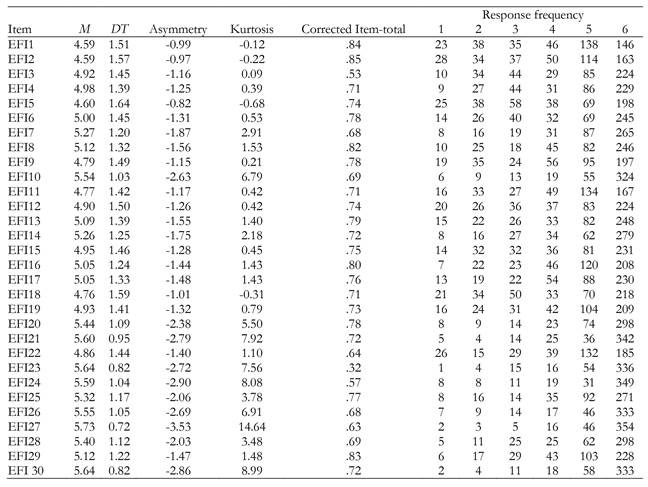
As shown in Table 1, the items of the EFI-30 met the reference criteria for these values proposed by Maroco (2014), showing asymmetry values near |3.00| and kurtosis values near |10.00|. It can be affirmed that the univariate distribution is normal. The standard deviations range from 0.72 to 1.63; thus, the variability may be considered adequate. All items have a corrected item-total correlation above .30.
Confirmatory Factor Analysis
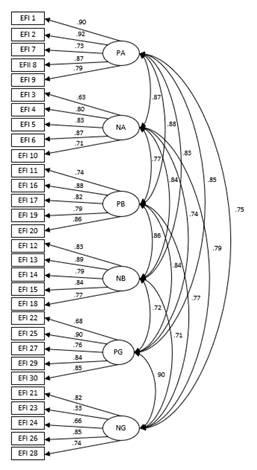
To verify if the factor structure proposed by Enright et al. (2021) was adequate for the data of the Spanish sample, a CFA was conducted using the model of six correlated factors corresponding to the six original scales of the EFI-30.
The results of the CFA of the factor structure of the model of six correlated factors proposed by Enright et al. (2021) indicated a good fit of the model to the Spanish sample. The RMSEA score was .067, below .10, the value recommended by Weston and Gore (2006). The CFI, TLI, IFI and NFI had scores equal to or above .90, coinciding with those recommended by various authors (Hair et al., 1999; Markland, 2007; Marsh et al., 2004). As shown in Figure 1, the range of factor loading for the original model ranges from .33 (item 23) to .92 (item 2). High correlations were also observed between the scales (from .72 to .90).
Although the fit of the six correlated factors model proposed by the authors of the original version was confirmed, the fit of other possible models was also evaluated: a unidimensional model and a three correlated factor model that grouped the positive and negative dimensions producing three subscales: Emotional, Behavioural and Cognitive. In both cases, as shown in Table 2, the goodness of fit indices was worse than the first model, indicating the superiority of the six-factor model.

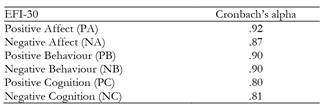
To determine the internal consistency of the total test, each scale was analyzed using Cronbach's alpha. For the entire instrument, Cronbach's alfa was .97, which is considered excellent according to George and Mallery (2003). As shown in Table 3, the reliability coefficient was excellent for the scales: Positive Affect (PA), Positive Behaviour (PB), and Negative Behaviour (NB), with a good reliability coefficient for the rest of the subscales: Negative Affect (NA), Positive Cognition (PC) and Negative Cognition (NC).
Validity criterion of the EFI-30
The validity criterion between the EFI-30 and the clinical symptomatology related to depression, anxiety and stress measured by the DASS-21 was analyzed using the Spearman correlations. As shown in Table 4, the scores of the six EFI-30 subscales (PA, NA, PB, NB, PC, NC) and the total scores of the test are negatively and significantly correlated with the total scores of the DASS-21. Negative correlations were also found between the total score of the EFI-30 and all its subscales with emotional symptomatology assessed by the DASS-21 subscales (Depression, Anxiety and Stress).

Convergent validity of the EFI-30
The convergent validity of the EFI-30 and its subscales was evaluated using the Revenge, Avoidance, and Benevolence subscales of the TRIM-18 and the Justification and Negation subscales of the RSS. As shown in Table 5, there are significant negative correlations between the EFI-30 and its subscales and the Revenge and Avoidance scales of the TRIM-18, and the Justification and Negation scales measured with the RSS. Significant positive correlations also were found between the EFI-30 and its scales, and the Benevolence scale of the TRIM-18 and the Apology scale measured with the RSS.

Discussion
The objective of the present study was to adapt the EFI-30 questionnaire for the assessment of interpersonal forgiveness in a Spanish sample, analyzing the construct validity of the EFI-30 and the convergent and criterion validity as well as the instrument's reliability. The results show that the EFI-30 is a reliable and valuable tool for evaluating interpersonal forgiveness within a specific offense among Spanish university students.
Regarding the first hypothesis, a CFA confirmed the factor structure of the original version of the EFI-30 proposed by Enright et al. (2021) and confirmed in eight countries. The results showed a similar fit of the model to the original. As proposed by the authors, the 30 items of the original instrument are distributed into six scales (Positive Affect, Negative Affect, Positive Behaviour, Negative Behaviour, Positive Cognition and Negative Cognition), each consisting of 5 items.
The global reliability of the instrument and the different scales was satisfactory; the results obtained in the present study are similar to those obtained in Austria, Brazil, Israel, Korea, Norway, Pakistan, Taiwan, and the USA (Enright et al., 2021). All values obtained in the present study are above the cut-off of .80 recommended by Nunnally and Bernstein (1994) for instruments used in basic research. The results confirm the quality of the EFI-30 for future research into interpersonal forgiveness in the Spanish population.
Regarding the second hypothesis, the criterion validity of the EFI-30 is shown by its significant negative correlation with the Revenge and Avoidance scales and its significant positive correlation with the Benevolence scale of the TRIM-18 (McCullough et al., 2006). Significant positive correlations were found (coefficients above .47) between the total score of the EFI-30 and all its scales (PA, NA, PB, NB, PC, NC) with the Benevolence scale. This is consistent with the findings of other authors (Rye et al., 2001), who consider benevolence as a positive dimension of forgiveness. Regarding significant negative correlations of the EFI-30, these were found with the Avoidance scale (considered a strong correlation) and the Revenge scale (considered a moderate correlation) (Fincham & Beach, 2002; Gordon et al., 2009) identifying avoidance and revenge as negative dimensions of forgiveness and thus the results of the present study coincide with the findings of other studies where avoidance and revenge were inversely associated with overall self-reported forgiveness (Guzmán et al., 2014). The positive correlations between the EFI-30 and the TRIM-18 show that they are related but with different measurements of the forgiveness construct, thus pointing to the theoretical debate in the assessment of forgiveness. The analysis of forgiveness in both questionnaires is different and, as the paper argues, the TRIM-18 does not assess forgiveness in its full sense (it does not assess the virtuous themes of kindness, respect, generosity, or love towards the offended person, and it combines in some items forgiveness with reconciliation). Meanwhile, the EFI-30 includes items that permit operationalizing the negative and positive dimensions of forgiveness
The positive dimension is, for some authors, essential since it permits a self-transformation experience, a rising sensation of sense that changes the way that the person that forgives observes the world and itself (Williamson & Gonzales, 2007). In this way, the EFI-30 is a more accurate assessment instrument that makes it possible to operationalize and evaluate forgiveness through both dimensions including cognitive, affective, and behavioral functioning of the person.
Regarding the third hypothesis, about the validity of the EFI-30 based on correlations with the RSS Apology scale, significant, although moderate positive correlations were found. This suggests that apologies may favor forgiveness (Metts & Cupach, 2007) and have an impact on the victim's willingness to forgive (Bachman & Guerrero, 2006; Kelley, 1998) but cannot be treated as synonyms.
The results of the present study indicate significant moderate negative correlations between the EFI-30 and its scales with the RSS Negation scale. It should be noted that negation refers to the strategy by which the offender denies the transgression occurred, which hinders any willingness to forgive. Significant negative correlations were also found between the EFI-30 and its scales and the Justification scale of the RSS, justifications which refer to attempts to reconsider the victim's interpretation of the offense and reduce its significance (Morse & Metts, 2011). The authors Enright and Fitzgibbons (2015) differentiate justification from forgiveness. It can be concluded that repair strategies based on negation and excuses are inadequate since they do not promote healthy forgiveness. In this sense, some authors (Lawler-Row et al., 2007) consider forgiveness through negation as a form of pseudo-forgiveness.
Regarding the last hypothesis, about the evidence of the criterion validity of the EFI-30 based on the associations with other variables, in line with expectations, it was found that the scores of the EFI-30 and its scales are negatively correlated with the scores of the DASS-21 and its scales (Depression, Anxiety and Stress) which evaluate clinical symptomatology related to health. It can be stated that individuals with higher forgiveness levels show fewer psychological disorders. Significant negative correlations were found (coefficients above .14) between the total score of the EFI-30 with a total score of DASS-21 and all its scales (Depression, Anxiety, Stress). This is consistent with the results of previous studies where forgiveness is negatively correlated with the symptomatology of depression (Barcaccia et al., 2022; Friedeberg et al., 2009; Kaleta & Mróz, 2020); anxiety (Friedeberg et al., 2009; Reed & Enright, 2006) and stress (Berry & Worthington, 2001; Friedeberg et al. 2009).
Although this study found the EFI-30 to have adequate psychometric properties for the Spanish population, certain limitations to the present work should be noted.
Firstly, all items present mean scores above 4.59, and there are items with scores very close to the highest value, which indicates that there is a poor distribution of responses in different alternatives. Despite the poor answer distribution, all the items have minimum and maximum values so a certain data dispersion can be concluded. These data could be affected by the characteristics of participants. It must be highlighted that the sample was recruited using convenience sampling and included only Spanish university students which may limit the possible generalization of the results. Further studies should be conducted using more heterogenous samples and studies in different contexts, for example, a clinical context, to evaluate if the instrument performs similarly. Secondly, remedial strategies appeared to be related to the process of pseudo-forgiveness, and thus, it is important to conduct a more systematic analysis of pseudo-forgiveness.
In the future, EFI-30 can be used for different types of offenses. For example, Haroon et al. (2021) focused the EFI-30 on men who engaged in an acid attack on the participant. Reed and Enright (2006) focused on the husband who acted unjustly within the marital relationship, even if this was years ago. Therefore, researchers should feel free to alter the wording of the opening statement of the EFI-30 to focus on the issue of interest in their research.

