




 Servicios personalizados
 Inglés (pdf)
 Articulo en XML
 Referencias del artículo
 Traducción automática
 Enviar articulo por email
 Citado por SciELO
  Citado por Google
  Similares en
SciELO
Similares en
SciELO  Similares en Google
 Permalink
Introduction
Bullying is a type of aggression that is done consciously, repetitively, and usually arises from a power imbalance between the perpetrator and the victim (Olweus, 2013). While the perpetrator engages in physical or psychological negative behaviors to cause harm, the victim may remain vulnerable and alone under pressure. It is known that this type of aggression, which is also ethically unacceptable, is a social problem among adolescents (Kaufman et al., 2020). After the concept of bullying was defined in the 1970s, studies have been carried out on the subject. Most of the bullying behaviors take place at school or in places where control can be difficult and low (Zych et al., 2019). The emergence of bullying is associated with low academic achievement and self-esteem, depression, and substance use (Turner et al., 2013). Being exposed to bullying during adolescence, when belonging to the peer group and socialization is of critical importance, can be harmful for adolescent mental health (Salmivalli et al., 2021). Being a perpetrator of bullying in adolescents is associated with depression, insomnia, social phobia, inattention, impulsivity, suicidality, and alcohol use (Yen et al., 2014). Similarly, adolescents who are victims of bullying are likely to show depressive symptoms, somatization, panic disorder, behavioral problems and low academic performance (Le et al., 2017). Similarly, mood disorders (depression, anxiety), insomnia, educational problems, hyperactivity and conduct disorder are more common in adolescents who are both victims and perpetrators of bullying behavior (Hysing et al., 2021). Therefore, reducing bullying behavior among adolescents is important for their mental health.
Bullying can manifest in various forms, including verbal aggression such as threats; physical aggression, which encompasses behaviors like kicking, pushing, or damaging personal property; social aggression, involving exclusion from social groups and spreading rumors; and, more recently, cyberbullying through technology and the internet (Menesini & Salmivalli, 2017; Olweus, 2005). Bullying entails an interaction between the perpetrator and the victim, during which the perpetrator's power typically increases while the victim's power diminishes. This dynamic exacerbates the victim's difficulty in managing the situation (Swearer & Hymel, 2015). The power imbalance between the perpetrator and the victim may stem from factors such as physical strength or socio-economic status. Additionally, the aggressor may gain power by exploiting the victim's vulnerabilities and weaknesses (Menesini & Salmivalli, 2017).
Investigating the estimated prevalence of bullying among adolescents is of considerable interest. Juvonen and Graham (2014) report that approximately 20% of adolescents are involved in bullying, either as perpetrators, victims, or both. This finding is supported by recent research; for instance, a recent study by Xing et al. (2022) determined that the prevalence of bullying victimization in schools is 22%, with a 15.7% likelihood of being bullied. The prevalence of bullying during childhood and adolescence is also examined in relation to gender and age. Zych et al. (2020) found that bullying is most prevalent among individuals aged 11-14 and is more common among boys compared to girls. Consequently, there is a pressing need to implement prevention and intervention strategies to address the widespread issue of bullying among adolescents.
There are various intervention methods to reduce bullying among children and adolescents. Intervention programs to prevent and treat bullying aim to teach a variety of skills. Deng et al. (2021), emphasizes that developing empathy skills in adolescents can reduce bullying tendency. Empathy is a personality trait that enables an individual to perceive the mood of others and to be cognitively and emotionally aware of the moods of others (Landazabal, 2009). Lack of empathy in adolescents makes it difficult for them to understand the emotions of others and makes it easier for them to be aggressive (Montero-Carretero et al., 2021). In this context, empathy can contribute to reducing behavioral problems and developing positive behaviors. Zych et al. (2019) also found that teaching the cognitive and emotional components of empathy to adolescents can reduce bullying behaviors. Therefore, cognitive behavioral interventions based on the relationship between emotions, thoughts and behaviors can be effective in reducing bullying among adolescents.
Cognitive behavioral interventions indicate that mental problems are caused by cognitive factors (Hofmann et al., 2012). Cognitive behavioral interventions argue that practices to change dysfunctional thoughts can also change emotional distress and problematic behaviors (Beck, 2020). In general, cognitive behavioral interventions frequently use methods such as psychoeducation, restructuring, relaxation, relaxation, keeping thought and emotion diaries (İme & Ümmet, 2023). Cognitive behavioral interventions are effective in the treatment of mood disorders such as depression and anxiety (Mirchandaney et al., 2022) and in the treatment of behavioral disorders, conduct disorder and aggression problems in adolescents (Riise et al., 2021). Similarly, cognitive behavioral interventions are also effective in the prevention and treatment of bullying behavior in adolescents. For example, Abdulkader (2017) found that cognitive behavioral intervention programs reduced the bullying tendencies of adolescents in his study with adolescents. The meta-analysis study conducted by Gaffney et al. (2021) also indicates that cognitive and behavioral intervention programs reduce the likelihood of bullying behaviors involving aggression in adolescents. Recent meta-analytic studies have indicated that cognitive-behavioral interventions can be effective in reducing bullying behaviors among adolescents (Hoogsteder et al., 2015). Cognitive behavioral interventions can also be effective in developing positive characteristics in adolescents (İme & Ümmet, 2023). Therefore, cognitive behavioral interventions may be effective not only in reducing problematic behaviors but also in developing empathy, the ability to understand others, in adolescents. Indeed, in a recent study, Matthys and Schutter (2023) state that cognitive behavioral interventions are effective in developing skills such as empathy and helping others in adolescents. The same study shows that the development of empathy, moral thinking and social problem-solving skills in adolescents may contribute to a decrease in their tendency to show conduct disorder. Therefore, the development of empathy skills in adolescents can contribute to the reduction of their bullying behaviors.
Present Study
Based on the literature review and existing studies, it is evident that further research is necessary to explore the impact of cognitive-behavioral interventions on bullying and empathy levels among adolescents. Research indicates that adolescents who exhibit bullying behavior may be at risk for developing conduct disorders and engaging in antisocial behaviors in the future (Mohamed et al., 2022). Additionally, the study by Miura and Fuchigami (2022) highlights that adolescents with conduct disorders often have a history of bullying behavior or victimization and may have been exposed to various forms of abuse. Similarly, other studies suggest that bullying victimization increases the likelihood of engaging in risky behaviors during adolescence and throughout subsequent developmental stages (Shah et al., 2022). Therefore, it is important for the healthy development of adolescents to improve adolescents who show bullying behaviors and to carry out preventive practices for bullying behaviors. Despite the need for therapeutic interventions for adolescents who engage in bullying behavior, studies on rehabilitating adolescents who engage in bullying behavior are also limited. For this reason, the current study aims to contribute to the field by investigating the effectiveness of cognitive behavioral group counseling to effectively intervene in the bullying behaviors and empathy skills of adolescents who engage in bullying behavior. The findings of the current study may help mental health professionals working with adolescents, especially school counseling services, to determine effective methods for intervening with adolescents who engage in bullying behavior. Therefore, the aim of this study is to examine the effect of cognitive behavioral group counseling program on adolescents' bullying behaviors and empathy skills. In line with this purpose, the study has three hypotheses. First, the bullying behaviors of adolescents participating in the cognitive behavioral group counseling program will decrease significantly compared to the control group. Secondly, the empathy skills of adolescents participating in the cognitive behavioral group counseling program will increase significantly compared to the control group. The last hypothesis is that the changes in the bullying behaviors and empathy skills of the adolescents in the experimental group will continue in the follow-up test to be conducted two months later.
Method
The present study examines the effect of a cognitive behavioral group counseling program on bullying behaviors and empathy levels of adolescents. In the study carried out in the experimental design, it consists of two groups, the experimental group and the control group. Participants were randomly assigned to groups. In this respect, except for the intervention methods, both groups were adjusted equally. The experimental group was subject to the intervention program, while the control group did not receive any intervention. Due to ethical concerns, the same program was applied to the control group after the study. In addition, measurements were made at three different times: pre-test, post-test, and follow-up test. In this respect, the study is a 2x3 factorial design (Creswell, 2014). The independent variable of the study is the cognitive behavioral group counseling program, and the dependent variables are bullying and empathy.
Participants
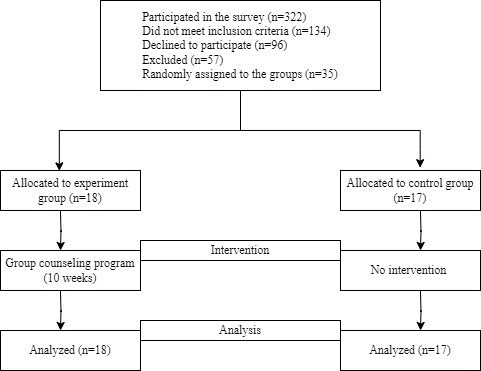
The present study was carried out with 35 students selected from among 322 adolescents who continued their education in public high schools in the district of Esenyurt in Istanbul and participated in the survey study. While determining the participants for the experimental and control groups in the study, adolescents who scored above the average on the bullying scale and below the average on the empathic orientation scale were determined as potential participants. Adolescents participating in the survey study were conducted on adolescents who previously bullied their friends in various ways. While determining these adolescents, cooperation was made with school psychological counselors and school administrations. School administrators shared with the researcher that these adolescents were referred to the school disciplinary committee at different times due to their bullying behavior. Thus, care was taken to select the participants from among the adolescents exhibiting bullying behavior. Necessary legal permissions have been obtained to participate in the survey study. Similarly, permission was obtained from all adolescents and their families. Inclusion criteria for the study were determined as volunteering and not receiving psychological support. The exclusion criterion was determined to be receiving psychological support.
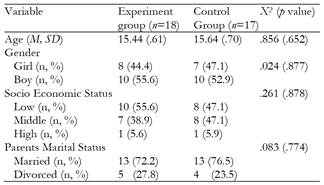
35 of the 322 adolescents who participated in the survey study agreed to participate in the study after obtaining informed consent from both them and their families and were randomly assigned to the experimental and control groups. The age range of the participants ranged from 15 to 17 (M=15.54, SD=.65). The experimental group consists of 18 adolescents, 11 boys and 7 girls. The control group consists of 17 adolescents, 10 boys and 7 girls. 287 adolescents who participated in the survey study, did not participate in the experimental study because they did not meet the inclusion criteria (n=134), did not want to participate in the study (n=96), and did not have appropriate time to participate in the study (n=57). Table 1 shows the demographic characteristics of the participants randomly assigned to the experimental and control groups. There was no difference in terms of demographic characteristics between the experimental and control groups participating in the study (p>.05).
Measures
Bullying Scale.- Shaw et al. (2013) developed the scale to determine bullying behaviors in a sample of adolescents. Arslan (2017) adapted the scale into Turkish. The bullying scale used in the study is the perpetration version. The scale, which consists of 10 items (e.g., I intentionally caused physical harm to someone), has a 5-point likert structure. High scores obtained from the scale indicate that the tendency of the individual to bullying behavior is high. The psychometric properties of the scale show that it is a valid and reliable measurement tool. The Cronbach alpha reliability coefficient of the scale was calculated as .86.
Adolescent KA-Sİ Empathic Tendency Scale.- Kaya & Siyez (2010) developed it to measure the empathic tendencies of adolescents. The 17-item scale (e.g., "When I see someone suffering in front of me, I feel the same pain") has two sub-dimensions: emotional empathy and cognitive empathy. The general empathy tendency score of the scale can also be calculated. In the present study, the overall mean score of the scale was calculated. The scale has a 4-point Likert structure, high scores indicate that the individual has a high empathic tendency. The psychometric properties of the scale show that it is a valid and reliable measurement tool. The Cronbach alpha reliability coefficient of the scale was calculated as .87.
Intervention
There are various anti-bullying programs that prioritize perspective-taking as a means of promoting the development of empathy among children and adolescents (Evans et al., 2014; Olweus & Limber, 2010). It is seen that the programs in the literature are mostly programs aimed at preventing or reducing bullying, which includes physical, verbal, relational or damage to the individual's belongings. However, in the current study, a program was developed that aims not only to reduce bullying but also to improve adolescents' empathy skills. because current studies indicate that empathy development in adolescents can reduce their bullying behavior (Deng et al., 2021). While preparing the intervention program, the items and sub-dimensions of the measurement tools used were taken into consideration. Gökkaya (2017) and İme & Ümmet (2023) studies were used in the preparation of group sessions. In addition, expert support was received during the preparation of the program. Again, before starting the study, a pilot study was conducted and the content of the program to be implemented was finalized in line with the opinions of the group leader and the participants. Before starting each session, the topics covered in the previous session were discussed and the new topic was introduced. During the preparation of the program, the needs and developmental stages of the adolescents were taken into consideration. The duration of the program was 60 minutes once a week and lasted for 10 weeks. Before the start of the program, individual interviews were held with all group members and information was given about the program to be implemented. In addition, the token economy systematic reward system was used throughout the program and care was taken to reward the positive behaviors of the group members. The sessions of the implemented program are as follows. In the first session, it was aimed to meet the group members, determine the rules, explain the purpose of the group and determine personal goals. In the second and third sessions, the definition of bullying, its characteristics, the differences between it and the joke, and the potential long-term effects of bullying on the bullying person were discussed. In addition, the possible feelings of the people who are exposed to bullying and their effects on the person in the long term are discussed. In the fourth session, it was aimed to recognize emotions, express them appropriately and teach possible emotions that can be experienced when bullying. In the fifth session, it was aimed to teach the ABC model to the group members in a practical way based on the relationship between emotion, thought and behavior. In addition, it has been studied how the thoughts that cause bullying can be replaced with other thoughts during bullying behaviors. In the sixth session, coping techniques including stopping the bullying behavior and rewarding oneself when the behavior is stopped were studied. In the seventh session, it was aimed to support group members to develop their empathy skills and establish social connections with others. For this purpose, various scenarios were given to the group members to develop their empathy skills, and it was aimed that the members internalize the concept of empathy. In the eighth session, it was aimed that the group members should realize their strengths and train themselves so that when they tend to show bullying behaviors, they can make positive self-talk that can stop these behaviors. In the ninth session, it was aimed to realize the positive effects of comfortable breathing and muscle relaxation activities on emotions. In this context, practical relaxation and deep breathing exercises have been studied to reduce bullying behaviors. In the last session, a general evaluation of the program, review of the personal goals achieved, compliments of the group members with positive words, filling the measurement tools and finalizing the process were made.
The Control Condition
In the current study, to test the effect of the independent variable on the dependent variables, a control group was formed to compare the experimental group. Participants assigned to both groups were considered similar and randomly assigned to groups. Adolescents in both groups did not receive any extra psychological help during the study. Thus, the researcher aimed to evaluate the effect of the independent variable more objectively by comparing the experimental and control groups.
Procedure
Bullying and Adolescent KA-SI Empathic Tendency Scale was applied to 322 high school adolescents in Esenyurt district of Istanbul province to identify possible participants to participate in the experimental study. The schools where the survey was conducted are public high schools. The survey study was carried out on adolescents who were referred to the school disciplinary committee due to their various bullying behaviors. This information was carried out in cooperation with the school administrations by obtaining the necessary legal permissions. After the survey study, potential participants with high bullying tendencies and low empathy tendencies were determined. The researcher conducted face-to-face interviews with the adolescents who were interested in participating in the study and who met the inclusion and exclusion criteria. 35 adolescents who were willing and voluntarily to participate in the study who met the inclusion and exclusion criteria were determined. Information received from students and school administrators revealed that the participants had low academic achievement, anxiety, anger problems as well as smoking experiences. In individual interviews, detailed information was given about the purpose, duration, place of application and the program to be applied. Verbal and written consent was obtained from 35 adolescents and their parents to participate in the experimental study. While forming the experimental and control groups, 35 adolescents were numbered and randomly assigned to the experimental and control groups (See Figure 1). Adolescents in both groups were given special attention by the researcher due to the possibility of bullying or similar behavior to each other. Afterwards, a psychological counseling program with a cognitive behavioral group consisting of 10 sessions (once a week) was applied to 18 participants in the experimental group (February 2023, April 2023). During this process, no interventions were administered to the control group. Upon completion of the program, the Bullying and Adolescent KA-SI Empathic Tendency Scale was re-administered to all participants as a post-test. Two months after the post-test, follow-up measurements were conducted for both groups to evaluate the program's long-term effectiveness (May 2023). Subsequently, due to ethical considerations, the same program was provided to the participants in the control group after the follow-up measurements.
Ethical Considerations
Verbal and written consent was obtained from the parents and themselves of all participants before the study was conducted. In addition, legal permission was obtained to work in Istanbul Provincial Directorate of National Education. Also, ethical approval for the study was obtained from the Ethics Committee of the Faculty of Social and Human Sciences at Necmettin Erbakan University (Board Number: 2023/485). It was stated to the adolescents in the experimental and control groups that they could leave the research at any time without any sanction. Confidentiality and privacy of all adolescents participating in the study were protected and their private information was not shared. After the program applied to the experimental group, the same program was applied to the control group by the researcher due to ethical concerns. The researcher sincerely answered the questions of all participants throughout the process.
Pilot Study
Prior to commencing the experimental study, a pilot study was conducted to assess the suitability of the program for adolescents with bullying tendencies and to evaluate the clarity of the measurement tools. Based on the findings from the pilot study, the program was refined and finalized. Adolescents who participated in the pilot study were excluded from the experimental study.
Therapist
The therapist is a psychological counselor with 14 years of experience working with adolescents. They have completed undergraduate, graduate, and doctoral studies in psychological counseling. Following their undergraduate education, the therapist received training in cognitive-behavioral therapy (CBT). They conduct research on the application of CBT both individually and in group settings for adolescents. Currently, the therapist serves as an academician at a university and received supervisory support for the development, organization, and implementation of the program used in the research.
Data Analysis
First, whether the participants assigned to the experimental and control groups differed in terms of demographic characteristics was examined with the chi-square test. Then, before starting the data analysis, whether the data of the experimental and control groups were normally distributed or not was examined with the Sha-piro-Wilk test. Similarly, the homogeneity of the distribution of the data belonging to the groups was examined with Levene's test. Whether the dependent variables (bullying and empathy) differed significantly according to the experimental and control groups was tested with the analysis of covariance (ANCOVA) method. Whether the mean scores of bullying and empathy differed at different times (pre-test, post-test and follow up) was tested with one-way analysis of variance (ANOVA) method in repeated measures. The effect size of the differences was tested with the Eta-square (n2 ) method. Eta-square indicates how much of the variance in the dependent variable is explained by a particular independent variable. Effect sizes are interpreted as small (>0.01-0.03), medium (>0.06-0.09) and large (>0.14) (Cohen, 2016). SPSS version 26 statistical program was used for all analyses.
Results
The aim of the current study was to examine the effect of a cognitive-behavioral group counseling program on adolescents' bullying behaviors and empathy skills. The mean and standard deviation values of the pre-test, post-test, and follow-up measurements regarding the dependent variables (bullying and empathy) are given in Table 2. Before starting the analysis, the normal distribution of the data (see Table 3) and whether the variances of the measured variables were equally distributed (see Table 4) were examined. The findings showed that the data were normally distributed, and the variances were homogeneous (p>.001).
Table 2. Bullying, and Empathic Tendency Scale Scores for the pre-test, post-test, and follow-up tests of the participants.
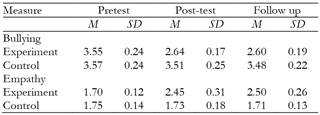
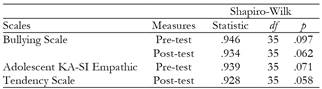

Table 5 presents the findings regarding the effect of the intervention program applied for the first hypothesis of the study on the bullying behaviors of adolescents in the experimental and control groups. When the pre-test results were fixed, it was found that there was a significant difference between the mean bullying scores of the experimental and control groups (F(1, 35) = 133.419, p<.001, n2 =.807). Accordingly, it was found that the mean bullying scores of the adolescents in the experimental group participating in the cognitive behavioral group counseling program were significantly lower than the mean scores of the control group.
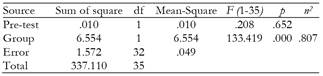
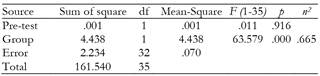
Table 6 presents the findings regarding the effect of the intervention program applied for the second hypothesis of the study on the empathic tendencies of the adolescents in the experimental and control groups. When the pre-test results were fixed, it was determined that there was a significant difference between the mean empathic tendency scores of the experimental and control groups (F (1, 35) = 63.579, p<.001, n2 =.665). Accordingly, it was found that the mean empathy scores of the adolescents in the experimental group participating in the cognitive behavioral group counseling program were significantly higher than the mean scores of the control group.
Finally, repeated measures ANOVA test was applied to test the third hypothesis of the current study. According to the findings, there is a significant difference between adolescents' pre-test, post-test and follow-up bullying mean scores (F(1, 34) = 29.847, p < .001, n2 = .467). When the differences were examined between which measurements, it was found that there was a significant difference between the pre-test and pretest-follow up tests of the experimental group, but there was no significant difference between the post-test and follouw up tests. The current finding shows that the mean bullying scores of the adolescents who participated in the intervention program decreased significantly after the program and this decrease was maintained in the follow-up measurements. Similarly, there was a significant difference between the pre-test, post-test and follow-up mean empathy scores of adolescents (F(1, 34) = 20.677, p < .001, n2 = .378). When the source of the difference was examined, it was seen that there was a significant difference between pre-test and pretest-follow up tests, but there was no significant difference between post-test and follow up tests. The present finding shows that the mean empathy scores of the adolescents who participated in the intervention program increased significantly after the program and this increase was maintained in the follow-up measurements.
Discussion
In the current study, the effect of a cognitive-behavioral group counseling program on the bullying and empathy levels of adolescents who engage in bullying behavior was investigated. The study was carried out in a 2x3 experimental design, and adolescents were randomly assigned to the experimental and control groups. Participants in the experimental and control groups were measured at the beginning, at the end of the program, and at follow-up. The research findings revealed that the bullying levels of the adolescents in the experimental group showed a significant decrease, and their empathy levels increased significantly. Current findings indicate that cognitive-behavioral group intervention programs can reduce bullying behaviors and improve empathy levels of adolescents who engage in bullying behavior.
Findings confirming the first hypothesis of the study show that there is a significant decrease in the bullying behavior of the adolescents in the experimental group who engage in bullying behavior. The present finding is like the study of Abdulkader (2017), which examined the effect of a cognitive-behavioral intervention program for adolescents who engage in bullying behavior. It was found that the bullying levels of the adolescents decreased significantly after the intervention for the adolescents who engage in bullying behavior. Similar results were obtained in the cognitive behavioral intervention program for children with bullying tendencies in pre-adolescence, conducted by Gökkaya and Sütçü (2018). The findings showed that the bullying tendencies of the participants in the experimental group decreased significantly compared to the pre-test scores of their post-test scores. Also, Gaffney et al. (2021), also shows that cognitive behavioral interventions can be effective in reducing bullying behaviors in adolescents. Therefore, it can be said that cognitive behavioral group intervention programs are effective in reducing bullying behavior in adolescents.
Findings also confirmed the second hypothesis of the study. The findings of the study showed that the cognitive-behavioral group counseling program had a positive effect on the empathy levels of adolescents who engaged in bullying behavior. This finding indicates that the components of the program applied to the participants were effective in developing empathy skills. Accordingly, it can be stated that the development of empathy skills is a powerful tool to confront and prevent bullying, especially among adolescents who engage in bullying behavior. Matthys & Shutter (2023) state that cognitive behavioral therapies in children and adolescents are effective in reducing aggressive and antisocial behaviors and developing empathy skills and helping others. In cognitive behavioral group therapy, sharing experiences among members, cognitive restructuring and feedback from other group members contribute to the development of empathy skills in individuals (Morrison et al., 2019). Moster et al. (2008) found that techniques such as cognitive restructuring and socratic questioning can reduce the aggression of people with aggressive behaviors and contribute to the development of empathy skills. All this information shows that cognitive behavioral interventions can contribute to the development of empathy skills in adolescents who engage in bullying behavior.
Cognitive behavioral interventions generally emphasize the relationship between emotion, thought and behavior. Intervention programs generally aim to make the client realize dysfunctional thoughts and change thoughts and behaviors with behavioral and cognitive techniques (Beck, 2020). In the current study, cognitive behavioral techniques were adhered to by teaching participants about the relationship between emotion, thought and behavior, rewarding, homework, empathy scenarios, relaxation and relaxation exercises. Studies conducted in accordance with the theoretical background indicate that cognitive behavioral interventions can reduce bullying in adolescents and contribute to the development of empathy skills (Farrington et al., 2017; Matthys, & Schutter, 2021). Bullying behaviors in adolescents negatively affect not only the victim but also the bully. Bullying can have negative effects on adolescents' academic life as well as their mental health (Urano et al., 2020). Adolescents who are exposed to bullying may feel lonely and unhappy during adolescence when socialization is critical (Cao et al., 2020). On the other hand, the development of empathy in adolescents not only reduces bullying behaviors but also protects adolescents against behaviors that may lead to crime (Goering & Mrug, 2021). The current study provides solutions for reducing bullying behaviors and developing empathy skills, which are of critical importance for adolescents' mental health. The findings also provide important findings for mental health professionals and school counselors working with adolescents. First, within the scope of remedial guidance, unwanted behaviors can be reduced by implementing the current program or similar programs for adolescents who exhibit bullying behaviors. Instead of undesirable behaviors, adolescents can gain positive characteristics. Similarly, within the scope of developmental and preventive guidance, school counselors can disseminate cognitive-behavioral practices that improve adolescents' empathy skills.
In conclusion, the present study showed that the cognitive-behavioral group intervention program was effective in reducing bullying behaviors and improving empathy skills in adolescents. The results of the program revealed that the posttest and follow-up scores of the experimental group differed from the control group in the desired direction. The fact that the situation was similar in the follow-up measurements made two months after the completion of the program indicates that the intervention program has a sustainable effect. The significant reduction in bullying behaviors and the marked increase in empathy levels observed among participants highlight the program's potential as a valuable intervention tool in educational and therapeutic settings. These findings suggest that cognitive-behavioral techniques, which focus on altering thought patterns and behaviors, can foster a more empathetic and supportive peer environment. By equipping adolescents with strategies to manage their emotions and interactions more effectively, this counseling program not only mitigates negative behaviors but also enhances positive social skills, paving the way for a more inclusive and respectful community.
Limitations and suggestions
The first limitation of the study is that the data is on the participants' own evaluations. The answers given by the participants may be in the desired direction, but this may be difficult to overcome. For this reason, peer, teacher, parent and researcher evaluations based on independent observations may also be useful. Secondly, the implementation phase of the current study lasted approximately 10 weeks and follow-up measurements were made after 2 months. However, bullying behaviors may reappear in the future. In this context, longer-term intervention and monitoring methods may be useful. Thirdly, the study involved a sample of 35 participants. Therefore, it is recommended that future research be conducted with larger sample sizes to enhance the generalizability of the findings. Finally, the current study was conducted with experimental and control groups, and the placebo group was not included in the study. Including the placebo group in a similar study may provide a clearer understanding of the effect of the independent variable. Despite all these limitations, the findings show that cognitive behavioral intervention programs can reduce bullying behaviors in adolescents and contribute to the development of empathy skills. For this reason, it is thought that training school counselors working especially in schools about cognitive behavioral practices may be helpful in intervening with adolescents with bullying behaviors. In addition, intervention programs that can include families in the process may be useful.

