




 Servicios personalizados
 Inglés (pdf)
 Articulo en XML
 Referencias del artículo
 Traducción automática
 Enviar articulo por email
 Citado por SciELO
  Citado por Google
  Similares en
SciELO
Similares en
SciELO  Similares en Google
 Permalink
Introduction
The burden of mental health disorders has steadily increased worldwide over the years (GBD 2019 Mental Disorders Collaborators, 2022). In 2019 the global prevalence of mental health disorders and substance use disorders in the 5 to 24 age group was 11.63% and 1.22% respectively, with prevalence rates for mental health disorders being highest among the 15 to 19 years age group at 13.96%, and 13.63 % in the 20 to 24 age group (Kieling et al., 2024). In Catalonia, Spain the incidence rate of common mental health disorders (e.g., depression, anxiety, eating disorders) in adolescents and young adults has also seen a steady increase from 2008 to 2022 (Lozano-Sánchez et al., 2024). The period of emerging adulthood is when most individuals start or are in university and is generally an unstable developmental stage related to important decision-making. Recent meta-analyses showed that the global prevalence rates among college students almost rivaling global figures, with 33.6% experiencing depression symptoms, and 39.0% with anxiety (Li et al., 2022) and with it an increasing demand for mental health services (Lipson, Lattie, et al., 2019; Xiao et al., 2017). Research suggests that for many students' life can be stressful (McCloud & Bann, 2019) and associated with substantial impairment (e.g., poorer academic performance, higher class absenteeism, and dropouts poorer functioning) (Alonso et al., 2018; Auerbach et al., 2016; Ishii et al., 2018). More alarmingly, the age range for majority university students (i.e., 18-22 years) falls within the age group (i.e., 15-29 years) in which suicide is one of the leading causes of death (World Health Organization, 2021). Recent reports show high rates of self-harm, which is one of the strongest risk factors associated with suicide, among university students in Spain and internationally (Clements et al., 2023; Lázaro-Pérez et al., 2023) and mental health difficulties are an important risk factor for suicidal behaviors (Blasco et al., 2019; Seo et al., 2021).
These increasing numbers in mental health disorders, that in some cases lead to suicidality among university students, have garnered a lot of research attention (Hernández-Torrano et al., 2020). It is a growing public health concern for the prevalence, incidence, and severity of mental health problems and their impact. As a result, there are calls for research aimed to better understand the current mental health of university students and the heterogeneity therein (Auerbach et al., 2018). The scope of the students’ mental health problems must be well described to be able to develop strategies to address these issues on university campuses.
Prevalence in one location may vary from another (Ochnik et al., 2021). In Spain, the most recently published papers have been mainly restricted to subgroups of students (e.g., in initial stage of university studies (Ballester et al., 2020; Fernández-Rodríguez et al., 2019), students enrolled in certain programs (Ramón-Arbués et al., 2020), or specific mental health problem (Fernández-Rodríguez et al., 2019; Ruiz-Hernández et al., 2022)). Research also shows other basic socio-demographic and academic factors shaping students’ mental health (e.g., age, ethnicity, sex, gender identity, finances, level of study, living situation, sexual orientation, academic pressures, foreign environment (Ahmed et al., 2023; Campbell et al., 2022; Limone & Toto, 2022; Sheldon et al., 2021)). Many of these studies have again looked at just a subgroup of students and one or two mental health outcomes. Despite the factors explored, research addressing the associations of these factors with poor mental health is limited (Campbell et al., 2022) or inconclusive (Ahmed et al., 2023; Ramón-Arbués et al., 2020; Sheldon et al., 2021). There is a need for up-to-date information of the prevalence of mental health problems in university students in Spain (Ramón-Arbués et al., 2020) and worldwide (Kang et al., 2021). It also seems necessary to continue investigating the contribution of sociodemographic and academic factors, even though most of them are non-modifiable (Kang et al., 2021); and investigate the effect on separate common mental health problems in a cohort of the student body, which will facilitate comparability. Findings will inform strategies to encourage help-seeking amongst those student groups at risk and tailor interventions for them, which may decrease related burden (e.g., overwhelming demand on under-resourced health services).
The aim of this cross-sectional study is twofold. First, to evaluate among students enrolled in a public university of Spain, in all levels and areas of study, the prevalence of students at risk of the following common mental health disorders: major depression disorder (MDD), panic disorder, generalized anxiety disorder (GAD), bulimia nervosa, binge eating disorder, alcohol abuse or dependence as selected by those students who meet DSM-IV diagnosis criteria (American Psychiatric Association, 1998) using self-rating instruments. Secondly, to identify sociodemographic (age, sex, gender, ethnicity, household composition) and academic factors (level of study, area of knowledge, and participation in an exchange program), associated with being at risk of mental health disorders among students, and explore whether these correlates are disorder-specific or transdiagnostic.
Method
Participants
Our target population included all students in a graduate or postgraduate program at one public university in Spain: Universitat Rovira i Virgili. We excluded students who did not provide informed consent for the study, and were not able to understand Catalan or Spanish.
The number of students in the Universitat Rovira i Virgili during the study period determined the sample size.
We obtained 4,315 participants who consented and immediately started the online survey, 1,453 of them (33.67%) dropped out prior to finishing. The results reported are based on 2,862 (66.33%) respondents who completed the online survey. Response rate was 18.45% of approximately 15,500 students enrolled at the university. Among those who completed, 25.26% (n = 723) had at least one missing value, there was some missing data among 96.04% of the variables, and there was 0.57% of missing data.
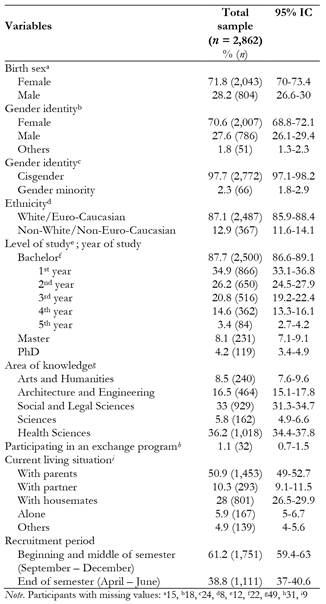
The mean age was 21.43 (SD = 4.72, range=17-80). Majority were female’ sex (71.4%, n = 2,043) and cisgender (96.9%, n = 2,772). Most were white (86.9%, n = 2,487), and the most common minority ethnic groups were Latin Americans/Hispanics (n = 216, 7.5%) and Arabs/North-Africans/Western Asians (n = 86, 3%). Living at home with their parents was the most prevalent housing situation (50.8%, n = 1,453). Most students were undergraduates (87.4%, n = 2,500), and health science, and social and legal sciences where the areas of study most students were in (35.6%, n = 1018 and 32.5%, n = 929, respectively). See Table 1 for further details.
Instruments
The validated Spanish versions of the measures were administered. However, since Catalan is also an official language, the measures were translated to Catalan using a back-translation procedure. Students could choose their preferred language.
Sociodemographic and academic characteristics
Ad-hoc self-report questions were incorporated to evaluate the following variables: age, sex at birth (sex), gender identity (gender), ethnicity, household composition, level of study, study program, year of study, and if part of an exchange program.
Both sex at birth and gender identity items (“What was your assigned sex at birth?” with the response options: ‘Male’ and ‘Female’. “What is your current gender identity? / How do you describe yourself?” with answer options: ‘Male’, ‘Female’ and ‘Other’) were used to evaluate gender categories as proposed by Tate et al. (2013). Gender minority category combined those respondents who endorsed ‘others’ as their gender identity, as well as those respondents who reported discordant birth sex and gender identity, and cisgender category included those who reported that their gender identity was aligned with the sex assigned at birth.
Mental health disorders: Patient Health Questionnaire (PHQ)
The PHQ (Spitzer et al., 1999) is one of the most comprehensive screening instruments for mental disorders. It is a self-administered questionnaire designed to evaluate the presence of common mental health disorders based on the DSM-IV including: major depression, other depressive disorders, panic disorder, other anxiety disorders, binge eating, bulimia nervosa, somatoform disorder, and alcohol abuse or dependence, using an algorithm scoring method. All the modules were administered except the one evaluating other anxiety disorders, which was covered by the GAD-7. Moreover, since the diagnosis of somatoform disorder requires clinical judgement to rule out a biological explanation for the physical symptoms that participant reports, and our survey did not ask about biological explanations, the prevalence of somatoform disorder is not reported.
The original PHQ has shown to have adequate psychometric properties (Spitzer et al., 1999, 2000). When used in primary care evaluation of mental disorders, it has been found to have a good concordance between diagnoses according to the PHQ and diagnoses according to the original clinician-administered PRIME-MD (kappa=0.65; overall accuracy=85%, sensitivity=75%, specificity=90%) and it was also found that a PHQ diagnosis was related with functional impairment, disability days, and health care use (Spitzer et al., 1999). A Spanish version has been developed and well-validated. The Spanish version, when used in general hospital with inpatients, also showed to have good diagnostic validity (Kappa = 74; overall accuracy = 88%; sensitivity = 87%; specificity = 88%) and good predictive validity: inpatients with a PHQ diagnosis had more functional impairment, disability days and health care use (Diez-Quevedo et al., 2001).
Major depression: Patient Health Questionnaire-9 (PHQ-9)
The PHQ-9 (Kroenke et al., 2001) is used to identify possible MDD. It follows nine criteria of the DSM-IV for the diagnosis of MDD. Each item is answered on a 4-point Likert scale (0 (not at all) - 3 (nearly every day)). The total score is the sum of the item scores, and ranges from 0 to 27. Scores of 5, 10, 15 and 20 represent cut points for mild, moderate, moderately severe, and severe depression, respectively, with a standard cut-off for suspected MDD being a 10 or above (Kroenke et al., 2010).
Internal consistency of the original PHQ-9 has shown to be high (i.e., Cronbach’s α= 0.86 and 0.89 in a study involving primary care centers and obstetrical clinics, respectively) (Kroenke et al., 2001). The cut-off of ≥10 on the original PHQ-9 yielded a sensitivity of 88% and a specificity of 88% for major depression (Kroenke et al., 2001). The PHQ-9 has also shown to be sensitive to changes of condition severity over time (Kroenke et al., 2010; Löwe et al., 2004) and to be related to functional status, disability days, and symptom-related difficulty (Kroenke et al., 2001).The psychometric properties of the Spanish version for Spain has also been studied (Muñoz-Navarro et al., 2017) and it showed to perform reasonably well as screening tool for MDD in adult patients in Spanish primary care centers when the most common cut-off point of ≥10 was used (sensitivity=0.95 and specificity=0.67) (Muñoz-Navarro et al., 2017). In our study sample, the Spanish version and our Catalan version were also found to be reliable (Cronbach's α=0.89 and 0.88, respectively).
Generalized anxiety disorder: Generalized Anxiety Disorder-7 (GAD-7)
The GAD-7 (Spitzer et al., 2006) was derived from the PHQ. Each of the seven items is answered on a 4-point Likert scale (0 (not at all) - 3 (nearly every day)). The total score is the sum of the items, and the total ranges from 0 to 21. Scores of 5, 10, and 15 represent cut points for mild, moderate, and severe anxiety, respectively, with a standard cut-off for suspected GAD being a 10 or above (Kroenke et al., 2010).
The original version of the GAD-7 showed to have excellent reliability (Cronbach's α =0.92), a sensitivity of 89 and specificity of 82 for diagnosis of GAD when using a cut-off of 10 in primary care clinicals in the United States, and the GAD scores were also found to be strongly associated with multiple domains of functional impairment (Spitzer et al., 2006). The adapted Spanish version for Spain that we used also demonstrated robust psychometric properties when the version was evaluated in primary care settings (Cronbach's α =0.83) and GAD-7 scores highly correlated with other scales (i.e., HADS-Anxiety, HADS-Depression, and HAM) (García-Campayo et al., 2012). In our study sample, the Spanish version and our Catalan version were also found to be reliable (Cronbach's α =0.91 and 0.91, respectively).
Procedure
In this cross-sectional study, students at the participating university were recruited from April 25th to June 19th, 2022, which coincides with end of a semester (i.e., February -June), and from September 5th to December 15th, 2022, which coincides with beginning and middle of a semester (September -January). Two different time periods were opened to facilitate recruitment. At both times, we used several recruitment methods, all students at the participating university (n= 15,418 in 2021/22 academic year and n=15,652 in 2022/23) were invited to participate as long as they have not answered the survey previously. Information regarding the study was passed through e-mail-invitations, in-person presentations in classrooms, and posting through the University’s official social media (i.e., Facebook, Instagram) or the University’s website or online learning platform.
Interested students were referred to a study website, where they could provide their online informed consent, and once consent was provided, they were automatically redirected to an online survey to be completed. The survey contained several sections: sociodemographic and academic characteristics, normative mental health needs, expressed mental health needs, and their view of mental health services, but only the first two, sociodemographic (age, sex, gender identity, ethnicity, household composition) and academic characteristics (level of study, area of knowledge, and participation in an exchange program), are relevant for the purpose of this study. The last two sections (i.e., expressed mental health needs, and students view of mental health services) fall outside of the scope of this study. Data taken at different recruitment periods (i.e., April- June, 2022 and September-December, 2022) was pooled and analyzed together.
The study was approved by the University Ethics committee (CEIPSA-2020-PR-0005). This study also followed the STROBE guidelines for reporting cross-sectional study data (Vandenbroucke et al., 2007). See appendix 1.
Data Analysis
Missing values: A high percentage of participants dropped out, so the dataset contains data not missing at random. Analyses were made only with the subset of participants who completed the survey. Among those who completed the survey, we encountered Missing At Random (MAR) data, representing less than 5% of the total data. To deal with MAR data, a modified Hot-Deck Multiple Imputation (HD-MI) was implemented (Lorenzo-Seva & Ginkel, 2016), which generated 5 complete data sets, and each missing value was replaced by the most repeated value of the 5 sets. After this, total scale scores were computed, and analyses performed.
Prevalence and severity: Proportions and 95% confidence interval (CI) were calculated.
Sociodemographic and academic factors associated with screening positively for mental health disorder: Various multivariate logistic regressions were performed to determine the association between sociodemographic and academic characteristics (independent variables) and screening positively for mental health disorders (dependent variables). This was done first for participants who screened positively for at least one mental disorder and then, 6 regressions, one for screening positively for each of the explored mental disorders: MDD, panic disorder, GAD, bulimia nervosa, binge eating disorder, and alcohol abuse. The following sociodemographic and academic variables were considered as independent variables: age, sex (male, female), gender (cisgender, minority), ethnicity (white/Euro Caucasian-, non-white/non-Euro Caucasian), household composition (with parents, with partner, with housemates, alone, others), level of study (first-year undergraduates, second to fifth-year undergraduates, masters, PhD), area of knowledge (health sciences, architecture and engineering, arts and humanities, sciences, and social and legal sciences), participation in an exchange program (yes, no), and recruitment period (end of semester, beginning and middle of the semester). Recruitment period was considered a posteriori a potential confounding factor and consequently, entered into the models as an independent variable because during data analysis, this variable was found to be associated with prevalence of being at risk for mental health disorders. The rest of sociodemographic and academic variables were established a priori as potential risk factors. Although gender identity defined as male, female, and other was also gathered, it was decided a posteriori not to be entered into the multivariate analyses because sex at birth and gender identity were highly correlated. For the multivariate analyses, all variables with p-value<0.05 when performing chi-square and independent t-test were entered into the analyses. Automatic selection using both forward likelihood ratio selection and backward likelihood ratio elimination was first used. After, we manually removed from the model the independent variables with a p-value of the Wald statistic larger than 0.05. Forward selection and backward elimination led to the same results. OR and corresponding 95% confidence intervals (CI) were calculated. Multicollinearity was checked by tolerance and variance inflation factor (VIF) and two- way interaction between independent variables retained in the model was also checked individually.
All analyses were performed with SPSS (version 29, IBM Corp) and MATLAB (The MathWorks, Inc.).
Results
Prevalence of being at risk of mental health disorders
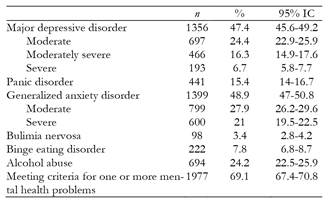
69.1% (95% CI 67.4-70.8%) screened positive for at least one disorder. The most common disorders that students screened positively for were GAD (48.9%, 95% CI 47-50.8%) followed by MDD (47.4%, 95% CI 45.6-49.2%) (see Table 2). Among those who screened positive for probable GAD or MDD, the severity of their symptoms was most frequently categorized as moderate (see Table 2).
Table 2: Prevalence of students screening positive for common mental health disorders and severity of their symptomatology
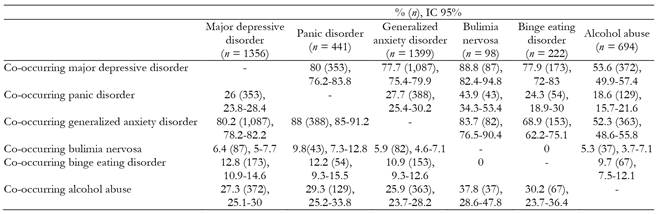
Among those who screened positive for at least one disorder (n = 1,977), 32.4% (n = 641) screened positively for only one and 67.6% (n = 1,336) screened positively for more than one. About 23.4% met criteria for two disorders and 23.3% met for three or more. The estimates for the pair-wise cross-sectional co-occurrence between explored mental disorders are presented in Table 3. Students at risk for eating disorders were often at risk for co-occurring MDD and GAD (i.e., of those at risk for bulimia nervosa, 88.8% were at risk for MDD and 83.7% for GAD; and of those at risk for binge eating, 77.9% were at risk for MDD and 68.9% for GAD). Co-occurrence between depression and anxiety was also often observed (i.e., 80.2% at risk for MDD were also at risk for GAD; 80% and 88% of individuals at risk for a panic disorder were also at risk for MDD and GAD, respectively; and 77.7% of students at risk for GAD were also at risk for MDD).
Factors associated with screening positively for at least one mental health disorders
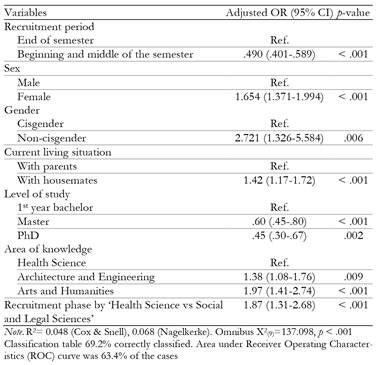
Age, sex, gender, living situation, level of study, area of knowledge, and recruitment period were found to be related with being at risk for at least one mental health disorder at univariate analysis (see appendix 2). Table 4 shows results from the multivariate logistic regression. Students recruited in the beginning and middle of semester had lower odds of being at risk than students recruited at the end (OR=0.49 (0.40, 0.59)). Females and gender minority students had higher odds of being at risk than males and cisgender students (OR=1.65 (1.37, 1.99), 2.72 (1.33, 5.58), respectively). Students living with housemates had higher odds of being at risk than students living with parents (OR=1.42 (1.17, 1.72)). Compared to first-year undergraduates, both masters and PhD students had lower odds of being at risk (OR=0.60 (0.45, 0.80), 0.45 (0.30, 0.67), respectively). When architecture and engineering students (OR=1.38 (1.08, 1.76)) and arts and humanities students (OR=1.97 (141, 2.74)) were compared to health science students, they were at greater odds of being at risk. Social and legal sciences students also had greater odds of being at risk but only among students recruited in the beginning and middle of semester but not among students recruited at the end of semester.
Factors associated with screening positively for being at risk for an emotional disorder
The factors associated with being at risk for an emotional disorder, which emerged as significant on univariate analyses, were the same for all the explored emotional disorders and included: recruitment period, sex, gender, age, level of study and area of knowledge (see appendix 2).
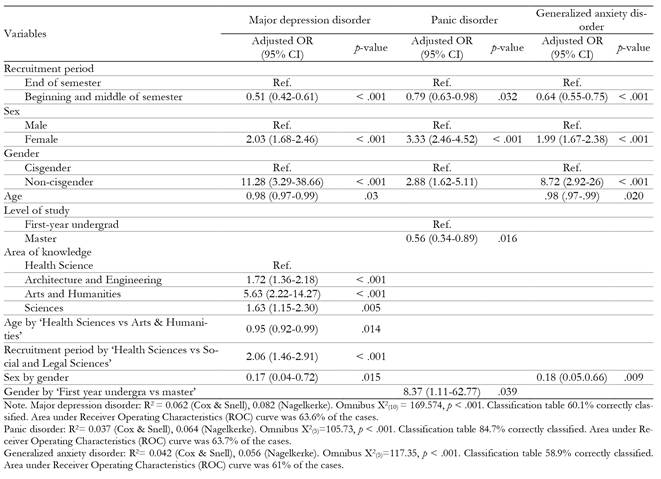
The results of multivariate logistic regression model for being at risk for MDD (Table 5) show that students in the beginning and middle of semester had lower odds of being at risk than students at the end (OR=0.51 (0.42, 0.61)). Females at birth had double the odds of being at risk than males (OR=2.03 (1.68, 2.46)), and gender minority students had eleven times greater odds than cisgender students (OR=11.28 (3.29, 38.66)). Older age was associated with lower odds (OR=0.98 (0.97, 0.99)). Compared to health science students, architecture and engineering students, arts and humanities students, and sciences students had greater odds of being at risk (OR=1.72 (1.36, 2.18), OR=5.63 (2.22, 14.27), and OR=1.63 (1.15, 2.30), respectively). Furthermore, three significant interaction effects were found. Older students in arts and humanities reported higher odds of being at risk than older students in health sciences. Health science students recruited in the beginning and middle of semester reported lower odds of being at risk than social and legal science students. Finally, males at birth who did not identify as males reported greater odds of being at risk than cisgender males.
The multivariate logistic regression model for being at risk for a panic disorder (Table 5) shows that students recruited in the beginning and middle of semester also had lower odds of being at risk (OR=0.79 (0.63, 0.98)). Females at birth and gender minority students had around three times greater odds of being at risk than males at birth (OR=3.33 (2.46, 4.52)) and cisgender students (OR=2.88 (1.62, 5.11)), respectively. Compared to first-year undergraduates, master students reported a lower odd of being at risk (OR=0.56 (0.34, 0.89)). Also, one interaction effect was found. Cisgender students enrolled in a master’s program had greater odds to be at risk than cisgender first year undergraduates.
Finally, the results of our multivariate analysis for being at risk for GAD (Table 5) showed that odds differed based on recruitment period, sex, and gender (OR=0.64 (0.55, 0.75), OR=1.99 (1.67, 2.38), and OR=8.72 (2.92-26), respectively), similar to findings for MDD and panic disorder. Analysis shows older students had lower odds of being at risk (OR=0.98 (0.97, 0.99) compared to younger students. Furthermore, there was sex and gender interactions. Males at birth that do not identify as male had higher odds of being at risk than cisgender males.
Factors associated with screening positively for an eating disorder
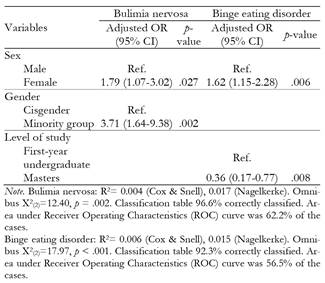
Univariate analyses show that being at risk for bulimia nervosa was associated with sex, gender, ethnicity, and area of knowledge (see appendix 2). The results of the logistic regression showed that compared to males assigned at birth and cisgender students, females assigned at birth and non-cisgender students were at higher odds of being at risk, respectively (OR=1.79 (1.07, 3.02) and OR=3.71 (1.64-9.38)) (see Table 6).
Sex and level of study were associated with being at risk for a binge eating disorder (see appendix), and both factors remained in the logistic regression analyses (see Table 5). Females at birth had higher odds of being at risk (OR=1.62 (1.15, 2.28)) when compared to males at birth. Those students in a master’s program had lower odds of being at risk (OR=0.36 (0.17, 0.77)) than first-year undergraduates.
Factors associated with screening positively for alcohol abuse
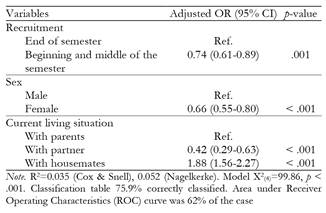
Sex, age, living situation, level of study, and recruitment period were related with being at risk for alcohol abuse at univariate analysis (see appendix 2). When performing multivariate logistic regressions, females at birth had lower odds of being at risk than males (OR=0.66 (0.55-0.80)). Students recruited in the beginning and middle of the semester were also at lower odds of being at risk (OR=0.74 (0.61-0.89)). Compared to students living with parents, students living with partner had 0.42 times (0.29-0.63) lower odds of being at risk, and students living with housemates had nearly double the odds of being at risk (OR=1.88 (1.56-2.27)) (see Table 7).
Discussion
There is a scarcity of studies globally, and especially in Spain, that; 1) invite all students enrolled in a university to participate 2) and provide recent epidemiological data on a broad range of mental health problems. The purpose of this study was to, evaluate the prevalence, and sociodemographic and academic factors associated with being at risk for common types of mental health problems reported among students enrolled in any program of one public university in Spain. Our results show that almost 7 out of 10 students screened positively for at least one examined mental health disorder. Consistent with previous studies (Auerbach et al., 2018; Lipson et al., 2022; Wang et al., 2020), the risk for anxiety (49%) and depression (47%) were the most prevalent. Our findings are similar to recent nationwide analyses which used similar methods (Capdevila-Gaudens et al., 2021; Gobierno de España, 2023). However, our rates, at times, are higher or equal than other recent European studies (Bootsma et al., 2023; Kavvadas et al., 2023), studies performed earlier in Spain (Auerbach et al., 2018), and recent systematic reviews (Ahmed et al., 2023; Li et al., 2022). It is not possible to know the extent to which these differences reflect a real increase in rates over time (Duffy et al., 2019) and the extent to which they reflect heterogeneity between studies or study samples (Li et al., 2022).
Co-occurrence between depression and anxiety, and co-occurrence of eating disorders with depression or anxiety were substantial and have been identified in previous studies (Hudson et al., 2007; ter Meulen et al., 2021).
When investigating the range of sociodemographic and academic potential predictive factors few of them were found to be common across several disorders. These transdiagnostic factors include sex, gender identity (cisgender and gender minority), and period in which students were recruited (end of semester vs beginning and middle of a semester). Sex is a factor that is reported consistently in the literature to be associated with certain mental health or behavioral problems. Being female at birth was associated with risk for internalizing psychopathology (i.e., anxiety, depression, and panic disorder) (Lynch et al., 2021) and eating disorders (i.e., binge eating and anorexia nervosa) (Alhaj et al., 2022), while being male was associated with risk for alcohol abuse (Lynch et al., 2021; McHugh et al., 2018). This linkage has been explained by a number of biological and psychosocial hypotheses (Bangasser & Cuarenta, 2021; Kang et al., 2020; McHugh et al., 2018)
Gender identity has also been studied. However, the majority of studies conducted with university students that have explored the association between gender and mental health conditions have not looked beyond the gender binary (i.e., male/female) or they have gathered information on gender minority (i.e., non-cisgender) but not taken it into account in the analysis (Auerbach et al., 2018; Duffy et al., 2019; Liu et al., 2022; Wang et al., 2020). There is small but growing literature that examine the potential effect of gender minorities on mental health. Our findings are consistent with initial findings reported in this literature, which show that gender-minority students have an elevated risk for poorer mental outcomes compared to cisgender students (Alibudbud, 2023; Lipson, Raifman, et al., 2019; Liu et al., 2019; Seehuus et al., 2021). For instance, a nationally representative survey of 65,213 college students randomly selected across the U.S. that used validated screenings tools to evaluate symptoms of anxiety, depression, eating disorders, self-injury and suicidality found that gender minority students were more likely to be at risk for one or more of the mental health problems than cisgender students (Lipson, Raifman, et al., 2019). Psychosocial stressors, including lack of social support, discrimination, violence, and victimization to which they are exposed to (McCann & Brown, 2017; Newcomb et al., 2020) likely can explain this increased risk. Further research to replicate and support findings are needed.
The recruitment period was also found to be related to being more at risk of any of the explored emotional disorders as well as alcohol abuse. Participants recruited at the end of a semester were at higher risk. The end of a semester is likely to be a stressful time due to the high workload associated with exams. This academic pressure may explain why these students are more vulnerable. Previous studies have found linkages between exam periods, mental health conditions, and suicidality (Gunnell et al., 2020; Steare et al., 2023). Due to such associations, caution should be taken to the timing within the academic year when epidemiological data is collected.
Age was another relevant factor, but only with emotional problems. Much like other studies conducted in the general population we found that younger age was associated with a higher likelihood of depression and anxiety (Basta et al., 2022), which may be related to greater social role instability (e.g., more frequent romantic transitions) (Patrick et al., 2020), but there are inconsistent study findings regarding age in the student populations (Ahmed et al., 2023; Campbell et al., 2022) .
Two additional and understudied potential risk factors include level of study and area of knowledge. Studies have mainly focused on undergraduates, especially first-year students (Ruiz-Hernández et al., 2022) or those in health sciences (Lipson et al., 2016), because of repeat findings that they are vulnerable groups. Our results align with those studies that warn first-year undergraduates are at risk for psychopathology (Bassols et al., 2014). First-years are vulnerable, probably due to the many challenges they face when transitioning between high school and university (e.g., homesickness, time management, creating a new social network) (Bassols et al., 2014). However, our study, much like others (McLafferty et al., 2022; Ramón-Arbués et al., 2020; Ruiz-Hernández et al., 2022), paradoxically found that health science students are less likely to report psychopathology or depression. Health science students are more conscientious about their health, which could lead to higher likelihood of seeking professional help, and have more knowledge about care; which could act as protective factors (Ruiz-Hernández et al., 2022). Further studies are needed to confirm these linkages.
Alcohol consumption has varied in the past decades in Spain due to alcohol control policy changes (e.g., increasing age requirements for purchasing alcohol, increasing taxes) (Llamosas-Falcón et al., 2022). Even though there has been a slight decrease in alcohol consumption amongst university students in Spain, it continues to be a public health concern (Romero-Rodríguez et al., 2022). One quarter of participants in our study sample reported to be at risk of alcohol abuse. Risk factors for alcohol abuse is still sparse (Solmi et al., 2021), but our findings are in line with other studies that suggest that parent control could exert a protective factor (Krieger et al., 2018) since those students that reported to live with parents were at lower risk when compared with those living with housemates. Living with a partner was also found to be associated with less risk than living with parents, so this appears as per our knowledge to be a unique finding thus far. The multivariate regression models derived from these factors despite showing acceptable model fit, have poor predictive accuracy. It is not possible to predict risk for psychopathology based on a few factors. We need to continue exploring the potential role of other factors involved at both individual and contextual levels.
The strength of this study lies in the investigation of a range of highly prevalent mental health problems in a sample of students in a university from different areas of knowledge, level of study, using screening tools validated against clinical diagnoses, which produces a wide scope of knowledge about the current mental health needs of university students and allows direct comparability.
The study also presents some limitations. First, our study sample was recruited from only one university, limiting the generalizability of results. However, this study was conducted in a public Spanish university with a demographic profile similar to the national population. Apart from this, performing this study in a single institution facilitated the use of refusal conversion strategies and, therefore, increased our response rate, which in turn helps reduce non-response bias. Second, the self-selection of participants could have introduced selection bias. Those more vulnerable could have been more attracted to participate (Kaźmierczak et al., 2023) and as a result influence the validity of results. Third, the need to understand Spanish or Catalan as inclusion criterion could have also been source of bias because it would have reduced the participation of foreigners. However, students unable to understand Spanish or Catalan tend to be newcomers and a minority at the University. Fourth, we chose to use universal community screening scales that assess key symptoms of the DSM-IV diagnoses (American Psychiatric Association, 1998). Although these scales were not written to align with the most updated diagnoses criteria, they were selected because they still capture the DSM-5-TR criteria (e.g., the DSM-5-TR still recommends the use of PHQ-9 to evaluate depression severity, American Psychiatric Association, 2022), and they are one of the most commonly used worldwide for screening due to their convenient use and sound psychometric properties and, consequently, they facilitate comparability across cultures and contexts. Fifth, our cross-sectional study does not capture causality nor the full complexity of the inter-relationship of potential predictive variables. Finally, we need to be cautious when interpreting our estimated prevalence rates since we used screening tools that have been validated against clinical diagnosis, but do not have diagnostic accuracy. Participants who screened positive for any of the evaluated disorders may not be diagnosed with the disorder if interviewed because of the potential limited positive predictive values of the screening tools. Levis et al., (2019)
Considering that use of screening self-administered tools can overestimate prevalence of disorders (Levis et al., 2020), to estimate the prevalence of common mental health disorders in university students and factors impacting that prevalence, it would be useful to perform epidemiological studies which included a two-stage diagnostic procedure. The first phase should include the use of self-administered screening questionnaires using a cutoff that prioritize the scale’s sensitivity so that diagnoses are not missed, followed by a second stage which should include the use of a diagnostic interview for those who screen positive on the screening questionnaires (Zimmerman, 2024). Moreover, in an attempt to generalize findings nationwide studies should be performed inviting the whole community of students to participate and using more response-inducing strategies (e.g., providing a conditional lottery ticket) to reduce potential bias due to selective participation (Spoor et al., 2024).
Clinical implications
Considering the large proportion of students at risk for mental health disorder and that mental health problems in young adulthood are a significant risk factor for poor mental health later in life (Solmi et al., 2022), more support in educational institutions are needed to reduce the incidence of mental health disorders and reduce the burden on health care systems. Selective prevention programs for mental health targeting those students that have self-identified to be at increased risk for a given disorder, and more support provided at the end of semesters could be undertaken on university campuses. A number of selective interventions have shown to be effective in preventing common mental health disorders (Salazar de Pablo et al., 2021).
Conclusions
This study highlights the need to take action towards the prevention and treatment of mental health problems among university students since close to 50% were considered at risk for at least one common mental health problem. This study also shows that sociodemographic and academic factors are associated with mental health problems, being female, non-cisgender, and at the end of semester are associated with being at risk for most of the evaluated mental health disorders. However, there are factors that their association differ depending on the mental health disorder. Therefore, when planning preventive and treatment actions, it is important to tailor those actions towards the groups of students identified as at-risk.

