




 Servicios personalizados
 Inglés (pdf)
 Articulo en XML
 Referencias del artículo
 Traducción automática
 Enviar articulo por email
 Citado por SciELO
  Citado por Google
  Similares en
SciELO
Similares en
SciELO  Similares en Google
 Permalink
Introduction
Internet use has grown significantly in recent decades, especially among adolescents. In 2023, 94.5% of the population in Spain between ages 16 and 74 reported using the internet in the last three months (representing a total of 33.5 million users; National Institute of Statistics, 2024). The highest rates of internet use correspond to young people and adolescents between the ages of 16 and 24. In their study on the impact of technology on adolescence, Andrade et al. (2021) found that 90.8% of adolescents between the ages of 11 and 18 use the internet daily and 31.6% spend more than 5 hours a day connected to the internet any day of the week. These data demonstrate the widespread importance and influence that the use of the internet has on the lives, and especially on the mental health, of adolescents.
In the present study, we will use the term Problematic Internet Use (PIU) and define PIU as refer to use of the internet that is characterized by a high frequency and intensity of connection and a high degree of interference in daily life, with impact on personal, emotional, family, and academic levels, and that does not inherently imply the presence of psychopathology (Andrade et al., 2021; Fundación Barrié., 2023; Restrepo et al., 2020). The literature indicates that the features of PIU do not meet the diagnostic criteria for a mental disorder because there is no evidence of functional impairment (Kamolthip et al., 2022). The World Health Organization recognizes the harmful effects that PIU can have and considers it a public health problem, despite the lack of consensus to consider it a disorder. A recent study on the subject with more than 8000 Spanish adolescent participants observed that at least one in four adolescents experienced PIU, with a higher prevalence among females (Fundación Barrié, 2023). This study also suggested a relationship between greater PIU and lower levels of emotional well-being and satisfaction with life, greater depressive symptoms, and significantly greater somatization (anxiety, tiredness, physical pain, etc.). As researchers and practitioners work to identify the mechanisms that explain the link between PIU and psychological adjustment problems, some researchers have suggested that difficulty with emotional self-regulation is one possible explanatory factor (Scharf et al., 2023).
The family, in general, plays a central role in the psychological development of adolescents. Increasing attention is being given to the role of parents in adolescents' Internet use. To prevent problematic usage, research has shown that parents or guardians should regulate screen time and monitor the content their children consume and share (Cordeiro et al., 2022). The emotional functioning of the family directly influences the psychological well-being of its members, and parents play a crucial role in this process (Bowen, 1978).
Internet Use and Emotional Self-Regulation in Adolescence
Several theorical models exist as possible approaches to the analysis of self-regulation, but perhaps one of the most prolific frameworks has been Social Psychology, particularly Bandura´s perspective (Bandura, 1991). Within this conceptual framework, the Self- vs. External Regulatory Theory (SR-ER; De la Fuente et al., 2002), which seeks to explain the combination of external and internal conditions that predispose individuals to appropriate behavior and motivation. In this research, a specific theorical framework from the systemic family therapy perspective is used: Bowen´s Family Systems Theory (Bowen, 1978; Rodríguez-Gonzalez, 2015). This theory proposes that the internal conditions for adequate self-regulation result from an experiential process within the family nucleus, developed from childhood to adolescence. Within this theoretical framework, success in this process is associated with a good differentiation of self, which reduces dependence on the external context to achieve proper emotional self-regulation.
Therefore, when we consider emotional self-regulation from the family systems perspective, it can be conceptualized as differentiation of self (DoS). DoS is defined as the ability to modulate emotional reactivity (emotional flooding, emotional lability, and hypersensitivity) and maintain a clear I-position (defined sense of self, firm convictions, and own goals; Skowron & Friedlander, 1998). Higher emotional self-regulation skills are characterized by having a set of behaviors, strategies, and skills (conscious or unconscious) that work to inhibit or modulate emotional expressions (Ribé, 2008).
There are many investigations in the literature that link PIU with emotional self-regulation. In Gioia et al. (2021) found a strong association between emotional dysregulation and PIU in a systematic review of 23 studies. This empirical relationship may be relevant in Spanish adolescents. For example, an emotional profile was found characterized by less parental monitoring of activities outside the home, greater frequency of internet use, younger age of initiation of use, higher levels of interpersonal perception, and less facilitation and emotional regulation in a sample of Spanish adolescents with PIU (Arrivillaga et al., 2021). In a sample of young Spanish university students, those who presented low psychological well-being and negative emotions had a greater predisposition to develop problematic use of the internet (Bernal-Ruiz et al., 2021). In another sample of Spanish adolescents between the ages of 12 and 17, it was found that those who had PIU and problematic mobile phone use had problems controlling the use of technology and worse self-regulation of negative emotions (De la Villa Moral & Suárez, 2016). These previous studies show us how adolescents may use the internet, to reduce their levels of distress, find relief, relaxation, or to escape from problems; however, none consider variables that represent the adolescent’s developmental task of seeking emotional autonomy from their family.
Differentiation of Self as Emotional Regulation
In this article, we consider emotional self-regulation from the systems perspective (Bowen Family Systems Theory; Bowen, 1978). Bowen described people with lower levels of differentiation as living in a feeling-controlled world in which feelings and the subjective dominate the objective reasoning process (Bowen, 1978). People with high levels of differentiation have a greater ability to regulate their own feelings and modulate their emotional reactions toward other people, are more autonomous, and can tolerate considerable levels of stress without symptoms appearing (Bowen, 1978; Rodríguez-González, 2015).
DoS is a multidimensional construct with interpersonal and intrapersonal components. The intrapersonal dimension of DoS is related to the levels of emotional reactivity, while the interpersonal dimension relates to emotional cutoff levels (Skowron & Friedlander, 1998). Emotional reactivity reflects the degree of response to the environment with great emotional overflow, hypersensitivity, and emotional lability, while emotional cutoff reflects emotional and behavioral detachment from significant relationships and fear of intimacy (Rodríguez-González et al., 2015).
According to Bowen (1978), DoS is a developmental process that begins in early childhood and progresses throughout adolescence. Along with this process, another of the essential psychological processes of adolescence is the search for identity. Bueno explains this search for identity as an individual’s need to develop their own value systems, establish their own opinions and interests (not be a copy of their parents or their friends), find out what they can do and how far they want to go, feel proud of their achievements, and feel respected for who they are (2022, p. 40).
Adolescence and Online Risk Behaviors
In this study, we will use the term “adolescence” to refer to the period between the ages of 14 (late early adolescence) to 21 years (late adolescence; Palacios, 1999). Currently, the developmental challenges of this stage must be overcome in total digital immersion (Subrahmanyam & Smahel, 2010). In addition, adolescence is a stage that entails an increase in risk behaviors (Viejo & Ortega-Ruiz, 2017), so it is likely that these behaviors are carried out through the internet. Some of the most common online risks include cyberbullying, sexting, contact with strangers, grooming, pornography, and gambling. Andrade et al. (2021) recorded worrying figures about these online risks in Spanish adolescents: 26.8% had practiced passive sexting and 8% active sexting, 57% had accepted people they did not know into their social networking applications and 21.5% had physically met someone they first met online, and 33.3% had accessed websites with pornographic content.
Some risky online behaviors result in the creation of hateful online material (racist, homophobic, or sexist material, etc.). Costello and Hawdon (2018) found that one fifth of a sample of adolescents and young adults produced material online that others interpreted as hateful and demeaning. The potential relationship between the internet and intolerance has largely been studied by other disciplines (e.g., Psycholinguistics; Assimakopoulos et al., 2017). This body of work demonstrates that although some young people were aware that hate speech is an issue that needs to be combated, many do not seem to be sensitized to what hate speech is, sometimes they justify it and/or are unaware of the laws that regulate it. Ortega et al. (1994) defines tolerance as the understanding and respect for beliefs, values, opinions, and behaviors that are different from one’s own and that leads to peaceful coexistence and the development of individual freedom. In adolescence, there is an increase in discrimination and prejudice toward groups that are perceived as different from the in-group itself, and for this reason, the study of attitudes of tolerance and their relationship with PIU is of special interest at this stage of development (e.g., Díaz-Aguado et al., 1996; Lozano & Etxebarria., 2007).
Although research regarding DoS is extensive regarding topics across relationship functioning, health, and some risk behaviors (Calatrava et al., 2022), research on the relationship of DoS and internet use is scarce. There is one study about the relationship between sexting and DoS in which participants with low DoS were found to be four times more likely to engage in unwanted sexting under duress (Laird et al., 2021). More generally, Knauth et al. (2006) found evidence that DoS is an important variable that enables adolescents to manage chronic anxiety and, as a result, engage in fewer risky behaviors.
To conclude, previous literature provides evidence of sex differences among adolescent males and females across all the variables mentioned. For instance, studies by Andrade et al. (2021) and Fundación Barrié (2023), indicate that females access the Internet more frequently and intensively than males. Additionally, males engage in more online risk behaviors than females (Sasson & Mesch, 2016), particularly consuming more pornography (Andrade et al., 2021; & Fundación Barrié, 2023). Research on differentiation of self has also identified sex differences, specifically, studies involving adolescent populations have shown that females tend to exhibit higher emotional reactivity than males (Mozas-Alonso et al., 2022). Furthermore, in studies on bullying and tolerance, females have been found to be more accepting of differences among their peers (e.g., Lozano & Etxebarria, 2007).Therefore, the present study extends research on risky internet use in adolescence by exploring the differences in online risk behaviors, DoS and tolerance of diversity based on sex and family structure. A second objective of this study is analyzing the relationship between PIU and these three variables (online risk behaviors, DoS and tolerance of diversity). Finally, the mediating role of DoS will be analyzed.
The following hypotheses will be tested: (1) we expect women will have higher scores in PIU, exhibit fewer online risk behaviors, less DoS, and will be more tolerant than adolescent men; (2) adolescents living with both parents will have less PIU and engage in fewer online risk behaviors than those who do not live with both parents; (3) PIU will predict lower DoS, the presence of higher online risk behaviors, and lower tolerance for diversity; and (4) DoS, as an emotional self-regulation variable, will mediate the relationship between PIU and online risk behaviors.
Method
Design
This is a cross-sectional study. Data was collected carrying out convenience sampling in academic centers in Spain (high schools and universities).
Sample
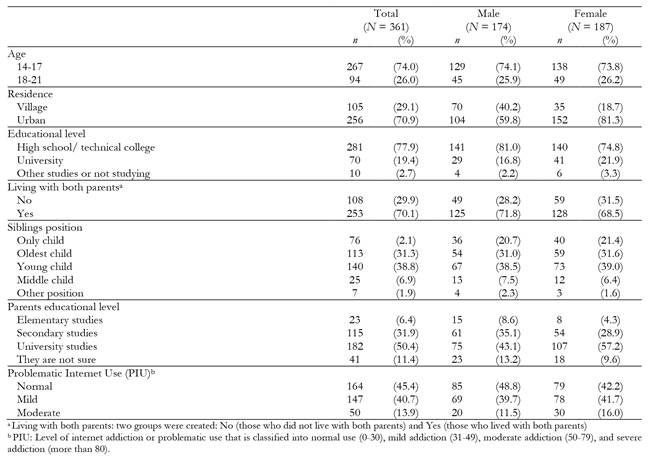
Participants were 361 adolescents (48.2% male, 51.8% female) between the ages of 14 to 21, M = 16.53 (SD = 2.03) living in Spain (70.9% living in urban areas). The inclusion criteria required adolescents to be between 14 and 21 years old, to be Spanish nationals or hold dual nationality (Spanish and another), to reside in Spain, and to use the Internet. An exclusion criterion was the lack of parental or legal guardian consent for minors to participate in the study. Regarding the educational level, most were in high school or in technical college (77.9%), in university (19.4%), or pursuing other types of studies or not studying (2.7%). More than half of the adolescents lived with both parents (70.1%), compared to 29.9% who did not (separated parents, presence of other relatives, etc.). Half of the participants’ parents had obtained a university education (50.4%). Examining the birth order among siblings, 31.1% of participants were the oldest in their family and 38.8% were youngest. See Table 1 for detailed data by sex.
Measures
Sociodemographic Questionnaire
The participants were asked to provide information about their sex (1 = female, 2 = male), age (cont.), were they were born (1 = village, 2 = urban), their level of education (1 = high school/ technical college, 2 = university, 3 = other studies or not studying), living with parents (1= one or none; 2 = both), sibling position (1 = only child, 2 = oldest child, 3 = youngest child, 4 = middle child, 5 = other position) and parents’ level of education (1= elementary studies, 2 = secondary studies, 3 = university studies, 4 = not sure).
Problematic Internet Use
The Internet Addiction Test (IAT) is a 20-item questionnaire ranked on a six-point Likert scale (0 = ‘never’ to 5 = ‘always’) based on the DSM criteria for pathological gambling (Young, 1998). The Spanish language version was used because it demonstrated high reliability (Cronbach´s Alpha = .93) and was an appropriate instrument to assess the impact of internet use on social interactions and the influence of internet use in daily life (Puerta-Cortés et al., 2012). The IAT was designed as a unidimensional instrument, however some studies describe a structure of more than one factor. The total score was the sum of the 20 questionnaire items with scores ranging from 0 to 100 (higher scores related to higher addiction) (Young & De Abreu, 2010). Cronbach’s Alpha in this study was .86.
Differentiation of Self
The Spanish Differentiation of Self Inventory for Adolescents (S-DSI-A; Duch-Ceballos et al., 2022) assessed participants´ levels of differentiation. This instrument was adapted from the Differentiation of Self Inventory for Adolescents by Knauth and Skowron (2004) for use with Spanish adolescent samples, and as validation for Spanish DSI for adults (Rodríguez-González et al., 2015). Its validation (Duch-Ceballos et al., 2022) revealed a two-factor structure with an excellent model fit. Additionally, the reliability of each scale was good, and the total scale also showed good reliability (Cronbach's alpha = .86 and ordinal alpha = .89). It is comprised of two subscales, Emotional Reactivity (ER) and Emotional Cutoff (EC), with ten items in each. Participants rate items using a 6-point Likert scale, ranging from 1 (not at all true of me) to 6 (very true of me). All items are reverse scored and summed across scales, so that higher scores on each subscale and the full scale all reflect greater DoS. In the current sample, the S-DSI-A also shows high reliability at the full scale (.81) and on each subscale (ER = .82 and EC = .67).
Online Risk Behaviors
A scale based on survey questions used by the Net Children Go Mobile Project in Spain (Garmendia et al., 2016) was created to assess the extent to which participants were involved in risky behavior online and to what extent they have felt upset about it. The following risk behaviors were explored: writing or receiving unpleasant or hurtful comments, sending or receiving messages with sexual content (words, pictures, or videos), online contact with strangers, real life contact with someone known on the internet, viewing pornographic content, visiting online sites with hate messages (e.g., racism or homophobia), and online gambling. Participants answered questions about the frequency of these online risks: “it hasn't happened to me,” “one time only,” “sometimes,” and “many times.”
Tolerance of Diversity
We used two subscales from the Diversity Tolerance Questionnaire (Lozano & Etxebarria, 2007): the culture-ethnicity-immigration subscale and the physical and intellectual characteristics subscale. The first scale is comprised of 12 items (e.g., "I like that people from very different places reside in my city, Latin America, Africa...") and the second consists of eight items (e.g., "Having classmates with special educational needs in the classroom is positive for all"). In addition, six extra items related to differences in gender, sexual orientation, etc., were added to the two subscales to create the Global Tolerance scale. In the questionnaire, participants were asked to indicate their degree of agreement or disagreement with each item (1 = strongly disagree, 5 = strongly agree). The Global Tolerance scale reached Cronbach’s alpha coefficient of .91. Cronbach's alpha was .85 for the culture-ethnicity-immigration subscale and .70 for physical and intellectual characteristics.
Procedure
High school and university counselors, teachers, and professional connections of the investigator(s) were contacted via email where they were provided information on the goals of the study and encouraged to share the opportunity with their students. Each center that agreed to participate notified us by email and the sample was collected through an online survey or a paper form. Participation in the study was voluntary and minor participants also obtained the authorization of their parents or legal guardians prior to participation. This study was approved by the Bioethics Committee of the University of Santiago de Compostela (USC).
Statistical Analysis
Statistical analyses were performed using Stata software v. 15, SPSS Statistics, and R software. The significant level was set at .05.
First, statistical assumptions were tested. Normality was confirmed for continuous variables using the Shapiro-Wilk test. Homogeneity of variance was verified using Levene’s test, supporting the use of parametric tests.
Second, basic descriptive statistical analysis was conducted on the sociodemographic data and the study variables to summarize the characteristics of the sample. The Chi-square statistical test was performed to compare proportions of online risk behavior based on participant sex (hypothesis 1). A Student´s t-test accompanied by Cohen´s d was conducted to compare means and calculate the effect size estimation (hypothesis 1 and 2), ensuring that differences were not only statistically significant but also meaningful in practical terms.
Next, three multiple regression models were conducted to explore the predictive value of PIU in the main outcomes (DoS, tolerance to diversity, and online risk behavior) (hypothesis 3). Age was included as a continuous variable as it demonstrated a linear relationship with the dependent variables. All the models were adjusted for sex, age, living with both parents, and parents' education level, controlling potential confounding effects.
Finally, Path Analysis was conducted to test a mediation model of DoS and tolerance to diversity in the relationship between PIU and online risk behaviors (hypothesis 4). Path analysis was chosen due to its capacity to assess direct and indirect relationships between multiple variables within a single model, offering a more comprehensive understanding of the underlying mechanisms driving these associations.
Results
No participants had scores that categorized them with a severe internet addiction. Among males, a little less than half fell in the normal range (48.8%), 39.7% had a mild addiction, and 11.5% had a moderate addiction. Among females, 42.2% fell in the normal range, 41.7% had a mild addiction, and 16.0% had a moderate addiction. This information is detailed in Table 1 (hypothesis 1).
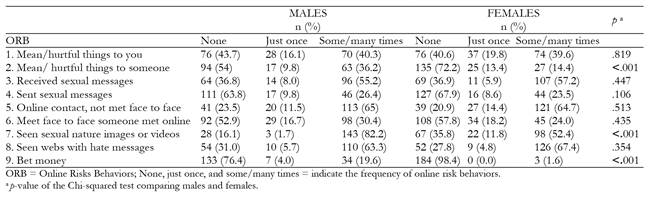
Table 2 illustrates that online risk behaviors among adolescents vary significantly across different categories (hypothesis 1). Approximately 40% of both males (40.3%) and females (39.6%) reported frequently receiving mean or hurtful comments online. However, there were substantial differences in sending such comments, with 36.2% of males admitting to doing so compared to only 14.4% of females, indicating a significant disparity (p < .001). More than half of the participants reported receiving sexual messages, with 55.2% of males and 57.2% of females experiencing this. The sending of sexual messages was slightly less common, reported by 26.4% of males and 23.5% of females. The most prevalent behavior among both sexes was making online contact with someone they had never met in person, with 65% of males and 64.7% of females engaging in this behavior. Meeting someone face-to-face after initial online contact was also reported, involving 30.4% of males and 24% of females. Significant differences were observed in viewing sexually explicit images or videos, with a notably higher percentage of males (82.2%) compared to females (52.4%) reporting such behavior (p < .001). Exposure to websites with hate messages was common, affecting 63.3% of males and 67.4% of females. Online gambling showed the greatest gender disparity, with 19.6% of males engaging in it, contrasted sharply by only 1.6% of females (p < .001).
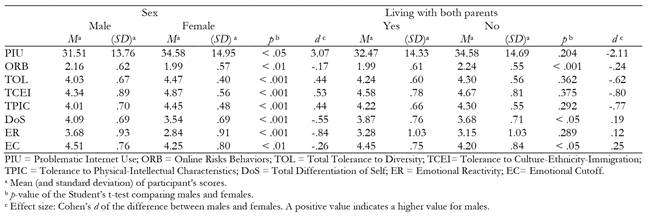
To analyze potential differences in the study variables based on sex and living with both parents, a Student´s-test was conducted (Table 3) (hypothesis 1 and 2). For all outcomes, there were statistically significant differences based on the participants' sex. Looking at males: they engaged in more online risk behaviors (M = 2.16; ± SD = .62; p < .01), showed greater total DoS (M = 4.09; ± SD = .69; p < .001), better emotional reactivity (M = 3.68; ± SD = .93; p < .001), and lower emotional cutoff (M = 4.51; ± SD = .76; p < .01). As for females, they scored higher in PIU, indicating greater addiction (M = 34.58 ± SD = 14.95; p < .05). Additionally, females scored higher on the total scale of tolerance to diversity (M = 4.47; ± SD = .40; p < .001), as well as in both subscales, showing more tolerance towards other cultures, ethnicities, and immigration (M = 4.87; ± SD = .56; p < .001), and more tolerance towards physical and intellectual characteristics (M = 4.45; ± SD = .48; p < .001).
Regarding living with both parents, significant differences were found in three variables: online risk behaviors, total DoS, and emotional cutoff. Adolescents who do not live with their both parents score higher in online risk behaviors, meaning they engage in these behaviors more frequently (M = 1.99; ± SD = .61; p < .001). Adolescents living with their both parents scored higher in total DoS and in emotional cutoff compared to those who did not live with their parents, indicating better DoS (M = 3.87; ± SD = .76; p < .05) and lower levels of emotional cutoff (M = 4.45; ± SD = .75; p < .05). In Table 3, the effect size of each difference is also discernible.
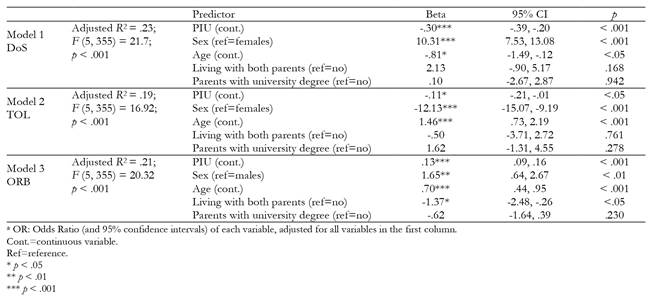
The multiple regression analyses presented in Table 4 show the relationships among PIU, DoS, tolerance to diversity, and online risk behaviors across three different models (hypothesis 3).
Model 1 focuses on DoS as a dependent variable, showing a notable negative association with PIU (β = -.30, 95% CI: -.39 to -.20, p < .001). This model also revealed significant effects for sex, with males showing higher DoS than females (β = 10.31, 95% CI: 7.53 to 13.08, p < .001), and age, where younger participants were more differentiated (β = -.81, 95% CI: -1.49 to -.12, p < .05). This model demonstrates a good fit to the data, with an adjusted R2 of .23 and an F statistic of 21.7 (df = 5, 355, p < .001).
Model 2 examines TOL as a dependent variable, revealing a negative association with PIU (β = -.11, 95% CI: -.21 to -.01, p < .05). Sex differences were also significant, with females showing higher tolerance (β = -12.13, 95% CI: -15.07 to -9.19, p < .001). Age had a positive association with TOL (β = 1.46, 95% CI: 0.73 to 2.19, p < .001). This model adjusted R2 was .19, indicating a good model fit, supported by an F statistic of 16.92 (df = 5, 355, p < .001).
Model 3 examines ORB as an outcome. ORB had a positive relationship with PIU (β = 0.13, 95% CI: 0.09 to .16, p < .001). Sex again played a significant role, with females being less likely to engage in online risk behaviors (β = 1.65, 95% CI: .64 to 2.67, p < .01). Age was also positively associated with ORB (β = .70, 95% CI: .44 to .95, p < .001). The presence of both parents showed a negative association with ORB (β = -1.37, 95% CI: -2.48 to - .26, p < .05). The adjusted R2 for this model was .21, with an F value of 20.32 (df = 5, 355, p < .001), indicating a robust model fit.
In our las set of analyses, we conducted path analysis to test the mediating role of DoS and TOL, in the relationship between PIU and ORB (hypothesis 4). In the first model, PIU had a positive association with ORB directly (ß =.126, 9% CI (.09, .16)). Mediation of this relationship by DoS was not significant, as indicated by the non-significant indirect effect (ab = .003). The model´s fit was poor, evidenced by a high RMSEA value of .278 and a low CFI of .673.
The second path model tested TOL as a mediator of the relationship between PIU and ORB. Again, a direct effect of PIU on ORB was observed (c = .125), but there is no evidence that TOL mediated the relationship between PIU and ORB (ab = .003). The model´s fit indicators remained unsatisfactory, with an RMSEA of .314 and a CFI of .535.
These analyses ultimately did not support mediation in any of the models, as demonstrated by non-significant indirect effects and poor model fit metrics across both models.
Discussion and Conclusions
The primary aim of the present study was to explore the relationship between PIU and three variables: emotional self-regulation (DoS), online risk behaviors, and tolerance of diversity in the adolescent population. Hypotheses one and three were confirmed, hypothesis two was partially confirmed and hypothesis four was not confirmed.
Hypothesis one that females would have higher scores in PIU, exhibit fewer online risk behaviors, have lower DoS, and be more tolerant than adolescent males was supported. PIU is a concern for all adolescents, and in the present study, problematic use was higher in females. This is consistent with prior research findings (e.g., Andrade et al., 2021 and Fundación Barrie, 2023). In our study, females, specifically, responded with a higher frequency (statistically significant) to four questions from the IAT: “How often do you try to cut down the time you spend online but fail?”; “How often do you think "just a few more minutes" when you are online?”; “How often do you check your email/WhatsApp before doing something else you need to do?”; and “How often do you feel like you spend more time on the internet than you intended?”. All these questions are related to a lack of control in the use of the internet and with constant connectivity (e.g., social media checking). Thus, consistent with prior research (Gentzler et al., 2023), adolescent females used social media more than adolescent males, valuing social communication and online relationships as an important part of their lives (connecting with friends, sharing experiences, and expressing their emotions).
The finding that females exhibit fewer online risk behaviors than males aligns with existing literature on risk-taking behavior in general, where males tend to be more prone to taking risks. This is believed to be attributed to explanations that consider various evolutionary perspectives (e.g., for survival and reproduction) and cultural factors (gender roles and socialization methods) (Shan & Jin, 2013). Other research also finds that male adolescents engage in more risk behaviors (e.g., Fundación Barrie, 2022 and Sasson & Mesch, 2016). Specifically, in our study, males more frequently viewed pornography, made hurtful comments to others, and engaged in online gambling. In the latest report from the Spanish Observatory of Drugs and Addictions (2023), male adolescents also consumed more pornography and engaged in more online gambling compared to females and it appears that industries target their marketing towards a teenage male audience. At a purely descriptive level, these findings add to the sparse literature on internet risk behaviors in Spanish adolescents and sex differences among those risk behaviors. Such findings hold value for understanding potential intervention targets for adolescent males and females.
In the current study females reported lower levels of DoS than men, when considering both dimensions of differentiation (females reported higher emotional reactivity and emotional cutoff than men). The research uncovered sex differences, indicating that men tend to have score suggesting a higher emotional cutoff, while women exhibited a higher degree of emotional reactivity (e.g., Skowron et al., 2014). It is important to note that lower scores on the ER subscale indicate greater emotional reactivity, which implies that adolescent females respond to environmental stimuli with poorer emotional control, emotional lability, or hypersensitivity to a greater extent than males. The findings mirror those found in a study by Mozas-Alonso et al. (2022) on Spanish adolescents. Additionally, females scored lower on the EC subscale, indicating a greater inclination toward emotional cutoff, which involves maintaining a lower sense of emotional intimacy with others (e.g., parents, friends). According to Bowen's theory, the stress a person experiences drives a lower level of DoS. It is possible that Spanish adolescent females in the current study may have experienced a higher degree of stress than males. Some studies suggest that pressure from social media (e.g., Instagram, TikTok) on Spanish adolescent females is greater than for males (Díaz-Moreno et al., 2023) Additional research is needed to clarify the relationship between sex, culture, and DoS.
Finally, women scored higher on tolerance of diversity, showing greater tolerance on the overall scale and on both sub-scales: culture-ethnicity-immigration and physical and intellectual characteristics. This is consistent with the previous findings of the literature (Gasser and Tan, 1999). In a study by Lozano & Etxebarria (2007), adolescent females also had higher scores in diversity tolerance and in all subscales.
Hypothesis two was partially supported. Differences were found in the PIU variable; those not living with both parents showed a higher score (worse PIU), but these differences were not significant. The observed difference in online risk behaviors was statistically significant; adolescents who did not live with both parents exhibited more online risk behaviors compared to those who did live with both parents. As proposed by Hernandez et al. (2023), it is necessary to understand the family dynamics and the involvement of each parent in adolescents´ internet use to prevent these risk behaviors and promote positive online behaviors.
Hypothesis three was supported across three different models. From the first model, it can be inferred that PIU is negatively correlated with DoS. On the one hand, a possible explanation for this relationship could be that adolescents use the internet to regulate their emotions, more likely when they present poorer emotional self-regulation competencies. Gioia et al. (2021) found in their review that PIU might represent a coping strategy to compensate for lower or less effective emotion regulation. On the other hand, this finding also could suggest PIU has a negative impact in the developmental process of DoS. It is emphasized that DoS refers to the capacity for interpersonal emotional self-regulation, stemming from teachings learned within the family during childhood and adolescence (Bowen, 1978; Ragelienė & Justickis, 2016). Specifically, adolescence is the stage in the life cycle when individuals begin to differentiate themselves from their family of origin (Skowron & Friedlander, 1998).
Therefore, our results suggest parents and the family play a crucial role in both this emotional self-regulation process and adolescents' internet use. We emphasize that to prevent issues in internet use (problematic use, online risk behaviors, etc.), as well as to achieve healthy DoS in adolescents, parents (ideally both) should actively participate in these processes. As some previous research suggests, PIU may lead adolescents to have lower social skills (e.g., Caplan, 2005) due to emotional disconnection from others, a lack of physical contact, or the loss of facial expressions and real social situations. Although future studies are needed to confirm and clarify the direction of this potential relationship, our study points out this can result also in a poorer DoS by restricting the expression and understanding of the emotional signals of others, leading to anxiety in real-world (versus online) social situations, leading to emotional challenges in social relationships.
From the second model, it can be inferred that PIU predicts a lower tolerance of diversity where sex and age also play a role in this relationship with females and older people exhibiting greater tolerance. This could be explained because adolescents who have more PIU may be exposed to more content that can be aggressive, hateful, or sexist, potentially causing them to become desensitized to others' experiences of suffering (this has been previously studied in the context of video games and pornography use; e.g., Miedzobrodzka et al., 2023; Millburn et al., 2000). Furthermore, it could be that since adolescents can choose who to interact with or who to follow on social media, those who engage only with people who share their opinions miss the opportunity to expose themselves to different perspectives and experiences that could enhance their tolerance of diversity.
The third model reveals that PIU is associated with more risky behavior online: findings showed that the more exposure adolescents have to the internet, the more likely they are to access risky content. Having PIU and spending more time online can lead adolescents to a feeling of boredom (Cannito et al., 2023) and drive them to seek intense emotions through online risks. For example, males may turn to pornography or online sports betting to experience these emotions. This study showed similar findings: lower supervision by both parents can lead adolescents to carry out more risky behaviors online (insulting others, sexting, grooming, etc.; Corcoran et al., 2022).
Finally, the last hypothesis was not confirmed. This and previous studies have shown that emotional regulation plays a role in both PIU and online risk behaviors (Gioia et al. 2021). However, in our sample, DoS does not operate as a mediator between PIU and online risk behavior. Future studies should delve into the mechanisms that mediate between PIU and online risk behaviors in order to inform interventions that may serve to protect against the harmful effects of PIU in adolescent populations.
The present study showed that PIU is related to emotional regulation in adolescents, therefore interventions aimed at reducing PIU should consider working to improve emotional regulation. Furthermore, given that DoS is a family systems variable, our results suggest it will be essential to conceptualize prevention or intervention programs on PIU and online risks as a systemic process, not only related with the individual itself or its ideas or knowledge but also connected with its family emotional processes.
Study findings should also be interpreted considering limitations. Although participants in the sample are diverse in age, sex, and residence status, to increase the generalization of findings to other individuals, study findings should be replicated with other family structures or participants with differing educational levels. The current cross-sectional study allows us to explore one snapshot of the current Spanish adolescent population on the key variables of interest, but it does not provide evidence as to how PIU is associated with risk behavior or escalation in risky internet behaviors online over time, nor how whether PIU causes online risk behaviors. Thus, it would be advantageous to investigating these variables with a longitudinal study and to use a conceptual theorical model that integrates the study variables to obtain a more efficient explanation and prediction, such as the Conceptual utility Model proposed by De la Fuente and Martinez-Vicente (2024). Finally, to have a more complete perspective of PIU in adolescence the inclusion of parents or relatives with whom the adolescent lives would provide greater perspective, giving a more complete picture of PIU in adolescents.

