




 Servicios personalizados
 Inglés (pdf)
 Articulo en XML
 Referencias del artículo
 Traducción automática
 Enviar articulo por email
 Citado por SciELO
  Citado por Google
  Similares en
SciELO
Similares en
SciELO  Similares en Google
 Permalink
Introduction
Parenthood is one of the most transformative normative transitions in adulthood, encompassing a range of positive and negative changes (Westrupp et al., 2022). On the positive side, becoming a parent is linked to increased joy, happiness, life satisfaction, and a sense of purpose (Myrskylä & Margolis, 2014). Parental well-being has been defined in various ways, including subjective well-being (e.g., life satisfaction, purpose, happiness) and mental and physical health (Nelson et al., 2014; Nomaguchi & Milkie, 2003, 2020). However, these definitions often measure general aspects of well-being rather than focusing on the specific effects of parenting.
One such effect is "parenting rewards". These rewards are the positive emotional gains and benefits of parenting, including the happiness and satisfaction derived from performing the parental role, enjoying time spent with the child, and feeling close to the child (Oronoz et al., 2007). It is important to note that parenting rewards stem from the act of parenting (i.e., "What parents do in terms of raising, supporting, and socializing children throughout their lives") rather than merely being a parent (Nomaguchi & Milkie, 2020, p.199). Research has generally approached positive parental outcomes broadly, encompassing various components of parental well-being such as emotional experience, subjective happiness, and life satisfaction, as well as related constructs like self-esteem (Nelson et al., 2014). However, little is known about which variables increase the likelihood of experiencing parenting rewards. In this context, parenting rewards refer to the specific aspect of parental well-being related to the positive experiences of exercising parenthood. While some aspects of parenting rewards are included in parental stress measurement instruments, such as the Parental Stress Scale (Berry & Jones, 1995), there is no dedicated instrument to measure parenting rewards.
Contrasting the general positive outcomes on well-being and specific parenting rewards, parenthood can also have negative consequences. Taking on the parental role has been associated with high levels of stress (Barroso et al., 2018), low levels of well-being (Nelson et al., 2014), and the presence of distress symptoms (e.g., depressive symptoms, Paulson & Bazemore, 2010). These adverse effects are particularly pronounced among parents caring for children with disabilities (Hayes & Watson, 2013; Priego-Ojeda & Rusu, 2023).
Among these adverse effects, parental stress-defined as "the stress reaction to the demands of being a parent" (Deater-Deckard, 1998, p. 314)-has frequently been identified as a negative outcome of parenthood. It arises from the discrepancy between a parent’s perception of their resources, the demands of their child, and their caregiving relationship (Abidin, 1992). Parenting young children generally involves more demands on the parent (Mowder et al., 1995), including midnight feedings, temper tantrums, discipline problems, homework battles, and spending more time doing housework (e.g., Rizzo et al., 2013). These demands can result in higher levels of parental stress, which has been associated with lower levels of parenting rewards (e.g., Oronoz et al., 2007). The relationship between parental stress and children's characteristics has been identified as a cross-cultural phenomenon. For instance, stress has been studied in relation to children's physical disabilities (e.g., Korean children with cerebral palsy, see Park & Chae, 2020) and cognitive disabilities (e.g., Arab children with autism, see Dardas et al., 2014, and French children with autism, see Derguy et al., 2020). Additionally, parenting stress levels were found to be higher in Spanish parents of children with autism spectrum disorder, attention deficit/hyperactivity disorder, and comorbid conditions compared to a control group (Miranda et al., 2015). While negative outcomes have been the primary focus of many studies, other research has also considered characteristics, attitudes, and adaptive coping skills that predict successful parenting of children with disabilities (Li-Tsang et al., 2001). Regarding family characteristics, parents from families at psychosocial risk typically experience high levels of parental stress (Pérez-Padilla et al., 2015).
Considering parental well-being broadly, several predictors have been identified that affect parental outcomes (e.g., Armstrong et al., 2018; Shorey & Ng, 2021; Rutherford et al., 2019). Among these, self-compassion appears particularly important (Jefferson et al., 2020). This positive and caring attitude toward oneself in the face of failures and shortcomings can help alleviate depression, anxiety, and stress (Han & Kim, 2023). In the context of parenting, previous interventions that increased parents’ levels of self-compassion also improved their levels of depression, anxiety, and stress (Jefferson et al., 2020).
Self-compassionate parents reported having more functional relationships with their children, meaning they did not find their interactions disappointing or emotionally disconnected (Neff & Faso, 2014). This suggests that self-compassion could be related to parental rewards, such as enjoying time with their children and feeling close to them.
In addition to direct effects, self-compassion appears to impact parental well-being through its effect on stress. Some studies have identified self-compassion as a moderator in the association between affiliate stigma and psychological distress. Specifically, affiliate stigma was found to be significantly associated with psychological distress among parents with low levels of self-compassion, but not among parents with high levels of self-compassion, indicating that self-compassion may act as a protective factor (Wong et al., 2016).
Self-compassion is a construct closely related to mindfulness. Although mindfulness cannot be always equated with a component of self-compassion, self-compassion has been conceptualized with three components (Neff, 2003b): self-kindness (vs. self-judgment), common humanity (vs. isolation), and mindfulness (vs. over-identification). Mindfulness has helped reduce stress among parents of children with developmental disabilities (Bazzano et al., 2013).
Rojas-Torres et al. (2021) found in a clinical trial that mindfulness-based stress reduction and self-compassion training reduce stress and anxiety while increasing mindful attention awareness in parents of primary school children with autism spectrum disorder (ASD). Additionally, mindfulness parental training was found to enhance mindfulness awareness, non-judgment, and reactivity, which consequently reduced anxiety and improved parent-child interactions. However, this improvement did not affect parents' perception of the severity of the disorder (Rojas-Torres et al., 2023). Self-compassion can enhance the effectiveness of mindfulness interventions in reducing stress (Sevel et al., 2020). For instance, Mazumdar et al. (2021) found that higher levels of self-compassion, lower levels of stress, and greater psychological flexibility were associated with higher levels of mothers' well-being during the COVID-19 pandemic. While previous studies suggest that (a) self-compassion influences stress and parental well-being and (b) stress impacts parental well-being, this mediated relationship needs further clarification, especially when considering parenting rewards rather than just overall well-being.
Examining this relationship is clinically important. Increased knowledge about variables associated with greater parental well-being (e.g., "parenting rewards") may contribute to improving both parental and child health (Nomaguchi & Milkie, 2020; Spinelli et al., 2021). To achieve this goal, the main objective of this study is to analyze the association between parents' self-compassion, parental stress, and parenting rewards in parents of children aged 0-6. Given the additional challenges noted in the literature for parents of children with disabilities (e.g., Priego-Ojeda & Rusu, 2023), this study will also consider potential differences in this group. Based on the existing literature, it is expected that parents with higher levels of self-compassion will report less stress and more parenting rewards. The hypotheses are: (H1) self-compassion and parental stress will have a negative relationship; (H2) self-compassion and parenting rewards will have a positive relationship; (H3) parental stress and parenting rewards will have a negative relationship; (H4) self-compassion will affect parenting rewards indirectly through parental stress; and (H5) self-compassion will be associated with parental stress and parenting rewards in parents caring for children with and without disabilities.
Method
Participants
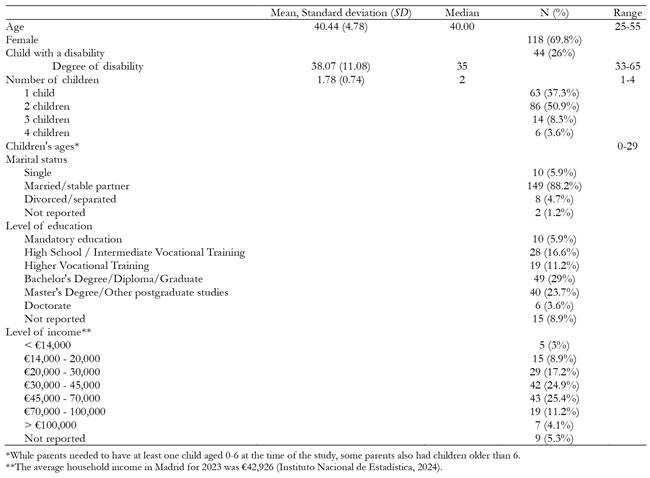
A total of 169 parents of young children participated in the study, all residing in Spain. The inclusion criteria for participation were: (a) being over 18 years old, and (b) providing care for at least one child between the ages of 0 and 6 years. Table 1 presents some demographic characteristics of the sample. The mean age of the participants was 40.44 years. A typical participant was female (69.8%), had 1 or 2 children (88.2%), was married or had a stable partner (88.2%), held a bachelor’s or master’s degree (52.7%), and reported a family income between €30,000 and €70,000 (50.3%)-an income level slightly above average. Additionally, 44 parents (26%) cared for a child with disabilities. The degree of the child's disability ranged from 33% to 65%, with an average disability percentage of 38.07%.
Measures
In addition to the sociodemographic control variables in Table 1, the following variables were assessed:
Self-compassion. Self-compassion was assessed using the Spanish version (García-Campayo, 2014) of the short form of the Self-Compassion Scale (Neff, 2003a). This 12-item scale includes statements such as “I try to be understanding and patient towards aspects of my personality that I don’t like.” Participants respond using a five-point Likert scale ranging from 1 (“Almost Never”) to 5 (“Almost Always”). The internal consistency (Cronbach’s α) of the scale in this study was .83.
Parental stress. Parental stress was assessed using the Spanish version (Díaz-Herrero et al., 2010, 2011) of the short form of the Parenting Stress Index (PSI; Abidin, 1983). This 36-item scale includes statements such as “I feel trapped by parental responsibilities” and measures parental distress and childcare stress. Participants respond using a five-point Likert scale ranging from 1 (“Strongly disagree”) to 5 (“Strongly agree”). The internal consistency (Cronbach’s α) of the scale in this study was .92.
Parenting rewards. Parenting rewards were assessed using the subscale “Baby’s Rewards” from the Spanish version (Oronoz et al., 2007) of the Parental Stress Scale (PSS; Berry & Jones, 1995). This subscale includes 5 items, such as “I feel happy in my role as a parent.” Participants respond using a five-point Likert scale ranging from 1 (“Strongly disagree”) to 5 (“Strongly agree”). The internal consistency (Cronbach’s α) of the subscale in this study was .84.
Procedure
Researchers recruited participants by contacting school principals, parent-teacher associations, and parents' WhatsApp groups. Parents received a pamphlet with information about the study, and those willing to participate contacted a member of the research team. After verifying the inclusion criteria of potential participants, the research team member obtained informed consent from the parents and provided them with a self-report questionnaire measuring the study's variables. The Ethics Committee of Universidad Rey Juan Carlos approved the study's protocol, procedure, and data protection measures.
Data analyses
Initial statistical analyses were conducted using IBM SPSS Statistics 28 (Statistical Package for the Social Sciences version 28; IBM Corp.). Among the variables measuring Self-Compassion, Parental Stress, and Parenting Rewards, 37 missing values were identified across 30 participants (17.75%). These missing values were determined to be missing completely at random according to Little’s MCAR test (χ²(6) = 2.44; p = .875). Consequently, the values were imputed using a multiple imputation procedure (Sterne et al., 2009).
To start, the descriptive statistics of sociodemographic variables in Table 1 were identified. These statistics help summarize the sample and begin to address questions of generalizability.
Second, the normality of continuous variables (age, self-compassion, parental stress, and parenting rewards) was tested. For samples larger than 50 (i.e., the whole sample, n = 169, and the subsample of parents of children without disabilities, n = 125), the Kolmogorov-Smirnov test was used. For samples smaller than 50 (i.e., the subsample of parents of children with disabilities, n = 44), the Shapiro-Wilk test was applied.
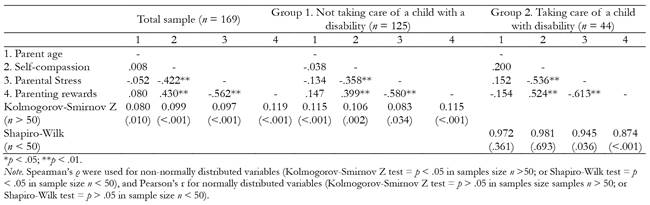
Next, Mann-Whitney U tests (for quantitative, non-normally distributed variables) and chi-square tests (for categorical variables) were used to compare the subsamples of parents of children with and without disabilities. To analyze the relationship between variables, correlation analyses were performed for the full sample and the two subsamples, using Pearson’s r for normally distributed variables and Spearman’s ρ for non-normally distributed variables, following Schober et al. (2018).
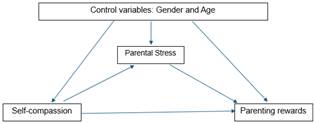
The main analysis, a path model, examined the association between self-compassion, parental stress, and parenting rewards. In this model, self-compassion was included as an independent variable, parental stress as a mediating variable, and parenting rewards as a dependent variable (see Figure 1), while controlling for the parents’ gender and age. This model analyzed the direct and indirect effects of self-compassion on the dependent variable (parenting rewards). The Maximum Likelihood Robust estimator was used due to the non-normal distribution of most of the data. An acceptable fit was determined using a two-index strategy, based on Standardized Root Mean Square Residual (SRMR) < 0.09 combined with Comparative Fit Index (CFI) > 0.95 (Hu & Bentler, 1999). Path analysis was also used to identify the percentage of variance in parental stress and parenting rewards explained by the model. Finally, invariance analyses compared the effects and fit of the model between parents of children with disabilities and parents of children without disabilities. Path analyses were conducted using Mplus v7.0 software (Muthén & Muthén, 2010).
Results
Variable distribution
In the total sample, neither parents' age (K-S = 0.080, p < .001), self-compassion (K-S = 0.099, p < .001), parental stress (K-S = 0.097, p < .001), nor parenting rewards (K-S = 0.119, p < .001) were normally distributed (see Table 3).
Differences between groups
There were no significant differences between parents caring for children with disabilities and those caring for children without disabilities. Comparing these two groups, there were no gender distribution differences (χ²(1) = 1.57, p = .211). Additionally, there were no differences between the groups in terms of age, self-compassion, parental stress, or parenting rewards (see Table 2).
Table 2: Means, standard deviations, and differences between participants who cared for a child with a disability and those who did not.

Correlational analyses
As seen in Table 3, positive and significant correlations were found between self-compassion and parenting rewards. Negative and significant correlations were found between self-compassion and parental stress, and between parental stress and parenting rewards. These correlations were identified for the whole sample and in both subsample groups (i.e., parents caring for children with and without disabilities).
Path analysis
The baseline model for the path analyses set self-compassion as the independent variable, parental stress as a mediating variable, and parenting rewards as the dependent variable, controlling for age and gender (see Fig. 1). Changes to this baseline model were made based on the following criteria: (1) exclusion of all non-significant pathways and (2) inclusion of theoretically relevant pathways suggested by the modification indices. Specifically, age and gender were removed from the model, as they did not have any significant effects on any of the other variables in the model (following Joreskog, 1993). The variables of educational level, income level, and number of children were considered for inclusion in the statistical analyses, as the literature indicates they are relevant for understanding the phenomenon of parental stress. In addition to the variables of sex and age, these variables were controlled for in the analyses. However, the results indicated that they should be removed from the model, as they did not have significant effects and the results obtained were very similar to those of the final model presented in this study. Additionally, including these variables would have reduced the sample size due to missing values. Therefore, the current model was chosen to be presented. No modification indices suggested additional, theoretically relevant pathways. The final model-and variance explained for each variable-are depicted in Fig. 2. Higher levels of self-compassion were directly associated with lower levels of parental stress (β = -.40, p < .001) and higher levels of parenting rewards (β = .24, p < .01), while lower levels of parental stress were associated with higher levels of parenting rewards (β = -.42, p < .001). Additionally, a significant indirect effect of higher levels of self-compassion on higher levels of parenting rewards, through lower levels of parental stress, was found (β = .17, p < .001). The final models explained 31.6% of the variance in parenting rewards and 15.6% of the variance in parental stress.
Configural invariance of the model between parents taking care of children with or without disabilities
Figure 2 displays the model as applied to the subsamples of parents caring for children without disabilities (Group 1) and parents caring for children with disabilities (Group 2). As with the full sample that included both groups, higher levels of self-compassion were directly associated with lower levels of parental stress in Group 1 (β = -.36, p <.001) and Group 2 (β = -.54, p < .001). Additionally, lower levels of parental stress were associated with higher levels of parenting rewards in both groups: Group 1 (β = -.48, p < .001) and Group 2 (β = -.49, p < .010). Furthermore, a significant indirect effect of higher levels of self-compassion on higher levels of parenting rewards, through its association with lower levels of parental stress, was found in Group 1 (β = .17, p < .001) and Group 2 (β = .26, p < .010). However, higher levels of self-compassion were directly associated with higher levels of parenting rewards in Group 1 (β = .22, p < .050) but not in Group 2 (β = .20, p > .050), providing mixed support for H2 and rejecting H5. The models explained 34.7% of the variance in parenting rewards and 13.1% of the variance in parental stress in parents caring for children without disabilities (Group 1), and 39% of the variance in parenting rewards and 28.7% of the variance in parental stress in parents caring for children with disabilities (Group 2).

Figure 2 Simplified model: Overview of the hypothetical model of mediated moderation to predict parenting rewards.

Testing the invariance of the path analysis for parents taking care of children with or without disabilities
Based on the configural invariance analyses presented above, an appropriate model fit to the data was not found when equality of patterns was imposed upon the data (χ²(3) = 7.91; p < .05; AIC = 3358.81; BIC = 3405.76; CFI = .928; RMSEA = .139 (.012, .261), p = .087; SRMR = .161). Pathway invariance analyses further showed that all direct associations within the model should be allowed to vary (see Table 4), as constraining them to equality significantly worsened the fit of the model: (a) when all three pathways were constrained to equality (Δχ²(2) = 4.25, p > .001); (b) when the pathway linking self-compassion and parental stress was allowed to vary between groups (Δχ²(2) = 6.60, p > .001); and (c) when the direct association of self-compassion and parenting rewards was also allowed to vary (Δχ²(2) = 3.38, p > .001). Therefore, the results support that the structure is different in both groups and the models should be considered independently. The model is different for parents taking care of children with disabilities and parents taking care of children without disabilities.
Discussion
The main objective of this study was to analyze the association between self-compassion, parental stress, and parenting rewards in parents of children aged 0-6 with and without disabilities. As expected, and according to previous studies (e.g., Jefferson et al., 2020; Sevel et al., 2020; Mazumdar et al., 2021), self-compassion was negatively and significantly associated with parental stress (H1) and positively and significantly associated with parenting rewards (H2). Additionally, as in other studies (e.g., Oronoz et al., 2007), the present study found that parental stress was negatively and significantly associated with parenting rewards (H3). Moreover, our results suggested an indirect effect between higher levels of self-compassion and higher levels of parenting rewards through a lower level of parental stress (H4). Finally, even though the associations of self-compassion with parental stress and parenting rewards were found in parents who take care of children with and without disabilities (H5), when considering our groups separately, the results do not allow us to infer the equivalence of these effects between groups.
According to previous research that found self-compassion as a key predictor of stress and quality of life (specifically in parents of children with a disability like autism spectrum disorder; Bohadana et al., 2019), the results of the present study suggest that higher levels of self-compassion may protect parents against the occurrence of parental stress in the early years of parenting. Through this pathway, self-compassion may indirectly increase the positive benefits of parenthood, such as parenting rewards. While this pattern was identified in the overall sample, separating parents of children with disabilities from parents of children without disabilities in an invariance analysis revealed that the two groups do not follow the same model. Specifically, a direct effect between self-compassion and parenting rewards was only found for parents of children without disabilities. Again, while the indirect effect of self-compassion is significant for both groups of parents, an additional part of the variance in parenting rewards is also explained by the direct effects of self-compassion among parents taking care of children without disabilities. One reason for the difference between parent subsamples could be differences in self-compassion. Self-compassion involves the acknowledgment that all humans fail. This acknowledgment was hypothesized to help parents connect with their children, directly leading to greater parenting rewards. However, it could be more difficult for parents taking care of children with disabilities to acknowledge their difficult experiences as part of the larger human experience. Rather, parents of children with disabilities may be more likely to feel isolated and alone in their parenting experiences, separated from parents of children without disabilities. So, while self-compassion may help with stress, the sense of loneliness in parenting children with disabilities may limit its direct influence on parenting rewards. Supporting this possible explanation, other studies have found that parents of children with disabilities experience loneliness, isolation, lower social support, insufficient social relationships, and low satisfaction with existing relationships (Yildirim et al., 2022). To better understand the mechanisms here, future work could examine isolation, self-compassion, and parenting rewards.
While the direct effects of self-compassion on parenting rewards differ between parent groups, self-compassion in the analyses was associated with lower levels of parental stress and, indirectly, higher parenting rewards. This finding is in line with Neff and Faso (2014), who found that self-compassion universally predicted parental well-being, over and above the effects of child symptom severity. A parent who sees their failures as part of the human condition (high level of self-compassion) could cope better with stressful situations than a parent who sees their failures as a reflection of their lack of skill (low levels of self-compassion). For example, when confronted with a temper tantrum or discipline problems, a self-compassionate parent would be more understanding, kind, patient, and less judgmental about their parenting. This perspective would lead to experiencing less stress and more rewarding parenting. Neff and Faso (2014) provide a similar explanation about how self-compassion reduces parents’ distress levels, providing a sense of self-efficacy, self-acceptance, and feelings of connectedness to common humanity in the parental role. Thus, self-compassionate parents may be able to experience more joy, happiness, and satisfaction in raising their children. In turn, this could increase devotion to the parenting role and feelings of attachment to their children (i.e., higher levels of parenting rewards). This explanation reflects previous literature (Akaroğlu, 2023) that found lower parental stress to be one of the most important variables for explaining parental role satisfaction. Consistent with previous research, current findings suggest that enhancing parents’ self-compassion could be a strategy to decrease stress and, consequently, allow parents to experience more joy and happiness from the act of parenting.
Worth noting, descriptive statistics showed that parents of children with and without disabilities had similar levels of self-compassion, parental stress, and parenting rewards. It was expected that parents of children with disabilities would have higher levels of parental stress (Priego-Ojeda & Rosu, 2023), but the mean comparison test was close to significance, suggesting a tendency in our results that aligns with previous findings. This may be due to parental stress being associated with multiple factors (Saloviita et al., 2003). Although it was not within the scope of the present study, controlling for these factors may have helped reveal the difference in stress between parents of children with and without disabilities.
It is important to note that this study has limitations that highlight the need for additional studies to confirm the results. First, the sample size and the convenience nature of the sampling process limit the generalizability of the findings. Participants were Spanish and tended to be well-educated, married, and have only one or two children. Additionally, by agreeing to participate in the study, participants displayed at least some level of engagement in parenting, which may result in higher levels of parenting rewards than non-participants. Second, the cross-sectional nature of the study does not allow causal relationships to be inferred. While the model presented here seems likely due to its basis in previous literature, it is possible that, for example, more parenting rewards reduce levels of stress, allowing parents to adopt a more self-compassionate attitude towards their own failures and mistakes. Third, self-compassion is reported in the literature not only as a stand-alone predictor of well-being but also as a protective factor against the effects of stress (e.g., among a sample of women during pregnancy and postpartum; Ilyas et al., 2024). Further studies conducted using longitudinal and experimental designs may be needed to specify the causal ordering between self-compassion, stress, and parenting rewards.
From a clinical perspective, it is crucial to consider certain limitations of this study, as there may be other important variables that should be explored in future research to make the model more complex and comprehensive. For example, Jones and Prinz (2005) observed that self-compassion improves parental self-efficacy, making parents feel more competent and confident in their parenting role, which reduces negative emotions. Blackledge et al. (2006) found that parents with high levels of acceptance, who face difficulties without self-judgment, experience reduced parental stress and increased well-being. Psychological flexibility, in turn, is associated with better adaptation to changing circumstances and a greater capacity to manage parental stress (Lobato et al., 2022). Additionally, clinicians working with stressed parents should consider not only psychological factors but economic resources as well, as these influence parents' ability to provide a stable and secure environment for their children, especially in families with multiple children or children with disabilities (Conger et al., 2010).
Acknowledging these limitations, this study is the first to jointly analyze self-compassion, parental stress, and parenting rewards. The results of this study provide additional support for the idea that self-compassion could play an important role in achieving parenting rewards both directly and through reducing stress levels. These findings support existing literature that identifies self-compassion as a key variable for understanding parental well-being (less parental stress and more parenting rewards). There is a growing body of scientific evidence (e.g., a meta-analysis by Han & Kim, 2023) showing that self-compassion can play a key role in alleviating negative outcomes (e.g., depressive symptoms, anxiety, and stress) and increasing positive outcomes, such as enhancing nurturing family environments (Kirby, 2016) or improving relationship quality for couples navigating pregnancy (Huynh et al., 2022).
Finally, the results have some clinical implications. Enhancing self-compassion through well-established therapies (e.g., the Mindful Self-Compassion Program: Neff & Germer, 2013) could help not only decrease parents’ levels of stress and distress manifestations (e.g., depressive symptoms; Rayan & Ahmad, 2018) but also enhance the probability of parents experiencing positive emotions from the act of parenting, improving parent-child interaction through Mindfulness Parental Training (Rojas-Torres, 2023). From a clinical perspective, it is important take into account the role of self-compassion in order to enhance the rewarding experiences of caring for a child. Therapies to increase self-compassion could be directed to parents in general but could also be targeted to help parents taking care of children with disabilities (e.g., Self-compassion Intervention for Parents of Children with Developmental Disabilities, Ahmed & Raj, 2023). In addition to including self-compassion programs, future intervention studies should consider parental rewards among their assessed outcomes to specify the beneficial effects of self-compassion.
Complementary information
Acknowledgements: We thank all research participants for participating in this study and the following centers for collaborating with us in the project: Colegio Retiro, Escuela Infantil Jardimar, Escuela Infantil Cantinela and Escuela Infantil El Romeral.
Funding: Work on this study was supported by Universidad Rey Juan Carlos under grant 2022-REGING-95655.
Ethics Statement: This study was approved by the Ethics Committee of Universidad Rey Juan Carlos de Madrid.
Informed Consent: Written informed consent was obtained from all research participants before study enrollment.
Declarations: The authors report there are no competing interests to declare.
Conflict of Interest: The authors declare that the research was conducted in the absence of any commercial or financial relationships that could be construed as a potential conflict of interest.
Use of Artificial Intelligence: Artificial intelligence (AI) was not used.

