




 Servicios personalizados
 texto en
  Inglés (pdf)
 Articulo en XML
 Referencias del artículo
 Traducción automática
 Enviar articulo por email
 Citado por SciELO
  Citado por Google
  Similares en
SciELO
Similares en
SciELO  Similares en Google
 Permalink
Introduction
According to the World Health Organization (WHO, 2022), 58 million children and adolescents experience an anxiety disorder. According to the United Nations Children's Fund (UNICEF), children and young people also manifest psychosocial distress that does not reach the level of disorder but disrupts their lives, health, and future prospects. In its U-Report survey, it reported that the pandemic has had a significant impact on the mental health and psychosocial well-being of children and young people in Latin America and the Caribbean, and, also revealed that more than a quarter had suffered from anxiety and 15% from depression (UNICEF, 2021).
A recent systematic review (Sanchez-Soto & Sanchez-Suricalday, 2023) has shown that mindfulness interventions are positive and favorable in people with ADHD and anxiety disorders producing significant changes in related symptomatology.
The late childhood or early adolescent stage is a critical period in individual development. This is due to the relevant changes in the functional and structural configuration of the brain. These changes generate a series of cognitive and psychosocial alterations. These directly impact the development process and how individuals interact with their environment (Davidson et al., 2012). During the preadolescent and adolescent years, the most common challenges encountered are elevated levels of anxiety and/or behavioral issues. These, although not meeting the full diagnostic criteria for clinical conditions, can impose significant limitations on day-to-day functioning (Oland & Shaw, 2005).
According to Selye (1936), stress is a non-specific response of the organism to a stimulus. Based on this premise, the conceptualization of the stress response has subsequently been expanded to consider it as an adaptive process involving the activation of cognitive, emotional, physiological, and behavioral systems (Campbell and Ehlert, 2012). Although the stress response is a normal and adaptive response, it is now widely accepted that excessive stress in early life may be associated with the onset of mental illness (Nakama et al., 2023).
On the other hand, anxiety is intrinsically related to stress. Although both are emotional responses, stress is usually caused by an external trigger and anxiety by persistent and excessive worry that does not go away even in the absence of a stressor (APA, 2018). Anxiety could also be defined as a consequence of stress, with the subjective component and anticipation of a threat being its main characteristics (Fink, 2016).
There are several strategies for reducing stress and anxiety. In recent years, techniques based on meditation and mindfulness have emerged as effective tools, either alone or in combination with other interventions (Hervás et al., 2016; Mejía et al., 2023). Specifically, mindfulness is defined as awareness of internal states and the environment; and can help people avoid destructive or automatic habits and reactions by learning to observe their thoughts, emotions, and other present-moment experiences without judging or reacting to them (APA, 2018). Mindfulness began in the late 1970s when Jon Kabat-Zinn, Ph.D., developed the Mindfulness-Based Stress Reduction (MBSR) program for adults, which was structured into eight two-and-a-half-hour weekly sessions and supplemented by a weekend retreat (Kabat-Zinn, 1982).
There is scientific evidence of the effectiveness of mindfulness in chronic pain (including fibromyalgia), recurrent depression or with residual symptoms, stress in general and in various anxiety disorders, as well as in certain medical conditions such as cancer, resistant epilepsy, psoriasis, and patients with human immunodeficiency virus (HIV), among others (see reviews: Bertolín, 2015; Hervás et al., 2016). Most studies that have implemented a mindfulness intervention program in children in the school setting have been able to significantly reduce levels of perceived stress (Baena-Extremera et al., 2021; Mejía et al., 2023). In addition, other studies have observed increases in empathy and self-compassion along with decreases in ruminative thinking and trait anxiety along with decreases in nonspecific stress (Chiesa & Serretti, 2009).
Short-term mindfulness training has also been reported to reduce negative emotions, including anxiety (Li et al., 20-21; Turanzas et al., 2018). Other studies have shown that in addition to regulating anxiety, mindfulness contributes to learning to control frustration, improves attention span and concentration in the classroom, and improves classroom climate (Sánchez-Gómez et al., 2020).
Conversely, mindfulness intervention programs implemented in schools have demonstrated efficacy in enhancing children's social and emotional competencies (Ager et al., 2015; Allen et al., 2012; Arévalo-Proaño et al., 2019; Cheang et al., 2019; García-Rubio et al., 2016; Pacheco-Sanz et al., 2018; Ricarte et al., 2015; Schonert-Reichl et al., 2015).
Regarding the effects of mindfulness on the activity of the hypothalamic-pituitary-adrenal (HPA) axis, studies in children show conflicting results regarding changes in cortisol; while some find a significant decrease due to the intervention (Carro et al., 2023; Koncz et al., 2022; López-Alarcón et al., 2020), others observe no effects (Chávez et al., 2020; Koncz et al., 2021). Others, while not observing changes in cortisol levels, report improvements in other physiological variables, such as decreases in blood pressure, heart rate, and heart rate variability (for review, see Van Loon et al., 2022). A possible explanation for the heterogeneity of the results lies in methodological aspects that lead to great variability in the programs, with different times both in the duration of the sessions and in the number of sessions per week or total sessions.
Considering the above, there is a need for systematized mindfulness-based intervention programs, empirically supported, and including both psychological and physiological assessment measures.
This study aimed to evaluate the effectiveness of a mindfulness-based intervention program through a group application of 14 sessions of 40 minutes each, 3 times a week, in a sample of elementary school students in a school setting.
This program will help us understand how well a mindfulness program can help with stress-related physical and mental health problems. This will also help us create and/or implement this type of program in the school environment. We can adapt it to the needs of the students. This will improve their emotional well-being, quality of life, and prevent the onset or worsening of mental disorders.
Method
Participants
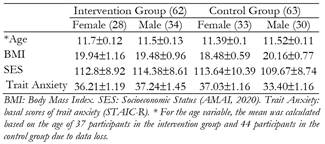
The initial sample consisted of 141 participants, of whom 125 completed all the questionnaires; 47.5% were girls and 52.5% were boys, aged between 9 and 12 years (M=11.35(0.54), in 5th and 6th grade, belonging to a public elementary school in a marginal area of Mexico. Almost 100% of the sample belonged to a lower-middle status (AMAI, 2020) (see Table 1). Students with a diagnosed psychological, psychiatric, or neurological disorder, or with a diagnosis that prevented them from following instructions, and who were receiving pharmacological treatment during the study that could interact with cognitive and physiological functioning, were excluded. For the cortisol samples, 27 participants did not complete the three saliva samples, resulting in 98 participants.
Methodological Design
Using a quasi-experimental and longitudinal design, 125 students were assessed for stress (IIEC), arousal (Calm-Activation-SAM), and salivary cortisol before, during, and after the mindfulness intervention (14 sessions over 5 weeks, three sessions per week, 40 minutes per session). Participants were randomly assigned so that sixty-three children participated in the intervention group and sixty-two children participated in the control group (waiting list); once the intervention was completed and data were analyzed, the control group was also offered the intervention. The sample size was calculated using GPower software (version 2021), with a repeated measures design with 5 measures and a between-subjects variable with 2 groups (intervention and control), with an effect size of medium size (0.25), a value of β= 0.95 and an error of α= 0.05, giving an N of 120 subjects (60 per group).
Instruments
Sociodemographic data. In the pre-intervention assessment, sociodemographic information was collected through a questionnaire completed by the participants' mothers, fathers, or guardians. This assessment was conducted individually.
Socioeconomic status. Mexican Association of Market Intelligence and Public Opinion Agencies (AMAI). It is based on the development of a statistical model that allows the objective and quantifiable classification of households according to their socioeconomic level (SES). The AMAI 8X7 rule classifies households into seven levels, taking into account six household characteristics (AMAI, 2020).
Children's Daily Stress Inventory (IIEC) (Trianes et al., 2009). It measures daily stressors in developmentally relevant domains in a population of school children between the ages of 8 and 12. It covers three relevant areas of child stress corresponding to the following factors or scales: 1) health and psychosomatic problems, 2) stress in the school environment, 3) stress in the family environment. The inventory is composed of 22 dichotomous items (YES/NO). The scores range from 0 to 22, so that high scores mean high stress and low scores mean low stress. Cronbach's alpha is 0.70 and test-retest reliability is 0.78 in the Spanish population.
Trait Anxiety Inventory in Children (STAIC-R). The STAIC-R evaluates anxiety as a trait (R), therefore it consists of two independent scales of self-evaluation, composed of 20 items, where 10 are positive towards anxiety and 10 are negative towards anxiety. The test has three response alternatives ranging from 0 to 2: almost never, sometimes, and often (frequency), asking how you feel in general, original version (Spielberger et al., 1973). The STAIC has moderate reliability, with a Cronbach's alpha of .70. The version used has been validated in the Colombian population (Castrillón Moreno & Borrero Copete, 2005).
Self-Assessment Manikin (SAM). It is a self-report instrument designed to measure changes in emotions that consists of three groups of pictograms with a humanoid figure, one for each dimension of emotion. In the arousal dimension, the group of pictograms ranges from a doll that appears trembling and with a bang on its body, to the extreme where the doll appears with its eyes closed in a calm state. Each dimension consists of 5 pictures and four spaces between them, allowing the participant to move in a range of 1 to 9 points per dimension (Bradley et al., 1994).
Salivary Cortisol. Saliva samples for cortisol determinations were collected before and after each intervention, with the approximate collection times being between 8:30 and 9:00 a.m. The children were asked to deposit their saliva in the polypropylene tubes in the presence of the teachers. This procedure was performed simultaneously in the control and intervention groups. After collection, samples were refrigerated, centrifuged, and aliquoted into microtubes, and frozen at -20ºC until processing. Salivary free cortisol concentrations were analyzed by competitive enzyme-linked immunoassay (ELISA) using the ALPCO kit (1-CORHU-E01-SL; 26-G Keewaydin Drive, Salem, NH 0307). The coefficient of variation was less than 10%.
Procedure
Baseline data were collected in December 2023 and the intervention was delivered between March and May 2024. The entire process was carried out by the field research team, which included a specialist in mindfulness and psychoeducational intervention with children, with the support of master’s and undergraduate psychology students who had been trained in their roles beforehand. All sessions, both assessment and intervention, took place in the students' classrooms. In each session, the groups consisted of about 30 boys and girls.
The study consisted of five evaluations: (1) an initial evaluation, which consisted of an initial interview with open questions for the students, mothers, fathers and/or guardians, where they were asked about their socio-demographic data (age, number of siblings, with whom they live, etc.) and about some aspects of the school climate, knowledge about emotions and ways to relax, among others; (2) a pre-intervention evaluation; (3) an interim evaluation in the eighth session; (4) a post-intervention evaluation; and (5) a follow-up evaluation (one month after the intervention). At all evaluations, the IEEC and the State Anxiety Questionnaire were administered before the start of each session, and changes in perceived arousal (MAR) were assessed before and after each session. Cortisol levels were assessed at baseline, post-intervention and follow-up.
Cortisol levels were assessed before the intervention, after the intervention, and at the end of the session. The control group was assessed in parallel on the same days and at the same times as the intervention group.
Mindfulness Intervention Program
The mindfulness program consisted of several activities. The design of these activities was based on the contributions of Greenland (2010), who proposes seven principles for implementing mindfulness in the classroom: motivation, perspective, simplicity, playfulness, fun, integration, collaboration, and strategy. In addition, the MBSR (Mindfulness Based Stress Reduction) method was taken as a reference, which is characterized by conscious breathing, body scanning, walking while being "aware" of the movement of the feet and breathing, and doing any daily educational activity with "mindfulness" (e.g., listening, playing; Moñivas et al., 2012). The book Calm and Mindful as a Frog (Snel, 2013) was also used, always using age-appropriate vocabulary. For example, instead of mindfulness, terms such as "enjoying what we are doing now" or "concentration" were used.
In the first sessions of the mindfulness activities, we worked on breathing, a fundamental element of mindfulness. In the later sessions, the different parts of the body and the senses were worked on using external materials and instruments (e.g. sounds, and everyday objects). The purpose of the activities was to promote breathing, relaxation, body scanning, conscious walking, conscious senses, and observation. The activities carried out during the mindfulness intervention program can be observed in the intervention protocol (see Appendix 1, under data availability).
Ethical considerations
First, approval of the research protocol was obtained from the Ethics Committee of the University of Guanajuato (CEPIUG) P692023 (Bioethics 11-CEI-001-20230127). All participants signed an assent form and informed consent was obtained from fathers, mothers, and/or guardians (see Annex 1, in data availability). This study was conducted based on the international ethical considerations established in the Declaration of Helsinki (2024).
Statistical Analysis
To analyze changes in perceived stress levels (IIEC) and salivary cortisol before and after a mindfulness intervention, a repeated-measures ANOVA was applied with a 2-level between-subjects factor (condition: intervention vs. control) and a 5-level within-subjects factor (session: assessment: initial, pre-intervention, intermediate, post-intervention, and follow-up). For changes in arousal (SAM), a within-subjects factor was added (Time: pre-session vs. post-session). In cases where the sphericity assumption was violated, Greenhouse-Geisser correction was applied. Data were analyzed with SPSS version 25. Data are presented as means and standard errors of measurement (M(SEM). The p-level was considered significant if it was less than 0.05.
Results
Sociodemographic Data
A total of 125 students aged 9 to 12 years (M = 11.35(0.54) participated in this study. 34.1% had three or more siblings. Twenty-four percent had experienced a traumatic event. Regarding the socioeconomic status of the participants, 2% were high status, 60.79% were middle status, and 37.28% were low status. Only 10.4% of the participants had already experienced menarche. It can be observed that the sample was gender balanced in the intervention and control groups (see Table 1).
Children's Daily Stress Inventory (IIEC)
Table 2 shows the scores of the different dimensions of daily stress in the control and experimental groups for each evaluation performed: (1) initial evaluation, (2) pre-intervention evaluation, (3) intermediate evaluation, (4) post-intervention evaluation and (5) follow-up evaluation.
For perceived stress in the Health factor, a main effect of Time was found, F (2.737, 336.591) = 10.991, p ≤ .001, η2p = .082, with stress scores lower in session 2 compared to session 1, although it did not reach significance (p = .055), but scores from sessions 3 to 5 were significantly lower compared to session 1 (all p ≤ .001). On the other hand, no main effect of condition was found, F (1, 123) = .276, p = .600, η2p = .001, nor of the Time x Condition interaction, F (2.737, 336.591) = .541, p = .638, η2p = .005.
For perceived stress in the School factor, a main effect of Time was observed, F (2.88, 354.199) = 7.737, p ≤ .001, η2p = .059. No main effect of Condition was found, F (1, 123) = .23, p = .088, η2p ≤ .001, however, a Time x Condition interaction was observed, albeit marginally, F (2.575, 354.199) = 2.575, p = .056, η2p = .021. Post hoc analyses showed that students in the intervention group had higher stress scores than those in the control group at the first assessment, p = .046. No significant differences between groups were observed at the other assessment times (all with p ≥ .368). While in the control group, the scores remained constant at all assessment times (all p≥ .066), in the intervention group a decrease in scores was observed at the interim, post-intervention, and follow-up evaluation sessions compared to the baseline assessment (all p≤ .003) but not compared to the pre-intervention assessment (p = .211).
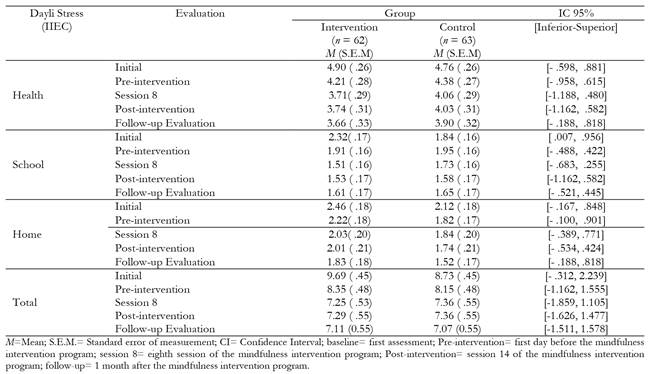
In the Home factor, a main effect of the Time was observed, F (2.973, 365.659) = 6.143, p ≤ .001, n2p = .048. A post hoc analysis showed that all scores are significantly lower than the initial assessment p≤ .001, except for the pre-intervention assessment where scores, although lower, did not reach significance, p = .055. On the other hand, no main effect of Condition was found, F (1, 123) = 1.938, p = .166, η2p = .016, nor the Time x condition interaction, F (2.973, 365.659) = .187, p = .904, η2p = .002 (see Table 2).
For total perceived stress, a main effect of Time was also observed, F (2.726, 335.348) = 14.946, p ≤ .001, η2p = .108. post hoc analyses showed that participants had lower scores on all assessments compared to the baseline assessment (all p ≥ .087); however, a main effect of Condition was not found, F (1, 123) = .59, p = .808, η2p ≤ .001; nor the Time x Condition interaction, F (2.726, 335.348) = 1.243, p = .294, η2p = .110.
Self- Assessment-Manikin (SAM)
Figure 1 shows the results corresponding to the perceived arousal (calm-activation) in the pre-session and post-session of the 5 evaluation moments.
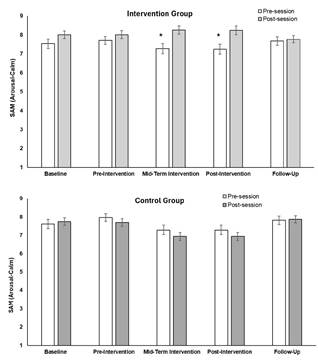
Figure 1 Self-Assessment-Manikin Scale (SAM) scores in Arousal-Calm dimension in intervention and control groups (N = 123)
In the perceived arousal factor (calm-activation), a main effect of the Session factor was observed, F (2.572, 313.828) = 3.565, p = .020, η2p = .028, Time, F (1, 122) = 6.498, p = .012 η2p = .051, Session x Condition, F (2.572, 313.828) = 2.924, p = .042, η2p = .023, Time x Condition, F (1, 122) = 20.618, p ≤ .001, η2p = .145, Session x Time x Condition, F (2.570, 313.589) = 4.750, p = .005, η2p = .037. However, no main effect of Condition was observed, F (1, 22) = 1.406, p= .238, η2p=.011. A posteriori analyses showed that only in sessions 3 (mid-term intervention) and 4 (post-intervention) after the intervention, participants in the intervention condition scored higher on the arousal dimension than those in the control condition (both p ≤ .001), reflecting a greater sense of calmness in the intervention group. Analyses also showed that only participants in the intervention group had significantly higher levels of perceived arousal (arousal-calm) after the intervention in Sessions 3 (mid-term-intervention) and 4 (post-intervention) (greater sense of calm) (both p ≤ .001). In contrast, participants in the control group did not show significant differences before and after the intervention in any of the assessment sessions. (all p ( .084).
Salivary Cortisol
Ther repeated measures ANOVA showed a main effect of Time, F (1.39, 125.096) = 4.446, p = .025 η2p = .039 and a Time x Condition interaction, F (1.39, 125.096) = 9.429, p = .001, η2p = .079. Cortisol concentrations in the pre-intervention session were similar between the intervention and control groups (p = .462), however, they were higher in the intervention group compared to the control group in the post-intervention session (p = .013) but decreased drastically in the intervention group to lower values than the control group at the follow-up assessment (p ≤ .001) (see Figure 2).
*p = .013;**p≤ .001.
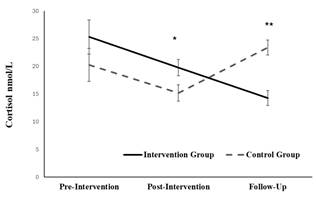
Saliva cortisol concentrations at the assessments on the first day of the intervention (pre-intervention), on the last day of the intervention (post-intervention), and one month after the end of the intervention (follow-up) in the intervention and control groups.
Discussion
The general objective of this research was to evaluate the efficacy of a mindfulness intervention program (with a duration of 14 sessions) on different indicators of stress and anxiety in students aged 9 to 12 years belonging to a public elementary school in a marginal area. Most of the students belonged to a lower middle status. In general, the effectiveness of the intervention program was confirmed with a significant decrease in the levels of perceived stress at school, perceived arousal (calm-activation), and cortisol.
Regarding the evaluation of perceived stress levels, a decrease was observed in the dimensions of Health, Home, and School throughout the assessments, regardless of being in the control or intervention group. This finding would suggest that simply paying different attention at school may have a health benefit. When changes in perceived stress at school were analyzed, we observed that the intervention group decreased stress levels, while the control group remained at similar levels at all evaluation times. Consistent with these findings, a study conducted among primary and secondary school students observed a reduction in stress scores in the health, school, and home dimensions following the application of the mindfulness program (Baena-Extremera et al., 2021). The study found significant reductions in three areas. But in our study, only the school area showed improvements. This might be because the program by Baena-Extremera et al. (2021) included activities for home. These activities might help people remember what they learned at school and use those skills in other areas of their lives.
Other studies have also found reductions in perceived stress in elementary school students following a controlled mindfulness intervention (Broderick & Metz, 2009; Campion & Sharn, 2009; Carro et al., 2021; Kappes et al., 2023; Mendelson et al., 2010). Even these decreases have been demonstrated in populations with attention deficit hyperactivity disorder (ADHD) (Oliva et al., 2021). In contrast, a systematic review focused on the effect of mindfulness on stress indicators concluded that mindfulness programs have a non-specific effect on stress reduction (Chiesa & Serretti, 2009). This may be due to the diversity of programs and their designs, which makes it difficult to compare them with each other and to draw conclusions about the true effect of these programs on stress indicators.
Regarding the intervention methodology, studies that have implemented mindfulness intervention programs in schools (primary and secondary) show positive results in reducing anxiety. The programs usually range from 4 to 20 sessions, with a duration of 30 to 60 minutes per session and at least one session per week (Areskoug Sandberg et al., 2024; García-Rubio, 2016; Lopes et al., 2024; Rose et al., 2010). In line with these studies, we found a decrease in the arousal dimension (calm-activation) after the intervention assessed by the SAM. This result is also consistent with that found in a study of primary school children (Matiz et al., 2024). Other studies have also found an increase in happiness and a better ability to control their behavior after mindfulness interventions at school (Pickerell et al., 2023; Sin et al., 2024).
Concerning salivary cortisol, in addition to the decrease in the concentrations in the intervention group, it should be noted that the levels were lower in the intervention group during the follow-up period, while cortisol levels increased in the control group.
This finding suggests the long-term benefits of this type of intervention for the activity of the HHA axis. Few studies have evaluated the long-term effect of a mindfulness intervention on HHA axis activity in children, and those have not found significant changes. This could be due to the limited number of sessions, where an immediate impact is observed but no significant long-term changes are seen.
On the other hand, studies conducted to date show contradictory results, with some observing decreases in cortisol after a mindfulness program in elementary schools (Carro et al., 2021; Carro et al., 2023; Ho et al., 2020; Lozada et al., 2014), while others do not find these effects (Koncz et al., 2021). One possible explanation for the lack of effects may be due to the short duration of the programs (less than 8 sessions) and the small sample size, among other factors.
The intervention program used in this study is among the first in Latin America to be administered in a group setting with mindfulness, complemented by both subjective or self-report and objective assessments of stress (cortisol in saliva). A key strength of the program is its frequency, with sessions held on three days per week, totaling 14 sessions throughout the study. Notably, the program includes five evaluations, including a follow-up session, a feature that is not present in most of the studies analyzed.
On the other hand, despite some limitations, such as sociodemographic characteristics (poor environment, higher levels of stress, a history of physical and psychological abuse, etc.) and the context of the intervention in the classroom, where sometimes control over some methodological aspects can be lost, it can be said that this type of strategies can help promote the physical and mental health of infants and adolescents.
Another limitation to highlight is the use of self-report instruments in the child population. The main problem with using this type of tool is that children have not yet developed the capacity for introspection (Fernández Berrocal & Extremera Pacheco, 2004). Aspects such as low cultural level and social desirability, among others, could also bias the results. This could be addressed in future research by combining observational data with physiological measures based on sympathetic activation. This type of measurement, which can currently be obtained with mobile devices (e.g. watches), allows the monitoring of vital signs such as heart rate, blood pressure, etc.
Despite such limitations, the relevance of these findings can facilitate the generation of action plans for educational professionals. It should be noted that the design of these protocols requires few economic resources and it is sufficient to use those of the school environment, which demonstrates the feasibility of implementing these techniques in less favorable environments. On the other hand, the results obtained in this study support the effectiveness of intervention programs based on mindfulness. Perceived stress levels and perceived activation are indicators to be included in programs aimed at children's mental health and the prevention of the development of physical and mental disorders.
One of the strengths of this study is that it is one of the first in Latin America to implement a mindfulness intervention in a school setting and to combine objective measures with self-report measures, which provides greater robustness and ecological validity.
The advancement of research in this area will allow continuity in the lines of approaches related to children's mental health. Future research should include a wider variety of contexts and populations, as this study was conducted in a public school with families of lower socioeconomic status and with particular conditions of marginality. Replication of this kind of intervention program in different socio-cultural contexts would be necessary to better understand possible factors associated with its effectiveness.
In addition, it is recommended to compare groups of different socioeconomic status to be able to analyze the influence of adverse conditions in a more controlled manner, to evaluate in detail the types of stressors that most affect this population, and to add other physiological indicators, such as heart rate variability, to have more objective indicators of stress.
In turn, the inclusion of mindfulness-based techniques and programs in educational systems, along with related evaluations, will facilitate the identification of protective factors in children and promote child resilience at this stage of development. Indirectly, it would also have an impact on the prevention of stress-related disorders in adulthood.
Conclusions
From the findings of this research, it can be concluded that mindfulness seems to be an adequate tool to reduce perceived stress, specifically in the school area.
Since no differences in perceived stress were found between the groups in the dimensions of home and health, it is suggested that mindfulness should be practiced in other settings, emphasizing the family environment to promote better results.
The decrease in perceived arousal after each session highlights the ability of mindfulness-based interventions to promote calmness and, in itself, increase feelings of relaxation, which can lead to a greater sense of well-being.
The reduction in cortisol levels after one month of intervention highlights the benefit of mindfulness on the main stress response system, the hypothalamic-pituitary-adrenal axis; therefore, salivary cortisol remains an objective indicator of intervention efficacy.
Considering these findings together with previous research, it can be concluded that standardized mindfulness-based programs can lead to improvements in childhood mental health. These benefits are only visible at the physiological level in programs with a minimum duration of 8 sessions; therefore, it is advisable to standardize these protocols with a duration between 8 and 14 sessions, at least one session per week, although two sessions per week would be more convenient, and with a duration of 30 to 45 minutes per session.
Mindfulness-based programs can help prevent the development of physical and mental illnesses. Its implementation in different settings and at an early age can contribute to other techniques for improving children's mental health.
Complementary information
Authors' contributions.- Luz Elvira Pérez Segoviano: conceptualization, methodology, writing, and editing. Herlinda Aguilar Zavala: methodology. Vanesa Hidalgo: revision, editing, and proofreading. Carolina Villada: funding acquisition, resource management, methodology, revision, editing, and proofreading.
Acknowledgments.- The authors would like to thank the Laboratory for Innovation in Interdisciplinary Health and Psychology Research and Learning (Laboratorio de Innovación en la Investigación y el Aprendizaje de Psicología y Salud Interdisciplinaria (IIAPSI-Lab)), the Secretaría de Educación Pública (SEP), the students, parents, and school authorities for making this study possible. To Luis Fernando Rebolledo Meza, Sandra Yazmin Mendez Yepez, and Paloma Isabel Martínez Fernández for their support during the evaluation sessions. To Dr. Leticia Chacón Gutiérrez for her contributions to the design and initial adaptation of the protocol.
Funding.- The authors declare to have received funding from the Consejo Nacional de Humanidades, Ciencias y Tecnologías (CONAHCYT): Master's Scholarship funded under No. 1273064; Universidad de Guanajuato (Project 075/2024) Convocatoria Institucional de Investigación Científica (CIIC 2024).
Declaration of interests.- The authors declare that there is no conflict of interest
Declaration of data availability.- The database used and the intervention sessions are openly available at https://www.icloud.com/iclouddrive/05eY2lmei6eTBuT0RRDwSQM1Q#link_datos

