




 Servicios personalizados
 Inglés (pdf)
 Articulo en XML
 Referencias del artículo
 Traducción automática
 Enviar articulo por email
 Citado por SciELO
  Citado por Google
  Similares en
SciELO
Similares en
SciELO  Similares en Google
 Permalink
Introduction
The situation caused by the COVID-19 pandemic led organizations to seek contingency measures to prevent and control the possibility of contagion. One of them was the implementation of teleworking1. Faced with the increase in infections, organizations implemented biological control strategies, as was the case in public institutions, which are usually entities that manage numerous employees; such was the case of the Instituto Costarricense de Electricidad (ICE), which organized more than 4800 officials with telecommuTable positions under this work modality.
Despite the fact that, nowadays, there is a trend towards a decrease in cases and the lethality of the virus, it has been established that this modality has become so relevant, that various organizations still have a high number of workers collaborating remotely or in a hybrid positions, both in person and virtual.
Venegas and Leyva2 identified the need to publish the aspects that entail the relationship between physical and mental problems associated with teleworking in order to set the bases for defining and installing policies at the organizational level to prevent and address any unfavorable situation for the teleworker population. The control of these policies requires the active participation of organizations, companies, institutions and individuals who manage the health risk associated with teleworking3.
There are many aspects considered as aggravating and that cause the deterioration and dysfunction of teleworking. Among which are mentioned the monotony, automation and rhythm of work, organization, hierarchical structure, relationships with others, determination of competencies, communication channels, breaks, shifts, type of work, even those of a socioeconomic nature such as employment conditions and salary2. That´s why it gets important to inform workers about the way they should take care of themselves while working in the home environment4.
This requires the identification of the impact of teleworking on the aspects that influence the worker's health, such as organizational, physical, environmental and psychosocial aspects. Therefore, the aim of this study is to determine the impact of this measure on self-perceived health at the musculoskeletal level, in order to guide the prevention of risks derived from the determining factors that may encompass teleworking. This work is one of the first of its kind and will generate information that will allow the establishment of replicable measures at the national and regional level.
Materials and methods
Methodology
Based on the collection methodology in the investigation of Sommer et al (2022), the data collection period was in July 2022, and virtually asynchronously, through emails containing the link to the questionnaire on Google Forms ® platform5.
All teleworkers who met the established inclusion and exclusion criteria such as belonging to the General Services Department of the institution, being under homeworking modality and having signed the informed consent, were taken as participants.
As it has being in the study of Martínez6, in order to collect the information associated with the symptoms of the different musculoskeletal disorders, an instrument of own elaboration was used, it contemplated aspects of teleworking conditions and habits, lifestyles, and the Nordic Questionnaire of Musculoskeletal Symptoms, which consists of a compilation of the anatomical areas that present symptoms of common disorders and associate office work7.
Data analysis
For data management and analysis, the open source JAMOVI® 2.2.5 Statistical Package8 and Microsoft Office Excel® were used. In all cases, statistical results were stablished to a 95% confidence level by considering significant results whenever the observed p-value was less than or equal to 0.05 (p≤0.05).
A descriptive analysis was carried out in order to know the frequency distribution of the variables, measures of central tendency (mean and median) and dispersion of the variables. An inferential analysis was applied to a parametric type for normal distribution of data. The relation between categorical variables (binomial) and teleworking conditions was analyzed using Chi-square tests (or Fisher's test in case the expected numbers were <5).
Also, logistic regression model was developed for each area (upper limbs, lower limbs, neck and back), with the aim of explaining the relationship between the possible causes (determining factors) and the presence of any musculoskeletal symptoms. For this regression, the variables that turned out to have a statistically significant relationship in the bivariate analysis were used as a basis using the Chi square or Fisher tests (as appropriate), and in this way possible models for each area were evaluated. To do this, the group that demonstrated a noTable increase in the value of R2 was chosen.
Female and male showed the data in distribution, by having the following definition of gender: a set of roles, behaviors and identities constructed in a social and cultural space9.
Ethical considerations
As a way of protecting the physical, emotional, psychological, and social health integrity of all participants, the various bioethical principles of the Belmont Report accepted by the United States Congress and drafted by the National Commission for the Protection of Persons Subjected to Biomedical and Behavioral Experimentation in 1979 were taken into account10. In addition, compliance with the principles of bioethics, such as confidentiality, non-maleficence, beneficence, and respect, was ensured.
The research was reviewed and approved by the Scientific Ethics Committee of the National University (CECUNA) through the official letter UNA-CECUNA-2022-P003, in turn, it was approved by the Consejo Nacional de Investigación en Salud del Ministerio de Salud de Costa Rica (National Health Research Council of the Ministry of Health of Costa Rica). The study did not represent a greater risk for people, since the answers to the inquiries carried out were simple for the participant and managed under an anonymized protocol, which initially contemplated an Informed Consent for each participant. Besides, the results were known by the administration, through a presentation made on May 30, 2023 virtually.
Funding
This research did not receive any specific grant from funding agencies in the public, commercial, or not-for-profit sectors. The project was supervised and tutored by Jennifer Crowe, MPH, PhD, on behalf of the Master's Program in Occupational Health of the Universidad Nacional (UNA), and the Institituto Tecnológico de Costa Rica (TEC). Besides, the decision to send the article for review is made by the Universidad Latina de Costa Rica (ULATINA).
Results
It has been obtained 108 responses from people. It was obtained that most people was from the administrative position are reported. In addition to an increasing trend in the BMI rates of the global population, where only 27.8% have a value considered normal. Nearly half (52.8%) were reported to exercise only once or twice a week (Table 1).
Table 1. Percentage distribution of the characterization of the population of teleworkers according to gender. Costa Rica, Costa Rican Institute of Electricity, 2022. (n=108).
| Female | Male | Total | ||||
|---|---|---|---|---|---|---|
| n | % | n | % | n | % | |
| Kind of position | ||||||
| Administrative | 31 | 28.7 | 25 | 23.1 | 56 | 51.9 |
| Construction | 0 | 0.0 | 2 | 1.9 | 2 | 1.9 |
| Operational | 17 | 15.7 | 18 | 16.7 | 35 | 32.4 |
| Press | 1 | 0.9 | 0 | 0.0 | 1 | 0.9 |
| Health services | 6 | 5.6 | 1 | 0.9 | 7 | 6.5 |
| Occupational Health | 0 | 0.0 | 1 | 0.9 | 1 | 0.9 |
| Security | 2 | 1.9 | 4 | 3.7 | 6 | 5.6 |
| BMI | ||||||
| Normal | 15 | 26.3 | 15 | 29.4 | 30 | 27.8 |
| Overweight | 25 | 43.9 | 26 | 51.0 | 51 | 47.2 |
| Obesity | 17 | 29.8 | 10 | 16 | 27 | 25 |
| Non patologycal history | ||||||
| Smokes | 0 | 0 | 1 | 2 | 1 | 0.9 |
| Alcoholic | 0 | 0 | 2 | 4 | 2 | 1.9 |
| Consuption of drugs | 0 | 0 | 1 | 2 | 1 | 0.9 |
| Excersise practicing | ||||||
| 1-2 a week | 33 | 579 | 24 | 47.1 | 57 | 52.8 |
| 3-4 a week | 18 | 31.6 | 17 | 33.3 | 35 | 32.4 |
| 5-6 a week | 3 | 5.3 | 10 | 19.6 | 13 | 12 |
| 7 a week | 3 | 5.3 | 0 | 0 | 3 | 2.8 |
| Kind of telecommuting | ||||||
| Mixed | 9 | 15.8 | 14 | 27.5 | 23 | 21.3 |
| Absolute | 48 | 84.2 | 37 | 72.5 | 85 | 78.7 |
Source: Authors' own elaboration, based on a collection instrument, applied to teleworkers.
It was considered such as an important aspect, to describe individuals by age, weight and tall, and was found that 52.8% of teleworkers are female and 47.2% male; with ages, weight and height as seen in Table 2.
Table 2. Average age, height and weight, according to gender, of teleworkers. Costa Rica, Costa Rican Institute of Electricity, 2022 (n= 108).
| Variable | Average ±SD (range) |
|---|---|
| Age (years) | |
| Female | 44.7 ±9.1 (31-63) |
| Male | 45.7±8.7 (30-63) |
| Height (m) | |
| Female | 1.59±0.08 (1.36-1.95) |
| Male | 1.73±0,06 (1.55-1.86) |
| Weight (kg) | |
| Female | 72.4±17.1 (43-139) |
| Male | 82.4±17.8 (60-175) |
Source: Authors' own elaboration, based on a collection instrument, applied to teleworkers. Note: SD= Standart deviation
Also, was known about their physical health, 17.5% of women and 31.4% of men reported "good to fair" levels. On the other hand, 14% of women and 31.4% of men said they had mental health below the "very good" level.
By considering the practice of exercise in relation to the level of perceived physical health, it was determined that people who exercise the most are those who are more likely to enjoy better self-reported physical health (chi-square, p=0.01). In addition, 69.2% of those who exercise 5-6 times per week reported having excellent physical health.
The level of stress was detected at least in a lesser degree, since most of the teleworkers reported perceiving a level considered as little or very little (36.8% in women and 41.2% in men). Only 5.9% and 8.8% of men and women, respectively, said they had no level of stress at all, while 5.9% of men, and none of women, reported a severe level.
When analyzing the number of hours that teleworkers sit continuously, it was found that women are the ones who say they spend more prolonged time in a seated position (7.7+/-1.9 hours in the case of women, and 7.03+/- 1.7 in the case of men) (p=0.04, Kruskal-Wallis test) (Figure 1).
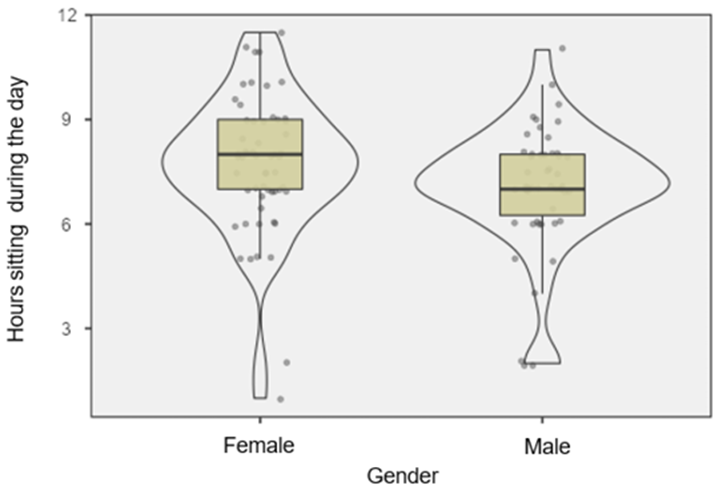
Figure 1. Hours sitting during the day, according to gender. Costa Rica, Costa Rican Institute of Electricity, 2022. (n= 108). Source: Authors' own elaboration, based on a collection instrument, applied to teleworkers.
On the other hand, no statistically significant association was found between the BMI categories with respect to the number of hours spent sitting (Kruskal-Wallis, p=0.9) (Figure 2).
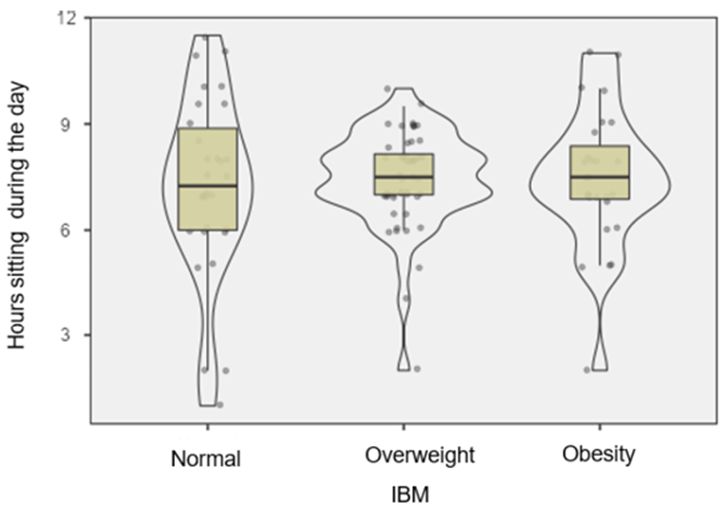
Figure 2. BMI according to the number of hours spent teleworking seated (a). Costa Rica, Costa Rican Institute of Electricity, 2022. (n= 108). Source: Authors' own elaboration, based on a collection instrument, applied to teleworkers.
When estimating the association between risk factors and the appearance of symptoms of musculoskeletal disorders in each area, the following was found:
Table 3. Association of variables with MSD symptoms by area (Chi-square test or Fisher's test). Costa Rica, Costa Rican Institute of Electricity, 2022. (n= 108).
| Zone | Variable | p | n | Fisher Test |
|---|---|---|---|---|
| Upper limb | No variable was statistically significant | NA | NA | NA |
| Lower limb | Perception of physical health (fair to good) | <0.001 | 108 | NA |
| Subjective stress level (mild to severe) | 0.004 | 108 | NA | |
| Neck | Gender (female) | 0.003 | 108 | NA |
| Hand dominance (left) | 0.04 | 108 | 0.07* | |
| Set up the teleworking area** | 0.08 | 108 | NA | |
| Telecommuting with adequate light** | 0.08 | 108 | NA | |
| Back | Noise-free telecommuting** | 0.07 | 108 | NA |
| Use of ergonomic mouse** | 0.06 | 92 | NA | |
| Use of lumbar support** | <,001 | 108 | NA |
Source: Authors' own elaboration, based on a collection instrument, applied to teleworkers. Note: p= statistical significance value, n=number of people, NA= Not applicable. *Fisher's test was applied if the expected number in the count was less than 5. **Corresponds to a possible protective factor.
For the upper limbs, no statistically significant variable was determined to represent a risk factor, while reporting fair to good physical health and a low to severe stress level is associated with the appearance of symptoms in the lower limbs. With regard to the neck area, it was found that being a woman implies a greater association in the appearance of symptoms of musculoskeletal disorders. As for the back, no associated factor was found.
Once the variables that presented a statistically significant association were estimated using the chi-square test, a logistic regression model was created for symptoms in the lower limbs and neck. This, in order to determine the combination of the most influential variables in the appearance of musculoskeletal disorders detected in the study.
Tables 4 and 5 present the parameters of the regression models with the variables that turned out to be risk factors for each of the grouping areas (lower limbs and neck). It is worth mentioning that a logistic regression model associated with symptoms was not found in the upper limb and back areas beyond the bivariate associations.
Table 4. Regression model for the lower limb area. Costa Rica, Costa Rican Institute of Electricity, 2022. (n= 108).
| Zone | Variable | Estimate | p | OR |
| Lower limbs | Perception of physical health (fair to good) | 1.48 | 0.002 | 4.4 |
| Subjective stress level (mild to severe) | 1.18 | 0.01 | 3.2 | |
| R squared coefficient | 0.13 |
Source: Own elaboration, based on collection instrument, applied to teleworkers. Note: OR=Odds Ratio, p= statistical significance value.
Table 5. Regression model for the neck area. Costa Rica, Costa Rican Institute of Electricity, 2022. (n= 108).
| Zone | Variable | Estimate | p | OR |
|---|---|---|---|---|
| Neck | Female gender | 2.34 | 0.06 | 10.38 |
| Left hand dominance | 1.45 | 0.003 | 4.25 | |
| R squared coefficient | 0.1 |
Source: Own elaboration, based on collection instrument, applied to teleworkers. Note: OR=Odds Ratio, p= statistical significance value.
As seen in the previous Tables, those who reported perception of physical health (fair to good) and a mild to severe level of stress, have a greater association with disorders in the lower limb (p=0.06 and p= 0.003, respectively). The female gender and teleworkers who had left dominance (p=0.06 and p=0.003, respectively) have a greater relationship with problems at the neck level.
Discussion
There were obtained information from 108 individuals, and the main area where the highest number of cases of symptoms were reported is in the lumbar spine. These percentages are lower than those reported by Becerra11, where they established values of between 55% and 63% for the same areas, so it is considered a low prevalence in relation to other known data.
When comparing the results of Gerding12 with the obtained prevalence of symptoms and conditions of teleworking, it is clear that in their results there was a prevalence of symptoms in the back and neck for approximately 40%, different from those obtained in this study.
In turn, García13 in their study of symptom prevalence in the city of Lima reported prevalences of 19.1% in upper limbs, 64.5% in the neck, 67.2% in the back, so, when making the comparison, the results of the present research are considered high for the upper limb area, and low in the case of the back and neck.
On the other hand, variables related to the health of teleworkers were considered. One of them was the Body Mass Index (BMI); This resulted in a noTable relationship with overweight people, but despite the fact that many cases were found outside the normal range (73% for women and 70% for men), a statistically significant association with the occurrence of musculoskeletal disorders was not concluded.
It was found that both men and women enjoy mental health that is above good. This estimate is positive in terms of the overall health of the teleworker, since it has been established that one of the main causes of musculoskeletal disorders is the decay of mental health in people, and, therefore, the self-perception of the state of health in general14.
Faced with this issue, for more than 10 years, the WHO (World Health Organization) has established the relevance of the issue of people's mental health. Therefore, it is expected that the member States will maintain their commitment to the design of relevant policies from all levels of care and in all social areas of the individual, including in the work environment (WHO, 2022). Similarly, the perception of physical health was mostly favorable, that is, above good. This provides an indication that the study population is in good health and has a low trend in the prevalence of musculoskeletal disorders.
In addition, it was found that teleworkers practice exercise at least 1 or 2 times a week, this is relevant, as it contrasts with the study carried out in Chile, in which it was evidenced that it is important for workers to take advantage of some extra-work and intra-work exercise program. Soto16, found that 92.3% of participants say that they consider exercise and physical activity as part of the demands of a healthy work environment.
The social implications of gender difference in the experience of roles related to teleworking and domestic life are becoming more evident every day. The work of Lopez17 focusing on teleworking with a gender perspective, identified that there is an ambiguity about whether teleworking complements and provides opportunities to a woman dedicated to the home, or if, on the contrary, it induces physical and mental exhaustion of her.
Figure 3 shows the behavior of the number of teleworking hours with respect to gender, showing that women are the ones who spend more time sitting, however, for this study it is unknown if it corresponds to the entire working day where home care time is included, or if they correspond only to teleworking activities. The fact is that today the gender difference has been even more marked than before the pandemic, since women acquired a greater permanence in household chores than men, even while they remain during working hours, has seen that there is a high dedication to domestic work simultaneously18.
At the same time, it has been shown that age and female sex are the main risk factors for musculoskeletal problems in the upper limbs caused by the repetition of movements at the level of the hand and wrist and by the constant hyperflexion and hyperextension of the those 19. Also, it has seen that people who maintain positions for a long time may present neck, shoulder, hand and wrist disorders20. However, no significant association was found in this study.
Among the associations found in this study, there is the one that relates the type of post with the prevalence of symptoms by grouped area, in which it was determined that the administrative post is the one with the highest number of symptoms (51.9%), especially at the level of the neck and back.
On the other hand, a strong relationship was observed between the perception of physical health and the appearance of MSDs in the lower limbs. Although it is not a relationship known exactly in the literature, it is known that workers who perform office work, or who remain seated, tend to have a high prevalence of lumbar problems, such as herniated discs, nerve entrapment and muscle contractures. Those may associate pain irradiation through the sensitivity mechanism of nerves that lead to the lower limbs21. This could imply a perception of a physical state derived from problems at the level of the back towards their lower limbs (radiation of symptoms of lumbar or even circulatory problems).
Furthermore, an association was found between the level of stress (mild to severe) and the presence of symptoms in the upper and lower limbs. This can be seen related not only to the organization of work, but also to the conditions of the work environment, where the teleworker must deal with noises typical of the home. It has been established that the noise values considered harmful to humans range from 80 dB(A) to 90 dB(A) in 8-hour days, and that a personal computer can emit sounds of approximately 40 dB(A)22.
However, in the teleworking modality, it is known that the environment is influenced, not only by the real estate, but by the family environment. If the worker does not have a physical space just teleworking, the possible noise coming from family activities, such as sound of television, listening to the radio, sounds from outside the house or the voices of children and adults can cause ear discomfort and emotional overload23.
Among the most important associations in the neck, it was found that both being a woman and having left hand dominance are risk factors. Martínez24 in his bibliographic review points out the strong relationship between having this physical characteristic and at least some musculoskeletal disorder in the neck and back, due to the poor posture that is acquired with the use of instrumentation which is designed only for people with right dominance24.
On the other hand, it was found that, for the areas of the lower limbs, neck and back, the using ergonomic equipment suggests a protective factor in the appearance of MSD symptoms. The ergonomic design facilitates the adaptation of the conditions of the chairs, desks and supplies, so that they adapt to the anthropometric characteristics of each individual. It is with the use of this type of resources that around 35% of disabilities are reduced worldwide, so institutions could manage the dysergonomic risk with them 25.
In contrast to a high or low prevalence of symptoms, teleworking can generate a degree of satisfaction for the worker, in the sense that it allows him to perform his professional work without neglecting certain personal aspects such as sharing with family for longer, exercising and other leisure activities, and even the economy 26.
It is for this reason that teleworking has social, economic, clinical significance; and that is why step by step, relevant measures must be implemented to promote good occupational health from home, together with each organization.

