




 Servicios personalizados
 Inglés (pdf)
 Articulo en XML
 Referencias del artículo
 Traducción automática
 Enviar articulo por email
 Citado por SciELO
  Citado por Google
  Similares en
SciELO
Similares en
SciELO  Similares en Google
 Permalink
Introduction
Burnout syndrome is considered the physical and psychological fatigue suffered by workers due to their work activity. This syndrome is characterized by the presence of emotional exhaustion, depersonalization, and lack of personal fulfillment1.
Emotional exhaustion is characterized by a lack of energy, fatigue, and lack of work motivation. It is associated with personal problems and workload. Likewise, depersonalization triggers anxiety, irritability, self-centeredness, and demotivation behaviors. These signs are generally the product of emotional detachment. At the same time, the lack of personal fulfillment leads to the worker negatively evaluating himself and not feeling satisfied with his job performance2.
This syndrome generates an increase in stress levels, physical fatigue, insomnia, and family problems, which undoubtedly directly impact the worker and the companies where they work since the quality of the service provided to customers can be seen to deteriorate. by these factors1.
In this sense, the Burnout Syndrome associated with work is considered a health problem that can affect any worker. In particular, those whose activity is related to the care of the human being3. Authors such as Urbanetto et al.4, indicate that this syndrome is very prevalent among health professionals because they permanently contact people. As well as the work conditions, personal problems, and other factors of occupational stress trigger a negative impact on the worker’s physical, mental, and social well-being.
The Agency for Healthcare Research and Quality estimates that burnout may affect 10-70% of nurses and 30-50% of physicians, nurse practitioners, and physician assistants5.
However, before the pandemic, health professionals were exposed to various psychosocial factors such as isolation, little social support, discrimination, and even violence by other people. This has increased since the declaration of the health emergency by COVID-19, triggering alterations in mental health such as low mood, low motivation, more significant fatigue, depression, anxiety, and other severe effects on mental health6.
Therefore, the objective of this study was to identify the presence of Burnout Syndrome associated with the labor characteristics of health workers in the municipality of Neiva-Colombia.
Methodology
Subjects
It was a study with a quantitative - cross-sectional approach, with a non-experimental design and correlational scope. It included an approximate population of 2,600 health workers from Neiva- Colombia, from the different clinics and hospitals in the same city. The formula for finite populations was used to find the study sample. There was a margin of error of 5%, a probability of occurrence of 0.25, and a confidence level of 99% for 254 health professionals.
Inclusion and exclusion criteria
The criteria for inclusion were that the Health professionals be of the legal age. Also, they were currently working in clinics and hospitals in the city of Neiva. On the other hand, the professionals who did not sign the informed consent and did not answer questions on each of the tests were excluded.
Ethics
Initially, each of the research participants was informed of the purpose, benefits, and risks of this research. The informed consent was then filled out, which was used as support to verify the desire to be part of the research process.
The research development took resolution 008430 and the Declaration of Helsinki into account. Likewise, it was approved by the ethics committee in Colombia.
Instruments
Labor characteristics: An instrument was created and put into an expert judgment for posterior use in measuring the variable (aspects related to the conditions of work, such as working hours, rest times, seniority in the position, and functions performed).
Burnout Syndrome: This instrument is made up of 22 questions and evaluates the three dimensions of Burnout syndrome: Emotional exhaustion (nine), depersonalization (five statements), and professional fulfillment (eight statements). It has been used in multiple investigations since it is considered the most widely used and accepted instrument to assess the key symptoms of Burnout syndrome2,7,8,9,10,11.
The information analysis was conducted by the statistical program SPSS version 26, which calculated the measures of central tendency, means, maximum and minimum values, and standard deviation.
Additionally, the Kolmogorov-Smirnov test was used to check the normality of the data. The Pearson correlation coefficient (r) was used to verify the relationship between the research variables. Finally, it includes the ANOVA test and Levine’s test to demonstrate the significant differences between the means of the variable position and physical condition. Conducting these analyses with a level of statistical significance of p < 0.05.
Results
Table 1 Distribution of the dimensions of the Burnout Syndrome.
| Variable | n | % | |
|---|---|---|---|
| emotional exhaustion | Alto | 59 | 23,2% |
| Medio | 68 | 26,8% | |
| Bajo | 127 | 50,0% | |
| Total | 254 | 100% | |
| depersonalization | Alto | 82 | 32,2% |
| Medio | 71 | 28,0% | |
| Bajo | 101 | 39,8% | |
| Total | 254 | 100% | |
| Personal fulfillment | Alto | 45 | 17,7% |
| Medio | 54 | 61,0% | |
| Bajo | 155 | 61,0% | |
| Total | 254 | 100% | |
Regarding the dimensions of Burnout, it was evidenced that 50% of health workers present emotional exhaustion, 60.2% present medium and high levels of Depersonalization, and 61.0% report having a low Personal Accomplishment (see table 1). Likewise, the study shows a statistically significant association between health professionals and the dimensions of the Burnout Syndrome (p<0.05) (see table 2)
Table 2 Association between the variables of Burnout and health professionals.
| Burnout | Chi2 | emotional exhaustion | Chi2 | Depersonalization | Chi2 | Personal fulfillment | Chi2 | |||||||||
|---|---|---|---|---|---|---|---|---|---|---|---|---|---|---|---|---|
| Low | Medium | High | Low | Medium | High | Low | Medium | High | Low | Medium | High | |||||
| Health workers | 38 | 142 | 74 | 0,02 | 127 | 68 | 59 | 0,00 | 101 | 71 | 82 | 0,0 | 155 | 54 | 45 | 0,01 |
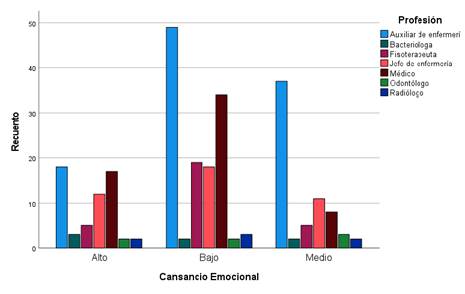
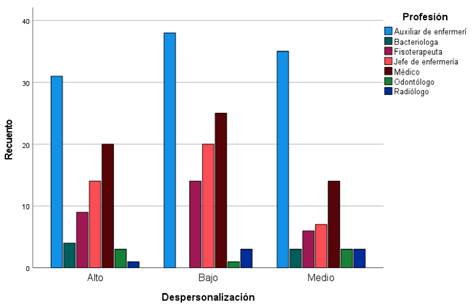
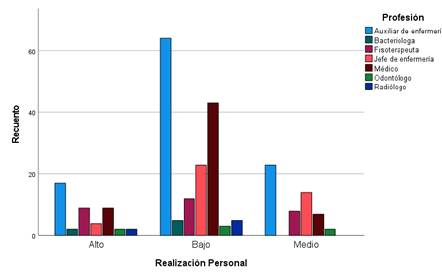
Figures 1 and 2 reveal that nursing assistants have the highest levels (medium-high) of emotional exhaustion and depersonalization, followed by doctors and nursing managers. This behavior is maintained in the Personal Accomplishment dimension, where low levels are evident in these same health professionals (see Figure 3).
The analysis of variance (ANOVA 3x3), using the: level of Burnout as a factor and seniority, the hours of work and time off as dependent variables, shows that there are statistically significant differences between the levels of Burnout and seniority p<0.001, hours of work p<0.000 and rest time p<0.04, (See table 3).
Table 3 Labor variables depend on the level of Burnout. Comparison of means figure 1. Profession distribution according to the emotional exhaustion dimension
| Burnout | Antiquity | Work Hours | Break time |
|---|---|---|---|
| High | 6,30+/-5,6 | 8,796+/-2,9 | 6,46+/-1,2 |
| Medium | 5,37+/-4,51 | 8,32+/-2,7 | 6,87+/-1,41 |
| Low | 5,50+/-3,02 | 8,36+/-2,7 | 6,13+/-1,0 |
| 0,001* | 0,000* | 0,04* | |
| 6,31** | 10,214** | 2,03** |
P*: One-way Anova
**Levene statistic
The Burnout dimensions showed a robust positive correlation between emotional exhaustion and hours of work r = 0.947, depersonalization and hours of work r = 0.966, and hours of rest and Burnout r = 0.976 (see table 4).
Table 4 Correlations between labor variables and Burnout dimensions
| Variables | Antiquity | Work Hours | Break Time |
|---|---|---|---|
| Antiquity | 1 | ||
| Work Hours | ,834 | 1 | |
| Break Time | ,246 | ,012 | 1 |
| emotional exhaustion | ,053 | ,947* | ,364 |
| Depersonalization | ,667 | ,966* | ,367 |
| Personal fulfillment | ,616 | ,471 | ,401 |
| Burnout | ,156 | ,716* | ,976* |
**. The correlation is significant at the 0.01 level (bilateral).
*. The connection is significant at the 0.05 level (bilateral).
Discussion
The present study shows that the most compromised dimension of Burnout in health professionals corresponds to personal fulfillment and depersonalization. These results differ from what was found by Torres et al, 202112 in their study, which reveals that the prevalence of Burnout Syndrome was high, especially in the component of depersonalization (95%) and emotional exhaustion (47%) and in a lower percentage in personal fulfillment (11%).
Various authors reveal that health professionals who develop Burnout syndrome have a higher average number of hours worked per day Gutiérrez-Lesmes, Loboa-Rodríguez, & Martínez-Torres13 and the work area Navarro-González, Ayechu-Díaz, & Huarte-Labiano14. These data are similar to what was found by authors such as Millán and D, Aubeterre15, who indicate that among the labor factors that trigger Burnout Syndrome in doctors is the number of hours they work daily or weekly.
Luengo et al.16 indicate that among the factors associated with Burnout syndrome are labor factors, with the dimensions of emotional exhaustion and depersonalization being the most compromised.
An investigation of radiologists and non-radiologists concluded that radiologists were more likely to feel unhappy and underappreciated in the workplace17. In nursing professionals, authors such as Gutiérrez et al.13 indicate higher proportions of emotional fatigue with 42%, emotional depersonalization with 38%, and lack of personal fulfillment with 30%.
Yslado and et al.18, indicate that health professionals who present high levels of Burnout syndrome may be associated with work variables, work overload, interpersonal conflicts, few stimuli at the work level, promotion limitations, dissatisfaction with salary, among others.
Therefore, authors such as Arrogante19 indicate that it is necessary to design and implement prevention programs that positively influence the health and well-being of health professionals to improve their health, quality care and care provided, and patient safety and reduce the economic costs of health institutions.
It is concluded that the burnout syndrome in the health professionals evaluated presents a more significant commitment to the Personal Realization dimension and depersonalization and emotional exhaustion. It is necessary to develop preventive medicine programs that mitigate this health problem

