




 Servicios personalizados
 Inglés (pdf)
 Articulo en XML
 Referencias del artículo
 Traducción automática
 Enviar articulo por email
 Citado por SciELO
  Citado por Google
  Similares en
SciELO
Similares en
SciELO  Similares en Google
 Permalink
Highlights
In the United States, the COVID-19 pandemic accelerated the incorporation of telework at academic institutions, but its effect on employee well-being has not been adequately studied.
This study identifies loneliness and personal health concerns as key risk factors for poor well-being among employees, with loneliness having an even greater negative effect when employees required additional support. In addition, faculty reported better well-being than staff or student employees while working remotely during the COVID-19 pandemic.
The study findings suggests that workplace policies should proactively address telework-related challenges, particularly loneliness and safety concerns, to improve employee well-being during future public health crises.
Introduction
Since the coronavirus disease 2019 (COVID-19) pandemic in 2020, many employers worldwide implemented telework policies in response to lockdown orders. In the United States (U.S.), a national emergency was declared on March 13, 2020, and all 50 governors also issued state-level emergency declarations. (1,2) For example, the “Stay Home, Work Safe” order was issued in Harris County, Texas, to minimize COVID-19 transmission. (3,4) As a result, millions of employees in the U.S. switched to telework, at times involuntarily, which exposed many of them to rapidly changing workplace environments. This sudden shift to telework during the pandemic suggested a potential stressor on employee well-being, (5) as many employees were not fully prepared to switch to their new work environment. (6)
Telework refers to a work arrangement in which employees regularly perform their duties outside the traditional workplace (e.g., an office), often splitting their time between the office and another location, such as home. In contrast, remote work typically implies a more permanent, fully off-site setup. In both cases, employees remain connected to their organizations through telecommunications technology. For the purposes of this paper, we will use "telework" as the general term. (7)
According to the National Bureau of Economic Research, over 35% of U.S. employees reported switching to telework at the beginning of the pandemic. (8) Over the course of this period, the emergence of new COVID-19 variants triggered many workplaces to settle into telework as permanent. In 2021, Gallup reported that 45% of U.S. employees were working remotely all or part of the time. (9) The drastic increase in telework employees poses concerns about potential adverse effects on employees’ well-being. Reported effects included reduced in-person interactions, increased sedentary behavior, less physical activity, decreased sleep quality, and altered dietary habits. (10,11) Study findings suggest that poor well-being is associated with other adverse effects, such as mental illness, physical illness, and productivity. (12,13)
The pandemic also accelerated the incorporation of telework at academic institutions. However, only a limited number of studies have examined the well-being of telework employees in U.S. academic environments. (14) Academic environments are unique because of their diverse populations, the broad nature of work performed, including teaching, research, and community service, and the various pressures to advance professionally, including tenure and promotion. Whereas student well-being and mental health during the pandemic have been examined to some extent (15-17), this has been less well studied among faculty and administrative staff, especially during the initial year of the pandemic, before the availability of COVID-19 vaccines, when uncertainty and other stressors were likely to have peaked. (18,19) The objective of this study was to identify telework-related risk factors and examine their associations with employee well-being during the COVID-19 pandemic, in order to add to the knowledge base that could guide employer responses and policies in future pandemics.
Methods
We conducted a two-wave cross-sectional survey among employees at a large health sciences university in Texas. We developed an anonymous online 15-minute questionnaire and administered it in May and October 2020 to measure short-term changes in employee well-being. All employees (n=10,453) were invited to participate via institutional emails and an institution-wide announcement. Participant inclusion criteria were being employed as of May 2020, providing consent to participate, and completing the survey. We excluded participants who did not perform their jobs remotely during the COVID-19 pandemic and participants who did not respond to questions on well-being.
Measures
The questionnaire consisted of 51 questions with sections on well-being, perceptions of telework, COVID-19 knowledge and beliefs, workplace resources, and socio-demographics. Employee well-being was assessed with the 5-item World Health Organization (WHO) Well-Being Index, reflecting current experiences of pleasure and enjoyment. (20) The index’s total score ranges from 0 to 25; a score below 13 indicates poor well-being, which is considered an indication for testing for depression in a clinical context. We dichotomized participant scores into poor well-being (total score: 0-12) vs. good well-being (total score: 13-25).
Telework perceptions were assessed through 13 questions on telework-related risk factors, including percentage of jobs being performed remotely before and after the pandemic (continuous: %), changes in workloads and working hours (categorical, Likert-type scale), difficulty adapting to telework (categorical, Likert-type), self-reported telework effectiveness (categorical, Likert-type), factors needed to increase telework effectiveness (categorical: yes or no), challenges of telework (categorical, Likert-type), and compatibility with home life (categorical, Likert-type). Covariates included gender, age, job classification (faculty, staff, or working students), being a supervisor (yes/no), loneliness (dichotomized into lonely vs. not lonely using the UCLA Loneliness scale (21), household composition (dichotomized as living with family/significant other vs. living alone/with someone else/as a single parent, or other), and length of employment (dichotomized as less than 10 years vs. 10 years or longer).
Statistical Analysis
Descriptive and logistic regression analyses were conducted for each wave separately and then compared to investigate possible short-term changes. Survey weights were generated based on the distribution of the target population’s age, gender, race/ethnicity, length of employment, and job classification and were applied accordingly. To estimate odds ratios (ORs) and 95% confidence intervals (95%CI), multivariable logistic regression was used. Employee gender, age, job classification, being a supervisor, and variables with a p-value ≤ 0.20 in either the first or second waves in the bivariate analyses were entered into preliminary models. Covariates with a p-value ≤ 0.05 in either waves were retained in the final models. Adjusted ORs were calculated for each wave separately. We also examined the interaction term between loneliness and the need for support from colleagues, supervisors, and/or administration/management as previous study findings suggested potential interactions between employee loneliness and the level of support from colleagues and supervisors. (22) All analyses were performed using SAS (version 9.4, SAS Institute, Cary, NC).
Ethical Approval and Consent to Participate
The study protocol was approved by The University of Texas Health Science Center at Houston Committee for the Protection of Human Subjects (IRB# HSC-SPH-20-0469). Participation in the study was entirely voluntary and anonymous. All participants were informed of their ability to withhold responses, terminate participation, and were provided staff contact information should they had any questions or concerns about the study. Participants’ consent was recorded prior to taking the survey.
Results
Study Participants
Among 10,453 eligible employees, there were 2,192 (21.0%) respondents in the first wave (May 2020) and 1,331 (12.7%) in the second wave (October 2020). Of those, 1,791 (81.7%) and 1,049 (78.8%) participants in each wave, respectively, completed the survey. Excluding participants who did not work remotely and/or did not report their well-being, 1,648 participants (first wave) and 932 participants (second wave) were included in the final analytic sample. The demographic characteristics were similar across waves: participants were predominantly female, non-Hispanic white, and staff employees. Most respondents were between 26 and 55 years of age and had worked for 1-4 years. More than one-third of participants reported being a supervisor in both waves. Lastly, 34.2% (first wave) and 36.6% (second wave) reported poor well-being (Table 1).
Table 1 Survey on telework and employee well-being during the first and second COVID-19 pandemic waves: participants characteristics.
| May 2020 (first wave) N=1648 n (%) | October 2020 (second wave) N=932 n (%) | Total N=2580 n (%) | |
|---|---|---|---|
| Well-Being Statusa | |||
| Good | 1085 (65.8) | 591 (63.4) | 1676 (65.0) |
| Poor | 563 (34.2) | 341 (36.6) | 904 (35.0) |
| Job Classification | |||
| Faculty | 387 (23.8) | 194 (21.0) | 581 (22.8) |
| Staff | 1150 (70.7) | 685 (74.0) | 1835 (71.9) |
| Working Student | 89 (5.5) | 47 (5.1) | 136 (5.3) |
| Missing | 22 | 6 | 28 |
| Age Category (Years) | |||
| 18-25 | 63 (3.8) | 25 (2.7) | 88 (3.4) |
| 26-35 | 353 (21.4) | 197 (21.1) | 550 (21.3) |
| 36-45 | 443 (26.9) | 252 (27.0) | 695 (26.9) |
| 46-55 | 415 (25.2) | 231 (24.8) | 646 (25.0) |
| 56-65 | 287 (17.4) | 174 (18.7) | 461 (17.9) |
| 66+ | 87 (5.3) | 53 (5.7) | 140 (5.4) |
| Gender | |||
| Female | 1289 (78.2) | 730 (78.3) | 2019 (78.3) |
| Male | 359 (21.8) | 202 (21.7) | 561 (21.7) |
| Race/Ethnicity | |||
| Non-Hispanic Asian | 208 (12.6) | 119 (12.8) | 327 (12.7) |
| Non-Hispanic Black | 187 (11.3) | 109 (11.7) | 296 (11.5) |
| Non-Hispanic White | 786 (47.7) | 460 (49.4) | 1246 (48.3) |
| Hispanic | 403 (24.5) | 211 (22.6) | 614 (23.8) |
| Other | 64 (3.9) | 33 (3.5) | 97 (3.8) |
| Job Seniority | |||
| Less than a year | 204 (12.4) | 105 (11.3) | 309 (12.0) |
| 1-4 years | 526 (31.9) | 296 (31.8) | 822 (31.9) |
| 5-9 years | 386 (23.4) | 229 (24.6) | 615 (23.8) |
| 10-14 years | 221 (13.4) | 125 (13.4) | 346 (13.4) |
| 15-19 years | 122 (7.4) | 66 (7.1) | 188 (7.3) |
| 20-24 years | 75 (4.6) | 45 (4.8) | 120 (4.7) |
| 25-29 years | 49 (3.0) | 24 (2.6) | 73 (2.8) |
| More than 30 years | 65 (3.9) | 42 (4.5) | 107 (4.1) |
| Are you a supervisor? | |||
| Yes | 515 (31.7) | 286 (31.0) | 801 (31.4) |
| No | 1110 (68.3) | 638 (69.0) | 1748 (68.6) |
| Missing | 23 | 8 | 31 |
| Loneliness Category | |||
| Lonely | 594 (36.3) | 384 (41.5) | 978 (38.2) |
| Not Lonely | 1044 (63.7) | 541 (58.5) | 1585 (61.8) |
| Missing | 10 | 7 | 17 |
n = Unweighted frequency.
% = Weighted percentage.
aWell-Being Status based on the total score of the 5-item World Health Organization Well-Being Index. A score below 13 is defined as poor well-being.
bLoneliness category was created using the UCLA loneliness total score ranging from 3 to 9, dichotomized into lonely (6 - 9) vs. not lonely (3 - 5).
Telework Perceptions
Participants reported that, on average, before the COVID-19 pandemic, less than 25% performed their jobs remotely (22.9% in the first wave and 20.7% in the second wave). However, after the start of the pandemic, most of participants reported working remotely (81.9% and 75.8%, respectively).
The percentage of participants reporting their workload had been “more than usual” increased from 39.3% to 46.9% between waves. A similar increase was observed for working “more hours than usual”, from 36.5% to 46.1%. However, there was a decrease in the proportion of participants reporting difficulty adapting to telework (19.1% to 15.8%), and indicating their telework effectiveness to be “less than usual” (41.1% to 34.1%) between waves (Table 2).
Table 2 Survey on telework and employee well-being during the first and second COVID-19 pandemic waves: questions related to telework and perceptions of telework.
| May 2020 (first wave) N=1648 n (%) | October 2020 (second wave) N=932 n (%) | Total N=2580 n (%) | |
|---|---|---|---|
| Since the COVID-19 pandemic, your workload has been…? | |||
| Less than usual | 204 (16.2) | 39 (5.6) | 243 (12.4) |
| Same as usual | 558 (44.4) | 332 (47.5) | 890 (45.5) |
| More than usual | 494 (39.3) | 328 (46.9) | 822 (42.0) |
| Since the COVID-19 pandemic, have you been working…? | |||
| Fewer hours than usual | 147 (11.7) | 34 (4.9) | 181 (9.3) |
| Same number of hours as usual | 649 (51.8) | 342 (49.1) | 991 (50.8) |
| More hours than usual | 458 (36.5) | 321 (46.1) | 779 (39.9) |
| Since the COVID-19 outbreak, how difficult has it been for you to adapt to working remotely? | |||
| Easy/Somewhat easy/Neutral | 1014 (80.9) | 588 (84.2) | 1602 (82.1) |
| Somewhat difficult/Very difficult | 240 (19.1) | 110 (15.8) | 350 (17.9) |
| Since the COVID-19 pandemic, how effective do you think you have been when working remotely? | |||
| No more than usual/Not at all | 516 (41.1) | 238 (34.1) | 754 (38.6) |
| Much more/Somewhat more than usual | 739 (58.9) | 460 (65.9) | 1199 (61.4) |
| What will it take for you to increase your effectiveness in working remotely? Select all that apply | |||
| Possess good quality resources | 572 (49.6) | 320 (50.9) | 892 (50.1) |
| Maintain regular communication with colleagues and supervisor | 568 (49.3) | 335 (53.3) | 903 (50.7) |
| Receive training in information technology | 192 (16.7) | 96 (15.3) | 288 (16.2) |
| Have more support from colleagues, supervisors, or administration | 290 (25.2) | 179 (28.5) | 469 (26.3) |
| Make myself available to my supervisor and colleagues | 160 (13.9) | 87 (13.8) | 247 (13.9) |
| Be able to structure my work environment at home better | 446 (38.7) | 224 (35.6) | 670 (37.6) |
| Do a better job of planning tasks and schedule based on goals | 312 (27.1) | 160 (25.4) | 472 (26.5) |
| Communicate with people in my home about my availability | 193 (16.7) | 101 (16.1) | 294 (16.5) |
| Secure help and trade off responsibilities for tending to others in home | 237 (20.6) | 105 (16.7) | 342 (19.2) |
| Other | 226 (19.6) | 113 (18.0) | 339 (19.0) |
| How have you adjusted to working remotely since the COVID-19 pandemic? Select all that apply | |||
| I have not had to adjust my work | 257 (20.8) | 172 (25.3) | 429 (22.4) |
| Cancelling/rescheduling meetings or events | 455 (36.8) | 163 (23.9) | 618 (32.2) |
| Adopting telehealth/virtual meetings | 923 (74.6) | 488 (71.7) | 1411 (73.5) |
| Restricting the types of activities I typically do | 443 (35.8) | 221 (32.5) | 664 (34.6) |
| Other | 153 (12.4) | 74 (10.9) | 227 (11.8) |
| How frequently are you experiencing the following challenges in performing your work since the COVID-19 pandemic? | |||
| Limitations of quality technology | |||
| Never/Rarely | 772 (62.1) | 446 (64.2) | 1218 (62.8) |
| Sometimes/Often/Always | 471 (37.9) | 249 (35.8) | 720 (37.2) |
| Limited knowledge/experience in transitioning work to online | |||
| Never/Rarely | 1043 (84.0) | 597 (86.0) | 1640 (84.8) |
| Sometimes/Often/Always | 198 (16.0) | 97 (14.0) | 295 (15.2) |
| Missing face-to-face interactions with work colleagues | |||
| Never/Rarely | 831 (66.7) | 434 (62.5) | 1265 (65.2) |
| Sometimes/Often/Always | 414 (33.3) | 260 (37.5) | 674 (34.8) |
| Difficulties managing, supervising, or coordinating with others | |||
| Never/Rarely | 861 (69.5) | 481 (69.4) | 1342 (69.5) |
| Sometimes/Often/Always | 377 (30.5) | 212 (30.6) | 589 (30.5) |
| Interruptions or distractions in the home environment | |||
| Never/Rarely | 776 (62.4) | 466 (67.3) | 1242 (64.2) |
| Sometimes/Often/Always | 467 (37.6) | 226 (32.7) | 693 (35.8) |
| Concerns about personal health and safety | |||
| Never/Rarely | 767 (61.8) | 432 (62.4) | 1199 (62.0) |
| Sometimes/Often/Always | 474 (38.2) | 260 (37.6) | 734 (38.0) |
| During this period that you are working remotely, have you been able to keep your work separate from your nonworking life? | |||
| Less than usual/Much less than usual | 530 (42.4) | 262 (37.9) | 792 (40.8) |
| More than usual/Same as usual | 719 (57.6) | 430 (62.1) | 1149 (59.2) |
| Since the COVID-19 pandemic, have you spent time at workplace? | |||
| Yes | 784 (62.5) | 511 (73.2) | 1295 (66.3) |
| No | 470 (37.5) | 187 (26.8) | 657 (33.7) |
| If it remains an option after restrictions on returning to campus are lifted, how likely are you to work remotely to complete part of your tasks? | |||
| Somewhat likely/Very likely | 828 (66.1) | 496 (71.3) | 1324 (67.9) |
| Very unlikely/Somewhat unlikely/Neutral | 425 (33.9) | 200 (28.7) | 625 (32.1) |
n = Unweighted frequency.
% = Weighted percentage.
When asked about ways to increase effectiveness in telework, participants responded that they needed good quality resources, such as equipment or internet services (49.6% vs. 50.9%) and regular communication with their colleagues and supervisor (49.3% vs. 53.3%). Participants reported that, to adjust to telework during the pandemic, most had adopted telehealth/virtual meetings instead of in-person meetings/events (74.6% vs. 71.7%), and about one-third of participants restricted the types of activities that they would typically do (35.8% vs. 32.5%).
The main challenges to performing work included missing face-to-face interactions with colleagues or students, concerns about personal health and safety, and limited quality technology. Separating work from personal life was reported as a challenge by 42.4% in the first wave, decreasing to 37.9% in the second wave. While 62.5% of participants indicated spending at least some time at their workplace in the first wave, this proportion had increased to 73.2% by the second survey. Participants also reported that, in the future, they were likely to continue telework to complete at least some part of their usual tasks (66.1% vs. 71.3%).
Multivariable Models for Poor Well-Being
Females were more likely to have poor well-being than males in both waves (OR=1.58; 95%CI: 1.03-2.43 in the first wave, and OR=1.39; 95%CI: 0.77-2.50 in the second wave), but the effect was only significant in the first wave. Regarding job classification, faculty and working students were less likely to have poor well-being than administrative staff personnel in both waves. However, the effect was only significant in the second wave for faculty (OR=0.20; 95%CI: 0.09-0.44). Personal health and safety concerns considered to challenge work performance were significantly associated with poor well-being in both surveys. As time passed, the magnitude of this effect decreased slightly from the first wave to the second wave (OR=2.14; 95%CI: 1.47-3.11 to OR=1.84; 95%CI: 1.13-3.01) (Figures 1 and 2).
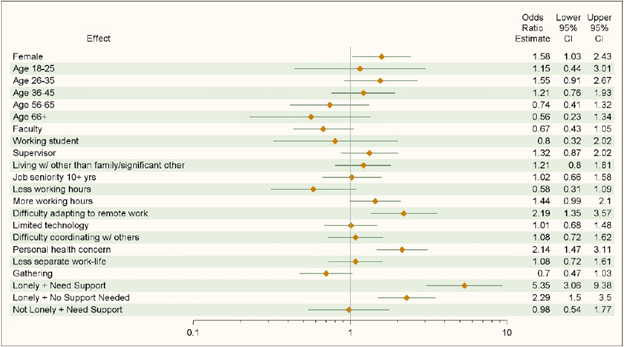
Figure 1 Survey on telework and employee well-being during the first and second COVID-19 pandemic waves: adjusted odds ratios for poor well-being in the first wave in May 2020 (N=1,648).
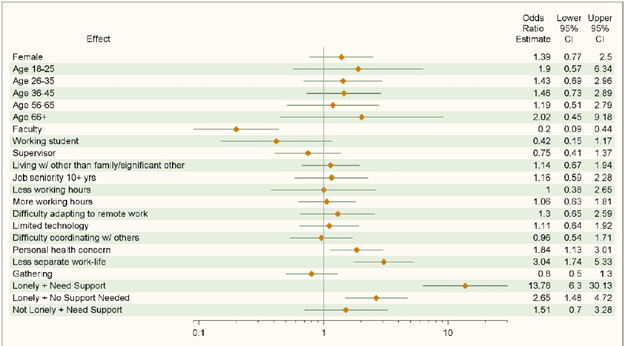
Figure 2 Survey on telework and employee well-being during the first and second COVID-19 pandemic waves: adjusted odds ratios for poor well-being in the second wave in October 2020 (N=932).
Reference groups are as follows. Age category: 46-55; Job classification: staff; Supervisor: no; Household composition: living with family/significant other; Job seniority: < 10 years; Working hours: usual; Difficulty adapting to remote work: rarely/never; Limited technology: rarely/never; Difficulty coordinating with others: rarely/never; Personal health concern: rarely/never; Separate work life: same as/more than usual; Gathering: no; Loneliness and needing support: not lonely and no support needed. Odds Ratios were adjusted for the other variables in the figure.
Loneliness was significantly associated with poor well-being in both waves, and this effect was amplified among those participants who needed more support from colleagues, supervisors, or administration/management to increase effectiveness in working remotely, indicating the presence of an interaction. Compared to the participants who were not lonely and did not need more support, participants who were lonely but did not need support had greater than two-fold odds of having poor well-being in both waves (OR=2.29; 95%CI: 1.50-3.50 and OR=2.65; 95%CI:1.48-4.72, respectively). However, these odds increased markedly to 5.35 in the first wave (OR=5.35; 95%CI: 3.06-9.38) and 13.78 in the second wave (OR=13.78; 95%CI: 6.30-30.13) when lonely participants also felt they needed support. Compared to employees without difficulty adapting to telework, those who had difficulty adapting to telework were associated with poor well-being only in the first wave (OR=2.19; 95%CI: 1.35-3.57). Also, employees who could not separate their working from their personal lives were more likely to have poor well-being in the second wave only (OR=3.04; 95%CI: 1.74-5.33) (Figures 1 and 2).
Reference groups are as follows. Age category: 46-55; Job classification: staff; Supervisor: no; Household composition: living with family/significant other; Job seniority: < 10 years; Working hours: usual; Difficulty adapting to remote work: rarely/never; Limited technology: rarely/never; Difficulty coordinating with others: rarely/never; Personal health concern: rarely/never; Separate work life: same as/more than usual; Gathering: no; Loneliness and needing support: not lonely and no support needed. Odds Ratios were adjusted for the other variables in the figure.
Discussion
In this study of telework among university employees during the initial year of the COVID-19 pandemic, over one-third of employees reported poor well-being in May and October 2020, i.e., a period in the pandemic that preceded the availability of the first COVID-19 vaccines (December 2020). Our study results indicate that two factors - personal health and safety concerns and loneliness - were consistently associated with poor well-being over the two survey waves.
Difficulty adapting to telework was significantly associated with poor well-being only in the first wave. The loss of this association probably reflects greater comfort and effectiveness once some time had gone by. Similarly, working more hours than usual was significantly associated with poor well-being at the beginning, but not in the second wave, possibly suggesting work routines evolved so as to be completed during usual working hours. Between the first and second waves, social gatherings with friends, family, and colleagues no longer provided a benefit to telework employees, as a significant negative association with poor well-being was observed only during the first wave.
The pandemic accelerated the development of existing technologies, fostering the adoption of new tools and practices and transforming how people work, learn, and connect.(23) As a result, telework and virtual collaboration have become more prevalent and accepted. In our study, job classification was a determinant of well-being, with faculty and working students reporting better well-being than staff in both waves, although this association was only significant for faculty in the second wave. Possible explanations include prior experience working from home, greater familiarity with online videoconferencing platforms, and greater job security. In U.S. higher education institutions, many faculty and working students were already familiar with working from home and via videoconferencing platforms such as Zoom© (zoom.us), Microsoft Teams© (teams.microsoft.com), or Webex© (webex.com) before the pandemic as these were used for online and hybrid course instruction.(24,25) Faculty and students also periodically worked from home, making the transition to telework during the pandemic easier than for administrative staff, who were usually required to be physically present at the workplace. Moreover, Scheibe et al. suggested that job security was important during “periods of involuntary telework” in the pandemic, finding it to be related to professional position and permanent employment contracts in academia.(26) As the COVID-19 pandemic progressed, some but not all employees experienced exacerbated job insecurity, which was strongly associated with precarious work and considered a stressor for many employees.(27,28)
In 2023, the U.S. Surgeon General issued a concerning report on the health effects of social connection and community, noting population increases in feelings of loneliness and isolation during and after the pandemic, and emphasizing the importance of prioritizing social connections in the workplace at all levels, including administration, management, and employees.(29) This report supports our own results on the importance of loneliness as a determinant of worker well-being. Miyake et al. also reported that employee loneliness was strongly associated with the level of support from colleagues and supervisors.(22) In our study, loneliness was consistently the most important telework-related risk factor for poor employee well-being in both waves, and this association was especially strong among those who indicated needing support from colleagues, supervisors, and/or management. Employees who reported being lonely but did not need support had greater than two-fold risk of poor well-being as compared to those without loneliness. However, when lonely employees also needed support, the risk increased more than five times in the first wave and almost 14 times in the second wave, respectively, compared to employees without loneliness who did not need support. Thus, as time passed, the association of poor well-being with loneliness and needing support to increase work effectiveness appeared to worsen. One interesting study of telework and loneliness during the pandemic found that loneliness negatively correlates with time spent with family.(30) However, the authors made an exception for situations where spending time with family members needing care and attention was significantly associated with employee loneliness.(30)
In this context, our study results suggested that females were more likely to experience poor well-being than males only in the first wave. Considering the closure of schools and childcare centers during the pandemic, many employees were burdened with caring for young family members in their homes. During the pandemic, working mothers were stressed by concerns about their children’s well-being and job security.(31) For example, between March and September 2020, about 1.9 million working mothers in the U.S. left their jobs during “the transitions of children to home-based learning”. (31) It is possible that the association between females and poor well-being may be related to family caregiving, due to the absence of childcare and the presence of virtual schooling environments at the beginning of the pandemic.
Lastly, our study results showed that personal health and safety concerns were associated with poor well-being in both waves, slightly decreasing in the second wave. This is consistent with De Vincenzi et al., who, in a systematic review, found that tele work employees may have felt insecure about their health and safety due to fear of getting infected with COVID-19, and those personal health and safety concerns may have a combined effect with work-related stress.(32) Toscano and Zappalà also discussed the role of concerns about COVID-19 among telework employees, and suggested these concerns strongly affect telework satisfaction when external resources, such as social relationships with supervisors and co-workers, are lacking.(33) Shih et al. also pointed out that emotional exhaustion was associated with concern about becoming ill due to COVID-19.(34) Collectively, this literature makes a case for employment policies addressing telework employee concerns, providing prompt support to boost employee work effectiveness by improving employee well-being.
As teleworking becomes widespread in the post-COVID-19 world, addressing teleworkers’ unique needs is essential for supporting their well-being. The insights from our study translate into actionable guidelines for occupational health practices and policies. We found that initial struggles with telework, and longer hours harmed well-being but faded over time, so onboarding and training in time management, boundary-setting, and digital tools can ease transitions into remote or hybrid models. To build a supportive environment, organizations should normalize mental health discussions to reduce stigma; train supervisors not only in managing workflow but also in recognizing loneliness, emotional strain, and social stress; and connect employees with internal or external support resources as needed. Employers should develop telework policies that incorporate structured strategies to reduce isolation (e.g., regular virtual check-ins, team-building activities), and simplify employee-supervisor communication. Additionally, employees would benefit from clear guidance and flexibility to maintain healthy nonwork-work lives boundaries and schedules. Businesses should consider investing in robust digital infrastructure that enables effective remote collaboration and a supportive and empathetic workplace culture, which will ensure that employee well-being is a core operational priority and keeps teams productive and resilient, especially during crises (e.g., COVID-19 pandemic).
Our study differs from previous telework studies of well-being in several respects. First, we used survey weights for statistical modeling to represent the target population better, which should make our results more generalizable. In contrast, other previous studies of telework employee populations used convenience sampling strategies. Second, although our study was conducted in a health science center, the inherent work characteristics of an academic environment and our study design, the results should be generalizable to other academic institutions. Third, we considered job classification as a possibly important factor associated with telework well-being. To our knowledge, most prior studies on telework employee populations did not consider this factor. Finally, the two survey waves also allowed us to investigate changes over time.
Our study has some limitations. First, we could not establish causal relationships because the study design was a repeated cross-sectional; therefore, interpretations must be made cautiously. Second, the survey response rates were low, approximately 20% and 12% in the first and second waves, respectively. These low response rates may introduce selection bias. However, survey weights were applied before the analysis, which should offset some of the issues of low response rates, and make results more generalizable to the target population. Third, both survey waves were conducted anonymously and independently, so a true longitudinal analysis of the same individuals who participated in both waves could not be performed. However, the repeated cross-sectional study design using the same sampling frame allows some analysis of results over time. Finally, this study was conducted before the COVID-19 vaccine was available, so we could not account for the impact of the COVID-19 vaccine on employee well-being. The availability of the COVID-19 vaccine impacted levels of concern for personal health and safety. According to a recent report from the Pew Research Center, over 50% of Americans were concerned about spreading the coronavirus or contracting a severe case of COVID-19 until late 2020.These levels of concerns drastically declined once the vaccine became available: 40% (January 2022), 29% (March 2023), and 27% (February 2024).(35) It is conceivable that we would find different results on poor well-being if our study were repeated after the introduction of the vaccine. Recent research suggests that the vaccine's availability seems to have represented relief, serving to decrease fear and uncertainty regarding social distancing.(36)
Despite these limitations, our findings should still provide some guidance on how to better structure telework, especially when employers and employees face a sudden transition in work practices, such as in the early stages of a pandemic, when effective interventions, such as vaccines, are not yet available.
In conclusion, telework may have financial and job flexibility advantages, but is not free of adverse emotional health effects that can affect worker well-being and productivity. These may be particularly important during prolonged periods of solitary activity brought on by forced telework, as occurred in the COVID-19 pandemic. Preventive medicine researchers and employers should prioritize employee well-being by integrating health and safety programs, considering each employee group's specific needs and communication preferences, and providing tools for managers to assess and respond effectively.(37)

