




 Servicios personalizados
 Inglés (pdf)
 Articulo en XML
 Referencias del artículo
 Traducción automática
 Enviar articulo por email
 Citado por SciELO
  Citado por Google
  Similares en
SciELO
Similares en
SciELO  Similares en Google
 Permalink
Therapeutic communities offer a supportive environment for individuals facing various challenges and may serve as therapeutic microcosms designed to facilitate personal growth, rehabilitation and the reintegration of individuals into mainstream society (Wood et al., 2022a, 2022b). Therapeutic communities generally cater to individuals struggling with substance abuse disorders, various mental health issues and/or behavioral problems which may often relate to significantly complex psychological, social, and environmental factors, such as childhood emotional neglect (CEN; Chang et al., 2021; Li et al., 2024).
Developmental cascade models offer a theoretical perspective for understanding the cumulative impact of childhood emotional neglect (CEN) on self-perceptions and overall well-being (Masten & Cicchetti, 2010). This framework suggests that the effects of early adversities such as CEN ripple throughout an individual's life, influencing various developmental stages and ultimately resulting in numerous negative outcomes. For instance, individuals who experience CEN are more likely to develop heightened self-criticism, as they internalize the lack of emotional support and validation received during childhood (Kotera et al., 2021; Petrocchi & Couyoumdjian, 2016). This persistent self-criticism can then lead to various health risk behaviors, as individuals struggle to cope with their negative self-perceptions. Consequently, these individuals may face significant challenges in finding a meaningful sense of purpose or fulfillment in life, a struggle that can exacerbate feelings of emptiness and worthlessness, further impacting their mental health and overall quality of life (Kurtuluş & Elemo, 2024; Lew et al., 2020). Additionally, gender appears to play a crucial role in the relationship between CEN, self-criticism, and life meaning, but its influence is still not clear yet. Indeed, research presents mixed findings (Akgöz Aktaş et al., 2023; Anwar et al., 2019; Aust et al., 2013; Hamama & Hamama-Raz, 2021; Reddy, 2023; Wanamaker et al., 2022; Wang et al., 2022; Zhang et al., 2022). Thus, understanding these developmental cascades and the influence of gender is crucial for developing targeted therapeutic interventions aimed at mitigating the long-term impacts of CEN.
CEN can be considered a psychological construct which describes a pattern during one's formative years where caregivers fail to adequately respond to a child's emotional needs (Bernstein & Fink, 1998; Kurtuluş & Elemo, 2024; Saladino et al., 2023). CEN often goes beyond physical necessities, such as food and shelter, and encompasses emotional support, validation, and understanding. CEN can also be considered a transdiagnostic distal risk factor, predisposing individuals to multiple forms of psychopathology across their lifespan. Specifically, CEN is linked to a range of other psychological deficits and disorders, such as depression, anxiety, and personality disorders (Huang et al., 2023; Salokangas et al., 2020). Furthermore, it can contribute to difficulties in forming and maintaining healthy relationships, a pervasive sense of inadequacy, and emotional dysregulation (Krvavac & Jansson, 2021; Müller et al., 2019). Individuals who experience CEN may thus grow up with a profound sense of emptiness and a difficulty in recognizing, expressing, or understanding their own emotions (Shahar et al., 2015; Tanzer et al., 2021). This emotional void can lead to various challenges in adulthood, including a heightened tendency towards self-criticism and struggles in finding meaning in life (MiL).
Self-criticism, a critical evaluation of one's own actions, thoughts, or abilities (Gilbert et al., 2004), is a transdiagnostic factor that exerts a significant influence on mental health, contributing to a range of psychological deficits, problems, and disorders such as depression, anxiety, and eating disorders (Iancu et al., 2015; Porter et al., 2018). Furthermore, self-criticism functions as both a distal and proximal risk factor. Distally, it may originate from early adverse experiences such as childhood emotional trauma, which shape a negative internal dialogue (Akgöz Aktaş et al., 2023). Proximally, self-criticism can trigger and sustain immediate psychological distress, exacerbating symptoms during stressful situations or life transitions (Petrocchi & Couyoumdjian, 2016). In addition, although self-criticism can be considered a stable personality trait, it can also be acquired through life experiences such as a lack of emotional support (Zuroff et al., 2016). Self-criticism can also be broken down into several dimensions, including self-criticizing (S-C), self-attacking (S-A), and self-reassuring (S-R). S-C refers to a general tendency to criticize oneself, S-A involves more intense and harsher self-rebuke, and S-R reflects the capacity to soothe and support oneself in times of failure or distress (Gilbert et al., 2004; Petrocchi & Couyoumdjian, 2016). These dimensions interact differently with psychological constructs such as childhood emotional neglect (CEN) and meaning in life (MiL), providing a nuanced understanding of how early emotional experiences shape later self-perception and well-being. A lack of emotional validation during formative years may contribute to the development of an internalized S-C voice. This voice often perpetuates negative beliefs about oneself (Shahar et al., 2015), fostering a constant sense of not being good enough or deserving of love and attention (Tanzer et al., 2021; Verrastro et al., 2024). Furthermore, as individuals internalize neglect and fail to receive the emotional nurturing needed, they may turn these critical perspectives inward, leading to pervasive self-doubt and harsh S-A thoughts. Finally, when individuals lack a foundation of emotional support during their developmental years (Boersma et al., 2015), they may struggle to be S-R and to form a sense of self from which to derive meaning from their experiences (Shahar et al., 2015). An internalized S-C or S-A voice can thus hinder the exploration and pursuit of meaningful activities, relationships, and objectives (Saladino et al., 2024; Shahar et al., 2015). It becomes a barrier to recognizing one's inherent value and finding purpose in life, as individuals may grapple with a lack of S-R feelings and a perpetual fear of failure (Barberis et al., 2019; Crăciun, 2013; Shavandi & Veshki, 2021). Although it is a multifaceted construct, therapies aiming to challenge and reframe negative self-beliefs, enhance self-compassion, and promote healthier ways of self-evaluation, such as compassion-focused therapies, have been found to be highly effective in reducing its grasp and favor a higher quality of life (Boersma et al., 2015; Shavandi & Veshki, 2021). Self-criticism significantly may thus impact the search for meaning (SfM) in life by affecting how individuals engage with and interpret their experiences. Specifically, individuals who are highly self-critical may struggle with a diminished sense of self-worth and self-efficacy, which can hinder their ability to seek out and find meaning in their lives, as self-criticism often perpetuates negative self-beliefs and can lead to a pervasive sense of inadequacy and failure (Crăciun, 2013; Shavandi & Veshki, 2021). These self-doubts, hence, can obstruct an individual's efforts to pursue meaningful goals and establish a coherent sense of purpose (Löw et al., 2020; Shavandi & Veshki, 2021).
Research consistently shows that individuals who find meaning in life report higher levels of psychological well-being, including greater life satisfaction, happiness, and overall mental health (Li et al., 2019). The SfM also bolsters resilience, aiding effective coping with stress, adversity, and trauma (Mohseni et al., 2019). Of note, if the SfM leads to unmet expectations or perceived failures, it can result in disillusionment and a sense of purposelessness, which may exacerbate mental health issues (Zhang et al., 2018). Nonetheless, meaning-centered therapies highlighted that a focus on helping individuals discover and create meaning in their lives can not only reduce psychopathological symptoms but also foster an overall higher well-being (Hazlett-Stevens, 2018; Vos, 2016).
The literature has been trying to address the question of whether gender has any role in CEN, self-criticism, and MIN. A recent meta-analysis found women to report significantly higher prevalence rates of CEN (Wanamaker et al., 2022). Nonetheless, some other studies highlighted no significant gender differentiation in CEN (Aust et al., 2013; Wang et al., 2022). Concerning self-criticism, Anwar et al. (2019) found men to have significantly stronger degrees of self-criticism in contract to women. However, Akgöz Aktaş et al. (2023) and Reddy (2023) found women to engage significantly more in S-C behaviors, although no significant gender dissimilarity was underlined in S-A and S-R behaviors. Regarding MiL, Zhang et al. (2022) found no significant gender differences, although Hamama and Hamama-Raz (2021) revealed that girls score significantly higher than boys in MiL. Furthermore, Zhao et al. (2020) suggest that, only in boys, presence of meaning (PoM) can buffer against negative outcomes, whereas search of meaning can foster them. In light of the above considerations, additional exploration appears to be required to attain a deeper grasp of how gender differences may impact the relationship connecting CEN, self-criticism, and MiL.
The present study addresses the nuanced interplay between CEN, self-criticism, and MiL within the specialized context of individuals residing in therapeutic communities. Furthermore, it appears that no previous studies have directly connected the three theoretical constructs of CEN, self-criticism, and MiL and studies focusing on individuals living in therapeutic communities are even scarcer. Recognizing CEN's impact on emotional and cognitive development, the research seeks to uncover the mediating effect of self-criticism in shaping individuals' sense of purpose. This exploration is crucial for tailoring targeted therapeutic interventions both inside and outside therapeutic communities, with the potential to enhance efficacy by addressing self-critical tendencies. Additionally, the research seeks to identify individuals at risk for such tendencies, informing preventive measures and early interventions. Ultimately, the study can contribute to a deeper psychological understanding of the aftermath of CEN in therapeutic settings, benefiting mental health professionals and researchers working in similar contexts.
Building on the aforementioned points, the current study aims to address existing research gaps by examining the following objectives: a) To investigate the potential mediating effects of S-C, S-A, and S-R on the relationships between CEN and both the PoM and the SfM among individuals residing in therapeutic communities; b) To evaluate whether the proposed model remains valid across different genders, thereby assessing its gender invariance.
Method
Participants
The current study consisted of a sample of 1,084 emerging adults, equally divided between 542 women and 542 men, residing in Italy and living in therapeutic communities due to behavioral and psychological issues associated with substance abuse, illicit conduct, and aggressive behavior. Therapeutic communities in Italy are diverse and multifaceted, reflecting the cultural, legal, and professional landscape of mental health care in the country. They offer a structured, community-based approach to treatment, with varying degrees of formality, freedom, and therapeutic focus depending on their public or private status, voluntary or involuntary nature, and specific therapeutic practices. Therapeutic communities in Italy, while varying in specifics, can all be considered specialized residential settings designed to support individuals dealing with mental health and behavioral issues. These communities employ a multidisciplinary team composed of a wide range of professionals, each with specific and complementary skills. Among them are doctors, nurses, social workers, psychiatrists, psychologists, psychotherapists, specialized educators, nutritionists, physiotherapists, and music therapists. Thanks to the collaboration and synergy among various professionals, it is possible to offer a more personalized and effective recovery path based on the individual's needs. For privacy and legal reasons, we could not collect specific information about why each participant was staying in the community. Therefore, the data has been combined and analyzed as a whole, without differentiating between the reasons for staying, to protect participants' confidentiality. Participants' ages ranged from 18 to 25 years (M = 21.69, SD = 2.20). The recruitment process was carried out by professionals affiliated with 12 therapeutic communities spread across Southern Italy. A random selection method was employed to choose participants from within these communities. All participants were fluent in Italian, were emerging adults, had resided in the therapeutic communities for a minimum of one month, and had no prior experiences of out of home care. According to Monte Carlo power analysis for mediation models, a sample size of at least 696 participants is necessary to attain a statistical power of 0.80, while a minimum of 980 participants is needed to achieve a statistical power of 0.95 (Schoemann et al., 2017). Concerning gender identity, 45% identified themselves as cisgender women, 45% as cisgender men, 5% as transgender men, 4% as transgender women, and 1% as non-binary. In terms of ethnicity, 94% identified themselves as White, 3% as Latinx, 2% as Multi-Ethnic, 1% as Black, and 1% as Asian. In regard to educational attainment, 10% of participants didn't complete elementary school, 47% had finished elementary school, 31% had reached middle education, and 12% had finished school education. Concerning civil status, 45% of participants were single, 42% were engaged, 7% were married, and 5% were cohabiting. In terms of employment status, 45% were employed, 23% were students, 13% were self-employed, 12% were unemployed.
Instruments
Childhood Emotional Neglect
CEN was evaluated using the CEN subscale of the Childhood Trauma Questionnaire-Short Form (CTQ-SF, Bernstein & Fink, 1998), an instrument validated in Italian young adults (Sacchi et al., 2018). Participants were required to rate the severity of CEN they experienced during their childhood by responding to a set of five items. An example item is "There was someone in my family who helped me feel important or special". All items required answers on a 5-point scale, varying 1-5 (never true-very often true). Mean scores of the answers were computed, with elevated scores underlining elevated levels of CEN. Cronbach's alpha of this study was adequate (Table 1).
Table 1. Descriptive Analyses and Correlations
| Variable | 1 | 2 | 3 | 4 | 5 | 6 |
|---|---|---|---|---|---|---|
| 1. Childhood Emotional Neglect | - | |||||
| 2. Self-criticizing | .26** | - | ||||
| 3. Self-reassuring | -.37** | -.56** | - | |||
| 4. Self-hating | .39** | .48** | -.53** | - | ||
| 5. Presence of Meaning | -.35** | -.42** | .56** | -.45** | - | |
| 6. Search for Meaning | .11** | .32** | -.14** | .07* | -.13** | - |
| Min | 1 | 0 | 0 | 0 | 1 | 1 |
| Max | 5 | 4 | 4 | 4 | 7 | 7 |
| M | 2.27 | 2.22 | 2.57 | 0.79 | 4.58 | 4.76 |
| SD | 1.05 | 0.98 | 0.86 | 0.90 | 1.35 | 1.44 |
| α | .91 | .91 | .90 | .86 | .86 | .87 |
Note. * p < .05, ** p < .01.
Self-criticism
To evaluate self-criticism, the Italian adaptation (Petrocchi & Couyoumdjian, 2016) of the Forms of Self-Criticizing/Attacking and Self-Reassuring Scale (FSCRS; Gilbert et al., 2004) was utilized. FSCRS, a self-reported instrument, comprises 22 items split into three subscales: S-C (e.g., "I think I deserve my self-criticism"), S-A (e.g., "I have a sense of disgust with myself"), and S-R (e.g., "I still like being me"). Individuals evaluated their accord on a 5-point scale, fluctuating from 0-4 (not at all like me-extremely like me). Elevated results on the FSCRS subscales suggest Elevated degrees of the respective constructs. Cronbach's alpha of the present research was adequate (Table 1).
Meaning in Life
The Italian adaptation (Negri et al., 2020) of the Meaning in Life Questionnaire (MLQ; Steger et al., 2006) was chosen to examine individuals' MiL, a 10-item instrument with two subscales: presence of meaning (e.g., "I understand my life's meaning"), and search for meaning (e.g., "I am looking for something that makes my life feel meaningful"). Individuals answered each question with a 7-point scale, ranging 1-7 (completely untrue-completely true). Elevated results on the MLQ scales suggest elevated degrees of the respective constructs. The Cronbach's alpha of the present research was adequate (Table 1).
Procedure
The study employed a cross-sectional design, which involved collecting data at a single point in time to assess the relationships between various variables. The present research adhered to the ethical norms as highlighted in the Helsinki Declaration and the (masked for review). Authorization for the research was granted from the Ethics Committee of (masked for review [authorization code: masked for review]). The data collection was carried out within various therapeutic communities in Italy. The process involved collaboration with community staff and participants. Trained researchers conducted the data collection digitally using standardized procedures to ensure consistency and reliability. Specifically, individuals filled out a comprehensive questionnaire via Google Forms, which allows for the setting of mandatory response fields to prevent participants from inadvertently missing any questions. This practice, commonly implemented to minimize missing data, is supported by recent literature (e.g., Chu et al., 2023). The study exclusively enrolled participants who willingly gave informed consent, and their involvement was voluntary and devoid of any compensation. The anonymity of the participants was rigorously maintained throughout all stages of the research. communities. To control error measurement, we used validated instruments, trained personnel rigorously, and checked Cronbach's alphas for consistency. Regarding the standardization of the assessment, we provided uniform instructions and maintained a consistent testing environment.
Data Analysis
Preliminary analyses were carried out with IBM SPSS. The main analyses were carried out using the lavaan package in RStudio.
Initial descriptive statistics and correlations were conducted to explore the data and identify any obvious patterns or anomalies. In our study, a significance level of 𝑝 < .05 was established for all statistical tests.
To account for the influence of confounding effects, a multivariate analysis of covariance (MANCOVA) was employed. The MANCOVA included CEN, S-C, S-A, S-R, PoM, and SfM as dependent variables. Gender and educational level were treated as fixed factors, while age served as a covariate. In cases where the background variables exhibited significant multivariate impacts, further univariate analyses as well as pairwise comparisons (Bonferroni correction) were executed. In the statistical analysis, Wilks's Lambda (λ) assessed the overall impact of independent variables on dependent variables, with values closer to 1.00 indicating minimal group differences. F statistics compared variance between and within groups, with lower values suggesting small between-group variance. The ηp² (Eta-squared) value represented the proportion of variance in dependent variables due to independent variables, with lower values indicating less variance attributed to these variables.
To examine the mediation model, a latent variable structural equation modeling (SEM) technique was utilized. The SEM analysis comprised CEN as the predictor variable. S-C, S-A, and S-R served as the mediating variables. The outcomes of interest were the PoM and SfM (see Figure 1). Indirect effects were evaluated with the bias-corrected confidence interval method generated through bootstrap resampling with 5000 resamples. This approach examined the direct and indirect effects of CEN on PoM and SfM through the dimensions self-criticism. Model fit was assessed using several indices: the chi-square (χ²) test for alignment between model predictions and observed data (lower values indicate a better fit), the Comparative Fit Index (CFI) for improvement over a baseline model (values closer to 1 are better), the Root Mean Square Error of Approximation (RMSEA) for error per degree of freedom (lower values are preferable), and the Standardized Root Mean Square Residual (SRMR) for discrepancies between observed and predicted correlations (smaller values indicate a better fit). Recommended cutoff criteria for model fit are CFI ≥ .95, RMSEA < 0.08, and SRMR < 0.06 (e.g., Alhija, 2010).
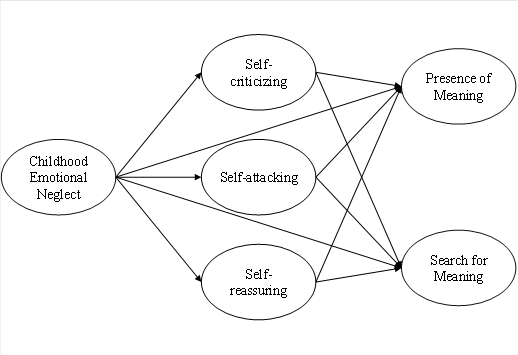
Furthermore, multigroup path analysis (MGPA) was carried out, incorporating gender as discriminant variable. The aim of this analysis was to evaluate possible dissimilarities in the paths among men/women. The analysis investigated whether the relationships between study variables differed between men and women. Model fit was assessed using several indices: the chi-square statistic (lower values indicate a better fit), the CFI (higher values reflect a better fit), and changes in these measures to evaluate if allowing paths to vary significantly improved the model fit. A small chi-square difference and minimal CFI change suggest that the models are similarly effective for both genders, indicating structural consistency across groups.
Results
Descriptive and Correlational Analysis
Descriptive and correlational analysis are shown in Table 1. Initial analyses were carried out to assess the impact of gender, educational level, and age on study variables. However, no significant multivariate effects were found, indicating that these variables did not have a substantial impact on the variables under investigation (gender: Wilks's λ = .99, F(6, 1070) = 1.48, p = .18, ηp² = .01; educational level: Wilks's λ = .98, F(18, 3027) = 1.42, p = .11, ηp² = .01; age: Wilks's λ = .99, F(6, 1070) = 1.28, p = .26, ηp² = .01). Despite the lack of significant multivariate effects, the main analyses accounted for these background variables to ensure a conservative evaluation of our hypotheses.
Mediation Model
The chosen model, which employed SEM, was assessed for its goodness of fit using the collected data. The results indicated that the model exhibited a satisfactory fit: χ²(156) = 605.94, p < .001, CFI = .97, RMSEA = .05 (90% CI = .05-.06), and SRMR = .04. Notably, significant relationships were underlined between almost all the constructs evaluated (Table 2). Specifically, CEN is positively associated with S-C and S-A, and negatively related to S-R and PoM. Furthermore, S-C is positively connected with SfM, while S-A is negatively associated with both PoM and SfM. In contrast, S-R is positively related to PoM. The indirect effects reveal that CEN positively influences SfM through S-C and negatively through S-A, while it negatively affects PoM through both S-A and S-R. It is worth noting that the only paths that did not reach statistical significance were the connections from S-C to PoM, and the links from S-R to SfM.
Table 2. Path Estimates, SEs and 95% CIs
| Effects | β | p | SE | CI | CI |
|---|---|---|---|---|---|
| LL | UL | ||||
| Direct Effects | |||||
| Childhood Emotional Neglect → Self-criticizing | .29 | < .001 | .03 | .20 | .32 |
| Childhood Emotional Neglect → Self-attacking | .45 | < .001 | .04 | .33 | .47 |
| Childhood Emotional Neglect → Self-reassuring | -.41 | < .001 | .03 | -.39 | -.27 |
| Childhood Emotional Neglect → Presence of Meaning | -.11 | .001 | .05 | -.25 | -.07 |
| Childhood Emotional Neglect → Search for Meaning | .08 | < .05 | .06 | .004 | .23 |
| Self-criticizing → Presence of Meaning | -.04 | .42 | .07 | -.18 | .08 |
| Self-criticizing → Search for Meaning | .46 | < .001 | .08 | .58 | .88 |
| Self-attacking → Presence of Meaning | -.19 | < .001 | .07 | -.45 | -.17 |
| Self-attacking → Search for Meaning | -.18 | < .001 | .08 | -.45 | -.14 |
| Self-reassuring → Presence of Meaning | .45 | < .001 | .08 | .59 | .93 |
| Self-reassuring → Search for Meaning | .06 | .23 | .09 | -.07 | .29 |
| Indirect Effects via Self-criticizing | |||||
| Childhood Emotional Neglect → Presence of Meaning | -.01 | .42 | .02 | -.05 | .02 |
| Childhood Emotional Neglect → Search for Meaning | .13 | < .001 | .03 | .13 | .25 |
| Indirect Effects via Self-attacking | |||||
| Childhood Emotional Neglect → Presence of Meaning | -.09 | < .001 | .03 | -.18 | -.07 |
| Childhood Emotional Neglect → Search for Meaning | -.08 | < .001 | .03 | -.18 | -.06 |
| Indirect Effects via Self-reassuring | |||||
| Childhood Emotional Neglect → Presence of Meaning | -.18 | < .001 | .03 | -.32 | -.19 |
| Childhood Emotional Neglect → Search for Meaning | -.03 | .24 | .03 | -.10 | .02 |
| Total Effects | |||||
| Childhood Emotional Neglect → Presence of Meaning | -.39 | < .001 | .05 | -.64 | -.45 |
| Childhood Emotional Neglect → Search for Meaning | .11 | .01 | .06 | .04 | .26 |
Note. β = standardized beta values, p = level of significance, SE = standard error, CI = confidence interval, LL = lower limit, UL = upper limit.
The Role of Gender
To analyze possible differences in the links among men/women, a MGPA was carried out on the theorized model. The analysis involved comparing a constrained model, where the links were made equal for both groups, χ² (311) = 782.63, p < .001, CFI = .97, to an unconstrained model, which allowed the connections to differ between the two groups, χ² (288) = 748.68, p < .001, CFI = .97. The fits of the models did not significantly differ from each other, indicating structural uniformity between the two groups, Δχ² (23) = 31.39, p = .11, ΔCFI < .001. Thus, the associations examined in the study were found to be similar for both genders.
Discussion
The primary goal of this research was to examine if S-C, S-A, and S-R serve as mediators in the connections between CEN and the PoM and between CEN and the SfM, in individuals living in therapeutic communities. The obtained means in this investigation are consistent with previous research findings (Holman & Jignea, 2022; Kotera et al., 2021; Lew et al., 2020). Furthermore, the results of the study reveal intricate relationships among these variables. Specifically, in terms of the individual components of self-criticism, it was found that S-A acts as a mediator in both the link between CEN and the PoM and between CEN and the SfM. On the other hand, S-C only serves as a mediator in the connection between CEN and the SfM, while S-R only mediates the link between CEN and the PoM. These findings offer valuable insights into the complex dynamics involving CEN, self-criticism, and the experience of MiL, and are theoretically in line with the developmental cascade model, which posits that early adversities such as CEN initiate a series of cascading effects that shape self-perceptions and overall well-being (Masten & Cicchetti, 2010). According to this framework, CEN triggers heightened self-criticism due to a lack of emotional support during childhood (Kotera et al., 2021; Petrocchi & Couyoumdjian, 2016). This self-criticism, in turn, can manifest in various maladaptive behaviors, making it challenging for individuals to find a meaningful sense of purpose and increasing their risk of experiencing feelings of emptiness and worthlessness (Kurtuluş & Elemo, 2024; Lew et al., 2020).
CEN, which involves a lack of emotional support, validation, and nurturing during formative years, has enduring effects on individuals' psychological well-being and their capacity to find MiL (Kurtuluş & Elemo, 2024). This study demonstrates that S-A tendencies serve as a mechanism through which CEN influences individuals' experience of meaning. Individuals who have experienced emotional neglect may internalize negative self-perceptions, leading to self-blame, self-criticism, and hostility (Shahar et al., 2015; Tanzer et al., 2021). The influence of S-A in the CEN-PoM connection suggests that individuals who experience S-A thoughts and behaviors are potentially more prone to a struggle with experiencing a sense of direction and fulfillment (Boersma et al., 2015). Such tendencies can contribute to a negative self-concept, heightened feelings of unworthiness, and a reduced sense of self-efficacy, all of which hinder the recognition and appreciation of meaningful aspects in life (Petrocchi & Couyoumdjian, 2016). Similarly, the impact of S-A in the connection among CEN and the SfM indicates that individuals who engage in S-A behaviors may face difficulties in actively seeking and exploring potential sources of meaning (Boersma et al., 2015; Shahar et al., 2015). S-A tendencies can foster a sense of hopelessness, self-doubt, and fear of failure, undermining individuals' motivation and ability to engage in activities or relationships that hold personal significance and contribute to a meaningful life (Petrocchi & Couyoumdjian, 2016; Tanzer et al., 2021).
Furthermore, the findings of the present research suggest that S-C acts as a mediator between CEN and the search for MiL, but not between CEN and the PoM. This indicates that S-C tendencies have a specific role in explaining how CEN influences individuals' pursuit of meaning. The mediation of S-C in the link between CEN and the SfM suggests that individuals who engage in self-critical tendencies may encounter obstacles in actively seeking and exploring potential sources of MiL and may also have a lower quality of life (Crăciun, 2013; Shavandi & Veshki, 2021). Self-criticism can contribute to feelings of self-doubt, low self-esteem, and a preoccupation with personal flaws, which can hinder motivation and the ability to engage in meaningful activities and relationships (Löw et al., 2020). Furthermore, the present research did not find evidence supporting the influence of S-C in the connection among CEN and the PoM. This suggests that S-C tendencies may not directly influence individuals' subjective experience of a meaningful life. Indeed, other self-related psychological factors, such as S-A and S-R behaviors, may be more pertinent in understanding how CEN affects the PoM.
The findings of this study also indicate that S-R does not serve as a mediating factor between CEN and the SfM. However, it has a mediating effect between CEN and the PoM. These results suggest that S-R tendencies have a specific function in explaining how CEN influences the sense of meaning in people's lives. The impact of S-R in the path between CEN and the PoM suggests that individuals who lacked emotional support during childhood may encounter difficulties in engaging with self-related perceptions (Gilbert et al., 2010), including self-compassion, self-kindness, and self-acceptance (Shahar et al., 2015). These difficulties can impede their ability to recognize and appreciate the meaningful facets of life, leading to thoughts of insecurity, self-doubt, and diminished self-worth, ultimately affecting their subjective experience of a meaningful life (Efrati & Gola, 2019; Shahar et al., 2015). On the other hand, the study did not find evidence to support the idea that S-R directly influences individuals' active pursuit and exploration of potential sources of purpose in the connection between CEN and the SfM. This suggests that other self-related factors, such as S-A and S-C behaviors, may have more significant roles in understanding how CEN impacts individuals' active SfM.
The secondary aim of the current investigation was to evaluate if the chosen model is equal across men/women. Study's results underlined that there were no significant dissimilarities between men/women in the links inside the model. This implies that the mediating impact of S-C, S-A, and S-R, in the link between CEN and both the PoM and the SfM, are equally important for the two genders. Study's findings enhance the generalizability of the research, indicating that the observed effects apply to both men/women. Previous studies have reported somewhat divergent findings when comparing men/women in relation to CEN (Aust et al., 2013; Wanamaker et al., 2022; Wang et al., 2022) self-criticism (Akgöz Aktaş et al., 2023; Anwar et al., 2019; Reddy, 2023) and MiL (Hamama & Hamama-Raz, 2021; Zhang et al., 2022; Zhao et al., 2020). However, this study's outcomes imply that the gender differences observed in previous studies could be partially explained by individual variations in CEN, self-criticism, and the experience of MiL.
Our research has several limitations. First, the cross-sectional design prevents us from establishing causal relationships between the constructs studied. Longitudinal studies would be useful to track participants over time and provide stronger evidence of the observed associations. Second, the reliance on self-reported data may introduce interpretive bias, as participants' subjective views could affect accuracy. Future research should consider using multiple data sources, such as objective measures or external reports, to improve the validity and reliability of the findings. Finally, privacy concerns limited our ability to collect individual reasons for participants' decisions to stay in the community, resulting in aggregated data that may not fully capture individual motivations and experiences.
The results of the present research have significant clinical considerations for professionals working with individuals who have experienced CEN, shedding light on its impact on one's sense of MiL and the impact of self-criticism in this relationship. Specifically, our study's results underscore the need to address these specific self-critical tendencies in therapeutic settings to enhance intervention strategies aimed at improving individuals' overall sense of meaning and well-being. By clarifying the roles of S-C, S-A, and S-R in these processes, this research contributes valuable insights into how developmental cascades influence mental health and offers practical implications for tailoring therapeutic interventions (Masten & Cicchetti, 2010). Understanding the long-term effects of emotional neglect and self-criticism on individuals' SfM is thus vital for guiding appropriate therapeutic interventions. Clinicians and therapists should be mindful of the potential enduring consequences of CEN on individuals' pursuit of meaning, allowing them to provide tailored support and interventions to meet their specific needs. Furthermore, the study underlines the influence of self-criticism between CEN and MiL, hence, addressing self-critical tendencies can be advantageous in aiding individuals to develop self-compassion, self-acceptance, and self-esteem, while simultaneously confronting and countering negative self-critical thoughts and behaviors (Boersma et al., 2015; Shavandi & Veshki, 2021). Even if S-R did not mediate the link between emotional neglect and the SfM, it still holds significance in relation to the PoM. Clinicians can assist individuals in developing S-R by fostering self-acceptance, self-compassion, and self-support. This can be achieved by encouraging positive self-talk, engaging in self-affirmation exercises, and promoting self-care practices. Such interventions may contribute to a more constructive self-concept and improve the experience of MiL (Löw et al., 2020; Shavandi & Veshki, 2021). Additionally, the study suggests that dissimilar shades of self-criticism (S-C, S-A, and S-R) exhibit distinct relationships with MiL. Therapeutic interventions should consider these nuances and tailor approaches to address specific self-critical tendencies that align with individuals' experiences, leading to more effective interventions and fostering improved well-being and MiL. Furthermore, understanding the effect of CEN on meaning highlights the importance of early intervention and prevention strategies. Addressing and mitigating emotional neglect in childhood can reduce its potential long-term impacts on individuals' well-being, social behavior, and their capacity to find MiL (Vos, 2016). Educating and raising awareness among parents, caregivers, and professionals are vital in identifying and addressing emotional neglect, ultimately promoting healthier developmental outcomes for individuals.
To enhance the credibility and scope of our knowledge, it is important for future research to replicate and expand upon these findings by examining diverse populations. This can involve investigating individuals from different age groups, cultural backgrounds, and clinical populations. By conducting studies with a broader range of participants, we can determine the generalizability of the observed relationships and develop a more comprehensive understanding of how CEN and self-criticism influence individuals' sense of MiL across various contexts. Moreover, future research endeavors can focus on evaluating the effectiveness of programs that specifically focus on self-criticism and MiL in individuals who have experienced CEN. The findings from these studies hold the potential to significantly impact clinical practice and contribute to the development of treatment guidelines, ultimately benefiting individuals who have experienced CEN and struggle to find meaning in their lives.

