




 Servicios personalizados
 Inglés (pdf)
 Articulo en XML
 Referencias del artículo
 Traducción automática
 Enviar articulo por email
 Citado por SciELO
  Citado por Google
  Similares en
SciELO
Similares en
SciELO  Similares en Google
 Permalink
INTRODUCTION
Osteoporosis is a bone disorder that increases a person's risk of fracture due to low bone mineral density, impaired bone microarchitecture/mineralization and/or decreased bone strength. It is a silent disease that progresses without symptoms until it shows as a fracture of the hip, spine, proximal humerus, pelvis and/or wrist, which may lead to hospitalization (1). This disease can be caused by several reasons; the main cause is due to hormone depletion, oestrogen depletion in postmenopausal women and androgen depletion in older men. In particular, due to the imbalance in bone remodelling after menopause, osteoclastic activity predominates over osteoblastic activity (2).
The main objective of a pharmacological therapy, in this case, is to reduce the risk of fracture. Drugs to treat osteoporosis are categorized as either antiresorptive (i.e., bisphosphonates, estrogen agonist/antagonists, estrogens, calcitonin, and denosumab) or anabolic (i.e., teriparatide). Antiresorptive drugs primarily decrease the rate of bone resorption while anabolic drugs increase bone formation more than bone resorption does. Bisphosphonates are anti-osteoclastic agents that suppress osteoclastic formation and help to increase or maintain bone mineral density in the long term (1,3). These drugs can be categorized into 2 groups with different molecular modes of action:
Bisphosphonates that do not contain a nitrogen atom in their structure (non-nitrogenous): these are the simplest and include etidronate and clodronate, among others. They can be metabolically incorporated into non-hydrolysable ATP analogues, which interfere with intracellular ATP-dependent pathways.
Bisphosphonates that contain a nitrogen atom in their structure (nitrogenous): these are the most potent drugs and include pamidronate, alendronate, risedronate, ibandronate and zoledronate. Although they are not metabolized in the same way as the non-nitrogen bisphosphonates, they inhibit key enzymes of the mevalonate/cholesterol biosynthetic pathway (4). In osteoclasts they inhibit the enzyme farnesyl pyrophosphate synthase (FDPS) a key branch point enzyme in the mevalonate pathway. As a consequence of osteoclast activity inhibition, recruitment and apoptosis, suppression of bone turnover occurs (5).
Oral bisphosphonates such as alendronate, ibandronate or risedronate have been widely used in the treatment and prevention of osteoporosis for 3 decades. Among oral bisphosphonates, alendronate and risedronate have been demonstrated to reduce the rate of hip fractures by approximately 40 %, and all non-vertebral fractures by 20-30 % (6). Initially, bisphosphonates were administered daily. However, nowadays, dosing regimens are weekly in the case of alendronate and risedronate, or monthly for ibandronate, and more recently for risedronate (7).
The variety of indications and the prolonged duration of most bisphosphonate oral treatments have favored the appearance of different adverse reactions. Among the most common ones are those related to the upper digestive tract: nausea, vomiting, erosions, gastric ulcers, oesophagitis, etc. All bisphosphonates are reported to be associated with a complication denominated osteonecrosis of the jaw, defined as the presence of exposed and necrotic bone in the maxillofacial region that does not heal in 8 or more weeks (8). Moreover, bone, joint and muscle pain may be secondary to bisphosphonates therapy. These last adverse reactions have been described as generally infrequent and mild, although severe pain has been reported (9). The onset of musculoskeletal pain may occur years after treatment initiation and does not always resolve with treatment discontinuation (10). A link between bisphosphonate intake and the development of synovitis, including carpal tunnel syndrome, has also been demonstrated (11).
The aims of our study were: a) to study the possible causal association between taking oral bisphosphonates (alendronic acid, ibandronic acid and risedronic acid) and the development of musculoskeletal adverse reactions; b) to determine the reporting frequencies for the variables age, sex and serious of these reactions; c) to identify the different musculoskeletal reactions associated with each bisphosphonate and their reported risks; and d) to analyze the available official information on these musculoskeletal reactions to bisphosphonates and to compare it with the results obtained in our own study.
MATERIALS AND METHODS
DATA MINING
Data required for our study were obtained from the Spanish Pharmacovigilance System's adverse reaction database, FEDRA. FEDRA contains spontaneous reports of adverse reactions made by health care professionals, the pharmaceutical industry and general population from the start of the programme in 1983 to this day. Adverse reactions are subsequently coded in FEDRA according to the terminology of the Medical Dictionary for Regulatory Activities, MedDRA. Through this tool, preferred terms describing the reactions of interest can be identified for searching. This can be done by system organ class (SOC), high level group term (HLGT), high level term (HLT) and preferred term (PT) (12).
FEDRA searches were conducted for the 3 selected bisphosphonates: alendronic acid, ibandronic acid and risedronic acid. A general search was first performed to identify spontaneous reports with the SOC musculoskeletal and connective tissue disorders, and after more specific searches were conducted with the following selected PTs: myalgia, arthralgia, bone pain, paresthesia, musculoskeletal pain, musculoskeletal stiffness, arthritis, muscle weakness and limb pain. The study of bone necrosis of the jaw has not been addressed in this study nor the occurrence of atypical fractures.
DATA STATISTICAL ANALYSIS
To achieve the proposed endpoints, we conducted an analytical, retrospective, observational using the case/non-case study approach, which is based on the logic of case-control studies (13). The study selects patients with the disease (cases) and compares their exposure to certain risk factors with that of patients without the disease (non-cases). The risk factors associated with a specific disease are thus identified and analyzed; in this case, with an adverse reaction of interest. If risk factors considered are drugs, as in the present study, the role they play in the occurrence of the reaction can then be explored. The strength of the association between the adverse reaction and the bisphosphonate was estimated by calculating a measure of disproportionality, the reporting odds ratio (ROR) with a 95 % confidence interval (CI) and chi-square test with Yates correction. This ROR is based on a 2-by-2 contingency table (ROR = (a/b)/(c/d) = ad/bc) (Table I).
Table I. 2 x 2 contingency table.

a = case-exposed; b = non-case-exposed; c = case-non-exposed; and d = non-case-non-exposed. ROR = (a/b)/(c/d) = ad/bc
Thus, a = case-exposed; b = non-case-exposed; c = case-non-exposed; and d = non-case-nonexposed. If the ROR value is = 1, there would be no association between the drug and the disease, as the exposure ratio in exposed and unexposed cases would be equal. If the ROR is > 1, then there would be an association; the higher the ROR, the greater the association. If the ROR is < 1, the drug would have a protective effect vs the disease under study (14).
RESULTS
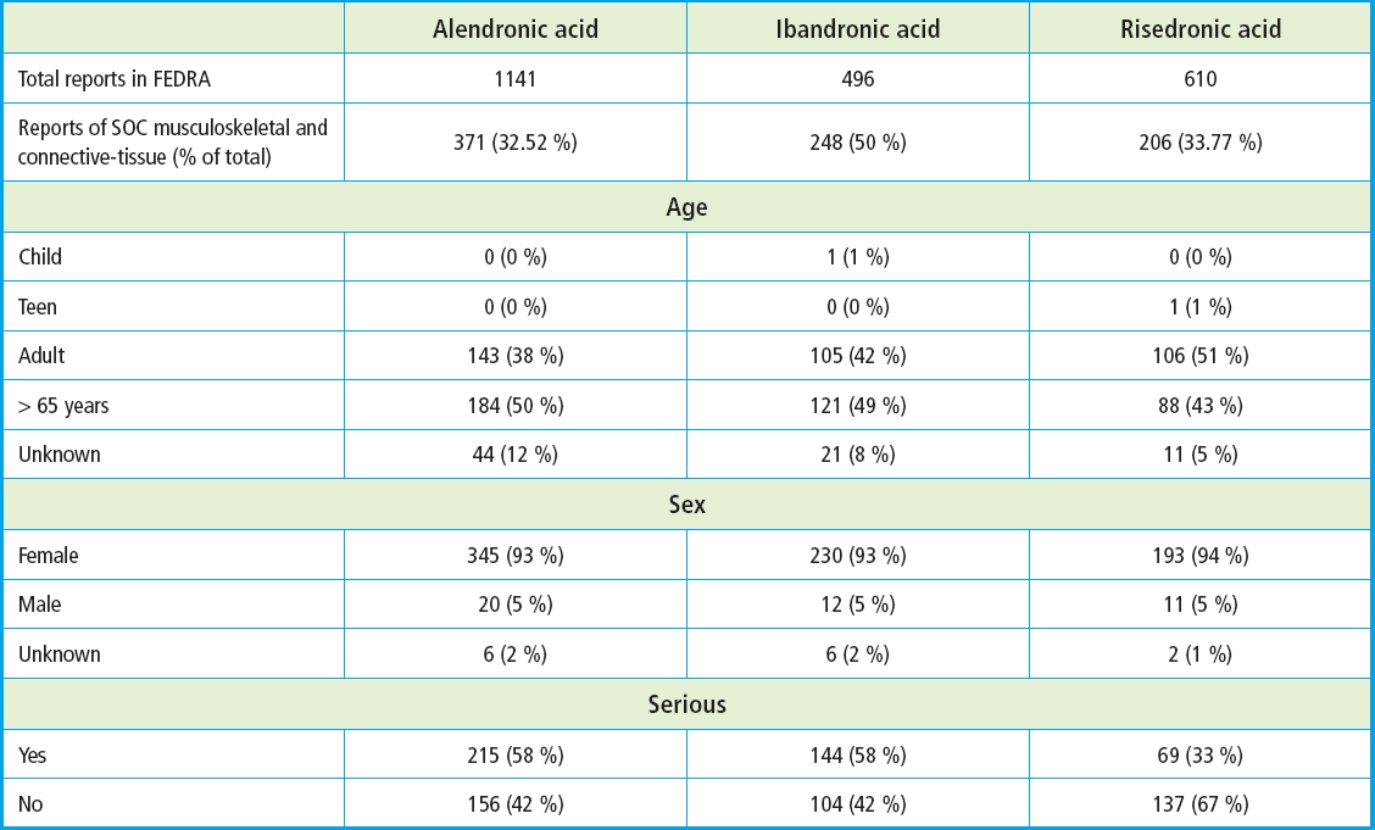
As of 31 October 2023, out of a total of 475,235 reports in the FEDRA database, a total of 371 notifications were identified for alendronic acid in relation to SOC musculoskeletal and connective tissue disorders, accounting for 32.52 % of the notifications for this drug in FEDRA, 248 for ibandronic acid-50 % overall-and 206 for risedronic acid-33.77 % of all notifications (Table II).
Table II. Characteristics of the reported cases of SOC musculoskeletal and connective-tissue disorders in the bisphosphonates studied summited to FEDRA until October 31st, 2023.
The study on disproportionality indicates that the ROR values for this SOC were > 1 for the 3 drugs in the pipeline. Specifically, for alendronic acid, the ROR was 4.2 (3).7-4.8), for ibandronic acid, the ROR was 8.7 (7.3-10.4), and for risedronic acid, the ROR was 4.4 (3.8-5.3) (Table III).
Table III. Disproportionality analysis for bisphosphonates and SOC musculoskeletal and connective-tissue disorders.

n: number of cases.
The analysis of the reports revealed that, for alendronic and ibandronic acid, these reactions mostly occur in patients older than 65 years, and most reports are categorized as serious. For all 3 drugs studied, these reactions occur much more frequently in women (Table II).
In the disproportionality analysis for the 9 studied PTs (myalgia, arthralgia, bone pain, paresthesia, musculoskeletal pain, musculoskeletal stiffness, arthritis, muscle weakness and pain in a limb) across the 3 selected drugs, ROR values > 1 were found for all PTs except for paresthesia with alendronic and risedronic acids, and pain in a limb with alendronic and ibandronic acids (Table IV).
Table IV. Disproportionality analysis for bisphosphonates and preferred terms of musculoskeletal adverse reactions selected.
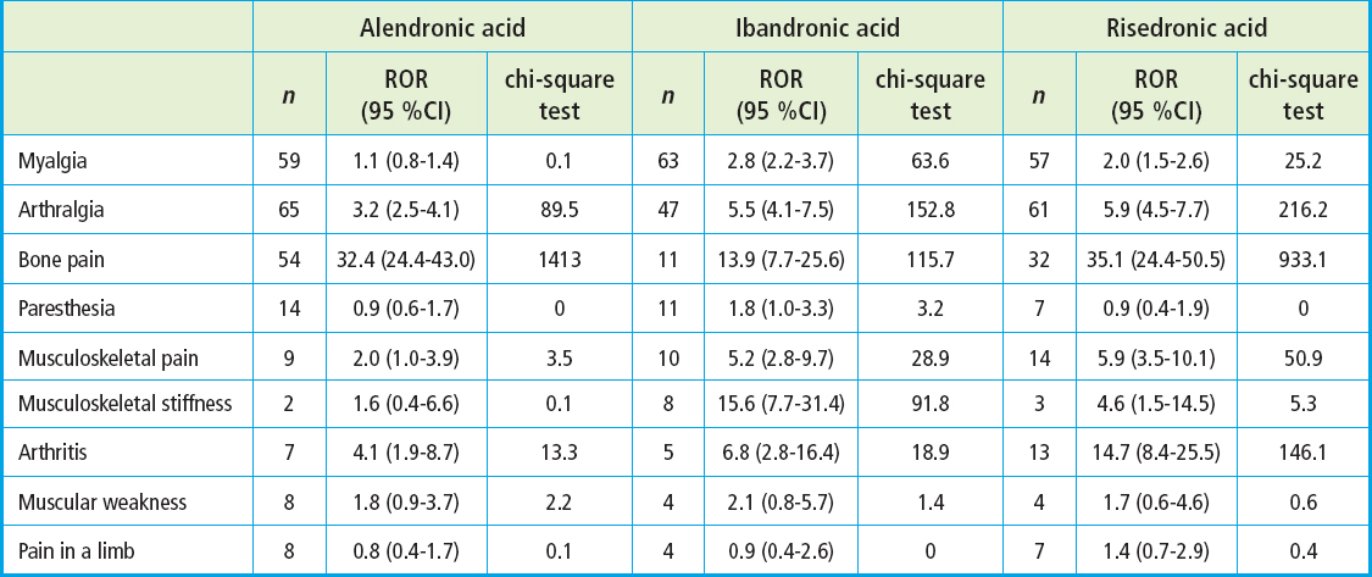
The ROR values for bone pain PT were particularly significant. Alendronic acid had a ROR of 32.4 (24.4-43.0), ibandronic acid had a ROR of 13.9 (7.7-25.6), and risedronic acid had a ROR of 35.1 (24.4-50.5). Additionally, for musculoskeletal stiffness PT, ibandronic acid had a ROR of 15.6 (7.7-31.4), and for arthritis PT, risedronic acid had a ROR of 14.7 (8.4-25.5) (Table III).
Table V compares information on several bisphosphonates marketed in Spain, selected in this study, with the information contained in their package leaflets and technical specifications. Arthritis is not mentioned as such in any of the 3 products; for alendronic acid, a term that could be considered as a synonym, “joint swelling”, is mentioned. “Pain in a limb” is not mentioned, nor is “muscle weakness”. “Musculoskeletal stiffness”, a characteristic and distinct reaction, is mentioned only in the label and package leaflet for ibandronic acid.

DISCUSSION
Musculoskeletal reactions, in particular muscle, bone and joint pain, are mentioned as a possibility in the European Medicines Agency (EMA) data for products marketed in Europe; of note, the instances of “severity” or “disability” were rare (15). The FDA reporting mentions ‘serious and disabling reactions have been reported' when taking a different approach that excludes rarity. However, the reporting also notes that a similar proportion of musculoskeletal reactions were found in both the alendronic acid and placebo comparison groups during clinical trials (16).
Out of a total of 475,235 reports in the FEDRA database at the time of the study, 49,110 (10.33 %) were identified as SOC reports of musculoskeletal and connective tissue reactions. For alendronic acid, 371 out of 1,141 reports (32.52 %) reported musculoskeletal reactions. Of these, 215 (57.95 %) were considered serious. Out of a total of 496 reports in FEDRA for ibandronic acid, 248 (50 %) had the reaction of interest. Furthermore, more than half of these reactions were considered serious (58.07 %; n = 144). For risedronic acid, there was a total of 610 reports, of which 206 (33.77 %) were musculoskeletal reactions. However, a smaller percentage of these reactions were considered serious (33.50 %, n = 69). It is important to understand that severity is determined by pharmacovigilance center technicians based on established criteria. Therefore, a life-threatening reaction is typically classified as serious. The disproportionality estimation in FEDRA produced the following ROR values: ROR = 4.2 (3.7-4.8) for all musculoskeletal reactions related to alendronic acid, ROR = 8.7 (7.3-10.4) for ibandronic acid, and ROR = 4.4 (3.8-5.3) for risedronic acid. These results suggest a strong association, but it is important to consider possible biases. While some musculoskeletal reactions studied may occur in the context of osteoporosis, which is the main indication for bisphosphonates, the fact that they have been reported as suspicious supports a potential causal relationship. The study of disproportionality in the selected PTs found statistically significant ROR values, except for paresthesia and pain in one limb. ROR values are considered statistically significant if they are > 1 and their confidence interval does not contain 1. For the remaining PTs that meet these assumptions, the RORs ranged from 2.0 (1.5-2.6) for the PT myalgia with risedronic acid up to 35.1 (24.4-50.5) for the PT bone pain with risedronic acid.
The ROR values for PT bone pain were significant: alendronic acid had a ROR of 32.4 (24.4-43.0), ibandronic acid had a ROR of 13.9 (7.7-25.6), and risedronic acid had a ROR of 35.1 (24.4-50.5). These high values suggest that the original site of injury is the bone, where bisphosphonates are deposited. Other reactions may be referred reactions depending on the affected bone site. Bone pain is considered to be less common in clinical settings than muscle or joint pain. It is typically described as penetrating, deep, and dull. The patient experiences a pain that is located in the bones and recorded by the physician. This is not a diagnosis based on the patient's symptoms, but rather a felt reaction or symptom. It is likely that reactions such as “pain in a limb”, which are listed in the MedDRA dictionary as different entities, may, at least in part, also be referred to as bone pain. Possible mechanisms of bone pain include osteitis, which is produced by acute phase reactions to bisphosphonates and mediated by cytokines (17). Other mechanisms may involve pressure changes in the bone marrow, hypoxia in the bone, and mechanical stimulation of nociceptors (18). Additionally, bisphosphonates, like statins, alter the HMG-CoA and mevalonate pathway. There are documented cases of bone pain in the literature where analytical data, such as elevated sedimentation rate and C-reactive protein, indicate inflammation (19).
On the other hand, risedronic acid showed a strong association with PT arthritis, with a ROR of 14.7 (8.4-25.5). The other bisphosphonates studied also showed ROR values indicative of association: alendronic acid with a ROR of 4.1 (1.9-8.7) and ibandronic acid with a ROR of 6.8 (2.8-16.4). Arthritis is an inflammation of the joints with an immunogenic basis. Drugs could act as haptens and contribute to the development of this type of reaction. The obtained high ROR value suggests a strong association, but it is important to rule out possible reporting biases. Arthritis may occur more frequently in patients with osteoporosis, who are eligible for bisphosphonate therapy, leading to a spurious association between the druf and the reaction. Osteoporosis can be associated with other conditions, including certain joint diseases. However, this does not fully account for all reported cases of suspected joint problems. There is evidence to suggest that reactions such as arthritis may be underreported in association with drug use. Literature contains numerous well-documented cases of arthritis associated with the use of various bisphosphonates, some of which also resulted in positive re-exposure (10). Therefore, the results of the clinical evaluation applied to the presented case series, along with the association data from the disproportionality analysis and literature reports, serve as argumentative sources for establishing causality in the specific combinations of bisphosphonates and musculoskeletal reactions in the absence of specific studies. Finally, the strong association between PT musculoskeletal stiffness and ibandronic acid is noteworthy, with a ROR of 15.5 (7.7-31.4). The technical specifications of the drug reflect this association, but it is not reflected in the technical specifications of risedronic acid, which has this adverse reaction with a ROR of 4.6 (1.5-14.5).
LIMITATIONS
One of the main limitations of this study is underreporting, which refers to the reporting of a small number of suspected adverse reactions relative to the actual number of occurrences (20). Underreporting can impact systems that rely on spontaneous reporting. This issue may arise due to the challenge of linking certain medical conditions with specific drugs. Apart from the difficulty of reporting suspicions, there are various reasons for not reporting. These reasons include the belief that the reaction is already known, laziness, lack of knowledge of the reporting programmes, or fear of being reported. It is important to note that reported information should be objective and free from subjective evaluations. The true rate of musculoskeletal adverse reactions associated with bisphosphonates in the population, as well as any adverse reactions in general, is difficult to determine due to underreporting and lack of information on the actual number of patients treated with these drugs. The information generated through spontaneous reporting only provides a partial view of the situation. Although underreporting does not allow for an accurate estimation of the quantitative magnitude of the problem, it does provide insight into the type of disease produced, its severity, and the clinical and public health repercussions. Additionally, it allows for the identification of possible causal associations, which is particularly relevant in the context of pharmacovigilance. Of note, most regulatory interventions on drug safety have been based on spontaneous reporting data (21). Therefore, these data remain valid.
Bisphosphonates are prescribed based on the presence of osteoporosis, a disease whose symptoms may be considered a confounding factor when evaluating the causal relationship between these drugs and the adverse musculoskeletal reactions studied. Osteoporosis is associated with other rheumatic diseases. Based on this confounding factor, the drug would be prescribed to patients who already have musculoskeletal symptoms, which would later be causally associated with the same symptoms. In other words, the prescription of the drug would be linked to the musculoskeletal symptoms that would later be attributed to the drug. Although associations have been described, it is difficult to conclude that they are always causal, especially without data on time sequence, withdrawal effects, or response to re-exposure. Clinical data supporting a causal reaction would be valuable.
CONCLUSIONS
Bisphosphonates may cause musculoskeletal adverse reactions that are not listed in the product information for bisphosphonate-containing products. Established reactions such as musculoskeletal stiffness, muscle weakness or arthritis, which are named as such, are not included in the information for use contained in the technical specifications and leaflets. The mandatory information on bisphosphonates in these documents needs updating to include known data on musculoskeletal reactions in a clear and consistent manner.
Bisphosphonates can cause a range of musculoskeletal adverse reactions, being arthritis and arthralgia being the most common ones. A significant proportion of reported musculoskeletal reactions are considered serious. As older individuals tend to have longer exposure to bisphosphonates, any adverse reactions would likely be more prevalent in this age group. Among the most frequently occurring musculoskeletal adverse reactions, bone pain is the reaction that is most strongly associated with bisphosphonates.
The benefit-risk ratio of bisphosphonates should be re-evaluated following new data on their long-term safety and efficacy profile. This work, along with literature reports, provides safety information on bisphosphonates that calls for an update of their benefit-risk ratio. Results obtained support the inclusion of new data in the information on these products. The regulatory authorities-Spanish and European-are responsible for including any new safety information in product information, where appropriate. Health care professionals should establish their own risk-benefit ratio based on new safety knowledge.

