




 Servicios personalizados
 Inglés (pdf)
 Articulo en XML
 Referencias del artículo
 Traducción automática
 Enviar articulo por email
 Citado por SciELO
  Citado por Google
  Similares en
SciELO
Similares en
SciELO  Similares en Google
 Permalink
INTRODUCTION
Transplant-induced osteoporosis is a complex metabolic condition frequently associated with chronic glucocorticoid use and factors related to pre-transplant end-stage diseases. While it shares certain characteristics with glucocorticoid-induced osteoporosis (GIOP), this condition is chronic, irreversible, and influenced by a combination of factors, such as pre-existing bone loss, immunosuppressive regimens, and transplant-associated comorbidities (1). Fractures are a common complication in this population, with incidence rates varying depending on the type of transplant and the postoperative period. For instance, in heart and liver transplants, lumbar spine bone mineral density (BMD) may recover over time, whereas fractures are more prevalent during the first years after transplantation (2-5). In kidney transplants, fractures occur more frequently at appendicular sites, related to persistent hyperparathyroidism and cortical and trabecular bone loss.
Regarding bone loss patterns, the first 6 to 12 months post-transplant represent a critical period for BMD reduction. For example, in heart transplants, trabecular bone loss may exceed 6 % in the spine and femoral neck within the first year, later stabilizing with maintenance doses of glucocorticoids. In liver transplants, fractures are common on year 1 (21 %) and may reach 33 % by the year 4 (1).
The pharmacological management of transplant-associated osteoporosis faces multiple challenges, partly due to variability in therapeutic responses. While both IV and oral bisphosphonates have demonstrated efficacy in improving BMD (6), adynamic bone disease remains a major concern. Denosumab has emerged as a promising option, with studies reporting significant increases in hip and spine BMD, along with a sustained reduction in bone turnover markers (7).
This agent may also be beneficial in hematopoietic stem cell transplants, where bone loss is more pronounced at the femoral neck, and fracture rates are significantly higher than in the general population (8,9). However, the available evidence remains limited, particularly in specific populations such as lung and intestinal transplants, where osteoporosis and fracture rates are particularly high (10,11).
This review aims to synthesize the current evidence on the safety, efficacy, and effectiveness profile of different antiresorptive therapies for transplant-associated osteoporosis, identifying knowledge gaps and areas for future research.
METHODS
This scoping review was conducted in full compliance with the Joanna Briggs Institute (JBI) protocol for scoping reviews (12).
POPULATION, CONCEPT, CONTEXT
We applied the PCC framework. The Population included adults (≥ 18 years) diagnosed with transplant-associated osteoporosis (T-score ≤ -2.5) with or without fractures on pharmacological therapies. The Concept included 3 domains: efficacy (trial-condition BMD gains and fracture risk reduction at 12 and 24 months), effectiveness (real-world fracture incidence and BMD changes), and safety (frequency and severity of treatment-related adverse events). The Context spanned hospitalized, emergency, and outpatient settings worldwide, across all ages, sexes, and cultures.
ELIGIBILITY CRITERIA
We included only prospective controlled clinical trials—randomized or nonrandomized with parallel or crossover designs—published from database inception through April 30, 2025. Eligible interventions encompassed:
- Antiresorptive agents: bisphosphonates (pamidronate, alendronate, etidronate, zoledronate, ibandronate).
- RANK-ligand inhibition: denosumab.
- Dual-action sclerostin inhibitors: monoclonal antibodies targeting sclerostin, recognized for their combined antiresorptive and anabolic effects on bone.
- Selective estrogen receptor modulators: estradiol and pyridine derivatives.
Anabolic drugs (eg, parathyroid hormone analogs) were explicitly excluded, as no prospective controlled trials of these agents in transplant-associated osteoporosis were identified. Studies were required to confirm osteoporosis by densitometry (T-score ≤ -2.5) and include a comparator arm (placebo, calcium ± vitamin D, or active comparator).
INFORMATION SOURCES AND SEARCH STRATEGY
We searched across Medline (via PubMed), Embase, Cochrane CENTRAL, ClinicalTrials.gov, Scopus, Web of Science Core Collection, Google Scholar, and OpenGrey from inception all the way through April 30th, 2025. No language or publication-date limits were applied. Key terms were: Osteoporosis OR “bone loss” AND Transplantation OR graft AND Drug Therapy OR pharmacotherapy OR medication OR drugs.
All references were imported into Rayyan (2016) for duplicate removal and screening.
(“Osteoporosis”[MeSH] OR osteoporosis[tiab] OR “bone loss”[tiab]) AND (“Transplantation”[MeSH] OR transplant[tiab] OR graft[tiab]) AND (“Drug Therapy”[MeSH] OR pharmacotherapy[tiab] OR medication[tiab] OR drugs[tiab]).
Embase and Lilacs strategies were analogous, using their respective subject headings and title/abstract fields.
STUDY SELECTION
Two reviewers (JP, GT) independently screened titles and abstracts in Rayyan, then assessed full texts against inclusion criteria. Discrepancies were resolved by discussion or by a third reviewer (LT).
DATA EXTRACTION
Data from included studies were captured in a standardized Excel sheet: publication details (author, year, country, funding), design, sample size, intervention (agent, dose, duration), comparator, outcome measures (BMD change, fracture incidence rate at 12 and 24 months, adverse events), and follow-up. JP and GT performed independent extraction; LT adjudicated any discrepancies.
Overall, 24 prospective trials evaluated efficacy, 3 assessed real-world effectiveness, 1 addressed safety alone, and 4 reported both safety and efficacy. This rigorous, reproducible approach ensures that our synthesis reflects the highest-quality prospective controlled evidence for transplant-induced osteoporosis.
RESULTS
A total of 24 studies on transplant-associated osteoporosis were analyzed, evaluating various pharmacological interventions in patients with low bone mineral density (BMD). Of these, 19 studies assessed efficacy, 3 analyzed clinical effectiveness, 3 combined safety and efficacy analysis, and 1 focused exclusively on the safety of interventions. Results showed that different interventions, such as Pamidronate, Alendronate, Etidronate, Neridronate, Ibandronate, and Denosumab, had varying effects on improving BMD and reducing fracture risk.
EFFICACY
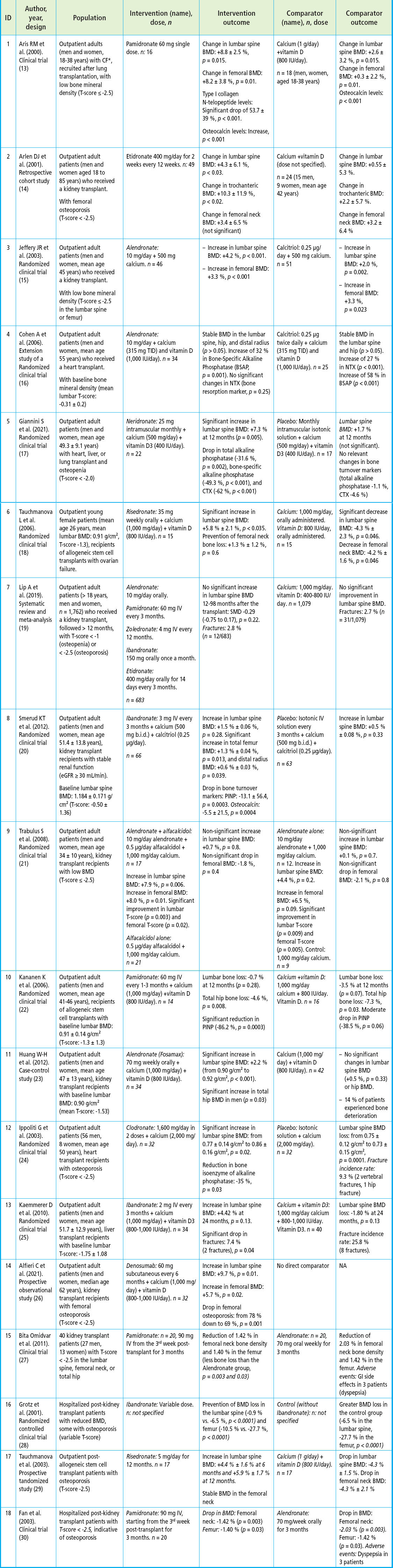
Several randomized and nonrandomized studies demonstrated that bisphosphonates and related agents significantly improved bone mineral density (BMD) in transplant recipients. In patients on pamidronate (13) a mean increase of +8.8 % in lumbar spine BMD and +8.2 % in femoral BMD is observed vs calcium-vitamin D controls (p < 0.015). Additionally, a long-term trial (30) reported that, at four years post-transplant, those without pamidronate prophylaxis lost 12.3 % at the femoral neck (p < 0.01), whereas the pamidronate group maintained stable BMD. Etidronate improved lumbar BMD by +4.3 % (p < 0.03) and trochanteric BMD by +10.3 % (p < 0.02) without affecting femoral-neck density (14). In a head-to-head trial, Jeffery et al. (2003) (15) showed that alendronate increased lumbar BMD by +4.2 % (p < 0.0001) and femoral BMD by +3.3 % (p < 0.001), whereas the calcitriol group experienced smaller gains. Another study (21) found that combining alendronate with alfacalcidol produced even greater benefits, with +7.9 % in lumbar and +8.0 % in femoral BMD (p ≤ 0.01 for both). Neridronate delivered monthly intramuscularly achieved +8.6 % in lumbar spine BMD at 12 months (p = 0.005) vs placebo (+4.2 %) (17). Zoledronate was associated with +8.6 % ± 7 % in lumbar (p < 0.01) and +5.4 % ± 2.2 % in femoral-neck BMD (p = 0.039) (18). Although a systematic review and meta-analysis of multiple bisphosphonates suggested a possible clinical effect on lumbar BMD beyond year 1, pooled analyses did not reach significance (SMD, -0.29; p = 0.22) (19). Ibandronate produced modest but significant gains of +1.3 % in total femur (p = 0.013) and +0.6 % in ultradistal radius (p = 0.039) (20). In heart-transplant recipients, both alendronate and calcitriol maintained stable BMD for more than 1 year (16). All these efficacy findings are shown in table I.
SAFETY
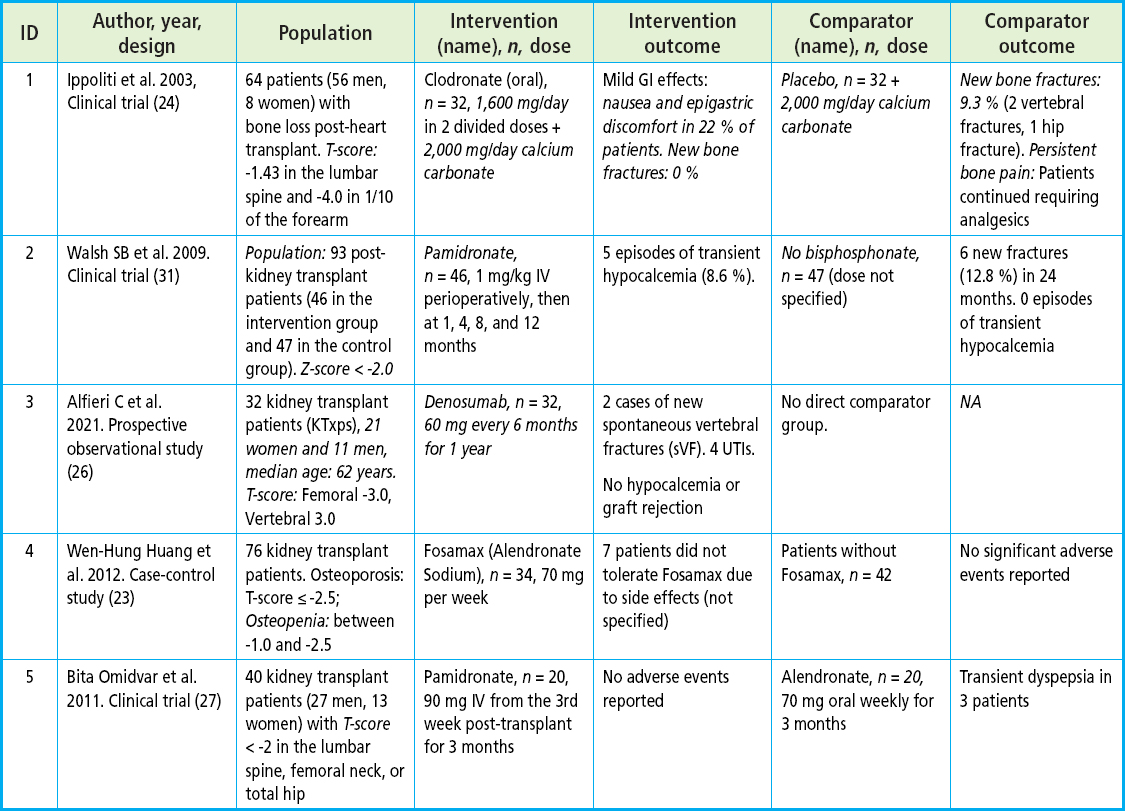
Through multiple studies, pharmacological therapies were generally well tolerated. Pamidronate was associated with mild hypocalcemia in 8.6 % of patients, which was effectively managed (31). Clodronate did not produce severe adverse events in heart-transplant recipients (32). Denosumab did not trigger rejection or major events, though it elicited a slight PTH increase (p = 0.009) (26). Alendronate triggered no serious adverse effects or renal-function deterioration (23). In kidney-transplant cohorts, 15 % of alendronate recipients experienced transient dyspepsia, whereas none did with pamidronate, and there were no significant differences in creatinine or GFR across treatments (p = 0.49 and p = 0.41, respectively) (27). A full summary of safety outcomes is shown in table II.
EFFICIENCY
When focusing on bone-loss prevention, pamidronate reduced hip BMD loss to -1.9 % vs -7.3 % in controls (p = 0.09) (22) and provided durable protection at 4 years (30).
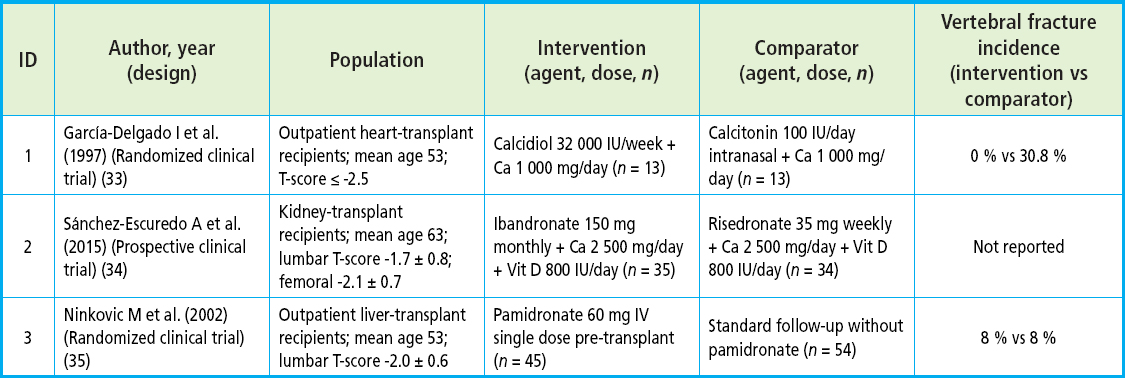
In kidney-transplant patients, alendronate increased lumbar BMD by +0.035 g/cm² vs +0.003 g/cm² in untreated subjects (23). A comparison of IV pamidronate vs oral alendronate showed that pamidronate preserved femoral-neck density (-1.42 % vs. -2.03 %; p = 0.003) and total femur (-1.40 % vs. -1.83 %; p = 0.03) more effectively (27). Clodronate achieved an +11.7 % increase in lumbar BMD (p = 0.02) while placebo produced no changes at all (24). Although ibandronate lumbar gain of +4.42 % did not reach statistical significance (p = 0.13), treated patients experienced significantly fewer vertebral deformities, less height loss, and fewer acute-rejection episodes than controls (28); (25). Risedronate increased lumbar BMD by +5.9 % in 12 months and stabilized femoral-neck density vs declines in controls (p < 0.05) (29). Regarding clinical effectiveness, calcidiol reduced vertebral-fracture incidence by 30 % (p < 0.05) (33); ibandronate and risedronate lowered NTX levels by 34 % and 28 %, respectively (p < 0.05) (34); and although pamidronate did not significantly change fracture rates (8 % vs. 8 %; p = 0.40) it did mitigate BMD loss (35). These efficiency and fracture-outcome data are shown in table III.
DISCUSSION
This scoping review confirms that transplant-induced osteoporosis (TO) is due to a multifactorial interaction among pre-existing bone health, chronic glucocorticoid exposure, immunosuppressive regimens, and transplant-specific factors. Nearly all studies included chronic glucocorticoid use as an underlying contributor to bone loss, yet only a minority explicitly reported corticosteroid dosing or its direct impact on BMD outcomes. Consistently, bisphosphonates (pamidronate, alendronate, etidronate, zoledronate, ibandronate) and denosumab increased BMD across renal, cardiac, and mixed transplant populations (13-21,26), even though fracture-reduction data remain sparse and variable.
Our efficacy findings are consistent with earlier reports identifying glucocorticoids as central drivers of post-transplant bone demineralization (30,33); which documented up to 12 % femoral BMD loss in renal recipients and high fracture rates in liver transplant patients. However, the wide divergence in fracture outcomes—such as the lower vertebral-fracture incidence reported (25) vs the neutral fracture effect seen (35)—likely reflects methodological heterogeneity (eg, variable glucocorticoid regimens, follow-up durations, and sample sizes). Notably, although most trials acknowledged patients’ glucocorticoid burden, few stratified results by steroid dose or duration, underscoring a gap between recognized pathophysiology and published outcomes.
Overall, pharmacological agents exhibited acceptable safety profiles in the context of concomitant glucocorticoid therapy. Although pamidronate was associated with mild, transient hypocalcemia (31), alendronate only caused only minor GI discomfort (23). Although denosumab did not precipitate rejection or serious adverse events, modest PTH elevations warrant monitoring (26). Of note, none of the studies reported glucocorticoid-related exacerbations of adverse effects, suggesting that these antiresorptives can be safely co-administered with glucocorticoids under careful supervision (Table II).
A clear strength of this review is the inclusion of diverse transplant types and pharmacotherapies, offering a panoramic view of current evidence. The rigorous JBI scoping methodology enhanced reproducibility in study selection and data extraction. Conversely, heterogeneity in glucocorticoid dosing regimens, inconsistent reporting of fracture endpoints, and variable follow-up durations limited cross-study comparability. Furthermore, the near-ubiquitous use of glucocorticoids was seldom quantified, impeding nuanced analysis of steroid-specific effects on BMD and fracture risk.
Clinicians should recognize chronic glucocorticoid therapy as a primary risk factor for TO and implement early, individualized bone-preserving strategies. Bisphosphonates remain first-line agents—particularly in kidney and heart transplant recipients—while denosumab offers an alternative for patients that are intolerant of oral bisphosphonates. Routine monitoring of BMD and fracture risk, along with judicious tapering of glucocorticoids when feasible, may optimize long-term skeletal health in transplant populations (36) (Table I).
To address current evidence gaps, future studies must standardize reporting of glucocorticoid exposure and incorporate fracture endpoints alongside BMD. Large scale, multicenter randomized trials with uniform definitions of TO, stratified by steroid dose and type, are essential. Extended follow-up beyond two years will capture delayed adverse events and fracture outcomes, while subgroup analyses of underrepresented transplant types (eg, lung, intestinal) will inform tailored interventions. Cost-effectiveness and patient-reported outcome measures should also be integrated to guide real-world clinical decision-making (37,38) (Table III).
CONCLUSIONS
Althouhg pharmacological therapies for transplant-induced osteoporosis effectively improve BMD in the setting of chronic glucocorticoid and immunosuppressive use, their impact on fracture prevention remains inadequately characterized. Enhanced focus on quantifying glucocorticoid regimens and standardized fracture reporting will be critical to developing evidence-based, patient-centered strategies that mitigate long-term skeletal complications in transplant recipients.

