




 Servicios personalizados
 Inglés (pdf)
 Articulo en XML
 Referencias del artículo
 Traducción automática
 Enviar articulo por email
 Citado por SciELO
  Citado por Google
  Similares en
SciELO
Similares en
SciELO  Similares en Google
 Permalink
CLINICAL CASE DESCRIPTION
On 10 October 2022, a 75-year-old man was referred to the vascular surgery unit of the reference hospital (Castellón General Hospital) for a months-long history of an ulcer on the back of the left foot (February 2022) that did not improve with topical treatment, with a history of smoking as a risk factor. There was chronic ischaemia of the left lower limb, with lesions on the left foot and leg. He had been previously examined at the outpatient unit of vascular surgery in May 2022 for femoropopliteal obliteration of the left lower limb with small uncomplicated periungual lesions.
The exploration of the lower limbs showed the following:
Right lower limb: pulse: femoral ++, popliteal + and pedis doubtful due to oedema.
Left lower limb: femoropopliteal obliteration. Ulcers on back of foot and pre-tibia with fibrin, granulation tissue and some necrotic areas, malodorous, exudative. Foot reddened and oedematous. Pain at rest. Knee with genu flexum deformity.
Ultrasound and venography of left lower limb: proximal internal saphenous vein of 5 mm diameter permeable from arch to halfway down the calf, up to where the examination could be carried out. Longitudinal R4 outlet that follows a line parallel to the internal saphenous vein, but more anterior, of about 3 mm diameter. Internal supragenicular saphenous vein of 4 mm, infragenicular of 3 mm, and internal saphenous vein at halfway point of calf of 2.5 mm. Ankle-brachial index of left lower limb on 13 October 2022: .31; and on 31 October 2022 (after bypass): 0.69.
Wound cultures on 31 November 2022: bacteriological culture of Escherichia coli.
Sensitive to piperacillin/tazobactam, fosfomycin and cefotaxime.
Principal diagnosis: Level IV critical ischaemia syndrome in left lower limb.
Secondary diagnoses: Leve IV chronic ischaemia in left lower limb and mixed ulcers in lower left limb.
EVOLUTION
A femoral distal bypass was carried out on 27 October 2022 with inverted saphenous vein under general anaesthesia, functional bypass, while a second intervention was carried out to debride the anterior tibial compartment. When the scab was raised, bone was exposed, revealing the tibial crest and uncomplicated dry necrosis of the heel and the exterior face of the left foot.
The ulcer was subsequently treated with surgical and chemical debridement, and attempted negative pressure therapy. Given the lack of improvement, larval therapy, also called biosurgery, was applied.
Use of this technique on this patient commenced at the hospital on 22 November 2022 (Figures 1 and 2), with the application of two bags of maggots. One of them was unconsciously extracted on the first night by the patient, who complained of “itching”. He extracted the second one on 25 November 2022. Given that the patient had been diagnosed with acute confusional syndrome and similar reactions were expected, treatment was interrupted.
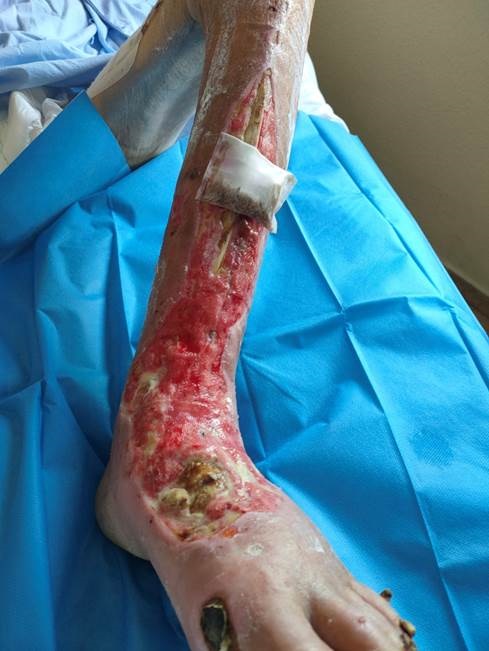
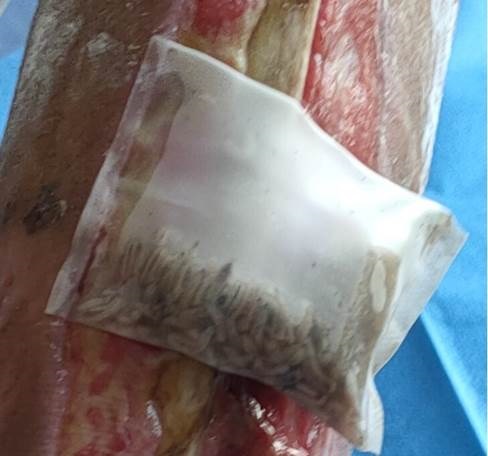
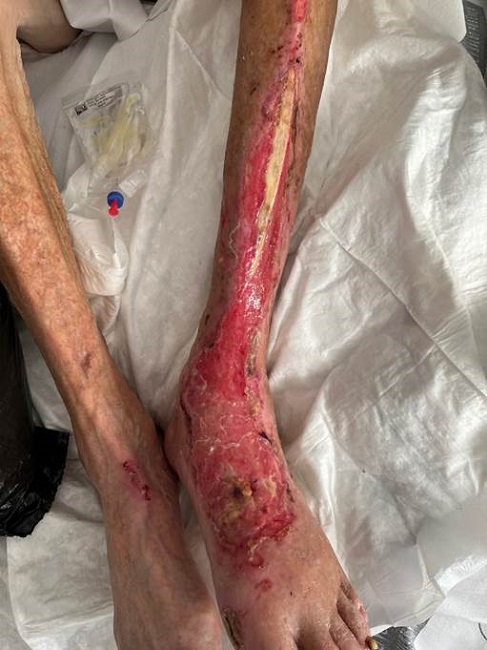
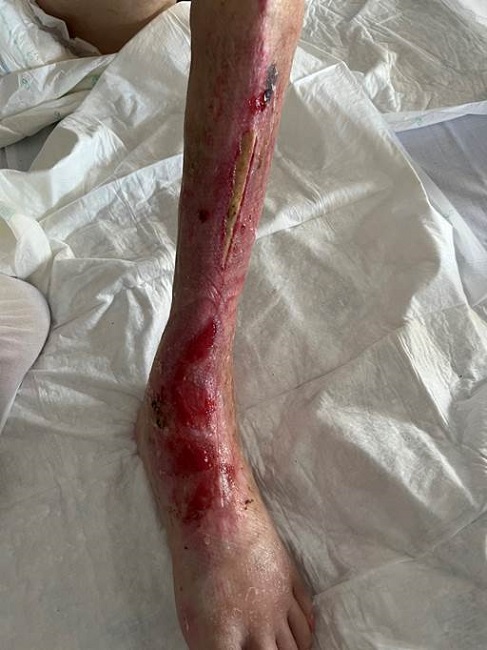
Antibiotics were associated in line with the culture antibiogram (tazocel is the most widely used one), with good evolution until the ulcer, which occupied the entire anterior face of the leg to the base of the toes, was clean, with good highly superficial granulation tissue: favourable evolution with epithelisation of the edge and progressive granulation of exposed area of bone (Figure 3 [November 2022] and Figure 4 [June 2023]).
FINAL COMMENTS
Larval therapy is a technique for curing ulcers that uses compression with bags containing maggots of the Lucilia sericata fly, the aim being that the maggots cause desquamation and cleaning of the necrotic areas. There are references to this therapy in the Bible1 and it is currently being studied and developed. It is postulated as an adequate therapy for treating major vascular wounds2-5.
In our case, although the patient himself, who was affected by confusional syndrome, was the causative factor that led to the treatment being interrupted (there are descriptions that it produces local dysesthesia and a sensation of heat), the attached images show that after a brief period of application of the maggots6, the result was very successful for the revascularisation and debridement of a large ulcer with bone exposure.

