




 Servicios personalizados
 Inglés (pdf)
 Articulo en XML
 Referencias del artículo
 Traducción automática
 Enviar articulo por email
 Citado por SciELO
  Citado por Google
  Similares en
SciELO
Similares en
SciELO  Similares en Google
 Permalink
KEY MESSAGES
White bread with a 20% substitution of cassava flour fermented dough has a higher protein and lipid content, as well as a lower amount of carbohydrates in its nutritional composition than commercial bread.
The glycemic index of the white bread in the study on average is classified as low
Although the classification of the index is maintained when analyzed by gender, variations occur, showing higher values in men than in women.
The use of sourdough based on cassava flour as a substitute is favorable for achieving a low glycemic index.
INTRODUCTION
The glycemic index (GI) is defined as the comparison of the area under the glycemic response curve following the ingestion of a single food. The higher this index, the greater the ease and speed with which glucose from the food is digested and absorbed. Literature reveals that the consumption of low-GI foods provides health benefits; therefore, researchers seek to modify the GI of staple foods arround the world, with bread being one of the most significant staple foods1,2.
Bread is the most consumed cereal-based food worldwide, typically made from wheat flour (WF) with a GI ranging from moderate to high. However, the approach has emerged to use non-traditional flour sources that are resilient to changing climate conditions, are more cost-effective, and contribute to enhancing food security for the population. One such example is the use of cassava tubers3,4.
Cassava or Manihot, is a high-yielding drought-resistant crop considered a staple food as it serves as a subsistence crop. Its use in the form of cassava flour (CF) has garnered interest due to its excellent stability, extraordinary thickening capacity, and lower retrogradation and gelatinization indices. Previously, the use of CF has been described as a partial substitute for baked products based on WF, Okafor et al. in 20185, and its evaluation of GI in bar-type breads with different levels of substitution resulted in a GI range of 91-94, which is higher than the average. However, a viable approach related to reducing the GI and improving the properties of baked products is the fermentation of the dough6-8.
Fermentation of dough provides several benefits, including improvement in the aroma, flavor, texture, shelf life, an increase in short-chain essential fatty acids (SCFA) and a reduction in GI in the baked product9,10. The use of non-traditional flour sources as a base in obtaining fermented dough as a partial substitute for recipes using WF can be encouraging for the innovation of staple products, making use of accessible and cost-effective crops. Therefore, the objective of this research was to evaluate the GI of a white bread with partial substitution of 20% CF sourdough to classify its impact on apparently healthy volunteers.
METHODOLOGY
This project underwent review by the institutional scientific ethics committee for scientific development at the Faculty of Chemical Sciences, Universidad Autónoma de Coahuila, and was approved under registration number TDCYTA-20-10-22-1. All volunteers were informed of the protocol orally and through a printed informed consent in compliance with the Sanitary Control of Products and Services Regulation11, the General Health Law Regulation on Health Research12, as well as ISO 26642:201213 pertaining to the protocol for determining the GI. This research employed a quantitative, non-experimental, and cross-sectional descriptive design.
Baked product
The food under study was a white bread with a 20% substitution of cassava fermented dough (CFD) fermented for 32 hours at 36 °C with Lactobacillus plantarum, which was obtained from the reservoir of microorganisms belonging to the Research Department of Food. The bread was obtained under a standard recipe (WF: 320 g, CFD: 80 g, milk: 250 mL, sugar: 15 g, salt: 7 g, unsalted butter: 50 g, instant dry yeast: 12 g) with three kneading cycles, including a 30-minutes rest period between kneading cycles to stimulate autolysis. Subsequently, a nutritional analysis was conducted to determine its bromatological profile: Moisture, ash content, fat content (Soxhlet), protein content (Kjeldahl/conversion factor 6.25), crude fiber content was determined according to the AOAC methods14; total carbohydrate content was determined by difference and Total Sugar Content by Phenol-Sulfuric Acid method described by DuBois15.
Volunteers
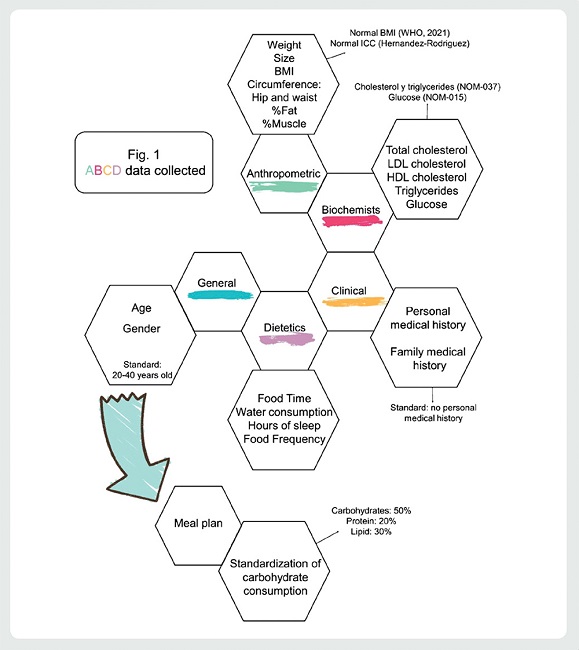
Due to the variability of GI influenced by several factors, of a total of 25 apparently healthy volunteers from the Universidad Autónoma de Coahuila, aged between 20 and 40 years, who participated in this study, only 18 volunteers were selected based on the acquisition and analysis of ABCD data shown in Figure 1. A SD Lipid Care® Analyzer (Brand: SD Biosensor, INC, Elaborado: Kana Undesa S.A. de C.V., México) was used to measure HDL cholesterol, LDL cholesterol, total cholesterol, total triglycerides, and capillary blood glucose levels. Following this, a brief questionnaire about lifestyle changes and physical activity was applied and a 2000 kcal dietary plan was implemented for five days to standardize carbohydrate consumption before the test. On three separate occasions, volunteers were requested to fast for 6-8 hours before each analysis.
GI evaluation
Following the protocol specified by FAO/WHO and ISO13,16, capillary blood samples were taken to obtain glucose levels at 0, 15, 30, 45, 60, 90, and 120 minutes after the consumption of the standard and white bread-cassava. Due to the variations that commercial white bread may have in its nutritional content (raw material and processes), a valued and and stable oral glucose tolerance solution was selected to determine glucose tolerance (Brand: Glucox, Manufactured: Materiales y Abastos Especializados S.A. de C.V., Mexico). The GI was obtained using Equation [1]:
Where: IAUC= Incremental area under the blood glucose response curve.
Statistical analysis
The data obtained from the accepted volunteers for this study was divided into females (F), males (M), and total data (T) to conduct a more in-depth analysis of the collected data. All results are reported as mean values with standard deviation. To determine significant differences (p<0.05), a means comparison was performed using the Tukey test at 95% confidence interval.
RESULTS
Enough white bread was made to use the same batch in all analyses. The nutritional composition of white bread with fermented cassava dough (mentioned as withe bread-cassava in the following) are presented in Table 1, where a very different profile is observed from its commercial version (Protein: 8.2 g/100 g, Lipid: 3 g/100 g and Carbohydrates: 50.4 g/100 g17). Continuing with the analysis of glycemic index, the average age in this study was 27 years, with a predominance of female participants.
Table 1. Nutritional composition (mean±standard deviation) of white bread-cassava.
| g/100 g | |
|---|---|
| Moisture | 31.78±0.97 |
| Ash | 5.22±0.71 |
| Lipids | 10.38±0.02 |
| Protein | 15.17±0.5 |
| Fiber | 0.11±0.007 |
| Total carbohydrates | 37.34±0.86 |
| Total sugars | 9±0.85 |
Anthropometric results, in general, indicate a normal BMI (23.96±3.26 kg/m2). However, M (25.22±3.51 kg/m2) showed slightly abnormal values compared to F (23.61±3.23 kg/m2), primarily due to the average muscle percentage (F: 25.57±2.74%, M: 33.03±5.49%, T: 27.23±4.61%). Likewise, the waist-to-hip ratio (WHR) values fall within the normal range (0.78±0.06). On the other hand, the biochemical results are presented in Table 2, with values within the established standards. These data provide an overview of the volunteers’ health status, classifying them as healty and fit for this study.
Table 2. Biochemical data (mean±standard deviation) related to the previous health status of the volunteers.
| mg/dL | Female | Male | Total | |
|---|---|---|---|---|
| Biochemical data | Triglycerides | 90.7±51.6 | 127.8±39.3 | 98.9±50.6 |
| Total cholesterol | 147±31.3 | 144.8±34.8 | 146.5±31.1 | |
| LDL cholesterol | 86.3±29 | 79±39.2 | 84.6±30.4 | |
| HDL cholesterol | 42.3±8.4 | 40.3±8.2 | 41.8±8.2 | |
| Glucose | 88.4±6.6 | 93±6.4 | 89.4±6.7 |
Clinical and Dietary data reveal interesting insights. In the Personal medical history aspect, it is observed that 67% of the volunteers had experienced COVID-19, and 83% of them changed their habits due to the pandemic. In the Familiar medical history, 72% of the volunteers have family members with type 2 diabetes, 67% hypertension, 39% some type of cancer and 22% hypothyroidism. On the Dietary data, meal timings are quite similar (T: 3±1), and water intake is deficient (T: 1.8 L). In terms of sleep duration, F (8±1.4) sleep 2 hours more on average than M (6±0.5), categorizing them differently in terms of sleep patterns18. The Food frequency reported by the volunteers shows high consumption of both recommended and non-recommended foods according to the ENSANUT CONTINUA 2022 classification. The ABCD data collected and displayed encompass 18 volunteers who passed the biochemical phase and, therefore, had their data included in this part of the study’s statistics.
Primarily, Figure 2 shows the increase in glycemia caused by glucose and white bread-cassava. This phase includes the final group of 15 volunteers who met the requirements on the days of the GI analysis. Each volunteer received a portion of 133.9±0.4 g of bread for the curve. We observed a lower increase in glucose with bread, with a much more prolonged and sustained decline, staying below reference values with glucose.
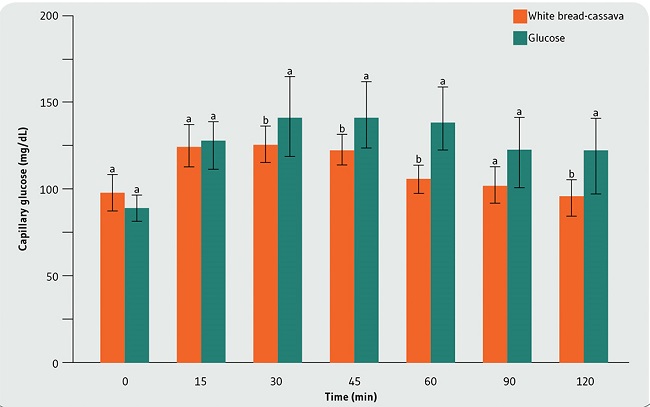
On the other hand, glucose exhibited an intermediate peak that gradually decreased, showing a significant difference from 30 to 60 minutes and again at 120 minutes. On average, a GI of 40 was obtained, classifying it as low, as shown in Table 3.
Table 3. GI of withe bread-cassava.
| n | GI (Glucose=100 g) | Classification1 | |
|---|---|---|---|
| Male | 4 | 52±8.21 a | Low |
| Female | 11 | 36±6.96 a | Low |
| Total | 15 | 40±6.33 a | Low |
1GI High: ≥70; GI Medium: 56 a 69; IG Low: ≤55. Data are expressed as mean±standard deviation.
[a]Values with different letters within the same column are significantly different (p<0.05).
DISCUSSION
The volunteers present an adequate nutritional status, with a high prevalence of diseases in their family medical history and significant changes in their habits, including decreased physical activity and irregular sleep patterns. According to food frequency, the duality presented by the young individuals in their efforts to maintain a healthy lifestyle through good nutrition and the ease of obtaining ready-to-eat products that provide convenience and comfort are part of the new normal. Overall, the withe bread-cassava is in the Low GI classification and this classification remains consistent when separating them by gender, despite variations that may be attributable to various factors, both modifiable and non-modifiable.
Fang et al., 202319, mentions that flour fermentation in general, reduces the GI of bread derived from the production of organic acids and from the important reduction in the digestibility of native starch, also explains that wheat breads with sourdough have low GI, and also mentions that sourdough type II (dough fermented with a starter culture) has advantages such as better control of fermentation parameters and better nutritional properties. Garrido-Galand et al., 202120, concluded that fermenting legume flour enhances techno-functional properties, while fermenting cereal flour increase antioxidant properties. Dough fermentation endows desirable nutritional and rheological properties to baked products, notable properties in cassava-white bread.
Oyeyinka et al., 202021, mentioned that fermentation in cassava is used to improve its functionality, being acid-lactic bacteria responsible for these processes. Longoria et al., 20203, conducted a study using cassava dough fermented with L. casei, concluding that fermentation in short periods improves the rheological properties of non-traditional flour-based products. Penido et al., 201822, concluded that in spontaneous fermentations with bitter cassava, acid-lactic bacteria prevail throughout the process, being L. plantarum one of the species present and with better performance as starter culture. For this reason, selecting L. plantarum, a positive change in the composition of the bread was expected and this is demonstrated in its nutritional profile, very different from traditional white bread.
Is evident that the quality and quantity of carbohydrates in the food are crucial in determining the GI. Additionally, the interactions that starch has with other components affect its availability. Luhovyy et al., 202223, explain that 7 to 10 grams of protein are required to observe a hypoglycemic effect, of course it depends on the type of protein and the overall composition of the food. Additionally, starch can interact with lipids, phytochemicals, proteins, and hydrocolloids, and these mechanisms can interfere with starch metabolism, reducing its availability24-26.
The bread in this project exhibited good rheological properties and a nutritional profile different from the traditional one but with a favorable GI. The bread in this project exhibited good rheological properties and a nutritional profile different from the traditional type but with a favorable GI. These attributes can be attributed to the recipe, the bread-making process, and the addition of fermented cassava dought, which is mainly responsible for the significant increase in protein content and the reduction of total carbohydrates. Okaford et al., 20175, stipulated that the addition of CF to the standard WF white bread recipe produces a high GI, however, in this study it was demonstrated that a previous fermentation with one of the naturally predominant BAL of CF, modifies its nutritional profile due to the decrease of free sugar content, increase of organic acids and reduction of starch digestibility19.
The white bread-cassava, both on average and by gender, is in the classification of low glycemic index, however, although there is no significant difference between them, the difference between the genders is remarkable. After the beginning of the strategy for an adequate reopening of activities of social, educational and economic nature called “The new normality”; the changes and new norms that it brought with it modified the social psyche because according to the National Epidemiologic Risk Symphor, the activities were or were not allowed27. In general, the factors with which the individual interacts have repercussions on the habits and therefore on the state of health in general, which includes metabolism.
Jarvis et al., 202328, decree that experiencing consecutive spikes in glucose levels leads to increased hunger sensations as well as lower mental health and sleep quality. Sleep is one of these factors and is crucial in regulating the endocrine and metabolic systems. Mohammadi et al., 202129, concluded that the duration of sleep does not directly interfere with the GI, however, they found a positive relationship between glycemic load and longer sleep duration. Ayer et al., 202230, conducted a study on adults in Brazil and found that more than half of the population modified the number of meals they consumed, of which 1/3 increased the number of meals. Additionally, the same pattern of increase in recommended and non-recommended food was presented, with a particular rise in the consumption of leafy green vegetables and bakery products. It is interesting to observe the current habits, as although they may be non-specific, they do show a certain relationship with the GI.

