




 Servicios personalizados
 Inglés (pdf)
 Articulo en XML
 Referencias del artículo
 Traducción automática
 Enviar articulo por email
 Citado por SciELO
  Citado por Google
  Similares en
SciELO
Similares en
SciELO  Similares en Google
 Permalink
Highlights
Developed a novel skin hydrating cream with Salvia hispanica seeds and Aloe vera for skin hydration and healing properties.
The formulated cream is also having antioxidant activity.
The formulated moisturizing cream containing Salvia hispanica seed extract and Aloe vera exhibited promising physicochemical and pharmacological properties, confirming its potential as an effective herbal skincare product.
The transepidermal water loss (TEWL) assessment demonstrated the creams efficacy in reducing moisture loss over time.
Introduction
The growing consumer desire for plant-based skincare products has sparked an increased interest in researching the medicinal properties of diverse botanical components. Among these, Salvia hispanica seeds (Salvia hispanica L.) and Aloe vera (Aloe barbadensis Miller) have received a lot of attention for their diverse bioactive components and demonstrated skin health advantages 1. Salvia hispanica seeds, a nutrient-dense superfood, contain high levels of important fatty acids, particularly omega-3, along with antioxidants, vitamins, and minerals, all of which have proven to aid in skin barrier function, hydration, and healing. External stimuli constantly subject the skin, the largest organ in the human body, to dryness, irritation, and damage. As a result, formulations that provide hydration, healing, and anti-inflammatory benefits are in high demand 2. Combining Salvia hispanica seed extract and Aloe vera cream provides a unique opportunity to create a multifunctional formulation that tackles these common skin issues while taking advantage of the synergistic effects of both components 3.
Salvia hispanica seeds contain polysaccharides that, when moistened, produce a cream-like structure, increasing the skin’s water retention capacity, while antioxidants protect the skin from oxidative stress. Aloe vera, recognized for its high vitamin, enzyme, and amino acid content, not only hydrates but also speeds up wound healing by encouraging cell regeneration and lowering inflammation. When combined, these components may provide an herbal and effective treatment for enhancing skin hydration, reducing inflammation, and boosting skin restoration 4.
The purpose of this study is to develope and evaluates cream based on Salvia hispanica seeds and Aloe vera, with a focus on skin hydration and healing characteristics. Authors conducted in vitro tests to analyse the physicochemical properties, stability, and efficacy of the formulation. This study adds to the expanding amount of information supporting plant-based skincare formulations and their potential role in improving skin health through herbal and sustainable methods 5,6.
Methods
Materials
Material
Salvia hispanica seeds procured from the sudarshan scientific, Nashik, India and Authenticated by the HH Sri Sri Murlidhara Swamiji College of Horticulture, Malegaon, Nashik, India (Ref. No MGV/HHSSMSCOH/410/2024-25). All required solvents and procured from the Locha Chem, India. Aloe vera is collected from the medicinal garden and authenticated by the Department of Pharmacognosy, SSS’s Divine College of Pharmacy in Satana, Nashik (India) (Ref. No DCOP/PG/004/2023-24, Dated 20/02/2023 and GPS Location https://maps.app.goo.gl/LicmfoiGtqqAUNTn6)
Procedure
Extraction for Salvia hispánica Mucilage
Clean the seeds with a fine sieve or distilled water. Dry them in air before using. Weigh 10 g of chia seeds for soaking. Stir gently and let the seeds soak at room temperature for 2-4 h to hydrate and expand the mucilage. After soaking, gently stir the mixture with a manual stirrer to separate the mucilage from the seed. To remove seed husks from mucilage, filter the mixture through a fine mesh sieve, cheese cloth, or muslin cloth. Refilter as needed to increase clarity. Heat the mucilage extract in a water bath or pan on low heat (40-50°C) to reduce water content if it is excessively dilute. Prevent degradation by not overheating. Pre-heat the oven to 40-50°C for drying. To preserve mucilage function, keep the temperature below 50°C. Pour mucilage onto a parchment- or silicone-lined flat drying tray. Spread it thinly to dry evenly. Dry the mucilage on the tray in the oven. Depending on layer thickness and wetness, the process may take 4-8 h. Check occasionally to avoid overheating or drying. When dried and brittle, mucilage is ready. Remove dry mucilage from tray. Use a mortar and pestle or grinder to pulverize it. Store powdered mucilage in an airtight container. Keep cool, dry, and out of direct sunlight and moisture 7,8.
Extraction of Aloe Vera
Run water over the leaves of fresh, thick, mature aloe vera to remove dirt and debris. Trim leaf bases and tips. Cut the side spines with a knife. Trimmed leaves should stand upright in a jar for 15-30 min to drain the yellow sap (aloin), which can irritate skin and digestion. Use a knife or peeler to delicately remove the green skin to reveal the clear aloe vera gel. Scrape out the inner gel using a spoon or knife, avoiding skin and sap. Put the gel in a clean container. Add a little distilled water to make it usable. A pinch of activated charcoal can eliminate pollutants and improve clarity. Make a charcoal stove or fire. Put the aloe vera gel mixture in a stainless steel or heat-resistant container over heat. Heat the mixture gently, stirring occasionally. Never boil aloe vera because the beneficial components deteriorate. Heat for 15-20 min below 60°C to preserve characteristics of gel. To remove charcoal and undissolved particulates, filter it through a fine mesh strainer or muslin cloth. Put filtered aloe vera gel in clean, sealed containers. Refrigerate for a week or freeze for longer 9,10.
Phytochemical Evaluation
1.For Identification of Alkaloids
Mayer’s Test: Mix 1 ml of the extract with a few drops of Mayer’s reagent (potassium mercuric iodide). When alkaloids are present, look for a white or creamy precipitate.
Dragendorff’s Test: Mix 1 ml of the extract with a few drops of the reagent (potassium bismuth iodide). A reddish-brown precipítate confirms the presence of alkaloids.
2.For Identification of Carbohydrates
Molisch’s Test: Mix 1 ml of the extract with two to three drops of Molisch’s reagent (α-naphthol in ethanol). Without mixing, carefully place a few drops of strong sulfuric acid around the test tube’s side. A violet ring at the interface indicates the presence of carbohydrates.
3.For Identification of Steroids
Salkowski’s Test: Dissolve a tiny quantity of extract in 2 ml of chloroform. By the tube’s side, add 2 ml of sulfuric acid concentrate. Look for signs of steroids, such as a yellow-green fluorescence and a red hue in the chloroform layer.
4.For Identification of Proteins
Biuret Test: Mix the extract with 1 ml of 1 % copper sulphate (CuSO4) solution and 1 ml of 10 % sodium hydroxide. Mix well, then look for a violet or pinkish tint, which is a sign that proteins are present.
5.For Identification of Phenols
Ferric Chloride Test: Add a few drops of 1 % ferric chloride solution to a tiny amount of the extract. A blue, green, or purple colouring indicates the presence of phenolic chemicals.
6.For Identification of Tannins
Ferric Chloride Test: Mix the extract with a few drops of a 5 % ferric chloride solution. Tannins are indicated by a dark blue or green-black colouring.
7.For Identification of Saponins
Foam Test: For 15 min, vigorously shake 2 ml of the extract with 5 ml of distilled water. Saponins are present if steady foam forms and lasts for 15 to 20 min.
8.For Identification of Flavonoids
The Shinoda Test: Mix 1 ml of the extract with a few magnesium turnings. A few drops of strong hydrochloric acid should be added carefully. Flavonoids are indicated by a pink, orange, or red hue.
9.For Identification of Glycosides
Borntrager’s Test: Bring the extract to a boil with diluted sulfuric acid and then let it cool and strain it. Separate the organic layer by shaking the filtrate after adding an equivalent volume of benzene or chloroform. Apply a solution of ammonia to the organic layer. Glycosides are present when the ammoniacal layer turns pink or crimson.
10.For Identification of Mucilage
Ruthenium Red Test: Mix 1 ml of the extract with a few drops of Ruthenium Red solution. Keep an eye out for any red or pink colouring, which denotes the presence of mucilage (11, 12).
Formulation Table
The foumulation of cream containing Salvia hispanica and Aloe vera described in Table 1.
Table 1 Formulation (F2) of Salvia hispanica and Aloe vera Cream.
| Sr. No | Ingredient | Quantity | Uses |
|---|---|---|---|
| 1 | Aloe vera Cream | 30 ml | Moisturizing and Soothing Agent |
| 2 | Salvia hispanica Mucilage | 10 g | Hydrating, Exfoliating |
| 3 | Shea Butter | 15 g | Emollient |
| 4 | Coconut Oil | 8 ml | Moisturizing, CarierOil |
| 5 | Emulsifying Wax | 5 g | Emulsifier |
| 6 | Glycerin | 10 ml | Humectant, Hydrating Agent |
| 7 | Jojoba Oil | 5 ml | Nourishing |
| 8 | Tea TreeOil | 1 ml | Preservative |
| 9 | Rose Oil | 5 ml | Hydrating |
| 10 | Preservative | 1 g | Preservative |
| 11 | Distilled Water | Q. S | Solvent, Hydration Base |
Manufacturing Process
Phase A (Oil Phase): In a heat-resistant container, combine shea butter (15 g), coconut oil (8 g), jojoba oil (10 g), and emulsifying wax (5 g). Heat gently in a double boiler until completely melted.
Phase B (Water Phase): In a separate container, mix Aloe vera (30 g), glycerine (10 g), and distilled water. Heat this phase to a similar temperature as the oil phase to allow emulsification.
Combine Phases: Slowly add the water phase (Phase B) to the oil phase (Phase A), stirring continuously to form an emulsion. Continue stirring until the mixture cools and thickens.
Add Active Ingredients and Preservatives: Once the emulsion has cooled to 40°C or below, add Chia seed Extract (10 g), tree tea Oil (1 g), rose oils (5 g), and Preservative (1 g). Stir well to ensure all ingredients are evenly dispersed.
Packaging: Transfer the cream into airtight containers and store in a Cool, Dry place. Multiple batches are prepared and stored at room temperature until further use 13,14.
Evaluation Of Moisturizing Cream
Physical Evaluation
a.Color: A visual inspection revealed the cream’s color.
b.Odor: It was discovered that the smell of cream was distinctive.
c.State: A visual examination revealed that the state was cream.
d.Consistency: Cream was manually rubbed on the hand to test the formula’s consistency. The consistency of the cream is smooth.
e.pH: The pH of the cream was measured using a digital pH meter. The cream solution was made with 100 ml of distilled water and allowed to sit for 2 h. Three measurements of the solution pH were made, and the average was calculated.
f.Spredability: Separability is the ability to be separated or divided from something. It can also refer to the state of being disconnected. Better Spredability has been shown by reduced separation times between the two slides.
g.Washability: after applying the formulation to the skin, the ease of washing with water was determined.
h.Non-irritancy test: The formulation of herbal cream was assessed for non-irritancy. There was no redness or irritation in the preparation.
i.Viscosity: Using a Brooke field viscometer set to 25ºC and spindle number 63 at rpm, the viscosity of the cream was measured.
j.Phase separation: A suitable wide-mouth container was used to transfer the manufactured cream. After 24 h, the separation between the oil and aqueous phases was visible and was set away for storage.
k.After feel: The amount of residue and emolliency slipperiness following the application of the prescribed quantity of cream was considered to be satisfactory. Table 2 displays the observation of all parameters 15,16.
Trans Epidermal Water Loss
Clean the testy area with distilled water and let it dry for 30 min. Before testing, mark the test site. Baseline measurement Use the TEWL device to measure baseline water loss before applying the cream. Record at least three consistent readings. Apply a measurement amount of cream allows cream to absorb. Measure TEWL at regular intervals (30 min, 1 h, 2 h) 17.

Pharmacological Evaluation:
Antioxidant Activity
Preparation of Phosphate Buffer Saline (pH 7.4)
To prepare phosphate-buffered saline (PBS) with a pH of 7.4: Dissolve 2.38 g of disodium hydrogen phosphate, 0.19 g of potassium dihydrogen phosphate, and 8.0 g of sodium chloride in sufficient water to make a total volume of 1000 ml. Adjust the pH as necessary to achieve the desired level of 7.4.
Preparation of 40 mM hydrogen peroxide: To prepare a solution, 0.228 ml of hydrogen peroxide (H2O2) is dissolved in 50 ml of phosphate buffer with a pH of 7.4.
Procedure: The study assessment the hydrogen peroxide scavenging ability of newly prepares Salvia hispanica cream using a standard assay. Initially a 40 mM hydrogen peroxide solution was prepared in a 10 % phosphate buffer saline at pH 7.4 different concentration of cream (ranging from 10 to 1000 ppm were dissolved in water and then mixed with the hydrogen peroxide solution. After 10 minutes, the absorbance at 230 nm was measured against blank solution to determine the scavenging activity. Ascorbic acid served as the control standard in this experiment, which were performed in triplicate under dark condition to prevent light induced degradation 18,19. The percentage of hydrogen peroxide scavenged was then calculated using a specific formula.
Results And Discussion
Evaluation of Formulated Cream containing Salvia hispanica and Aloe vera:
Evaluation Parameter of Formulated cream described in Table 2
Table 2 Evaluation Parameter of Formulated cream.
| Sr. No. | Parameter | Observation |
|---|---|---|
| 1 | Appearance | White withgreen tones |
| 2 | Aroma | Sweet and floral |
| 3 | Physical Form | Semi-solid |
| 4 | Texture | Smooth and uniform |
| 5 | Spredability | 7.5 g.cm/s |
| 6 | Ease of Washing | Easilywashable |
| 7 | Post-Application Feel | Leaves an emollient effect |
| 8 | pH Value | 5.5 |
| 9 | Irritancy Assessment | Non-irritating |
| 10 | Phase Stability | No separation observed |
| 11 | Viscosity | 10,500 Pa |
The cream composed of Aloe vera cream and Salvia hispanica seed mucilage, showed a semi-solid state with a smooth, emollient after-feel. The pH of the cream was measured at 5.5, ensuring its compatibility with skin pH. The Spredability was found to be 7.5 g/cm, indicating good ease of application. No phase separation was observed, indicating a stable emulsion. The non-irritancy test confirmed that the cream is safe for topical use, showing no signs of redness or irritation. The cream was easy to wash off, and its viscosity 10500 Pa, tested using a Brookfield viscometer, supported the semi-solid consistency and smooth application.
Physicochemical and Phytochemical evaluation of Salvia hispanica Mucilage and Aloe vera cream
Table 3 Physicochemical and Phytochemical evaluation of Salvia hispanica Mucilage and Aloe vera cream.
| Sr. No | Parameter | Observation | |
|---|---|---|---|
| Salvia hispanica Mucilage | Aloe vera cream | ||
| 1 | Colour | Greyish White | White Transparent |
| 2 | Test | Mucilaginous | Better |
| 3 | Odour | Odourless | Odourless |
| 4 | Appearance | Flaky Appearance | Transparent |
| 5 | Solubility | Turbid Solution in Water | Water Soluble |
| 6 | pH | 6 | 5.5 |
| 7 | Test For Alkaloids | + Ve | - |
| 8 | Test For Carbohydrate | + Ve | - |
| 9 | Test For Steroid | +Ve | - Ve |
| 10 | Test For Proteins | + Ve | - |
| 11 | Test For Phenol | - Ve | - |
| 12 | Test For Tannins | + Ve | -Ve |
| 13 | Test For Saponins | - Ve | + Ve |
| 14 | Test For Flavonoid | + Ve | -/+ Ve |
| 15 | Test For Glycoside | + Ve | - Ve |
| 16 | Test For Mucilage | + Ve | - |
| 17 | Test For Terpenoid | - | + Ve |
The Salvia hispanica seed mucilage exhibited a greyish-white colour and flaky appearance. It formed a turbid solution in water and had a pH of 6. The tests for alkaloids, carbohydrates, steroids, proteins, tannins, flavonoids, and glycosides were positive. The negative results for phenols and saponins suggest that the mucilage lacks these secondary metabolites, while the positive tests for mucilage and other phytochemicals confirm its suitability for use in cosmetic formulations.
Aloe vera cream appeared white and transparent, with a pH of 5.5. It was water-soluble and tested positively for terpenoids, tannins, and saponins, while it tested negatively for cardiac glycosides, steroids, and Phlobotannins. Its transparency and chemical properties make it a good candidate for use in moisturizing and hydrating formulations (Table 3).
Trans Epidermal Water Loss
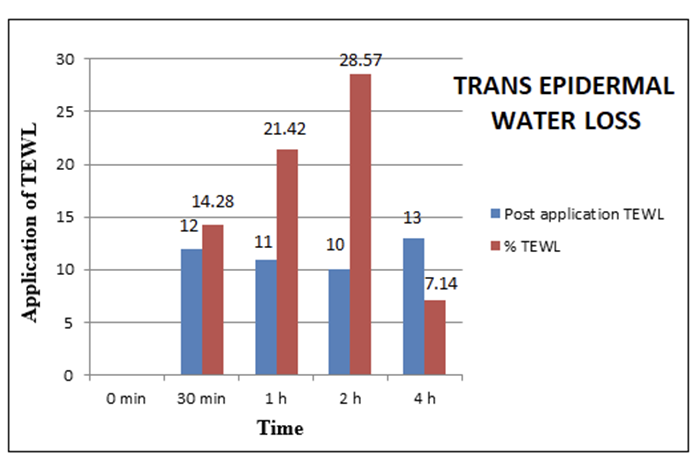
The TEWL Test was performed and the result in table 4 indicated changes in TEWL over a 4 h period after cream application. TEWL the baseline is 14g/m2/h. after 30 min is showing 14.28 %, after 1 h shows 21.42 %, at the 4 h shows 13g/m2/h shown in Figure 1.
Table 4 Result of Trans Epidermal water loss.
| Time | Baseline TEWL | Post application TEWL | % TEWL | SD | SE | P value |
|---|---|---|---|---|---|---|
| 0 min | 14 | - | - | - | - | - |
| 30 min | - | 12 | 14.28 | 1 | 0.5774 | 0.0742 |
| 1 h | - | 11 | 21.42 | 1 | 0.5774 | 0.0351 |
| 2 h | - | 10 | 28.57 | 1 | 0.5774 | 0.0202 |
| 4 h | - | 13 | 7.14 | 1 | 0.5774 | 0.2254 |
Pharmacological Evaluation
Antioxidant Activity
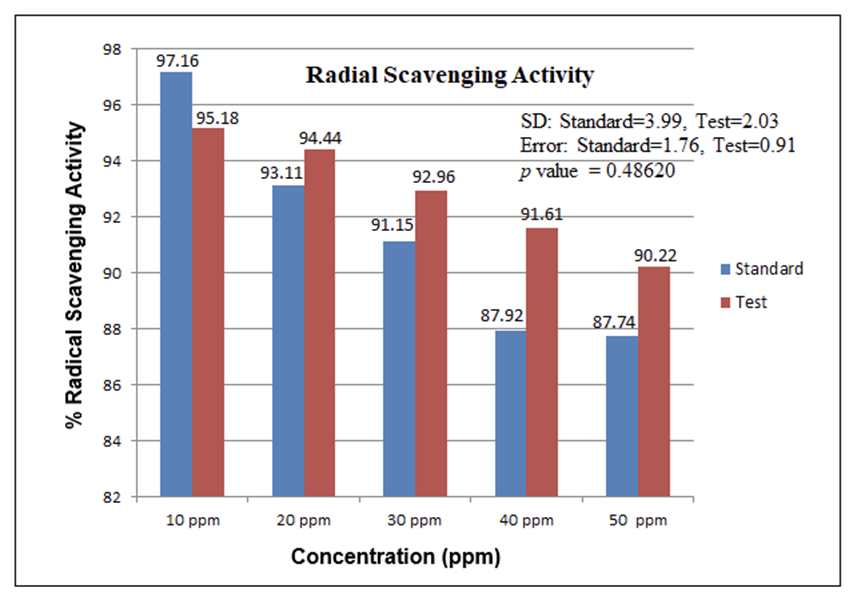
The absorbance values and percentage inhibition data highlight the scavenging activity of the test sample, standard, and control across concentrations. At 10 ppm, the test sample showed 95.18 % scavenging activity, closely matching the standard’s 97.16 %. Both exhibited a decline in inhibition at higher concentrations, with the test sample showing 90.22 % at 50 ppm and the standard 87.74 %. These results indicate the test sample having strong and consistent scavenging potential, nearly comparable to the standard across all concentrations (Table 5 and figure 2).
Table 5 Effect of component on Radial scavenging Activity.
| Concentration | Absorbance | % Scavenging Activity | ||||
| Control | Standard | Test | Control | Standard | Test | |
| 10 ppm | 5.043 | 0.143 | 0.243 | 0 | 97.16 | 95.18 |
| 20 ppm | 5.043 | 0.347 | 0.280 | 0 | 93.11 | 94.44 |
| 30 ppm | 5.043 | 0.446 | 0.355 | 0 | 91.15 | 92.96 |
| 40 ppm | 5.043 | 0.609 | 0.423 | 0 | 87.92 | 91.61 |
| 50 ppm | 5.043 | 0.618 | 0.493 | 0 | 87.74 | 90.22 |
Discussion
Zia-ud et al., (2021) reported that chia seeds are nutritious and healthy. They include antioxidant phytochemicals that reduce cholinesterase and may prevent neurodegenerative diseases. Minerals, omega-3s, fibers, and proteins in seeds boost skeletal muscle insulin sensitivity and lipid metabolism. Chia seeds boost omega-3s and lower saturated fat, which are essential for a balanced diet. The high fiber content of chia seeds can prevent many diseases. Products with chia seeds may be healthier and more functional 20,21.
In this study, the formulated moisturizing cream containing Salvia hispanica seed extract and Aloe vera exhibited promising physicochemical and pharmacological properties, confirming its potential as an effective herbal skincare product. The physical evaluation demonstrated that the cream possessed a semi-solid consistency with a smooth texture, a sweet and floral aroma, and an emollient after-feel. The pH value of 5.5 aligns well with the natural pH of the skin, ensuring compatibility and minimizing the risk of irritation. The ease of washing and absence of phase separation further indicate good formulation stability, an essential attribute for commercial skincare products. The viscosity of 10,500 Pa supports the cream semi-solid state, which facilitates uniform application and absorption.
The phytochemical analysis of Aloe vera cream confirmed the presence of beneficial compounds such as terpenoids, tannins, and saponins, which contribute to its soothing and moisturizing effects. The physicochemical characterization of Salvia hispanica mucilage revealed a greyish-white, flaky appearance with mucilaginous properties. It formed a turbid solution in water and exhibited a pH of 6, making it compatible with the skin.
The trans-epidermal water loss (TEWL) assessment demonstrated the cream’s efficacy in reducing moisture loss over time. At baseline, TEWL was recorded at 14 g/m²/h, which decreased significantly after application, reaching 10 g/m²/h at the 2 h mark. This reduction indicates enhanced skin hydration, which is a crucial parameter for an effective moisturizing cream. The statistical analysis further supported the significance of the observed changes, with p values confirming the reliability of the results.
The antioxidant activity of the cream, assessed through its radical scavenging activity, indicated that it had strong free radical neutralization potential. The test sample showed 95.18 % scavenging activity at 10 ppm, which was comparable to the standard (97.16 %). Even at higher concentrations, the test formulation maintained substantial antioxidant potential, with 90.22 % scavenging activity at 50 ppm. This demonstrates the cream’s potential in protecting the skin against oxidative stress, which is a key factor in premature aging and skin damage.
Conclusion
The research shows that both Salvia hispanica and aloe vera are powerful natural ingredients. The physicochemical tests indicated that chia seed extract forms a turbid solution in water and has a relatively low pH, indicating its potential for skin-care applications. The cream formulation, which combined chia seed mucilage and aloe vera, demonstrated excellent physical properties with a smooth consistency, emollient after-feel, and stability under different conditions. The pH of cream was measured at 6, which is compatible with the skin’s natural pH. In pharmacological evaluations, the cream exhibited promising antioxidant activity. The cream closely matched the standard antioxidant in the antioxidant test, exhibiting a scavenging activity of 95.18 % at 10 ppm.

