




 Servicios personalizados
 Inglés (pdf)
 Articulo en XML
 Referencias del artículo
 Traducción automática
 Enviar articulo por email
 Citado por SciELO
  Citado por Google
  Similares en
SciELO
Similares en
SciELO  Similares en Google
 Permalink
Highlights
Stiripentol is recommended to treat Dravets syndrome in infants. In market it is available as capsule and powder for reconstitution which is not convenient for administration in infants.
It belongs to BCS class II; hence solution formulation is difficult to develop. The suspension formulation of the drug was developed for ease of administration.
Different formulations were prepared and optimized formulation was selected on the basis of drug release. Optimized formulation was found stable and suitable for oral administration.
Introduction
Epilepsy is the most common, heterogeneous neurological disorder; globally around five million individuals are diagnosed each year. Unpredictable and re-current interruptions of normal brain functions characterize it. It results from the imbalance between excitatory and inhibitory neurotransmitters within certain central nervous system regions (CNS). It is associated with psychological comorbidity, mild degree of convulsions and short-term loss of consciousness. The risk of premature death in epileptic patients is up to three times higher than common population 1. It might be a result of genetics, brain tumor, brain injury, bacterial or viral meningitis/viral encephalitis, stroke etc. Epilepsy requires prolonged treatment that might be extended to the patient’s entire life. Despite inventive approaches to seizure control, administration of antiepileptic drugs remains integral 2. Various antiepileptic drugs such as have been used to treat epilepsy. Depending on the type of seizure various antiepileptic drugs are available to treat epilepsy such as valproic acid, lamotrigine, phenytoin, carbamazepine. Among them, stiripentol is a novel orally active antiepileptic drug structurally dissimilar to other antiepileptics and exhibits both in-direct and direct anticonvulsant activity. It stimulates ɤ- amino butyric acid (GABA) transmission by augmenting its release, restricts synaptosomal uptake and hinders GABA transaminase-mediated degradation of GABA. It has been approved by the European Medicines Agency (EMEA) in 2008 as an adjuvant therapy with clobazam and valproate to treat Dravet’s syndrome. It is used as adjuvant therapy in combination with other antiepileptics as it also exhibits the potential to restrict cytochrome P450 3. The anticonvulsant activity of stiripentol is age-dependent and it was found more effective in younger kids 4. Chiron et al. (2023) have reported real-world retrospective study regarding effectiveness of stiripentol before 2 year of age in patients with Dravet syndrome. Stiripentol was introduced alongside valproate and clobazam in 93 % of cases at the age of 13 months, with a median dosage of 50 mg/kg per day. They have concluded that stiripentol treatment is both safe and advantageous, leading to a substantial decrease in prolonged seizures, such as status epilepticus, as well as a reduction in hospital admissions and mortality rates during the crucial early years of life 5. Wheless and Weatherspoon (2025) overviewed stiripentol in detail with respect to mechanism, efficacy, side effects and tolerability, prescribing and dosing consideration, combined therapy with stiripentol 6.
Currently, 205 mg and 500 mg capsules and powder for reconstitution of stiripentol are available in the market. For ease of consumption in pediatrics or infants, it is utmost necessary to develop an oral liquid formulation of stiripentol. The current research work was focused on the development of stable oral suspension of stiripentol.
Material and methods
Material
Stiripentol was purchased from Nuray Chemicals Pvt Ltd., India, Sodium Lauryl Sulphate was obtained from BASF India Ltd, Methyl Paraben, Sucralose, Citric acid monohydrate and Aspartame were procured from Merck Life Science Pvt Ltd., Sodium Carmellose was purchased from Ashland India Pvt, Veegum K was obtained from Vanderbilt Minerals, LLC. Sodium Citrate was obtained from Finar Limited, India. Lemon Flavour was procured from FONA International Inc. All other materials, reagents and chemicals used were of analytical grade.
Methods
Drug-excipient compatibility study by FTIR
The spectra of stiripentol, physical mixture of stiripentol and excipients were recorded by FTIR equipment (Apha Bruker, Germany) using an attenuated total reflectance (ATR) accessory 7. For this purpose, drug-excipient mixtures dry (excipients mixed in a 1:1 ratio) were packed in glass vials, stoppered with a butyl rubber stopper and sealed with aluminium caps. These packed samples were then exposed to 60 °C and 40 °C/ 75 % RH for 30 days. Then samples were withdrawn and scanned by FTIR and analysed for visual appearance. Single spectra of each sample were collected in wavelength range from 4000 to 400 cm-1 by averaging 10 scans at a resolution of 4 cm-1.
Formulation of suspensión
Different formulations were prepared by varying the amount of sodium lauryl sulphate, crosscarmallose sodium and Veegum as listed in Table 1. All materials were weighed accurately using a calibrated weighing balance (Sartorious MCA225P-20IN-U-QP1, Germany) and shifted through a 30 # sieve using a vibratory shifter (S.S. Engineering Works, India).
Preparation of suspending and thickening agent dispersión
Veegum K and carmellose sodium were added in a sufficient quantity of purified water and stirred at 3500 rpm by homogenizer (Remi, India) for 180 min to generate smooth slurry (Solution A).
Preparation of preservative solution
Purified water was heated up to a temperature of 70 °C to 80 °C and methyl paraben was added in heated water under continuous stirring till a clear solution was obtained. Solution was cooled up to 50 °C to 60 °C and glycerol was added with continuous stirring. The resulting solution was added in solution A and stirring was continued for 30 min.
Preparation of buffering solution
Citric acid monohydrate and trisodium citrate dihydrate were dissolved in purified water to form a clear solution. This buffering solution was added to solution A and stirred for 30 min.
Preparation of stiripentol dispersión
An accurately weighed quantity of sodium lauryl sulfate was dissolved in water slowly with stirring at a slow speed to generate clear solution. Stiripentol was slowly added to this solution with constant stirring at 2000 rpm for 60 min to ensure complete wetting. Prepared dispersion was incorporated in solution A with stirring at 2500 rpm for 120 min. Sucrose, aspartame, sucralose, and lemon flavour were added to bulk dispersion and continuously stirred for 10 min. The pH of the formulation was checked. Purified water was added to attain final bulk volume and dispersion was homogenized at 2000 rpm.
Table 1: Formulation of suspension/ 5 ml.
| Ingredients (mg) | F1 | F2 | F3 | F4 | F5 | F6 | F7 | F8 | F9 |
|---|---|---|---|---|---|---|---|---|---|
| Stiripentol | 30 | 30 | 30 | 30 | 30 | 30 | 30 | 30 | 30 |
| Sodium lauryl sulphate | 0.110 | 0.110 | 0.075 | 0.038 | 0.038 | 0.038 | 0.110 | 0.110 | 0.038 |
| Methyl paraben | 0.3 | 0.3 | 0.3 | 0.3 | 0.3 | 0.3 | 0.3 | 0.3 | 0.3 |
| Glycerol | 30 | 30 | 30 | 30 | 30 | 30 | 30 | 30 | 30 |
| Carmellose sodium | 0.075 | 0.225 | 0.150 | 0.075 | 0.225 | 0.075 | 0.075 | 0.225 | 0.225 |
| Veegum K | 4.8 | 10.8 | 7.8 | 4.8 | 10.8 | 10.8 | 10.8 | 4.8 | 4.8 |
| Sucrose | 60 | 60 | 60 | 60 | 60 | 60 | 60 | 60 | 60 |
| Aspartame | 0.3 | 0.3 | 0.3 | 0.3 | 0.3 | 0.3 | 0.3 | 0.3 | 0.3 |
| Sucralose | 0.3 | 0.3 | 0.3 | 0.3 | 0.3 | 0.3 | 0.3 | 0.3 | 0.3 |
| Lemon flavour | 0.6 | 0.6 | 0.6 | 0.6 | 0.6 | 0.6 | 0.6 | 0.6 | 0.6 |
| Citric acid | 0.6 | 0.6 | 0.6 | 0.6 | 0.6 | 0.6 | 0.6 | 0.6 | 0.6 |
| Sodium citrate | 3 | 3 | 3 | 3 | 3 | 3 | 3 | 3 | 3 |
| Purified water | q. s. | q. s. | q. s. | q. s. | q. s. | q. s. | q. s. | q. s. | q. s. |
Evaluation of suspensión
Percentage yield of all formulations
Viscosity, pH, sedimentation volume
Viscosity of formulations was determined at 25 °C using Brookfield viscometer and circulating detector (DV2TLVTJO, Brookfield Engineering Laboratories, Germany) at 25 rpm using Spindle SC4-18. pH of stiripentol suspension was determined by pH meter (Orion Star A211, Thermo Scientific Orion, India) at 25 °C temperature 8. Sedimentation volume (F) is the ratio of the final volume of sediment (Vu) to the original volume of sediment (Vo) before settling. The suspension (40 ml) was transferred to 50 ml measuring cylinders and the volume of sediment was noted at 24 h. Sedimentation volume (F), was calculated using the equation (1) 9.
F=(Vu/Vo) (1)
Dissolution study
Drug release of suspension was carried out by using the paddle method specified in USP type II (Paddle Type) dissolution apparatus (Electrolab, India) by using 900 ml of phosphate buffer pH 6.8 and 1 % SLS as dissolution media. A suspension sample (5 ml) was transferred to the bottom of a vessel using a syringe. Paddle speed and bath temperature were set at 75 rpm and 37 ± 0.5 °C respectively. Aliquots (5 ml) were withdrawn at fixed intervals of 5, 10, 15, 30, 45, and 60 min and 5 ml buffer were added after each sample removal to maintain sink conditions. All the samples were analysed by UV-visible spectrophotometer (Shimadzu 1800, Shimadzu Corporation, Japan) at λmax of 265 nm. The dissolution study was conducted in triplicate 10.
Drug release kinetic
The release kinetic of optimized batch was analyzed by different kinetic models to get into insight of probable release mechanism. Zero order kinetic model is given by equation (2), where drug release expected to release independent on concentration.
Mt∕M∞ = kt (2)
Where, Mt is the cumulative released amount at time t, M∞ is the amount of drug released at infnite time, Mt∕M∞ is the percentage of drug released at time t, k is a kinetic constant. First-order kinetic is denoted by equation (3) which represents concentration dependent release.
Ln( Mt∕M∞ ) = kt (3)
Higuchi and Korsemeyer-Peppas model is given by equation (4 and 5), respectively.
Mt∕M∞ = kt1∕2 (4)
Mt∕M∞ = kt (5)
Where, n is the release exponent which indicates the drug release mechanism.
Appearance of optimized batch
Optimized suspension was observed at weekly intervals for 4 weeks for physical changes such as crystal growth, aggregation and caking 9.
Particle size distribution and zeta potential
The size distribution (PDI) of the optimized suspension was measured by Malvern Zetasizer (Malvern Instrument, Malvern, UK). The suspension was diluted 100 folds in deionized water and transferred in a cuvette for analysis at 25°C 11.
Stability study
Stability studies were performed as per International Council for Harmonisation of Technical Requirements for Pharmaceuticals for Human Use (ICH) guidelines. These were conducted at storage conditions at 25 °C/60 % RH (Relative Humidity) and 40 °C/75 % RH for three months 12. At the end of every month optimized formulation was evaluated for release of drug, viscosity and pH.
Results and Discussion
Stiripentol is a crystalline insoluble drug; hence it was formulated as a suspension. Various ingredients used in formulation were selected in the view to maintain stability, palatability and ease of handling. Sodium lauryl sulphate was selected as a surfactant as it is the most frequently used anionic surfactant and functions to reduce surface tension. Carmellose sodium was used as a viscosity-modifying agent, which alters the viscosity and enhances the stability of suspension by hindering sedimentation rate. It is water soluble, anionic, biodegradable, non-toxic and linear polysaccharide of un-hydro glucose. Besides, it is thermostable up to 140˚C, follows Newtonian flow at lower concentration (below 1 %) and non-Newtonian at high concentration (above 1 %). It do not form gelatinous, irreversible gel as that of gums 13. Veegum K (magnesium aluminum silicate) was used as a suspending agent as it improves stability of suspension owing to its colloidal nature. It is having ability to suspend even high density particulate; it enhances re-dispersability and maintains pourability. As it is oral suspension and intended to be used in infants, organoleptic additives are integral. Aspartame, sucrose and sucralose were used as sweetening agent to mask the unpleasant taste or to increase palatability of oral suspension. Orange flavour was used for to enhance their taste and aroma. To maintain the pH of formulation during storage, citric acid monohydrate and sodium citrate were used as buffering agent in suspension.
Fourier transformation infrared spectroscopy (FTIR)
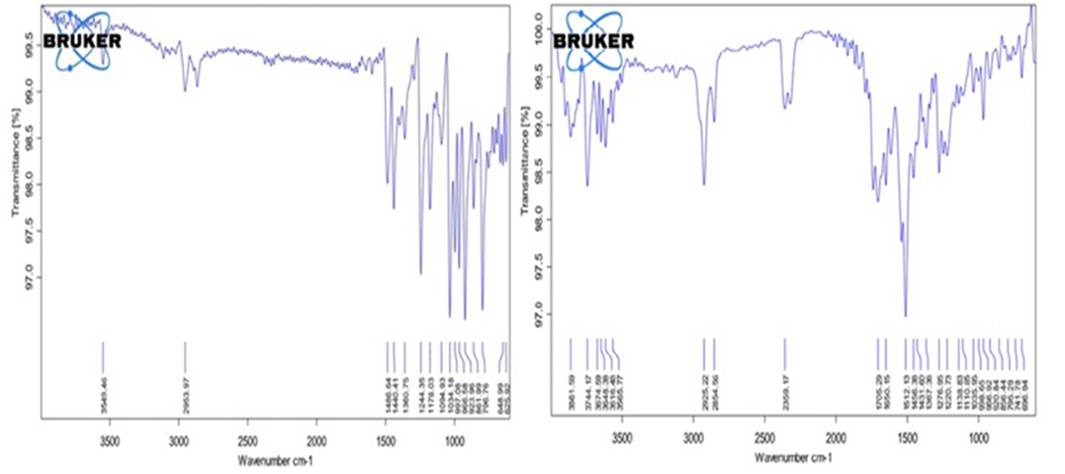
Major functional groups present in stiripentol showed characteristic peaks in FT-IR spectrum (Figure 1). FT-IR spectrum of stiripentol was characterized by a sharp peak at 3549.46 cm−1corresponding to O-H group. Peaks at 2953.97 and 2890.02 cm−1was indicative of H-C = C-H and aliphatic C-H respectively. Peak at 1380.75 and 861.99 cm-1 represented C-H ethyl and CH3 vibrations. Peaks at 1246.35 and 796.76 cm−1 were corresponding to bending vibration of C-H phenyl group. Vibration of CH2-O and C-C phenyl was detected at 1036.16 cm-1. Presence of CH3 vibration was detected at 997.06 cm-1and 923.96 cm-1. FT-IR spectra of physical mixture showed 3661.99 cm-1 corresponding to O-H group, Peaks of H-C = C-H and aliphatic C-H were found at 2925.22 and 2854.96 cm-1 respectively. C-H ethyl and CH3 vibrations were present at 1367.36 and 856.44 cm-1 respectively. Peaks at 1220.73 and 795.29 cm-1 were confirmed bending vibration of C-H phenyl group. Peaks of CH2-O and C-C phenyl vibrations were detected at 1035.95 cm-1. CH3 vibrations were detected at 998.65 cm-1 and 920.64 cm-1. The presence of FT-IR peaks corresponding to stiripentol was indicative of compatibility of drug with added excipients 14.
Physicochemical appearance for drug-excipient compatibility study
Mixtures of drug and excipients were stored at higher temperature and humidity to test the compatibility and examined visually for appearance at the end of one month. List of excipient and ratios along with compatibility study results are summarized in Table 2.
Table 2: Physicochemical appearance for drug-excipient compatibility study.
| Sr. No | Description | Ratio | Initial | 40°C/75 % RH (4 week) | 60°C/75 %RH (4 week) |
|---|---|---|---|---|---|
| 1 | Stiripentol | Stiripentol 500 mg: 0 mg | Off white powder | No significant change | No significant change |
| 2 | Stiripentol: sodium lauryl sulphate | 500 mg:10mg | Off white powder | No significant change | No significant change |
| 3 | Stiripentol: methyl paraben | 500 mg:10 mg | Off white powder | No significant change | No significant change |
| 4 | Stiripentol: glycerol | 500 mg: 1000 mg | Off white powder | No significant change | No significant change |
| 5 | Stiripentol: carmellose sodium | 500 mg:10 mg | Off white powder | No significant change | No significant change |
| 6 | Stiripentol: veegum K | 500 mg: 200 mg | Off white powder | No significant change | No significant change |
| 7 | Stiripentol: sucrose | 500 mg: 2000 mg | Off white powder | No significant change | No significant change |
| 8 | Stiripentol: aspartame | 500 mg:10 mg | Off white powder | No significant change | No significant change |
| 9 | Stiripentol: sucralose | 500 mg:30 mg | Off white powder | No significant change | No significant change |
| 10 | Stiripentol: citric acid monohydrate + sodium citrate | 500 mg:10 mg:50 mg | Off white powder | No significant change | No significant change |
RH= Relative Humidity
No significant changes were observed in appearance of all samples up to period of 30 days when stored at 60 0C and at 40 °C/75 % RH. In addition to FT-IR this test also confirmed the compatibility between drug and excipients.
Viscosity
Key criteria for oral liquids are ease of pourability and inhibition of spillage from the container. Ideally, liquid should not be spilled off during removal from container owing to high fluidity and it should be too thick to pose the difficulty in removal of accurate dose from the container. To accomplish this a shear thinning or pseudoplastic behavior is essential; specifically, the dispersions must exhibit high viscosity when at rest to prevent the sedimentation of drug particles, while simultaneously demonstrating reduced viscosity during agitation to facilitate easy pouring from a container. This criterion can be maintained by modifying viscosity. Viscosity of suspension is also one of the determinants of stability. The viscosity of all formulations was in the range of 22.92 ± 1.2 to 54.8 ± 2.1 cPs (Table 3). The difference in viscosity was solely attributed to the presence of Veegum K. It is composed of three lattice layers of octahedral alumina and two tetrahedral silica sheets which can be separated upon hydration in water. Once, it undergoes hydration weakly positive edges are attracted to negatively charged faces and creates three dimensional colloidal structure that exhibits thixotropic behaviour 15. As concentration of suspending agent Veegum K is highest (10.8 mg) in formulation F2, F5, F6 and F7, more clumpy mass was generated and measurement of viscosity was difficult. These results revealed major impact of suspending agent on viscosity, Formulation F3 showed higher viscosity as it contained a moderate amount of Veegum K (7.8 mg). The ideal pH range of oral formulation is ranged between 3 to 9 16. pH of all formulations ranged from 5.32 ± 1.84 to 6.1 ± 1.16. Results were indicative of an almost neutral pH of formulation that can be well tolerated by body. Comparative profile of pH all batches is given in Table 3. Sedimentation refers to settling of solid particles under gravitation force in liquid at bottom of the container. As it is a suspension formulation, it is very important to check rate of sedimentation owing to basic consideration for suspension stability. Preferably, suspensions should not settle quickly and should maintain uniform and accurate dose. For ideal suspension sedimentation value range is 0.5-1 and value near to 1 denotes better stability 17. Comparative profile of sedimentation volume all batches is given in Table 3. An increase in the concentration of the suspending agent resulted in a corresponding rise in sedimentation volume, which was attributed to enhanced viscosity of medium with rise in concentration that retards the rate of sedimentation. Sedimentation volume of formulation batches was ranged from 0.47 ± 0.06 to 0.96 ± 0.02 at the end of 24 h. Results demonstrate that formulations F1, F4, F8 and F9 exhibited more settling owing to lower concentration of suspending agent. Formulation F2, F3, F5, F6 and F7 revealed good sedimentation volume which was within acceptable limit of 0.5 to 1.
Table 3: Sedimentation volume, pH, and viscosity of all formulations.
| F1 | F2 | F3 | F4 | F5 | F6 | F7 | F8 | F9 | |
| Viscosity (cPs) | 22.92 ± 1.2 | ** | 54.8 ± 2.1 | 33.72 ± 1.8 | ** | ** | ** | 26.58 ± 3.8 | 25.85 ± 4.6 |
| Sedimentation volume (%) | 0.49 ± 0.09 | 0.87 ± 0.02 | 0.85 ± 0.05 | 0.47 ± 0.06 | 0.96 ± 0.02 | 0.87 ± 0.09 | 0.94 ± 0.04 | 0.58 ± 0.02 | 0.65 ± 0.03 |
| pH | 6 ± 1.19 | 5.8 ± 1.26 | 5.5 ± 1.33 | 5.8 ± 2.07 | 6.1 ± 1.16 | 6.01 ± 1.28 | 5.68 ± 1.22 | 5.32 ± 1.84 | 5.67 ± 0.09 |
** Formulations composed of clumpy mass, so determination of viscosity was difficult
In-vitro drug release studies
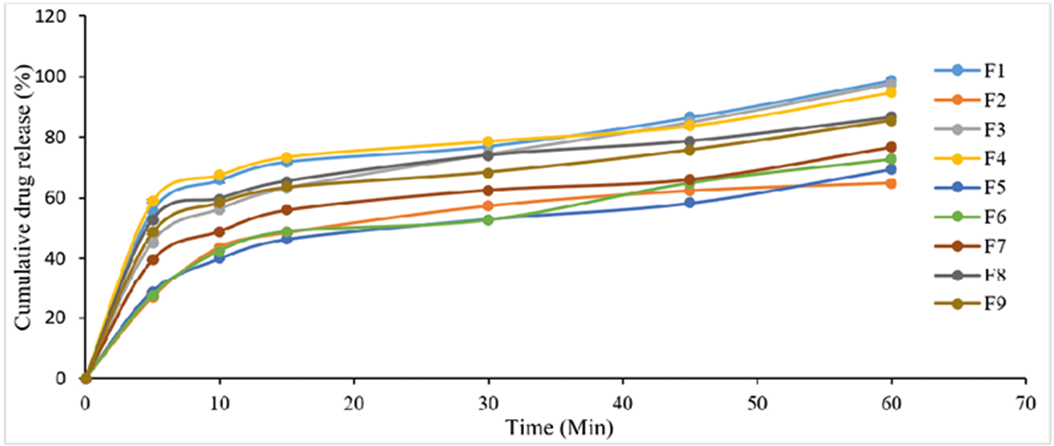
In-vitro drug release studies were performed by using USP type II dissolution apparatus of all formulation (Figure 2). Inverse correlation was found between concentration of suspending agent and drug release. Drug release from various formulations ranged from 64.86 % to 98.56 %. The formulations F1, F4, F8 and F9 having lower concentration of suspending agent showed 98.56 %, 94.75 %, 86.46 % and 85.57 % drug release respectively. While, formulations F2, F5, F6 and F7 having high concentration of suspending agent showed 64.86 %, 69.34 %, 72.65 % and 76.59 % release of drug respectively. Formulation (F3) composed of intermediate concentration of suspending agent showed 97.57 % drug release. Formulation F3 was selected as desirable formulation based on drug release studies.
Drug release kinetic
The optimized formulation was fitted into different kinetic models. R2 value obtained for zero order, first order, Higuchi and Korsemeyer-Peppas were 0.9634, 0.8438, 0.8439 and 0.8149 respectively. These results were indicative of zero order type of drug release.
Appearance of optimized batch
To check any undesirable physical changes, instability and loss of aesthetic appeal optimized suspension (Formulation F3) was observed at weekly intervals for 4 weeks for crystal growth, caking and aggregation. No undesirable physical changes were observed in the optimized formulation. These observations proved that suspension was physically stable and its aesthetic appeal was maintained. It also reflected the correct excipients selection.
Particle size distribution, polydispersity index (PDI) and zeta potential
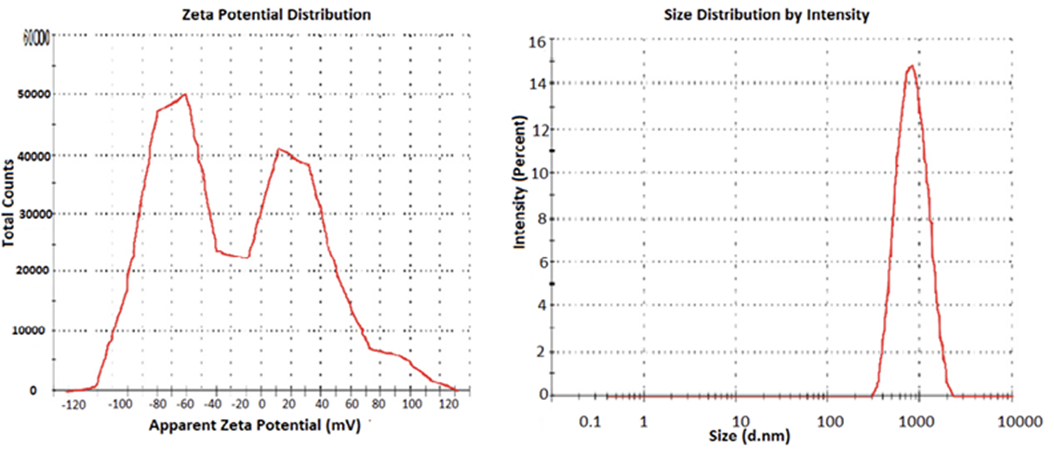
As it is suspension formulation particle size is of crucial importance. It is one of determinant of quality, stability, palatability and bioavailability. Average particle size of suspension was 713.5 ± 2.24 nm. Homogeneity of particle can be computed form value of polydispersity index. It is an indicator of size variation among the disperse system. PDI scale ranging from 0.0-1.0, while values ≤0.1 demonstrate highly monodispersed particles, 0.3 to 0.5 value indicative of moderately monodispersed and value of 0.5 to 1 is regarded as polydispersed particles. For suspension formulation monodispersed particles are recommended. PDI of F3 formulation was 0.198± 3.24, confirmed the uniform particle size throughout the formulation. Charge of the particles was denoted by value of zeta potential. Zeta potential (positive or negative) values have a substantial contribution in stabilizing suspended particles. Similar charges attributed to electrostatic repulsion between particles and ultimately avoids clumping within the suspended solids 18. The obtained value for F3 formulation was -52.1 ± 2.84 mV, depicting a stable system as the values of zeta potential within ± 30 and -30 are not considered to be stable 19. The obtained results were in agreement with research carried out by Adeleke et al. (2020) 20, where researchers reported PDI value of 0.37 ± 0.04 and zeta potential −41.10 ± 5.57 mV for isoniazid reconstitute dry suspension.
Stability study of optimized formulation
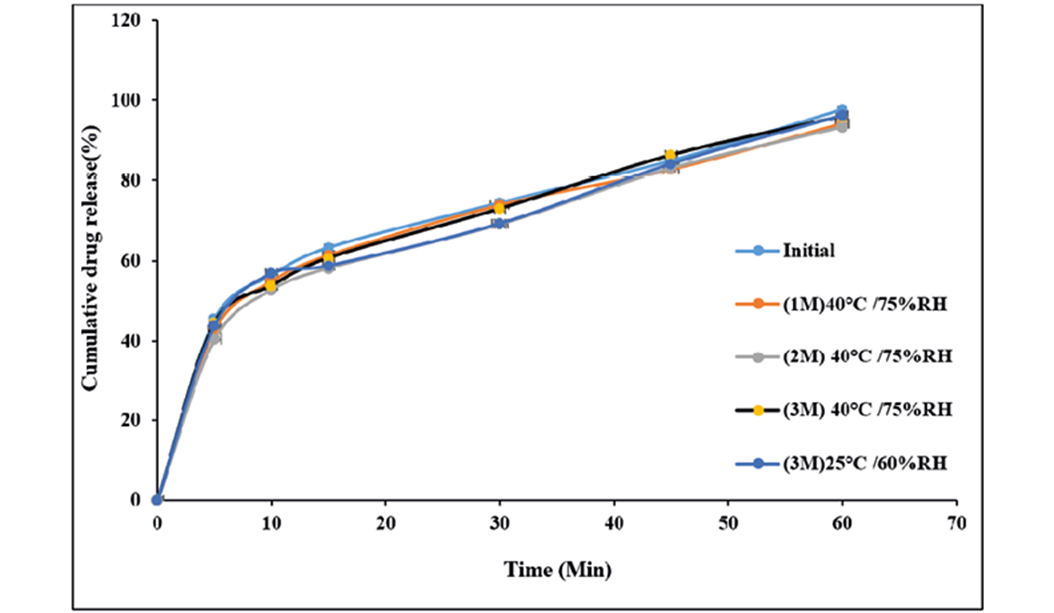
The purpose of stability testing is to provide evidence on how quality of a drug substance or drug product varies with time under influence of a variety of environmental factors such as temperature, humidity and light, and enables recommended storage condition, re-test periods and shelf life to be established. Formulation F3 was studied for stability. F3 was stored at temperature 40 °C/45 % RH and 25 °C/60 % RH for 1 month, 2 month and 3 month. Results obtained from that all were within the limits. There was no significant change in viscosity of suspension as compared to initial values (Table 4). In-vitro drug release obtained at storage conditions at 40 °C/45 % RH after 1 month, 2 month, and 3 month was 94.17 ± 2.28 %, 93.42 ± 3.06 % and 95.94 ± 2.53 % respectively. Whereas, 96.14 ± 2.16 % drug release was observed at storage conditions of 25 °C/60 % RH at the end of 3rd month (Figure 4). pH and viscosity for formulation ranged between 5.6 ± 0.2 to 6.1 ± 0.3 and 54.8 ± 2.13 cPs to 62.79 ± 4.2 cPs respectively. Stability data was indicative of insignificant deviations from initial values 21 .
Table 4: Stability data of optimized batch.
| Parameters | Initial | 40°C /75 %RH | 25°C/60 %RH | ||
| 0M | 1M | 2M | 3M | 3M | |
| pH | 5.6 ± 0.2 | 5.8 ± 0.8 | 6.1 ± 0.3 | 5.8 ± 0.2 | 5.7 ± 0.1 |
| Viscosity (cPs) | 54.8 ± 2.13 | 56.48 ± 3.44 | 62.79 ± 4.2 | 58.31 ± 3.6 | 56.85 ± 3.2 |
*All the readings were carried out in triplicate. RH= Relative Humidity
Photostability study of optimized formulation
Pure stiripentol and optimized formulation was exposed to light and evaluated for appearance, assay and related substance in open condition, closed condition and control sample (Table 5). Appearance of pure drug and optimized formulation was white to beige colour which signifies stability under exposed light. Assay (%) obtained from pure drug and finished product at various conditions was in specified limit i.e., 95 % to 105 %. Related substances such as piperonal impurity, stiripentol stage-1 impurity was not more than 10 %. Any individual unspecified impurity was not detected when directly exposed to light. All overall results obtained from photostability data gives confirmation of stability of optimized formulation at in presence of light.
Table 5: Photostability data of optimized batch (F3).
| Test parameters | Stability product specification | Stiripentol | Finished product | ||||
| Open condition (Petri dish) | Closed Condition (Amber colour vials with stopper) | Control sample (Petridish wrapped with aluminium foil) | Open condition (Direct exposure) transparent Bottle | Closed condition (Amber colour bottle with CRC cap) | Control sample (Wrapped with aluminium foil) | ||
| Appearance | White to beige colour powder | White to beige colour powder | White to beige colour powder | Complies | Complies | Complies | |
| Assay (%) | 95.0 % -105.0 %. | 98.8 | 98.7 | 98.3 | 100.8 | 99.6 | 99.6 |
| Methyl paraben | 80-120 % | - | - | - | 98.8 | 98.0 | 98.2 |
| Related substances (%) | |||||||
| Piperonal impurity | NMT 0.15 % | ND | ND | ND | ND | ND | ND |
| Stiripentol stage-I impurity | NMT 0.15 % | ND | ND | ND | ND | ND | ND |
| Any individual unspecified impurity | NMT 0.10 % | 0.04 | 0.04 | 0.04 | 0.04 | 0.04 | 0.04 |
| Total impurities | NMT 1.0 % | 0.04 | 0.04 | 0.04 | 0.04 | 0.04 | 0.04 |
**ND- Not detected, *NMT- Not more than.
Conclusion
Stiripentol liquid oral suspension is not available in market. Hence, current study was aimed to develop stable liquid suspension. During the development of formulation Veegum K and cross carmellose sodium had major impact on viscosity, sedimentation volume and drug release. Optimized formulation was selected based on optimum viscosity, sedimentation volume and higher drug release. The optimized formulation was stable with uniform particle size. The pH and viscosity of the optimized formulation was suitable for oral administration. The study concluded that stiripentol oral suspension was formulated using a combination of suitable excipients to achieve good stability, uniformity and sustained release of the drug.

