




 Servicios personalizados
 Inglés (pdf)
 Articulo en XML
 Referencias del artículo
 Traducción automática
 Enviar articulo por email
 Citado por SciELO
  Citado por Google
  Similares en
SciELO
Similares en
SciELO  Similares en Google
 Permalink
Highlight
This study evaluates the phytochemical composition and biological activities of selected Fabaceae species, including antioxidant, DNA protection, antidiabetic, anti-leishmanial, and anti-dengue properties.
Sophora mollis, Mucuna pruriens, and Sesbania sesbans exhibited significant bioactivity, with M. pruriens showing the highest antioxidant activity and S. sesbans demonstrating strong anti-leishmanial (82.99 %) and anti-dengue (70.10 ppm LD50) effects.
GC/MS analysis identified 37 bioactive compounds, with 9-octadecenamide (Z) and tetradecanamide predominating. These findings underscore the therapeutic potential of these species, offering a foundation for integrated antiviral, antidiabetic, and antioxidant strategies.
Introduction
Oxygen is an essential component of life. However, excessive production of reactive oxygen species (ROS), such as hydroxyl radical (OH-) and nitric oxide (NO), along with alterations in DNA and protein, may cause oxidative stress 1. If affected cells fail to repair completely, then it may cause chronic diseases like diabetes, Alzheimer’s disease and ageing. The plants can scavenge ROS due to the compounds and antioxidant molecules, including polyphenols that can scavenge free radicals, chelating free metals, thereby protecting the integrity of cell membranes and free-radical mediated oxidative stress2.
Besides these, investigations on the antidiabetic activities of wild plants have also gained considerable attention due to their strong potential as natural antidiabetic agents. 1 As the mechanisms of these diseases are complex, the rate of response of synthetic drugs is low and more likely to cause adverse effects. Hence, it is necessary to explore novel plants for treating such diseases in which immune responses are vital for disease development3.
The Fabaceae family is second to Graminae, with approximately 750 genera and includes various economically and medicinally important flowering plants. In this context, some studies have highlighted the biological significance of Fabaceae species. For instance4 , proposed antimicrobial, hypoglycemic, anti-tumour, antioxidant and anti-Parkinson properties of Mucuna pruriens seed extract. Similarly, Lablab purpureus leaves and flowers treat cholera, diarrhea, nausea, inflammations and uterus inflammation5,6, Pueraria tuberosa and Sesbania sesbans are used in traditional medicines to cure blood and urinary diseases and as cardiotonic, demulcent, anthelmintic, diuretic and galactagogue7,8. Anti-mutagenic effects of P. tuberosa have been described, and 9 flavonoids’ presence has been attributed to them. Furthermore, the authors 10 revealed the antibacterial, cytotoxic, antipyretic, analgesic and anti-tumour potential of different compounds extracted from Sophora mollis.
Hence, the objectives of the current study were to prepare the methanol, methanol-dimethyl sulfoxide (DMSO) and methanol-glycerol extracts of fresh leaves of five Fabaceae species commonly grown in Pakistan. The five species were: M. pruriens, S. sesbans, S. mollis, P. tuberosa and L. purpureus. Subsequently, the phytochemical content, antioxidant, DNA damage protection, anti-diabetic, anti-leishmanial and anti-dengue potential of the selected leaf extracts was determined using standard bioassays. Lastly, the concentration of different hydrocarbons, fatty acids and esters was evaluated using GC/MS method.
Methods
Extracts preparation
Fresh leaves of five selected species were collected and their accession numbers were assigned from the Herbarium of the National Agriculture Research Centre (NARC), Islamabad. The extracts were weighed to determine the extract yield (Table 1).
Table 1 Selected Fabaceae species, their accession numbers, extract yield and acronyms.
| Plant species | Accession numbers | Methanol extracts | Methanol-DMSO extracts | Methanol-Glycerol extracts | |||
|---|---|---|---|---|---|---|---|
| Yield | Acronym | Yield | Acronym | Yield | Acronym | ||
| Mucuna pruriens (Linn.) DC. | RAW101497 | 24.25 | MPM | 27.10 | MPMD | 50.50 | MPMG |
| Sesbania sesbans (L.) Merrill | RAW101498 | 72.35 | SSM | 43.65 | SSMD | 97.40 | SSMG |
| Sophora mollis (Royle) Baker | RAW101499 | 29.75 | SMM | 33.00 | SMMD | 72.50 | SMMG |
| Pueraria tuberosa (Roxb.ex Willd.) DC. | RAW101500 | 27.60 | PTM | 39.00 | PTMD | 92.00 | PTMG |
| Lablab purpureus (L.) Sweet | RAW101501 | 31.50 | LPM | 39.75 | LPMD | 72.25 | LPMG |
*DMSO: Dimethyl sulfoxide; The extract yield was measured in percentage (%).
Determination of phytochemicals
For total phenolic contents (TPC), total flavonoid contents (TFC) and total alkaloid contents (TAC), the procedure was the same as the previously reported method(11,12, 13).
Antioxidant assay
In this assay, 0.1 mM DPPH solution was made by adding 3.94 mg of DPPH in 100 mL of methanol, and the absorbance (0.98 ± 0.02) was set at 517 nm. The procedure was followed as per the previously reported method14.
DNA damage protection assay
Briefly, 14 mg of iron sulphate heptahydrate (FeSO4.7H2O) was added to 25 ml of distilled water (dH2O), and 0.2 µg/µl pBR322 plasmid was diluted using 50 mM of phosphate buffer saline (PBS). Then, 3 µl of pBR322 plasmid DNA was added in Fenton reagent and plant extracts, and the volume was made up to 15 µl using dH2O. The reaction mixture was incubated (30 min) at 37 °C, and then 1 % agarose gel was prepared. Subsequently, 5 µl of ethidium bromide (EtBr) was added to the gel and transferred to the gel tank, using 1x Tris-borate EDTA (TBE) as a running buffer. The reaction mixtures (10 µl) were loaded on the gel, and 2 µL of loading dye and electrophoresis were conducted. After 20-30 min, DNA bands were observed under UV light15.
Anti-leishmanial assay
For parasites culture, L. major isolates were obtained from the Department of Zoology, University of Peshawar (Pakistan) and grown in RPMI-1640 culture medium with 10 % heat-inactivated fetal calf serum (HIFCS) in the presence of penicillin and streptomycin solution (100 µg/mL each) at 23 °C. The MTT (3-(4,5-dimethylthiazole-2yl)-2,5-diphenyltetrazolium bromide) assay was done per the previously reported protocol18.
Anti-dengue assay
A. aegypti larvae were collected with an aquatic net and then transferred to the laboratory. The larvae were fed dog biscuits and yeast powder (3:1) and maintained at 28 ± 2 °C. Afterwards, the 4th instar larvae were visually detected by a relatively larger size, and larvicidal activity was performed following the WHO protocol19. Finally, % mortality and LD50 values were determined.
Gas chromatography-mass spectrometry (GCMS) analysis
For GC/MS, 70 µL of plant oil was accumulated by adding 10 grams of powdered plant material in 100 mL of ultrapure dH2O and then performing microwave-assisted hydro-distillation for 40 min. GCMS instrument (Agilent technologies - GC7890B and MS5977A) was equipped with DB-5MS fused capillary column. Various compounds were recognized with the help of NIST and WILEY database20,21.
Results and Discussion
Plant extraction
The polarity of extraction solvents plays a critical role in plants’ biological activities22. In this study, DMSO and glycerol were chosen as green solvents in combination with the strongly polar solvent (methanol) to determine the phytochemicals and biological activities of five species.
Total phenolics, flavonoids and alkaloids content
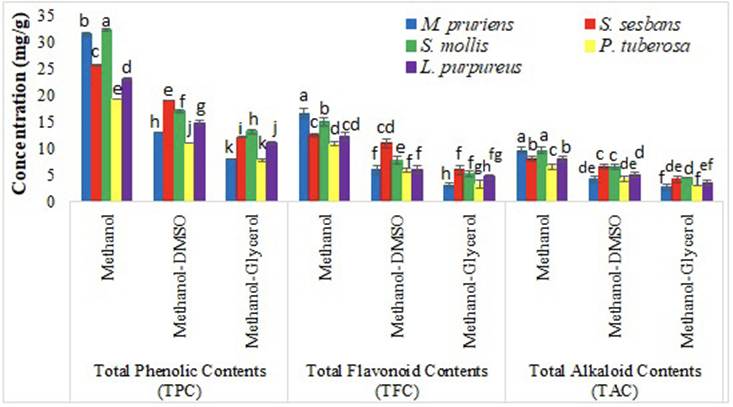
Our study showed a large variation in TPC, TFC and TAC among selected extracts. TPC and TFC were observed highest in S. mollis (32.35 ± 0.19 mg gallic acid equivalent/g and 15.00 ± 0.78 mg rutin equivalent/g) and M. pruriens (31.62 ± 0.22 mg GAE/g and 16.66 ± 0.78 mg RE/g) methanol extracts while lowest in the methanol-glycerol extracts of P. tuberosa (7.75 ± 0.26 mg GAE/g and 3.33 ± 0.78 mg RE/g) and M. pruriens (8.05 ± 0.07 mg GAE/g and 3.05 ± 0.39 mg RE/g) (Figure 1).
Similarly, the highest TAC was also recorded in SMM (9.61 ± 0.54 mg AE/g) and MPM (9.61 ± 0.54 mg AE/g) and lowest in MPMG (2.69 ± 0.54 mg AE/g) and PTMG (3.07 ± 0.00 mg AE/g). However, all phytochemical contents were found in descending order of methanol extracts > methanol-DMSO extracts > methanol-glycerol extracts.
Antioxidant activity
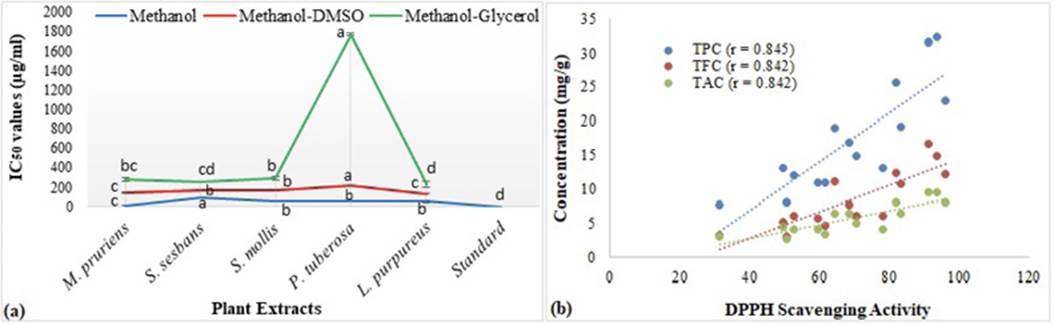
The antioxidant activity revealed DPPH activity in descending order of methanol extracts > methanol-DMSO extracts > methanol-glycerol extracts. The lowest IC50 value was recorded in MPM, i.e. 14.09 ± 3.60 µg/mL, indicating the highest scavenging activity, while the highest IC50 value was found in PTMG, i.e. 1772.66 ± 10.01 µg/mL showing the lowest antioxidant capacity (Figure 2a). The correlation test showed that DPPH activity was strongly correlated with TPC (r = 0.845), TFC (r = 0.842) and TAC (r = 0.842) (Figure 2b). It can be suggested that the DPPH scavenging activity of leaf extracts is directly associated with the concentration of phenolic, flavonoid and alkaloid content in leaves. Similarly, our results are comparable to the other studies that TPC and DPPH activity were 10.96 ± 0.21 mg GAE/g and 61.51 ± 0.33 % in S. sesbans, 2.89 ± 0.01 mg GAE/g and 28.21 ± 1.29 % in L. purpureus and 39.96 ± 0.00 mg GAE/g and 40-60 % in M. pruriens grown in Thailand and India(23, 6).
DNA damage protection assay
In this assay, untreated plasmid expressed two bands while strand scission was observed on treating DNA with Fenton reagent. The gel photographs showed that PTM (3631.88) and SSMD (2050.85) exhibited highest protection, whereas SSM (1283.59), MPM (1088.60), SMM (1044.59), PTMD (886.41) and SSMG (211) possesses lowest protection against oxidative DNA damage, as corroborated by densitometric analysis (Figure 3b). However, all other extracts were found to be ineffective in protecting DNA from damage (Figure 3a). In the current study, methanol extracts protected DNA by scavenging the oxidation products that damage the DNA. It can be inferred that the abundance of TPC, TFC and TAC present in leaves acted directly on the oxidative agents and prevented the chain reaction of oxidative stress which alleviated oxidative damage in the methanol extracts.
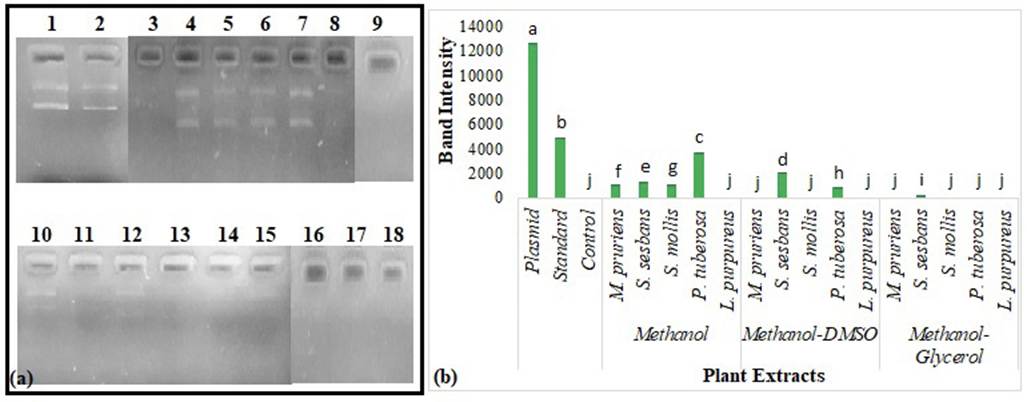
Figure 3 Effects of Fabaceae extracts showing DNA damage protection ability (a) Gel photograph displaying DNA bands (Lane 1: plasmid; Lane 2: plasmid + reagent + standard; Lane 3: plasmid + reagent; Lane 4: plasmid + reagent + MPM; Lane 5: plasmid + reagent + SSM; Lane 6: plasmid + reagent + SMM; Lane 7: plasmid + reagent + PTM; Lane 8: plasmid + reagent + LPM; Lane 9: plasmid + reagent + MPMD; Lane 10: plasmid + reagent + SSMD; Lane 11: plasmid + reagent + SMMD; Lane 12: plasmid + reagent + PTMD; Lane 13: plasmid + reagent + LPMD; Lane 14: plasmid + reagent + MPMG; Lane 15: plasmid + reagent + SSMG; Lane 16: plasmid + reagent + SMMG; Lane 17: plasmid + reagent + PTMG; Lane 18: plasmid + reagent + LPMG) (b) Densitometry calculation of DNA bands.
α-Amylase and α-glucosidase inhibition assays
In current study, α-amylase assay revealed lowest IC50 value in SMM (10.62 ± 7.71 µg/mL) and SSM (17.01 ± 11.94 µg/mL) indicating highest α-amylase inhibition potential (Figure 4a). In α-glucosidase assay, highest activity was recorded in the methanol-glycerol and methanol-DMSO extracts of S. sesbans (i.e. 0.02 ± 0.01 µg/mL and 0.03 ± 0.03 µg/mL IC50 values). In contrast, lowest α-glucosidase inhibitory potential was found in all extracts of P. tuberosa (IC50 values 13.82 to 26.36 µg/mL) (Figure 4c). Comparatively, α-amylase activity was significantly correlated with TPC (r = 0.490) and TFC (r = 0.470) as compared to the TAC (r = 0.394) (Figure 4b). Likewise, α-glucosidase inhibitory activity also depicted moderately positive correlation with TPC (r = 0.497), TFC (r = 0.446) and TAC (r = 0.483) (Figure 4d). The r value of 0.4 indicates a moderately positive correlation but not a stronger one. The results further corroborate previous studies22 that elucidated > 80 % α-glucosidase inhibitory activity in S. sesbans and L. purpureus extracts. Similarly, Gulati et al. 4 documented significantly lower IC50 values for both α-amylase (< 25 µg/mL) and α-glucosidase (< 5 µg/mL) inhibitory activities in M. pruriens grown in Ethiopia.
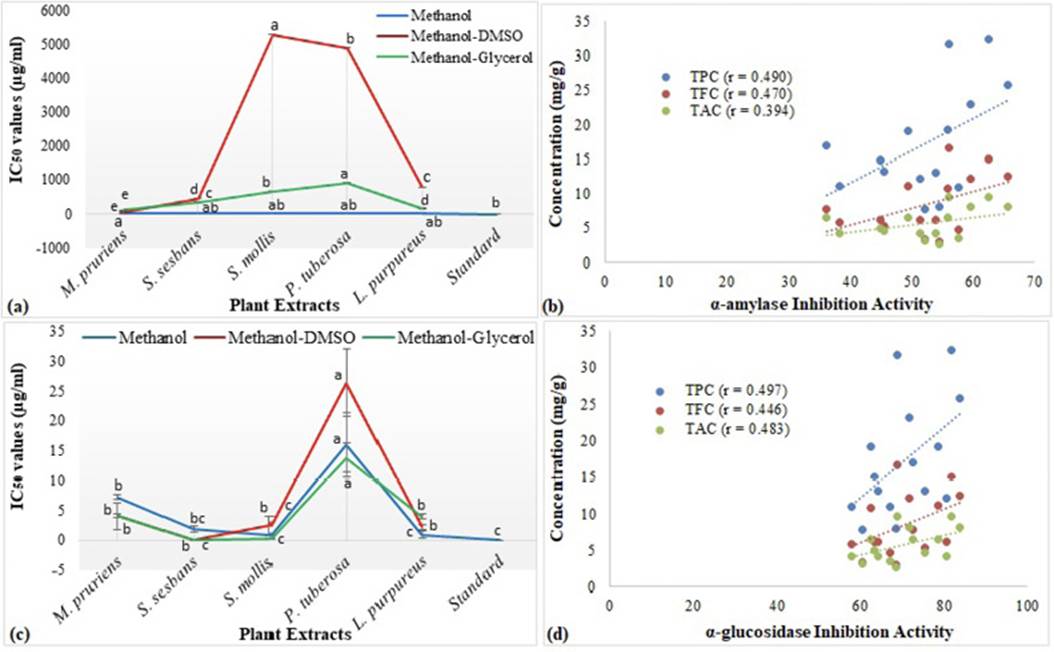
Figure 4 Antidiabetic activity of plant extracts and its correlation with phytochemicals (a) α- amylase inhibition assay (b) Correlation of α- amylase inhibition activity with phytochemicals (c) α- glucosidase inhibition assay (d) Correlation of α- glucosidase inhibition activity with the phytochemicals. * r is correlation coefficient and IC50 stands for half-maximal inhibitory concentration. * Acarbose was used as a standard.
Anti-leishmanial and anti-dengue assays
All examined species showed significant biological activities in their methanol extracts. Hence, the methanol extracts were further tested to examine anti-leishmanial and anti-dengue potential of these species. The anti-leishmanial activity was found in descending order of S. sesbans (82.99 % inhibition) > L. purpureus (69.31 % inhibition) > M. pruriens (68.85 % inhibition) > P. tuberosa (66.92 % inhibition) > S. mollis (36.27 % inhibition) (Table 2). In the anti-dengue assay, only S. sesbans and L. purpureus were found to be effective in controlling the growth of A. aegypti as they displayed LD50 values of 70.10 and 200.00 ppm, respectively (Table 3).
Table 2 Percentage inhibition and IC50 values of methanol leaves extracts as determined in anti-leishmanial activity.
| Plant extracts | Percentage inhibition observed at different concentrations | IC50 values (µg/ml) | ||
|---|---|---|---|---|
| 250 µg/ml | 500 µg/ml | 1000 µg/ml | ||
| M. pruriens | 33.11 | 39.78 | 68.85 | 566.10 |
| S. sesbans | 21.59 | 59.10 | 82.99 | 397.70 |
| S. mollis | 6.99 | 17.74 | 36.27 | 1368.00 |
| P. tuberosa | 25.45 | 40.17 | 66.92 | 617.20 |
| L. purpureus | 21.56 | 49.61 | 69.31 | 514.70 |
*IC50: Half-maximal inhibitory concentration.
Table 3 Larvicidal activity examined against dengue vector Aedes aegypti L. after exposure to the selected methanol extracts.
| Plant Extracts | Percentage mortality at different concentrations (ppm) | R-square | LD50 | 95 % CI | ||
|---|---|---|---|---|---|---|
| 50 | 100 | 200 | ||||
| M. pruriens | 0 | 0 | 0 | - | - | - |
| S. sesbans | 40 | 60 | 80 | 0.99 | 70.10 | 38.62 - 127.24 |
| S. mollis | 0 | 0 | 0 | - | - | - |
| P. tuberosa | 0 | 0 | 0 | - | - | - |
| L. purpureus | 0 | 30 | 50 | 1.00 | 200.00 | 105.37 - 379.60 |
| Standard (Permethrin) | 60 | 80 | 100 | 1.00 | 37.09 | 20.02 - 68.71 |
LD50: Lethal dose; CI: Confidence interval.
Previously24, determined anti-plasmodial flavones from the roots of S. mollis. Hence, the antileishmanial activity of leaves examined in the current study was ineffective in inhibiting leishmanial parasites’ growth. The current study confirmed the parasite inhibitory potential of M. pruriens using L. major promastigotes.
The decreased parasite growth can be ascribed to the increased production of ROS and reduced level of arginase that can be metabolized to nitric oxide (NO), a microbicidal agent responsible for the intracellular parasite removal25.
GC/MS analysis
A total of 37 compounds, viz. hydrocarbons, fatty acids, alcohols, esters and carbohydrates, were identified, and differences in their peak area were observed in the GC/MS chromatograms. Among these, 9-octadecenamide, (Z) and tetradecanamide were found to be dominant compounds ranging from 11.94 to 63.89 % in all species. Similarly, 13-Docosenamide was also present in higher concentration (20.87 %) in L. purpureus only. However, all other compounds were found < 12 % as shown in Table 4.
Table 4 Concentration (%) of compounds observed in five Fabaceae species using GCMS method.
| Names of Compounds | CC | Concentration (%) | ||||
|---|---|---|---|---|---|---|
| M. pruriens | S. sesbans | S. mollis | P. tuberosa | L. purpureus | ||
| α-D-glucopyranoside, methyl | C9 | - | - | 1.68 | - | 10.19 |
| o- Xylene | C4 | - | - | 1.48 | 0.96 | - |
| p-Xylene | C4 | 3.46 | 1.46 | 0.78 | - | 3.76 |
| 1-Cyclohexene, 1-ethynyl | C3 | - | 0.47 | - | - | - |
| 1-Docosene | C3 | - | - | - | - | 0.40 |
| 1-Heptanol, 6-methyl | C7 | - | - | 0.51 | - | 0.69 |
| 2-Amino-5-methylamino-1,3,4-thiadiazole | C4 | - | - | - | - | 1.11 |
| 2-Cyclohexen-1-one, dimethyl- | C3 | - | 0.38 | - | - | - |
| 2-O-Methyl-D-mannopyranosa | C10 | - | - | 1.65 | - | - |
| 2-Pentanol, acetate | C6 | 8.92 | - | 8.03 | 2.46 | - |
| 3-Ethyl-2,6,10-trimethylundecane | C1 | - | - | 1.17 | - | - |
| 5-methyl-5-propyl, Nonane | C1 | - | - | - | - | 0.63 |
| 8-Methylnonanoic acid | C5 | 4.76 | - | - | - | - |
| 9-Octadecenamide, (Z) | C12 | 57.76 | 63.36 | 62.46 | 63.89 | 43.54 |
| 13-Docosenamide | C12 | - | - | - | - | 20.87 |
| 16-Hexadecanoyl hydrazide | C5 | - | - | - | - | 0.03 |
| Acetic acid, hydrazide | C5 | - | 4.14 | - | - | - |
| Bicyclo[2.1.1]hexan-2-ol, 2-ethenyl- | C2 | 10.15 | - | - | - | - |
| Butyric acid hydrazide | C5 | - | - | - | - | 3.75 |
| Carbamodithioic acid, phenyl-, methyl ester | C13 | - | 0.06 | - | - | - |
| cis-11-Eicosenamide | C12 | - | - | - | 12.03 | - |
| Cyclohexane | C2 | - | - | - | - | 1.63 |
| Cyclohexane, 1,1-dimethoxy | C2 | - | 2.09 | 1.51 | - | - |
| Cyclohexanone | C2 | - | 2.39 | 2.30 | 1.66 | - |
| Dodecane, 2,6,10-trimethyl | C1 | - | 0.78 | - | - | - |
| Glycoaldehyde dimer | C10 | - | - | - | - | 0.37 |
| Heptane, 3,4-dimethyl- | C1 | - | - | 0.74 | - | - |
| Hexadecanal | C11 | - | - | 0.86 | - | - |
| Hexadecanoic acid, 15-methyl-, methyl ester | C5 | - | 0.55 | - | - | - |
| Hydrazinecarboxamide | C13 | - | - | 0.71 | - | - |
| Nonane, 3,7-dimethyl- | C1 | - | - | - | 0.39 | - |
| Nonyl chloroformate | C6 | - | 0.38 | - | - | - |
| Oxirane, hexadecyl | C8 | - | - | - | - | 0.84 |
| Pentadecanal | C11 | - | 0.80 | 2.57 | - | - |
| Phenol, 2,4-bis(1,1-dimethylethyl)- | C4 | - | 0.47 | - | - | - |
| Sulfurous acid, hexyl octyl ester | C6 | - | - | - | 1.07 | - |
| Tetradecanamide | C12 | 14.94 | 34.56 | 13.45 | 17.53 | 11.94 |
*Compounds are listed in alphabetical order; CC: Chemical class; C1: Linear alkanes; C2: Cycloalkanes; C3: Unsaturated hydrocarbons; C4: Aromatic/heterocyclic hydrocarbons; C5: Fatty acids; C6: Esters; C7: Alcohols; C8: Cyclic ether; C9: Carbohydrates; C10: Aldehyde; C11: Fatty aldehyde; C12: Fatty amides; C13: Other compounds.
The 9-octadecenamide (Z) is used as a hypolipidemic agent and for treating atherosclerosis, while tetradecanamide is considered for anti-mycobacterial and anti-tubercular activities26. Previously27, proposed anti-leishmanial properties of 13-docosenamide, which have been detected significantly (20.87 %) in L. purpureus leaves. Cis-11-eicosenamide (12.03 %) was detected only in P. tuberosa and hexadecanoic acid-methyl ester was recorded in minor concentration in S. sesbans (0.55 %) only.
Conclusion
The obtained results confirmed that the extracts prepared with green solvents differed significantly in their chemical composition, which is directly related to their biological activities. It can be concluded that the strongly polar i.e. methanol extracts of S. mollis, M. pruriens and S. sesbans exhibited the strongest degree of biological activities due to the presence of the highest amount of phenolic, flavonoid and alkaloid contents. The methanol extract of M. pruriens displayed the highest antioxidant potential, P. tuberosa showed the highest DNA protection ability, and S. sesbans revealed the highest anti-leishmanial and anti-dengue potential. Thus, their methanol extracts could be promising candidates as natural bioactive agents in relevant fields, yet the antidiabetic activities in animal models need to be studied.

