




 Servicios personalizados
 Inglés (pdf)
 Articulo en XML
 Referencias del artículo
 Traducción automática
 Enviar articulo por email
 Citado por SciELO
  Citado por Google
  Similares en
SciELO
Similares en
SciELO  Similares en Google
 Permalink
A 3-month-old male diagnosed with Harlequin ichthyosis was admitted to the Child Protection Center referred from a hospital due to a risky social situation and parental inability to provide the basic and medical care he needs. He is currently receiving dermatological treatment (Acitetrina 5 mg/24 hours orally, barrier and moisturizing cream in the diaper area, and sterilized vaseline all over the body every 3-4 hours), ophthalmological treatment (Thealoz eye drops, single-dose Artific, Lipolac gel and vitalizing Blefarix every 3-4 hours and Hydrosorb dressings while sleep) and daily physiotherapy. He is fed with artificial breastfeeding on demand. The skin condition has improved considerably since birth, evolving towards a phenotype similar to severe congenital ichthyosiform erythroderma, and no ocular lesions have been detected. He is the second child of consanguineous parents (first cousins) originally from Morocco. Healthy 3-year-old sister. He was born preterm (31 weeks) with an adequate weight for gestational age (1,880 grams) after a poorly controlled pregnancy. Apgar test 8/8. In the neonatal period, he was diagnosed and successfully treated for sepsis due to coagulase-negative staphylococcus, invasive aspergillosis, necrotizing enterocolitis, and mild bronchopulmonary dysplasia. At 2 months of age, he was diagnosed with bilateral hearing loss. At the time of admission, the infant presents shiny hyperkeratotic, cracked, peeling, and slightly fissured skin, bilateral ectropion of the upper eyelids, supraciliary madarosis, eclabium, hypoplastic and folded ears, hypoplasia of the nasal bones, and hypoplasia and contracture of the fingers of the hands (Figure 1). Weight, length, and head circumference are 4SD below average for age and sex. The rest of the physical examination is apparently normal. At 4 months of age, he was referred to the emergency hospital due to acute abdomen. He is diagnosed with perforation of the cecum. In the immediate postoperative period, he presented oligoanuria, with progressive clinical worsening in the following 48 hours. He underwent reoperation to rule out new perforation or acute complications, revealing significant ascites and devitalized tissue. In the immediate postoperative period, he presented refractory septic shock with anuria, dying 24 hours later.
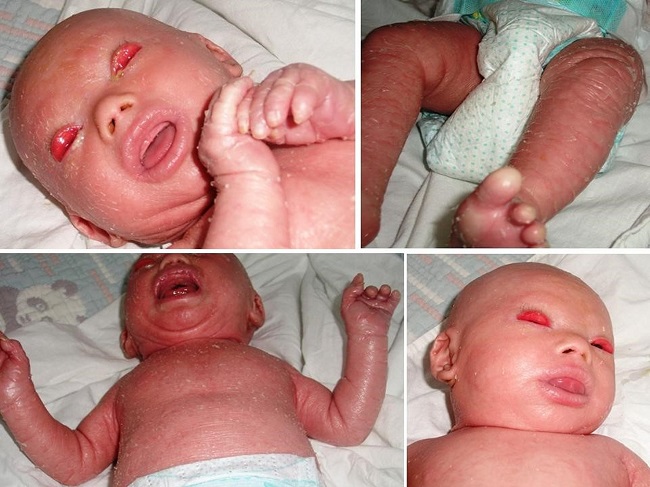
Figure 1: A 3-month-old male affected by Harlequin Ichthyosis was treated from birth with oral retinoid, dermatological and ophthalmological care, and physiotherapy. He presents shiny hyperkeratotic, cracked, peeling, and slightly fissured skin, bilateral ectropion of the upper eyelids, supraciliary madarosis, eclabium, hypoplastic and folded ears, hypoplasia of the nasal bones, and hypoplasia and contracture of the fingers of the hands.
Harlequin ichthyosis is the rarest and most severe form of non-syndromic congenital ichthyosis. This autosomal recessive genetic disorder affects around 1 in 300,000 births, more likely if consanguinity is present, and there is no significant association between sex and race [1, 2]. This condition is caused by loss-of-function mutations in the ABCA12 gene, which is essential for the transportation of lipids required for the skin's barrier function [2, 3]. Newborns with harlequin ichthyosis are characterized by thickened, dry "armor-like" plaques that give an appearance of 'scales' that are separated by deep fissures covering the entire surface of the body. The eyelids may be everted (ectropion), leaving the eyes and the area around them very susceptible to infection. The lips are pulled back by the dry skin (eclabium) giving a fish mouth appearance. The nose and ears may be very poorly developed or absent entirely. Hypoplasia is sometimes found in the fingers [1, 2, 3, 4, 5]. There is no cure for the condition and around half of those affected die within the first few months. The most common causes of death are sepsis and acute respiratory failure due to the plaques. Other complications can include premature birth, problems with body temperature, and dehydration [1, 2, 4]. Improved neonatal intensive care, antibiotics, early treatment with oral retinoids, constant moisturizing and protection of the skin and eyes, and coordinated multidisciplinary management may improve survival and quality of life. Early oral retinoid therapy softens scales, encourages desquamation, and improves the eclabium and ectropion in a matter of weeks [1, 4, 5]. As happened in the present case, children who survive the neonatal period usually evolve to a less severe phenotype, resembling a severe congenital ichthyosiform erythroderma [4, 5].

