<?xml version="1.0" encoding="ISO-8859-1"?><article xmlns:mml="http://www.w3.org/1998/Math/MathML" xmlns:xlink="http://www.w3.org/1999/xlink" xmlns:xsi="http://www.w3.org/2001/XMLSchema-instance">
<front>
<journal-meta>
<journal-id>0212-1611</journal-id>
<journal-title><![CDATA[Nutrición Hospitalaria]]></journal-title>
<abbrev-journal-title><![CDATA[Nutr. Hosp.]]></abbrev-journal-title>
<issn>0212-1611</issn>
<publisher>
<publisher-name><![CDATA[Grupo Arán]]></publisher-name>
</publisher>
</journal-meta>
<article-meta>
<article-id>S0212-16112013000400048</article-id>
<article-id pub-id-type="doi">10.3305/nh.2013.28.4.6609</article-id>
<title-group>
<article-title xml:lang="en"><![CDATA[Nutritional status influences the length of stay and clinical outcomes in hospitalized patients in internal medicine wards]]></article-title>
<article-title xml:lang="es"><![CDATA[El estado nutricional influye en la duración de la estancia y los resultados clínicos en pacientes hospitalizados en las clínicas médicas]]></article-title>
</title-group>
<contrib-group>
<contrib contrib-type="author">
<name>
<surname><![CDATA[Ordoñez]]></surname>
<given-names><![CDATA[Ana Manuela]]></given-names>
</name>
<xref ref-type="aff" rid="A01"/>
</contrib>
<contrib contrib-type="author">
<name>
<surname><![CDATA[Madalozzo Schieferdecker]]></surname>
<given-names><![CDATA[Maria Eliana]]></given-names>
</name>
<xref ref-type="aff" rid="A02"/>
</contrib>
<contrib contrib-type="author">
<name>
<surname><![CDATA[Cestonaro]]></surname>
<given-names><![CDATA[Talita]]></given-names>
</name>
<xref ref-type="aff" rid="A02"/>
</contrib>
<contrib contrib-type="author">
<name>
<surname><![CDATA[Cardoso Neto]]></surname>
<given-names><![CDATA[João]]></given-names>
</name>
<xref ref-type="aff" rid="A03"/>
</contrib>
<contrib contrib-type="author">
<name>
<surname><![CDATA[Ligocki Campos]]></surname>
<given-names><![CDATA[Antônio Carlos]]></given-names>
</name>
<xref ref-type="aff" rid="A04"/>
</contrib>
</contrib-group>
<aff id="A01">
<institution><![CDATA[,Universidad Federal de Paraná Programa de Posgrado en Niños y Adolescente ]]></institution>
<addr-line><![CDATA[ Paraná]]></addr-line>
</aff>
<aff id="A02">
<institution><![CDATA[,Universidad Federal de Paraná Programa de Posgrado en Seguridad Alimentaria ]]></institution>
<addr-line><![CDATA[ Paraná]]></addr-line>
</aff>
<aff id="A03">
<institution><![CDATA[,Universidad Federal de Paraná  ]]></institution>
<addr-line><![CDATA[ Paraná]]></addr-line>
</aff>
<aff id="A04">
<institution><![CDATA[,Universidad Federal de Paraná (UFPR) Programa de Posgrado em Clínica Quirúrgica ]]></institution>
<addr-line><![CDATA[ Paraná]]></addr-line>
<country>Brazil</country>
</aff>
<pub-date pub-type="pub">
<day>00</day>
<month>08</month>
<year>2013</year>
</pub-date>
<pub-date pub-type="epub">
<day>00</day>
<month>08</month>
<year>2013</year>
</pub-date>
<volume>28</volume>
<numero>4</numero>
<fpage>1313</fpage>
<lpage>1320</lpage>
<copyright-statement/>
<copyright-year/>
<self-uri xlink:href="http://scielo.isciii.es/scielo.php?script=sci_arttext&amp;pid=S0212-16112013000400048&amp;lng=en&amp;nrm=iso"></self-uri><self-uri xlink:href="http://scielo.isciii.es/scielo.php?script=sci_abstract&amp;pid=S0212-16112013000400048&amp;lng=en&amp;nrm=iso"></self-uri><self-uri xlink:href="http://scielo.isciii.es/scielo.php?script=sci_pdf&amp;pid=S0212-16112013000400048&amp;lng=en&amp;nrm=iso"></self-uri><abstract abstract-type="short" xml:lang="en"><p><![CDATA[Objective: The aim of this study was to investigate the relationship between the nutritional status (NS) and clinical outcome and length of stay (LOS) among patients admitted to the internal medicine ward. Methods: This is a retrospective observational study performed with the data of clinical patients collected during a one year period. The NS was assessed using: subjective global assessment (SGA), body mass index (BMI), triceps skinfold thickness (TST), muscle arm circumference (MAC) and combined tools. Statistical analysis was performed with a confidence interval of 95% (p < 0.05). For categories comparison the chi-square test was used. To examine the association between length of stay and variables related to the NS Mann-Whitney and Kruskal-Wallis tests was used with multiple comparisons. Results: 396 patients were included in the study, 42.2% were over 60 years of age, what was associated with the presence of hypertension (p < 0.001), diabetes mellitus (p = 0.003) and required diet with modifications consistency (p = 0.003). According to combined diagnostic tools, 45.7% of patients were malnourished. Decreased food intake (p = 0.01), malnutrition according to SGA (p = 0.02) and MAC (p = 0.03) were associated with increased mortality. Patients with tertiary level of care (p = 0.01), decreased food intake (p = 0.001), who died (p = 0.004) and diagnosed with malnutrition by SGA (p = 0.001) and by the combined tools (p = 0.001) had a longer LOS. Conclusions: Patients who were malnourished by SGA and who presented decrease food intake at admission had longer LOS and poorer clinical outcomes (highest number of deaths). The diagnosis of malnutrition by MAC was also related to higher mortality.]]></p></abstract>
<abstract abstract-type="short" xml:lang="es"><p><![CDATA[Objetivo: Vincular el estado nutricional (EN) con la evolución clínica y la duración de la estancia de los pacientes ingresados en las clínicas médicas de un hospital universitario. Métodos: Estudio observacional retrospectivo en el que los datos analíticos se obtuvieron de los pacientes ingresados durante el período de un año. Para la evaluación del EN se utilizaron: la valoración global subjetiva (VGS), el índice de masa corporal (IMC), el pliegue cutáneo triciptal (PCT), la circunferencia muscular del brazo (CMB) y el diagnostico del estado nutricional por la combinación de métodos (VGS, medidas de antropometría y bioquímicas). El análisis estadístico se realizó con el poder de confianza del 95% (p < 0,05). Para las categorías de comparación se utilizó chi-cuadrado. Para examinar la asociación entre la duración de la estancia y variables relacionadas con el EN se utilizaron Mann-Whitney y Kruskal-Wallis con comparaciones múltiples. Resultados: De los 396 sujetos estudiados 57,8% eran adultos. Ser mayor se asoció con la presencia de hipertensión arterial (p <0,001), diabetes mellitus (p = 0,003) y requerir cambios en la consistencia de la dieta (p = 0,003). Al final de la evaluación el 45,7% eran desnutridos. Presentar disminución de la ingesta de alimentos (p = 0,01), malnutrición según el SGA (p = 0,02) y la CMB (p = 0,03) se asoció con mortalidad. Estuvieron más tiempo hospitalizados los pacientes con nivel terciario de atención (p = 0,01), disminución de la ingestión de alimentos (p = 0,001), que murieron (p = 0,004), con un diagnóstico de desnutrición por VGS (p = 0,001) y por la combinación de métodos (p = 0,001). Conclusión: pacientes desnutridos según VGS y con disminución de la ingestión de alimentos al comienzo de la hospitalización se mantuvieron más tiempo en el hospital y tuvieron peores resultados clínicos (mayor número de muertes). El diagnóstico de la desnutrición por CMB también se relacionó con una mayor frecuencia de muertes.]]></p></abstract>
<kwd-group>
<kwd lng="en"><![CDATA[Nutritional status]]></kwd>
<kwd lng="en"><![CDATA[Length of stay]]></kwd>
<kwd lng="en"><![CDATA[Clinical outcome]]></kwd>
<kwd lng="es"><![CDATA[Estado nutricional]]></kwd>
<kwd lng="es"><![CDATA[Tiempo de internación]]></kwd>
<kwd lng="es"><![CDATA[Evolución clínica]]></kwd>
</kwd-group>
</article-meta>
</front><body><![CDATA[  <a name="top"></a>     <p><font face="Verdana" size="2"><b>ORIGINAL / <i>Otros</i></b></font></p>     <p>&nbsp;</p>     <p><font face="Verdana" size="4"><b>Nutritional status influences the length of stay and clinical outcomes in hospitalized patients in internal medicine wards</b></font></p>     <p><font face="Verdana" size="4"><b>El estado nutricional influye en la duración de la estancia y los resultados clínicos en pacientes hospitalizados en las clínicas médicas</b></font></p>     <p>&nbsp;</p>     <p>&nbsp;</p>     <p><font face="Verdana" size="2"><b>Ana Manuela Ordoñez<sup>1</sup>, Maria Eliana Madalozzo Schieferdecker<sup>2</sup>,Talita Cestonaro<sup>3</sup>, Jo&#227;o Cardoso Neto<sup>4</sup> and Ant&#244;nio Carlos Ligocki Campos<sup>5</sup></b></font></p>     <p><font face="Verdana" size="2"><sup>1</sup>MS estudiante en el Programa de Posgrado en Niños y Adolescente. Universidad Federal de Paraná.    <br><sup>2</sup>Profesora Doctora en Clínica Quirúrgica del Programa de Posgrado en Seguridad Alimentaria de la Universidad Federal de Paraná.    ]]></body>
<body><![CDATA[<br><sup>3</sup>MS estudiante en el Programa de Posgrado en Seguridad Alimentaria. Universidad Federal de Paraná.    <br><sup>4</sup>MS estudiante en Ingeniería de Producción. Universidad Federal de Paraná.    <br><sup>5</sup>Profesor doctor y cirujano coordinador del Programa de Posgrado em Clínica Quirúrgica. Universidad Federal de Paraná (UFPR). Brazil.</font></p>     <p><font face="Verdana" size="2"><a href="#bajo">Correspondence</a></font></p>     <p>&nbsp;</p>     <p>&nbsp;</p> <hr size="1">    <p><font face="Verdana" size="2"><b>ABSTRACT</b></font></p>     <p><font face="Verdana" size="2"><b>Objective:</b> The aim of this study was to investigate the relationship between the nutritional status (NS) and clinical outcome and length of stay (LOS) among patients admitted to the internal medicine ward.    <br><b>Methods:</b> This is a retrospective observational study performed with the data of clinical patients collected during a one year period. The NS was assessed using: subjective global assessment (SGA), body mass index (BMI), triceps skinfold thickness (TST), muscle arm circumference (MAC) and combined tools. Statistical analysis was performed with a confidence interval of 95% (p &lt; 0.05). For categories comparison the chi-square test was used. To examine the association between length of stay and variables related to the NS Mann-Whitney and Kruskal-Wallis tests was used with multiple comparisons.    <br><b>Results:</b> 396 patients were included in the study, 42.2% were over 60 years of age, what was associated with the presence of hypertension (p &lt; 0.001), diabetes mellitus (p = 0.003) and required diet with modifications consistency (p = 0.003). According to combined diagnostic tools, 45.7% of patients were malnourished. Decreased food intake (p = 0.01), malnutrition according to SGA (p = 0.02) and MAC (p = 0.03) were associated with increased mortality. Patients with tertiary level of care (p = 0.01), decreased food intake (p = 0.001), who died (p = 0.004) and diagnosed with malnutrition by SGA (p = 0.001) and by the combined tools (p = 0.001) had a longer LOS.    ]]></body>
<body><![CDATA[<br><b>Conclusions:</b> Patients who were malnourished by SGA and who presented decrease food intake at admission had longer LOS and poorer clinical outcomes (highest number of deaths). The diagnosis of malnutrition by MAC was also related to higher mortality.</font></p>     <p><font face="Verdana" size="2"><b>Key words:</b> Nutritional status. Length of stay. Clinical outcome.</font></p> <hr size="1">    <p><font face="Verdana" size="2"><b>RESUMEN</b></font></p>     <p><font face="Verdana" size="2"><b>Objetivo:</b> Vincular el estado nutricional (EN) con la evolución clínica y la duración de la estancia de los pacientes ingresados en las clínicas médicas de un hospital universitario.    <br><b>Métodos:</b> Estudio observacional retrospectivo en el que los datos analíticos se obtuvieron de los pacientes ingresados durante el período de un año. Para la evaluación del EN se utilizaron: la valoración global subjetiva (VGS), el índice de masa corporal (IMC), el pliegue cutáneo triciptal (PCT), la circunferencia muscular del brazo (CMB) y el diagnostico del estado nutricional por la combinación de métodos (VGS, medidas de antropometría y bioquímicas). El análisis estadístico se realizó con el poder de confianza del 95% (p &lt; 0,05). Para las categorías de comparación se utilizó chi-cuadrado. Para examinar la asociación entre la duración de la estancia y variables relacionadas con el EN se utilizaron Mann-Whitney y Kruskal-Wallis con comparaciones múltiples.    <br><b>Resultados:</b> De los 396 sujetos estudiados 57,8% eran adultos. Ser mayor se asoció con la presencia de hipertensión arterial (p &lt;0,001), diabetes mellitus (p = 0,003) y requerir cambios en la consistencia de la dieta (p = 0,003). Al final de la evaluación el 45,7% eran desnutridos. Presentar disminución de la ingesta de alimentos (p = 0,01), malnutrición según el SGA (p = 0,02) y la CMB (p = 0,03) se asoció con mortalidad. Estuvieron más tiempo hospitalizados los pacientes con nivel terciario de atención (p = 0,01), disminución de la ingestión de alimentos (p = 0,001), que murieron (p = 0,004), con un diagnóstico de desnutrición por VGS (p = 0,001) y por la combinación de métodos (p = 0,001).    <br><b>Conclusión:</b> pacientes desnutridos según VGS y con disminución de la ingestión de alimentos al comienzo de la hospitalización se mantuvieron más tiempo en el hospital y tuvieron peores resultados clínicos (mayor número de muertes). El diagnóstico de la desnutrición por CMB también se relacionó con una mayor frecuencia de muertes.</b></font></p>     <p><font face="Verdana" size="2"><b>Palabras clave:</b> Estado nutricional. Tiempo de internación. Evolución clínica.</font></p> <hr size="1">     <p><font face="Verdana" size="2"><b>Abbreviations</b>    <br>NS: Nutritional status.    ]]></body>
<body><![CDATA[<br>LOS: Length of Stay.    <br>SGA: Subjective Global Assessment.    <br>BMI: Body Mass Index.    <br>TST: Triceps Skinfold Thickness.    <br>MAC: Muscle Arm Circumference.    <br>HTN: Hypertension.    <br>DM: Diabetes Mellitus.</font></p>     <p>&nbsp;</p>     <p><font face="Verdana" size="2"><b>Introduction</b></font></p>     <p><font face="Verdana" size="2">According to studies from around the world malnutrition is a prevalent condition in hospitals, being present in about half of hospitalized patients. Malnourished patients have worse treatment response and increased rates of complication. This framework prolongs hospital stay and increases costs and mortality.<sup>1,2,3,4,5,6</sup></font></p>     ]]></body>
<body><![CDATA[<p><font face="Verdana" size="2">However, there is not a gold standard tool for nutritional assessment. Due to the limitation of the different tools the Academy of Nutrition and Dietetics indicates the use of a large number of combine methods.<sup>7</sup> Despite the importance of hospitalized patients nutritional status, frequently the nutritional assessment is neglected. In the Brazilian National Survey on Hospital Nutritional Assessment (IBRANUTRI) study, only about 20% of patients had the nutritional status registered in personal health records.<sup>6</sup> The nutritional assessment enables early identification of patients at nutritional risk and predicts the probability of a better or worse outcome due to nutritional status. The nutritional support initiated at the proper time might improvement the outcome.<sup>8</sup></font></p>     <p>&nbsp;</p>     <p><font face="Verdana" size="2"><b>Objectives</b></font></p>     <p><font face="Verdana" size="2">The aim of this study was to investigate the relationship of the nutritional status (NS) with clinical outcome and length of stay (LOS) among patients admitted to the internal medicine ward.</font></p>     <p>&nbsp;</p>     <p><font face="Verdana" size="2"><b>Patients and methods</b></font></p>     <p><font face="Verdana" size="2">This is a retrospective observational and analytical study using the data of hospitalized patients admitted at the male and female internal medicine wards of the Clinical Hospital of the Federal University of Paraná, Curitiba, Brazil, over a period of one year (between 2008-2009 years). The data were from nutritional records used by the Nutrition Service and were obtained at the time of admission. In the study, only records containing complete patient information were included. The information records used contained identification (gender, age), health (diagnosis, comorbidities, clinical outcome, LOS) and assessment of nutritional status by different tools.</font></p>     <p><font face="Verdana" size="2">The diagnosis was categorized into two categories according to reason of hospitalization (disease under treatment or disease still under investigation). The division was carried out because of the large number of different diseases assisted at internal medicine wards. The clinical outcome was classified as discharge or death.</font></p>     <p><font face="Verdana" size="2">The Subjective Global Assessment (SGA) used is adapted from Detsky.<sup>9</sup> Information about decreased food intake and consistency modified diet used in this study were from SGA.</font></p>     <p><font face="Verdana" size="2">Body weight was measure in a mechanical scale (Filizola<sup>&reg;</sup>) with capacity of 150 kg and precision of 0,1 kg and height was assessing using stadiometer fixed at the same equipment. The weight loss during hospitalization was calculated as the difference between weight at admission and last weight before discharge or death. The body mass index (BMI) was calculated dividing the weight by the square of the height (kg/m<sup>2</sup>) and was classified according to WHO<sup>10</sup> criteria for adults and Lipschitz<sup>11</sup> for elderly.</font></p>     ]]></body>
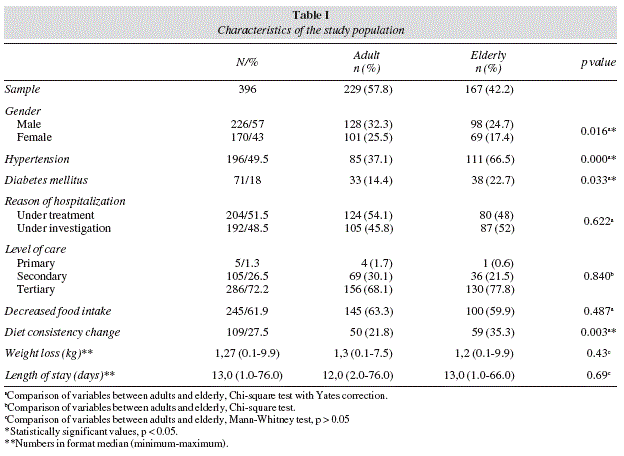
<body><![CDATA[<p><font face="Verdana" size="2">The triceps skinfold thickness (TST) was measure using a skinfold caliper (Cescorf<sup>&reg;</sup>) with a range of 0100 mm and precision of &plusmn; 1.0 mm. The measurement was performed on the right side of body and was used the mean of three times for the analyses. Mid-arm circumference was assessed at the measure midpoint of upper right arm to the nearest 0.1 cm. Mid-arm muscle circumference (MAC) was determined using the standard equation of Frisancho.<sup>12</sup> TST and MAC were standardized for gender and age: data was multiplied for 100 and divided by 50th percentile. After, both TST and MAC were classified according to Frisancho.<sup>12</sup></font></p>     <p><font face="Verdana" size="2">The classification level of nutritional care in primary, secondary and tertiary considers the underlying disease and the nutritional status.<sup>13</sup> The nutritional diagnosis by the combined tools is defined subjectively using data from the SGA, BMI, TST, MAC and laboratory tests -albumin (normal range: 3,5-5,5 g/dL) and total lymphocyte count (&gt; 1,600/ mL).</font></p>     <p><font face="Verdana" size="2">Statistical analysis was performed with power of 95% confidence (p &lt; 0.05), using the R software, version 2.12.0, the software Statgraphics, Centurion version, and Excel spreadsheets to store data. The age variable had a normal distribution, but the same behavior was not observed with the other variables. In order to compare two categories chi-square test was used, whilst the chi-square test with Yates correction was used to compare three or more categories. The length of stay (LOS) was evaluated using Mann-Whitney and Kruskal-Wallis tests, the last one with multiple comparison test. Correlation tests were made between nutritional status and clinical outcomes.</font></p>     <p><font face="Verdana" size="2">The use of nutrition records data in this study was approved by the Research Ethics Committee of the Clinical Hospital of the Federal University of Paraná.</font></p>     <p>&nbsp;</p>     <p><font face="Verdana" size="2"><b>Results</b></font></p>     <p><font face="Verdana" size="2">The study included data from 396 individuals. Elderly over 60 years of age represented a significant proportion of the study population (42%). Half of the patients (51.5%) were admitted for treatment of previously diagnosed disease and 72.2% of individuals had nutritional care classified as tertiary. Hypertension (HTN) and diabetes mellitus (DM) were associated with age and were present in 66.5% and 22.7% of the elderly population, respectively (p &lt; 0.05) (<a href="#t1">table I</a>).</font></p>     <p>&nbsp;</p>     <p align="center"><font face="Verdana" size="2"><a name="t1"><img src="/img/revistas/nh/v28n4/48original39_t1.gif"></a></font></p>     <p>&nbsp;</p>     ]]></body>
<body><![CDATA[<p><font face="Verdana" size="2"><i>Nutritional status</i></font></p>     <p><font face="Verdana" size="2">Decrease food intake prior to hospitalization was reported by 62% of participants and it was not associated with age. However, a significant proportion of the elderly needed consistency modified diets (35.3%; p = 0.003).</font></p>     <p><font face="Verdana" size="2">The method based on TST measurement identified the highest degree of malnutrition in patients (58.3%). The TST and SGA obtained the best results in order to identified severely malnourished individuals (37.4% and 35.6% respectively).</font></p>     <p><font face="Verdana" size="2">The majority of patients were classified as well nourished by the BMI and MAC (50% and 64.9%, respectively). Nevertheless, combined tools detected malnutrition in 45.7% and nutritional risk in 41.2% of patients. Few patients were diagnosed as well nourished or overweight/obesity, 8.3% and 4.8%, respectively (<a href="#f1">fig. 1</a> and <a href="#t2">table II</a>). Combined diagnostic tools were correlated with some anthropometric measures, such as TST (weak correlation, r<sub>TST</sub> = 0.302), BMI and MAC (moderate correlations, r<sub>BMI</sub> = 0.407 and r<sub>MAC</sub> = 0.404 respectively).</font></p>     <p>&nbsp;</p>     <p align="center"><font face="Verdana" size="2"><a name="f1"><img src="/img/revistas/nh/v28n4/48original39_f1.gif"></a></font></p>     <p>&nbsp;</p>     <p align="center"><font face="Verdana" size="2"><a name="t2"><img src="/img/revistas/nh/v28n4/48original39_t2.gif"></a></font></p>     <p>&nbsp;</p>     <p><font face="Verdana" size="2"><i>Clinical outcomes</i></font></p>     ]]></body>
<body><![CDATA[<p><font face="Verdana" size="2">Clinical outcome was not related to gender, age, HTN, DM, level of nutritional care and diet consistency modified (p &gt; 0.05) in this study. Decreased food intake at admission was significantly associated with poorer clinical outcome. Most patients who died (87.5%) presented decreased in food intake (p = 0.01). Poorer outcome was significantly associated with malnutrition by SGA and MAC (p = 0.02 and p = 0.03 respectively). Most patients who died were classified as malnourished by SGA (62.5%) and by MAC (58.3%) (<a href="#t3">table III</a>).</font></p>     <p>&nbsp;</p>     <p align="center"><font face="Verdana" size="2"><a name="t3"><img src="/img/revistas/nh/v28n4/48original39_t3.gif"></a></font></p>     <p>&nbsp;</p>     <p><font face="Verdana" size="2"><i>Length of hospital stay</i></font></p>     <p><font face="Verdana" size="2">The median length of stay was 13 days, ranging from 1 to 76 days (IC 95% = 5-29 days), without significant difference between adults and elderly. Among the patients included in the study, 6% died (<a href="#t1">table I</a>).</font></p>     <p><font face="Verdana" size="2">The LOS did not differ according to gender, age, need of diet consistency change and anthropometric measurements. Longer hospitalization periods were associated with poor clinical outcomes, decreased food intake, level of nutritional care, diagnosis by SGA and malnutrition diagnosis by combining tools. The LOS of patients who died, was 7 days longer than those who were discharged (p = 0.004). Patients that decreased food intake had LOS 3 days longer than patients without decreased food intake (p = 0.001). Tertiary patients remained hospitalized 4 days longer than secondary care patients (p &lt; 0.01) (<a href="#t4">table IV</a>). According to SGA, malnourished and patients at nutritional risk had longer LOS than well nourished patients. The LOS of malnourished patients was 5 days longer than well nourished. The LOS of severe malnourished patients by combined tools was 5 days longer than well nourished ones and 10 days longer than obese patients (<a href="#t4">table IV</a>). The correlation coefficients between weight loss during the hospitalization period and clinical outcome (r = 0.028) and LOS (r = 0.010) were not significant.</font></p>     <p>&nbsp;</p>     <p align="center"><font face="Verdana" size="2"><a name="t4"><img src="/img/revistas/nh/v28n4/48original39_t4.gif"></a></font></p>     <p>&nbsp;</p>     ]]></body>
<body><![CDATA[<p><font face="Verdana" size="2"><b>Discussion</b></font></p>     <p><font face="Verdana" size="2">The elderly population is increasing over the past years<sup>14</sup> and added to this situation exists a progressive increase in the prevalence of chronic diseases among the general population. In this study elderly population represents almost half of the patients evaluated. Further, HTN and DM were associated with the elderly population increasing the risk of developing complications from chronic diseases, which affect the maintenance of a good nutritional status<sup>15,16</sup>. Elderly people are a risk group for nutritional alteration due to physical, cognitive and physiological limitations imposed by advancing age. In this study, the elderly required more dietary modifications and had higher median weight loss.</font></p>     <p><font face="Verdana" size="2">Fifty percent of the patients in the present study had some degree of weight loss during the hospitalization period, which is higher than the percentage published in another study in a university hospital, in which 31% of hospitalized patients showed decline in nutritional status during hospitalization<sup>17</sup>. Half of patients did not have a definitive diagnosis at admission, which involves performing several diagnostic tests. This may have contributed to increase the fasting times which can affect negatively the nutritional status. Most patients were classified as tertiary level care, <i>i.e.,</i> the underlying disease required nutritional care and it was already associated to nutritional risk factors (anorexia, decreased food intake, weight loss). This fact can be justified because this is a tertiary hospital, where the patients are admitted when the symptoms are already advanced in a process of underlying diseases investigation. These clinical symptoms can affect the food intake and interfere with the maintenance of a good nutritional status.</font></p>     <p><font face="Verdana" size="2">In this study nutritional status assessment was done using different tools. There is not a gold standard method for the diagnosis of nutritional status, which makes the use of different tools important in order to define the nutritional diagnosis, since each of these tools has limitations. Therefore, in this study a combination of different tools (here called combined tools) were used in order to make a better diagnosis of nutritional status<sup>7</sup>.</font></p>     <p><font face="Verdana" size="2">Analyzing the tools used to diagnose undernutrition, TST and SGA were those more effective to detect some degree of malnutrition. In this study, more than half the cases of death were from patients diagnosed as malnourished by SGA. The SGA considers clinical characteristics and presents predictive capacity of nutritional status related complications<sup>18</sup>. These data indicate the importance of periodic nutritional status assessment, which improves the chances of early nutritional therapy and better prognosis<sup>19</sup>.</font></p>     <p><font face="Verdana" size="2">BMI and MAC showed moderate correlation with the nutritional diagnosis by combining tools. Although it has been proposed that anthropometric measurements identify malnutrition mainly in advanced stages<sup>20</sup>. In the present study only MAC was related to increase mortality. This result might be explained by the fact that this anthropometric measure is able to detect mainly body lean mass changes as compared to other anthropometric measures. The relationship between body lean mass deterioration and mortality is well established<sup>21</sup>.</font></p>     <p><font face="Verdana" size="2">When clinical, anthropometric and biochemical variables (combined tools) routinely used at the teaching hospital were considered to determine the nutritional status, 46% of patients were classified as malnourished. These results are similar to those reported in other studies, in which 30% to 50% of hospitalized patients were malnourished<sup>6,22</sup>. Thus, combined tools can improve the early detection of nutritional status, which allows minimize the negative impact of hospital malnutrition. Malnutrition is responsible for poor clinical responses to treatment, increased complications, LOS and costs of hospitalization what adversely affects clinical outcomes<sup>22,23,24</sup>.</font></p>     <p><font face="Verdana" size="2">Tertiary care patients, with decreased food intake, diagnosed as malnourished by SGA at admission and by combined tools had longer LOS and poor clinical outcomes. These results have been found in other studies.<sup>25,26,27,28</sup>. Decreased food intake can be a consequence of advanced underlying disease and be related to poor response to medical treatment. The association between malnutrition detected by SGA at admission and negative clinical outcome has been described in other studies confirming the importance of SGA as a tool for early nutritional assessment at admission.<sup>29,30</sup>. This may also be associated with more severe underlying disease.</font></p>     <p><font face="Verdana" size="2">In this study longer LOS was associated with higher mortality. The relationship between malnutrition and LOS was also reported in other studies<sup>17,31,32,33</sup> and can be considered an independent risk factor for increased complications rates, mortality, and costs<sup>34</sup>.</font></p>     <p><font face="Verdana" size="2">This study has some limitations, such as the wide variety of underlying diseases treated or investigated at the internal medicine department. Additionally a large number of patients are admitted for investigation without a definitive diagnosis. Thus, it was not possible to determine the impact of the underlying disease on the nutritional status.</font></p>     ]]></body>
<body><![CDATA[<p>&nbsp;</p>     <p><font face="Verdana" size="2"><b>Conclusion</b></font></p>     <p><font face="Verdana" size="2">Malnourished patients according to SGA and those with decreased food intake at admission have longer LOS and poorer clinical outcomes. Malnutrition diagnosed by MAC is also related to higher mortality.</font></p>     <p>&nbsp;</p>     <p><font face="Verdana" size="2"><b>References</b></font></p>     <!-- ref --><p><font face="Verdana" size="2">1. Correia MITD, Campos ACL, Study EC. Prevalence of hospital malnutrition in Latin America: The multicenter ELAN study. <i>Nutrition</i> 2003; 19 (10): 823-5.    &nbsp;&nbsp;&nbsp;&nbsp;&nbsp;&nbsp;&nbsp;&nbsp;[&#160;<a href="javascript:void(0);" onclick="javascript: window.open('/scielo.php?script=sci_nlinks&ref=3742159&pid=S0212-1611201300040004800001&lng=','','width=640,height=500,resizable=yes,scrollbars=1,menubar=yes,');">Links</a>&#160;]<!-- end-ref --></font></p>    <!-- ref --><p><font face="Verdana" size="2">2. Porbén SS. The state of the provision of nutritional care to hospitalized patients-results from The Elan-Cuba Study. <i>Clin Nutr</i> 2006; 25 (6): 1015-29.    &nbsp;&nbsp;&nbsp;&nbsp;&nbsp;&nbsp;&nbsp;&nbsp;[&#160;<a href="javascript:void(0);" onclick="javascript: window.open('/scielo.php?script=sci_nlinks&ref=3742161&pid=S0212-1611201300040004800002&lng=','','width=640,height=500,resizable=yes,scrollbars=1,menubar=yes,');">Links</a>&#160;]<!-- end-ref --></font></p>    <!-- ref --><p><font face="Verdana" size="2">3. Valente da Silva HG, Santos SO, Silva NO, Ribeiro FD, Josua LL, Moreira AS. Nutritional assessment associated with length of inpatients' hospital stay. <i>Nutr Hosp</i> 2012; 27 (2): 542-7.    &nbsp;&nbsp;&nbsp;&nbsp;&nbsp;&nbsp;&nbsp;&nbsp;[&#160;<a href="javascript:void(0);" onclick="javascript: window.open('/scielo.php?script=sci_nlinks&ref=3742163&pid=S0212-1611201300040004800003&lng=','','width=640,height=500,resizable=yes,scrollbars=1,menubar=yes,');">Links</a>&#160;]<!-- end-ref --></font></p>    <!-- ref --><p><font face="Verdana" size="2">4. Baccaro F, Moreno JB, Borlenghi C, Aquino L, Armesto G, Plaza G, Zapata S. Subjective global assessment in the clinical setting. <i>JPEN J Parenter Enteral Nutr</i> 2007; 31 (5): 406-9.    &nbsp;&nbsp;&nbsp;&nbsp;&nbsp;&nbsp;&nbsp;&nbsp;[&#160;<a href="javascript:void(0);" onclick="javascript: window.open('/scielo.php?script=sci_nlinks&ref=3742165&pid=S0212-1611201300040004800004&lng=','','width=640,height=500,resizable=yes,scrollbars=1,menubar=yes,');">Links</a>&#160;]<!-- end-ref --></font></p>    <!-- ref --><p><font face="Verdana" size="2">5. Pirlich M, Schütz T, Norman K, Gastell S, Lübke HJ, Bischoff SC, Bolder U, Frieling T, Güldenzoph H, Hahn K, Jauch KW, Schindler K, Stein J, Volkert D, Weimann A, Werner H, Wolf C, Zürcher G, Bauer P, Lochs H. The German hospital malnutrition study. <i>Clin Nutr</i> 2006; 25 (4): 563-72.    &nbsp;&nbsp;&nbsp;&nbsp;&nbsp;&nbsp;&nbsp;&nbsp;[&#160;<a href="javascript:void(0);" onclick="javascript: window.open('/scielo.php?script=sci_nlinks&ref=3742167&pid=S0212-1611201300040004800005&lng=','','width=640,height=500,resizable=yes,scrollbars=1,menubar=yes,');">Links</a>&#160;]<!-- end-ref --></font></p>    <!-- ref --><p><font face="Verdana" size="2">6. Waitzberg DL, Caiaffa WT, Correia MITD. Hospital malnutrition: The Brazilian National Survey (IBRANUTRI): A study of 4,000 patients. <i>Nutrition</i> 2001; 17 (7-8): 573-80.    &nbsp;&nbsp;&nbsp;&nbsp;&nbsp;&nbsp;&nbsp;&nbsp;[&#160;<a href="javascript:void(0);" onclick="javascript: window.open('/scielo.php?script=sci_nlinks&ref=3742169&pid=S0212-1611201300040004800006&lng=','','width=640,height=500,resizable=yes,scrollbars=1,menubar=yes,');">Links</a>&#160;]<!-- end-ref --></font></p>    <!-- ref --><p><font face="Verdana" size="2">7. Lacey K, Pritchett E. Nutrition Care Process and Model: ADA adopts roadmap to quality care and outcomes management. <i>J Am Diet Assoc</i> 2003; 103 (8): 1061-72.    &nbsp;&nbsp;&nbsp;&nbsp;&nbsp;&nbsp;&nbsp;&nbsp;[&#160;<a href="javascript:void(0);" onclick="javascript: window.open('/scielo.php?script=sci_nlinks&ref=3742171&pid=S0212-1611201300040004800007&lng=','','width=640,height=500,resizable=yes,scrollbars=1,menubar=yes,');">Links</a>&#160;]<!-- end-ref --></font></p>    <!-- ref --><p><font face="Verdana" size="2">8. Kondrup J, Allison SP, Elia M, Vellas B, Plauth M; Educational and Clinical Practice Committee, European Society of Parenteral and Enteral Nutrition (ESPEN). ESPEN Guidelines for Nutrition Screening 2002. <i>Clin Nutr</i> 2003; 22 (4): 415-21.    &nbsp;&nbsp;&nbsp;&nbsp;&nbsp;&nbsp;&nbsp;&nbsp;[&#160;<a href="javascript:void(0);" onclick="javascript: window.open('/scielo.php?script=sci_nlinks&ref=3742173&pid=S0212-1611201300040004800008&lng=','','width=640,height=500,resizable=yes,scrollbars=1,menubar=yes,');">Links</a>&#160;]<!-- end-ref --></font></p>    <!-- ref --><p><font face="Verdana" size="2">9. Detsky AS, McLaughlin JR, Baker JP, Johnston N, Whittaker S, Mendelson RA, et al. What is subjective global assessment of nutritional status? <i>JPEN J Parenter Enteral Nutr</i> 1987; 11 (1): 8-13.    &nbsp;&nbsp;&nbsp;&nbsp;&nbsp;&nbsp;&nbsp;&nbsp;[&#160;<a href="javascript:void(0);" onclick="javascript: window.open('/scielo.php?script=sci_nlinks&ref=3742175&pid=S0212-1611201300040004800009&lng=','','width=640,height=500,resizable=yes,scrollbars=1,menubar=yes,');">Links</a>&#160;]<!-- end-ref --></font></p>    <!-- ref --><p><font face="Verdana" size="2">10. World Health Organization (WHO). Global Database on Body Mass Index: BMI classification. Access in 17 July 2012. Available in: <a target="_blank" href="http://apps.who.int/bmi/index.jsp? introPage=intro3_html">http://apps.who.int/bmi/index.jsp? introPage=intro3_html</a>.    &nbsp;&nbsp;&nbsp;&nbsp;&nbsp;&nbsp;&nbsp;&nbsp;[&#160;<a href="javascript:void(0);" onclick="javascript: window.open('/scielo.php?script=sci_nlinks&ref=3742177&pid=S0212-1611201300040004800010&lng=','','width=640,height=500,resizable=yes,scrollbars=1,menubar=yes,');">Links</a>&#160;]<!-- end-ref --></font></p>    <!-- ref --><p><font face="Verdana" size="2">11. Lipschitz DA. Screening for Nutritional-status in the Elderly. <i>Prim Care</i> 1994; 21 (1): 55-67.    &nbsp;&nbsp;&nbsp;&nbsp;&nbsp;&nbsp;&nbsp;&nbsp;[&#160;<a href="javascript:void(0);" onclick="javascript: window.open('/scielo.php?script=sci_nlinks&ref=3742179&pid=S0212-1611201300040004800011&lng=','','width=640,height=500,resizable=yes,scrollbars=1,menubar=yes,');">Links</a>&#160;]<!-- end-ref --></font></p>    <!-- ref --><p><font face="Verdana" size="2">12. Frisancho AR. New norms of upper limb fat and muscle areas for assessment of nutritional status. <i>Am J Clin Nutr</i> 1981; 34 (11): 2540-5.    &nbsp;&nbsp;&nbsp;&nbsp;&nbsp;&nbsp;&nbsp;&nbsp;[&#160;<a href="javascript:void(0);" onclick="javascript: window.open('/scielo.php?script=sci_nlinks&ref=3742181&pid=S0212-1611201300040004800012&lng=','','width=640,height=500,resizable=yes,scrollbars=1,menubar=yes,');">Links</a>&#160;]<!-- end-ref --></font></p>    <!-- ref --><p><font face="Verdana" size="2">13. Maculevicius J, Fornasari MLL, Baxter YC. Níveis de assisténcia em nutricäo. <i>Rev Hosp Clin Fac Med S&#227;o Paulo</i> 1994; 49: 79-81.    &nbsp;&nbsp;&nbsp;&nbsp;&nbsp;&nbsp;&nbsp;&nbsp;[&#160;<a href="javascript:void(0);" onclick="javascript: window.open('/scielo.php?script=sci_nlinks&ref=3742183&pid=S0212-1611201300040004800013&lng=','','width=640,height=500,resizable=yes,scrollbars=1,menubar=yes,');">Links</a>&#160;]<!-- end-ref --></font></p>    <!-- ref --><p><font face="Verdana" size="2">14. IBGE, Censo Demográfico 2010. Censo demográfico 2010: Características da popula&#231;&#227;o e dos domicílios: resultados do universo. Access in: 20 August 2012. Available in: <a target="_blank" href="http://www.censo2010.ibge.gov.br/">http://www.censo2010.ibge.gov.br/</a>.    &nbsp;&nbsp;&nbsp;&nbsp;&nbsp;&nbsp;&nbsp;&nbsp;[&#160;<a href="javascript:void(0);" onclick="javascript: window.open('/scielo.php?script=sci_nlinks&ref=3742185&pid=S0212-1611201300040004800014&lng=','','width=640,height=500,resizable=yes,scrollbars=1,menubar=yes,');">Links</a>&#160;]<!-- end-ref --></font></p>    <!-- ref --><p><font face="Verdana" size="2">15. Sociedade Brasileira de Cardiologia/Sociedade Brasileira de Hipertensão / Sociedade Brasileira de Nefrologia. VI Diretrizes Brasileiras de Hipertensão. <i>Arq Bras Cardiol</i> 2010; 95 (1 Suppl. 1): 1-51.    &nbsp;&nbsp;&nbsp;&nbsp;&nbsp;&nbsp;&nbsp;&nbsp;[&#160;<a href="javascript:void(0);" onclick="javascript: window.open('/scielo.php?script=sci_nlinks&ref=3742187&pid=S0212-1611201300040004800015&lng=','','width=640,height=500,resizable=yes,scrollbars=1,menubar=yes,');">Links</a>&#160;]<!-- end-ref --></font></p>    <!-- ref --><p><font face="Verdana" size="2">16. Nip WFR, Perry L, McLaren S, Mackenzie A. Dietary intake, nutritional status and rehabilitation outcomes of stroke patients in hospital. <i>J Hum Nutr Diet</i> 2011; 24 (5): 460-9.    &nbsp;&nbsp;&nbsp;&nbsp;&nbsp;&nbsp;&nbsp;&nbsp;[&#160;<a href="javascript:void(0);" onclick="javascript: window.open('/scielo.php?script=sci_nlinks&ref=3742189&pid=S0212-1611201300040004800016&lng=','','width=640,height=500,resizable=yes,scrollbars=1,menubar=yes,');">Links</a>&#160;]<!-- end-ref --></font></p>    <!-- ref --><p><font face="Verdana" size="2">17. Braunschweig C, Gomez S, Sheean PM. Impact of declines in nutritional status on outcomes in adult patients hospitalized for more than 7 days. <i>J Am Diet Assoc</i> 2000; 100 (11): 1316-22.    &nbsp;&nbsp;&nbsp;&nbsp;&nbsp;&nbsp;&nbsp;&nbsp;[&#160;<a href="javascript:void(0);" onclick="javascript: window.open('/scielo.php?script=sci_nlinks&ref=3742191&pid=S0212-1611201300040004800017&lng=','','width=640,height=500,resizable=yes,scrollbars=1,menubar=yes,');">Links</a>&#160;]<!-- end-ref --></font></p>    <!-- ref --><p><font face="Verdana" size="2">18. Barbosa-Silva MC, Barros AJ. Indications and limitations of the use of subjective global assessment in clinical practice: an update. <i>Curr Opin Clin Nutr Metab Care</i> 2006; 9 (3): 263-9.    &nbsp;&nbsp;&nbsp;&nbsp;&nbsp;&nbsp;&nbsp;&nbsp;[&#160;<a href="javascript:void(0);" onclick="javascript: window.open('/scielo.php?script=sci_nlinks&ref=3742193&pid=S0212-1611201300040004800018&lng=','','width=640,height=500,resizable=yes,scrollbars=1,menubar=yes,');">Links</a>&#160;]<!-- end-ref --></font></p>    <!-- ref --><p><font face="Verdana" size="2">19. Kondrup J, Rasmussen HH, Hamberg O, Stanga Z; Ad Hoc ESPEN Working Group. Nutritional risk screening (NRS 2002): a new method based on an analysis of controlledc linical trials. <i>Clin Nutr</i> 2003; 22 (3): 321-36.    &nbsp;&nbsp;&nbsp;&nbsp;&nbsp;&nbsp;&nbsp;&nbsp;[&#160;<a href="javascript:void(0);" onclick="javascript: window.open('/scielo.php?script=sci_nlinks&ref=3742195&pid=S0212-1611201300040004800019&lng=','','width=640,height=500,resizable=yes,scrollbars=1,menubar=yes,');">Links</a>&#160;]<!-- end-ref --></font></p>    <!-- ref --><p><font face="Verdana" size="2">20. Barbosa-Silva MC. Subjective and objective nutritional assessment methods: what do they really assess? <i>Curr Opin Clin Nutr Metab Care</i> 2008; 11 (3): 248-54.    &nbsp;&nbsp;&nbsp;&nbsp;&nbsp;&nbsp;&nbsp;&nbsp;[&#160;<a href="javascript:void(0);" onclick="javascript: window.open('/scielo.php?script=sci_nlinks&ref=3742197&pid=S0212-1611201300040004800020&lng=','','width=640,height=500,resizable=yes,scrollbars=1,menubar=yes,');">Links</a>&#160;]<!-- end-ref --></font></p>    <!-- ref --><p><font face="Verdana" size="2">21. Visser M, Schaap LA. Consequences of sarcopenia. <i>Clin Geriatr Med</i> 2011; 27 (3): 387-99.    &nbsp;&nbsp;&nbsp;&nbsp;&nbsp;&nbsp;&nbsp;&nbsp;[&#160;<a href="javascript:void(0);" onclick="javascript: window.open('/scielo.php?script=sci_nlinks&ref=3742199&pid=S0212-1611201300040004800021&lng=','','width=640,height=500,resizable=yes,scrollbars=1,menubar=yes,');">Links</a>&#160;]<!-- end-ref --></font></p>    <!-- ref --><p><font face="Verdana" size="2">22. Ocón Bretón MJ, Altemir Trallero J, Mañas Martínez AB, Sallán Díaz L, Aguillo Gutiérrez E, Gimeno Orna JA. Comparison of two nutritional screening tools for predicting the development of complications in hospitalized patients. <i>Nutr Hosp</i> 2012; 27 (3): 701-6.    &nbsp;&nbsp;&nbsp;&nbsp;&nbsp;&nbsp;&nbsp;&nbsp;[&#160;<a href="javascript:void(0);" onclick="javascript: window.open('/scielo.php?script=sci_nlinks&ref=3742201&pid=S0212-1611201300040004800022&lng=','','width=640,height=500,resizable=yes,scrollbars=1,menubar=yes,');">Links</a>&#160;]<!-- end-ref --></font></p>    <!-- ref --><p><font face="Verdana" size="2">23. Mueller C, Compher C, Ellen DM; American Society for Parenteral and Enteral Nutrition (ASPEN) Board of Directors. ASPEN clinical guidelines: Nutrition screening, assessment, and intervention in adults. <i>JPEN J Parenter Enteral Nutr</i> 2011; 35 (1): 16-24. doi: 10.1177/0148607110389335.    &nbsp;&nbsp;&nbsp;&nbsp;&nbsp;&nbsp;&nbsp;&nbsp;[&#160;<a href="javascript:void(0);" onclick="javascript: window.open('/scielo.php?script=sci_nlinks&ref=3742203&pid=S0212-1611201300040004800023&lng=','','width=640,height=500,resizable=yes,scrollbars=1,menubar=yes,');">Links</a>&#160;]<!-- end-ref --></font></p>    <!-- ref --><p><font face="Verdana" size="2">24. White JV, Guenter P, Jensen G, Malone A, Schofield M; Academy Malnutrition Work Group; ASPEN. Malnutrition Task Force; ASPEN. Board of Directors. Consensus statement: Academy of Nutrition and Dietetics and American Society for Parenteral and Enteral Nutrition: characteristics recommended for the identification and documentation of adult malnutrition (undernutrition). <i>JPEN J Parenter Enteral Nutr</i> 2012; 36 (3): 275-83. doi: 10.1177/0148607112440285.    &nbsp;&nbsp;&nbsp;&nbsp;&nbsp;&nbsp;&nbsp;&nbsp;[&#160;<a href="javascript:void(0);" onclick="javascript: window.open('/scielo.php?script=sci_nlinks&ref=3742205&pid=S0212-1611201300040004800024&lng=','','width=640,height=500,resizable=yes,scrollbars=1,menubar=yes,');">Links</a>&#160;]<!-- end-ref --></font></p>    <!-- ref --><p><font face="Verdana" size="2">25. Goiburu ME, Goiburu MM, Bianco H, Díaz JR, Alderete F, Palacios MC, Cabral V, Escobar D, López R, Waitzberg DL. The impact of malnutrition on morbidity, mortality and length of hospital stay in trauma patients. <i>Nutr Hosp</i> 2006; 21 (5): 604-10.    &nbsp;&nbsp;&nbsp;&nbsp;&nbsp;&nbsp;&nbsp;&nbsp;[&#160;<a href="javascript:void(0);" onclick="javascript: window.open('/scielo.php?script=sci_nlinks&ref=3742207&pid=S0212-1611201300040004800025&lng=','','width=640,height=500,resizable=yes,scrollbars=1,menubar=yes,');">Links</a>&#160;]<!-- end-ref --></font></p>    <!-- ref --><p><font face="Verdana" size="2">26. Burgos R, Sarto B, Elío I, Planas M, Forga M, Cantón A, Trallero R, Muñoz MJ, Pérez D, Bonada A, Saló E, Lecha M, Enrich G, Salas-Salvadó J; Group for the Study of Malnutrition in Hospitals in Catalonia. Prevalence of malnutrition and its etiological factors in hospitals. <i>Nutr Hosp</i> 2012; 27 (2): 469-76.    &nbsp;&nbsp;&nbsp;&nbsp;&nbsp;&nbsp;&nbsp;&nbsp;[&#160;<a href="javascript:void(0);" onclick="javascript: window.open('/scielo.php?script=sci_nlinks&ref=3742209&pid=S0212-1611201300040004800026&lng=','','width=640,height=500,resizable=yes,scrollbars=1,menubar=yes,');">Links</a>&#160;]<!-- end-ref --></font></p>    <!-- ref --><p><font face="Verdana" size="2">27. Pasquini TA, Neder HD, Araújo-Junqueira L, De-Souza DA. Clinical outcome of protein-energy malnourished patients in a Brazilian university hospital. <i>Braz J Med Biol Res</i> 2012; 45 (12): 1301-7.    &nbsp;&nbsp;&nbsp;&nbsp;&nbsp;&nbsp;&nbsp;&nbsp;[&#160;<a href="javascript:void(0);" onclick="javascript: window.open('/scielo.php?script=sci_nlinks&ref=3742211&pid=S0212-1611201300040004800027&lng=','','width=640,height=500,resizable=yes,scrollbars=1,menubar=yes,');">Links</a>&#160;]<!-- end-ref --></font></p>    <!-- ref --><p><font face="Verdana" size="2">28. Lim SL, Ong KC, Chan YH, Loke WC, Ferguson M, Daniels L. Malnutrition and its impact on cost of hospitalization, length of stay, readmission and 3-year mortality. <i>Clin Nutr</i> 2012; 31 (3): 345-50. doi: 10.1016/j.clnu.2011.11.001.    &nbsp;&nbsp;&nbsp;&nbsp;&nbsp;&nbsp;&nbsp;&nbsp;[&#160;<a href="javascript:void(0);" onclick="javascript: window.open('/scielo.php?script=sci_nlinks&ref=3742213&pid=S0212-1611201300040004800028&lng=','','width=640,height=500,resizable=yes,scrollbars=1,menubar=yes,');">Links</a>&#160;]<!-- end-ref --></font></p>    <!-- ref --><p><font face="Verdana" size="2">29. Gupta D, Vashi PG, Lammersfeld CA, Braun DP. Role of nutritional status in predicting the length of stay in cancer: a systematic review of the epidemiological literature. <i>Ann Nutr Metab</i> 2011; 59 (2-4): 96-106. doi: 10.1159/000332914.    &nbsp;&nbsp;&nbsp;&nbsp;&nbsp;&nbsp;&nbsp;&nbsp;[&#160;<a href="javascript:void(0);" onclick="javascript: window.open('/scielo.php?script=sci_nlinks&ref=3742215&pid=S0212-1611201300040004800029&lng=','','width=640,height=500,resizable=yes,scrollbars=1,menubar=yes,');">Links</a>&#160;]<!-- end-ref --></font></p>    <!-- ref --><p><font face="Verdana" size="2">30. Sacks GS, Dearman K, Replogle WH, Cora VL, Meeks M, Canada T. Use of subjective global assessment to identify nutrition-associated complications and death in geriatric long-term care facility residents. <i>J Am Coll Nutr</i> 2000; 19 (5): 570-7.    &nbsp;&nbsp;&nbsp;&nbsp;&nbsp;&nbsp;&nbsp;&nbsp;[&#160;<a href="javascript:void(0);" onclick="javascript: window.open('/scielo.php?script=sci_nlinks&ref=3742217&pid=S0212-1611201300040004800030&lng=','','width=640,height=500,resizable=yes,scrollbars=1,menubar=yes,');">Links</a>&#160;]<!-- end-ref --></font></p>    <!-- ref --><p><font face="Verdana" size="2">31. Planas M, Audivert S, Pérez-Portabella C, Burgos R, Puiggrós C, Casanelles JM, Rosselló J. Nutritional status among adult patients admitted to an university-affiliated hospital in Spain at the time of genoma. <i>Clin Nutr</i> 2004; 23 (5): 1016-24.    &nbsp;&nbsp;&nbsp;&nbsp;&nbsp;&nbsp;&nbsp;&nbsp;[&#160;<a href="javascript:void(0);" onclick="javascript: window.open('/scielo.php?script=sci_nlinks&ref=3742219&pid=S0212-1611201300040004800031&lng=','','width=640,height=500,resizable=yes,scrollbars=1,menubar=yes,');">Links</a>&#160;]<!-- end-ref --></font></p>    <!-- ref --><p><font face="Verdana" size="2">32. Middleton MH, Nazarenko G, Nivison-Smith I, Smerdely P. Prevalence of malnutrition and 12-month incidence of mortality in two Sydney teaching hospitals. <i>Intern Med J</i> 200; 31 (8): 455-61.    &nbsp;&nbsp;&nbsp;&nbsp;&nbsp;&nbsp;&nbsp;&nbsp;[&#160;<a href="javascript:void(0);" onclick="javascript: window.open('/scielo.php?script=sci_nlinks&ref=3742221&pid=S0212-1611201300040004800032&lng=','','width=640,height=500,resizable=yes,scrollbars=1,menubar=yes,');">Links</a>&#160;]<!-- end-ref --></font></p>    <!-- ref --><p><font face="Verdana" size="2">33. Valente da Silva HG, Santos SO, Silva NO, Ribeiro FD, Josua LL, Moreira AS Nutritional assessment associated with length of inpatients' hospital stay. <i>Nutr Hosp</i> 2012; 27 (2): 542-7.    &nbsp;&nbsp;&nbsp;&nbsp;&nbsp;&nbsp;&nbsp;&nbsp;[&#160;<a href="javascript:void(0);" onclick="javascript: window.open('/scielo.php?script=sci_nlinks&ref=3742223&pid=S0212-1611201300040004800033&lng=','','width=640,height=500,resizable=yes,scrollbars=1,menubar=yes,');">Links</a>&#160;]<!-- end-ref --></font></p>    <!-- ref --><p><font face="Verdana" size="2">34. Correia MI, Waitzberg DL. The impact of malnutrition on morbidity, mortality, length of hospital stay and costs evaluated through a multivariate model analysis. <i>Clin Nutr</i> 2003; 22 (3): 235-9.    &nbsp;&nbsp;&nbsp;&nbsp;&nbsp;&nbsp;&nbsp;&nbsp;[&#160;<a href="javascript:void(0);" onclick="javascript: window.open('/scielo.php?script=sci_nlinks&ref=3742225&pid=S0212-1611201300040004800034&lng=','','width=640,height=500,resizable=yes,scrollbars=1,menubar=yes,');">Links</a>&#160;]<!-- end-ref --></font></p>     <p>&nbsp;</p>     <p>&nbsp;</p>     <p><font face="Verdana" size="2"><a href="#top"><img border="0" src="/img/revistas/nh/v28n4/seta.gif" width="15" height="17"></a><a name="bajo"></a><b>Correspondence:</b>    <br>Ana Manuela Ordóñez.    <br>MS estudiante en el Programa de Posgrado en Niños y Adolescentes.    <br>Universidad Federal de Paraná.    <br>Rua Guilherme Pugsley, 1959, apartamento 42, bloco K.    ]]></body>
<body><![CDATA[<br>CEP 80620-000 Água verde - Curitiba, PR - Brasil.    <br>E-mail: <a href="mailto:anamanuela.ordonez@gmail.com">anamanuela.ordonez@gmail.com</a></font></p>     <p><font face="Verdana" size="2">Recibido: 1-IV-2013.    <br>Aceptado: 11-VI-2013.</font></p>      ]]></body><back>
<ref-list>
<ref id="B1">
<label>1</label><nlm-citation citation-type="journal">
<person-group person-group-type="author">
<name>
<surname><![CDATA[Correia]]></surname>
<given-names><![CDATA[MITD]]></given-names>
</name>
<name>
<surname><![CDATA[Campos]]></surname>
<given-names><![CDATA[ACL]]></given-names>
</name>
<name>
<surname><![CDATA[Study]]></surname>
<given-names><![CDATA[EC]]></given-names>
</name>
</person-group>
<article-title xml:lang="en"><![CDATA[Prevalence of hospital malnutrition in Latin America: The multicenter ELAN study]]></article-title>
<source><![CDATA[Nutrition]]></source>
<year>2003</year>
<volume>19</volume>
<numero>10</numero>
<issue>10</issue>
<page-range>823-5</page-range></nlm-citation>
</ref>
<ref id="B2">
<label>2</label><nlm-citation citation-type="journal">
<person-group person-group-type="author">
<name>
<surname><![CDATA[Porbén]]></surname>
<given-names><![CDATA[SS]]></given-names>
</name>
</person-group>
<article-title xml:lang="en"><![CDATA[The state of the provision of nutritional care to hospitalized patients-results from The Elan-Cuba Study]]></article-title>
<source><![CDATA[Clin Nutr]]></source>
<year>2006</year>
<volume>25</volume>
<numero>6</numero>
<issue>6</issue>
<page-range>1015-29</page-range></nlm-citation>
</ref>
<ref id="B3">
<label>3</label><nlm-citation citation-type="journal">
<person-group person-group-type="author">
<name>
<surname><![CDATA[Valente da Silva]]></surname>
<given-names><![CDATA[HG]]></given-names>
</name>
<name>
<surname><![CDATA[Santos]]></surname>
<given-names><![CDATA[SO]]></given-names>
</name>
<name>
<surname><![CDATA[Silva]]></surname>
<given-names><![CDATA[NO]]></given-names>
</name>
<name>
<surname><![CDATA[Ribeiro]]></surname>
<given-names><![CDATA[FD]]></given-names>
</name>
<name>
<surname><![CDATA[Josua]]></surname>
<given-names><![CDATA[LL]]></given-names>
</name>
<name>
<surname><![CDATA[Moreira]]></surname>
<given-names><![CDATA[AS]]></given-names>
</name>
</person-group>
<article-title xml:lang="en"><![CDATA[Nutritional assessment associated with length of inpatients' hospital stay]]></article-title>
<source><![CDATA[Nutr Hosp]]></source>
<year>2012</year>
<volume>27</volume>
<numero>2</numero>
<issue>2</issue>
<page-range>542-7</page-range></nlm-citation>
</ref>
<ref id="B4">
<label>4</label><nlm-citation citation-type="journal">
<person-group person-group-type="author">
<name>
<surname><![CDATA[Baccaro]]></surname>
<given-names><![CDATA[F]]></given-names>
</name>
<name>
<surname><![CDATA[Moreno]]></surname>
<given-names><![CDATA[JB]]></given-names>
</name>
<name>
<surname><![CDATA[Borlenghi]]></surname>
<given-names><![CDATA[C]]></given-names>
</name>
<name>
<surname><![CDATA[Aquino]]></surname>
<given-names><![CDATA[L]]></given-names>
</name>
<name>
<surname><![CDATA[Armesto]]></surname>
<given-names><![CDATA[G]]></given-names>
</name>
<name>
<surname><![CDATA[Plaza]]></surname>
<given-names><![CDATA[G]]></given-names>
</name>
<name>
<surname><![CDATA[Zapata]]></surname>
<given-names><![CDATA[S]]></given-names>
</name>
</person-group>
<article-title xml:lang="en"><![CDATA[Subjective global assessment in the clinical setting]]></article-title>
<source><![CDATA[JPEN J Parenter Enteral Nutr]]></source>
<year>2007</year>
<volume>31</volume>
<numero>5</numero>
<issue>5</issue>
<page-range>406-9</page-range></nlm-citation>
</ref>
<ref id="B5">
<label>5</label><nlm-citation citation-type="journal">
<person-group person-group-type="author">
<name>
<surname><![CDATA[Pirlich]]></surname>
<given-names><![CDATA[M]]></given-names>
</name>
<name>
<surname><![CDATA[Schütz]]></surname>
<given-names><![CDATA[T]]></given-names>
</name>
<name>
<surname><![CDATA[Norman]]></surname>
<given-names><![CDATA[K]]></given-names>
</name>
<name>
<surname><![CDATA[Gastell]]></surname>
<given-names><![CDATA[S]]></given-names>
</name>
<name>
<surname><![CDATA[Lübke]]></surname>
<given-names><![CDATA[HJ]]></given-names>
</name>
<name>
<surname><![CDATA[Bischoff]]></surname>
<given-names><![CDATA[SC]]></given-names>
</name>
<name>
<surname><![CDATA[Bolder]]></surname>
<given-names><![CDATA[U]]></given-names>
</name>
<name>
<surname><![CDATA[Frieling]]></surname>
<given-names><![CDATA[T]]></given-names>
</name>
<name>
<surname><![CDATA[Güldenzoph]]></surname>
<given-names><![CDATA[H]]></given-names>
</name>
<name>
<surname><![CDATA[Hahn]]></surname>
<given-names><![CDATA[K]]></given-names>
</name>
<name>
<surname><![CDATA[Jauch]]></surname>
<given-names><![CDATA[KW]]></given-names>
</name>
<name>
<surname><![CDATA[Schindler]]></surname>
<given-names><![CDATA[K]]></given-names>
</name>
<name>
<surname><![CDATA[Stein]]></surname>
<given-names><![CDATA[J]]></given-names>
</name>
<name>
<surname><![CDATA[Volkert]]></surname>
<given-names><![CDATA[D]]></given-names>
</name>
<name>
<surname><![CDATA[Weimann]]></surname>
<given-names><![CDATA[A]]></given-names>
</name>
<name>
<surname><![CDATA[Werner]]></surname>
<given-names><![CDATA[H]]></given-names>
</name>
<name>
<surname><![CDATA[Wolf]]></surname>
<given-names><![CDATA[C]]></given-names>
</name>
<name>
<surname><![CDATA[Zürcher]]></surname>
<given-names><![CDATA[G]]></given-names>
</name>
<name>
<surname><![CDATA[Bauer]]></surname>
<given-names><![CDATA[P]]></given-names>
</name>
<name>
<surname><![CDATA[Lochs]]></surname>
<given-names><![CDATA[H]]></given-names>
</name>
</person-group>
<article-title xml:lang="en"><![CDATA[The German hospital malnutrition study]]></article-title>
<source><![CDATA[Clin Nutr]]></source>
<year>2006</year>
<volume>25</volume>
<numero>4</numero>
<issue>4</issue>
<page-range>563-72</page-range></nlm-citation>
</ref>
<ref id="B6">
<label>6</label><nlm-citation citation-type="journal">
<person-group person-group-type="author">
<name>
<surname><![CDATA[Waitzberg]]></surname>
<given-names><![CDATA[DL]]></given-names>
</name>
<name>
<surname><![CDATA[Caiaffa]]></surname>
<given-names><![CDATA[WT]]></given-names>
</name>
<name>
<surname><![CDATA[Correia]]></surname>
<given-names><![CDATA[MITD]]></given-names>
</name>
</person-group>
<article-title xml:lang="en"><![CDATA[Hospital malnutrition: The Brazilian National Survey (IBRANUTRI): A study of 4,000 patients]]></article-title>
<source><![CDATA[Nutrition]]></source>
<year>2001</year>
<volume>17</volume>
<numero>7-8</numero>
<issue>7-8</issue>
<page-range>573-80</page-range></nlm-citation>
</ref>
<ref id="B7">
<label>7</label><nlm-citation citation-type="journal">
<person-group person-group-type="author">
<name>
<surname><![CDATA[Lacey]]></surname>
<given-names><![CDATA[K]]></given-names>
</name>
<name>
<surname><![CDATA[Pritchett]]></surname>
<given-names><![CDATA[E]]></given-names>
</name>
</person-group>
<article-title xml:lang="en"><![CDATA[Nutrition Care Process and Model: ADA adopts roadmap to quality care and outcomes management]]></article-title>
<source><![CDATA[J Am Diet Assoc]]></source>
<year>2003</year>
<volume>103</volume>
<numero>8</numero>
<issue>8</issue>
<page-range>1061-72</page-range></nlm-citation>
</ref>
<ref id="B8">
<label>8</label><nlm-citation citation-type="journal">
<person-group person-group-type="author">
<name>
<surname><![CDATA[Kondrup]]></surname>
<given-names><![CDATA[J]]></given-names>
</name>
<name>
<surname><![CDATA[Allison]]></surname>
<given-names><![CDATA[SP]]></given-names>
</name>
<name>
<surname><![CDATA[Elia]]></surname>
<given-names><![CDATA[M]]></given-names>
</name>
<name>
<surname><![CDATA[Vellas]]></surname>
<given-names><![CDATA[B]]></given-names>
</name>
<name>
<surname><![CDATA[Plauth]]></surname>
<given-names><![CDATA[M]]></given-names>
</name>
</person-group>
<collab>Educational and Clinical Practice Committee</collab>
<collab>European Society of Parenteral and Enteral Nutrition (ESPEN)</collab>
<article-title xml:lang="en"><![CDATA[ESPEN Guidelines for Nutrition Screening 2002]]></article-title>
<source><![CDATA[Clin Nutr]]></source>
<year>2003</year>
<volume>22</volume>
<numero>4</numero>
<issue>4</issue>
<page-range>415-21</page-range></nlm-citation>
</ref>
<ref id="B9">
<label>9</label><nlm-citation citation-type="journal">
<person-group person-group-type="author">
<name>
<surname><![CDATA[Detsky]]></surname>
<given-names><![CDATA[AS]]></given-names>
</name>
<name>
<surname><![CDATA[McLaughlin]]></surname>
<given-names><![CDATA[JR]]></given-names>
</name>
<name>
<surname><![CDATA[Baker]]></surname>
<given-names><![CDATA[JP]]></given-names>
</name>
<name>
<surname><![CDATA[Johnston]]></surname>
<given-names><![CDATA[N]]></given-names>
</name>
<name>
<surname><![CDATA[Whittaker]]></surname>
<given-names><![CDATA[S]]></given-names>
</name>
<name>
<surname><![CDATA[Mendelson]]></surname>
<given-names><![CDATA[RA]]></given-names>
</name>
</person-group>
<article-title xml:lang="en"><![CDATA[What is subjective global assessment of nutritional status?]]></article-title>
<source><![CDATA[JPEN J Parenter Enteral Nutr]]></source>
<year>1987</year>
<volume>11</volume>
<numero>1</numero>
<issue>1</issue>
<page-range>8-13</page-range></nlm-citation>
</ref>
<ref id="B10">
<label>10</label><nlm-citation citation-type="">
<collab>World Health Organization (WHO)</collab>
<source><![CDATA[Global Database on Body Mass Index: BMI classification]]></source>
<year></year>
</nlm-citation>
</ref>
<ref id="B11">
<label>11</label><nlm-citation citation-type="journal">
<person-group person-group-type="author">
<name>
<surname><![CDATA[Lipschitz]]></surname>
<given-names><![CDATA[DA]]></given-names>
</name>
</person-group>
<article-title xml:lang="en"><![CDATA[Screening for Nutritional-status in the Elderly]]></article-title>
<source><![CDATA[Prim Care]]></source>
<year>1994</year>
<volume>21</volume>
<numero>1</numero>
<issue>1</issue>
<page-range>55-67</page-range></nlm-citation>
</ref>
<ref id="B12">
<label>12</label><nlm-citation citation-type="journal">
<person-group person-group-type="author">
<name>
<surname><![CDATA[Frisancho]]></surname>
<given-names><![CDATA[AR]]></given-names>
</name>
</person-group>
<article-title xml:lang="en"><![CDATA[New norms of upper limb fat and muscle areas for assessment of nutritional status]]></article-title>
<source><![CDATA[Am J Clin Nutr]]></source>
<year>1981</year>
<volume>34</volume>
<numero>11</numero>
<issue>11</issue>
<page-range>2540-5</page-range></nlm-citation>
</ref>
<ref id="B13">
<label>13</label><nlm-citation citation-type="journal">
<person-group person-group-type="author">
<name>
<surname><![CDATA[Maculevicius]]></surname>
<given-names><![CDATA[J]]></given-names>
</name>
<name>
<surname><![CDATA[Fornasari]]></surname>
<given-names><![CDATA[MLL]]></given-names>
</name>
<name>
<surname><![CDATA[Baxter]]></surname>
<given-names><![CDATA[YC]]></given-names>
</name>
</person-group>
<article-title xml:lang="pt"><![CDATA[Níveis de assisténcia em nutricäo]]></article-title>
<source><![CDATA[Rev Hosp Clin Fac Med São Paulo]]></source>
<year>1994</year>
<volume>49</volume>
<page-range>79-81</page-range></nlm-citation>
</ref>
<ref id="B14">
<label>14</label><nlm-citation citation-type="">
<collab>IBGE</collab>
<source><![CDATA[Censo demográfico 2010: Características da população e dos domicílios: resultados do universo]]></source>
<year></year>
</nlm-citation>
</ref>
<ref id="B15">
<label>15</label><nlm-citation citation-type="journal">
<collab>Sociedade Brasileira de Cardiologia</collab>
<collab>Sociedade Brasileira de Hipertensão</collab>
<collab>Sociedade Brasileira de Nefrologia</collab>
<article-title xml:lang="pt"><![CDATA[VI Diretrizes Brasileiras de Hipertensão]]></article-title>
<source><![CDATA[Arq Bras Cardiol]]></source>
<year>2010</year>
<volume>95</volume>
<numero>1^s1</numero>
<issue>1^s1</issue>
<supplement>1</supplement>
<page-range>1-51</page-range></nlm-citation>
</ref>
<ref id="B16">
<label>16</label><nlm-citation citation-type="journal">
<person-group person-group-type="author">
<name>
<surname><![CDATA[Nip]]></surname>
<given-names><![CDATA[WFR]]></given-names>
</name>
<name>
<surname><![CDATA[Perry]]></surname>
<given-names><![CDATA[L]]></given-names>
</name>
<name>
<surname><![CDATA[McLaren]]></surname>
<given-names><![CDATA[S]]></given-names>
</name>
<name>
<surname><![CDATA[Mackenzie]]></surname>
<given-names><![CDATA[A]]></given-names>
</name>
</person-group>
<article-title xml:lang="en"><![CDATA[Dietary intake, nutritional status and rehabilitation outcomes of stroke patients in hospital]]></article-title>
<source><![CDATA[J Hum Nutr Diet]]></source>
<year>2011</year>
<volume>24</volume>
<numero>5</numero>
<issue>5</issue>
<page-range>460-9</page-range></nlm-citation>
</ref>
<ref id="B17">
<label>17</label><nlm-citation citation-type="journal">
<person-group person-group-type="author">
<name>
<surname><![CDATA[Braunschweig]]></surname>
<given-names><![CDATA[C]]></given-names>
</name>
<name>
<surname><![CDATA[Gomez]]></surname>
<given-names><![CDATA[S]]></given-names>
</name>
<name>
<surname><![CDATA[Sheean]]></surname>
<given-names><![CDATA[PM]]></given-names>
</name>
</person-group>
<article-title xml:lang="en"><![CDATA[Impact of declines in nutritional status on outcomes in adult patients hospitalized for more than 7 days]]></article-title>
<source><![CDATA[J Am Diet Assoc]]></source>
<year>2000</year>
<volume>100</volume>
<numero>11</numero>
<issue>11</issue>
<page-range>1316-22</page-range></nlm-citation>
</ref>
<ref id="B18">
<label>18</label><nlm-citation citation-type="journal">
<person-group person-group-type="author">
<name>
<surname><![CDATA[Barbosa-Silva]]></surname>
<given-names><![CDATA[MC]]></given-names>
</name>
<name>
<surname><![CDATA[Barros]]></surname>
<given-names><![CDATA[AJ]]></given-names>
</name>
</person-group>
<article-title xml:lang="en"><![CDATA[Indications and limitations of the use of subjective global assessment in clinical practice: an update]]></article-title>
<source><![CDATA[Curr Opin Clin Nutr Metab Care]]></source>
<year>2006</year>
<volume>9</volume>
<numero>3</numero>
<issue>3</issue>
<page-range>263-9</page-range></nlm-citation>
</ref>
<ref id="B19">
<label>19</label><nlm-citation citation-type="journal">
<person-group person-group-type="author">
<name>
<surname><![CDATA[Kondrup]]></surname>
<given-names><![CDATA[J]]></given-names>
</name>
<name>
<surname><![CDATA[Rasmussen]]></surname>
<given-names><![CDATA[HH]]></given-names>
</name>
<name>
<surname><![CDATA[Hamberg]]></surname>
<given-names><![CDATA[O]]></given-names>
</name>
<name>
<surname><![CDATA[Stanga]]></surname>
<given-names><![CDATA[Z]]></given-names>
</name>
</person-group>
<collab>Ad Hoc ESPEN Working Group</collab>
<article-title xml:lang="en"><![CDATA[Nutritional risk screening (NRS 2002): a new method based on an analysis of controlledc linical trials]]></article-title>
<source><![CDATA[Clin Nutr]]></source>
<year>2003</year>
<volume>22</volume>
<numero>3</numero>
<issue>3</issue>
<page-range>321-36</page-range></nlm-citation>
</ref>
<ref id="B20">
<label>20</label><nlm-citation citation-type="journal">
<person-group person-group-type="author">
<name>
<surname><![CDATA[Barbosa-Silva]]></surname>
<given-names><![CDATA[MC]]></given-names>
</name>
</person-group>
<article-title xml:lang="en"><![CDATA[Subjective and objective nutritional assessment methods: what do they really assess?]]></article-title>
<source><![CDATA[Curr Opin Clin Nutr Metab Care]]></source>
<year>2008</year>
<volume>11</volume>
<numero>3</numero>
<issue>3</issue>
<page-range>248-54</page-range></nlm-citation>
</ref>
<ref id="B21">
<label>21</label><nlm-citation citation-type="journal">
<person-group person-group-type="author">
<name>
<surname><![CDATA[Visser]]></surname>
<given-names><![CDATA[M]]></given-names>
</name>
<name>
<surname><![CDATA[Schaap]]></surname>
<given-names><![CDATA[LA]]></given-names>
</name>
</person-group>
<article-title xml:lang="en"><![CDATA[Consequences of sarcopenia]]></article-title>
<source><![CDATA[Clin Geriatr Med]]></source>
<year>2011</year>
<volume>27</volume>
<numero>3</numero>
<issue>3</issue>
<page-range>387-99</page-range></nlm-citation>
</ref>
<ref id="B22">
<label>22</label><nlm-citation citation-type="journal">
<person-group person-group-type="author">
<name>
<surname><![CDATA[Ocón Bretón]]></surname>
<given-names><![CDATA[MJ]]></given-names>
</name>
<name>
<surname><![CDATA[Altemir Trallero]]></surname>
<given-names><![CDATA[J]]></given-names>
</name>
<name>
<surname><![CDATA[Mañas Martínez]]></surname>
<given-names><![CDATA[AB]]></given-names>
</name>
<name>
<surname><![CDATA[Sallán Díaz]]></surname>
<given-names><![CDATA[L]]></given-names>
</name>
<name>
<surname><![CDATA[Aguillo Gutiérrez]]></surname>
<given-names><![CDATA[E]]></given-names>
</name>
<name>
<surname><![CDATA[Gimeno Orna]]></surname>
<given-names><![CDATA[JA]]></given-names>
</name>
</person-group>
<article-title xml:lang="en"><![CDATA[Comparison of two nutritional screening tools for predicting the development of complications in hospitalized patients]]></article-title>
<source><![CDATA[Nutr Hosp]]></source>
<year>2012</year>
<volume>27</volume>
<numero>3</numero>
<issue>3</issue>
<page-range>701-6</page-range></nlm-citation>
</ref>
<ref id="B23">
<label>23</label><nlm-citation citation-type="journal">
<person-group person-group-type="author">
<name>
<surname><![CDATA[Mueller]]></surname>
<given-names><![CDATA[C]]></given-names>
</name>
<name>
<surname><![CDATA[Compher]]></surname>
<given-names><![CDATA[C]]></given-names>
</name>
<name>
<surname><![CDATA[Ellen]]></surname>
<given-names><![CDATA[DM]]></given-names>
</name>
</person-group>
<collab>American Society for Parenteral and Enteral Nutrition (ASPEN) Board of Directors</collab>
<article-title xml:lang="en"><![CDATA[ASPEN clinical guidelines: Nutrition screening, assessment, and intervention in adults]]></article-title>
<source><![CDATA[JPEN J Parenter Enteral Nutr]]></source>
<year>2011</year>
<volume>35</volume>
<numero>1</numero>
<issue>1</issue>
<page-range>16-24</page-range></nlm-citation>
</ref>
<ref id="B24">
<label>24</label><nlm-citation citation-type="journal">
<person-group person-group-type="author">
<name>
<surname><![CDATA[White]]></surname>
<given-names><![CDATA[JV]]></given-names>
</name>
<name>
<surname><![CDATA[Guenter]]></surname>
<given-names><![CDATA[P]]></given-names>
</name>
<name>
<surname><![CDATA[Jensen]]></surname>
<given-names><![CDATA[G]]></given-names>
</name>
<name>
<surname><![CDATA[Malone]]></surname>
<given-names><![CDATA[A]]></given-names>
</name>
<name>
<surname><![CDATA[Schofield]]></surname>
<given-names><![CDATA[M]]></given-names>
</name>
</person-group>
<collab>Academy Malnutrition Work Group</collab>
<collab>ASPEN. Malnutrition Task Force</collab>
<collab>ASPEN. Board of Directors</collab>
<article-title xml:lang="en"><![CDATA[Consensus statement: Academy of Nutrition and Dietetics and American Society for Parenteral and Enteral Nutrition: characteristics recommended for the identification and documentation of adult malnutrition (undernutrition)]]></article-title>
<source><![CDATA[JPEN J Parenter Enteral Nutr]]></source>
<year>2012</year>
<volume>36</volume>
<numero>3</numero>
<issue>3</issue>
<page-range>275-83</page-range></nlm-citation>
</ref>
<ref id="B25">
<label>25</label><nlm-citation citation-type="journal">
<person-group person-group-type="author">
<name>
<surname><![CDATA[Goiburu]]></surname>
<given-names><![CDATA[ME]]></given-names>
</name>
<name>
<surname><![CDATA[Goiburu]]></surname>
<given-names><![CDATA[MM]]></given-names>
</name>
<name>
<surname><![CDATA[Bianco]]></surname>
<given-names><![CDATA[H]]></given-names>
</name>
<name>
<surname><![CDATA[Díaz]]></surname>
<given-names><![CDATA[JR]]></given-names>
</name>
<name>
<surname><![CDATA[Alderete]]></surname>
<given-names><![CDATA[F]]></given-names>
</name>
<name>
<surname><![CDATA[Palacios]]></surname>
<given-names><![CDATA[MC]]></given-names>
</name>
<name>
<surname><![CDATA[Cabral]]></surname>
<given-names><![CDATA[V]]></given-names>
</name>
<name>
<surname><![CDATA[Escobar]]></surname>
<given-names><![CDATA[D]]></given-names>
</name>
<name>
<surname><![CDATA[López]]></surname>
<given-names><![CDATA[R]]></given-names>
</name>
<name>
<surname><![CDATA[Waitzberg]]></surname>
<given-names><![CDATA[DL]]></given-names>
</name>
</person-group>
<article-title xml:lang="en"><![CDATA[The impact of malnutrition on morbidity, mortality and length of hospital stay in trauma patients]]></article-title>
<source><![CDATA[Nutr Hosp]]></source>
<year>2006</year>
<volume>21</volume>
<numero>5</numero>
<issue>5</issue>
<page-range>604-10</page-range></nlm-citation>
</ref>
<ref id="B26">
<label>26</label><nlm-citation citation-type="journal">
<person-group person-group-type="author">
<name>
<surname><![CDATA[Burgos]]></surname>
<given-names><![CDATA[R]]></given-names>
</name>
<name>
<surname><![CDATA[Sarto]]></surname>
<given-names><![CDATA[B]]></given-names>
</name>
<name>
<surname><![CDATA[Elío]]></surname>
<given-names><![CDATA[I]]></given-names>
</name>
<name>
<surname><![CDATA[Planas]]></surname>
<given-names><![CDATA[M]]></given-names>
</name>
<name>
<surname><![CDATA[Forga]]></surname>
<given-names><![CDATA[M]]></given-names>
</name>
<name>
<surname><![CDATA[Cantón]]></surname>
<given-names><![CDATA[A]]></given-names>
</name>
<name>
<surname><![CDATA[Trallero]]></surname>
<given-names><![CDATA[R]]></given-names>
</name>
<name>
<surname><![CDATA[Muñoz]]></surname>
<given-names><![CDATA[MJ]]></given-names>
</name>
<name>
<surname><![CDATA[Pérez]]></surname>
<given-names><![CDATA[D]]></given-names>
</name>
<name>
<surname><![CDATA[Bonada]]></surname>
<given-names><![CDATA[A]]></given-names>
</name>
<name>
<surname><![CDATA[Saló]]></surname>
<given-names><![CDATA[E]]></given-names>
</name>
<name>
<surname><![CDATA[Lecha]]></surname>
<given-names><![CDATA[M]]></given-names>
</name>
<name>
<surname><![CDATA[Enrich]]></surname>
<given-names><![CDATA[G]]></given-names>
</name>
<name>
<surname><![CDATA[Salas-Salvadó]]></surname>
<given-names><![CDATA[J]]></given-names>
</name>
</person-group>
<collab>Group for the Study of Malnutrition in Hospitals in Catalonia</collab>
<article-title xml:lang="en"><![CDATA[Prevalence of malnutrition and its etiological factors in hospitals]]></article-title>
<source><![CDATA[Nutr Hosp]]></source>
<year>2012</year>
<volume>27</volume>
<numero>2</numero>
<issue>2</issue>
<page-range>469-76</page-range></nlm-citation>
</ref>
<ref id="B27">
<label>27</label><nlm-citation citation-type="journal">
<person-group person-group-type="author">
<name>
<surname><![CDATA[Pasquini]]></surname>
<given-names><![CDATA[TA]]></given-names>
</name>
<name>
<surname><![CDATA[Neder]]></surname>
<given-names><![CDATA[HD]]></given-names>
</name>
<name>
<surname><![CDATA[Araújo-Junqueira]]></surname>
<given-names><![CDATA[L]]></given-names>
</name>
<name>
<surname><![CDATA[De-Souza]]></surname>
<given-names><![CDATA[DA]]></given-names>
</name>
</person-group>
<article-title xml:lang="en"><![CDATA[Clinical outcome of protein-energy malnourished patients in a Brazilian university hospital]]></article-title>
<source><![CDATA[Braz J Med Biol Res]]></source>
<year>2012</year>
<volume>45</volume>
<numero>12</numero>
<issue>12</issue>
<page-range>1301-7</page-range></nlm-citation>
</ref>
<ref id="B28">
<label>28</label><nlm-citation citation-type="journal">
<person-group person-group-type="author">
<name>
<surname><![CDATA[Lim]]></surname>
<given-names><![CDATA[SL]]></given-names>
</name>
<name>
<surname><![CDATA[Ong]]></surname>
<given-names><![CDATA[KC]]></given-names>
</name>
<name>
<surname><![CDATA[Chan]]></surname>
<given-names><![CDATA[YH]]></given-names>
</name>
<name>
<surname><![CDATA[Loke]]></surname>
<given-names><![CDATA[WC]]></given-names>
</name>
<name>
<surname><![CDATA[Ferguson]]></surname>
<given-names><![CDATA[M]]></given-names>
</name>
<name>
<surname><![CDATA[Daniels]]></surname>
<given-names><![CDATA[L]]></given-names>
</name>
</person-group>
<article-title xml:lang="en"><![CDATA[Malnutrition and its impact on cost of hospitalization, length of stay, readmission and 3-year mortality]]></article-title>
<source><![CDATA[Clin Nutr]]></source>
<year>2012</year>
<volume>31</volume>
<numero>3</numero>
<issue>3</issue>
<page-range>345-50</page-range></nlm-citation>
</ref>
<ref id="B29">
<label>29</label><nlm-citation citation-type="journal">
<person-group person-group-type="author">
<name>
<surname><![CDATA[Gupta]]></surname>
<given-names><![CDATA[D]]></given-names>
</name>
<name>
<surname><![CDATA[Vashi]]></surname>
<given-names><![CDATA[PG]]></given-names>
</name>
<name>
<surname><![CDATA[Lammersfeld]]></surname>
<given-names><![CDATA[CA]]></given-names>
</name>
<name>
<surname><![CDATA[Braun]]></surname>
<given-names><![CDATA[DP]]></given-names>
</name>
</person-group>
<article-title xml:lang="en"><![CDATA[Role of nutritional status in predicting the length of stay in cancer: a systematic review of the epidemiological literature]]></article-title>
<source><![CDATA[Ann Nutr Metab]]></source>
<year>2011</year>
<volume>59</volume>
<numero>2-4</numero>
<issue>2-4</issue>
<page-range>96-106</page-range></nlm-citation>
</ref>
<ref id="B30">
<label>30</label><nlm-citation citation-type="journal">
<person-group person-group-type="author">
<name>
<surname><![CDATA[Sacks]]></surname>
<given-names><![CDATA[GS]]></given-names>
</name>
<name>
<surname><![CDATA[Dearman]]></surname>
<given-names><![CDATA[K]]></given-names>
</name>
<name>
<surname><![CDATA[Replogle]]></surname>
<given-names><![CDATA[WH]]></given-names>
</name>
<name>
<surname><![CDATA[Cora]]></surname>
<given-names><![CDATA[VL]]></given-names>
</name>
<name>
<surname><![CDATA[Meeks]]></surname>
<given-names><![CDATA[M]]></given-names>
</name>
<name>
<surname><![CDATA[Canada]]></surname>
<given-names><![CDATA[T]]></given-names>
</name>
</person-group>
<article-title xml:lang="en"><![CDATA[Use of subjective global assessment to identify nutrition-associated complications and death in geriatric long-term care facility residents]]></article-title>
<source><![CDATA[J Am Coll Nutr]]></source>
<year>2000</year>
<volume>19</volume>
<numero>5</numero>
<issue>5</issue>
<page-range>570-7</page-range></nlm-citation>
</ref>
<ref id="B31">
<label>31</label><nlm-citation citation-type="journal">
<person-group person-group-type="author">
<name>
<surname><![CDATA[Planas]]></surname>
<given-names><![CDATA[M]]></given-names>
</name>
<name>
<surname><![CDATA[Audivert]]></surname>
<given-names><![CDATA[S]]></given-names>
</name>
<name>
<surname><![CDATA[Pérez-Portabella]]></surname>
<given-names><![CDATA[C]]></given-names>
</name>
<name>
<surname><![CDATA[Burgos]]></surname>
<given-names><![CDATA[R]]></given-names>
</name>
<name>
<surname><![CDATA[Puiggrós]]></surname>
<given-names><![CDATA[C]]></given-names>
</name>
<name>
<surname><![CDATA[Casanelles]]></surname>
<given-names><![CDATA[JM]]></given-names>
</name>
<name>
<surname><![CDATA[Rosselló]]></surname>
<given-names><![CDATA[J]]></given-names>
</name>
</person-group>
<article-title xml:lang="en"><![CDATA[Nutritional status among adult patients admitted to an university-affiliated hospital in Spain at the time of genoma]]></article-title>
<source><![CDATA[Clin Nutr]]></source>
<year>2004</year>
<volume>23</volume>
<numero>5</numero>
<issue>5</issue>
<page-range>1016-24</page-range></nlm-citation>
</ref>
<ref id="B32">
<label>32</label><nlm-citation citation-type="journal">
<person-group person-group-type="author">
<name>
<surname><![CDATA[Middleton]]></surname>
<given-names><![CDATA[MH]]></given-names>
</name>
<name>
<surname><![CDATA[Nazarenko]]></surname>
<given-names><![CDATA[G]]></given-names>
</name>
<name>
<surname><![CDATA[Nivison-Smith]]></surname>
<given-names><![CDATA[I]]></given-names>
</name>
<name>
<surname><![CDATA[Smerdely]]></surname>
<given-names><![CDATA[P]]></given-names>
</name>
</person-group>
<article-title xml:lang="en"><![CDATA[Prevalence of malnutrition and 12-month incidence of mortality in two Sydney teaching hospitals]]></article-title>
<source><![CDATA[Intern Med J]]></source>
<year>200</year>
<volume>31</volume>
<numero>8</numero>
<issue>8</issue>
<page-range>455-61</page-range></nlm-citation>
</ref>
<ref id="B33">
<label>33</label><nlm-citation citation-type="journal">
<person-group person-group-type="author">
<name>
<surname><![CDATA[Valente da Silva]]></surname>
<given-names><![CDATA[HG]]></given-names>
</name>
<name>
<surname><![CDATA[Santos]]></surname>
<given-names><![CDATA[SO]]></given-names>
</name>
<name>
<surname><![CDATA[Silva]]></surname>
<given-names><![CDATA[NO]]></given-names>
</name>
<name>
<surname><![CDATA[Ribeiro]]></surname>
<given-names><![CDATA[FD]]></given-names>
</name>
<name>
<surname><![CDATA[Josua]]></surname>
<given-names><![CDATA[LL]]></given-names>
</name>
</person-group>
<article-title xml:lang="en"><![CDATA[Moreira AS Nutritional assessment associated with length of inpatients' hospital stay]]></article-title>
<source><![CDATA[Nutr Hosp]]></source>
<year>2012</year>
<volume>27</volume>
<numero>2</numero>
<issue>2</issue>
<page-range>542-7</page-range></nlm-citation>
</ref>
<ref id="B34">
<label>34</label><nlm-citation citation-type="journal">
<person-group person-group-type="author">
<name>
<surname><![CDATA[Correia]]></surname>
<given-names><![CDATA[MI]]></given-names>
</name>
<name>
<surname><![CDATA[Waitzberg]]></surname>
<given-names><![CDATA[DL]]></given-names>
</name>
</person-group>
<article-title xml:lang="en"><![CDATA[The impact of malnutrition on morbidity, mortality, length of hospital stay and costs evaluated through a multivariate model analysis]]></article-title>
<source><![CDATA[Clin Nutr]]></source>
<year>2003</year>
<volume>22</volume>
<numero>3</numero>
<issue>3</issue>
<page-range>235-9</page-range></nlm-citation>
</ref>
</ref-list>
</back>
</article>
