<?xml version="1.0" encoding="ISO-8859-1"?><article xmlns:mml="http://www.w3.org/1998/Math/MathML" xmlns:xlink="http://www.w3.org/1999/xlink" xmlns:xsi="http://www.w3.org/2001/XMLSchema-instance">
<front>
<journal-meta>
<journal-id>1130-0108</journal-id>
<journal-title><![CDATA[Revista Española de Enfermedades Digestivas]]></journal-title>
<abbrev-journal-title><![CDATA[Rev. esp. enferm. dig.]]></abbrev-journal-title>
<issn>1130-0108</issn>
<publisher>
<publisher-name><![CDATA[Sociedad Española de Patología Digestiva]]></publisher-name>
</publisher>
</journal-meta>
<article-meta>
<article-id>S1130-01082006000400003</article-id>
<title-group>
<article-title xml:lang="en"><![CDATA[Prevalence of Helicobacter pylori infection in the general adult population of the province of Ourense]]></article-title>
<article-title xml:lang="es"><![CDATA[Prevalencia de la infección por Helicobacter pylori en la población general adulta de la provincia de Ourense]]></article-title>
</title-group>
<contrib-group>
<contrib contrib-type="author">
<name>
<surname><![CDATA[Macenlle García]]></surname>
<given-names><![CDATA[R.]]></given-names>
</name>
<xref ref-type="aff" rid="A01"/>
</contrib>
<contrib contrib-type="author">
<name>
<surname><![CDATA[Gayoso Diz]]></surname>
<given-names><![CDATA[P.]]></given-names>
</name>
<xref ref-type="aff" rid="A02"/>
</contrib>
<contrib contrib-type="author">
<name>
<surname><![CDATA[Sueiro Benavides]]></surname>
<given-names><![CDATA[R. A.]]></given-names>
</name>
<xref ref-type="aff" rid="A03"/>
</contrib>
<contrib contrib-type="author">
<name>
<surname><![CDATA[Fernández Seara]]></surname>
<given-names><![CDATA[J.]]></given-names>
</name>
<xref ref-type="aff" rid="A01"/>
</contrib>
</contrib-group>
<aff id="A01">
<institution><![CDATA[,Complejo Hospitalario de Ourense Department of Digestive Medicine ]]></institution>
<addr-line><![CDATA[ ]]></addr-line>
</aff>
<aff id="A02">
<institution><![CDATA[,Complejo Hospitalario de Ourense Department of Research ]]></institution>
<addr-line><![CDATA[ ]]></addr-line>
</aff>
<aff id="A03">
<institution><![CDATA[,Universidad de Santiago de Compostela Institute for Research and Food Analysis Laboratory of Microbiology]]></institution>
<addr-line><![CDATA[ ]]></addr-line>
</aff>
<pub-date pub-type="pub">
<day>00</day>
<month>04</month>
<year>2006</year>
</pub-date>
<pub-date pub-type="epub">
<day>00</day>
<month>04</month>
<year>2006</year>
</pub-date>
<volume>98</volume>
<numero>4</numero>
<fpage>241</fpage>
<lpage>248</lpage>
<copyright-statement/>
<copyright-year/>
<self-uri xlink:href="http://scielo.isciii.es/scielo.php?script=sci_arttext&amp;pid=S1130-01082006000400003&amp;lng=en&amp;nrm=iso"></self-uri><self-uri xlink:href="http://scielo.isciii.es/scielo.php?script=sci_abstract&amp;pid=S1130-01082006000400003&amp;lng=en&amp;nrm=iso"></self-uri><self-uri xlink:href="http://scielo.isciii.es/scielo.php?script=sci_pdf&amp;pid=S1130-01082006000400003&amp;lng=en&amp;nrm=iso"></self-uri><abstract abstract-type="short" xml:lang="en"><p><![CDATA[Objectives: to determine the prevalence of Helicobacter pylori infection in the general adult population of the province of Ourense. Material and methods: a cross-sectional study was carried out with a randomly selected populational sample. The diagnosis of Helicobacter pylori infection was reached using the 13C-urea breath test. Results: three hundred and eighty-three subjects were studied, with a prevalence rate of 69.1% (95% CI: 61.7-75.1%); 69.8% (95% CI: 63.2-76.6%) in males and 68.4% (95% CI: 61.5-75.4%) in females (difference not statistically significant). Prevalence increases with age up to a maximum of 88.4% in the 45-54 years age group, and decreases thereafter to a rate of 57.1% in individuals over the age of 84 years. Conclusion: this study reveals that the prevalence rate of Helicobacter pylori infection is high in the general adult population of the province of Ourense. It increases with age until it peaks in the group of middle-aged individuals and is similar in both sexes.]]></p></abstract>
<abstract abstract-type="short" xml:lang="es"><p><![CDATA[Objetivos: conocer la prevalencia de la infección por Helicobacter pylori en la población general adulta de la provincia de Ourense. Material y métodos: se ha realizado un estudio transversal con una muestra poblacional seleccionada al azar. El diagnóstico de la infección por Helicobacter pylori se ha realizado mediante la prueba de aliento con 13C-urea. Resultados: se han estudiado 383 sujetos, obteniéndose una prevalencia del 69,1% (IC 95%: 61,7-75,1%), del 69,8% (IC 95%: 63,2-76,6%) en hombres y del 68,4% (IC 95%: 61,5-75,4%) en mujeres, diferencia no significativa. La prevalencia aumenta en relación con la edad, hasta un máximo del 88,4% en el grupo de 45-54 años, y decrece en los grupos siguientes hasta alcanzar el 57,1% en los individuos de más de 84 años. Conclusión: este estudio muestra que la prevalencia de la infección por Helicobacter pylori es elevada en la población general adulta de la provincia de Ourense. Aumenta con la edad hasta alcanzar un máximo en el grupo de edad media, y es similar en ambos sexos.]]></p></abstract>
<kwd-group>
<kwd lng="en"><![CDATA[Helicobacter pylori]]></kwd>
<kwd lng="en"><![CDATA[Prevalence]]></kwd>
<kwd lng="en"><![CDATA[Epidemiology]]></kwd>
<kwd lng="es"><![CDATA[Helicobacter pylori]]></kwd>
<kwd lng="es"><![CDATA[Prevalencia]]></kwd>
<kwd lng="es"><![CDATA[Epidemiología]]></kwd>
</kwd-group>
</article-meta>
</front><body><![CDATA[ <p align="right"><b><font size="2" face="Verdana">ORIGINAL PAPERS</font></b></p>     <p>&nbsp;</p>     <p><b><font face="Verdana" size="4"><a name="top"></a>Prevalence of <i>Helicobacter pylori</i> infection in the general adult population of the province of Ourense</font></b></p>     <p>&nbsp;</p>     <p>&nbsp;</p>     <p><font face="Verdana" size="2"><b>R. Macenlle Garc&iacute;a, P. Gayoso Diz<sup>1</sup>, R. A. Sueiro Benavides<sup>2</sup> and J. Fern&aacute;ndez Seara</b></font></p>     <p><font face="Verdana" size="2">Department of Digestive Medicine. <sup>1</sup>Department of Research. Complejo Hospitalario de Ourense, Spain    <br> <sup>2</sup>Laboratory of Microbiology. Institute for Research and Food Analysis. Universidad de Santiago de Compostela. A Coru&ntilde;a, Spain</font></p>     <p><font face="Verdana" size="2">This work was made possible thanks to a grant from the Spanish Foundation of Digestive Pathology.</font></p>     <p><font face="Verdana" size="2"><a href="#back">Correspondence</a></font></p>     ]]></body>
<body><![CDATA[<p>&nbsp;</p>     <p>&nbsp;</p> <hr size="1">     <p><b><font face="Verdana" size="2">ABSTRACT</font></b></p>     <p><font face="Verdana" size="2"><b>Objectives:</b> to determine the prevalence of <i>Helicobacter pylori </i>infection in the general adult population of the province of Ourense.<b>    <br> Material and methods:</b> a cross-sectional study was carried out with a randomly selected populational sample. The diagnosis of Helicobacter pylori infection was reached using the <sup>13</sup>C-urea breath test.<b>    <br> Results:</b> three hundred and eighty-three subjects were studied, with a prevalence rate of 69.1% (95% CI: 61.7-75.1%); 69.8% (95% CI: 63.2-76.6%) in males and 68.4% (95% CI: 61.5-75.4%) in females (difference not statistically significant). Prevalence increases with age up to a maximum of 88.4% in the 45-54 years age group, and decreases thereafter to a rate of 57.1% in individuals over the age of 84 years.<b>    <br> Conclusion:</b> this study reveals that the prevalence rate of <i>Helicobacter pylori</i> infection is high in the general adult population of the province of Ourense. It increases with age until it peaks in the group of middle-aged individuals and is similar in both sexes.</font></p>     <p><font face="Verdana" size="2"><b>Key words:</b> <i>Helicobacter pylori</i>. Prevalence. Epidemiology.</font></p> <hr size="1">      <p><i><font face="Verdana" size="2">Macenlle Garc&iacute;a R, Gayoso Diz P, Sueiro Benavides RA, Fern&aacute;ndez Seara J Prevalence of Helicobacter pylori infection in the general adult population of the province of Ourense. Rev Esp Enferm Dig 2006; 98: 241-248.</font></i></p> <hr size="1">     <p>&nbsp;</p>     ]]></body>
<body><![CDATA[<p><b><font face="Verdana" size="3">Introduction</font></b></p>     <p> <font face="Verdana" size="2"> Some 20 years ago, Warren and Marshall (1) reported the discovery of a bacterium, subsequently named <i>Helicobacter pylori (H. pylori)</i> (2), whose habitat was the human gastric mucosa. Although most infected individuals will never have clinical manifestations, its participation in the genesis of specific disease such as gastroduodenal peptic ulcer or gastric adenocarcinoma has been demonstrated; the development of these specific diseases depends on the interaction between bacterial and environmental factors, as well as host-related factors that have yet to be characterized. This makes it impossible to accurately identify the population at high risk for developing this illness and, hence, to implement prevention programs (3-6). Numerous epidemiological studies have been conducted all over the world with the intention of determining the prevalence of this infection, having estimated that it may affect half of the population worldwide (5,7,8). Many of these studies show relevant methodological limitations, the most common of which being the failure to include randomly chosen individuals from the general population; instead, they generally study blood donors, inpatients, or subjects seen in medical practices, which diminishes the validity of their results (8,9). The current study seeks to determine the prevalence of <i>H. pylori </i>infection in the general adult population of the province of Ourense, with the aim of contributing to a better understanding of this infection's epidemiology in Spain.</font></p>     <p> &nbsp;</p>     <p> <b><font face="Verdana" size="3">Material and methods</font></b></p>     <p> <b><font face="Verdana" size="2">Participants</font></b></p>     <p> <font face="Verdana" size="2">A cross-sectional study was carried out in the general adult population (aged 18 years and older) of the province of Ourense, which has some 350,000 inhabitants registered in the census. Approximately, one third of the population resides in the city of Ourense, and the rest in semi-urban or rural areas. Participants were randomly selected using a table of random numbers applied to a list of 3,000 subjects, obtained in turn by random sampling of the electoral census as published in Bolet&iacute;n Oficial de la Provincia de Ourense (BOP) on October 24, 1998 as a provisional list of individuals eligible for jury duty. The sample size that was needed, 383 individuals, was estimated for a prevalence of infection of 50% (referenced on prior studies conducted in the Spanish population), considering a 5% accuracy and a 95% confidence level (1-a). A letter explaining the nature of the study was mailed or delivered by hand to selected individuals in their homes. Subsequently, attempts were made to contact these individuals and clarify any doubts they might have, inviting them to participate. In the event that consent was obtained, an appointment was made to perform a diagnostic test for <i>H. pylori</i> infection at a healthcare center. Participants were included consecutively from December 1999 to June 2002, until an exact sample size was achieved.</font></p>     <p> <font face="Verdana" size="2"> The following were considered to be exclusion criteria: a) psychiatric incapacity to comprehend the nature of the study and to perform the diagnostic test; b) physical inability to attend the appointment; c) total or subtotal gastrectomy; and d) use of acid secretion inhibitors in the event that it was impossible to temporarily suspend the use of said medications for four weeks. Individuals who could not be localized, who did not reside in the province, who were deceased, who met exclusion criteria, who were unable to participate for employment reasons, and who refused to participate in the study were considered a loss.</font></p>     <p>     <br> <b><font face="Verdana" size="2">Measures and variables analyzed</font></b></p>     <p> <font face="Verdana" size="2"> The diagnosis of infection was made on the basis of the carbon-13-labeled urea breath test marketed under the brand name TAU-KIT<sup>&reg;</sup> (Isomed S.L., Madrid). Carbon-13-labeled urea is formulated as a soluble tablet, and 4.2 grams of product are mixed with citric acid in a sachet in the form of a powder to be dissolved in a solution. The test was performed as per the manufacturer's recommendations. In the case of subjects who were under treatment with antibiotics or who had taken them recently, the test was performed four weeks after the last dose had been taken. Those individuals who had received eradication treatment were tested using the breath test if it had not been previously done. The breath test was not performed in people who had received an endoscopic diagnosis of <i>H. pylori </i>infection in the preceding months, had not been treated, and whose earlier positive result was deemed valid.</font></p>    ]]></body>
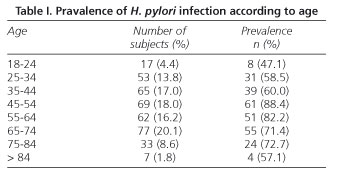
<body><![CDATA[<p> <font face="Verdana" size="2"> According to the test's technical specifications, sensitivity and specificity for the detection of <i>H. pylori</i> is 94.3% (95% confidence interval (95% CI): 87-98%) and 94.5% (95% CI: 93-98%)), respectively, for a 4-unit difference in delta values, whereas for a 5-unit difference, sensitivity is 94.3% (95% CI: 87-98%) and specificity 96.3% (95% CI: 93-98%). A difference in delta values of 5.37 units was used in this study, in light of the local validation study for the breath test with 50 subjects without prior gastric surgery and who were eradication treatment-naive (unpublished data), thus reaching a sensitivity of 96% (95% CI: 80.5-99.3%) and specificity of 100% (95% CI: 80.5-99.3%). Samples were analyzed in a clinical laboratory equipped with mass spectrometry (HELCIO-GALIZ. Ourense).</font></p>     <p>     <br> <b><font face="Verdana" size="2">Statistical analysis</font></b></p>     <p> <font face="Verdana" size="2"> Data were entered into a database using the Access program, and were then analyzed by means of the SPSS version 10.0 and Epidad 2.0 software programs, with a 95% confidence level. Mean and 95% CI values were used for quantitative variables, and frequency and percentage were used for qualitative variables. A Chi-squared test was used to compare qualitative variables. Significance was established as a p value &lt; 0.05.</font></p>     <p> &nbsp;</p>     <p> <b><font face="Verdana" size="3">Results</font></b></p>     <p> <font face="Verdana" size="2">In order to study 383 subjects, attempts to localize 1,003 individuals had to be made. It was not possible to find 159 individuals (15.8%), mainly due to errors in the data published in the BOP, because such individuals had moved their place of residence, and due to incorrect information characterizing place of residence as rural or urban. Thirty-one individuals (3.0%) were deceased, 49 (4.8%) were considered invalid because they met one or more of the exclusion criteria, and it was not possible to contact 109 (10.8%) because they were registered as living outside the province. Two hundred and twenty (21.9%) did not choose to participate in the study, and 52 (5.1%) did not participate for employment reasons. The participation rate was considered to be 63.5% when taking account of those who accepted and those who refused to be analyzed; had the 52 individuals who did not do so for occupational reasons been included in the group of those who refused to participate, the participation rate would have been 58.4%. No statistically significant differences were observed with respect to age and gender between the group of participants and the group of those who were considered lost; nor were statistical differences observed between the group of participants and the group that refused to participate.</font></p>     <p> <font face="Verdana" size="2"> <i>H. pylori</i> infection was detected in 265 subjects, 69.1% of those studied (95% CI: 61.7-75.1%). It is worthy to note that, among participants, 9 had previously been diagnosed and treated; 4 of these diagnoses were made by blood testing and 5 by endoscopy. All underwent a breath test, which was negative in 8 of the aforementioned cases. In order to establish the current prevalence rate, these 8 individuals were considered non-infected. Had they not been treated, they would likely continue to be infected, and the prevalence rate in that case would be 71.2%. Mention must also be made of the fact that 2 subjects had been diagnosed with gastric cancer in the previous 12 months; both were positive for infection as determined by histological studies of gastric biopsy specimens. Neither of the two had undergone surgery, nor had they received eradication treatment; hence, they were considered to be infected, and the breath test was not performed.</font></p>    <p> <font face="Verdana" size="2"> Three hundred and eighty-three subjects were studied, 196 men (51.2%) and 187 women (48.8%). Of the 265 infected individuals, 137 were male and 128 were female, with a prevalence rate of infection of 69.8% (95% CI: 63.2-76.6%) and 68.4% (95% CI: 61.5-75.4%), respectively. If the 8 subjects who had successfully undergone eradication therapy had been included in the infected group, the figures would have been 144 men and 129 women, with a prevalence rate of 73.4 and 68.9%, respectively. In either scenario, no statistical differences are seen between both sexes.</font></p>    <p>   <font face="Verdana" size="2">   Mean age of participants was 52.8 years (range: 20-93; 95% CI: 51.1-54.6) - 54.3 (95% CI: 52.4-56.2) for the group of infected participants and 49.2 (95% CI: 45.6-52.9) for the group of uninfected participants. Ten-year interval age cohorts were established: from 25-34 to 75-84, in addition to two extreme groups (an 18-24-year cohort and one for those over the age of 84). In the lowest age group (18-24 years) prevalence rate was 47.1%, increasing in subsequent cohorts until a peak of 88.4% was observed in the 45-54 year cohort, followed by a decline, which was more pronounced in the age group of those over the age of 84 years, which had a 57.1% rate of infection   (<a href="#t1">Table I</a>).</font></p>     ]]></body>
<body><![CDATA[<p align="center">   <a name="t1">   <img border="0" src="/img/revistas/diges/v98n4/original2_t1.jpg" width="342" height="172"></a></p>     <p align="center">&nbsp;</p>     <p><b><font face="Verdana" size="3">Discussion</font></b></p>     <p><font size="2" face="Verdana">We present the first epidemiological study on <i>H. pylori </i>infection carried out in the province of Ourense, with a population sample taken from the general population. The carbon-13-labeled urea breath test was used to establish the diagnosis of infection; this test is easy to use and has a high degree of both sensitivity and specificity, thereby enabling us to identify both individuals with active infection and uninfected individuals with great accuracy (10-12).</font></p>     <p>   <font size="2" face="Verdana">   The percentage of participation, around 60%, can be considered acceptable in order to meet the objective defined for the study. Other relevant epidemiological studies, such as those performed by Gasbarrini et al. (13) in San Marino, Bazzoli et al. (14) in Italy, and Murray et al. (15) in Northern Ireland, report participation rates of 77, 67.9, and 58.4%, respectively. It is possible that the higher participation rates achieved by these authors versus our study was made possible by the fact the they were carried out in geographically smaller areas with smaller target populations than in our case, making it easier to locate the individuals and to establish a closer relationship between the selected individuals and the investigating physicians.</font></p>    <p>   <font size="2" face="Verdana">   The prevalence rate obtained, of 69.1% (95% CI: 61.7-75.1%), is high if we compare it to studies conducted in Catalonia, the Basque Country, Asturias, Andalusia, and Madrid, with results of approximately 50% (9,16-20). Nonetheless, it is below the 84% obtained in a study carried out in Guadalajara (21), and similar to the 65.6 and 68% described in the Canary Islands (22) and Cuenca (23), respectively. Reina et al. (24) in Majorca, and Navarro et al. (25) in Vall&eacute;s Occidental (Catalonia) have described lower prevalence rates (21.1 and 38.2%, respectively) when compared to those we detected; however, only four of these studies were conducted with samples taken from the general population, as in our case, which confers greater validity to the results observed (16,19,21,22). The remaining studies were performed using volunteers, blood donors, and inpatients or people who were cared for in medical practices, which imply that the results are not applicable to the general population. Moreover, some of the aforementioned studies did not include individuals with a history of digestive illness, which we believe to be a mistake, since they also are a part of the general population (18). We included 2 subjects with a recent diagnosis of gastric cancer, with histology-confirmed infection, and 9 individuals previously diagnosed with <i>H. pylori</i> infection that had undergone eradication therapy. With the exception of the work by Rafols et al. (18), in which the breath test was used, all the other studies were performed using blood tests, different commercially available systems generally lacking prior validation; hence, the results are not easily comparable. With the data derived from comparative studies in hand, their diagnostic precision is less than that achieved with the breath test, with a mean sensitivity of 85% and a mean specificity of 79% (11).</font></p>    <p>   <font size="2" face="Verdana">   Insofar as the prevalence in other countries is concerned, the result obtained is far from the 30.6% reported for Australia (26), the 32.5% for the United States (27), or the 39.2% for Germany (28). It also differs from the prevalence rates described for San Marino and Ireland, 51 and 58.4%, respectively (13,15). In contrast, it is closer to the 67.9% detected for Northern Italy by Bazzoli et al. (14) (who also used the carbon-13-labeled urea breath test) and the 75.9% reported by Mattana et al. for Argentina (29). Various African nations have also reported very high prevalence rates in both children and adults. Seroprevalence rates of 72 and 76% were reported in Egypt and Libya, respectively (30,31). Glupczynski et al. (32) found a 77.4% infection rate in individuals analyzed in Zaire using the carbon-14 breath test, whereas in Nigeria Holcombe et al. (33) detected a seroprevalence rate of 85%. In Asia, more disparate results have been reported: in India, Graham et al. (34) obtained a prevalence rate of 79%, whereas in China, Taiwan, Nepal, and Vietnam prevalence rates of 44, 54.4, 56.8 and 75%, respectively (35-38), have been obtained.</font></p>    <p>   <font size="2" face="Verdana">   As other authors in our country have described (9, 16), the epidemiological pattern observed is an intermediate one -prevalence rates are neither as low as those found in more developed countries, nor as high as those seen in developing countries. In 9 cases, the infection had been previously diagnosed, and had been successfully treated in 8. Had they not received treatment, these subjects would have probably continued to be infected, in which case the infection rate would have risen to 71.2% of participants. Therefore, we can state that medical action can be considered as having induced a slight decline in the number of infected individuals in our area.</font></p>    <p>   <font size="2" face="Verdana">   We have not detected any differences in prevalence according to gender, which is consistent with the majority of studies in the literature (9,13-16,20). In terms of age, our data also coincide with most published studies conducted in developed countries, in which prevalence is seen to rise until it peaks in middle-aged individuals, around 50-60 years (9,14,15,18,20). In developing countries such as Nigeria, a very high prevalence rate is observed in the young -82% in children aged 2 to 9 years, with a slight subsequent increase until it affects 100% of individuals with 50-59 years of age (33).</font></p>    <p>   <font size="2" face="Verdana">   In conclusion, this study reveals that there is a very high prevalence rate -close to 70%- of <i>H. pylori </i>infection in the general adult population of the province of Ourense. Prevalence has not been seen to differ according to sex; insofar as age is concerned, prevalence is seen to increase until it peaks in middle-aged individuals, with a gradual decline in the older age   cohorts.</font></p>     ]]></body>
<body><![CDATA[<p>   &nbsp;</p>     <p>   <b><font face="Verdana" size="3">Acknowledgements</font></b></p>     <p><font size="2" face="Verdana">The authors would like to express their gratitude to Dr. Adolfo Figueiras of Department of Preventive Medicine at Universidad de Santiago de Compostela for his collaboration in the drafting of this manuscript.</font></p>     <p>&nbsp;</p>     <p><b><font face="Verdana" size="3">References</font></b></p>     <!-- ref --><p><font size="2" face="Verdana">1. Warren JR, Marshall B. Unidentified curved bacilli on gastric epithelium in active chronic gastritis. Lancet 1983; i: 1273-5.</font>&nbsp;&nbsp;&nbsp;&nbsp;&nbsp;&nbsp;&nbsp;&nbsp;[&#160;<a href="javascript:void(0);" onclick="javascript: window.open('/scielo.php?script=sci_nlinks&ref=5223839&pid=S1130-0108200600040000300001&lng=','','width=640,height=500,resizable=yes,scrollbars=1,menubar=yes,');">Links</a>&#160;]<!-- end-ref --><!-- ref --><p> <font size="2" face="Verdana"> 2. Goodwin CS, Armstrong JA, Chilvers T, Peters M, Collins MD, Sly L, et al. Transfer of Campylobacter pylori and Campylobacter mustelae to Helicobacter gen. nov. as Helicobacter pylori com. nov. and Helicobacter mustelae comb. nov., respectively. Int J Syst Bacteriol 1989; 39: 397-495.</font>&nbsp;&nbsp;&nbsp;&nbsp;&nbsp;&nbsp;&nbsp;&nbsp;[&#160;<a href="javascript:void(0);" onclick="javascript: window.open('/scielo.php?script=sci_nlinks&ref=5223840&pid=S1130-0108200600040000300002&lng=','','width=640,height=500,resizable=yes,scrollbars=1,menubar=yes,');">Links</a>&#160;]<!-- end-ref --><!-- ref --><p> <font size="2" face="Verdana"> 3. Cover TL. Commentary: Helicobacter pylori transmission, host factors, and bacterial factors. Gastroenterology 1997; 113 (Supl. 1): S29-S30.</font>&nbsp;&nbsp;&nbsp;&nbsp;&nbsp;&nbsp;&nbsp;&nbsp;[&#160;<a href="javascript:void(0);" onclick="javascript: window.open('/scielo.php?script=sci_nlinks&ref=5223841&pid=S1130-0108200600040000300003&lng=','','width=640,height=500,resizable=yes,scrollbars=1,menubar=yes,');">Links</a>&#160;]<!-- end-ref --><!-- ref --><p> <font size="2" face="Verdana"> 4. Go MF. What are the host factors that place an individual at risk for Helicobacter pylori associated disease? Gastrenterology 1997; 113: S15-S20.</font>&nbsp;&nbsp;&nbsp;&nbsp;&nbsp;&nbsp;&nbsp;&nbsp;[&#160;<a href="javascript:void(0);" onclick="javascript: window.open('/scielo.php?script=sci_nlinks&ref=5223842&pid=S1130-0108200600040000300004&lng=','','width=640,height=500,resizable=yes,scrollbars=1,menubar=yes,');">Links</a>&#160;]<!-- end-ref --><!-- ref --><p> <font size="2" face="Verdana"> 5. Covacci A, Telford JL, Del Giudice G, Parsonnet J, Rappuoli R. Helicobacter pylori virulence and genetic geography. Science 1999; 284: 1328-33.</font>&nbsp;&nbsp;&nbsp;&nbsp;&nbsp;&nbsp;&nbsp;&nbsp;[&#160;<a href="javascript:void(0);" onclick="javascript: window.open('/scielo.php?script=sci_nlinks&ref=5223843&pid=S1130-0108200600040000300005&lng=','','width=640,height=500,resizable=yes,scrollbars=1,menubar=yes,');">Links</a>&#160;]<!-- end-ref --><!-- ref --><p> <font size="2" face="Verdana"> 6. Marshall B. Helicobacter pylori: 20 years on. Clinical Medicine 2002; 2 (2): 147-52.</font>&nbsp;&nbsp;&nbsp;&nbsp;&nbsp;&nbsp;&nbsp;&nbsp;[&#160;<a href="javascript:void(0);" onclick="javascript: window.open('/scielo.php?script=sci_nlinks&ref=5223844&pid=S1130-0108200600040000300006&lng=','','width=640,height=500,resizable=yes,scrollbars=1,menubar=yes,');">Links</a>&#160;]<!-- end-ref --><!-- ref --><p> <font size="2" face="Verdana"> 7. Bardhan PK. Epidemiological features of Helicobacter pylori infection in developing countries. Clin Infect Dis 1997; 25: 973-8.</font>&nbsp;&nbsp;&nbsp;&nbsp;&nbsp;&nbsp;&nbsp;&nbsp;[&#160;<a href="javascript:void(0);" onclick="javascript: window.open('/scielo.php?script=sci_nlinks&ref=5223845&pid=S1130-0108200600040000300007&lng=','','width=640,height=500,resizable=yes,scrollbars=1,menubar=yes,');">Links</a>&#160;]<!-- end-ref --><!-- ref --><p> <font size="2" face="Verdana"> 8. Go MF. Review article: natural history and epidemiology of Helicobacter pylori infection. Aliment Pharmacol Ther 2002; 16 (Supl. 1): 3-15.</font>&nbsp;&nbsp;&nbsp;&nbsp;&nbsp;&nbsp;&nbsp;&nbsp;[&#160;<a href="javascript:void(0);" onclick="javascript: window.open('/scielo.php?script=sci_nlinks&ref=5223846&pid=S1130-0108200600040000300008&lng=','','width=640,height=500,resizable=yes,scrollbars=1,menubar=yes,');">Links</a>&#160;]<!-- end-ref --><!-- ref --><p> <font size="2" face="Verdana"> 9. Baena JM, Garc&iacute;a M, Mart&iacute; J, Le&oacute;n I, Mu&ntilde;iz D, Teruel J, et al. Prevalencia de la infecci&oacute;n por Helicobacter pylori en atenci&oacute;n primaria: estudio seroepidemiol&oacute;gico. Aten Primaria 2002; 29 (9): 553-7.</font>&nbsp;&nbsp;&nbsp;&nbsp;&nbsp;&nbsp;&nbsp;&nbsp;[&#160;<a href="javascript:void(0);" onclick="javascript: window.open('/scielo.php?script=sci_nlinks&ref=5223847&pid=S1130-0108200600040000300009&lng=','','width=640,height=500,resizable=yes,scrollbars=1,menubar=yes,');">Links</a>&#160;]<!-- end-ref --><!-- ref --><p> <font size="2" face="Verdana"> 10. Savarino V, Vigneri S, Celle G. The 13C urea breath test in the diagnosis of Helicobacter pylori infection. Gut 1999; 45 (Supl. 1): I18-I22.</font>&nbsp;&nbsp;&nbsp;&nbsp;&nbsp;&nbsp;&nbsp;&nbsp;[&#160;<a href="javascript:void(0);" onclick="javascript: window.open('/scielo.php?script=sci_nlinks&ref=5223848&pid=S1130-0108200600040000300010&lng=','','width=640,height=500,resizable=yes,scrollbars=1,menubar=yes,');">Links</a>&#160;]<!-- end-ref --><!-- ref --><p> <font size="2" face="Verdana"> 11. Pajares JM. Infecci&oacute;n por Helicobacter pylori. Rev Clin Esp 2002; 202 (2): 99-110.</font>&nbsp;&nbsp;&nbsp;&nbsp;&nbsp;&nbsp;&nbsp;&nbsp;[&#160;<a href="javascript:void(0);" onclick="javascript: window.open('/scielo.php?script=sci_nlinks&ref=5223849&pid=S1130-0108200600040000300011&lng=','','width=640,height=500,resizable=yes,scrollbars=1,menubar=yes,');">Links</a>&#160;]<!-- end-ref --><!-- ref --><p> <font size="2" face="Verdana"> 12. Gisbert JP, Ducons J, Gomoll&oacute;n F, Dom&iacute;nguez-Mu&ntilde;oz JE, Borda F, Mi&ntilde;o G, et al. Validaci&oacute;n de la prueba del aliento con 13C-urea para el diagn&oacute;stico inicial de la infecci&oacute;n por Helicobacter pylori y la confirmaci&oacute;n de su erradicaci&oacute;n tras el tratamiento. Rev Esp Enferm Dig 2003; 95 (2): 115-20.</font>&nbsp;&nbsp;&nbsp;&nbsp;&nbsp;&nbsp;&nbsp;&nbsp;[&#160;<a href="javascript:void(0);" onclick="javascript: window.open('/scielo.php?script=sci_nlinks&ref=5223850&pid=S1130-0108200600040000300012&lng=','','width=640,height=500,resizable=yes,scrollbars=1,menubar=yes,');">Links</a>&#160;]<!-- end-ref --><!-- ref --><p> <font size="2" face="Verdana"> 13. Gasbarrini G, Pretolani S, Bonvicini F, Gatto MRA, Tonelli E, Megraud F, et al. A population based study of Helicobacter pylori infection in a European country: the San Marino Study. Relations with gastrointestinal diseases. Gut 1995; 36: 838-44.</font>&nbsp;&nbsp;&nbsp;&nbsp;&nbsp;&nbsp;&nbsp;&nbsp;[&#160;<a href="javascript:void(0);" onclick="javascript: window.open('/scielo.php?script=sci_nlinks&ref=5223851&pid=S1130-0108200600040000300013&lng=','','width=640,height=500,resizable=yes,scrollbars=1,menubar=yes,');">Links</a>&#160;]<!-- end-ref --><!-- ref --><p>   <font size="2" face="Verdana">   14. Bazzoli F, Palli D, Zagari RM, Festi D, Pozzato P, Nicolini G, et al. The Loiano-Monghidoro population-based study of Helicobacter pylori infection: prevalence by 13C-urea breath test and associated factors. Aliment Pharmacol Ther 2001; 15 (7): 1001-7.</font>&nbsp;&nbsp;&nbsp;&nbsp;&nbsp;&nbsp;&nbsp;&nbsp;[&#160;<a href="javascript:void(0);" onclick="javascript: window.open('/scielo.php?script=sci_nlinks&ref=5223852&pid=S1130-0108200600040000300014&lng=','','width=640,height=500,resizable=yes,scrollbars=1,menubar=yes,');">Links</a>&#160;]<!-- end-ref --><!-- ref --><p>   <font size="2" face="Verdana">   15. Murray LJ, McCrum EE, Evans AE, Bamford KB. Epidemiology of Helicobacter pylori infection among 4742 randomly selected subjets from Northern Ireland. Int J Epidemiol 1997; 26 (4): 880-7.</font>&nbsp;&nbsp;&nbsp;&nbsp;&nbsp;&nbsp;&nbsp;&nbsp;[&#160;<a href="javascript:void(0);" onclick="javascript: window.open('/scielo.php?script=sci_nlinks&ref=5223853&pid=S1130-0108200600040000300015&lng=','','width=640,height=500,resizable=yes,scrollbars=1,menubar=yes,');">Links</a>&#160;]<!-- end-ref --><!-- ref --><p>   <font size="2" face="Verdana">   16. Rafols A, Solanas P, Ramio G, Suelves N, Rodr&iacute;guez C, Gonz&aacute;lez C et al. Prevalencia de la infecci&oacute;n por Helicobacter pylori en atenci&oacute;n primaria de salud. Aten Primaria 2000; 25 (8): 104-11.</font>&nbsp;&nbsp;&nbsp;&nbsp;&nbsp;&nbsp;&nbsp;&nbsp;[&#160;<a href="javascript:void(0);" onclick="javascript: window.open('/scielo.php?script=sci_nlinks&ref=5223854&pid=S1130-0108200600040000300016&lng=','','width=640,height=500,resizable=yes,scrollbars=1,menubar=yes,');">Links</a>&#160;]<!-- end-ref --><!-- ref --><p>   <font size="2" face="Verdana">   17. Cilla G, P&eacute;rez-Trallero E, Garc&iacute;a-Bengoechea M, Marim&oacute;n JM, Arenas JI. Helicobacter pylori infection: a seroepidemiological study in Guip&uacute;zcoa, Basque Country, Spain. Eur J Epidemiol 1997; 13: 945-9.</font>&nbsp;&nbsp;&nbsp;&nbsp;&nbsp;&nbsp;&nbsp;&nbsp;[&#160;<a href="javascript:void(0);" onclick="javascript: window.open('/scielo.php?script=sci_nlinks&ref=5223855&pid=S1130-0108200600040000300017&lng=','','width=640,height=500,resizable=yes,scrollbars=1,menubar=yes,');">Links</a>&#160;]<!-- end-ref --><!-- ref --><p>   <font size="2" face="Verdana">   18. Rodrigo L, Riestra S, Fern&aacute;ndez E, Fern&aacute;ndez MR, Garc&iacute;a S, Lauret ME. Estudio epidemiol&oacute;gico de la infecci&oacute;n por Helicobacter pylori en la poblaci&oacute;n general de Asturias. Rev Esp Enferm Dig 1997; 89 (7): 511-6.</font>&nbsp;&nbsp;&nbsp;&nbsp;&nbsp;&nbsp;&nbsp;&nbsp;[&#160;<a href="javascript:void(0);" onclick="javascript: window.open('/scielo.php?script=sci_nlinks&ref=5223856&pid=S1130-0108200600040000300018&lng=','','width=640,height=500,resizable=yes,scrollbars=1,menubar=yes,');">Links</a>&#160;]<!-- end-ref --><!-- ref --><p>   <font size="2" face="Verdana">   19. Caballero AM, Sofos S, Valenzuela M, Mart&iacute;n JL, Casado FJ, Guilarte J. Epidemiolog&iacute;a de la dispepsia en una comunidad del sur de Espa&ntilde;a. Prevalencia de la infecci&oacute;n por Helicobacter pylori. Rev Esp Enferm Dig 2000; 92 (12): 781-6.</font>&nbsp;&nbsp;&nbsp;&nbsp;&nbsp;&nbsp;&nbsp;&nbsp;[&#160;<a href="javascript:void(0);" onclick="javascript: window.open('/scielo.php?script=sci_nlinks&ref=5223857&pid=S1130-0108200600040000300019&lng=','','width=640,height=500,resizable=yes,scrollbars=1,menubar=yes,');">Links</a>&#160;]<!-- end-ref --><!-- ref --><p>   <font size="2" face="Verdana">   20. Mart&iacute;n de Argila C, Boixeda D, Cant&oacute;n R, Mir N, de Rafael L, Gisbert J, et al. Helicobacter pylori infection in a healthy population in Spain. Eur J Gastroenterol Hepatol 1996; 8 (12): 1165-8.</font>&nbsp;&nbsp;&nbsp;&nbsp;&nbsp;&nbsp;&nbsp;&nbsp;[&#160;<a href="javascript:void(0);" onclick="javascript: window.open('/scielo.php?script=sci_nlinks&ref=5223858&pid=S1130-0108200600040000300020&lng=','','width=640,height=500,resizable=yes,scrollbars=1,menubar=yes,');">Links</a>&#160;]<!-- end-ref --><!-- ref --><p>   <font size="2" face="Verdana">   21. Carballo F, Mart&iacute;nez C, Aldeguer M, Garc&iacute;a A, Dom&iacute;nguez E, Malfertheiner P, et al. Infecci&oacute;n por Helicobacter pylori en Guadalajara: prevalencia y factores asociados. Rev Esp Enferm Dig 1995; 87 (Supl. 1): 7.</font>&nbsp;&nbsp;&nbsp;&nbsp;&nbsp;&nbsp;&nbsp;&nbsp;[&#160;<a href="javascript:void(0);" onclick="javascript: window.open('/scielo.php?script=sci_nlinks&ref=5223859&pid=S1130-0108200600040000300021&lng=','','width=640,height=500,resizable=yes,scrollbars=1,menubar=yes,');">Links</a>&#160;]<!-- end-ref --><!-- ref --><p>   <font size="2" face="Verdana">   22. Castellot A, Santana E, Orengo JC, Pe&ntilde;a L, Santana M, Sierra A, et al. Seroprevalencia de la infecci&oacute;n por Helicobacter pylori en la Islas Canarias. Rev Esp Enferm Dig 2001; 93 (Supl. 1): 153.</font>&nbsp;&nbsp;&nbsp;&nbsp;&nbsp;&nbsp;&nbsp;&nbsp;[&#160;<a href="javascript:void(0);" onclick="javascript: window.open('/scielo.php?script=sci_nlinks&ref=5223860&pid=S1130-0108200600040000300022&lng=','','width=640,height=500,resizable=yes,scrollbars=1,menubar=yes,');">Links</a>&#160;]<!-- end-ref --><!-- ref --><p>   <font size="2" face="Verdana">   23. Gonz&aacute;lez JA, G&oacute;mez C, Garc&iacute;a-Cano J, Nieto J, Morillas J, P&eacute;rez JI, et al. Infecci&oacute;n por Helicobacter pylori en poblaci&oacute;n sana en la provincia de Cuenca. Rev Esp Enferm Dig 2003; 95 (Supl. 1): 52.</font>&nbsp;&nbsp;&nbsp;&nbsp;&nbsp;&nbsp;&nbsp;&nbsp;[&#160;<a href="javascript:void(0);" onclick="javascript: window.open('/scielo.php?script=sci_nlinks&ref=5223861&pid=S1130-0108200600040000300023&lng=','','width=640,height=500,resizable=yes,scrollbars=1,menubar=yes,');">Links</a>&#160;]<!-- end-ref --><!-- ref --><p>   <font size="2" face="Verdana">   24. Reina J, Salv&aacute; F, Alomar P. An&aacute;lisis de la prevalencia de anticuerpos anti-Campylobacter pylori detectados en la poblaci&oacute;n humana sana. Rev Esp Enferm Dig 1989; 76 (2): 151-4.</font>&nbsp;&nbsp;&nbsp;&nbsp;&nbsp;&nbsp;&nbsp;&nbsp;[&#160;<a href="javascript:void(0);" onclick="javascript: window.open('/scielo.php?script=sci_nlinks&ref=5223862&pid=S1130-0108200600040000300024&lng=','','width=640,height=500,resizable=yes,scrollbars=1,menubar=yes,');">Links</a>&#160;]<!-- end-ref --><!-- ref --><p>   <font size="2" face="Verdana">   25. Navarro M, Calvet X, Font B, Sanfeliu I, Segura F. Prevalence of Helicobacter pylori infection in the Vall&eacute;s Occidental, Catalonia. Clin Microbiol Infect 1999; 5 (11): 704-6.</font>&nbsp;&nbsp;&nbsp;&nbsp;&nbsp;&nbsp;&nbsp;&nbsp;[&#160;<a href="javascript:void(0);" onclick="javascript: window.open('/scielo.php?script=sci_nlinks&ref=5223863&pid=S1130-0108200600040000300025&lng=','','width=640,height=500,resizable=yes,scrollbars=1,menubar=yes,');">Links</a>&#160;]<!-- end-ref --><!-- ref --><p>   <font size="2" face="Verdana">   26. Peach HG, Pearce DC, Farish SJ. Helicobacter pylori infection in an Australian regional city: prevalence and risk factors. Med J Aust 1997; 167 (6): 310-3.</font>&nbsp;&nbsp;&nbsp;&nbsp;&nbsp;&nbsp;&nbsp;&nbsp;[&#160;<a href="javascript:void(0);" onclick="javascript: window.open('/scielo.php?script=sci_nlinks&ref=5223864&pid=S1130-0108200600040000300026&lng=','','width=640,height=500,resizable=yes,scrollbars=1,menubar=yes,');">Links</a>&#160;]<!-- end-ref --><!-- ref --><p>   <font size="2" face="Verdana">   27. Everhart JE, Kruszon-Moran D, P&eacute;rez-P&eacute;rez GI, Tralka TS, McQuillan G. Seroprevalence and ethnic differences in Helicobacter pylori infection among adults in the United States. J Infect Dis 2000; 181: 1359-63.</font>&nbsp;&nbsp;&nbsp;&nbsp;&nbsp;&nbsp;&nbsp;&nbsp;[&#160;<a href="javascript:void(0);" onclick="javascript: window.open('/scielo.php?script=sci_nlinks&ref=5223865&pid=S1130-0108200600040000300027&lng=','','width=640,height=500,resizable=yes,scrollbars=1,menubar=yes,');">Links</a>&#160;]<!-- end-ref --><!-- ref --><p>   <font size="2" face="Verdana">   28. Breuer T, Sudhop T, Hoch J, Sauerbruch T, Malfertheiner P. Prevalence of and risk factors for Helicobacter pylori infection in the western part of Germany. Eur J Gastroenterol Hepatol 1996; 8: 47-52.</font>&nbsp;&nbsp;&nbsp;&nbsp;&nbsp;&nbsp;&nbsp;&nbsp;[&#160;<a href="javascript:void(0);" onclick="javascript: window.open('/scielo.php?script=sci_nlinks&ref=5223866&pid=S1130-0108200600040000300028&lng=','','width=640,height=500,resizable=yes,scrollbars=1,menubar=yes,');">Links</a>&#160;]<!-- end-ref --><!-- ref --><p>   <font size="2" face="Verdana">   29. Mattana C, Vega A, G&oacute;mez P, Puig de Centorbi O. Serological profile of Helicobacter pylori infection in the population of San Luis (Argentina). Enferm Infecc Microbiol Clin 2004; 22 (4): 227-9.</font>&nbsp;&nbsp;&nbsp;&nbsp;&nbsp;&nbsp;&nbsp;&nbsp;[&#160;<a href="javascript:void(0);" onclick="javascript: window.open('/scielo.php?script=sci_nlinks&ref=5223867&pid=S1130-0108200600040000300029&lng=','','width=640,height=500,resizable=yes,scrollbars=1,menubar=yes,');">Links</a>&#160;]<!-- end-ref --><!-- ref --><p>   <font size="2" face="Verdana">   30. Metwally MA, Kabil SM, Rossignol JF, Montasser NA, Zein CC. A population based study of Helicobacter pylori in Egypt. Gastroenterology 2001; 120 (5): A735.</font>&nbsp;&nbsp;&nbsp;&nbsp;&nbsp;&nbsp;&nbsp;&nbsp;[&#160;<a href="javascript:void(0);" onclick="javascript: window.open('/scielo.php?script=sci_nlinks&ref=5223868&pid=S1130-0108200600040000300030&lng=','','width=640,height=500,resizable=yes,scrollbars=1,menubar=yes,');">Links</a>&#160;]<!-- end-ref --><!-- ref --><p>   <font size="2" face="Verdana">   31. Bakka AS, Salih BA. Prevalence of Helicobacter pylori infection in aymptomatic subjects in Lybia. Diagn Microbiol Infect Dis 2002; 43 (4): 265-8.</font>&nbsp;&nbsp;&nbsp;&nbsp;&nbsp;&nbsp;&nbsp;&nbsp;[&#160;<a href="javascript:void(0);" onclick="javascript: window.open('/scielo.php?script=sci_nlinks&ref=5223869&pid=S1130-0108200600040000300031&lng=','','width=640,height=500,resizable=yes,scrollbars=1,menubar=yes,');">Links</a>&#160;]<!-- end-ref --><!-- ref --><p>   <font size="2" face="Verdana">   32. Glupczynski Y, Bourdeaux L, Verhas M, DePerez C, DeVos D, Devreker T. Use of a urea breath test versus invasive methods to determine the prevalence of Helicobacter pylori in Zaire. Eur J Clin Microbiol Infect Dis 1992; 11 (4): 322-7.</font>&nbsp;&nbsp;&nbsp;&nbsp;&nbsp;&nbsp;&nbsp;&nbsp;[&#160;<a href="javascript:void(0);" onclick="javascript: window.open('/scielo.php?script=sci_nlinks&ref=5223870&pid=S1130-0108200600040000300032&lng=','','width=640,height=500,resizable=yes,scrollbars=1,menubar=yes,');">Links</a>&#160;]<!-- end-ref --><!-- ref --><p>   <font size="2" face="Verdana">   33. Holcombe C, Omotara BA, Eldrige J, Jones DM. H. pylori, the most common bacterial infection in Africa: a random serological study. Am J Gastroenterol 1992; 87 (1): 28-30.</font>&nbsp;&nbsp;&nbsp;&nbsp;&nbsp;&nbsp;&nbsp;&nbsp;[&#160;<a href="javascript:void(0);" onclick="javascript: window.open('/scielo.php?script=sci_nlinks&ref=5223871&pid=S1130-0108200600040000300033&lng=','','width=640,height=500,resizable=yes,scrollbars=1,menubar=yes,');">Links</a>&#160;]<!-- end-ref --><!-- ref --><p>   <font size="2" face="Verdana">   34. Graham DY, Adam E, Reddy GT, Agarwal, JP, Agarwal R, Evans DJ et al. Seroepidemiology of Helicobacter infection in India. Comparison of developing and developed countries. Dig Dis Sci 1991; 36 (8): 1084-8.</font>&nbsp;&nbsp;&nbsp;&nbsp;&nbsp;&nbsp;&nbsp;&nbsp;[&#160;<a href="javascript:void(0);" onclick="javascript: window.open('/scielo.php?script=sci_nlinks&ref=5223872&pid=S1130-0108200600040000300034&lng=','','width=640,height=500,resizable=yes,scrollbars=1,menubar=yes,');">Links</a>&#160;]<!-- end-ref --><!-- ref --><p>   <font size="2" face="Verdana">   35. Mitchell HM, Li YY, Hu PJ, Liu Q, Chen M, Du G, et al. Epidemiology of Helicobacter pylori in Southern China: identification of early childhood as the critical period of adquisition. J Infect Dis 1992; 166: 149-53.</font>&nbsp;&nbsp;&nbsp;&nbsp;&nbsp;&nbsp;&nbsp;&nbsp;[&#160;<a href="javascript:void(0);" onclick="javascript: window.open('/scielo.php?script=sci_nlinks&ref=5223873&pid=S1130-0108200600040000300035&lng=','','width=640,height=500,resizable=yes,scrollbars=1,menubar=yes,');">Links</a>&#160;]<!-- end-ref --><!-- ref --><p>   <font size="2" face="Verdana">   36. Lin JT, Wang JT, Wang TH, Wu MS, Lee TK, Chen CJ. Helicobacter pylori infection in a randomly selected population, heathy volunteers, and patients with gastric ulcer and gastric adenocarcinoma. Scand J Gastroenterol 1993; 28: 1067-72.</font>&nbsp;&nbsp;&nbsp;&nbsp;&nbsp;&nbsp;&nbsp;&nbsp;[&#160;<a href="javascript:void(0);" onclick="javascript: window.open('/scielo.php?script=sci_nlinks&ref=5223874&pid=S1130-0108200600040000300036&lng=','','width=640,height=500,resizable=yes,scrollbars=1,menubar=yes,');">Links</a>&#160;]<!-- end-ref --><!-- ref --><p>   <font size="2" face="Verdana">   37. Kawasaki M, Kawasaki T, Ogaki T, Ito K, Kobayashi S, Yoshimizu Y, et al. Seroprevalence of Helicobacter pylori infection in Nepal: low prevalence in an isolated rural village. J Gastroenterol Hepatol 1998; 10 (1): 47-50.</font>&nbsp;&nbsp;&nbsp;&nbsp;&nbsp;&nbsp;&nbsp;&nbsp;[&#160;<a href="javascript:void(0);" onclick="javascript: window.open('/scielo.php?script=sci_nlinks&ref=5223875&pid=S1130-0108200600040000300037&lng=','','width=640,height=500,resizable=yes,scrollbars=1,menubar=yes,');">Links</a>&#160;]<!-- end-ref --><!-- ref --><p>   <font size="2" face="Verdana">   38. Hoang TT, Bengtsson C, Phung DC, Sorberg M, Granstrom M. Seroprevalence of Helicobacter pylori infection in urban and rural Vietnam. Clin Diagn Lab Immunol 2005; 12 (1): 81-5.</font>&nbsp;&nbsp;&nbsp;&nbsp;&nbsp;&nbsp;&nbsp;&nbsp;[&#160;<a href="javascript:void(0);" onclick="javascript: window.open('/scielo.php?script=sci_nlinks&ref=5223876&pid=S1130-0108200600040000300038&lng=','','width=640,height=500,resizable=yes,scrollbars=1,menubar=yes,');">Links</a>&#160;]<!-- end-ref --><p>   &nbsp;</p>     <p>&nbsp;</p>     <p><font size="2" face="Verdana"><a name="back"></a><a href="#top"><img border="0" src="/img/revistas/diges/v98n4/seta.gif" width="15" height="17"></a><b>Correspondence:    <br> </b>Ramiro Manuel Macenlle García.    <br> Servicio de Aparato Digestivo.    <br> Complejo Hospitalario de Ourense.    <br> C/ Ramón Puga, 54.    ]]></body>
<body><![CDATA[<br> 32005 Ourense.    <br> e-mail: <a href="mailto:macenlle@mixmail.com">macenlle@mixmail.com</a></font></p>     <p><font size="2" face="Verdana">Recibido: 06-10-05.    <br> Aceptado: 19-12-05.</font></p>      ]]></body><back>
<ref-list>
<ref id="B1">
<label>1</label><nlm-citation citation-type="journal">
<person-group person-group-type="author">
<name>
<surname><![CDATA[Warren]]></surname>
<given-names><![CDATA[JR]]></given-names>
</name>
<name>
<surname><![CDATA[Marshall]]></surname>
<given-names><![CDATA[B]]></given-names>
</name>
</person-group>
<article-title xml:lang="en"><![CDATA[Unidentified curved bacilli on gastric epithelium in active chronic gastritis]]></article-title>
<source><![CDATA[Lancet]]></source>
<year>1983</year>
<volume>i</volume>
<page-range>1273-5</page-range></nlm-citation>
</ref>
<ref id="B2">
<label>2</label><nlm-citation citation-type="journal">
<person-group person-group-type="author">
<name>
<surname><![CDATA[Goodwin]]></surname>
<given-names><![CDATA[CS]]></given-names>
</name>
<name>
<surname><![CDATA[Armstrong]]></surname>
<given-names><![CDATA[JA]]></given-names>
</name>
<name>
<surname><![CDATA[Chilvers]]></surname>
<given-names><![CDATA[T]]></given-names>
</name>
<name>
<surname><![CDATA[Peters]]></surname>
<given-names><![CDATA[M]]></given-names>
</name>
<name>
<surname><![CDATA[Collins]]></surname>
<given-names><![CDATA[MD]]></given-names>
</name>
<name>
<surname><![CDATA[Sly]]></surname>
<given-names><![CDATA[L]]></given-names>
</name>
</person-group>
<article-title xml:lang="en"><![CDATA[Transfer of Campylobacter pylori and Campylobacter mustelae to Helicobacter gen: nov. as Helicobacter pylori com. nov. and Helicobacter mustelae comb. nov., respectively]]></article-title>
<source><![CDATA[Int J Syst Bacteriol]]></source>
<year>1989</year>
<volume>39</volume>
<page-range>397-495</page-range></nlm-citation>
</ref>
<ref id="B3">
<label>3</label><nlm-citation citation-type="journal">
<person-group person-group-type="author">
<name>
<surname><![CDATA[Cover]]></surname>
<given-names><![CDATA[TL]]></given-names>
</name>
</person-group>
<article-title xml:lang="en"><![CDATA[Commentary: Helicobacter pylori transmission, host factors, and bacterial factors]]></article-title>
<source><![CDATA[Gastroenterology]]></source>
<year>1997</year>
<volume>113</volume>
<numero>^s1</numero>
<issue>^s1</issue>
<supplement>1</supplement>
<page-range>S29-S30</page-range></nlm-citation>
</ref>
<ref id="B4">
<label>4</label><nlm-citation citation-type="journal">
<person-group person-group-type="author">
<name>
<surname><![CDATA[Go]]></surname>
<given-names><![CDATA[MF]]></given-names>
</name>
</person-group>
<article-title xml:lang="en"><![CDATA[What are the host factors that place an individual at risk for Helicobacter pylori associated disease?]]></article-title>
<source><![CDATA[Gastrenterology]]></source>
<year>1997</year>
<volume>113</volume>
<page-range>S15-S20</page-range></nlm-citation>
</ref>
<ref id="B5">
<label>5</label><nlm-citation citation-type="journal">
<person-group person-group-type="author">
<name>
<surname><![CDATA[Covacci]]></surname>
<given-names><![CDATA[A]]></given-names>
</name>
<name>
<surname><![CDATA[Telford]]></surname>
<given-names><![CDATA[JL]]></given-names>
</name>
<name>
<surname><![CDATA[Del]]></surname>
<given-names><![CDATA[Giudice G]]></given-names>
</name>
<name>
<surname><![CDATA[Parsonnet]]></surname>
<given-names><![CDATA[J]]></given-names>
</name>
<name>
<surname><![CDATA[Rappuoli]]></surname>
<given-names><![CDATA[R]]></given-names>
</name>
</person-group>
<article-title xml:lang="en"><![CDATA[Helicobacter pylori virulence and genetic geography]]></article-title>
<source><![CDATA[Science]]></source>
<year>1999</year>
<volume>284</volume>
<page-range>1328-33</page-range></nlm-citation>
</ref>
<ref id="B6">
<label>6</label><nlm-citation citation-type="journal">
<person-group person-group-type="author">
<name>
<surname><![CDATA[Marshall]]></surname>
<given-names><![CDATA[B]]></given-names>
</name>
</person-group>
<article-title xml:lang="en"><![CDATA[Helicobacter pylori: 20 years on]]></article-title>
<source><![CDATA[Clinical Medicine]]></source>
<year>2002</year>
<volume>2</volume>
<numero>2</numero>
<issue>2</issue>
<page-range>147-52</page-range></nlm-citation>
</ref>
<ref id="B7">
<label>7</label><nlm-citation citation-type="journal">
<person-group person-group-type="author">
<name>
<surname><![CDATA[Bardhan]]></surname>
<given-names><![CDATA[PK]]></given-names>
</name>
</person-group>
<article-title xml:lang="en"><![CDATA[Epidemiological features of Helicobacter pylori infection in developing countries]]></article-title>
<source><![CDATA[Clin Infect Dis]]></source>
<year>1997</year>
<volume>25</volume>
<page-range>973-8</page-range></nlm-citation>
</ref>
<ref id="B8">
<label>8</label><nlm-citation citation-type="journal">
<person-group person-group-type="author">
<name>
<surname><![CDATA[Go]]></surname>
<given-names><![CDATA[MF]]></given-names>
</name>
</person-group>
<article-title xml:lang="en"><![CDATA[Review article: natural history and epidemiology of Helicobacter pylori infection]]></article-title>
<source><![CDATA[Aliment Pharmacol Ther]]></source>
<year>2002</year>
<volume>16</volume>
<numero>^s1</numero>
<issue>^s1</issue>
<supplement>1</supplement>
<page-range>3-15</page-range></nlm-citation>
</ref>
<ref id="B9">
<label>9</label><nlm-citation citation-type="journal">
<person-group person-group-type="author">
<name>
<surname><![CDATA[Baena]]></surname>
<given-names><![CDATA[JM]]></given-names>
</name>
<name>
<surname><![CDATA[García]]></surname>
<given-names><![CDATA[M]]></given-names>
</name>
<name>
<surname><![CDATA[Martí]]></surname>
<given-names><![CDATA[J]]></given-names>
</name>
<name>
<surname><![CDATA[León]]></surname>
<given-names><![CDATA[I]]></given-names>
</name>
<name>
<surname><![CDATA[Muñiz]]></surname>
<given-names><![CDATA[D]]></given-names>
</name>
<name>
<surname><![CDATA[Teruel]]></surname>
<given-names><![CDATA[J]]></given-names>
</name>
</person-group>
<article-title xml:lang="es"><![CDATA[Prevalencia de la infección por Helicobacter pylori en atención primaria: estudio seroepidemiológico]]></article-title>
<source><![CDATA[Aten Primaria]]></source>
<year>2002</year>
<volume>29</volume>
<numero>9</numero>
<issue>9</issue>
<page-range>553-7</page-range></nlm-citation>
</ref>
<ref id="B10">
<label>10</label><nlm-citation citation-type="journal">
<person-group person-group-type="author">
<name>
<surname><![CDATA[Savarino]]></surname>
<given-names><![CDATA[V]]></given-names>
</name>
<name>
<surname><![CDATA[Vigneri]]></surname>
<given-names><![CDATA[S]]></given-names>
</name>
<name>
<surname><![CDATA[Celle]]></surname>
<given-names><![CDATA[G]]></given-names>
</name>
</person-group>
<article-title xml:lang="en"><![CDATA[The 13C urea breath test in the diagnosis of Helicobacter pylori infection]]></article-title>
<source><![CDATA[Gut]]></source>
<year>1999</year>
<volume>45</volume>
<numero>^s1</numero>
<issue>^s1</issue>
<supplement>1</supplement>
<page-range>I18-I22</page-range></nlm-citation>
</ref>
<ref id="B11">
<label>11</label><nlm-citation citation-type="journal">
<person-group person-group-type="author">
<name>
<surname><![CDATA[Pajares]]></surname>
<given-names><![CDATA[JM]]></given-names>
</name>
</person-group>
<article-title xml:lang="es"><![CDATA[Infección por Helicobacter pylori]]></article-title>
<source><![CDATA[Rev Clin Esp]]></source>
<year>2002</year>
<volume>202</volume>
<numero>2</numero>
<issue>2</issue>
<page-range>99-110</page-range></nlm-citation>
</ref>
<ref id="B12">
<label>12</label><nlm-citation citation-type="journal">
<person-group person-group-type="author">
<name>
<surname><![CDATA[Gisbert]]></surname>
<given-names><![CDATA[JP]]></given-names>
</name>
<name>
<surname><![CDATA[Ducons]]></surname>
<given-names><![CDATA[J]]></given-names>
</name>
<name>
<surname><![CDATA[Gomollón]]></surname>
<given-names><![CDATA[F]]></given-names>
</name>
<name>
<surname><![CDATA[Domínguez-Muñoz]]></surname>
<given-names><![CDATA[JE]]></given-names>
</name>
<name>
<surname><![CDATA[Borda]]></surname>
<given-names><![CDATA[F]]></given-names>
</name>
<name>
<surname><![CDATA[Miño]]></surname>
<given-names><![CDATA[G]]></given-names>
</name>
</person-group>
<article-title xml:lang="es"><![CDATA[Validación de la prueba del aliento con 13C-urea para el diagnóstico inicial de la infección por Helicobacter pylori y la confirmación de su erradicación tras el tratamiento]]></article-title>
<source><![CDATA[Rev Esp Enferm Dig]]></source>
<year>2003</year>
<volume>95</volume>
<numero>2</numero>
<issue>2</issue>
<page-range>115-20</page-range></nlm-citation>
</ref>
<ref id="B13">
<label>13</label><nlm-citation citation-type="journal">
<person-group person-group-type="author">
<name>
<surname><![CDATA[Gasbarrini]]></surname>
<given-names><![CDATA[G]]></given-names>
</name>
<name>
<surname><![CDATA[Pretolani]]></surname>
<given-names><![CDATA[S]]></given-names>
</name>
<name>
<surname><![CDATA[Bonvicini]]></surname>
<given-names><![CDATA[F]]></given-names>
</name>
<name>
<surname><![CDATA[Gatto]]></surname>
<given-names><![CDATA[MRA]]></given-names>
</name>
<name>
<surname><![CDATA[Tonelli]]></surname>
<given-names><![CDATA[E]]></given-names>
</name>
<name>
<surname><![CDATA[Megraud]]></surname>
<given-names><![CDATA[F]]></given-names>
</name>
</person-group>
<article-title xml:lang="en"><![CDATA[A population based study of Helicobacter pylori infection in a European country: the San Marino Study]]></article-title>
<source><![CDATA[Relations with gastrointestinal diseases. Gut]]></source>
<year>1995</year>
<volume>36</volume>
<page-range>838-44</page-range></nlm-citation>
</ref>
<ref id="B14">
<label>14</label><nlm-citation citation-type="journal">
<person-group person-group-type="author">
<name>
<surname><![CDATA[Bazzoli]]></surname>
<given-names><![CDATA[F]]></given-names>
</name>
<name>
<surname><![CDATA[Palli]]></surname>
<given-names><![CDATA[D]]></given-names>
</name>
<name>
<surname><![CDATA[Zagari]]></surname>
<given-names><![CDATA[RM]]></given-names>
</name>
<name>
<surname><![CDATA[Festi]]></surname>
<given-names><![CDATA[D]]></given-names>
</name>
<name>
<surname><![CDATA[Pozzato]]></surname>
<given-names><![CDATA[P]]></given-names>
</name>
<name>
<surname><![CDATA[Nicolini]]></surname>
<given-names><![CDATA[G]]></given-names>
</name>
</person-group>
<article-title xml:lang="en"><![CDATA[The Loiano-Monghidoro population-based study of Helicobacter pylori infection: prevalence by 13C-urea breath test and associated factors]]></article-title>
<source><![CDATA[Aliment Pharmacol Ther]]></source>
<year>2001</year>
<volume>15</volume>
<numero>7</numero>
<issue>7</issue>
<page-range>1001-7</page-range></nlm-citation>
</ref>
<ref id="B15">
<label>15</label><nlm-citation citation-type="journal">
<person-group person-group-type="author">
<name>
<surname><![CDATA[Murray]]></surname>
<given-names><![CDATA[LJ]]></given-names>
</name>
<name>
<surname><![CDATA[McCrum]]></surname>
<given-names><![CDATA[EE]]></given-names>
</name>
<name>
<surname><![CDATA[Evans]]></surname>
<given-names><![CDATA[AE]]></given-names>
</name>
<name>
<surname><![CDATA[Bamford]]></surname>
<given-names><![CDATA[KB]]></given-names>
</name>
</person-group>
<article-title xml:lang="en"><![CDATA[Epidemiology of Helicobacter pylori infection among 4742 randomly selected subjets from Northern Ireland]]></article-title>
<source><![CDATA[Int J Epidemiol]]></source>
<year>1997</year>
<volume>26</volume>
<numero>4</numero>
<issue>4</issue>
<page-range>880-7</page-range></nlm-citation>
</ref>
<ref id="B16">
<label>16</label><nlm-citation citation-type="journal">
<person-group person-group-type="author">
<name>
<surname><![CDATA[Rafols]]></surname>
<given-names><![CDATA[A]]></given-names>
</name>
<name>
<surname><![CDATA[Solanas]]></surname>
<given-names><![CDATA[P]]></given-names>
</name>
<name>
<surname><![CDATA[Ramio]]></surname>
<given-names><![CDATA[G]]></given-names>
</name>
<name>
<surname><![CDATA[Suelves]]></surname>
<given-names><![CDATA[N]]></given-names>
</name>
<name>
<surname><![CDATA[Rodríguez]]></surname>
<given-names><![CDATA[C]]></given-names>
</name>
<name>
<surname><![CDATA[González]]></surname>
<given-names><![CDATA[C]]></given-names>
</name>
</person-group>
<article-title xml:lang="es"><![CDATA[Prevalencia de la infección por Helicobacter pylori en atención primaria de salud]]></article-title>
<source><![CDATA[Aten Primaria]]></source>
<year>2000</year>
<volume>25</volume>
<numero>8</numero>
<issue>8</issue>
<page-range>104-11</page-range></nlm-citation>
</ref>
<ref id="B17">
<label>17</label><nlm-citation citation-type="journal">
<person-group person-group-type="author">
<name>
<surname><![CDATA[Cilla]]></surname>
<given-names><![CDATA[G]]></given-names>
</name>
<name>
<surname><![CDATA[Pérez-Trallero]]></surname>
<given-names><![CDATA[E]]></given-names>
</name>
<name>
<surname><![CDATA[García-Bengoechea]]></surname>
<given-names><![CDATA[M]]></given-names>
</name>
<name>
<surname><![CDATA[Marimón]]></surname>
<given-names><![CDATA[JM]]></given-names>
</name>
<name>
<surname><![CDATA[Arenas]]></surname>
<given-names><![CDATA[JI]]></given-names>
</name>
</person-group>
<article-title xml:lang="en"><![CDATA[Helicobacter pylori infection: a seroepidemiological study in Guipúzcoa, Basque Country, Spain]]></article-title>
<source><![CDATA[Eur J Epidemiol]]></source>
<year>1997</year>
<volume>13</volume>
<page-range>945-9</page-range></nlm-citation>
</ref>
<ref id="B18">
<label>18</label><nlm-citation citation-type="journal">
<person-group person-group-type="author">
<name>
<surname><![CDATA[Rodrigo]]></surname>
<given-names><![CDATA[L]]></given-names>
</name>
<name>
<surname><![CDATA[Riestra]]></surname>
<given-names><![CDATA[S]]></given-names>
</name>
<name>
<surname><![CDATA[Fernández]]></surname>
<given-names><![CDATA[E]]></given-names>
</name>
<name>
<surname><![CDATA[Fernández]]></surname>
<given-names><![CDATA[MR]]></given-names>
</name>
<name>
<surname><![CDATA[García]]></surname>
<given-names><![CDATA[S]]></given-names>
</name>
<name>
<surname><![CDATA[Lauret]]></surname>
<given-names><![CDATA[ME]]></given-names>
</name>
</person-group>
<article-title xml:lang="es"><![CDATA[Estudio epidemiológico de la infección por Helicobacter pylori en la población general de Asturias]]></article-title>
<source><![CDATA[Rev Esp Enferm Dig]]></source>
<year>1997</year>
<volume>89</volume>
<numero>7</numero>
<issue>7</issue>
<page-range>511-6</page-range></nlm-citation>
</ref>
<ref id="B19">
<label>19</label><nlm-citation citation-type="journal">
<person-group person-group-type="author">
<name>
<surname><![CDATA[Caballero]]></surname>
<given-names><![CDATA[AM]]></given-names>
</name>
<name>
<surname><![CDATA[Sofos]]></surname>
<given-names><![CDATA[S]]></given-names>
</name>
<name>
<surname><![CDATA[Valenzuela]]></surname>
<given-names><![CDATA[M]]></given-names>
</name>
<name>
<surname><![CDATA[Martín]]></surname>
<given-names><![CDATA[JL]]></given-names>
</name>
<name>
<surname><![CDATA[Casado]]></surname>
<given-names><![CDATA[FJ]]></given-names>
</name>
<name>
<surname><![CDATA[Guilarte]]></surname>
<given-names><![CDATA[J]]></given-names>
</name>
</person-group>
<article-title xml:lang="es"><![CDATA[Epidemiología de la dispepsia en una comunidad del sur de España: Prevalencia de la infección por Helicobacter pylori]]></article-title>
<source><![CDATA[Rev Esp Enferm Dig]]></source>
<year>2000</year>
<volume>92</volume>
<numero>12</numero>
<issue>12</issue>
<page-range>781-6</page-range></nlm-citation>
</ref>
<ref id="B20">
<label>20</label><nlm-citation citation-type="journal">
<person-group person-group-type="author">
<name>
<surname><![CDATA[Martín]]></surname>
<given-names><![CDATA[de Argila C]]></given-names>
</name>
<name>
<surname><![CDATA[Boixeda]]></surname>
<given-names><![CDATA[D]]></given-names>
</name>
<name>
<surname><![CDATA[Cantón]]></surname>
<given-names><![CDATA[R]]></given-names>
</name>
<name>
<surname><![CDATA[Mir]]></surname>
<given-names><![CDATA[N]]></given-names>
</name>
<name>
<surname><![CDATA[de Rafael]]></surname>
<given-names><![CDATA[L]]></given-names>
</name>
<name>
<surname><![CDATA[Gisbert]]></surname>
<given-names><![CDATA[J]]></given-names>
</name>
</person-group>
<article-title xml:lang="es"><![CDATA[Helicobacter pylori infection in a healthy population in Spain]]></article-title>
<source><![CDATA[Eur J Gastroenterol Hepatol]]></source>
<year>1996</year>
<volume>8</volume>
<numero>12</numero>
<issue>12</issue>
<page-range>1165-8</page-range></nlm-citation>
</ref>
<ref id="B21">
<label>21</label><nlm-citation citation-type="journal">
<person-group person-group-type="author">
<name>
<surname><![CDATA[Carballo]]></surname>
<given-names><![CDATA[F]]></given-names>
</name>
<name>
<surname><![CDATA[Martínez]]></surname>
<given-names><![CDATA[C]]></given-names>
</name>
<name>
<surname><![CDATA[Aldeguer]]></surname>
<given-names><![CDATA[M]]></given-names>
</name>
<name>
<surname><![CDATA[García]]></surname>
<given-names><![CDATA[A]]></given-names>
</name>
<name>
<surname><![CDATA[Domínguez]]></surname>
<given-names><![CDATA[E]]></given-names>
</name>
<name>
<surname><![CDATA[Malfertheiner]]></surname>
<given-names><![CDATA[P]]></given-names>
</name>
</person-group>
<article-title xml:lang="es"><![CDATA[Infección por Helicobacter pylori en Guadalajara: prevalencia y factores asociados]]></article-title>
<source><![CDATA[Rev Esp Enferm Dig]]></source>
<year>1995</year>
<volume>87</volume>
<numero>^s1</numero>
<issue>^s1</issue>
<supplement>1</supplement>
<page-range>7</page-range></nlm-citation>
</ref>
<ref id="B22">
<label>22</label><nlm-citation citation-type="journal">
<person-group person-group-type="author">
<name>
<surname><![CDATA[Castellot]]></surname>
<given-names><![CDATA[A]]></given-names>
</name>
<name>
<surname><![CDATA[Santana]]></surname>
<given-names><![CDATA[E]]></given-names>
</name>
<name>
<surname><![CDATA[Orengo]]></surname>
<given-names><![CDATA[JC]]></given-names>
</name>
<name>
<surname><![CDATA[Peña]]></surname>
<given-names><![CDATA[L]]></given-names>
</name>
<name>
<surname><![CDATA[Santana]]></surname>
<given-names><![CDATA[M]]></given-names>
</name>
<name>
<surname><![CDATA[Sierra]]></surname>
<given-names><![CDATA[A]]></given-names>
</name>
</person-group>
<article-title xml:lang="es"><![CDATA[Seroprevalencia de la infección por Helicobacter pylori en la Islas Canarias]]></article-title>
<source><![CDATA[Rev Esp Enferm Dig]]></source>
<year>2001</year>
<volume>93</volume>
<numero>^s1</numero>
<issue>^s1</issue>
<supplement>1</supplement>
<page-range>153</page-range></nlm-citation>
</ref>
<ref id="B23">
<label>23</label><nlm-citation citation-type="journal">
<person-group person-group-type="author">
<name>
<surname><![CDATA[González]]></surname>
<given-names><![CDATA[JA]]></given-names>
</name>
<name>
<surname><![CDATA[Gómez]]></surname>
<given-names><![CDATA[C]]></given-names>
</name>
<name>
<surname><![CDATA[García-Cano]]></surname>
<given-names><![CDATA[J]]></given-names>
</name>
<name>
<surname><![CDATA[Nieto]]></surname>
<given-names><![CDATA[J]]></given-names>
</name>
<name>
<surname><![CDATA[Morillas]]></surname>
<given-names><![CDATA[J]]></given-names>
</name>
<name>
<surname><![CDATA[Pérez]]></surname>
<given-names><![CDATA[JI]]></given-names>
</name>
</person-group>
<article-title xml:lang="es"><![CDATA[Infección por Helicobacter pylori en población sana en la provincia de Cuenca]]></article-title>
<source><![CDATA[Rev Esp Enferm Dig]]></source>
<year>2003</year>
<volume>95</volume>
<numero>^s1</numero>
<issue>^s1</issue>
<supplement>1</supplement>
<page-range>52</page-range></nlm-citation>
</ref>
<ref id="B24">
<label>24</label><nlm-citation citation-type="journal">
<person-group person-group-type="author">
<name>
<surname><![CDATA[Reina]]></surname>
<given-names><![CDATA[J]]></given-names>
</name>
<name>
<surname><![CDATA[Salvá]]></surname>
<given-names><![CDATA[F]]></given-names>
</name>
<name>
<surname><![CDATA[Alomar]]></surname>
<given-names><![CDATA[P]]></given-names>
</name>
</person-group>
<article-title xml:lang="es"><![CDATA[Análisis de la prevalencia de anticuerpos anti-Campylobacter pylori detectados en la población humana sana]]></article-title>
<source><![CDATA[Rev Esp Enferm Dig]]></source>
<year>1989</year>
<volume>76</volume>
<numero>2</numero>
<issue>2</issue>
<page-range>151-4</page-range></nlm-citation>
</ref>
<ref id="B25">
<label>25</label><nlm-citation citation-type="journal">
<person-group person-group-type="author">
<name>
<surname><![CDATA[Navarro]]></surname>
<given-names><![CDATA[M]]></given-names>
</name>
<name>
<surname><![CDATA[Calvet]]></surname>
<given-names><![CDATA[X]]></given-names>
</name>
<name>
<surname><![CDATA[Font]]></surname>
<given-names><![CDATA[B]]></given-names>
</name>
<name>
<surname><![CDATA[Sanfeliu]]></surname>
<given-names><![CDATA[I]]></given-names>
</name>
<name>
<surname><![CDATA[Segura]]></surname>
<given-names><![CDATA[F]]></given-names>
</name>
</person-group>
<article-title xml:lang="en"><![CDATA[Prevalence of Helicobacter pylori infection in the Vallés Occidental, Catalonia]]></article-title>
<source><![CDATA[Clin Microbiol Infect]]></source>
<year>1999</year>
<volume>5</volume>
<numero>11</numero>
<issue>11</issue>
<page-range>704-6</page-range></nlm-citation>
</ref>
<ref id="B26">
<label>26</label><nlm-citation citation-type="journal">
<person-group person-group-type="author">
<name>
<surname><![CDATA[Peach]]></surname>
<given-names><![CDATA[HG]]></given-names>
</name>
<name>
<surname><![CDATA[Pearce]]></surname>
<given-names><![CDATA[DC]]></given-names>
</name>
<name>
<surname><![CDATA[Farish]]></surname>
<given-names><![CDATA[SJ]]></given-names>
</name>
</person-group>
<article-title xml:lang="en"><![CDATA[Helicobacter pylori infection in an Australian regional city: prevalence and risk factors]]></article-title>
<source><![CDATA[Med J Aust]]></source>
<year>1997</year>
<volume>167</volume>
<numero>6</numero>
<issue>6</issue>
<page-range>310-3</page-range></nlm-citation>
</ref>
<ref id="B27">
<label>27</label><nlm-citation citation-type="journal">
<person-group person-group-type="author">
<name>
<surname><![CDATA[Everhart]]></surname>
<given-names><![CDATA[JE]]></given-names>
</name>
<name>
<surname><![CDATA[Kruszon-Moran]]></surname>
<given-names><![CDATA[D]]></given-names>
</name>
<name>
<surname><![CDATA[Pérez-Pérez]]></surname>
<given-names><![CDATA[GI]]></given-names>
</name>
<name>
<surname><![CDATA[Tralka]]></surname>
<given-names><![CDATA[TS]]></given-names>
</name>
<name>
<surname><![CDATA[McQuillan]]></surname>
<given-names><![CDATA[G]]></given-names>
</name>
</person-group>
<article-title xml:lang="en"><![CDATA[Seroprevalence and ethnic differences in Helicobacter pylori infection among adults in the United States]]></article-title>
<source><![CDATA[J Infect Dis]]></source>
<year>2000</year>
<volume>181</volume>
<page-range>1359-63</page-range></nlm-citation>
</ref>
<ref id="B28">
<label>28</label><nlm-citation citation-type="journal">
<person-group person-group-type="author">
<name>
<surname><![CDATA[Breuer]]></surname>
<given-names><![CDATA[T]]></given-names>
</name>
<name>
<surname><![CDATA[Sudhop]]></surname>
<given-names><![CDATA[T]]></given-names>
</name>
<name>
<surname><![CDATA[Hoch]]></surname>
<given-names><![CDATA[J]]></given-names>
</name>
<name>
<surname><![CDATA[Sauerbruch]]></surname>
<given-names><![CDATA[T]]></given-names>
</name>
<name>
<surname><![CDATA[Malfertheiner]]></surname>
<given-names><![CDATA[P]]></given-names>
</name>
</person-group>
<article-title xml:lang="en"><![CDATA[Prevalence of and risk factors for Helicobacter pylori infection in the western part of Germany]]></article-title>
<source><![CDATA[Eur J Gastroenterol Hepatol]]></source>
<year>1996</year>
<volume>8</volume>
<page-range>47-52</page-range></nlm-citation>
</ref>
<ref id="B29">
<label>29</label><nlm-citation citation-type="journal">
<person-group person-group-type="author">
<name>
<surname><![CDATA[Mattana]]></surname>
<given-names><![CDATA[C]]></given-names>
</name>
<name>
<surname><![CDATA[Vega]]></surname>
<given-names><![CDATA[A]]></given-names>
</name>
<name>
<surname><![CDATA[Gómez]]></surname>
<given-names><![CDATA[P]]></given-names>
</name>
<name>
<surname><![CDATA[Puig]]></surname>
<given-names><![CDATA[de Centorbi O]]></given-names>
</name>
</person-group>
<article-title xml:lang="en"><![CDATA[Serological profile of Helicobacter pylori infection in the population of San Luis (Argentina)]]></article-title>
<source><![CDATA[Enferm Infecc Microbiol Clin]]></source>
<year>2004</year>
<volume>22</volume>
<numero>4</numero>
<issue>4</issue>
<page-range>227-9</page-range></nlm-citation>
</ref>
<ref id="B30">
<label>30</label><nlm-citation citation-type="journal">
<person-group person-group-type="author">
<name>
<surname><![CDATA[Metwally]]></surname>
<given-names><![CDATA[MA]]></given-names>
</name>
<name>
<surname><![CDATA[Kabil]]></surname>
<given-names><![CDATA[SM]]></given-names>
</name>
<name>
<surname><![CDATA[Rossignol]]></surname>
<given-names><![CDATA[JF]]></given-names>
</name>
<name>
<surname><![CDATA[Montasser]]></surname>
<given-names><![CDATA[NA]]></given-names>
</name>
<name>
<surname><![CDATA[Zein]]></surname>
<given-names><![CDATA[CC]]></given-names>
</name>
</person-group>
<article-title xml:lang="en"><![CDATA[A population based study of Helicobacter pylori in Egypt]]></article-title>
<source><![CDATA[Gastroenterology]]></source>
<year>2001</year>
<volume>120</volume>
<numero>5</numero>
<issue>5</issue>
<page-range>A735</page-range></nlm-citation>
</ref>
<ref id="B31">
<label>31</label><nlm-citation citation-type="journal">
<person-group person-group-type="author">
<name>
<surname><![CDATA[Bakka]]></surname>
<given-names><![CDATA[AS]]></given-names>
</name>
<name>
<surname><![CDATA[Salih]]></surname>
<given-names><![CDATA[BA]]></given-names>
</name>
</person-group>
<article-title xml:lang="en"><![CDATA[Prevalence of Helicobacter pylori infection in aymptomatic subjects in Lybia]]></article-title>
<source><![CDATA[Diagn Microbiol Infect Dis]]></source>
<year>2002</year>
<volume>43</volume>
<numero>4</numero>
<issue>4</issue>
<page-range>265-8</page-range></nlm-citation>
</ref>
<ref id="B32">
<label>32</label><nlm-citation citation-type="journal">
<person-group person-group-type="author">
<name>
<surname><![CDATA[Glupczynski]]></surname>
<given-names><![CDATA[Y]]></given-names>
</name>
<name>
<surname><![CDATA[Bourdeaux]]></surname>
<given-names><![CDATA[L]]></given-names>
</name>
<name>
<surname><![CDATA[Verhas]]></surname>
<given-names><![CDATA[M]]></given-names>
</name>
<name>
<surname><![CDATA[DePerez]]></surname>
<given-names><![CDATA[C]]></given-names>
</name>
<name>
<surname><![CDATA[DeVos]]></surname>
<given-names><![CDATA[D]]></given-names>
</name>
<name>
<surname><![CDATA[Devreker]]></surname>
<given-names><![CDATA[T]]></given-names>
</name>
</person-group>
<article-title xml:lang="en"><![CDATA[Use of a urea breath test versus invasive methods to determine the prevalence of Helicobacter pylori in Zaire]]></article-title>
<source><![CDATA[Eur J Clin Microbiol Infect Dis]]></source>
<year>1992</year>
<volume>11</volume>
<numero>4</numero>
<issue>4</issue>
<page-range>322-7</page-range></nlm-citation>
</ref>
<ref id="B33">
<label>33</label><nlm-citation citation-type="journal">
<person-group person-group-type="author">
<name>
<surname><![CDATA[Holcombe]]></surname>
<given-names><![CDATA[C]]></given-names>
</name>
<name>
<surname><![CDATA[Omotara]]></surname>
<given-names><![CDATA[BA]]></given-names>
</name>
<name>
<surname><![CDATA[Eldrige]]></surname>
<given-names><![CDATA[J]]></given-names>
</name>
<name>
<surname><![CDATA[Jones]]></surname>
<given-names><![CDATA[DM]]></given-names>
</name>
</person-group>
<article-title xml:lang="en"><![CDATA[H. pylori, the most common bacterial infection in Africa: a random serological study]]></article-title>
<source><![CDATA[Am J Gastroenterol]]></source>
<year>1992</year>
<volume>87</volume>
<numero>1</numero>
<issue>1</issue>
<page-range>28-30</page-range></nlm-citation>
</ref>
<ref id="B34">
<label>34</label><nlm-citation citation-type="journal">
<person-group person-group-type="author">
<name>
<surname><![CDATA[Graham]]></surname>
<given-names><![CDATA[DY]]></given-names>
</name>
<name>
<surname><![CDATA[Adam]]></surname>
<given-names><![CDATA[E]]></given-names>
</name>
<name>
<surname><![CDATA[Reddy]]></surname>
<given-names><![CDATA[GT]]></given-names>
</name>
<name>
<surname><![CDATA[Agarwal,]]></surname>
<given-names><![CDATA[JP]]></given-names>
</name>
<name>
<surname><![CDATA[Agarwal]]></surname>
<given-names><![CDATA[R]]></given-names>
</name>
<name>
<surname><![CDATA[Evans]]></surname>
<given-names><![CDATA[DJ]]></given-names>
</name>
</person-group>
<article-title xml:lang="en"><![CDATA[Seroepidemiology of Helicobacter infection in India: Comparison of developing and developed countries]]></article-title>
<source><![CDATA[Dig Dis Sci]]></source>
<year>1991</year>
<volume>36</volume>
<numero>8</numero>
<issue>8</issue>
<page-range>1084-8</page-range></nlm-citation>
</ref>
<ref id="B35">
<label>35</label><nlm-citation citation-type="journal">
<person-group person-group-type="author">
<name>
<surname><![CDATA[Mitchell]]></surname>
<given-names><![CDATA[HM]]></given-names>
</name>
<name>
<surname><![CDATA[Li]]></surname>
<given-names><![CDATA[YY]]></given-names>
</name>
<name>
<surname><![CDATA[Hu]]></surname>
<given-names><![CDATA[PJ]]></given-names>
</name>
<name>
<surname><![CDATA[Liu]]></surname>
<given-names><![CDATA[Q]]></given-names>
</name>
<name>
<surname><![CDATA[Chen]]></surname>
<given-names><![CDATA[M]]></given-names>
</name>
<name>
<surname><![CDATA[Du]]></surname>
<given-names><![CDATA[G]]></given-names>
</name>
</person-group>
<article-title xml:lang="en"><![CDATA[Epidemiology of Helicobacter pylori in Southern China: identification of early childhood as the critical period of adquisition]]></article-title>
<source><![CDATA[J Infect Dis]]></source>
<year>1992</year>
<volume>166</volume>
<page-range>149-53</page-range></nlm-citation>
</ref>
<ref id="B36">
<label>36</label><nlm-citation citation-type="journal">
<person-group person-group-type="author">
<name>
<surname><![CDATA[Lin]]></surname>
<given-names><![CDATA[JT]]></given-names>
</name>
<name>
<surname><![CDATA[Wang]]></surname>
<given-names><![CDATA[JT]]></given-names>
</name>
<name>
<surname><![CDATA[Wang]]></surname>
<given-names><![CDATA[TH]]></given-names>
</name>
<name>
<surname><![CDATA[Wu]]></surname>
<given-names><![CDATA[MS]]></given-names>
</name>
<name>
<surname><![CDATA[Lee]]></surname>
<given-names><![CDATA[TK]]></given-names>
</name>
<name>
<surname><![CDATA[Chen]]></surname>
<given-names><![CDATA[CJ]]></given-names>
</name>
</person-group>
<article-title xml:lang="en"><![CDATA[Helicobacter pylori infection in a randomly selected population, heathy volunteers, and patients with gastric ulcer and gastric adenocarcinoma]]></article-title>
<source><![CDATA[Scand J Gastroenterol]]></source>
<year>1993</year>
<volume>28</volume>
<page-range>1067-72</page-range></nlm-citation>
</ref>
<ref id="B37">
<label>37</label><nlm-citation citation-type="journal">
<person-group person-group-type="author">
<name>
<surname><![CDATA[Kawasaki]]></surname>
<given-names><![CDATA[M]]></given-names>
</name>
<name>
<surname><![CDATA[Kawasaki]]></surname>
<given-names><![CDATA[T]]></given-names>
</name>
<name>
<surname><![CDATA[Ogaki]]></surname>
<given-names><![CDATA[T]]></given-names>
</name>
<name>
<surname><![CDATA[Ito]]></surname>
<given-names><![CDATA[K]]></given-names>
</name>
<name>
<surname><![CDATA[Kobayashi]]></surname>
<given-names><![CDATA[S]]></given-names>
</name>
<name>
<surname><![CDATA[Yoshimizu]]></surname>
<given-names><![CDATA[Y]]></given-names>
</name>
</person-group>
<article-title xml:lang="en"><![CDATA[Seroprevalence of Helicobacter pylori infection in Nepal: low prevalence in an isolated rural village]]></article-title>
<source><![CDATA[J Gastroenterol Hepatol]]></source>
<year>1998</year>
<volume>10</volume>
<numero>1</numero>
<issue>1</issue>
<page-range>47-50</page-range></nlm-citation>
</ref>
<ref id="B38">
<label>38</label><nlm-citation citation-type="journal">
<person-group person-group-type="author">
<name>
<surname><![CDATA[Hoang]]></surname>
<given-names><![CDATA[TT]]></given-names>
</name>
<name>
<surname><![CDATA[Bengtsson]]></surname>
<given-names><![CDATA[C]]></given-names>
</name>
<name>
<surname><![CDATA[Phung]]></surname>
<given-names><![CDATA[DC]]></given-names>
</name>
<name>
<surname><![CDATA[Sorberg]]></surname>
<given-names><![CDATA[M]]></given-names>
</name>
<name>
<surname><![CDATA[Granstrom]]></surname>
<given-names><![CDATA[M]]></given-names>
</name>
</person-group>
<article-title xml:lang="en"><![CDATA[Seroprevalence of Helicobacter pylori infection in urban and rural Vietnam]]></article-title>
<source><![CDATA[Clin Diagn Lab Immunol]]></source>
<year>2005</year>
<volume>12</volume>
<numero>1</numero>
<issue>1</issue>
<page-range>81-5</page-range></nlm-citation>
</ref>
</ref-list>
</back>
</article>
