<?xml version="1.0" encoding="ISO-8859-1"?><article xmlns:mml="http://www.w3.org/1998/Math/MathML" xmlns:xlink="http://www.w3.org/1999/xlink" xmlns:xsi="http://www.w3.org/2001/XMLSchema-instance">
<front>
<journal-meta>
<journal-id>0004-0592</journal-id>
<journal-title><![CDATA[Archivos de Zootecnia]]></journal-title>
<abbrev-journal-title><![CDATA[Arch. zootec.]]></abbrev-journal-title>
<issn>0004-0592</issn>
<publisher>
<publisher-name><![CDATA[Universidad de Córdoba]]></publisher-name>
</publisher>
</journal-meta>
<article-meta>
<article-id>S0004-05922009000100003</article-id>
<title-group>
<article-title xml:lang="en"><![CDATA[Performance of growing pullets fed cassava peel meal diet supplemented with cashew nut reject meal]]></article-title>
<article-title xml:lang="es"><![CDATA[Rendimiento de pollos en crecimiento alimentados con harina de peladuras de mandioca y harina de residuos de semilla de anacardo]]></article-title>
</title-group>
<contrib-group>
<contrib contrib-type="author">
<name>
<surname><![CDATA[Sogunle]]></surname>
<given-names><![CDATA[O.M.]]></given-names>
</name>
<xref ref-type="aff" rid="A01"/>
</contrib>
<contrib contrib-type="author">
<name>
<surname><![CDATA[Fanimo]]></surname>
<given-names><![CDATA[A.O.]]></given-names>
</name>
<xref ref-type="aff" rid="A01"/>
</contrib>
<contrib contrib-type="author">
<name>
<surname><![CDATA[Abiola]]></surname>
<given-names><![CDATA[S.S.]]></given-names>
</name>
<xref ref-type="aff" rid="A01"/>
</contrib>
<contrib contrib-type="author">
<name>
<surname><![CDATA[Bamgbose]]></surname>
<given-names><![CDATA[A.M.]]></given-names>
</name>
<xref ref-type="aff" rid="A02"/>
</contrib>
</contrib-group>
<aff id="A01">
<institution><![CDATA[,University of Agriculture of Nigeria Department of Animal Production and Health ]]></institution>
<addr-line><![CDATA[Abeokuta Ogun]]></addr-line>
<country>Nigeria</country>
</aff>
<aff id="A02">
<institution><![CDATA[,University of Agriculture of Nigeria Department of Animal Nutrition ]]></institution>
<addr-line><![CDATA[Abeokuta Ogun]]></addr-line>
<country>Nigeria</country>
</aff>
<pub-date pub-type="pub">
<day>00</day>
<month>03</month>
<year>2009</year>
</pub-date>
<pub-date pub-type="epub">
<day>00</day>
<month>03</month>
<year>2009</year>
</pub-date>
<volume>58</volume>
<numero>221</numero>
<fpage>23</fpage>
<lpage>31</lpage>
<copyright-statement/>
<copyright-year/>
<self-uri xlink:href="http://scielo.isciii.es/scielo.php?script=sci_arttext&amp;pid=S0004-05922009000100003&amp;lng=en&amp;nrm=iso"></self-uri><self-uri xlink:href="http://scielo.isciii.es/scielo.php?script=sci_abstract&amp;pid=S0004-05922009000100003&amp;lng=en&amp;nrm=iso"></self-uri><self-uri xlink:href="http://scielo.isciii.es/scielo.php?script=sci_pdf&amp;pid=S0004-05922009000100003&amp;lng=en&amp;nrm=iso"></self-uri><abstract abstract-type="short" xml:lang="en"><p><![CDATA[The performance and blood constituents of growing pullets fed cassava (Manihot esculenta Crantz) peel meal (CPM) diet supplemented with cashew nut (Anacardium occidentale Linn) reject meal (CNM) were studied for 13 weeks using four hundred and thirtytwo 9 weeks old Yaafa Brown pullet chicks. The birds were maintained on a grower diet consisting of 3 levels of CPM (0, 10 and 20%) each supplemented with 4 levels of CNM (0, 10, 20 and 30%) in a 3 x 4 factorial experimental layout. The highest weight gain of 7.96 g/bird/day was obtained in diet 3 (0% CPM and 20%CNM) while the highest feed intake of 107.29 g/bird/day and cost of 1 kg feed of $0.31 were obtained in diet 12 (20% CPM and 30% CNM). CPM inclusion in the diets significantly (p<0.05) influenced the haemoglobin concentration and the serum total protein. The growing pullets performed poorly with increasing CPM in the diets but had an improved performance, as CNM was included. It was then concluded that the combination of 10% CPM and 30% CNM was appropriate for enhanced performance of growing pullets.]]></p></abstract>
<abstract abstract-type="short" xml:lang="es"><p><![CDATA[El rendimiento y contituyentes sanguíneos de pollos en crecimiento alimentados con harina de peladuras de mandioca (Manihot esculenta Crantz) (CPM) suplementados con harina de residuos de semilla de anacardo (Anacardium occidentale Linn) (CNM), fue estudiado durante 13 semanas empleando 432 pollitos Yaafa Brown de nueve semanas. Las aves fueron mantenidas con una dieta de crecimiento consistente en tres niveles de CPM (0, 10 y 20%), cada uno de ellos suplementado con cuatro niveles de CNM (0, 10, 20 y 30%), en un diseño factorial 3 x 4. La mayor ganancia de peso fue de 7,96 g/ave/día obtenida con la dieta 3 (0% CPM y 20% CNM) mientras que la mayor ingestión de alimento de 107,29 g/ave/día y coste de 1 kg de alimento de $0,31, se registró con la dieta 12 (20% CPM y 30% CNM). La inclusión de CPM en las dietas influyó significativamente (p<0,05) sobre la concentración de hemoglobina y proteína sérica total. El rendimiento de los pollos en crecimiento se empobreció al aumentar la proporción de CPM en las dietas, aunque el rendimiento mejoró al incluir CNM. Se concluyó que la combinación de 10% de CPM y 30% de CNM, fue apropiada para mejorar el rendimiento de pollos en crecimiento.]]></p></abstract>
<kwd-group>
<kwd lng="en"><![CDATA[Growing pullets]]></kwd>
<kwd lng="en"><![CDATA[Haemoglobin concentration]]></kwd>
<kwd lng="es"><![CDATA[Pollos en crecimiento]]></kwd>
<kwd lng="es"><![CDATA[Concentración de hemoglobina]]></kwd>
</kwd-group>
</article-meta>
</front><body><![CDATA[ <p>&nbsp;</p>     <p>&nbsp;</p>     <p><font face="Verdana" size="4"><b>Performance of growing pullets fed cassava peel meal diet supplemented with cashew nut reject meal</b></font></p>     <p><font face="Verdana" size="4"><b>Rendimiento de pollos en crecimiento alimentados con harina de peladuras de mandioca y harina de residuos de semilla de anacardo</b></font></p>     <p>&nbsp;</p>     <p>&nbsp;</p>     <p><font face="Verdana" size="2"><b>Sogunle,O.M.<sup>1</sup>*, A.O. Fanimo<sup>1</sup>, S.S. Abiola<sup>1</sup> and A.M. Bamgbose<sup>2</sup></b></font></p>     <p><font face="Verdana" size="2"><sup>1</sup>Department of Animal Production and Health. University of Agriculture. Abeokuta. Ogun State. Nigeria. <a href="mailto:jidesogunle@yahoo.com">jidesogunle@yahoo.com</a>    <br><sup>2</sup>Department of Animal Nutrition. University of Agriculture. Abeokuta. Ogun State. Nigeria.    <br>&nbsp;</p>     ]]></body>
<body><![CDATA[<p>&nbsp;</p>     <p>&nbsp;</p> <hr size="1">    <p><font face="Verdana" size="2"><b>SUMMARY</b></font></p>     <p><font face="Verdana" size="2">The performance and blood constituents of growing pullets fed cassava (<i>Manihot esculenta Crantz</i>) peel meal (CPM) diet supplemented with cashew nut (<i>Anacardium occidentale</i> Linn) reject meal (CNM) were studied for 13 weeks using four hundred and thirtytwo 9 weeks old Yaafa Brown pullet chicks. The birds were maintained on a grower diet consisting of 3 levels of CPM (0, 10 and 20%) each supplemented with 4 levels of CNM (0, 10, 20 and 30%) in a 3 x 4 factorial experimental layout. The highest weight gain of 7.96 g/bird/day was obtained in diet 3 (0% CPM and 20%CNM) while the highest feed intake of 107.29 g/bird/day and cost of 1 kg feed of $0.31 were obtained in diet 12 (20% CPM and 30% CNM). CPM inclusion in the diets significantly (p&lt;0.05) influenced the haemoglobin concentration and the serum total protein. The growing pullets performed poorly with increasing CPM in the diets but had an improved performance, as CNM was included. It was then concluded that the combination of 10% CPM and 30% CNM was appropriate for enhanced performance of growing pullets.</font></p>     <p><font face="Verdana" size="2"><b>Key words:</b> Growing pullets. Haemoglobin concentration.</font></p> <hr size="1">    <p><font face="Verdana" size="2"><b>RESUMEN</b></font></p>     <p><font face="Verdana" size="2">El rendimiento y contituyentes sangu&iacute;neos de pollos en crecimiento alimentados con harina de peladuras de mandioca (<i>Manihot esculenta</i> Crantz) (CPM) suplementados con harina de residuos de semilla de anacardo (<i>Anacardium occidentale</i> Linn) (CNM), fue estudiado durante 13 semanas empleando 432 pollitos Yaafa Brown de nueve semanas. Las aves fueron mantenidas con una dieta de crecimiento consistente en tres niveles de CPM (0, 10 y 20%), cada uno de ellos suplementado con cuatro niveles de CNM (0, 10, 20 y 30%), en un diseño factorial 3 x 4. La mayor ganancia de peso fue de 7,96 g/ave/d&iacute;a obtenida con la dieta 3 (0% CPM y 20% CNM) mientras que la mayor ingesti&oacute;n de alimento de 107,29 g/ave/d&iacute;a y coste de 1 kg de alimento de $0,31, se registr&oacute; con la dieta 12 (20% CPM y 30% CNM). La inclusi&oacute;n de CPM en las dietas influy&oacute; significativamente (p&lt;0,05) sobre la concentraci&oacute;n de hemoglobina y prote&iacute;na s&eacute;rica total. El rendimiento de los pollos en crecimiento se empobreci&oacute; al aumentar la proporci&oacute;n de CPM en las dietas, aunque el rendimiento mejor&oacute; al incluir CNM. Se concluy&oacute; que la combinaci&oacute;n de 10% de CPM y 30% de CNM, fue apropiada para mejorar el rendimiento de pollos en crecimiento.</font></p>     <p><font face="Verdana" size="2"><b>Palabras clave:</b> Pollos en crecimiento. Concentraci&oacute;n de hemoglobina.</font></p> <hr size="1">     <p>&nbsp;</p>     <p><font face="Verdana" size="2"><b>Introduction</b></font></p>     ]]></body>
<body><![CDATA[<p><font face="Verdana" size="2">In view of high poultry feed cost resulting from the cost of maize and vegetable protein sources such as soyabean meal, it is almost never profitable to feed protein at a level which will maximize animal performance. Hence, there is a need to find an appropriate alternative feed resource which can replace a certain proportion of maize and vegetable protein sources in the diets of growing pullets at a lower cost of production. Many research efforts were invested in the search for alternative energy sources for poultry (Aina, 1990; Eruvbetine <i>et al.</i>, 2003). One of such alternatives is cassava. Though it is a staple food for humans, there is increasing interest in its use as a substitute for maize in feeding livestock. The renewed interests in cassava are because of availability throughout the year, efficient production of cheap energy (Hahn and Keyser, 1985), drought tolerance and ability to thrive on marginal soils.</font></p>     <p><font face="Verdana" size="2">It is noteworthy that the protein content of cassava is of poorer quality (Agunbiade <i>et al.</i>, 2001) compared to that of cereal grain. When utilized in replacing cereals in diet for monogastric animals, it becomes imperative to balance for protein deficiencies, which are sometimes expensive. Hence, cashew nut reject meal finds an excellent supplement as both protein and energy source in the diets of poultry (Sogunle <i>et al.</i>, 2005). The processing of the raw nut carried out in many of the producing countries revealed that 60-65% are of commercial value while 35-40% of the processed nuts are often discarded either as broken or scorched kernels (Fetuga <i>et al.</i>, 1974). The discarded nut is said to contain a significant quantity of high protein material, which is particularly useful for feeding monogastric animals. The inclusion of full-fat cashew nut rejects and cassava peel meal in the diets of the growing pullets was studied to determine the effects of the combination on the bird's performance.</font></p>     <p>&nbsp;</p>     <p><b>Materials and methods</b></p>     <p><font face="Verdana" size="2">EXPERIMENTAL SITE</font></p>     <p><font face="Verdana" size="2">The experiment was carried out in 2006 at the poultry unit (deep litter pen) of the Teaching and Research Farm, University of Agriculture, Abeokuta, Nigeria (7<sup>o</sup> 15' N, 3<sup>o</sup> 25' E). The period of the experiment was early dry season (i.e. September-November).</font></p>     <p><font face="Verdana" size="2">EXPERIMENTAL BIRDS AND MANAGEMENT</font></p>     <p><font face="Verdana" size="2">Four hundred and thirty two (432), 9 weeks old Yaafa Brown pullet chicks were used for the study that lasted for 13 weeks. The birds were divided into 12 treatment groups with 3 replications of 12 birds each and were managed intensively in a deep litter pen containing wood shavings (6 cm deep) as litter material. The diets consisted of three levels (0, 10 and 20%) of cassava peel meal with each level supplemented with four levels (0, 10, 20 and 30%) of cashew nut reject meal <b>(<a href="#t1">table I</a>)</b>.</font></p>     <p align="center"><a name="t1"><img src="/img/revistas/azoo/v58n221/art3_1.jpg"></a></font></p>     <p><font face="Verdana" size="2">CHEMICAL ANALYSIS</font></p>     ]]></body>
<body><![CDATA[<p><font face="Verdana" size="2">The proximate compositions of the test ingredients and diets were determined by the method of AOAC (1995). The moisture content was determined by ovendrying the diets and faeces to constant weight at 65<sup>o</sup>C for 26 hours.</font></p>     <p><font face="Verdana" size="2">BIOCHEMICAL AND HAEMATOLOGICAL ANALYSES</font></p>     <p><font face="Verdana" size="2">At the 13<sup>th</sup> week blood samples (2 ml each) were collected via the wing veins of 3 birds per replicate group into ethylene diamine tetra acetate (EDTA) bottles for serum biochemical analysis (total protein, albumin, globulin, uric acid, creatinine ,and glucose) and haematological (packed cell volume, haemoglobin, red blood cell, white blood cell and platelet) analyses. Packed cell volume (PCV), haemoglobin concentration (Hb) and red blood cell (RBC) were determined using Wintrobes microhaematocrit, colorimetry cyanomethaemoglobin method, and improved Neubauer haemocytometer, respectively (Jain, 1986). Serum total protein, albumin and globulin were analyzed colorimetrically using diagnostic reagent kit (Reanal Diagnosztikai Reagents, Keszlet, Hungary) (Varley <i>et al.</i>, 1980).</font></p>     <p><font face="Verdana" size="2">DATA COLLECTION</font></p>     <p><font face="Verdana" size="2">Data were collected daily on the birds' body temperature (<sup>o</sup>C) which was measured via the wing web using a digital clinical thermometer. The prevailing market prices ($) of the ingredients at the time of the study were used to calculate the cost of 1kg feed consumed and the cost of 1kg feed consumed/weight gain (Naira 127.00= $1.00).</font></p>     <p><font face="Verdana" size="2">EXPERIMENTAL DESIGN AND STATISTICAL ANALYSIS</font></p>     <p><font face="Verdana" size="2">The experimental layout was a 3x4 factorial arrangement. The data obtained were subjected to analysis of variance using SAS (1999). Significant means among variables were separated using Duncan Multiple Range Test (Duncan, 1955) at 5% level of significance.</font></p>     <p>&nbsp;</p>     <p><font face="Verdana" size="2"><b>Results and discussion</b></font></p>     <p><font face="Verdana" size="2"><b><a href="#t2">Table II</a></b> showed that cassava peel meal (% airdry basis) contained: 80.95, dry matter; 5.50, crude protein; 21.36, crude fibre; 0.67, ether extract; 66.49, nitrogen-free extract; 21.95, hydrocyanic acid content (mg/kg); while, cashew nut reject meal contained: 95.40, dry matter; 21.20, crude protein; 2.15, crude fibre; 46.21, ether extract; 3.68, ash; and 26.76% nitrogen-free extract. The CPM cyanide content (21.95 mg/kg) was lower than the optimum tolerable level of 100 mg/ kg reported by Tewe (1975; 1983). Hence, the variety used in the study was a low cyanide variety (IITA, 1994). In addition the proximate composition of CNM agreed with the values reported by Sogunle <i>et al.</i> (2005).</font></p>     ]]></body>
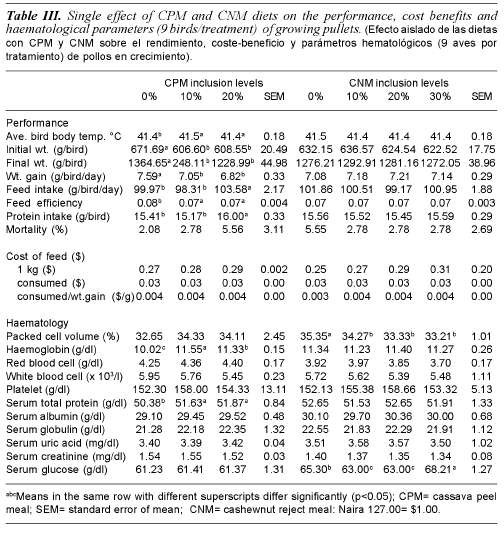
<body><![CDATA[<p align="center"><a name="t2"><img src="/img/revistas/azoo/v58n221/art3_2.jpg"></a></font></p>     <p><font face="Verdana" size="2">The single effect of CPM inclusion levels on the performance of growing pullets shown in <b><a href="#t3">table III</a></b> revealed significant (p<b>&lt;</b>0.05) differences in all the parameters considered except in the mortality and the cost of 1kg feed. The average body temperature of the birds was highest (41.5<sup>o</sup>C) in 10% CPM inclusion comparable to the values obtained at 0% CNM inclusion. The values, though increased with increasing CPM in the diets were within the reported values of 41-42<sup>o</sup>C recorded for birds (Marsden and Morris, 1987). The final weight (g/bird) and the weight gain (g/bird/day), feed efficiency and protein efficiency ratio decreased with increasing CPM inclusion in the diets. However, the cost of feed consumed per weight gain and the mortality increased with increasing CPM inclusion in the diets.</font></p>     <p align="center"><a name="t3"><img src="/img/revistas/azoo/v58n221/art3_3.jpg"></a></font></p>     <p><font face="Verdana" size="2">Moreover, the single effect of CNM on performance showed depressed significance (p&gt;0.05) in all the parameters considered except in the cost of feed consumed and the cost of feed consumed per weight gain. The average body temperature of the birds (<sup>o</sup>C) decreased with increasing CNM inclusion in the diets. The cost of 1kg feed, cost of feed consumed ($) and the cost of feed consumed per weight gain ($/g) increased with increasing CNM inclusion levels. The highest values of $0.03 and $0.01/g were obtained in the cost of feed consumed and the cost of feed consumed per weight gain, respectively, at the 30% CNM inclusion levels. Mortality decreased with increasing CNM inclusion in the diets thereby confirming the reports of Onifade <i>et al.</i> (1999) that CNM is an excellent feed resource.</font></p>     <p><font face="Verdana" size="2">CPM inclusion in the diets significantly (p&lt;0.05) influenced the haemoglobin concentration (g/dl) and the serum total protein (g/dl). The highest value of 11.55 g/dl was obtained at the 10% CPM inclusion level for haemoglobin while 51.87g/dl was obtained at 20% CPM inclusion level comparable only to 51.63 g/dl at 10% CPM inclusion level were obtained for the serum total protein. The red blood cell (RBC) and serum albumin increased with increasing CPM inclusion levels in the diets, but the white blood cell (WBC) decreased with increasing CPM inclusion levels in the diets. On the other hand, increase in CNM inclusion levels significantly (p<b>&lt;</b>0.05) reduced the packed cell volume whereas it showed varying effects on the serum glucose, though, the highest value of 68.21 g/dl was obtained at 30% CNM inclusion.</font></p>     <p><font face="Verdana" size="2">The interactive effect of CPM and CNM inclusion in the diets on the performance characteristics and cost benefits of growing pullets <b>(<a target="_blank" href="/img/revistas/azoo/v58n221/art3_4.jpg">table IV</a>)</b> showed no significant (p<b>&gt;</b>0.05) differences in all the parameters across treatments. The average body temperature (<sup>o</sup>C) of the birds ranged from 41.1 in diets 1 (0% CPM and 0% CNM) and 11 (20% CPM and 20% CNM) to 41.7 in diet 5 (10% CPM and 0% CNM). Hence, the highest body temperature was obtained in diet 5 (10% CPM and 0% CNM). The highest weight gain of 7.96 g/bird/day was obtained in diet 3 (0% CPM and 20% CNM) while the highest feed intake of 107.29 g/bird/day and cost of 1kg feed of $0.31 were obtained in diet 12 (20% CPM and 30% CNM). The nature of the feed could probably confer some astringency on them and thereby reduce their palatability and consumption. This could result to a reduced availability of nutrients for growth purposes, hence, the relatively reduced performance of the growing pullets (Ologhobo and Balogun, 1987).</font></p>     <p><font face="Verdana" size="2">The results of the interactive effects of CPM and CNM diets on the haematological parameters, nitrogen utilization and nutrient digestibility of growing pullets <b>(<a target="_blank" href="/img/revistas/azoo/v58n221/art3_5.jpg">table V</a>)</b> revealed statistical similarities (p<b>&gt;</b>0.05) in all the parameters considered on hematology across treatments. However, the range of values obtained was within normal limits for avian species (Fraser and Mays, 1986). In addition, the results showed significant (p&lt;0.05) increase in the nitrogen retention values with increasing inclusion of CPM and CNM in the diets.</font></p>     <p><font face="Verdana" size="2">From the performance of the growing pullets, it could be adduced that the proportion of dietary energy obtained from fats versus carbohydrates exerted an effect on appetite through a physiological <i>appetite control center</i> responsible to the blood levels of certain nutrients such as glucose and amino acids as reported by Mcleod (1982). Jensen <i>et al.</i> (1970) corroborated these findings that such an effect might involve an increased ability of the chicks to convert dietary energy from fat into stored energy, thereby ensuring a greater increase in dietary intake. Whitehead and Fisher (1975) observed that dietary fat improved efficiency of feed utilization of poultry diets and the improvement was attributed to the high energy concentration of fats, while Homer and Schiable (1980) attributed it to both increased density and improved palatability. The latter observation was evident from the use of CNM as a dietary fat supplement in the present study which resulted from a higher energy density of the CNM supplemented diets. Thereby, it confirmed the suggestions of Stockstad <i>et al.</i> (1983) that fats might also increase energy utilization of other dietary constituents. It was then concluded that the combination of 10% CPM and 30% CNM was appropriate for enhanced performance of growing pullets.</font></p>     <p>&nbsp;</p>     <p><font face="Verdana" size="2"><b>References</b></font></p>     ]]></body>
<body><![CDATA[<!-- ref --><p><font face="Verdana" size="2">Agunbiade, J.A., O.A. Adeyemi, O.E. Fasina and S.A. Bagbe. 2001. Fortification of cassava peel meal in balanced diets for rabbits. Nig. J. Anim. Prod., 28: 167-173.</font>&nbsp;&nbsp;&nbsp;&nbsp;&nbsp;&nbsp;&nbsp;&nbsp;[&#160;<a href="javascript:void(0);" onclick="javascript: window.open('/scielo.php?script=sci_nlinks&ref=977561&pid=S0004-0592200900010000300001&lng=','','width=640,height=500,resizable=yes,scrollbars=1,menubar=yes,');">Links</a>&#160;]<!-- end-ref --><!-- ref --><p><font face="Verdana" size="2">Aina, A.B.J. 1990. Replacing maize with cassava peels in finisher rations for cockerels: The effects on cut-up pieces of eviscerated carcass. Nig. J. Anim. Prod., 17: 17-22.</font>&nbsp;&nbsp;&nbsp;&nbsp;&nbsp;&nbsp;&nbsp;&nbsp;[&#160;<a href="javascript:void(0);" onclick="javascript: window.open('/scielo.php?script=sci_nlinks&ref=977562&pid=S0004-0592200900010000300002&lng=','','width=640,height=500,resizable=yes,scrollbars=1,menubar=yes,');">Links</a>&#160;]<!-- end-ref --><!-- ref --><p><font face="Verdana" size="2">A.O.A.C. 1995. Official methods of analysis. 16<sup>th</sup> edition, Washington, D.C.</font>&nbsp;&nbsp;&nbsp;&nbsp;&nbsp;&nbsp;&nbsp;&nbsp;[&#160;<a href="javascript:void(0);" onclick="javascript: window.open('/scielo.php?script=sci_nlinks&ref=977563&pid=S0004-0592200900010000300003&lng=','','width=640,height=500,resizable=yes,scrollbars=1,menubar=yes,');">Links</a>&#160;]<!-- end-ref --><!-- ref --><p><font face="Verdana" size="2">Duncan, D.B. 1955. Multiple range and F tests. Biometrics, 11: 1-42.</font>&nbsp;&nbsp;&nbsp;&nbsp;&nbsp;&nbsp;&nbsp;&nbsp;[&#160;<a href="javascript:void(0);" onclick="javascript: window.open('/scielo.php?script=sci_nlinks&ref=977564&pid=S0004-0592200900010000300004&lng=','','width=640,height=500,resizable=yes,scrollbars=1,menubar=yes,');">Links</a>&#160;]<!-- end-ref --><!-- ref --><p><font face="Verdana" size="2">Eruvbetine, D., I.D. Tajudeen, A.T. Adeosun and A.A. Oloyede. 2003. Cassava (Manihot esculen-ta) leaf and tuber concentrate in diets for broiler chickens. Bioresource Tech., 86: 277-281.</font>&nbsp;&nbsp;&nbsp;&nbsp;&nbsp;&nbsp;&nbsp;&nbsp;[&#160;<a href="javascript:void(0);" onclick="javascript: window.open('/scielo.php?script=sci_nlinks&ref=977565&pid=S0004-0592200900010000300005&lng=','','width=640,height=500,resizable=yes,scrollbars=1,menubar=yes,');">Links</a>&#160;]<!-- end-ref --><!-- ref --><p><font face="Verdana" size="2">Fetuga, B.L., G.M. Babatunde and V.A. Oyenuga. 1974. Composition and nutritive value of cashew nut to rats. J. Agric. Fd. Chem., 22: 678-682.</font>&nbsp;&nbsp;&nbsp;&nbsp;&nbsp;&nbsp;&nbsp;&nbsp;[&#160;<a href="javascript:void(0);" onclick="javascript: window.open('/scielo.php?script=sci_nlinks&ref=977566&pid=S0004-0592200900010000300006&lng=','','width=640,height=500,resizable=yes,scrollbars=1,menubar=yes,');">Links</a>&#160;]<!-- end-ref --><!-- ref --><p><font face="Verdana" size="2">Fraser, C.M. and A. Mays. 1986. The Merck veterinary manual: A handbook of diagnosis. Therapy and disease prevention and control for the veterinarian. 6<sup>th</sup> edition. Merck and Co., Inc. Rahway, New Jersey, U.S.A. p. 1613-1614.</font>&nbsp;&nbsp;&nbsp;&nbsp;&nbsp;&nbsp;&nbsp;&nbsp;[&#160;<a href="javascript:void(0);" onclick="javascript: window.open('/scielo.php?script=sci_nlinks&ref=977567&pid=S0004-0592200900010000300007&lng=','','width=640,height=500,resizable=yes,scrollbars=1,menubar=yes,');">Links</a>&#160;]<!-- end-ref --><!-- ref --><p><font face="Verdana" size="2">Hahn, S.K. and J. Keyser. 1985. Cassava as a basic food of Africa. Outlook on Agriculture, 4: 95-100.</font>&nbsp;&nbsp;&nbsp;&nbsp;&nbsp;&nbsp;&nbsp;&nbsp;[&#160;<a href="javascript:void(0);" onclick="javascript: window.open('/scielo.php?script=sci_nlinks&ref=977568&pid=S0004-0592200900010000300008&lng=','','width=640,height=500,resizable=yes,scrollbars=1,menubar=yes,');">Links</a>&#160;]<!-- end-ref --><!-- ref --><p><font face="Verdana" size="2">Homer, A. and J. Schiable. 1980. Poultry feeds and nutrition. 2<sup>nd</sup> Edition, Avi Pub Company. New York. p. 73.</font>&nbsp;&nbsp;&nbsp;&nbsp;&nbsp;&nbsp;&nbsp;&nbsp;[&#160;<a href="javascript:void(0);" onclick="javascript: window.open('/scielo.php?script=sci_nlinks&ref=977569&pid=S0004-0592200900010000300009&lng=','','width=640,height=500,resizable=yes,scrollbars=1,menubar=yes,');">Links</a>&#160;]<!-- end-ref --><!-- ref --><p><font face="Verdana" size="2">IITA. 1994. International Workshop on Cassava Safety. Acta Horticulture, ISHC. No 373. 1-4 March. IITA. Ibadan. Nigeria.</font>&nbsp;&nbsp;&nbsp;&nbsp;&nbsp;&nbsp;&nbsp;&nbsp;[&#160;<a href="javascript:void(0);" onclick="javascript: window.open('/scielo.php?script=sci_nlinks&ref=977570&pid=S0004-0592200900010000300010&lng=','','width=640,height=500,resizable=yes,scrollbars=1,menubar=yes,');">Links</a>&#160;]<!-- end-ref --><!-- ref --><p><font face="Verdana" size="2">Jain, N.C. 1986. Schalm's veterinary haematology. 4<sup>th</sup> Edition. Lea and Febiger. Philadelphia.</font>&nbsp;&nbsp;&nbsp;&nbsp;&nbsp;&nbsp;&nbsp;&nbsp;[&#160;<a href="javascript:void(0);" onclick="javascript: window.open('/scielo.php?script=sci_nlinks&ref=977571&pid=S0004-0592200900010000300011&lng=','','width=640,height=500,resizable=yes,scrollbars=1,menubar=yes,');">Links</a>&#160;]<!-- end-ref --><!-- ref --><p><font face="Verdana" size="2">Jensen, L.S., G.W. Shumair and J.D. Latshaw. 1970. "Extra caloric" effect of dietary fat for developing turkeys as influenced by calorie to protein ratio. Poult. Sci., 49: 1697-1704.</font>&nbsp;&nbsp;&nbsp;&nbsp;&nbsp;&nbsp;&nbsp;&nbsp;[&#160;<a href="javascript:void(0);" onclick="javascript: window.open('/scielo.php?script=sci_nlinks&ref=977572&pid=S0004-0592200900010000300012&lng=','','width=640,height=500,resizable=yes,scrollbars=1,menubar=yes,');">Links</a>&#160;]<!-- end-ref --><!-- ref --><p><font face="Verdana" size="2">Marsden, A. and T.R. Morris. 1987. Quantitative review of the effects of environmental temperatures on food intake, egg output and energy balance in laying pullets. Br. Poult. Sci., 28: 693-704.</font>&nbsp;&nbsp;&nbsp;&nbsp;&nbsp;&nbsp;&nbsp;&nbsp;[&#160;<a href="javascript:void(0);" onclick="javascript: window.open('/scielo.php?script=sci_nlinks&ref=977573&pid=S0004-0592200900010000300013&lng=','','width=640,height=500,resizable=yes,scrollbars=1,menubar=yes,');">Links</a>&#160;]<!-- end-ref --><!-- ref --><p><font face="Verdana" size="2">Mcleod, J.A. 1982. Nutritional factors influencing carcass fat in broilers -A review. World's Poult. Sci. J., 38: 194-200.</font>&nbsp;&nbsp;&nbsp;&nbsp;&nbsp;&nbsp;&nbsp;&nbsp;[&#160;<a href="javascript:void(0);" onclick="javascript: window.open('/scielo.php?script=sci_nlinks&ref=977574&pid=S0004-0592200900010000300014&lng=','','width=640,height=500,resizable=yes,scrollbars=1,menubar=yes,');">Links</a>&#160;]<!-- end-ref --><!-- ref --><p><font face="Verdana" size="2">Ologhobo, A.D. and A.M. Balogun. 1987. The value of dried fish silage for pullets and the layer hen. Nig. J. Anim. Prod., 14: 67-76.</font>&nbsp;&nbsp;&nbsp;&nbsp;&nbsp;&nbsp;&nbsp;&nbsp;[&#160;<a href="javascript:void(0);" onclick="javascript: window.open('/scielo.php?script=sci_nlinks&ref=977575&pid=S0004-0592200900010000300015&lng=','','width=640,height=500,resizable=yes,scrollbars=1,menubar=yes,');">Links</a>&#160;]<!-- end-ref --><!-- ref --><p><font face="Verdana" size="2">Onifade, A.A., O.O. Tewe, O. Okunola and A.O. Fanimo. 1999. Performance of laying pullets fed on cereal free dietary based on maize offal, cassava peels and reject cashewnut meal. Brit. Poult. Sci., 40: 84-87.</font>&nbsp;&nbsp;&nbsp;&nbsp;&nbsp;&nbsp;&nbsp;&nbsp;[&#160;<a href="javascript:void(0);" onclick="javascript: window.open('/scielo.php?script=sci_nlinks&ref=977576&pid=S0004-0592200900010000300016&lng=','','width=640,height=500,resizable=yes,scrollbars=1,menubar=yes,');">Links</a>&#160;]<!-- end-ref --><!-- ref --><p><font face="Verdana" size="2">SAS Institute. 1999. SAS User's Guide: Statistics. Inc. Cary, N.C. p. 923.</font>&nbsp;&nbsp;&nbsp;&nbsp;&nbsp;&nbsp;&nbsp;&nbsp;[&#160;<a href="javascript:void(0);" onclick="javascript: window.open('/scielo.php?script=sci_nlinks&ref=977577&pid=S0004-0592200900010000300017&lng=','','width=640,height=500,resizable=yes,scrollbars=1,menubar=yes,');">Links</a>&#160;]<!-- end-ref --><!-- ref --><p><font face="Verdana" size="2">Sogunle, O.M., A.O. Fanimo, W.O. Biobaku and A.M. Bamgbose. 2005. The feeding value of full-fat cashew nut (Anacardium occidentale Linn) rejects and low cereal diets for broiler chickens. Nig. J. Anim. Prod., 32: 46-53.</font>&nbsp;&nbsp;&nbsp;&nbsp;&nbsp;&nbsp;&nbsp;&nbsp;[&#160;<a href="javascript:void(0);" onclick="javascript: window.open('/scielo.php?script=sci_nlinks&ref=977578&pid=S0004-0592200900010000300018&lng=','','width=640,height=500,resizable=yes,scrollbars=1,menubar=yes,');">Links</a>&#160;]<!-- end-ref --><!-- ref --><p><font face="Verdana" size="2">Stockstad, E.L.R., T.M. Jukes and W.L. Williams. 1983. Growth promoting effects of aureomycin on various types of diets. Poult. Sci., 32: 1054-1058.</font>&nbsp;&nbsp;&nbsp;&nbsp;&nbsp;&nbsp;&nbsp;&nbsp;[&#160;<a href="javascript:void(0);" onclick="javascript: window.open('/scielo.php?script=sci_nlinks&ref=977579&pid=S0004-0592200900010000300019&lng=','','width=640,height=500,resizable=yes,scrollbars=1,menubar=yes,');">Links</a>&#160;]<!-- end-ref --><!-- ref --><p><font face="Verdana" size="2">Tewe, O.O. 1983. Thyroid cassava toxicity in animals. In: Cassava toxicity and thyroid: Research and public health issues (F. Delange and R. Ahluwalia, eds.). Proc. of International Workshop on Cassava Toxicity. Ottawa, Canada. IDRC-207e. Ottawa. p. 114-118.</font>&nbsp;&nbsp;&nbsp;&nbsp;&nbsp;&nbsp;&nbsp;&nbsp;[&#160;<a href="javascript:void(0);" onclick="javascript: window.open('/scielo.php?script=sci_nlinks&ref=977580&pid=S0004-0592200900010000300020&lng=','','width=640,height=500,resizable=yes,scrollbars=1,menubar=yes,');">Links</a>&#160;]<!-- end-ref --><!-- ref --><p><font face="Verdana" size="2">Tewe, O.O. 1975. Implications of cyanogenic glucoside of cassava in the growth and reproductive performance of rats and pigs. PhD thesis, University of Ibadan, Nigeria. 517 p.</font>&nbsp;&nbsp;&nbsp;&nbsp;&nbsp;&nbsp;&nbsp;&nbsp;[&#160;<a href="javascript:void(0);" onclick="javascript: window.open('/scielo.php?script=sci_nlinks&ref=977581&pid=S0004-0592200900010000300021&lng=','','width=640,height=500,resizable=yes,scrollbars=1,menubar=yes,');">Links</a>&#160;]<!-- end-ref --><!-- ref --><p><font face="Verdana" size="2">Varley, H., A.H. Gowelock and M. Bell. 1980. Determination of serum urea using the acetyl monoxide method. Practical biochemistry. 5<sup>th</sup> Edition. William Heinemann Medical Books Ltd. London.</font>&nbsp;&nbsp;&nbsp;&nbsp;&nbsp;&nbsp;&nbsp;&nbsp;[&#160;<a href="javascript:void(0);" onclick="javascript: window.open('/scielo.php?script=sci_nlinks&ref=977582&pid=S0004-0592200900010000300022&lng=','','width=640,height=500,resizable=yes,scrollbars=1,menubar=yes,');">Links</a>&#160;]<!-- end-ref --><!-- ref --><p><font face="Verdana" size="2">Whitehead, C.C. and C. Fisher. 1975. The utilization of various fats by turkeys of different ages. Br. Poult. Sci., 16: 481-485.</font>&nbsp;&nbsp;&nbsp;&nbsp;&nbsp;&nbsp;&nbsp;&nbsp;[&#160;<a href="javascript:void(0);" onclick="javascript: window.open('/scielo.php?script=sci_nlinks&ref=977583&pid=S0004-0592200900010000300023&lng=','','width=640,height=500,resizable=yes,scrollbars=1,menubar=yes,');">Links</a>&#160;]<!-- end-ref --><p>&nbsp;</p>     <p>&nbsp;</p>     <p><font face="Verdana" size="2">Recibido: 16-2-07    <br>Aceptado: 1-10-07</font></p>      ]]></body><back>
<ref-list>
<ref id="B1">
<nlm-citation citation-type="journal">
<person-group person-group-type="author">
<name>
<surname><![CDATA[Agunbiade]]></surname>
<given-names><![CDATA[J.A.]]></given-names>
</name>
<name>
<surname><![CDATA[Adeyemi]]></surname>
<given-names><![CDATA[O.A.]]></given-names>
</name>
<name>
<surname><![CDATA[Fasina]]></surname>
<given-names><![CDATA[O.E.]]></given-names>
</name>
<name>
<surname><![CDATA[Bagbe]]></surname>
<given-names><![CDATA[S.A.]]></given-names>
</name>
</person-group>
<article-title xml:lang="en"><![CDATA[Fortification of cassava peel meal in balanced diets for rabbits]]></article-title>
<source><![CDATA[Nig. J. Anim. Prod.]]></source>
<year>2001</year>
<volume>28</volume>
<page-range>167-173</page-range></nlm-citation>
</ref>
<ref id="B2">
<nlm-citation citation-type="journal">
<person-group person-group-type="author">
<name>
<surname><![CDATA[Aina]]></surname>
<given-names><![CDATA[A.B.J]]></given-names>
</name>
</person-group>
<article-title xml:lang="en"><![CDATA[Replacing maize with cassava peels in finisher rations for cockerels: The effects on cut-up pieces of eviscerated carcass]]></article-title>
<source><![CDATA[Nig. J. Anim. Prod.]]></source>
<year>1990</year>
<volume>17</volume>
<page-range>17-22</page-range></nlm-citation>
</ref>
<ref id="B3">
<nlm-citation citation-type="">
<collab>A.O.A.C</collab>
<source><![CDATA[Official methods of analysis]]></source>
<year>1995</year>
<edition>16</edition>
<publisher-loc><![CDATA[Washington^eD.C D.C]]></publisher-loc>
</nlm-citation>
</ref>
<ref id="B4">
<nlm-citation citation-type="journal">
<person-group person-group-type="author">
<name>
<surname><![CDATA[Duncan]]></surname>
<given-names><![CDATA[D.B]]></given-names>
</name>
</person-group>
<article-title xml:lang="en"><![CDATA[Multiple range and F tests]]></article-title>
<source><![CDATA[Biometrics]]></source>
<year>1955</year>
<volume>11</volume>
<page-range>1-42</page-range></nlm-citation>
</ref>
<ref id="B5">
<nlm-citation citation-type="journal">
<person-group person-group-type="author">
<name>
<surname><![CDATA[Eruvbetine]]></surname>
<given-names><![CDATA[D.]]></given-names>
</name>
<name>
<surname><![CDATA[Tajudeen]]></surname>
<given-names><![CDATA[I.D.]]></given-names>
</name>
<name>
<surname><![CDATA[Adeosun]]></surname>
<given-names><![CDATA[A.T.]]></given-names>
</name>
<name>
<surname><![CDATA[Oloyede]]></surname>
<given-names><![CDATA[A.A.]]></given-names>
</name>
</person-group>
<article-title xml:lang="en"><![CDATA[Cassava (Manihot esculen-ta) leaf and tuber concentrate in diets for broiler chickens]]></article-title>
<source><![CDATA[Bioresource Tech.]]></source>
<year>2003</year>
<volume>86</volume>
<page-range>277-281</page-range></nlm-citation>
</ref>
<ref id="B6">
<nlm-citation citation-type="journal">
<person-group person-group-type="author">
<name>
<surname><![CDATA[Fetuga]]></surname>
<given-names><![CDATA[B.L.]]></given-names>
</name>
<name>
<surname><![CDATA[Babatunde]]></surname>
<given-names><![CDATA[G.M.]]></given-names>
</name>
<name>
<surname><![CDATA[Oyenuga]]></surname>
<given-names><![CDATA[V.A.]]></given-names>
</name>
</person-group>
<article-title xml:lang="en"><![CDATA[Composition and nutritive value of cashew nut to rats]]></article-title>
<source><![CDATA[J. Agric. Fd. Chem.]]></source>
<year>1974</year>
<volume>22</volume>
<page-range>678-682</page-range></nlm-citation>
</ref>
<ref id="B7">
<nlm-citation citation-type="book">
<person-group person-group-type="author">
<name>
<surname><![CDATA[Fraser]]></surname>
<given-names><![CDATA[C.M.]]></given-names>
</name>
<name>
<surname><![CDATA[Mays]]></surname>
<given-names><![CDATA[A.]]></given-names>
</name>
</person-group>
<source><![CDATA[The Merck veterinary manual: A handbook of diagnosis. Therapy and disease prevention and control for the veterinarian]]></source>
<year>1986</year>
<edition>6</edition>
<page-range>1613-1614</page-range><publisher-loc><![CDATA[Rahway^eNew Jersey New Jersey]]></publisher-loc>
<publisher-name><![CDATA[Merck and Co.]]></publisher-name>
</nlm-citation>
</ref>
<ref id="B8">
<nlm-citation citation-type="journal">
<person-group person-group-type="author">
<name>
<surname><![CDATA[Hahn]]></surname>
<given-names><![CDATA[S.K.]]></given-names>
</name>
<name>
<surname><![CDATA[Keyser]]></surname>
<given-names><![CDATA[J.]]></given-names>
</name>
</person-group>
<article-title xml:lang="en"><![CDATA[Cassava as a basic food of Africa]]></article-title>
<source><![CDATA[Outlook on Agriculture]]></source>
<year>1985</year>
<volume>4</volume>
<page-range>95-100</page-range></nlm-citation>
</ref>
<ref id="B9">
<nlm-citation citation-type="book">
<person-group person-group-type="author">
<name>
<surname><![CDATA[Homer]]></surname>
<given-names><![CDATA[A.]]></given-names>
</name>
<name>
<surname><![CDATA[Schiable]]></surname>
<given-names><![CDATA[J.]]></given-names>
</name>
</person-group>
<source><![CDATA[Poultry feeds and nutrition]]></source>
<year>1980</year>
<edition>2</edition>
<page-range>73</page-range><publisher-loc><![CDATA[New York ]]></publisher-loc>
<publisher-name><![CDATA[Avi Pub Company]]></publisher-name>
</nlm-citation>
</ref>
<ref id="B10">
<nlm-citation citation-type="confpro">
<collab>IITA</collab>
<source><![CDATA[International Workshop on Cassava Safety: Acta Horticulture]]></source>
<year>1994</year>
<conf-name><![CDATA[373 ISHC]]></conf-name>
<conf-date>1-4 March</conf-date>
<conf-loc>Ibadan </conf-loc>
</nlm-citation>
</ref>
<ref id="B11">
<nlm-citation citation-type="book">
<person-group person-group-type="author">
<name>
<surname><![CDATA[Jain]]></surname>
<given-names><![CDATA[N.C]]></given-names>
</name>
</person-group>
<source><![CDATA[Schalm's veterinary haematology]]></source>
<year>1986</year>
<edition>4</edition>
<publisher-loc><![CDATA[Philadelphia ]]></publisher-loc>
<publisher-name><![CDATA[Lea and Febiger]]></publisher-name>
</nlm-citation>
</ref>
<ref id="B12">
<nlm-citation citation-type="journal">
<person-group person-group-type="author">
<name>
<surname><![CDATA[Jensen]]></surname>
<given-names><![CDATA[L.S.]]></given-names>
</name>
<name>
<surname><![CDATA[Shumair]]></surname>
<given-names><![CDATA[G.W.]]></given-names>
</name>
<name>
<surname><![CDATA[Latshaw]]></surname>
<given-names><![CDATA[J.D.]]></given-names>
</name>
</person-group>
<article-title xml:lang="en"><![CDATA["Extra caloric" effect of dietary fat for developing turkeys as influenced by calorie to protein ratio]]></article-title>
<source><![CDATA[Poult. Sci.]]></source>
<year>1970</year>
<volume>49</volume>
<page-range>1697-1704</page-range></nlm-citation>
</ref>
<ref id="B13">
<nlm-citation citation-type="journal">
<person-group person-group-type="author">
<name>
<surname><![CDATA[Marsden]]></surname>
<given-names><![CDATA[A.]]></given-names>
</name>
<name>
<surname><![CDATA[Morris]]></surname>
<given-names><![CDATA[T.R.]]></given-names>
</name>
</person-group>
<article-title xml:lang="en"><![CDATA[Quantitative review of the effects of environmental temperatures on food intake, egg output and energy balance in laying pullets]]></article-title>
<source><![CDATA[Br. Poult. Sci.]]></source>
<year>1987</year>
<volume>28</volume>
<page-range>693-704</page-range></nlm-citation>
</ref>
<ref id="B14">
<nlm-citation citation-type="journal">
<person-group person-group-type="author">
<name>
<surname><![CDATA[Mcleod]]></surname>
<given-names><![CDATA[J.A.]]></given-names>
</name>
</person-group>
<article-title xml:lang="en"><![CDATA[Nutritional factors influencing carcass fat in broilers: A review]]></article-title>
<source><![CDATA[World's Poult. Sci. J.]]></source>
<year>1982</year>
<volume>38</volume>
<page-range>194-200</page-range></nlm-citation>
</ref>
<ref id="B15">
<nlm-citation citation-type="journal">
<person-group person-group-type="author">
<name>
<surname><![CDATA[Ologhobo]]></surname>
<given-names><![CDATA[A.D.]]></given-names>
</name>
<name>
<surname><![CDATA[Balogun]]></surname>
<given-names><![CDATA[A.M.]]></given-names>
</name>
</person-group>
<article-title xml:lang="en"><![CDATA[The value of dried fish silage for pullets and the layer hen]]></article-title>
<source><![CDATA[Nig. J. Anim. Prod.]]></source>
<year>1987</year>
<volume>14</volume>
<page-range>67-76</page-range></nlm-citation>
</ref>
<ref id="B16">
<nlm-citation citation-type="journal">
<person-group person-group-type="author">
<name>
<surname><![CDATA[Onifade]]></surname>
<given-names><![CDATA[A.A.]]></given-names>
</name>
<name>
<surname><![CDATA[Tewe]]></surname>
<given-names><![CDATA[O.O.]]></given-names>
</name>
<name>
<surname><![CDATA[Okunola]]></surname>
<given-names><![CDATA[O.]]></given-names>
</name>
<name>
<surname><![CDATA[Fanimo]]></surname>
<given-names><![CDATA[A.O.]]></given-names>
</name>
</person-group>
<article-title xml:lang="en"><![CDATA[Performance of laying pullets fed on cereal free dietary based on maize offal, cassava peels and reject cashewnut meal]]></article-title>
<source><![CDATA[Brit. Poult. Sci.]]></source>
<year>1999</year>
<volume>40</volume>
<page-range>84-87</page-range></nlm-citation>
</ref>
<ref id="B17">
<nlm-citation citation-type="">
<collab>SAS Institute</collab>
<source><![CDATA[SAS User's Guide: Statistics]]></source>
<year>1999</year>
<page-range>923</page-range><publisher-loc><![CDATA[Cary^eN.C. N.C.]]></publisher-loc>
</nlm-citation>
</ref>
<ref id="B18">
<nlm-citation citation-type="journal">
<person-group person-group-type="author">
<name>
<surname><![CDATA[Sogunle]]></surname>
<given-names><![CDATA[O.M.]]></given-names>
</name>
<name>
<surname><![CDATA[Fanimo]]></surname>
<given-names><![CDATA[A.O.]]></given-names>
</name>
<name>
<surname><![CDATA[Biobaku]]></surname>
<given-names><![CDATA[W.O.]]></given-names>
</name>
<name>
<surname><![CDATA[Bamgbose]]></surname>
<given-names><![CDATA[A.M.]]></given-names>
</name>
</person-group>
<article-title xml:lang="en"><![CDATA[The feeding value of full-fat cashew nut (Anacardium occidentale Linn) rejects and low cereal diets for broiler chickens]]></article-title>
<source><![CDATA[Nig. J. Anim. Prod.]]></source>
<year>2005</year>
<volume>32</volume>
<page-range>46-53</page-range></nlm-citation>
</ref>
<ref id="B19">
<nlm-citation citation-type="journal">
<person-group person-group-type="author">
<name>
<surname><![CDATA[Stockstad]]></surname>
<given-names><![CDATA[E.L.R.]]></given-names>
</name>
<name>
<surname><![CDATA[Jukes]]></surname>
<given-names><![CDATA[T.M.]]></given-names>
</name>
<name>
<surname><![CDATA[Williams]]></surname>
<given-names><![CDATA[W.L.]]></given-names>
</name>
</person-group>
<article-title xml:lang="en"><![CDATA[Growth promoting effects of aureomycin on various types of diets]]></article-title>
<source><![CDATA[Poult. Sci.]]></source>
<year>1983</year>
<volume>32</volume>
<page-range>1054-1058</page-range></nlm-citation>
</ref>
<ref id="B20">
<nlm-citation citation-type="book">
<person-group person-group-type="author">
<name>
<surname><![CDATA[Tewe]]></surname>
<given-names><![CDATA[O.O]]></given-names>
</name>
</person-group>
<article-title xml:lang="en"><![CDATA[Thyroid cassava toxicity in animals]]></article-title>
<person-group person-group-type="editor">
<name>
<surname><![CDATA[Delange]]></surname>
<given-names><![CDATA[F.]]></given-names>
</name>
<name>
<surname><![CDATA[Ahluwalia]]></surname>
<given-names><![CDATA[R.]]></given-names>
</name>
</person-group>
<source><![CDATA[Cassava toxicity and thyroid: Research and public health issues]]></source>
<year>1983</year>
<page-range>114-118</page-range><publisher-loc><![CDATA[Ottawa ]]></publisher-loc>
<publisher-name><![CDATA[Proc. of International Workshop on Cassava Toxicity]]></publisher-name>
</nlm-citation>
</ref>
<ref id="B21">
<nlm-citation citation-type="">
<person-group person-group-type="author">
<name>
<surname><![CDATA[Tewe]]></surname>
<given-names><![CDATA[O.O]]></given-names>
</name>
</person-group>
<source><![CDATA[Implications of cyanogenic glucoside of cassava in the growth and reproductive performance of rats and pigs]]></source>
<year>1975</year>
<page-range>517</page-range></nlm-citation>
</ref>
<ref id="B22">
<nlm-citation citation-type="book">
<person-group person-group-type="author">
<name>
<surname><![CDATA[Varley]]></surname>
<given-names><![CDATA[H.]]></given-names>
</name>
<name>
<surname><![CDATA[Gowelock]]></surname>
<given-names><![CDATA[A.H.]]></given-names>
</name>
<name>
<surname><![CDATA[Bell]]></surname>
<given-names><![CDATA[M.]]></given-names>
</name>
</person-group>
<source><![CDATA[Determination of serum urea using the acetyl monoxide method: Practical biochemistry]]></source>
<year>1980</year>
<edition>5</edition>
<publisher-loc><![CDATA[London ]]></publisher-loc>
<publisher-name><![CDATA[William Heinemann Medical Books]]></publisher-name>
</nlm-citation>
</ref>
<ref id="B23">
<nlm-citation citation-type="journal">
<person-group person-group-type="author">
<name>
<surname><![CDATA[Whitehead]]></surname>
<given-names><![CDATA[C.C.]]></given-names>
</name>
<name>
<surname><![CDATA[Fisher]]></surname>
<given-names><![CDATA[C.]]></given-names>
</name>
</person-group>
<article-title xml:lang="en"><![CDATA[The utilization of various fats by turkeys of different ages]]></article-title>
<source><![CDATA[Br. Poult. Sci.]]></source>
<year>1975</year>
<volume>16</volume>
<page-range>481-485</page-range></nlm-citation>
</ref>
</ref-list>
</back>
</article>
