<?xml version="1.0" encoding="ISO-8859-1"?><article xmlns:mml="http://www.w3.org/1998/Math/MathML" xmlns:xlink="http://www.w3.org/1999/xlink" xmlns:xsi="http://www.w3.org/2001/XMLSchema-instance">
<front>
<journal-meta>
<journal-id>0004-0592</journal-id>
<journal-title><![CDATA[Archivos de Zootecnia]]></journal-title>
<abbrev-journal-title><![CDATA[Arch. zootec.]]></abbrev-journal-title>
<issn>0004-0592</issn>
<publisher>
<publisher-name><![CDATA[Universidad de Córdoba]]></publisher-name>
</publisher>
</journal-meta>
<article-meta>
<article-id>S0004-05922010000400004</article-id>
<title-group>
<article-title xml:lang="en"><![CDATA[Serum concentration of thyroid hormones in crioula lanada serrana ewes in gestation and lactation]]></article-title>
<article-title xml:lang="pt"><![CDATA[Concentrações séricas dos hormônios tireoidianos em ovelhas crioula lanada serrana na gestação e lactação]]></article-title>
</title-group>
<contrib-group>
<contrib contrib-type="author">
<name>
<surname><![CDATA[Colodel]]></surname>
<given-names><![CDATA[M.M.]]></given-names>
</name>
<xref ref-type="aff" rid="A01"/>
</contrib>
<contrib contrib-type="author">
<name>
<surname><![CDATA[Martins]]></surname>
<given-names><![CDATA[E.]]></given-names>
</name>
<xref ref-type="aff" rid="A02"/>
</contrib>
<contrib contrib-type="author">
<name>
<surname><![CDATA[Martins]]></surname>
<given-names><![CDATA[V.M.V.]]></given-names>
</name>
<xref ref-type="aff" rid="A01"/>
</contrib>
<contrib contrib-type="author">
<name>
<surname><![CDATA[Marques Júnior]]></surname>
<given-names><![CDATA[A.P.]]></given-names>
</name>
<xref ref-type="aff" rid="A03"/>
</contrib>
</contrib-group>
<aff id="A01">
<institution><![CDATA[,Universidade do Estado de Santa Catarina (UDESC) Centro de Ciências Veterinárias (CAV) ]]></institution>
<addr-line><![CDATA[Lages SC]]></addr-line>
<country>Brazil</country>
</aff>
<aff id="A02">
<institution><![CDATA[,Empresa de Pesquisa Agropecuária e Extensão Rural de Santa Catarina (EPAGRI) Estação Experimental de Lages ]]></institution>
<addr-line><![CDATA[Lages SC]]></addr-line>
<country>Brazil</country>
</aff>
<aff id="A03">
<institution><![CDATA[,Universidade Federal de Minas Gerais (UFMG) Escola de Veterinária (UFMG) ]]></institution>
<addr-line><![CDATA[Belo Horizonte MG]]></addr-line>
<country>Brazil</country>
</aff>
<pub-date pub-type="pub">
<day>00</day>
<month>12</month>
<year>2010</year>
</pub-date>
<pub-date pub-type="epub">
<day>00</day>
<month>12</month>
<year>2010</year>
</pub-date>
<volume>59</volume>
<numero>228</numero>
<fpage>509</fpage>
<lpage>517</lpage>
<copyright-statement/>
<copyright-year/>
<self-uri xlink:href="http://scielo.isciii.es/scielo.php?script=sci_arttext&amp;pid=S0004-05922010000400004&amp;lng=en&amp;nrm=iso"></self-uri><self-uri xlink:href="http://scielo.isciii.es/scielo.php?script=sci_abstract&amp;pid=S0004-05922010000400004&amp;lng=en&amp;nrm=iso"></self-uri><self-uri xlink:href="http://scielo.isciii.es/scielo.php?script=sci_pdf&amp;pid=S0004-05922010000400004&amp;lng=en&amp;nrm=iso"></self-uri><abstract abstract-type="short" xml:lang="en"><p><![CDATA[The effects of gestation and lactation on the dynamics of the thyroid hormones, triiodothyronine (T3) and thyroxine (T4) were evaluated in Crioula Lanada Serrana ewes from the plateau region in Santa Catarina - Brazil. To evaluate the effects of gestation, twenty four ewes were randomly divided into groups I and II. Group I was composed of 12 pregnant ewes and the control group (II) was composed of 12 non-pregnant ewes. The effects of lactation were evaluated in the same ewes of group I after parturition (LE) and in the control group (NL). Blood samples were taken in the first, second and third periods of gestation, at parturition, and at 30, 60 and 90 days of lactation. T3 and T4 concentrations were determined by radio-immunoassay (RIA). Pregnant ewes showed lower serum concentrations of T3 and T4 than those of non-pregnant ewes. At parturition, there was no significant difference in T3 concentrations between groups I and II (p>0.05). During lactation, serum T3 concentrations were lower (p<0.05) in LE than in NL ewes. Serum T3 concentrations were greater (p<0.05) at lambing than during the lactation periods. Serum T4 concentrations in LE at parturition did not differ (p>0.05) from those of NL ewes. During lactation, T4 concentrations of LE were lower (p<0.05) than those of the NL ewes. The results of this study have shown that gestation causes a variation in the T3 and T4 serum concentrations, and that lactation results in a decrease of serum concentrations of T3 and T4 in Crioula Lanada Serrana ewes.]]></p></abstract>
<abstract abstract-type="short" xml:lang="pt"><p><![CDATA[Os efeitos da gestação e lactação sobre a dinâmica dos hormônios tireoidianos triiodotironina (T3) e tiroxina (T4) foram avaliados em ovelhas Crioula Lanada Serrana na região do Planalto Serrano Catarinense. Para avaliar os efeitos da gestação, foram utilizadas vinte e quatro ovelhas distribuídas aleatoriamente em dois grupos. O grupo I foi formado por 12 ovelhas gestantes e o grupo controle por 12 ovelhas não gestantes (grupo II). Os efeitos da lactação foram avaliados nas mesmas ovelhas do grupo I após a parição (LE) e no grupo controle (NL). Foram colhidas amostras sanguíneas no primeiro, segundo e terceiro terço da gestação, ao parto e aos 30, 60 e 90 dias de lactação. As concentrações de T3 e T4 foram determinadas por radioimunoensaio (RIA). As ovelhas gestantes apresentaram concen-trações séricas de T3 e T4 inferiores àquelas não gestantes. Ao parto não houve diferença significativa nas concentrações de T3 entre os grupos I e II (p>0,05). Durante a lactação as concentrações de T3 foram menores (p<0,05) para LE que para NL. No momento do parto, as concentrações de T3 foram maiores (p<0.05) do que aquelas observadas no período de lactação e as concentrações de T4 em LE, não diferiram de NL. Durante a lactação as concentrações de T4 de LE foram menores (p<0,05) do que em NL. Os resultados deste estudo demonstraram que a gestação causa variação nas concentrações séricas de T3 e T4 que, no momento do parto são similares àquelas observadas em ovelhas não gestantes. A lactação causa diminuição nas concentrações de T3 e T4 em ovelhas Crioula Lanada Serrana.]]></p></abstract>
<kwd-group>
<kwd lng="en"><![CDATA[Thyroid]]></kwd>
<kwd lng="en"><![CDATA[Hormones]]></kwd>
<kwd lng="en"><![CDATA[Reproduction]]></kwd>
<kwd lng="pt"><![CDATA[Tireóide]]></kwd>
<kwd lng="pt"><![CDATA[Hormônios]]></kwd>
<kwd lng="pt"><![CDATA[Reprodução]]></kwd>
</kwd-group>
</article-meta>
</front><body><![CDATA[ <p>&nbsp;</p>     <p>&nbsp;</p>     <p><font face="Verdana" size="4"><b>Serum concentration of thyroid hormones in crioula lanada serrana ewes in gestation and lactation</b></font></p>     <p><font face="Verdana" size="4"><b>Concentrações séricas dos hormônios tireoidianos em ovelhas crioula lanada serrana na gestação e lactação</b></font></p>     <p>&nbsp;</p>     <p>&nbsp;</p>     <p><font face="Verdana" size="2"><b>Colodel, M.M.<sup>1A</sup>, Martins, E.<sup>2</sup>, Martins, V.M.V.<sup>1B</sup> and Marques Júnior, A.P.<sup>3</sup></b></font></p>     <p><font face="Verdana" size="2"><sup>1</sup>Centro de Ciências Veterinárias-CAV. Universidade do Estado de Santa Catarina. UDESC. Av. Luiz de Camões, 2090. Bairro Conta Dinheiro. CEP 88520-100. Lages, SC. Brazil. <sup>A</sup><a href="mailto:a8mmc@cav.udesc.br">a8mmc@cav.udesc.br</a>; <sup>B </sup> <a href="mailto:a2vmvm@cav.udesc.br">a2vmvm@cav.udesc.br</a>    <br><sup>2</sup>Empresa de Pesquisa Agropecuária e Extensão Rural de Santa Catarina-EPAGRI. Estação Experimental de Lages. Rua João José Godinho, s/n. Bairro Morro do Posto. C.P. 181. CEP 88502-970. Lages, SC. Brazil.  <a href="mailto:martinsev@terra.com.br">martinsev@terra.com.br</a>    <br><sup>3</sup>Escola de Veterinária-UFMG. C.P. 567. CEP 30161-970. Belo Horizonte, MG. Brazil.</font></p>     ]]></body>
<body><![CDATA[<p>&nbsp;</p>     <p>&nbsp;</p> <hr size="1">     <p><font face="Verdana" size="2"><b>SUMMARY</b></font></p>     <p><font face="Verdana" size="2">The effects of gestation and lactation on the dynamics of the thyroid hormones, triiodothyronine (T<sub>3</sub>) and thyroxine (T<sub>4</sub>) were evaluated in Crioula Lanada Serrana ewes from the plateau region in Santa Catarina - Brazil. To evaluate the effects of gestation, twenty four ewes were randomly divided into groups I and II. Group I was composed of 12 pregnant ewes and the control group (II) was composed of 12 non-pregnant ewes. The effects of lactation were evaluated in the same ewes of group I after parturition (LE) and in the control group (NL). Blood samples were taken in the first, second and third periods of gestation, at parturition, and at 30, 60 and 90 days of lactation. T<sub>3</sub> and T<sub>4</sub> concentrations were determined by radio-immunoassay (RIA). Pregnant ewes showed lower serum concentrations of T<sub>3</sub> and T<sub>4</sub> than those of non-pregnant ewes. At parturition, there was no significant difference in T<sub>3</sub> concentrations between groups I and II (p&gt;0.05). During lactation, serum T<sub>3</sub> concentrations were lower (p<u>&lt;</u>0.05) in LE than in NL ewes. Serum T<sub>3</sub> concentrations were greater (p<u>&lt;</u>0.05) at lambing than during the lactation periods. Serum T<sub>4</sub> concentrations in LE at parturition did not differ (p&gt;0.05) from those of NL ewes. During lactation, T<sub>4</sub> concentrations of LE were lower (p<u>&lt;</u>0.05) than those of the NL ewes. The results of this study have shown that gestation causes a variation in the T<sub>3</sub> and T<sub>4</sub> serum concentrations, and that lactation results in a decrease of serum concentrations of T<sub>3</sub> and T<sub>4</sub> in Crioula Lanada Serrana ewes.</font></p>     <p><font face="Verdana" size="2"><b>Key words:</b> Thyroid. Hormones. Reproduction.</font></p> <hr size="1">     <p><font face="Verdana" size="2"><b>RESUMO</b></font></p>     <p><font face="Verdana" size="2">Os efeitos da gestação e lactação sobre a dinâmica dos hormônios tireoidianos triiodotironina (T<sub>3</sub>) e tiroxina (T<sub>4</sub>) foram avaliados em ovelhas Crioula Lanada Serrana na região do Planalto Serrano Catarinense. Para avaliar os efeitos da gestação, foram utilizadas vinte e quatro ovelhas distribuídas aleatoriamente em dois grupos. O grupo I foi formado por 12 ovelhas gestantes e o grupo controle por 12 ovelhas não gestantes (grupo II). Os efeitos da lactação foram avaliados nas mesmas ovelhas do grupo I após a parição (LE) e no grupo controle (NL). Foram colhidas amostras sanguíneas no primeiro, segundo e terceiro terço da gestação, ao parto e aos 30, 60 e 90 dias de lactação. As concentrações de T<sub>3</sub> e T<sub>4</sub> foram determinadas por radioimunoensaio (RIA). As ovelhas gestantes apresentaram concen-trações séricas de T<sub>3</sub> e T<sub>4</sub> inferiores àquelas não gestantes. Ao parto não houve diferença significativa nas concentrações de T<sub>3</sub> entre os grupos I e II (p&gt;0,05). Durante a lactação as concentrações de T<sub>3</sub> foram menores (p<u>&lt;</u>0,05) para LE que para NL. No momento do parto, as concentrações de T<sub>3</sub> foram maiores (p<u>&lt;</u>0.05) do que aquelas observadas no período de lactação e as concentrações de T<sub>4</sub> em LE, não diferiram de NL. Durante a lactação as concentrações de T<sub>4</sub> de LE foram menores (p<u>&lt;</u>0,05) do que em NL. Os resultados deste estudo demonstraram que a gestação causa variação nas concentrações séricas de T<sub>3</sub> e T<sub>4</sub> que, no momento do parto são similares àquelas observadas em ovelhas não gestantes. A lactação causa diminuição nas concentrações de T<sub>3</sub> e T<sub>4</sub> em ovelhas Crioula Lanada Serrana.</font></p>     <p><font face="Verdana" size="2"><b>Palavras chave:</b> Tireóide. Hormônios. Reprodução.</font></p> <hr size="1">     <p>&nbsp;</p>     <p><font face="Verdana" size="2"><b>Introduction</b></font></p>     ]]></body>
<body><![CDATA[<p><font face="Verdana" size="2">The thyroid gland synthesizes the triiodothyronine (T<sub>3</sub>) and thyroxine (T<sub>4</sub>) hormones, which, directly or in combination with growth factors and hormones from other endocrine glands, are fundamental for the genesis and function of several organs. In addition, they play a role in a series of biochemical processes, triggering responses throughout the organism, including reproductive responses. Studies on the thyroid hormone dynamics in ovines have shown variations according to the sex, breed, age and physiologic state of the animals (Canola, 1982; Patel <i>et al.</i>, 1992; Wells <i>et al.</i>, 2003; Georgiev and Nikolov, 2004). The amount of iodine ingested and the daily food intake controls both T<sub>3</sub> and T<sub>4</sub> synthesis and secretion as well (Andre-wartha <i>et al.</i>, 1980; Rae <i>et al.</i>, 2002).</font></p>     <p><font face="Verdana" size="2">The onset and continuation of homeos-tatic adjustments that occur during gestation depend on endocrine and neuro-endocrine mechanisms, of which the thyroid hormones, triiodothyronine (T<sub>3</sub>) and thyroxine (T<sub>4</sub>) play important regulating roles (Bergamashi <i>et al.</i>, 2002). Some studies on the thyroid hormone dynamics in ovines have shown that there are variations in the concentration of thyroid hormones during lactation. However, the baseline serum thyroid hormone concentrations of the Crioula Lanada Serrana breed have not yet been determined. The availability of endocrine parameters of specific breeds, besides helping to prevent common neonatal illnesses such as hypothermia and hypogly-cemia, may contribute to our understanding of the productive and reproductive potential of the Crioula Lanada Serrana ovine population. Furthermore, it could contribute to genetic improvement programs.</font></p>     <p><font face="Verdana" size="2">Crioula Lanada Serrana ewes raised in the plateau region of southern Brazil have faced climatic and nutritional adversities for four centuries, going through a process of natural selection and becoming highly adapted to the regional ecosystem (Vaz, 2000). Empiric observations of the fact that this breed offers a distinctive reproductive performance when compared to other animals of the species suggest the existence of highly adaptative endocrine and metabolic characteristics. Distinctive features observed include characteristics such as early puberty and high reproductive longevity and prolificity (Fernández, 2000), an enhanced maternal ability, births distributed throughout the year, low neonatal mortality rate and a large number of weaned lambs (Vaz <i>et al.</i>, 1999; Vaz <i>et al.</i>, 2002).</font></p>     <p><font face="Verdana" size="2">In agreement with the above exposed reasons, the aim of this study was to determine the serum concentrations of T<sub>3</sub> and T<sub>4</sub> in Crioula Lanada Serrana ewes during gestation and lactation.</font></p>     <p>&nbsp;</p>     <p><font face="Verdana" size="2"><b>Material and methods</b></font></p>     <p><font face="Verdana" size="2">The study was carried out at an ovine establishment in the plateau region of Santa Catarina. The region presents geographic coordinates of 27<sup>o</sup> 49' South latitude, 50<sup>o</sup> 40' West longitude from Greenwich and an average altitude of 884 meters. The region also presents an annual average temperature of 16.05<sup>o</sup> C (-4.00<sup>o</sup> C to 32.30<sup>o</sup> C as minimum and maximum absolute temperatures, respectively), average relative air humidity of 79.95%, a monthly average rainfall of 154.45 mm, a maximum precipitation in 24 hours of 114.45 mm and an average daily rainfall of 11.97 on rainy days. The environmental conditions of minimum and maximum daily temperatures during the experimental period were obtained at the meteorological station of the Estação Experimental de Lages/ EPAGRI. The serum levels of thyroid hormones T<sub>3</sub> and T<sub>4</sub> were evaluated in two experiments.</font></p>     <p><font face="Verdana" size="2">EXPERIMENT 1</font></p>     <p><font face="Verdana" size="2">Twenty four Crioula Lanada Serrana ewes, from one to four years old were used. The animals were randomly divided into two groups of twelve ewes each. The number of animals per age group was similar in both groups. Group I was composed of pregnant ewes and group II of non-pregnant ewes (control).</font></p>     <p><font face="Verdana" size="2">The twelve ewes from group I were breed to rams for 40 days, from February 1<sup>st</sup> to March 11<sup>th</sup>, 2004. The 12 ewes from group II were not mated and served as controls. Mating was carried out at night, when the animals from groups I and II were separated, and the ewes from group I were placed together with a ram that was marked with paint on its chest so that upon mating the female would then become marked with paint herself. The ewes raised under free grazing conditions were kept during the whole experimental period in natural <i>Axonopus jesuiticus</i> pastures, where both groups received the same treatment.</font></p>     ]]></body>
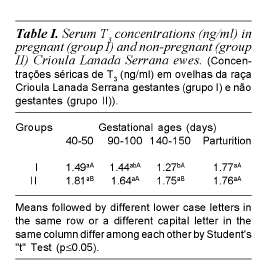
<body><![CDATA[<p><font face="Verdana" size="2">All the ewes underwent four 10 ml- blood sample collections by jugular venopuncture using vacutainer 20GI1/2 needles attached to vacuum tubes<sup>1</sup> . The blood samples from the pregnant ewes (group I) were collected at the end of the first third of the gestational period (40 to 50 days), at the end of the second third of the gestational period (90 to 100 days), at the end of the gestational period (140 to 150 days), and at the moment of parturition. Blood samples from nonpregnant ewes (group II) were collected on the same collection days as the pregnant group.</font></p>     <p><font face="Verdana" size="2">EXPERIMENT 2</font></p>     <p><font face="Verdana" size="2">The effects of lactation were evaluated in the same ewes of group I after parturition (LE group). Blood samples from the lactating ewes (LE) were collected at the moment of parturition, at the end of the first third of the lactation period (30 days), at the end of the second third of the lactation period (60 days), and at the end of the lactation period (90 days). Blood samples from non-lactating ewes (NL) were collected on the same days that the lactating group was sampled.</font></p>     <p><font face="Verdana" size="2">Blood samples were centrifuged at 1612 x g for 15 min in order to separate the blood serum, which was placed in Eppendorfs tubes, properly identified, and stored at -20<sup>o</sup> C for subsequent determination of T<sub>3</sub> and T<sub>4</sub> serum levels by radioimunoassay (RIA) method, in the solid phase using specific commercial<sup>2</sup> kits for each hormone, for the <i>in vitro</i> diagnostic. The analyses were carried out at Bluegrass Embryo Transplant Laboratories (B.E.T. Laboratories), Rio de Janeiro, RJ, Brazil.</font></p>     <p><font face="Verdana" size="2">The experiments were entirely randomized in a 2x4 factorial, corresponding to the two treatments and 4 time periods. The numerical data of the T<sub>3</sub> and T<sub>4</sub> serum concentrations were statistically analyzed through variance of analysis. The treatments means were compared using the Student's <i>t</i> Test at a significance level of p<u>&lt;</u>0.05 (Snedecor and Cochran, 1994).</font></p>     <p>&nbsp;</p>     <p><font face="Verdana" size="2"><b>Results</b></font></p>     <p><font face="Verdana" size="2">EXPERIMENT 1</font></p>     <p><font face="Verdana" size="2">The T<sub>3</sub> serum concentration in Crioula Lanada Serrana ewes <b>(<a href="#t1">table I</a>)</b> decreased from 1.49 ng/ml at the beginning of gestation to 1.27 ng/ml at the end of gestation (p<u>&lt;</u>0.05), and increased at the moment of parturition. The variation in T<sub>3</sub> in non-pregnant ewes, on corresponding days, was between 1.81 ng/ml and 1.75 ng/ml, not differing from the results found during the gestational periods (p&gt;0.05), nor in relation to the moment of parturition.</font></p>     <p align="center"><font face="Verdana" size="2"><a name="t1"><img src="/img/revistas/azoo/v59n228/art4_1.jpg"></a></font></p>     ]]></body>
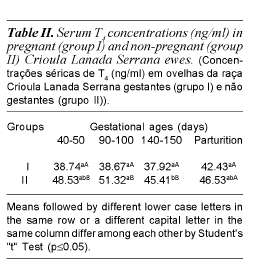
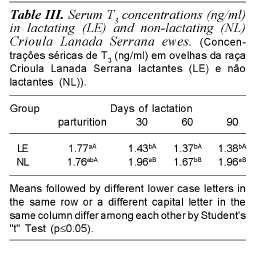
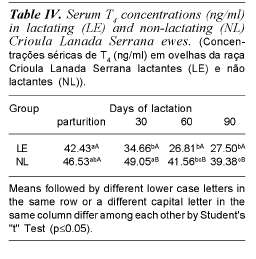
<body><![CDATA[<p><font face="Verdana" size="2">T<sub>3</sub> serum concentrations in pregnant ewes, in the first and third thirds of gestation were lower than the concentrations in non-pregnant ewes (p<u>&lt;</u>0.05). In the second third of gestation, the concentration in pregnant ewes was lower when compared to that of the non-pregnant ewes (p<u>&lt;</u>0.7), however, at the moment of parturition, it was similar to the concentration of the non-pregnant ewes.</font></p>     <p><font face="Verdana" size="2">There was no significant difference among the T<sub>4</sub> serum concentrations at the different gestational stages and the parturition day for group I (p&gt;0.05). During gestation, group I values for T<sub>4</sub> serum concentration were lower (p<u>&lt;</u>0.05) when compared to the values of the non-pregnant ewes (group II) at the same points of time <b>(<a href="#t2">table II</a>)</b>. However, at the moment of parturition, there was no significant difference (p&gt;0.05) between the concentrations of the two groups.</font></p>     <p align="center"><font face="Verdana" size="2"><a name="t2"><img src="/img/revistas/azoo/v59n228/art4_3.jpg"></a></font></p>     <p><font face="Verdana" size="2">EXPERIMENT 2</font></p>     <p><font face="Verdana" size="2">At parturition, there was no significant difference in T<sub>3</sub> concentrations between LE and NL ewes (p&gt;0.05). At all points of time evaluated during lactation, the serum T<sub>3</sub> concentrations were lower (p<u>&lt;</u>0.05) in the lactating ewes when compared to the non-lactating ewes <b>(<a href="#t3">table III</a>)</b>.</font></p>     <p><font face="Verdana" size="2">In the LE, at the moment of parturition, the serum T<sub>3</sub> concentrations were greater (p<u>&lt;</u>0.05) than those from the lactation periods <b>(<a href="#t3">table III</a>)</b>.</font></p>     <p align="center"><font face="Verdana" size="2"><a name="t3"><img src="/img/revistas/azoo/v59n228/art4_2.jpg"></a></font></p>     <p><font face="Verdana" size="2">Serum T<sub>4</sub> concentrations in LE did not differ from those of NL ewes at the moment of parturition. At 30, 60 and 90 days of lactation <b>(<a href="#t4">table IV</a>)</b>, T<sub>4</sub> concentrations of LE were lower (p<u>&lt;</u>0.05) than those of the NL ewes.</font></p>     <p align="center"><font face="Verdana" size="2"><a name="t4"><img src="/img/revistas/azoo/v59n228/art4_4.jpg"></a></font></p>     <p><font face="Verdana" size="2"><b>Discussion</b></font></p>     ]]></body>
<body><![CDATA[<p><font face="Verdana" size="2">The lower T<sub>3</sub> (1.49 ng/ml) and T<sub>4</sub> (38,7 ng/ ml) concentrations in the first third of gestation in comparison with the non-pregnant ewes (T<sub>3</sub>= 1.81 ng/ml and T<sub>4</sub>= 48.53 ng/ml), could be related to the passage of thyroid hormones through the placenta, since the ovine thyroid becomes functional only between the sixth and eighth weeks of embryonic life (Bryden <i>et al.</i>, 1972). According to Escobar (2001), the mother is the only source of T<sub>3</sub> and T<sub>4</sub> up to the moment that the thyroid tissue becomes active in the fetus and plays its role in organogenesis and in the development of the placenta.</font></p>     <p><font face="Verdana" size="2">The decrease in maternal T<sub>3</sub> and T<sub>4</sub> serum concentrations, respectively, in the second third (1.44 ng/ml; 38.67 ng/ml) and the last third (1.27 ng/ml; 37.92 ng/ml) of gestation, in comparison to T<sub>3</sub> (1.64 ng/ml; 1.75 ng/ml) and T<sub>4</sub> (38.67 ng/ml; 37.92 ng/ml) of non-pregnant ewes during these periods, repectively, could be related, according to Bergamashi <i>et al.</i> (2002), to iodine uptake by the fetus through the placenta. Indeed, during the first third of gestation, the fetal thyroid is not functional and it needs no iodine, as it does not form thyroid hormones. However, as the fetus becomes more developed, it begins to produce its own thyroid hormones and it requires maternal iodine in increasing amounts for the hormonal synthesis. The iodine requirement increases mainly in the last third of gestation, when 87% of the circulating maternal iodine is transferred to the fetus (Falconer, 1963), coinciding with the period of highest fetal growth (Campos <i>et al.</i>, 1993). At the end of the gestation, the fetal hypothalamic-pituitary-thyroid axis in the ovine works independently from the maternal axis and there is little transference of T<sub>3</sub> and T<sub>4</sub> from the mother to the fetus (Nathanielsz, 1975).</font></p>     <p><font face="Verdana" size="2">The lower T<sub>3</sub> and T<sub>4</sub> serum concentrations in pregnant ewes in comparison to non-pregnant ewes could be related to the enzymatic activity of deiodinase. According to Kelly (2000), type 2 deiodinase is probably responsible for the maintenance of adequate local T<sub>3</sub> concentrations, and type 3 deio-dinase transforms T<sub>3</sub> and T<sub>4</sub> into inactive metabolites. Acting together, type 2 and 3 deiodinases may reduce thyroid hormone concentration during gestation.</font></p>     <p><font face="Verdana" size="2">The T<sub>4</sub> values shown in this study differ from the findings presented by Chopra <i>et al.</i> (1975) who compared pregnant ewes in the last third of gestation with non-pregnant ewes (Columbia breed or a Columbia x Suffolk cross-breed), and observed no variation in the concentrations of this hormone.</font></p>     <p><font face="Verdana" size="2">The higher T<sub>3</sub> concentration in the first third of gestation (1.49 ng/ml) compared to the second (1.44 ng/ml), and this concentration compared to that of the final third (1.27 ng/ml), could be related to the gradual increase of iodine transfer through the placenta, as well as to the significant increase in the urinary excretion of iodine during gestation due to maternal glomerular filtration (Burrow <i>et al.</i>, 1994).</font></p>     <p><font face="Verdana" size="2">The higher T<sub>3</sub> concentration at parturition (1.77 ng/ml) compared to the three gestational periods (1.49; 1.44; 1.27 ng/ml for the first, second and last third, respectively) could be due to the action of glucocorticoids, which in ovines increase progressively in the last thirteen days before parturition (Chopra <i>et al.</i>, 1975). Cortisol stimulates hepatic and renal deiodination from T<sub>4</sub> to T<sub>3</sub> by type 1 deiodinase. In addition, the cortisol wave at pre-parturition and at parturition increases the circulating T<sub>3</sub> concentration and may reduce the T<sub>4</sub> serum concentration (Graf and Carvalho, 2002). However, a decrease in the T<sub>4</sub> concentration was not observed in the present study, and its value at parturition (42.43 ng/ml) did not differ from the values observed at the three points of time during gestation (38.74; 38.67; 37.92 ng/ml for the first, second, and last third respectively).</font></p>     <p><font face="Verdana" size="2">The T<sub>4</sub> results cited above related to the gestational phases differ from the results found by Aumont <i>et al.</i> (1989) and Wallace <i>et al.</i> (1997) who studied the thyroid dynamics in Suffolk, Dorset and crossbreeds, and found a reduction from the last third of gestation up to the moment of parturition when compared to the other gestational phases. This divergent result may be responsible for the large number of weaned lambs and the excellent maternal ability, remarkable characteristics of the Crioula Lanada breed. Nevertheless, this is a question that needs further investigation in animals of different breeds exposed to the same management and environmental conditions.</font></p>     <p><font face="Verdana" size="2">In the non-pregnant ewes (Group II), changes in T<sub>4</sub> serum concentrations <b>(<a href="#t2">table II</a>)</b> were observed only between the periods that corresponded to the second and third gestational periods of the animals of group I (p<u>&lt;</u>0.05). This finding is likely to be related to intrinsic and extrinsic factors, since the collection of blood samples in May coincided with noticeable drops in the temperature, characteristic of the plateau region of Santa Catarina. As thyroid hormone liberation brings about an increase in thermogenesis and in the consumption of energy (Douglas, 2002), it may be possible that the availability of these hormones varies in response to changes in the caloric or thermal conditions of the organism. Therefore, significant differences between the values obtained in different months of collections were expected. This result is similar to that found by Nascimento <i>et al.</i> (1997) and Andre-wartha <i>et al.</i> (1980), who observed seasonal changes in serum concentrations of thyroid hormones in ovines.</font></p>     <p><font face="Verdana" size="2">The results obtained for lactating ewes differ from those found by Henneman <i>et al.</i> (1955) who observed increased secretion of thyroid hormones in lactating ewes of the Shoropshire breed when compared to non-lactating ewes. Similarly, Falconer (1963) did not find a difference in thyroid hormone concentrations in Merino ewes between the two physiological stages.</font></p>     <p><font face="Verdana" size="2">In the present work, the lower T<sub>3</sub> and T<sub>4</sub> concentrations throughout the lactation period in relation to the NL ewes may have occurred as a result of the decrease in thyroid secretion. According to Bauman and Currie (1980), Refsal <i>et al.</i> (1984), Bauman (1992) and Tiirats (1997), the decrease in the secretion of thyroid hormones occurs as a result of an insufficient energy supply in the extra-mammary tissues, due to the intense consumption of nutrients by the mammary gland during lactation. During this period, when milk is produced and mammary gland activity increases, a mobilization of body fat, a loss in weight and a negative energetic balance occur as a consequence of the mammary gland's demand of glucose, amino acids and fatty acids.</font></p>     ]]></body>
<body><![CDATA[<p><font face="Verdana" size="2">The lower secretion of hormones by the thyroid gland, which may have reduced the T<sub>3</sub> and T<sub>4</sub> concentrations throughout the lactation period in this study, may have also occurred because thyroid hormones increase the secretion of insulin (Guyton and Hall, 2002). According to Achmadi and Terashima (1995), the reduction in serum concentration of T<sub>3</sub> can decrease the secretion of insulin in sheep. The reduced concentrations of thyroid hormones, in association with a low concentration of insulin during lactation, promote the mammary gland's preferential utilization of the substrates (Gueorguiev, 1999). Also according to Gueorguiev (1999), an increase in thyroid hormone secretion during lactation would be unfavorable for the physiologic adjustment to milk production, because some of its precursors, especially glucose, would be directed to the extra-mammary tissues, such as the adipose tissue and the muscles.</font></p>     <p><font face="Verdana" size="2">The lower serum concentration of T<sub>3</sub> and T<sub>4</sub> observed in the LE ewes when compared to the NL in this study could also be attributed to the mammary gland's demand for thyroid hormones (Akasha <i>et al.</i>, 1987). At the beginning of lactopoiesis, there is an increase in the number of T<sub>3</sub> receptors in the mammary gland's secretory cells during lactation (Wilson and Gorewit, 1980) and there is a greater activity of the organ-specific type 2 deiodinase enzyme, which generates T<sub>3</sub> intracelullarly from T<sub>4,</sub> and also of the type 3 deiodinase enzyme, which in turn deactivates the thyroid hormones (Kahl <i>et al.</i>, 1998; Pezzi <i>et al.</i>, 2003); and there is an actual secretion of T<sub>4</sub> through the milk, which may represent between 4% and 7% of the total required for the maintenance of metabolic functions (Akasha and Anderson, 1984). In addition, the decrease in T<sub>4</sub> concentrations in the LE ewes could yet be caused by the additional mammary gland's excretion of maternal iodine during lactation, since 55.66% of ovine circulating iodine is excreted by the milk, which is the reason that the concentration of iodine in milk and in the blood serum are, respectively, 29:1 and 92:1 (Falconer, 1963).</font></p>     <p><font face="Verdana" size="2">In this study, as stated before, the higher serum concentration of T<sub>3</sub> on the day of parturition (1.77 ng/ml) when compared to the periods of lactation could be related to the glucocorticoid concentrations, which increase at the end of gestation (Chopra <i>et al.</i>, 1975; Mathur <i>et al.</i>, 1980). The glucocorticoids stimulate the hepatic and renal deiodination of T<sub>4</sub> and T<sub>3</sub>, which increases the serum concentration of T<sub>3</sub> and may decrease the concentration of T<sub>4</sub> (Thomas <i>et al.</i>, 1978; Graf and Carvalho, 2002). However, a decrease in the concentration of T<sub>4</sub> was not observed in this study, in which their values of 42.43 ng/ml immediately after parturition and 34.66 ng/ ml at 30 days of lactation were greater than the concentrations observed at 60 and 90 days of lactation (26.81 and 27.50 ng/ml, respectively). These results differ from those found by Falconer (1963) and Andrewartha <i>et al.</i> (1980) who did not observe differences between the serum concentrations of the thyroid hormones of Australian ewes in the first two stages of lactation.</font></p>     <p>&nbsp;</p>     <p><font face="Verdana" size="2"><b>Conclusion</b></font></p>     <p><font face="Verdana" size="2">The findings obtained, in the conditions under which the experiment was carried out, allow us to conclude that for the Crioula Lanada Serrana breed the physiological stage of gestation causes a variation in the T<sub>3</sub> and T<sub>4</sub> serum concentrations, which at the moment of parturition are similar to the concentrations observed in non-pregnant ewes. Also in this breed, during lactation, there is a decrease in serum concentrations of T<sub>3</sub> and T<sub>4</sub>.</font></p> <hr align="left" width="30%" size="1">     <p><font face="Verdana" size="2"><sup>1</sup>Becton Dickinson Indústria Cirúrgica Ltda. Curitiba, Paraná. Brazil.    <br><sup>2</sup>Coat-A-Count<sup>&reg;</sup>. Diagnostic Products Corporation. Los Angeles. USA.</p>     <p>&nbsp;</p>     <p>&nbsp;</p>     ]]></body>
<body><![CDATA[<p><font face="Verdana" size="2"><b>References</b></font></p>     <!-- ref --><p><font face="Verdana" size="2">Akasha, M. and Anderson, R.R. 1984. Thyroxine and triiodothyronine in milk of cows, goats, sheep, and guinea pigs. <i>Proc. Soc. Exper. Biol. Med.</i>, 177: 360-371.</font>&nbsp;&nbsp;&nbsp;&nbsp;&nbsp;&nbsp;&nbsp;&nbsp;[&#160;<a href="javascript:void(0);" onclick="javascript: window.open('/scielo.php?script=sci_nlinks&ref=993302&pid=S0004-0592201000040000400001&lng=','','width=640,height=500,resizable=yes,scrollbars=1,menubar=yes,');">Links</a>&#160;]<!-- end-ref --><!-- ref --><p><font face="Verdana" size="2">Akasha, M.A., Anderson, R.R., Ellersieck, M. and Nixon, D.A. 1987. Concentration of thyroid hormones and prolactin in dairy cattle serum and milk at three stages of lactation. <i>J. Dairy Sci.</i>, 70: 271-276.</font>&nbsp;&nbsp;&nbsp;&nbsp;&nbsp;&nbsp;&nbsp;&nbsp;[&#160;<a href="javascript:void(0);" onclick="javascript: window.open('/scielo.php?script=sci_nlinks&ref=993303&pid=S0004-0592201000040000400002&lng=','','width=640,height=500,resizable=yes,scrollbars=1,menubar=yes,');">Links</a>&#160;]<!-- end-ref --><!-- ref --><p><font face="Verdana" size="2">Achmadi, J. and Terashima, Y. 1995. The effect of propylthiouracil-induced low thyroid function on secretion response and action of insulin in sheep. <i>Domestic. Anim. Endocrinol.</i>, 12: 157-166.</font>&nbsp;&nbsp;&nbsp;&nbsp;&nbsp;&nbsp;&nbsp;&nbsp;[&#160;<a href="javascript:void(0);" onclick="javascript: window.open('/scielo.php?script=sci_nlinks&ref=993304&pid=S0004-0592201000040000400003&lng=','','width=640,height=500,resizable=yes,scrollbars=1,menubar=yes,');">Links</a>&#160;]<!-- end-ref --><!-- ref --><p><font face="Verdana" size="2">Andrewartha, K.A., Caple, I.W., Davies, W.D. and Mcdonald, J.E. 1980. Observations on serum thyroxine concentrations in lambs and ewes to assess iodine nutrition. <i>Aust. Vet. J.</i>, 56: 18-21.</font>&nbsp;&nbsp;&nbsp;&nbsp;&nbsp;&nbsp;&nbsp;&nbsp;[&#160;<a href="javascript:void(0);" onclick="javascript: window.open('/scielo.php?script=sci_nlinks&ref=993305&pid=S0004-0592201000040000400004&lng=','','width=640,height=500,resizable=yes,scrollbars=1,menubar=yes,');">Links</a>&#160;]<!-- end-ref --><!-- ref --><p><font face="Verdana" size="2">Aumont, G., Lamand, M. and Tressol, J.C. 1989. Iodine nutrition in ewes: effects of low to high iodine intake on iodine content of biological fluids in pregnant and lactating ewes. <i>Reprod. Nutr. Dev.</i>, 29: 113-125.</font>&nbsp;&nbsp;&nbsp;&nbsp;&nbsp;&nbsp;&nbsp;&nbsp;[&#160;<a href="javascript:void(0);" onclick="javascript: window.open('/scielo.php?script=sci_nlinks&ref=993306&pid=S0004-0592201000040000400005&lng=','','width=640,height=500,resizable=yes,scrollbars=1,menubar=yes,');">Links</a>&#160;]<!-- end-ref --><!-- ref --><p><font face="Verdana" size="2">Bauman, D.E. 1992. Bovine somatotrophin: review of an emerging animal technology. <i>J. Dairy Sci.</i>, 75: 3432-3451.</font>&nbsp;&nbsp;&nbsp;&nbsp;&nbsp;&nbsp;&nbsp;&nbsp;[&#160;<a href="javascript:void(0);" onclick="javascript: window.open('/scielo.php?script=sci_nlinks&ref=993307&pid=S0004-0592201000040000400006&lng=','','width=640,height=500,resizable=yes,scrollbars=1,menubar=yes,');">Links</a>&#160;]<!-- end-ref --><!-- ref --><p><font face="Verdana" size="2">Bauman, D.E. and Currie, W.B. 1980. Partitioning of nutrients during pregnancy and lactation: a review of mechanisms involving homeostasis and homeorhesis. <i>J. Dairy Sci.</i>, 63: 1514-1529.</font>&nbsp;&nbsp;&nbsp;&nbsp;&nbsp;&nbsp;&nbsp;&nbsp;[&#160;<a href="javascript:void(0);" onclick="javascript: window.open('/scielo.php?script=sci_nlinks&ref=993308&pid=S0004-0592201000040000400007&lng=','','width=640,height=500,resizable=yes,scrollbars=1,menubar=yes,');">Links</a>&#160;]<!-- end-ref --><!-- ref --><p><font face="Verdana" size="2">Bergamashi, M.A.C.M., Vicente, W.R.R., Barbosa, R.T., Marques, J.A. e Freitas, A.R. 2002. Perfis plasmáticos maternos de triiodotironina e tiroxina em fêmeas nelore e crescimento fetal bovino. <i>Rev. Bras. Med. Vet.</i>, 25: 35-39.</font>&nbsp;&nbsp;&nbsp;&nbsp;&nbsp;&nbsp;&nbsp;&nbsp;[&#160;<a href="javascript:void(0);" onclick="javascript: window.open('/scielo.php?script=sci_nlinks&ref=993309&pid=S0004-0592201000040000400008&lng=','','width=640,height=500,resizable=yes,scrollbars=1,menubar=yes,');">Links</a>&#160;]<!-- end-ref --><!-- ref --><p><font face="Verdana" size="2">Bryden, M.M., Evans, H.E. and Binns, W. 1972. Embriology of the sheep. II. The alimentary tract and associated glands. <i>J. Morphol.</i>, 138: 187-206.</font>&nbsp;&nbsp;&nbsp;&nbsp;&nbsp;&nbsp;&nbsp;&nbsp;[&#160;<a href="javascript:void(0);" onclick="javascript: window.open('/scielo.php?script=sci_nlinks&ref=993310&pid=S0004-0592201000040000400009&lng=','','width=640,height=500,resizable=yes,scrollbars=1,menubar=yes,');">Links</a>&#160;]<!-- end-ref --><!-- ref --><p><font face="Verdana" size="2">Burrow, G.N., Fisher, D.A. and Larsen, P.R. 1994. Maternal and fetal thyroid function. <i>N. Engl. J. Med.</i>, 331: 1072-1078.</font>&nbsp;&nbsp;&nbsp;&nbsp;&nbsp;&nbsp;&nbsp;&nbsp;[&#160;<a href="javascript:void(0);" onclick="javascript: window.open('/scielo.php?script=sci_nlinks&ref=993311&pid=S0004-0592201000040000400010&lng=','','width=640,height=500,resizable=yes,scrollbars=1,menubar=yes,');">Links</a>&#160;]<!-- end-ref --><!-- ref --><p><font face="Verdana" size="2">Campos, R., Díaz, F. y Wilches, M. 1993. Hormonas tireoideanas durante la gestacion: nivelis sericos en la madre y en el feto. <i>Acta Agron.</i>, 43: 156-159.</font>&nbsp;&nbsp;&nbsp;&nbsp;&nbsp;&nbsp;&nbsp;&nbsp;[&#160;<a href="javascript:void(0);" onclick="javascript: window.open('/scielo.php?script=sci_nlinks&ref=993312&pid=S0004-0592201000040000400011&lng=','','width=640,height=500,resizable=yes,scrollbars=1,menubar=yes,');">Links</a>&#160;]<!-- end-ref --><!-- ref --><p><font face="Verdana" size="2">Canola, J.C. 1982. Determinação, por radioimuno-análise, dos níveis séricos de triiodotironina e tiroxina, em ovinos da raça Corriedale do Rio Grande do Sul. Universidade Federal de Santa Maria. Dissertação. Santa Maria. Brasil.</font>&nbsp;&nbsp;&nbsp;&nbsp;&nbsp;&nbsp;&nbsp;&nbsp;[&#160;<a href="javascript:void(0);" onclick="javascript: window.open('/scielo.php?script=sci_nlinks&ref=993313&pid=S0004-0592201000040000400012&lng=','','width=640,height=500,resizable=yes,scrollbars=1,menubar=yes,');">Links</a>&#160;]<!-- end-ref --><!-- ref --><p><font face="Verdana" size="2">Chopra, I.J., Sack, J. and Fisher, D.A. 1975. 3,3',5'-triiodothyronine (reverse T<sub>3</sub>) and 3,3',5-triiodothyronine (T<sub>3</sub>) in fetal and adult sheep: studies of metabolic clearance rates, production rates, serum binding, and thyroidal content relative to thyroxine. <i>Endocrinology</i>, 97: 1080-1088.</font>&nbsp;&nbsp;&nbsp;&nbsp;&nbsp;&nbsp;&nbsp;&nbsp;[&#160;<a href="javascript:void(0);" onclick="javascript: window.open('/scielo.php?script=sci_nlinks&ref=993314&pid=S0004-0592201000040000400013&lng=','','width=640,height=500,resizable=yes,scrollbars=1,menubar=yes,');">Links</a>&#160;]<!-- end-ref --><!-- ref --><p><font face="Verdana" size="2">Douglas, C.R. 2002. Fisiologia da glândula tireóide. Em: Douglas, C.R. Tratado de fisiologia aplicado à saúde. 5<sup>a</sup>  ed. Robe Editorial. São Paulo. pp. 1211-1231.</font>&nbsp;&nbsp;&nbsp;&nbsp;&nbsp;&nbsp;&nbsp;&nbsp;[&#160;<a href="javascript:void(0);" onclick="javascript: window.open('/scielo.php?script=sci_nlinks&ref=993315&pid=S0004-0592201000040000400014&lng=','','width=640,height=500,resizable=yes,scrollbars=1,menubar=yes,');">Links</a>&#160;]<!-- end-ref --><!-- ref --><p><font face="Verdana" size="2">Escobar, G.M. 2001. The role of thyroid hormone in fetal neurodevelopment. <i>J. Pediatr. Endocr. Met.</i>, 14: 1453-1462.</font>&nbsp;&nbsp;&nbsp;&nbsp;&nbsp;&nbsp;&nbsp;&nbsp;[&#160;<a href="javascript:void(0);" onclick="javascript: window.open('/scielo.php?script=sci_nlinks&ref=993316&pid=S0004-0592201000040000400015&lng=','','width=640,height=500,resizable=yes,scrollbars=1,menubar=yes,');">Links</a>&#160;]<!-- end-ref --><!-- ref --><p><font face="Verdana" size="2">Falconer, I.R. 1963. Iodide metabolism of the thyroid and mammary glands during lactation in sheep. <i>J. Endocrinol.</i>, 25: 533-539.</font>&nbsp;&nbsp;&nbsp;&nbsp;&nbsp;&nbsp;&nbsp;&nbsp;[&#160;<a href="javascript:void(0);" onclick="javascript: window.open('/scielo.php?script=sci_nlinks&ref=993317&pid=S0004-0592201000040000400016&lng=','','width=640,height=500,resizable=yes,scrollbars=1,menubar=yes,');">Links</a>&#160;]<!-- end-ref --><!-- ref --><p><font face="Verdana" size="2">Fernández, G. 2000. Situación de los recursos genéticos domésticos locales del Uruguay. <i>Arch. Zootec.</i>, 49: 333-340.</font>&nbsp;&nbsp;&nbsp;&nbsp;&nbsp;&nbsp;&nbsp;&nbsp;[&#160;<a href="javascript:void(0);" onclick="javascript: window.open('/scielo.php?script=sci_nlinks&ref=993318&pid=S0004-0592201000040000400017&lng=','','width=640,height=500,resizable=yes,scrollbars=1,menubar=yes,');">Links</a>&#160;]<!-- end-ref --><!-- ref --><p><font face="Verdana" size="2">Georgiev, P. and Nikolov, Y. 2004. Blood chemical and endocrine changes in sheep with experimental chronic acidosis. <i>Bulg. J. Vet. Med.</i>, 7: 149-153.</font>&nbsp;&nbsp;&nbsp;&nbsp;&nbsp;&nbsp;&nbsp;&nbsp;[&#160;<a href="javascript:void(0);" onclick="javascript: window.open('/scielo.php?script=sci_nlinks&ref=993319&pid=S0004-0592201000040000400018&lng=','','width=640,height=500,resizable=yes,scrollbars=1,menubar=yes,');">Links</a>&#160;]<!-- end-ref --><!-- ref --><p><font face="Verdana" size="2">Graf, H. e Carvalho, G.A. 2002. Fatores interferentes na interpretação de dosagens laboratoriais no diagnóstico de hiper e hipotireoidismo. <i>Arq. Bras. Endocrinol. Metab.</i>, 46: 51-64.</font>&nbsp;&nbsp;&nbsp;&nbsp;&nbsp;&nbsp;&nbsp;&nbsp;[&#160;<a href="javascript:void(0);" onclick="javascript: window.open('/scielo.php?script=sci_nlinks&ref=993320&pid=S0004-0592201000040000400019&lng=','','width=640,height=500,resizable=yes,scrollbars=1,menubar=yes,');">Links</a>&#160;]<!-- end-ref --><!-- ref --><p><font face="Verdana" size="2">Gueorguiev, I.P. 1999. Thyroxine and triio-dothyronine concentrations during lactation in dairy cows. <i>Ann. Zootech.</i>, 48: 477-480.</font>&nbsp;&nbsp;&nbsp;&nbsp;&nbsp;&nbsp;&nbsp;&nbsp;[&#160;<a href="javascript:void(0);" onclick="javascript: window.open('/scielo.php?script=sci_nlinks&ref=993321&pid=S0004-0592201000040000400020&lng=','','width=640,height=500,resizable=yes,scrollbars=1,menubar=yes,');">Links</a>&#160;]<!-- end-ref --><!-- ref --><p><font face="Verdana" size="2">Guyton, A.C. e Hall, J.E. 2002. Tratado de fisiologia médica. 10<sup>a</sup>  ed. Ed. Guanabara Koogan. Rio de Janeiro. 1008 pp.</font>&nbsp;&nbsp;&nbsp;&nbsp;&nbsp;&nbsp;&nbsp;&nbsp;[&#160;<a href="javascript:void(0);" onclick="javascript: window.open('/scielo.php?script=sci_nlinks&ref=993322&pid=S0004-0592201000040000400021&lng=','','width=640,height=500,resizable=yes,scrollbars=1,menubar=yes,');">Links</a>&#160;]<!-- end-ref --><!-- ref --><p><font face="Verdana" size="2">Henneman, H.A., Reineke, E.P. and Griffin, S.A. 1955. The thyroid secretion rate of sheep as affected by season, age, breed, pregnancy and lactation. <i>J. Anim. Sci.</i>, 14: 419-434.</font>&nbsp;&nbsp;&nbsp;&nbsp;&nbsp;&nbsp;&nbsp;&nbsp;[&#160;<a href="javascript:void(0);" onclick="javascript: window.open('/scielo.php?script=sci_nlinks&ref=993323&pid=S0004-0592201000040000400022&lng=','','width=640,height=500,resizable=yes,scrollbars=1,menubar=yes,');">Links</a>&#160;]<!-- end-ref --><!-- ref --><p><font face="Verdana" size="2">Kahl, S., Elsasser, T.H. and Rumsey, T.S. 1998. Regulation of thyroid hormone action: 5 deiodinase. In: Proceeding of 1<sup>st</sup> Symposium on Growth in Ruminant: Basic Aspects. Theory and Practice for the Future, 1998. Switzerland. pp. 168-177.</font>&nbsp;&nbsp;&nbsp;&nbsp;&nbsp;&nbsp;&nbsp;&nbsp;[&#160;<a href="javascript:void(0);" onclick="javascript: window.open('/scielo.php?script=sci_nlinks&ref=993324&pid=S0004-0592201000040000400023&lng=','','width=640,height=500,resizable=yes,scrollbars=1,menubar=yes,');">Links</a>&#160;]<!-- end-ref --><!-- ref --><p><font face="Verdana" size="2">Kelly, G. 2000. Peripheral metabolism of thyroid hormones: a review. <i>Altern. Med. Rev.</i>, 5: 306-332.</font>&nbsp;&nbsp;&nbsp;&nbsp;&nbsp;&nbsp;&nbsp;&nbsp;[&#160;<a href="javascript:void(0);" onclick="javascript: window.open('/scielo.php?script=sci_nlinks&ref=993325&pid=S0004-0592201000040000400024&lng=','','width=640,height=500,resizable=yes,scrollbars=1,menubar=yes,');">Links</a>&#160;]<!-- end-ref --><!-- ref --><p><font face="Verdana" size="2">Mathur, H., Brown, B.L., Krane, E.J., Thomas, A.L. and Nathaniels, P.W. 1980. Thyroid hormone relationships in the fetal and newborn lamb. <i>Biol. Neonate</i>, 37: 138-141.</font>&nbsp;&nbsp;&nbsp;&nbsp;&nbsp;&nbsp;&nbsp;&nbsp;[&#160;<a href="javascript:void(0);" onclick="javascript: window.open('/scielo.php?script=sci_nlinks&ref=993326&pid=S0004-0592201000040000400025&lng=','','width=640,height=500,resizable=yes,scrollbars=1,menubar=yes,');">Links</a>&#160;]<!-- end-ref --><!-- ref --><p><font face="Verdana" size="2">Nascimento, M.R.B.M., Silva, R.G. and Dantas, M.A. 1997. Effect of air temperature and humidity on the variation of the serum levels of thyroid hormones in corriedale sheep. <i>ARS Veterinária</i>, 13: 209-217.</font>&nbsp;&nbsp;&nbsp;&nbsp;&nbsp;&nbsp;&nbsp;&nbsp;[&#160;<a href="javascript:void(0);" onclick="javascript: window.open('/scielo.php?script=sci_nlinks&ref=993327&pid=S0004-0592201000040000400026&lng=','','width=640,height=500,resizable=yes,scrollbars=1,menubar=yes,');">Links</a>&#160;]<!-- end-ref --><!-- ref --><p><font face="Verdana" size="2">Nathanielsz, P.W. 1975. Thyroid function in the fetus and newborn mammal. <i>Brit. Med. Bull.</i>, 31: 51-56.</font>&nbsp;&nbsp;&nbsp;&nbsp;&nbsp;&nbsp;&nbsp;&nbsp;[&#160;<a href="javascript:void(0);" onclick="javascript: window.open('/scielo.php?script=sci_nlinks&ref=993328&pid=S0004-0592201000040000400027&lng=','','width=640,height=500,resizable=yes,scrollbars=1,menubar=yes,');">Links</a>&#160;]<!-- end-ref --><!-- ref --><p><font face="Verdana" size="2">Patel, J.S., Mehta, V.M., Tajane, K.R. and Kulkarni, W. 1992. Effect of thermal exposure on some of the hormones in Patanwadi and its crosses. <i>Indian Vet. J.</i>, 62: 89-90.</font>&nbsp;&nbsp;&nbsp;&nbsp;&nbsp;&nbsp;&nbsp;&nbsp;[&#160;<a href="javascript:void(0);" onclick="javascript: window.open('/scielo.php?script=sci_nlinks&ref=993329&pid=S0004-0592201000040000400028&lng=','','width=640,height=500,resizable=yes,scrollbars=1,menubar=yes,');">Links</a>&#160;]<!-- end-ref --><!-- ref --><p><font face="Verdana" size="2">Pezzi, C., Accorsi, P.A., Vigo, D., Govoni, N. and Gaiani, R. 2003. 5'-deiodinase activity and circulating thyronines in lactating cows. <i>J. Dairy Sci.</i>, 86: 152-158.</font>&nbsp;&nbsp;&nbsp;&nbsp;&nbsp;&nbsp;&nbsp;&nbsp;[&#160;<a href="javascript:void(0);" onclick="javascript: window.open('/scielo.php?script=sci_nlinks&ref=993330&pid=S0004-0592201000040000400029&lng=','','width=640,height=500,resizable=yes,scrollbars=1,menubar=yes,');">Links</a>&#160;]<!-- end-ref --><!-- ref --><p><font face="Verdana" size="2">Rae, M.T., Rhind, S.M., Kyle, C.E., Miller, D.W. and Brooks, A.N. 2002. Maternal undernutrition alters triiodothyronine concentrations and pituitary response to GnRH in fetal sheep. <i>J. Endocrinol.</i>, 173: 449-455.</font>&nbsp;&nbsp;&nbsp;&nbsp;&nbsp;&nbsp;&nbsp;&nbsp;[&#160;<a href="javascript:void(0);" onclick="javascript: window.open('/scielo.php?script=sci_nlinks&ref=993331&pid=S0004-0592201000040000400030&lng=','','width=640,height=500,resizable=yes,scrollbars=1,menubar=yes,');">Links</a>&#160;]<!-- end-ref --><!-- ref --><p><font face="Verdana" size="2">Refsal, K.R., Nachreiner, R.F. and Anderson, C.R. 1984. Relationship of season, herd, lactation, age and pregnancy with serum thyroxine and triiodothyronine in Holstein cows. <i>Domestic. Anim. Endocrinol.</i>, 1: 225-234.</font>&nbsp;&nbsp;&nbsp;&nbsp;&nbsp;&nbsp;&nbsp;&nbsp;[&#160;<a href="javascript:void(0);" onclick="javascript: window.open('/scielo.php?script=sci_nlinks&ref=993332&pid=S0004-0592201000040000400031&lng=','','width=640,height=500,resizable=yes,scrollbars=1,menubar=yes,');">Links</a>&#160;]<!-- end-ref --><!-- ref --><p><font face="Verdana" size="2">Snedecor, G.W. and Cochran, W.G. 1994. Statistical methods. 8<sup>th</sup> ed. Iowa State University Press. Ames. 503 pp.</font>&nbsp;&nbsp;&nbsp;&nbsp;&nbsp;&nbsp;&nbsp;&nbsp;[&#160;<a href="javascript:void(0);" onclick="javascript: window.open('/scielo.php?script=sci_nlinks&ref=993333&pid=S0004-0592201000040000400032&lng=','','width=640,height=500,resizable=yes,scrollbars=1,menubar=yes,');">Links</a>&#160;]<!-- end-ref --><!-- ref --><p><font face="Verdana" size="2">Tiirats, T. 1997. Thyroxine, triiodothyronine and reverse-triiodothyronine concentrations in blood plasma in relation to lactational stage, milk yield, energy and dietary protein intake in Estonian dairy cows. <i>Acta Vet. Scand.</i>, 38: 339-348.</font>&nbsp;&nbsp;&nbsp;&nbsp;&nbsp;&nbsp;&nbsp;&nbsp;[&#160;<a href="javascript:void(0);" onclick="javascript: window.open('/scielo.php?script=sci_nlinks&ref=993334&pid=S0004-0592201000040000400033&lng=','','width=640,height=500,resizable=yes,scrollbars=1,menubar=yes,');">Links</a>&#160;]<!-- end-ref --><!-- ref --><p><font face="Verdana" size="2">Thomas, A.L., Krane, E.J. and Nathanielsz, P.W. 1978. Changes in the fetal thyroid axis after induction of premature parturition by low dose continuous intravascular cortisol infusion to the fetal sheep at 130 days of gestation. <i>Endocrinology</i>, 103: 17-23.</font>&nbsp;&nbsp;&nbsp;&nbsp;&nbsp;&nbsp;&nbsp;&nbsp;[&#160;<a href="javascript:void(0);" onclick="javascript: window.open('/scielo.php?script=sci_nlinks&ref=993335&pid=S0004-0592201000040000400034&lng=','','width=640,height=500,resizable=yes,scrollbars=1,menubar=yes,');">Links</a>&#160;]<!-- end-ref --><!-- ref --><p><font face="Verdana" size="2">Vaz, C.M.S.L., Bialkowski, J.G., Andrade, S.F.J., Matos, C.W. e Bertan, H. 2002. Comportamento da raça ovina Crioula durante a parição. Em: Anais do Congresso Brasileiro de Medicina Veterinária (Conbravet), 24; Congresso Estadual de Medicina Veterinária, 15; Congresso de Medicina Veterinária do Conesul, 4; Congresso Estadual da Anclivepa-RS, 1; Exposição de Produtos e Serviços em Medicina Veterinária (EXPOVET), 8; 2002, Gramado, Brasil &#091;CD-ROM&#093;.</font>&nbsp;&nbsp;&nbsp;&nbsp;&nbsp;&nbsp;&nbsp;&nbsp;[&#160;<a href="javascript:void(0);" onclick="javascript: window.open('/scielo.php?script=sci_nlinks&ref=993336&pid=S0004-0592201000040000400035&lng=','','width=640,height=500,resizable=yes,scrollbars=1,menubar=yes,');">Links</a>&#160;]<!-- end-ref --><!-- ref --><p><font face="Verdana" size="2">Vaz, C.M.S.L., Bricarello. P.A., Gonçalves, I.G.E. e Vaz, C.S.L. 1999. Comportamento de cordeiros das raças Crioula Lanada e Corriedale frente ao aleitamento artificial. Em: Anais do Congreso Latinoamericano de Especialistas em Pequeños Ruminantes y Camélidos Sudamericanos, 1; Jornadas Uruguayas de Ovinos, 11; Encontro de Medicina de Pequenos Ruminantes do Cone Sul, 2; 1999, Montevideo, Uruguay &#091;CD-ROM&#093;. Montevideo: AVEPER.</font>&nbsp;&nbsp;&nbsp;&nbsp;&nbsp;&nbsp;&nbsp;&nbsp;[&#160;<a href="javascript:void(0);" onclick="javascript: window.open('/scielo.php?script=sci_nlinks&ref=993337&pid=S0004-0592201000040000400036&lng=','','width=640,height=500,resizable=yes,scrollbars=1,menubar=yes,');">Links</a>&#160;]<!-- end-ref --><!-- ref --><p><font face="Verdana" size="2">Vaz, C.M.S.L. 2000. Morfologia e Aptidão da Ovelha Crioula Lanada. EMBRAPA Pecuária Sul. Bagé. 20 pp. (EMBRAPA Pecuária Sul. Doc., 22).</font>&nbsp;&nbsp;&nbsp;&nbsp;&nbsp;&nbsp;&nbsp;&nbsp;[&#160;<a href="javascript:void(0);" onclick="javascript: window.open('/scielo.php?script=sci_nlinks&ref=993338&pid=S0004-0592201000040000400037&lng=','','width=640,height=500,resizable=yes,scrollbars=1,menubar=yes,');">Links</a>&#160;]<!-- end-ref --><!-- ref --><p><font face="Verdana" size="2">Wallace, J.M., Silva, P., Aitken, R.P. and Cruickshank, M.A. 1997. Maternal endocrine status in relation to pregnancy outcome in rapidly growing adolescent sheep. <i>J. Endocrinol.</i>, 155: 359-368.</font>&nbsp;&nbsp;&nbsp;&nbsp;&nbsp;&nbsp;&nbsp;&nbsp;[&#160;<a href="javascript:void(0);" onclick="javascript: window.open('/scielo.php?script=sci_nlinks&ref=993339&pid=S0004-0592201000040000400038&lng=','','width=640,height=500,resizable=yes,scrollbars=1,menubar=yes,');">Links</a>&#160;]<!-- end-ref --><!-- ref --><p><font face="Verdana" size="2">Wells, N.H., Hallford, D.M. and Hernandez, J.A. 2003. Serum thyroid hormones and reproductive characteristics of Rambouiellet ewe lambs treated with propylthiouracil before puberty. <i>Theriogenology</i>, 59: 1403-1413.</font>&nbsp;&nbsp;&nbsp;&nbsp;&nbsp;&nbsp;&nbsp;&nbsp;[&#160;<a href="javascript:void(0);" onclick="javascript: window.open('/scielo.php?script=sci_nlinks&ref=993340&pid=S0004-0592201000040000400039&lng=','','width=640,height=500,resizable=yes,scrollbars=1,menubar=yes,');">Links</a>&#160;]<!-- end-ref --><!-- ref --><p><font face="Verdana" size="2">Wilson, D.B. and Gorewit, R.C. 1980. Specific thyroxine receptors in mammary cytosol from lactating cattle. <i>Biochem. Biophys. Res. Commum.</i>, 95: 807-815.</font>&nbsp;&nbsp;&nbsp;&nbsp;&nbsp;&nbsp;&nbsp;&nbsp;[&#160;<a href="javascript:void(0);" onclick="javascript: window.open('/scielo.php?script=sci_nlinks&ref=993341&pid=S0004-0592201000040000400040&lng=','','width=640,height=500,resizable=yes,scrollbars=1,menubar=yes,');">Links</a>&#160;]<!-- end-ref --><p>&nbsp;</p>     <p>&nbsp;</p>     <p><font face="Verdana" size="2">Recibido: 17-4-08.    <br>Aceptado: 4-2-09.</font></p>      ]]></body><back>
<ref-list>
<ref id="B1">
<nlm-citation citation-type="journal">
<person-group person-group-type="author">
<name>
<surname><![CDATA[Akasha]]></surname>
<given-names><![CDATA[M.]]></given-names>
</name>
<name>
<surname><![CDATA[Anderson]]></surname>
<given-names><![CDATA[R.R.]]></given-names>
</name>
</person-group>
<article-title xml:lang="en"><![CDATA[Thyroxine and triiodothyronine in milk of cows, goats, sheep, and guinea pigs]]></article-title>
<source><![CDATA[Proc. Soc. Exper. Biol. Med.]]></source>
<year>1984</year>
<volume>177</volume>
<page-range>360-371</page-range></nlm-citation>
</ref>
<ref id="B2">
<nlm-citation citation-type="journal">
<person-group person-group-type="author">
<name>
<surname><![CDATA[Akasha,]]></surname>
<given-names><![CDATA[M.A.]]></given-names>
</name>
<name>
<surname><![CDATA[Anderson,]]></surname>
<given-names><![CDATA[R.R.]]></given-names>
</name>
<name>
<surname><![CDATA[Ellersieck,]]></surname>
<given-names><![CDATA[M.]]></given-names>
</name>
<name>
<surname><![CDATA[Nixon]]></surname>
<given-names><![CDATA[D.A.]]></given-names>
</name>
</person-group>
<article-title xml:lang="en"><![CDATA[Concentration of thyroid hormones and prolactin in dairy cattle serum and milk at three stages of lactation]]></article-title>
<source><![CDATA[J. Dairy Sci.,]]></source>
<year>1987</year>
<volume>70</volume>
<page-range>271-276</page-range></nlm-citation>
</ref>
<ref id="B3">
<nlm-citation citation-type="journal">
<person-group person-group-type="author">
<name>
<surname><![CDATA[Achmadi,]]></surname>
<given-names><![CDATA[J.]]></given-names>
</name>
<name>
<surname><![CDATA[Terashima]]></surname>
<given-names><![CDATA[Y.]]></given-names>
</name>
</person-group>
<article-title xml:lang="en"><![CDATA[The effect of propylthiouracil-induced low thyroid function on secretion response and action of insulin in sheep]]></article-title>
<source><![CDATA[Domestic. Anim. Endocrinol.,]]></source>
<year>1995</year>
<volume>12</volume>
<page-range>157-166</page-range></nlm-citation>
</ref>
<ref id="B4">
<nlm-citation citation-type="journal">
<person-group person-group-type="author">
<name>
<surname><![CDATA[Andrewartha,]]></surname>
<given-names><![CDATA[K.A.]]></given-names>
</name>
<name>
<surname><![CDATA[Caple]]></surname>
<given-names><![CDATA[I.W.]]></given-names>
</name>
<name>
<surname><![CDATA[Davies,]]></surname>
<given-names><![CDATA[W.D.]]></given-names>
</name>
<name>
<surname><![CDATA[Mcdonald]]></surname>
<given-names><![CDATA[J.E.]]></given-names>
</name>
</person-group>
<article-title xml:lang="en"><![CDATA[Observations on serum thyroxine concentrations in lambs and ewes to assess iodine nutrition]]></article-title>
<source><![CDATA[Aust. Vet. J.,]]></source>
<year>1980</year>
<volume>56</volume>
<page-range>18-21</page-range></nlm-citation>
</ref>
<ref id="B5">
<nlm-citation citation-type="journal">
<person-group person-group-type="author">
<name>
<surname><![CDATA[Aumont]]></surname>
<given-names><![CDATA[G.]]></given-names>
</name>
<name>
<surname><![CDATA[Lamand]]></surname>
<given-names><![CDATA[M.]]></given-names>
</name>
<name>
<surname><![CDATA[Tressol]]></surname>
<given-names><![CDATA[J.C.]]></given-names>
</name>
</person-group>
<article-title xml:lang="en"><![CDATA[Iodine nutrition in ewes: effects of low to high iodine intake on iodine content of biological fluids in pregnant and lactating ewes]]></article-title>
<source><![CDATA[Reprod. Nutr. Dev.,]]></source>
<year>1989</year>
<volume>29</volume>
<page-range>113-125</page-range></nlm-citation>
</ref>
<ref id="B6">
<nlm-citation citation-type="journal">
<person-group person-group-type="author">
<name>
<surname><![CDATA[Bauman]]></surname>
<given-names><![CDATA[D. E.]]></given-names>
</name>
</person-group>
<article-title xml:lang="en"><![CDATA[Bovine somatotrophin: review of an emerging animal technology]]></article-title>
<source><![CDATA[J. Dairy Sci.,]]></source>
<year>1992</year>
<volume>75</volume>
<page-range>3432-3451</page-range></nlm-citation>
</ref>
<ref id="B7">
<nlm-citation citation-type="journal">
<person-group person-group-type="author">
<name>
<surname><![CDATA[Bauman]]></surname>
<given-names><![CDATA[D.E.]]></given-names>
</name>
<name>
<surname><![CDATA[Currie]]></surname>
<given-names><![CDATA[W.B.]]></given-names>
</name>
</person-group>
<article-title xml:lang="en"><![CDATA[Partitioning of nutrients during pregnancy and lactation: a review of mechanisms involving homeostasis and homeorhesis]]></article-title>
<source><![CDATA[J. Dairy Sci.,]]></source>
<year>1980</year>
<volume>63</volume>
<page-range>1514-1529</page-range></nlm-citation>
</ref>
<ref id="B8">
<nlm-citation citation-type="journal">
<person-group person-group-type="author">
<name>
<surname><![CDATA[Bergamashi]]></surname>
<given-names><![CDATA[M.A.C.M.]]></given-names>
</name>
<name>
<surname><![CDATA[Vicente]]></surname>
<given-names><![CDATA[W.R.R.]]></given-names>
</name>
<name>
<surname><![CDATA[Barbosa]]></surname>
<given-names><![CDATA[R.T.]]></given-names>
</name>
<name>
<surname><![CDATA[Marques]]></surname>
<given-names><![CDATA[J.A.]]></given-names>
</name>
<name>
<surname><![CDATA[Freitas]]></surname>
<given-names><![CDATA[A.R.]]></given-names>
</name>
</person-group>
<article-title xml:lang="pt"><![CDATA[Perfis plasmáticos maternos de triiodotironina e tiroxina em fêmeas nelore e crescimento fetal bovino]]></article-title>
<source><![CDATA[Rev. Bras. Med. Vet.,]]></source>
<year>2002</year>
<volume>25</volume>
<page-range>35-39</page-range></nlm-citation>
</ref>
<ref id="B9">
<nlm-citation citation-type="journal">
<person-group person-group-type="author">
<name>
<surname><![CDATA[Bryden]]></surname>
<given-names><![CDATA[M.M.]]></given-names>
</name>
<name>
<surname><![CDATA[Evans,]]></surname>
<given-names><![CDATA[H.E.]]></given-names>
</name>
<name>
<surname><![CDATA[Binns]]></surname>
<given-names><![CDATA[W.]]></given-names>
</name>
</person-group>
<article-title xml:lang="en"><![CDATA[Embriology of the sheep: II. The alimentary tract and associated glands]]></article-title>
<source><![CDATA[J. Morphol.]]></source>
<year>1972</year>
<volume>138</volume>
<page-range>187-206</page-range></nlm-citation>
</ref>
<ref id="B10">
<nlm-citation citation-type="journal">
<person-group person-group-type="author">
<name>
<surname><![CDATA[Burrow,]]></surname>
<given-names><![CDATA[G.N.]]></given-names>
</name>
<name>
<surname><![CDATA[Fisher]]></surname>
<given-names><![CDATA[D.A.]]></given-names>
</name>
<name>
<surname><![CDATA[Larsen]]></surname>
<given-names><![CDATA[P.R.]]></given-names>
</name>
</person-group>
<article-title xml:lang="en"><![CDATA[Maternal and fetal thyroid function]]></article-title>
<source><![CDATA[N. Engl. J. Med.,]]></source>
<year>1994</year>
<volume>331</volume>
<page-range>1072-1078</page-range></nlm-citation>
</ref>
<ref id="B11">
<nlm-citation citation-type="journal">
<person-group person-group-type="author">
<name>
<surname><![CDATA[Campos]]></surname>
<given-names><![CDATA[R.]]></given-names>
</name>
<name>
<surname><![CDATA[Díaz]]></surname>
<given-names><![CDATA[F.]]></given-names>
</name>
<name>
<surname><![CDATA[Wilches]]></surname>
<given-names><![CDATA[M.]]></given-names>
</name>
</person-group>
<article-title xml:lang="es"><![CDATA[Hormonas tireoideanas durante la gestacion: nivelis sericos en la madre y en el feto]]></article-title>
<source><![CDATA[Acta Agron.,]]></source>
<year>1993</year>
<volume>43</volume>
<page-range>156-159</page-range></nlm-citation>
</ref>
<ref id="B12">
<nlm-citation citation-type="book">
<person-group person-group-type="author">
<name>
<surname><![CDATA[Canola]]></surname>
<given-names><![CDATA[J.C.]]></given-names>
</name>
</person-group>
<source><![CDATA[Determinação, por radioimuno-análise, dos níveis séricos de triiodotironina e tiroxina, em ovinos da raça Corriedale do Rio Grande do Sul]]></source>
<year>1982</year>
<publisher-loc><![CDATA[Santa Maria ]]></publisher-loc>
<publisher-name><![CDATA[Universidade Federal de Santa Maria]]></publisher-name>
</nlm-citation>
</ref>
<ref id="B13">
<nlm-citation citation-type="journal">
<person-group person-group-type="author">
<name>
<surname><![CDATA[Chopra]]></surname>
<given-names><![CDATA[I.J.]]></given-names>
</name>
<name>
<surname><![CDATA[Sack]]></surname>
<given-names><![CDATA[J.]]></given-names>
</name>
<name>
<surname><![CDATA[Fisher]]></surname>
<given-names><![CDATA[D.A.]]></given-names>
</name>
</person-group>
<article-title xml:lang="en"><![CDATA[3,3',5'-triiodothyronine (reverse T3) and 3,3',5-triiodothyronine (T3) in fetal and adult sheep: studies of metabolic clearance rates, production rates, serum binding, and thyroidal content relative to thyroxine]]></article-title>
<source><![CDATA[Endocrinology]]></source>
<year>1975</year>
<volume>97</volume>
<page-range>1080-1088</page-range></nlm-citation>
</ref>
<ref id="B14">
<nlm-citation citation-type="book">
<person-group person-group-type="author">
<name>
<surname><![CDATA[Douglas]]></surname>
<given-names><![CDATA[C.R.]]></given-names>
</name>
</person-group>
<article-title xml:lang="pt"><![CDATA[Fisiologia da glândula tireóide]]></article-title>
<person-group person-group-type="editor">
<name>
<surname><![CDATA[Douglas]]></surname>
<given-names><![CDATA[C.R.]]></given-names>
</name>
</person-group>
<source><![CDATA[Tratado de fisiologia aplicado à saúde]]></source>
<year>2002</year>
<edition>5</edition>
<page-range>1211-1231</page-range><publisher-loc><![CDATA[São Paulo ]]></publisher-loc>
<publisher-name><![CDATA[Robe Editorial]]></publisher-name>
</nlm-citation>
</ref>
<ref id="B15">
<nlm-citation citation-type="journal">
<person-group person-group-type="author">
<name>
<surname><![CDATA[Escobar]]></surname>
<given-names><![CDATA[G.M.]]></given-names>
</name>
</person-group>
<article-title xml:lang="en"><![CDATA[The role of thyroid hormone in fetal neurodevelopment]]></article-title>
<source><![CDATA[J. Pediatr. Endocr. Met.,]]></source>
<year>2001</year>
<volume>14</volume>
<page-range>1453-1462</page-range></nlm-citation>
</ref>
<ref id="B16">
<nlm-citation citation-type="journal">
<person-group person-group-type="author">
<name>
<surname><![CDATA[Falconer]]></surname>
<given-names><![CDATA[I.R.]]></given-names>
</name>
</person-group>
<article-title xml:lang="en"><![CDATA[Iodide metabolism of the thyroid and mammary glands during lactation in sheep]]></article-title>
<source><![CDATA[J. Endocrinol.,]]></source>
<year>1963</year>
<volume>25</volume>
<page-range>533-539</page-range></nlm-citation>
</ref>
<ref id="B17">
<nlm-citation citation-type="journal">
<person-group person-group-type="author">
<name>
<surname><![CDATA[Fernández]]></surname>
<given-names><![CDATA[G]]></given-names>
</name>
</person-group>
<article-title xml:lang="es"><![CDATA[Situación de los recursos genéticos domésticos locales del Uruguay]]></article-title>
<source><![CDATA[Arch. Zootec.,]]></source>
<year>2000</year>
<volume>49</volume>
<page-range>333-340</page-range></nlm-citation>
</ref>
<ref id="B18">
<nlm-citation citation-type="journal">
<person-group person-group-type="author">
<name>
<surname><![CDATA[Georgiev]]></surname>
<given-names><![CDATA[P.]]></given-names>
</name>
<name>
<surname><![CDATA[Nikolov]]></surname>
<given-names><![CDATA[Y.]]></given-names>
</name>
</person-group>
<article-title xml:lang="en"><![CDATA[Blood chemical and endocrine changes in sheep with experimental chronic acidosis]]></article-title>
<source><![CDATA[Bulg. J. Vet. Med.,]]></source>
<year>2004</year>
<volume>7</volume>
<page-range>149-153</page-range></nlm-citation>
</ref>
<ref id="B19">
<nlm-citation citation-type="journal">
<person-group person-group-type="author">
<name>
<surname><![CDATA[Graf,]]></surname>
<given-names><![CDATA[H.]]></given-names>
</name>
<name>
<surname><![CDATA[Carvalho]]></surname>
<given-names><![CDATA[G.A.]]></given-names>
</name>
</person-group>
<article-title xml:lang="pt"><![CDATA[Fatores interferentes na interpretação de dosagens laboratoriais no diagnóstico de hiper e hipotireoidismo]]></article-title>
<source><![CDATA[Arq. Bras. Endocrinol. Metab.,]]></source>
<year>2002</year>
<volume>46</volume>
<page-range>51-64</page-range></nlm-citation>
</ref>
<ref id="B20">
<nlm-citation citation-type="journal">
<person-group person-group-type="author">
<name>
<surname><![CDATA[Gueorguiev]]></surname>
<given-names><![CDATA[I.P.]]></given-names>
</name>
</person-group>
<article-title xml:lang="en"><![CDATA[Thyroxine and triio-dothyronine concentrations during lactation in dairy cows]]></article-title>
<source><![CDATA[Ann. Zootech.,]]></source>
<year>1999</year>
<volume>48</volume>
<page-range>477-480</page-range></nlm-citation>
</ref>
<ref id="B21">
<nlm-citation citation-type="book">
<person-group person-group-type="author">
<name>
<surname><![CDATA[Guyton]]></surname>
<given-names><![CDATA[A.C.]]></given-names>
</name>
<name>
<surname><![CDATA[Hall]]></surname>
<given-names><![CDATA[J.E.]]></given-names>
</name>
</person-group>
<source><![CDATA[Tratado de fisiologia médica]]></source>
<year>2002</year>
<edition>10</edition>
<page-range>1008</page-range><publisher-loc><![CDATA[Rio de Janeiro ]]></publisher-loc>
<publisher-name><![CDATA[Guanabara Koogan]]></publisher-name>
</nlm-citation>
</ref>
<ref id="B22">
<nlm-citation citation-type="journal">
<person-group person-group-type="author">
<name>
<surname><![CDATA[Henneman]]></surname>
<given-names><![CDATA[H.A.]]></given-names>
</name>
<name>
<surname><![CDATA[Reineke,]]></surname>
<given-names><![CDATA[E.P.]]></given-names>
</name>
<name>
<surname><![CDATA[Griffin]]></surname>
<given-names><![CDATA[S.A.]]></given-names>
</name>
</person-group>
<article-title xml:lang="en"><![CDATA[The thyroid secretion rate of sheep as affected by season, age, breed, pregnancy and lactation]]></article-title>
<source><![CDATA[J Anim. Sci.,]]></source>
<year>1955</year>
<volume>14</volume>
<page-range>419-434</page-range></nlm-citation>
</ref>
<ref id="B23">
<nlm-citation citation-type="confpro">
<person-group person-group-type="author">
<name>
<surname><![CDATA[Kahl]]></surname>
<given-names><![CDATA[S.]]></given-names>
</name>
<name>
<surname><![CDATA[Elsasser]]></surname>
<given-names><![CDATA[T.H.]]></given-names>
</name>
<name>
<surname><![CDATA[Rumsey]]></surname>
<given-names><![CDATA[T.S.]]></given-names>
</name>
</person-group>
<article-title xml:lang="en"><![CDATA[Regulation of thyroid hormone action: 5 deiodinase]]></article-title>
<source><![CDATA[Proceeding]]></source>
<year>1998</year>
<month>19</month>
<day>98</day>
<conf-name><![CDATA[1 Symposium on Growth in Ruminant: Basic Aspects. Theory and Practice for the Future]]></conf-name>
<conf-loc> </conf-loc>
<page-range>168-177</page-range></nlm-citation>
</ref>
<ref id="B24">
<nlm-citation citation-type="journal">
<person-group person-group-type="author">
<name>
<surname><![CDATA[Kelly,]]></surname>
<given-names><![CDATA[G]]></given-names>
</name>
</person-group>
<article-title xml:lang="en"><![CDATA[Peripheral metabolism of thyroid hormones: a review]]></article-title>
<source><![CDATA[Altern. Med. Rev.,]]></source>
<year>2000</year>
<volume>5</volume>
<page-range>306-332</page-range></nlm-citation>
</ref>
<ref id="B25">
<nlm-citation citation-type="journal">
<person-group person-group-type="author">
<name>
<surname><![CDATA[Mathur]]></surname>
<given-names><![CDATA[H.]]></given-names>
</name>
<name>
<surname><![CDATA[Brown]]></surname>
<given-names><![CDATA[B.L.]]></given-names>
</name>
<name>
<surname><![CDATA[Krane]]></surname>
<given-names><![CDATA[E.J.]]></given-names>
</name>
<name>
<surname><![CDATA[Thomas]]></surname>
<given-names><![CDATA[A.L.]]></given-names>
</name>
<name>
<surname><![CDATA[Nathaniels]]></surname>
<given-names><![CDATA[P.W.]]></given-names>
</name>
</person-group>
<article-title xml:lang="en"><![CDATA[Thyroid hormone relationships in the fetal and newborn lamb]]></article-title>
<source><![CDATA[Biol. Neonate,]]></source>
<year>1980</year>
<volume>37</volume>
<page-range>138-141</page-range></nlm-citation>
</ref>
<ref id="B26">
<nlm-citation citation-type="journal">
<person-group person-group-type="author">
<name>
<surname><![CDATA[Nascimento]]></surname>
<given-names><![CDATA[M.R.B.M.]]></given-names>
</name>
<name>
<surname><![CDATA[Silva]]></surname>
<given-names><![CDATA[R.G.]]></given-names>
</name>
<name>
<surname><![CDATA[Dantas]]></surname>
<given-names><![CDATA[M.A.]]></given-names>
</name>
</person-group>
<article-title xml:lang="en"><![CDATA[Effect of air temperature and humidity on the variation of the serum levels of thyroid hormones in corriedale sheep]]></article-title>
<source><![CDATA[ARS Veterinária]]></source>
<year>1997</year>
<volume>13</volume>
<page-range>209-217</page-range></nlm-citation>
</ref>
<ref id="B27">
<nlm-citation citation-type="journal">
<person-group person-group-type="author">
<name>
<surname><![CDATA[Nathanielsz]]></surname>
<given-names><![CDATA[P.W.]]></given-names>
</name>
</person-group>
<article-title xml:lang="en"><![CDATA[Thyroid function in the fetus and newborn mammal]]></article-title>
<source><![CDATA[Brit. Med. Bull.,]]></source>
<year>1975</year>
<volume>31</volume>
<page-range>51-56</page-range></nlm-citation>
</ref>
<ref id="B28">
<nlm-citation citation-type="journal">
<person-group person-group-type="author">
<name>
<surname><![CDATA[Patel]]></surname>
<given-names><![CDATA[J.S.]]></given-names>
</name>
<name>
<surname><![CDATA[Mehta]]></surname>
<given-names><![CDATA[V.M.]]></given-names>
</name>
<name>
<surname><![CDATA[Tajane]]></surname>
<given-names><![CDATA[K.R.]]></given-names>
</name>
<name>
<surname><![CDATA[Kulkarni]]></surname>
<given-names><![CDATA[W.]]></given-names>
</name>
</person-group>
<article-title xml:lang="en"><![CDATA[Effect of thermal exposure on some of the hormones in Patanwadi and its crosses]]></article-title>
<source><![CDATA[Indian Vet. J.,]]></source>
<year>1992</year>
<volume>62</volume>
<page-range>89-90</page-range></nlm-citation>
</ref>
<ref id="B29">
<nlm-citation citation-type="journal">
<person-group person-group-type="author">
<name>
<surname><![CDATA[Pezzi]]></surname>
<given-names><![CDATA[C.]]></given-names>
</name>
<name>
<surname><![CDATA[Accorsi]]></surname>
<given-names><![CDATA[P.A.]]></given-names>
</name>
<name>
<surname><![CDATA[Vigo]]></surname>
<given-names><![CDATA[D.]]></given-names>
</name>
<name>
<surname><![CDATA[Govoni]]></surname>
<given-names><![CDATA[N.]]></given-names>
</name>
<name>
<surname><![CDATA[Gaiani]]></surname>
<given-names><![CDATA[R.]]></given-names>
</name>
</person-group>
<article-title xml:lang="en"><![CDATA[5'-deiodinase activity and circulating thyronines in lactating cows]]></article-title>
<source><![CDATA[J. Dairy Sci.,]]></source>
<year>2003</year>
<volume>86</volume>
<page-range>152-158</page-range></nlm-citation>
</ref>
<ref id="B30">
<nlm-citation citation-type="journal">
<person-group person-group-type="author">
<name>
<surname><![CDATA[Rae]]></surname>
<given-names><![CDATA[M.T.]]></given-names>
</name>
<name>
<surname><![CDATA[Rhind]]></surname>
<given-names><![CDATA[S.M.]]></given-names>
</name>
<name>
<surname><![CDATA[Kyle]]></surname>
<given-names><![CDATA[C.E.]]></given-names>
</name>
<name>
<surname><![CDATA[Miller]]></surname>
<given-names><![CDATA[D.W.]]></given-names>
</name>
<name>
<surname><![CDATA[Brooks]]></surname>
<given-names><![CDATA[A.N.]]></given-names>
</name>
</person-group>
<article-title xml:lang="en"><![CDATA[Maternal undernutrition alters triiodothyronine concentrations and pituitary response to GnRH in fetal sheep]]></article-title>
<source><![CDATA[J. Endocrinol.]]></source>
<year>2002</year>
<volume>173</volume>
<page-range>449-455</page-range></nlm-citation>
</ref>
<ref id="B31">
<nlm-citation citation-type="journal">
<person-group person-group-type="author">
<name>
<surname><![CDATA[Refsal]]></surname>
<given-names><![CDATA[K.R.]]></given-names>
</name>
<name>
<surname><![CDATA[Nachreiner]]></surname>
<given-names><![CDATA[R.F.]]></given-names>
</name>
<name>
<surname><![CDATA[Anderson]]></surname>
<given-names><![CDATA[C.R.]]></given-names>
</name>
</person-group>
<article-title xml:lang="en"><![CDATA[Relationship of season, herd, lactation, age and pregnancy with serum thyroxine and triiodothyronine in Holstein cows]]></article-title>
<source><![CDATA[Domestic Anim. Endocrinol.]]></source>
<year>1984</year>
<volume>1</volume>
<page-range>225-234</page-range></nlm-citation>
</ref>
<ref id="B32">
<nlm-citation citation-type="book">
<person-group person-group-type="author">
<name>
<surname><![CDATA[Snedecor]]></surname>
<given-names><![CDATA[G.W.]]></given-names>
</name>
<name>
<surname><![CDATA[Cochran]]></surname>
<given-names><![CDATA[W.G.]]></given-names>
</name>
</person-group>
<source><![CDATA[Statistical methods]]></source>
<year>1994</year>
<edition>8</edition>
<page-range>503</page-range><publisher-loc><![CDATA[Ames ]]></publisher-loc>
<publisher-name><![CDATA[Iowa State University Press]]></publisher-name>
</nlm-citation>
</ref>
<ref id="B33">
<nlm-citation citation-type="journal">
<person-group person-group-type="author">
<name>
<surname><![CDATA[Tiirats]]></surname>
<given-names><![CDATA[T.]]></given-names>
</name>
</person-group>
<article-title xml:lang="en"><![CDATA[Thyroxine, triiodothyronine and reverse-triiodothyronine concentrations in blood plasma in relation to lactational stage, milk yield, energy and dietary protein intake in Estonian dairy cows]]></article-title>
<source><![CDATA[Acta Vet Scand.]]></source>
<year>1997</year>
<volume>38</volume>
<page-range>339-348</page-range></nlm-citation>
</ref>
<ref id="B34">
<nlm-citation citation-type="journal">
<person-group person-group-type="author">
<name>
<surname><![CDATA[Thomas]]></surname>
<given-names><![CDATA[A.L.]]></given-names>
</name>
<name>
<surname><![CDATA[Krane,]]></surname>
<given-names><![CDATA[E.J.]]></given-names>
</name>
<name>
<surname><![CDATA[Nathanielsz]]></surname>
<given-names><![CDATA[P.W.]]></given-names>
</name>
</person-group>
<article-title xml:lang="en"><![CDATA[Changes in the fetal thyroid axis after induction of premature parturition by low dose continuous intravascular cortisol infusion to the fetal sheep at 130 days of gestation]]></article-title>
<source><![CDATA[Endocrinology]]></source>
<year>1978</year>
<volume>103</volume>
<page-range>17-23</page-range></nlm-citation>
</ref>
<ref id="B35">
<nlm-citation citation-type="confpro">
<person-group person-group-type="author">
<name>
<surname><![CDATA[Vaz]]></surname>
<given-names><![CDATA[C.M.S.L.]]></given-names>
</name>
<name>
<surname><![CDATA[Bialkowski]]></surname>
<given-names><![CDATA[J.G.]]></given-names>
</name>
<name>
<surname><![CDATA[Andrade]]></surname>
<given-names><![CDATA[S.F.J.]]></given-names>
</name>
<name>
<surname><![CDATA[Matos]]></surname>
<given-names><![CDATA[C.W.]]></given-names>
</name>
<name>
<surname><![CDATA[Bertan]]></surname>
<given-names><![CDATA[H.]]></given-names>
</name>
</person-group>
<article-title xml:lang="pt"><![CDATA[Comportamento da raça ovina Crioula durante a parição]]></article-title>
<source><![CDATA[Anais]]></source>
<year>2002</year>
<month>20</month>
<day>02</day>
<conf-name><![CDATA[2415418 Congresso Brasileiro de Medicina Veterinária (Conbravet)Congresso Estadual de Medicina VeterináriaCongresso de Medicina Veterinária do ConesulCongresso Estadual da Anclivepa-RSExposição de Produtos e Serviços em Medicina Veterinária (EXPOVET)]]></conf-name>
<conf-loc> </conf-loc>
<publisher-loc><![CDATA[Gramado ]]></publisher-loc>
</nlm-citation>
</ref>
<ref id="B36">
<nlm-citation citation-type="confpro">
<person-group person-group-type="author">
<name>
<surname><![CDATA[Vaz]]></surname>
<given-names><![CDATA[C.M.S.L.]]></given-names>
</name>
<name>
<surname><![CDATA[Bricarello]]></surname>
<given-names><![CDATA[P.A.]]></given-names>
</name>
<name>
<surname><![CDATA[Gonçalves]]></surname>
<given-names><![CDATA[I.G.E.]]></given-names>
</name>
<name>
<surname><![CDATA[Vaz]]></surname>
<given-names><![CDATA[C.S.L.]]></given-names>
</name>
</person-group>
<article-title xml:lang="pt"><![CDATA[Comportamento de cordeiros das raças Crioula Lanada e Corriedale frente ao aleitamento artificial]]></article-title>
<source><![CDATA[Anais]]></source>
<year>1999</year>
<month>19</month>
<day>99</day>
<conf-name><![CDATA[1112 Congreso Latinoamericano de Especialistas em Pequeños Ruminantes y Camélidos SudamericanosJornadas Uruguayas de OvinosEncontro de Medicina de Pequenos Ruminantes do Cone Sul]]></conf-name>
<conf-loc> </conf-loc>
<publisher-loc><![CDATA[Montevideo ]]></publisher-loc>
<publisher-name><![CDATA[AVEPER]]></publisher-name>
</nlm-citation>
</ref>
<ref id="B37">
<nlm-citation citation-type="">
<person-group person-group-type="author">
<name>
<surname><![CDATA[Vaz]]></surname>
<given-names><![CDATA[C.M.S.L.]]></given-names>
</name>
</person-group>
<source><![CDATA[Morfologia e Aptidão da Ovelha Crioula Lanada: EMBRAPA Pecuária Sul]]></source>
<year>2000</year>
<page-range>20</page-range><publisher-loc><![CDATA[Bagé ]]></publisher-loc>
</nlm-citation>
</ref>
<ref id="B38">
<nlm-citation citation-type="journal">
<person-group person-group-type="author">
<name>
<surname><![CDATA[Wallace]]></surname>
<given-names><![CDATA[J.M.]]></given-names>
</name>
<name>
<surname><![CDATA[Silva]]></surname>
<given-names><![CDATA[P.]]></given-names>
</name>
<name>
<surname><![CDATA[Aitken]]></surname>
<given-names><![CDATA[R.P.]]></given-names>
</name>
<name>
<surname><![CDATA[Cruickshank]]></surname>
<given-names><![CDATA[M.A.]]></given-names>
</name>
</person-group>
<article-title xml:lang="en"><![CDATA[Maternal endocrine status in relation to pregnancy outcome in rapidly growing adolescent sheep]]></article-title>
<source><![CDATA[J. Endocrinol.]]></source>
<year>1997</year>
<volume>155</volume>
<page-range>359-368</page-range></nlm-citation>
</ref>
<ref id="B39">
<nlm-citation citation-type="journal">
<person-group person-group-type="author">
<name>
<surname><![CDATA[Wells]]></surname>
<given-names><![CDATA[N.H.]]></given-names>
</name>
<name>
<surname><![CDATA[Hallford]]></surname>
<given-names><![CDATA[D.M.]]></given-names>
</name>
<name>
<surname><![CDATA[Hernandez]]></surname>
<given-names><![CDATA[J.A.]]></given-names>
</name>
</person-group>
<article-title xml:lang="en"><![CDATA[Serum thyroid hormones and reproductive characteristics of Rambouiellet ewe lambs treated with propylthiouracil before puberty]]></article-title>
<source><![CDATA[Theriogenology]]></source>
<year>2003</year>
<volume>59</volume>
<page-range>1403-1413</page-range></nlm-citation>
</ref>
<ref id="B40">
<nlm-citation citation-type="journal">
<person-group person-group-type="author">
<name>
<surname><![CDATA[Wilson]]></surname>
<given-names><![CDATA[D.B.]]></given-names>
</name>
<name>
<surname><![CDATA[Gorewit]]></surname>
<given-names><![CDATA[R.C.]]></given-names>
</name>
</person-group>
<article-title xml:lang="en"><![CDATA[Specific thyroxine receptors in mammary cytosol from lactating cattle]]></article-title>
<source><![CDATA[Biochem. Biophys. Res. Commum.]]></source>
<year>1980</year>
<volume>95</volume>
<page-range>807-815</page-range></nlm-citation>
</ref>
</ref-list>
</back>
</article>