<?xml version="1.0" encoding="ISO-8859-1"?><article xmlns:mml="http://www.w3.org/1998/Math/MathML" xmlns:xlink="http://www.w3.org/1999/xlink" xmlns:xsi="http://www.w3.org/2001/XMLSchema-instance">
<front>
<journal-meta>
<journal-id>0004-0592</journal-id>
<journal-title><![CDATA[Archivos de Zootecnia]]></journal-title>
<abbrev-journal-title><![CDATA[Arch. zootec.]]></abbrev-journal-title>
<issn>0004-0592</issn>
<publisher>
<publisher-name><![CDATA[Universidad de Córdoba]]></publisher-name>
</publisher>
</journal-meta>
<article-meta>
<article-id>S0004-05922011000200006</article-id>
<article-id pub-id-type="doi">10.4321/S0004-05922011000200006</article-id>
<title-group>
<article-title xml:lang="en"><![CDATA[Assessment scale for behaviour in bulfighting cattle (EBL 10): Reliability and validity]]></article-title>
<article-title xml:lang="es"><![CDATA[Escala de evaluación del comportamiento en bovinos de Lidia (EBL-10): Estudios de fiabilidad y validación]]></article-title>
</title-group>
<contrib-group>
<contrib contrib-type="author">
<name>
<surname><![CDATA[Almenara-Barrios]]></surname>
<given-names><![CDATA[J.]]></given-names>
</name>
<xref ref-type="aff" rid="A01"/>
</contrib>
<contrib contrib-type="author">
<name>
<surname><![CDATA[García González-Gordon]]></surname>
<given-names><![CDATA[R.]]></given-names>
</name>
<xref ref-type="aff" rid="A02"/>
</contrib>
</contrib-group>
<aff id="A01">
<institution><![CDATA[,Universidad de Cádiz Área de Medicina Preventiva y Salud Pública (Bioestadística) ]]></institution>
<addr-line><![CDATA[Cádiz ]]></addr-line>
<country>España</country>
</aff>
<aff id="A02">
<institution><![CDATA[,Universidad de Cádiz Departamento de Psicología ]]></institution>
<addr-line><![CDATA[Puerto Real ]]></addr-line>
<country>España</country>
</aff>
<pub-date pub-type="pub">
<day>00</day>
<month>06</month>
<year>2011</year>
</pub-date>
<pub-date pub-type="epub">
<day>00</day>
<month>06</month>
<year>2011</year>
</pub-date>
<volume>60</volume>
<numero>230</numero>
<fpage>215</fpage>
<lpage>224</lpage>
<copyright-statement/>
<copyright-year/>
<self-uri xlink:href="http://scielo.isciii.es/scielo.php?script=sci_arttext&amp;pid=S0004-05922011000200006&amp;lng=en&amp;nrm=iso"></self-uri><self-uri xlink:href="http://scielo.isciii.es/scielo.php?script=sci_abstract&amp;pid=S0004-05922011000200006&amp;lng=en&amp;nrm=iso"></self-uri><self-uri xlink:href="http://scielo.isciii.es/scielo.php?script=sci_pdf&amp;pid=S0004-05922011000200006&amp;lng=en&amp;nrm=iso"></self-uri><abstract abstract-type="short" xml:lang="en"><p><![CDATA[Our intention is to objectively assess the behavior patterns related to bravery in bullfighting cattle by means of a scale devised for this purpose. Reliability and validity studies have been carried out. This instrument will allow researchers to analyse inherited behaviour characters, permitting breeders to select in a more objective and systematic way. The evaluation scale of bravery in Fighting bovines, EBL 10, has been constructed. A glossary has also been developed with the distinguishing definitions of the ten dimensions dealt with, as well as a set of objective indicators for each dimension. A feasibility and validity study of the scale has been undertaken, assessing a sample made up of 380 bulls' behavior during a bullfight. Previously, a reliability study was carried out by two evaluators in a sample of 116 cows during a practical bravery test, (tienta). The scale (EBL 10) is a valid and reliable tool for standard behavior assessment related to bravery in fighting bovines and may be useful for both researchers and breeders alike.]]></p></abstract>
<abstract abstract-type="short" xml:lang="es"><p><![CDATA[Se pretende evaluar objetivamente los comportamientos relacionados con la bravura en bovinos de Lidia mediante una escala elaborada con dicho propósito. Se realizaron los estudios de fiabilidad y viabilidad. Este instrumento permitirá a los investigadores estudiar la heredabilidad de caracteres comportamentales, posibilitando una selección ganadera más objetiva y sistemática. Se construyó la escala de evaluación de la bravura para bovinos de Lidia (EBL-10). Se desarrolló un glosario con las definiciones diferenciales de las diez dimensiones manejadas así como un conjunto de indicadores objetivos para cada dimensión. Se realizó un estudio de validación de la escala aplicándola a una muestra constituida por 380 toros durante la lidia. Previamente, se realizó un estudio de fiabilidad inter-evaluadores en una muestra de 116 hembras durante la tienta. Se dispone de un instrumento viable y fiable para medir el comportamiento relacionado con la bravura en bovinos de lidia, que puede ser útil a investigadores y ganaderos.]]></p></abstract>
<kwd-group>
<kwd lng="en"><![CDATA[Bos taurus]]></kwd>
<kwd lng="es"><![CDATA[Bos taurus]]></kwd>
</kwd-group>
</article-meta>
</front><body><![CDATA[ <p>&nbsp;</p>     <p>&nbsp;</p>     <p><font face="Verdana" size="4"><b>Assessment scale for behaviour in bulfighting cattle (EBL 10). Reliability and validity studies</b></font></p>     <p><font face="Verdana" size="4"><b>Escala de evaluación del comportamiento en bovinos de  Lidia (EBL-10). Estudios de fiabilidad y validación</b></font></p>     <p>&nbsp;</p>     <p>&nbsp;</p>     <p><font face="Verdana" size="2"><b>Almenara-Barrios, J.<sup>1</sup> and García González-Gordon, R.<sup>2</sup>*</b></font></p>     <p><font face="Verdana" size="2"><sup>1</sup>Área de Medicina Preventiva y salud Pública (Bioestadística). Universidad de Cádiz. Edificio Ciencias de la salud. Avda. Ana de Viya, N<sup>o</sup> 52. 11009 Cádiz. España. <a href="mailto:jose.almenara@uca.es">jose.almenara@uca.es</a>    <br><sup>2</sup>Departamento de Psicología. Universidad de Cádiz. Campus Universitario Río san Pedro s/n. 11510 Puerto Real. Cádiz. España. *<a href="mailto:rodrigo.garcia@uca.es">rodrigo.garcia@uca.es</a>&nbsp;</font></p>     <p>&nbsp;</p>     ]]></body>
<body><![CDATA[<p>&nbsp;</p> <hr size="1">     <p><font face="Verdana" size="2"><b>SUMMARY</b></font></p>     <p><font face="Verdana" size="2">Our intention is to objectively assess the behavior patterns related to bravery in bullfighting cattle by means of a scale devised for this purpose. Reliability and validity studies have been carried out. This instrument will allow researchers to analyse inherited behaviour characters, permitting breeders to select in a more objective and systematic way. The evaluation scale of bravery in Fighting bovines, EBL 10, has been constructed. A glossary has also been developed with the distinguishing definitions of the ten dimensions dealt with, as well as a set of <i>objective indicators</i> for each dimension. A feasibility and validity study of the scale has been undertaken, assessing a sample made up of 380 bulls' behavior during a bullfight. Previously, a reliability study was carried out by two evaluators in a sample of 116 cows during a practical bravery test, (tienta). The scale (EBL 10) is a valid and reliable tool for standard behavior assessment related to bravery in fighting bovines and may be useful for both researchers and breeders alike.</font></p>     <p><font face="Verdana" size="2"><b>Key words:</b> <i>Bos taurus.</i></font></p> <hr size="1">     <p><font face="Verdana" size="2"><b>RESUMEN</b></font></p>     <p><font face="Verdana" size="2">Se pretende evaluar objetivamente los comportamientos relacionados con la bravura en bovinos de Lidia mediante una escala elaborada con dicho propósito. Se realizaron los estudios de fiabilidad y viabilidad. Este instrumento permitirá a los investigadores estudiar la heredabilidad de caracteres comportamentales, posibilitando una selección ganadera más objetiva y sistemática. Se construyó la escala de evaluación de la bravura para bovinos de Lidia (EBL-10). Se desarrolló un glosario con las definiciones diferenciales de las diez dimensiones manejadas así como un conjunto de indicadores objetivos para cada dimensión. Se realizó un estudio de validación de la escala aplicándola a una muestra constituida por 380 toros durante la lidia. Previamente, se realizó un estudio de fiabilidad inter-evaluadores en una muestra de 116 hembras durante la tienta. Se dispone de un instrumento viable y fiable para medir el comportamiento relacionado con la bravura en bovinos de lidia, que puede ser útil a investigadores y ganaderos.</font></p>     <p><font face="Verdana" size="2"><b>Palabras clave:</b> <i>Bos taurus.</i></font></p> <hr size="1">     <p>&nbsp;</p>     <p><font face="Verdana" size="2"><b>Introduction</b></font></p>     <p><font face="Verdana" size="2">Very few scientific studies exist about the behavior of fighting bulls (Vallejo <i>et al.</i>, 2001) and genetic parameters of behaviour (silva <i>et al.</i>, 2006). The majority of which refer to the domesticated breeds of <i>Bos taurus</i> (Aguilar, 1991). The Fighting Bull is not a very extensive breed, found solely in some European countries and various in Latin America. However its greatest cultural impact is mainly in spain, (taurine themes have been very common in painting, sculpture and literature for various centuries), where it assumes a genetic heritage of inestimable value.</font></p>     ]]></body>
<body><![CDATA[<p><font face="Verdana" size="2">Also, in spain, <i>the bull</i> represents an important economic contribution to the country. The taurine world makes up 2% of the G.N.P. From an economic view point, this farming sector contributes between 35% and 40% of the total agrarian production in Spain (Domínguez, 2005). There are more than one thousand ranches belonging to five organisations. The Union of Fighting Bull Breeders (Unión de Criadores de Toros de Lidia-UCTL), is one of these associations and if we add up the extent of the lands on which the cattle graze among the ranches associated with the UCTL, there are more than 300 thousand hectares, an expanse of land greater than some spanish counties, such as Guipuzcoa.</font></p>     <p><font face="Verdana" size="2">In Spain, the fighting bull has been selectively bred for more than two centuries and if this selection takes into account aspects related to the phenotype, they are above all, the character behaviours which prevail in a definitive way. The traditional system that breeders use to evaluate and record the behaviour of cows during bravery testing (tienta), and bulls during a bullfight has a series of limitations, (García <i>et al.</i>, 2002, 2003), which has led us to design a standard scale for the evaluation of bravery in fighting bovines, (EBL 10) (García and Almenara, 2004, 2005). This scale has been subjected to strict quality criteria which are currently used in Psychometrics and Biostatistics and constitute a key instrument within the Programme for Genetic Improvement, selectivity and Conservation which The Union of Fighting Bull Breeders (UCTL) has recently presented to the Ministry of Agriculture (UCTL, 2006).</font></p>     <p><font face="Verdana" size="2">Once these quality criteria have been completed, this scale could permit breeders to carry out a more objective and systematic selection process, while at the same time providing researchers with cuantative and reliable information on which they could base their studies about the inheritance of behavior characteristics. Likewise, this scale could serve to objectively evaluate the quality of bulls fought at specific taurine festivals, providing cuantative scores for comparison between preceding and successive years. Finally, this scale can also be useful to foster and spread interest in the taurine world, helping beginners to better understand such complex and fascinating behavior such as that of bravery in Fighting Bulls.</font></p>     <p><font face="Verdana" size="2">Essentially, we think that bravery in the fighting bovine is a hypothetical concept which appears inside the definition of a complex phenomenon where a group of 'variables or dimensions interact and are, at times, difficult to define. On evaluating a phenomenon of the aforesaid characteristics it is important therefore to place ourselves inside a dimensional model which delimits, in the first place, the number of variables or dimensions that it can consist of. When a phenomenon is complex it is seen as a multidimensional framework, where basic dimensions should be delimited concerning those the evaluation is centered on, since their actual number is practically inaccessible (Salvador <i>et al.</i>, 2000).</font></p>     <p><font face="Verdana" size="2">By developing this line of argument science has been able to figure out the dimensional components of intelligence, pain, and other entities of interest for Psychology and Medicine. And now, we intend to carry out a task from the same scientific perspective but with a view to understanding and knowing the behavioral characteristics of this unique animal; the fighting bull. We have begun our programme, as stated above, with the elaboration of a standardized scale for the evaluation of bravery in fighting bovines (EBL 10). The final aim of the current work is to present the structure of the aforementioned multidimensional scale for the evaluation of bravery in fighting bovines, and its subsequent validation.</font></p>     <p>&nbsp;</p>     <p><font face="Verdana" size="2"><b>Material and Methods</b></font></p>     <p><font face="Verdana" size="2">The first part of the study was carried out using a sample made up of 116 fighting cows (from M.P. García Fdez-Palacios livestock) during the process of <i>tientas</i>, or practical bravery test. Te second part of the study was completed with a total of 380 bulls, of which 262 were fought in the Madrid bullring (Las Ventas) (Almenara and García, 2004), and 118 in the El Puerto de Santa Maria bullring.</font></p>     <p><font face="Verdana" size="2">For this, we have constructed a scale of ten dimensions, with opposite descriptors at each extreme of the measured dimension or item. In this way, the following characteristics are measured: 1) lack of mobility to mobility, 2) indecision to charging decisively, quickly and with impetus, 3) distraction to fixed attention, 4) charging at the mounted bullfighter's horse (<i>picador</i>) without style to charging with style, 5) charging at the cape without style to charging with style, 6) docility to fierceness, 7) cunningness to nobility, 8) weakness to strength, 9) lack of transmission of emotion to public to transmission, 10) decreasing fighting spirit to increasing fighting spirit.</font></p>     <p><font face="Verdana" size="2">A scale thus constructed allows us to characterize an animal with a single score which is the sum of all the scores obtained for each dimension.</font></p>     ]]></body>
<body><![CDATA[<p><font face="Verdana" size="2">The following example about the evaluation of the first of the ten dimensions of bravery, mobility, can be seen in the <b><a href="#f1">figure 1</a></b>, and gives the reader a more graphic idea of how the scale works.</font></p>     <p align="center"><a name="f1"><img src="/img/revistas/azoo/v60n230/art6_f1.jpg" width="532" height="214"></a></font></p>     <p>&nbsp;</p>     <p><font face="Verdana" size="2">We have also developed a glossary of all the dimensions dealt with and a set of indicators to evaluate them.</font></p>     <p><font face="Verdana" size="2">Later, the scale was subjected to a reliability and validity study.</font></p>     <p><font face="Verdana" size="2">RELIABILITY</font></p>     <p><font face="Verdana" size="2">The reliability study between evaluators of the EBL 10 scale was carried out using a sample made up of 116 fighting cows (from M.P. García Fdez-Palacios livestock) during the process of <i>tientas</i>, or practical bravery test. The ten dimensions of the EBL 10 test were measured in all animals by two trained evaluators.</font></p>     <p><font face="Verdana" size="2">Each animal obtained a score in every item of the scale which ranged from 0 and 5, representing a gradient where the highest score, (5), reflected the most positive expression of the animal's attitude. The addition of the scores obtained in each dimension of the scale gave us the final score for the animal, which ranged from 0 to 50, thus allowing us to rank the animals in order and to compare them.</font></p>     <p><font face="Verdana" size="2">All the individual measurements given by both evaluators were used to calculate the intraclass correlation coefficient between scores by means of a mixed effects model. Also a categorical classification of the animal in brave or non - brave behaviour was carried out. Here, the concordance was evaluated according to Kappa's coefficient.</font></p>     <p><font face="Verdana" size="2">VALIADITY</font></p>     ]]></body>
<body><![CDATA[<p><font face="Verdana" size="2">Subsequently, we used the same EBL 10 scale to carry out a validation study with a total of 380 bulls, of which 262 were fought in the Madrid bullring (Las Ventas), and 118 in the El Puerto de Santa Maria bullring.</font></p>     <p><font face="Verdana" size="2">We have calculated an important number of statistical indicators of which here, we have only presented the mean, the standard deviation, and the minimum and maximum values obtained. Later, the results obtained in both bullrings were compared with the aim of evaluating the possible existence of significant differences between the bulls fought in each bullring.</font></p>     <p><font face="Verdana" size="2">Finally, we performed a principal components analysis (PCA) with the matrix of initial data, given that the study of an intangible concept as is bravery in fighting bulls, requires a multivariant statistical analysis (Cuadras, 1996). Moreover, it will help to construct validity for the scale if we find one or more underlying variables which are not susceptible to being measured directly and which can be substituted by synthetic variables or components (Silva, 1997; Schuling <i>et al.</i>, 1993).</font></p>     <p><font face="Verdana" size="2">Principal components analysis (PCA) is perhaps the oldest technique of multivariant analysis. It was first introduced by Pearson (1901), and developed independently by Hotelling (1933), to whom we owe its real development and applicability. As has happened with many other multivariant techniques, its practical applications will not be manifested until the neccessary computing techniques are developed (Jolliffe, 2002).</font></p>     <p><font face="Verdana" size="2">The central idea of PCA is to obtain a simplification of a group of data, generally quantitative, coming from the measurement of a group of interrelated variables. This aim is achieved by transforming to a new group of variables, the principal components (PC), which are uncorrelated, and which are ordered so that the first PC retain most of the variation present in all of the original variables (Jolliffe, 2002, and Almenara <i>et al.</i>, 1998).</font></p>     <p><font face="Verdana" size="2">From a practical point of view, following González (1991), we can obtain the following objectives with this: 1) Synthesizing the information coming from an important volume of data. 2) Create indexes or new indicators, in our case bravery, represented by the CP. 3) Also, to use the technique as a prior step to others.</font></p>     <p><font face="Verdana" size="2">In the first place, the idea centres on resolving the problem of ranking, trying to ensure that all measurements carried out are included. For this, PCA can help us. As previously mentioned, it is able to originate a lineal combination of the original variables. With this, it can be obtained a specific score for every subject (fighting bovine), in every one of the chosen PCs, which enables us to put them in order. Also, these PCs can help us to figure out a specific model underlying (bravery) in the group of initial data, which are obtained by the process of interpreting the PCs.</font></p>     <p><font face="Verdana" size="2">The data will be treated statistically in the computer programmes sPss (version 14) and statgraphics Plus (version 5.1), both licensed by the University of Cádiz.</font></p>     <p>&nbsp;</p>     <p><font face="Verdana" size="2"><b>Results</b></font></p>     ]]></body>
<body><![CDATA[<p><font face="Verdana" size="2">RELIABILITY RESULTS</font></p>     <p><font face="Verdana" size="2">The results obtained in the feasibility studies between evaluators indicate they are high. The intraclass correlation coefficient reached a value of 0.91 (p= 0.000) and the Kappa's coefficient was 0.76 (p= 0.000).</font></p>     <p><font face="Verdana" size="2">VALIDITY RESULTS</font></p>     <p><font face="Verdana" size="2">We have divided the results of the validation study into: analysis of the variables studied, correlation of them, and creation of synthetic variables by means of PCA.</font></p>     <p><font face="Verdana" size="2"><i>Analysis of studied variables</i> </font></p>     <p><font face="Verdana" size="2">The mean, standard deviation (sD), the minimum and maximum values for each of the dimensions shown in the following table. <b>(<a href="#t1">table I</a>)</b>.</font></p>     <p align="center"><a name="t1"><img src="/img/revistas/azoo/v60n230/art6_t1.jpg" width="515" height="265"></a></font></p>     <p>&nbsp;</p>     <p><font face="Verdana" size="2">The highest score corresponds to nobility (2.78) and fixed attention (2.69) and the lowest to increasing fighting spirit (1.84).</font></p>     <p><font face="Verdana" size="2">We have compared the results obtained in Madrid with those obtained in El Puerto de Santa Maria for the years 2004, 2005 and 2006 (assessed with the student-t test, p&lt;0.05) <b>(<a href="#t2">table II</a>)</b>.</font></p>     ]]></body>
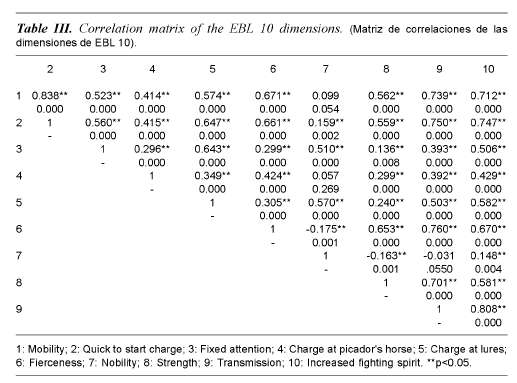
<body><![CDATA[<p align="center"><a name="t2"><img src="/img/revistas/azoo/v60n230/art6_t2.jpg" width="519" height="423"></a></font></p>     <p>&nbsp;</p>     <p><font face="Verdana" size="2"><i>Correlation between the EBL-10 variables</i> </font></p>     <p><font face="Verdana" size="2">To try to evaluate the statistical relationship between the EBL 10 variables we proceeded in the first place to calculate the correlation matrix between them. For this, all the measurements carried out in all the evaluated animals were used. The correlation analysis was done using Pearson's lineal correlation coefficient. The results are shown in <b><a href="#t3">table III</a></b>.</font></p>     <p align="center"><a name="t3"><img src="/img/revistas/azoo/v60n230/art6_t3.jpg" width="517" height="383"></a></font></p>     <p>&nbsp;</p>     <p><font face="Verdana" size="2">From the previous data matrix we can obtain valuable information about the relationship between the different variables, of which the most relevant are indicated here: Thus, we can see how mobility correlates in an important and significant way with quick to start charge (r= 0.838), with transmission (r= 0.739) and increased fighting spirit (r= 0.712) quick to start charge strongly correlates with transmission (r= 0.750) and fixed attention with charging at the cape with style (r= 0.643). We can also observe how charging at the picador's horse does not show any strong correlations with any other variable. On the other hand, charging at the cape with style, correlates fundamentally with the aforementioned fixed attention, with quick to start charge (r= 0.647) and with nobility (r= 0.582). Fierceness, as expected, correlates negatively with nobility (r= -0.175) but relates positively and strongly with transmission (r= 0.760), mobility (r= 0.671), increased fighting spirit (r= 0.670) and strength (r= 0.653). The nobility variable has its greatest correlation, as mentioned before, with charging at the cape with style. There is a slight negative correlation between nobility and strength (r= -0.175).</font></p>     <p><font face="Verdana" size="2"><i>The creation of synthetic variables through ACP</i></font></p>     <p><font face="Verdana" size="2">To continue we carried out the ACP, selecting the first two eigenvalues greater than one, knowing l1= 5.453 which explains 54.53% of the initial variability and l2= 1.861 which explains 18.615%, together explaining almost 73.15% of the initial variance. This is sufficient criteria to enable the selection of the first two associated components (Y1, Y2) <b>(<a href="#t4">table IV</a>)</b>.</font></p>     <p align="center"><a name="t4"><img src="/img/revistas/azoo/v60n230/art6_t4.jpg" width="509" height="245"></a></font></p>     ]]></body>
<body><![CDATA[<p>&nbsp;</p>     <p><font face="Verdana" size="2">To understand the meaning of both components it is necessary to study the correlation between the variables originally measured and the selected components, which facilitates the interpretation of the new synthetic variable generated.</font></p>     <p><font face="Verdana" size="2">The correlation of the variable components matrix <b>(<a href="#t5">table V</a>)</b>, shows us that the greatest correlation of the first component goes with the quick to charge variable (r= 0.903), followed by those obtained with increasing fighting spirit (r= 0.882), mobility (r= 0.881), and transmission (r= 0.881). Also, we can see an important correlation with fierceness (r= 0.779). The variable with least weight in this component is nobility (r= 0.188).</font></p>     <p align="center"><a name="t5"><img src="/img/revistas/azoo/v60n230/art6_t5.jpg" width="516" height="248"></a></font></p>     <p>&nbsp;</p>     <p><font face="Verdana" size="2">The greatest correlation with the second component is obtained with the nobility variable (r= 0.879), followed by those obtained with fixed attention (r= 0.570) and then by charging at the cape with style (r= 0.551). In opposition (variables with negative influence), are increasing fighting spirit, transmission, fierceness and strength. We can associate this component with the manageability.</font></p>     <p><font face="Verdana" size="2">We have finally named the two new synthetically generated variables: <i>aggresiveness</i> (casta), and <i>manageability</i> (toreabilidad), which are defined in the following way:</font></p>     <p><font face="Verdana" size="2"><i>Aggresiveness</i> = 0.386 quick to start charge + 0.377 increasing braveness + 0.377 mobility + 0.377 transmission + 0.335 fierceness + 0.302 + charging at lures with style + 0.219 strength + 0.268 fixed attention + 0.234 charging at picador's horse with style + 0.080 nobility.</font></p>     <p><font face="Verdana" size="2"><i>Manageability</i> = 0.644 nobility + 0.417 fixed attention + 0.403 charging at lures with style + 0.021 quick to start charge -0.017 charge at picador's horse with style -0.024 increasing braveness -0.028 mobility -0.182 transmission -0.301 fierceness -0.347 strength.</font></p>     <p>&nbsp;</p>     ]]></body>
<body><![CDATA[<p><font face="Verdana" size="2"><b>Discussion</b></font></p>     <p><font face="Verdana" size="2">A scale has been designed to measure behaviours in fighting cattle. The viability criteria (applicability, acceptability and practicality), are adequate. We believe that the constructed scale complies with the reliability between evaluators criteria that are advocated for this type of instrument, with high reliability indexes expressed in the results.</font></p>     <p><font face="Verdana" size="2">The validity study of the scale has allowed the appropriate analysis of the correlation between the variables that make it up, allowing the comparison of results. With the PCA we have created two synthetic variables as functions of a set of intermediate variables, each one of which contributes to quantify some aspect or feature of the concept of <i>bravery</i> (Silva 1997). Both variables, we can say, are valid. In other words, they have the capacity to really measure the concept intended for measurement. Both variables present face validity that relates to the fact that the synthetic variables measure what it is wanted. The content validity, measured by experts' consensus, relates to the capacity that the synthetic variable components cover the spectrum of the concept to be defined (silva, 1997), (Dowell and Newell, 1987). In this study, the experts consulted from The Union of Brave Bull Breeders, U.C.T.L. (breeders, veterinary surgeons), professionals and enthusiasts who are learned about these subjects, have seen all the elements which intuitively correspond with the ideas of <i>aggressiveness</i> and <i>manageability</i>, present in both synthetic variables.</font></p>     <p><font face="Verdana" size="2">This study will enable new ways to develop the difficult process of understanding the behaviour associated with bravery, and therefore with breeding selection. Finally, our ultimate goal is to provide objective data and measurements to help breeders to make the right decisions.</font></p>     <p>&nbsp;</p>     <p><font face="Verdana" size="2"><b>Conclusion</b></font></p>     <p><font face="Verdana" size="2">For the first time, it has been able to take measurements in a reliable and valid way, during a bullfight, of the variables associated with brave behaviour. It has been possible to analyse the information obtained statistically and the results are acceptable for breeders' and professionals' interests.</font></p>     <p>&nbsp;</p>     <p><font face="Verdana" size="2"><b>Acknowledgements</b></font></p>     <p><font face="Verdana" size="2">It is evident that all research is brought to light by a series of motivations. In no uncertain terms, the brave bull ranch of Don Manuel Pío García Fernández-Palacios has been at the forefront of this work. He has been our driving force and his <i>plaza de tientas</i> (bravery testing bullring), has been our laboratory. From here, we would like to offer him our thanks. We would also like to thank Diana Thurston, from the London Taurine Club, for the specially difficult English translation of this paper.</font></p>     ]]></body>
<body><![CDATA[<p><font face="Verdana" size="2">Equally we would like to thank all the different people, who from numerous forums have invited us to share our ideas in analysing the bravery of fighting bulls: The University of Navarra Debating Group, The University of Cadiz taurine Debating Group, The U.C.T.L., The Hotel Monasterio Discussion Group, The Jerez Casino, and lastly, The Tauromaquia Debating Group of san Pablo University, Madrid, who published preliminary aspects of this work, (Almenara and García 2005).</font></p>     <p>&nbsp;</p>     <p><font face="Verdana" size="2"><b>References</b></font></p>     <!-- ref --><p><font face="Verdana" size="2">Aguilar, I.1991. Predicción de la bravura y comportamiento en campo del toro de Lidia. <i>Taurología. Revista Cultural Taurina</i>, 6: 77-82.    &nbsp;&nbsp;&nbsp;&nbsp;&nbsp;&nbsp;&nbsp;&nbsp;[&#160;<a href="javascript:void(0);" onclick="javascript: window.open('/scielo.php?script=sci_nlinks&ref=998263&pid=S0004-0592201100020000600001&lng=','','width=640,height=500,resizable=yes,scrollbars=1,menubar=yes,');">Links</a>&#160;]<!-- end-ref --></font></p>    <!-- ref --><p><font face="Verdana" size="2">Almenara, J., González, J.L., García, C. y Peña, P. 1998. ¿Qué es el análisis de componentes principales?. Sección Notas de Metodología y Estadística. <i>Jano</i>, 55: 18-24.    &nbsp;&nbsp;&nbsp;&nbsp;&nbsp;&nbsp;&nbsp;&nbsp;[&#160;<a href="javascript:void(0);" onclick="javascript: window.open('/scielo.php?script=sci_nlinks&ref=998265&pid=S0004-0592201100020000600002&lng=','','width=640,height=500,resizable=yes,scrollbars=1,menubar=yes,');">Links</a>&#160;]<!-- end-ref --></font></p>    <!-- ref --><p><font face="Verdana" size="2">Almenara, J. y García, R. 2004. Evaluación de la bravura de los toros lidiados en la feria de San Isidro 2004, mediante la escala EBL-10. <i>Tercio de Varas, El Puerto de Santa María.</i> 12: 19-21.    &nbsp;&nbsp;&nbsp;&nbsp;&nbsp;&nbsp;&nbsp;&nbsp;[&#160;<a href="javascript:void(0);" onclick="javascript: window.open('/scielo.php?script=sci_nlinks&ref=998267&pid=S0004-0592201100020000600003&lng=','','width=640,height=500,resizable=yes,scrollbars=1,menubar=yes,');">Links</a>&#160;]<!-- end-ref --></font></p>    <!-- ref --><p><font face="Verdana" size="2">Almenara, J. y García, R., 2005. Una valoración científica de la bravura del toro: estudio de los toros lidiados en San Isidro (Madrid 2004-2005). Publicación del Servicio de Actividades Culturales del Aula de Tauromaquia. Universidad San Pablo-CEU. Madrid. Curso 2005-2006.    &nbsp;&nbsp;&nbsp;&nbsp;&nbsp;&nbsp;&nbsp;&nbsp;[&#160;<a href="javascript:void(0);" onclick="javascript: window.open('/scielo.php?script=sci_nlinks&ref=998269&pid=S0004-0592201100020000600004&lng=','','width=640,height=500,resizable=yes,scrollbars=1,menubar=yes,');">Links</a>&#160;]<!-- end-ref --></font></p>    <!-- ref --><p><font face="Verdana" size="2">Cuadras, C.M. 1996. Métodos de análisis multivariante. Eunibar S.A. Barcelona.    &nbsp;&nbsp;&nbsp;&nbsp;&nbsp;&nbsp;&nbsp;&nbsp;[&#160;<a href="javascript:void(0);" onclick="javascript: window.open('/scielo.php?script=sci_nlinks&ref=998271&pid=S0004-0592201100020000600005&lng=','','width=640,height=500,resizable=yes,scrollbars=1,menubar=yes,');">Links</a>&#160;]<!-- end-ref --></font></p>    <!-- ref --><p><font face="Verdana" size="2">Domínguez, J. 2005. Los toros de Lidia en la economía. <i>Rev. Inst. Estudios Económicos.</i> Número dedicado a: Economía de la Ganadería de Lidia en España, 3: 83-98.    &nbsp;&nbsp;&nbsp;&nbsp;&nbsp;&nbsp;&nbsp;&nbsp;[&#160;<a href="javascript:void(0);" onclick="javascript: window.open('/scielo.php?script=sci_nlinks&ref=998273&pid=S0004-0592201100020000600006&lng=','','width=640,height=500,resizable=yes,scrollbars=1,menubar=yes,');">Links</a>&#160;]<!-- end-ref --></font></p>    <!-- ref --><p><font face="Verdana" size="2">Dowell, I. and Newell, C.1987. Measuring Health. Oxford University Press. New York.    &nbsp;&nbsp;&nbsp;&nbsp;&nbsp;&nbsp;&nbsp;&nbsp;[&#160;<a href="javascript:void(0);" onclick="javascript: window.open('/scielo.php?script=sci_nlinks&ref=998275&pid=S0004-0592201100020000600007&lng=','','width=640,height=500,resizable=yes,scrollbars=1,menubar=yes,');">Links</a>&#160;]<!-- end-ref --></font></p>    <!-- ref --><p><font face="Verdana" size="2">García, R., Almenara, J., Valdés, J., Navarro, J.I., Salvador, L. y Fernández, R. 2002. Evaluación estandarizada de la bravura I. Disponible en: <i><a target="_blank" href="http://www.toroslidia.com">Toroslidia.com</a>.</i> Revista electrónica de la Unión de Criadores de Toros de Lidia. (15/01/09).    &nbsp;&nbsp;&nbsp;&nbsp;&nbsp;&nbsp;&nbsp;&nbsp;[&#160;<a href="javascript:void(0);" onclick="javascript: window.open('/scielo.php?script=sci_nlinks&ref=998277&pid=S0004-0592201100020000600008&lng=','','width=640,height=500,resizable=yes,scrollbars=1,menubar=yes,');">Links</a>&#160;]<!-- end-ref --></font></p>    <!-- ref --><p><font face="Verdana" size="2">García, R., Almenara, J., Valdés, J., Navarro, J.I., Salvador, L. y Fernández, R. 2003. Evaluación estandarizada de la bravura II. Disponible en: <i><a target="_blank" href="http://www.toroslidia.com">Toroslidia.com</a>.</i> Revista electrónica de la Unión de Criadores de Toros de Lidia. (15/01/09).    &nbsp;&nbsp;&nbsp;&nbsp;&nbsp;&nbsp;&nbsp;&nbsp;[&#160;<a href="javascript:void(0);" onclick="javascript: window.open('/scielo.php?script=sci_nlinks&ref=998279&pid=S0004-0592201100020000600009&lng=','','width=640,height=500,resizable=yes,scrollbars=1,menubar=yes,');">Links</a>&#160;]<!-- end-ref --></font></p>    <!-- ref --><p><font face="Verdana" size="2">García, R. y Almenara, J. 2004. Escala de evaluación de la bravura para bovinos de Lidia (EBL-10). <i>Revista de Estudios Taurinos.</i> Fundación de Estudios taurinos. Sevilla. 18: 251-278.    &nbsp;&nbsp;&nbsp;&nbsp;&nbsp;&nbsp;&nbsp;&nbsp;[&#160;<a href="javascript:void(0);" onclick="javascript: window.open('/scielo.php?script=sci_nlinks&ref=998281&pid=S0004-0592201100020000600010&lng=','','width=640,height=500,resizable=yes,scrollbars=1,menubar=yes,');">Links</a>&#160;]<!-- end-ref --></font></p>    <!-- ref --><p><font face="Verdana" size="2">García, R. and Almenara, J. 2005. Behaviour assessment in fighting bovines. European Congress of Psychology. Granada.    &nbsp;&nbsp;&nbsp;&nbsp;&nbsp;&nbsp;&nbsp;&nbsp;[&#160;<a href="javascript:void(0);" onclick="javascript: window.open('/scielo.php?script=sci_nlinks&ref=998283&pid=S0004-0592201100020000600011&lng=','','width=640,height=500,resizable=yes,scrollbars=1,menubar=yes,');">Links</a>&#160;]<!-- end-ref --></font></p>    <!-- ref --><p><font face="Verdana" size="2">González, B. 1991. Análisis multivariante. Aplicación al ámbito sanitario. SE Editores, S.A. Barcelona.    &nbsp;&nbsp;&nbsp;&nbsp;&nbsp;&nbsp;&nbsp;&nbsp;[&#160;<a href="javascript:void(0);" onclick="javascript: window.open('/scielo.php?script=sci_nlinks&ref=998285&pid=S0004-0592201100020000600012&lng=','','width=640,height=500,resizable=yes,scrollbars=1,menubar=yes,');">Links</a>&#160;]<!-- end-ref --></font></p>    <!-- ref --><p><font face="Verdana" size="2">Hotelling, H. 1933. Analysis of a complex of statistical variables into principal components. <i>J. Educ. Psychol.</i>, 24: 417-441.    &nbsp;&nbsp;&nbsp;&nbsp;&nbsp;&nbsp;&nbsp;&nbsp;[&#160;<a href="javascript:void(0);" onclick="javascript: window.open('/scielo.php?script=sci_nlinks&ref=998287&pid=S0004-0592201100020000600013&lng=','','width=640,height=500,resizable=yes,scrollbars=1,menubar=yes,');">Links</a>&#160;]<!-- end-ref --></font></p>    <!-- ref --><p><font face="Verdana" size="2">Jolliffe, I.T. 2002. Principal component analysis. Springer-Verlag. New York.    &nbsp;&nbsp;&nbsp;&nbsp;&nbsp;&nbsp;&nbsp;&nbsp;[&#160;<a href="javascript:void(0);" onclick="javascript: window.open('/scielo.php?script=sci_nlinks&ref=998289&pid=S0004-0592201100020000600014&lng=','','width=640,height=500,resizable=yes,scrollbars=1,menubar=yes,');">Links</a>&#160;]<!-- end-ref --></font></p>    <!-- ref --><p><font face="Verdana" size="2">Pearson, K. 1901. On lines and planes of closest fit to systems of points in space. <i>Philos. Mag.</i>, 6: 559-572.    &nbsp;&nbsp;&nbsp;&nbsp;&nbsp;&nbsp;&nbsp;&nbsp;[&#160;<a href="javascript:void(0);" onclick="javascript: window.open('/scielo.php?script=sci_nlinks&ref=998291&pid=S0004-0592201100020000600015&lng=','','width=640,height=500,resizable=yes,scrollbars=1,menubar=yes,');">Links</a>&#160;]<!-- end-ref --></font></p>    <!-- ref --><p><font face="Verdana" size="2">Salvador, L., Romero, C. y González-Saiz, F. 2000. Guías para la descripción y selección de instrumentos de evaluación en Psiquiatría. En: Balbuena, A. Berrios, G.E. Fernández de Larrinoa, P. (Eds.). Medición Clínica en Psiquiatría y Psicología. Masson-Salvat. Barcelona.    &nbsp;&nbsp;&nbsp;&nbsp;&nbsp;&nbsp;&nbsp;&nbsp;[&#160;<a href="javascript:void(0);" onclick="javascript: window.open('/scielo.php?script=sci_nlinks&ref=998293&pid=S0004-0592201100020000600016&lng=','','width=640,height=500,resizable=yes,scrollbars=1,menubar=yes,');">Links</a>&#160;]<!-- end-ref --></font></p>    <!-- ref --><p><font face="Verdana" size="2">Schuling, J., De Haaen, R., Limburg, M. and Groenier, K.H. 1993. The frenchay activities index; assessment of functional status in stroke patients. <i>Strokes</i>, 24: 1173-1177.    &nbsp;&nbsp;&nbsp;&nbsp;&nbsp;&nbsp;&nbsp;&nbsp;[&#160;<a href="javascript:void(0);" onclick="javascript: window.open('/scielo.php?script=sci_nlinks&ref=998295&pid=S0004-0592201100020000600017&lng=','','width=640,height=500,resizable=yes,scrollbars=1,menubar=yes,');">Links</a>&#160;]<!-- end-ref --></font></p>    <!-- ref --><p><font face="Verdana" size="2">Silva, L.C. 1997. Cultura estadística e investigación científica en el campo de la salud: una mirada crítica. Díaz de santos. Madrid.    &nbsp;&nbsp;&nbsp;&nbsp;&nbsp;&nbsp;&nbsp;&nbsp;[&#160;<a href="javascript:void(0);" onclick="javascript: window.open('/scielo.php?script=sci_nlinks&ref=998297&pid=S0004-0592201100020000600018&lng=','','width=640,height=500,resizable=yes,scrollbars=1,menubar=yes,');">Links</a>&#160;]<!-- end-ref --></font></p>    <!-- ref --><p><font face="Verdana" size="2">Silva, B., Gonzalo, A. and Cañón, J. 2006. Genetic parameters of aggressiveness, ferocity and mobility in the Fighting Bull breed. <i>Anim. Res.</i>, 55: 65-70.    &nbsp;&nbsp;&nbsp;&nbsp;&nbsp;&nbsp;&nbsp;&nbsp;[&#160;<a href="javascript:void(0);" onclick="javascript: window.open('/scielo.php?script=sci_nlinks&ref=998299&pid=S0004-0592201100020000600019&lng=','','width=640,height=500,resizable=yes,scrollbars=1,menubar=yes,');">Links</a>&#160;]<!-- end-ref --></font></p>    <!-- ref --><p><font face="Verdana" size="2">UCTL.1996. Programa de mejora genética, selección conservación de la Unión de Criadores de Toros de Lidia. Disponible en: <i><a target="_blank" href="http://www.toroslidia.com">Toroslidia.com</a>.</i> Revista electrónica de la Unión de Criadores de Toros de Lidia. (15/01/09).    &nbsp;&nbsp;&nbsp;&nbsp;&nbsp;&nbsp;&nbsp;&nbsp;[&#160;<a href="javascript:void(0);" onclick="javascript: window.open('/scielo.php?script=sci_nlinks&ref=998301&pid=S0004-0592201100020000600020&lng=','','width=640,height=500,resizable=yes,scrollbars=1,menubar=yes,');">Links</a>&#160;]<!-- end-ref --></font></p>    <!-- ref --><p><font face="Verdana" size="2">Vallejo, M., Gonzalo, A. y Cañón, J. 2001. Relaciones entre los caracteres de comportamiento del toro de Lidia. <i>Toro Bravo</i>, 28: 29-33.    &nbsp;&nbsp;&nbsp;&nbsp;&nbsp;&nbsp;&nbsp;&nbsp;[&#160;<a href="javascript:void(0);" onclick="javascript: window.open('/scielo.php?script=sci_nlinks&ref=998303&pid=S0004-0592201100020000600021&lng=','','width=640,height=500,resizable=yes,scrollbars=1,menubar=yes,');">Links</a>&#160;]<!-- end-ref --></font></p>     <p>&nbsp;</p>     <p><font face="Verdana" size="2">Recibido: 23-2-09.    <br>Aceptado: 22-7-09.</font></p>      ]]></body><back>
<ref-list>
<ref id="B1">
<nlm-citation citation-type="journal">
<person-group person-group-type="author">
<name>
<surname><![CDATA[Aguilar]]></surname>
<given-names><![CDATA[I.]]></given-names>
</name>
</person-group>
<article-title xml:lang="es"><![CDATA[Predicción de la bravura y comportamiento en campo del toro de Lidia]]></article-title>
<source><![CDATA[Taurología. Revista Cultural Taurina]]></source>
<year>1991</year>
<volume>6</volume>
<page-range>77-82</page-range></nlm-citation>
</ref>
<ref id="B2">
<nlm-citation citation-type="journal">
<person-group person-group-type="author">
<name>
<surname><![CDATA[Almenara]]></surname>
<given-names><![CDATA[J.]]></given-names>
</name>
<name>
<surname><![CDATA[González]]></surname>
<given-names><![CDATA[J.L.]]></given-names>
</name>
<name>
<surname><![CDATA[García]]></surname>
<given-names><![CDATA[C.]]></given-names>
</name>
<name>
<surname><![CDATA[Peña]]></surname>
<given-names><![CDATA[P.]]></given-names>
</name>
</person-group>
<article-title xml:lang="es"><![CDATA[¿Qué es el análisis de componentes principales?]]></article-title>
<source><![CDATA[Jano]]></source>
<year>1998</year>
<volume>55</volume>
<page-range>18-24</page-range></nlm-citation>
</ref>
<ref id="B3">
<nlm-citation citation-type="journal">
<person-group person-group-type="author">
<name>
<surname><![CDATA[Almenara]]></surname>
<given-names><![CDATA[J.]]></given-names>
</name>
<name>
<surname><![CDATA[García]]></surname>
<given-names><![CDATA[R.]]></given-names>
</name>
</person-group>
<article-title xml:lang="es"><![CDATA[Evaluación de la bravura de los toros lidiados en la feria de San Isidro 2004, mediante la escala EBL-10]]></article-title>
<source><![CDATA[Tercio de Varas, El Puerto de Santa María]]></source>
<year>2004</year>
<volume>12</volume>
<page-range>19-21</page-range></nlm-citation>
</ref>
<ref id="B4">
<nlm-citation citation-type="book">
<person-group person-group-type="author">
<name>
<surname><![CDATA[Almenara]]></surname>
<given-names><![CDATA[J.]]></given-names>
</name>
<name>
<surname><![CDATA[García]]></surname>
<given-names><![CDATA[R.]]></given-names>
</name>
</person-group>
<source><![CDATA[Una valoración científica de la bravura del toro: estudio de los toros lidiados en San Isidro (Madrid 2004-2005)]]></source>
<year>2005</year>
<publisher-loc><![CDATA[Madrid ]]></publisher-loc>
<publisher-name><![CDATA[Servicio de Actividades Culturales del Aula de Tauromaquia. Universidad San Pablo-CEU]]></publisher-name>
</nlm-citation>
</ref>
<ref id="B5">
<nlm-citation citation-type="book">
<person-group person-group-type="author">
<name>
<surname><![CDATA[Cuadras]]></surname>
<given-names><![CDATA[C.M.]]></given-names>
</name>
</person-group>
<source><![CDATA[Métodos de análisis multivariante]]></source>
<year>1996</year>
<publisher-loc><![CDATA[Barcelona ]]></publisher-loc>
<publisher-name><![CDATA[Eunibar]]></publisher-name>
</nlm-citation>
</ref>
<ref id="B6">
<nlm-citation citation-type="journal">
<person-group person-group-type="author">
<name>
<surname><![CDATA[Domínguez]]></surname>
<given-names><![CDATA[J.]]></given-names>
</name>
</person-group>
<article-title xml:lang="es"><![CDATA[Los toros de Lidia en la economía]]></article-title>
<source><![CDATA[Rev. Inst. Estudios Económicos]]></source>
<year>2005</year>
<volume>3</volume>
<page-range>83-98</page-range></nlm-citation>
</ref>
<ref id="B7">
<nlm-citation citation-type="book">
<person-group person-group-type="author">
<name>
<surname><![CDATA[Dowell]]></surname>
<given-names><![CDATA[I.]]></given-names>
</name>
<name>
<surname><![CDATA[Newell]]></surname>
<given-names><![CDATA[C.]]></given-names>
</name>
</person-group>
<source><![CDATA[Measuring Health]]></source>
<year>1987</year>
<publisher-loc><![CDATA[New York ]]></publisher-loc>
<publisher-name><![CDATA[Oxford University Press]]></publisher-name>
</nlm-citation>
</ref>
<ref id="B8">
<nlm-citation citation-type="">
<person-group person-group-type="author">
<name>
<surname><![CDATA[García]]></surname>
<given-names><![CDATA[R.]]></given-names>
</name>
<name>
<surname><![CDATA[Almenara]]></surname>
<given-names><![CDATA[J.]]></given-names>
</name>
<name>
<surname><![CDATA[Valdés]]></surname>
<given-names><![CDATA[J.]]></given-names>
</name>
<name>
<surname><![CDATA[Navarro]]></surname>
<given-names><![CDATA[J.I.]]></given-names>
</name>
<name>
<surname><![CDATA[Salvador]]></surname>
<given-names><![CDATA[L.]]></given-names>
</name>
<name>
<surname><![CDATA[Fernández]]></surname>
<given-names><![CDATA[R.]]></given-names>
</name>
</person-group>
<source><![CDATA[Evaluación estandarizada de la bravura I]]></source>
<year>2002</year>
</nlm-citation>
</ref>
<ref id="B9">
<nlm-citation citation-type="">
<person-group person-group-type="author">
<name>
<surname><![CDATA[García]]></surname>
<given-names><![CDATA[R.]]></given-names>
</name>
<name>
<surname><![CDATA[Almenara]]></surname>
<given-names><![CDATA[J.]]></given-names>
</name>
<name>
<surname><![CDATA[Valdés]]></surname>
<given-names><![CDATA[J.]]></given-names>
</name>
<name>
<surname><![CDATA[Navarro]]></surname>
<given-names><![CDATA[J.I.]]></given-names>
</name>
<name>
<surname><![CDATA[Salvador]]></surname>
<given-names><![CDATA[L.]]></given-names>
</name>
<name>
<surname><![CDATA[Fernández]]></surname>
<given-names><![CDATA[R.]]></given-names>
</name>
</person-group>
<source><![CDATA[Evaluación estandarizada de la bravura II]]></source>
<year>2003</year>
</nlm-citation>
</ref>
<ref id="B10">
<nlm-citation citation-type="journal">
<person-group person-group-type="author">
<name>
<surname><![CDATA[García]]></surname>
<given-names><![CDATA[R.]]></given-names>
</name>
<name>
<surname><![CDATA[Almenara]]></surname>
<given-names><![CDATA[J.]]></given-names>
</name>
</person-group>
<article-title xml:lang="es"><![CDATA[Escala de evaluación de la bravura para bovinos de Lidia (EBL-10)]]></article-title>
<source><![CDATA[Revista de Estudios Taurinos]]></source>
<year>2004</year>
<volume>18</volume>
<page-range>251-278</page-range><publisher-loc><![CDATA[Sevilla ]]></publisher-loc>
<publisher-name><![CDATA[Fundación de Estudios taurinos]]></publisher-name>
</nlm-citation>
</ref>
<ref id="B11">
<nlm-citation citation-type="confpro">
<person-group person-group-type="author">
<name>
<surname><![CDATA[García]]></surname>
<given-names><![CDATA[R.]]></given-names>
</name>
<name>
<surname><![CDATA[Almenara]]></surname>
<given-names><![CDATA[J.]]></given-names>
</name>
</person-group>
<source><![CDATA[Behaviour assessment in fighting bovines]]></source>
<year>2005</year>
<conf-name><![CDATA[ European Congress of Psychology]]></conf-name>
<conf-loc>Granada </conf-loc>
</nlm-citation>
</ref>
<ref id="B12">
<nlm-citation citation-type="book">
<person-group person-group-type="author">
<name>
<surname><![CDATA[González]]></surname>
<given-names><![CDATA[B.]]></given-names>
</name>
</person-group>
<source><![CDATA[Análisis multivariante: Aplicación al ámbito sanitario]]></source>
<year>1991</year>
<publisher-loc><![CDATA[Barcelona ]]></publisher-loc>
<publisher-name><![CDATA[SE Editores]]></publisher-name>
</nlm-citation>
</ref>
<ref id="B13">
<nlm-citation citation-type="journal">
<person-group person-group-type="author">
<name>
<surname><![CDATA[Hotelling]]></surname>
<given-names><![CDATA[H.]]></given-names>
</name>
</person-group>
<article-title xml:lang="en"><![CDATA[Analysis of a complex of statistical variables into principal components]]></article-title>
<source><![CDATA[J. Educ. Psychol.]]></source>
<year>1933</year>
<volume>24</volume>
<page-range>417-441</page-range></nlm-citation>
</ref>
<ref id="B14">
<nlm-citation citation-type="book">
<person-group person-group-type="author">
<name>
<surname><![CDATA[Jolliffe]]></surname>
<given-names><![CDATA[I.T.]]></given-names>
</name>
</person-group>
<source><![CDATA[Principal component analysis]]></source>
<year>2002</year>
<publisher-loc><![CDATA[New York ]]></publisher-loc>
<publisher-name><![CDATA[Springer-Verlag]]></publisher-name>
</nlm-citation>
</ref>
<ref id="B15">
<nlm-citation citation-type="journal">
<person-group person-group-type="author">
<name>
<surname><![CDATA[Pearson]]></surname>
<given-names><![CDATA[K.]]></given-names>
</name>
</person-group>
<article-title xml:lang="en"><![CDATA[On lines and planes of closest fit to systems of points in space]]></article-title>
<source><![CDATA[Philos. Mag.]]></source>
<year>1901</year>
<volume>6</volume>
<page-range>559-572</page-range></nlm-citation>
</ref>
<ref id="B16">
<nlm-citation citation-type="book">
<person-group person-group-type="author">
<name>
<surname><![CDATA[Salvador]]></surname>
<given-names><![CDATA[L.]]></given-names>
</name>
<name>
<surname><![CDATA[Romero]]></surname>
<given-names><![CDATA[C.]]></given-names>
</name>
<name>
<surname><![CDATA[González-Saiz]]></surname>
<given-names><![CDATA[F.]]></given-names>
</name>
</person-group>
<article-title xml:lang="es"><![CDATA[Guías para la descripción y selección de instrumentos de evaluación en Psiquiatría]]></article-title>
<person-group person-group-type="editor">
<name>
<surname><![CDATA[Balbuena]]></surname>
<given-names><![CDATA[A.]]></given-names>
</name>
<name>
<surname><![CDATA[Berrios]]></surname>
<given-names><![CDATA[G.E.]]></given-names>
</name>
<name>
<surname><![CDATA[Fernández de Larrinoa]]></surname>
<given-names><![CDATA[P.]]></given-names>
</name>
</person-group>
<source><![CDATA[Medición Clínica en Psiquiatría y Psicología]]></source>
<year>2000</year>
<publisher-loc><![CDATA[Barcelona ]]></publisher-loc>
<publisher-name><![CDATA[Masson-Salvat]]></publisher-name>
</nlm-citation>
</ref>
<ref id="B17">
<nlm-citation citation-type="journal">
<person-group person-group-type="author">
<name>
<surname><![CDATA[Schuling]]></surname>
<given-names><![CDATA[J.]]></given-names>
</name>
<name>
<surname><![CDATA[De Haaen]]></surname>
<given-names><![CDATA[R.]]></given-names>
</name>
<name>
<surname><![CDATA[Limburg]]></surname>
<given-names><![CDATA[M.]]></given-names>
</name>
<name>
<surname><![CDATA[Groenier]]></surname>
<given-names><![CDATA[K.H.]]></given-names>
</name>
</person-group>
<article-title xml:lang="en"><![CDATA[The frenchay activities index: assessment of functional status in stroke patients]]></article-title>
<source><![CDATA[Strokes]]></source>
<year>1993</year>
<volume>24</volume>
<page-range>1173-1177</page-range></nlm-citation>
</ref>
<ref id="B18">
<nlm-citation citation-type="book">
<person-group person-group-type="author">
<name>
<surname><![CDATA[Silva]]></surname>
<given-names><![CDATA[L.C.]]></given-names>
</name>
</person-group>
<source><![CDATA[Cultura estadística e investigación científica en el campo de la salud: una mirada crítica]]></source>
<year>1997</year>
<publisher-loc><![CDATA[Madrid ]]></publisher-loc>
<publisher-name><![CDATA[Díaz de santos]]></publisher-name>
</nlm-citation>
</ref>
<ref id="B19">
<nlm-citation citation-type="journal">
<person-group person-group-type="author">
<name>
<surname><![CDATA[Silva]]></surname>
<given-names><![CDATA[B.]]></given-names>
</name>
<name>
<surname><![CDATA[Gonzalo]]></surname>
<given-names><![CDATA[A.]]></given-names>
</name>
<name>
<surname><![CDATA[Cañón]]></surname>
<given-names><![CDATA[J.]]></given-names>
</name>
</person-group>
<article-title xml:lang="en"><![CDATA[Genetic parameters of aggressiveness, ferocity and mobility in the Fighting Bull breed]]></article-title>
<source><![CDATA[Anim. Res.]]></source>
<year>2006</year>
<volume>55</volume>
<page-range>65-70</page-range></nlm-citation>
</ref>
<ref id="B20">
<nlm-citation citation-type="">
<collab>UCTL</collab>
<source><![CDATA[Programa de mejora genética, selección conservación de la Unión de Criadores de Toros de Lidia]]></source>
<year>1996</year>
</nlm-citation>
</ref>
<ref id="B21">
<nlm-citation citation-type="journal">
<person-group person-group-type="author">
<name>
<surname><![CDATA[Vallejo]]></surname>
<given-names><![CDATA[M.]]></given-names>
</name>
<name>
<surname><![CDATA[Gonzalo]]></surname>
<given-names><![CDATA[A.]]></given-names>
</name>
<name>
<surname><![CDATA[Cañón]]></surname>
<given-names><![CDATA[J.]]></given-names>
</name>
</person-group>
<article-title xml:lang="es"><![CDATA[Relaciones entre los caracteres de comportamiento del toro de Lidia]]></article-title>
<source><![CDATA[Toro Bravo]]></source>
<year>2001</year>
<volume>28</volume>
<page-range>29-33</page-range></nlm-citation>
</ref>
</ref-list>
</back>
</article>