<?xml version="1.0" encoding="ISO-8859-1"?><article xmlns:mml="http://www.w3.org/1998/Math/MathML" xmlns:xlink="http://www.w3.org/1999/xlink" xmlns:xsi="http://www.w3.org/2001/XMLSchema-instance">
<front>
<journal-meta>
<journal-id>0004-0592</journal-id>
<journal-title><![CDATA[Archivos de Zootecnia]]></journal-title>
<abbrev-journal-title><![CDATA[Arch. zootec.]]></abbrev-journal-title>
<issn>0004-0592</issn>
<publisher>
<publisher-name><![CDATA[Universidad de Córdoba]]></publisher-name>
</publisher>
</journal-meta>
<article-meta>
<article-id>S0004-05922011000300055</article-id>
<article-id pub-id-type="doi">10.4321/S0004-05922011000300055</article-id>
<title-group>
<article-title xml:lang="en"><![CDATA[Effect of the ratio between carried and body weight on finishing time in thoroughbreds]]></article-title>
<article-title xml:lang="es"><![CDATA[Efecto de la relación entre peso soportado y el tiempo de carrera en PSI]]></article-title>
</title-group>
<contrib-group>
<contrib contrib-type="author">
<name>
<surname><![CDATA[Lee]]></surname>
<given-names><![CDATA[H.K.]]></given-names>
</name>
<xref ref-type="aff" rid="A01"/>
</contrib>
<contrib contrib-type="author">
<name>
<surname><![CDATA[Park]]></surname>
<given-names><![CDATA[K.D.]]></given-names>
</name>
<xref ref-type="aff" rid="A01"/>
</contrib>
</contrib-group>
<aff id="A01">
<institution><![CDATA[,Hankyong National University Genomic Informatics Center ]]></institution>
<addr-line><![CDATA[ ]]></addr-line>
</aff>
<pub-date pub-type="pub">
<day>00</day>
<month>09</month>
<year>2011</year>
</pub-date>
<pub-date pub-type="epub">
<day>00</day>
<month>09</month>
<year>2011</year>
</pub-date>
<volume>60</volume>
<numero>231</numero>
<fpage>681</fpage>
<lpage>686</lpage>
<copyright-statement/>
<copyright-year/>
<self-uri xlink:href="http://scielo.isciii.es/scielo.php?script=sci_arttext&amp;pid=S0004-05922011000300055&amp;lng=en&amp;nrm=iso"></self-uri><self-uri xlink:href="http://scielo.isciii.es/scielo.php?script=sci_abstract&amp;pid=S0004-05922011000300055&amp;lng=en&amp;nrm=iso"></self-uri><self-uri xlink:href="http://scielo.isciii.es/scielo.php?script=sci_pdf&amp;pid=S0004-05922011000300055&amp;lng=en&amp;nrm=iso"></self-uri><abstract abstract-type="short" xml:lang="en"><p><![CDATA[Since the racehorses with excellent performance have a heavy carried weight (CW) in the current system, their finishing time does not increase along with heavier CW. As the CW increases, the finishing time decreases. Moreover, the percentage of victories also gets higher as the CW increases. Therefore, the effect of ratio CW/ BW as the ratio of carried weight to the body weight on finishing time was analyzed in order to suggest the problems of current CW system. The objective of this study is to examine the influence of CW/BW ratio on finishing time, using a total of 155 656 racing records belong to 8197 racehorses. Generally, the BW of racehorse is heavier, the potentiality as a good racehorse is higher. The fact that the ratio CW/BW is high means that most of racehorses have lighter BW. As the ratio CW/BW increases in the racing distance of 1000 m, the actual finishing time tends to increase in general. The finishing time that has run while bearing the ratio of 12.0-12.7%, has demonstrated a good racing record. When the ratio CW/BW is about 13.1% or more, it has begun to influence on the finishing time gradually. Also, the racehorse tends to have a growth potential in a long distance race when the BW is no less than 475-480 kg. Consequently, when setting a handicap, it is desirable to consider the just before raced BW of racehorse to a certain degree.]]></p></abstract>
<abstract abstract-type="short" xml:lang="es"><p><![CDATA[Dado que los caballos de carrera con excelentes prestaciones transportan un handicap pesado (CW) en el sistema actual, su tiempo a la finalización no aumenta con handicaps (CW) aún mayores. Cuando el CW aumenta, el tiempo de carrera disminuye. Por otra parte, el porcentaje de victorias se hace mayor a medida que aumenta el CW. Por ello, el efecto de la relación CW/BW, como relación entre peso transportado y peso corporal, sobre el tiempo de la carrera fue analizado al objeto de detectar los problemas en el sistema actual de handicap. El objetivo de este estudio fue examinar la influencia de la relación CW/BW, sobre el tiempo de carrera, empleando un total de 155 656 registros pertenecientes a 8197 carreras. Generalmente si el peso corporal del caballo es más pesado, su potencial como buen caballo de carrera es mayor. El hecho de que la relación CW/BW sea alta, significa que el peso de los caballos es menor. Cuando la relación CW/BW aumenta en la distancia de 1000 m el tiempo de la carrera tiende a aumentar. Cuando la relación está entre 12,012,7%, se ha demostrado conseguir un buen tiempo de carrera. Cuando la relación CW/BW es de 13,1 o más, comienza a influir gradualmente sobre el tiempo de carrera. También el caballo tiende a tener un buen potencial de recuperación en una distancia larga cuando el BW no es inferior a 475-480 kg. Consecuentemente cuando se asigna un handicap, es deseable tener en cuenta el peso del caballo antes de la carrera.]]></p></abstract>
<kwd-group>
<kwd lng="en"><![CDATA[Handicap]]></kwd>
<kwd lng="en"><![CDATA[KRA (Korea Racing Association)]]></kwd>
<kwd lng="es"><![CDATA[Handicap]]></kwd>
<kwd lng="es"><![CDATA[KRA (Asociacion Coreana de Carreras)]]></kwd>
</kwd-group>
</article-meta>
</front><body><![CDATA[ <p>&nbsp;</p>     <p><font face="Verdana" size="4"><b>Effect of the ratio between carried and body weight on finishing time in thoroughbreds</b></font></p>     <p><font face="Verdana" size="4"><b>Efecto de la relación entre peso soportado y el tiempo de carrera en PSI</b></font></p>     <p>&nbsp;</p>     <p>&nbsp;</p>     <p><font face="Verdana" size="2"><b>Lee, H.K. and Park, K.D.<sup>*</sup></b></font></p>     <p><font face="Verdana" size="2">Genomic Informatics Center. Hankyong National University. Anseong-si. Gyeonggi-do. 456-749. Korea *<a href="mailto:doobalo@hknu.ac.kr">doobalo@hknu.ac.kr</a></font></p>     <p>&nbsp;</p>     <p>&nbsp;</p> <hr size="1">     <p><font face="Verdana" size="2"><b>SUMMARY</b></font></p>     ]]></body>
<body><![CDATA[<p><font face="Verdana" size="2">Since the racehorses with excellent performance have a heavy carried weight (CW) in the current system, their finishing time does not increase along with heavier CW. As the CW increases, the finishing time decreases. Moreover, the percentage of victories also gets higher as the CW increases. Therefore, the effect of ratio CW/ BW as the ratio of carried weight to the body weight on finishing time was analyzed in order to suggest the problems of current CW system. The objective of this study is to examine the influence of CW/BW ratio on finishing time, using a total of 155 656 racing records belong to 8197 racehorses. Generally, the BW of racehorse is heavier, the potentiality as a good racehorse is higher. The fact that the ratio CW/BW is high means that most of racehorses have lighter BW. As the ratio CW/BW increases in the racing distance of 1000 m, the actual finishing time tends to increase in general. The finishing time that has run while bearing the ratio of 12.0-12.7%, has demonstrated a good racing record. When the ratio CW/BW is about 13.1% or more, it has begun to influence on the finishing time gradually. Also, the racehorse tends to have a growth potential in a long distance race when the BW is no less than 475-480 kg. Consequently, when setting a handicap, it is desirable to consider the just before raced BW of racehorse to a certain degree.</font></p>     <p><font face="Verdana" size="2"><b>Key words:</b> Handicap. KRA (Korea Racing Association).</font></p> <hr size="1">     <p><font face="Verdana" size="2"><b>RESUMEN</b></font></p>     <p><font face="Verdana" size="2">Dado que los caballos de carrera con excelentes prestaciones transportan un handicap pesado (CW) en el sistema actual, su tiempo a la finalización no aumenta con handicaps (CW) aún mayores. Cuando el CW aumenta, el tiempo de carrera disminuye. Por otra parte, el porcentaje de victorias se hace mayor a medida que aumenta el CW. Por ello, el efecto de la relación CW/BW, como relación entre peso transportado y peso corporal, sobre el tiempo de la carrera fue analizado al objeto de detectar los problemas en el sistema actual de handicap. El objetivo de este estudio fue examinar la influencia de la relación CW/BW, sobre el tiempo de carrera, empleando un total de 155 656 registros pertenecientes a 8197 carreras. Generalmente si el peso corporal del caballo es más pesado, su potencial como buen caballo de carrera es mayor. El hecho de que la relación CW/BW sea alta, significa que el peso de los caballos es menor. Cuando la relación CW/BW aumenta en la distancia de 1000 m el tiempo de la carrera tiende a aumentar. Cuando la relación está entre 12,012,7%, se ha demostrado conseguir un buen tiempo de carrera. Cuando la relación CW/BW es de 13,1 o más, comienza a influir gradualmente sobre el tiempo de carrera. También el caballo tiende a tener un buen potencial de recuperación en una distancia larga cuando el BW no es inferior a 475-480 kg. Consecuentemente cuando se asigna un <i>handicap</i>, es deseable tener en cuenta el peso del caballo antes de la carrera.</font></p>     <p><font face="Verdana" size="2"><b>Palabras clave:</b> Handicap. KRA (Asociacion Coreana de Carreras).</font></p> <hr size="1">     <p>&nbsp;</p>     <p><font face="Verdana" size="2"><b>Introduction</b></font></p>     <p><font face="Verdana" size="2">The Korea Racing Association (KRA) tries to be the Part-II horse racing operation country in accordance with the promotion policy of horse industry and is about to build the advanced racehorse improvement system targeting to hold the International Invitational Race. Although the Korea horse racing industry has grown up at a surprising speed in quantity, the improvement in the racehorse quality has fallen behind. Despite of this fact, the signs that the studies on horse are to be made actively would be regarded as quite encouraging.</font></p>     <p><font face="Verdana" size="2">Handicap weight is an extra weight to carry, allotted to handicap a racehorse which has proved itself able to beat all the other entries if it was not allotted this handicap. This mechanism is to guarantee a fair competition. Usually, carried weight (CW) refers to the weight a racehorse is assigned to carry in a race. CW can be divided into the weight for age, special allowance and handicap weight. Basically, how much weight a racehorse carries in a race is partly determined by age and sex.</font></p>     <p><font face="Verdana" size="2">Since an excessive level of CW may force the racehorse owner to lose the chance of the victory, this can be a very sensitive issue. Although the handicap race is gradually decreasing, the overseas horse racing systems that are well developed as compared to that of Korea rely on the empirical theory rather than the scientific theory. Especially, the CW system may be the case. Accordingly, the objective of this study is to suggest the problems of current CW system and to look into the effect of CW to the body weight (BW) on finished time.</font></p>     ]]></body>
<body><![CDATA[<p>&nbsp;</p>     <p><font face="Verdana" size="2"><b>Materials and methods</b></font></p>     <p><font face="Verdana" size="2"><b>DATA COLLECTION</b></font></p>     <p><font face="Verdana" size="2">The data used in this study are finishing time records collected from thoroughbred racehorses that raced at Gwacheon racecourse from January, 1994 to December, 2006 provided by KRA. Records distributed outside the 3.5 standard deviations, from the mean of each distance, were all eliminated from the data for the reasons of possible injuries of the racehorse during the race, or unavoidable mistake made by the jockey. The data actually for analysis contained 155 656 finished time records of 8197 racehorses and pedigree of each horse was extended as far as possible to create a file with a total of 15 770 animals. Finishing time means racing time from start position to finish line and BW was measured before each race. Fixed effects included in the analytical model were racing distance, sex, age of year and contemporary group. Sex of racehorses was classified into stallion, gelding and mare, and number of age and contemporary group were 6, 14 and 119, respectively.</font></p>     <p><font face="Verdana" size="2">A statistical summary of the data for finished time is shown in <b><a href="#t1">table I</a></b>. The number of race records and racehorses decreases as the distance of race increases, which is explained to be due to the reason of high selection of better racehorses for a longer distance. Racehorses do not have their best distance to race, and when the racehorse becomes a winner in a shorter distance, he/ she enters into the race of a longer distance in Korea Racing System, which is why racing distance have to include in the statistical model. Also, the age of racehorse tends to increase (<b><a href="#t1">table I</a></b>).</font></p>     <p>&nbsp;</p>     <p align=center><a name="t1"></a><img src="/img/revistas/azoo/v60n231/art55_1_t1.jpg"></p>     <p>&nbsp;</p>     <p><font face="Verdana" size="2"><b>STATISTICAL METHODS</b></font></p>     <p><font face="Verdana" size="2">The analytical model used is as follows:</font></p>     ]]></body>
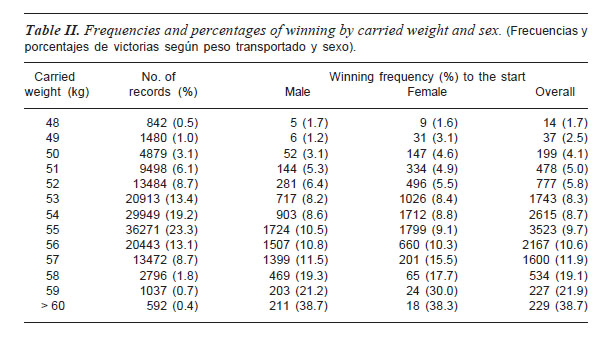
<body><![CDATA[<p><img src="/img/revistas/azoo/v60n231/art55_2.jpg"></p>     <p><font face="Verdana" size="2">variance ratios used in animal model were as follows:</font></p>     <p><img src="/img/revistas/azoo/v60n231/art55_3.jpg"></p>     <p><img src="/img/revistas/azoo/v60n231/art55_4.jpg"></p>     <p><font face="Verdana" size="2">The heritability and repeatability used in this study were assumed 0.298 and 0.395, respectively (Park and Lee, 1999). The solution of mixed model equation was solved using the PEST program (Groeneveld <i>et al</i>., 1990).</font></p>     <p>&nbsp;</p>     <p><font face="Verdana" size="2"><b>Results and discussion</b></font></p>     <p><font face="Verdana" size="2">According to Tolley <i>et al</i>. (1983) and Buttram <i>et al</i>. (1988a), although the prize money and the order of finish are important selection traits in racehorses, they are not normally distributed; so, they argued that the records of racehorse without winning prize money, must be eliminated from the data. Also neither the prize money nor the order of finish can be used to examine effect of ratio CW/BW because they do not properly account for the environmental differences affecting the racing performance.</font></p>     <p><font face="Verdana" size="2">Contemporary group means that the racehorses ran together at the same track in the same race on the same date (Buttram <i>et al</i>., 1988b), and average size of the contemporary group was approximately 11 heads. The effect of different racing methods by year was account for by the year of race, the season effect on race was accounted for by the month of race, the condition of race track was accounted for by the date of race, and the individual race can account for the sampling variation of racehorse classes and the presence of the winning racehorses in a group (Buttram <i>et al</i>., 1988b; Park and Lee, 1999).</font></p>     <p><font face="Verdana" size="2">The carried weight (CW) is defined as the jockey weight, saddles, saddle cloth and other necessary tack except for whip, safety helmet, blinkers, number cloth bridle and reins. The mode of CW was 55 kg (22.8% of the whole data) and, the average CW was 54.2 kg. There was no considerable difference by the racing distance, and the while bearing 12.1% of their BW on average. result has appeared to be about 1 kg less Generally, the finished time records that than the average CW (55.2 kg) of Brazilian have carried 58 kg or more as to be defined racehorse (Buxadera and Mota, 2008). as carrying a handicap were 2.84% of the Considering that the average BW of whole data and the finished time records racehorses is 449 kg, they have run the races with an excessive level of CW (60 kg or more) were found 0.33% of the whole data. The racehorses that have carried the CW of 60 kg or more were mostly the racehorses that have proven their racing ability in the perspective of the prize money.</font></p>     ]]></body>
<body><![CDATA[<p><font face="Verdana" size="2">As shown in the <b><a href="#t2">table II</a></b>, percentages of winning have not decreased even though the CW has increased. In some cases, the percentage of victories has increased and this result was found to be identical to the report of Bugislaus <i>et al</i>. (2004). Buttram <i>et al</i>. (1988a) has reported that the finished time may be influenced when the CW becomes 56.2 kg, and the average CW was approximately 55 kg in Quarter Horse. However, considering the Quarter Horse race that the racing distance is 320 m, the result was different from that of thoroughbred flat race.</font></p>     <p>&nbsp;</p>     <p align=center><a name="t2"></a><img src="/img/revistas/azoo/v60n231/art55_5_t2.jpg"></p>     <p>&nbsp;</p>     <p><font face="Verdana" size="2">The fact that runs a race while carrying a heavy CW proves that the racing ability is relatively excellent. Hence as the CW is heavier, the relative percentage of victories gets higher since the racehorse excellent in the racing ability carries a heavier weight.</font></p>     <p><font face="Verdana" size="2">Therefore, it may not be reasonable to consider the CW is fixed effect.</font></p>     <p><font face="Verdana" size="2">Since the Korea racing system sets the CW only be the sex and age of racehorse regardless of the BW, it is apparent that the racehorse of less BW may have a disadvantage in the CW. As shown in the <b><a href="#f1">figure 1</a></b>, the real finished time has increased as the ratio CW/BW of racehorse increases at the racing distance of 1000 m. When having used the BLUEs (Best Linear Unbiased Estimates) of the ratio CW/BW, the finished time was affected gradually when the ratio of CW to the BW gets to about 12.9%.</font></p>     <p>&nbsp;</p>     <p align=center><a name="f1"></a><img src="/img/revistas/azoo/v60n231/art55_6_f1.jpg"></p>     <p>&nbsp;</p>     ]]></body>
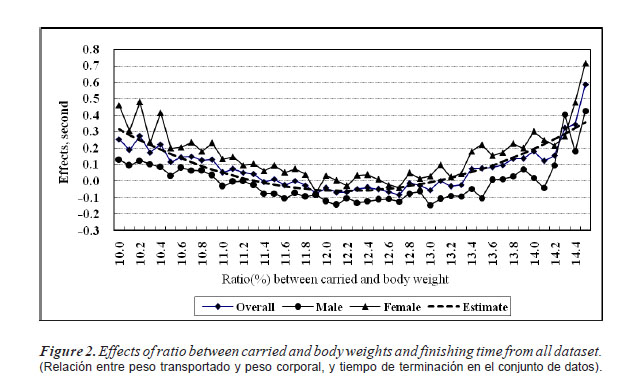
<body><![CDATA[<p><font face="Verdana" size="2"><b><a href="#f2">figure 2</a></b> shows when the ratio CW/BW influences on the finished time. The finished time in general were quite good when running the races while carrying the CW of about 12.0-12.7% as compared to the BW of racehorse. When the ratio CW/BW reaches at about 13.0%, the CW has gradually influenced on the finished time. Considering the Korea racing system, the racehorse may have a growth potential only if the BW of racehorse is at least 470-480 kg (<b><a href="#t3">table III</a></b>). Therefore, it is desirable to consider the just before raced BW of racehorse in a certain degree when setting a handicap.</font></p>     <p>&nbsp;</p>     <p align=center><a name="f2"></a><img src="/img/revistas/azoo/v60n231/art55_7_f2.jpg"></p>     <p>&nbsp;</p>     <p align=center><a name="t3"></a><img src="/img/revistas/azoo/v60n231/art55_8_t3.jpg"></p>     <p>&nbsp;</p>     <p><font face="Verdana" size="2"><b>Conclusion</b></font></p>     <p><font face="Verdana" size="2">Generally, the carried weight (CW) is granted under an assumption that 1 kg of weight allowance as equivalent to an average difference of 2 lengths (5 m). And it has been speculated that marginal CW is about 13% of body weight (BW) of racehorse.</font></p>     <p><font face="Verdana" size="2">However, according to the result of this study, the estimate was quite different from the fact and the finished time was gradually influenced as the ratio CW/BW reaches at about 13%.</font></p>     <p><font face="Verdana" size="2">Accordingly, the racehorse with lighter BW relatively holds a disadvantage in the CW. Hence in the future, it is necessary to establish a system of granting CW while considering the BW of racehorse.</font></p>     ]]></body>
<body><![CDATA[<p>&nbsp;</p>     <p><font face="Verdana" size="2"><b>Acknowledgement</b></font></p>     <p><font face="Verdana" size="2">This work was supported by a grant from the Next-Generation BioGreen 21 Program (No.PJ0081062011), Rural Development Administration, Republic of Korea.</font></p>     <p>&nbsp;</p>     <p><font face="Verdana" size="2"><b>References</b></font></p>     <!-- ref --><p><font face="Verdana" size="2">Buxadera, A.M. and Mota, M.D.S. 2008. Variance component estimations for race performance of thoroughbred horses in Brazil by random regression model. Livest. Sci., 117: 298-307.    &nbsp;&nbsp;&nbsp;&nbsp;&nbsp;&nbsp;&nbsp;&nbsp;[&#160;<a href="javascript:void(0);" onclick="javascript: window.open('/scielo.php?script=sci_nlinks&ref=1000155&pid=S0004-0592201100030005500001&lng=','','width=640,height=500,resizable=yes,scrollbars=1,menubar=yes,');">Links</a>&#160;]<!-- end-ref --></font></p>    <!-- ref --><p><font face="Verdana" size="2">Bugislaus, A.E., Roehe, R., Uphaus, H. and Kalm, E. 2004. Development of genetic models for estimation of racing performances in German thoroughbreds. Arch. Tierz., 47: 505-516.    &nbsp;&nbsp;&nbsp;&nbsp;&nbsp;&nbsp;&nbsp;&nbsp;[&#160;<a href="javascript:void(0);" onclick="javascript: window.open('/scielo.php?script=sci_nlinks&ref=1000157&pid=S0004-0592201100030005500002&lng=','','width=640,height=500,resizable=yes,scrollbars=1,menubar=yes,');">Links</a>&#160;]<!-- end-ref --></font></p>    <!-- ref --><p><font face="Verdana" size="2">Buttram, S.T., Willham, R.L., Wilson, D.E. and Heird J.C. 1988a. Genetics of racing performance in the American Quater horse: Description of the data. J. Anim. Sci., 66: 2791-2799.    &nbsp;&nbsp;&nbsp;&nbsp;&nbsp;&nbsp;&nbsp;&nbsp;[&#160;<a href="javascript:void(0);" onclick="javascript: window.open('/scielo.php?script=sci_nlinks&ref=1000159&pid=S0004-0592201100030005500003&lng=','','width=640,height=500,resizable=yes,scrollbars=1,menubar=yes,');">Links</a>&#160;]<!-- end-ref --></font></p>    <!-- ref --><p><font face="Verdana" size="2">Buttram, S.T., Willham, R.L. and Wilson, D.E. 1988b. Genetics of racing performance in the American Quater horse: Adjustment factors and contemporary groups. J. Anim. Sci., 66: 2800-2807.    &nbsp;&nbsp;&nbsp;&nbsp;&nbsp;&nbsp;&nbsp;&nbsp;[&#160;<a href="javascript:void(0);" onclick="javascript: window.open('/scielo.php?script=sci_nlinks&ref=1000161&pid=S0004-0592201100030005500004&lng=','','width=640,height=500,resizable=yes,scrollbars=1,menubar=yes,');">Links</a>&#160;]<!-- end-ref --></font></p>    <!-- ref --><p><font face="Verdana" size="2">Groeneveld, E., Kovac, M. and Wang, T. 1990. PEST, a general purpose BLUP package for mutivariate prediction and estimation. Proc. 4th World Congr. Genet. Appl. Livest. Prod., 13: 468-475.    &nbsp;&nbsp;&nbsp;&nbsp;&nbsp;&nbsp;&nbsp;&nbsp;[&#160;<a href="javascript:void(0);" onclick="javascript: window.open('/scielo.php?script=sci_nlinks&ref=1000163&pid=S0004-0592201100030005500005&lng=','','width=640,height=500,resizable=yes,scrollbars=1,menubar=yes,');">Links</a>&#160;]<!-- end-ref --></font></p>    <!-- ref --><p><font face="Verdana" size="2">Park, K.D. and Lee, K.J. 1999. Genetic evaluation of Thoroughbred racehorses in Korea. Korean J. Anim. Sci., 41: 135-140.    &nbsp;&nbsp;&nbsp;&nbsp;&nbsp;&nbsp;&nbsp;&nbsp;[&#160;<a href="javascript:void(0);" onclick="javascript: window.open('/scielo.php?script=sci_nlinks&ref=1000165&pid=S0004-0592201100030005500006&lng=','','width=640,height=500,resizable=yes,scrollbars=1,menubar=yes,');">Links</a>&#160;]<!-- end-ref --></font></p>    <!-- ref --><p><font face="Verdana" size="2">Tolley, E.A., Notter, D.R. and Marlowe, T.J. 1983. Heritability and repeatability of speed 2- and 3yr-old standardbred race horses. J. Anim. Sci., 56: 1294-1305.    &nbsp;&nbsp;&nbsp;&nbsp;&nbsp;&nbsp;&nbsp;&nbsp;[&#160;<a href="javascript:void(0);" onclick="javascript: window.open('/scielo.php?script=sci_nlinks&ref=1000167&pid=S0004-0592201100030005500007&lng=','','width=640,height=500,resizable=yes,scrollbars=1,menubar=yes,');">Links</a>&#160;]<!-- end-ref --></font></p>     <p>&nbsp;</p>     ]]></body>
<body><![CDATA[<p>&nbsp;</p>     <p><font face="Verdana" size="2">Recibido: 18-3-09    <br>Aceptado: 22-7-09</font></p>      ]]></body><back>
<ref-list>
<ref id="B1">
<nlm-citation citation-type="journal">
<person-group person-group-type="author">
<name>
<surname><![CDATA[Buxadera]]></surname>
<given-names><![CDATA[A.M.]]></given-names>
</name>
<name>
<surname><![CDATA[Mota]]></surname>
<given-names><![CDATA[M.D.S]]></given-names>
</name>
</person-group>
<article-title xml:lang="en"><![CDATA[Variance component estimations for race performance of thoroughbred horses in Brazil by random regression model]]></article-title>
<source><![CDATA[Livest. Sci.]]></source>
<year>2008</year>
<volume>117</volume>
<page-range>298-307</page-range></nlm-citation>
</ref>
<ref id="B2">
<nlm-citation citation-type="journal">
<person-group person-group-type="author">
<name>
<surname><![CDATA[Bugislaus]]></surname>
<given-names><![CDATA[A.E.]]></given-names>
</name>
<name>
<surname><![CDATA[Roehe]]></surname>
<given-names><![CDATA[R.]]></given-names>
</name>
<name>
<surname><![CDATA[Uphaus]]></surname>
<given-names><![CDATA[H.]]></given-names>
</name>
<name>
<surname><![CDATA[Kalm]]></surname>
<given-names><![CDATA[E]]></given-names>
</name>
</person-group>
<article-title xml:lang="en"><![CDATA[Development of genetic models for estimation of racing performances in German thoroughbreds]]></article-title>
<source><![CDATA[Arch. Tierz.]]></source>
<year>2004</year>
<volume>47</volume>
<page-range>505-516</page-range></nlm-citation>
</ref>
<ref id="B3">
<nlm-citation citation-type="journal">
<person-group person-group-type="author">
<name>
<surname><![CDATA[Buttram]]></surname>
<given-names><![CDATA[S.T.]]></given-names>
</name>
<name>
<surname><![CDATA[Willham]]></surname>
<given-names><![CDATA[R.L.]]></given-names>
</name>
<name>
<surname><![CDATA[Wilson]]></surname>
<given-names><![CDATA[D.E]]></given-names>
</name>
<name>
<surname><![CDATA[Heird]]></surname>
<given-names><![CDATA[J.C]]></given-names>
</name>
</person-group>
<article-title xml:lang="en"><![CDATA[Genetics of racing performance in the American Quater horse: Description of the data]]></article-title>
<source><![CDATA[J. Anim. Sci.]]></source>
<year>1988</year>
<volume>66</volume>
<page-range>2791-2799</page-range></nlm-citation>
</ref>
<ref id="B4">
<nlm-citation citation-type="journal">
<person-group person-group-type="author">
<name>
<surname><![CDATA[Buttram]]></surname>
<given-names><![CDATA[S.T.]]></given-names>
</name>
<name>
<surname><![CDATA[Willham]]></surname>
<given-names><![CDATA[R.L.]]></given-names>
</name>
<name>
<surname><![CDATA[Wilson]]></surname>
<given-names><![CDATA[D.E]]></given-names>
</name>
</person-group>
<article-title xml:lang="en"><![CDATA[Genetics of racing performance in the American Quater horse: Adjustment factors and contemporary groups]]></article-title>
<source><![CDATA[J. Anim. Sci.]]></source>
<year>1988</year>
<volume>66</volume>
<page-range>2800-2807</page-range></nlm-citation>
</ref>
<ref id="B5">
<nlm-citation citation-type="journal">
<person-group person-group-type="author">
<name>
<surname><![CDATA[Groeneveld]]></surname>
<given-names><![CDATA[E.]]></given-names>
</name>
<name>
<surname><![CDATA[Kovac]]></surname>
<given-names><![CDATA[M.]]></given-names>
</name>
<name>
<surname><![CDATA[Wang]]></surname>
<given-names><![CDATA[T]]></given-names>
</name>
</person-group>
<article-title xml:lang="en"><![CDATA[PEST, a general purpose BLUP package for mutivariate prediction and estimation]]></article-title>
<source><![CDATA[Proc. 4th World Congr. Genet. Appl. Livest. Prod.]]></source>
<year>1990</year>
<volume>13</volume>
<page-range>468-475</page-range></nlm-citation>
</ref>
<ref id="B6">
<nlm-citation citation-type="journal">
<person-group person-group-type="author">
<name>
<surname><![CDATA[Park]]></surname>
<given-names><![CDATA[K.D.]]></given-names>
</name>
<name>
<surname><![CDATA[Lee]]></surname>
<given-names><![CDATA[K.J.]]></given-names>
</name>
</person-group>
<article-title xml:lang="en"><![CDATA[Genetic evaluation of Thoroughbred racehorses in Korea]]></article-title>
<source><![CDATA[Korean J. Anim. Sci.]]></source>
<year>1999</year>
<volume>41</volume>
<page-range>135-140</page-range></nlm-citation>
</ref>
<ref id="B7">
<nlm-citation citation-type="journal">
<person-group person-group-type="author">
<name>
<surname><![CDATA[Tolley]]></surname>
<given-names><![CDATA[E.A.]]></given-names>
</name>
<name>
<surname><![CDATA[Notter]]></surname>
<given-names><![CDATA[D.R.]]></given-names>
</name>
<name>
<surname><![CDATA[Marlowe]]></surname>
<given-names><![CDATA[T.J]]></given-names>
</name>
</person-group>
<article-title xml:lang="en"><![CDATA[Heritability and repeatability of speed 2- and 3yr-old standardbred race horses]]></article-title>
<source><![CDATA[J. Anim. Sci.]]></source>
<year>1983</year>
<volume>56</volume>
<page-range>1294-1305</page-range></nlm-citation>
</ref>
</ref-list>
</back>
</article>