<?xml version="1.0" encoding="ISO-8859-1"?><article xmlns:mml="http://www.w3.org/1998/Math/MathML" xmlns:xlink="http://www.w3.org/1999/xlink" xmlns:xsi="http://www.w3.org/2001/XMLSchema-instance">
<front>
<journal-meta>
<journal-id>0004-0592</journal-id>
<journal-title><![CDATA[Archivos de Zootecnia]]></journal-title>
<abbrev-journal-title><![CDATA[Arch. zootec.]]></abbrev-journal-title>
<issn>0004-0592</issn>
<publisher>
<publisher-name><![CDATA[Universidad de Córdoba]]></publisher-name>
</publisher>
</journal-meta>
<article-meta>
<article-id>S0004-05922011000400027</article-id>
<article-id pub-id-type="doi">10.4321/S0004-05922011000400027</article-id>
<title-group>
<article-title xml:lang="en"><![CDATA[Discriminant analysis of sexual dimorphism in morphological traits of African Muscovy ducks]]></article-title>
<article-title xml:lang="es"><![CDATA[Análisis discriminante del dimorfismo sexual de caracteres morfológicos de patos Muscovy Africanos]]></article-title>
</title-group>
<contrib-group>
<contrib contrib-type="author">
<name>
<surname><![CDATA[Yakubu]]></surname>
<given-names><![CDATA[A.]]></given-names>
</name>
<xref ref-type="aff" rid="A01"/>
</contrib>
</contrib-group>
<aff id="A01">
<institution><![CDATA[,Nasarawa State University Shabu-Lafia Campus Faculty of Agriculture]]></institution>
<addr-line><![CDATA[Lafia Nasarawa State]]></addr-line>
<country>Nigeria</country>
</aff>
<pub-date pub-type="pub">
<day>00</day>
<month>12</month>
<year>2011</year>
</pub-date>
<pub-date pub-type="epub">
<day>00</day>
<month>12</month>
<year>2011</year>
</pub-date>
<volume>60</volume>
<numero>232</numero>
<fpage>1115</fpage>
<lpage>1123</lpage>
<copyright-statement/>
<copyright-year/>
<self-uri xlink:href="http://scielo.isciii.es/scielo.php?script=sci_arttext&amp;pid=S0004-05922011000400027&amp;lng=en&amp;nrm=iso"></self-uri><self-uri xlink:href="http://scielo.isciii.es/scielo.php?script=sci_abstract&amp;pid=S0004-05922011000400027&amp;lng=en&amp;nrm=iso"></self-uri><self-uri xlink:href="http://scielo.isciii.es/scielo.php?script=sci_pdf&amp;pid=S0004-05922011000400027&amp;lng=en&amp;nrm=iso"></self-uri><abstract abstract-type="short" xml:lang="en"><p><![CDATA[Sexual dimorphism was examined in 221 randomly selected adult African Muscovy ducks extensively reared in north central Nigeria using univariate and multivariate measures of body size and skeletal proportions. The body parameters investigated included body weight, 8 primary linear body measurements [breast circumference (BTC), thigh circumference (THC), body length (BDL), bill length (BLL), neck length (NKL),foot length (FTL), total leg length (TLL) and wing length (WNL)] and 4 morphological indices (massiveness, stockiness, long-leggedness and condition index). The univariate analysis showed male dominance (p<0.05) in all the morphometric measurements, with the exception of stockiness and longleggedness where significantly higher mean values were recorded for females. Low, moderate and high positive and negative correlations among the body size and shape characters of the ducks were recorded. The canonical discriminant analysis on body weight and primary linear body measurements revealed that wing length was the most discriminating variable between the sexes, followed by body weight, neck circumference, total leg length, body length and foot length respectively. Three other variables not qualified to enter the model were expunged. The single discriminant function obtained (D= -3.116 + 0.280WNL+ 0.921BWT + 0.191NKL - 0.196TLL 0.063BDL - 0.283FTL) correctly classified 91.4% of individuals of known-sex ducks. This might aid in ecological studies, conservation and improvement of the indigenous ducks.]]></p></abstract>
<abstract abstract-type="short" xml:lang="es"><p><![CDATA[Se estudió el dimorfismo sexual en 221 patos, Muscovy Africanos, adultos, seleccionados al azar, explotados extensivamente en la región norte centro de Nigeria, empleando para ello medidas uni y multivariadas del tamaño corporal y proporciones del esqueleto. Los parámetros corporales investigados incluyeron: peso corporal, ocho medidas lineales corporales (circunferencia de la pechuga, BTC; circunferencia del muslo, THC; longitud del cuerpo, BDL; longitud del pico, BLL; longitud del cuello, NKL; longitud del pie, FTL; longitud total de la pata, TLL y longitud del ala, WNL) y cuatro índices morfológicos (masividad, solidez, largura de la pata e índice de condición). El análisis univariado mostró la dominancia del macho (p<0,05) en todas las medidas morfométricas, salvo para solidez y largura de la pata en los que se registraron valores medios significativamente más altos para las hembras. Correlaciones positivas y negativas, bajas, moderadas o altas, fueron encontradas entre tamaño corporal y caracteres morfológicos de los patos. El análisis discriminan-te canónico para el peso corporal y medidas lineales primarias del cuerpo, reveló que la longitud del ala fue la variable más discriminante entre sexos, seguida del peso corporal, circunferencia del cuello, longitud total de la pata, longitud del cuerpo y longitud del pie respectivamente. Otras tres variables no cualificadas para entrar en el modelo fueron eliminadas. La función discriminan-te simple obtenida (D= -3,116 + 0,280WNL+ 0,921BWT + 0,191NKL - 0,196TLL - 0,063BDL 0,283FTL), permitió clasificar correctamente 91,4% de los individuos de la muestra de patos de sexo conocido. Esto puede ser útil en estudios ecológicos y de conservación y mejora de patos indígenas.]]></p></abstract>
<kwd-group>
<kwd lng="en"><![CDATA[Nigeria]]></kwd>
<kwd lng="en"><![CDATA[Body parameters]]></kwd>
<kwd lng="en"><![CDATA[Cairina moschata]]></kwd>
<kwd lng="es"><![CDATA[Nigeria]]></kwd>
<kwd lng="es"><![CDATA[Parámetros corporales]]></kwd>
<kwd lng="es"><![CDATA[Cairina moschata]]></kwd>
</kwd-group>
</article-meta>
</front><body><![CDATA[ <p>&nbsp;</p>     <p>&nbsp;</p>     <p><font face="Verdana" size="4"><b>Discriminant analysis of sexual dimorphism in morphological traits of African Muscovy ducks</b></font></p>     <p><font face="Verdana" size="4"><b>Análisis discriminante del dimorfismo sexual de caracteres morfológicos de patos Muscovy Africanos</b></font></p>     <p>&nbsp;</p>     <p>&nbsp;</p>     <p><font face="Verdana" size="2"><b>Yakubu, A.<sup>1*</sup></b></font></p>     <p><font face="Verdana" size="2"><sup>1</sup>Department of Animal Science. Faculty of Agriculture. Nasarawa State University. Keffi. Shabu-Lafia Campus. Lafia. Nasarawa State. Nigeria. *<a href="mailto:abdul_mojeedy@yahoo.com">abdul_mojeedy@yahoo.com</a></font></p>     <p>&nbsp;</p>     <p>&nbsp;</p> <hr size="1">     ]]></body>
<body><![CDATA[<p><font face="Verdana" size="2"><b>SUMMARY</b></font></p>     <p><font face="Verdana" size="2">Sexual dimorphism was examined in 221 randomly selected adult African Muscovy ducks extensively reared in north central Nigeria using univariate and multivariate measures of body size and skeletal proportions. The body parameters investigated included body weight, 8 primary linear body measurements &#091;breast circumference (BTC), thigh circumference (THC), body length (BDL), bill length (BLL), neck length (NKL),foot length (FTL), total leg length (TLL) and wing length (WNL)&#093; and 4 morphological indices (massiveness, stockiness, long-leggedness and condition index). The univariate analysis showed male dominance (p&lt;0.05) in all the morphometric measurements, with the exception of stockiness and longleggedness where significantly higher mean values were recorded for females. Low, moderate and high positive and negative correlations among the body size and shape characters of the ducks were recorded. The canonical discriminant analysis on body weight and primary linear body measurements revealed that wing length was the most discriminating variable between the sexes, followed by body weight, neck circumference, total leg length, body length and foot length respectively. Three other variables not qualified to enter the model were expunged. The single discriminant function obtained (D= -3.116 + 0.280WNL+ 0.921BWT + 0.191NKL - 0.196TLL 0.063BDL - 0.283FTL) correctly classified 91.4% of individuals of known-sex ducks. This might aid in ecological studies, conservation and improvement of the indigenous ducks.</font></p>     <p><font face="Verdana" size="2"><b>Key words:</b> Nigeria. Body parameters. <i>Cairina moschata</i>.</font></p> <hr size="1">     <p><font face="Verdana" size="2"><b>RESUMEN</b></font></p>     <p><font face="Verdana" size="2">Se estudió el dimorfismo sexual en 221 patos, Muscovy Africanos, adultos, seleccionados al azar, explotados extensivamente en la región norte centro de Nigeria, empleando para ello medidas uni y multivariadas del tamaño corporal y proporciones del esqueleto. Los parámetros corporales investigados incluyeron: peso corporal, ocho medidas lineales corporales (circunferencia de la pechuga, BTC; circunferencia del muslo, THC; longitud del cuerpo, BDL; longitud del pico, BLL; longitud del cuello, NKL; longitud del pie, FTL; longitud total de la pata, TLL y longitud del ala, WNL) y cuatro índices morfológicos (masividad, solidez, largura de la pata e índice de condición). El análisis univariado mostró la dominancia del macho (p&lt;0,05) en todas las medidas morfométricas, salvo para solidez y largura de la pata en los que se registraron valores medios significativamente más altos para las hembras. Correlaciones positivas y negativas, bajas, moderadas o altas, fueron encontradas entre tamaño corporal y caracteres morfológicos de los patos. El análisis discriminan-te canónico para el peso corporal y medidas lineales primarias del cuerpo, reveló que la longitud del ala fue la variable más discriminante entre sexos, seguida del peso corporal, circunferencia del cuello, longitud total de la pata, longitud del cuerpo y longitud del pie respectivamente. Otras tres variables no cualificadas para entrar en el modelo fueron eliminadas. La función discriminan-te simple obtenida (D= -3,116 + 0,280WNL+ 0,921BWT + 0,191NKL - 0,196TLL - 0,063BDL 0,283FTL), permitió clasificar correctamente 91,4% de los individuos de la muestra de patos de sexo conocido. Esto puede ser útil en estudios ecológicos y de conservación y mejora de patos indígenas.</font></p>     <p><font face="Verdana" size="2"><b>Palabras clave:</b> Nigeria. Parámetros corporales.<i> Cairina moschata</i>.</font></p> <hr size="1">     <p>&nbsp;</p>     <p><font face="Verdana" size="2"><b>Introduction</b></font></p>     <p><font face="Verdana" size="2">Poultry production in the tropics is characterized by high dynamics of development. This outstanding trend is based on increasing demands and preferences for poultry products on one hand and on improvements in management, disease prophylaxis and breeding on the other hand (Horst, 1999). In the tropics such as Nigeria, the poultry industry is not as diversified as in the temperate. Here, emphasis is laid on egg production and on only one species of poultry, the domestic fowl; whereas economic and nutritional benefits can be derived from keeping other species, such as ducks, some strains of which are fastgrowing, resistant to many diseases of the domestic fowls and can produce as many as 300 eggs per year (Oluyemi and Roberts, 2000; Teguia et al., 2008). Adesope and Nodu (2002) reported that the meat of Muscovy ducks, which make up about 74% of the total duck population in Nigeria, contains less fat and it's healthier.</font></p>     <p><font face="Verdana" size="2">Morphological variation within a species is of great biological interest, both as a phenomenon and as a descriptive and an analytical tool. Sexual differences in external morphology are of interest in studies of reproductive biology and descriptively, to analyse population composition (Norman and Robert, 1984; Piersma, 1988). This can be used to detect the amount and distribution of genetic variation within and between populations of the local Muscovy ducks thereby increasing the understanding of the historical processes underlying the genetic diversity. It can also provide important basic information for selection and breeding programmes. Knowledge on the objective description of body size and skeletal proportions of native stock is imperative in Nigeria because of the introduction of exotic ducks such as Pekins and Khaki Campbell into the country which, as a result of interbreeding, could lead to the erosion of the genetic resource of the indigenous Muscovy ducks.</font></p>     ]]></body>
<body><![CDATA[<p><font face="Verdana" size="2">Visually assessing with certainty the sex of African Muscovy ducks in the field is a difficult task. In Nigeria, some attempts have been made to characterize the Muscovy ducks using univariate analysis of body weight and linear body measurements. However, there is dearth of information on their phenotypic differentiation using morphological indices and multivariate analysis; which are currently receiving increased attention in birds (Lorentsen and Rov, 1994; Strelec et al., 2005; Zenatello and Kiss, 2005; Robertson et al., 2008) and bees (Souza et al., 2009). The present investigation therefore, aimed at providing baseline information on sexual dimorphism in African Muscovy ducks using morphological indices and discriminant analysis in addition to primary morphometric characters. The information so obtained will ensure better characterization which could aid in the ecological studies, conservation, selection and genetic improvement of the native stock.</font></p>     <p>&nbsp;</p>     <p><font face="Verdana" size="2"><b>Materials and methods</b></font></p>     <p><font face="Verdana" size="2">LOCATION OF STUDY AND EXPERIMENTAL ANIMALS</font></p>     <p><font face="Verdana" size="2">Data were obtained from two hundred and twenty one (221) randomly selected adult African Muscovy ducks of both sexes (95 males and 126 females respectively). The birds were selected in their breeding tracts in certain smallholder farms in Nasarawa State, north central Nigeria from December, 2008 to May, 2009. The State falls within the guinea savanna agroecological zone, and is found between latitudes 7052 N and 8056 N and longitudes 7025 E and 9037 E respectively. It has two distinct seasons. The wet season lasts from about the beginning of May and ends in October. The dry season is experienced between November and April. Annual rainfall figures range from 1100 to 2000 mm. The mean monthly temperatures in the State range between 20 and 34<sup>o</sup>C, with the hottest months being March/April and the coolest months being December/January (Lyam, 2000). The birds were managed through the traditional scavenging system.</font></p>     <p><font face="Verdana" size="2">TRAITS MEASURED</font></p>     <p><font face="Verdana" size="2">Body weight (BWT), eight primary biometric traits (body length, breast circumference, thigh circumference, bill length, neck length, foot length, total leg length and wing length) and four morphological indices (massiveness, stockiness, long-leggedness and condition index) were measured on each adult African Muscovy duck. Measurements were restricted to apparently healthy birds that conformed to the species' classification descriptors. The body parts measured were, body length (BDL), length between the tip of the <i>Rostrum maxillare</i> (bill) and that of the <i>Cauda</i> (tail, without feathers); breast circumference (BTC), taken under the wings at the edge of the sternum; thigh circumference (THC), measured as the circumference of the drumstick at the coxa region; bill length (BLL), measured as distance from the rectal apterium to the maxillary nail; neck length (NKL), distance between the occipital condyle and the cephalic borders of the coracoids; foot length (FTL), distance from the shank joint to the extremity of the <i>Digitus pedis</i>; total leg length (TLL), taken as the length of the femur, shank and metatarsal; wing length (WNL), taken from the shoulder joint to the extremity of the terminal phalanx, digit 111; massiveness (MAS) (the ratio of live body weight to body length × 100); stockiness (STK) (the ratio of breast circumference to body length × 100); longleggedness (LLN) (the ratio of total leg length to body length × 100) and condition index (CND) (the ratio of live body weight to wing length × 100). The anatomical reference points were as earlier described (Fox et al., 1992; Oblakova, 2007; Teguai et al., 2008). A 5-kg measuring scale was used for the weight measurement. The length and circumference measurements were effected using a measuring tape calibrated in centimetres (cm). All measurements were taken by the same individual early in the morning before the ducks were released for scavenging.</font></p>     <p><font face="Verdana" size="2">STATISTICAL ANALYSIS</font></p>     <p><font face="Verdana" size="2">Body weight, primary linear body measurements and morphological indices were subjected to analysis of variance to determine sex effect using the General Linear Model of SPSS Version 13 (2001). Means were separated using the two-tailed, two-sample t-test of the same statistical package. Pearson's coefficients of correlation among the various body parameters were computed. The multivariate technique involved the use of canonical discriminant analysis on body weight and the original eight primary linear body measurements of the ducks. The standardized discriminant function was used to screen for the most discriminating variables between the sexes. Wilks' lambda (U statistic) was used to test the significance of the discriminant function while the Bartlett's V transformation of lambda (chi-square statistic) was later used to compute the significance of lambda. For sex identification, the unstandardized discriminant function procedure was employed. The ability of this function to identify males and females is indicated as the percentage of individuals correctly classified from the sample that generated the function. The robustness (reliability testing) of the function was validated using split-sample validation (cross-validation) of the SPSS package.</font></p>     <p>&nbsp;</p>     ]]></body>
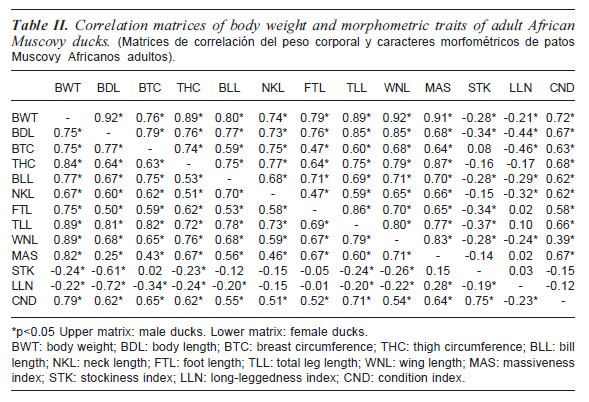
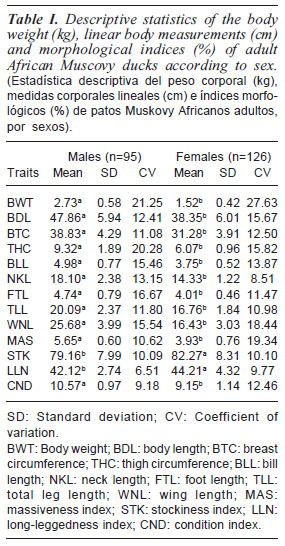
<body><![CDATA[<p><font face="Verdana" size="2"><b>Results and discussion</b></font></p>     <p><font face="Verdana" size="2">The means, standard deviations and coefficients of variation of the body parameters of African Muscovy ducks are presented in <a href="#t1">table I</a>. The sex ratio reflects the population structure of the ducks. More females were obtained than males. This could be attributed to the fact that males were more frequently put for sales to generate income and for festive purposes, whereas more females are needed in the breeding tract for procreation.</font></p>     <p>&nbsp;</p>     <p align="center"><font face="Verdana" size="2"><a name="t1"><img src="/img/revistas/azoo/v60n232/art27_1.jpg"></a></font></p>     <p>&nbsp;</p>     <p><font face="Verdana" size="2">Sex-associated differences were found in all the body traits and indices investigated. Males (drakes) had significantly (p&lt;0.05) higher body weight, body length, breast circumference, thigh circumference, bill length, neck length, foot length, total leg length, wing length, massiveness and condition index. However, female (ducks) dominance (p&lt;0.05) was observed in stockiness and long-leggedness. The longer total leg length of the males confers greater body height. The present findings on body weight and linear body measurements of both sexes are consistent with the reports of earlier workers (Tai and Rouvier, 1998; Goswami et al., 2000; Teguia et al., 2008). This sexual dimorphism is attributable to the usual between-sex differential hormonal action (Baeza et al., 2001) which invariably leads to differential growth rates. Another possible explanation for the appearance of extreme sex-related differences in the biometrics of Muscovy ducks is the strong female selection for high quality males or competition among males for limited access to females which led to fixation of larger body size and other secondary sexual characters in males (McCracken et al., 2000). The greater difference in bill length between the sexes suggests that the trait may play an important role, probably in sexual display and territorial defence by males (Chochi et al., 2002). Additionally, the superiority of males over females could be as a result of their ability to feed at greater depth and better feed conversion efficiency (Gillespie, 1985; Bochno et al., 1994). The higher variability of body weight in both sexes is an indication of the high environmental sensitivity of this primary production trait. Generally, a higher phenotypic variation of traits indicates a higher genetic variation which guarantees a sufficient selection response. This is more so important because directional selection on morphological traits which commonly occurs in natural populations (Kingsolver et al., 2001), rarely operates on only one character at a time.</font></p>     <p><font face="Verdana" size="2">The proportions of the various body parts are determined by measuring body configuration. While body weight and linear body measurements are usually used for phenotypic characterization; body conformation type and meatiness of the ducks could better be assessed using massiveness, stockiness, long-leggedness and condition index. These principal selection indices state the ratio of measurements that characterizes the proportionality of bird's body (Fox et al., 1992; Oblakova, 2007). Massiveness and stockiness which, are used to assess musculature development, are traits for solidity of the body and clearly defined traits for meat-type ducks. In the present study, meatiness trait was better described in males using massiveness (5.65  <i>versus</i> 3.93%; p&lt;0.05 for males and females respectively) while in females, it was better explained via stockiness (82.27  <i>versus</i> 79.16%; p&lt;0.05 for females and males respectively). Body weight was corrected for body size using weight/ wing ratio × 100. This, according to Owen and Cook (1977), gives a better indication of a bird's ability to meet its present and future energy requirements than using body weight alone. This condition index was found to be higher in males (10.57%) than females (9.15%). This is of physiological importance because standard measures of metabolic activities are frequently expressed as a function of body size, and it is often useful to examine the relationship of structures or organs relative to overall body size (Blem, 1984). However, long-leggedness was higher in females (44.21%) compared to their male counterparts (42.12%). The higher leg-body ratio of the females is an indication that they have relatively longer legs while their male counterparts have relatively longer body. This index could play a role in the assessment of type and function. While the females display a narrower body, which is suitable for egg production; the males exhibit a blockier appearance, which is more a characteristic of meatiness. Higher coefficients of variation were however recorded for females than males in all the four morphological indices.</font></p>     <p><font face="Verdana" size="2">Generally, the smaller body stature exhibited by the indigenous ducks as compared to their exotic counterparts (McCracken et al., 2000), could be a reflection of their adaptive strategy to the stressful environmental and nutritional conditions of the tropics. According to Olawunmi et al. (2008), smaller body size of indigenous birds is important to reduce the maintenance feed requirements and increase feed efficiency in the tropics characterized by free range system where feed resources are limited in terms of quantity and quality.</font></p>     <p><font face="Verdana" size="2">Phenotypic correlations among body weight, zoometrical traits and indices are presented in <a href="#t2">table II</a>. Low, moderate and high positive and negative correlation coefficients were recorded among the various body parameters. In males, the coefficients of correlation ranged from -0.12 to 0.92. Body weight was highly correlated with wing length and body length (r= 0.92; p&lt;0.01 in both cases), followed by thigh circumference and total leg length respectively. Among the morphological indices, the highest correlation was recorded between body weight and massiveness, followed by condition index (r= 0.91 and 0.72; p&lt;0.01). The association between body weight and stockiness and long- leggedness was however, negative (r= -0.28 and -0.21; p&lt;0.01 respectively). Other single variables highly related to massiveness were thigh circumference (r= 0.87) and wing length (r= 0.83). In female birds, the estimates of correlation ranged from -0.01 to 0.89. Wing length, total leg length and thigh circumference were highly correlated with body weight (r= 0.89, 0.89 and 0.84; p&lt;0.01 respectively). The relationship between massiveness, condition index and body weight was equally high and significant (r=0.82 and 0.79; p&lt;0.01 respectively). Negative correlation coefficients were also recorded for stockiness, long-leggedness and body weight (r= -0.24 and -0.22; p&lt;0.01 respectively). High positive relationships among traits suggest that they are under the same gene action and can also be predicted from one another singly or in combinations (Ngapongora et al., 2004; Ogah et al., 2009). The varying phenotypic correlation coefficients in the two sexes suggest sexual differences in the genetic architecture of the birds. According to Jensen et al. (2003), additive genetic variance-covariance structure of the morphological traits differs between sexes.</font></p>     <p>&nbsp;</p>     ]]></body>
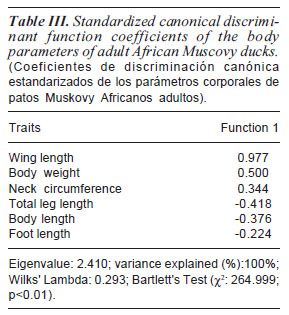
<body><![CDATA[<p align="center"><font face="Verdana" size="2"><a name="t2"><img src="/img/revistas/azoo/v60n232/art27_2.jpg"></a></font></p>     <p>&nbsp;</p>     <p><font face="Verdana" size="2">Although the univariate analysis revealed differences in the body weight and linear type traits of the sexes of Muscovy ducks, the multivariate analysis provided better resolution (<a href="#t3">table III</a>), thereby limiting the number of variables contributing to sexual dimorphism in ducks. Only a single standardized canonical discriminant function was extracted in the present study. The significance of the discriminant function tested with the minimization of Wilks' lambda (lambda= 0.293) and Bartlett's test (chi square= 264.999; p&lt;0.01) provided validity for the canonical discriminant analysis. The discriminating power of wing length was highest, chronologically followed by body weight, neck circumference, total leg length, body length and foot length; the respective standardized canonical coefficients being 0.977, 0.500, 0.344, -0.418, -0.376 and -0.224. Three other variables (chest circumference, thigh circumference and bill length) not qualified to enter the model were expunged. The reduction in the number of measurements saves time and energy required to distinguish between the sexes of Muscovy ducks, and also aids in the ecology, conservation, selection and breeding process. The present findings are consistent with the report of Zenatello and Kiss (2005) where wing length was observed as the most discriminating variable of the sexes of Rose-coloured Starlings Sturnus roseus. Similarly, Martinez-Gomez and Curry (1998) reported that wing chord and tarsus length were the two most important traits for sex-separation in birds. However, Lo Valvo (2001) reported that bill depth was the best parameter in sexing birds.</font></p>     <p align="center"><font face="Verdana" size="2"><a name="t3"><img src="/img/revistas/azoo/v60n232/art27_3.jpg"></a></font></p>     <p><font face="Verdana" size="2">The unstandardized canonical discriminant function was used to classify individual birds. Wing length, body weight, neck length, total leg length, body length and foot length were the variables included in the discriminant (D) equation below:</font></p>     <blockquote> 	    <p><font face="Verdana" size="2">D= -3.116 + 0.280WNL+ 0.921BWT + 0.191NKL 0.196TLL - 0.063BDL - 0.283FTL</font></p> </blockquote>     <p><font face="Verdana" size="2">The classification function could be directly used to identify the two sexes, since positive D scores indicate males and negative D scores indicate females. This function was able to classify correctly 91.4% of individuals from the sample of known-sex ducks. Cross-validation with the splitsample method equally indicated a 91.4% overall success rate (96% of the females and 85.3% of the males were correctly assigned). The six variables therefore, were sufficiently robust to be used in the field to determine the gender of live birds. This is an indication that morphological measurements could be taken into consideration to increase the consistency of individual sexing especially by farmers, livestock extension officers and researchers who are not familiar with African Muscovy ducks. Sexual dimorphism is important because it allows the assessment of sex effect on survival and dispersal; evaluation of population dynamics, since female members are frequent model parameters and identification of species threats such as sex ratio disequilibria or sexual differences in predation risk (Bourgeois et al., 2007). In a related study, Zenatello and Kiss (2005) were able to assign correctly 88% male and 96% female birds into their individual sexes. Similarly, Thalmann et al. (2007) reported that a discriminant function analysis resulted in gender being correctly assigned in 91% of birds using three morphological characters.</font></p>     <p>&nbsp;</p>     <p><font face="Verdana" size="2"><b>Conclusion</b></font></p>     ]]></body>
<body><![CDATA[<p><font face="Verdana" size="2">The study revealed that there were marked sexual differences in the morphological measurements of African Muscovy ducks with higher values in most cases recorded for males. Low, moderate and high positive and negative phenotypic correlations were observed among the body size and skeletal proportions. Wing length was the most discriminating variable between the sexes, followed by body weight, neck length, total leg length, body length and foot length. Chest circumference, thigh circumference and bill length were not included in the canonical discriminant model. The discriminant function correctly classified 91.4% of individuals in the sample from which it was derived. This means that the six variables were sufficiently robust to be used in the field to determine the gender of live birds. The use of biometrics and discriminant analysis therefore, may considerably increase the reliability of separating the sexes of African Muscovy ducks. The present results might aid in better understanding of the ecology, conservation and improvement of the indigenous birds.</font></p>     <p>&nbsp;</p>     <p><font face="Verdana" size="2"><b>References</b></font></p>     <!-- ref --><p><font face="Verdana" size="2">Adesope, O.M. and Nodu, M.B. 2002. A note on acceptance of duck as table-meat among inhabitants of selected communities in the Niger Delta zone, Nigeria. LRRD, 14. <a target="_blank" href="http://www.lrrd.org/lrrd14/6/ades146.htm">http://www.lrrd.org/lrrd14/6/ades146.htm</a> (20/08/08).    &nbsp;&nbsp;&nbsp;&nbsp;&nbsp;&nbsp;&nbsp;&nbsp;[&#160;<a href="javascript:void(0);" onclick="javascript: window.open('/scielo.php?script=sci_nlinks&ref=1010905&pid=S0004-0592201100040002700001&lng=','','width=640,height=500,resizable=yes,scrollbars=1,menubar=yes,');">Links</a>&#160;]<!-- end-ref --></font></p>    <!-- ref --><p><font face="Verdana" size="2">Baeza, E., Williams, N., Guemene, D. and Duclos, M.J. 2001. Sexual dimorphism for growth in Muscovy duck and changes in insulin-like growth factor I (IGF- I), growth hormone (GH) and triiodothyronine (T3) plasma levels. Reprod. Dev., 41: 173-179.    &nbsp;&nbsp;&nbsp;&nbsp;&nbsp;&nbsp;&nbsp;&nbsp;[&#160;<a href="javascript:void(0);" onclick="javascript: window.open('/scielo.php?script=sci_nlinks&ref=1010907&pid=S0004-0592201100040002700002&lng=','','width=640,height=500,resizable=yes,scrollbars=1,menubar=yes,');">Links</a>&#160;]<!-- end-ref --></font></p>    <!-- ref --><p><font face="Verdana" size="2">Blem, C.R. 1984. Ratios in avian physiology. Auk, 101: 153-155.    &nbsp;&nbsp;&nbsp;&nbsp;&nbsp;&nbsp;&nbsp;&nbsp;[&#160;<a href="javascript:void(0);" onclick="javascript: window.open('/scielo.php?script=sci_nlinks&ref=1010909&pid=S0004-0592201100040002700003&lng=','','width=640,height=500,resizable=yes,scrollbars=1,menubar=yes,');">Links</a>&#160;]<!-- end-ref --></font></p>    <!-- ref --><p><font face="Verdana" size="2">Bochno, R., Lewezuk, A. and Wawro, E. 1994. Comparison of growth and feed conversion efficiency of Muscovy and Pekin ducks. CAB Int. Poult. Abstract, 20: 18.    &nbsp;&nbsp;&nbsp;&nbsp;&nbsp;&nbsp;&nbsp;&nbsp;[&#160;<a href="javascript:void(0);" onclick="javascript: window.open('/scielo.php?script=sci_nlinks&ref=1010911&pid=S0004-0592201100040002700004&lng=','','width=640,height=500,resizable=yes,scrollbars=1,menubar=yes,');">Links</a>&#160;]<!-- end-ref --></font></p>    <!-- ref --><p><font face="Verdana" size="2">Bourgeois, K., Cure, C., Legrand, J., Gomez-Diaz, E., Vidal, E., Aubin, T. and Mathevon, N. 2007. Morphological versus acoustic analysis: What is the most efficient method for sexing yelkouan shearwaters Puffinus yelkouan? J. Ornithol., 148: 261-269.    &nbsp;&nbsp;&nbsp;&nbsp;&nbsp;&nbsp;&nbsp;&nbsp;[&#160;<a href="javascript:void(0);" onclick="javascript: window.open('/scielo.php?script=sci_nlinks&ref=1010913&pid=S0004-0592201100040002700005&lng=','','width=640,height=500,resizable=yes,scrollbars=1,menubar=yes,');">Links</a>&#160;]<!-- end-ref --></font></p>    <!-- ref --><p><font face="Verdana" size="2">Chochi, M., Niizuma, Y. and Takagi, M. 2002. Sexual differences in the external measurements of black-tailed gulls breeding on Rishiri Island, Japan. Ornithol. Sci., 1: 163-166.    &nbsp;&nbsp;&nbsp;&nbsp;&nbsp;&nbsp;&nbsp;&nbsp;[&#160;<a href="javascript:void(0);" onclick="javascript: window.open('/scielo.php?script=sci_nlinks&ref=1010915&pid=S0004-0592201100040002700006&lng=','','width=640,height=500,resizable=yes,scrollbars=1,menubar=yes,');">Links</a>&#160;]<!-- end-ref --></font></p>    <!-- ref --><p><font face="Verdana" size="2">Fox, A.D., King, R. and Watkin, J. 1992. Seasonal variation in weight, body measurements and condition of free living. Teal. Bird Study, 31: 53-62.    &nbsp;&nbsp;&nbsp;&nbsp;&nbsp;&nbsp;&nbsp;&nbsp;[&#160;<a href="javascript:void(0);" onclick="javascript: window.open('/scielo.php?script=sci_nlinks&ref=1010917&pid=S0004-0592201100040002700007&lng=','','width=640,height=500,resizable=yes,scrollbars=1,menubar=yes,');">Links</a>&#160;]<!-- end-ref --></font></p>    <!-- ref --><p><font face="Verdana" size="2">Gillespie, G.D. 1985. Hybridization, introgression, and morphological differentiation between mallard (<i>Anas platyrhynchos</i>) and grey duck (<i>Anas superciliosa</i>) in Otago, New Zealand. Auk, 102: 459-469.    &nbsp;&nbsp;&nbsp;&nbsp;&nbsp;&nbsp;&nbsp;&nbsp;[&#160;<a href="javascript:void(0);" onclick="javascript: window.open('/scielo.php?script=sci_nlinks&ref=1010919&pid=S0004-0592201100040002700008&lng=','','width=640,height=500,resizable=yes,scrollbars=1,menubar=yes,');">Links</a>&#160;]<!-- end-ref --></font></p>    <!-- ref --><p><font face="Verdana" size="2">Goswami, N., Das, G.C., Das, D. and Goswami, R.N. 2000. Factors affecting some of the body measurement traits in Khaki Campbell, Desi ducks and their crosses. Indian J. Poult. Sci., 35: 205-206.    &nbsp;&nbsp;&nbsp;&nbsp;&nbsp;&nbsp;&nbsp;&nbsp;[&#160;<a href="javascript:void(0);" onclick="javascript: window.open('/scielo.php?script=sci_nlinks&ref=1010921&pid=S0004-0592201100040002700009&lng=','','width=640,height=500,resizable=yes,scrollbars=1,menubar=yes,');">Links</a>&#160;]<!-- end-ref --></font></p>    <!-- ref --><p><font face="Verdana" size="2">Horst, P. 1999. Evaluation of local poultry resources for genetic stock with improved adaptability, productivity and disease resistance in tropical environments. Summary reports of European Commission supported STD-3 projects (1992-1995). CTA. Wageningen. The Netherlands.    &nbsp;&nbsp;&nbsp;&nbsp;&nbsp;&nbsp;&nbsp;&nbsp;[&#160;<a href="javascript:void(0);" onclick="javascript: window.open('/scielo.php?script=sci_nlinks&ref=1010923&pid=S0004-0592201100040002700010&lng=','','width=640,height=500,resizable=yes,scrollbars=1,menubar=yes,');">Links</a>&#160;]<!-- end-ref --></font></p>    <!-- ref --><p><font face="Verdana" size="2">Jensen, H., Saether, B.E., Ringsby, T.H., Tufto, J., Griffith, S.C. and Ellegren, H. 2003. Sexual variation in heritability and genetic correlations of morphological traits in house sparrows (<i>Passer domesticus</i>). J. Evol. Biol., 16: 1296-1307.    &nbsp;&nbsp;&nbsp;&nbsp;&nbsp;&nbsp;&nbsp;&nbsp;[&#160;<a href="javascript:void(0);" onclick="javascript: window.open('/scielo.php?script=sci_nlinks&ref=1010925&pid=S0004-0592201100040002700011&lng=','','width=640,height=500,resizable=yes,scrollbars=1,menubar=yes,');">Links</a>&#160;]<!-- end-ref --></font></p>    <!-- ref --><p><font face="Verdana" size="2">Kingsolver, J.G., Hoekstra, H.E., Hoekstra, J.M., Berrigan, D., Vignieri, S.N., Hill, C.E., Hoang, A., Gilbert, P. and Beerli, P. 2001. The strength of phenotypic selection in natural populations. Am. Nat., 157: 245-261.    &nbsp;&nbsp;&nbsp;&nbsp;&nbsp;&nbsp;&nbsp;&nbsp;[&#160;<a href="javascript:void(0);" onclick="javascript: window.open('/scielo.php?script=sci_nlinks&ref=1010927&pid=S0004-0592201100040002700012&lng=','','width=640,height=500,resizable=yes,scrollbars=1,menubar=yes,');">Links</a>&#160;]<!-- end-ref --></font></p>    <!-- ref --><p><font face="Verdana" size="2">Lorentsen S. and Rov, N. 1994. Sex determination of Antarctic petrels <i>Thalassoica antarctica</i> by discriminant analysis of morphometric characters. Polar Biology, 14: 143-145.    &nbsp;&nbsp;&nbsp;&nbsp;&nbsp;&nbsp;&nbsp;&nbsp;[&#160;<a href="javascript:void(0);" onclick="javascript: window.open('/scielo.php?script=sci_nlinks&ref=1010929&pid=S0004-0592201100040002700013&lng=','','width=640,height=500,resizable=yes,scrollbars=1,menubar=yes,');">Links</a>&#160;]<!-- end-ref --></font></p>    <!-- ref --><p><font face="Verdana" size="2">Lo Valvo, M. 2001. Sexing adult Cory's shearwater by discriminant analysis of body measurements on Linosa Island (Sicilian Channel), Italy. Water Birds, 24: 169-174.    &nbsp;&nbsp;&nbsp;&nbsp;&nbsp;&nbsp;&nbsp;&nbsp;[&#160;<a href="javascript:void(0);" onclick="javascript: window.open('/scielo.php?script=sci_nlinks&ref=1010931&pid=S0004-0592201100040002700014&lng=','','width=640,height=500,resizable=yes,scrollbars=1,menubar=yes,');">Links</a>&#160;]<!-- end-ref --></font></p>    <!-- ref --><p><font face="Verdana" size="2">Lyam, A. 2000. Nasarawa State. In: Mamman, A.B., Oyebanji, J.O. and Peters, S.W. (Eds.). Nigeria: A people united, a future assured. Survey of states. Vol. 2 (2). Federal Ministry of Information. Abuja.    &nbsp;&nbsp;&nbsp;&nbsp;&nbsp;&nbsp;&nbsp;&nbsp;[&#160;<a href="javascript:void(0);" onclick="javascript: window.open('/scielo.php?script=sci_nlinks&ref=1010933&pid=S0004-0592201100040002700015&lng=','','width=640,height=500,resizable=yes,scrollbars=1,menubar=yes,');">Links</a>&#160;]<!-- end-ref --></font></p>    <!-- ref --><p><font face="Verdana" size="2">Martinez-Gomez, J.E. and Curry, R.C. 1998. Distinguishing sex of Socorro mockingbirds by body measurements. Ornithol. Neotrop., 9: 103-110.    &nbsp;&nbsp;&nbsp;&nbsp;&nbsp;&nbsp;&nbsp;&nbsp;[&#160;<a href="javascript:void(0);" onclick="javascript: window.open('/scielo.php?script=sci_nlinks&ref=1010935&pid=S0004-0592201100040002700016&lng=','','width=640,height=500,resizable=yes,scrollbars=1,menubar=yes,');">Links</a>&#160;]<!-- end-ref --></font></p>    <!-- ref --><p><font face="Verdana" size="2">McCracken, K.V., Paton, D.C. and Afton, A.D. 2000. Sexual size dimorphism of the Musk duck. Wilson Bull., 112: 457-466.    &nbsp;&nbsp;&nbsp;&nbsp;&nbsp;&nbsp;&nbsp;&nbsp;[&#160;<a href="javascript:void(0);" onclick="javascript: window.open('/scielo.php?script=sci_nlinks&ref=1010937&pid=S0004-0592201100040002700017&lng=','','width=640,height=500,resizable=yes,scrollbars=1,menubar=yes,');">Links</a>&#160;]<!-- end-ref --></font></p>    <!-- ref --><p><font face="Verdana" size="2">Ngapongora, J.M.N., Mbaga, S.H. and Mutayoba, S.K. 2004. Study on the growth performance of growing native Muscovy ducks under semi and fully confined rearing systems. www.husdyr.kvi.dk&U=w (04/03/09).    &nbsp;&nbsp;&nbsp;&nbsp;&nbsp;&nbsp;&nbsp;&nbsp;[&#160;<a href="javascript:void(0);" onclick="javascript: window.open('/scielo.php?script=sci_nlinks&ref=1010939&pid=S0004-0592201100040002700018&lng=','','width=640,height=500,resizable=yes,scrollbars=1,menubar=yes,');">Links</a>&#160;]<!-- end-ref --></font></p>    <!-- ref --><p><font face="Verdana" size="2">Norman, J.S. Jr. and Robert, P.R. 1984. Phenotypic variation of the Mexican duck (<i>Anas platyrhnchos Diazi</i>) in Mexico. The Condor, 86: 266-274.    &nbsp;&nbsp;&nbsp;&nbsp;&nbsp;&nbsp;&nbsp;&nbsp;[&#160;<a href="javascript:void(0);" onclick="javascript: window.open('/scielo.php?script=sci_nlinks&ref=1010941&pid=S0004-0592201100040002700019&lng=','','width=640,height=500,resizable=yes,scrollbars=1,menubar=yes,');">Links</a>&#160;]<!-- end-ref --></font></p>    <!-- ref --><p><font face="Verdana" size="2">Oblakova M. 2007. Weight development and body configuration of turkey-broiler parents Big-6. Trakia J. Sci., 5: 33-39.    &nbsp;&nbsp;&nbsp;&nbsp;&nbsp;&nbsp;&nbsp;&nbsp;[&#160;<a href="javascript:void(0);" onclick="javascript: window.open('/scielo.php?script=sci_nlinks&ref=1010943&pid=S0004-0592201100040002700020&lng=','','width=640,height=500,resizable=yes,scrollbars=1,menubar=yes,');">Links</a>&#160;]<!-- end-ref --></font></p>    <!-- ref --><p><font face="Verdana" size="2">Ogah, D.M., Musa, I.S., Yakubu, A., Mommoh, M.O. and Dim, N.I. 2009. Variation in morphological traits of geographical separated population of Muscovy duck (<i>Cairina moschata</i>) in Nigeria. Proceedings of the 5<sup>th</sup> World Poultry Science Conference. March 10-13. Taba. Egypt. pp. 93-101.    &nbsp;&nbsp;&nbsp;&nbsp;&nbsp;&nbsp;&nbsp;&nbsp;[&#160;<a href="javascript:void(0);" onclick="javascript: window.open('/scielo.php?script=sci_nlinks&ref=1010945&pid=S0004-0592201100040002700021&lng=','','width=640,height=500,resizable=yes,scrollbars=1,menubar=yes,');">Links</a>&#160;]<!-- end-ref --></font></p>    <!-- ref --><p><font face="Verdana" size="2">Olawunmi, O.O., Salako, A.E. and Afuwape, A.A. 2008. Morphometric differentiation and assessment of function of the Fulani and Yoruba ecotype indigenous chickens of Nigeria. Int. J. Morphol., 26: 975-980.    &nbsp;&nbsp;&nbsp;&nbsp;&nbsp;&nbsp;&nbsp;&nbsp;[&#160;<a href="javascript:void(0);" onclick="javascript: window.open('/scielo.php?script=sci_nlinks&ref=1010947&pid=S0004-0592201100040002700022&lng=','','width=640,height=500,resizable=yes,scrollbars=1,menubar=yes,');">Links</a>&#160;]<!-- end-ref --></font></p>    <!-- ref --><p><font face="Verdana" size="2">Oluyemi, J.A. and Roberts, F.A. 2000. Poultry production in warm wet climates. 2<sup>nd</sup> ed. Spectrum Books Ltd. Ibadan. 244 pp.    &nbsp;&nbsp;&nbsp;&nbsp;&nbsp;&nbsp;&nbsp;&nbsp;[&#160;<a href="javascript:void(0);" onclick="javascript: window.open('/scielo.php?script=sci_nlinks&ref=1010949&pid=S0004-0592201100040002700023&lng=','','width=640,height=500,resizable=yes,scrollbars=1,menubar=yes,');">Links</a>&#160;]<!-- end-ref --></font></p>    <!-- ref --><p><font face="Verdana" size="2">Owen, M. and Cook, W.A. 1977. Variations in body weight, wing length and condition of Mallard <i>Anas platyrhynchos</i> and their relationship to environmental changes. J. Zool. Lond., 183: 377-395.    &nbsp;&nbsp;&nbsp;&nbsp;&nbsp;&nbsp;&nbsp;&nbsp;[&#160;<a href="javascript:void(0);" onclick="javascript: window.open('/scielo.php?script=sci_nlinks&ref=1010951&pid=S0004-0592201100040002700024&lng=','','width=640,height=500,resizable=yes,scrollbars=1,menubar=yes,');">Links</a>&#160;]<!-- end-ref --></font></p>    <!-- ref --><p><font face="Verdana" size="2">Piersma, T. 1988. Morphological variation in a European population of great crested grebes Podiceps cristatus in relation to age, sex and season. J. Ornithol., 3: 299-316.    &nbsp;&nbsp;&nbsp;&nbsp;&nbsp;&nbsp;&nbsp;&nbsp;[&#160;<a href="javascript:void(0);" onclick="javascript: window.open('/scielo.php?script=sci_nlinks&ref=1010953&pid=S0004-0592201100040002700025&lng=','','width=640,height=500,resizable=yes,scrollbars=1,menubar=yes,');">Links</a>&#160;]<!-- end-ref --></font></p>    <!-- ref --><p><font face="Verdana" size="2">Robertson, G.J., Mittelhauser, G.H., Chubbs, T., Trimper, P., Goudie, R.I., Thomas, P.W., Brodeur, S., Robert, M., Gilliland, S.G. and Savard, J.L. 2008. Morphological variation among harlequin ducks in the Northwest Atlantic. Waterbirds, 31: 194-203.    &nbsp;&nbsp;&nbsp;&nbsp;&nbsp;&nbsp;&nbsp;&nbsp;[&#160;<a href="javascript:void(0);" onclick="javascript: window.open('/scielo.php?script=sci_nlinks&ref=1010955&pid=S0004-0592201100040002700026&lng=','','width=640,height=500,resizable=yes,scrollbars=1,menubar=yes,');">Links</a>&#160;]<!-- end-ref --></font></p>    <!-- ref --><p><font face="Verdana" size="2">Souza, D.L., Evangelista-Rodrigues, A., Ribeiro, M.N., Alvarez, F.P., Farias, E.S.L. and Pereira, W.E. 2009. Morphometric analyses between <i>Apis mellifera</i> from region Sertao Paraiba State, Brazil. Arch. Zootec., 58: 65-71.    &nbsp;&nbsp;&nbsp;&nbsp;&nbsp;&nbsp;&nbsp;&nbsp;[&#160;<a href="javascript:void(0);" onclick="javascript: window.open('/scielo.php?script=sci_nlinks&ref=1010957&pid=S0004-0592201100040002700027&lng=','','width=640,height=500,resizable=yes,scrollbars=1,menubar=yes,');">Links</a>&#160;]<!-- end-ref --></font></p>    <!-- ref --><p><font face="Verdana" size="2">SPSS. 2001. Statistical Package for Social Sciences. SPSS Inc. Chicago IL.    &nbsp;&nbsp;&nbsp;&nbsp;&nbsp;&nbsp;&nbsp;&nbsp;[&#160;<a href="javascript:void(0);" onclick="javascript: window.open('/scielo.php?script=sci_nlinks&ref=1010959&pid=S0004-0592201100040002700028&lng=','','width=640,height=500,resizable=yes,scrollbars=1,menubar=yes,');">Links</a>&#160;]<!-- end-ref --></font></p>    <!-- ref --><p><font face="Verdana" size="2">Strelec, V., Glaser, R., Brus, M. and Volk, M. 2005. Analysis of production results in broiler chickens of various proveniences under test conditions. VI Simpozij Peradarski Dani Smeunarodnim Sudjelovanjem. Hrvatska. Porec, 11-14. Svibnja.    &nbsp;&nbsp;&nbsp;&nbsp;&nbsp;&nbsp;&nbsp;&nbsp;[&#160;<a href="javascript:void(0);" onclick="javascript: window.open('/scielo.php?script=sci_nlinks&ref=1010961&pid=S0004-0592201100040002700029&lng=','','width=640,height=500,resizable=yes,scrollbars=1,menubar=yes,');">Links</a>&#160;]<!-- end-ref --></font></p>    <!-- ref --><p><font face="Verdana" size="2">Tai, C. and Rouvier, R. 1998. Crossbreeding effect on sexual dimorphism of body weight in intergeneric hybrids obtained between Muscovy and Pekin duck. Genet. Sel. Evol., 30: 163-170.    &nbsp;&nbsp;&nbsp;&nbsp;&nbsp;&nbsp;&nbsp;&nbsp;[&#160;<a href="javascript:void(0);" onclick="javascript: window.open('/scielo.php?script=sci_nlinks&ref=1010963&pid=S0004-0592201100040002700030&lng=','','width=640,height=500,resizable=yes,scrollbars=1,menubar=yes,');">Links</a>&#160;]<!-- end-ref --></font></p>    <!-- ref --><p><font face="Verdana" size="2">Teguia, A., Ngandjou, H.M., Defang, H. and Tchoumboue, J. 2008. Study of the live body weight and body characteristics of the African Muscovy Duck (<i>Cairina moschata</i>). Trop. Anim. Health Prod., 40: 5-10.    &nbsp;&nbsp;&nbsp;&nbsp;&nbsp;&nbsp;&nbsp;&nbsp;[&#160;<a href="javascript:void(0);" onclick="javascript: window.open('/scielo.php?script=sci_nlinks&ref=1010965&pid=S0004-0592201100040002700031&lng=','','width=640,height=500,resizable=yes,scrollbars=1,menubar=yes,');">Links</a>&#160;]<!-- end-ref --></font></p>    <!-- ref --><p><font face="Verdana" size="2">Thalmann, S., Baker, G.B., Hindell, M., Double, M.C. and Gales, R. 2007. Using biometric measurements to determine gender of fleshfooted shearwaters, and their application as a tool in long-line by-catch management and ecological field studies. Emu, 107: 231-238.    &nbsp;&nbsp;&nbsp;&nbsp;&nbsp;&nbsp;&nbsp;&nbsp;[&#160;<a href="javascript:void(0);" onclick="javascript: window.open('/scielo.php?script=sci_nlinks&ref=1010967&pid=S0004-0592201100040002700032&lng=','','width=640,height=500,resizable=yes,scrollbars=1,menubar=yes,');">Links</a>&#160;]<!-- end-ref --></font></p>    <!-- ref --><p><font face="Verdana" size="2">Zenatello, M. and Kiss, J.B. 2005. Biometrics and sex identification of the rose-coloured starling <i>Sturnus roseus.</i> Ringing and Migration, 22: 163-166.    &nbsp;&nbsp;&nbsp;&nbsp;&nbsp;&nbsp;&nbsp;&nbsp;[&#160;<a href="javascript:void(0);" onclick="javascript: window.open('/scielo.php?script=sci_nlinks&ref=1010969&pid=S0004-0592201100040002700033&lng=','','width=640,height=500,resizable=yes,scrollbars=1,menubar=yes,');">Links</a>&#160;]<!-- end-ref --></font></p>     <p>&nbsp;</p>     ]]></body>
<body><![CDATA[<p>&nbsp;</p>     <p><font face="Verdana" size="2">Recibido: 13-8-09    <br>Aceptado: 20-12-10.</font></p>      ]]></body><back>
<ref-list>
<ref id="B1">
<nlm-citation citation-type="book">
<person-group person-group-type="author">
<name>
<surname><![CDATA[Adesope]]></surname>
<given-names><![CDATA[O.M.]]></given-names>
</name>
<name>
<surname><![CDATA[Nodu]]></surname>
<given-names><![CDATA[M.B]]></given-names>
</name>
</person-group>
<source><![CDATA[A note on acceptance of duck as table-meat among inhabitants of selected communities in the Niger Delta zone, Nigeria]]></source>
<year>2002</year>
<page-range>14</page-range><publisher-name><![CDATA[LRRD]]></publisher-name>
</nlm-citation>
</ref>
<ref id="B2">
<nlm-citation citation-type="journal">
<person-group person-group-type="author">
<name>
<surname><![CDATA[Baeza]]></surname>
<given-names><![CDATA[E.]]></given-names>
</name>
<name>
<surname><![CDATA[Williams]]></surname>
<given-names><![CDATA[N.]]></given-names>
</name>
<name>
<surname><![CDATA[Guemene]]></surname>
<given-names><![CDATA[D.]]></given-names>
</name>
<name>
<surname><![CDATA[Duclos]]></surname>
<given-names><![CDATA[M.J]]></given-names>
</name>
</person-group>
<article-title xml:lang="en"><![CDATA[Sexual dimorphism for growth in Muscovy duck and changes in insulin-like growth factor I (IGF- I), growth hormone (GH) and triiodothyronine (T3) plasma levels]]></article-title>
<source><![CDATA[Reprod. Dev.]]></source>
<year>2001</year>
<volume>41</volume>
<page-range>173-179</page-range></nlm-citation>
</ref>
<ref id="B3">
<nlm-citation citation-type="journal">
<person-group person-group-type="author">
<name>
<surname><![CDATA[Blem]]></surname>
<given-names><![CDATA[C.R]]></given-names>
</name>
</person-group>
<article-title xml:lang="en"><![CDATA[Ratios in avian physiology]]></article-title>
<source><![CDATA[Auk]]></source>
<year>1984</year>
<volume>101</volume>
<page-range>153-155</page-range></nlm-citation>
</ref>
<ref id="B4">
<nlm-citation citation-type="journal">
<person-group person-group-type="author">
<name>
<surname><![CDATA[Bochno]]></surname>
<given-names><![CDATA[R.]]></given-names>
</name>
<name>
<surname><![CDATA[Lewezuk]]></surname>
<given-names><![CDATA[A.]]></given-names>
</name>
<name>
<surname><![CDATA[Wawro]]></surname>
<given-names><![CDATA[E]]></given-names>
</name>
</person-group>
<article-title xml:lang="en"><![CDATA[Comparison of growth and feed conversion efficiency of Muscovy and Pekin ducks]]></article-title>
<source><![CDATA[CAB Int. Poult. Abstract]]></source>
<year>1994</year>
<volume>20</volume>
<page-range>18</page-range></nlm-citation>
</ref>
<ref id="B5">
<nlm-citation citation-type="journal">
<person-group person-group-type="author">
<name>
<surname><![CDATA[Bourgeois]]></surname>
<given-names><![CDATA[K.]]></given-names>
</name>
<name>
<surname><![CDATA[Cure]]></surname>
<given-names><![CDATA[C.]]></given-names>
</name>
<name>
<surname><![CDATA[Legrand]]></surname>
<given-names><![CDATA[J.]]></given-names>
</name>
<name>
<surname><![CDATA[Gomez-Diaz]]></surname>
<given-names><![CDATA[E.]]></given-names>
</name>
<name>
<surname><![CDATA[Vidal]]></surname>
<given-names><![CDATA[E.]]></given-names>
</name>
<name>
<surname><![CDATA[Aubin]]></surname>
<given-names><![CDATA[T.]]></given-names>
</name>
<name>
<surname><![CDATA[Mathevon]]></surname>
<given-names><![CDATA[N]]></given-names>
</name>
</person-group>
<article-title xml:lang="en"><![CDATA[Morphological versus acoustic analysis: What is the most efficient method for sexing yelkouan shearwaters Puffinus yelkouan?]]></article-title>
<source><![CDATA[J. Ornithol.]]></source>
<year>2007</year>
<volume>148</volume>
<page-range>261-269</page-range></nlm-citation>
</ref>
<ref id="B6">
<nlm-citation citation-type="journal">
<person-group person-group-type="author">
<name>
<surname><![CDATA[Chochi]]></surname>
<given-names><![CDATA[M.]]></given-names>
</name>
<name>
<surname><![CDATA[Niizuma]]></surname>
<given-names><![CDATA[Y.]]></given-names>
</name>
<name>
<surname><![CDATA[Takagi]]></surname>
<given-names><![CDATA[M]]></given-names>
</name>
</person-group>
<article-title xml:lang="en"><![CDATA[Sexual differences in the external measurements of black-tailed gulls breeding on Rishiri Island, Japan]]></article-title>
<source><![CDATA[Ornithol. Sci.]]></source>
<year>2002</year>
<volume>1</volume>
<page-range>163-166</page-range></nlm-citation>
</ref>
<ref id="B7">
<nlm-citation citation-type="journal">
<person-group person-group-type="author">
<name>
<surname><![CDATA[Fox]]></surname>
<given-names><![CDATA[A.D.]]></given-names>
</name>
<name>
<surname><![CDATA[King]]></surname>
<given-names><![CDATA[R.]]></given-names>
</name>
<name>
<surname><![CDATA[Watkin]]></surname>
<given-names><![CDATA[J]]></given-names>
</name>
</person-group>
<article-title xml:lang="en"><![CDATA[Seasonal variation in weight, body measurements and condition of free living]]></article-title>
<source><![CDATA[Teal. Bird Study]]></source>
<year>1992</year>
<volume>31</volume>
<page-range>53-62</page-range></nlm-citation>
</ref>
<ref id="B8">
<nlm-citation citation-type="journal">
<person-group person-group-type="author">
<name>
<surname><![CDATA[Gillespie]]></surname>
<given-names><![CDATA[G.D]]></given-names>
</name>
</person-group>
<article-title xml:lang="en"><![CDATA[Hybridization, introgression, and morphological differentiation between mallard (Anas platyrhynchos) and grey duck (Anas superciliosa) in Otago, New Zealand]]></article-title>
<source><![CDATA[Auk]]></source>
<year>1985</year>
<volume>102</volume>
<page-range>459-469</page-range></nlm-citation>
</ref>
<ref id="B9">
<nlm-citation citation-type="journal">
<person-group person-group-type="author">
<name>
<surname><![CDATA[Goswami]]></surname>
<given-names><![CDATA[N.]]></given-names>
</name>
<name>
<surname><![CDATA[Das]]></surname>
<given-names><![CDATA[G.C.]]></given-names>
</name>
<name>
<surname><![CDATA[Das]]></surname>
<given-names><![CDATA[D.]]></given-names>
</name>
<name>
<surname><![CDATA[Goswami]]></surname>
<given-names><![CDATA[R.N]]></given-names>
</name>
</person-group>
<article-title xml:lang="en"><![CDATA[Factors affecting some of the body measurement traits in Khaki Campbell, Desi ducks and their crosses]]></article-title>
<source><![CDATA[Indian J. Poult. Sci.]]></source>
<year>2000</year>
<volume>35</volume>
<page-range>205-206</page-range></nlm-citation>
</ref>
<ref id="B10">
<nlm-citation citation-type="book">
<person-group person-group-type="author">
<name>
<surname><![CDATA[Horst]]></surname>
<given-names><![CDATA[P]]></given-names>
</name>
</person-group>
<source><![CDATA[Evaluation of local poultry resources for genetic stock with improved adaptability, productivity and disease resistance in tropical environments: Summary reports of European Commission supported STD-3 projects (1992-1995)]]></source>
<year>1999</year>
<publisher-loc><![CDATA[Wageningen ]]></publisher-loc>
<publisher-name><![CDATA[CTA]]></publisher-name>
</nlm-citation>
</ref>
<ref id="B11">
<nlm-citation citation-type="journal">
<person-group person-group-type="author">
<name>
<surname><![CDATA[Jensen]]></surname>
<given-names><![CDATA[H.]]></given-names>
</name>
<name>
<surname><![CDATA[Saether]]></surname>
<given-names><![CDATA[B.E.]]></given-names>
</name>
<name>
<surname><![CDATA[Ringsby]]></surname>
<given-names><![CDATA[T.H.]]></given-names>
</name>
<name>
<surname><![CDATA[Tufto]]></surname>
<given-names><![CDATA[J.]]></given-names>
</name>
<name>
<surname><![CDATA[Griffith]]></surname>
<given-names><![CDATA[S.C.]]></given-names>
</name>
<name>
<surname><![CDATA[Ellegren]]></surname>
<given-names><![CDATA[H]]></given-names>
</name>
</person-group>
<article-title xml:lang="en"><![CDATA[Sexual variation in heritability and genetic correlations of morphological traits in house sparrows (Passer domesticus)]]></article-title>
<source><![CDATA[J. Evol. Biol.]]></source>
<year>2003</year>
<volume>16</volume>
<page-range>1296-1307</page-range></nlm-citation>
</ref>
<ref id="B12">
<nlm-citation citation-type="journal">
<person-group person-group-type="author">
<name>
<surname><![CDATA[Kingsolver]]></surname>
<given-names><![CDATA[J.G.]]></given-names>
</name>
<name>
<surname><![CDATA[Hoekstra]]></surname>
<given-names><![CDATA[H.E.]]></given-names>
</name>
<name>
<surname><![CDATA[Hoekstra]]></surname>
<given-names><![CDATA[J.M.]]></given-names>
</name>
<name>
<surname><![CDATA[Berrigan]]></surname>
<given-names><![CDATA[D.]]></given-names>
</name>
<name>
<surname><![CDATA[Vignieri]]></surname>
<given-names><![CDATA[S.N.]]></given-names>
</name>
<name>
<surname><![CDATA[Hill]]></surname>
<given-names><![CDATA[C.E.]]></given-names>
</name>
<name>
<surname><![CDATA[Hoang]]></surname>
<given-names><![CDATA[A.]]></given-names>
</name>
<name>
<surname><![CDATA[Gilbert]]></surname>
<given-names><![CDATA[P.]]></given-names>
</name>
<name>
<surname><![CDATA[Beerli]]></surname>
<given-names><![CDATA[P]]></given-names>
</name>
</person-group>
<article-title xml:lang="en"><![CDATA[The strength of phenotypic selection in natural populations]]></article-title>
<source><![CDATA[Am. Nat.]]></source>
<year>2001</year>
<volume>157</volume>
<page-range>245-261</page-range></nlm-citation>
</ref>
<ref id="B13">
<nlm-citation citation-type="journal">
<person-group person-group-type="author">
<name>
<surname><![CDATA[Lorentsen]]></surname>
<given-names><![CDATA[S]]></given-names>
</name>
<name>
<surname><![CDATA[Rov]]></surname>
<given-names><![CDATA[N]]></given-names>
</name>
</person-group>
<article-title xml:lang="en"><![CDATA[Sex determination of Antarctic petrels Thalassoica antarctica by discriminant analysis of morphometric characters]]></article-title>
<source><![CDATA[Polar Biology]]></source>
<year>1994</year>
<volume>14</volume>
<page-range>143-145</page-range></nlm-citation>
</ref>
<ref id="B14">
<nlm-citation citation-type="journal">
<person-group person-group-type="author">
<name>
<surname><![CDATA[Lo Valvo]]></surname>
<given-names><![CDATA[M]]></given-names>
</name>
</person-group>
<article-title xml:lang="en"><![CDATA[Sexing adult Cory's shearwater by discriminant analysis of body measurements on Linosa Island (Sicilian Channel), Italy]]></article-title>
<source><![CDATA[Water Birds]]></source>
<year>2001</year>
<volume>24</volume>
<page-range>169-174</page-range></nlm-citation>
</ref>
<ref id="B15">
<nlm-citation citation-type="book">
<person-group person-group-type="author">
<name>
<surname><![CDATA[Lyam]]></surname>
<given-names><![CDATA[A]]></given-names>
</name>
</person-group>
<article-title xml:lang="en"><![CDATA[Nasarawa State]]></article-title>
<person-group person-group-type="editor">
<name>
<surname><![CDATA[Mamman]]></surname>
<given-names><![CDATA[A.B.]]></given-names>
</name>
<name>
<surname><![CDATA[Oyebanji]]></surname>
<given-names><![CDATA[J.O.]]></given-names>
</name>
<name>
<surname><![CDATA[Peters]]></surname>
<given-names><![CDATA[S.W.]]></given-names>
</name>
</person-group>
<source><![CDATA[Nigeria: A people united, a future assured. Survey of states]]></source>
<year>2000</year>
<volume>2</volume>
<publisher-loc><![CDATA[Abuja ]]></publisher-loc>
<publisher-name><![CDATA[Federal Ministry of Information]]></publisher-name>
</nlm-citation>
</ref>
<ref id="B16">
<nlm-citation citation-type="journal">
<person-group person-group-type="author">
<name>
<surname><![CDATA[Martinez-Gomez]]></surname>
<given-names><![CDATA[J.E.]]></given-names>
</name>
<name>
<surname><![CDATA[Curry]]></surname>
<given-names><![CDATA[R.C]]></given-names>
</name>
</person-group>
<article-title xml:lang="en"><![CDATA[Distinguishing sex of Socorro mockingbirds by body measurements]]></article-title>
<source><![CDATA[Ornithol. Neotrop.]]></source>
<year>1998</year>
<volume>9</volume>
<page-range>103-110</page-range></nlm-citation>
</ref>
<ref id="B17">
<nlm-citation citation-type="journal">
<person-group person-group-type="author">
<name>
<surname><![CDATA[McCracken]]></surname>
<given-names><![CDATA[K.V.]]></given-names>
</name>
<name>
<surname><![CDATA[Paton]]></surname>
<given-names><![CDATA[D.C.]]></given-names>
</name>
<name>
<surname><![CDATA[Afton]]></surname>
<given-names><![CDATA[A.D]]></given-names>
</name>
</person-group>
<article-title xml:lang="en"><![CDATA[Sexual size dimorphism of the Musk duck]]></article-title>
<source><![CDATA[Wilson Bull.]]></source>
<year>2000</year>
<volume>112</volume>
<page-range>457-466</page-range></nlm-citation>
</ref>
<ref id="B18">
<nlm-citation citation-type="">
<person-group person-group-type="author">
<name>
<surname><![CDATA[Ngapongora]]></surname>
<given-names><![CDATA[J.M.N.]]></given-names>
</name>
<name>
<surname><![CDATA[Mbaga]]></surname>
<given-names><![CDATA[S.H.]]></given-names>
</name>
<name>
<surname><![CDATA[Mutayoba]]></surname>
<given-names><![CDATA[S.K]]></given-names>
</name>
</person-group>
<source><![CDATA[Study on the growth performance of growing native Muscovy ducks under semi and fully confined rearing systems]]></source>
<year>2004</year>
</nlm-citation>
</ref>
<ref id="B19">
<nlm-citation citation-type="journal">
<person-group person-group-type="author">
<name>
<surname><![CDATA[Norman]]></surname>
<given-names><![CDATA[J.S. Jr.]]></given-names>
</name>
<name>
<surname><![CDATA[Robert]]></surname>
<given-names><![CDATA[P.R]]></given-names>
</name>
</person-group>
<article-title xml:lang="en"><![CDATA[Phenotypic variation of the Mexican duck (Anas platyrhnchos Diazi) in Mexico]]></article-title>
<source><![CDATA[The Condor]]></source>
<year>1984</year>
<volume>86</volume>
<page-range>266-274</page-range></nlm-citation>
</ref>
<ref id="B20">
<nlm-citation citation-type="journal">
<person-group person-group-type="author">
<name>
<surname><![CDATA[Oblakova]]></surname>
<given-names><![CDATA[M]]></given-names>
</name>
</person-group>
<article-title xml:lang="en"><![CDATA[Weight development and body configuration of turkey-broiler parents Big-6]]></article-title>
<source><![CDATA[Trakia J. Sci.]]></source>
<year>2007</year>
<volume>5</volume>
<page-range>33-39</page-range></nlm-citation>
</ref>
<ref id="B21">
<nlm-citation citation-type="confpro">
<person-group person-group-type="author">
<name>
<surname><![CDATA[Ogah]]></surname>
<given-names><![CDATA[D.M.]]></given-names>
</name>
<name>
<surname><![CDATA[Musa]]></surname>
<given-names><![CDATA[I.S.]]></given-names>
</name>
<name>
<surname><![CDATA[Yakubu]]></surname>
<given-names><![CDATA[A.]]></given-names>
</name>
<name>
<surname><![CDATA[Mommoh]]></surname>
<given-names><![CDATA[M.O.]]></given-names>
</name>
<name>
<surname><![CDATA[Dim]]></surname>
<given-names><![CDATA[N.I]]></given-names>
</name>
</person-group>
<source><![CDATA[Variation in morphological traits of geographical separated population of Muscovy duck (Cairina moschata) in Nigeria]]></source>
<year>2009</year>
<conf-name><![CDATA[5 World Poultry Science Conference]]></conf-name>
<conf-loc>Taba </conf-loc>
<page-range>93-101</page-range></nlm-citation>
</ref>
<ref id="B22">
<nlm-citation citation-type="journal">
<person-group person-group-type="author">
<name>
<surname><![CDATA[Olawunmi]]></surname>
<given-names><![CDATA[O.O.]]></given-names>
</name>
<name>
<surname><![CDATA[Salako]]></surname>
<given-names><![CDATA[A.E.]]></given-names>
</name>
<name>
<surname><![CDATA[Afuwape]]></surname>
<given-names><![CDATA[A.A]]></given-names>
</name>
</person-group>
<article-title xml:lang="en"><![CDATA[Morphometric differentiation and assessment of function of the Fulani and Yoruba ecotype indigenous chickens of Nigeria]]></article-title>
<source><![CDATA[Int. J. Morphol.]]></source>
<year>2008</year>
<volume>26</volume>
<page-range>975-980</page-range></nlm-citation>
</ref>
<ref id="B23">
<nlm-citation citation-type="book">
<person-group person-group-type="author">
<name>
<surname><![CDATA[Oluyemi]]></surname>
<given-names><![CDATA[J.A.]]></given-names>
</name>
<name>
<surname><![CDATA[Roberts]]></surname>
<given-names><![CDATA[F.A]]></given-names>
</name>
</person-group>
<source><![CDATA[Poultry production in warm wet climates]]></source>
<year>2000</year>
<edition>2</edition>
<publisher-loc><![CDATA[Ibadan ]]></publisher-loc>
<publisher-name><![CDATA[Spectrum Books L]]></publisher-name>
</nlm-citation>
</ref>
<ref id="B24">
<nlm-citation citation-type="journal">
<person-group person-group-type="author">
<name>
<surname><![CDATA[Owen]]></surname>
<given-names><![CDATA[M.]]></given-names>
</name>
<name>
<surname><![CDATA[Cook]]></surname>
<given-names><![CDATA[W.A]]></given-names>
</name>
</person-group>
<article-title xml:lang="en"><![CDATA[Variations in body weight, wing length and condition of Mallard Anas platyrhynchos and their relationship to environmental changes]]></article-title>
<source><![CDATA[J. Zool. Lond.]]></source>
<year>1977</year>
<volume>183</volume>
<page-range>377-395</page-range></nlm-citation>
</ref>
<ref id="B25">
<nlm-citation citation-type="journal">
<person-group person-group-type="author">
<name>
<surname><![CDATA[Piersma]]></surname>
<given-names><![CDATA[T]]></given-names>
</name>
</person-group>
<article-title xml:lang="en"><![CDATA[Morphological variation in a European population of great crested grebes Podiceps cristatus in relation to age, sex and season]]></article-title>
<source><![CDATA[J. Ornithol.]]></source>
<year>1988</year>
<volume>3</volume>
<page-range>299-316</page-range></nlm-citation>
</ref>
<ref id="B26">
<nlm-citation citation-type="journal">
<person-group person-group-type="author">
<name>
<surname><![CDATA[Robertson]]></surname>
<given-names><![CDATA[G.J.]]></given-names>
</name>
<name>
<surname><![CDATA[Mittelhauser]]></surname>
<given-names><![CDATA[G.H.]]></given-names>
</name>
<name>
<surname><![CDATA[Chubbs]]></surname>
<given-names><![CDATA[T.]]></given-names>
</name>
<name>
<surname><![CDATA[Trimper]]></surname>
<given-names><![CDATA[P.]]></given-names>
</name>
<name>
<surname><![CDATA[Goudie]]></surname>
<given-names><![CDATA[R.I.]]></given-names>
</name>
<name>
<surname><![CDATA[Thomas]]></surname>
<given-names><![CDATA[P.W.]]></given-names>
</name>
<name>
<surname><![CDATA[Brodeur]]></surname>
<given-names><![CDATA[S.]]></given-names>
</name>
<name>
<surname><![CDATA[Robert]]></surname>
<given-names><![CDATA[M.]]></given-names>
</name>
<name>
<surname><![CDATA[Gilliland]]></surname>
<given-names><![CDATA[S.G.]]></given-names>
</name>
<name>
<surname><![CDATA[Savard]]></surname>
<given-names><![CDATA[J.L]]></given-names>
</name>
</person-group>
<article-title xml:lang="en"><![CDATA[Morphological variation among harlequin ducks in the Northwest Atlantic]]></article-title>
<source><![CDATA[Waterbirds]]></source>
<year>2008</year>
<volume>31</volume>
<page-range>194-203</page-range></nlm-citation>
</ref>
<ref id="B27">
<nlm-citation citation-type="journal">
<person-group person-group-type="author">
<name>
<surname><![CDATA[Souza]]></surname>
<given-names><![CDATA[D.L.]]></given-names>
</name>
<name>
<surname><![CDATA[Evangelista-Rodrigues]]></surname>
<given-names><![CDATA[A.]]></given-names>
</name>
<name>
<surname><![CDATA[Ribeiro]]></surname>
<given-names><![CDATA[M.N.]]></given-names>
</name>
<name>
<surname><![CDATA[Alvarez]]></surname>
<given-names><![CDATA[F.P.]]></given-names>
</name>
<name>
<surname><![CDATA[Farias]]></surname>
<given-names><![CDATA[E.S.L.]]></given-names>
</name>
<name>
<surname><![CDATA[Pereira]]></surname>
<given-names><![CDATA[W.E]]></given-names>
</name>
</person-group>
<article-title xml:lang="en"><![CDATA[Morphometric analyses between Apis mellifera from region Sertao Paraiba State, Brazil]]></article-title>
<source><![CDATA[Arch. Zootec.]]></source>
<year>2009</year>
<volume>58</volume>
<page-range>65-71</page-range></nlm-citation>
</ref>
<ref id="B28">
<nlm-citation citation-type="book">
<source><![CDATA[SPSS. 2001: Statistical Package for Social Sciences]]></source>
<year></year>
<publisher-loc><![CDATA[Chicago^eIL IL]]></publisher-loc>
<publisher-name><![CDATA[SPSS Inc]]></publisher-name>
</nlm-citation>
</ref>
<ref id="B29">
<nlm-citation citation-type="journal">
<person-group person-group-type="author">
<name>
<surname><![CDATA[Strelec]]></surname>
<given-names><![CDATA[V.]]></given-names>
</name>
<name>
<surname><![CDATA[Glaser]]></surname>
<given-names><![CDATA[R.]]></given-names>
</name>
<name>
<surname><![CDATA[Brus]]></surname>
<given-names><![CDATA[M.]]></given-names>
</name>
<name>
<surname><![CDATA[Volk]]></surname>
<given-names><![CDATA[M]]></given-names>
</name>
</person-group>
<article-title xml:lang="en"><![CDATA[Analysis of production results in broiler chickens of various proveniences under test conditions: VI Simpozij Peradarski Dani Smeunarodnim Sudjelovanjem]]></article-title>
<source><![CDATA[Hrvatska. Porec]]></source>
<year>2005</year>
<page-range>11-14</page-range><publisher-loc><![CDATA[Svibnja ]]></publisher-loc>
</nlm-citation>
</ref>
<ref id="B30">
<nlm-citation citation-type="journal">
<person-group person-group-type="author">
<name>
<surname><![CDATA[Tai]]></surname>
<given-names><![CDATA[C.]]></given-names>
</name>
<name>
<surname><![CDATA[Rouvier]]></surname>
<given-names><![CDATA[R]]></given-names>
</name>
</person-group>
<article-title xml:lang="en"><![CDATA[Crossbreeding effect on sexual dimorphism of body weight in intergeneric hybrids obtained between Muscovy and Pekin duck]]></article-title>
<source><![CDATA[Genet. Sel. Evol.]]></source>
<year>1998</year>
<volume>30</volume>
<page-range>163-170</page-range></nlm-citation>
</ref>
<ref id="B31">
<nlm-citation citation-type="journal">
<person-group person-group-type="author">
<name>
<surname><![CDATA[Teguia]]></surname>
<given-names><![CDATA[A.]]></given-names>
</name>
<name>
<surname><![CDATA[Ngandjou]]></surname>
<given-names><![CDATA[H.M.]]></given-names>
</name>
<name>
<surname><![CDATA[Defang]]></surname>
<given-names><![CDATA[H.]]></given-names>
</name>
<name>
<surname><![CDATA[Tchoumboue]]></surname>
<given-names><![CDATA[J]]></given-names>
</name>
</person-group>
<article-title xml:lang="en"><![CDATA[Study of the live body weight and body characteristics of the African Muscovy Duck (Cairina moschata)]]></article-title>
<source><![CDATA[Trop. Anim. Health Prod.]]></source>
<year>2008</year>
<volume>40</volume>
<page-range>5-10</page-range></nlm-citation>
</ref>
<ref id="B32">
<nlm-citation citation-type="journal">
<person-group person-group-type="author">
<name>
<surname><![CDATA[Thalmann]]></surname>
<given-names><![CDATA[S.]]></given-names>
</name>
<name>
<surname><![CDATA[Baker]]></surname>
<given-names><![CDATA[G.B.]]></given-names>
</name>
<name>
<surname><![CDATA[Hindell]]></surname>
<given-names><![CDATA[M.]]></given-names>
</name>
<name>
<surname><![CDATA[Double]]></surname>
<given-names><![CDATA[M.C.]]></given-names>
</name>
<name>
<surname><![CDATA[Gales]]></surname>
<given-names><![CDATA[R]]></given-names>
</name>
</person-group>
<article-title xml:lang="en"><![CDATA[Using biometric measurements to determine gender of fleshfooted shearwaters, and their application as a tool in long-line by-catch management and ecological field studies]]></article-title>
<source><![CDATA[Emu]]></source>
<year>2007</year>
<volume>107</volume>
<page-range>231-238</page-range></nlm-citation>
</ref>
<ref id="B33">
<nlm-citation citation-type="journal">
<person-group person-group-type="author">
<name>
<surname><![CDATA[Zenatello]]></surname>
<given-names><![CDATA[M.]]></given-names>
</name>
<name>
<surname><![CDATA[Kiss]]></surname>
<given-names><![CDATA[J.B]]></given-names>
</name>
</person-group>
<article-title xml:lang="en"><![CDATA[Biometrics and sex identification of the rose-coloured starling Sturnus roseus]]></article-title>
<source><![CDATA[Ringing and Migration]]></source>
<year>2005</year>
<volume>22</volume>
<page-range>163-166</page-range></nlm-citation>
</ref>
</ref-list>
</back>
</article>