<?xml version="1.0" encoding="ISO-8859-1"?><article xmlns:mml="http://www.w3.org/1998/Math/MathML" xmlns:xlink="http://www.w3.org/1999/xlink" xmlns:xsi="http://www.w3.org/2001/XMLSchema-instance">
<front>
<journal-meta>
<journal-id>0004-0592</journal-id>
<journal-title><![CDATA[Archivos de Zootecnia]]></journal-title>
<abbrev-journal-title><![CDATA[Arch. zootec.]]></abbrev-journal-title>
<issn>0004-0592</issn>
<publisher>
<publisher-name><![CDATA[Universidad de Córdoba]]></publisher-name>
</publisher>
</journal-meta>
<article-meta>
<article-id>S0004-05922012000100003</article-id>
<article-id pub-id-type="doi">10.4321/S0004-05922012000100003</article-id>
<title-group>
<article-title xml:lang="en"><![CDATA[Agronomic evaluation of Arachis pintoi (Krap. and Greg.) germplasm in Florida]]></article-title>
<article-title xml:lang="es"><![CDATA[Evaluación agronómica de germoplasma de Arachis pintoi en Florida]]></article-title>
</title-group>
<contrib-group>
<contrib contrib-type="author">
<name>
<surname><![CDATA[Carvalho]]></surname>
<given-names><![CDATA[M.A.]]></given-names>
</name>
<xref ref-type="aff" rid="A01"/>
</contrib>
<contrib contrib-type="author">
<name>
<surname><![CDATA[Quesenberry]]></surname>
<given-names><![CDATA[K.H.]]></given-names>
</name>
<xref ref-type="aff" rid="A02"/>
</contrib>
</contrib-group>
<aff id="A01">
<institution><![CDATA[,Brazilian Agriculture Research Corporation (Embrapa) Embrapa Cerrados ]]></institution>
<addr-line><![CDATA[Planaltina DF]]></addr-line>
<country>Brazil</country>
</aff>
<aff id="A02">
<institution><![CDATA[,University of Florida Agronomy Department ]]></institution>
<addr-line><![CDATA[Gainesville Florida]]></addr-line>
<country>USA</country>
</aff>
<pub-date pub-type="pub">
<day>00</day>
<month>03</month>
<year>2012</year>
</pub-date>
<pub-date pub-type="epub">
<day>00</day>
<month>03</month>
<year>2012</year>
</pub-date>
<volume>61</volume>
<numero>233</numero>
<fpage>19</fpage>
<lpage>29</lpage>
<copyright-statement/>
<copyright-year/>
<self-uri xlink:href="http://scielo.isciii.es/scielo.php?script=sci_arttext&amp;pid=S0004-05922012000100003&amp;lng=en&amp;nrm=iso"></self-uri><self-uri xlink:href="http://scielo.isciii.es/scielo.php?script=sci_abstract&amp;pid=S0004-05922012000100003&amp;lng=en&amp;nrm=iso"></self-uri><self-uri xlink:href="http://scielo.isciii.es/scielo.php?script=sci_pdf&amp;pid=S0004-05922012000100003&amp;lng=en&amp;nrm=iso"></self-uri><abstract abstract-type="short" xml:lang="en"><p><![CDATA[Arachis pintoi germplasm displayed great variability with respect to adaptation, dry matter yield, nutritive value, seed production, and nematode reaction. Average forage dry matter yield (FDMY) during the year 2003 was 4.35 Mg/ ha, and ranged from zero to 9.10 Mg/ha. Crude protein andin vitro organic matter digestibility (IVOMD) were high and confirmed the fact that A. pintoi has excellent nutritive value. Average CP was 180 g/kg of DM and ranged from 130 to 220 g/kg of DM. IVOMD averaged 670 g/kg of DM and ranged from 600 to 730 g/kg of DM. Some accessions produced high seed yields reaching values above 1 Mg/ha, 18 and 30 months after sowing. The average seed production was 0.32 Mg/ha in 2003, and 0.43 Mg/ha in 2004. Overall, accessions PI 604817, 497574, 604815, 604810, 604808, and 604857 were the best adapted to the north central Florida environment and with the best agronomic characteristics. This research strength that general conclusions about the adaptation and agronomic value of a species to a particular environment should not be based on a single or a few germplasm lines.]]></p></abstract>
<abstract abstract-type="short" xml:lang="es"><p><![CDATA[El germoplasma de Arachis pintoi muestra una gran variabilidad con respecto a la adaptación, producción de materia seca, valor nutritivo, producción de semillas, y la reacción a los nematodos. El rendimiento medio de materia seca de forraje (FDMY) durante el año 2003 fue de 4,35 Mg/ha, y osciló entre cero y 9,10 Mg/ha. La proteína bruta y la digestibilidad in vitro de la materia orgánica (IVOMD) fueron altas confirmando que A. pintoi tiene excelente valor nutritivo. La proteína bruta promedio fue de 180 g/kg de MS y osciló entre 130 a 220 g/kg de MS. La IVOMD fue de 670 g/kg de MS, promedio y osciló entre 600 y 730 g/kg de MS. Algunas cepas de semillas de alto rendimiento alcanzaron valores superiores a 1 Mg/ha, 18 y 30 meses después de la siembra. El promedio de producción de semillas fue 0,32 Mg/ha en 2003, y 0,43 Mg/ha en 2004. En general, las cepas PI 604817, 497574, 604815, 604810, 604808 y 604857 fueron las que mejor se adaptaron al medio ambiente de la zona norte-centro de Florida siendo las de mejores características agronómicas. Este estudio demuestra, que en general las conclusiones sobre la adaptación y el valor agronómico de una especie a un medio ambiente no deben estar basadas en una o unas pocas líneas de germoplasma.]]></p></abstract>
<kwd-group>
<kwd lng="en"><![CDATA[Tropical legume]]></kwd>
<kwd lng="en"><![CDATA[Dry matter yield]]></kwd>
<kwd lng="en"><![CDATA[Seed production]]></kwd>
<kwd lng="en"><![CDATA[Nutritive value]]></kwd>
<kwd lng="es"><![CDATA[Leguminosa tropical]]></kwd>
<kwd lng="es"><![CDATA[Materia seca]]></kwd>
<kwd lng="es"><![CDATA[Producción de semillas]]></kwd>
<kwd lng="es"><![CDATA[Valor nutritivo del forage]]></kwd>
</kwd-group>
</article-meta>
</front><body><![CDATA[ <p>&nbsp;</p>     <p><font face="Verdana" size="4"><b>Agronomic evaluation of <i>Arachis pintoi</i> (Krap. and Greg.) germplasm in Florida</b></font></p>     <p><font face="Verdana" size="4"><b>Evaluación agronómica de germoplasma de <i>Arachis pintoi</i> en Florida</b></font></p>     <p>&nbsp;</p>     <p>&nbsp;</p>     <p><font face="Verdana" size="2"><b>Carvalho, M.A.<sup>1*</sup> and Quesenberry, K.H.<sup>2</sup></b></font></p>     <p><font face="Verdana" size="2"><sup>1</sup>Brazilian Agriculture Research Corporation (Embrapa). Embrapa Cerrados. Planaltina, DF. Brazil. <sup>*</sup><a href="mailto:marcelo@cpac.embrapa.br">marcelo@cpac.embrapa.br</a>    <br><sup>2</sup>University of Florida. Agronomy Department. Gainesville. Florida. USA.</font></p>     <p><font face="Verdana" size="2">This work was funded partially by the National Council for Scientific and Technological Development (CNPq), a foundation linked to the Ministry of Science and Technology (MCT), to support Brazilian research, and the Brazilian Agriculture Research Corporation (Embrapa).</font></p>     <p>&nbsp;</p>     ]]></body>
<body><![CDATA[<p>&nbsp;</p> <hr size="1">     <p><font face="Verdana" size="2"><b>SUMMARY</b></font></p>     <p><font face="Verdana" size="2"><i>Arachis pintoi</i> germplasm displayed great variability with respect to adaptation, dry matter yield, nutritive value, seed production, and nematode reaction. Average forage dry matter yield (FDMY) during the year 2003 was 4.35 Mg/ ha, and ranged from zero to 9.10 Mg/ha. Crude protein and<i>in vitro</i> organic matter digestibility (IVOMD) were high and confirmed the fact that <i>A. pintoi</i> has excellent nutritive value. Average CP was 180 g/kg of DM and ranged from 130 to 220 g/kg of DM. IVOMD averaged 670 g/kg of DM and ranged from 600 to 730 g/kg of DM. Some accessions produced high seed yields reaching values above 1 Mg/ha, 18 and 30 months after sowing. The average seed production was 0.32 Mg/ha in 2003, and 0.43 Mg/ha in 2004. Overall, accessions PI 604817, 497574, 604815, 604810, 604808, and 604857 were the best adapted to the north central Florida environment and with the best agronomic characteristics. This research strength that general conclusions about the adaptation and agronomic value of a species to a particular environment should not be based on a single or a few germplasm lines.</font></p>     <p><font face="Verdana" size="2"><b>Key words:</b> Tropical legume. Dry matter yield. Seed production. Nutritive value.</font></p> <hr size="1">     <p><font face="Verdana" size="2"><b>RESUMEN</b></font></p>     <p><font face="Verdana" size="2">El germoplasma de <i>Arachis pintoi</i> muestra una gran variabilidad con respecto a la adaptación, producción de materia seca, valor nutritivo, producción de semillas, y la reacción a los nematodos. El rendimiento medio de materia seca de forraje (FDMY) durante el a&ntilde;o 2003 fue de 4,35 Mg/ha, y osciló entre cero y 9,10 Mg/ha. La proteína bruta y la digestibilidad <i>in vitro</i> de la materia orgánica (IVOMD) fueron altas confirmando que <i>A. pintoi</i> tiene excelente valor nutritivo. La proteína bruta promedio fue de 180 g/kg de MS y osciló entre 130 a 220 g/kg de MS. La IVOMD fue de 670 g/kg de MS, promedio y osciló entre 600 y 730 g/kg de MS. Algunas cepas de semillas de alto rendimiento alcanzaron valores superiores a 1 Mg/ha, 18 y 30 meses después de la siembra. El promedio de producción de semillas fue 0,32 Mg/ha en 2003, y 0,43 Mg/ha en 2004. En general, las cepas PI 604817, 497574, 604815, 604810, 604808 y 604857 fueron las que mejor se adaptaron al medio ambiente de la zona norte-centro de Florida siendo las de mejores características agronómicas. Este estudio demuestra, que en general las conclusiones sobre la adaptación y el valor agronómico de una especie a un medio ambiente no deben estar basadas en una o unas pocas líneas de germoplasma.</font></p>     <p><font face="Verdana" size="2"><b>Palabras clave:</b> Leguminosa tropical. Materia seca. Producción de semillas. Valor nutritivo del forage.</font></p> <hr size="1">     <p>&nbsp;</p>     <p><font face="Verdana" size="2"><b>Introduction</b></font></p>     <p><font face="Verdana" size="2">Agronomic evaluation is a very important step in germplasm characterization programs. Although molecular and morphological characteristics are relevant, plant breeders and ultimately producers have their attention focused on the potential of the plant to grow well in their environment and to produce forage, grain, or other economic products. Thus, agronomic evaluation will always be a key component in selection and breeding programs.</font></p>     ]]></body>
<body><![CDATA[<p><font face="Verdana" size="2">When evaluating a species outside its original environment, it is important to assess its adaptation to the new ecosystem. Emphasis must be given to how soils, climate, and rainfall conditions will impact the growth of this <i>new species</i>. Along with adaptation, several agronomic characteristics can be measured. The importance of each variable will be defined by the use of the plant and by the environment where it will be cultivated. In the case of a forage crop such as <i>Arachis pintoi</i> growing in a subtropical environment like Florida, forage yield, forage nutritive value, seed production and winter survival are some of the characteristics that should be evaluated.</font></p>     <p><font face="Verdana" size="2"><i>Arachis pintoi</i> is native of and well adapted to certain tropical environments. According to Pizarro and Rincón (1994), <i>A. pintoi</i> was evaluated by the International Tropical Pastures Evaluation Network (RIEPT) in Brazil, Uruguay, Bolivia, Colombia, Peru, and Venezuela under savanna and humid tropical conditions. They concluded that it presented a wide range of adaptation and grows best under humid tropical conditions with total annual rainfall ranging from 2000 to 4000 mm.</font></p>     <p><font face="Verdana" size="2">Pizarro and Rincón (1994), however, reported that plants growing in a subtropical environment in Pelotas-Brazil, exposed to severe frosts (temperature &lt; 0<sup>o</sup>C), presented a reduced growth. However these conditions did not result in a drastic reduction of the plant stands. In fact, plants recovered after the return of warm and rainy conditions.</font></p>     <p><font face="Verdana" size="2">The literature has abundant <i>A. pintoi</i> forage yield data collected in the tropics. In evaluations performed in Bolivia, Brazil, Ecuador, Colombia, and Peru, accession CIAT 17434 produced between 0 and 2.7 Mg/ha of dry matter (DM) during the rainy season and 0.04 to 2.8 Mg/ha during the dry season with a growing period of 12 weeks (Pizarro and Rincón, 1994). In Costa Rica, Argel and Valerio (1993) reported forage yields of 7, 12 and 7 Mg/ha of dry matter for accessions CIAT 17434, 18744, and 18748, with 20 months of growth in Guapiles and San Isidro. In Puerto Rico, forage dry matter yields of 2.1 Mg/ha were harvested 16 weeks after planting from the accession CIAT 17434 (Argel, 1994).</font></p>     <p><font face="Verdana" size="2">As stated before, the literature has several examples of research work done in the past where agronomic characterization of <i>Arachis pintoi</i> was the primary goal. However, most of this work was done with a single germplasm accession, that latter was released as commercial cultivars in several different countries. These studies also have in common the fact that most of them where carried out in tropical regions. Therefore, there is a lack of information about other accessions of <i>A. pintoi</i> stored in germplasm banks, and there are little or no existing data regarding the performance of the same germplasm in subtropical conditions.</font></p>     <p><font face="Verdana" size="2">The goal of this research was to evaluate the agronomic adaptation, forage yield, forage nutritive value and seed yield of several <i>A. pintoi</i> germplasm accessions stored at the USDA-NPGS germplasm bank.</font></p>     <p>&nbsp;</p>     <p><font face="Verdana" size="2"><b>Material and methods</b></font></p>     <p><font face="Verdana" size="2">THE GERMPLASM</font></p>     <p><font face="Verdana" size="2">Accessions of <i>A. pintoi</i> stored in the Southern Regional Plant Introduction Station of the National Plant Germplasm System (NPGS) located at Griffin, Georgia were transferred to the University of Florida in 2001 and 2002. A list of these accessions with information related to the respective PI numbers and sites of collection is presented in <a href="#t1"><b>table I</b></a>.</font></p>     ]]></body>
<body><![CDATA[<p>&nbsp;</p>     <p align=center><a name="t1"><img border="0" src="/img/revistas/azoo/v61n233/art3_tabla1.jpg" width="250" height="445"></a></p>     <p>&nbsp;</p>     <p><font face="Verdana" size="2">ADAPTATION AND FORAGE DRY MATTER YIELD</font></p>     <p><font face="Verdana" size="2">In September 2001, 4 m<sup>2</sup> (2 mx2m) field plots of the original 24 accessions were established with four rooted cuttings in a randomized complete block design with two replications at the Agronomy Department Forage Research Unit of the University of Florida near Gainesville. The experiment was located on a Pomona sand (siliceous, Hyperthermic Typic Psammaquents- Entisol) soil type, a flatwood soil characteristic of north central Florida. The soil was prepared by disking and 190 kg/ha of 0-1020 fertilizer was applied and incorporated into the soil. <i>Arachis glabrata</i> Florigraze and Arbrook were used as local standards and were also planted following the same scheme.</font></p>     <p><font face="Verdana" size="2">During the years 2001, 2002, and 2003 plots were maintained with periodical hand weeding and applications of the herbicide Cadre (Imazapic), in accordance with the recommended dosage for cultivated peanut (100 g/ha). Annual applications of 800 kg/ ha of 0-10-20 were made in May 2002 and 2003.</font></p>     <p><font face="Verdana" size="2">Visual evaluations were made following the winter 2001/2002. In these evaluations number of plants per plot, plant survival and rate of spread were assessed. Plant survival was expressed as percentage of total plants alive and rate of spread in accordance with a scale of 1 to 5 (1  &lt; 10% plot coverage, 2= 20%, 3= 30%, 4= 40%, and 5 &gt; 50% plot coverage). These parameters were intended as indications of adaptation and winter survival. Average annual temperature and rainfall data during the experimental period is presented in <a href="#t2"><b>table II</b></a>. No dry matter harvest was made in 2002.</font></p>     <p>&nbsp;</p>     <p align=center><a name="t2"><img border="0" src="/img/revistas/azoo/v61n233/art3_tabla2.jpg" width="384" height="494"></a></p>     <p>&nbsp;</p>     ]]></body>
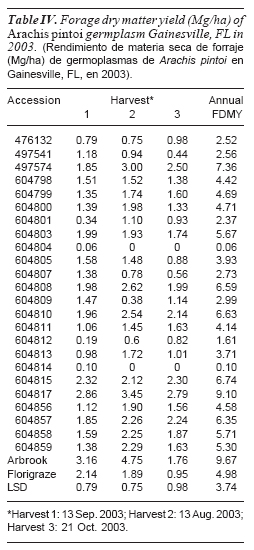
<body><![CDATA[<p><font face="Verdana" size="2">Forage dry matter yield (FDMY) was estimated on three dates during 2003, with an interval of 8 weeks between harvests. These dates were June 13<sup>th</sup> (Harvest 1), August 13<sup>th</sup> (Harvest 2), and October 21<sup>st</sup> (Harvest 3). To estimate FDMY a sample of 0.25 m<sup>2</sup> was harvested at ground level using battery-powered hand clippers as a cutting tool. Pintoi peanut and weeds were manually separated and the samples were placed in a 65<sup>o</sup>C forced-air drier for 72 h. Dry weight was measured using a digital scale. Plot borders were uniformly cut at soil level with a rotary lawn mowing tractor after each harvest.</font></p>     <p><font face="Verdana" size="2">FDMY was analyzed with Proc GLM of SAS (SAS, 1989) using the following model:</font></p>     <p><img src="/img/revistas/azoo/v61n233/art3_2.jpg"></p>     <p><font face="Verdana" size="2">Where:</font></p>     <p><font face="Verdana" size="2">&mu;= mean;    <br>B<sub>l</sub>= block effect;    <br>A<sub>j</sub>= accession effect;    <br>e<sub>lj</sub>= experimental error.</font></p>     <p><font face="Verdana" size="2">LSD at 5% significance level was used as the mean separation test. </font></p>     <p><font face="Verdana" size="2">This same model was used for forage nutritive value and seed production.</font></p>     ]]></body>
<body><![CDATA[<p><font face="Verdana" size="2">FORAGE NUTRITIVE VALUE</font></p>     <p><font face="Verdana" size="2">Forage samples harvested on August 13<sup>th</sup> 2003 were ground in a Wiley Mill, to pass through a 1 mm screen. This ground tissue was analyzed for crude protein and <i>in vitro</i> organic matter digestibility (IVOMD).</font></p>     <p><font face="Verdana" size="2">The nitrogen (N) analysis started with sample digestion using a modification of the aluminum block digestion procedure (Gallaher <i>et al.</i>, 1975). In this procedure samples of 0.25 g and catalyst of 1.5 g of 9:1 K2SO<sub>4</sub>:CuSO<sub>4</sub> were used during a 4 h digestion at 375<sup>o</sup>C using 6 mL of H<sub>2</sub>SO<sub>4</sub> and 2 mL of H<sub>2</sub>O<sub>2</sub>. Digestate was then filtrated and N was determined by semiautomated colorimetry (Hambleton, 1977).</font></p>     <p><font face="Verdana" size="2">IVOMD was performed by a modified two-stage technique (Moore and Mott, 1974). Both crude protein and IVOMD were expressed on an organic matter basis.</font></p>     <p><font face="Verdana" size="2">SEED PRODUCTION</font></p>     <p><font face="Verdana" size="2">In February 2003 and 2004 plots were sampled to assess seed production. Single samples were taken in each plot using a soil core sampler of 12.5 cm diameter and 24 cm depth (0.01227 m<sup>3</sup>). The soil was screened on a sieve with a 0.6 x 0.6 cm mesh to remove the pods from the soil. The pods were then dried at room temperature for 6 weeks and weighed. Calculations were made to extrapolate the values in terms of production per hectare.</font></p>     <p>&nbsp;</p>     <p><font face="Verdana" size="2"><b>Results and discussion</b></font></p>     <p><font face="Verdana" size="2">ADAPTATION AND FORAGE DRY MATTER YIELD</font></p>     <p><font face="Verdana" size="2">The evaluations performed in 2002, eight, eleven, and twelve months after planting, revealed that although <i>A. pintoi</i> presented great reduction of green tissue during the winter, most plants did not die, and in fact, they fully recovered when the temperature warmed up and soil moisture increased (<b><a href="#t3">table III</a></b>). During the 2001/2002 winter, temperatures reached 0<sup>o</sup>C or less on 24 different occasions.</font></p>     ]]></body>
<body><![CDATA[<p>&nbsp;</p>     <p align=center><a name="t3"><img border="0" src="/img/revistas/azoo/v61n233/art3_tabla3.jpg" width="516" height="526"></a></p>     <p>&nbsp;</p>     <p><font face="Verdana" size="2">The average plant survival (PS%) in Evaluation 1 was 79%, which shows that <i>A. pintoi</i> can tolerate winters where freezing and frosting are normal occurrences. However, when rate of spread (RS) was analyzed, most of the accessions were covering less than 50% of the plot area. Cultivars Florigraze and Arbrook presented 100% of plant survival, but they also covered less than 50% of the plot area.</font></p>     <p><font face="Verdana" size="2">This same trend was displayed in Evaluations 2 and 3, where average plant survival recorded was superior to 80% and plot coverage inferior to 50%. Actuality, this is one of the biggest problems that <i>A. pintoi</i> and also <i>A. glabrata</i> display, the fact that both species required a long period to establish themselves and cover the area where they were planted.</font></p>     <p><font face="Verdana" size="2">Even with general small plot cover, differences among accessions were noted regarding plant survival and plot coverage, which is an indication of variation in adaptation to the north Florida environment. Accessions PI 497574, 604798, 604800, 604803, 604807, 604814, 604817, and 604857 were the ones that appeared better adapted, with values of plant survival and rate of spread superior to the others.</font></p>     <p><font face="Verdana" size="2">Pizarro and Rincón (1994) affirmed that <i>A. pintoi</i> slow establishment is a limitation to adoption as producers want to see quick results. They suggested that when seeds are used as the propagation material the establishment time is shortened compared to vegetative propagation. French <i>et al.</i> (1994) stated that although adequate establishment has been achieved in Florida with rhizoma peanut (<i>A. glabrata</i>) in a single year, a typical planting demands 2 to 3 yr for full development. Cook <i>et al.</i> (1994) agreed with the authors previously cited. They believe that the major constraint to farmer acceptance of these species is the complexity and cost of establishment.</font></p>     <p><font face="Verdana" size="2">Slow establishment is particularly significant where weed pressure is high. This fact will require extra resources to assure an adequate initial coverage that will extend the period of utilization of the pasture or hay field. Research is necessary to determine the best planting method, using the different factors that could result in a fast and inexpensive pasture establishment.</font></p>     <p><font face="Verdana" size="2">A careful analysis of these evaluations demonstrates that there are large differences among accessions in relation to environmental adaptation. Accessions PI 604801, 604804, 604812, 604814, and 604859, presented small plot coverage in each one of the three evalutions.</font></p>     <p><font face="Verdana" size="2">Forage dry matter yield (FDMY) was assessed three times during summer 2003 with an 8-week interval between harvests. Significant differences (p&lt;0.01) were present among accessions in all three FDMY harvests, indicating that accessions showed variability in their environmental adaptation, an attribute that will consequently impact their forage production potential.</font></p>     ]]></body>
<body><![CDATA[<p><font face="Verdana" size="2">Forage dry matter yield at each harvest date in 2003 is presented in the <b><a href="#t4">table IV</a></b>. A large amount of variability was present among these <i>A. pintoi</i> accessions with respect to their FDMY. The average FDMY at harvest 1 was 1.34 Mg/ha, ranging from 0.06 to 2.86 Mg/ha. More than half of the accessions presented superior performance producing above the average, but accessions PI 604801, 604804, 604812, and 604814 had very low yields. These low yields are a reflection of poor plot coverage for these accessions. In comparison, accessions PI 604817, 604815, 604803, 604808, 604810, 604857, and 497574 were the most productive, showing no differences in FDMY to the rhizoma peanut cultivars.</font></p>     <p>&nbsp;</p>     <p align=center><a name="t4"><img border="0" src="/img/revistas/azoo/v61n233/art3_tabla4.jpg" width="254" height="550"></a></p>     <p>&nbsp;</p>     <p><font face="Verdana" size="2">At harvest 2, the average FDMY of <i>A. pintoi</i> germplasm showed a 20% increase reaching 1.62 Mg/ha. Accessions PI 604804 and 604814 showed no production, which reflects small plot coverage and poor adaptation to the north Florida environment. Here once more, half of the accessions presented superior performance with FDMY above the average. Accessions PI 604817 and 497574 were the most productive, showing no difference to Arbrook, which produced 4.75 Mg/ha. Florigraze however, was intermediate in FDMY and similar to a group of <i>A. pintoi</i> accessions. This is somewhat surprising, since it is regarded by many as the most adapted and productive of the rhizoma peanut cultivars.</font></p>     <p><font face="Verdana" size="2">Harvest 3 presented mean FDMY of 1.39 Mg/ha, which corresponded to a drop of about 20% in relation to the preceding harvest. Arbrook and Florigraze exhibited a 50% reduction in FDMY compared to previous period. <i>A. pintoi</i> germplasm also exhibited this reduction, however in a lower degree. This reduction in FDMY could represent a change in nutrient partitioning as a process to overcome restriction in growth due to the shortening days in autumn. Accessions PI 604817, 497574, 604815, and 604857 had the highest FDMY and were significantly higher than Florigraze and Arbrook rhizoma peanut.</font></p>     <p><font face="Verdana" size="2">Annual average FDMY for <i>A. pintoi</i> accessions was 4.36 Mg/ha (<b><a href="#t3">table III</a></b>). Arbrook produced 9.67 Mg/ha and was the most productive. Accessions PI 604817, 497574, 604815, 604810, 604808, and 604857 were the most productive among the <i>A. pintoi</i> germplasm and were not different from Arbrook.</font></p>     <p><font face="Verdana" size="2">Several <i>A. pintoi</i> accessions yielded more than 5 Mg/ha which can be considered a satisfactory legume production in north central Florida. In fact, this number is similar to yields displayed by other warm-season legumes used in Florida, and even could be compared to <i>A. pintoi</i> or others legume species yields obtained in tropical regions.</font></p>     <p><font face="Verdana" size="2">Kretschmer and Wilson (1988) reported 3-year average FDMY for <i>Desmodium heterocarpon</i> Florida, <i>Macroptilium atropurpureum</i> Siratro, and <i>Arachis kretschmeri</i> Pantanal of the order of 2.97, 2.39, and 1.16 Mg/ha respectively. Annual yields of <i>Stylosanthes guianensis</i> Savanna, <i>Alysicarpus vaginalis</i> and <i>Indigofera hirsuta</i>. Flamingo ranged from 5 to7 Mg/ha, in plantings at Brooksville, FL during years 1989 and 1990 (Williams <i>et al.</i>, 1993).Mislevy and Martin (2001) reported similar annual FDMY (5.70 Mg/ha) for <i>Aeschynomene evenia</i> at Ona, FL.</font></p>     <p><font face="Verdana" size="2">In tropical areas, comparable yields were presented by Souza <i>et al.</i> (1992) who evaluated <i>Stylosanthes</i> and <i>Centrosema</i> germplasm in central Brazil. Average FDMY of 1.50 Mg/ha were harvested in a 12-wk growing period during the summers of 1989 and 1990. Pizarro <i>et al.</i> (1996) reported annual FDMY of <i>Calopogonium mucunoides</i> of the order of 1.72 Mg/ha in research conducted at several different locations in South America.</font></p>     ]]></body>
<body><![CDATA[<p><font face="Verdana" size="2">Data from diverse agronomic characterization of <i>A. pintoi</i> are also similar to those presented in this work. Argel and Pizarro (1992) stated that cv. Amarillo produced 2.30 Mg/ha in Planaltina, Brazil, during the rainy season. In Australia, Cook <i>et al.</i> (1990) stated that Amarillo yielded 6.50 and 7.30 Mg/ha/yr in unirrigated and irrigated conditions respectively. Also in Australia, Cook <i>et al.</i> (1994) presented average annual yields of 5.80 Mg/ha for Amarillo in two years of evaluation.</font></p>     <p><font face="Verdana" size="2">FORAGE NUTRITIVE VALUE</font></p>     <p><font face="Verdana" size="2">Crude protein and IVOMD values of <i>A. pintoi</i> accessions from this research confirm those reported in the literature, and support the information that this species produces high nutritive value forage. The results endorse the claim of some that <i>A. pintoi</i> could be considered a  <i>tropical alfalfa</i> (<b><a href="#t5">table V</a></b>).</font></p>     <p>&nbsp;</p>     <p align=center><a name="t5"><img border="0" src="/img/revistas/azoo/v61n233/art3_tabla5.jpg" width="250" height="533"></a></p>     <p>&nbsp;</p>     <p><font face="Verdana" size="2">Average crude protein concentration across <i>A. pintoi</i> accessions was 180 g/kg ranging from 139 (PI 604800) to 225 g/kg (PI 604858). Florigraze CP was 172 g/kg while that of Arbrook was 153 g/kg. When CP of the <i>A. pintoi</i> germplasm was compared to the rhizoma peanut cultivars, the majority of the accessions demonstrated higher values than either rhizoma peanut cultivars.</font></p>     <p><font face="Verdana" size="2">Average IVOMD of the <i>A. pintoi</i> germplasm was 670 g/kg, and ranged from 600 to 730 g/kg. Accession PI 604812 had the lowest value, while PI 604801 was the highest. Florigraze presented the highest IVOMD value (740 g/kg), however several <i>A. pintoi</i> accessions were not different from it.</font></p>     <p><font face="Verdana" size="2">CP and IVOMD displayed in this research could be considered high and comparable to those reported for <i>A. pintoi</i> in other investigations. Average values of CP in the leaves of accession CIAT 17434 varied from 122 to 218 g/kg in Colombia, during dry and rainy seasons, respectively. In stems the same accession presented values of 93 and 135 g/kg during the same seasons (Argel and Pizarro, 1992). In Brazil, Purcino and Viana (1994) reported total-herbage CP values of 183, 157 and 161 g/kg, for accessions BRA-013251 (PI 338447), BRA015253 (PI 604859) and BRA-015598 (PI 604815), respectively. Rincon <i>et al.</i> (1992) reported CP values for the whole plant of 130 and 180 g/kg, during the dry and rainy season, respectively. Average values of IVOMD during the same periods were 67 and 62 g/kg.</font></p>     <p><font face="Verdana" size="2">Average IVOMD of 168 days growth forage from three <i>A. pintoi</i> accessions in Brazil was 610 g/kg (Pizarro <i>et al.</i>, 1992). In Australia, Amarillo IVDMD was 730 g/kg in 2 yr of evaluation (Cook <i>et al.</i>, 1994).</font></p>     ]]></body>
<body><![CDATA[<p><font face="Verdana" size="2">SEED PRODUCTION</font></p>     <p><font face="Verdana" size="2">Another important factor for which genetic variability should be investigated is seed production. In February 2003 and 2004, respectively, 18 and 30 mo after planting, samples were collected in each plot to assess this trait.</font></p>     <p><font face="Verdana" size="2">In 2003, the average seed production was 0.32 Mg/ha, ranging from zero to 2 Mg/ ha (<b><a href="#t6">table VI</a></b>). Only 60% of the <i>A. pintoi</i> germplasm yielded seeds, however, if we consider only those accessions with production above 0.1 Mg/ha this number falls below 50%. Accession PI 604857 was the most productive yielding 2 Mg/ha.</font></p>     <p>&nbsp;</p>     <p align=center><a name="t6"><img border="0" src="/img/revistas/azoo/v61n233/art3_tabla6.jpg" width="252" height="532"></a></p>     <p>&nbsp;</p>     <p><font face="Verdana" size="2">In 2004, with the exception of three accessions, all accession produced seeds. The average seed production was higher than the previous year reaching 0.43 Mg/ ha, ranging from zero to 1.58 Mg/ha (<b><a href="#t5">table V</a></b>). In general, yields of most accessions increased compared to 2003 evaluation. Exceptions were PI 604803, 604809, 604815, and 604857. Curiously, these accessions were among the most productive in 2003. Although 87% of the accessions produced some seeds, six of then yielded less than 0.10 Mg/ha, amount that would not be useful for commercial harvest. PI 604799 had the highest yield (1.58 Mg/ha) in 2004 although it was intermediate in seed yield in 2003.</font></p>     <p><font face="Verdana" size="2">Seed production obtained in this research for some of the accessions was comparable to that obtained by other authors working with <i>A. pintoi</i> in tropical conditions. For legumes this trait has particular importance because it can be related to persistence. A species with high seed production capacity may have an advantage over one lacking this characteristic, because in theory, pasture establishment by seeds is simpler and cheaper than when vegetative material is used. Also, plants established by seeds will grow faster (Baruch and Fisher, 1992), and consequently will have higher ground covered area. <i>A. pintoi</i> has also a notable characteristic that differentiates it from other legumes in relation to seed production, in that the seeds are located below ground.</font></p>     <p><font face="Verdana" size="2">As previously stated, yields in this research were comparable to others found in the literature. Cook and Franklin (1988) reported mechanized harvest yield for Amarillo in Australia of 1.40 Mg/ha 12 mo after planting. In other work, seed yield of Amarillo in Australia reached an average production of 2.80 Mg/ha (Cook and Loch, 1993).</font></p>     <p><font face="Verdana" size="2">In a Costa Rica location with 4260 mm annual rainfall, Diulgheroff <i>et al.</i> (1990) obtained seed yields of 1.95 Mg/ha, 12 months after sowing the cv. Maní Forrajero perenne. Also in Costa Rica, Argel and Valerio (1993) reported average yields of 0.59, 0.54, 0.50, and 0.52 Mg/ha over the accessions CIAT 17434 , 18744, and 18748, at 8, 12, 16, and 20 mo after sowing, respectively. Rincon <i>et al.</i> (1992) stated that seed yields of 2 Mg/ha were obtained for cv. Maní Forrajero perenne in mixed pasture with Brachiaria under grazing. This supports the idea of excellent persistence potential for <i>A. pintoi</i> due to seedling recruitment.</font></p>     ]]></body>
<body><![CDATA[<p>&nbsp;</p>     <p><font face="Verdana" size="2"><b>Conclusions</b></font></p>     <p><font face="Verdana" size="2"><i>Arachis pintoi</i> germplasm displayed large variability with respect to its adaptation, dry matter yield, nutritive value and seed production.</font></p>     <p><font face="Verdana" size="2">Annual average dry matter yield for some <i>A. pintoi</i> accessions was close to the forage production presented by both rhizoma peanut cultivars. Crude protein and IVOMD were high and confirmed the fact that <i>A. pintoi</i> has superior nutritive value.</font></p>     <p><font face="Verdana" size="2">Some accessions produce elevated seed yields reaching values superior to 1 Mg/ha 18 and 30 mo after sowing, which would give a pintoi peanut cultivar a great advantage over a rhizoma peanut cultivar, in terms of pasture establishment and seedling recruitment, if similar forage yields and persistence were present.</font></p>     <p><font face="Verdana" size="2">The information generated by this research reaffirms once more for plant selectors and plant breeders that conclusions about a species genetic diversity, adaptation to environments, and agronomic characteristics must not be based on a single or small number of germplasm accessions. This information will also be useful for genetic resources management, germplasm selection and plant breeding programs, and genetic studies in general. Ultimately, this work will contribute for the utilization of the genetic resources of <i>A. pintoi</i> stored in the germplasm banks.</font></p>     <p>&nbsp;</p>     <p><font face="Verdana" size="2"><b>References</b></font></p>     <!-- ref --><p><font face="Verdana" size="2">Argel, P.J. 1994. Regional experience with forage Arachis in Central America. In: P.C. Kerridge and B. Hardy (ed.). Biology and agronomy of forage Arachis. CIAT. Cali. Colombia. pp. 134-143.    &nbsp;&nbsp;&nbsp;&nbsp;&nbsp;&nbsp;&nbsp;&nbsp;[&#160;<a href="javascript:void(0);" onclick="javascript: window.open('/scielo.php?script=sci_nlinks&ref=1013190&pid=S0004-0592201200010000300001&lng=','','width=640,height=500,resizable=yes,scrollbars=1,menubar=yes,');">Links</a>&#160;]<!-- end-ref --></font></p>    ]]></body>
<body><![CDATA[<!-- ref --><p><font face="Verdana" size="2">Argel, P.J. and Valerio, A. 1993. Effect of crop age on seed yield of <i>Arachis pintoi</i> at two sites in Costa Rica, Central America. In: Proc. Int. Grassl. Congr., 17<sup>th</sup>. Palmerston North. New Zealand. 8-21 Feb. New Zealand Grassland Association. pp. 1696-1698.    &nbsp;&nbsp;&nbsp;&nbsp;&nbsp;&nbsp;&nbsp;&nbsp;[&#160;<a href="javascript:void(0);" onclick="javascript: window.open('/scielo.php?script=sci_nlinks&ref=1013192&pid=S0004-0592201200010000300002&lng=','','width=640,height=500,resizable=yes,scrollbars=1,menubar=yes,');">Links</a>&#160;]<!-- end-ref --></font></p>    <!-- ref --><p><font face="Verdana" size="2">Argel, P.J. and Pizarro, E.A. 1992. Germplasm case study: <i>Arachis pintoi</i>. In: Pastures for the tropical lowlands-CIAT's Contribuition. CIAT. Cali. Colombia. pp. 57-76.    &nbsp;&nbsp;&nbsp;&nbsp;&nbsp;&nbsp;&nbsp;&nbsp;[&#160;<a href="javascript:void(0);" onclick="javascript: window.open('/scielo.php?script=sci_nlinks&ref=1013194&pid=S0004-0592201200010000300003&lng=','','width=640,height=500,resizable=yes,scrollbars=1,menubar=yes,');">Links</a>&#160;]<!-- end-ref --></font></p>    <!-- ref --><p><font face="Verdana" size="2">Baruch, Z. y Fisher, M. 1992. Efecto del método de siembra y de la textura del suelo sobre el crecimiento y desarrollo de <i>Arachis pintoi</i>. Proc. Reunión Sabanas. Red Internacional de Evaluación de Pastos Tropicales (RIEPT). CIAT. Brasília. Brazil.    &nbsp;&nbsp;&nbsp;&nbsp;&nbsp;&nbsp;&nbsp;&nbsp;[&#160;<a href="javascript:void(0);" onclick="javascript: window.open('/scielo.php?script=sci_nlinks&ref=1013196&pid=S0004-0592201200010000300004&lng=','','width=640,height=500,resizable=yes,scrollbars=1,menubar=yes,');">Links</a>&#160;]<!-- end-ref --></font></p>    <!-- ref --><p><font face="Verdana" size="2">Cook, B.G. and Loch, D.S.1993. Commercialisation of <i>Arachis pintoi</i> cv. Amarillo in northern Australia. Proc. Int. Grassl. Congr., 17<sup>th</sup>. Palmerston North. New Zealand Grassland Association. 8-21 Feb. New Zealand.    &nbsp;&nbsp;&nbsp;&nbsp;&nbsp;&nbsp;&nbsp;&nbsp;[&#160;<a href="javascript:void(0);" onclick="javascript: window.open('/scielo.php?script=sci_nlinks&ref=1013198&pid=S0004-0592201200010000300005&lng=','','width=640,height=500,resizable=yes,scrollbars=1,menubar=yes,');">Links</a>&#160;]<!-- end-ref --></font></p>    <!-- ref --><p><font face="Verdana" size="2">Cook, B.G. and Franklin, T.G. 1988. Crop management and seed harvesting of <i>Arachis pintoi</i> Krap. et Greg. nom. nud. J Appl Seed Prod, 6: 26-30.    &nbsp;&nbsp;&nbsp;&nbsp;&nbsp;&nbsp;&nbsp;&nbsp;[&#160;<a href="javascript:void(0);" onclick="javascript: window.open('/scielo.php?script=sci_nlinks&ref=1013200&pid=S0004-0592201200010000300006&lng=','','width=640,height=500,resizable=yes,scrollbars=1,menubar=yes,');">Links</a>&#160;]<!-- end-ref --></font></p>    ]]></body>
<body><![CDATA[<!-- ref --><p><font face="Verdana" size="2">Cook, B.G., Williams, R.J. and Wilson, G.P.M. 1990. Register of Australian plant cultivars. B. Legumes. 21. Arachis (a) <i>Arachis pintoi</i> Krap. & Greg. nom. nud. (pinto peanut) cv. Amarillo. Aust J Exp Agr, 30: 445-446.    &nbsp;&nbsp;&nbsp;&nbsp;&nbsp;&nbsp;&nbsp;&nbsp;[&#160;<a href="javascript:void(0);" onclick="javascript: window.open('/scielo.php?script=sci_nlinks&ref=1013202&pid=S0004-0592201200010000300007&lng=','','width=640,height=500,resizable=yes,scrollbars=1,menubar=yes,');">Links</a>&#160;]<!-- end-ref --></font></p>    <!-- ref --><p><font face="Verdana" size="2">Cook, B.G., Jones, R.M. and Williams, R.J. 1994. Regional experience with forage Arachis in Australia. In: P.C. Kerridge and B. Hardy (Eds.). Biology and agronomy of forage Arachis. CIAT. Cali. Colombia. pp. 158-168.    &nbsp;&nbsp;&nbsp;&nbsp;&nbsp;&nbsp;&nbsp;&nbsp;[&#160;<a href="javascript:void(0);" onclick="javascript: window.open('/scielo.php?script=sci_nlinks&ref=1013204&pid=S0004-0592201200010000300008&lng=','','width=640,height=500,resizable=yes,scrollbars=1,menubar=yes,');">Links</a>&#160;]<!-- end-ref --></font></p>    <!-- ref --><p><font face="Verdana" size="2">Diulgheroff, S., Pizarro, E.A., Ferguson, J.E. and Argel, P.J. 1990. Seed multiplication of tropical forage species in Costa Rica. Past Trop, 12: 15-23.    &nbsp;&nbsp;&nbsp;&nbsp;&nbsp;&nbsp;&nbsp;&nbsp;[&#160;<a href="javascript:void(0);" onclick="javascript: window.open('/scielo.php?script=sci_nlinks&ref=1013206&pid=S0004-0592201200010000300009&lng=','','width=640,height=500,resizable=yes,scrollbars=1,menubar=yes,');">Links</a>&#160;]<!-- end-ref --></font></p>    <!-- ref --><p><font face="Verdana" size="2">French, E.C., Prine, G.M., Ocumpaugh, W.R. and Rice, R.W. 1994. Regional experience with forage Arachis in the United States. In: P.C. Kerridge and B. Hardy (Eds.). Biology and agronomy of forage Arachis. CIAT. Cali. Colombia. pp. 169-186.    &nbsp;&nbsp;&nbsp;&nbsp;&nbsp;&nbsp;&nbsp;&nbsp;[&#160;<a href="javascript:void(0);" onclick="javascript: window.open('/scielo.php?script=sci_nlinks&ref=1013208&pid=S0004-0592201200010000300010&lng=','','width=640,height=500,resizable=yes,scrollbars=1,menubar=yes,');">Links</a>&#160;]<!-- end-ref --></font></p>    <!-- ref --><p><font face="Verdana" size="2">Gallaher, R.N., Weldon, C.O. and Futral, J.G. 1975. An aluminum block digester for plant and soil analysis. Soil Sci Soc Am Proc, 39: 803-806.    &nbsp;&nbsp;&nbsp;&nbsp;&nbsp;&nbsp;&nbsp;&nbsp;[&#160;<a href="javascript:void(0);" onclick="javascript: window.open('/scielo.php?script=sci_nlinks&ref=1013210&pid=S0004-0592201200010000300011&lng=','','width=640,height=500,resizable=yes,scrollbars=1,menubar=yes,');">Links</a>&#160;]<!-- end-ref --></font></p>    ]]></body>
<body><![CDATA[<!-- ref --><p><font face="Verdana" size="2">Hambleton, L.G. 1977. Semiautomated method for simultaneous determination of phosphorous, calcium and crude protein in animal feeds. J.A.O.A.C., 60: 845-852.    &nbsp;&nbsp;&nbsp;&nbsp;&nbsp;&nbsp;&nbsp;&nbsp;[&#160;<a href="javascript:void(0);" onclick="javascript: window.open('/scielo.php?script=sci_nlinks&ref=1013212&pid=S0004-0592201200010000300012&lng=','','width=640,height=500,resizable=yes,scrollbars=1,menubar=yes,');">Links</a>&#160;]<!-- end-ref --></font></p>    <!-- ref --><p><font face="Verdana" size="2">Kretschmer, A.E. and Wilson, T.C. 1988. A new seed production <i>Arachis</i> sp. with potential as a forage in Florida. Soil Crop Sci Soc Fla Proc, 47: 229-233.    &nbsp;&nbsp;&nbsp;&nbsp;&nbsp;&nbsp;&nbsp;&nbsp;[&#160;<a href="javascript:void(0);" onclick="javascript: window.open('/scielo.php?script=sci_nlinks&ref=1013214&pid=S0004-0592201200010000300013&lng=','','width=640,height=500,resizable=yes,scrollbars=1,menubar=yes,');">Links</a>&#160;]<!-- end-ref --></font></p>    <!-- ref --><p><font face="Verdana" size="2">Mislevy, P. and Martin, E.G. 2001. Harvest management of <i>Aeschynomene evenia</i>. Proc. Soil and Crop Science Society of Florida. Stuart. Florida. pp. 35-37.    &nbsp;&nbsp;&nbsp;&nbsp;&nbsp;&nbsp;&nbsp;&nbsp;[&#160;<a href="javascript:void(0);" onclick="javascript: window.open('/scielo.php?script=sci_nlinks&ref=1013216&pid=S0004-0592201200010000300014&lng=','','width=640,height=500,resizable=yes,scrollbars=1,menubar=yes,');">Links</a>&#160;]<!-- end-ref --></font></p>    <!-- ref --><p><font face="Verdana" size="2">Moore, J.E. and Mott, G.O. 1974. Recovery of residual organic matter from <i>in vitro</i> digestion of forages. J Dairy Sci, 57: 1258-1259.    &nbsp;&nbsp;&nbsp;&nbsp;&nbsp;&nbsp;&nbsp;&nbsp;[&#160;<a href="javascript:void(0);" onclick="javascript: window.open('/scielo.php?script=sci_nlinks&ref=1013218&pid=S0004-0592201200010000300015&lng=','','width=640,height=500,resizable=yes,scrollbars=1,menubar=yes,');">Links</a>&#160;]<!-- end-ref --></font></p>    <!-- ref --><p><font face="Verdana" size="2">Pizarro, E.A. and Rincón, A.C. 1994. Regional experience with forage <i>Arachis</i> in South America. In: P.C. Kerridge and B. Hardy (ed.). Biology and agronomy of forage Arachis. CIAT. Cali. Colombia. pp. 144-157.    &nbsp;&nbsp;&nbsp;&nbsp;&nbsp;&nbsp;&nbsp;&nbsp;[&#160;<a href="javascript:void(0);" onclick="javascript: window.open('/scielo.php?script=sci_nlinks&ref=1013220&pid=S0004-0592201200010000300016&lng=','','width=640,height=500,resizable=yes,scrollbars=1,menubar=yes,');">Links</a>&#160;]<!-- end-ref --></font></p>    ]]></body>
<body><![CDATA[<!-- ref --><p><font face="Verdana" size="2">Pizarro, E.A., Ramos, A.K.B. and Carvalho, M.A. 1996. Forage potential and seed production of accessions of selected <i>Calopogonium mucunoides</i> in the Brazilian Cerrados. Past Trop, 18: 25-31.    &nbsp;&nbsp;&nbsp;&nbsp;&nbsp;&nbsp;&nbsp;&nbsp;[&#160;<a href="javascript:void(0);" onclick="javascript: window.open('/scielo.php?script=sci_nlinks&ref=1013222&pid=S0004-0592201200010000300017&lng=','','width=640,height=500,resizable=yes,scrollbars=1,menubar=yes,');">Links</a>&#160;]<!-- end-ref --></font></p>    <!-- ref --><p><font face="Verdana" size="2">Pizarro, E.A., Carvalho,M.A., Valls, J.F.M. y Maciel, D. 1992.  <i>Arachis</i> spp.: Evaluación agronómica en áreas bajas del Cerrado. En: Proc. Reunión Sabanas. Red Internacional de Evaluación de Pastos Tropicales (RIEPT). CIAT. Brasília. Brazil. pp. 353-356.    &nbsp;&nbsp;&nbsp;&nbsp;&nbsp;&nbsp;&nbsp;&nbsp;[&#160;<a href="javascript:void(0);" onclick="javascript: window.open('/scielo.php?script=sci_nlinks&ref=1013224&pid=S0004-0592201200010000300018&lng=','','width=640,height=500,resizable=yes,scrollbars=1,menubar=yes,');">Links</a>&#160;]<!-- end-ref --></font></p>    <!-- ref --><p><font face="Verdana" size="2">Purcino, H.M.A. and Viana, M.C.M. 1994. Preliminary evaluations of <i>Arachis pintoi</i> in lowland areas. Proc. da Reuni&atilde;o Anual da Soc. Bras. Zootec. 31<sup>st</sup>. Maringá, PR. EDUEM. Brazil.    &nbsp;&nbsp;&nbsp;&nbsp;&nbsp;&nbsp;&nbsp;&nbsp;[&#160;<a href="javascript:void(0);" onclick="javascript: window.open('/scielo.php?script=sci_nlinks&ref=1013226&pid=S0004-0592201200010000300019&lng=','','width=640,height=500,resizable=yes,scrollbars=1,menubar=yes,');">Links</a>&#160;]<!-- end-ref --></font></p>    <!-- ref --><p><font face="Verdana" size="2">Rincón, A.C., Cuesta, M.P.A., Pérez, B.R., Lascano, C.E. y Fergunson, J. 1992. Maní forrajero perenne (<i>Arachis pintoi</i> Krapovickas et Gregory): Una alternativa para ganaderos y agricultores. Boletín Técnico 219. IAC/CIAT. Cali. Colombia.    &nbsp;&nbsp;&nbsp;&nbsp;&nbsp;&nbsp;&nbsp;&nbsp;[&#160;<a href="javascript:void(0);" onclick="javascript: window.open('/scielo.php?script=sci_nlinks&ref=1013228&pid=S0004-0592201200010000300020&lng=','','width=640,height=500,resizable=yes,scrollbars=1,menubar=yes,');">Links</a>&#160;]<!-- end-ref --></font></p>    <!-- ref --><p><font face="Verdana" size="2">SAS. 1989. SAS/STAT User's Guide, Version 6. 4<sup>th</sup> ed. SAS Inst. Inc. Cary. NC.    &nbsp;&nbsp;&nbsp;&nbsp;&nbsp;&nbsp;&nbsp;&nbsp;[&#160;<a href="javascript:void(0);" onclick="javascript: window.open('/scielo.php?script=sci_nlinks&ref=1013230&pid=S0004-0592201200010000300021&lng=','','width=640,height=500,resizable=yes,scrollbars=1,menubar=yes,');">Links</a>&#160;]<!-- end-ref --></font></p>    ]]></body>
<body><![CDATA[<!-- ref --><p><font face="Verdana" size="2">Sousa, M.A., Pizarro, E.A., Carvalho, M.A., Grof, B. and Schulz, A.L. 1992. Agronomic evaluation of forage grasses and legumes in Planaltina, Distrito Federal, Brasília. In: Proc. Reunión Sabanas. Red Internacional de Evaluación de Pastos Tropicales (RIEPT). Brasília. CIAT. Brazil.    &nbsp;&nbsp;&nbsp;&nbsp;&nbsp;&nbsp;&nbsp;&nbsp;[&#160;<a href="javascript:void(0);" onclick="javascript: window.open('/scielo.php?script=sci_nlinks&ref=1013232&pid=S0004-0592201200010000300022&lng=','','width=640,height=500,resizable=yes,scrollbars=1,menubar=yes,');">Links</a>&#160;]<!-- end-ref --></font></p>    <!-- ref --><p><font face="Verdana" size="2">Williams, M.J., Chambliss, C.G. and Brolmann, J.B. 1993. Potential of Savanna stylo as a stockpiled forage for the subtropical USA. J Prod Agric, 6: 553-556.    &nbsp;&nbsp;&nbsp;&nbsp;&nbsp;&nbsp;&nbsp;&nbsp;[&#160;<a href="javascript:void(0);" onclick="javascript: window.open('/scielo.php?script=sci_nlinks&ref=1013234&pid=S0004-0592201200010000300023&lng=','','width=640,height=500,resizable=yes,scrollbars=1,menubar=yes,');">Links</a>&#160;]<!-- end-ref --></font></p>     <p>&nbsp;</p>     <p>&nbsp;</p>     <p><font face="Verdana" size="2">Recibido: 10-6-09    <br>Aceptado: 12-5-10</font></p>      ]]></body><back>
<ref-list>
<ref id="B1">
<nlm-citation citation-type="book">
<person-group person-group-type="author">
<name>
<surname><![CDATA[Argel]]></surname>
<given-names><![CDATA[P.J]]></given-names>
</name>
</person-group>
<article-title xml:lang="en"><![CDATA[Regional experience with forage Arachis in Central America]]></article-title>
<person-group person-group-type="editor">
<name>
<surname><![CDATA[Kerridge]]></surname>
<given-names><![CDATA[P.C.]]></given-names>
</name>
<name>
<surname><![CDATA[Hardy]]></surname>
<given-names><![CDATA[B.]]></given-names>
</name>
</person-group>
<source><![CDATA[Biology and agronomy of forage Arachis]]></source>
<year>1994</year>
<page-range>134-143</page-range><publisher-loc><![CDATA[Cali ]]></publisher-loc>
<publisher-name><![CDATA[CIAT]]></publisher-name>
</nlm-citation>
</ref>
<ref id="B2">
<nlm-citation citation-type="confpro">
<person-group person-group-type="author">
<name>
<surname><![CDATA[Argel]]></surname>
<given-names><![CDATA[P.J.]]></given-names>
</name>
<name>
<surname><![CDATA[Valerio]]></surname>
<given-names><![CDATA[A]]></given-names>
</name>
</person-group>
<article-title xml:lang="en"><![CDATA[Effect of crop age on seed yield of Arachis pintoi at two sites in Costa Rica, Central America]]></article-title>
<source><![CDATA[Proc.]]></source>
<year>1993</year>
<conf-name><![CDATA[17 Int. Grassl. Congr.]]></conf-name>
<conf-date>8-21 Feb</conf-date>
<conf-loc>Palmerston North </conf-loc>
<page-range>1696-1698</page-range><publisher-name><![CDATA[New Zealand Grassland Association]]></publisher-name>
</nlm-citation>
</ref>
<ref id="B3">
<nlm-citation citation-type="book">
<person-group person-group-type="author">
<name>
<surname><![CDATA[Argel]]></surname>
<given-names><![CDATA[P.J.]]></given-names>
</name>
<name>
<surname><![CDATA[Pizarro]]></surname>
<given-names><![CDATA[E.A]]></given-names>
</name>
</person-group>
<article-title xml:lang="en"><![CDATA[Germplasm case study: Arachis pintoi]]></article-title>
<source><![CDATA[Pastures for the tropical lowlands: CIAT's Contribuition]]></source>
<year>1992</year>
<page-range>57-76</page-range><publisher-loc><![CDATA[Cali ]]></publisher-loc>
<publisher-name><![CDATA[CIAT]]></publisher-name>
</nlm-citation>
</ref>
<ref id="B4">
<nlm-citation citation-type="confpro">
<person-group person-group-type="author">
<name>
<surname><![CDATA[Baruch]]></surname>
<given-names><![CDATA[Z.]]></given-names>
</name>
<name>
<surname><![CDATA[Fisher]]></surname>
<given-names><![CDATA[M]]></given-names>
</name>
</person-group>
<article-title xml:lang="es"><![CDATA[Efecto del método de siembra y de la textura del suelo sobre el crecimiento y desarrollo de Arachis pintoi]]></article-title>
<source><![CDATA[Proc.]]></source>
<year>1992</year>
<conf-name><![CDATA[ Reunión Sabanas]]></conf-name>
<conf-loc> </conf-loc>
<publisher-loc><![CDATA[Brasília ]]></publisher-loc>
<publisher-name><![CDATA[CIAT]]></publisher-name>
</nlm-citation>
</ref>
<ref id="B5">
<nlm-citation citation-type="confpro">
<person-group person-group-type="author">
<name>
<surname><![CDATA[Cook]]></surname>
<given-names><![CDATA[B.G.]]></given-names>
</name>
<name>
<surname><![CDATA[Loch]]></surname>
<given-names><![CDATA[D.S]]></given-names>
</name>
</person-group>
<article-title xml:lang="en"><![CDATA[Commercialisation of Arachis pintoi cv. Amarillo in northern Australia]]></article-title>
<source><![CDATA[Proc.]]></source>
<year>1993</year>
<conf-name><![CDATA[17 Int. Grassl. Congr.]]></conf-name>
<conf-date>8-21 Feb</conf-date>
<conf-loc>Palmerston North </conf-loc>
<publisher-loc><![CDATA[New Zealand ]]></publisher-loc>
</nlm-citation>
</ref>
<ref id="B6">
<nlm-citation citation-type="journal">
<person-group person-group-type="author">
<name>
<surname><![CDATA[Cook]]></surname>
<given-names><![CDATA[B.G.]]></given-names>
</name>
<name>
<surname><![CDATA[Franklin]]></surname>
<given-names><![CDATA[T.G]]></given-names>
</name>
</person-group>
<article-title xml:lang="en"><![CDATA[Crop management and seed harvesting of Arachis pintoi Krap. et Greg. nom. nud]]></article-title>
<source><![CDATA[J Appl Seed Prod]]></source>
<year>1988</year>
<volume>6</volume>
<page-range>26-30</page-range></nlm-citation>
</ref>
<ref id="B7">
<nlm-citation citation-type="journal">
<person-group person-group-type="author">
<name>
<surname><![CDATA[Cook]]></surname>
<given-names><![CDATA[B.G.]]></given-names>
</name>
<name>
<surname><![CDATA[Williams]]></surname>
<given-names><![CDATA[R.J.]]></given-names>
</name>
<name>
<surname><![CDATA[Wilson]]></surname>
<given-names><![CDATA[G.P.M]]></given-names>
</name>
</person-group>
<article-title xml:lang="en"><![CDATA[Register of Australian plant cultivars: B. Legumes. 21. Arachis (a) Arachis pintoi Krap. & Greg. nom. nud. (pinto peanut) cv. Amarillo.]]></article-title>
<source><![CDATA[Aust J Exp Agr]]></source>
<year>1990</year>
<volume>30</volume>
<page-range>445-446</page-range></nlm-citation>
</ref>
<ref id="B8">
<nlm-citation citation-type="book">
<person-group person-group-type="author">
<name>
<surname><![CDATA[Cook]]></surname>
<given-names><![CDATA[B.G.]]></given-names>
</name>
<name>
<surname><![CDATA[Jones]]></surname>
<given-names><![CDATA[R.M.]]></given-names>
</name>
<name>
<surname><![CDATA[Williams]]></surname>
<given-names><![CDATA[R.J]]></given-names>
</name>
</person-group>
<article-title xml:lang="en"><![CDATA[Regional experience with forage Arachis in Australia]]></article-title>
<person-group person-group-type="editor">
<name>
<surname><![CDATA[Kerridge]]></surname>
<given-names><![CDATA[P.C.]]></given-names>
</name>
<name>
<surname><![CDATA[Hardy]]></surname>
<given-names><![CDATA[B.]]></given-names>
</name>
</person-group>
<source><![CDATA[Biology and agronomy of forage Arachis]]></source>
<year>1994</year>
<page-range>158-168</page-range><publisher-loc><![CDATA[Cali ]]></publisher-loc>
<publisher-name><![CDATA[CIAT]]></publisher-name>
</nlm-citation>
</ref>
<ref id="B9">
<nlm-citation citation-type="journal">
<person-group person-group-type="author">
<name>
<surname><![CDATA[Diulgheroff]]></surname>
<given-names><![CDATA[S.]]></given-names>
</name>
<name>
<surname><![CDATA[Pizarro]]></surname>
<given-names><![CDATA[E.A.]]></given-names>
</name>
<name>
<surname><![CDATA[Ferguson]]></surname>
<given-names><![CDATA[J.E.]]></given-names>
</name>
<name>
<surname><![CDATA[Argel]]></surname>
<given-names><![CDATA[P.J]]></given-names>
</name>
</person-group>
<article-title xml:lang="en"><![CDATA[Seed multiplication of tropical forage species in Costa Rica]]></article-title>
<source><![CDATA[Past Trop]]></source>
<year>1990</year>
<volume>12</volume>
<page-range>15-23</page-range></nlm-citation>
</ref>
<ref id="B10">
<nlm-citation citation-type="book">
<person-group person-group-type="author">
<name>
<surname><![CDATA[French]]></surname>
<given-names><![CDATA[E.C.]]></given-names>
</name>
<name>
<surname><![CDATA[Prine]]></surname>
<given-names><![CDATA[G.M.]]></given-names>
</name>
<name>
<surname><![CDATA[Ocumpaugh]]></surname>
<given-names><![CDATA[W.R.]]></given-names>
</name>
<name>
<surname><![CDATA[Rice]]></surname>
<given-names><![CDATA[R.W]]></given-names>
</name>
</person-group>
<article-title xml:lang="en"><![CDATA[Regional experience with forage Arachis in the United States]]></article-title>
<person-group person-group-type="editor">
<name>
<surname><![CDATA[Kerridge]]></surname>
<given-names><![CDATA[P.C.]]></given-names>
</name>
<name>
<surname><![CDATA[Hardy]]></surname>
<given-names><![CDATA[B.]]></given-names>
</name>
</person-group>
<source><![CDATA[Biology and agronomy of forage Arachis]]></source>
<year>1994</year>
<page-range>169-186</page-range><publisher-loc><![CDATA[Cali ]]></publisher-loc>
<publisher-name><![CDATA[CIATColombia]]></publisher-name>
</nlm-citation>
</ref>
<ref id="B11">
<nlm-citation citation-type="journal">
<person-group person-group-type="author">
<name>
<surname><![CDATA[Gallaher]]></surname>
<given-names><![CDATA[R.N.]]></given-names>
</name>
<name>
<surname><![CDATA[Weldon]]></surname>
<given-names><![CDATA[C.O.]]></given-names>
</name>
<name>
<surname><![CDATA[Futral]]></surname>
<given-names><![CDATA[J.G]]></given-names>
</name>
</person-group>
<article-title xml:lang="en"><![CDATA[An aluminum block digester for plant and soil analysis]]></article-title>
<source><![CDATA[Soil Sci Soc Am Proc]]></source>
<year>1975</year>
<volume>39</volume>
<page-range>803-806</page-range></nlm-citation>
</ref>
<ref id="B12">
<nlm-citation citation-type="journal">
<person-group person-group-type="author">
<name>
<surname><![CDATA[Hambleton]]></surname>
<given-names><![CDATA[L.G]]></given-names>
</name>
</person-group>
<article-title xml:lang="en"><![CDATA[Semiautomated method for simultaneous determination of phosphorous, calcium and crude protein in animal feeds]]></article-title>
<source><![CDATA[J.A.O.A.C.]]></source>
<year>1977</year>
<volume>60</volume>
<page-range>845-852</page-range></nlm-citation>
</ref>
<ref id="B13">
<nlm-citation citation-type="journal">
<person-group person-group-type="author">
<name>
<surname><![CDATA[Kretschmer]]></surname>
<given-names><![CDATA[A.E.]]></given-names>
</name>
<name>
<surname><![CDATA[Wilson]]></surname>
<given-names><![CDATA[T.C]]></given-names>
</name>
</person-group>
<article-title xml:lang="en"><![CDATA[A new seed production Arachis sp. with potential as a forage in Florida]]></article-title>
<source><![CDATA[Soil Crop Sci Soc Fla Proc]]></source>
<year>1988</year>
<volume>47</volume>
<page-range>229-233</page-range></nlm-citation>
</ref>
<ref id="B14">
<nlm-citation citation-type="">
<person-group person-group-type="author">
<name>
<surname><![CDATA[Mislevy]]></surname>
<given-names><![CDATA[P.]]></given-names>
</name>
<name>
<surname><![CDATA[Martin]]></surname>
<given-names><![CDATA[E.G]]></given-names>
</name>
</person-group>
<article-title xml:lang="en"><![CDATA[Harvest management of Aeschynomene evenia]]></article-title>
<source><![CDATA[Proc. Soil and Crop Science Society of Florida]]></source>
<year>2001</year>
<page-range>35-37</page-range><publisher-loc><![CDATA[Stuart^eFlorida Florida]]></publisher-loc>
</nlm-citation>
</ref>
<ref id="B15">
<nlm-citation citation-type="journal">
<person-group person-group-type="author">
<name>
<surname><![CDATA[Moore]]></surname>
<given-names><![CDATA[J.E.]]></given-names>
</name>
<name>
<surname><![CDATA[Mott]]></surname>
<given-names><![CDATA[G.O]]></given-names>
</name>
</person-group>
<article-title xml:lang="en"><![CDATA[Recovery of residual organic matter from in vitro digestion of forages]]></article-title>
<source><![CDATA[J Dairy Sci]]></source>
<year>1974</year>
<volume>57</volume>
<page-range>1258-1259</page-range></nlm-citation>
</ref>
<ref id="B16">
<nlm-citation citation-type="book">
<person-group person-group-type="author">
<name>
<surname><![CDATA[Pizarro]]></surname>
<given-names><![CDATA[E.A.]]></given-names>
</name>
<name>
<surname><![CDATA[Rincón]]></surname>
<given-names><![CDATA[A.C]]></given-names>
</name>
</person-group>
<article-title xml:lang="en"><![CDATA[Regional experience with forage Arachis in South America]]></article-title>
<person-group person-group-type="editor">
<name>
<surname><![CDATA[Kerridge]]></surname>
<given-names><![CDATA[P.C.]]></given-names>
</name>
<name>
<surname><![CDATA[Hardy]]></surname>
<given-names><![CDATA[B.]]></given-names>
</name>
</person-group>
<source><![CDATA[Biology and agronomy of forage Arachis]]></source>
<year>1994</year>
<page-range>144-157</page-range><publisher-loc><![CDATA[Cali ]]></publisher-loc>
<publisher-name><![CDATA[CIATColombia]]></publisher-name>
</nlm-citation>
</ref>
<ref id="B17">
<nlm-citation citation-type="journal">
<person-group person-group-type="author">
<name>
<surname><![CDATA[Pizarro]]></surname>
<given-names><![CDATA[E.A.]]></given-names>
</name>
<name>
<surname><![CDATA[Ramos]]></surname>
<given-names><![CDATA[A.K.B.]]></given-names>
</name>
<name>
<surname><![CDATA[Carvalho]]></surname>
<given-names><![CDATA[M.A]]></given-names>
</name>
</person-group>
<article-title xml:lang="en"><![CDATA[Forage potential and seed production of accessions of selected Calopogonium mucunoides in the Brazilian Cerrados]]></article-title>
<source><![CDATA[Past Trop]]></source>
<year>1996</year>
<volume>18</volume>
<page-range>25-31</page-range></nlm-citation>
</ref>
<ref id="B18">
<nlm-citation citation-type="confpro">
<person-group person-group-type="author">
<name>
<surname><![CDATA[Pizarro]]></surname>
<given-names><![CDATA[E.A.]]></given-names>
</name>
<name>
<surname><![CDATA[Carvalho]]></surname>
<given-names><![CDATA[M.A.]]></given-names>
</name>
<name>
<surname><![CDATA[Valls]]></surname>
<given-names><![CDATA[J.F.M.]]></given-names>
</name>
<name>
<surname><![CDATA[Maciel]]></surname>
<given-names><![CDATA[D]]></given-names>
</name>
</person-group>
<article-title xml:lang="es"><![CDATA[Arachis spp.: Evaluación agronómica en áreas bajas del Cerrado]]></article-title>
<source><![CDATA[Proc.]]></source>
<year>1992</year>
<conf-name><![CDATA[ Reunión Sabanas]]></conf-name>
<conf-loc> </conf-loc>
<page-range>353-356</page-range><publisher-loc><![CDATA[Brasília ]]></publisher-loc>
<publisher-name><![CDATA[CIAT]]></publisher-name>
</nlm-citation>
</ref>
<ref id="B19">
<nlm-citation citation-type="confpro">
<person-group person-group-type="author">
<name>
<surname><![CDATA[Purcino]]></surname>
<given-names><![CDATA[H.M.A.]]></given-names>
</name>
<name>
<surname><![CDATA[Viana]]></surname>
<given-names><![CDATA[M.C.M]]></given-names>
</name>
</person-group>
<article-title xml:lang="en"><![CDATA[Preliminary evaluations of Arachis pintoi in lowland areas]]></article-title>
<source><![CDATA[Proc.]]></source>
<year>1994</year>
<conf-name><![CDATA[31 Reunião Anual da Soc. Bras. Zootec.]]></conf-name>
<conf-loc>Maringá PR</conf-loc>
<publisher-name><![CDATA[EDUEM]]></publisher-name>
</nlm-citation>
</ref>
<ref id="B20">
<nlm-citation citation-type="journal">
<person-group person-group-type="author">
<name>
<surname><![CDATA[Rincón]]></surname>
<given-names><![CDATA[A.C.]]></given-names>
</name>
<name>
<surname><![CDATA[Cuesta]]></surname>
<given-names><![CDATA[M.P.A.]]></given-names>
</name>
<name>
<surname><![CDATA[Pérez]]></surname>
<given-names><![CDATA[B.R.]]></given-names>
</name>
<name>
<surname><![CDATA[Lascano]]></surname>
<given-names><![CDATA[C.E.]]></given-names>
</name>
<name>
<surname><![CDATA[Fergunson]]></surname>
<given-names><![CDATA[J]]></given-names>
</name>
</person-group>
<article-title xml:lang="es"><![CDATA[Maní forrajero perenne (Arachis pintoi Krapovickas et Gregory): Una alternativa para ganaderos y agricultores]]></article-title>
<source><![CDATA[Boletín Técnico]]></source>
<year>1992</year>
<numero>219</numero>
<issue>219</issue>
<publisher-loc><![CDATA[Cali ]]></publisher-loc>
<publisher-name><![CDATA[IAC/CIAT]]></publisher-name>
</nlm-citation>
</ref>
<ref id="B21">
<nlm-citation citation-type="book">
<collab>SAS</collab>
<source><![CDATA[SAS/STAT User's Guide: Version 6]]></source>
<year>1989</year>
<edition>4</edition>
<publisher-loc><![CDATA[Cary^eNC NC]]></publisher-loc>
<publisher-name><![CDATA[SAS Inst.]]></publisher-name>
</nlm-citation>
</ref>
<ref id="B22">
<nlm-citation citation-type="confpro">
<person-group person-group-type="author">
<name>
<surname><![CDATA[Sousa]]></surname>
<given-names><![CDATA[M.A.]]></given-names>
</name>
<name>
<surname><![CDATA[Pizarro]]></surname>
<given-names><![CDATA[E.A.]]></given-names>
</name>
<name>
<surname><![CDATA[Carvalho]]></surname>
<given-names><![CDATA[M.A.]]></given-names>
</name>
<name>
<surname><![CDATA[Grof]]></surname>
<given-names><![CDATA[B.]]></given-names>
</name>
<name>
<surname><![CDATA[Schulz]]></surname>
<given-names><![CDATA[A.L.]]></given-names>
</name>
</person-group>
<article-title xml:lang="en"><![CDATA[Agronomic evaluation of forage grasses and legumes in Planaltina, Distrito Federal, Brasília]]></article-title>
<source><![CDATA[Proc.]]></source>
<year>1992</year>
<conf-name><![CDATA[ Reunión Sabanas]]></conf-name>
<conf-loc> </conf-loc>
<publisher-loc><![CDATA[Brasília ]]></publisher-loc>
<publisher-name><![CDATA[CIAT]]></publisher-name>
</nlm-citation>
</ref>
<ref id="B23">
<nlm-citation citation-type="journal">
<person-group person-group-type="author">
<name>
<surname><![CDATA[Williams]]></surname>
<given-names><![CDATA[M.J.]]></given-names>
</name>
<name>
<surname><![CDATA[Chambliss]]></surname>
<given-names><![CDATA[C.G.]]></given-names>
</name>
<name>
<surname><![CDATA[Brolmann]]></surname>
<given-names><![CDATA[J.B]]></given-names>
</name>
</person-group>
<article-title xml:lang="en"><![CDATA[Potential of Savanna stylo as a stockpiled forage for the subtropical USA]]></article-title>
<source><![CDATA[J Prod Agric]]></source>
<year>1993</year>
<volume>6</volume>
<page-range>553-556</page-range></nlm-citation>
</ref>
</ref-list>
</back>
</article>