<?xml version="1.0" encoding="ISO-8859-1"?><article xmlns:mml="http://www.w3.org/1998/Math/MathML" xmlns:xlink="http://www.w3.org/1999/xlink" xmlns:xsi="http://www.w3.org/2001/XMLSchema-instance">
<front>
<journal-meta>
<journal-id>0004-0592</journal-id>
<journal-title><![CDATA[Archivos de Zootecnia]]></journal-title>
<abbrev-journal-title><![CDATA[Arch. zootec.]]></abbrev-journal-title>
<issn>0004-0592</issn>
<publisher>
<publisher-name><![CDATA[Universidad de Córdoba]]></publisher-name>
</publisher>
</journal-meta>
<article-meta>
<article-id>S0004-05922012000100015</article-id>
<article-id pub-id-type="doi">10.4321/S0004-05922012000100015</article-id>
<title-group>
<article-title xml:lang="en"><![CDATA[Effects of selenium supplementation on serum cortisol in repeatedly handled cattle]]></article-title>
<article-title xml:lang="pt"><![CDATA[Efeito da suplementação com selênio no cortisol sérico em bovinos manejados repetidamente]]></article-title>
</title-group>
<contrib-group>
<contrib contrib-type="author">
<name>
<surname><![CDATA[Reis]]></surname>
<given-names><![CDATA[L.S.L.S.]]></given-names>
</name>
<xref ref-type="aff" rid="A01"/>
</contrib>
<contrib contrib-type="author">
<name>
<surname><![CDATA[Chiacchio]]></surname>
<given-names><![CDATA[S.B.]]></given-names>
</name>
<xref ref-type="aff" rid="A01"/>
</contrib>
<contrib contrib-type="author">
<name>
<surname><![CDATA[Oba]]></surname>
<given-names><![CDATA[E.]]></given-names>
</name>
<xref ref-type="aff" rid="A01"/>
</contrib>
<contrib contrib-type="author">
<name>
<surname><![CDATA[Pardo]]></surname>
<given-names><![CDATA[P.E.]]></given-names>
</name>
<xref ref-type="aff" rid="A02"/>
</contrib>
<contrib contrib-type="author">
<name>
<surname><![CDATA[Frazatti-Gallina]]></surname>
<given-names><![CDATA[N.M.]]></given-names>
</name>
<xref ref-type="aff" rid="A03"/>
</contrib>
</contrib-group>
<aff id="A01">
<institution><![CDATA[,Universidade Estadual Paulista Júlio de Mesquita Filho Faculdade de Medicina Veterinária e Zootecnia (FMVZ/UNESP) ]]></institution>
<addr-line><![CDATA[Botucatu SP]]></addr-line>
<country>Brazil</country>
</aff>
<aff id="A02">
<institution><![CDATA[,Universidade do Oeste Paulista  ]]></institution>
<addr-line><![CDATA[Presidente Prudente SP]]></addr-line>
<country>Brazil</country>
</aff>
<aff id="A03">
<institution><![CDATA[,Instituto Butantan Rabies Laboratory ]]></institution>
<addr-line><![CDATA[São Paulo SP]]></addr-line>
<country>Brazil</country>
</aff>
<pub-date pub-type="pub">
<day>00</day>
<month>03</month>
<year>2012</year>
</pub-date>
<pub-date pub-type="epub">
<day>00</day>
<month>03</month>
<year>2012</year>
</pub-date>
<volume>61</volume>
<numero>233</numero>
<fpage>141</fpage>
<lpage>144</lpage>
<copyright-statement/>
<copyright-year/>
<self-uri xlink:href="http://scielo.isciii.es/scielo.php?script=sci_arttext&amp;pid=S0004-05922012000100015&amp;lng=en&amp;nrm=iso"></self-uri><self-uri xlink:href="http://scielo.isciii.es/scielo.php?script=sci_abstract&amp;pid=S0004-05922012000100015&amp;lng=en&amp;nrm=iso"></self-uri><self-uri xlink:href="http://scielo.isciii.es/scielo.php?script=sci_pdf&amp;pid=S0004-05922012000100015&amp;lng=en&amp;nrm=iso"></self-uri><abstract abstract-type="short" xml:lang="en"><p><![CDATA[This study evaluated the relationship between Se supplementation and serum cortisol in repeatedly handled cattle. Sixty Nellore calves were randomly distributed into four experimental groups, which were fed a mineral-protein mixture added with Se to achieve individual daily supplementation of 0 (Gc), 3.6 (G3.6), 5.4 (G5.4) and 6.4 (G6.4) mg Se. Stressful handling procedures and blood sampling were performed on days 0, 15, 30, 60, 90 and 120. Serum cortisol increased until day 90 and decreased on day 120, irrespective of Se supplementation. This finding shows that cattle reached a stress state but adapted. Cortisol and Se levels were not markedly correlated. Serum Se increased over the course of the experiment in the supplemented groups. However, because serum Se decreased in Gc, it may have mobilized to form the selenoproteins needed to remove metabolic wastes from handling-related oxidative stress.]]></p></abstract>
<abstract abstract-type="short" xml:lang="pt"><p><![CDATA[Este estudo avaliou a relação entre suplementação com Se e cortisol sérico em gado manejado repetidamente. Sessenta bezerros Nelore foram distribuídos em quatro grupos, os quais se alimentaram de uma mistura mineral protéica acrescida de Se de modo a alcançar suplementação individual diária de 0 (Gc), 3.6 (G3.6), 5.4 (G5.4) or 6.4 (G6.4) mg Se. O estresse de manejo e as colheitas das amostras de sangue foram nos dias 0, 15, 30, 60, 90 e 120. O cortisol sérico aumentou até o dia 90 e reduziu no dia 120, independente da suplementação com Se. Isso indica que os bovinos ficaram estressados, mas se adaptaram ao longo do tempo. O cortisol e Se sérico não foram marcantemente correlacionados. A concentração de Se sérico aumentou ao longo do experimento nos grupos suplementados. Entretanto, como o Se sérico foi reduzido em Gc, deve-se considerar que ele pode ter sido mobilizado para formação de selenoproteínas necessárias à remoção dos restos metabólicos resultantes do estresse oxidativo desencadeado pelo estresse de manejo.]]></p></abstract>
<kwd-group>
<kwd lng="en"><![CDATA[Mineral mixture]]></kwd>
<kwd lng="en"><![CDATA[Stress]]></kwd>
<kwd lng="pt"><![CDATA[Mistura mineral]]></kwd>
<kwd lng="pt"><![CDATA[Estresse]]></kwd>
</kwd-group>
</article-meta>
</front><body><![CDATA[ <p><font face="Verdana" size="2"><b>SHORT NOTE</b></font></p>     <p>&nbsp;</p>     <p><font face="Verdana" size="4"><b>Effects of selenium supplementation on serum cortisol in repeatedly handled cattle</b></font></p>     <p><font face="Verdana" size="4"><b>Efeito da suplementa&ccedil;&atilde;o com sel&ecirc;nio no cortisol sérico em bovinos manejados repetidamente</b></font></p>     <p>&nbsp;</p>     <p>&nbsp;</p>     <p><font face="Verdana" size="2"><b>Reis, L.S.L.S.<sup>1*</sup>; Chiacchio, S.B.<sup>1</sup>; Oba, E.<sup>1</sup>; Pardo, P.E.<sup>2</sup> and Frazatti-Gallina, N.M.<sup>3</sup></b></font></p>     <p><font face="Verdana" size="2"><sup>1</sup>Universidade Estadual Paulista Júlio de Mesquita Filho. Faculdade de Medicina Veterinária e Zootecnia (FMVZ/UNESP). Botucatu-SP. Brazil. <sup>*</sup><a href="mailto:reis.lsls@gmail.com">reis.lsls@gmail.com</a>    <br><sup>2</sup>Universidade do Oeste Paulista. Presidente Prudente-SP. Brazil.    <br><sup>3</sup>Instituto Butantan. Rabies Laboratory. S&atilde;o Paulo-SP. Brazil.</font></p>     ]]></body>
<body><![CDATA[<p><font face="Verdana" size="2">Acknowledgements to Matsuda Sementes e Nutri&ccedil;&atilde;o Animal, Álvares Machado, SP, Brazil, for supporting and encouraging this research.</font></p>     <p>&nbsp;</p>     <p>&nbsp;</p> <hr size="1">     <p><font face="Verdana" size="2"><b>SUMMARY</b></font></p>     <p><font face="Verdana" size="2">This study evaluated the relationship between Se supplementation and serum cortisol in repeatedly handled cattle. Sixty Nellore calves were randomly distributed into four experimental groups, which were fed a mineral-protein mixture added with Se to achieve individual daily supplementation of 0 (Gc), 3.6 (G<sub>3.6</sub>), 5.4 (G<sub>5.4</sub>) and 6.4 (G<sub>6.4</sub>) mg Se. Stressful handling procedures and blood sampling were performed on days 0, 15, 30, 60, 90 and 120. Serum cortisol increased until day 90 and decreased on day 120, irrespective of Se supplementation. This finding shows that cattle reached a stress state but adapted. Cortisol and Se levels were not markedly correlated. Serum Se increased over the course of the experiment in the supplemented groups. However, because serum Se decreased in Gc, it may have mobilized to form the selenoproteins needed to remove metabolic wastes from handling-related oxidative stress.</font></p>     <p><font face="Verdana" size="2"><b>Key words:</b> Mineral mixture. Stress.</font></p> <hr size="1">     <p><font face="Verdana" size="2"><b>RESUMO</b></font></p>     <p><font face="Verdana" size="2">Este estudo avaliou a rela&ccedil;&atilde;o entre suplementa&ccedil;&atilde;o com Se e cortisol sérico em gado manejado repetidamente. Sessenta bezerros Nelore foram distribuídos em quatro grupos, os quais se alimentaram de uma mistura mineral protéica acrescida de Se de modo a alcan&ccedil;ar suplementa&ccedil;&atilde;o individual diária de 0 (Gc), 3.6 (G<sub>3.6</sub>), 5.4 (G<sub>5.4</sub>) or 6.4 (G<sub>6.4</sub>) mg Se. O estresse de manejo e as colheitas das amostras de sangue foram nos dias 0, 15, 30, 60, 90 e 120. O cortisol sérico aumentou até o dia 90 e reduziu no dia 120, independente da suplementa&ccedil;&atilde;o com Se. Isso indica que os bovinos ficaram estressados, mas se adaptaram ao longo do tempo. O cortisol e Se sérico n&atilde;o foram marcantemente correlacionados. A concentra&ccedil;&atilde;o de Se sérico aumentou ao longo do experimento nos grupos suplementados. Entretanto, como o Se sérico foi reduzido em Gc, deve-se considerar que ele pode ter sido mobilizado para forma&ccedil;&atilde;o de selenoproteínas necessárias à remo&ccedil;&atilde;o dos restos metabólicos resultantes do estresse oxidativo desencadeado pelo estresse de manejo.</font></p>     <p><font face="Verdana" size="2"><b>Palavras chave:</b> Mistura mineral. Estresse.</font></p> <hr size="1">     <p>&nbsp;</p>     ]]></body>
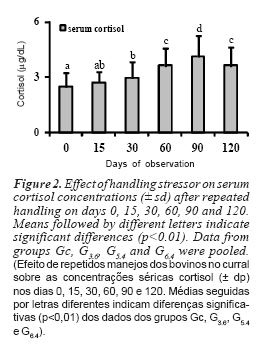
<body><![CDATA[<p><font face="Verdana" size="2"><b>Introduction</b></font></p>     <p><font face="Verdana" size="2">Handling cattle in the corral is a common practice that causes physical, psychological and metabolic and activation of the hypothalamus-pituitary-adrenal axis (HPA) and consequent release of cortisol, adrenalin and noradrenalin by the adrenal gland. Itcan promote oxidative stress, thereby increasing hydroperoxide and lipid peroxideproduction. These free radicals are detoxified by the glutathione peroxidase (GSH-Px), which can convert them into oxygen andwater or non-toxic fatty acid hydroxides (Carroll and Forsberg, 2007).</font></p>     <p>&nbsp;</p>     <p><font face="Verdana" size="2"><b>Materials and methods</b></font></p>     <p><font face="Verdana" size="2">Sixty uncastrated male Nellore calves (<i>Bos taurus indicus</i>) aged 10 to 12 months and acclimatized to an extensive pasture system in  <i>Brachiaria decumbens</i> pasture for at least 30 days were tested. They were equally and randomly distributed into four experimental groups that received <i>ad libitum</i> protein-mineral mixture supplemented with Se at different concentrations. Considering a daily consumption of 200 g of mixture, individual Se supplementation provided by each diet was 0 mg (Gc, Se-free mixture), 3.6 mg (G<sub>3.6</sub>, 18 mg Se/kg feed), 5.4 mg (G<sub>5.4</sub>, 27 mg Se/kg feed) and 6.4 mg (G<sub>6.4</sub>, 32 mg Se/kg feed). The protein mineral mixture (Top Line Recria<sup>&reg;</sup>, <i>Matsuda Sementes e Nutri&ccedil;&atilde;o Animal</i>) contained calcium, phosphorus, magnesium, sodium, cobalt, copper, sulphur, iron, iodine, manganese, nickel, zinc, vitamin A, vitamin D, vitamin E, buffer, 400 kcal metabolizable energy, 140 mg non-protein nitrogen (maximum equivalent protein), 650 mg fluorine (maximal), 95% phosphorous solubility in citric acid 2% (minimum). Cattle groups were held in paddocks of similar topography. They were moved from one paddock to another every 30 days. The paddocks had stocking density of 100 kg live weight per hectare. Pasture samples were collected at grazing height and stored at -5<sup>o</sup>C for Se determination.</font></p>     <p><font face="Verdana" size="2">On days 0, 15, 30, 60, 90 and 120, the cattle was submitted to handling followed by blood sampling. Blood was collected from the jugular vein in vacuum tubes without anticlotting agent and centrifuged at 2500 rpm for 10 min. Serum samples were stored at -20<sup>o</sup>C until analyzed using a commercial kit for solid phase radioimmunoassay (DPC-Diagnostic Products Corporation, USA). Se concentration in serum (days 0, 60 and 120) was determined by graphite furnace atomic absorption spectrophotometry. The involved stressors were: conveyance of the animals to the corral; entry into a new environment (corral); stay in the corral; forced exercise during handling in the corral; presence of people speaking loudly and restraint in the stunning box for 5 min for blood sampling.</font></p>     <p><font face="Verdana" size="2">Cortisol levels were compared among the groups and among the observation days by mean of repeated measures using ANOVA followed by the LSD test. Data on Se levels violated normality predictions of distribution (Shapiro-Wilk test) and were analyzed using Kruskal-Wallis analysis (<i>H</i>) for comparisons among the groups and Friedman (&chi;<sup>2</sup><sub>r</sub>) for comparisons among the days. Significant differences were compared by the Nemenyi multiple comparisons test. Associations between Se and cortisol levels were tested by Spearman's Rank Correlation test (<i>r<sub>s</sub></i>). The alpha error was set at 5%.</font></p>     <p>&nbsp;</p>     <p><font face="Verdana" size="2"><b>Results</b></font></p>     <p><font face="Verdana" size="2">Cortisol levels were neither affected (p= 0.79) by Se supplementation (data pooled for each day) nor by any interactions between Se concentration and time (p= 0.14) (<b><a href="#f1">figure 1</a></b>). However, they increased gradually over the experiment (p&lt;0.01; data pooled for each group); a peak on day 90 was followed by a cortisol drop on day 120 (<b><a href="#f2">figure 2</a></b>).</font></p>     ]]></body>
<body><![CDATA[<p>&nbsp;</p>     <p align=center><a name="f1"><img border="0" src="/img/revistas/azoo/v61n233/art15_figura1.jpg" width="259" height="326"></a></p>     <p>&nbsp;</p>     <p align=center><a name="f2"><img border="0" src="/img/revistas/azoo/v61n233/art15_figura2.jpg" width="258" height="354"></a></p>     <p>&nbsp;</p>     <p><font face="Verdana" size="2">A comparison of groups showed that Se level was higher in Gc than in G<sub>5.4</sub> and G<sub>6.4</sub> only on day 0 (p= 0.005). Over the course of the experiment, Se decreased only in Gc from day 60 on (p&lt;0.004). In G<sub>3.6</sub>, it increased progressively (p&lt;0.01). In G<sub>5.4</sub> Se level was higher on day 120 than on day 0 (p&lt;0.01), whereas in G<sub>6.4</sub> it was high from day 60 on (p&lt;0.002) (<b><a href="#f3">figure 3</a></b>). Of 12 associations tested, we found a negative correlation only between cortisol and Se levels in G<sub>6.4</sub> on day 0 (rs= -0.514; p>0.050).</font></p>     <p>&nbsp;</p>     <p align=center><a name="f3"><img border="0" src="/img/revistas/azoo/v61n233/art15_figura3.jpg" width="257" height="362"></a></p>     <p>&nbsp;</p>     <p><font face="Verdana" size="2">Se levels in the pasture were similar among the paddocks (0.04 mg Se/kg dry matter).</font></p>     ]]></body>
<body><![CDATA[<p>&nbsp;</p>     <p><font face="Verdana" size="2"><b>Discussion</b></font></p>     <p><font face="Verdana" size="2">Cortisol is a good indicator of chronic stress in cattle. Therefore, the increased levels of this hormone over the experiment indicate that the repeated handling procedures adopted, stressed the cattle. At the beginning of the experiment, the cattle was likely not stressed because cortisol levels were nearly 2.50 &mu;g/dL. This is lower than the baseline cortisol values reported earlier for Zebu (3.29 &mu;g/dL; Vásquez and Herrera, 2003) and Nellore cattle (3.68 &mu;g/dL; Reis <i>et al.</i>, 2006). As indicated by the cortisol levels, corral handling did not stress the cattle in the first 2 weeks of the experiment, but after day 15, serum cortisol increased gradually to a peak on day 90. This finding corroborates Andrade <i>et al.</i> (2001) and Reis <i>et al.</i> (2006), who also considered handling inside the corral as a cattle stressor.</font></p>     <p><font face="Verdana" size="2">On day 120, serum cortisol concentrations dropped significantly (p&lt;0.01; <b><a href="#f2">figure 2</a></b>), possibly because the cattle adapted to the handling procedures even though baseline cortisol levels had not recovered. Other studies report cattle adaptation to handling procedures (Solano <i>et al.</i>, 2004; Reis <i>et al.</i>, 2006). This is driven by the HPA axis, which decreases the response to the repetitive stressor stimuli. Genetics, breed and temperament may also affect adaptation capacity (Beatty <i>et al.</i>, 2006).</font></p>     <p><font face="Verdana" size="2">The supplementation regime applied was efficient. Serum Se increased in the groups receiving Se supplementation even though they had different profiles. However, we could not trace any substantial correlation between serum Se and cortisol levels. Given that the negative correlation between cortisol and Se concentrations in G<sub>6.4</sub> is weak, isolated, and occurred only at the beginning of the experiment (day 0), when the animals had not been subjected to the stressors, it is likely a casual rather than a biological effect. After handling stressors were imposed repeatedly, this correlation did not persist.</font></p>     <p><font face="Verdana" size="2">An intriguing result was observed in the non-supplemented group. Serum Se decreased in Gc cattle (<b><a href="#f3">figure 3</a></b>). This can be expected in Se-deficient pastures such as the <i>Brachiaria decumbens</i> analyzed. Se levels in this forage were in fact more than twofold lower than that recommended by the NRC (2000) for beef cattle. However, we can not rule out the hypothesis that serum Se in this group was decreased because this element was mobilized to form the selenoproteins needed to remove metabolic wastes from handling-related oxidative stress. This is an interesting topic for further study.</font></p>     <p><font face="Verdana" size="2">On the basis of the experimental conditions and the results obtained we conclude that: Se supplementation with 3.6; 5.4 and 6.4 mg per animal per day does not affect serum cortisol concentrations in cattle; repeated handling inside the corral is a stress agent; cattle adapt to the handling procedures after 120 days, but serum cortisol concentration does not return to baseline values after 120 days.</font></p>     <p>&nbsp;</p>     <p><font face="Verdana" size="2"><b>References</b></font></p>     <!-- ref --><p><font face="Verdana" size="2">Andrade, O., Orihuela, A., Solano, J. and Galina, C.S. 2001. Some effects of repeated handling and the use of a mask on stress responses in Zebu cattle during restraint. Appl Anim Behav Sci, 71: 175-181.    &nbsp;&nbsp;&nbsp;&nbsp;&nbsp;&nbsp;&nbsp;&nbsp;[&#160;<a href="javascript:void(0);" onclick="javascript: window.open('/scielo.php?script=sci_nlinks&ref=1017232&pid=S0004-0592201200010001500001&lng=','','width=640,height=500,resizable=yes,scrollbars=1,menubar=yes,');">Links</a>&#160;]<!-- end-ref --></font></p>    <!-- ref --><p><font face="Verdana" size="2">Beatty, D.T., Barnes, A., Taylor, E., Pethick, D., Mccarthy, M. and Maloney, S.K. 2006. Physiological responses of Bos taurus and Bos indicus cattle to prolonged, continuous heat and humidity. J Anim Sci, 84: 972-985.    &nbsp;&nbsp;&nbsp;&nbsp;&nbsp;&nbsp;&nbsp;&nbsp;[&#160;<a href="javascript:void(0);" onclick="javascript: window.open('/scielo.php?script=sci_nlinks&ref=1017234&pid=S0004-0592201200010001500002&lng=','','width=640,height=500,resizable=yes,scrollbars=1,menubar=yes,');">Links</a>&#160;]<!-- end-ref --></font></p>    <!-- ref --><p><font face="Verdana" size="2">Carroll, J.A. and Forsberg, N.E. 2007. Influence of stress and nutrition on cattle immunity. Vet Clin N Am Food A, 23: 105-149.    &nbsp;&nbsp;&nbsp;&nbsp;&nbsp;&nbsp;&nbsp;&nbsp;[&#160;<a href="javascript:void(0);" onclick="javascript: window.open('/scielo.php?script=sci_nlinks&ref=1017236&pid=S0004-0592201200010001500003&lng=','','width=640,height=500,resizable=yes,scrollbars=1,menubar=yes,');">Links</a>&#160;]<!-- end-ref --></font></p>    <!-- ref --><p><font face="Verdana" size="2">NRC. 2000. National Research Council. Minerals. Nutrient Requirements of Beef Cattle. 7<sup>th</sup> ed. National Academy Press. Washington. pp. 54-74.    &nbsp;&nbsp;&nbsp;&nbsp;&nbsp;&nbsp;&nbsp;&nbsp;[&#160;<a href="javascript:void(0);" onclick="javascript: window.open('/scielo.php?script=sci_nlinks&ref=1017238&pid=S0004-0592201200010001500004&lng=','','width=640,height=500,resizable=yes,scrollbars=1,menubar=yes,');">Links</a>&#160;]<!-- end-ref --></font></p>    <!-- ref --><p><font face="Verdana" size="2">Reis, L.S.L.S., Pardo, P.E., Oba, E., Kronka, S.N. and Frazatti-Gallina, N.M. 2006. <i>Matricaria chamomilla</i> CH12 decreases handling stress in Nellore calves. J Vet Sci, 7: 189-192.    &nbsp;&nbsp;&nbsp;&nbsp;&nbsp;&nbsp;&nbsp;&nbsp;[&#160;<a href="javascript:void(0);" onclick="javascript: window.open('/scielo.php?script=sci_nlinks&ref=1017240&pid=S0004-0592201200010001500005&lng=','','width=640,height=500,resizable=yes,scrollbars=1,menubar=yes,');">Links</a>&#160;]<!-- end-ref --></font></p>    <!-- ref --><p><font face="Verdana" size="2">Solano, J., Galindo, F., Orihuela, A. and Galina, C.S. 2004. The effect of social rank on the physiological response during repeated stressful handling in Zebu cattle (<i>Bos indicus</i>). Physiol Behav, 82: 679-683.    &nbsp;&nbsp;&nbsp;&nbsp;&nbsp;&nbsp;&nbsp;&nbsp;[&#160;<a href="javascript:void(0);" onclick="javascript: window.open('/scielo.php?script=sci_nlinks&ref=1017242&pid=S0004-0592201200010001500006&lng=','','width=640,height=500,resizable=yes,scrollbars=1,menubar=yes,');">Links</a>&#160;]<!-- end-ref --></font></p>    <!-- ref --><p><font face="Verdana" size="2">Vásquez, E.F.A. e Herrera, A.P.N. 2003. Concentra&ccedil;&atilde;o plasmática de cortisol, uréia, cálcio e fósforo em vacas de corte mantidas a pasto suplementadas com levedura de cromo durante a esta&ccedil;&atilde;o de monta. Ci&ecirc;nc Rural, 33: 743-747.    &nbsp;&nbsp;&nbsp;&nbsp;&nbsp;&nbsp;&nbsp;&nbsp;[&#160;<a href="javascript:void(0);" onclick="javascript: window.open('/scielo.php?script=sci_nlinks&ref=1017244&pid=S0004-0592201200010001500007&lng=','','width=640,height=500,resizable=yes,scrollbars=1,menubar=yes,');">Links</a>&#160;]<!-- end-ref --></font></p>     <p>&nbsp;</p>     <p>&nbsp;</p>     <p><font face="Verdana" size="2">Recibido: 12-1-09    <br>Aceptado: 29-3-10</font></p>      ]]></body><back>
<ref-list>
<ref id="B1">
<nlm-citation citation-type="journal">
<person-group person-group-type="author">
<name>
<surname><![CDATA[Andrade]]></surname>
<given-names><![CDATA[O.]]></given-names>
</name>
<name>
<surname><![CDATA[Orihuela]]></surname>
<given-names><![CDATA[A.]]></given-names>
</name>
<name>
<surname><![CDATA[Solano]]></surname>
<given-names><![CDATA[J.]]></given-names>
</name>
<name>
<surname><![CDATA[Galina]]></surname>
<given-names><![CDATA[C.S]]></given-names>
</name>
</person-group>
<article-title xml:lang="en"><![CDATA[Some effects of repeated handling and the use of a mask on stress responses in Zebu cattle during restraint]]></article-title>
<source><![CDATA[Appl Anim Behav Sci]]></source>
<year>2001</year>
<volume>71</volume>
<page-range>175-181</page-range></nlm-citation>
</ref>
<ref id="B2">
<nlm-citation citation-type="journal">
<person-group person-group-type="author">
<name>
<surname><![CDATA[Beatty]]></surname>
<given-names><![CDATA[D.T.]]></given-names>
</name>
<name>
<surname><![CDATA[Barnes]]></surname>
<given-names><![CDATA[A.]]></given-names>
</name>
<name>
<surname><![CDATA[Taylor]]></surname>
<given-names><![CDATA[E.]]></given-names>
</name>
<name>
<surname><![CDATA[Pethick]]></surname>
<given-names><![CDATA[D.]]></given-names>
</name>
<name>
<surname><![CDATA[Mccarthy]]></surname>
<given-names><![CDATA[M.]]></given-names>
</name>
<name>
<surname><![CDATA[Maloney]]></surname>
<given-names><![CDATA[S.K]]></given-names>
</name>
</person-group>
<article-title xml:lang="en"><![CDATA[Physiological responses of Bos taurus and Bos indicus cattle to prolonged, continuous heat and humidity]]></article-title>
<source><![CDATA[J Anim Sci]]></source>
<year>2006</year>
<volume>84</volume>
<page-range>972-985</page-range></nlm-citation>
</ref>
<ref id="B3">
<nlm-citation citation-type="journal">
<person-group person-group-type="author">
<name>
<surname><![CDATA[Carroll]]></surname>
<given-names><![CDATA[J.A.]]></given-names>
</name>
<name>
<surname><![CDATA[Forsberg]]></surname>
<given-names><![CDATA[N.E]]></given-names>
</name>
</person-group>
<article-title xml:lang="en"><![CDATA[Influence of stress and nutrition on cattle immunity]]></article-title>
<source><![CDATA[Vet Clin N Am Food A]]></source>
<year>2007</year>
<volume>23</volume>
<page-range>105-149</page-range></nlm-citation>
</ref>
<ref id="B4">
<nlm-citation citation-type="book">
<collab>NRC</collab>
<source><![CDATA[National Research Council: Minerals. Nutrient Requirements of Beef Cattle]]></source>
<year>2000</year>
<edition>7</edition>
<page-range>54-74</page-range><publisher-loc><![CDATA[Washington ]]></publisher-loc>
<publisher-name><![CDATA[National Academy Press]]></publisher-name>
</nlm-citation>
</ref>
<ref id="B5">
<nlm-citation citation-type="journal">
<person-group person-group-type="author">
<name>
<surname><![CDATA[Reis]]></surname>
<given-names><![CDATA[L.S.L.S.]]></given-names>
</name>
<name>
<surname><![CDATA[Pardo]]></surname>
<given-names><![CDATA[P.E.]]></given-names>
</name>
<name>
<surname><![CDATA[Oba]]></surname>
<given-names><![CDATA[E.]]></given-names>
</name>
<name>
<surname><![CDATA[Kronka]]></surname>
<given-names><![CDATA[S.N.]]></given-names>
</name>
<name>
<surname><![CDATA[Frazatti-Gallina]]></surname>
<given-names><![CDATA[N.M]]></given-names>
</name>
</person-group>
<article-title xml:lang="en"><![CDATA[Matricaria chamomilla CH12 decreases handling stress in Nellore calves]]></article-title>
<source><![CDATA[J Vet Sci]]></source>
<year>2006</year>
<volume>7</volume>
<page-range>189-192</page-range></nlm-citation>
</ref>
<ref id="B6">
<nlm-citation citation-type="journal">
<person-group person-group-type="author">
<name>
<surname><![CDATA[Solano]]></surname>
<given-names><![CDATA[J.]]></given-names>
</name>
<name>
<surname><![CDATA[Galindo]]></surname>
<given-names><![CDATA[F.]]></given-names>
</name>
<name>
<surname><![CDATA[Orihuela]]></surname>
<given-names><![CDATA[A.]]></given-names>
</name>
<name>
<surname><![CDATA[Galina]]></surname>
<given-names><![CDATA[C.S]]></given-names>
</name>
</person-group>
<article-title xml:lang="en"><![CDATA[The effect of social rank on the physiological response during repeated stressful handling in Zebu cattle (Bos indicus)]]></article-title>
<source><![CDATA[Physiol Behav]]></source>
<year>2004</year>
<volume>82</volume>
<page-range>679-683</page-range></nlm-citation>
</ref>
<ref id="B7">
<nlm-citation citation-type="journal">
<person-group person-group-type="author">
<name>
<surname><![CDATA[Vásquez]]></surname>
<given-names><![CDATA[E.F.A.]]></given-names>
</name>
<name>
<surname><![CDATA[Herrera]]></surname>
<given-names><![CDATA[A.P.N]]></given-names>
</name>
</person-group>
<article-title xml:lang="pt"><![CDATA[Concentração plasmática de cortisol, uréia, cálcio e fósforo em vacas de corte mantidas a pasto suplementadas com levedura de cromo durante a estação de monta]]></article-title>
<source><![CDATA[Ciênc Rural]]></source>
<year>2003</year>
<volume>33</volume>
<page-range>743-747</page-range></nlm-citation>
</ref>
</ref-list>
</back>
</article>