<?xml version="1.0" encoding="ISO-8859-1"?><article xmlns:mml="http://www.w3.org/1998/Math/MathML" xmlns:xlink="http://www.w3.org/1999/xlink" xmlns:xsi="http://www.w3.org/2001/XMLSchema-instance">
<front>
<journal-meta>
<journal-id>0004-0592</journal-id>
<journal-title><![CDATA[Archivos de Zootecnia]]></journal-title>
<abbrev-journal-title><![CDATA[Arch. zootec.]]></abbrev-journal-title>
<issn>0004-0592</issn>
<publisher>
<publisher-name><![CDATA[Universidad de Córdoba]]></publisher-name>
</publisher>
</journal-meta>
<article-meta>
<article-id>S0004-05922013000100001</article-id>
<article-id pub-id-type="doi">10.4321/S0004-05922013000100001</article-id>
<title-group>
<article-title xml:lang="en"><![CDATA[Archivos de Zootecnia: Editorial report 2012]]></article-title>
<article-title xml:lang="es"><![CDATA[Archivos de Zootecnia: Informe editorial 2012]]></article-title>
</title-group>
<contrib-group>
<contrib contrib-type="author">
<name>
<surname><![CDATA[Gómez Castro]]></surname>
<given-names><![CDATA[A.G.]]></given-names>
</name>
<xref ref-type="aff" rid="A01"/>
</contrib>
<contrib contrib-type="author">
<name>
<surname><![CDATA[López de Bustamante]]></surname>
<given-names><![CDATA[M.C.]]></given-names>
</name>
<xref ref-type="aff" rid="A01"/>
</contrib>
<contrib contrib-type="author">
<name>
<surname><![CDATA[Perea Muñoz]]></surname>
<given-names><![CDATA[J.]]></given-names>
</name>
<xref ref-type="aff" rid="A01"/>
</contrib>
<contrib contrib-type="author">
<name>
<surname><![CDATA[Arcos Castejón]]></surname>
<given-names><![CDATA[J.]]></given-names>
</name>
<xref ref-type="aff" rid="A01"/>
</contrib>
</contrib-group>
<aff id="A01">
<institution><![CDATA[,University of Cordoba Campus Rabanales Animal Production Department]]></institution>
<addr-line><![CDATA[Cordoba ]]></addr-line>
<country>España</country>
</aff>
<pub-date pub-type="pub">
<day>00</day>
<month>03</month>
<year>2013</year>
</pub-date>
<pub-date pub-type="epub">
<day>00</day>
<month>03</month>
<year>2013</year>
</pub-date>
<volume>62</volume>
<numero>237</numero>
<fpage>3</fpage>
<lpage>7</lpage>
<copyright-statement/>
<copyright-year/>
<self-uri xlink:href="http://scielo.isciii.es/scielo.php?script=sci_arttext&amp;pid=S0004-05922013000100001&amp;lng=en&amp;nrm=iso"></self-uri><self-uri xlink:href="http://scielo.isciii.es/scielo.php?script=sci_abstract&amp;pid=S0004-05922013000100001&amp;lng=en&amp;nrm=iso"></self-uri><self-uri xlink:href="http://scielo.isciii.es/scielo.php?script=sci_pdf&amp;pid=S0004-05922013000100001&amp;lng=en&amp;nrm=iso"></self-uri><abstract abstract-type="short" xml:lang="en"><p><![CDATA[The editorial process of Archivos de Zootecnia during 2012 is reported below. A total of 361 manuscripts coming from 28 countries, mainly from Brazil (78 %), were received. Consequently, the language most frequently used in the manuscripts was Portuguese, followed by Spanish and English. The mean time elapsed from submission of a manuscript until printing, was 599 days, a hundred days shorter than 2011. The rejection rate was 65 %. In 2011, 53 articles, 11 short notes and 7 reviews (total 72) were published by authors coming from 14 different countries.]]></p></abstract>
<abstract abstract-type="short" xml:lang="es"><p><![CDATA[Se analiza el proceso editorial de Archivos de Zootecnia durante 2012. Se recibieron 361 manuscritos procedentes de 28 países, principalmente de Brasil (78 %). Consecuentemente, el lenguaje más frecuentemente usado fue el portugués, seguido del español y el inglés. El tiempo medio entre recepción y publicación de un manuscrito fue de 599 dias, aún elevado, pero 100 días menor que el de 2011. La tasa de rechazo fue del 65 %. En 2012 fueron publicados 53 artículos, 11 notas breves y 7 revisiones (72 trabajos en total) cuyos autores pertenecían a 14 países diferentes.]]></p></abstract>
<kwd-group>
<kwd lng="en"><![CDATA[Scientific journals]]></kwd>
<kwd lng="en"><![CDATA[Scientific manuscripts]]></kwd>
<kwd lng="es"><![CDATA[Revistas científicas]]></kwd>
<kwd lng="es"><![CDATA[Trabajos científicos]]></kwd>
</kwd-group>
</article-meta>
</front><body><![CDATA[ <p>&nbsp;</p>     <p><font face="Verdana" size="4"><b>Archivos de Zootecnia. Editorial report 2012</b></font></p>     <p><font face="Verdana" size="4"><b>Archivos de Zootecnia. Informe editorial 2012</b></font></p>     <p>&nbsp;</p>     <p>&nbsp;</p>     <p><font face="Verdana" size="2"><b>Gómez Castro, A.G.<sup>1*</sup>; López de Bustamante, M.C.<sup>1</sup>; Perea Muñoz, J.<sup>1</sup> and Arcos Castejón, J.<sup>1</sup></b></font></p>     <p><font face="Verdana" size="2"><sup>1</sup>Editorial Office of Archivos de Zootecnia. Animal Production Department. University of Cordoba. Campus Rabanales. Cordoba. España    <br><sup>*</sup><a href="mailto:pa1gocag@uco.es">pa1gocag@uco.es</a></font></p>     <p>&nbsp;</p>     <p>&nbsp;</p> <hr size="1">     ]]></body>
<body><![CDATA[<p><font face="Verdana" size="2"><b>SUMMARY</b></font></p>     <p><font face="Verdana" size="2">The editorial process of Archivos de Zootecnia during 2012 is reported below. A total of 361 manuscripts coming from 28 countries, mainly from Brazil (78 %), were received. Consequently, the language most frequently used in the manuscripts was Portuguese, followed by Spanish and English. The mean time elapsed from submission of a manuscript until printing, was 599 days, a hundred days shorter than 2011. The rejection rate was 65 %. In 2011, 53 articles, 11 short notes and 7 reviews (total 72) were published by authors coming from 14 different countries.</font></p>     <p><font face="Verdana" size="2"><b>Key words:</b> Scientific journals. Scientific manuscripts.</font></p> <hr size="1">     <p><font face="Verdana" size="2"><b>RESUMEN</b></font></p>     <p><font face="Verdana" size="2">Se analiza el proceso editorial de Archivos de Zootecnia durante 2012. Se recibieron 361 manuscritos procedentes de 28 países, principalmente de Brasil (78 %). Consecuentemente, el lenguaje más frecuentemente usado fue el portugués, seguido del español y el inglés. El tiempo medio entre recepción y publicación de un manuscrito fue de 599 dias, aún elevado, pero 100 días menor que el de 2011. La tasa de rechazo fue del 65 %. En 2012 fueron publicados 53 artículos, 11 notas breves y 7 revisiones (72 trabajos en total) cuyos autores pertenecían a 14 países diferentes.</font></p>     <p><font face="Verdana" size="2"><b>Palabras clave:</b> Revistas científicas. Trabajos científicos.</font></p> <hr size="1">     <p>&nbsp;</p>     <p><font face="Verdana" size="2"><b>Introduccion</b></font></p>     <p><font face="Verdana" size="2">The shortening of excessively long editorial times, specially from submission to printing, as indicated in previous editorial reports (Gómez Castro <i>et al.</i>, 2012), continued as the principal target for 2012. As the economic crisis has increased, the difficults remain, and so, to increase the number of pages published yearly is a hard and not viable task. Nevertheless, during 2012 an important effort was done in order to shortening the editorial times.</font></p>     <p>&nbsp;</p>     ]]></body>
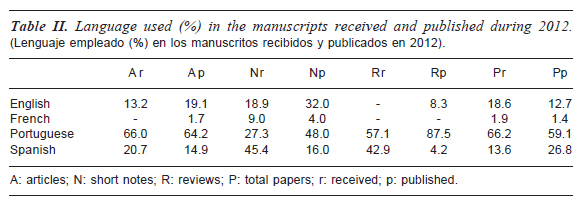
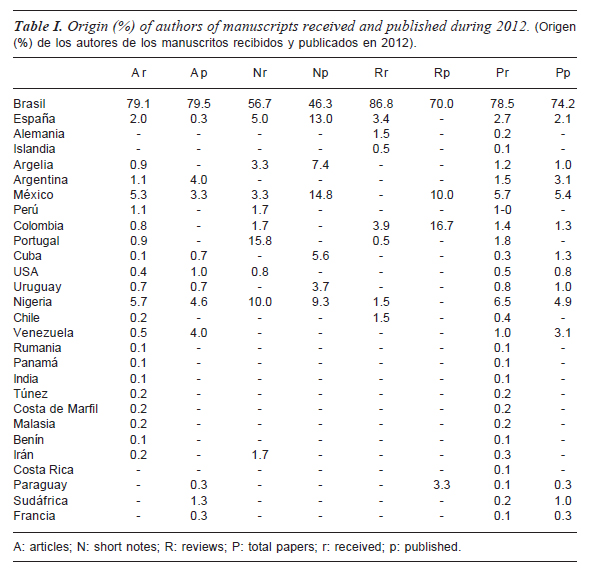
<body><![CDATA[<p><b><font face="Verdana" size="2">Received manuscripts</font></b></p>     <p><font face="Verdana" size="2">During the year 2012, three hundred sixty one manuscripts coming from 28 different countries were received. Of them: 288 (79.8 %) articles; 25 (6.9 %) short notes and 48 (13.3 %) reviews. </font></p>     <p><font face="Verdana" size="2">There have been no significant changes in the countries of origin of the manuscripts (<b><a href="#t1">table I</a></b>) in comparation with previous years.</font></p>     <p align=center><a name="t1"><img src="/img/revistas/azoo/v62n237/art1_t1.jpg"></a></p>     <p>&nbsp;</p>     <p><font face="Verdana" size="2">The greatest number of manuscripts received come from Brazil and so, Brazilian authors represent also the greater proportion (78.5 %), due to the greater number of authors of each of these manuscripts. Nevertheless this figure is lower than previous year. Manuscripts signed by Mexican an Nigerian authors represented an additional 12.2 %, and the remaining, came from other 25 countries, distributed in very similar proportions (all lower than 3.0 %). Manuscripts received are from 12 different Spanish speaking countries, two Lusophone countries, and other 13 countries, speaking different languages (English, French and Italian) official in the magazine. In whole, 6 European countries, 13 from Central and Sud America (including Mexico) and 5 from Africa; the remaining countries providing manuscripts were mainly Asiatic (3).</font></p>     <p><font face="Verdana" size="2">As shown in <b><a href="#t2">table II</a></b>, the origin of the manuscripts is reflected on the language used by its authors. However the Portuguese represents 66.2 % of manuscripts received; Spanish was used in 13.6 % of the manuscripts received; English language was used in higher (18.6 %), proportion than previous year. A little, but growing, proportion of manuscripts (1.9 %) were written in French.</font></p>     <p align=center><a name="t2"><img src="/img/revistas/azoo/v62n237/art1_t2.jpg"></a></p>     <p>&nbsp;</p>     <p><font face="Verdana" size="2"><b>Editorial times</b></font></p>     ]]></body>
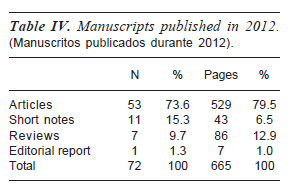
<body><![CDATA[<p><font face="Verdana" size="2">Each manuscript submitted to Archivos de Zootecnia, is first reviewed by members of the Editorial Board and Advisory Council. Subsequently, the Editorial Board at its plenary session, analyzes each submitted manuscript and decide if it must be reviewed (in which case at least two, and up to four reviewers, are assigned) or rejected. Reviewers are chosen from a repertoire of nearly 1500 reputed international experts from many different countries.</font></p>     <p><font face="Verdana" size="2">Archivos de Zootecnia is grateful to the more of 500 experts (from more of twenty countries) to whom at least one manuscript was sent to, for reviewing, during 2012.</font></p>     <p><font face="Verdana" size="2">As shown in <b><a href="#t3">table III</a></b>, the average peer reviewing time, was reduced in 20 days respect to the 160.2 days in previous year. However, better improvement was reached in the time elapsed from acceptance to the publication, that changed from 448.5 &plusmn; 31.8 days in 2011 to 245 &plusmn; 155, as consequence of reduction of the number of manuscripts waiting for impression done in 2011. Consequently, the time between submission of a manuscript and its publication has decreased from 700.4 &plusmn; 309.2 days in 2011, to 599 &plusmn; 229. These waiting times continue too high and, although causes for this are attributed to all stages of editorial process, frequently the authors themselves caused large delays during the correction of their manuscripts; also the delay in peer evaluations is sometimes too long. In 2012 new gestion procedures have been implemented for reduce these long waiting times.</font></p>     <p align=center><a name="t3"><img src="/img/revistas/azoo/v62n237/art1_t3.jpg"></a></p>     <p>&nbsp;</p>     <p><font face="Verdana" size="2">From the 361 manuscripts received during 2012, 72.3 % were (favourably or unfavourably) resolved during the year 2012. From manuscripts received, which editorial process was completed in 2012, the acceptance and rejection rates reached about 7 % and 65 % respectively. Both, the acceptance, and the rejection rates, have increased compared to previous year as results of a more faster evaluation process. The sum of these rates does not imply that only 38 % of the manuscripts received during 2012 are pending of a decision, since in fact, there are more manuscripts received during the precedent year in revision.</font></p>     <p>&nbsp;</p>     <p><font face="Verdana" size="2"><b>Manuscripts published</b></font></p>     <p><font face="Verdana" size="2">The journal Archivos de Zootecnia published 72 manuscripts during 2012 (<b><a href="#t4">table IV</a></b>).</font></p>     <p align=center><a name="t4"><img src="/img/revistas/azoo/v62n237/art1_t4.jpg"></a></p>     ]]></body>
<body><![CDATA[<p>&nbsp;</p>     <p><font face="Verdana" size="2">As shown in <b><a href="#t2">table II</a></b>, the origin of the manuscripts is reflected on the language used. However the Portuguese represents 59.1 % of published manuscripts, which is lower than the percentage of items of Portuguese speaking origin. Spanish was used in 26.8 % of the manuscripts published with a significant decrease on the previous 39.05 %; The English language was used (12.7 %) in lesser proportion than previous year. Only very few of manuscripts published (1.4 %) were written in French. As in previous years, there were no articles in Italian. It is remarkable that only the percentage of manuscripts published in Spanish is higher than those received in this language, the trend is reversed in the manuscripts published in other languages.</font></p>     <p><font face="Verdana" size="2">The average number of authors in papers published in 2012 was 5.5 &plusmn; 2.1/manuscript; These figures are practically the same in both received and published papers in each type of contributions. The average size of articles was 9.7 &plusmn; 1.7 pages, 4.0 &plusmn; 0.1 pages for short notes, and 15.0 &plusmn; 6.2 pages for reviews.</font></p>     <p><font face="Verdana" size="2">About 4.7 % of the received manuscripts are written by authors coming from more than one country, in the case of published papers, this figure rises to 12.7 %. Authors, members both the Publisher Institution, or from the Editorial Council in the previous year accounted for 3.9 percent, in 2012 this figure rose to 4.3 %. In any case, the ratios of endogamy in the journal's articles are maintained low.</font></p>     <p><font face="Verdana" size="2">The topics covered in the manuscripts published by Archivos de Zootecnia continue the trend of recent years as are shown in <b><a href="#t5">table V</a></b>. The animal species studied, were mainly, bovine, followed by ovine, porcine and poultry. The studies mainly focused on feeding and foods, breeds and genetics, and reproduction.</font></p>     <p align=center><a name="t5"><img src="/img/revistas/azoo/v62n237/art1_t5.jpg"></a></p>     <p>&nbsp;</p>     <p><font face="Verdana" size="2"><b>References</b></font></p>     <!-- ref --><p><font face="Verdana" size="2">1. Gómez Castro, A.G.; López de Bustamante, M.C.; Perea Muñoz, J. and Arcos Castejón, J. 2012. Archivos de Zootecnia. Editorial report 2011. Arch Zootec, 61: 3-9.    &nbsp;&nbsp;&nbsp;&nbsp;&nbsp;&nbsp;&nbsp;&nbsp;[&#160;<a href="javascript:void(0);" onclick="javascript: window.open('/scielo.php?script=sci_nlinks&ref=1021783&pid=S0004-0592201300010000100001&lng=','','width=640,height=500,resizable=yes,scrollbars=1,menubar=yes,');">Links</a>&#160;]<!-- end-ref --></font></p>     ]]></body>
<body><![CDATA[ ]]></body><back>
<ref-list>
<ref id="B1">
<label>1</label><nlm-citation citation-type="journal">
<person-group person-group-type="author">
<name>
<surname><![CDATA[Gómez Castro]]></surname>
<given-names><![CDATA[A.G.]]></given-names>
</name>
<name>
<surname><![CDATA[López de Bustamante]]></surname>
<given-names><![CDATA[M.C.]]></given-names>
</name>
<name>
<surname><![CDATA[Perea Muñoz]]></surname>
<given-names><![CDATA[J.]]></given-names>
</name>
<name>
<surname><![CDATA[Arcos Castejón]]></surname>
<given-names><![CDATA[J.]]></given-names>
</name>
</person-group>
<article-title xml:lang="es"><![CDATA[Archivos de Zootecnia: Editorial report 2011]]></article-title>
<source><![CDATA[Arch Zootec]]></source>
<year>2012</year>
<volume>61</volume>
<page-range>3-9</page-range></nlm-citation>
</ref>
</ref-list>
</back>
</article>