<?xml version="1.0" encoding="ISO-8859-1"?><article xmlns:mml="http://www.w3.org/1998/Math/MathML" xmlns:xlink="http://www.w3.org/1999/xlink" xmlns:xsi="http://www.w3.org/2001/XMLSchema-instance">
<front>
<journal-meta>
<journal-id>0004-0592</journal-id>
<journal-title><![CDATA[Archivos de Zootecnia]]></journal-title>
<abbrev-journal-title><![CDATA[Arch. zootec.]]></abbrev-journal-title>
<issn>0004-0592</issn>
<publisher>
<publisher-name><![CDATA[Universidad de Córdoba]]></publisher-name>
</publisher>
</journal-meta>
<article-meta>
<article-id>S0004-05922014000200013</article-id>
<article-id pub-id-type="doi">10.4321/S0004-05922014000200013</article-id>
<title-group>
<article-title xml:lang="en"><![CDATA[Genetic diversity and population structure in remnant subpopulations of Nordestino horse breed]]></article-title>
<article-title xml:lang="pt"><![CDATA[Diversidade genética e estrututa populacional de subpopulações remanescentes da raça equina Nordestino]]></article-title>
</title-group>
<contrib-group>
<contrib contrib-type="author">
<name>
<surname><![CDATA[Pires]]></surname>
<given-names><![CDATA[D.A.F.]]></given-names>
</name>
<xref ref-type="aff" rid="A01"/>
</contrib>
<contrib contrib-type="author">
<name>
<surname><![CDATA[Coelho]]></surname>
<given-names><![CDATA[E.G.A.]]></given-names>
</name>
<xref ref-type="aff" rid="A02"/>
</contrib>
<contrib contrib-type="author">
<name>
<surname><![CDATA[Melo]]></surname>
<given-names><![CDATA[J.B.]]></given-names>
</name>
<xref ref-type="aff" rid="A03"/>
</contrib>
<contrib contrib-type="author">
<name>
<surname><![CDATA[Oliveira]]></surname>
<given-names><![CDATA[D.A.A.]]></given-names>
</name>
<xref ref-type="aff" rid="A02"/>
</contrib>
<contrib contrib-type="author">
<name>
<surname><![CDATA[Ribeiro]]></surname>
<given-names><![CDATA[M.N.]]></given-names>
</name>
<xref ref-type="aff" rid="A01"/>
</contrib>
<contrib contrib-type="author">
<name>
<surname><![CDATA[Gus Cothran]]></surname>
<given-names><![CDATA[E.]]></given-names>
</name>
<xref ref-type="aff" rid="A04"/>
</contrib>
<contrib contrib-type="author">
<name>
<surname><![CDATA[Juras]]></surname>
<given-names><![CDATA[R.]]></given-names>
</name>
<xref ref-type="aff" rid="A04"/>
</contrib>
<contrib contrib-type="author">
<name>
<surname><![CDATA[Khanshour]]></surname>
<given-names><![CDATA[A.]]></given-names>
</name>
<xref ref-type="aff" rid="A04"/>
</contrib>
</contrib-group>
<aff id="A01">
<institution><![CDATA[,Universidade Federal Rural de Pernambuco Departamento de Zootecnia ]]></institution>
<addr-line><![CDATA[Recife PE]]></addr-line>
<country>Brasil</country>
</aff>
<aff id="A02">
<institution><![CDATA[,Universidade Federal de Minas Gerais Laboratório de Genética da Escola de Veterinária ]]></institution>
<addr-line><![CDATA[Belo Horizonte MG]]></addr-line>
<country>Brasil</country>
</aff>
<aff id="A03">
<institution><![CDATA[,Universidade Estadual do Sudoeste da Bahia Departamento de Estudos Básicos e Instrumentais ]]></institution>
<addr-line><![CDATA[Itapetinga BA]]></addr-line>
<country>Brasil</country>
</aff>
<aff id="A04">
<institution><![CDATA[,Texas A & M University Department of Veterinary Integrative Biosciences ]]></institution>
<addr-line><![CDATA[College Station TX]]></addr-line>
<country>USA</country>
</aff>
<pub-date pub-type="pub">
<day>00</day>
<month>06</month>
<year>2014</year>
</pub-date>
<pub-date pub-type="epub">
<day>00</day>
<month>06</month>
<year>2014</year>
</pub-date>
<volume>63</volume>
<numero>242</numero>
<fpage>349</fpage>
<lpage>358</lpage>
<copyright-statement/>
<copyright-year/>
<self-uri xlink:href="http://scielo.isciii.es/scielo.php?script=sci_arttext&amp;pid=S0004-05922014000200013&amp;lng=en&amp;nrm=iso"></self-uri><self-uri xlink:href="http://scielo.isciii.es/scielo.php?script=sci_abstract&amp;pid=S0004-05922014000200013&amp;lng=en&amp;nrm=iso"></self-uri><self-uri xlink:href="http://scielo.isciii.es/scielo.php?script=sci_pdf&amp;pid=S0004-05922014000200013&amp;lng=en&amp;nrm=iso"></self-uri><abstract abstract-type="short" xml:lang="en"><p><![CDATA[This study analyzed four remnant subpopulations of Nordestino horse breed to detect genetic structure and diversity through 14 microsatellite markers. Hair root follicles from a total of 393 horses were collected. There were 61 animals from Salitre Valley (JUAZ-BA) located at Bahia state, 89 from North and Central North ecoregions located at Piauí state (NCEN-PI), 185 animals from Sertão and Sertão do São Francisco ecoregions (SERT-PE) and 58 animals from Agrestina city (AGRE-PE) located at Pernambuco state. Genetic diversity, genetic differentiation and bottleneck effects were examined in the 4 remnant subpopulations of Nordestino horse breed. There was high allelic diversity and the Fis value did not show evidence of a significant predominance of mating among relatives, probably because of crossbreeding among populations. Recent bottleneck effects were not detected in the 4 subpopulations, but the IAM and TPM model did suggest a bottleneck effect. This may be a reflection of the decreased number of breeding animals caused by castration of males, mechanization processes and changes in life style in the rural areas. The bottleneck event was not enough to lead a genetic differentiation among the 4 remnant subpopulations of Nordestino horse. There was no evidence of genetic differentiation, so the 4 subpopulations formed one genetic group.]]></p></abstract>
<abstract abstract-type="short" xml:lang="pt"><p><![CDATA[O presente trabalho teve como objetivo avaliar a estrutura e diversidade genética de quatro subpopulações do cavalo Nordestino utilizando 14 marcadores microssatélites. Amostras de bulbo capilar de 393 cavalos foram coletadas, distribuídos em: 61 animais do vale do Salitre (JUAZ-BA) localizado no estado da Bahia, 89 das mesorregiões Norte e Centro-Norte do estado do Piauí, 58 animais da cidade de Agrestina (AGRE-PE) e 185 das mesorregiões Sertão e Sertão do São Francisco localizado no estado de Pernambuco (SERT-PE). A diversidade genética, diferenciação genética e efeito de gargalo genético foram avaliados nas 4 subpopulações do cavalo Nordestino. Observou-se elevada diversidade genética e valores de Fis que não evidenciaram níveis de consanguinidade significativa, provavelmente isso se deve à acasalamentos entre as subpopulações. Efeito de gargalo genético recente não foi detectado para as quatro subpopulações, porém os modelos IAM e TPM sugeriram um efeito de gargalo genético não recente. Isso pode ser reflexo da redução no número de reprodutores decorrente da castração de machos, processo de mecanização e mudanças no estilo de vida das populações da zona rural. Eventos mais antigos do efeito de gargalo genético não foram suficientes para evidenciar uma diferenciação genética entre as 4 subpopulações, portanto elas formam um só grupo genético.]]></p></abstract>
<kwd-group>
<kwd lng="en"><![CDATA[Allelic diversity]]></kwd>
<kwd lng="en"><![CDATA[Bottleneck effect]]></kwd>
<kwd lng="en"><![CDATA[Genetic structure]]></kwd>
<kwd lng="en"><![CDATA[Microsatellite]]></kwd>
<kwd lng="pt"><![CDATA[Diversidade alélica]]></kwd>
<kwd lng="pt"><![CDATA[Efeito de gargalo genético]]></kwd>
<kwd lng="pt"><![CDATA[Estrutura genética]]></kwd>
<kwd lng="pt"><![CDATA[Microssatélite]]></kwd>
</kwd-group>
</article-meta>
</front><body><![CDATA[ <p>&nbsp;</p>     <p>&nbsp;</p>     <p><font face="Verdana" size="4"><b>Genetic diversity and population structure in remnant subpopulations of Nordestino horse breed</b></font></p>     <p><font face="Verdana" size="4"><b>Diversidade genética e estrututa populacional de subpopula&ccedil;&otilde;es remanescentes da ra&ccedil;a equina Nordestino</b></font></p>     <p>&nbsp;</p>     <p>&nbsp;</p>     <p><font face="Verdana" size="2"><b>Pires, D.A.F.<sup>1*</sup>; Coelho, E.G.A.<sup>2</sup>; Melo, J.B.<sup>3</sup>; Oliveira, D.A.A.<sup>2</sup>; Ribeiro, M.N.<sup>1</sup>; Gus Cothran, E.<sup>4</sup>; Juras, R.<sup>4</sup> and Khanshour, A.<sup>4</sup></b></font></p>     <p><font face="Verdana" size="2"><sup>1</sup>Departamento de Zootecnia. Universidade Federal Rural de Pernambuco. Recife-PE. Brasil. <sup>*</sup><a href="mailto:dna@zootecnista.com.br">dna@zootecnista.com.br</a>    <br><sup>2</sup>Laboratório de Genética da Escola de Veterinária. Universidade Federal de Minas Gerais. Belo Horizonte-MG. Brasil    <br><sup>3</sup>Departamento de Estudos Básicos e Instrumentais. Universidade Estadual do Sudoeste da Bahia. Itapetinga-BA. Brasil    ]]></body>
<body><![CDATA[<br><sup>4</sup>Department of Veterinary Integrative Biosciences. Texas A &amp; M University. College Station, TX. USA</font></p>     <p>&nbsp;</p>     <p>&nbsp;</p> <hr size="1">     <p><font face="Verdana" size="2"><b>SUMMARY</b></font></p>     <p><font face="Verdana" size="2">This study analyzed four remnant subpopulations of Nordestino horse breed to detect genetic structure and diversity through 14 microsatellite markers. Hair root follicles from a total of 393 horses were collected. There were 61 animals from Salitre Valley (JUAZ-BA) located at Bahia state, 89 from North and Central North ecoregions located at Piauí state (NCEN-PI), 185 animals from Sert&atilde;o and Sert&atilde;o do S&atilde;o Francisco ecoregions (SERT-PE) and 58 animals from Agrestina city (AGRE-PE) located at Pernambuco state. Genetic diversity, genetic differentiation and bottleneck effects were examined in the 4 remnant subpopulations of Nordestino horse breed. There was high allelic diversity and the <i>F<sub>is</sub></i> value did not show evidence of a significant predominance of mating among relatives, probably because of crossbreeding among populations. Recent bottleneck effects were not detected in the 4 subpopulations, but the IAM and TPM model did suggest a bottleneck effect. This may be a reflection of the decreased number of breeding animals caused by castration of males, mechanization processes and changes in life style in the rural areas. The bottleneck event was not enough to lead a genetic differentiation among the 4 remnant subpopulations of Nordestino horse. There was no evidence of genetic differentiation, so the 4 subpopulations formed one genetic group.</font></p>     <p><font face="Verdana" size="2"><b>Key words:</b> Allelic diversity. Bottleneck effect. Genetic structure. Microsatellite.</font></p> <hr size="1">     <p><font face="Verdana" size="2"><b>RESUMO</b></font></p>     <p><font face="Verdana" size="2">O presente trabalho teve como objetivo avaliar a estrutura e diversidade genética de quatro subpopula&ccedil;&otilde;es do cavalo Nordestino utilizando 14 marcadores microssatélites. Amostras de bulbo capilar de 393 cavalos foram coletadas, distribuídos em: 61 animais do vale do Salitre (JUAZ-BA) localizado no estado da Bahia, 89 das mesorregi&otilde;es Norte e Centro-Norte do estado do Piauí, 58 animais da cidade de Agrestina (AGRE-PE) e 185 das mesorregi&otilde;es Sert&atilde;o e Sert&atilde;o do S&atilde;o Francisco localizado no estado de Pernambuco (SERT-PE). A diversidade genética, diferencia&ccedil;&atilde;o genética e efeito de gargalo genético foram avaliados nas 4 subpopula&ccedil;&otilde;es do cavalo Nordestino. Observou-se elevada diversidade genética e valores de <i>F<sub>is</sub></i> que n&atilde;o evidenciaram níveis de consanguinidade significativa, provavelmente isso se deve à acasalamentos entre as subpopula&ccedil;&otilde;es. Efeito de gargalo genético recente n&atilde;o foi detectado para as quatro subpopula&ccedil;&otilde;es, porém os modelos IAM e TPM sugeriram um efeito de gargalo genético n&atilde;o recente. Isso pode ser reflexo da redu&ccedil;&atilde;o no número de reprodutores decorrente da castra&ccedil;&atilde;o de machos, processo de mecaniza&ccedil;&atilde;o e mudan&ccedil;as no estilo de vida das popula&ccedil;&otilde;es da zona rural. Eventos mais antigos do efeito de gargalo genético n&atilde;o foram suficientes para evidenciar uma diferencia&ccedil;&atilde;o genética entre as 4 subpopula&ccedil;&otilde;es, portanto elas formam um só grupo genético.</font></p>     <p><font face="Verdana" size="2"><b>Palavras chave:</b> Diversidade alélica. Efeito de gargalo genético. Estrutura genética. Microssatélite.</font></p> <hr size="1">     <p>&nbsp;</p>     ]]></body>
<body><![CDATA[<p><font face="Verdana" size="2"><b>Introduction</b></font></p>     <p><font face="Verdana" size="2">The Nordestino horse is a local breed from the Brazilian Northeast that has adapted to semi-arid conditions of the Caatinga biome. The Nordestino horse breed is characterized by small animals, small head, strong hooves with deep frog, dark skin and good work ability in the semi-arid Northeast region (ABCCN, 1987; Melo, 2011). High insolation, few clouds, low forage available, rain shortage over the year and rocked soils are Northeast semiarid condition at Brazil, and the Nordestino horse can survive and keep its healthy status very well furthermore it can ride on rocked soils naturally without compromise its hooves because they are adapted. Other horse breeds could not survive under those conditions or they would have a low performance with degeneration of their characteristics. Molecular Genetic information's about Nordestino Horse does not exist until 2013.</font></p>     <p><font face="Verdana" size="2">The first breed association of the Nordestino horse was founded on 1974 and the headquarters was located at Recife city. However, in the 1990s the association was shut down until 2011 (Melo, 2011). As a result, the official record of the Nordestino horse stopped. Most of the registered animals were sold for slaughter. Nowadays, Nordestino horse lives without a registry and with a minimum or almost no management. The remaining Nordestino horses are at risk as a result of shutting the association down, increased crossbreeding that might lead as mischaracterization of the Nordestino horse in the future and the high percentage of castrated stallions (Melo, 2011). Add to this the mechanization of agricultural processes and the increase of automobiles for transportation in rural area as a threat for the Nordestino horse. Nordestino horse is in a different situation from other Brazilian breeds: they are horses of poor farmers in Brazil, there is no interest from Brazilian government to conserve or preserve them and nearly all people still have Nordestino horse are unaware the importance to preserve it as the unique horse able to survive with a good performance in Semiarid condition from Brazil.</font></p>     <p><font face="Verdana" size="2">One of the first steps in a conservation program for a local breed is the genetic characterization, It provides important information for conservation management in a country's national strategy for animal genetic resources (FAO, 2012). The aims of this study were characterized genetically four subpopulations of Nordestino horses from different regions of the Brazilian Northeast and to determine if those represent a single population of the Nordestino horses through microsatellite markers.</font></p>     <p>&nbsp;</p>     <p><font face="Verdana" size="2"><b>Material and methods</b></font></p>     <p><font face="Verdana" size="2">SAMPLE COLLECTION AND LOCATION SITES</font></p>     <p><font face="Verdana" size="2">Horse hair roots were collected from S&atilde;o Francisco Valley ecoregion in the Bahia state (number of animals= 61), cities from North and Central-North ecoregions in the Piauí state (89), Agrestina city in the Pernambuco state (58), cities from Sert&atilde;o do S&atilde;o Francisco and Sert&atilde;o ecoregions in the Pernambuco state (185). All ecoregions are inside the Caatinga biome (climate is semiarid). The animals were split into 4 subpopulations that were named as: JUAZ-BA (n=61), NCEN-PI (n=89), the animals from Pernambuco state were divided up into 2 subpopulations AGRE-PE (n=58) and SERT-PE (n=185). All animals sampled were considered as typical of the remainder of Nordestino horse breed because they had phenotypic traits similar to last breed standard: animals with height at withers of male 138 cm (&plusmn;8) and female 135 cm (&plusmn;8), small head, strong hooves with deep frog and dark skin (ABCCN, 1987). A total of 137 samples of the Arabian horse breed from Brazilian studs were included as an outgroup using data from LGEV/UFMG (Laboratory of Genetic in the Animal Science Department at Veterinary School of Federal University of Minas Gerais-Brazil).</font></p>     <p><font face="Verdana" size="2">EXTRACTION OF GENOMIC DNA, PCR, ELECTROPHORETIC RUN AND READING OF ELECTROPHEROGRAM</font></p>     <p><font face="Verdana" size="2">DNA extraction was made according to Coelho <i>et al.</i> (2004). PCR solution was prepared with 5.0 &mu;L of Phusion Flash Master Mix Enzyme-Finnzymes, 1.0 &mu;L of ultra pure water, 3.0 &mu;L of primer mix and 1.0 &mu;L of DNA extracted. The panel for genotyping consisted of 14 microsatellites: AHT4, AHT5, ASB2, ASB17, HTG4, HTG6, HMS3, HMS6, HMS7, ASB23, HTG7, HTG10, LEX 33 and VHL20. Those microsatellite marks were recommended by FAO/ISAG (Hoffmann <i>et al.</i>, 2004; FAO/ISAG, 2011) to study genetic characterization in horse breeds around the world. The standardized was according to FAO/ISAG (2011). The specific set of microsatellite is used in paternity tests because of its highly polymorphic. There were 3 multiplex panels for PCR: one with annealing temperature of 60 <sup>o</sup>C (AHT4, AHT5, ASB17, ASB23, HMS6, HMS7, HTG4 and VHL20), other with 56 <sup>o</sup>C (ASB2, HMS3 and HTG10) and the third with 60 <sup>o</sup>C (LEX33, HTG6 and HTG7). The same annealing temperature in 2 multiplex panels was used due to the typing of LEX33, HTG6 and HTG7 which are not part of routine testing. For microsatellite amplification in the 3 multiplex panel sets: 98 <sup>o</sup>C for 10 s for activation step, followed by 34 cycles of 95 <sup>o</sup>C for 45 s (denaturation step), 56 <sup>o</sup>C or 60 <sup>o</sup>C (depending on multiplex panel) for 30 s (annealing) and 72 <sup>o</sup>C for 30 s (extension), and a final extension step of 60 min at 72 <sup>o</sup>C. Capillary electrophoretic run was performed by 0.3 &mu;L of LIZ&trade; (standard molecular weight), 8.7 &mu;L of Formamide Hi-Di (both products are Applied Biosystems), and 1 &mu;L of mixture of the panels from 3 PCR products, per sample. PCR products were analyzed by using the ABI3130 of the applied biosystems for capillary electrophoresis run. Fragments sizes were determined with GeneMapper v.4.0 software of the Applied Biosystems. All 530 samples were genotyped at LGEV/ UFMG, Minas Gerais- Brazil.</font></p>     ]]></body>
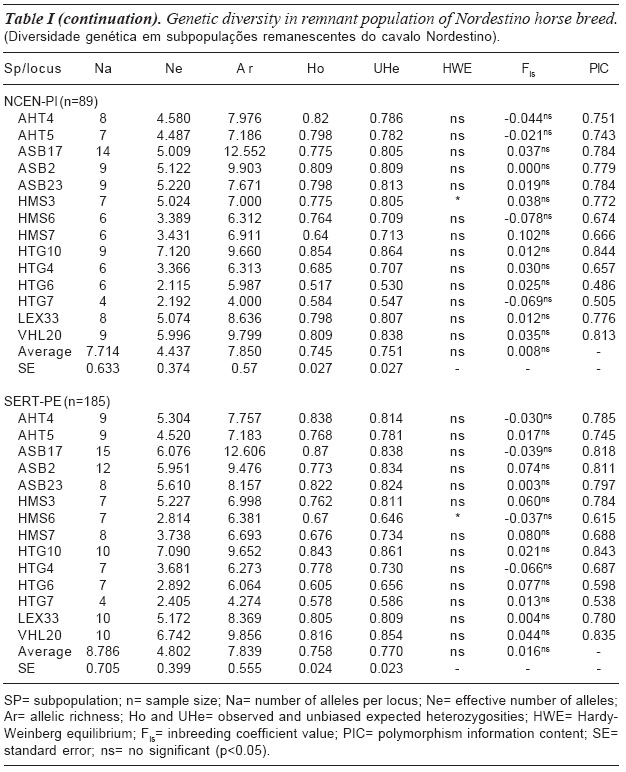
<body><![CDATA[<p><font face="Verdana" size="2">STATISTICAL ANALYSIS</font></p>     <p><font face="Verdana" size="2">Genetic diversity within each of the 4 subpopulations was measured as the number of alleles per locus (<i>Na</i>), effective number of alleles per locus (<i>Ne</i>), observed (<i>Ho</i>) and unbiased expected (<i>UHe</i>) heterozygosities estimated per locus that were calculated using the GenAlex 6.4 (Peakall and Smouse, 2006). Allelic richness (<i>Ar</i>) per locus was calculated with FSTAT v.2.9.3.2 (Goudet, 1995). It was used a rarefied sample size of 58 diploids individuals per subpopulation to calculate <i>Ar.</i> Heterozygote deficit and deviations from Hardy-Weinberg Equilibrium (HWE) were estimated by GenePop v.4.1.1 (Rousset, 2008). Deviations from HWE were performed with Markov Chain parameters: 10 000 dememorization, 20 batches and 5000 iterations per batch. Polymorphic Information Content (PIC) was estimated using the Cervus v.3.0.3 software (Kalinowski <i>et al.</i>, 2007).</font></p>     <p><font face="Verdana" size="2">Wright's (1951) F-statistics (<i>F<sub>st</sub></i>, <i>F<sub>it</sub></i> and <i>F<sub>is</sub></i>) was performed with 1000 bootstrap on confidence interval of 95 % and Gene differentiation coefficient (<i>G<sub>st</sub></i>) were calculated using GENETIX v.4.04 (Belkhir <i>et al.</i>, 2003). Analysis of molecular variance (AMOVA) with permutations set to 999 was calculated with the GenAlex 6.4 (Peakall and Smouse, 2006) to study genetic differentiation among subpopulations ( <i>&Phi;<sub>pt</sub></i> and <i>F<sub>st</sub></i> pairwise) and fractionate the genetic variance within and among subpopulation.</font></p>     <p><font face="Verdana" size="2">A Bayesian method to cluster the animals was used to analyze genetic structure of the 4 subpopulations with STRUCTURE 2.3.3 (Pritchard <i>et al.</i>, 2000; Falush <i>et al.</i>, 2003). Model admixture and correlated allele frequencies were used as the basis of which an individual may have mixed ancestry. The model estimates <i>a posteriori</i> probability given that an individual originated from subpopulations among the inferred groups. The K values (number of clusters) ranging from 1 to 10 and for each cluster 20 independent runs were repeated. It was used a burn-in period of 20 000 and 100 000 Monte Carlo Markov Chain (MCMC) repetitions in all replications in order to obtain the number of suitable groups at the end, as recommended by Falush <i>et al.</i> (2007). The four subpopulations were analysed along with the Arabian group. The results of the natural logarithm (Ln) of the probability of the data (Ln Pr (X/K)) were used for detection of the best value of K (Evanno <i>et al.</i>, 2005) and to identify which approach is most appropriate. After that, the replicates were summarized for each K using CLUMPP software (Ja-kobsson and Rosenberg, 2007). Graphical display was generated using the DISTRUCT v.1.1 (Rosenberg, 2004) and GhostView v.4.9 (Lang, 2006) programs. Genotyping data from Arab breed horse was used as an outgroup to Nei's <i>D<sub>A</sub></i> genetic distance and Structure software.</font></p>     <p><font face="Verdana" size="2">The BOTTLENECK v.1.2.02 (Cornuet and Luikart, 1996) program was used to detect possible bottleneck event on the 4 subpopulations of Nordestino horse breed. Three models of microsatellite evolution were evaluated (IAM-Infinite allele model; SMM-stepwise mutation model and TPM-two-phase model of mutation) with two tests: Sign test and Wilcoxon sign-rank test. The probability distribution was established using 1000 simulations. The Mode Shift Indicator that based on the shape of the allele frequency distribution was also performed. The values of average hetero-zygosity (<i>He</i>) and their probabilities (<i>H</i>) in the Sign test, under three models of microsatellite evolution (IAM, SMM and TPM) were calculated and used to measure the expected number of loci with heterozygosity excess.</font></p>     <p>&nbsp;</p>     <p><font face="Verdana" size="2"><b>Results</b></font></p>     <p><font face="Verdana" size="2">GENETIC DIVERSITY</font></p>     <p><font face="Verdana" size="2">The 14 microsatellites markers were amplified in the 4 remnant populations of the Nordestino horse breed. A total of 115, 110, 108 and 123 alleles were found and the average number of alleles per locus was 8.214, 7.857, 7.714 and 8.786 for AGRE-PE, JUAZ-BA, NCEN-PI and SERT-PE, respectively (<b><a href="#t1">table I</a></b>). The highest effective number of alleles per locus by subpopulations for AGRE-PE was 7.097 (VHL20), JUAZ-BA was 7.390 (VHL20), NCEN-PI was 7.120 (HTG10) and SERT-PE was 7.090 (HTG10). Average allelic richness per subpopulation was higher than 7 (<b><a href="#t1">table I</a></b>). The observed hetero-zygosity (<i>Ho</i>) ranged from 0.517 (HTG6 at NCEN-PI) to 0.902 (VHL20 at JUAZ-BA). The unbiased expected heterozygosity (<i>UHe</i>) ranged from 0.530 (HTG6 at NCEN-PI) to 0.872 (VHL20 at JUAZ-BA). Ott (1992) reported a locus is considered highly polymorphic when heterozygosity is greater than 0.7 and almost all loci were equal or higher than 0.7. There was high allelic variation in the remnant subpopulations of Nordestino horse breed. Significant (p&lt;0.05) deviation from HWE was detected for HTG6 and LEX33 loci at AGRE-PE, HMS3 at NCEN-PI and HMS6 at SERT-PE. However, there were not significant deviations from HWE when all microsatellite markers were analyzed together in their respective subpopulation. Heterozygote deficit was identified at HMS3 and ASB2 loci at SERT-PE, but in multiloci analyzes in their respective subpopulation there was no heterozygote deficit. It was not observed significant <i>F.<sub>is</sub></i> values for both loci inside subpopulations and average for each subpopulation (<b><a href="#t1">table I</a></b>) were not significant. There were high PIC values per locus (p&gt;0.555); the exceptions were observed in the HTG6 and HTG7 loci at NCEN-PI and HTG7 at SERT-PE that showed medium polymorphism information content.</font></p>     <p align=center><a name="t1"><img src="/img/revistas/azoo/v63n242/art13_t1a.jpg"></a>    ]]></body>
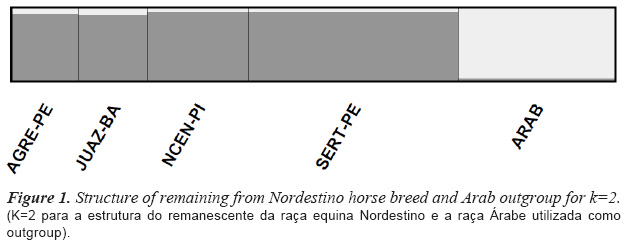
<body><![CDATA[<br><img src="/img/revistas/azoo/v63n242/art13_t1b.jpg"></p>     <p>&nbsp;</p>     <p><font face="Verdana" size="2">GENETIC DIFFERENTIATION</font></p>     <p><font face="Verdana" size="2">Low genetic differentiation among the four remnant subpopulations of Nordestino horse breed was found. The <i>F<sub>is</sub></i>, <i>F<sub>it</sub></i> and <i>F<sub>st</sub></i> (Weir and Cockerham, 1984) average values in the Nordestino subpopulations were 0.012, 0.017 and 0.005, respectively and not significant. Coefficient of gene differentiation value (<i>G<sub>st</sub></i>) among the subpopulations was 0.009. According to AMOVA the <i>&Phi;<sub>pt</sub></i> value was 0.010 (p=0.001) and 99 % of variance was explicated within subpopulations and just 1 % among subpopulations.</font></p>     <p><font face="Verdana" size="2">The value of pairwise <i>F<sub>st</sub></i> (<b><a href="#t2">table II</a></b>) between AGRE-PE and NCEN-PI of 0.008 (p=0.001) was the highest among the comparisons of the 4 subpopulations of Nordestino horse, followed by the <i>F<sub>st</sub></i> value between AGRE-PE and JUAZ-BA of 0.006 (p=0.008) and NCEN-PI and SERT-PE of 0.006 (p=0.001). Subpopulations from AGRE-PE and SERT-PE had the smallest coefficient of genetic differentiation (Fst=0.002; p=0.035). Overall, when all loci were considered, the <i>F<sub>st</sub></i> among subpopulations of Nordestino horses was 0.005 (p= 0.001). In other words, the variation among the studied subpopulations corresponded to 0.5 %. The estimated number of migrants between AGRE-PE and JUAZ-BA was around 40, AGRE-PE and NCEN-PI was 31, AGRE-PE and SERT-PE was 110, JUAZ-BA and NCEN-PI was 60, JUAZ-BA and SERTPE was 56 and NCEN-PI and SERT-PE was 43. There were 3 migrants between ARAB and the subpopulations of Nordestino horses.</font></p>     <p align=center><a name="t2"><img src="/img/revistas/azoo/v63n242/art13_t2.jpg"></a></p>     <p>&nbsp;</p>     <p><font face="Verdana" size="2">Bayesian analysis with MCMC was carried out to study the structure of the four subpopulations of Nordestino horses. There were two groups found according to Bayesian method of the STRUCTURE software. The computing method of Evanno <i>et al.</i> (2005) detected that best K value was 2 (<b><a href="#f1">figure 1</a></b>). In the first group were assigned 93.3 % of animals from AGRE-PE, 91.8 % from JUAZ-BA, 95.9 % from NCEN-PI, 95.7 % from SERT-PE and 3.3 % from ARAB.</font></p>     <p align=center><a name="f1"><img src="/img/revistas/azoo/v63n242/art13_f1.jpg"></a></p>     <p>&nbsp;</p>     ]]></body>
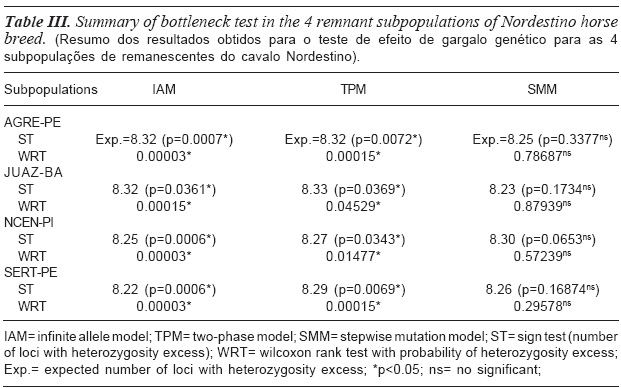
<body><![CDATA[<p><font face="Verdana" size="2">BOTTLENECK EFFECTS</font></p>     <p><font face="Verdana" size="2">According to Mode Shift Indicator method, the four subpopulations have not undergone a recent bottleneck event as the L-shaped curves were normal. There was no evidence of bottleneck effects with the Stepwise Mutation Model (SMM) method or Sign Test (ST) and Wilcoxon Rank Test (WRT) for all subpopulations of Nordestino horse (<b><a href="#t3">table III</a></b>). However, the TPM (Two-Phase Model) and IAM (Infinite Allele Model) methods evidenced a significant bottleneck effect on the remnant subpopulations of Nordestino horse breed for ST and WRT.</font></p>     <p align=center><a name="t3"><img src="/img/revistas/azoo/v63n242/art13_t3.jpg"></a></p>     <p>&nbsp;</p>     <p><font face="Verdana" size="2"><b>Discussion</b></font></p>     <p><font face="Verdana" size="2">GENETIC DIVERSITY</font></p>     <p><font face="Verdana" size="2">Genetic diversity corresponds to the variety of alleles presents in a group and can be described by average number of different alleles, allelic richness and expected heterozygosity. Average number of alleles per subpopulation and number of alleles per microsatellite by subpopulation indicated high allelic diversity. All other microsatellite markers tested fit the recommendation of Barker (1994): loci with a minimum of 4 different alleles. The allelic richness is a measure that is not dependent on sample size and among the subpopulations all loci demonstrated values equal to 4 or greater. This result confirmed a high genetic diversity among the subpopulations studied.</font></p>     <p><font face="Verdana" size="2"><i>UHe</i> was high in the four subpopulations of Nordestino horses. This probably is because the breed is of recent origin and the Nordestino horses have been crossed with other breeds. Established breeds tend to have <i>UHe</i> lower than newly formed breeds because the established breed has undergone some inbreeding and selection for the breed specific traits. The highest <i>UHe</i> average value was observed for AGRE-PE and SERT-PE. Probably this is a result of crossbreeding, mainly with animals from AGRE-PE with nearby specialized breeds and for SERT-PE due to indiscriminate crossbreeding with horse breeds used in sports practice. Deviations from HWE in isolated loci for remnant subpopulations of Nordestino horses may be due to crossbreeding, negative-assortative mating or gene flow. According to the <i>F<sub>is</sub></i> parameter there was no significant deficit of heterozygotes which indicates that the four subpopulations are randomly mating predominantly.</font></p>     <p><font face="Verdana" size="2">GENETIC DIFFERENTIATION</font></p>     <p><font face="Verdana" size="2"><i>G<sub>st</sub></i>, <i>F<sub>st</sub></i> and <i>&Phi;<sub>pt</sub></i> values among the four subpopulations of Nordestino horses showed that the animals were a single genetic group with no evidence of genetic differentiation among them. Giacomoni <i>et al</i>. (2008) analyzed three subpopulations (Ipiranga, Nova Esperança and Promissão) of Pantaneiro horses and Cothran <i>et al.</i> (2011) studied three subpopulations (Apure, Aragua and Merida) of Venezuelan Criollo and also observed low genetic differentiation, no evidence of genetic differentiation among horses of the same breed from different places. That the subpopulations of Nordestino horse were the same gene pool was corroborated by the distribution of the animals in the STRUCTURE analysis where only two defined groups (k=2): one the Arab outgroup and other the Nordestino horses. Costa <i>et al.</i> (1974) reported Bahia, Pernambuco, Ceara and Piaui states were the places where the Nordestino horse was essentiality formed and there was a larger herd at that time. There has been a fair number of horses selected from those states to integrate into the foundation of the stud nucleus. Until the last years of the ABCCN animals were widely transported among states and farms both intentionally and due to natural wandering. In the 1990s the Nordestino horse breed Association stopped animal registrations, but even so the Nordestino horse survives in the Caatinga biome from the Brazilian Northeast region.</font></p>     ]]></body>
<body><![CDATA[<p><font face="Verdana" size="2">The horses have exchanged genes among the subpopulations with a large number of individual migrants between AGRE-PE and SERT-PE (110 migrants estimated) followed by NCEN-PI and JUAZBA (60 migrants estimated) which has served to homogenize the population. The high gene flow estimated among subpopulations and the historical accounts demonstrate that the populations represent a single interbreeding genetic group.</font></p>     <p><font face="Verdana" size="2">BOTTLENECK EFFECT</font></p>     <p><font face="Verdana" size="2">There was no strong evidence of a recent population bottleneck which was consistent with the high genetic variability within each subpopulation. Probably, the bottleneck was not recent, or just a demographic bottlenecks occurred without genetic one or/and the subpopulations were not completely isolated and contains genes from migrants that had disguised genetic effects of the bottlenecks (Luikart <i>et al.</i>, 1998a,b). The Nordestino horse breed may be experienced a gradual decline in their overall population numbers mainly because of closure of the Association due to lack of interest in the breed, the current castration practice on the males, the mechanization process and increase of automobile in rural areas. Those results and reasons may be suggested that a demographic bottleneck event have occurred in the Nordestino horse breed. However it was not enough to cause genetic differentiation how was detect and discussed in the topic above.</font></p>     <p>&nbsp;</p>     <p><font face="Verdana" size="2"><b>References</b></font></p>     <!-- ref --><p><font face="Verdana" size="2">1. ABCCN. 1987. Associa&ccedil;&atilde;o Brasileira dos Criadores do Cavalo Nordestino. Regulamento do registro genealógico do cavalo Nordestino. ABCCN. Recife. pp. 33-34.    &nbsp;&nbsp;&nbsp;&nbsp;&nbsp;&nbsp;&nbsp;&nbsp;[&#160;<a href="javascript:void(0);" onclick="javascript: window.open('/scielo.php?script=sci_nlinks&ref=1043219&pid=S0004-0592201400020001300001&lng=','','width=640,height=500,resizable=yes,scrollbars=1,menubar=yes,');">Links</a>&#160;]<!-- end-ref --></font></p>    <!-- ref --><p><font face="Verdana" size="2">2. Barker, J.S.F. 1994. A global protocol for determining genetic distances among domestic livestock breeds. International Committee for World Congresses on Genetics Applied to Livestock Production. V World Congress on Genetics Applied to Livestock Production. Guelph. Canada. pp. 501-508.    &nbsp;&nbsp;&nbsp;&nbsp;&nbsp;&nbsp;&nbsp;&nbsp;[&#160;<a href="javascript:void(0);" onclick="javascript: window.open('/scielo.php?script=sci_nlinks&ref=1043221&pid=S0004-0592201400020001300002&lng=','','width=640,height=500,resizable=yes,scrollbars=1,menubar=yes,');">Links</a>&#160;]<!-- end-ref --></font></p>    <!-- ref --><p><font face="Verdana" size="2">3. Belkhir, K.; Borsa, P.; Chikhi, L.; Raufaste, N. and Bonhomme, F. 2003. Laboratoire genome, populations, interactions: CNRS UMR. Université de Montpellier II. Montpellier. France.    &nbsp;&nbsp;&nbsp;&nbsp;&nbsp;&nbsp;&nbsp;&nbsp;[&#160;<a href="javascript:void(0);" onclick="javascript: window.open('/scielo.php?script=sci_nlinks&ref=1043223&pid=S0004-0592201400020001300003&lng=','','width=640,height=500,resizable=yes,scrollbars=1,menubar=yes,');">Links</a>&#160;]<!-- end-ref --></font></p>    <!-- ref --><p><font face="Verdana" size="2">4. Coelho, E.G.A.; Oliveira, D.A.A.; Teixeira, C.S.; Sampaio, I.B.M.; Rodrigues, S.G. e Alves, C. 2004. Compara&ccedil;&atilde;o entre métodos de estocagem de DNA extraído de amostras de sangue, s&ecirc;men e p&ecirc;los e entre técnicas de extra&ccedil;&atilde;o. <i>Arq Bras Med Vet Zoo</i>, 56: 111-115.    &nbsp;&nbsp;&nbsp;&nbsp;&nbsp;&nbsp;&nbsp;&nbsp;[&#160;<a href="javascript:void(0);" onclick="javascript: window.open('/scielo.php?script=sci_nlinks&ref=1043225&pid=S0004-0592201400020001300004&lng=','','width=640,height=500,resizable=yes,scrollbars=1,menubar=yes,');">Links</a>&#160;]<!-- end-ref --></font></p>    <!-- ref --><p><font face="Verdana" size="2">5. Cornuet, J.M. and Luikart, G. 1996. Description and power analysis of two tests for detecting recent population bottlenecks from allele frequency data. <i>Genetics</i>, 144: 2001-2014.    &nbsp;&nbsp;&nbsp;&nbsp;&nbsp;&nbsp;&nbsp;&nbsp;[&#160;<a href="javascript:void(0);" onclick="javascript: window.open('/scielo.php?script=sci_nlinks&ref=1043227&pid=S0004-0592201400020001300005&lng=','','width=640,height=500,resizable=yes,scrollbars=1,menubar=yes,');">Links</a>&#160;]<!-- end-ref --></font></p>    <!-- ref --><p><font face="Verdana" size="2">6. Costa, N.; Val, L.L. e Leite, G.U. 1974. Estudo da preserva&ccedil;&atilde;o do cavalo Nordestino. Departamento de Produ&ccedil;&atilde;o Animal. V. 38. Recife. Brasil. pp. 1-15.    &nbsp;&nbsp;&nbsp;&nbsp;&nbsp;&nbsp;&nbsp;&nbsp;[&#160;<a href="javascript:void(0);" onclick="javascript: window.open('/scielo.php?script=sci_nlinks&ref=1043229&pid=S0004-0592201400020001300006&lng=','','width=640,height=500,resizable=yes,scrollbars=1,menubar=yes,');">Links</a>&#160;]<!-- end-ref --></font></p>    <!-- ref --><p><font face="Verdana" size="2">7. Cothran, E.G.; Canelon, J.L.; Luis, C.; Conant, E. and Juras, R. 2011. Genetic analysis of the Venezuelan Criollo horse. <i>Genet Mol Res</i>, 10: 2394-2403.    &nbsp;&nbsp;&nbsp;&nbsp;&nbsp;&nbsp;&nbsp;&nbsp;[&#160;<a href="javascript:void(0);" onclick="javascript: window.open('/scielo.php?script=sci_nlinks&ref=1043231&pid=S0004-0592201400020001300007&lng=','','width=640,height=500,resizable=yes,scrollbars=1,menubar=yes,');">Links</a>&#160;]<!-- end-ref --></font></p>    <!-- ref --><p><font face="Verdana" size="2">8. Evanno, G.; Regnaut, S. and Goudet, J. 2005. Detecting the number of clusters of individuals using the software STRUCTURE: a simulation study. <i>Mol Ecol</i>, 14: 2611-2620.    &nbsp;&nbsp;&nbsp;&nbsp;&nbsp;&nbsp;&nbsp;&nbsp;[&#160;<a href="javascript:void(0);" onclick="javascript: window.open('/scielo.php?script=sci_nlinks&ref=1043233&pid=S0004-0592201400020001300008&lng=','','width=640,height=500,resizable=yes,scrollbars=1,menubar=yes,');">Links</a>&#160;]<!-- end-ref --></font></p>    <!-- ref --><p><font face="Verdana" size="2">9. Falush, D.; Stephens, M. and Pritchard, J.K. 2003. Inference of population structure using multilocus genotype data: linked loci and correlated allele frequencies. <i>Genetics</i>, 164: 1567-1587.    &nbsp;&nbsp;&nbsp;&nbsp;&nbsp;&nbsp;&nbsp;&nbsp;[&#160;<a href="javascript:void(0);" onclick="javascript: window.open('/scielo.php?script=sci_nlinks&ref=1043235&pid=S0004-0592201400020001300009&lng=','','width=640,height=500,resizable=yes,scrollbars=1,menubar=yes,');">Links</a>&#160;]<!-- end-ref --></font></p>    <!-- ref --><p><font face="Verdana" size="2">10. Falush D.; Stephens, M. and Pritchard, J.K. 2007. Inference of population structure using multilocus genotype data: dominant markers and null alleles. <i>Mol Ecol Notes</i>, 7: 574-578.    &nbsp;&nbsp;&nbsp;&nbsp;&nbsp;&nbsp;&nbsp;&nbsp;[&#160;<a href="javascript:void(0);" onclick="javascript: window.open('/scielo.php?script=sci_nlinks&ref=1043237&pid=S0004-0592201400020001300010&lng=','','width=640,height=500,resizable=yes,scrollbars=1,menubar=yes,');">Links</a>&#160;]<!-- end-ref --></font></p>    <!-- ref --><p><font face="Verdana" size="2">11. FAO/ISAG. 2011. Food and Agriculture Organization of the United Nations and International Society for Animal Genetics. Molecular genetic characterization of Animal Genetic Resources. Guidelines. FAO. Rome. 100 pp.    &nbsp;&nbsp;&nbsp;&nbsp;&nbsp;&nbsp;&nbsp;&nbsp;[&#160;<a href="javascript:void(0);" onclick="javascript: window.open('/scielo.php?script=sci_nlinks&ref=1043239&pid=S0004-0592201400020001300011&lng=','','width=640,height=500,resizable=yes,scrollbars=1,menubar=yes,');">Links</a>&#160;]<!-- end-ref --></font></p>    <!-- ref --><p><font face="Verdana" size="2">12. FAO. 2012. Food and Agriculture organization of the United Nations. Draft guidelines on <i>in vivo</i> conservation of Animal Genetic Resources. FAO. Rome. 160 pp.    &nbsp;&nbsp;&nbsp;&nbsp;&nbsp;&nbsp;&nbsp;&nbsp;[&#160;<a href="javascript:void(0);" onclick="javascript: window.open('/scielo.php?script=sci_nlinks&ref=1043241&pid=S0004-0592201400020001300012&lng=','','width=640,height=500,resizable=yes,scrollbars=1,menubar=yes,');">Links</a>&#160;]<!-- end-ref --></font></p>    <!-- ref --><p><font face="Verdana" size="2">13. Giacomoni, E.H.; Fernández-Stolz, G.P. and Freitas, T.R.O. 2008. Genetic diversity in the Pantaneiro horse breed assessed using microsatellite DNA markers. <i>Genet Mol Res</i>, 7: 261-270.    &nbsp;&nbsp;&nbsp;&nbsp;&nbsp;&nbsp;&nbsp;&nbsp;[&#160;<a href="javascript:void(0);" onclick="javascript: window.open('/scielo.php?script=sci_nlinks&ref=1043243&pid=S0004-0592201400020001300013&lng=','','width=640,height=500,resizable=yes,scrollbars=1,menubar=yes,');">Links</a>&#160;]<!-- end-ref --></font></p>    <!-- ref --><p><font face="Verdana" size="2">14. Goudet, J. 1995. FSTAT (vers. 1.2): a computer program to calculate F-statistics. <i>J Hered</i>, 86: 485-486.    &nbsp;&nbsp;&nbsp;&nbsp;&nbsp;&nbsp;&nbsp;&nbsp;[&#160;<a href="javascript:void(0);" onclick="javascript: window.open('/scielo.php?script=sci_nlinks&ref=1043245&pid=S0004-0592201400020001300014&lng=','','width=640,height=500,resizable=yes,scrollbars=1,menubar=yes,');">Links</a>&#160;]<!-- end-ref --></font></p>    <!-- ref --><p><font face="Verdana" size="2">15. Hoffmann, I.; Ajmone Marsan, P.; Barker, J.S.F.; Cothran, E.G.; Hanotte, O.; Lenstra, J.A.; Milan, D.; Weigend, S. and Simianer, H. 2004. New MoDAD marker sets to be used in diversity studies for the major farm animal species: recommendations of a joint ISAG/ FAO working group. In: Proceedings of 29<sup>th</sup> International Conference on Animal Genetics. Tokyo. Japan. 123 pp.    &nbsp;&nbsp;&nbsp;&nbsp;&nbsp;&nbsp;&nbsp;&nbsp;[&#160;<a href="javascript:void(0);" onclick="javascript: window.open('/scielo.php?script=sci_nlinks&ref=1043247&pid=S0004-0592201400020001300015&lng=','','width=640,height=500,resizable=yes,scrollbars=1,menubar=yes,');">Links</a>&#160;]<!-- end-ref --></font></p>    <!-- ref --><p><font face="Verdana" size="2">16. Jakobsson, M. and Rosenberg, N.A. 2007. CLUMPP: a cluster matching and permutation program for dealing with label switching and multimodality in analysis of population structure. <i>Bioinformatics</i>, 23: 1801-1806.    &nbsp;&nbsp;&nbsp;&nbsp;&nbsp;&nbsp;&nbsp;&nbsp;[&#160;<a href="javascript:void(0);" onclick="javascript: window.open('/scielo.php?script=sci_nlinks&ref=1043249&pid=S0004-0592201400020001300016&lng=','','width=640,height=500,resizable=yes,scrollbars=1,menubar=yes,');">Links</a>&#160;]<!-- end-ref --></font></p>    <!-- ref --><p><font face="Verdana" size="2">17. Kalinowski, S.T.; Taper, M.L. and Marshall, T.C. 2007. Revising how the computer program CERVUS accommodates genotyping error increases success in paternity assignment. <i>Mol Ecol</i>, 16: 1099-1106.    &nbsp;&nbsp;&nbsp;&nbsp;&nbsp;&nbsp;&nbsp;&nbsp;[&#160;<a href="javascript:void(0);" onclick="javascript: window.open('/scielo.php?script=sci_nlinks&ref=1043251&pid=S0004-0592201400020001300017&lng=','','width=640,height=500,resizable=yes,scrollbars=1,menubar=yes,');">Links</a>&#160;]<!-- end-ref --></font></p>    <!-- ref --><p><font face="Verdana" size="2">18. Lang, R. 2006 GhostView version 4.9 software.    &nbsp;&nbsp;&nbsp;&nbsp;&nbsp;&nbsp;&nbsp;&nbsp;[&#160;<a href="javascript:void(0);" onclick="javascript: window.open('/scielo.php?script=sci_nlinks&ref=1043253&pid=S0004-0592201400020001300018&lng=','','width=640,height=500,resizable=yes,scrollbars=1,menubar=yes,');">Links</a>&#160;]<!-- end-ref --></font></p>    <!-- ref --><p><font face="Verdana" size="2">19. Luikart, G.; Allendorf, F.W.; Cornuet, J.M. and Sherwin, W.B. 1998a. Distortion of allele frequency distributions provides a test for recent population bottlenecks. <i>J Hered</i>, 89: 238-247.    &nbsp;&nbsp;&nbsp;&nbsp;&nbsp;&nbsp;&nbsp;&nbsp;[&#160;<a href="javascript:void(0);" onclick="javascript: window.open('/scielo.php?script=sci_nlinks&ref=1043255&pid=S0004-0592201400020001300019&lng=','','width=640,height=500,resizable=yes,scrollbars=1,menubar=yes,');">Links</a>&#160;]<!-- end-ref --></font></p>    <!-- ref --><p><font face="Verdana" size="2">20. Luikart, G.; Sherwin, W.B.; Steele, B.M. and Allendorf, F.W. 1998b. Usefulness of molecular markers for detecting population bottlenecks via monitoring genetic change. <i>Mol Ecol</i>, 7: 963-974.    &nbsp;&nbsp;&nbsp;&nbsp;&nbsp;&nbsp;&nbsp;&nbsp;[&#160;<a href="javascript:void(0);" onclick="javascript: window.open('/scielo.php?script=sci_nlinks&ref=1043257&pid=S0004-0592201400020001300020&lng=','','width=640,height=500,resizable=yes,scrollbars=1,menubar=yes,');">Links</a>&#160;]<!-- end-ref --></font></p>    <!-- ref --><p><font face="Verdana" size="2">21. Melo, J.B. 2011. Caracteriza&ccedil;&atilde;o zoométrica do remanescente da ra&ccedil;a equina Nordestina nos estados de Pernambuco e Piauí. Doutorado em Zootecnia thesis. Universidade Federal Rural de Pernambuco. Recife.    &nbsp;&nbsp;&nbsp;&nbsp;&nbsp;&nbsp;&nbsp;&nbsp;[&#160;<a href="javascript:void(0);" onclick="javascript: window.open('/scielo.php?script=sci_nlinks&ref=1043259&pid=S0004-0592201400020001300021&lng=','','width=640,height=500,resizable=yes,scrollbars=1,menubar=yes,');">Links</a>&#160;]<!-- end-ref --></font></p>    <!-- ref --><p><font face="Verdana" size="2">22. Ott, J. 1992. Strategies for characterizing highly polymorphic markers in human gene mapping. <i>Am J Hum Genet</i>, 51: 283-290.    &nbsp;&nbsp;&nbsp;&nbsp;&nbsp;&nbsp;&nbsp;&nbsp;[&#160;<a href="javascript:void(0);" onclick="javascript: window.open('/scielo.php?script=sci_nlinks&ref=1043261&pid=S0004-0592201400020001300022&lng=','','width=640,height=500,resizable=yes,scrollbars=1,menubar=yes,');">Links</a>&#160;]<!-- end-ref --></font></p>    <!-- ref --><p><font face="Verdana" size="2">23. Peakall, R. and Smouse, P.E. 2006. GENALEX 6: genetic analysis in Excel. Population genetic software for teaching and research. <i>Mol Ecol Notes</i>, 6: 288-295.    &nbsp;&nbsp;&nbsp;&nbsp;&nbsp;&nbsp;&nbsp;&nbsp;[&#160;<a href="javascript:void(0);" onclick="javascript: window.open('/scielo.php?script=sci_nlinks&ref=1043263&pid=S0004-0592201400020001300023&lng=','','width=640,height=500,resizable=yes,scrollbars=1,menubar=yes,');">Links</a>&#160;]<!-- end-ref --></font></p>    <!-- ref --><p><font face="Verdana" size="2">24. Pritchard, J.K.; Stephens, M. and Donnelly, P. 2000. Inference of population structure using multilocus genotype data. <i>Genetics</i>, 155: 945-959.    &nbsp;&nbsp;&nbsp;&nbsp;&nbsp;&nbsp;&nbsp;&nbsp;[&#160;<a href="javascript:void(0);" onclick="javascript: window.open('/scielo.php?script=sci_nlinks&ref=1043265&pid=S0004-0592201400020001300024&lng=','','width=640,height=500,resizable=yes,scrollbars=1,menubar=yes,');">Links</a>&#160;]<!-- end-ref --></font></p>    <!-- ref --><p><font face="Verdana" size="2">25. Rosenberg, N.A. 2004. DISTRUCT: a program for the graphical display of population structure. <i>Mol Ecol Notes</i>, 4: 137-138.    &nbsp;&nbsp;&nbsp;&nbsp;&nbsp;&nbsp;&nbsp;&nbsp;[&#160;<a href="javascript:void(0);" onclick="javascript: window.open('/scielo.php?script=sci_nlinks&ref=1043267&pid=S0004-0592201400020001300025&lng=','','width=640,height=500,resizable=yes,scrollbars=1,menubar=yes,');">Links</a>&#160;]<!-- end-ref --></font></p>    <!-- ref --><p><font face="Verdana" size="2">26. Rousset, F. 2008. Genepop'007: a complete re-implementation of the genepop software for Windows and Linux. <i>Mol Ecol Resour</i>, 8: 103-106.    &nbsp;&nbsp;&nbsp;&nbsp;&nbsp;&nbsp;&nbsp;&nbsp;[&#160;<a href="javascript:void(0);" onclick="javascript: window.open('/scielo.php?script=sci_nlinks&ref=1043269&pid=S0004-0592201400020001300026&lng=','','width=640,height=500,resizable=yes,scrollbars=1,menubar=yes,');">Links</a>&#160;]<!-- end-ref --></font></p>    <!-- ref --><p><font face="Verdana" size="2">27. Weir, B.S. and Cockerham, C.C. 1984. Estimating F-statistics for the analysis of population structure. <i>Evolution</i>, 38: 1358-1370.    &nbsp;&nbsp;&nbsp;&nbsp;&nbsp;&nbsp;&nbsp;&nbsp;[&#160;<a href="javascript:void(0);" onclick="javascript: window.open('/scielo.php?script=sci_nlinks&ref=1043271&pid=S0004-0592201400020001300027&lng=','','width=640,height=500,resizable=yes,scrollbars=1,menubar=yes,');">Links</a>&#160;]<!-- end-ref --></font></p>    <!-- ref --><p><font face="Verdana" size="2">28. Wright, S. 1951. The genetical structure of populations. <i>Ann Eugenics</i>, 15: 323-354.    &nbsp;&nbsp;&nbsp;&nbsp;&nbsp;&nbsp;&nbsp;&nbsp;[&#160;<a href="javascript:void(0);" onclick="javascript: window.open('/scielo.php?script=sci_nlinks&ref=1043273&pid=S0004-0592201400020001300028&lng=','','width=640,height=500,resizable=yes,scrollbars=1,menubar=yes,');">Links</a>&#160;]<!-- end-ref --></font></p>     <p>&nbsp;</p>     <p>&nbsp;</p>     <p><font face="Verdana" size="2">Recibido: 12-11-13    <br>Aceptado: 20-3-14</font></p>      ]]></body><back>
<ref-list>
<ref id="B1">
<label>1</label><nlm-citation citation-type="book">
<collab>ABCCN</collab>
<collab>Associação Brasileira dos Criadores do Cavalo Nordestino</collab>
<source><![CDATA[Regulamento do registro genealógico do cavalo Nordestino]]></source>
<year>1987</year>
<page-range>33-34</page-range><publisher-loc><![CDATA[Recife ]]></publisher-loc>
<publisher-name><![CDATA[ABCCN]]></publisher-name>
</nlm-citation>
</ref>
<ref id="B2">
<label>2</label><nlm-citation citation-type="confpro">
<person-group person-group-type="author">
<name>
<surname><![CDATA[Barker]]></surname>
<given-names><![CDATA[J.S.F]]></given-names>
</name>
</person-group>
<article-title xml:lang="en"><![CDATA[A global protocol for determining genetic distances among domestic livestock breeds]]></article-title>
<collab>International Committee for World Congresses on Genetics Applied to Livestock Production</collab>
<source><![CDATA[]]></source>
<year>1994</year>
<conf-name><![CDATA[V World Congress on Genetics Applied to Livestock Production]]></conf-name>
<conf-loc> </conf-loc>
<page-range>501-508</page-range><publisher-loc><![CDATA[Guelph ]]></publisher-loc>
</nlm-citation>
</ref>
<ref id="B3">
<label>3</label><nlm-citation citation-type="book">
<person-group person-group-type="author">
<name>
<surname><![CDATA[Belkhir]]></surname>
<given-names><![CDATA[K.]]></given-names>
</name>
<name>
<surname><![CDATA[Borsa]]></surname>
<given-names><![CDATA[P.]]></given-names>
</name>
<name>
<surname><![CDATA[Chikhi]]></surname>
<given-names><![CDATA[L.]]></given-names>
</name>
<name>
<surname><![CDATA[Raufaste]]></surname>
<given-names><![CDATA[N.]]></given-names>
</name>
<name>
<surname><![CDATA[Bonhomme]]></surname>
<given-names><![CDATA[F.]]></given-names>
</name>
</person-group>
<source><![CDATA[Laboratoire genome, populations, interactions]]></source>
<year>2003</year>
<publisher-loc><![CDATA[Montpellier ]]></publisher-loc>
<publisher-name><![CDATA[CNRS UMR. Université de Montpellier II]]></publisher-name>
</nlm-citation>
</ref>
<ref id="B4">
<label>4</label><nlm-citation citation-type="journal">
<person-group person-group-type="author">
<name>
<surname><![CDATA[Coelho]]></surname>
<given-names><![CDATA[E.G.A.]]></given-names>
</name>
<name>
<surname><![CDATA[Oliveira]]></surname>
<given-names><![CDATA[D.A.A.]]></given-names>
</name>
<name>
<surname><![CDATA[Teixeira]]></surname>
<given-names><![CDATA[C.S.]]></given-names>
</name>
<name>
<surname><![CDATA[Sampaio]]></surname>
<given-names><![CDATA[I.B.M.]]></given-names>
</name>
<name>
<surname><![CDATA[Rodrigues]]></surname>
<given-names><![CDATA[S.G.]]></given-names>
</name>
<name>
<surname><![CDATA[Alves]]></surname>
<given-names><![CDATA[C.]]></given-names>
</name>
</person-group>
<article-title xml:lang="pt"><![CDATA[Comparação entre métodos de estocagem de DNA extraído de amostras de sangue, sêmen e pêlos e entre técnicas de extração]]></article-title>
<source><![CDATA[Arq Bras Med Vet Zoo]]></source>
<year>2004</year>
<volume>56</volume>
<page-range>111-115</page-range></nlm-citation>
</ref>
<ref id="B5">
<label>5</label><nlm-citation citation-type="journal">
<person-group person-group-type="author">
<name>
<surname><![CDATA[Cornuet]]></surname>
<given-names><![CDATA[J.M.]]></given-names>
</name>
<name>
<surname><![CDATA[Luikart]]></surname>
<given-names><![CDATA[G.]]></given-names>
</name>
</person-group>
<article-title xml:lang="en"><![CDATA[Description and power analysis of two tests for detecting recent population bottlenecks from allele frequency data]]></article-title>
<source><![CDATA[Genetics]]></source>
<year>1996</year>
<volume>144</volume>
<page-range>2001-2014</page-range></nlm-citation>
</ref>
<ref id="B6">
<label>6</label><nlm-citation citation-type="book">
<person-group person-group-type="author">
<name>
<surname><![CDATA[Costa]]></surname>
<given-names><![CDATA[N.]]></given-names>
</name>
<name>
<surname><![CDATA[Val]]></surname>
<given-names><![CDATA[L.L.]]></given-names>
</name>
<name>
<surname><![CDATA[Leite]]></surname>
<given-names><![CDATA[G.U.]]></given-names>
</name>
</person-group>
<source><![CDATA[Estudo da preservação do cavalo Nordestino]]></source>
<year>1974</year>
<page-range>1-15</page-range><publisher-loc><![CDATA[Recife ]]></publisher-loc>
<publisher-name><![CDATA[Departamento de Produção Animal]]></publisher-name>
</nlm-citation>
</ref>
<ref id="B7">
<label>7</label><nlm-citation citation-type="journal">
<person-group person-group-type="author">
<name>
<surname><![CDATA[Cothran]]></surname>
<given-names><![CDATA[E.G.]]></given-names>
</name>
<name>
<surname><![CDATA[Canelon]]></surname>
<given-names><![CDATA[J.L.]]></given-names>
</name>
<name>
<surname><![CDATA[Luis]]></surname>
<given-names><![CDATA[C.]]></given-names>
</name>
<name>
<surname><![CDATA[Conant]]></surname>
<given-names><![CDATA[E.]]></given-names>
</name>
<name>
<surname><![CDATA[Juras]]></surname>
<given-names><![CDATA[R.]]></given-names>
</name>
</person-group>
<article-title xml:lang="en"><![CDATA[Genetic analysis of the Venezuelan Criollo horse]]></article-title>
<source><![CDATA[Genet Mol Res]]></source>
<year>2011</year>
<volume>10</volume>
<page-range>2394-2403</page-range></nlm-citation>
</ref>
<ref id="B8">
<label>8</label><nlm-citation citation-type="journal">
<person-group person-group-type="author">
<name>
<surname><![CDATA[Evanno]]></surname>
<given-names><![CDATA[G.]]></given-names>
</name>
<name>
<surname><![CDATA[Regnaut]]></surname>
<given-names><![CDATA[S.]]></given-names>
</name>
<name>
<surname><![CDATA[Goudet]]></surname>
<given-names><![CDATA[J.]]></given-names>
</name>
</person-group>
<article-title xml:lang="en"><![CDATA[Detecting the number of clusters of individuals using the software STRUCTURE: a simulation study]]></article-title>
<source><![CDATA[Mol Ecol]]></source>
<year>2005</year>
<volume>14</volume>
<page-range>2611-2620</page-range></nlm-citation>
</ref>
<ref id="B9">
<label>9</label><nlm-citation citation-type="journal">
<person-group person-group-type="author">
<name>
<surname><![CDATA[Falush]]></surname>
<given-names><![CDATA[D.]]></given-names>
</name>
<name>
<surname><![CDATA[Stephens]]></surname>
<given-names><![CDATA[M.]]></given-names>
</name>
<name>
<surname><![CDATA[Pritchard]]></surname>
<given-names><![CDATA[J.K.]]></given-names>
</name>
</person-group>
<article-title xml:lang="en"><![CDATA[Inference of population structure using multilocus genotype data: linked loci and correlated allele frequencies]]></article-title>
<source><![CDATA[Genetics]]></source>
<year>2003</year>
<volume>164</volume>
<page-range>1567-1587</page-range></nlm-citation>
</ref>
<ref id="B10">
<label>10</label><nlm-citation citation-type="journal">
<person-group person-group-type="author">
<name>
<surname><![CDATA[Falush]]></surname>
<given-names><![CDATA[D.]]></given-names>
</name>
<name>
<surname><![CDATA[Stephens]]></surname>
<given-names><![CDATA[M.]]></given-names>
</name>
<name>
<surname><![CDATA[Pritchard]]></surname>
<given-names><![CDATA[J.K.]]></given-names>
</name>
</person-group>
<article-title xml:lang="en"><![CDATA[Inference of population structure using multilocus genotype data: dominant markers and null alleles]]></article-title>
<source><![CDATA[Mol Ecol Notes]]></source>
<year>2007</year>
<volume>7</volume>
<page-range>574-578</page-range></nlm-citation>
</ref>
<ref id="B11">
<label>11</label><nlm-citation citation-type="book">
<collab>FAO</collab>
<collab>ISAG</collab>
<collab>Food and Agriculture Organization of the United Nations</collab>
<collab>International Society for Animal Genetics</collab>
<source><![CDATA[Molecular genetic characterization of Animal Genetic Resources: Guidelines]]></source>
<year>2011</year>
<publisher-loc><![CDATA[Rome ]]></publisher-loc>
<publisher-name><![CDATA[FAO]]></publisher-name>
</nlm-citation>
</ref>
<ref id="B12">
<label>12</label><nlm-citation citation-type="book">
<collab>FAO</collab>
<collab>United Nations^dFood and Agriculture organization</collab>
<source><![CDATA[Draft guidelines on in vivo conservation of Animal Genetic Resources]]></source>
<year>2012</year>
<publisher-loc><![CDATA[Rome ]]></publisher-loc>
<publisher-name><![CDATA[FAO]]></publisher-name>
</nlm-citation>
</ref>
<ref id="B13">
<label>13</label><nlm-citation citation-type="journal">
<person-group person-group-type="author">
<name>
<surname><![CDATA[Giacomoni]]></surname>
<given-names><![CDATA[E.H.]]></given-names>
</name>
<name>
<surname><![CDATA[Fernández-Stolz]]></surname>
<given-names><![CDATA[G.P.]]></given-names>
</name>
<name>
<surname><![CDATA[Freitas]]></surname>
<given-names><![CDATA[T.R.O.]]></given-names>
</name>
</person-group>
<article-title xml:lang="en"><![CDATA[Genetic diversity in the Pantaneiro horse breed assessed using microsatellite DNA markers]]></article-title>
<source><![CDATA[Genet Mol Res]]></source>
<year>2008</year>
<volume>7</volume>
<page-range>261-270</page-range></nlm-citation>
</ref>
<ref id="B14">
<label>14</label><nlm-citation citation-type="journal">
<person-group person-group-type="author">
<name>
<surname><![CDATA[Goudet]]></surname>
<given-names><![CDATA[J.]]></given-names>
</name>
</person-group>
<article-title xml:lang="en"><![CDATA[FSTAT (vers. 1.2): a computer program to calculate F-statistics]]></article-title>
<source><![CDATA[J Hered]]></source>
<year>1995</year>
<volume>86</volume>
<page-range>485-486</page-range></nlm-citation>
</ref>
<ref id="B15">
<label>15</label><nlm-citation citation-type="confpro">
<person-group person-group-type="author">
<name>
<surname><![CDATA[Hoffmann]]></surname>
<given-names><![CDATA[I.]]></given-names>
</name>
<name>
<surname><![CDATA[Ajmone Marsan]]></surname>
<given-names><![CDATA[P.]]></given-names>
</name>
<name>
<surname><![CDATA[Barker]]></surname>
<given-names><![CDATA[J.S.F.]]></given-names>
</name>
<name>
<surname><![CDATA[Cothran]]></surname>
<given-names><![CDATA[E.G.]]></given-names>
</name>
<name>
<surname><![CDATA[Hanotte]]></surname>
<given-names><![CDATA[O.]]></given-names>
</name>
<name>
<surname><![CDATA[Lenstra]]></surname>
<given-names><![CDATA[J.A.]]></given-names>
</name>
<name>
<surname><![CDATA[Milan]]></surname>
<given-names><![CDATA[D.]]></given-names>
</name>
<name>
<surname><![CDATA[Weigend]]></surname>
<given-names><![CDATA[S.]]></given-names>
</name>
<name>
<surname><![CDATA[Simianer]]></surname>
<given-names><![CDATA[H.]]></given-names>
</name>
</person-group>
<article-title xml:lang="en"><![CDATA[New MoDAD marker sets to be used in diversity studies for the major farm animal species: recommendations of a joint ISAG/ FAO working group]]></article-title>
<source><![CDATA[Proceedings]]></source>
<year>2004</year>
<conf-name><![CDATA[29 International Conference on Animal Genetics]]></conf-name>
<conf-loc>Tokyo </conf-loc>
</nlm-citation>
</ref>
<ref id="B16">
<label>16</label><nlm-citation citation-type="journal">
<person-group person-group-type="author">
<name>
<surname><![CDATA[Jakobsson]]></surname>
<given-names><![CDATA[M.]]></given-names>
</name>
<name>
<surname><![CDATA[Rosenberg]]></surname>
<given-names><![CDATA[N.A.]]></given-names>
</name>
</person-group>
<article-title xml:lang="en"><![CDATA[CLUMPP: a cluster matching and permutation program for dealing with label switching and multimodality in analysis of population structure]]></article-title>
<source><![CDATA[Bioinformatics]]></source>
<year>2007</year>
<volume>23</volume>
<page-range>1801-1806</page-range></nlm-citation>
</ref>
<ref id="B17">
<label>17</label><nlm-citation citation-type="journal">
<person-group person-group-type="author">
<name>
<surname><![CDATA[Kalinowski]]></surname>
<given-names><![CDATA[S.T.]]></given-names>
</name>
<name>
<surname><![CDATA[Taper]]></surname>
<given-names><![CDATA[M.L.]]></given-names>
</name>
<name>
<surname><![CDATA[Marshall]]></surname>
<given-names><![CDATA[T.C.]]></given-names>
</name>
</person-group>
<article-title xml:lang="en"><![CDATA[Revising how the computer program CERVUS accommodates genotyping error increases success in paternity assignment]]></article-title>
<source><![CDATA[Mol Ecol]]></source>
<year>2007</year>
<volume>16</volume>
<page-range>1099-1106</page-range></nlm-citation>
</ref>
<ref id="B18">
<label>18</label><nlm-citation citation-type="">
<person-group person-group-type="author">
<name>
<surname><![CDATA[Lang]]></surname>
<given-names><![CDATA[R.]]></given-names>
</name>
</person-group>
<source><![CDATA[GhostView version 4.9 software]]></source>
<year>2006</year>
</nlm-citation>
</ref>
<ref id="B19">
<label>19</label><nlm-citation citation-type="journal">
<person-group person-group-type="author">
<name>
<surname><![CDATA[Luikart]]></surname>
<given-names><![CDATA[G.]]></given-names>
</name>
<name>
<surname><![CDATA[Allendorf]]></surname>
<given-names><![CDATA[F.W.]]></given-names>
</name>
<name>
<surname><![CDATA[Cornuet]]></surname>
<given-names><![CDATA[J.M.]]></given-names>
</name>
<name>
<surname><![CDATA[Sherwin]]></surname>
<given-names><![CDATA[W.B.]]></given-names>
</name>
</person-group>
<article-title xml:lang="en"><![CDATA[Distortion of allele frequency distributions provides a test for recent population bottlenecks]]></article-title>
<source><![CDATA[J Hered]]></source>
<year>1998</year>
<volume>89</volume>
<page-range>238-247</page-range></nlm-citation>
</ref>
<ref id="B20">
<label>20</label><nlm-citation citation-type="journal">
<person-group person-group-type="author">
<name>
<surname><![CDATA[Luikart]]></surname>
<given-names><![CDATA[G.]]></given-names>
</name>
<name>
<surname><![CDATA[Sherwin]]></surname>
<given-names><![CDATA[W.B.]]></given-names>
</name>
<name>
<surname><![CDATA[Steele]]></surname>
<given-names><![CDATA[B.M.]]></given-names>
</name>
<name>
<surname><![CDATA[Allendorf]]></surname>
<given-names><![CDATA[F.W.]]></given-names>
</name>
</person-group>
<article-title xml:lang="en"><![CDATA[Usefulness of molecular markers for detecting population bottlenecks via monitoring genetic change]]></article-title>
<source><![CDATA[Mol Ecol]]></source>
<year>1998</year>
<volume>7</volume>
<page-range>963-974</page-range></nlm-citation>
</ref>
<ref id="B21">
<label>21</label><nlm-citation citation-type="">
<person-group person-group-type="author">
<name>
<surname><![CDATA[Melo]]></surname>
<given-names><![CDATA[J.B.]]></given-names>
</name>
</person-group>
<source><![CDATA[Caracterização zoométrica do remanescente da raça equina Nordestina nos estados de Pernambuco e Piauí]]></source>
<year>2011</year>
</nlm-citation>
</ref>
<ref id="B22">
<label>22</label><nlm-citation citation-type="journal">
<person-group person-group-type="author">
<name>
<surname><![CDATA[Ott]]></surname>
<given-names><![CDATA[J.]]></given-names>
</name>
</person-group>
<article-title xml:lang="en"><![CDATA[Strategies for characterizing highly polymorphic markers in human gene mapping]]></article-title>
<source><![CDATA[Am J Hum Genet]]></source>
<year>1992</year>
<volume>51</volume>
<page-range>283-290</page-range></nlm-citation>
</ref>
<ref id="B23">
<label>23</label><nlm-citation citation-type="journal">
<person-group person-group-type="author">
<name>
<surname><![CDATA[Peakall]]></surname>
<given-names><![CDATA[R.]]></given-names>
</name>
<name>
<surname><![CDATA[Smouse]]></surname>
<given-names><![CDATA[P.E.]]></given-names>
</name>
</person-group>
<article-title xml:lang="en"><![CDATA[GENALEX 6: genetic analysis in Excel. Population genetic software for teaching and research]]></article-title>
<source><![CDATA[Mol Ecol Notes]]></source>
<year>2006</year>
<volume>6</volume>
<page-range>288-295</page-range></nlm-citation>
</ref>
<ref id="B24">
<label>24</label><nlm-citation citation-type="journal">
<person-group person-group-type="author">
<name>
<surname><![CDATA[Pritchard]]></surname>
<given-names><![CDATA[J.K.]]></given-names>
</name>
<name>
<surname><![CDATA[Stephens]]></surname>
<given-names><![CDATA[M.]]></given-names>
</name>
<name>
<surname><![CDATA[Donnelly]]></surname>
<given-names><![CDATA[P.]]></given-names>
</name>
</person-group>
<article-title xml:lang="en"><![CDATA[Inference of population structure using multilocus genotype data]]></article-title>
<source><![CDATA[Genetics]]></source>
<year>2000</year>
<volume>155</volume>
<page-range>945-959</page-range></nlm-citation>
</ref>
<ref id="B25">
<label>25</label><nlm-citation citation-type="journal">
<person-group person-group-type="author">
<name>
<surname><![CDATA[Rosenberg]]></surname>
<given-names><![CDATA[N.A.]]></given-names>
</name>
</person-group>
<article-title xml:lang="en"><![CDATA[DISTRUCT: a program for the graphical display of population structure]]></article-title>
<source><![CDATA[Mol Ecol Notes]]></source>
<year>2004</year>
<volume>4</volume>
<page-range>137-138</page-range></nlm-citation>
</ref>
<ref id="B26">
<label>26</label><nlm-citation citation-type="journal">
<person-group person-group-type="author">
<name>
<surname><![CDATA[Rousset]]></surname>
<given-names><![CDATA[F.]]></given-names>
</name>
</person-group>
<article-title xml:lang="en"><![CDATA[Genepop'007: a complete re-implementation of the genepop software for Windows and Linux]]></article-title>
<source><![CDATA[Mol Ecol Resour]]></source>
<year>2008</year>
<volume>8</volume>
<page-range>103-106</page-range></nlm-citation>
</ref>
<ref id="B27">
<label>27</label><nlm-citation citation-type="journal">
<person-group person-group-type="author">
<name>
<surname><![CDATA[Weir]]></surname>
<given-names><![CDATA[B.S.]]></given-names>
</name>
<name>
<surname><![CDATA[Cockerham]]></surname>
<given-names><![CDATA[C.C.]]></given-names>
</name>
</person-group>
<article-title xml:lang="en"><![CDATA[Estimating F-statistics for the analysis of population structure]]></article-title>
<source><![CDATA[Evolution]]></source>
<year>1984</year>
<volume>38</volume>
<page-range>1358-1370</page-range></nlm-citation>
</ref>
<ref id="B28">
<label>28</label><nlm-citation citation-type="journal">
<person-group person-group-type="author">
<name>
<surname><![CDATA[Wright]]></surname>
<given-names><![CDATA[S.]]></given-names>
</name>
</person-group>
<article-title xml:lang="en"><![CDATA[The genetical structure of populations]]></article-title>
<source><![CDATA[Ann Eugenics]]></source>
<year>1951</year>
<volume>15</volume>
<page-range>323-354</page-range></nlm-citation>
</ref>
</ref-list>
</back>
</article>