<?xml version="1.0" encoding="ISO-8859-1"?><article xmlns:mml="http://www.w3.org/1998/Math/MathML" xmlns:xlink="http://www.w3.org/1999/xlink" xmlns:xsi="http://www.w3.org/2001/XMLSchema-instance">
<front>
<journal-meta>
<journal-id>0004-0614</journal-id>
<journal-title><![CDATA[Archivos Españoles de Urología (Ed. impresa)]]></journal-title>
<abbrev-journal-title><![CDATA[Arch. Esp. Urol.]]></abbrev-journal-title>
<issn>0004-0614</issn>
<publisher>
<publisher-name><![CDATA[INIESTARES, S.A.]]></publisher-name>
</publisher>
</journal-meta>
<article-meta>
<article-id>S0004-06142005000300004</article-id>
<title-group>
<article-title xml:lang="es"><![CDATA[Manifestaciones urinarias de la apendicitis aguda]]></article-title>
<article-title xml:lang="en"><![CDATA[Urological manifestations of acute appendicitis]]></article-title>
</title-group>
<contrib-group>
<contrib contrib-type="author">
<name>
<surname><![CDATA[Tundidor Bermúdez]]></surname>
<given-names><![CDATA[Ángel Manuel]]></given-names>
</name>
<xref ref-type="aff" rid="A01"/>
</contrib>
<contrib contrib-type="author">
<name>
<surname><![CDATA[Amado Diéguez]]></surname>
<given-names><![CDATA[José Antonio]]></given-names>
</name>
<xref ref-type="aff" rid="A01"/>
</contrib>
<contrib contrib-type="author">
<name>
<surname><![CDATA[Montes de Oca Mastrapa]]></surname>
<given-names><![CDATA[Jorge Luis]]></given-names>
</name>
<xref ref-type="aff" rid="A01"/>
</contrib>
</contrib-group>
<aff id="A01">
<institution><![CDATA[,Hospital General Docente Guillermo Domínguez  ]]></institution>
<addr-line><![CDATA[Puerto Padre Las Tunas]]></addr-line>
<country>Cuba</country>
</aff>
<pub-date pub-type="pub">
<day>00</day>
<month>04</month>
<year>2005</year>
</pub-date>
<pub-date pub-type="epub">
<day>00</day>
<month>04</month>
<year>2005</year>
</pub-date>
<volume>58</volume>
<numero>3</numero>
<fpage>207</fpage>
<lpage>212</lpage>
<copyright-statement/>
<copyright-year/>
<self-uri xlink:href="http://scielo.isciii.es/scielo.php?script=sci_arttext&amp;pid=S0004-06142005000300004&amp;lng=en&amp;nrm=iso"></self-uri><self-uri xlink:href="http://scielo.isciii.es/scielo.php?script=sci_abstract&amp;pid=S0004-06142005000300004&amp;lng=en&amp;nrm=iso"></self-uri><self-uri xlink:href="http://scielo.isciii.es/scielo.php?script=sci_pdf&amp;pid=S0004-06142005000300004&amp;lng=en&amp;nrm=iso"></self-uri><abstract abstract-type="short" xml:lang="es"><p><![CDATA[OBJETIVOS: Identificar los síntomas urinarios más frecuentes en la apendicitis aguda. Determinar los hallazgos en los análisis de orina. Relacionar estadísticamente edad, sexo, duración del dolor abdominal, posición del apéndice y estadio evolutivo, con los hallazgos al interrogatorio y en el análisis de orina. MÉTODOS: Se estudiaron 500 pacientes consecutivos, operados de apendicitis aguda, recogiéndose los datos contemplados en "OBJETIVOS". Se utilizó la prueba de Chi Cuadrado para establecer la relación estadística prevista. RESULTADOS: Uno de cada 3 pacientes presentó algún síntoma urinario; el dolor lumbar derecho y la disuria fueron los más frecuentes. El sedimento urinario mostró leucocituria superior a 10 células por campo en 1 de cada 7 enfermos, y eritrocituria superior a 3 células por campo en 1 de cada 6. Uno de cada 7 enfermos presentó proteinuria (trazas); y uno de cada 77, cilindruria. Los síntomas urinarios, la proteinuria y la cilindruria se presentaron con mayor frecuencia en mayores de 59 años; la leucocituria, en el grupo de 15-19 años; y la eritrocituria, en el sexo femenino. Las posiciones pelviana y retrocecal del apéndice se asociaron con mayor incidencia de polaquiuria. La duración del dolor abdominal y el estadio evolutivo no guardaron relación estadística con la presencia de síntomas ni con los resultados de los análisis de orina. CONCLUSIONES: Los síntomas urinarios son frecuentes en la apendicitis aguda; su presencia no debe excluir el diagnóstico de esta enfermedad. El análisis de orina no es de utilidad para descartar la existencia de una apendicitis aguda.]]></p></abstract>
<abstract abstract-type="short" xml:lang="en"><p><![CDATA[OBJECTIVES: To identify the most frequent urinary tract symptoms of acute appendicitis. To determine the findings in urine analysis. To establish statistically the relationships between age, sex, duration of abdominal pain, appendix position and the evolution stage with the findings on clinical history and urine analysis. METHODS: We studied 500 consecutive patients undergoing surgery for acute appendicitis registering all data specified in the objectives . The chi-square test was used to establish statistical relationships . RESULTS: One third of the patients showed some urinary symptoms; right flank pain and dysuria were the most frequent symptoms. Urinary sediment showed pyuria > 10 cells per high-power field in 1/7 patients, and more than 3 red blood cells per high-power field in 1/6. 1/7 patients presented proteinuria; and 1/77 presented casts. Urinary symptoms, proteinuria, and urinary casts appeared more frequently in patients older than 59 years; pyuria in the group between 15-19 years; and microhematuria in females. Pelvic and retrocecal appendix positions were associated with a higher incidence of voiding symptoms. Duration of abdominal pain and evolution stage did not have any statistical relationship with either symptoms or urine analysis findings. CONCLUSIONS: Urinary tract symptoms are frequent in acute appendicitis; their presence should not exclude the diagnosis of this disease. Urine analysis is not useful to rule out the existence of acute appendicitis.]]></p></abstract>
<kwd-group>
<kwd lng="es"><![CDATA[Apendicitis]]></kwd>
<kwd lng="es"><![CDATA[Síntomas urinarios]]></kwd>
<kwd lng="es"><![CDATA[Análisis de orina]]></kwd>
<kwd lng="en"><![CDATA[Appendicitis]]></kwd>
<kwd lng="en"><![CDATA[Urinary tract symptoms]]></kwd>
<kwd lng="en"><![CDATA[Urine analysis]]></kwd>
</kwd-group>
</article-meta>
</front><body><![CDATA[   <hr>      <p align="right"><font face="Arial">Urología General</font></p> <hr> <b>     <p><i><font face="Arial" size="4">MANIFESTACIONES URINARIAS DE LA APENDICITIS AGUDA.</font></i></p>     <p>&nbsp;</p> </b>     <p><font face="Arial"><i>Ángel Manuel Tundidor Bermúdez, José Antonio Amado Diéguez y Jorge Luis Montes de Oca Mastrapa.</i></font></p>     <p>&nbsp;</p>     <p><font face="Arial" size="2"><i>Servicios de Urología y Cirugía General, Hospital General Docente &quot;Guillermo Domínguez&quot;, Puerto Padre, Las Tunas, Cuba</i>.</font></p> <hr>     <p><b><font face="Arial">Resumen</font><font face="Arial" size="2">.-<i> </i> </font> </b><font face="Arial" size="2"><i>OBJETIVOS:</i> Identificar los síntomas urinarios más frecuentes en la apendicitis aguda. Determinar los hallazgos en los análisis de orina. Relacionar estadísticamente edad, sexo, duración del dolor abdominal, posición del apéndice y estadio evolutivo, con los hallazgos al interrogatorio y en el análisis de orina.    <br> <i>MÉTODOS</i>: Se estudiaron 500 pacientes consecutivos, operados de apendicitis aguda, recogiéndose los datos contemplados en &quot;OBJETIVOS&quot;. Se utilizó la prueba de Chi Cuadrado para establecer la relación estadística prevista.    <br> <i>RESULTADOS</i>: Uno de cada 3 pacientes presentó algún síntoma urinario; el dolor lumbar derecho y la disuria fueron los más frecuentes. El sedimento urinario mostró leucocituria superior a 10 células por campo en 1 de cada 7 enfermos, y eritrocituria superior a 3 células por campo en 1 de cada 6. Uno de cada 7 enfermos presentó proteinuria (trazas); y uno de cada 77, cilindruria. Los síntomas urinarios, la proteinuria y la cilindruria se presentaron con mayor frecuencia en mayores de 59 años; la leucocituria, en el grupo de 15-19 años; y la eritrocituria, en el sexo femenino. Las posiciones pelviana y retrocecal del apéndice se asociaron con mayor incidencia de polaquiuria. La duración del dolor abdominal y el estadio evolutivo no guardaron relación estadística con la presencia de síntomas ni con los resultados de los análisis de orina.    ]]></body>
<body><![CDATA[<br> <i>CONCLUSIONES</i>: Los síntomas urinarios son frecuentes en la apendicitis aguda; su presencia no debe excluir el diagnóstico de esta enfermedad. El análisis de orina no es de utilidad para descartar la existencia de una apendicitis aguda.</font></p> <b>     <p><font face="Arial">Palabras clave:</font><font face="Arial" size="2"> </font> </b><font face="Arial" size="2"><i>Apendicitis. Síntomas urinarios. Análisis de orina.</i></font></p> <hr> <b>     <p><font face="Arial">Summary.-</font><font face="Arial" size="2"> </font> </b><font face="Arial" size="2"><i>OBJECTIVES</i>: To identify the most frequent urinary tract symptoms of acute appendicitis. To determine the findings in urine analysis. To establish statistically the relationships between age, sex, duration of abdominal pain, appendix position and the evolution stage with the findings on clinical history and urine analysis.    <br> <i>METHODS</i>: We studied 500 consecutive patients undergoing surgery for acute appendicitis registering all data specified in the objectives . The chi-square test was used to establish statistical relationships .    <br> <i>RESULTS</i>: One third of the patients showed some urinary symptoms; right flank pain and dysuria were the most frequent symptoms. Urinary sediment showed pyuria &gt; 10 cells per high-power field in 1/7 patients, and more than 3 red blood cells per high-power field in 1/6. 1/7 patients presented proteinuria; and 1/77 presented casts. Urinary symptoms, proteinuria, and urinary casts appeared more frequently in patients older than 59 years; pyuria in the group between 15-19 years; and microhematuria in females. Pelvic and retrocecal appendix positions were associated with a higher incidence of voiding symptoms. Duration of abdominal pain and evolution stage did not have any statistical relationship with either symptoms or urine analysis findings.    <br> <i>CONCLUSIONS</i>: Urinary tract symptoms are frequent in acute appendicitis; their presence should not exclude the diagnosis of this disease. Urine analysis is not useful to rule out the existence of acute appendicitis.</font></p> <b>     <p><font face="Arial">Keywords:</font><font face="Arial" size="2"> </font> </b><font face="Arial" size="2"><i>Appendicitis. Urinary tract symptoms. Urine analysis.</i></font></p> <hr width="30%" align="left">     <p><font face="Arial" size="2"><i>Correspondencia</i></font></p>     <p><font face="Arial" size="2">Dr. Ángel M. Tundidor Bermúdez    <br>  Calle 5ª nº 22, Reparto Médico    ]]></body>
<body><![CDATA[<br> 77210 Puerto Padre. Las Tunas. Cuba.    <br> e-mail: <a href="mailto:cmicm@villazul.ltu.sld.cu">cmicm@villazul.ltu.sld.cu</a></font></p>     <p><font face="Arial" size="2">Trabajo recibido: 24 de septiembre 2004</font></p> <hr>      <p>&nbsp;</p>     <p><font face="Arial" size="2"><b>INTRODUCCIÓN</b></font></p>     <p><font face="Arial" size="2">La apendicitis aguda es la más frecuente de las urgencias quirúrgicas (1), y no tratada oportunamente, suele conducir a graves complicaciones e incluso a la muerte (2). Debido a las limitaciones de las pruebas imagenológicas y de laboratorio empleadas para el diagnóstico de esta entidad (2-4), y a que un medio de mayor precisión como la endoscopia no se encuentra siempre disponible, el reconocimiento de sus variadas formas clínicas sigue siendo un reto para la profesión médica.</font></p>     <p><font face="Arial" size="2">La mayoría de las veces, la presentación de la apendicitis es tan típica que no da lugar a dudas diagnósticas; pero en algunas ocasiones pueden aparecer dificultades debido a la presencia de manifestaciones de otros aparatos, lo que se ha relacionado con las variadas posiciones en que el apéndice se puede encontrar (5-13). La superposición de hallazgos inusuales como los relativos al tracto urinario, puede oscurecer el diagnóstico y retardar el tratamiento apropiado (6,8,11,14,15).</font></p>     <p><font face="Arial" size="2">Entre las manifestaciones urinarias descritas en la literatura se encuentran síntomas como hematuria macroscópica, dolor lumbar, disuria, polaquiuria y retención urinaria (5,11,14,16-23); complicaciones como dilatación ureteropielocalicial y fístulas apendículo- vesicales o apendículo-ureterales (11,18-20,24- 28); y alteraciones del análisis de orina como bacteriuria, piuria, hematuria microscópica, proteinuria y cilindruria (5,9,11,15,16, 24,26,29-32).</font></p>     <p><font face="Arial" size="2">Papazov et al., del Instituto Gorki, (Donietz, Ucrania), publicaron en 1989 una serie de 62 pacientes con apendicitis aguda diagnosticada tardíamente. El diagnóstico inicial fue cólico nefrítico en 49 casos, infección urinaria alta en 8 e infección urinaria baja en 5 (16).</font></p>     <p><font face="Arial" size="2">Rothrock et al., de la Universidad de Loma Linda (California, EE.UU), encontraron a la disuria entre las principales causas de diagnóstico tardío de la apendicitis, en niños menores de 13 años (14). En un trabajo ulterior de este mismo autor, realizado en el Orlando Regional Center (Florida, EE.UU.), las infecciones urinarias aparecieron entre los 3 diagnósticos equivocados más frecuentes en mujeres en edad fértil, afectas de apendicitis (33).</font></p>     ]]></body>
<body><![CDATA[<p><font face="Arial" size="2">La presente investigación tuvo como objetivos:</font></p> <b>     <p><font face="Arial" size="2">1. </font> </b><font face="Arial" size="2">Identificar los síntomas urinarios más frecuentes en pacientes con apendicitis aguda, en nuestro medio.</font></p> <b>     <p><font face="Arial" size="2">2. </font> </b><font face="Arial" size="2">Determinar los hallazgos en los análisis de orina en dichos pacientes.</font></p> <b>     <p><font face="Arial" size="2">3. </font> </b><font face="Arial" size="2">Relacionar estadísticamente la edad, el sexo, la duración del dolor abdominal, la posición del apéndice y el estadio evolutivo de la enfermedad, con los hallazgos al interrogatorio y en el análisis de orina.</font></p>      <p><font face="Arial" size="2"><b>MATERIAL Y MÉTODO</b></font></p>     <p><font face="Arial" size="2">El universo estuvo constituido por 500 pacientes consecutivos con apendicitis aguda, operados en nuestra institución. Todos los pacientes con el diagnóstico operatorio de la enfermedad fueron entrevistados en las primeras 48 horas siguientes a la intervención.</font></p>     <p><font face="Arial" size="2">A cada uno se le confeccionó un formulario donde se consignó edad, sexo, duración del dolor abdominal, síntomas urinarios preoperatorios, resultado del análisis de orina previo a la operación (realizado en 466 casos con apendicitis confirmada), posición del apéndice (según descripción en el informe operatorio) (7), y estadio evolutivo de la enfermedad (de acuerdo con el diagnóstico histopatológico) (34). Fueron excluidos del estudio aquellos pacientes cuyo diagnóstico no fue corroborado por la histología.</font></p>     <p><font face="Arial" size="2">La edad de los pacientes estuvo comprendida entre 3 y 93 años (promedio: 26.3 años), distribuida de la siguiente forma: &lt;15 años: 113 casos (22.6%), 15-59: 365 (73.0%) y &gt;59: 22 (4.4%). Correspondieron al sexo masculino 309 casos (61.8%) y al femenino 191 (38.2%). La duración del dolor abdominal varió entre 5 y 168 horas (promedio: 30.8 horas), distribuida como sigue: &#8804;24 horas: 297 casos (59.4%), 25-72: 175 (35.0%) y &gt;72: 28 (5.6%). La posición del apéndice fue retrocecal en 125 casos (25.0%) y pelviana en 67 (13.4%); se encontró en otras posiciones (iliaca, mesocelíaca o subhepática) en 308 pacientes (51.6%). Correspondieron al estadio precoz (catarral) 89 casos (17.8%), al supurado 372 (74.4%) y al gangrenoso 39 (7.8%).</font></p>     <p><font face="Arial" size="2">Se utilizó la prueba Chi Cuadrado sobre diferencias de proporciones, para relacionar estadísticamente la edad, el sexo, la duración del dolor abdominal, la posición del apéndice y el estadio evolutivo de la enfermedad, con los hallazgos al interrogatorio y en el análisis de orina.</font></p>      <p><font face="Arial" size="2"><b>RESULTADOS</b></font></p>     ]]></body>
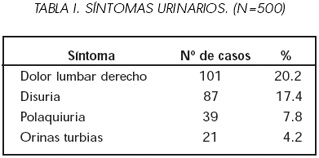
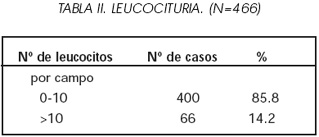
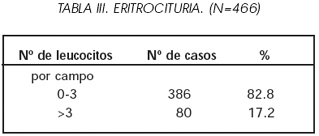
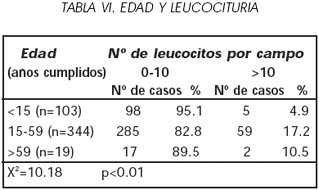
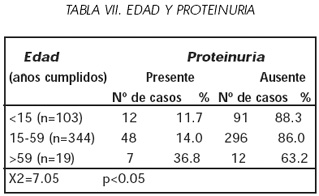
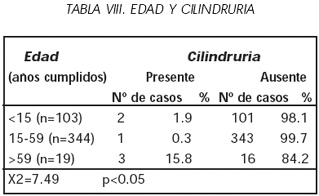
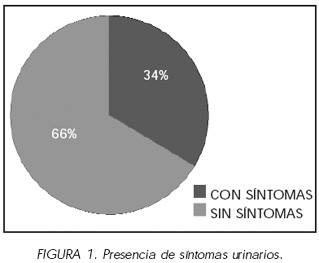
<body><![CDATA[<p><font face="Arial" size="2">Uno de cada 3 pacientes presentó algún síntoma urinario &#091;<a href="#f1">Gráfico 1</a>&#093;; el dolor lumbar derecho y la disuria fueron los más frecuentes &#091;<a href="#t1">Tabla I</a>&#093;. El sedimento urinario mostró leucocituria superior a 10 células por campo en 1 de cada 7 enfermos &#091;<a href="#t2">Tabla II</a>&#093;, y eritrocituria superior a 3 células por campo en 1 de cada 6 &#091;<a href="#t3">Tabla III</a>&#093;. Uno de cada 7 enfermos presentó proteinuria (trazas); y uno de cada 77, cilindruria &#091;<a href="#t4">Tabla IV</a>&#093;.</font></p>     <p align="center"><a name="f1"><img src="/img/revistas/urol/v58n3/207Fig1.jpg" width="319" height="263"></a></p>     <p align="center"><a name="t1"><img src="/img/revistas/urol/v58n3/207Tabla1.jpg" width="319" height="158"></a></p>     <p align="center"><a name="t2"><img src="/img/revistas/urol/v58n3/207Tabla2.jpg" width="319" height="137"></a></p>     <p align="center"><a name="t3"><img src="/img/revistas/urol/v58n3/207Tabla3.jpg" width="319" height="136"></a></p>     <p align="center"><a name="t4"><img src="/img/revistas/urol/v58n3/207Tabla4.jpg" width="319" height="159"></a></p>      <p><font face="Arial" size="2">    <br> La edad influyó en la presencia de síntomas urinarios (más frecuentes en los pacientes menos jóvenes &#091;<a href="#t5">Tabla V</a>&#093;), de leucocituria (mayor en el grupo de 15-59 años &#091;<a href="#t6">Tabla VI</a>&#093;), y de proteinuria y cilindruria (más alta incidencia en los mayores de 59 años &#091;Tablas <a href="#t7">VII</a> y <a href="#t8">VIII</a>&#093;). No estuvo, empero, relacionada con la magnitud de la eritrocituria.</font></p>     <p align="center"><a name="t5"><img src="/img/revistas/urol/v58n3/207Tabla5.jpg" width="319" height="191"></a></p>     <p align="center"><a name="t6"><img src="/img/revistas/urol/v58n3/207Tabla6.jpg" width="319" height="190"></a></p>     ]]></body>
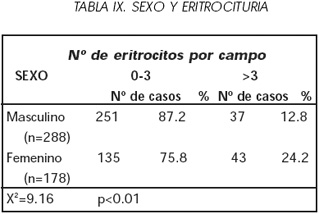
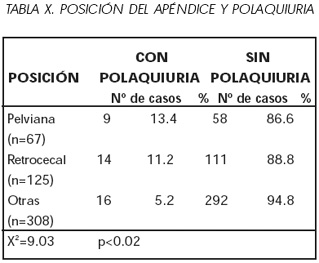
<body><![CDATA[<p align="center"><a name="t7"><img src="/img/revistas/urol/v58n3/207Tabla7.jpg" width="319" height="196"></a></p>     <p align="center"><a name="t8"><img src="/img/revistas/urol/v58n3/207Tabla8.jpg" width="319" height="196"></a></p>      <p><font face="Arial" size="2">    <br> En cambio, el sexo mostró diferencias significativas en lo tocante al conteo eritrocitario (que resultó superior en las mujeres &#091;<a href="#t9">Tabla IX</a>&#093;), pero no estuvo relacionado con otras alteraciones en el análisis de orina ni con la presencia de síntomas urinarios.</font></p>     <p align="center"><a name="t9"><img src="/img/revistas/urol/v58n3/207Tabla9.jpg" width="319" height="214"></a></p>      <p><font face="Arial" size="2">    <br> Las posiciones pelviana y retrocecal del apéndice se asociaron con una mayor incidencia de polaquiuria &#091;<a href="#t10">Tabla X</a>&#093;, y no con el resto de los síntomas urinarios ni con alteraciones del análisis de orina. La duración del dolor abdominal y el estadio evolutivo de la enfermedad no guardaron relación estadística con la presencia de los síntomas ni con los resultados de laboratorio.</font></p>     <p align="center"><a name="t10"><img src="/img/revistas/urol/v58n3/207Tabla10.jpg" width="319" height="263"></a></p>      <br>    <p><font face="Arial" size="2"><b>DISCUSIÓN</b></font></p>     ]]></body>
<body><![CDATA[<p><font face="Arial" size="2">En la serie de Papazov et al.(16), compuesta por 62 pacientes con apendicitis diagnosticada tardíamente, el dolor lumbar estuvo presente en 30 casos, y la disuria en 18, contribuyendo a los errores diagnósticos iniciales. Estos fueron también los síntomas urinarios más frecuentes en nuestra casuística.</font></p>     <p><font face="Arial" size="2">Kretchmar y McDonald, de la Universidad de Rochester (Nueva York, EE.UU.), en un estudio de 113 apendicitis, encontraron que 21 pacientes (19%) presentaban de 5 a 20 leucocitos por campo, y 4 pacientes (3.5%) entre 5 y 30 eritrocitos por campo. La leucocituria resultó superior en mayores de 40 años, y en pacientes con apéndice retrocecal o pelviano; no hubo diferencias significativas en lo tocante al sexo (5).</font></p>     <p><font face="Arial" size="2">Scott et al., de la Universidad de Louisville (Kentucky, EE.UU.), consideraron como anormal el sedimento de una muestra de orina recogida por micción espontánea y centrifugada, en el cual aparecieran más de 4 leucocitos o eritrocitos por campo; y encontraron un sedimento con esas características en el 30% de una serie de 100 apendicitis consecutivas. Estos hallazgos correspondieron al 36% de los mayores de 15 años y al 24% de los menores, lo que equivale al 13% de los niños, el 40% de las niñas, el 25% de los hombres y el 50% de las mujeres; este predominio del sexo femenino es atribuido por los autores de dicho artículo, a la contaminación genital de las muestras obtenidas por micción espontánea. El 53% de los análisis anormales correspondió a casos con apéndice retrocecal o pelviano. La incidencia de sedimento anormal en pacientes con apendicitis perforada fue del 50% (9).</font></p>     <p><font face="Arial" size="2">Por su parte, Arnbjörnsson, de la Universidad de Lund (Suecia), aceptó como anormal el sedimento urinario que mostrara al menos uno de los siguientes criterios: presencia de cilindros, más de 2 eritrocitos por milímetro cúbico, más de 5 leucocitos por milímetro cúbico, más de 5 células epiteliales por milímetro cúbico, y más de 20 bacterias por campo. Este autor encontró un sedimento con alguno de esos criterios en 30 casos (15%) de una serie de 194 apendicitis (30).</font></p>     <p><font face="Arial" size="2">De los casos de Papazov et al., 20 presentaron leucocituria superior a 10 células por campo, 8 tuvieron uno o más eritrocitos por campo, y en 9 se detectó proteinuria (16).</font></p>     <p><font face="Arial" size="2">Puskar et al., del Hospital Nuevo de Zagreb (Croacia), siguiendo los criterios de Scott et al. (9), informaron análisis de orina anormal en el 48% de 66 enfermos de apendicitis. La frecuencia de los análisis anormales no estuvo relacionada con la posición anatómica del apéndice, pero resultó directamente proporcional al grado de inflamación (estadio evolutivo) apendicular (26).</font></p>     <p><font face="Arial" size="2">Paajanen et al., del Hospital de la Universidad de Kuopio (Finlandia), reportaron la presencia de eritrocitos en la orina del 26% de 188 pacientes afectos de la enfermedad (31).</font></p>     <p><font face="Arial" size="2">La disparidad de criterios sobre el sedimento urinario anormal nos impide comparar con exactitud los resultados de los autores citados, con los nuestros.</font></p>      <p><font face="Arial" size="2"><b>CONCLUSIONES</b></font></p>     <p><font face="Arial" size="2"><b>1.</b> Los síntomas urinarios son frecuentes en la apendicitis aguda, sobre todo en mayores de 59 años. Su presencia no debe excluir el diagnóstico de esta enfermedad.</font></p> <b>     ]]></body>
<body><![CDATA[<p><font face="Arial" size="2">2. </font> </b><font face="Arial" size="2">Los síntomas urinarios más frecuentemente encontrados fueron dolor lumbar derecho y disuria.</font></p> <b>     <p><font face="Arial" size="2">3. </font> </b><font face="Arial" size="2">El análisis de orina no es de utilidad para descartar la existencia de una apendicitis aguda.</font></p> <b>     <p><font face="Arial" size="2">4. </font> </b><font face="Arial" size="2">La duración del dolor abdominal y el estadio evolutivo de la enfermedad no guardaron relación estadística con la presencia de síntomas urinarios ni con el resultado del análisis de orina.</font></p> <b>     <p><font face="Arial" size="2">5. </font> </b><font face="Arial" size="2">Los síntomas urinarios (excepto la polaquiuria) y las alteraciones del análisis de orina, no estuvieron relacionados con la proximidad del apéndice inflamado a las vías urinarias.</font></p>      <p>&nbsp;</p>     <p><font face="Arial" size="2"><b>BIBLIOGRAFIA y LECTURAS RECOMENDADAS (*lectura de interés y **lectura fundamental)</b></font></p>     <!-- ref --><p><font face="Arial" size="2">1. LIU, C.D.; McFADDEN, D.W.: &quot;Acute abdomen and appendix&quot;. Greenfield, L.J. (Ed): Surgery: scientific principles and practice. 2 ed. Pp 1246, Lippincott- Raven, Philadelphia, 1997.    &nbsp;&nbsp;&nbsp;&nbsp;&nbsp;&nbsp;&nbsp;&nbsp;[&#160;<a href="javascript:void(0);" onclick="javascript: window.open('/scielo.php?script=sci_nlinks&ref=1053879&pid=S0004-0614200500030000400001&lng=','','width=640,height=500,resizable=yes,scrollbars=1,menubar=yes,');">Links</a>&#160;]<!-- end-ref --></font></p>     <!-- ref --><p><font face="Arial" size="2">*2. WILCOX, R.T.; TRAVERSO, L.W.: &quot;Have the evaluation and treatment of acute appendicitis changed with new technology?&quot;. Surg. Clin. North Am., 77: 1355, 1997.    &nbsp;&nbsp;&nbsp;&nbsp;&nbsp;&nbsp;&nbsp;&nbsp;[&#160;<a href="javascript:void(0);" onclick="javascript: window.open('/scielo.php?script=sci_nlinks&ref=1053881&pid=S0004-0614200500030000400002&lng=','','width=640,height=500,resizable=yes,scrollbars=1,menubar=yes,');">Links</a>&#160;]<!-- end-ref --></font></p>     ]]></body>
<body><![CDATA[<!-- ref --><p><font face="Arial" size="2">*3. HARDIN, D.M.: &quot;Acute appendicitis: review and update&quot;. Am. Fam. Physician, 60: 2027, 1999.    &nbsp;&nbsp;&nbsp;&nbsp;&nbsp;&nbsp;&nbsp;&nbsp;[&#160;<a href="javascript:void(0);" onclick="javascript: window.open('/scielo.php?script=sci_nlinks&ref=1053883&pid=S0004-0614200500030000400003&lng=','','width=640,height=500,resizable=yes,scrollbars=1,menubar=yes,');">Links</a>&#160;]<!-- end-ref --></font></p>     <!-- ref --><p><font face="Arial" size="2">4. FLUM, D.R.; MORRIS, A.; KOEPSELL, T. y cols.: &quot;Has misdiagnosis of appendicitis decreased over time? A population-based analysis&quot;. JAMA, 286: 1748, 2001.    &nbsp;&nbsp;&nbsp;&nbsp;&nbsp;&nbsp;&nbsp;&nbsp;[&#160;<a href="javascript:void(0);" onclick="javascript: window.open('/scielo.php?script=sci_nlinks&ref=1053885&pid=S0004-0614200500030000400004&lng=','','width=640,height=500,resizable=yes,scrollbars=1,menubar=yes,');">Links</a>&#160;]<!-- end-ref --></font></p>     <!-- ref --><p><font face="Arial" size="2">*5. KRETCHMAR, L.H.; McDONALD, D.F.: &quot;The urinary sediment in acute appendicitis&quot;. Arch. Surg., 87: 209, 1963.    &nbsp;&nbsp;&nbsp;&nbsp;&nbsp;&nbsp;&nbsp;&nbsp;[&#160;<a href="javascript:void(0);" onclick="javascript: window.open('/scielo.php?script=sci_nlinks&ref=1053887&pid=S0004-0614200500030000400005&lng=','','width=640,height=500,resizable=yes,scrollbars=1,menubar=yes,');">Links</a>&#160;]<!-- end-ref --></font></p>     <!-- ref --><p><font face="Arial" size="2">6. MONDOR, H.: &quot;Abdomen agudo&quot;. Pp 162, Toray- Masson, Barcelona, 1963.    &nbsp;&nbsp;&nbsp;&nbsp;&nbsp;&nbsp;&nbsp;&nbsp;[&#160;<a href="javascript:void(0);" onclick="javascript: window.open('/scielo.php?script=sci_nlinks&ref=1053889&pid=S0004-0614200500030000400006&lng=','','width=640,height=500,resizable=yes,scrollbars=1,menubar=yes,');">Links</a>&#160;]<!-- end-ref --></font></p>     <!-- ref --><p><font face="Arial" size="2">7. TORROELLA MATA, E.: &quot;Cirugía&quot;. T1, Pp 282, Pueblo y Educación, La Habana, 1976.    &nbsp;&nbsp;&nbsp;&nbsp;&nbsp;&nbsp;&nbsp;&nbsp;[&#160;<a href="javascript:void(0);" onclick="javascript: window.open('/scielo.php?script=sci_nlinks&ref=1053891&pid=S0004-0614200500030000400007&lng=','','width=640,height=500,resizable=yes,scrollbars=1,menubar=yes,');">Links</a>&#160;]<!-- end-ref --></font></p>     ]]></body>
<body><![CDATA[<!-- ref --><p><font face="Arial" size="2">8. CLAIN, A.: &quot;Hamilton Bailey’s demonstrations of physical signs in clinical surgery&quot;. 16 ed. Pp 293, Year Book Medical Publishers, Chicago, 1980.    &nbsp;&nbsp;&nbsp;&nbsp;&nbsp;&nbsp;&nbsp;&nbsp;[&#160;<a href="javascript:void(0);" onclick="javascript: window.open('/scielo.php?script=sci_nlinks&ref=1053893&pid=S0004-0614200500030000400008&lng=','','width=640,height=500,resizable=yes,scrollbars=1,menubar=yes,');">Links</a>&#160;]<!-- end-ref --></font></p>     <!-- ref --><p><font face="Arial" size="2">*9. SCOTT, J.H.; AMIN, M.; HARTY, J.I.: &quot;Abnormal urinalysis in appendicitis&quot;. J. Urol., 129: 1015, 1983.    &nbsp;&nbsp;&nbsp;&nbsp;&nbsp;&nbsp;&nbsp;&nbsp;[&#160;<a href="javascript:void(0);" onclick="javascript: window.open('/scielo.php?script=sci_nlinks&ref=1053895&pid=S0004-0614200500030000400009&lng=','','width=640,height=500,resizable=yes,scrollbars=1,menubar=yes,');">Links</a>&#160;]<!-- end-ref --></font></p>     <!-- ref --><p><font face="Arial" size="2">10. YAMAMOTO, M.; ANDO, T.; KANAI, S. y cols.: &quot;Abnormal urinalysis in acute appendicitis&quot;. Hinyokika Kiyo 31: 1723, 1985.    &nbsp;&nbsp;&nbsp;&nbsp;&nbsp;&nbsp;&nbsp;&nbsp;[&#160;<a href="javascript:void(0);" onclick="javascript: window.open('/scielo.php?script=sci_nlinks&ref=1053897&pid=S0004-0614200500030000400010&lng=','','width=640,height=500,resizable=yes,scrollbars=1,menubar=yes,');">Links</a>&#160;]<!-- end-ref --></font></p>     <!-- ref --><p><font face="Arial" size="2">**11. JONES, W.G.; BARIE, P.S.: &quot;Urological manifestations of acute appendicitis&quot;. J. Urol., 139: 1325, 1988.    &nbsp;&nbsp;&nbsp;&nbsp;&nbsp;&nbsp;&nbsp;&nbsp;[&#160;<a href="javascript:void(0);" onclick="javascript: window.open('/scielo.php?script=sci_nlinks&ref=1053899&pid=S0004-0614200500030000400011&lng=','','width=640,height=500,resizable=yes,scrollbars=1,menubar=yes,');">Links</a>&#160;]<!-- end-ref --></font></p>     <!-- ref --><p><font face="Arial" size="2">12. DIANA, M.; ZOPPE, C.; MASTRANGELI, B.: &quot;L’ematuria di origine appendicolare&quot;. Arch. Ital. Urol. Androl., 71: 229, 1999.    &nbsp;&nbsp;&nbsp;&nbsp;&nbsp;&nbsp;&nbsp;&nbsp;[&#160;<a href="javascript:void(0);" onclick="javascript: window.open('/scielo.php?script=sci_nlinks&ref=1053901&pid=S0004-0614200500030000400012&lng=','','width=640,height=500,resizable=yes,scrollbars=1,menubar=yes,');">Links</a>&#160;]<!-- end-ref --></font></p>     ]]></body>
<body><![CDATA[<!-- ref --><p><font face="Arial" size="2">13. DELIC, J.; SAVKOVIC, A.; ISAKOVIC, E.: &quot;Variations in the position and point of origin of the vermiform appendix&quot;. Med. Arh., 56: 5, 2002.    &nbsp;&nbsp;&nbsp;&nbsp;&nbsp;&nbsp;&nbsp;&nbsp;[&#160;<a href="javascript:void(0);" onclick="javascript: window.open('/scielo.php?script=sci_nlinks&ref=1053903&pid=S0004-0614200500030000400013&lng=','','width=640,height=500,resizable=yes,scrollbars=1,menubar=yes,');">Links</a>&#160;]<!-- end-ref --></font></p>     <!-- ref --><p><font face="Arial" size="2">14. ROTHROCK, S.G.; SKEOCH, G.; RUSH, J.J. y cols.: &quot;Clinical features of misdiagnosed appendicitis in children&quot;. Ann. Emerg. Med., 20: 45, 1991.    &nbsp;&nbsp;&nbsp;&nbsp;&nbsp;&nbsp;&nbsp;&nbsp;[&#160;<a href="javascript:void(0);" onclick="javascript: window.open('/scielo.php?script=sci_nlinks&ref=1053905&pid=S0004-0614200500030000400014&lng=','','width=640,height=500,resizable=yes,scrollbars=1,menubar=yes,');">Links</a>&#160;]<!-- end-ref --></font></p>     <!-- ref --><p><font face="Arial" size="2">15. MAHMOODIAN, S.: &quot;Appendicitis complicating pregnancy&quot;. South Med. J., 85: 19, 1992.    &nbsp;&nbsp;&nbsp;&nbsp;&nbsp;&nbsp;&nbsp;&nbsp;[&#160;<a href="javascript:void(0);" onclick="javascript: window.open('/scielo.php?script=sci_nlinks&ref=1053907&pid=S0004-0614200500030000400015&lng=','','width=640,height=500,resizable=yes,scrollbars=1,menubar=yes,');">Links</a>&#160;]<!-- end-ref --></font></p>     <!-- ref --><p><font face="Arial" size="2">*16. PAPAZOV, F.K.; TIKHI, A.T.; BELIK, I.E. y cols.: &quot;Errors in diagnosis of acute appendicitis in dominating urological symptoms&quot;. Vestnik Khirurgii, 142: 120, 1989.    &nbsp;&nbsp;&nbsp;&nbsp;&nbsp;&nbsp;&nbsp;&nbsp;[&#160;<a href="javascript:void(0);" onclick="javascript: window.open('/scielo.php?script=sci_nlinks&ref=1053909&pid=S0004-0614200500030000400016&lng=','','width=640,height=500,resizable=yes,scrollbars=1,menubar=yes,');">Links</a>&#160;]<!-- end-ref --></font></p>     <!-- ref --><p><font face="Arial" size="2">17. FARIÑA, L.A.; ALLENDE, L.; HOCSMAN, H.: &quot;Absceso pelviano y retención aguda de orina por apendicitis&quot;. Arch. Esp. Urol., 45: 71, 1992.    &nbsp;&nbsp;&nbsp;&nbsp;&nbsp;&nbsp;&nbsp;&nbsp;[&#160;<a href="javascript:void(0);" onclick="javascript: window.open('/scielo.php?script=sci_nlinks&ref=1053911&pid=S0004-0614200500030000400017&lng=','','width=640,height=500,resizable=yes,scrollbars=1,menubar=yes,');">Links</a>&#160;]<!-- end-ref --></font></p>     ]]></body>
<body><![CDATA[<!-- ref --><p><font face="Arial" size="2">18. MAIO, G.; ARAGONA, F.; CISTERNINO, A. y cols.: &quot;Urological manifestations of acute appendicitis: report of two new cases&quot;. Urol. Int., 48: 242, 1992.    &nbsp;&nbsp;&nbsp;&nbsp;&nbsp;&nbsp;&nbsp;&nbsp;[&#160;<a href="javascript:void(0);" onclick="javascript: window.open('/scielo.php?script=sci_nlinks&ref=1053913&pid=S0004-0614200500030000400018&lng=','','width=640,height=500,resizable=yes,scrollbars=1,menubar=yes,');">Links</a>&#160;]<!-- end-ref --></font></p>     <!-- ref --><p><font face="Arial" size="2">19. KUBO, M.; TAGUCHI, K.; FUJISUE, H. y cols.: &quot;Hydronephrosis as a complication of appendicitis: a case report&quot;. Hinyokika Kiyo, 42: 679, 1996.    &nbsp;&nbsp;&nbsp;&nbsp;&nbsp;&nbsp;&nbsp;&nbsp;[&#160;<a href="javascript:void(0);" onclick="javascript: window.open('/scielo.php?script=sci_nlinks&ref=1053915&pid=S0004-0614200500030000400019&lng=','','width=640,height=500,resizable=yes,scrollbars=1,menubar=yes,');">Links</a>&#160;]<!-- end-ref --></font></p>     <!-- ref --><p><font face="Arial" size="2">20. IDA, K.; YAMAGUCHI, K.; NISHIMURA, Y. y cols.: &quot;Hydronephrosis as a complication of the apendiceal abcess: report of a case&quot;. Hinyokika Kiyo, 46: 181, 2000.    &nbsp;&nbsp;&nbsp;&nbsp;&nbsp;&nbsp;&nbsp;&nbsp;[&#160;<a href="javascript:void(0);" onclick="javascript: window.open('/scielo.php?script=sci_nlinks&ref=1053917&pid=S0004-0614200500030000400020&lng=','','width=640,height=500,resizable=yes,scrollbars=1,menubar=yes,');">Links</a>&#160;]<!-- end-ref --></font></p>     <!-- ref --><p><font face="Arial" size="2">21. GALINKIN, D.; KATZ, S.; GREENWALD, M. y cols.: &quot;Pseudotumor of the bladder as a manifestation of uncomplicated appendicitis&quot;. J. Clin. Gastroenterol., 32: 367, 2001.    &nbsp;&nbsp;&nbsp;&nbsp;&nbsp;&nbsp;&nbsp;&nbsp;[&#160;<a href="javascript:void(0);" onclick="javascript: window.open('/scielo.php?script=sci_nlinks&ref=1053919&pid=S0004-0614200500030000400021&lng=','','width=640,height=500,resizable=yes,scrollbars=1,menubar=yes,');">Links</a>&#160;]<!-- end-ref --></font></p>     <!-- ref --><p><font face="Arial" size="2">22.PREECE, J.M.; BEVERLEY, D.W.: &quot;Acute urinary retention: an unusual presentation of acute apendicitis in a 3 year old boy&quot;. Arch. Dis. Child, 84: 269, 2001.    &nbsp;&nbsp;&nbsp;&nbsp;&nbsp;&nbsp;&nbsp;&nbsp;[&#160;<a href="javascript:void(0);" onclick="javascript: window.open('/scielo.php?script=sci_nlinks&ref=1053921&pid=S0004-0614200500030000400022&lng=','','width=640,height=500,resizable=yes,scrollbars=1,menubar=yes,');">Links</a>&#160;]<!-- end-ref --></font></p>     ]]></body>
<body><![CDATA[<!-- ref --><p><font face="Arial" size="2">23. SALIM, A.S.; AHMED, T.M.: &quot;Acute appendicitis presenting as urinary retention: a note of caution&quot;. Saudi Med. J., 23: 353, 2002.    &nbsp;&nbsp;&nbsp;&nbsp;&nbsp;&nbsp;&nbsp;&nbsp;[&#160;<a href="javascript:void(0);" onclick="javascript: window.open('/scielo.php?script=sci_nlinks&ref=1053923&pid=S0004-0614200500030000400023&lng=','','width=640,height=500,resizable=yes,scrollbars=1,menubar=yes,');">Links</a>&#160;]<!-- end-ref --></font></p>     <!-- ref --><p><font face="Arial" size="2">24. SELMAN, S.H.; GRECOS, G.P.: &quot;Appendico-ureterocutaneous fistula: report of a case&quot;. J. Urol., 128: 593, 1982.    &nbsp;&nbsp;&nbsp;&nbsp;&nbsp;&nbsp;&nbsp;&nbsp;[&#160;<a href="javascript:void(0);" onclick="javascript: window.open('/scielo.php?script=sci_nlinks&ref=1053925&pid=S0004-0614200500030000400024&lng=','','width=640,height=500,resizable=yes,scrollbars=1,menubar=yes,');">Links</a>&#160;]<!-- end-ref --></font></p>     <!-- ref --><p><font face="Arial" size="2">25. REIG RUIZ, C.; VILA BARJA, J.; QUINTANILLA MUÑOZ, B. y cols.: &quot;Fístula apendicovesical secundaria a apendicitis. Revisión de la literatura&quot;. Arch. Esp. Urol. 46: 340, 1993.    &nbsp;&nbsp;&nbsp;&nbsp;&nbsp;&nbsp;&nbsp;&nbsp;[&#160;<a href="javascript:void(0);" onclick="javascript: window.open('/scielo.php?script=sci_nlinks&ref=1053927&pid=S0004-0614200500030000400025&lng=','','width=640,height=500,resizable=yes,scrollbars=1,menubar=yes,');">Links</a>&#160;]<!-- end-ref --></font></p>     <!-- ref --><p><font face="Arial" size="2">26. PUSKAR, D.; BEDALOV, G.; FRIDRIH, S. y cols.: &quot;Urinalysis, ultrasound analysis, and renal dynamic scintigraphy in acute appendicitis&quot;. Urology, 45: 108, 1995.    &nbsp;&nbsp;&nbsp;&nbsp;&nbsp;&nbsp;&nbsp;&nbsp;[&#160;<a href="javascript:void(0);" onclick="javascript: window.open('/scielo.php?script=sci_nlinks&ref=1053929&pid=S0004-0614200500030000400026&lng=','','width=640,height=500,resizable=yes,scrollbars=1,menubar=yes,');">Links</a>&#160;]<!-- end-ref --></font></p>     <!-- ref --><p><font face="Arial" size="2">27. MONTERO SÁNCHEZ, M.; GÓMEZ TELLADO, M.; MÉNDEZ GALLART, R. y cols.: &quot;Ureterohidronefrosis secundaria a absceso apendicular&quot;. Arch. Esp. Urol., 50: 972, 1997.    &nbsp;&nbsp;&nbsp;&nbsp;&nbsp;&nbsp;&nbsp;&nbsp;[&#160;<a href="javascript:void(0);" onclick="javascript: window.open('/scielo.php?script=sci_nlinks&ref=1053931&pid=S0004-0614200500030000400027&lng=','','width=640,height=500,resizable=yes,scrollbars=1,menubar=yes,');">Links</a>&#160;]<!-- end-ref --></font></p>     ]]></body>
<body><![CDATA[<!-- ref --><p><font face="Arial" size="2">28. IZAWA, J.I.; TAYLOR, B.M.; DENSTEDT, J.D.: &quot;Appendicovesical fistula: case report and review&quot;. Can. J. Urol., 5: 566, 1998.    &nbsp;&nbsp;&nbsp;&nbsp;&nbsp;&nbsp;&nbsp;&nbsp;[&#160;<a href="javascript:void(0);" onclick="javascript: window.open('/scielo.php?script=sci_nlinks&ref=1053933&pid=S0004-0614200500030000400028&lng=','','width=640,height=500,resizable=yes,scrollbars=1,menubar=yes,');">Links</a>&#160;]<!-- end-ref --></font></p>     <!-- ref --><p><font face="Arial" size="2">29. GRAHAM, J.A.: &quot;Urinary cell counts in appendicitis&quot;. Scot. Med. J., 10: 126, 1965.    &nbsp;&nbsp;&nbsp;&nbsp;&nbsp;&nbsp;&nbsp;&nbsp;[&#160;<a href="javascript:void(0);" onclick="javascript: window.open('/scielo.php?script=sci_nlinks&ref=1053935&pid=S0004-0614200500030000400029&lng=','','width=640,height=500,resizable=yes,scrollbars=1,menubar=yes,');">Links</a>&#160;]<!-- end-ref --></font></p>     <!-- ref --><p><font face="Arial" size="2">*30. ARNBJÖRNSSON, E.: &quot;Bacteriuria in appendicitis&quot;. Am. J. Surg., 155: 356, 1988.    &nbsp;&nbsp;&nbsp;&nbsp;&nbsp;&nbsp;&nbsp;&nbsp;[&#160;<a href="javascript:void(0);" onclick="javascript: window.open('/scielo.php?script=sci_nlinks&ref=1053937&pid=S0004-0614200500030000400030&lng=','','width=640,height=500,resizable=yes,scrollbars=1,menubar=yes,');">Links</a>&#160;]<!-- end-ref --></font></p>     <!-- ref --><p><font face="Arial" size="2">31. PAAJANEN, H.; TAINIO, H.; LAATO, M.: &quot;A chance of misdiagnosis between acute appendicitis and renal colic&quot;. Scand. J. Urol. Nephrol., 30: 363, 1996.    &nbsp;&nbsp;&nbsp;&nbsp;&nbsp;&nbsp;&nbsp;&nbsp;[&#160;<a href="javascript:void(0);" onclick="javascript: window.open('/scielo.php?script=sci_nlinks&ref=1053939&pid=S0004-0614200500030000400031&lng=','','width=640,height=500,resizable=yes,scrollbars=1,menubar=yes,');">Links</a>&#160;]<!-- end-ref --></font></p>     <!-- ref --><p><font face="Arial" size="2">32. PUSKAR, D.; VUCKOVIC, I.; BEDALOV, G. y cols.: &quot;Urinary tract infection in acute appendicitis&quot;. Acta Med. Croatica, 51: 197, 1997.    &nbsp;&nbsp;&nbsp;&nbsp;&nbsp;&nbsp;&nbsp;&nbsp;[&#160;<a href="javascript:void(0);" onclick="javascript: window.open('/scielo.php?script=sci_nlinks&ref=1053941&pid=S0004-0614200500030000400032&lng=','','width=640,height=500,resizable=yes,scrollbars=1,menubar=yes,');">Links</a>&#160;]<!-- end-ref --></font></p>     ]]></body>
<body><![CDATA[<!-- ref --><p><font face="Arial" size="2">33. ROTHROCK, S.G.; GREEN, S.M.; DOBSON, M. y cols.: &quot;Misdiagnosis of appendicitis in nonpregnant women of childbearing age&quot;. J. Emerg. Med., 13: 1, 1995.    &nbsp;&nbsp;&nbsp;&nbsp;&nbsp;&nbsp;&nbsp;&nbsp;[&#160;<a href="javascript:void(0);" onclick="javascript: window.open('/scielo.php?script=sci_nlinks&ref=1053943&pid=S0004-0614200500030000400033&lng=','','width=640,height=500,resizable=yes,scrollbars=1,menubar=yes,');">Links</a>&#160;]<!-- end-ref --></font></p>     <!-- ref --><p><font face="Arial" size="2">34. ROBBINS, S.L.; COTRAN, R.S.; KUMAR, V.: &quot;Patología estructural y funcional&quot;. 3 ed. Pp. 862, Interamericana, México D.F., 1988.    &nbsp;&nbsp;&nbsp;&nbsp;&nbsp;&nbsp;&nbsp;&nbsp;[&#160;<a href="javascript:void(0);" onclick="javascript: window.open('/scielo.php?script=sci_nlinks&ref=1053945&pid=S0004-0614200500030000400034&lng=','','width=640,height=500,resizable=yes,scrollbars=1,menubar=yes,');">Links</a>&#160;]<!-- end-ref --></font></p>       ]]></body><back>
<ref-list>
<ref id="B1">
<label>1</label><nlm-citation citation-type="book">
<person-group person-group-type="author">
<name>
<surname><![CDATA[LIU]]></surname>
<given-names><![CDATA[C.D.]]></given-names>
</name>
<name>
<surname><![CDATA[McFADDEN]]></surname>
<given-names><![CDATA[D.W.]]></given-names>
</name>
</person-group>
<article-title xml:lang="en"><![CDATA[Acute abdomen and appendix]]></article-title>
<person-group person-group-type="editor">
<name>
<surname><![CDATA[Greenfield]]></surname>
<given-names><![CDATA[L.J.]]></given-names>
</name>
</person-group>
<source><![CDATA[Surgery: scientific principles and practice]]></source>
<year>1997</year>
<edition>2</edition>
<page-range>1246</page-range><publisher-loc><![CDATA[Philadelphia ]]></publisher-loc>
<publisher-name><![CDATA[Lippincott- Raven]]></publisher-name>
</nlm-citation>
</ref>
<ref id="B2">
<label>2</label><nlm-citation citation-type="journal">
<person-group person-group-type="author">
<name>
<surname><![CDATA[WILCOX]]></surname>
<given-names><![CDATA[R.T.]]></given-names>
</name>
<name>
<surname><![CDATA[TRAVERSO]]></surname>
<given-names><![CDATA[L.W.]]></given-names>
</name>
</person-group>
<article-title xml:lang="en"><![CDATA[Have the evaluation and treatment of acute appendicitis changed with new technology?]]></article-title>
<source><![CDATA[Surg. Clin. North Am.]]></source>
<year>1997</year>
<volume>77</volume>
<page-range>1355</page-range></nlm-citation>
</ref>
<ref id="B3">
<label>3</label><nlm-citation citation-type="journal">
<person-group person-group-type="author">
<name>
<surname><![CDATA[HARDIN]]></surname>
<given-names><![CDATA[D.M.]]></given-names>
</name>
</person-group>
<article-title xml:lang="en"><![CDATA[Acute appendicitis: review and update]]></article-title>
<source><![CDATA[Am. Fam. Physician]]></source>
<year>1999</year>
<volume>60</volume>
<page-range>2027</page-range></nlm-citation>
</ref>
<ref id="B4">
<label>4</label><nlm-citation citation-type="journal">
<person-group person-group-type="author">
<name>
<surname><![CDATA[FLUM]]></surname>
<given-names><![CDATA[D.R.]]></given-names>
</name>
<name>
<surname><![CDATA[MORRIS]]></surname>
<given-names><![CDATA[A.]]></given-names>
</name>
<name>
<surname><![CDATA[KOEPSELL]]></surname>
<given-names><![CDATA[T.]]></given-names>
</name>
</person-group>
<article-title xml:lang="en"><![CDATA[Has misdiagnosis of appendicitis decreased over time?: A population-based analysis]]></article-title>
<source><![CDATA[JAMA]]></source>
<year>2001</year>
<volume>286</volume>
<page-range>1748</page-range></nlm-citation>
</ref>
<ref id="B5">
<label>5</label><nlm-citation citation-type="journal">
<person-group person-group-type="author">
<name>
<surname><![CDATA[KRETCHMAR]]></surname>
<given-names><![CDATA[L.H.]]></given-names>
</name>
<name>
<surname><![CDATA[McDONALD]]></surname>
<given-names><![CDATA[D.F.]]></given-names>
</name>
</person-group>
<article-title xml:lang="en"><![CDATA[The urinary sediment in acute appendicitis]]></article-title>
<source><![CDATA[Arch. Surg.]]></source>
<year>1963</year>
<volume>87</volume>
<page-range>209</page-range></nlm-citation>
</ref>
<ref id="B6">
<label>6</label><nlm-citation citation-type="book">
<person-group person-group-type="author">
<name>
<surname><![CDATA[MONDOR]]></surname>
<given-names><![CDATA[H.]]></given-names>
</name>
</person-group>
<source><![CDATA[Abdomen agudo]]></source>
<year>1963</year>
<page-range>162</page-range><publisher-loc><![CDATA[Barcelona ]]></publisher-loc>
<publisher-name><![CDATA[Toray- Masson]]></publisher-name>
</nlm-citation>
</ref>
<ref id="B7">
<label>7</label><nlm-citation citation-type="book">
<person-group person-group-type="author">
<name>
<surname><![CDATA[TORROELLA MATA]]></surname>
<given-names><![CDATA[E.]]></given-names>
</name>
</person-group>
<source><![CDATA[Cirugía]]></source>
<year>1976</year>
<volume>1</volume>
<page-range>282</page-range><publisher-loc><![CDATA[La Habana ]]></publisher-loc>
<publisher-name><![CDATA[Pueblo y Educación]]></publisher-name>
</nlm-citation>
</ref>
<ref id="B8">
<label>8</label><nlm-citation citation-type="book">
<person-group person-group-type="author">
<name>
<surname><![CDATA[CLAIN]]></surname>
<given-names><![CDATA[A.]]></given-names>
</name>
</person-group>
<source><![CDATA[Hamilton Bailey’s demonstrations of physical signs in clinical surgery]]></source>
<year>1980</year>
<edition>16</edition>
<page-range>293</page-range><publisher-loc><![CDATA[Chicago ]]></publisher-loc>
<publisher-name><![CDATA[Year Book Medical Publishers]]></publisher-name>
</nlm-citation>
</ref>
<ref id="B9">
<label>9</label><nlm-citation citation-type="journal">
<person-group person-group-type="author">
<name>
<surname><![CDATA[SCOTT]]></surname>
<given-names><![CDATA[J.H.]]></given-names>
</name>
<name>
<surname><![CDATA[AMIN]]></surname>
<given-names><![CDATA[M.]]></given-names>
</name>
<name>
<surname><![CDATA[HARTY]]></surname>
<given-names><![CDATA[J.I.]]></given-names>
</name>
</person-group>
<article-title xml:lang="en"><![CDATA[Abnormal urinalysis in appendicitis]]></article-title>
<source><![CDATA[J. Urol.]]></source>
<year>1983</year>
<volume>129</volume>
<page-range>1015</page-range></nlm-citation>
</ref>
<ref id="B10">
<label>10</label><nlm-citation citation-type="journal">
<person-group person-group-type="author">
<name>
<surname><![CDATA[YAMAMOTO]]></surname>
<given-names><![CDATA[M.]]></given-names>
</name>
<name>
<surname><![CDATA[ANDO]]></surname>
<given-names><![CDATA[T.]]></given-names>
</name>
<name>
<surname><![CDATA[KANAI]]></surname>
<given-names><![CDATA[S.]]></given-names>
</name>
</person-group>
<article-title xml:lang="en"><![CDATA[Abnormal urinalysis in acute appendicitis]]></article-title>
<source><![CDATA[Hinyokika Kiyo]]></source>
<year>1985</year>
<volume>31</volume>
<page-range>1723</page-range></nlm-citation>
</ref>
<ref id="B11">
<label>11</label><nlm-citation citation-type="journal">
<person-group person-group-type="author">
<name>
<surname><![CDATA[JONES]]></surname>
<given-names><![CDATA[W.G.]]></given-names>
</name>
<name>
<surname><![CDATA[BARIE]]></surname>
<given-names><![CDATA[P.S.]]></given-names>
</name>
</person-group>
<article-title xml:lang="en"><![CDATA[Urological manifestations of acute appendicitis]]></article-title>
<source><![CDATA[J. Urol.]]></source>
<year>1988</year>
<volume>139</volume>
<page-range>1325</page-range></nlm-citation>
</ref>
<ref id="B12">
<label>12</label><nlm-citation citation-type="journal">
<person-group person-group-type="author">
<name>
<surname><![CDATA[DIANA]]></surname>
<given-names><![CDATA[M.]]></given-names>
</name>
<name>
<surname><![CDATA[ZOPPE]]></surname>
<given-names><![CDATA[C.]]></given-names>
</name>
<name>
<surname><![CDATA[MASTRANGELI]]></surname>
<given-names><![CDATA[B.]]></given-names>
</name>
</person-group>
<article-title xml:lang="it"><![CDATA[L’ematuria di origine appendicolare]]></article-title>
<source><![CDATA[Arch. Ital. Urol. Androl.]]></source>
<year>1999</year>
<volume>71</volume>
<page-range>229</page-range></nlm-citation>
</ref>
<ref id="B13">
<label>13</label><nlm-citation citation-type="journal">
<person-group person-group-type="author">
<name>
<surname><![CDATA[DELIC]]></surname>
<given-names><![CDATA[J.]]></given-names>
</name>
<name>
<surname><![CDATA[SAVKOVIC]]></surname>
<given-names><![CDATA[A.]]></given-names>
</name>
<name>
<surname><![CDATA[ISAKOVIC]]></surname>
<given-names><![CDATA[E.]]></given-names>
</name>
</person-group>
<article-title xml:lang="en"><![CDATA[Variations in the position and point of origin of the vermiform appendix]]></article-title>
<source><![CDATA[Med. Arh.]]></source>
<year>2002</year>
<volume>56</volume>
<page-range>5</page-range></nlm-citation>
</ref>
<ref id="B14">
<label>14</label><nlm-citation citation-type="journal">
<person-group person-group-type="author">
<name>
<surname><![CDATA[ROTHROCK]]></surname>
<given-names><![CDATA[S.G.]]></given-names>
</name>
<name>
<surname><![CDATA[SKEOCH]]></surname>
<given-names><![CDATA[G.]]></given-names>
</name>
<name>
<surname><![CDATA[RUSH]]></surname>
<given-names><![CDATA[J.J.]]></given-names>
</name>
</person-group>
<article-title xml:lang="en"><![CDATA[Clinical features of misdiagnosed appendicitis in children]]></article-title>
<source><![CDATA[Ann. Emerg. Med.]]></source>
<year>1991</year>
<volume>20</volume>
<page-range>45</page-range></nlm-citation>
</ref>
<ref id="B15">
<label>15</label><nlm-citation citation-type="journal">
<person-group person-group-type="author">
<name>
<surname><![CDATA[MAHMOODIAN]]></surname>
<given-names><![CDATA[S.]]></given-names>
</name>
</person-group>
<article-title xml:lang="en"><![CDATA[Appendicitis complicating pregnancy]]></article-title>
<source><![CDATA[South Med. J.]]></source>
<year>1992</year>
<volume>85</volume>
<page-range>19</page-range></nlm-citation>
</ref>
<ref id="B16">
<label>16</label><nlm-citation citation-type="journal">
<person-group person-group-type="author">
<name>
<surname><![CDATA[PAPAZOV]]></surname>
<given-names><![CDATA[F.K.]]></given-names>
</name>
<name>
<surname><![CDATA[TIKHI]]></surname>
<given-names><![CDATA[A.T.]]></given-names>
</name>
<name>
<surname><![CDATA[BELIK]]></surname>
<given-names><![CDATA[I.E.]]></given-names>
</name>
</person-group>
<article-title xml:lang="en"><![CDATA[Errors in diagnosis of acute appendicitis in dominating urological symptoms]]></article-title>
<source><![CDATA[Vestnik Khirurgii]]></source>
<year>1989</year>
<volume>142</volume>
<page-range>120</page-range></nlm-citation>
</ref>
<ref id="B17">
<label>17</label><nlm-citation citation-type="journal">
<person-group person-group-type="author">
<name>
<surname><![CDATA[FARIÑA]]></surname>
<given-names><![CDATA[L.A.]]></given-names>
</name>
<name>
<surname><![CDATA[ALLENDE]]></surname>
<given-names><![CDATA[L.]]></given-names>
</name>
<name>
<surname><![CDATA[HOCSMAN]]></surname>
<given-names><![CDATA[H.]]></given-names>
</name>
</person-group>
<article-title xml:lang="es"><![CDATA[Absceso pelviano y retención aguda de orina por apendicitis]]></article-title>
<source><![CDATA[Arch. Esp. Urol.]]></source>
<year>1992</year>
<volume>45</volume>
<page-range>71</page-range></nlm-citation>
</ref>
<ref id="B18">
<label>18</label><nlm-citation citation-type="journal">
<person-group person-group-type="author">
<name>
<surname><![CDATA[MAIO]]></surname>
<given-names><![CDATA[G.]]></given-names>
</name>
<name>
<surname><![CDATA[ARAGONA]]></surname>
<given-names><![CDATA[F.]]></given-names>
</name>
<name>
<surname><![CDATA[CISTERNINO]]></surname>
<given-names><![CDATA[A.]]></given-names>
</name>
</person-group>
<article-title xml:lang="en"><![CDATA[Urological manifestations of acute appendicitis: report of two new cases]]></article-title>
<source><![CDATA[Urol. Int.]]></source>
<year>1992</year>
<volume>48</volume>
<page-range>242</page-range></nlm-citation>
</ref>
<ref id="B19">
<label>19</label><nlm-citation citation-type="journal">
<person-group person-group-type="author">
<name>
<surname><![CDATA[KUBO]]></surname>
<given-names><![CDATA[M.]]></given-names>
</name>
<name>
<surname><![CDATA[TAGUCHI]]></surname>
<given-names><![CDATA[K.]]></given-names>
</name>
<name>
<surname><![CDATA[FUJISUE]]></surname>
<given-names><![CDATA[H.]]></given-names>
</name>
</person-group>
<article-title xml:lang="en"><![CDATA[Hydronephrosis as a complication of appendicitis: a case report]]></article-title>
<source><![CDATA[Hinyokika Kiyo]]></source>
<year>1996</year>
<volume>42</volume>
<page-range>679</page-range></nlm-citation>
</ref>
<ref id="B20">
<label>20</label><nlm-citation citation-type="journal">
<person-group person-group-type="author">
<name>
<surname><![CDATA[IDA]]></surname>
<given-names><![CDATA[K.]]></given-names>
</name>
<name>
<surname><![CDATA[YAMAGUCHI]]></surname>
<given-names><![CDATA[K.]]></given-names>
</name>
<name>
<surname><![CDATA[NISHIMURA]]></surname>
<given-names><![CDATA[Y.]]></given-names>
</name>
</person-group>
<article-title xml:lang="en"><![CDATA[Hydronephrosis as a complication of the apendiceal abcess: report of a case]]></article-title>
<source><![CDATA[Hinyokika Kiyo]]></source>
<year>2000</year>
<volume>46</volume>
<page-range>181</page-range></nlm-citation>
</ref>
<ref id="B21">
<label>21</label><nlm-citation citation-type="journal">
<person-group person-group-type="author">
<name>
<surname><![CDATA[GALINKIN]]></surname>
<given-names><![CDATA[D.]]></given-names>
</name>
<name>
<surname><![CDATA[KATZ]]></surname>
<given-names><![CDATA[S.]]></given-names>
</name>
<name>
<surname><![CDATA[GREENWALD]]></surname>
<given-names><![CDATA[M.]]></given-names>
</name>
</person-group>
<article-title xml:lang="en"><![CDATA[Pseudotumor of the bladder as a manifestation of uncomplicated appendicitis]]></article-title>
<source><![CDATA[J. Clin. Gastroenterol.]]></source>
<year>2001</year>
<volume>32</volume>
<page-range>367</page-range></nlm-citation>
</ref>
<ref id="B22">
<label>22</label><nlm-citation citation-type="journal">
<person-group person-group-type="author">
<name>
<surname><![CDATA[PREECE]]></surname>
<given-names><![CDATA[J.M.]]></given-names>
</name>
<name>
<surname><![CDATA[BEVERLEY]]></surname>
<given-names><![CDATA[D.W.]]></given-names>
</name>
</person-group>
<article-title xml:lang="en"><![CDATA[Acute urinary retention: an unusual presentation of acute apendicitis in a 3 year old boy]]></article-title>
<source><![CDATA[Arch. Dis. Child]]></source>
<year>2001</year>
<volume>84</volume>
<page-range>269</page-range></nlm-citation>
</ref>
<ref id="B23">
<label>23</label><nlm-citation citation-type="journal">
<person-group person-group-type="author">
<name>
<surname><![CDATA[SALIM]]></surname>
<given-names><![CDATA[A.S.]]></given-names>
</name>
<name>
<surname><![CDATA[AHMED]]></surname>
<given-names><![CDATA[T.M.]]></given-names>
</name>
</person-group>
<article-title xml:lang="en"><![CDATA[Acute appendicitis presenting as urinary retention: a note of caution]]></article-title>
<source><![CDATA[Saudi Med. J.]]></source>
<year>2002</year>
<volume>23</volume>
<page-range>353</page-range></nlm-citation>
</ref>
<ref id="B24">
<label>24</label><nlm-citation citation-type="journal">
<person-group person-group-type="author">
<name>
<surname><![CDATA[SELMAN]]></surname>
<given-names><![CDATA[S.H.]]></given-names>
</name>
<name>
<surname><![CDATA[GRECOS]]></surname>
<given-names><![CDATA[G.P.]]></given-names>
</name>
</person-group>
<article-title xml:lang="en"><![CDATA[Appendico-ureterocutaneous fistula: report of a case]]></article-title>
<source><![CDATA[J. Urol.]]></source>
<year>1982</year>
<volume>128</volume>
<page-range>593</page-range></nlm-citation>
</ref>
<ref id="B25">
<label>25</label><nlm-citation citation-type="journal">
<person-group person-group-type="author">
<name>
<surname><![CDATA[REIG RUIZ]]></surname>
<given-names><![CDATA[C.]]></given-names>
</name>
<name>
<surname><![CDATA[VILA BARJA]]></surname>
<given-names><![CDATA[J.]]></given-names>
</name>
<name>
<surname><![CDATA[QUINTANILLA MUÑOZ]]></surname>
<given-names><![CDATA[B.]]></given-names>
</name>
</person-group>
<article-title xml:lang="es"><![CDATA[Fístula apendicovesical secundaria a apendicitis: Revisión de la literatura]]></article-title>
<source><![CDATA[Arch. Esp. Urol.]]></source>
<year>1993</year>
<volume>46</volume>
<page-range>340</page-range></nlm-citation>
</ref>
<ref id="B26">
<label>26</label><nlm-citation citation-type="journal">
<person-group person-group-type="author">
<name>
<surname><![CDATA[PUSKAR]]></surname>
<given-names><![CDATA[D.]]></given-names>
</name>
<name>
<surname><![CDATA[BEDALOV]]></surname>
<given-names><![CDATA[G.]]></given-names>
</name>
<name>
<surname><![CDATA[FRIDRIH]]></surname>
<given-names><![CDATA[S.]]></given-names>
</name>
</person-group>
<article-title xml:lang="en"><![CDATA[Urinalysis, ultrasound analysis, and renal dynamic scintigraphy in acute appendicitis]]></article-title>
<source><![CDATA[Urology]]></source>
<year>1995</year>
<volume>45</volume>
<page-range>108</page-range></nlm-citation>
</ref>
<ref id="B27">
<label>27</label><nlm-citation citation-type="journal">
<person-group person-group-type="author">
<name>
<surname><![CDATA[MONTERO SÁNCHEZ]]></surname>
<given-names><![CDATA[M.]]></given-names>
</name>
<name>
<surname><![CDATA[GÓMEZ TELLADO]]></surname>
<given-names><![CDATA[M.]]></given-names>
</name>
<name>
<surname><![CDATA[MÉNDEZ GALLART]]></surname>
<given-names><![CDATA[R.]]></given-names>
</name>
</person-group>
<article-title xml:lang="es"><![CDATA[Ureterohidronefrosis secundaria a absceso apendicular]]></article-title>
<source><![CDATA[Arch. Esp. Urol.]]></source>
<year>1997</year>
<volume>50</volume>
<page-range>972</page-range></nlm-citation>
</ref>
<ref id="B28">
<label>28</label><nlm-citation citation-type="journal">
<person-group person-group-type="author">
<name>
<surname><![CDATA[IZAWA]]></surname>
<given-names><![CDATA[J.I.]]></given-names>
</name>
<name>
<surname><![CDATA[TAYLOR]]></surname>
<given-names><![CDATA[B.M.]]></given-names>
</name>
<name>
<surname><![CDATA[DENSTEDT]]></surname>
<given-names><![CDATA[J.D.]]></given-names>
</name>
</person-group>
<article-title xml:lang="en"><![CDATA[Appendicovesical fistula: case report and review]]></article-title>
<source><![CDATA[Can. J. Urol.]]></source>
<year>1998</year>
<volume>5</volume>
<page-range>566</page-range></nlm-citation>
</ref>
<ref id="B29">
<label>29</label><nlm-citation citation-type="journal">
<person-group person-group-type="author">
<name>
<surname><![CDATA[GRAHAM]]></surname>
<given-names><![CDATA[J.A.]]></given-names>
</name>
</person-group>
<article-title xml:lang="en"><![CDATA[Urinary cell counts in appendicitis]]></article-title>
<source><![CDATA[Scot. Med. J.]]></source>
<year>1965</year>
<volume>10</volume>
<page-range>126</page-range></nlm-citation>
</ref>
<ref id="B30">
<label>30</label><nlm-citation citation-type="journal">
<person-group person-group-type="author">
<name>
<surname><![CDATA[ARNBJÖRNSSON]]></surname>
<given-names><![CDATA[E.]]></given-names>
</name>
</person-group>
<article-title xml:lang="en"><![CDATA[Bacteriuria in appendicitis]]></article-title>
<source><![CDATA[Am. J. Surg.]]></source>
<year>1988</year>
<volume>155</volume>
<page-range>356</page-range></nlm-citation>
</ref>
<ref id="B31">
<label>31</label><nlm-citation citation-type="journal">
<person-group person-group-type="author">
<name>
<surname><![CDATA[PAAJANEN]]></surname>
<given-names><![CDATA[H.]]></given-names>
</name>
<name>
<surname><![CDATA[TAINIO]]></surname>
<given-names><![CDATA[H.]]></given-names>
</name>
<name>
<surname><![CDATA[LAATO]]></surname>
<given-names><![CDATA[M.]]></given-names>
</name>
</person-group>
<article-title xml:lang="en"><![CDATA[A chance of misdiagnosis between acute appendicitis and renal colic]]></article-title>
<source><![CDATA[Scand. J. Urol. Nephrol.]]></source>
<year>1996</year>
<volume>30</volume>
<page-range>363</page-range></nlm-citation>
</ref>
<ref id="B32">
<label>32</label><nlm-citation citation-type="journal">
<person-group person-group-type="author">
<name>
<surname><![CDATA[PUSKAR]]></surname>
<given-names><![CDATA[D.]]></given-names>
</name>
<name>
<surname><![CDATA[VUCKOVIC]]></surname>
<given-names><![CDATA[I.]]></given-names>
</name>
<name>
<surname><![CDATA[BEDALOV]]></surname>
<given-names><![CDATA[G.]]></given-names>
</name>
</person-group>
<article-title xml:lang="en"><![CDATA[Urinary tract infection in acute appendicitis]]></article-title>
<source><![CDATA[Acta Med. Croatica]]></source>
<year>1997</year>
<volume>51</volume>
<page-range>197</page-range></nlm-citation>
</ref>
<ref id="B33">
<label>33</label><nlm-citation citation-type="journal">
<person-group person-group-type="author">
<name>
<surname><![CDATA[ROTHROCK]]></surname>
<given-names><![CDATA[S.G.]]></given-names>
</name>
<name>
<surname><![CDATA[GREEN]]></surname>
<given-names><![CDATA[S.M.]]></given-names>
</name>
<name>
<surname><![CDATA[DOBSON]]></surname>
<given-names><![CDATA[M.]]></given-names>
</name>
</person-group>
<article-title xml:lang="en"><![CDATA[Misdiagnosis of appendicitis in nonpregnant women of childbearing age]]></article-title>
<source><![CDATA[J. Emerg. Med.]]></source>
<year>1995</year>
<volume>13</volume>
<page-range>1</page-range></nlm-citation>
</ref>
<ref id="B34">
<label>34</label><nlm-citation citation-type="book">
<person-group person-group-type="author">
<name>
<surname><![CDATA[ROBBINS]]></surname>
<given-names><![CDATA[S.L.]]></given-names>
</name>
<name>
<surname><![CDATA[COTRAN]]></surname>
<given-names><![CDATA[R.S.]]></given-names>
</name>
<name>
<surname><![CDATA[KUMAR]]></surname>
<given-names><![CDATA[V.]]></given-names>
</name>
</person-group>
<source><![CDATA[Patología estructural y funcional]]></source>
<year>1988</year>
<edition>3</edition>
<page-range>862</page-range><publisher-loc><![CDATA[México D.F. ]]></publisher-loc>
<publisher-name><![CDATA[Interamericana]]></publisher-name>
</nlm-citation>
</ref>
</ref-list>
</back>
</article>