<?xml version="1.0" encoding="ISO-8859-1"?><article xmlns:mml="http://www.w3.org/1998/Math/MathML" xmlns:xlink="http://www.w3.org/1999/xlink" xmlns:xsi="http://www.w3.org/2001/XMLSchema-instance">
<front>
<journal-meta>
<journal-id>0004-0614</journal-id>
<journal-title><![CDATA[Archivos Españoles de Urología (Ed. impresa)]]></journal-title>
<abbrev-journal-title><![CDATA[Arch. Esp. Urol.]]></abbrev-journal-title>
<issn>0004-0614</issn>
<publisher>
<publisher-name><![CDATA[INIESTARES, S.A.]]></publisher-name>
</publisher>
</journal-meta>
<article-meta>
<article-id>S0004-06142008000800005</article-id>
<title-group>
<article-title xml:lang="en"><![CDATA[Dynamic hydrodistention classification of the ureter and the double HIT method to correct vesicoureteral reflux]]></article-title>
<article-title xml:lang="es"><![CDATA[Clasificación de la hidrodistensión dinámica del uréter y el método doble de hiperdistensión-implante en el tratamiento del reflujo vesicoureteral]]></article-title>
</title-group>
<contrib-group>
<contrib contrib-type="author">
<name>
<surname><![CDATA[Cerwinka]]></surname>
<given-names><![CDATA[Wolfgang H.]]></given-names>
</name>
<xref ref-type="aff" rid="A01"/>
</contrib>
<contrib contrib-type="author">
<name>
<surname><![CDATA[Scherz]]></surname>
<given-names><![CDATA[Hal C.]]></given-names>
</name>
</contrib>
<contrib contrib-type="author">
<name>
<surname><![CDATA[Kirsch]]></surname>
<given-names><![CDATA[Andrew J.]]></given-names>
</name>
</contrib>
</contrib-group>
<aff id="A01">
<institution><![CDATA[,Emory University School of Medicine Children's Healthcare of Atlanta ]]></institution>
<addr-line><![CDATA[Atlanta ]]></addr-line>
<country>USA</country>
</aff>
<pub-date pub-type="pub">
<day>00</day>
<month>10</month>
<year>2008</year>
</pub-date>
<pub-date pub-type="epub">
<day>00</day>
<month>10</month>
<year>2008</year>
</pub-date>
<volume>61</volume>
<numero>8</numero>
<fpage>882</fpage>
<lpage>887</lpage>
<copyright-statement/>
<copyright-year/>
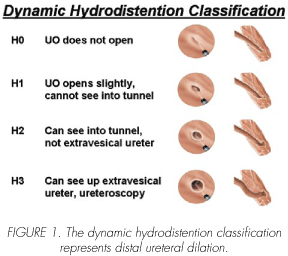
<self-uri xlink:href="http://scielo.isciii.es/scielo.php?script=sci_arttext&amp;pid=S0004-06142008000800005&amp;lng=en&amp;nrm=iso"></self-uri><self-uri xlink:href="http://scielo.isciii.es/scielo.php?script=sci_abstract&amp;pid=S0004-06142008000800005&amp;lng=en&amp;nrm=iso"></self-uri><self-uri xlink:href="http://scielo.isciii.es/scielo.php?script=sci_pdf&amp;pid=S0004-06142008000800005&amp;lng=en&amp;nrm=iso"></self-uri><abstract abstract-type="short" xml:lang="en"><p><![CDATA[Objectives: The objective of this monograph is to familiarize the reader with dynamic hydrodistention classification of the ureter and Hydrodistention Implantation Technique (HIT) methodology for the endoscopic correction of vesicoureteral reflux (VUR). The indications, current success rates, complications, and potential future applications of these methods are reviewed. Methods: Hydrodistention (HD) of the ureteral orifice and distal ureter permits visualization of the intraureteral submucosal injection site and assessment of the degree of ureteral coaptation. We have designated 4 levels of HD. H0 denotes absence of ureteral dilation, H1 indicates dilation of the ureteral orifice only. H2 allows visualization of the intramural ureter, and H3 allows visualization of the extramural ureter. The Double HIT method is a systematic technique that utilizes HD to both classify the ureter and gauge the degree of ureteral coaptation secondary to bulking during endoscopic injection. The needle is inserted at the mid ureteral tunnel at the 6 o'clock position. The first injection coapts the detrusor tunnel (until H1 or H0 is achieved), while a second implant within the most distal intramural tunnel leads to complete coaptation of the ureteral orifice (H0). Results: HD grade correlated significantly with VUR grade. Normal ureters rarely hydrodistended. While non-refluxing contralateral ureters demonstrated low HD grades, all contralateral ureters that subsequently developed VUR showed H2 or H3. The HIT method has not only been employed for primary VUR (90% cure), but also for repeat endoscopic injections (90%), VUR associated with paraureteral diverticula (81%), complex cases such as post-reimplantation (88%), neurogenic bladders (78%), duplication anomalies (80%), and in adults (88%). Furthermore, injection of contralateral VUR-negative but hydrodistending ureters may be treated to prevent new contralateral VUR. While decreasing success was seen with increasing VUR grade with the STING method, superior success rates have been realized with the HIT method. Conclusions: The dynamic hydrodistention classification reflects the competency of the ureterovesical junction. The HIT and Double HIT methods achieve superior cure rates and are likely to become the method of choice for the treatment of primary as well as complex cases of VUR.]]></p></abstract>
<abstract abstract-type="short" xml:lang="es"><p><![CDATA[Objetivo: El objetivo de esta monografía es familiarizar al lector con la clasificación de la hidrodistensión dinámica del uréter y la metodología de la técnica de hidrodistensión-implante para la corrección endoscópica del reflujo vesicoureteral (RVU). Revisamos las indicaciones, la tasa de éxitos actual, sus complicaciones y las potencialesaplicaciones de estos métodos en el futuro. Métodos: La hidrodistensión del orificio ureteral y el uréter distal permite la visualización del sitio de inyección de la submucosa ureteral y la evaluación del grado de coaptación ureteral. Hemos designado cuatro niveles de hidrodistensión. H0 ausencia de dilatación ureteral, H1 dilatación sólo del orificio ureteral, H2 permite la visualización del uréter intramural y H3 permite la visualización del uréter extramural. El método de doble hidrodistensión-implante es una técnica sistemática que utiliza la hidrodistensión para clasificar el uréter y evaluar el grado de coaptación ureteral después de la inyección endoscópica de sustancias de relleno. La aguja se inserta en el túnel medio ureteral a las 6 horarias. La primera inyección coapta el túnel en el detrusor (hasta conseguir H1 o H0), mientras que una segunda inyección más distal en el túnel intramural lleva una coaptación completa del orificio ureteral (H0). Resultados: El grado de hidrodistensión se correlacionó significativamente con el grado de RVU. Mientras que los uréteres contralaterales no refluyentes demostraban grados bajos de hiperdistensión, todos los uréteres que desarrollaron reflujo vesicoureteral posterior mostraban H2 o H3. El método de hidrodistensión-implante no se ha empleado sólo para RVU primario (90% de curaciones), sino también para inyecciones endoscópicas repetidas (90%), RVU asociado con divertículo paraureteral (8I%), casos complejos como después de reimplante (88%), vejiga neurógena (78%), anomalías con duplicación (80%), y en adultos (88%). Además, el uréter contralateral no refluyente que presenta hidrodistensión puede tratarse para prevenir el RVU de novo. Mientras que con el método STING las tasas de éxito disminuyen al aumentar el grado del RVU, con el método de hidro distensión-implante se han visto mejores tasas de éxitos. Conclusiones: La clasificación de la hidrodistensión dinámica refleja la competencia de la unión ureterovesical. Los métodos de hidrodistensión-implante simple y doble consiguen tasas de curación superiores y probablemente se convertirán en el método de elección para el tratamiento del RVU primario y de los casos complejos.]]></p></abstract>
<kwd-group>
<kwd lng="en"><![CDATA[Vesicoureteral reflux]]></kwd>
<kwd lng="en"><![CDATA[Endoscopic injection]]></kwd>
<kwd lng="en"><![CDATA[Hydrodistention]]></kwd>
<kwd lng="es"><![CDATA[Reflujo vesicoureteral]]></kwd>
<kwd lng="es"><![CDATA[Inyección endoscópica]]></kwd>
<kwd lng="es"><![CDATA[Hidrodistensión]]></kwd>
</kwd-group>
</article-meta>
</front><body><![CDATA[ <p ALIGN="left"><font face="Verdana" size="2"><b><a name="top"></a>UROLOG&Iacute;A INFANTIL</b></font></p>     <p ALIGN="RIGHT">&nbsp;</p>     <p><font face="Verdana" size="4"><b>Dynamic hydrodistention classification of the ureter and the double HIT method to correct vesicoureteral reflux</b></font></p>     <p><font SIZE="4" face="Verdana"><b>Clasificaci&oacute;n de la hidrodistensi&oacute;n din&aacute;mica del ur&eacute;ter y el m&eacute;todo doble de hiperdistensi&oacute;n-implante en el tratamiento del reflujo vesicoureteral</b></font></p>     <p>&nbsp;</p>     <p>&nbsp;</p>     <p><font face="Verdana" size="2"><b>Wolfgang H. Cerwinka<sup>1</sup>, Hal C. Scherz and Andrew J. Kirsch</b></font></p>     <p><font face="Verdana" size="2">Children's Healthcare of Atlanta. Emory University School of Medicine. Atlanta. USA.</font></p>     <p><font face="Verdana" SIZE="2"><a HREF="#back">Correspondence</a></font></p>     <p>&nbsp;</p>     ]]></body>
<body><![CDATA[<p>&nbsp;</p> <hr SIZE="1" noshade>     <p><font face="Verdana" size="2"><b>SUMMARY</b></font></p>     <p><font face="Verdana" size="2"><b>Objectives:</b> The objective of this monograph is to familiarize the reader with dynamic hydrodistention classification of the ureter and Hydrodistention Implantation Technique (HIT) methodology for the endoscopic correction of vesicoureteral reflux (VUR). The indications, current success rates, complications, and potential future applications of these methods are reviewed.    <br><b>Methods:</b> Hydrodistention (HD) of the ureteral orifice and distal ureter permits visualization of the intraureteral submucosal injection site and assessment of the degree of ureteral coaptation. We have designated 4 levels of HD. H0 denotes absence of ureteral dilation, H1 indicates dilation of the ureteral orifice only. H2 allows visualization of the intramural ureter, and H3 allows visualization of the extramural ureter. The Double HIT method is a systematic technique that utilizes HD to both classify the ureter and gauge the degree of ureteral coaptation secondary to bulking during endoscopic injection. The needle is inserted at the mid ureteral tunnel at the 6 o'clock position. The first injection coapts the detrusor tunnel (until H1 or H0 is achieved), while a second implant within the most distal intramural tunnel leads to complete coaptation of the ureteral orifice (H0).    <br><b>Results:</b> HD grade correlated significantly with VUR grade. Normal ureters rarely hydrodistended. While non-refluxing contralateral ureters demonstrated low HD grades, all contralateral ureters that subsequently developed VUR showed H2 or H3. The HIT method has not only been employed for primary VUR (90% cure), but also for repeat endoscopic injections (90%), VUR associated with paraureteral diverticula (81%), complex cases such as post-reimplantation (88%), neurogenic bladders (78%), duplication anomalies (80%), and in adults (88%). Furthermore, injection of contralateral VUR-negative but hydrodistending ureters may be treated to prevent new contralateral VUR. While decreasing success was seen with increasing VUR grade with the STING method, superior success rates have been realized with the HIT method.    <br><b>Conclusions:</b> The dynamic hydrodistention classification reflects the competency of the ureterovesical junction. The HIT and Double HIT methods achieve superior cure rates and are likely to become the method of choice for the treatment of primary as well as complex cases of VUR.</font></p>     <p><font face="Verdana" size="2"><B>Key words:</B> Vesicoureteral reflux. Endoscopic injection. Hydrodistention.</font></p> <hr SIZE="1" noshade>     <p><font face="Verdana" size="2"><b>RESUMEN</b></font></p>     <p><font face="Verdana" size="2"><b>Objetivo:</b> El objetivo de esta monograf&iacute;a es familiarizar al lector con la clasificaci&oacute;n de la hidrodistensi&oacute;n din&aacute;mica del ur&eacute;ter y la metodolog&iacute;a de la t&eacute;cnica de hidrodistensi&oacute;n-implante para la correcci&oacute;n endosc&oacute;pica del reflujo vesicoureteral (RVU). Revisamos las indicaciones, la tasa de &eacute;xitos actual, sus complicaciones y las potencialesaplicaciones de estos m&eacute;todos en el futuro.    <br><b>M&eacute;todos:</b> La hidrodistensi&oacute;n del orificio ureteral y el ur&eacute;ter distal permite la visualizaci&oacute;n del sitio de inyecci&oacute;n de la submucosa ureteral y la evaluaci&oacute;n del grado de coaptaci&oacute;n ureteral. Hemos designado cuatro niveles de hidrodistensi&oacute;n. H0 ausencia de dilataci&oacute;n ureteral, H1 dilataci&oacute;n s&oacute;lo del orificio ureteral, H2 permite la visualizaci&oacute;n del ur&eacute;ter intramural y H3 permite la visualizaci&oacute;n del ur&eacute;ter extramural. El m&eacute;todo de doble hidrodistensi&oacute;n-implante es una t&eacute;cnica sistem&aacute;tica que utiliza la hidrodistensi&oacute;n para clasificar el ur&eacute;ter y evaluar el grado de coaptaci&oacute;n ureteral despu&eacute;s de la inyecci&oacute;n endosc&oacute;pica de sustancias de relleno. La aguja se inserta en el t&uacute;nel medio ureteral a las 6 horarias. La primera inyecci&oacute;n coapta el t&uacute;nel en el detrusor (hasta conseguir H1 o H0), mientras que una segunda inyecci&oacute;n m&aacute;s distal en el t&uacute;nel intramural lleva una coaptaci&oacute;n completa del orificio ureteral (H0).    ]]></body>
<body><![CDATA[<br><b>Resultados:</b> El grado de hidrodistensi&oacute;n se correlacion&oacute; significativamente con el grado de RVU. Mientras que los ur&eacute;teres contralaterales no refluyentes demostraban grados bajos de hiperdistensi&oacute;n, todos los ur&eacute;teres que desarrollaron reflujo vesicoureteral posterior mostraban H2 o H3. El m&eacute;todo de hidrodistensi&oacute;n-implante no se ha empleado s&oacute;lo para RVU primario (90% de curaciones), sino tambi&eacute;n para inyecciones endosc&oacute;picas repetidas (90%), RVU asociado con divert&iacute;culo paraureteral (8I%), casos complejos como despu&eacute;s de reimplante (88%), vejiga neur&oacute;gena (78%), anomal&iacute;as con duplicaci&oacute;n (80%), y en adultos (88%). Adem&aacute;s, el ur&eacute;ter contralateral no refluyente que presenta hidrodistensi&oacute;n puede tratarse para prevenir el RVU de novo. Mientras que con el m&eacute;todo STING las tasas de &eacute;xito disminuyen al aumentar el grado del RVU, con el m&eacute;todo de hidro distensi&oacute;n-implante se han visto mejores tasas de &eacute;xitos.    <br><b>Conclusiones:</b> La clasificaci&oacute;n de la hidrodistensi&oacute;n din&aacute;mica refleja la competencia de la uni&oacute;n ureterovesical. Los m&eacute;todos de hidrodistensi&oacute;n-implante simple y doble consiguen tasas de curaci&oacute;n superiores y probablemente se convertir&aacute;n en el m&eacute;todo de elecci&oacute;n para el tratamiento del RVU primario y de los casos complejos.</font></p>     <p><font face="Verdana" size="2"><b>Palabras clave:</b> Reflujo vesicoureteral. Inyecci&oacute;n endosc&oacute;pica. Hidrodistensi&oacute;n.</font></p> <hr size="1" noshade>     <p>&nbsp;</p>     <p><font face="Verdana" size="3"><b>Introduction</b></font></p>     <p><font face="Verdana" size="2">Vesicoureteral reflux (VUR) affects approximately 1% of children and can promote pyelonephritis, which may lead to significant sequelae such as renal scarring, hypertension, and renal failure (1). VUR is one of many treatable risk factors (e.g., dysfunctional elimination) in the development of urinary tract infection (UTI). Treatment intends to prevent pyelonephritis and to preserve renal function (2). Since the introduction of endoscopic treatment for VUR in 1981, and its first clinical application in 1984 as Subureteric Teflon Injection (STING), injection techniques and injectable agents have undergone considerable modifications (3,4). In 2004, the modified STING procedure, later known as the Hydrodistention Implantation Technique (HIT) was introduced and is rapidly becoming the technique of choice world-wide achieving success rates of over 90% after a single treatment (5,6).</font></p>     <p><font face="Verdana" size="2">The purpose of this monograph is to familiarize the reader with the Hydrodistention Implantation Technique and the dynamic hydrodistention classification. Indications, current success rates, complications, and potential future applications of these methods are reviewed.</font></p>     <p>&nbsp;</p>     <p><font face="Verdana" size="3"><b>Materials and methods</b></font></p>     <p><font face="Verdana" size="2">Cystoscopy is performed with a p6ediatric cystoscope with an off-set lens. An off-set lens permits direct passage of the needle in line with the ureter without bending the needle. The bladder is filled to less than half capacity to permit visualization of the ureter and avoid tension within the submucosal layer of the ureter secondary to overdistention. Hydrodistention (HD) is performed with the tip of the cystoscope placed at the ureteral orifice (UO), a pressured stream achieved by placing the irrigation bag approximately 1 meter above the bladder on full flow. HD of the distal ureter serves two purposes: It allows visualization of the intraureteral injection site and assessment of treatment progress. Ureteral HD is graded according to the extent of ureteral dilation (<a href="#f1">Figure 1</a>). H0 denotes absence of ureteral dilation. H1 indicates dilation of the UO only, whereas H2 allows visualization of the intramural ureter, and H3 visualization of the extramural ureter. Our data indicate that H0-H1 is normal, while H2-H3 is abnormal and is associated with VUR and pyelonephritis (7).</font></p>     ]]></body>
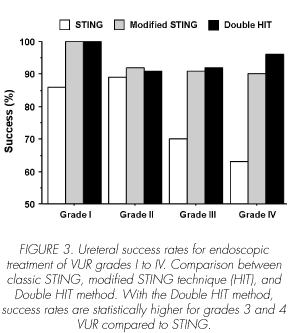
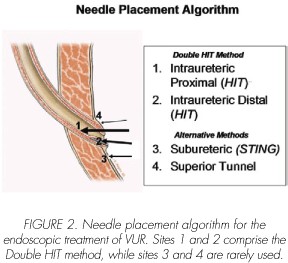
<body><![CDATA[<p align="center"><img src="/img/revistas/urol/v61n8/05f1.gif"><a name="f1"></a></p>     <p><font face="Verdana" size="2">The HIT method has employed dextranomer/ hyaluronic acid copolymer (Deflux<sup>&reg;</sup>, Q-Med Scandinavia) as an injectable agent, which has been used in pediatric urology for over 10 years and is the preferred injectable agent due to its safety and efficacy (8). The needle is passed into the UO and inserted at the mid ureteral tunnel at the 6 o'clock position. Sufficient bulking agent is injected to produce a bulge, which initially coapts the detrusor tunnel (until H0 or H1 is achieved), while a second implant within the most distal intramural tunnel leads to coaptation of the UO (until H0 is achieved, approximately 1-1.5 mL). Rarely, if the two intraureteric submucosal injections (Double HIT method) fail to coapt the ureter, a classic STING or a supraureteric injection is needed to achieve coaptation. The latter 2 injection sites are used more commonly in complex or redo cases (<a href="#f2">Figure 2</a>). HD is performed after each injection to monitor treatment progress; when HD ceases to dilate the UO, appropriate coaptation has been achieved. At our institution, all procedures are performed on an outpatient basis and all patients receive preoperative antibiotic prophylaxis, which is continued until resolution of VUR has been confirmed. Success is defined as grade 0 VUR on a postoperative voiding cystourethrogram (VCUG), 1 to 3 months after a single treatment.</font></p>     <p align="center"><img src="/img/revistas/urol/v61n8/05f2.gif"><a name="f2"></a></p>     <p>&nbsp;</p>     <p><font face="Verdana" size="3"><b>Results</b></font></p>     <p><font face="Verdana" size="2"><b><i>Dynamic Hydrodistention Classification:</i></b></font></p>     <p><font face="Verdana" size="2">All patients with documented VUR demonstrated HD. HD grade correlated significantly with VUR grade. Seventy-seven percent of patients with VUR grade V demonstrated H3, and 23% H2, respectively. Contralateral ureters without evidence of VUR hydrodistended in 90%, however, H3 ureters were only identified in 13%. Patients with a history of recurrent UTIs and at least one negative VCUG, and no history of VUR, who underwent PIC (Positioning the Instillation of Contrast) cystography demonstrated HD grades similar to non-refluxing contralateral ureters. These patients are felt to have occult VUR and non-diagnostic preoperative micturition cystograms. However, ureters in patients with neither evidence of VUR nor UTI rarely hydrodistended (69% H0, 31% H1).</font></p>     <p><font face="Verdana" size="2">In our experience new contralateral VUR (NCVUR) occurs in 13.5% of cases (9). Girls younger than 5 years appeared to be at highest risk (21%) compared to all other patients (6.3%). Besides gender and age, HD grade was predictive of NCVUR occurrence; all ureters demonstrated H2 or H3. Because of the low morbidity of endoscopic injection, we have initiated a prospective study to determine the success in preventing contralateral VUR by prophylactically treating hydrodistending contralateral ureters (H2 or H3). In the past 30 patients treated as such there has been no new contralateral VUR. The clinical utility of this approach, however, deserves further study.</font></p>     <p><font face="Verdana" size="2"><b><i>Double HIT Method:</i></b></font></p>     <p><font face="Verdana" size="2">The modified STING procedure (HIT) was developed at our institution and introduced in 2002. The cure rate of 52 patients (80 ureters) treated with the standard STING procedure was compared to 70 patients (119 ureters) treated with the modified STING procedure. Overall success was 71% in the STING and 89% in the modified STING group. While decreasing success was seen with increasing VUR grade in the STING group this did not occur in the modified STING group (<a href="#f3">Figure 3</a>) (5).</font></p>     ]]></body>
<body><![CDATA[<p align="center"><img src="/img/revistas/urol/v61n8/05f3.gif"><a name="f3"></a></p>     <p><font face="Verdana" size="2">The Double HIT method has been used at other centers with success rates of over 90% after one or two injections (6,10). Despite the high cure rate after a single injection, approximately 10% of patients will present with persistent VUR. Fortunately, 40% of failures are down-graded to grade 1 and are observed, leaving only very few patients considered for further treatment. Treatment options for those with higher grades of VUR include continued antibiotic prophylaxis, repeat endoscopic treatment, or ureteral reimplantation. In our last 200 patients treated endoscopically, 90% of patients were cured (grade 0 after 1 treatment), 93% ureters cured, 97% patients improved, 94% off antibiotics, only 3% retreated, and only 1 patient went on to open surgery.</font></p>     <p><font face="Verdana" size="2">We studied the outcome of a second injection in 39 patients (53 ureters) who had failed prior treatment (11). The most common cystoscopic finding was bleb migration (distal or medial) and only in 5 cases the bleb could not be identified. All patients who had failed treatment demonstrated some degree of HD. The second injection was performed in identical fashion and was curative in 90%.</font></p>     <p><font face="Verdana" size="2">The Double HIT method has not only been used for primary, but also complex cases of VUR, such as failed open reimplantation, duplicated ureters, ureteroceles after puncture, retained ureteral stumps, neurogenic bladder, and ectopic ureters (12). Overall success was 68% after a single injection, however, varied greatly among groups. While only 1 of 7 patients with ectopic ureteral insertion at the bladder neck was cured, 7 of 9 patients with neurogenic bladder were successfully treated.</font></p>     <p><font face="Verdana" size="2">Paraureteral diverticula (PUD) associated with VUR have traditionally been treated with open reimplantation (13). A recent study demonstrated that the presence of PUDs did not affect the resolution rate of VUR, suggesting observation as an alternative for reimplantation (14). Our results indicate that endoscopic treatment of VUR associated with PUD is curative in 81% of patients. Large diverticular size and high injected volume were associated with treatment failure (15). However, when the PUD index (PUD diameter/Ureteral diameter) was less than 2.6, the success rate was 100%.</font></p>     <p><font face="Verdana" size="2"><b><i>Complications:</i></b></font></p>     <p><font face="Verdana" size="2">The most common complications following endoscopic treatment of VUR are NCVUR (13.5%) and treatment failure (10%). Less than 4% of children complained of moderate flank pain or emesis several hours after the procedure and all responded to analgesics (5). Gross hematuria, urinary retention, or febrile UTIs have not been observed. The most significant potential complication of endoscopic treatment for VUR includes a 0.6% risk of ureteral obstruction (16). Our obstruction rate is 4 ureters (2 patients) in over 1200 ureteral injections, or &lt;0.3%. Factors that may increase the risk of obstruction include bladder dysfunction and markedly dilated ureters.</font></p>     <p>&nbsp;</p>     <p><font face="Verdana" size="3"><b>Discussion</b></font></p>     <p><font face="Verdana" size="2">While the treatment algorithm for VUR remains controversial, surgical treatment has been proven effective in reducing VUR-related morbidity. Results of the American and European arm of the International Reflux Study in Children demonstrated a 50% decrease in the incidence of pyelonephritis, however, no effect on the occurrence of cystitis and new renal scars (17,18).</font></p>     ]]></body>
<body><![CDATA[<p><font face="Verdana" size="2">Of all available surgical treatment options for VUR, endoscopic injection has become increasingly popular among pediatric urologists as well as parents. The procedure generally lasts less than 15 minutes and is performed on an outpatient basis. While cure rates are approaching those of open ureteral reimplantation, significant complications are rare (6,10,16). Endoscopic treatment offers major advantages such as greater patient convenience, lower morbidity (e.g., pain, abdominal scar), and reduced cost (19,20). Studies showed that the management decision was ultimately influenced by a parental preference for endoscopic treatment (21,22). A more recent study demonstrated that both, patients and parents regarded endoscopic injection as the least bothersome aspect of VUR treatment followed by antibiotic prophylaxis and VCUG (23).</font></p>     <p><font face="Verdana" size="2">At present, few pediatric urologists rely on location or configuration of the UO to predict VUR resolution, and only occasionally is this information useful in determining the need for contralateral treatment during unilateral correction of VUR. Because NCVUR after ureteral reimplantation (10-20%) typically resolves without manifestation of symptoms, concomitant reimplantation of the non-refluxing ureter is usually not recommended. However, preoperative resolution of contralateral VUR is an indication for bilateral ureteral reimplantation because of a 45% recurrence rate (24). Recently, PIC cystography was shown to identify VUR in patients with history of recurrent UTIs, but negative VCUG (25,26). We have found that all ureters that reflux on PIC cystography also hydrodistend. Consequently, HD may serve three purposes: To aid in the needle placement, to confirm adequate injection, and to estimate the probability of NCVUR. Parents of children who developed NCVUR are understandably anxious and many will select endoscopic retreatment for the same reasons they initially chose minimally invasive treatment. The benefit of treating the contralateral ureter prophylactically is to avoid postoperative morbidity while utilizing the same surgical setting. This approach seems to be reasonable in select patients (e.g., girls younger than 5 years), however, may increase overall cost.</font></p>     <p><font face="Verdana" size="2">The HIT method is easy to learn and achieves cure rates of over 90% thus approaching the success of open reimplantation (6,10). Treatment success is similar for all grades of VUR and may be explained by the Double HIT method per se (5,6). Tandem mid-intramural and distal intramural injection sites coapt a longer segment of distal ureter. This anchors the bleb more efficiently and may prevent bleb migration. HD performed intermittently during injection assesses the ureterovesical junction for competency. Once a sufficient volume of bulking agent is implanted at the appropriate site, the ureter will cease to hydrodistend (and reflux). An intraoperative cure rate of 100% should be achieved in all patients.</font></p>     <p><font face="Verdana" size="2"><b><i>Potential Future Applications:</i></b></font></p>     <p><font face="Verdana" size="2">As the HIT method continues to be applied to complex cases of VUR and more outcome data become available, the indication for endoscopic treatment may exceed the scope of primary VUR. In the USA, for example, duplex ureters are no longer considered a contraindication for endoscopic treatment with Deflux<sup>&reg;</sup> by the Food and Drug Administration. Treatment outcome analysis of primary and complex cases of VUR will establish predictors of treatment success and failure. Such data will aid in preoperative counseling and patient selection and paired with proper technique ultimately improve success rates of endoscopic treatment. As an example, treatment of selected patients with paraureteral diverticula proved to be successful and ureters with VUR Grade V, transplanted ureters with VUR (27), and VUR after puncture of ureteroceles may respond to the Double HIT method as well. Endoscopic treatment of VUR in adults with recurrent pyelonephritis is beginning to emerge as more adult patients are being appropriately evaluated for VUR. Finally, once more accurate predictors of VUR resolution or persistence become available, endoscopic treatment may be more frequently used as the primary treatment.</font></p>     <p>&nbsp;</p>     <p><font face="Verdana" size="3"><b>Conclusions</b></font></p>     <p><font face="Verdana" size="2">The dynamic hydrodistention classification reflects the competency of the ureterovesical junction and assists the pediatric urologist to decide which ureteral orifice and how much of bulking agent to inject. The Hydrodistention Implantation Technique achieves superior cure rates and is likely to become the method of choice for the treatment of primary and complex cases of vesicoureteral reflux.</font></p>     <p>&nbsp;</p>     <p><font face="Verdana" size="3"><b>Abbreviations</b></font></p> <table width="372" border="0"> <tr>  <td width="69"><font face="Verdana" size="2">VUR</font></td> <td width="293"><font face="Verdana" size="2">Vesicoureteral reflux</font></td> </tr> <tr>  <td width="69"><font face="Verdana" size="2">UTI</font></td> <td width="293"><font face="Verdana" size="2">Urinary tract infection</font></td> </tr> <tr>  <td width="69"><font face="Verdana" size="2">STING</font></td> <td width="293"><font face="Verdana" size="2">Subureteric teflon injection</font></td> </tr> <tr>  <td width="69"><font face="Verdana" size="2">HIT</font></td> <td width="293"><font face="Verdana" size="2">Hydrodistention implantion technique</font></td> </tr> <tr>  <td width="69"><font face="Verdana" size="2">HD</font></td> <td width="293"><font face="Verdana" size="2">Hydrodistention</font></td> </tr> <tr>  <td width="69"><font face="Verdana" size="2">UO</font></td> <td width="293"><font face="Verdana" size="2">Ureteral orifice</font></td> </tr> <tr>  <td width="69"><font face="Verdana" size="2">VCUG</font></td> <td width="293"><font face="Verdana" size="2">Voiding cystourethrography</font></td> </tr> <tr>  <td width="69"><font face="Verdana" size="2">PIC</font></td> <td width="293"><font face="Verdana" size="2">Positioning the instillation of contrast</font></td> </tr> <tr>  <td width="69"><font face="Verdana" size="2">NCVUR</font></td> <td width="293"><font face="Verdana" size="2">New contralateral vesicoureteral reflux</font></td> </tr> <tr>  <td width="69"><font face="Verdana" size="2">PUD</font></td> <td width="293"><font face="Verdana" size="2">Paraureteral diverticulum</font></td> </tr> </table>     ]]></body>
<body><![CDATA[<p>&nbsp;</p>     <p><font face="Verdana" size="3"><b>References and recomended readings (*of special interest, **of outstanding interest)</b></font></p>     <!-- ref --><p><font face="Verdana" size="2">1. JACOBSON, S.H.; HANSSON, S.; JAKOBSSON, B.: "Vesico-ureteric reflux: Occurrence and long-term risks". Acta Paediatr. Suppl., 88: 22, 1999.</font>&nbsp;&nbsp;&nbsp;&nbsp;&nbsp;&nbsp;&nbsp;&nbsp;[&#160;<a href="javascript:void(0);" onclick="javascript: window.open('/scielo.php?script=sci_nlinks&ref=1130012&pid=S0004-0614200800080000500001&lng=','','width=640,height=500,resizable=yes,scrollbars=1,menubar=yes,');">Links</a>&#160;]<!-- end-ref --><!-- ref --><p><font face="Verdana" size="2">2. ELDER, J.S.; PETERS, C.A.; ARANT, B.S. Jr. y cols.: "Pediatric vesicoureteral reflux guidelines panel summary report on the management of primary vesicoureteral reflux in children". J. Urol., 157: 1846, 1997.</font>&nbsp;&nbsp;&nbsp;&nbsp;&nbsp;&nbsp;&nbsp;&nbsp;[&#160;<a href="javascript:void(0);" onclick="javascript: window.open('/scielo.php?script=sci_nlinks&ref=1130013&pid=S0004-0614200800080000500002&lng=','','width=640,height=500,resizable=yes,scrollbars=1,menubar=yes,');">Links</a>&#160;]<!-- end-ref --><!-- ref --><p><font face="Verdana" size="2">3. MATOUSCHEK, E.: "Die behandlung des vesikorenalen refluxes durch transurethrale einspritzung von teflonpaste". Der. Urologe. Ausg. A., 20: 263, 1981.</font>&nbsp;&nbsp;&nbsp;&nbsp;&nbsp;&nbsp;&nbsp;&nbsp;[&#160;<a href="javascript:void(0);" onclick="javascript: window.open('/scielo.php?script=sci_nlinks&ref=1130014&pid=S0004-0614200800080000500003&lng=','','width=640,height=500,resizable=yes,scrollbars=1,menubar=yes,');">Links</a>&#160;]<!-- end-ref --><!-- ref --><p><font face="Verdana" size="2">4. O'DONNELL, B.; PURI, P.: "Treatment of vesicoureteric reflux by endoscopic injection of teflon". Br. Med. J. (Clin. Res. Ed.) 289: 7, 1984.</font>&nbsp;&nbsp;&nbsp;&nbsp;&nbsp;&nbsp;&nbsp;&nbsp;[&#160;<a href="javascript:void(0);" onclick="javascript: window.open('/scielo.php?script=sci_nlinks&ref=1130015&pid=S0004-0614200800080000500004&lng=','','width=640,height=500,resizable=yes,scrollbars=1,menubar=yes,');">Links</a>&#160;]<!-- end-ref --><!-- ref --><p><font face="Verdana" size="2">5. KIRSCH, A.J.; PEREZ-BRAYFIELD, M.; SMITH, E.A. y cols.: "The modified sting procedure to correct vesicoureteral reflux: Improved results with submucosal implantation within the intramural ureter". J. Urol., 171: 2413, 2004.</font>&nbsp;&nbsp;&nbsp;&nbsp;&nbsp;&nbsp;&nbsp;&nbsp;[&#160;<a href="javascript:void(0);" onclick="javascript: window.open('/scielo.php?script=sci_nlinks&ref=1130016&pid=S0004-0614200800080000500005&lng=','','width=640,height=500,resizable=yes,scrollbars=1,menubar=yes,');">Links</a>&#160;]<!-- end-ref --><!-- ref --><p><font face="Verdana" size="2">6. KIRSCH, A.J.; ELMORE, J.M.; MOLITIERNO, J. y cols.: "The double HIT methodology for the endoscopic correction of vesicoureteral reflux". Presented at the annual AUA meeting in Atlanta, Georgia 2006.</font>&nbsp;&nbsp;&nbsp;&nbsp;&nbsp;&nbsp;&nbsp;&nbsp;[&#160;<a href="javascript:void(0);" onclick="javascript: window.open('/scielo.php?script=sci_nlinks&ref=1130017&pid=S0004-0614200800080000500006&lng=','','width=640,height=500,resizable=yes,scrollbars=1,menubar=yes,');">Links</a>&#160;]<!-- end-ref --><!-- ref --><p><font face="Verdana" size="2">7. MOLITIERNO, J.A. Jr.; WATSON, J.M.; KIRSCH, A.J.: "Hydrodistention grading system for vesicoureteral reflux: Reproducibility and concordance". Presented at the annual AUA meeting in Anaheim, California 2007.</font>&nbsp;&nbsp;&nbsp;&nbsp;&nbsp;&nbsp;&nbsp;&nbsp;[&#160;<a href="javascript:void(0);" onclick="javascript: window.open('/scielo.php?script=sci_nlinks&ref=1130018&pid=S0004-0614200800080000500007&lng=','','width=640,height=500,resizable=yes,scrollbars=1,menubar=yes,');">Links</a>&#160;]<!-- end-ref --><!-- ref --><p><font face="Verdana" size="2">8. STENBERG, A.; L&Aacute;CKGREN, G.: "A new bio-implant for the endoscopic treatment of vesicoureteral reflux: Experimental and short-term clinical results". J. Urol., 154: 800, 1995.</font>&nbsp;&nbsp;&nbsp;&nbsp;&nbsp;&nbsp;&nbsp;&nbsp;[&#160;<a href="javascript:void(0);" onclick="javascript: window.open('/scielo.php?script=sci_nlinks&ref=1130019&pid=S0004-0614200800080000500008&lng=','','width=640,height=500,resizable=yes,scrollbars=1,menubar=yes,');">Links</a>&#160;]<!-- end-ref --><!-- ref --><p><font face="Verdana" size="2">9. ELMORE, J.M.; KIRSCH, A.J.; LYLES, R.H. y cols.: "New contralateral vesicoureteral reflux following dextranomer/hyaluronic acid implantation: Incidence and identification of a high risk group". J. Urol., 175: 1097, 2006.</font>&nbsp;&nbsp;&nbsp;&nbsp;&nbsp;&nbsp;&nbsp;&nbsp;[&#160;<a href="javascript:void(0);" onclick="javascript: window.open('/scielo.php?script=sci_nlinks&ref=1130020&pid=S0004-0614200800080000500009&lng=','','width=640,height=500,resizable=yes,scrollbars=1,menubar=yes,');">Links</a>&#160;]<!-- end-ref --><!-- ref --><p><font face="Verdana" size="2">10. YU, R.N.; ROTH, D.R.: "Treatment of vesicoureteral reflux using endoscopic injection of nonanimal stabilized hyaluronic acid/dextranomer gel: Initial experience in pediatric patients by a single surgeon". Pediatrics, 118: 698, 2006.</font>&nbsp;&nbsp;&nbsp;&nbsp;&nbsp;&nbsp;&nbsp;&nbsp;[&#160;<a href="javascript:void(0);" onclick="javascript: window.open('/scielo.php?script=sci_nlinks&ref=1130021&pid=S0004-0614200800080000500010&lng=','','width=640,height=500,resizable=yes,scrollbars=1,menubar=yes,');">Links</a>&#160;]<!-- end-ref --><!-- ref --><p><font face="Verdana" size="2">11. ELMORE, J.M.; SCHERZ, H.C.; KIRSCH, A.J.: "Dextranomer/hyaluronic acid for vesicoureteral reflux: Success rates after initial treatment failure". J. Urol., 175: 712, 2006.</font>&nbsp;&nbsp;&nbsp;&nbsp;&nbsp;&nbsp;&nbsp;&nbsp;[&#160;<a href="javascript:void(0);" onclick="javascript: window.open('/scielo.php?script=sci_nlinks&ref=1130022&pid=S0004-0614200800080000500011&lng=','','width=640,height=500,resizable=yes,scrollbars=1,menubar=yes,');">Links</a>&#160;]<!-- end-ref --><!-- ref --><p><font face="Verdana" size="2">12. PÉREZ-BRAYFIELD, M.; KIRSCH, A.J.; HENSLE, T.W. y cols.: "Endoscopic treatment with dextranomer/hyaluronic acid for complex cases of vesicoureteral reflux". J. Urol., 172: 1614, 2004.</font>&nbsp;&nbsp;&nbsp;&nbsp;&nbsp;&nbsp;&nbsp;&nbsp;[&#160;<a href="javascript:void(0);" onclick="javascript: window.open('/scielo.php?script=sci_nlinks&ref=1130023&pid=S0004-0614200800080000500012&lng=','','width=640,height=500,resizable=yes,scrollbars=1,menubar=yes,');">Links</a>&#160;]<!-- end-ref --><!-- ref --><p><font face="Verdana" size="2">13. JAYANTHI, V.R.; McLORIE, G.A.; KHOURY, A.E. y cols.: "Extravesical detrusorrhaphy for refluxing ureters associated with paraureteral diverticula". Urology, 45: 664, 1995.</font>&nbsp;&nbsp;&nbsp;&nbsp;&nbsp;&nbsp;&nbsp;&nbsp;[&#160;<a href="javascript:void(0);" onclick="javascript: window.open('/scielo.php?script=sci_nlinks&ref=1130024&pid=S0004-0614200800080000500013&lng=','','width=640,height=500,resizable=yes,scrollbars=1,menubar=yes,');">Links</a>&#160;]<!-- end-ref --><!-- ref --><p><font face="Verdana" size="2">14. AFSHAR, K.; MALEK, R.; BAKHSHI, M. y cols.: "Should the presence of congenital paraureteral diverticulum affect the management of vesicoureteral reflux?". J. Urol., 174: 1590, 2005.</font>&nbsp;&nbsp;&nbsp;&nbsp;&nbsp;&nbsp;&nbsp;&nbsp;[&#160;<a href="javascript:void(0);" onclick="javascript: window.open('/scielo.php?script=sci_nlinks&ref=1130025&pid=S0004-0614200800080000500014&lng=','','width=640,height=500,resizable=yes,scrollbars=1,menubar=yes,');">Links</a>&#160;]<!-- end-ref --><!-- ref --><p><font face="Verdana" size="2">15. CERWINKA, W.H.; SCHERZ, H.C.; KIRSCH, A.J.: "Endoscopic treatment of vesicoureteral reflux associated with paraureteral diverticula in children". J. Urol., 178:1.469, 2007.</font>&nbsp;&nbsp;&nbsp;&nbsp;&nbsp;&nbsp;&nbsp;&nbsp;[&#160;<a href="javascript:void(0);" onclick="javascript: window.open('/scielo.php?script=sci_nlinks&ref=1130026&pid=S0004-0614200800080000500015&lng=','','width=640,height=500,resizable=yes,scrollbars=1,menubar=yes,');">Links</a>&#160;]<!-- end-ref --><!-- ref --><p><font face="Verdana" size="2">16. VANDERSTEEN, D.R.; ROUTH, J.C.; KIRSCH, A.J. y cols.: "Postoperative ureteral obstruction after subureteral injection of dextranomer/hyaluronic acid copolymer". J. Urol., 176: 1593, 2006.</font>&nbsp;&nbsp;&nbsp;&nbsp;&nbsp;&nbsp;&nbsp;&nbsp;[&#160;<a href="javascript:void(0);" onclick="javascript: window.open('/scielo.php?script=sci_nlinks&ref=1130027&pid=S0004-0614200800080000500016&lng=','','width=640,height=500,resizable=yes,scrollbars=1,menubar=yes,');">Links</a>&#160;]<!-- end-ref --><!-- ref --><p><font face="Verdana" size="2">17. WEISS, R.; DUCKETT, J.; SPITZER, A.: "Results of a randomized clinical trial of medical versus surgical management of infants and children with grades III and IV primary vesicoureteral reflux (United States). The international reflux study in children". J. Urol., 148: 1667, 1992.</font>&nbsp;&nbsp;&nbsp;&nbsp;&nbsp;&nbsp;&nbsp;&nbsp;[&#160;<a href="javascript:void(0);" onclick="javascript: window.open('/scielo.php?script=sci_nlinks&ref=1130028&pid=S0004-0614200800080000500017&lng=','','width=640,height=500,resizable=yes,scrollbars=1,menubar=yes,');">Links</a>&#160;]<!-- end-ref --><!-- ref --><p><font face="Verdana" size="2">18. JODAL, U.; SMELLIE, J.M.; LAX, H. y cols.: "Ten-year results of randomized treatment of children with severe vesicoureteral reflux. Final report of the international reflux study in children". Pediatr. Nephrol., 21: 785, 2006.</font>&nbsp;&nbsp;&nbsp;&nbsp;&nbsp;&nbsp;&nbsp;&nbsp;[&#160;<a href="javascript:void(0);" onclick="javascript: window.open('/scielo.php?script=sci_nlinks&ref=1130029&pid=S0004-0614200800080000500018&lng=','','width=640,height=500,resizable=yes,scrollbars=1,menubar=yes,');">Links</a>&#160;]<!-- end-ref --><!-- ref --><p><font face="Verdana" size="2">19. KOBELT, G.; CANNING, D.A.; HENSLE, T.W. y cols.: "The cost-effectiveness of endoscopic injection of dextranomer/hyaluronic acid copolymer for vesicoureteral reflux". J. Urol., 169: 1480, 2003.</font>&nbsp;&nbsp;&nbsp;&nbsp;&nbsp;&nbsp;&nbsp;&nbsp;[&#160;<a href="javascript:void(0);" onclick="javascript: window.open('/scielo.php?script=sci_nlinks&ref=1130030&pid=S0004-0614200800080000500019&lng=','','width=640,height=500,resizable=yes,scrollbars=1,menubar=yes,');">Links</a>&#160;]<!-- end-ref --><!-- ref --><p><font face="Verdana" size="2">20. BENOIT, R.M.; PEELE, P.B.; DOCIMO, S.G.: "The cost-effectiveness of dextranomer/hyaluronic acid copolymer for the management of vesicoureteral reflux. 1: Substitution for surgical management". J. Urol., 176: 1588, 2006.</font>&nbsp;&nbsp;&nbsp;&nbsp;&nbsp;&nbsp;&nbsp;&nbsp;[&#160;<a href="javascript:void(0);" onclick="javascript: window.open('/scielo.php?script=sci_nlinks&ref=1130031&pid=S0004-0614200800080000500020&lng=','','width=640,height=500,resizable=yes,scrollbars=1,menubar=yes,');">Links</a>&#160;]<!-- end-ref --><!-- ref --><p><font face="Verdana" size="2">21. OGAN, K.; POHL, H.G.; CARLSON, D. y cols.: "Parental preferences in the management of vesicoureteral reflux". J. Urol., 166: 240, 2001.</font>&nbsp;&nbsp;&nbsp;&nbsp;&nbsp;&nbsp;&nbsp;&nbsp;[&#160;<a href="javascript:void(0);" onclick="javascript: window.open('/scielo.php?script=sci_nlinks&ref=1130032&pid=S0004-0614200800080000500021&lng=','','width=640,height=500,resizable=yes,scrollbars=1,menubar=yes,');">Links</a>&#160;]<!-- end-ref --><!-- ref --><p><font face="Verdana" size="2">22. CAPOZZA, N.; LAIS, A.; MATARAZZO, E. y cols.: "Treatment of vesico-ureteric reflux: A new algorithm based on parental preference". BJU Int., 92: 285, 2003.</font>&nbsp;&nbsp;&nbsp;&nbsp;&nbsp;&nbsp;&nbsp;&nbsp;[&#160;<a href="javascript:void(0);" onclick="javascript: window.open('/scielo.php?script=sci_nlinks&ref=1130033&pid=S0004-0614200800080000500022&lng=','','width=640,height=500,resizable=yes,scrollbars=1,menubar=yes,');">Links</a>&#160;]<!-- end-ref --><!-- ref --><p><font face="Verdana" size="2">23. STENBERG, A.; L&Aacute;CKGREN, G.: "Treatment of vesicoureteral reflux in children using stabilized non-animal hyaluronic acid/dextranomer gel (NASHA/DX): A long-term observational study". J. Pediatr. Urol., 3: 80, 2007. </font>&nbsp;&nbsp;&nbsp;&nbsp;&nbsp;&nbsp;&nbsp;&nbsp;[&#160;<a href="javascript:void(0);" onclick="javascript: window.open('/scielo.php?script=sci_nlinks&ref=1130034&pid=S0004-0614200800080000500023&lng=','','width=640,height=500,resizable=yes,scrollbars=1,menubar=yes,');">Links</a>&#160;]<!-- end-ref --><!-- ref --><p><font face="Verdana" size="2">24. ROSS, J.H.; KAY, R.; NASRALLAH, P.: "Contralateral reflux after unilateral ureteral reimplantation in patients with a history of resolved contralateral reflux". J. Urol., 154: 1171, 1995.</font>&nbsp;&nbsp;&nbsp;&nbsp;&nbsp;&nbsp;&nbsp;&nbsp;[&#160;<a href="javascript:void(0);" onclick="javascript: window.open('/scielo.php?script=sci_nlinks&ref=1130035&pid=S0004-0614200800080000500024&lng=','','width=640,height=500,resizable=yes,scrollbars=1,menubar=yes,');">Links</a>&#160;]<!-- end-ref --><!-- ref --><p><font face="Verdana" size="2">25. RUBENSTEIN, J.N.; MAIZELS, M.; KIM, S.C. y cols.: "The PIC cystogram: A novel approach to identify occult vesicoureteral reflux in children with febrile urinary tract infections". J. Urol., 169: 2339, 2003.</font>&nbsp;&nbsp;&nbsp;&nbsp;&nbsp;&nbsp;&nbsp;&nbsp;[&#160;<a href="javascript:void(0);" onclick="javascript: window.open('/scielo.php?script=sci_nlinks&ref=1130036&pid=S0004-0614200800080000500025&lng=','','width=640,height=500,resizable=yes,scrollbars=1,menubar=yes,');">Links</a>&#160;]<!-- end-ref --><!-- ref --><p><font face="Verdana" size="2">26. EDMONDSON, J.D.; MAIZELS, M.; ALPERT, S.A. y cols.: "Multi-institutional experience with PIC cystography- incidence of occult vesicoureteral reflux in children with febrile urinary tract infections". Urology, 67: 608, 2006.</font>&nbsp;&nbsp;&nbsp;&nbsp;&nbsp;&nbsp;&nbsp;&nbsp;[&#160;<a href="javascript:void(0);" onclick="javascript: window.open('/scielo.php?script=sci_nlinks&ref=1130037&pid=S0004-0614200800080000500026&lng=','','width=640,height=500,resizable=yes,scrollbars=1,menubar=yes,');">Links</a>&#160;]<!-- end-ref --><!-- ref --><p><font face="Verdana" size="2">27. CAMPBELL, J.B.; LENDVAY, T.S.; RISK, M.C. y cols.: "Endoscopic treatment of symptomatic refluxing renal transplant ureteroneocystostomies in children". Presented at the annual AUA meeting, Anaheim, California 2007.</font>&nbsp;&nbsp;&nbsp;&nbsp;&nbsp;&nbsp;&nbsp;&nbsp;[&#160;<a href="javascript:void(0);" onclick="javascript: window.open('/scielo.php?script=sci_nlinks&ref=1130038&pid=S0004-0614200800080000500027&lng=','','width=640,height=500,resizable=yes,scrollbars=1,menubar=yes,');">Links</a>&#160;]<!-- end-ref --><p>&nbsp;</p>     ]]></body>
<body><![CDATA[<p>&nbsp;</p>     <p><font face="Verdana" SIZE="2"><a NAME="back"></a><a HREF="#top"><img src="/img/revistas/urol/v61n8/seta.gif" BORDER="0"></a><b>Correspondence:    <br></b>Wolfgang H. Cerwinka    <br>Children's Healthcare of Atlanta    <br>Emory University School of Medicine    <br>5445 Meridian Mark Road, Suite 420    <br>Atlanta, GA 30342. USA.    <br><a HREF="mailto:wcerwinka@gaurology.com">wcerwinka@gaurology.com</a></font></p>      ]]></body><back>
<ref-list>
<ref id="B1">
<label>1</label><nlm-citation citation-type="journal">
<person-group person-group-type="author">
<name>
<surname><![CDATA[JACOBSON]]></surname>
<given-names><![CDATA[S.H.]]></given-names>
</name>
<name>
<surname><![CDATA[HANSSON]]></surname>
<given-names><![CDATA[S.]]></given-names>
</name>
<name>
<surname><![CDATA[JAKOBSSON]]></surname>
<given-names><![CDATA[B.]]></given-names>
</name>
</person-group>
<article-title xml:lang="en"><![CDATA[Vesico-ureteric reflux: Occurrence and long-term risks]]></article-title>
<source><![CDATA[Acta Paediatr.]]></source>
<year>1999</year>
<volume>88</volume>
<page-range>22</page-range></nlm-citation>
</ref>
<ref id="B2">
<label>2</label><nlm-citation citation-type="journal">
<person-group person-group-type="author">
<name>
<surname><![CDATA[ELDER]]></surname>
<given-names><![CDATA[J.S.]]></given-names>
</name>
<name>
<surname><![CDATA[PETERS]]></surname>
<given-names><![CDATA[C.A.]]></given-names>
</name>
<name>
<surname><![CDATA[ARANT]]></surname>
<given-names><![CDATA[B.S. Jr.]]></given-names>
</name>
</person-group>
<article-title xml:lang="en"><![CDATA[Pediatric vesicoureteral reflux guidelines panel summary report on the management of primary vesicoureteral reflux in children]]></article-title>
<source><![CDATA[J. Urol.]]></source>
<year>1997</year>
<volume>157</volume>
<page-range>1846</page-range></nlm-citation>
</ref>
<ref id="B3">
<label>3</label><nlm-citation citation-type="journal">
<person-group person-group-type="author">
<name>
<surname><![CDATA[MATOUSCHEK]]></surname>
<given-names><![CDATA[E.]]></given-names>
</name>
</person-group>
<article-title xml:lang="de"><![CDATA[Die behandlung des vesikorenalen refluxes durch transurethrale einspritzung von teflonpaste]]></article-title>
<source><![CDATA[Der. Urologe. Ausg. A.]]></source>
<year>1981</year>
<volume>20</volume>
<page-range>263</page-range></nlm-citation>
</ref>
<ref id="B4">
<label>4</label><nlm-citation citation-type="journal">
<person-group person-group-type="author">
<name>
<surname><![CDATA[O'DONNELL]]></surname>
<given-names><![CDATA[B.]]></given-names>
</name>
<name>
<surname><![CDATA[PURI]]></surname>
<given-names><![CDATA[P.]]></given-names>
</name>
</person-group>
<article-title xml:lang="en"><![CDATA[Treatment of vesicoureteric reflux by endoscopic injection of teflon]]></article-title>
<source><![CDATA[Br. Med. J. (Clin. Res. Ed.)]]></source>
<year>1984</year>
<volume>289</volume>
<page-range>7</page-range></nlm-citation>
</ref>
<ref id="B5">
<label>5</label><nlm-citation citation-type="journal">
<person-group person-group-type="author">
<name>
<surname><![CDATA[KIRSCH]]></surname>
<given-names><![CDATA[A.J.]]></given-names>
</name>
<name>
<surname><![CDATA[PEREZ-BRAYFIELD]]></surname>
<given-names><![CDATA[M.]]></given-names>
</name>
<name>
<surname><![CDATA[SMITH]]></surname>
<given-names><![CDATA[E.A.]]></given-names>
</name>
</person-group>
<article-title xml:lang="en"><![CDATA[The modified sting procedure to correct vesicoureteral reflux: Improved results with submucosal implantation within the intramural ureter]]></article-title>
<source><![CDATA[J. Urol.]]></source>
<year>2004</year>
<volume>171</volume>
<page-range>2413</page-range></nlm-citation>
</ref>
<ref id="B6">
<label>6</label><nlm-citation citation-type="confpro">
<person-group person-group-type="author">
<name>
<surname><![CDATA[KIRSCH]]></surname>
<given-names><![CDATA[A.J.]]></given-names>
</name>
<name>
<surname><![CDATA[ELMORE]]></surname>
<given-names><![CDATA[J.M.]]></given-names>
</name>
<name>
<surname><![CDATA[MOLITIERNO]]></surname>
<given-names><![CDATA[J.]]></given-names>
</name>
</person-group>
<article-title xml:lang="en"><![CDATA[The double HIT methodology for the endoscopic correction of vesicoureteral reflux]]></article-title>
<source><![CDATA[]]></source>
<year></year>
<conf-name><![CDATA[ AUA meeting]]></conf-name>
<conf-date>2006</conf-date>
<conf-loc>Atlanta Georgia</conf-loc>
</nlm-citation>
</ref>
<ref id="B7">
<label>7</label><nlm-citation citation-type="confpro">
<person-group person-group-type="author">
<name>
<surname><![CDATA[MOLITIERNO]]></surname>
<given-names><![CDATA[J.A. Jr.]]></given-names>
</name>
<name>
<surname><![CDATA[WATSON]]></surname>
<given-names><![CDATA[J.M.]]></given-names>
</name>
<name>
<surname><![CDATA[KIRSCH]]></surname>
<given-names><![CDATA[A.J.]]></given-names>
</name>
</person-group>
<article-title xml:lang="en"><![CDATA[Hydrodistention grading system for vesicoureteral reflux: Reproducibility and concordance]]></article-title>
<source><![CDATA[]]></source>
<year></year>
<conf-name><![CDATA[ AUA meeting]]></conf-name>
<conf-date>2007</conf-date>
<conf-loc>Anaheim California</conf-loc>
</nlm-citation>
</ref>
<ref id="B8">
<label>8</label><nlm-citation citation-type="journal">
<person-group person-group-type="author">
<name>
<surname><![CDATA[STENBERG]]></surname>
<given-names><![CDATA[A.]]></given-names>
</name>
<name>
<surname><![CDATA[LÁCKGREN]]></surname>
<given-names><![CDATA[G.]]></given-names>
</name>
</person-group>
<article-title xml:lang="en"><![CDATA[A new bio-implant for the endoscopic treatment of vesicoureteral reflux: Experimental and short-term clinical results]]></article-title>
<source><![CDATA[J. Urol.]]></source>
<year>1995</year>
<volume>154</volume>
<page-range>800</page-range></nlm-citation>
</ref>
<ref id="B9">
<label>9</label><nlm-citation citation-type="journal">
<person-group person-group-type="author">
<name>
<surname><![CDATA[ELMORE]]></surname>
<given-names><![CDATA[J.M.]]></given-names>
</name>
<name>
<surname><![CDATA[KIRSCH]]></surname>
<given-names><![CDATA[A.J.]]></given-names>
</name>
<name>
<surname><![CDATA[LYLES]]></surname>
<given-names><![CDATA[R.H.]]></given-names>
</name>
</person-group>
<article-title xml:lang="en"><![CDATA[New contralateral vesicoureteral reflux following dextranomer/hyaluronic acid implantation: Incidence and identification of a high risk group]]></article-title>
<source><![CDATA[J. Urol.]]></source>
<year>2006</year>
<volume>175</volume>
<page-range>1097</page-range></nlm-citation>
</ref>
<ref id="B10">
<label>10</label><nlm-citation citation-type="journal">
<person-group person-group-type="author">
<name>
<surname><![CDATA[YU]]></surname>
<given-names><![CDATA[R.N.]]></given-names>
</name>
<name>
<surname><![CDATA[ROTH]]></surname>
<given-names><![CDATA[D.R.]]></given-names>
</name>
</person-group>
<article-title xml:lang="en"><![CDATA[Treatment of vesicoureteral reflux using endoscopic injection of nonanimal stabilized hyaluronic acid/dextranomer gel: Initial experience in pediatric patients by a single surgeon]]></article-title>
<source><![CDATA[Pediatrics]]></source>
<year>2006</year>
<volume>118</volume>
<page-range>698</page-range></nlm-citation>
</ref>
<ref id="B11">
<label>11</label><nlm-citation citation-type="journal">
<person-group person-group-type="author">
<name>
<surname><![CDATA[ELMORE]]></surname>
<given-names><![CDATA[J.M.]]></given-names>
</name>
<name>
<surname><![CDATA[SCHERZ]]></surname>
<given-names><![CDATA[H.C.]]></given-names>
</name>
<name>
<surname><![CDATA[KIRSCH]]></surname>
<given-names><![CDATA[A.J]]></given-names>
</name>
</person-group>
<article-title xml:lang="en"><![CDATA[Dextranomer/hyaluronic acid for vesicoureteral reflux: Success rates after initial treatment failure]]></article-title>
<source><![CDATA[J. Urol.]]></source>
<year>2006</year>
<volume>175</volume>
<page-range>712</page-range></nlm-citation>
</ref>
<ref id="B12">
<label>12</label><nlm-citation citation-type="journal">
<person-group person-group-type="author">
<name>
<surname><![CDATA[PÉREZ-BRAYFIELD]]></surname>
<given-names><![CDATA[M.]]></given-names>
</name>
<name>
<surname><![CDATA[KIRSCH]]></surname>
<given-names><![CDATA[A.J.]]></given-names>
</name>
<name>
<surname><![CDATA[HENSLE]]></surname>
<given-names><![CDATA[T.W.]]></given-names>
</name>
</person-group>
<article-title xml:lang="en"><![CDATA[Endoscopic treatment with dextranomer/hyaluronic acid for complex cases of vesicoureteral reflux]]></article-title>
<source><![CDATA[J. Urol.]]></source>
<year>2004</year>
<volume>172</volume>
<page-range>1614</page-range></nlm-citation>
</ref>
<ref id="B13">
<label>13</label><nlm-citation citation-type="journal">
<person-group person-group-type="author">
<name>
<surname><![CDATA[JAYANTHI]]></surname>
<given-names><![CDATA[V.R.]]></given-names>
</name>
<name>
<surname><![CDATA[McLORIE]]></surname>
<given-names><![CDATA[G.A.]]></given-names>
</name>
<name>
<surname><![CDATA[KHOURY]]></surname>
<given-names><![CDATA[A.E.]]></given-names>
</name>
</person-group>
<article-title xml:lang="en"><![CDATA[Extravesical detrusorrhaphy for refluxing ureters associated with paraureteral diverticula]]></article-title>
<source><![CDATA[Urology]]></source>
<year>1995</year>
<volume>45</volume>
<page-range>664</page-range></nlm-citation>
</ref>
<ref id="B14">
<label>14</label><nlm-citation citation-type="journal">
<person-group person-group-type="author">
<name>
<surname><![CDATA[AFSHAR]]></surname>
<given-names><![CDATA[K.]]></given-names>
</name>
<name>
<surname><![CDATA[MALEK]]></surname>
<given-names><![CDATA[R.]]></given-names>
</name>
<name>
<surname><![CDATA[BAKHSHI]]></surname>
<given-names><![CDATA[M.]]></given-names>
</name>
</person-group>
<article-title xml:lang="en"><![CDATA[Should the presence of congenital paraureteral diverticulum affect the management of vesicoureteral reflux?]]></article-title>
<source><![CDATA[J. Urol.]]></source>
<year>2005</year>
<volume>174</volume>
<page-range>1590</page-range></nlm-citation>
</ref>
<ref id="B15">
<label>15</label><nlm-citation citation-type="journal">
<person-group person-group-type="author">
<name>
<surname><![CDATA[CERWINKA]]></surname>
<given-names><![CDATA[W.H.]]></given-names>
</name>
<name>
<surname><![CDATA[SCHERZ]]></surname>
<given-names><![CDATA[H.C.]]></given-names>
</name>
<name>
<surname><![CDATA[KIRSCH]]></surname>
<given-names><![CDATA[A.J.]]></given-names>
</name>
</person-group>
<article-title xml:lang="en"><![CDATA[Endoscopic treatment of vesicoureteral reflux associated with paraureteral diverticula in children]]></article-title>
<source><![CDATA[J. Urol.]]></source>
<year>2007</year>
<volume>178</volume>
<page-range>1.469</page-range></nlm-citation>
</ref>
<ref id="B16">
<label>16</label><nlm-citation citation-type="journal">
<person-group person-group-type="author">
<name>
<surname><![CDATA[VANDERSTEEN]]></surname>
<given-names><![CDATA[D.R.]]></given-names>
</name>
<name>
<surname><![CDATA[ROUTH]]></surname>
<given-names><![CDATA[J.C.]]></given-names>
</name>
<name>
<surname><![CDATA[KIRSCH]]></surname>
<given-names><![CDATA[A.J.]]></given-names>
</name>
</person-group>
<article-title xml:lang="en"><![CDATA[Postoperative ureteral obstruction after subureteral injection of dextranomer/hyaluronic acid copolymer]]></article-title>
<source><![CDATA[J. Urol.]]></source>
<year>2006</year>
<volume>176</volume>
<page-range>1593</page-range></nlm-citation>
</ref>
<ref id="B17">
<label>17</label><nlm-citation citation-type="journal">
<person-group person-group-type="author">
<name>
<surname><![CDATA[WEISS]]></surname>
<given-names><![CDATA[R.]]></given-names>
</name>
<name>
<surname><![CDATA[DUCKETT]]></surname>
<given-names><![CDATA[J.]]></given-names>
</name>
<name>
<surname><![CDATA[SPITZER]]></surname>
<given-names><![CDATA[A.]]></given-names>
</name>
</person-group>
<article-title xml:lang="en"><![CDATA[Results of a randomized clinical trial of medical versus surgical management of infants and children with grades III and IV primary vesicoureteral reflux (United States): The international reflux study in children]]></article-title>
<source><![CDATA[J. Urol.]]></source>
<year>1992</year>
<volume>148</volume>
<page-range>1667</page-range></nlm-citation>
</ref>
<ref id="B18">
<label>18</label><nlm-citation citation-type="journal">
<person-group person-group-type="author">
<name>
<surname><![CDATA[JODAL]]></surname>
<given-names><![CDATA[U.]]></given-names>
</name>
<name>
<surname><![CDATA[SMELLIE]]></surname>
<given-names><![CDATA[J.M.]]></given-names>
</name>
<name>
<surname><![CDATA[LAX]]></surname>
<given-names><![CDATA[H.]]></given-names>
</name>
</person-group>
<article-title xml:lang="en"><![CDATA[Ten-year results of randomized treatment of children with severe vesicoureteral reflux: Final report of the international reflux study in children]]></article-title>
<source><![CDATA[Pediatr. Nephrol.]]></source>
<year>2006</year>
<volume>21</volume>
<page-range>785</page-range></nlm-citation>
</ref>
<ref id="B19">
<label>19</label><nlm-citation citation-type="journal">
<person-group person-group-type="author">
<name>
<surname><![CDATA[KOBELT]]></surname>
<given-names><![CDATA[G.]]></given-names>
</name>
<name>
<surname><![CDATA[CANNING]]></surname>
<given-names><![CDATA[D.A.]]></given-names>
</name>
<name>
<surname><![CDATA[HENSLE]]></surname>
<given-names><![CDATA[T.W.]]></given-names>
</name>
</person-group>
<article-title xml:lang="en"><![CDATA[The cost-effectiveness of endoscopic injection of dextranomer/hyaluronic acid copolymer for vesicoureteral reflux]]></article-title>
<source><![CDATA[J. Urol.]]></source>
<year>2003</year>
<volume>169</volume>
<page-range>1480</page-range></nlm-citation>
</ref>
<ref id="B20">
<label>20</label><nlm-citation citation-type="journal">
<person-group person-group-type="author">
<name>
<surname><![CDATA[BENOIT]]></surname>
<given-names><![CDATA[R.M.]]></given-names>
</name>
<name>
<surname><![CDATA[PEELE]]></surname>
<given-names><![CDATA[P.B.]]></given-names>
</name>
<name>
<surname><![CDATA[DOCIMO]]></surname>
<given-names><![CDATA[S.G.]]></given-names>
</name>
</person-group>
<article-title xml:lang="en"><![CDATA[The cost-effectiveness of dextranomer/hyaluronic acid copolymer for the management of vesicoureteral reflux. 1: Substitution for surgical management]]></article-title>
<source><![CDATA[J. Urol.]]></source>
<year>2006</year>
<volume>176</volume>
<page-range>1588</page-range></nlm-citation>
</ref>
<ref id="B21">
<label>21</label><nlm-citation citation-type="journal">
<person-group person-group-type="author">
<name>
<surname><![CDATA[OGAN]]></surname>
<given-names><![CDATA[K.]]></given-names>
</name>
<name>
<surname><![CDATA[POHL]]></surname>
<given-names><![CDATA[H.G.]]></given-names>
</name>
<name>
<surname><![CDATA[CARLSON]]></surname>
<given-names><![CDATA[D.]]></given-names>
</name>
</person-group>
<article-title xml:lang="en"><![CDATA[Parental preferences in the management of vesicoureteral reflux]]></article-title>
<source><![CDATA[J. Urol.]]></source>
<year>2001</year>
<volume>166</volume>
<page-range>240</page-range></nlm-citation>
</ref>
<ref id="B22">
<label>22</label><nlm-citation citation-type="journal">
<person-group person-group-type="author">
<name>
<surname><![CDATA[CAPOZZA]]></surname>
<given-names><![CDATA[N.]]></given-names>
</name>
<name>
<surname><![CDATA[LAIS]]></surname>
<given-names><![CDATA[A.]]></given-names>
</name>
<name>
<surname><![CDATA[MATARAZZO]]></surname>
<given-names><![CDATA[E.]]></given-names>
</name>
</person-group>
<article-title xml:lang="en"><![CDATA[Treatment of vesico-ureteric reflux: A new algorithm based on parental preference]]></article-title>
<source><![CDATA[BJU Int.]]></source>
<year>2003</year>
<volume>92</volume>
<page-range>285</page-range></nlm-citation>
</ref>
<ref id="B23">
<label>23</label><nlm-citation citation-type="journal">
<person-group person-group-type="author">
<name>
<surname><![CDATA[STENBERG]]></surname>
<given-names><![CDATA[A.]]></given-names>
</name>
<name>
<surname><![CDATA[LÁCKGREN]]></surname>
<given-names><![CDATA[G.]]></given-names>
</name>
</person-group>
<article-title xml:lang="en"><![CDATA[Treatment of vesicoureteral reflux in children using stabilized non-animal hyaluronic acid/dextranomer gel (NASHA/DX): A long-term observational study]]></article-title>
<source><![CDATA[J. Pediatr. Urol.]]></source>
<year>2007</year>
<volume>3</volume>
<page-range>80</page-range></nlm-citation>
</ref>
<ref id="B24">
<label>24</label><nlm-citation citation-type="journal">
<person-group person-group-type="author">
<name>
<surname><![CDATA[ROSS]]></surname>
<given-names><![CDATA[J.H.]]></given-names>
</name>
<name>
<surname><![CDATA[KAY]]></surname>
<given-names><![CDATA[R.]]></given-names>
</name>
<name>
<surname><![CDATA[NASRALLAH]]></surname>
<given-names><![CDATA[P.]]></given-names>
</name>
</person-group>
<article-title xml:lang="en"><![CDATA[Contralateral reflux after unilateral ureteral reimplantation in patients with a history of resolved contralateral reflux]]></article-title>
<source><![CDATA[J. Urol.]]></source>
<year>1995</year>
<volume>154</volume>
<page-range>1171</page-range></nlm-citation>
</ref>
<ref id="B25">
<label>25</label><nlm-citation citation-type="journal">
<person-group person-group-type="author">
<name>
<surname><![CDATA[RUBENSTEIN]]></surname>
<given-names><![CDATA[J.N.]]></given-names>
</name>
<name>
<surname><![CDATA[MAIZELS]]></surname>
<given-names><![CDATA[M.]]></given-names>
</name>
<name>
<surname><![CDATA[KIM]]></surname>
<given-names><![CDATA[S.C.]]></given-names>
</name>
</person-group>
<article-title xml:lang="en"><![CDATA[The PIC cystogram: A novel approach to identify occult vesicoureteral reflux in children with febrile urinary tract infections]]></article-title>
<source><![CDATA[J. Urol.]]></source>
<year>2003</year>
<volume>169</volume>
<page-range>2339</page-range></nlm-citation>
</ref>
<ref id="B26">
<label>26</label><nlm-citation citation-type="journal">
<person-group person-group-type="author">
<name>
<surname><![CDATA[EDMONDSON]]></surname>
<given-names><![CDATA[J.D.]]></given-names>
</name>
<name>
<surname><![CDATA[MAIZELS]]></surname>
<given-names><![CDATA[M.]]></given-names>
</name>
<name>
<surname><![CDATA[ALPERT]]></surname>
<given-names><![CDATA[S.A.]]></given-names>
</name>
</person-group>
<article-title xml:lang="en"><![CDATA[Multi-institutional experience with PIC cystography- incidence of occult vesicoureteral reflux in children with febrile urinary tract infections]]></article-title>
<source><![CDATA[Urology]]></source>
<year>2006</year>
<volume>67</volume>
<page-range>608</page-range></nlm-citation>
</ref>
<ref id="B27">
<label>27</label><nlm-citation citation-type="confpro">
<person-group person-group-type="author">
<name>
<surname><![CDATA[CAMPBELL]]></surname>
<given-names><![CDATA[J.B.]]></given-names>
</name>
<name>
<surname><![CDATA[LENDVAY]]></surname>
<given-names><![CDATA[T.S.]]></given-names>
</name>
<name>
<surname><![CDATA[RISK]]></surname>
<given-names><![CDATA[M.C.]]></given-names>
</name>
</person-group>
<article-title xml:lang="en"><![CDATA[Endoscopic treatment of symptomatic refluxing renal transplant ureteroneocystostomies in children]]></article-title>
<source><![CDATA[]]></source>
<year></year>
<conf-name><![CDATA[ AUA meeting]]></conf-name>
<conf-date>2007</conf-date>
<conf-loc>Anaheim California</conf-loc>
</nlm-citation>
</ref>
</ref-list>
</back>
</article>