<?xml version="1.0" encoding="ISO-8859-1"?><article xmlns:mml="http://www.w3.org/1998/Math/MathML" xmlns:xlink="http://www.w3.org/1999/xlink" xmlns:xsi="http://www.w3.org/2001/XMLSchema-instance">
<front>
<journal-meta>
<journal-id>0004-0614</journal-id>
<journal-title><![CDATA[Archivos Españoles de Urología (Ed. impresa)]]></journal-title>
<abbrev-journal-title><![CDATA[Arch. Esp. Urol.]]></abbrev-journal-title>
<issn>0004-0614</issn>
<publisher>
<publisher-name><![CDATA[INIESTARES, S.A.]]></publisher-name>
</publisher>
</journal-meta>
<article-meta>
<article-id>S0004-06142008000900017</article-id>
<title-group>
<article-title xml:lang="en"><![CDATA[Endoscopic management of upper urinary tract urothelial malignancies: broadening experience]]></article-title>
<article-title xml:lang="es"><![CDATA[Tratamiento endoscópico de los tumores uroteliales del tracto urinariosuperior: ampliando la experiencia]]></article-title>
</title-group>
<contrib-group>
<contrib contrib-type="author">
<name>
<surname><![CDATA[Grasso]]></surname>
<given-names><![CDATA[Michael]]></given-names>
</name>
<xref ref-type="aff" rid="A01"/>
</contrib>
</contrib-group>
<aff id="A01">
<institution><![CDATA[,Saint Vincent Medical Center New York Department of Urology ]]></institution>
<addr-line><![CDATA[New York ]]></addr-line>
<country>USA</country>
</aff>
<pub-date pub-type="pub">
<day>00</day>
<month>11</month>
<year>2008</year>
</pub-date>
<pub-date pub-type="epub">
<day>00</day>
<month>11</month>
<year>2008</year>
</pub-date>
<volume>61</volume>
<numero>9</numero>
<fpage>1070</fpage>
<lpage>1079</lpage>
<copyright-statement/>
<copyright-year/>
<self-uri xlink:href="http://scielo.isciii.es/scielo.php?script=sci_arttext&amp;pid=S0004-06142008000900017&amp;lng=en&amp;nrm=iso"></self-uri><self-uri xlink:href="http://scielo.isciii.es/scielo.php?script=sci_abstract&amp;pid=S0004-06142008000900017&amp;lng=en&amp;nrm=iso"></self-uri><self-uri xlink:href="http://scielo.isciii.es/scielo.php?script=sci_pdf&amp;pid=S0004-06142008000900017&amp;lng=en&amp;nrm=iso"></self-uri><abstract abstract-type="short" xml:lang="en"><p><![CDATA[Upper urinary tract urothelial tumors reflect a small but growing number of urologic malignancies. The application of progressive endoscopic therapies including ureteroscopic and percutaneous nephroscopic resection and topical chemotherapy have found success, defined as the preservation of the renal unit without malignant progression, in those with low grade lesions. Careful and meticulous diagnostic endoscopy with tissue sampling and cytologic evaluation is key to directing treatment and counseling patients with regard to the risk of recurrence and progression. It is the population with a low grade lesion and negative cytology that are most commonly selected for endsoscopic resection. Those with high grade lesions who opt for endoscopic resection are counseled that this therapy is palliative and can often control local symptoms but is infrequently curative. Surveillance endoscopy post endoscopic resection and topical chemotherapy is essential. With growing surgical experience and improved instrumentation, the complications associated with these and other endoscopic procedures is acceptably low.]]></p></abstract>
<abstract abstract-type="short" xml:lang="es"><p><![CDATA[Los tumores uroteliales del aparato urinario superior representan un pequeño número, aunque creciente, dentro de los tumores urológicos. La aplicación de tratamientos endoscópicos progresivos incluyendo la resección por ureteroscopia o nefroscopia percutánea con aplicación de quimioterapia tópica han resultado exitosos en las lesiones de bajo grado, definiendo el éxito como la preservación de la unidad renal sin progresión del tumor maligno. El diagnóstico endoscópico meticuloso y cuidadoso, con evaluación de muestras de tejido y citología, es fundamental para dirigir el tratamiento y aconsejar a los pacientes en relación con el riesgo de recurrencia y progresión. La población con lesiones de bajo grado y citología negativa son los más frecuentemente seleccionados para la resección endoscópica. A aquellos pacientes con lesiones de alto grado que optan por la resección endoscópica se les debe transmitir que el tratamiento es paliativo y puede frecuentemente controlar los síntomas locales pero que rara vez es curativo. La endoscopia de vigilancia después de la resección y la quimioterapia tópica son esenciales. Con el aumento de la experiencia quirúrgica y la mejoría del instrumental, las complicaciones asociadas con estas y otros procedimientos endoscópicos es aceptablemente baja.]]></p></abstract>
<kwd-group>
<kwd lng="en"><![CDATA[Upper urinary tract]]></kwd>
<kwd lng="en"><![CDATA[TCCa]]></kwd>
<kwd lng="en"><![CDATA[Ureteroscopic therapies]]></kwd>
<kwd lng="en"><![CDATA[Laser]]></kwd>
<kwd lng="es"><![CDATA[Tracto urinario superior]]></kwd>
<kwd lng="es"><![CDATA[Carcinoma urotelial]]></kwd>
<kwd lng="es"><![CDATA[Tratamiento ureteroscópico]]></kwd>
<kwd lng="es"><![CDATA[Láser]]></kwd>
</kwd-group>
</article-meta>
</front><body><![CDATA[ <p><font face="Verdana" size="2"><b><a name="top"></a>MONOGR&Aacute;FICO:   ENDOUROLOG&Iacute;A Y L&Aacute;SER</b></font></p>     <p>&nbsp;</p>     <p><font face="Verdana" size="4"><b>Endoscopic management of upper urinary tract   urothelial malignancies: broadening experience</b></font></p>     <p><font face="Verdana" size="4"><b>Tratamiento endosc&oacute;pico de los tumores   uroteliales del tracto urinariosuperior: ampliando la experiencia</b></font></p>     <p>&nbsp;</p>     <p>&nbsp;</p>     <p><font face="Verdana" size="2"><b>Michael Grasso.</b></font></p>     <p><font face="Verdana" size="2">Department of Urology. Saint Vincent Medical   Center New York. New York. USA.</font></p>     <p><font face="Verdana" size="2"><a href="#back">Correspondence</a></font></p>     <p>&nbsp;</p>     ]]></body>
<body><![CDATA[<p>&nbsp;</p> <hr size="1" noshade>     <p><font face="Verdana" size="2"><b>SUMMARY</b></font></p>     <p><font face="Verdana" size="2">Upper urinary tract urothelial tumors reflect   a small but growing number of urologic malignancies. The application of progressive   endoscopic therapies including ureteroscopic and percutaneous nephroscopic resection   and topical chemotherapy have found success, defined as the preservation of   the renal unit without malignant progression, in those with low grade lesions.   Careful and meticulous diagnostic endoscopy with tissue sampling and cytologic   evaluation is key to directing treatment and counseling patients with regard   to the risk of recurrence and progression. It is the population with a low grade   lesion and negative cytology that are most commonly selected for endsoscopic   resection. Those with high grade lesions who opt for endoscopic resection are   counseled that this therapy is palliative and can often control local symptoms   but is infrequently curative. Surveillance endoscopy post endoscopic resection   and topical chemotherapy is essential. With growing surgical experience and   improved instrumentation, the complications associated with these and other   endoscopic procedures is acceptably low.</font></p>     <p><font face="Verdana" size="2"><b>Keywords:</b> Upper urinary tract. TCCa. Ureteroscopic   therapies. Laser.</font></p> <hr size="1" noshade>     <p><font face="Verdana" size="2"><b>RESUMEN</b></font></p>     <p><font face="Verdana" size="2">Los tumores uroteliales del aparato urinario   superior representan un peque&ntilde;o n&uacute;mero, aunque creciente, dentro   de los tumores urol&oacute;gicos. La aplicaci&oacute;n de tratamientos endosc&oacute;picos   progresivos incluyendo la resecci&oacute;n por ureteroscopia o nefroscopia percut&aacute;nea   con aplicaci&oacute;n de quimioterapia t&oacute;pica han resultado exitosos   en las lesiones de bajo grado, definiendo el &eacute;xito como la preservaci&oacute;n   de la unidad renal sin progresi&oacute;n del tumor maligno. El diagn&oacute;stico   endosc&oacute;pico meticuloso y cuidadoso, con evaluaci&oacute;n de muestras   de tejido y citolog&iacute;a, es fundamental para dirigir el tratamiento y aconsejar   a los pacientes en relaci&oacute;n con el riesgo de recurrencia y progresi&oacute;n.   La poblaci&oacute;n con lesiones de bajo grado y citolog&iacute;a negativa son   los m&aacute;s frecuentemente seleccionados para la resecci&oacute;n endosc&oacute;pica.   A aquellos pacientes con lesiones de alto grado que optan por la resecci&oacute;n   endosc&oacute;pica se les debe transmitir que el tratamiento es paliativo y   puede frecuentemente controlar los s&iacute;ntomas locales pero que rara vez   es curativo. La endoscopia de vigilancia despu&eacute;s de la resecci&oacute;n   y la quimioterapia t&oacute;pica son esenciales. Con el aumento de la experiencia   quir&uacute;rgica y la mejor&iacute;a del instrumental, las complicaciones asociadas   con estas y otros procedimientos endosc&oacute;picos es aceptablemente baja.</font></p>     <p><font face="Verdana" size="2"><b>Palabras clave:</b> Tracto urinario superior.   Carcinoma urotelial. Tratamiento ureterosc&oacute;pico. L&aacute;ser.</font></p> <hr size="1" noshade>     <p>&nbsp;</p>     <p>&nbsp;</p>     <p><font face="Verdana" size="3"><b>Introduction</b></font></p>     ]]></body>
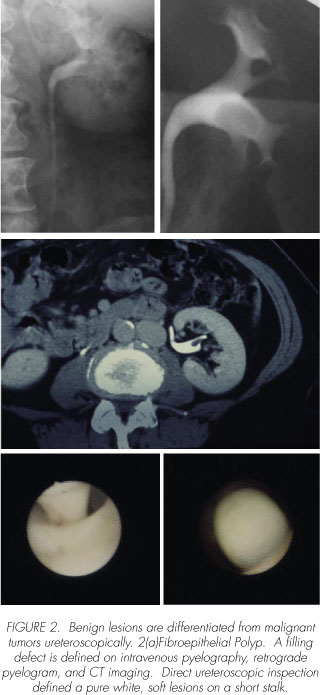
<body><![CDATA[<p><font face="Verdana" size="2">Upper urinary tract urothelial malignancies account   for 5 - 6% of urothelial tumors. This is a growing group based in part on success   of local therapies for lower urinary tract transitional cell malignancies, where   recurrence occurs above the bladder. Intrarenal and ureteral malignancies often   present a surgical dilemma in that they are frequently multifocaland can require   complex surgical treatment. Nephroureterectomy, long considered the treatment   of choice, may confer unacceptable morbidity. As with solid renal malignancies,   nephron sparing procedures are anattractive alternative especially in those   with impaired renal function who would requiring lifelong hemodialysis after   nephrouretrectomy. This is of particular concern in patients with a compromised   contralateral kidney, a solitary kidney, or bilateral. Since this disease is   most prevalent in the elderly, there is a general concern with progression to   renal failure in this group after nephrectomy. Just as important is the fact   that a growing cohort of individuals with renal pelvis or ureteral urothelial   tumors, once treated successfully for a uilateral process, will go on to develop   contralateral disease (1).</font></p>     <p><font face="Verdana" size="2">It has been our aim to develop and employ advanced   endoscopic therapies to treat upper urinary tract urothelial malignancies in   an attempt to preserve renal function, while also obtaining an acceptable oncologic   result. We have tried to replicate therapies and sought the success obtained   historically with contemporary transurethral procedures and topical therapies   performed for lower urinary tract urothelial tumors. This includes ureteroscopic   and percutaneous endoscopic tumor resection, laser ablation, as well as topical   therapies post endoscopy to minimize recurrence.</font></p>     <p><font face="Verdana" size="2"><b>Diagnostic Ureteroscopy: An Essential First   Step</b></font></p>     <p><font face="Verdana" size="2">Initial diagnostic evaluation is one key to the   overall success of treatment in patients with upper urinart tract urothelial   tumors. This includes CT or MR imaging of the retroperitoneum, urine tests including   cytology and FISH, and most importantly diagnostic ureteroscopy. Ureteroscopy   is by far the most sensitive and accurate means of mapping upper tract urothelial   tumors (2-5). Biopsy with either a basket/snare or cup biopsy forcept is essential.   The results of these diagnostic tests will influence the ultimate crafting of   a treatment plan (5,6).</font></p>     <p><font face="Verdana" size="2">Diagnostic ureteroscopy begins with cystoscopic   evaluation. Retrograde pyelography is then performed bilaterally Finally direct   endoscoscopic inspection of the upper urinary tract is performed, employing   technique that minimaizes urothelial trauma to help prevent false positive results.   Demetrius Bagley coined the term "No Touch" ureteroscopy in the early 1990's   which refers to placing a ureteroscope directly into the upper urinary tract   without a guidewire or sheath to facilitate complete urothelial inspection with   minimal trauma from access devices. Initially this was performed with a small   caliber semi-rigid employed for the distal ureter in men, and often the entire   ureter in women (4-6). A guidewire was then place only to the level visualized   with the rigid instrument and then over this wire an actively deflectable, flexible   endoscope was passed, with subsequent complete stepwise inspection of the intrarenal   collecting system and proximal ureter (<a target="_blank" href="/img/revistas/urol/v61n9/17f1.jpg">Figure 1</a>).   The sensitivity of this technique rivals any other diagnostic modalities. In   addition, improvements in flexible ureteroscope design since 2001 allow for   complete inspection without a guidewire or ureteral dilation for access, often   obviating the use of the semi-rigid endoscope (7).</font></p>     <p><font face="Verdana" size="2">Tissue sampling begins with a barbotage specimen   of sterile saline obtained thru the working channel of the ureteroscope after   mapping is complete (8). It is essential that the cytopathologist be familiar   with the technique employed to obtain the specimen to help minimize false positives   that reflect instrumentation artifact. If the endoscope mapping is complete   and clear, a cytology report suggesting low grade urothelial disease is almost   always a false positive reading reflecting either a thin film of normal urothelial   cells rolled off with endoscope placement.</font></p>     <p><font face="Verdana" size="2">Based on the ureteroscopic mapping, a surgical   treatment plan is crafted (<a href="#f2">Figure 2</a>). Benign lesions must   be differentiated from malignant. The variables which require careful consideration   with regard to malignant lesions include tumor grade, volume, location, cytologic   assessment, and the general comorbidities frequently found in this patient population   (e.g. renal insufficiency, COPD, cardiac disease, etc). Most centers are offering   ureteroscopic resection for low grade upper urinary tract lesions, similar to   what is traditionally been performed in the bladder (911). The diagnosis of   low grade disease is based on both biopsy results and urine cytology obtained   both from the upper urinary tract and the bladder (5,8,12). Even if the ureteroscopic   biopsies are consistent with a low grade process, positive class V cytology   infers a much higher grade process either reflecting incomplete sampling (i.e.   low and high grade components) or concurrent carcinom in situ, both of which   portend a poor outcome.</font></p>     <p><a name="f2"></a></p>     <p align="center"><img src="/img/revistas/urol/v61n9/17f2.jpg"></p>     <p>&nbsp;</p>     ]]></body>
<body><![CDATA[<p align="center"><img src="/img/revistas/urol/v61n9/17f2b.jpg"></p>     <p>&nbsp;</p>     <p align="center"><img src="/img/revistas/urol/v61n9/17f2c.jpg"></p>     <p>&nbsp;</p>     <p><font face="Verdana" size="2">Most often the ureteroscopist can differentiate   high and low grade lesions, as is commonly performed cystoscopically (<a href="#f3">Figure   3</a>). Any lesions with a solid non-papillary component, or patches of beefy   red mucosa suggesting carcinoma in situ, portend a higher grade process which   infrequently can be cured with ureteroscopic treatment alone.</font></p>     <p><a name="f3"></a></p>     <p align="center"><img src="/img/revistas/urol/v61n9/17f3.jpg"></p>     <p>&nbsp;</p>     <p><font face="Verdana" size="2">Papillary lesions are biopsied with either a   flat wire stainless steel (i.e. Segura) or nitinol basket. Care must be taken   when removing the specimen to preserve tissue architecture. With a papillary   exophytic tumor, once engaged in the basket, the entire unit must be extracted   together rather than removing the basket thru the endoscope working channel   (<a href="#f4">Figure 4</a>). This will increase the tissue yield and prevent   sample disengagement from the basket wires cutting thru the sample.</font></p>     <p><a name="f4"></a></p>     ]]></body>
<body><![CDATA[<p align="center"><img src="/img/revistas/urol/v61n9/17f4.jpg"></p>     <p>&nbsp;</p>     <p><font face="Verdana" size="2">Sampling of flat lesions is performed with 3   French cup biopsy forceps. Multiple samples extracted thru the working channel   are required. The specimen are placed in a cylindrical tube filled with a small   aliquot of saline which is delivered to a cytopatholgist who will employ a cell   block technique on the pellet of spun down specimens as well as standard cytology   of the supernatant. Trying to employ standard histopathologic preparation techniques   with cassettes on these one millimeter or smaller fragments is unsatisfactory   without special attention. Sampling a solid intrusive lesion, in comparison,   can require either electrocautery or laser energy to excise a representative   fragment which is then extracted and prepared with standard histopathologic   technique.</font></p>     <p><font face="Verdana" size="2">Here again the importance of cytopatholgy cannot   be overstated. Once a representative biopsy is perform, as long as the hematuria   caused by this maneuver is not extreme, subsequent washings will increase the   diagnostic yield.</font></p>     <p><font face="Verdana" size="2">Ureteroscopic biopsy specimens have been shown   to correlate well with final pathologic specimens (12). Although ureteroscopy   has not been demonstrated to be a dependable method of staging, the correlation   between grade and stage is highly reliable (12-14). Low grade tumors are almost   exclusively low stage.</font></p>     <p><font face="Verdana" size="2"><b>Endoscopic Therapy: Technical Issues</b></font></p>     <p><font face="Verdana" size="2">In 1945 renal sparing surgery for upper tract   urothelial tumors was first proposed by Vest (15). However, it was not until   many years later inan effort to preserve renal function in patients with parenchymal   disease that conservative treatment found acceptance. Conservative open therapy   was reserved for individuals with solitary kidneys, compromised renal function   or bilateral disease. As in the bladder, lower grade lesions are preferred when   selecting patients for nephron sparing procedures (14).</font></p>     <p><font face="Verdana" size="2">Percutaneous and ureteroscopic treatment of upper   tract urothelial malignancies was first reported in the mid 1980's (16-18).   Since these initial endoscopic therapies were first described, minimally invasive   endoscopic techniques have progressed with the development of smaller and more   steerable endoscopes. More than any other tool, the evolution of the actively   deflectable, flexible endoscope has facilitated advances in the treatment of   tumor in the upper ureter and renal collecting system.</font></p>     <p><font face="Verdana" size="2">Retrograde endoscopic treatment has also been   furthered by the use of laser energy delivered thru flexible fiberoptic glass   passed thru the working channels of these endoscopes. Both holmium and Nd:Yag   lasers have been employed in this setting. Nd:YAG was employed first but was   associated with higher stricture rates based in large part by the deep penetration   noted with this wavelength (19). For example, with a setting of 60 watts employed   on a tumor for a minute, the tissue coagulation depth will exceed on cm. This   deep thermal effect is difficult to control and frequently surrounding normal   tissue is effected causing subsequent stricture. For these reasons this laser   energy is employed at a lower power (30 watts) for short 15 second pulses to   help minimize surrounding tissue destruction. Nd: YAG is useful at these setting   for particularly vascular or large friable papillary tumors. Specifically, dual   head solid state lasers which can deliver both Nd:YAG and holmium are attractive   in these settings (4,5). Nd:YAG is employed first to coagulate papillary intraluminal   tumor to minimize bleeding, then holmium laser energy can be employed to ablate   or "resect" the pretreated areas. His technique can be repeated in a stepwise   fashion to remove bulky lesions, with a dual footswitch being particularly useful   to increase efficiency.</font></p>     <p><font face="Verdana" size="2">The holmium laser energy was first employed for   tumor therapy to treat superficial bladder tumors (20). This laser energy has   a high water affinity, creating a microscopic vaporization bubble at the tip   of the delivering fiber which ablates stones, papillary tumors, and even dense   fibrotic tissue. Holmium lasers energy is pulsed thru low water density quartz   fibers, causing specific tissue effects based on the parameters chosen. By manipulating   total energy and frequency of pulsation, a variety of tissue effects are noted.   Low energy (0.6 joules and low frequency of pulsation (5 hertz) are common settings   when treating papillary lesions in the bladder and upper urinary tract. By defocusing   the laser energy at the fiber tip at a low power of 3-5 watts, papillary tumors   are both coagulated and ablated. The pulsatile energy delivery visually appears   to blow away and remove devascularized tumor, akin to endoscopic resection.   Increasing the settings will change the effect with less coagulation. For example,   to incise a stricture or cut a portion of solid tumor from the mass, energies   of 1 to 1.4 joules and frequency of pulsation of 15 to 20 hertz are employed.</font></p>     ]]></body>
<body><![CDATA[<p><font face="Verdana" size="2">Electracautery continues to play a role in the   ureteroscopic management of upper urinary tract urothelial tumors. Historically,   12 French ureteroresectoscopes were employed to resect distal ureteral tumors.   These endoscopes, due to their large size, are infrequently employed. One exception   is very large, low grade distal ureteral lesions. Commonly ureteral pre-stenting   is required to facilitate endoscope placement. The other more common application   of electrocautery the upper urinary tract is to treat lower pole lesions. The   2 F bugbee electrode does not inhibit flexible ureteroscope deflection and can   be place more easily into a dependant lower pole calyx. The settings vary by   cautery box manufacturer, but for practical purposes the cut and coagulation   levels should be set as low as possible to obtain the desired tissue effect.   Irrigant must also be adjusted when electrocautery is employed. Instead of standard   sterile saline, sorbitol or small aliquots of sterile water are used. When sterile   water is employed, careful attention to volume instilled, most often less than   200 cc's, is essential even with the undestaning that most of this fluid drains   around the endoscope into the bladder.</font></p>     <p><font face="Verdana" size="2">When performing ureteroscopic treatment of upper   urinary tract urothelial tumors, the endoscopist should employ various energy   sources to clear all visible tumor (5). Commonly, different energy sources are   interchanged to obtain desired effects based on the vascularity of the tumor   and its location. Staged therapy is common, particularly when attempting to   clear a large lesion shortly after primary diagnosis. Patients with circumferential   ureteral tumors also are better served with sequential sessions after a period   of healing. Ablative or coagulating energy is never applied circumferentially   to the ureteral lumen at the same sitting, rather only segments of ureteral   wall are treated with intervals of healing to help minimize ureteral stricture.</font></p>     <p><font face="Verdana" size="2">Percutaneous endoscopic tumor resection is employed   for large intrarenal lesions or those that cannot be managed ureteroscopically   for technical reasons (21,22). For the facile ureteroscopist this is a very   select group. These include patients with excessively long or tortuous ureters,   and patients with urinary diversions where retrograde ureterosocpic access is   difficult or prohibited. The violation of the urothelium with a percutaneous   puncture has at least a theoretical risk of tumor seeding, even though in relatively   large series this has been only noted rarely (23,24). Treatment technique is   similar to bladder therapies with the caveat that the upper urinary tract is   composed of thinner walled structures overlying large vascular structures. Endoscopic   resection similar to TURBT should not be performed percutaneously in the intrarenal   collecting system. Most techniques are based on mechanical tumor debulking with   laser and electracutery employed for the remainder either thru a flexible or   rigid nephroscope. As opposed to stone management, a nephrostomy should be place   post procedurally and only removed after a period which allows for tract maturation.</font></p>     <p><font face="Verdana" size="2"><b>Endoscopic Therapy: Post Procedure Topical   Therapies</b></font></p>     <p><font face="Verdana" size="2">As with bladder tumors, it is intuitiveto hope   that topical therapies placed directly on the urothelium will positively affect   outcomes. Low patient accrual and non-uniformity of this varied group has prohibited   definitive statements. It is clear, however, that agents like BCG and Mitomycin   affect urothelialtumor recurrence rates positively (25-27). The issue is whether   the entire upper urinary tract is appropriately coated with these agents long   enough. Placing agents in the bladder and hoping they will reflux up an internal   double pigtail stent is more wishful than practical. The only sure means of   administering these agents onto the urothelium of concern is to place a catheter   directly into the upper tract in either a retrograde or percutaneous fashion   for delivery (25).</font></p>     <p><font face="Verdana" size="2">Our center is not employing topical agent after   endoscopic therapy for low volume, low grade lesions. Specifically, this treatment   is employed in higher risk patients or in those who are having frequent recurrence.   The technique employed after endoscopic therapy is based on placing a single   pigtail, externally draining ureteralstent which is secured to a bladder drainage   catheter. Correct catheter position is verified with contrast and fluoroscopy.   In the recovery room, immediately after ureteroscopic therapy, 20 to 40 mg of   Mitomycin-C in 50 to 100cc's of diluentis delivered over 1 to 2 hours while   the foley catheter is clamped. The dose, diluent volume, instillation time,   and foley clamp time are adjusted based on the estimated volume of the upper   urinary tract, with larger collecting systems requiring greater dose and volume.   During the session patient complaint of pain, fever is noted, or any other negative   clinical parameter leads to prompt cessation with drainage of both catheters.</font></p>     <p><font face="Verdana" size="2">Agents employed for topical therapy in the upper   urinary tract include Mitomycin-C, BCG, Alpha interferon, and adriamycin. Of   all these agents, Mitomycin-C has the lowest risk profile. Keeley found in his   series that the risks were acceptable when the aforementioned technique was   employed (27). He however could not validate this technique to statistical significance   due to the small study size, but his results were encouraging. Martinez-Pineiro's   group presented their experience with all four agents and found the best success   with Mitomycin-C and BCG (9). The fundamental question is safety with delivery.   Even though BCG has been employed at select centers after percutaneousne-phroscopic   tumor debulking, there have been cases, all be it rare, of high fevers and presumed   bacillemia after this treatment. For this reason Mitomycin is our preferred   agent (28,29).</font></p>     <p><font face="Verdana" size="2"><b>Endoscopic Therapy: Indications, Outcomes,   and Surveillance Protocols</b></font></p>     <p><font face="Verdana" size="2">With the advancement in minimally invasive treatment   and recognition of the low metastatic potential of low grade lesions, the need   for nephroureterectomy in individuals with low grade disease and two normal   functioning kidneys has been questioned (10,14,30-33). Retrograde endoscopic   management of upper tract urothelial malignancies offers the advantage of preserving   renal function and may also be performed on patients who would not tolerate   more invasive therapeutic modalities. Morbidity is generally less with retrograde   endoscopic procedures whi-chcan be performed on an out patient basis. Fundamental   questions of efficacy and safety are balanced with the desire to preserve renal   function and to avoid dialysis. As in the bladder, it is clear that those patients   with low grade, low stage disease and negative washings of malignant cells which   portends a low grade processes frequently achieve an acceptable oncologic outcome.   Their risk of progression in grade and stage is low, but far from zero. In our   data base, and the Mayo clinic experience, results have been were encouraging   (10,33). As follow-up increased to ten years out we are seeing more patients   progress in grade, and then stage (15% of the patient population currently in   surveillance post endoscopic therapy - <a href="#t1">Table I</a>). This is not   completely unexpected, when compared to results obtained post endoscopic resection   of low grade bladder tumors. In this same population of patients with low grade   tumors upper urinary tract urothelial tumors treated with ureteroscopic resection,   low grade recurrence was common (67%), with recurrence at the same site occurring   much less frequently (18%). These lesions are most often small and easily treated   during surveillance.</font></p>     <p><a name="t1"></a></p>     ]]></body>
<body><![CDATA[<p align="center"><img src="/img/revistas/urol/v61n9/17t1.gif"></p>     <p>&nbsp;</p>     <p><font face="Verdana" size="2">Iborra et. al. has shown that previous multi-recurrent   bladder tumors and tumors in the renal pelvis are the strongest risk factors   for recurrence and progressionof upper urinary tract tumors (14). These were   also found to be the strongest risk factors for bilateral disease. Primary tumor   size also appears to influence recurrence rate as Keeley et al reported that   only 21% of patients with tumors &gt;1.5 cm were eventually rendered tumor free   (11). We have also found that those presenting with tumors greater than 1.5   cm had a higher incidence of recurrence and did recur sooner. In our series,   with vigorous treatment often in stages, we have cleaned large tumors up to   10 cm. This is tedious and time consuming, requiring patience and persistence,   but can be ultimately fruitful (<a href="#f5">Figure 5</a>).</font></p>     <p><a name="f5"></a></p>     <p align="center"><img src="/img/revistas/urol/v61n9/17f5.jpg"></p>     <p>&nbsp;</p>     <p><font face="Verdana" size="2">Patients with high grade upper tract urothelial   lesions, including those with low grade lesions and positive cytology and those   with a component of carcinoma in situ, frequently progress in stage after treatment.   This includes patients treated ureteroscopically and those treated with radical   nephrouereterectomy. In select patients with high grade disease we have offered   ureteroscopic therapy, with many obtaining local control with resolution of   symptoms. These patients are clearly counseled that this therapy is palliative.   These patients tend to be older, higher risk for large surgical procedures,   frequently with a component of renal insufficiency. It is our intent in this   group to maintain renal function off dialysis by controlling local disease,   but the progression to metastatic disease is high.</font></p>     <p><font face="Verdana" size="2">All patients who undergo either ureteroscopic   or percutaneous endoscopic tumor therapy are clearly counseled that lifelong   endoscopic surveillance is an essential part of the protocol and must consent   to this before treatment is initiated. The standard protocol after complete   tumor resection is to see patient back three months later for diagnostic ureteroscopy.   If the endoscopic inspection is clear and the washing negative, then repeat   upper urinary tract inspection is performed every six months, while cystoscopy   alone is performed at the three month interval in between. Broad metastatic   evaluation, including Ct or MR imaging of the retroperitoneum, is performed   first semiannually, and then annually as the evaluations remain acceptable.   Positive findings may adjust the interval back to more frequent. As in bladder,   a few small low grade tumors noted during surveillance with otherwise negative   parameters does not necessarily alter the surveillance protocol.</font></p>     <p><font face="Verdana" size="2"><b>Endoscopic Therapy: Complications</b></font></p>     <p><font face="Verdana" size="2">The complications of retrograde endoscopic therapyhave   decreased with the improved instrumentation and refined technique (<a target="_blank" href="/img/revistas/urol/v61n9/17t2.gif">Table   II</a>). A higher incidence of ureteral stricture with the ureteroscopic application   ofNd:YAG laser energy is well documented (19). Not surprisingly, we have noted   a higher rate ofinfundibularstenosis when this frequency of laser light is employed.   As a routine, we very rarely employ Nd:YG in the ureter, and have segregated   its application to large vascular intrarenal lesions. In comparison, the shallow   penetration of the Ho:YAG laser decreases the potential for stricture formation   and has become our energy source of choice for most lesions.</font></p>     ]]></body>
<body><![CDATA[<p><font face="Verdana" size="2">Potentially life threatening complications can   arise from the administration of adjuvant chemotherapy agents and discretion   is essential when giving retrograde intracavitary topical therapies. Care must   be taken not to apply agents likemitomycinunder high pressure so as to avoid   systemic absorption and potential agranulocytosis (9). Intracavitary bacillus   Calmette-Guerin therapy (BCG) has been used as an adjuvant agent administered   through a nephrostomy tube with fever and overwhelming sepsis as reported complications   in this setting (26,28,284). We have not used BCG as an adjuvant agent for upper   tract urothelial tumors because of the above noted complications although retrograde   application of BCG has been reported (25).</font></p>     <p><font face="Verdana" size="2">Tumor seeding of the nephrostomy tract after   percutaneous treatment of upper tract urothelial tumors has been reported (23).   In an effort to avoid tract seeding, routine prophylactic irradiation of the   nephrostomy tract is carried out at some centers (24). Retrograde ureteroscopic   treatment avoids the potential complications of nephrostomy tract seeding, as   such is the preferred in all but select patients.</font></p>     <p><font face="Verdana" size="2">Careful life long follow-up is essential in the   treatment of upper tract urothelial cancer. As with superficial bladder cancer,   patients require long term follow-up due to the relatively high incidence of   recurrence. In our series first recurrence was identified up 63 months after   initial therapy. Imaging studies alone cannot be relied upon to identify new   or recurrent lesions as it has been shown that up to 75% of tumors identified   by ureteroscopy are not identified radiographically (11). In some patients ureteroscopic   surveillance may be carried out in the office setting. Of course, careful cystoscopy   must also be performed on these patients as approximately one half of individuals   with upper tract tumors will go on to develop bladder lesions.</font></p>     <p>&nbsp;</p>     <p><font face="Verdana" size="3"><b>Conclusions</b></font></p>     <p><font face="Verdana" size="2">Retrograde ureteroscopic treatment of upper tract   urothelial tumors is particularly useful in patients who present with low-grade   lesions. Endoscopic management was once considered a therapy of last resort,   reserved for those with a solitary kidney, renal insufficiency, or severe medical   co-morbidities. The low rate of progression of tumor stage or grade in those   patients with low grade primary lesions is encouraging, but lifelong surveillance   is required for progression can occur. The low morbidity associated with ureteroscopic   treatment of these tumors provides a reasonable alternative to nephroureterectomy   in select patients. Ureteroscopic treatment of higher-grade urothelial lesions   is palliative, but can be employed for local control.</font></p>     <p>&nbsp;</p>     <p><font face="Verdana" size="3"><b>References and recomended readings</b></font></p>     <!-- ref --><p><font face="Verdana" size="2">1. YOUSEM, D.M.; GATEWOOD, O.M.; GOLDMAN, S.M. y cols.: "Synchronous and metachronous transitional cell carcinoma of the urinary tract: Prevalence, incidence, and radiographic detection". Radiology, 167: 613, 1988.</font>&nbsp;&nbsp;&nbsp;&nbsp;&nbsp;&nbsp;&nbsp;&nbsp;[&#160;<a href="javascript:void(0);" onclick="javascript: window.open('/scielo.php?script=sci_nlinks&ref=1134017&pid=S0004-0614200800090001700001&lng=','','width=640,height=500,resizable=yes,scrollbars=1,menubar=yes,');">Links</a>&#160;]<!-- end-ref --><!-- ref --><p><font face="Verdana" size="2">2. BAGLEY, D.H.; HUFFMAN, J.L.; LYON, E.S.: "Flexible ureteropyeloscopy: Diagnosis and treatment in the upper urinary tract". J. Urol., 138: 280, 1987.</font>&nbsp;&nbsp;&nbsp;&nbsp;&nbsp;&nbsp;&nbsp;&nbsp;[&#160;<a href="javascript:void(0);" onclick="javascript: window.open('/scielo.php?script=sci_nlinks&ref=1134018&pid=S0004-0614200800090001700002&lng=','','width=640,height=500,resizable=yes,scrollbars=1,menubar=yes,');">Links</a>&#160;]<!-- end-ref --><!-- ref --><p><font face="Verdana" size="2">3. BAGLEY, D.H.; RIVAS, D.: "Upper urinary tract filling defects: Flexible ureteroscopic diagnosis". J. Urol., 143: 1196, 1990.</font>&nbsp;&nbsp;&nbsp;&nbsp;&nbsp;&nbsp;&nbsp;&nbsp;[&#160;<a href="javascript:void(0);" onclick="javascript: window.open('/scielo.php?script=sci_nlinks&ref=1134019&pid=S0004-0614200800090001700003&lng=','','width=640,height=500,resizable=yes,scrollbars=1,menubar=yes,');">Links</a>&#160;]<!-- end-ref --><!-- ref --><p><font face="Verdana" size="2">4. GRASSO, M.; FRAIMAN, M.; LEVINE, M.: "Ureteropyeloscopic diagnosis and treatment of upper urinary tract urothelial malignancies". Urology, 54: 240, 1999.</font>&nbsp;&nbsp;&nbsp;&nbsp;&nbsp;&nbsp;&nbsp;&nbsp;[&#160;<a href="javascript:void(0);" onclick="javascript: window.open('/scielo.php?script=sci_nlinks&ref=1134020&pid=S0004-0614200800090001700004&lng=','','width=640,height=500,resizable=yes,scrollbars=1,menubar=yes,');">Links</a>&#160;]<!-- end-ref --><!-- ref --><p><font face="Verdana" size="2">5. CHEN, G.L.; BAGLEY, D.H.: "Ureteroscopic Surgery for Upper Tract Transitional-CellCarcinoma: Complications and Management". J. Endourology, 15: 399, 2001.</font>&nbsp;&nbsp;&nbsp;&nbsp;&nbsp;&nbsp;&nbsp;&nbsp;[&#160;<a href="javascript:void(0);" onclick="javascript: window.open('/scielo.php?script=sci_nlinks&ref=1134021&pid=S0004-0614200800090001700005&lng=','','width=640,height=500,resizable=yes,scrollbars=1,menubar=yes,');">Links</a>&#160;]<!-- end-ref --><!-- ref --><p><font face="Verdana" size="2">6. GRASSO, M.: "Flexible FiberopticUreteropyeloscopy". Smith, A.D.; Lingeman, J.E.; Bagley, D.H.; Preminger, G.M.; Clayman, R.V.; Badlani, G.H.; Jordan, G.H.; Kavoussi, L.V.; Segura, J.W.; eds. Smith's Textbook of Endourology. Vol 1. St Louis, Mo: Quality Medical Publishing, p&aacute;gs. 443-54, 1996.</font>&nbsp;&nbsp;&nbsp;&nbsp;&nbsp;&nbsp;&nbsp;&nbsp;[&#160;<a href="javascript:void(0);" onclick="javascript: window.open('/scielo.php?script=sci_nlinks&ref=1134022&pid=S0004-0614200800090001700006&lng=','','width=640,height=500,resizable=yes,scrollbars=1,menubar=yes,');">Links</a>&#160;]<!-- end-ref --><!-- ref --><p><font face="Verdana" size="2">7. JOHNSON, G.B.; PORTELA, D.; GRASSO, M.: "Advanced Ureteroscopy: Wireless and Sheathless". J. Endourology, 20: 552, 2006.</font>&nbsp;&nbsp;&nbsp;&nbsp;&nbsp;&nbsp;&nbsp;&nbsp;[&#160;<a href="javascript:void(0);" onclick="javascript: window.open('/scielo.php?script=sci_nlinks&ref=1134023&pid=S0004-0614200800090001700007&lng=','','width=640,height=500,resizable=yes,scrollbars=1,menubar=yes,');">Links</a>&#160;]<!-- end-ref --><!-- ref --><p><font face="Verdana" size="2">8. BAGLEY, D.; KULP, D.A.; BIBBO, M.: "Ureteroscopic biopsy optimized by cytopathologic techniques". J. Urol., 151: 387, 1994.</font>&nbsp;&nbsp;&nbsp;&nbsp;&nbsp;&nbsp;&nbsp;&nbsp;[&#160;<a href="javascript:void(0);" onclick="javascript: window.open('/scielo.php?script=sci_nlinks&ref=1134024&pid=S0004-0614200800090001700008&lng=','','width=640,height=500,resizable=yes,scrollbars=1,menubar=yes,');">Links</a>&#160;]<!-- end-ref --><!-- ref --><p><font face="Verdana" size="2">9. MARTÍNEZ-PINEIRO, J.A.; GARCIA MATRES, M.J.; MARTINEZ-PINEIRO, L.: "Endourological treatment of upper tract urothelial carcinomas: Analysis of a series of 59 tumors". J. Urol., 156: 377, 1996.</font>&nbsp;&nbsp;&nbsp;&nbsp;&nbsp;&nbsp;&nbsp;&nbsp;[&#160;<a href="javascript:void(0);" onclick="javascript: window.open('/scielo.php?script=sci_nlinks&ref=1134025&pid=S0004-0614200800090001700009&lng=','','width=640,height=500,resizable=yes,scrollbars=1,menubar=yes,');">Links</a>&#160;]<!-- end-ref --><!-- ref --><p><font face="Verdana" size="2">10. ELLIOTT, D.S.; SEGURA, J.W.; LIGHTNER, D. y cols.: "Is nephroureterectomy necessary in all cases of upper tract transitional cell carcinoma? Long-term results of conservative endourologic management of upper tract transitional cell carcinoma in individuals with a normal contralateral kidney". Urology, 58: 174, 2001.</font>&nbsp;&nbsp;&nbsp;&nbsp;&nbsp;&nbsp;&nbsp;&nbsp;[&#160;<a href="javascript:void(0);" onclick="javascript: window.open('/scielo.php?script=sci_nlinks&ref=1134026&pid=S0004-0614200800090001700010&lng=','','width=640,height=500,resizable=yes,scrollbars=1,menubar=yes,');">Links</a>&#160;]<!-- end-ref --><!-- ref --><p><font face="Verdana" size="2">11. KEELEY, F.X.; BIBBO, M.; BAGLEY, D.H.: "Ureteroscopic treatment and surveillance of upper urinary tract transitional cell carcinoma". J. Urol., 157: 1560, 1997.</font>&nbsp;&nbsp;&nbsp;&nbsp;&nbsp;&nbsp;&nbsp;&nbsp;[&#160;<a href="javascript:void(0);" onclick="javascript: window.open('/scielo.php?script=sci_nlinks&ref=1134027&pid=S0004-0614200800090001700011&lng=','','width=640,height=500,resizable=yes,scrollbars=1,menubar=yes,');">Links</a>&#160;]<!-- end-ref --><!-- ref --><p><font face="Verdana" size="2">12. KEELEY, F.X.; KULP, D.A.; BIBBO, M. y cols.: "Diagnostic accuracy of ureteroscopic biopsy in upper tract transitional cell carcinoma". J. Urol., 157: 33, 1997.</font>&nbsp;&nbsp;&nbsp;&nbsp;&nbsp;&nbsp;&nbsp;&nbsp;[&#160;<a href="javascript:void(0);" onclick="javascript: window.open('/scielo.php?script=sci_nlinks&ref=1134028&pid=S0004-0614200800090001700012&lng=','','width=640,height=500,resizable=yes,scrollbars=1,menubar=yes,');">Links</a>&#160;]<!-- end-ref --><!-- ref --><p><font face="Verdana" size="2">13. MURPHY, D.M.; ZINCKE, H.; FURLOW, W.L.: "Primary grade 1 transitional cell carcinoma of the renal pelvis and ureter". J. Urol., 123: 629, 1980.</font>&nbsp;&nbsp;&nbsp;&nbsp;&nbsp;&nbsp;&nbsp;&nbsp;[&#160;<a href="javascript:void(0);" onclick="javascript: window.open('/scielo.php?script=sci_nlinks&ref=1134029&pid=S0004-0614200800090001700013&lng=','','width=640,height=500,resizable=yes,scrollbars=1,menubar=yes,');">Links</a>&#160;]<!-- end-ref --><!-- ref --><p><font face="Verdana" size="2">14. IBORRA, I.; SOLSONA, J.; CASANOVA, J. y cols.: "Conservative elective treatment of upper urinary tract tumors: A multivariate analysis of prognostic factors for recurence and progression". J. Urol., 169: 82, 2003.</font>&nbsp;&nbsp;&nbsp;&nbsp;&nbsp;&nbsp;&nbsp;&nbsp;[&#160;<a href="javascript:void(0);" onclick="javascript: window.open('/scielo.php?script=sci_nlinks&ref=1134030&pid=S0004-0614200800090001700014&lng=','','width=640,height=500,resizable=yes,scrollbars=1,menubar=yes,');">Links</a>&#160;]<!-- end-ref --><!-- ref --><p><font face="Verdana" size="2">15. VEST, S.A.: "Conservative surgery in certain benign tumors of the ureter". J. Urol., 53: 97, 1945.</font>&nbsp;&nbsp;&nbsp;&nbsp;&nbsp;&nbsp;&nbsp;&nbsp;[&#160;<a href="javascript:void(0);" onclick="javascript: window.open('/scielo.php?script=sci_nlinks&ref=1134031&pid=S0004-0614200800090001700015&lng=','','width=640,height=500,resizable=yes,scrollbars=1,menubar=yes,');">Links</a>&#160;]<!-- end-ref --><!-- ref --><p><font face="Verdana" size="2">16. STREEM, S.B.; PONTES, E.J.: "Percuaneous management of upper urinary tract transitional cell carcinoma". J. Urol., 135: 773, 1986.</font>&nbsp;&nbsp;&nbsp;&nbsp;&nbsp;&nbsp;&nbsp;&nbsp;[&#160;<a href="javascript:void(0);" onclick="javascript: window.open('/scielo.php?script=sci_nlinks&ref=1134032&pid=S0004-0614200800090001700016&lng=','','width=640,height=500,resizable=yes,scrollbars=1,menubar=yes,');">Links</a>&#160;]<!-- end-ref --><!-- ref --><p><font face="Verdana" size="2">17. SMITH, A.D.; ORIHUELA, E.; CROWLEY, A.R.: "Percutaneous management of renal pelvic tumors: A treatment option in select cases". J. Urol., 137: 852, 1987.</font>&nbsp;&nbsp;&nbsp;&nbsp;&nbsp;&nbsp;&nbsp;&nbsp;[&#160;<a href="javascript:void(0);" onclick="javascript: window.open('/scielo.php?script=sci_nlinks&ref=1134033&pid=S0004-0614200800090001700017&lng=','','width=640,height=500,resizable=yes,scrollbars=1,menubar=yes,');">Links</a>&#160;]<!-- end-ref --><!-- ref --><p><font face="Verdana" size="2">18. HUFFMAN, J.L.; BAGLEY, D.H.; LYON, E.S. y cols.: "Endoscopic diagnosis and treatment of upper-tract urothelial tumors. A preliminary report". Cancer, 55: 1422, 1985.</font>&nbsp;&nbsp;&nbsp;&nbsp;&nbsp;&nbsp;&nbsp;&nbsp;[&#160;<a href="javascript:void(0);" onclick="javascript: window.open('/scielo.php?script=sci_nlinks&ref=1134034&pid=S0004-0614200800090001700018&lng=','','width=640,height=500,resizable=yes,scrollbars=1,menubar=yes,');">Links</a>&#160;]<!-- end-ref --><!-- ref --><p><font face="Verdana" size="2">19. SCHMELLER, N.T.; HOFSTETTER, A.G.: "Laser treatment of ureteral tumors". J. Urol., 141: 840, 1989.</font>&nbsp;&nbsp;&nbsp;&nbsp;&nbsp;&nbsp;&nbsp;&nbsp;[&#160;<a href="javascript:void(0);" onclick="javascript: window.open('/scielo.php?script=sci_nlinks&ref=1134035&pid=S0004-0614200800090001700019&lng=','','width=640,height=500,resizable=yes,scrollbars=1,menubar=yes,');">Links</a>&#160;]<!-- end-ref --><!-- ref --><p><font face="Verdana" size="2">20. JOHNSON, D.E.: "Use of the holmium: YAG (Ho: YAG) laser for treatment of superficial bladder carcinoma". Laser Surg. Med., 14: 213, 1994.</font>&nbsp;&nbsp;&nbsp;&nbsp;&nbsp;&nbsp;&nbsp;&nbsp;[&#160;<a href="javascript:void(0);" onclick="javascript: window.open('/scielo.php?script=sci_nlinks&ref=1134036&pid=S0004-0614200800090001700020&lng=','','width=640,height=500,resizable=yes,scrollbars=1,menubar=yes,');">Links</a>&#160;]<!-- end-ref --><!-- ref --><p><font face="Verdana" size="2">21. PLANCKE, H.R.F.; STRIJBOS, W.E.M.; DELAERE, K.P.J.: "Percutaneous endoscopic treatment of urothelialtumours of the renal pelvis". BJU Int., 75: 736, 1995.</font>&nbsp;&nbsp;&nbsp;&nbsp;&nbsp;&nbsp;&nbsp;&nbsp;[&#160;<a href="javascript:void(0);" onclick="javascript: window.open('/scielo.php?script=sci_nlinks&ref=1134037&pid=S0004-0614200800090001700021&lng=','','width=640,height=500,resizable=yes,scrollbars=1,menubar=yes,');">Links</a>&#160;]<!-- end-ref --><!-- ref --><p><font face="Verdana" size="2">22. POTTER, S.R.; CHOW, G.K.; JARRETT, T.W.: "Percutaneous endoscopic management of urothelial tumors of the renal pelvis". Urology, 58: 457, 2001.</font>&nbsp;&nbsp;&nbsp;&nbsp;&nbsp;&nbsp;&nbsp;&nbsp;[&#160;<a href="javascript:void(0);" onclick="javascript: window.open('/scielo.php?script=sci_nlinks&ref=1134038&pid=S0004-0614200800090001700022&lng=','','width=640,height=500,resizable=yes,scrollbars=1,menubar=yes,');">Links</a>&#160;]<!-- end-ref --><!-- ref --><p><font face="Verdana" size="2">23. HUANG, A.; LOW, R.K.; DEVERE, W.R.: "Nephrostomy tract tumor seeding following percutaneous manipulation of a ureteral carcinoma". J. Urol., 153: 1041, 1995.</font>&nbsp;&nbsp;&nbsp;&nbsp;&nbsp;&nbsp;&nbsp;&nbsp;[&#160;<a href="javascript:void(0);" onclick="javascript: window.open('/scielo.php?script=sci_nlinks&ref=1134039&pid=S0004-0614200800090001700023&lng=','','width=640,height=500,resizable=yes,scrollbars=1,menubar=yes,');">Links</a>&#160;]<!-- end-ref --><!-- ref --><p><font face="Verdana" size="2">24. PATEL, A.; SOONAWALLA, P.; SHEPHERD, S.F. y cols.: "Long-term outcome after percutaneous treatment of transitional cell carcinoma of the renal pelvis". J. Urol., 155: 868, 1996.</font>&nbsp;&nbsp;&nbsp;&nbsp;&nbsp;&nbsp;&nbsp;&nbsp;[&#160;<a href="javascript:void(0);" onclick="javascript: window.open('/scielo.php?script=sci_nlinks&ref=1134040&pid=S0004-0614200800090001700024&lng=','','width=640,height=500,resizable=yes,scrollbars=1,menubar=yes,');">Links</a>&#160;]<!-- end-ref --><!-- ref --><p><font face="Verdana" size="2">25. PATEL, A.; FUCHS, G.J.: "New techniques for the administration of topical adjuvant therapy after endoscopic ablation of upper urinary tract transitional cell carcinoma". J. Urol., 159: 71, 1998.</font>&nbsp;&nbsp;&nbsp;&nbsp;&nbsp;&nbsp;&nbsp;&nbsp;[&#160;<a href="javascript:void(0);" onclick="javascript: window.open('/scielo.php?script=sci_nlinks&ref=1134041&pid=S0004-0614200800090001700025&lng=','','width=640,height=500,resizable=yes,scrollbars=1,menubar=yes,');">Links</a>&#160;]<!-- end-ref --><!-- ref --><p><font face="Verdana" size="2">26. THALMANN, G.N.; MARKWALDER, R.; WALTER, B. y cols.: "Long-term experience with bacillus Calmette-Guerin therapy of upper urinary tract transitional cell carcinoma in patients not eligible for surgery". J. Urol., 168: 1381, 2002.</font>&nbsp;&nbsp;&nbsp;&nbsp;&nbsp;&nbsp;&nbsp;&nbsp;[&#160;<a href="javascript:void(0);" onclick="javascript: window.open('/scielo.php?script=sci_nlinks&ref=1134042&pid=S0004-0614200800090001700026&lng=','','width=640,height=500,resizable=yes,scrollbars=1,menubar=yes,');">Links</a>&#160;]<!-- end-ref --><!-- ref --><p><font face="Verdana" size="2">27. KEEELEY, F.X.; BAGLEY, D.H.: "AdjuventMitomycin C Following Endoscopic Treatment Of Upper Urinary Tract Transitional Cell Carcinaoma". J. Urol., 158: 2074, 1997.</font>&nbsp;&nbsp;&nbsp;&nbsp;&nbsp;&nbsp;&nbsp;&nbsp;[&#160;<a href="javascript:void(0);" onclick="javascript: window.open('/scielo.php?script=sci_nlinks&ref=1134043&pid=S0004-0614200800090001700027&lng=','','width=640,height=500,resizable=yes,scrollbars=1,menubar=yes,');">Links</a>&#160;]<!-- end-ref --><!-- ref --><p><font face="Verdana" size="2">28. SCHNAPP, D.S.; WEISS, G.H.; SMITH, A.D.: "Fever following intracavitary bacillus Calmette-Guerin therapy for upper tract transitional cell carcinoma". J. Urol., 156: 386, 1996.</font>&nbsp;&nbsp;&nbsp;&nbsp;&nbsp;&nbsp;&nbsp;&nbsp;[&#160;<a href="javascript:void(0);" onclick="javascript: window.open('/scielo.php?script=sci_nlinks&ref=1134044&pid=S0004-0614200800090001700028&lng=','','width=640,height=500,resizable=yes,scrollbars=1,menubar=yes,');">Links</a>&#160;]<!-- end-ref --><!-- ref --><p><font face="Verdana" size="2">29. BELLMAN, G.C.; SWEETSER, P.; SMITH, A.D.: "Complications of intracavitary bacillus Calmette-Guerin after percutaneous resection of upper tract transitional cell carcinoma". J. Urol., 151: 13, 1994.</font>&nbsp;&nbsp;&nbsp;&nbsp;&nbsp;&nbsp;&nbsp;&nbsp;[&#160;<a href="javascript:void(0);" onclick="javascript: window.open('/scielo.php?script=sci_nlinks&ref=1134045&pid=S0004-0614200800090001700029&lng=','','width=640,height=500,resizable=yes,scrollbars=1,menubar=yes,');">Links</a>&#160;]<!-- end-ref --><!-- ref --><p><font face="Verdana" size="2">30. CHEN, G.L.; BAGLEY, D.H.: "Ureteroscopicmanagement of upper urinary tract transitional cell carcinoma in patients with contralateral kidneys". J. Urol., 164: 1173, 2000.</font>&nbsp;&nbsp;&nbsp;&nbsp;&nbsp;&nbsp;&nbsp;&nbsp;[&#160;<a href="javascript:void(0);" onclick="javascript: window.open('/scielo.php?script=sci_nlinks&ref=1134046&pid=S0004-0614200800090001700030&lng=','','width=640,height=500,resizable=yes,scrollbars=1,menubar=yes,');">Links</a>&#160;]<!-- end-ref --><!-- ref --><p><font face="Verdana" size="2">31. RAZDAN, S.; JOHANNES, J.; VOX, M. y cols.: "Current practice patterns in the urologic management of upper tract transitiona; ce;; carcinoma". J. Endourol., 19: 366, 2005.</font>&nbsp;&nbsp;&nbsp;&nbsp;&nbsp;&nbsp;&nbsp;&nbsp;[&#160;<a href="javascript:void(0);" onclick="javascript: window.open('/scielo.php?script=sci_nlinks&ref=1134047&pid=S0004-0614200800090001700031&lng=','','width=640,height=500,resizable=yes,scrollbars=1,menubar=yes,');">Links</a>&#160;]<!-- end-ref --><!-- ref --><p><font face="Verdana" size="2">32. SODERDAHL, D.W.; FABRIZIO, M.D.; RAHMAN, N.U. y cols.: "Endoscopic treatment of upper tract transitional cell carcinoma". Urol. Oncol., 223: 114, 2005.</font>&nbsp;&nbsp;&nbsp;&nbsp;&nbsp;&nbsp;&nbsp;&nbsp;[&#160;<a href="javascript:void(0);" onclick="javascript: window.open('/scielo.php?script=sci_nlinks&ref=1134048&pid=S0004-0614200800090001700032&lng=','','width=640,height=500,resizable=yes,scrollbars=1,menubar=yes,');">Links</a>&#160;]<!-- end-ref --><!-- ref --><p><font face="Verdana" size="2">33. JOHNSON, G.B.; FRAIMAN, M., GRASSO, M.: "Broadening experience with the retrograde endoscopic management of upper urinary tract urothelial malignancies". BJU Int., 95: 110, 2005.</font>&nbsp;&nbsp;&nbsp;&nbsp;&nbsp;&nbsp;&nbsp;&nbsp;[&#160;<a href="javascript:void(0);" onclick="javascript: window.open('/scielo.php?script=sci_nlinks&ref=1134049&pid=S0004-0614200800090001700033&lng=','','width=640,height=500,resizable=yes,scrollbars=1,menubar=yes,');">Links</a>&#160;]<!-- end-ref --><p>&nbsp;</p>     <p>&nbsp;</p>     <p><font face="Verdana" size="2"><b><a name="back"></a><a href="#top"><img src="/img/revistas/urol/v61n9/seta.gif" border="0"></a>Correspondence:</b>    <br>Michael Grasso II, M.D.    <br>Department Of Urology    <br>Saint Vincent Medical Center New York    <br>New York (USA)    <br><a href="mailto:mgrasso3@earthlink.net">mgrasso3@earthlink.net</a></font></p>      ]]></body><back>
<ref-list>
<ref id="B1">
<label>1</label><nlm-citation citation-type="journal">
<person-group person-group-type="author">
<name>
<surname><![CDATA[YOUSEM]]></surname>
<given-names><![CDATA[D.M.]]></given-names>
</name>
<name>
<surname><![CDATA[GATEWOOD]]></surname>
<given-names><![CDATA[O.M.]]></given-names>
</name>
<name>
<surname><![CDATA[GOLDMAN]]></surname>
<given-names><![CDATA[S.M.]]></given-names>
</name>
</person-group>
<article-title xml:lang="en"><![CDATA[Synchronous and metachronous transitional cell carcinoma of the urinary tract: Prevalence, incidence, and radiographic detection]]></article-title>
<source><![CDATA[Radiology]]></source>
<year>1988</year>
<volume>167</volume>
<page-range>613</page-range></nlm-citation>
</ref>
<ref id="B2">
<label>2</label><nlm-citation citation-type="journal">
<person-group person-group-type="author">
<name>
<surname><![CDATA[BAGLEY]]></surname>
<given-names><![CDATA[D.H.]]></given-names>
</name>
<name>
<surname><![CDATA[HUFFMAN]]></surname>
<given-names><![CDATA[J.L.]]></given-names>
</name>
<name>
<surname><![CDATA[LYON]]></surname>
<given-names><![CDATA[E.S.]]></given-names>
</name>
</person-group>
<article-title xml:lang="en"><![CDATA[Flexible ureteropyeloscopy: Diagnosis and treatment in the upper urinary tract]]></article-title>
<source><![CDATA[J. Urol.]]></source>
<year>1987</year>
<volume>138</volume>
<page-range>280</page-range></nlm-citation>
</ref>
<ref id="B3">
<label>3</label><nlm-citation citation-type="journal">
<person-group person-group-type="author">
<name>
<surname><![CDATA[BAGLEY]]></surname>
<given-names><![CDATA[D.H.]]></given-names>
</name>
<name>
<surname><![CDATA[RIVAS]]></surname>
<given-names><![CDATA[D.]]></given-names>
</name>
</person-group>
<article-title xml:lang="en"><![CDATA[Upper urinary tract filling defects: Flexible ureteroscopic diagnosis]]></article-title>
<source><![CDATA[J. Urol.]]></source>
<year>1990</year>
<volume>143</volume>
<page-range>1196</page-range></nlm-citation>
</ref>
<ref id="B4">
<label>4</label><nlm-citation citation-type="journal">
<person-group person-group-type="author">
<name>
<surname><![CDATA[GRASSO]]></surname>
<given-names><![CDATA[M.]]></given-names>
</name>
<name>
<surname><![CDATA[FRAIMAN]]></surname>
<given-names><![CDATA[M.]]></given-names>
</name>
<name>
<surname><![CDATA[LEVINE]]></surname>
<given-names><![CDATA[M.]]></given-names>
</name>
</person-group>
<article-title xml:lang="en"><![CDATA[Ureteropyeloscopic diagnosis and treatment of upper urinary tract urothelial malignancies]]></article-title>
<source><![CDATA[Urology]]></source>
<year>1999</year>
<volume>54</volume>
<page-range>240</page-range></nlm-citation>
</ref>
<ref id="B5">
<label>5</label><nlm-citation citation-type="journal">
<person-group person-group-type="author">
<name>
<surname><![CDATA[CHEN]]></surname>
<given-names><![CDATA[G.L.]]></given-names>
</name>
<name>
<surname><![CDATA[BAGLEY]]></surname>
<given-names><![CDATA[D.H.]]></given-names>
</name>
</person-group>
<article-title xml:lang="en"><![CDATA[Ureteroscopic Surgery for Upper Tract Transitional-CellCarcinoma: Complications and Management]]></article-title>
<source><![CDATA[J. Endourology]]></source>
<year>2001</year>
<volume>15</volume>
<page-range>399</page-range></nlm-citation>
</ref>
<ref id="B6">
<label>6</label><nlm-citation citation-type="book">
<person-group person-group-type="author">
<name>
<surname><![CDATA[GRASSO]]></surname>
<given-names><![CDATA[M.]]></given-names>
</name>
</person-group>
<article-title xml:lang="en"><![CDATA[Flexible FiberopticUreteropyeloscopy]]></article-title>
<person-group person-group-type="editor">
<name>
<surname><![CDATA[Smith]]></surname>
<given-names><![CDATA[A.D.]]></given-names>
</name>
<name>
<surname><![CDATA[Lingeman]]></surname>
<given-names><![CDATA[J.E.]]></given-names>
</name>
<name>
<surname><![CDATA[Bagley]]></surname>
<given-names><![CDATA[D.H.]]></given-names>
</name>
<name>
<surname><![CDATA[Preminger]]></surname>
<given-names><![CDATA[G.M.]]></given-names>
</name>
<name>
<surname><![CDATA[Clayman]]></surname>
<given-names><![CDATA[R.V.]]></given-names>
</name>
<name>
<surname><![CDATA[Badlani]]></surname>
<given-names><![CDATA[G.H.]]></given-names>
</name>
<name>
<surname><![CDATA[Jordan]]></surname>
<given-names><![CDATA[G.H.]]></given-names>
</name>
<name>
<surname><![CDATA[Kavoussi]]></surname>
<given-names><![CDATA[L.V.]]></given-names>
</name>
<name>
<surname><![CDATA[Segura]]></surname>
<given-names><![CDATA[J.W.]]></given-names>
</name>
</person-group>
<source><![CDATA[Smith's Textbook of Endourology]]></source>
<year>1996</year>
<volume>1</volume>
<page-range>443-54</page-range><publisher-loc><![CDATA[St Louis^eMo Mo]]></publisher-loc>
<publisher-name><![CDATA[Quality Medical Publishing]]></publisher-name>
</nlm-citation>
</ref>
<ref id="B7">
<label>7</label><nlm-citation citation-type="journal">
<person-group person-group-type="author">
<name>
<surname><![CDATA[JOHNSON]]></surname>
<given-names><![CDATA[G.B.]]></given-names>
</name>
<name>
<surname><![CDATA[PORTELA]]></surname>
<given-names><![CDATA[D.]]></given-names>
</name>
<name>
<surname><![CDATA[GRASSO]]></surname>
<given-names><![CDATA[M.]]></given-names>
</name>
</person-group>
<article-title xml:lang="en"><![CDATA[Advanced Ureteroscopy: Wireless and Sheathless]]></article-title>
<source><![CDATA[J. Endourology]]></source>
<year>2006</year>
<volume>20</volume>
<page-range>552</page-range></nlm-citation>
</ref>
<ref id="B8">
<label>8</label><nlm-citation citation-type="journal">
<person-group person-group-type="author">
<name>
<surname><![CDATA[BAGLEY]]></surname>
<given-names><![CDATA[D.]]></given-names>
</name>
<name>
<surname><![CDATA[KULP]]></surname>
<given-names><![CDATA[D.A.]]></given-names>
</name>
<name>
<surname><![CDATA[BIBBO]]></surname>
<given-names><![CDATA[M.]]></given-names>
</name>
</person-group>
<article-title xml:lang="en"><![CDATA[Ureteroscopic biopsy optimized by cytopathologic techniques]]></article-title>
<source><![CDATA[J. Urol.]]></source>
<year></year>
<volume>151</volume>
<page-range>387</page-range><page-range>1994</page-range></nlm-citation>
</ref>
<ref id="B9">
<label>9</label><nlm-citation citation-type="journal">
<person-group person-group-type="author">
<name>
<surname><![CDATA[MARTÍNEZ-PINEIRO]]></surname>
<given-names><![CDATA[J.A.]]></given-names>
</name>
<name>
<surname><![CDATA[GARCIA MATRES]]></surname>
<given-names><![CDATA[M.J.]]></given-names>
</name>
<name>
<surname><![CDATA[MARTINEZ-PINEIRO]]></surname>
<given-names><![CDATA[L.]]></given-names>
</name>
</person-group>
<article-title xml:lang="en"><![CDATA[Endourological treatment of upper tract urothelial carcinomas: Analysis of a series of 59 tumors]]></article-title>
<source><![CDATA[J. Urol.]]></source>
<year>1996</year>
<volume>156</volume>
<page-range>377</page-range></nlm-citation>
</ref>
<ref id="B10">
<label>10</label><nlm-citation citation-type="journal">
<person-group person-group-type="author">
<name>
<surname><![CDATA[ELLIOTT]]></surname>
<given-names><![CDATA[D.S.]]></given-names>
</name>
<name>
<surname><![CDATA[SEGURA]]></surname>
<given-names><![CDATA[J.W.]]></given-names>
</name>
<name>
<surname><![CDATA[LIGHTNER]]></surname>
<given-names><![CDATA[D.]]></given-names>
</name>
</person-group>
<article-title xml:lang="en"><![CDATA[Is nephroureterectomy necessary in all cases of upper tract transitional cell carcinoma?: Long-term results of conservative endourologic management of upper tract transitional cell carcinoma in individuals with a normal contralateral kidney]]></article-title>
<source><![CDATA[Urology]]></source>
<year>2001</year>
<volume>58</volume>
<page-range>174</page-range></nlm-citation>
</ref>
<ref id="B11">
<label>11</label><nlm-citation citation-type="journal">
<person-group person-group-type="author">
<name>
<surname><![CDATA[KEELEY]]></surname>
<given-names><![CDATA[F.X.]]></given-names>
</name>
<name>
<surname><![CDATA[BIBBO]]></surname>
<given-names><![CDATA[M.]]></given-names>
</name>
<name>
<surname><![CDATA[BAGLEY]]></surname>
<given-names><![CDATA[D.H.]]></given-names>
</name>
</person-group>
<article-title xml:lang="en"><![CDATA[Ureteroscopic treatment and surveillance of upper urinary tract transitional cell carcinoma]]></article-title>
<source><![CDATA[J. Urol.]]></source>
<year>1997</year>
<volume>157</volume>
<page-range>1560</page-range></nlm-citation>
</ref>
<ref id="B12">
<label>12</label><nlm-citation citation-type="journal">
<person-group person-group-type="author">
<name>
<surname><![CDATA[KEELEY]]></surname>
<given-names><![CDATA[F.X.]]></given-names>
</name>
<name>
<surname><![CDATA[KULP]]></surname>
<given-names><![CDATA[D.A.]]></given-names>
</name>
<name>
<surname><![CDATA[BIBBO]]></surname>
<given-names><![CDATA[M.]]></given-names>
</name>
</person-group>
<article-title xml:lang="en"><![CDATA[Diagnostic accuracy of ureteroscopic biopsy in upper tract transitional cell carcinoma]]></article-title>
<source><![CDATA[J. Urol.]]></source>
<year>1997</year>
<volume>157</volume>
<page-range>33</page-range></nlm-citation>
</ref>
<ref id="B13">
<label>13</label><nlm-citation citation-type="journal">
<person-group person-group-type="author">
<name>
<surname><![CDATA[MURPHY]]></surname>
<given-names><![CDATA[D.M.]]></given-names>
</name>
<name>
<surname><![CDATA[ZINCKE]]></surname>
<given-names><![CDATA[H.]]></given-names>
</name>
<name>
<surname><![CDATA[FURLOW]]></surname>
<given-names><![CDATA[W.L.]]></given-names>
</name>
</person-group>
<article-title xml:lang="en"><![CDATA[Primary grade 1 transitional cell carcinoma of the renal pelvis and ureter]]></article-title>
<source><![CDATA[J. Urol.]]></source>
<year>1980</year>
<volume>123</volume>
<page-range>629</page-range></nlm-citation>
</ref>
<ref id="B14">
<label>14</label><nlm-citation citation-type="journal">
<person-group person-group-type="author">
<name>
<surname><![CDATA[IBORRA]]></surname>
<given-names><![CDATA[I.]]></given-names>
</name>
<name>
<surname><![CDATA[SOLSONA]]></surname>
<given-names><![CDATA[J.]]></given-names>
</name>
<name>
<surname><![CDATA[CASANOVA]]></surname>
<given-names><![CDATA[J.]]></given-names>
</name>
</person-group>
<article-title xml:lang="en"><![CDATA[Conservative elective treatment of upper urinary tract tumors: A multivariate analysis of prognostic factors for recurence and progression]]></article-title>
<source><![CDATA[J. Urol.]]></source>
<year>2003</year>
<volume>169</volume>
<page-range>82</page-range></nlm-citation>
</ref>
<ref id="B15">
<label>15</label><nlm-citation citation-type="journal">
<person-group person-group-type="author">
<name>
<surname><![CDATA[VEST]]></surname>
<given-names><![CDATA[S.A.]]></given-names>
</name>
</person-group>
<article-title xml:lang="en"><![CDATA[Conservative surgery in certain benign tumors of the ureter]]></article-title>
<source><![CDATA[J. Urol.]]></source>
<year>1945</year>
<volume>53</volume>
<page-range>97</page-range></nlm-citation>
</ref>
<ref id="B16">
<label>16</label><nlm-citation citation-type="journal">
<person-group person-group-type="author">
<name>
<surname><![CDATA[STREEM]]></surname>
<given-names><![CDATA[S.B.]]></given-names>
</name>
<name>
<surname><![CDATA[PONTES]]></surname>
<given-names><![CDATA[E.J.]]></given-names>
</name>
</person-group>
<article-title xml:lang="en"><![CDATA[Percuaneous management of upper urinary tract transitional cell carcinoma]]></article-title>
<source><![CDATA[J. Urol.]]></source>
<year>1986</year>
<volume>135</volume>
<page-range>773</page-range></nlm-citation>
</ref>
<ref id="B17">
<label>17</label><nlm-citation citation-type="journal">
<person-group person-group-type="author">
<name>
<surname><![CDATA[SMITH]]></surname>
<given-names><![CDATA[A.D.]]></given-names>
</name>
<name>
<surname><![CDATA[ORIHUELA]]></surname>
<given-names><![CDATA[E.]]></given-names>
</name>
<name>
<surname><![CDATA[CROWLEY]]></surname>
<given-names><![CDATA[A.R.]]></given-names>
</name>
</person-group>
<article-title xml:lang="en"><![CDATA[Percutaneous management of renal pelvic tumors: A treatment option in select cases]]></article-title>
<source><![CDATA[J. Urol.]]></source>
<year>1987</year>
<volume>137</volume>
<page-range>852</page-range></nlm-citation>
</ref>
<ref id="B18">
<label>18</label><nlm-citation citation-type="journal">
<person-group person-group-type="author">
<name>
<surname><![CDATA[HUFFMAN]]></surname>
<given-names><![CDATA[J.L.]]></given-names>
</name>
<name>
<surname><![CDATA[BAGLEY]]></surname>
<given-names><![CDATA[D.H.]]></given-names>
</name>
<name>
<surname><![CDATA[LYON]]></surname>
<given-names><![CDATA[E.S.]]></given-names>
</name>
</person-group>
<article-title xml:lang="en"><![CDATA[Endoscopic diagnosis and treatment of upper-tract urothelial tumors: A preliminary report]]></article-title>
<source><![CDATA[Cancer]]></source>
<year>1985</year>
<volume>55</volume>
<page-range>1422</page-range></nlm-citation>
</ref>
<ref id="B19">
<label>19</label><nlm-citation citation-type="journal">
<person-group person-group-type="author">
<name>
<surname><![CDATA[SCHMELLER]]></surname>
<given-names><![CDATA[N.T.]]></given-names>
</name>
<name>
<surname><![CDATA[HOFSTETTER]]></surname>
<given-names><![CDATA[A.G.]]></given-names>
</name>
</person-group>
<article-title xml:lang="en"><![CDATA[Laser treatment of ureteral tumors]]></article-title>
<source><![CDATA[J. Urol.]]></source>
<year>1989</year>
<volume>141</volume>
<page-range>840</page-range></nlm-citation>
</ref>
<ref id="B20">
<label>20</label><nlm-citation citation-type="journal">
<person-group person-group-type="author">
<name>
<surname><![CDATA[JOHNSON]]></surname>
<given-names><![CDATA[D.E.]]></given-names>
</name>
</person-group>
<article-title xml:lang="en"><![CDATA[Use of the holmium: YAG (Ho: YAG) laser for treatment of superficial bladder carcinoma]]></article-title>
<source><![CDATA[Laser Surg. Med.]]></source>
<year>1994</year>
<volume>14</volume>
<page-range>213</page-range></nlm-citation>
</ref>
<ref id="B21">
<label>21</label><nlm-citation citation-type="journal">
<person-group person-group-type="author">
<name>
<surname><![CDATA[PLANCKE]]></surname>
<given-names><![CDATA[H.R.F.]]></given-names>
</name>
<name>
<surname><![CDATA[STRIJBOS]]></surname>
<given-names><![CDATA[W.E.M.]]></given-names>
</name>
<name>
<surname><![CDATA[DELAERE]]></surname>
<given-names><![CDATA[K.P.J.]]></given-names>
</name>
</person-group>
<article-title xml:lang="en"><![CDATA[Percutaneous endoscopic treatment of urothelialtumours of the renal pelvis]]></article-title>
<source><![CDATA[BJU Int.]]></source>
<year>1995</year>
<volume>75</volume>
<page-range>736</page-range></nlm-citation>
</ref>
<ref id="B22">
<label>22</label><nlm-citation citation-type="journal">
<person-group person-group-type="author">
<name>
<surname><![CDATA[POTTER]]></surname>
<given-names><![CDATA[S.R.]]></given-names>
</name>
<name>
<surname><![CDATA[CHOW]]></surname>
<given-names><![CDATA[G.K.]]></given-names>
</name>
<name>
<surname><![CDATA[JARRETT]]></surname>
<given-names><![CDATA[T.W.]]></given-names>
</name>
</person-group>
<article-title xml:lang="en"><![CDATA[Percutaneous endoscopic management of urothelial tumors of the renal pelvis]]></article-title>
<source><![CDATA[Urology]]></source>
<year>2001</year>
<volume>58</volume>
<page-range>457</page-range></nlm-citation>
</ref>
<ref id="B23">
<label>23</label><nlm-citation citation-type="journal">
<person-group person-group-type="author">
<name>
<surname><![CDATA[HUANG]]></surname>
<given-names><![CDATA[A.]]></given-names>
</name>
<name>
<surname><![CDATA[LOW]]></surname>
<given-names><![CDATA[R.K.]]></given-names>
</name>
<name>
<surname><![CDATA[DEVERE]]></surname>
<given-names><![CDATA[W.R.]]></given-names>
</name>
</person-group>
<article-title xml:lang="en"><![CDATA[Nephrostomy tract tumor seeding following percutaneous manipulation of a ureteral carcinoma]]></article-title>
<source><![CDATA[J. Urol.]]></source>
<year>1995</year>
<volume>153</volume>
<page-range>1041</page-range></nlm-citation>
</ref>
<ref id="B24">
<label>24</label><nlm-citation citation-type="journal">
<person-group person-group-type="author">
<name>
<surname><![CDATA[PATEL]]></surname>
<given-names><![CDATA[A.]]></given-names>
</name>
<name>
<surname><![CDATA[SOONAWALLA]]></surname>
<given-names><![CDATA[P.]]></given-names>
</name>
<name>
<surname><![CDATA[SHEPHERD]]></surname>
<given-names><![CDATA[S.F.]]></given-names>
</name>
</person-group>
<article-title xml:lang="en"><![CDATA[Long-term outcome after percutaneous treatment of transitional cell carcinoma of the renal pelvis]]></article-title>
<source><![CDATA[J. Urol.]]></source>
<year>1996</year>
<volume>155</volume>
<page-range>868</page-range></nlm-citation>
</ref>
<ref id="B25">
<label>25</label><nlm-citation citation-type="journal">
<person-group person-group-type="author">
<name>
<surname><![CDATA[PATEL]]></surname>
<given-names><![CDATA[A.]]></given-names>
</name>
<name>
<surname><![CDATA[FUCHS]]></surname>
<given-names><![CDATA[G.J.]]></given-names>
</name>
</person-group>
<article-title xml:lang="en"><![CDATA[New techniques for the administration of topical adjuvant therapy after endoscopic ablation of upper urinary tract transitional cell carcinoma]]></article-title>
<source><![CDATA[J. Urol.]]></source>
<year>1998</year>
<volume>159</volume>
<page-range>71</page-range></nlm-citation>
</ref>
<ref id="B26">
<label>26</label><nlm-citation citation-type="journal">
<person-group person-group-type="author">
<name>
<surname><![CDATA[THALMANN]]></surname>
<given-names><![CDATA[G.N.]]></given-names>
</name>
<name>
<surname><![CDATA[MARKWALDER]]></surname>
<given-names><![CDATA[R.]]></given-names>
</name>
<name>
<surname><![CDATA[WALTER]]></surname>
<given-names><![CDATA[B.]]></given-names>
</name>
</person-group>
<article-title xml:lang="en"><![CDATA[Long-term experience with bacillus Calmette-Guerin therapy of upper urinary tract transitional cell carcinoma in patients not eligible for surgery]]></article-title>
<source><![CDATA[J. Urol.]]></source>
<year>2002</year>
<volume>168</volume>
<page-range>1381</page-range></nlm-citation>
</ref>
<ref id="B27">
<label>27</label><nlm-citation citation-type="journal">
<person-group person-group-type="author">
<name>
<surname><![CDATA[KEEELEY]]></surname>
<given-names><![CDATA[F.X.]]></given-names>
</name>
<name>
<surname><![CDATA[BAGLEY]]></surname>
<given-names><![CDATA[D.H.]]></given-names>
</name>
</person-group>
<article-title xml:lang="en"><![CDATA[AdjuventMitomycin C Following Endoscopic Treatment Of Upper Urinary Tract Transitional Cell Carcinaoma]]></article-title>
<source><![CDATA[J. Urol.]]></source>
<year>1997</year>
<volume>158</volume>
<page-range>2074</page-range></nlm-citation>
</ref>
<ref id="B28">
<label>28</label><nlm-citation citation-type="journal">
<person-group person-group-type="author">
<name>
<surname><![CDATA[SCHNAPP]]></surname>
<given-names><![CDATA[D.S.]]></given-names>
</name>
<name>
<surname><![CDATA[WEISS]]></surname>
<given-names><![CDATA[G.H.]]></given-names>
</name>
<name>
<surname><![CDATA[SMITH]]></surname>
<given-names><![CDATA[A.D.]]></given-names>
</name>
</person-group>
<article-title xml:lang="en"><![CDATA[Fever following intracavitary bacillus Calmette-Guerin therapy for upper tract transitional cell carcinoma]]></article-title>
<source><![CDATA[J. Urol.]]></source>
<year>1996</year>
<volume>156</volume>
<page-range>386</page-range></nlm-citation>
</ref>
<ref id="B29">
<label>29</label><nlm-citation citation-type="journal">
<person-group person-group-type="author">
<name>
<surname><![CDATA[BELLMAN]]></surname>
<given-names><![CDATA[G.C.]]></given-names>
</name>
<name>
<surname><![CDATA[SWEETSER]]></surname>
<given-names><![CDATA[P.]]></given-names>
</name>
<name>
<surname><![CDATA[SMITH]]></surname>
<given-names><![CDATA[A.D.]]></given-names>
</name>
</person-group>
<article-title xml:lang="en"><![CDATA[Complications of intracavitary bacillus Calmette-Guerin after percutaneous resection of upper tract transitional cell carcinoma]]></article-title>
<source><![CDATA[J. Urol.]]></source>
<year>1994</year>
<volume>151</volume>
<page-range>13</page-range></nlm-citation>
</ref>
<ref id="B30">
<label>30</label><nlm-citation citation-type="journal">
<person-group person-group-type="author">
<name>
<surname><![CDATA[CHEN]]></surname>
<given-names><![CDATA[G.L.]]></given-names>
</name>
<name>
<surname><![CDATA[BAGLEY]]></surname>
<given-names><![CDATA[D.H.]]></given-names>
</name>
</person-group>
<article-title xml:lang="en"><![CDATA[Ureteroscopicmanagement of upper urinary tract transitional cell carcinoma in patients with contralateral kidneys]]></article-title>
<source><![CDATA[J. Urol.]]></source>
<year>2000</year>
<volume>164</volume>
<page-range>1173</page-range></nlm-citation>
</ref>
<ref id="B31">
<label>31</label><nlm-citation citation-type="journal">
<person-group person-group-type="author">
<name>
<surname><![CDATA[RAZDAN]]></surname>
<given-names><![CDATA[S.]]></given-names>
</name>
<name>
<surname><![CDATA[JOHANNES]]></surname>
<given-names><![CDATA[J.]]></given-names>
</name>
<name>
<surname><![CDATA[VOX]]></surname>
<given-names><![CDATA[M.]]></given-names>
</name>
</person-group>
<article-title xml:lang="en"><![CDATA[Current practice patterns in the urologic management of upper tract transitiona; ce;; carcinoma]]></article-title>
<source><![CDATA[J. Endourol.]]></source>
<year>2005</year>
<volume>19</volume>
<page-range>366</page-range></nlm-citation>
</ref>
<ref id="B32">
<label>32</label><nlm-citation citation-type="journal">
<person-group person-group-type="author">
<name>
<surname><![CDATA[SODERDAHL]]></surname>
<given-names><![CDATA[D.W.]]></given-names>
</name>
<name>
<surname><![CDATA[FABRIZIO]]></surname>
<given-names><![CDATA[M.D.]]></given-names>
</name>
<name>
<surname><![CDATA[RAHMAN]]></surname>
<given-names><![CDATA[N.U.]]></given-names>
</name>
</person-group>
<article-title xml:lang="en"><![CDATA[Endoscopic treatment of upper tract transitional cell carcinoma]]></article-title>
<source><![CDATA[Urol. Oncol.]]></source>
<year>2005</year>
<volume>223</volume>
<page-range>114</page-range></nlm-citation>
</ref>
<ref id="B33">
<label>33</label><nlm-citation citation-type="journal">
<person-group person-group-type="author">
<name>
<surname><![CDATA[JOHNSON]]></surname>
<given-names><![CDATA[G.B.]]></given-names>
</name>
<name>
<surname><![CDATA[FRAIMAN]]></surname>
<given-names><![CDATA[M.]]></given-names>
</name>
<name>
<surname><![CDATA[GRASSO]]></surname>
<given-names><![CDATA[M.]]></given-names>
</name>
</person-group>
<article-title xml:lang="en"><![CDATA[Broadening experience with the retrograde endoscopic management of upper urinary tract urothelial malignancies]]></article-title>
<source><![CDATA[BJU Int.]]></source>
<year>2005</year>
<volume>95</volume>
<page-range>110</page-range></nlm-citation>
</ref>
</ref-list>
</back>
</article>
