<?xml version="1.0" encoding="ISO-8859-1"?><article xmlns:mml="http://www.w3.org/1998/Math/MathML" xmlns:xlink="http://www.w3.org/1999/xlink" xmlns:xsi="http://www.w3.org/2001/XMLSchema-instance">
<front>
<journal-meta>
<journal-id>0004-0614</journal-id>
<journal-title><![CDATA[Archivos Españoles de Urología (Ed. impresa)]]></journal-title>
<abbrev-journal-title><![CDATA[Arch. Esp. Urol.]]></abbrev-journal-title>
<issn>0004-0614</issn>
<publisher>
<publisher-name><![CDATA[INIESTARES, S.A.]]></publisher-name>
</publisher>
</journal-meta>
<article-meta>
<article-id>S0004-06142009000900013</article-id>
<title-group>
<article-title xml:lang="es"><![CDATA[Hernia ureteral inguinal: caso clínico]]></article-title>
<article-title xml:lang="en"><![CDATA[Inguinal ureteral hernia: a clinical case]]></article-title>
</title-group>
<contrib-group>
<contrib contrib-type="author">
<name>
<surname><![CDATA[Zarraonandia Andraca]]></surname>
<given-names><![CDATA[Antón]]></given-names>
</name>
<xref ref-type="aff" rid="A01"/>
</contrib>
<contrib contrib-type="author">
<name>
<surname><![CDATA[Ríos Reboledo]]></surname>
<given-names><![CDATA[Ángel]]></given-names>
</name>
<xref ref-type="aff" rid="A02"/>
</contrib>
<contrib contrib-type="author">
<name>
<surname><![CDATA[Casas Nebra]]></surname>
<given-names><![CDATA[Javier]]></given-names>
</name>
<xref ref-type="aff" rid="A01"/>
</contrib>
<contrib contrib-type="author">
<name>
<surname><![CDATA[Ponce Díaz-Reixa]]></surname>
<given-names><![CDATA[José]]></given-names>
</name>
<xref ref-type="aff" rid="A01"/>
</contrib>
<contrib contrib-type="author">
<name>
<surname><![CDATA[Martínez Breijo]]></surname>
<given-names><![CDATA[Sara]]></given-names>
</name>
<xref ref-type="aff" rid="A01"/>
</contrib>
<contrib contrib-type="author">
<name>
<surname><![CDATA[González Dacal]]></surname>
<given-names><![CDATA[Juan]]></given-names>
</name>
<xref ref-type="aff" rid="A01"/>
</contrib>
<contrib contrib-type="author">
<name>
<surname><![CDATA[Sánchez R. Losada]]></surname>
<given-names><![CDATA[Javier]]></given-names>
</name>
<xref ref-type="aff" rid="A01"/>
</contrib>
<contrib contrib-type="author">
<name>
<surname><![CDATA[Chantada Abal]]></surname>
<given-names><![CDATA[Venancio]]></given-names>
</name>
<xref ref-type="aff" rid="A01"/>
</contrib>
</contrib-group>
<aff id="A01">
<institution><![CDATA[,Complejo Hospitalario Universitario A Coruña Servicio de Urología ]]></institution>
<addr-line><![CDATA[ ]]></addr-line>
</aff>
<aff id="A02">
<institution><![CDATA[,Complejo Hospitalario Universitario A Coruña Servicio de Radiología ]]></institution>
<addr-line><![CDATA[La Coruña ]]></addr-line>
<country>España</country>
</aff>
<pub-date pub-type="pub">
<day>00</day>
<month>11</month>
<year>2009</year>
</pub-date>
<pub-date pub-type="epub">
<day>00</day>
<month>11</month>
<year>2009</year>
</pub-date>
<volume>62</volume>
<numero>9</numero>
<fpage>755</fpage>
<lpage>757</lpage>
<copyright-statement/>
<copyright-year/>
<self-uri xlink:href="http://scielo.isciii.es/scielo.php?script=sci_arttext&amp;pid=S0004-06142009000900013&amp;lng=en&amp;nrm=iso"></self-uri><self-uri xlink:href="http://scielo.isciii.es/scielo.php?script=sci_abstract&amp;pid=S0004-06142009000900013&amp;lng=en&amp;nrm=iso"></self-uri><self-uri xlink:href="http://scielo.isciii.es/scielo.php?script=sci_pdf&amp;pid=S0004-06142009000900013&amp;lng=en&amp;nrm=iso"></self-uri><abstract abstract-type="short" xml:lang="es"><p><![CDATA[Objetivos: Describir caso clínico de hernia ureteral inguinal y luego comentar brevemente tema. Métodos: Paciente 80 años hipertenso con hernia inguinal izquierda operada, hemicolectomia derecha por adenocarcinoma de colon y colecistectomia. En urografía intravenosa como hallazgo se identifica uréter derecho en posición ectópica que sale de la cavidad abdominal por región inguinal derecha para luego volver al abdomen. Resultados: Se realiza TAC que confirma diagnostico. Debido a la edad avanzada del paciente, comorbilidades y ausencia de síntomas, se decidió actitud expectante. Conclusiones: Las hernias urterales a través del conducto inguinal son poco frecuentes. Existen 2 tipos: paraperitoneal y extraperitoneal. La más frecuente es la paraperitoneal (80%) donde se acompaña de saco hemiario y pueden aparecer otros órganos intra abdominales. La extraperitoneal suele acompañarse de grasa retroperitoneal. Ambos tipos de hernias suelen se indirectas. El tratamiento suele ser la herniorrafia.]]></p></abstract>
<abstract abstract-type="short" xml:lang="en"><p><![CDATA[Objectives: To describe a clinical case of ureteral inguinal hernia and to comment briefly about the topic. Methods: 80 year-old patient with, hypertension, left inguinal hernia sugery, right hemicolectomy for colon adenocarcinoma and cholecystectomy. Intravenous urogram casually found that the right ureter was leaving the abdominal cavity though the right inguinal duct and then returned to the abdomen. Results: CT scan confirmed the diagnosis. Due to the advanced age of the patient, comorbidities and the absence of symptoms, conservative treatment was decided. Conclusions: Ureteral hernias through the inguinal duct are uncommon. There are 2 types: paraperitoneal and extraperitoneal. The most common is the paraperitoneal (80%) which is accompanied by hernia sac and can appear with other abdominal organs. The extraperitoneal often accompanied by retroperitoneal fat. Both types of hernias are usually indirect. Treatment is usually herniorrhaphy.]]></p></abstract>
<kwd-group>
<kwd lng="es"><![CDATA[Ureter]]></kwd>
<kwd lng="es"><![CDATA[Hernia]]></kwd>
<kwd lng="es"><![CDATA[Inguinal]]></kwd>
<kwd lng="en"><![CDATA[Ureter]]></kwd>
<kwd lng="en"><![CDATA[Inguinal]]></kwd>
<kwd lng="en"><![CDATA[Hernia]]></kwd>
</kwd-group>
</article-meta>
</front><body><![CDATA[ <p><font face="Verdana" size="2"><b><a name="top"></a>CASOS CL&Iacute;NICOS</b></font></p>     <p>&nbsp;</p>     <p><font face="Verdana" size="4"><b>Hernia ureteral inguinal: caso cl&iacute;nico</b></font></p>     <p><font face="Verdana" size="4"><b>Inguinal ureteral hernia: a clinical case</b></font></p>     <p>&nbsp;</p>     <p>&nbsp;</p>     <p><font face="Verdana" size="2"><b>Ant&oacute;n Zarraonandia Andraca, &Aacute;ngel R&iacute;os Reboledo<sup>1</sup>, Javier Casas Nebra, Jos&eacute; Ponce D&iacute;az-Reixa, Sara Mart&iacute;nez Breijo, Juan González Dacal, Javier S&aacute;nchez R. Losada y Venancio Chantada Abal</b></font></p>     <p><font face="Verdana" size="2">Servicio de Urolog&iacute;a y Servicio de Radiolog&iacute;a<sup>1</sup>. Complejo Hospitalario Universitario A Coru&ntilde;a. La Coru&ntilde;a. Espa&ntilde;a.</font></p>     <p><font face="Verdana" size="2"><a href="#back">Direcci&oacute;n para correspondencia</a></font></p>     <p>&nbsp;</p>     ]]></body>
<body><![CDATA[<p>&nbsp;</p> <hr size="1">     <p><font face="Verdana" size="2"><b>RESUMEN</b></font></p>     <p><font face="Verdana" size="2"><b>Objetivos:</b> Describir caso cl&iacute;nico de hernia ureteral inguinal y luego comentar brevemente tema.    <br><b>M&eacute;todos:</b> Paciente 80 a&ntilde;os hipertenso con hernia inguinal izquierda operada, hemicolectomia derecha por adenocarcinoma de colon y colecistectomia. En urograf&iacute;a intravenosa como hallazgo se identifica ur&eacute;ter derecho en posici&oacute;n ect&oacute;pica que sale de la cavidad abdominal por regi&oacute;n inguinal derecha para luego volver al abdomen.    <br><b>Resultados:</b> Se realiza TAC que confirma diagnostico. Debido a la edad avanzada del paciente, comorbilidades y ausencia de s&iacute;ntomas, se decidi&oacute; actitud expectante.    <br><b>Conclusiones:</b> Las hernias urterales a trav&eacute;s del conducto inguinal son poco frecuentes. Existen 2 tipos: paraperitoneal y extraperitoneal. La m&aacute;s frecuente es la paraperitoneal (80%) donde se acompa&ntilde;a de saco hemiario y pueden aparecer otros &oacute;rganos intra abdominales. La extraperitoneal suele acompa&ntilde;arse de grasa retroperitoneal. Ambos tipos de hernias suelen se indirectas. El tratamiento suele ser la herniorrafia.</font></p>     <p><font face="Verdana" size="2"><b>Palabras clave:</b> Ureter. Hernia. Inguinal.</font></p> <hr size="1">     <p><font face="Verdana" size="2"><b>SUMMARY</b></font></p>     <p><font face="Verdana" size="2"><b>Objectives:</b> To describe a clinical case of ureteral inguinal hernia and to comment briefly about the topic.    <br><b>Methods:</b> 80 year-old patient with, hypertension, left inguinal hernia sugery, right hemicolectomy for colon adenocarcinoma and cholecystectomy. Intravenous urogram casually found that the right ureter was leaving the abdominal cavity though the right inguinal duct and then returned to the abdomen.    ]]></body>
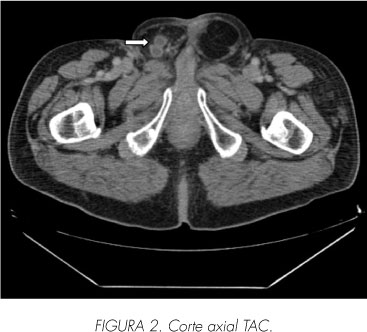
<body><![CDATA[<br><b>Results:</b> CT scan confirmed the diagnosis. Due to the advanced age of the patient, comorbidities and the absence of symptoms, conservative treatment was decided.    <br><b>Conclusions:</b> Ureteral hernias through the inguinal duct are uncommon. There are 2 types: paraperitoneal and extraperitoneal. The most common is the paraperitoneal (80%) which is accompanied by hernia sac and can appear with other abdominal organs. The extraperitoneal often accompanied by retroperitoneal fat. Both types of hernias are usually indirect. Treatment is usually herniorrhaphy.</font></p>     <p><font face="Verdana" size="2"><b>Key words:</b> Ureter. Inguinal. Hernia.</font></p> <hr size="1">     <p>&nbsp;</p>     <p><font face="Verdana" size="2"><b>Introducci&oacute;n</b></font></p>     <p><font face="Verdana" size="2">Paciente var&oacute;n de 80 a&ntilde;os con antecedentes de hipertensi&oacute;n arterial y hernia inguinal izquierda operada, hemicolectomia derecha por adenocarcinoma de colon y colecistectomia.</font></p>     <p><font face="Verdana" size="2">Valorado en consultas de urolog&iacute;a por dilataci&oacute;n leve del ri&ntilde;&oacute;n derecho en ecograf&iacute;a abdominal de control, indic&aacute;ndose urograf&iacute;a intravenosa en agosto del 2008 donde se aprecia buena concentraci&oacute;n de contraste, retraso de eliminaci&oacute;n del contraste por sistema colector derecho que comienza a eliminar a los 45 minutos y dilataci&oacute;n del sistema pielocalicial derecho. Se identifica posici&oacute;n ect&oacute;pica del ur&eacute;ter derecho que sale de la cavidad abdominal por regi&oacute;n inguinal derecha para luego volver al abdomen (<a href="#f1">Figura 1</a>).</font></p>     <p><a name="f1"></a></p>     <p align="center"><img src="/img/revistas/urol/v62n9/13f01.jpg"></p>     <p>&nbsp;</p>     ]]></body>
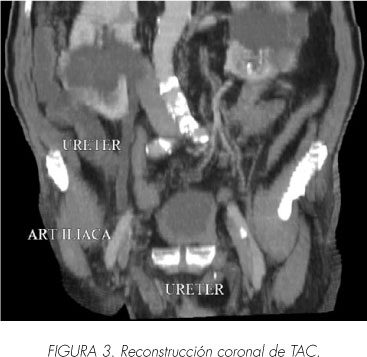
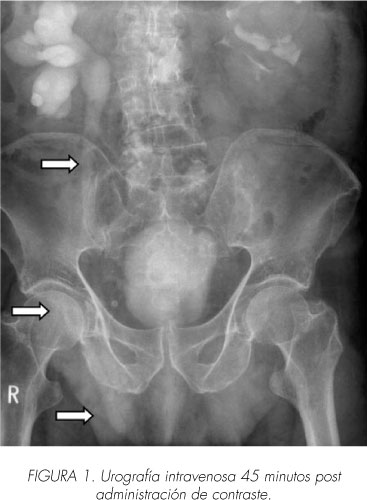
<body><![CDATA[<p><font face="Verdana" size="2">Se realiza TAC de abdomen y pelvis con reconstrucci&oacute;n coronal donde se aprecia herniaci&oacute;n de ur&eacute;ter derecho en canal inguinal (Figuras <a href="#f2">2</a> y <a href="#f3">3</a>). Actualmente, el paciente esta asintom&aacute;tico desde el punto de vista urol&oacute;gico y presenta buena funci&oacute;n renal (creatinina 1.1 mg/dL). Se decide tratamiento expectante con controles peri&oacute;dicos.</font></p>     <p><a name="f2"></a></p>     <p align="center"><img src="/img/revistas/urol/v62n9/13f02.jpg"></p>     <p>&nbsp;</p>     <p><a name="f3"></a></p>     <p align="center"><img src="/img/revistas/urol/v62n9/13f03.jpg"></p>     <p>&nbsp;</p>     <p><font face="Verdana" size="2"><b>Discusi&oacute;n</b></font></p>     <p><font face="Verdana" size="2">La herniaci&oacute;n del ur&eacute;ter a trav&eacute;s del conducto inguinal es poco habitual (1) alrededor de 140 casos reportados en la literatura (2). Esta patolog&iacute;a puede afectar tanto a hombres como mujeres, siendo en los hombres m&aacute;s frecuente asociado con hernias inguinales y en mujeres con hernias femorales (3) y dado a que estas hernias suelen ser de gran tama&ntilde;o, rara vez tienen complicaciones isqu&eacute;micas. Otro sitio poco frecuente de herniaci&oacute;n ureteral es el agujero ci&aacute;tico con 17 casos publicados en la literatura (4). Suelen aparecer s&iacute;ntomas urol&oacute;gicos cuando se asocia con herniaci&oacute;n vesical, que pueden ser: aumento de frecuencia miccional, nicturia, disuria y hematuria.</font></p>     <p><font face="Verdana" size="2">Es frecuente encontrar alteraciones en los estudios por imagen destacando uropat&iacute;a obstructiva de grado variable. La clasificaci&oacute;n de este tipo de hernia va a depender de la presencia o no de saco herniario. La m&aacute;s frecuente es la paraperitoneal (80%) donde se acompa&ntilde;a de saco hemiario y pueden aparecer otros &oacute;rganos intra abdominales. La extraperitoneal suele acompa&ntilde;arse de grasa retroperitoneal (5). Ambos tipos de hernias suelen se indirectas (6).</font></p>     ]]></body>
<body><![CDATA[<p><font face="Verdana" size="2">La mayor&iacute;a de las veces el diagn&oacute;stico es un hallazgo durante la cirug&iacute;a o urograf&iacute;a (7). La herniorraf&iacute;a est&aacute; indicada para resolver la uropat&iacute;a obstructiva, y es necesario hacer una disecci&oacute;n precisa del ur&eacute;ter para liberarlo de estructuras vecinas, luego una reducci&oacute;n simple bastar&iacute;a para resolver el problema (3).</font></p>     <p><font face="Verdana" size="2">En nuestro caso, dada la edad avanzada del paciente, comorbilidades y ausencia de s&iacute;ntomas, se decidi&oacute; actitud expectante.</font></p>     <p>&nbsp;</p>     <p><font face="Verdana" size="2"><b>Conclusiones</b></font></p>     <p><font face="Verdana" size="2">La herniaci&oacute;n de ur&eacute;ter a trav&eacute;s del canal inguinal es una entidad poco frecuente, generalmente diagnosticada de manera incidental. El tratamiento vendr&aacute; medido por la evaluaci&oacute;n de los s&iacute;ntomas y posibles patolog&iacute;as asociadas al canal inguinal.</font></p>     <p>&nbsp;</p>     <p><font face="Verdana" size="2"><b>Bibliograf&iacute;a y lecturas recomendadas (*lectura de inter&eacute;s y **lectura fundamental)</b></font></p>     <!-- ref --><p><font face="Verdana" size="2">1. Pascale MD, Shabahang M, Evans SRT. Obstructive uropathy secodary to masive inguinioescrotal bladder herniation. J. Urol. 1993; 150:1906-8.</font>&nbsp;&nbsp;&nbsp;&nbsp;&nbsp;&nbsp;&nbsp;&nbsp;[&#160;<a href="javascript:void(0);" onclick="javascript: window.open('/scielo.php?script=sci_nlinks&ref=1156967&pid=S0004-0614200900090001300001&lng=','','width=640,height=500,resizable=yes,scrollbars=1,menubar=yes,');">Links</a>&#160;]<!-- end-ref --><!-- ref --><p><font face="Verdana" size="2">**2. Giglio M, Medica M, Germinale F, Raggio M, Campodonico F, Stubinski R, et al. Scrotal extraperitoneal hernia of the ureter: Case report and literatura review. Urol. Int. 2007; 66:166-8.</font>&nbsp;&nbsp;&nbsp;&nbsp;&nbsp;&nbsp;&nbsp;&nbsp;[&#160;<a href="javascript:void(0);" onclick="javascript: window.open('/scielo.php?script=sci_nlinks&ref=1156968&pid=S0004-0614200900090001300002&lng=','','width=640,height=500,resizable=yes,scrollbars=1,menubar=yes,');">Links</a>&#160;]<!-- end-ref --><!-- ref --><p><font face="Verdana" size="2">*3. Elider KS, Freedland SJ, Raifer J. Obstructive uropathy secondary to ureteroinguinal herniation. Rev. Urol. 2001; 3:207-8.</font>&nbsp;&nbsp;&nbsp;&nbsp;&nbsp;&nbsp;&nbsp;&nbsp;[&#160;<a href="javascript:void(0);" onclick="javascript: window.open('/scielo.php?script=sci_nlinks&ref=1156969&pid=S0004-0614200900090001300003&lng=','','width=640,height=500,resizable=yes,scrollbars=1,menubar=yes,');">Links</a>&#160;]<!-- end-ref --><!-- ref --><p><font face="Verdana" size="2">4. Tsai PJ, Lin JT, Wu TT, Tsai CC. Ureterosciatic hernia causes obstructive uropathy. J. Chin. Med. Assoc. 2008; 71:491-3.</font>&nbsp;&nbsp;&nbsp;&nbsp;&nbsp;&nbsp;&nbsp;&nbsp;[&#160;<a href="javascript:void(0);" onclick="javascript: window.open('/scielo.php?script=sci_nlinks&ref=1156970&pid=S0004-0614200900090001300004&lng=','','width=640,height=500,resizable=yes,scrollbars=1,menubar=yes,');">Links</a>&#160;]<!-- end-ref --><!-- ref --><p><font face="Verdana" size="2">5. Rommel FM, Boline GB, Huffnagle HW. Ureterosciatic hernia: an anatomical radigraphic correlation. J. Urol. 1993; 150:1232-3.</font>&nbsp;&nbsp;&nbsp;&nbsp;&nbsp;&nbsp;&nbsp;&nbsp;[&#160;<a href="javascript:void(0);" onclick="javascript: window.open('/scielo.php?script=sci_nlinks&ref=1156971&pid=S0004-0614200900090001300005&lng=','','width=640,height=500,resizable=yes,scrollbars=1,menubar=yes,');">Links</a>&#160;]<!-- end-ref --><!-- ref --><p><font face="Verdana" size="2">6. Pollac HM, Popky GL, Blumberg ML. Hernias of the ur&eacute;ter an anatomic-roentgenographic study. Radiology 1975; 117:275-81.</font>&nbsp;&nbsp;&nbsp;&nbsp;&nbsp;&nbsp;&nbsp;&nbsp;[&#160;<a href="javascript:void(0);" onclick="javascript: window.open('/scielo.php?script=sci_nlinks&ref=1156972&pid=S0004-0614200900090001300006&lng=','','width=640,height=500,resizable=yes,scrollbars=1,menubar=yes,');">Links</a>&#160;]<!-- end-ref --><!-- ref --><p><font face="Verdana" size="2">7. Marchal C, Chicharro JA, Gonz&aacute;lez JA, Ruiz JL, Burgos R. Unilateral ureteral hernia. Report of a case. Arch. Esp. Urol. 1994; 47(2):174-5.</font>&nbsp;&nbsp;&nbsp;&nbsp;&nbsp;&nbsp;&nbsp;&nbsp;[&#160;<a href="javascript:void(0);" onclick="javascript: window.open('/scielo.php?script=sci_nlinks&ref=1156973&pid=S0004-0614200900090001300007&lng=','','width=640,height=500,resizable=yes,scrollbars=1,menubar=yes,');">Links</a>&#160;]<!-- end-ref --><p>&nbsp;</p>     <p>&nbsp;</p>     <p><font face="Verdana" size="2"><a name="back"></a><a href="#top"><img src="/img/revistas/urol/v62n9/seta.gif" border="0"></a><b>Direcci&oacute;n para correspondencia:</b>    <br>Ant&oacute;n Zarraonandia Andraca    <br>Servicio de Urolog&iacute;a    <br>Complejo Hospitalario Universitario A Coru&ntilde;a.    ]]></body>
<body><![CDATA[<br>Xubias de Arriba, 84    <br>15006 La Coru&ntilde;a. (Espa&ntilde;a)    <br><a href="mailto:antonzarraonandia@yahoo.com">antonzarraonandia@yahoo.com</a>.</font></p>     <p><font face="Verdana" size="2">Recibido: 2 de mayo 2009.</font></p>      ]]></body><back>
<ref-list>
<ref id="B1">
<label>1</label><nlm-citation citation-type="journal">
<person-group person-group-type="author">
<name>
<surname><![CDATA[Pascale]]></surname>
<given-names><![CDATA[MD]]></given-names>
</name>
<name>
<surname><![CDATA[Shabahang]]></surname>
<given-names><![CDATA[M]]></given-names>
</name>
<name>
<surname><![CDATA[Evans]]></surname>
<given-names><![CDATA[SRT]]></given-names>
</name>
</person-group>
<article-title xml:lang="en"><![CDATA[Obstructive uropathy secodary to masive inguinioescrotal bladder herniation]]></article-title>
<source><![CDATA[J. Urol.]]></source>
<year>1993</year>
<volume>150</volume>
<page-range>1906-8</page-range></nlm-citation>
</ref>
<ref id="B2">
<label>2</label><nlm-citation citation-type="journal">
<person-group person-group-type="author">
<name>
<surname><![CDATA[Giglio]]></surname>
<given-names><![CDATA[M]]></given-names>
</name>
<name>
<surname><![CDATA[Medica]]></surname>
<given-names><![CDATA[M]]></given-names>
</name>
<name>
<surname><![CDATA[Germinale]]></surname>
<given-names><![CDATA[F]]></given-names>
</name>
<name>
<surname><![CDATA[Raggio]]></surname>
<given-names><![CDATA[M]]></given-names>
</name>
<name>
<surname><![CDATA[Campodonico]]></surname>
<given-names><![CDATA[F]]></given-names>
</name>
<name>
<surname><![CDATA[Stubinski]]></surname>
<given-names><![CDATA[R]]></given-names>
</name>
</person-group>
<article-title xml:lang="en"><![CDATA[Scrotal extraperitoneal hernia of the ureter: Case report and literatura review]]></article-title>
<source><![CDATA[Urol. Int.]]></source>
<year>2007</year>
<volume>66</volume>
<page-range>166-8</page-range></nlm-citation>
</ref>
<ref id="B3">
<label>3</label><nlm-citation citation-type="journal">
<person-group person-group-type="author">
<name>
<surname><![CDATA[Elider]]></surname>
<given-names><![CDATA[KS]]></given-names>
</name>
<name>
<surname><![CDATA[Freedland]]></surname>
<given-names><![CDATA[SJ]]></given-names>
</name>
<name>
<surname><![CDATA[Raifer]]></surname>
<given-names><![CDATA[J]]></given-names>
</name>
</person-group>
<article-title xml:lang="en"><![CDATA[Obstructive uropathy secondary to ureteroinguinal herniation]]></article-title>
<source><![CDATA[Rev. Urol.]]></source>
<year>2001</year>
<volume>3</volume>
<page-range>207-8</page-range></nlm-citation>
</ref>
<ref id="B4">
<label>4</label><nlm-citation citation-type="journal">
<person-group person-group-type="author">
<name>
<surname><![CDATA[Tsai]]></surname>
<given-names><![CDATA[PJ]]></given-names>
</name>
<name>
<surname><![CDATA[Lin]]></surname>
<given-names><![CDATA[JT]]></given-names>
</name>
<name>
<surname><![CDATA[Wu]]></surname>
<given-names><![CDATA[TT]]></given-names>
</name>
<name>
<surname><![CDATA[Tsai]]></surname>
<given-names><![CDATA[CC]]></given-names>
</name>
</person-group>
<article-title xml:lang="en"><![CDATA[Ureterosciatic hernia causes obstructive uropathy]]></article-title>
<source><![CDATA[J. Chin. Med. Assoc.]]></source>
<year>2008</year>
<volume>71</volume>
<page-range>491-3</page-range></nlm-citation>
</ref>
<ref id="B5">
<label>5</label><nlm-citation citation-type="journal">
<person-group person-group-type="author">
<name>
<surname><![CDATA[Rommel]]></surname>
<given-names><![CDATA[FM]]></given-names>
</name>
<name>
<surname><![CDATA[Boline]]></surname>
<given-names><![CDATA[GB]]></given-names>
</name>
<name>
<surname><![CDATA[Huffnagle]]></surname>
<given-names><![CDATA[HW]]></given-names>
</name>
</person-group>
<article-title xml:lang="en"><![CDATA[Ureterosciatic hernia: an anatomical radigraphic correlation]]></article-title>
<source><![CDATA[J. Urol.]]></source>
<year>1993</year>
<volume>150</volume>
<page-range>1232-3</page-range></nlm-citation>
</ref>
<ref id="B6">
<label>6</label><nlm-citation citation-type="journal">
<person-group person-group-type="author">
<name>
<surname><![CDATA[Pollac]]></surname>
<given-names><![CDATA[HM]]></given-names>
</name>
<name>
<surname><![CDATA[Popky]]></surname>
<given-names><![CDATA[GL]]></given-names>
</name>
<name>
<surname><![CDATA[Blumberg]]></surname>
<given-names><![CDATA[ML]]></given-names>
</name>
</person-group>
<article-title xml:lang="en"><![CDATA[Hernias of the uréter an anatomic-roentgenographic study]]></article-title>
<source><![CDATA[Radiology]]></source>
<year>1975</year>
<volume>117</volume>
<page-range>275-81</page-range></nlm-citation>
</ref>
<ref id="B7">
<label>7</label><nlm-citation citation-type="journal">
<person-group person-group-type="author">
<name>
<surname><![CDATA[Marchal]]></surname>
<given-names><![CDATA[C]]></given-names>
</name>
<name>
<surname><![CDATA[Chicharro]]></surname>
<given-names><![CDATA[JA]]></given-names>
</name>
<name>
<surname><![CDATA[González]]></surname>
<given-names><![CDATA[JA]]></given-names>
</name>
<name>
<surname><![CDATA[Ruiz]]></surname>
<given-names><![CDATA[JL]]></given-names>
</name>
<name>
<surname><![CDATA[Burgos]]></surname>
<given-names><![CDATA[R]]></given-names>
</name>
</person-group>
<article-title xml:lang="en"><![CDATA[Unilateral ureteral hernia: Report of a case]]></article-title>
<source><![CDATA[Arch. Esp. Urol.]]></source>
<year>1994</year>
<volume>47</volume>
<numero>2</numero>
<issue>2</issue>
<page-range>174-5</page-range></nlm-citation>
</ref>
</ref-list>
</back>
</article>