<?xml version="1.0" encoding="ISO-8859-1"?><article xmlns:mml="http://www.w3.org/1998/Math/MathML" xmlns:xlink="http://www.w3.org/1999/xlink" xmlns:xsi="http://www.w3.org/2001/XMLSchema-instance">
<front>
<journal-meta>
<journal-id>0211-6995</journal-id>
<journal-title><![CDATA[Nefrología (Madrid)]]></journal-title>
<abbrev-journal-title><![CDATA[Nefrología (Madr.)]]></abbrev-journal-title>
<issn>0211-6995</issn>
<publisher>
<publisher-name><![CDATA[Sociedad Española de Nefrología]]></publisher-name>
</publisher>
</journal-meta>
<article-meta>
<article-id>S0211-69952011000300015</article-id>
<title-group>
<article-title xml:lang="en"><![CDATA[Fuller Albright and our current understanding of calcium and phosphorus regulation and primary hyperparathyroidism]]></article-title>
<article-title xml:lang="es"><![CDATA[Fuller Albright y nuestro conocimiento actual sobre la regulación del calcio y del fósforo y el hiperparatiroidismo primario]]></article-title>
</title-group>
<contrib-group>
<contrib contrib-type="author">
<name>
<surname><![CDATA[Felsenfeld]]></surname>
<given-names><![CDATA[A.J.]]></given-names>
</name>
<xref ref-type="aff" rid="A01"/>
</contrib>
<contrib contrib-type="author">
<name>
<surname><![CDATA[Levine]]></surname>
<given-names><![CDATA[B.S.]]></given-names>
</name>
<xref ref-type="aff" rid="A01"/>
</contrib>
<contrib contrib-type="author">
<name>
<surname><![CDATA[Kleeman]]></surname>
<given-names><![CDATA[C. R.]]></given-names>
</name>
<xref ref-type="aff" rid="A01"/>
</contrib>
</contrib-group>
<aff id="A01">
<institution><![CDATA[,University of California, Los Angeles (UCLA) School of Medicine VA Greater Los Angeles Healthcare System and the David Geffen]]></institution>
<addr-line><![CDATA[Los Angeles CA]]></addr-line>
<country>USA</country>
</aff>
<pub-date pub-type="pub">
<day>00</day>
<month>00</month>
<year>2011</year>
</pub-date>
<pub-date pub-type="epub">
<day>00</day>
<month>00</month>
<year>2011</year>
</pub-date>
<volume>31</volume>
<numero>3</numero>
<fpage>346</fpage>
<lpage>357</lpage>
<copyright-statement/>
<copyright-year/>
<self-uri xlink:href="http://scielo.isciii.es/scielo.php?script=sci_arttext&amp;pid=S0211-69952011000300015&amp;lng=en&amp;nrm=iso"></self-uri><self-uri xlink:href="http://scielo.isciii.es/scielo.php?script=sci_abstract&amp;pid=S0211-69952011000300015&amp;lng=en&amp;nrm=iso"></self-uri><self-uri xlink:href="http://scielo.isciii.es/scielo.php?script=sci_pdf&amp;pid=S0211-69952011000300015&amp;lng=en&amp;nrm=iso"></self-uri><abstract abstract-type="short" xml:lang="en"><p><![CDATA[The major contributions of Fuller Albright to our understanding of calcium and phosphorus regulation and primary hyperparathyroidism are highlighted. Albright was the first investigator to initiate a systematic study of mineral metabolism. With resources limited to the measurement of serum calcium and phosphorus and the infusion of parathyroid extract, Albright used balance studies to establish a framework for our understanding of calcium and phosphorus regulation and primary hyperparathyroidism. Albright was the first to show that the etiology of primary hyperparathyroidism could be from either an adenoma or hyperplasia of the parathyroid glands and stone disease was a separate manifestation of primary hyperparathyroidism. Albright also showed that: 1) a renal threshold for calcium excretion was present in hypoparathyroid patients; 2) correction of hypocalcemia in hypoparathyroid patients with vitamin D had a phosphaturic action; 3) renal failure reduced the intestinal absorption of calcium in primary hyperparathyroidism; 4) the «hungry bone» syndrome developed after parathyroidectomy in severe primary hyperparathyroidism; and 5) a target organ can fail to respond to a hormone. He also suggested that a malignant tumor could be responsible for ectopic hormone production. Finally, our review integrates the observations of Albright with our current knowledge of calcium regulation and disorders.]]></p></abstract>
<abstract abstract-type="short" xml:lang="es"><p><![CDATA[Se destacan las principales contribuciones de Fuller Albright sobre el conocimiento de la regulación del calcio y del fósforo en el hiperparatiroidismo primario. Albright fue el primer investigador que inició un estudio sistemático sobre el metabolismo de los minerales. Con unos recursos que se limitaban a la medición de la concentración de calcio y fósforo en suero y la infusión de extracto paratiroideo, Albright, a través de estudios del equilibrio, estableció unas bases para entender la regulación del calcio y del fósforo y el hiperparatiroidismo primario. Albright fue el primero en afirmar que un adenoma o una hiperplasia de las glándulas paratiroideas podrían ser las causantes del hiperparatiroidismo primario. Además indicó que la litiasis sería una manifestación independiente del hiperparatiroidismo primario. Albright observó también que: 1) los pacientes con hipoparatiroidismo primario presentaban un valor umbral para la eliminación renal del calcio; 2) en pacientes con hipoparatiroidismo la rectificación de la hipocalcemia con vitamina D tenía un efecto fosfatúrico; 3) en el hiperparatiroidismo primario, la insuficiencia renal reducía la absorción intestinal del calcio; 4) en el hiperparatiroidismo primario grave, tras una paratiroidectomía se observaba el síndrome del «hueso hambriento» y 5) es posible que un órgano diana deje de responder a una hormona. Albright también defendió la posibilidad de que un tumor maligno provocara la producción ectópica de hormona. Por último, nuestra revisión integra las observaciones de Albright con los conocimientos actuales sobre la regulación y los trastornos del calcio.]]></p></abstract>
<kwd-group>
<kwd lng="en"><![CDATA[Calcium]]></kwd>
<kwd lng="en"><![CDATA[Hyperparathyroidism]]></kwd>
<kwd lng="en"><![CDATA[Hypoparathyroidism]]></kwd>
<kwd lng="en"><![CDATA[Parathyroid hormone]]></kwd>
<kwd lng="en"><![CDATA[Phosphorus]]></kwd>
<kwd lng="es"><![CDATA[Calcio]]></kwd>
<kwd lng="es"><![CDATA[Hiperparatiroidismo]]></kwd>
<kwd lng="es"><![CDATA[Hipoparatiroidismo]]></kwd>
<kwd lng="es"><![CDATA[Hormona paratiroidea]]></kwd>
<kwd lng="es"><![CDATA[Fósforo]]></kwd>
</kwd-group>
</article-meta>
</front><body><![CDATA[ <p><a name="top"></a><font face="Verdana" size="2"><b>HISTORIA DE LA NEFROLOGÍA</b></font></p>     <p>&nbsp;</p>     <p><font face="Verdana" size="4"><b>Fuller Albright and our current understanding of calcium and phosphorus regulation and primary hyperparathyroidism</b></font></p>     <p><font face="Verdana" size="4"><b>Fuller Albright y nuestro conocimiento actual sobre la regulación del calcio y del fósforo y el hiperparatiroidismo primario</b></font></p>     <p>&nbsp;</p>     <p>&nbsp;</p>     <p><font face="Verdana" size="2"><b>A.J. Felsenfeld, B.S. Levine, C. R. Kleeman</b></font></p>     <p><font face="Verdana" size="2">Department of Medicine. VA Greater Los Angeles Healthcare System and the David Geffen School of Medicine at UCLA. Los Angeles, CA (USA)</font></p>     <p><font face="Verdana" size="2"><a href="#bajo">Correspondence</a></font></p>     <p>&nbsp;</p>     ]]></body>
<body><![CDATA[<p>&nbsp;</p> <hr size="1">     <p><font face="Verdana" size="2"><b>ABSTRACT</b></font></p>     <p><font face="Verdana" size="2">The major contributions of Fuller Albright to our understanding of calcium and phosphorus regulation and primary hyperparathyroidism are highlighted. Albright was the first investigator to initiate a systematic study of mineral metabolism. With resources limited to the measurement of serum calcium and phosphorus and the infusion of parathyroid extract, Albright used balance studies to establish a framework for our understanding of calcium and phosphorus regulation and primary hyperparathyroidism. Albright was the first to show that the etiology of primary hyperparathyroidism could be from either an adenoma or hyperplasia of the parathyroid glands and stone disease was a separate manifestation of primary hyperparathyroidism. Albright also showed that: <i>1)</i> a renal threshold for calcium excretion was present in hypoparathyroid patients; <i>2)</i> correction of hypocalcemia in hypoparathyroid patients with vitamin D had a phosphaturic action; <i>3)</i> renal failure reduced the intestinal absorption of calcium in primary hyperparathyroidism; <i>4)</i> the «hungry bone» syndrome developed after parathyroidectomy in severe primary hyperparathyroidism; and <i>5)</i> a target organ can fail to respond to a hormone. He also suggested that a malignant tumor could be responsible for ectopic hormone production. Finally, our review integrates the observations of Albright with our current knowledge of calcium regulation and disorders.</font></p>     <p><font face="Verdana" size="2"><b>Key words:</b> Calcium, Hyperparathyroidism, Hypoparathyroidism, Parathyroid hormone, Phosphorus.</font></p> <hr size="1">     <p><font face="Verdana" size="2"><b>RESUMEN</b></font></p>     <p><font face="Verdana" size="2">Se destacan las principales contribuciones de Fuller Albright sobre el conocimiento de la regulación del calcio y del fósforo en el hiperparatiroidismo primario. Albright fue el primer investigador que inició un estudio sistemático sobre el metabolismo de los minerales. Con unos recursos que se limitaban a la medición de la concentración de calcio y fósforo en suero y la infusión de extracto paratiroideo, Albright, a través de estudios del equilibrio, estableció unas bases para entender la regulación del calcio y del fósforo y el hiperparatiroidismo primario. Albright fue el primero en afirmar que un adenoma o una hiperplasia de las glándulas paratiroideas podrían ser las causantes del hiperparatiroidismo primario. Además indicó que la litiasis sería una manifestación independiente del hiperparatiroidismo primario. Albright observó también que: 1) los pacientes con hipoparatiroidismo primario presentaban un valor umbral para la eliminación renal del calcio; 2) en pacientes con hipoparatiroidismo la rectificación de la hipocalcemia con vitamina D tenía un efecto fosfatúrico; 3) en el hiperparatiroidismo primario, la insuficiencia renal reducía la absorción intestinal del calcio; 4) en el hiperparatiroidismo primario grave, tras una paratiroidectomía se observaba el síndrome del «hueso hambriento» y 5) es posible que un órgano diana deje de responder a una hormona. Albright también defendió la posibilidad de que un tumor maligno provocara la producción ectópica de hormona. Por último, nuestra revisión integra las observaciones de Albright con los conocimientos actuales sobre la regulación y los trastornos del calcio.</font></p>     <p><font face="Verdana" size="2"><b>Palabras clave:</b> Calcio. Hiperparatiroidismo. Hipoparatiroidismo. Hormona paratiroidea. Fósforo.</font></p> <hr size="1">     <p>&nbsp;</p>     <p><font face="Verdana" size="2"><b>Introduction</b></font></p>     <p><font face="Verdana" size="2">Fuller Albright's academic career began in the late 1920s and ended in 1956 after brain surgery for Parkinson's disease resulted in a non-functional state until his death in 1969. Although increasingly disabled by Parkinson's disease from the mid 1930s, Albright continued to make important contributions to our knowledge of calcium and phosphorus disorders<sup>1</sup>. His book, "Parathyroid Glands and Metabolic Bone Disease", published in 1948, is a testimony to his many important observations<sup>2</sup>. Our goal is to highlight some of the many contributions made by Albright on calcium and phosphorus regulation and primary hyperparathyroidism and to integrate the findings of Albright with more recent studies. Albright's contributions to our understanding of renal phosphate transport have been discussed elsewhere<sup>3</sup>. Virtually all that Albright observed remains valid today, but as often happens, the explanations and their complexity continue to evolve.</font></p>     ]]></body>
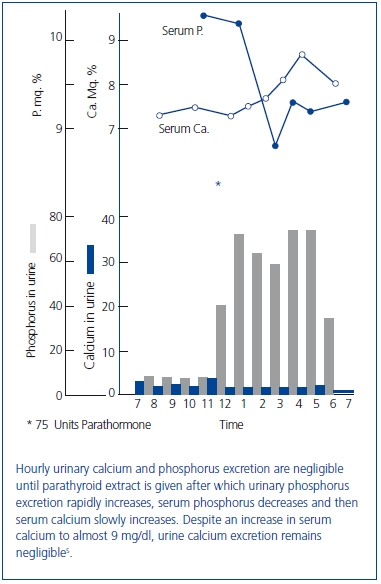
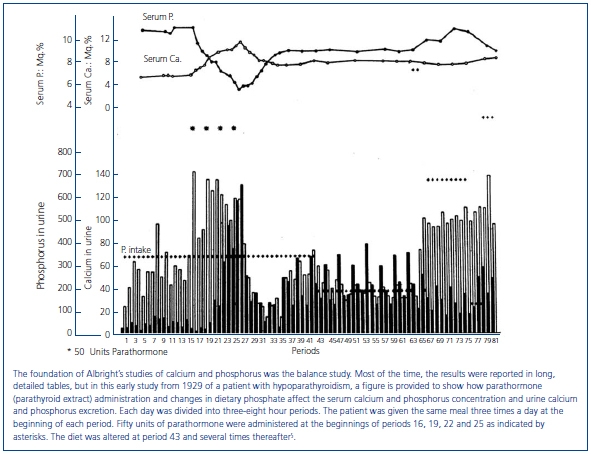
<body><![CDATA[<p><font face="Verdana" size="2">Our retrospective highlights Albright's enduring legacy to the modern study of calcium and phosphorus regulation and primary hyperparathyroidism. The following topics are discussed: <i>1)</i> the resources available to Albright to study calcium and phosphorus regulation and primary hyperparathyroidism; <i>2)</i> Albright's studies of calcium balance; <i>3)</i> phosphaturia resulting from the correction of hypocalcemia in hypoparathyroid patients; <i>4)</i> primary hyperparathyroidism as a surgically curable disorder; and <i>5)</i> several clinical vignettes which include: <i>a)</i> a prelude to the trade-off hypothesis of Slatopolsky and Bricker advanced by Albright to explain the development of secondary hyperparathyroidism in renal failure; <i>b)</i> the suggestion that a malignant tumor could be responsible for ectopic hormone production; <i>c)</i> the realization that vitamin D deficiency can be associated with the failure to respond to parathyroid hormone (PTH); and <i>d)</i> the appreciation that immobilization can be a cause of hypercalcemia.</font></p>     <p>&nbsp;</p>     <p><font face="Verdana" size="2"><b>Tools of the trade</b></font></p>     <p><font face="Verdana" size="2">In the late 1920s when Albright first started his studies of calcium and phosphorus regulation and primary hyperparathyroidism, his primary tools were: <i>1)</i> parathyroid extract (PTE), which was a bovine preparation from Eli Lilly and Company; <i>2)</i> the personnel on the newly organized Ward 4 at Massachusetts General Hospital who were trained to perform balance studies in which dietary calcium and phosphorus could be prepared with accuracy and the fecal and urine excretion of calcium and phosphorus collected with precision<sup>4</sup>; and <i>3)</i> the measurement of calcium and phosphorus in the blood, urine and feces. As a result of balance studies it became possible to determine how variations in dietary calcium and phosphate content and the administration of PTE affected: <i>1)</i> serum calcium and phosphorus concentration; <i>2)</i> fecal and urinary excretion of calcium and phosphorus; and <i>3)</i> retention or loss of calcium and phosphorus from the body (<a href="#f1">figure 1</a>). Because PTH could not be measured, Albright could not know whether PTH values were modified by serum calcium.</font></p>     <p>&nbsp;</p>     <p align="center"><font face="Verdana" size="2"><a name="f1"><img src="/img/revistas/nefrologia/v31n3/historia_figure1.jpg"></a>    <br><b>Figure 1.</b> Graphic representation of balance data.</font></p>     <p>&nbsp;</p>     <p><font face="Verdana" size="2"><b>Effect of parathyroid extract and dietary calcium ans phosphate on calcium balance in normal subjects and in patients with hypoparathyroidism and hyperparathyroidism</b></font></p>     <p><font face="Verdana" size="2">In an early study, Albright infused PTE into a patient with longstanding idiopathic hypoparathyroidism (<a href="#f2">Figure 2</a>)<sup>5</sup>. Albright observed that: <i>1)</i> urine phosphorus excretion immediately increased and peaked within two hours; <i>2)</i> the increase in serum calcium and decrease in serum phosphorus followed the increase in phosphorus excretion; and <i>3)</i> there was a critical serum calcium value at about 8.5 mg/dl at which a negligible urinary calcium excretion suddenly became appreciable. Albright concluded that the action of PTE was rapid, its first effect was phosphaturia, and the increase in serum calcium followed the increase in phosphorus excretion. Thus, Albright developed the hypothesis that PTH primarily modified phosphorus rather than calcium, a view that he still championed when his book was published almost 20 years later<sup>2</sup>. Albright argued that the PTH-induced increase in phosphorus excretion and the resulting decrease in serum phosphorus promoted bone dissolution releasing calcium. While such a conclusion might sound somewhat fanciful today, it should be remembered that Albright had participated in studies in which ammonium chloride-induced acidosis increased the serum calcium concentration and urinary calcium excretion without increasing intestinal calcium absorption suggesting that acidosis induced bone dissolution<sup>6</sup><sup>,</sup><sup>7</sup>. Today it is recognized that phosphate depletion increases calcium release from bone resulting in hypercalciuria and even hypercalcemia despite a marked reduction in PTH values suggesting that bone dissolution is an important feature<sup>8</sup><sup>,</sup><sup>9</sup>. Finally, Albright was correct in his hypothesis that phosphate was a major modifier of the calcemic response of bone to PTH. Many subsequent studies have shown that phosphate loading and restriction change the calcemic response to PTH<sup>10-12</sup>.</font></p>     ]]></body>
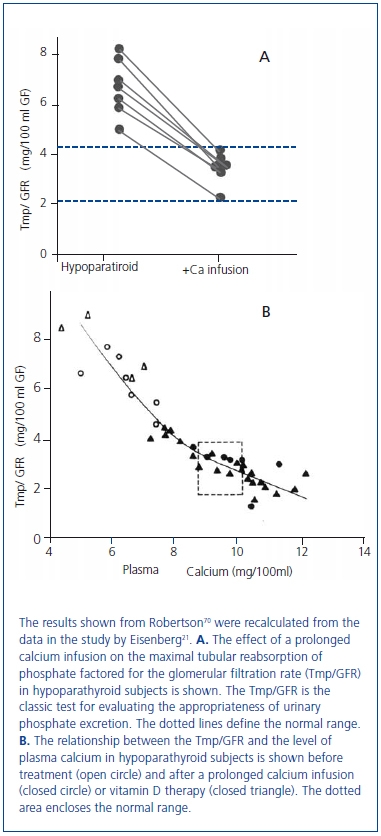
<body><![CDATA[<p align="center"><font face="Verdana" size="2"><a name="f2"><img src="/img/revistas/nefrologia/v31n3/historia_figure2.jpg"></a>    <br><b>Figure 2.</b> Effect of parathyroid extract on urinary calcium    <br> and phosphorus excretion in a patient with idiopathic hypoparathyroidism.</font></p>     <p>&nbsp;</p>     <p><font face="Verdana" size="2">As already mentioned, Albright had observed during a PTE-induced increase in serum calcium in a hypoparathyroid patient that the serum calcium threshold at which urinary calcium excretion increased from negligible values was approximately 8.5 mg/dl. However, that threshold value did not account for the now known effect of PTH on urinary calcium excretion. In 1961, one of the authors (CRK) first showed that PTE administration directly increased renal calcium reabsorption<sup>13</sup>. Subsequently, it was shown that the threshold serum calcium value for excreting calcium during a calcium infusion was seen at serum calcium values between 7 and 8 mg/dl in hypoparathyroid patients<sup>14</sup>. In 1984, Ogata and associates showed that besides PTH, the active form of vitamin D, calcitriol, directly increased the threshold for renal calcium excretion and also enhanced the responsiveness of the tubule to PTH<sup>15</sup>. More recently, Bindels and colleagues have shown that the stimulatory effect of both calcitriol and PTH on renal calcium reabsorption results from the activation of an epithelial calcium channel (TRPV5) in the distal convoluted tubule<sup>16</sup>.</font></p>     <p>&nbsp;</p>     <p><font face="Verdana" size="2"><b>Vitamin D treatment and calcium infusion as phosphaturic agents</b></font></p>     <p><font face="Verdana" size="2">In 1938 and in 1942, Albright used the newly available analog of vitamin D, dihydrotachysterol, for the treatment of hypocalcemia in patients with hypoparathyroidism<sup>17</sup> and also in the newly described disorder of pseudohypoparathyroidism in which there was a failure to respond to administered PTE<sup>18</sup>. Albright observed that the correction of hypocalcemia increased urine phosphate excretion. This observation had been made earlier by associates of Albright<sup>19</sup> and by Howland and Kramer<sup>20</sup>. In 1965, Eisenberg demonstrated in hypoparathyroid patients that the phosphaturia was independent of vitamin D by showing that a prolonged intravenous infusion of calcium sufficient to normalize the serum calcium concentration at 48 hours was phosphaturic and also lowered the serum phosphorus concentration (<a href="#f3">figure 3A, figure3B</a>)<sup>21</sup>. Evidence has accumulated during the past several years that the recently discovered bone-derived phosphaturic hormone, fibroblast growth factor 23 (FGF23) might be involved. High dietary calcium has been shown to stimulate FGF23<sup>22</sup> and the correlation between the serum calcium concentration and FGF23 seen in primary hyperparathyroidism<sup>23-</sup><sup>25</sup> even remained significant after parathyroidectomy<sup>24</sup>. However, a study has yet to be performed identifying the specific mechanism for the observation made more than 70 years ago by Albright and others.</font></p>     <p align="center"><font face="Verdana" size="2"><a name="f3"><img src="/img/revistas/nefrologia/v31n3/historia_figure3.jpg"></a>    <br><b>Figure 3.</b> Effect of a 48 hour calcium infusion with normalization of    ]]></body>
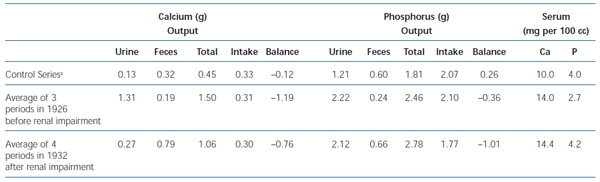
<body><![CDATA[<br> the serum calcium concentration on phosphate excretion in hypoparathyroid patients.</font></p>     <p>&nbsp;</p>     <p><font face="Verdana" size="2"><b>Primary hyperparathyroidism, intestinal calcium absorption, and renal failure</b></font></p>     <p><font face="Verdana" size="2">In patients with primary hyperparathyroidism, Albright showed that changes in dietary calcium and phosphate affected calcium balance. The first patient studied was Captain Martell<sup>26</sup>, who was to have seven parathyroid operations before an ectopic parathyroid gland was removed from the anterior mediastinum<sup>27</sup>. From the balance studies in Captain Martell, who had serum calcium values between 13.1 and 15.3 mg/dl, Albright made the following observations: <i>1)</i> the patient's negative calcium balance on a low calcium diet (0.1 grams/day) was greater than in normal controls (-0.46 vs -1.29 grams per 3 day study period); <i>2)</i> the increased negative calcium balance in the hyperparathyroid patient was due to increased urinary calcium excretion because fecal calcium excretion was less than in normals; <i>3)</i> an infusion of PTE in normal volunteers sufficient to increase serum calcium to between 11.5 and 12.8 mg/dl resulted in a negative calcium balance duplicating the results of the hyperparathyroid patient; and <i>4)</i> a calcium diet of 1.07 grams/day in the hyperparathyroid patient resulted in a positive calcium balance (0.36 grams per day) because urinary calcium excretion increased by only 0.06 grams/day from that on a low calcium diet (0.1 grams/day). Thus, Albright concluded that in primary hyperparathyroidism: <i>1)</i> adaptation to a low calcium diet did not occur because high urine calcium losses persisted; <i>2)</i> intestinal calcium absorption was increased; and <i>3)</i> high PTH values were the likely cause of the negative calcium balance.</font></p>     <p><font face="Verdana" size="2">Albright also evaluated the effect of dietary phosphate on calcium balance in hyperparathyroidism. He showed that a high phosphate diet improved calcium balance in hyperparathyroid patients on both low (0.07 g/day) and normal (0.9 g/day) intakes of dietary calcium<sup>28</sup>. When high dietary phosphate was given to patients with primary hyperparathyroidism, there was: <i>1)</i> almost complete intestinal absorption of phosphate; <i>2)</i> rapid excretion of the absorbed phosphate by the kidneys; <i>3)</i> a rise in the previously low serum phosphorus; <i>4)</i> a fall in the previously elevated serum calcium; <i>5)</i> a rise in the serum calcium-phosphorus product; and <i>6)</i> a fall in urinary calcium excretion. While a high phosphate diet seemed to have certain beneficial effects such as lowering the serum calcium concentration and decreasing urinary calcium excretion, Albright recognized that there were two potential dangers associated with increased phosphate ingestion in patients with primary hyperparathyroidism: <i>1)</i> parathyroid poisoning with soft tissue calcium deposition including the kidney and lungs; and <i>2)</i> calcium-phosphate kidney stones. Today, the recognition that hyperphosphatemia in CKD patients and perhaps even high normal serum phosphorus values in the general population are associated with increased vascular disease and mortality probably from increased vascular calcification<sup>29,30</sup> could be considered an extension of the pioneering studies of Albright.</font></p>     <p><font face="Verdana" size="2">By 1934, Albright came to understand that renal failure had a specific effect on calcium and phosphorus regulation<sup>31</sup>. When a 13 year old girl with moderate renal failure was referred for hypercalcemia (13.6 mg/dl), bone demineralization, a markedly elevated serum alkaline phosphatase, and a serum phosphorus of 4.3 mg/dl, balance studies were performed before the parathyroid surgery during which an adenoma was removed. The balance studies showed that on a low calcium diet (0.1 g/day), urine calcium excretion despite hypercalcemia was only marginally greater than in controls on a similar diet (94 mg vs 63 mg/day). This value was much less than in non-azotemic patients with primary hyperparathyroidism and hypercalcemia (435 mg/day). Also, fecal calcium excretion was greater than in controls and much greater than in hyperparathyroid patients without renal failure. Because of the results in this young girl with renal failure, Albright reviewed the results of the series of balance studies which had been performed on Captain Martell before and after he developed renal failure. As shown in  <a href="#t1">table 1</a>, for a similar magnitude of hypercalcemia (14 mg/dl vs 14.4 mg/dl), for the same low calcium diet after the onset of renal failure, intestinal calcium absorption was less (0.06 vs 0.26 g/day) as was urine calcium excretion (0.09 vs 0.44 g/day). Thus, Albright was the first to recognize that the development of renal failure in primary hyperparathyroidism dramatically decreased both intestinal absorption and the renal excretion of calcium. Today, it is known that PTH stimulates renal production of the active form of vitamin D, calcitriol, which in turn enhances intestinal absorption of calcium. With loss of renal function, calcitriol production is decreased despite high PTH values, a result which may in part be due to increased FGF23 values. Consequently, both intestinal calcium absorption and renal calcium excretion are reduced in renal failure. The latter results from both a decrease in the glomerular filtration of calcium and increased tubular calcium reabsorption from high PTH values.</font></p>     <p>&nbsp;</p>     <p align="center"><font face="Verdana" size="2"><b><a name="t1"></a>Table 1.</b> A comparison of the calcium and phosphorus metabolism of a patient with    <br> hyperparathyroidism before and after the development of renal impairment    <br>   <img src="/img/revistas/nefrologia/v31n3/historia_table1.jpg">    ]]></body>
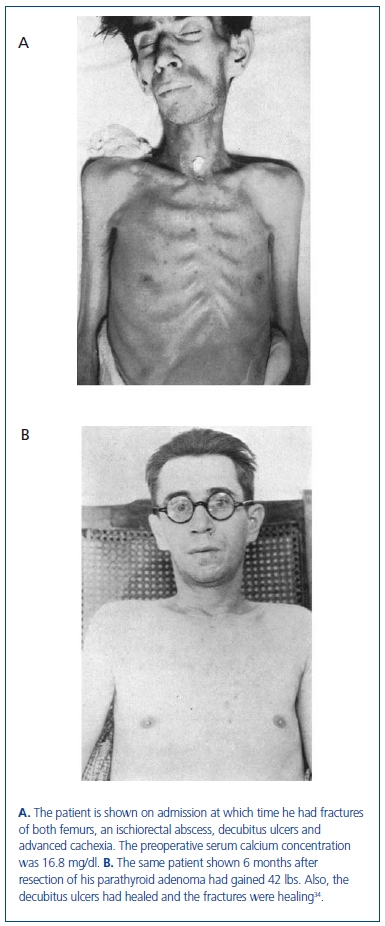
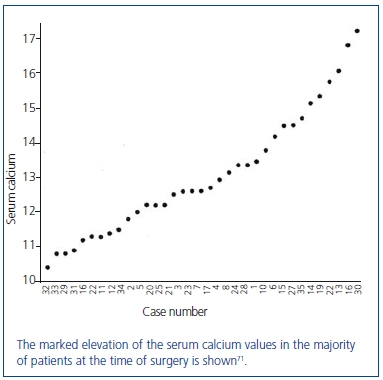
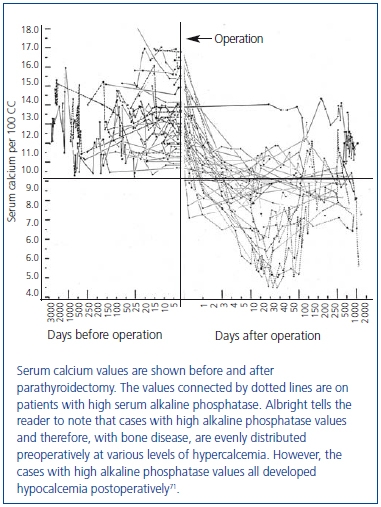
<body><![CDATA[<br>The results for normal individuals are included for comparison<sup>31</sup>.    <br><sup>a</sup>Each collection period was three days.</font></p>     <p>&nbsp;</p>     <p><font face="Verdana" size="2"><b>Primary hyperparathyroidism</b></font></p>     <p><font face="Verdana" size="2">In several patients in his original series of 17 patients published in 1934<sup>32</sup>, Albright made the diagnosis of hyperparathyroidism only because he had the insight to measure serum calcium and phosphorus values in all patients who presented with kidney stones. In the first 14 patients to undergo parathyroid surgery, parathyroid adenomas were found. Two of these patients had ectopic parathyroid adenomas located in the anterior mediastinum. Cases 15 to 17 had hyperplasia of all the parathyroid glands. Because hyperplasia had not been previously recognized as an entity, Case 15 required three parathyroid operations to remove a sufficient amount of the hyperplastic glands before the hypercalcemia resolved. Between the second and third operations, estrogen treatment and irradiation of the pituitary and parathyroid glands were tried without success<sup>33</sup>.</font></p>     <p><font face="Verdana" size="2">In this series of 17 patients, the dimensions, but not the weights of the removed parathyroid glands were provided<sup>32</sup>. The mean amount of parathyroid tissue removed per patient was approximately 83 times greater than the combined size of four normal human parathyroid glands, which subsequently were shown to have a combined weight of approximately 140 mg<sup>34</sup>. Based on these results, the average estimated weight of removed parathyroid tissue for each patient was approximately 11 grams. In severe cases of primary hyperparathyroidism with marked hypercalcemia, cachexia and debilitating fractures were sometimes seen and parathyroidectomy was life saving (<a href="#f4">figure 4</a>). The different magnitude of primary hyperparathyroidism in patients presenting in the 1930s and today is shown by the very high preoperative serum calcium values in Albright's patients (<a href="#f5">figure 5</a>). Finally, Albright was the first to describe the "hungry bone syndrome" in which severe hypocalcemia developed values shortly after parathyroidectomy (<a href="#f6">figure 6</a>). He also showed that the decrease in serum calcium correlated with the pre-operative serum alkaline phosphatase value. When the serum calcium decreased to less than 7 mg/dl, Albright reported that tetany and visual disturbances were often seen. In actuality, the subsequent recognition of the "hungry bone syndrome" in dialysis patients after parathyroidectomy is an extension of the results in primary hyperparathyroidism by Albright.</font></p>     <p align="center"><font face="Verdana" size="2"><a name="f4"><img src="/img/revistas/nefrologia/v31n3/historia_figure4.jpg"></a>    <br><b>Figure 4.</b> The same patient before and after parathyroidectomy    <br> from original series of Albright.</font></p>     <p>&nbsp;</p>     ]]></body>
<body><![CDATA[<p align="center"><font face="Verdana" size="2"><a name="f5"><img src="/img/revistas/nefrologia/v31n3/historia_figure5.jpg"></a>    <br><b>Figure 5.</b> Average preoperative serum calcium values of the first 35 patients    <br> with primary hyperparathyroidism from the Massachusetts General Hospital series.</font></p>     <p>&nbsp;</p>     <p align="center"><font face="Verdana" size="2"><a name="f6"><img src="/img/revistas/nefrologia/v31n3/historia_figure6.jpg"></a>    <br><b>Figure 6.</b> Fall in serum calcium values after parathyroidectomy in 35 cases    <br> of primary hyperparathyroidism (first demonstration of hungry bone syndrome).</font></p>     <p>&nbsp;</p>     <p><font face="Verdana" size="2">In 1934, Albright also recognized that patients with primary hyperparathyroidism presented with either bone disease or stone disease, but rarely both together<sup>32</sup>. In patients with bone disease, skeletal symptoms associated with bone loss, bone cysts, brown tumors, and fractures predominated. In patients with stone disease, presenting symptoms were those associated with nephrolithiasis and skeletal problems were generally absent. Albright questioned why there should be two separate presentations for the same disease. He hypothesized that the extent of bone disease was proportional to the duration of disease times the daily loss of calcium<sup>32</sup>. Thus, according to Albright a short duration of disease would lessen the risk of bone disease. Moreover, a high calcium intake would make bone disease less likely because as Albright had previously observed in studies of patients with primary hyperparathyroidism, a high calcium diet resulted in a positive calcium balance<sup>26</sup>.</font></p>     <p><font face="Verdana" size="2">In 1945, Keating reported 24 patients with primary hyperparathyroidism in whom the magnitude of hypercalcemia, hypophosphatemia and serum alkaline phosphatase elevation was greater in patients with bone disease than with stone disease<sup>35</sup>. In contradiction to the hypothesis advanced by Albright, the patients with bone disease had a shorter duration of symptoms before presentation. In 1956, Dent also reported that patients with bone disease had a shorter duration of symptoms<sup>36</sup>. Subsequently, Dent reported that there was no difference in dietary intake of calcium between patients with bone or stone disease<sup>37</sup>.</font></p>     ]]></body>
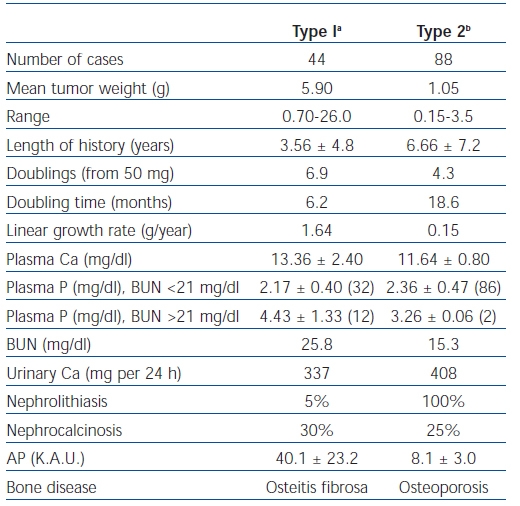
<body><![CDATA[<p><font face="Verdana" size="2">In 1968, Lloyd reviewed 138 consecutive cases of primary hyperparathyroidism accumulated by Dent in London from 1950 to 1965<sup>38</sup>. Patients were divided into overt bone disease without kidney stones (Type 1, n = 44) and kidney stones without overt bone disease (Type 2, n = 88). The remaining six patients had neither overt bone disease nor kidney stones. As shown in  <a href="#t2">table 2</a>, the adenoma weight was greater, the growth rate of the parathyroid tissue more rapid, and the duration of symptoms was shorter in patients with bone disease. These results contradicted Albright's hypothesis that patients with bone disease have a longer duration of disease.</font></p>     <p>&nbsp;</p>     <p align="center"><font face="Verdana" size="2"><b><a name="t2"></a>Table 2.</b> Comparison of two types of primary hyperparathyroidism based on a series analyzed by Lloyd    <br><img src="/img/revistas/nefrologia/v31n3/historia_table2.jpg">    <br>From Lloyd<sup>69</sup>.<sup>    <br> a</sup>Type 1: presenting with bone disease.    <br> <sup>b</sup>Type 2: presenting with stone disease.</font></p>     <p>&nbsp;</p>     <p><font face="Verdana" size="2">One explanation for the shorter duration of disease together with more severe hypercalcemia and larger adenomas in patients with bone disease is simply a more rapid growth rate of the parathyroid adenomas in patients with bone disease. In the early 1970s, both Woodhouse et al<sup>39</sup> and Lumb and Stanbury<sup>40</sup> suggested that the more rapid growth of adenomas in patients with bone disease might be from a lack of vitamin D. In 1987, one of the authors (CRK) wrote an editorial in support of this possibility<sup>41</sup>. Also in 1987, Paillard and associates reported that patients with bone disease had lower values of the stored form of vitamin D, 25-hydroxyvitamin D (25&#091;OH&#093;D), 3.4 ± 2.0 vs 17.6 ± 13.6 ng/ml (P &lt;0.001) and three-fold greater PTH values than patients with stone disease<sup>42</sup>. In more recent studies, Silverberg et al in a longitudinal study of patients with mild hyperparathyroidism, found that patients in the lowest tertile of 25(OH)D measurements (12 ± 3 ng/ml) had the highest PTH values<sup>43</sup>. Rao, et al., in a study of 148 consecutive patients operated for primary hyperparathyroidism with a mean resected parathyroid gland weight of 1.27 grams, reported an inverse correlation between 25(OH)D and parathyroid gland weight while the correlation between the active form of vitamin D, calcitriol, and parathyroid gland weight was not significant<sup>44</sup>. These results suggest that a suboptimal vitamin D status may stimulate parathyroid adenoma growth. The presence of 1 alpha-hydroxylase, the enzyme responsible for conversion of 25(OH)D to calcitriol, in parathyroid cells suggests the possibility that 25(OH)D may directly affect PTH secretion and parathyroid gland growth<sup>45,46</sup>. Also contributing to the lowering of 25(OH)D levels in primary hyperparathyroidism is that high PTH levels decrease 25(OH)D levels by increasing conversion of 25(OH)D to calcitriol<sup>47</sup>. In summary, even in the studies of Silverberg and Rao in which the increased weight of the parathyroid adenoma was modest and the diagnosis of primary hyperparathyroidism was made relatively early in the course of the disease, vitamin D status seemed to play a role<sup>43,44</sup>.</font></p>     <p><font face="Verdana" size="2">Since the 1970s, the clear demarcation between patients with bone and stone disease previously seen in patients with primary hyperparathyroidism starting with the report of Albright in 1934 and continuing through the 1960s has been lost<sup>32,35,38,48-51</sup>. Beginning in the 1930s and continuing for the next three decades, the sequence of events in diagnosing bone disease in primary hyperparathyroidism often was as described by Albright, "appearance of a bone tumor, biopsy, diagnosis of benign giant cell tumor, local treatment, and finally recognition of generalized disease only years later"<sup>2</sup>. However, the introduction of multichannel analyzers in which serum calcium and phosphorus values were routinely measured resulted in the detection of many asymptomatic hyperparathyroid patients with mild hypercalcemia.</font></p>     ]]></body>
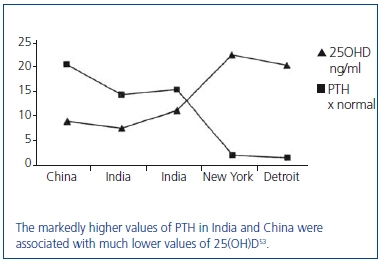
<body><![CDATA[<p><font face="Verdana" size="2">In a recent review of primary hyperparathyroidism, the average weight of the removed adenoma was 400 to 600 mg, values which are only three to four times greater than the combined weight of four normal parathyroid glands<sup>52</sup>. In contrast, the mean weight of the removed parathyroid adenomas in the Albright study from 1934 was approximately 11 grams<sup>32</sup>. In 1947, Norris reviewed 322 cases from the existing world literature and reported that the average weight of a removed parathyroid adenoma was 8 grams<sup>48</sup>. In 1963, Hodgkinson reported that the mean weight of the removed adenoma was 5.1 grams in patients with bone disease and 1.4 grams in patients with stone disease<sup>49</sup>. Similar differences in the weight of parathyroid adenomas between patients with bone and those with stone disease were reported by Lloyd in his analysis of Dent's patients<sup>38</sup> and by O'Riordan<sup>51</sup>. The mean weight of the parathyroid adenoma in patients with bone disease was 5.9 grams in the former and 4.2 grams in the latter series.</font></p>     <p><font face="Verdana" size="2">In areas of the world with limited access to medical care, vitamin D insufficiency/deficiency appears to be more common and the duration of primary hyperparathyroidism much longer before diagnosis and treatment. In recent studies of primary hyperparathyroidism from India and China, the presence of large parathyroid adenomas and bone disease has been associated with vitamin D insufficiency/deficiency (<a href="#f7">figure 7</a>)<sup>53-</sup><sup>57</sup>. In a study from China, the presenting PTH value was 21 times greater than normal<sup>55</sup>. Similarly, in a study from India, the mean weight of the removed parathyroid adenoma was 10.75 g in hypercalcemic patients and 3.9 g in normocalcemic patients<sup>54</sup>. In another study from India, the mean weight of the removed parathyroid adenoma was 7.9 g<sup>56</sup>. Moreover, the 25(OH)D value was less than 10 ng/ml in the majority of these patients. In the cited studies, pathologic bone fractures, bone cysts, and brown tumors were commonly encountered<sup>54-</sup><sup>56</sup>. In summary, the severe form of primary hyperparathyroidism characterized by large adenomas and disabling bone disease, first described by Albright in the 1930s, is still commonly encountered in areas of the world with limited access to medical care. Furthermore, the severe form of primary hyperparathyroidism seen in these patients is often associated with vitamin D insufficiency/deficiency.</font></p>     <p>&nbsp;</p>     <p align="center"><font face="Verdana" size="2"><a name="f7"><img src="/img/revistas/nefrologia/v31n3/historia_figure7.jpg"></a>    <br><b>Figure 7.</b> A global view of vitamin D levels and the magnitude    <br> of hyperparathyroidism as determined by the elevation in PTH.</font></p>     <p>&nbsp;</p>     <p><font face="Verdana" size="2"><b>Vignettes in which observations by Albright  have had continued clinical relevance</b></font></p>     <p><font face="Verdana" size="2"><b>1937. Prelude to the "Trade-Off Hypothesis" of  slatopolsky and bricker<sup>10,58</sup> which was advanced to explain the development of  secondary hyperparathyroidism</b></font></p>     <p><font face="Verdana" size="2">Albright made the following statement in a 1937 publication<sup>59</sup>: "It has been suggested above that the parathyroid hyperplasia is a compensation for the disturbed equilibrium occasioned by phosphate retention resulting from the renal insufficiency. In the absence of the hyperplasia there would probably be greater phosphate retention in the blood with a lowering of the blood calcium level and severe tetany. If these concepts are correct, the hyperplasia would have to be considered beneficial. The one reservation might have to be made that, while helping homeostasis, the parathyroid hyperplasia may lead to bone disease". Confirmation of the Albright hypothesis has been shown in many animal and clinical studies of phosphate loading. Also in studies of patients with stage 3 and 4 CKD treated with the calcimimetic, cinacalcet, the reduction in PTH values has increased the serum phosphorus concentration<sup>60</sup>.</font></p>     ]]></body>
<body><![CDATA[<p><font face="Verdana" size="2"><b>1941. Hypothesis that Hypercalcemia in malignancy could be from  ectopic hormone production</b></font></p>     <p><font face="Verdana" size="2">At a clinicopathological conference, a 51 year old male presenting with hypercalcemia and hypophosphatemia was discussed<sup>61</sup>. A neck exploration for presumed hyperparathyroidism was performed, but no abnormality was found. Bone x-rays showed a destructive lesion in the right ilium, which on biopsy was reported to originate from a renal cell carcinoma. The comment of Albright at the end of the conference was "Why a person should have high serum calcium and low serum phosphorus when the cause of the disturbance is a tumor destroying bone is an interesting theoretical question. We treated this case by radiation of the tumor masses; the serum calcium went down to normal, and the serum phosphorus went up to normal. Gradually, both values became abnormal again. I suspected that the tumor might be producing parathyroid hormone. I therefore had it assayed by Dr. J. B. Collip, but no hormone was found". In essence, Albright was the first to suggest the possibility of ectopic hormone production by a tumor. Today we know the causal agent responsible for the hypercalcemia and hypophosphatemia to be PTH-related protein and not PTH.</font></p>     <p><font face="Verdana" size="2"><b>1941. Pseudohypoparathyroidism in vitamin D  deficiency</b></font></p>     <p><font face="Verdana" size="2">A year before Albright reported the clinical entity of pseudohypoparathyroidism in which there was a failure to respond to PTE in patients with characteristic body features<sup>18</sup>, he recognized a subset of patients with vitamin D deficiency in whom the serum calcium was low and the serum phosphorus was normal. Albright logically but incorrectly thought that the problem was because the necessary compensatory increase in parathyroid function had not taken place<sup>62</sup>. Subsequently, there continued to be reports of patients with vitamin D deficiency in whom hypocalcemia was accompanied by normal or even high serum phosphorus values<sup>40</sup><sup>,</sup><sup>63-</sup><sup>65</sup>. In 1985, Rao et al established that the hypocalcemia associated with vitamin D depletion can impair the phosphaturic response to PTH despite an appropriately increased nephrogenous cyclic AMP response<sup>66</sup>. Correction of hypocalcemia with vitamin D and calcium treatment restored the phosphaturic response to PTH despite a reduction in nephrogenous cyclic AMP. Thus, these patients had an acquired form of pseudohypoparathyroidism type II, which was subsequently shown to be from a postreceptor G protein defect<sup>67</sup>. In the opinion of the authors, another possibility which should be evaluated is that the vitamin D deficiency and the hypocalcemia combine to impair FGF23 production<sup>22-25</sup>.</font></p>     <p><font face="Verdana" size="2"><b>1941. Immobilization and Hypercalcemia</b></font></p>     <p><font face="Verdana" size="2">Albright reported the case of a 14 year old boy who in an athletic injury, fractured his right femur at the site of a bone cyst<sup>68</sup>. After an open reduction, the boy was placed in a spica cast immobilizing him from the waist down. Shortly thereafter anorexia and vomiting developed. Because the presence of the bone cyst raised the possibility of primary hyperparathyroidism, serum calcium was measured and found to be 14.6 mg/dl with a serum phosphorus of 4.5 mg/dl. Mild renal insufficiency also developed. Because of the persistent hypercalcemia, the boy underwent a parathyroid exploration at which only normal parathyroid glands were identified. Six weeks later because of persistent hypercalemia, the anterior mediastinum was explored but no parathyroid tissue was identified. Once the patient was mobilized, the serum calcium decreased to normal values. Albright concluded that the sequence of events was: <i>a)</i> solitary bone cyst; <i>b)</i> fracture through cyst; <i>c)</i> immobilization of a large part of a previously active skeleton; <i>d)</i> osteoporosis from disuse with an excess of calcium from bone being presented to the kidney; <i>e)</i> an inability of the kidney to excrete promptly all the calcium; <i>f)</i> resulting in hypercalcemia; and <i>g)</i> kidney damage from excess of calcium being excreted through the kidney. Albright further added that once renal insufficiency developed, it probably increased the tendency to hypercalcemia. From this case, Albright learned that immobilization of an individual with active skeletal remodeling increases calcium efflux from bone and he also recognized that a decreased glomerular filtration rate reduces the capacity to excrete calcium, which in turn, exacerbates hypercalcemia.</font></p>     <p>&nbsp;</p>     <p><font face="Verdana" size="2"><b>Conclusion</b></font></p>     <p><font face="Verdana" size="2">In the late 1920s, Albright joined Joseph Aub and Walter Bauer to pursue studies of calcium and phosphorus metabolism. First Aub and then Bauer were appointed to academic positions in other subspecialties at Harvard, which by 1930 left the young Albright as the primary investigator of calcium and phosphorus metabolism in Boston. Through inductive reasoning, which has been defined by the late Jacob Bronowski as that unpredictable blend of speculation and insight, Albright came to recognize in normal volunteers and in hypo- and hyperparathyroid patients, the presence of consistent patterns of response for calcium and phosphorus metabolism. Fuller Albright was truly the first person to establish a sense of order out of the existing chaos in the new field of calcium and phosphorus metabolism. As one of the 20<sup>th</sup> century's preeminent philosophers of science, Karl Popper has stated, "Science does not rest upon rock-bottom. The bold structure of its theories rises, as it were, above a swamp, but not down to any natural or given base; and when we cease our attempts to drive our piles into a deeper layer, it is not because we have reached firm ground. We simply stop when we are satisfied that they are firm enough to carry the structure, at least for the time being". Albright was the first to establish a functional system which explained calcium and phosphorus metabolism. His classic book, <i>The Parathyroid Glands and Metabolic Bone Disease</i>, published in 1948, became the standard reference for a generation of students of calcium and phosphorus metabolism. Albright trained many future investigators and became an inspiration for the next generation of clinical investigators studying calcium and phosphorus disorders. As the importance of translational research is again rightfully being emphasized, the contributions of Fuller Albright should be recognized and he should be celebrated as a role model for a new generation of young clinical investigators.</font></p>     <p>&nbsp;</p>     ]]></body>
<body><![CDATA[<p><font face="Verdana" size="2"><b>Referencias Bibliográficas</b></font></p>     <!-- ref --><p><font face="Verdana" size="2">1. Kleeman CR, Levine BS, Felsenfeld AJ. Fuller, Albright, the consummate clinical investigator. Clin J Am Soc Nephrol 2009;4:1541-6.    &nbsp;&nbsp;&nbsp;&nbsp;&nbsp;&nbsp;&nbsp;&nbsp;[&#160;<a href="javascript:void(0);" onclick="javascript: window.open('/scielo.php?script=sci_nlinks&ref=3196661&pid=S0211-6995201100030001500001&lng=','','width=640,height=500,resizable=yes,scrollbars=1,menubar=yes,');">Links</a>&#160;]<!-- end-ref --></font></p>    <!-- ref --><p><font face="Verdana" size="2">2. Albright F, Reifenstein EC, Jr. The parathyroid glands and metabolic bone disease, selected studies. Baltimore, MD: The Williams and Wilkins Company; 1948.    &nbsp;&nbsp;&nbsp;&nbsp;&nbsp;&nbsp;&nbsp;&nbsp;[&#160;<a href="javascript:void(0);" onclick="javascript: window.open('/scielo.php?script=sci_nlinks&ref=3196663&pid=S0211-6995201100030001500002&lng=','','width=640,height=500,resizable=yes,scrollbars=1,menubar=yes,');">Links</a>&#160;]<!-- end-ref --></font></p>    <!-- ref --><p><font face="Verdana" size="2">3. Levine BS, Kleeman CR, Felsenfeld AJ. The journey from vitamin D-resistant rickets to the regulation of renal phosphate transport. Clin J Am Soc Nephrol 2009;4:1866-77.    &nbsp;&nbsp;&nbsp;&nbsp;&nbsp;&nbsp;&nbsp;&nbsp;[&#160;<a href="javascript:void(0);" onclick="javascript: window.open('/scielo.php?script=sci_nlinks&ref=3196665&pid=S0211-6995201100030001500003&lng=','','width=640,height=500,resizable=yes,scrollbars=1,menubar=yes,');">Links</a>&#160;]<!-- end-ref --></font></p>    <!-- ref --><p><font face="Verdana" size="2">4. Means JH. Ward 4 Cambridge: Harvard University Press; 1958:101.    &nbsp;&nbsp;&nbsp;&nbsp;&nbsp;&nbsp;&nbsp;&nbsp;[&#160;<a href="javascript:void(0);" onclick="javascript: window.open('/scielo.php?script=sci_nlinks&ref=3196667&pid=S0211-6995201100030001500004&lng=','','width=640,height=500,resizable=yes,scrollbars=1,menubar=yes,');">Links</a>&#160;]<!-- end-ref --></font></p>    <!-- ref --><p><font face="Verdana" size="2">5. Albright F, Ellsworth R. Studies on the physiology of the parathyroid glands. I. Calcium and phosphorus studies on a case of idiopathic hypoparathyroidism. J Clin Invest 1929;7:183-201.    &nbsp;&nbsp;&nbsp;&nbsp;&nbsp;&nbsp;&nbsp;&nbsp;[&#160;<a href="javascript:void(0);" onclick="javascript: window.open('/scielo.php?script=sci_nlinks&ref=3196669&pid=S0211-6995201100030001500005&lng=','','width=640,height=500,resizable=yes,scrollbars=1,menubar=yes,');">Links</a>&#160;]<!-- end-ref --></font></p>    <!-- ref --><p><font face="Verdana" size="2">6. Albright F, Bauer W, Ropes M, Aub JC. Studies of calcium and phosphorus metabolism. IV. The effect of the parathyroid hormone. J Clin Invest 1929;7:139-81.    &nbsp;&nbsp;&nbsp;&nbsp;&nbsp;&nbsp;&nbsp;&nbsp;[&#160;<a href="javascript:void(0);" onclick="javascript: window.open('/scielo.php?script=sci_nlinks&ref=3196671&pid=S0211-6995201100030001500006&lng=','','width=640,height=500,resizable=yes,scrollbars=1,menubar=yes,');">Links</a>&#160;]<!-- end-ref --></font></p>    <!-- ref --><p><font face="Verdana" size="2">7. Albright F, Bauer W. The action of sodium chloride, ammonium chloride, and sodium bicarbonate on the total acid-base balance of a case of chronic nephritis with edema. J Clin Invest 1929;7:465-86.    &nbsp;&nbsp;&nbsp;&nbsp;&nbsp;&nbsp;&nbsp;&nbsp;[&#160;<a href="javascript:void(0);" onclick="javascript: window.open('/scielo.php?script=sci_nlinks&ref=3196673&pid=S0211-6995201100030001500007&lng=','','width=640,height=500,resizable=yes,scrollbars=1,menubar=yes,');">Links</a>&#160;]<!-- end-ref --></font></p>    <!-- ref --><p><font face="Verdana" size="2">8. Raisz LG, Niemann I. Effect of phosphate, calcium, and magnesium on bone resorption and hormonal responses in tissue culture. Endocrinology 1969;85:446-52.    &nbsp;&nbsp;&nbsp;&nbsp;&nbsp;&nbsp;&nbsp;&nbsp;[&#160;<a href="javascript:void(0);" onclick="javascript: window.open('/scielo.php?script=sci_nlinks&ref=3196675&pid=S0211-6995201100030001500008&lng=','','width=640,height=500,resizable=yes,scrollbars=1,menubar=yes,');">Links</a>&#160;]<!-- end-ref --></font></p>    <!-- ref --><p><font face="Verdana" size="2">9. Coburn JW, Massry SG. Changes in serum and urinary calcium during phosphate depletion: studies on mechanism. J Clin Invest 1970;49:1073-87.    &nbsp;&nbsp;&nbsp;&nbsp;&nbsp;&nbsp;&nbsp;&nbsp;[&#160;<a href="javascript:void(0);" onclick="javascript: window.open('/scielo.php?script=sci_nlinks&ref=3196677&pid=S0211-6995201100030001500009&lng=','','width=640,height=500,resizable=yes,scrollbars=1,menubar=yes,');">Links</a>&#160;]<!-- end-ref --></font></p>    <!-- ref --><p><font face="Verdana" size="2">10. Slatopolsky E, Caglar S, Pennell JP, et al. On the pathogenesis of hyperparathyroidism in chronic experimental renal insuffficiency in the dog. J Clin Invest 1971;50:492-99.    &nbsp;&nbsp;&nbsp;&nbsp;&nbsp;&nbsp;&nbsp;&nbsp;[&#160;<a href="javascript:void(0);" onclick="javascript: window.open('/scielo.php?script=sci_nlinks&ref=3196679&pid=S0211-6995201100030001500010&lng=','','width=640,height=500,resizable=yes,scrollbars=1,menubar=yes,');">Links</a>&#160;]<!-- end-ref --></font></p>    <!-- ref --><p><font face="Verdana" size="2">11. Rodríguez M, Martín Malo A, Martínez ME, Torres A, Felsenfeld AJ, Llach F. Calcemic response to parathyroid hormone in renal failure: role of phosphorus and its effect on calcitriol. Kidney Int 1991;40:1055-62.    &nbsp;&nbsp;&nbsp;&nbsp;&nbsp;&nbsp;&nbsp;&nbsp;[&#160;<a href="javascript:void(0);" onclick="javascript: window.open('/scielo.php?script=sci_nlinks&ref=3196681&pid=S0211-6995201100030001500011&lng=','','width=640,height=500,resizable=yes,scrollbars=1,menubar=yes,');">Links</a>&#160;]<!-- end-ref --></font></p>    <!-- ref --><p><font face="Verdana" size="2">12. Krapf R, Glatz M, Hulter HN. Neutral phosphate administration generates and maintains renal metabolic alkalosis and hyperparathyroidism. Am J Physiol 1995;268:F802-7.    &nbsp;&nbsp;&nbsp;&nbsp;&nbsp;&nbsp;&nbsp;&nbsp;[&#160;<a href="javascript:void(0);" onclick="javascript: window.open('/scielo.php?script=sci_nlinks&ref=3196683&pid=S0211-6995201100030001500012&lng=','','width=640,height=500,resizable=yes,scrollbars=1,menubar=yes,');">Links</a>&#160;]<!-- end-ref --></font></p>    <!-- ref --><p><font face="Verdana" size="2">13. Kleeman CR, Bernstein D, Rockney R, Dowling JT, Maxwell MH. Studies on the renal clearance of diffusible calcium and the role of the parathyroid glands in its regulation. Yale J Biol Med 1961;34:1-30.    &nbsp;&nbsp;&nbsp;&nbsp;&nbsp;&nbsp;&nbsp;&nbsp;[&#160;<a href="javascript:void(0);" onclick="javascript: window.open('/scielo.php?script=sci_nlinks&ref=3196685&pid=S0211-6995201100030001500013&lng=','','width=640,height=500,resizable=yes,scrollbars=1,menubar=yes,');">Links</a>&#160;]<!-- end-ref --></font></p>    <!-- ref --><p><font face="Verdana" size="2">14. Peacock M, Robertson WG, Nordin BEC. Relation between serum and urinary calcium with particular reference to parathyroid activity. Lancet 1969;1:384-6.    &nbsp;&nbsp;&nbsp;&nbsp;&nbsp;&nbsp;&nbsp;&nbsp;[&#160;<a href="javascript:void(0);" onclick="javascript: window.open('/scielo.php?script=sci_nlinks&ref=3196687&pid=S0211-6995201100030001500014&lng=','','width=640,height=500,resizable=yes,scrollbars=1,menubar=yes,');">Links</a>&#160;]<!-- end-ref --></font></p>    <!-- ref --><p><font face="Verdana" size="2">15. Yamamoto M, Kawanobe Y, Takahashi H, Shimazawa E, Kimura S, Ogata E. Vitamin D deficiency and renal calcium transport in the rat. J Clin Invest 1984;74:507-13.    &nbsp;&nbsp;&nbsp;&nbsp;&nbsp;&nbsp;&nbsp;&nbsp;[&#160;<a href="javascript:void(0);" onclick="javascript: window.open('/scielo.php?script=sci_nlinks&ref=3196689&pid=S0211-6995201100030001500015&lng=','','width=640,height=500,resizable=yes,scrollbars=1,menubar=yes,');">Links</a>&#160;]<!-- end-ref --></font></p>    <!-- ref --><p><font face="Verdana" size="2">16. Hoenderop JGJ, Muller D, Van der Kemp AWCM, et al. Calcitriol controls the epithelial calcium channel in kidney. J Am Soc Nephrol 2001;12:1342-9.    &nbsp;&nbsp;&nbsp;&nbsp;&nbsp;&nbsp;&nbsp;&nbsp;[&#160;<a href="javascript:void(0);" onclick="javascript: window.open('/scielo.php?script=sci_nlinks&ref=3196691&pid=S0211-6995201100030001500016&lng=','','width=640,height=500,resizable=yes,scrollbars=1,menubar=yes,');">Links</a>&#160;]<!-- end-ref --></font></p>    <!-- ref --><p><font face="Verdana" size="2">17. Albright F, Bloomberg E, Drake T, Sulkowitch HW. A comparison of the effects of AT10 (dihydrotachysterol) and vitamin D on calcium and phosphorus metabolism in hypoparathyroidism. J Clin Invest 1938;17:317-29.    &nbsp;&nbsp;&nbsp;&nbsp;&nbsp;&nbsp;&nbsp;&nbsp;[&#160;<a href="javascript:void(0);" onclick="javascript: window.open('/scielo.php?script=sci_nlinks&ref=3196693&pid=S0211-6995201100030001500017&lng=','','width=640,height=500,resizable=yes,scrollbars=1,menubar=yes,');">Links</a>&#160;]<!-- end-ref --></font></p>    <!-- ref --><p><font face="Verdana" size="2">18. Albright F, Burnett CH, Smith PH, Parson W. Pseudo-hypoparathyroidism - An example of Seabright-Bantam syndrome. Endocrinology 1942;30:922-32.    &nbsp;&nbsp;&nbsp;&nbsp;&nbsp;&nbsp;&nbsp;&nbsp;[&#160;<a href="javascript:void(0);" onclick="javascript: window.open('/scielo.php?script=sci_nlinks&ref=3196695&pid=S0211-6995201100030001500018&lng=','','width=640,height=500,resizable=yes,scrollbars=1,menubar=yes,');">Links</a>&#160;]<!-- end-ref --></font></p>    <!-- ref --><p><font face="Verdana" size="2">19. Bauer W, Marble A, Claflin D. Studies on the mode of action of irradiated ergosterol IV. In hypoparathyroidism. J Clin Invest 1932;11:47-62.    &nbsp;&nbsp;&nbsp;&nbsp;&nbsp;&nbsp;&nbsp;&nbsp;[&#160;<a href="javascript:void(0);" onclick="javascript: window.open('/scielo.php?script=sci_nlinks&ref=3196697&pid=S0211-6995201100030001500019&lng=','','width=640,height=500,resizable=yes,scrollbars=1,menubar=yes,');">Links</a>&#160;]<!-- end-ref --></font></p>    <!-- ref --><p><font face="Verdana" size="2">20. Howland J, Kramer B. Calcium and phosphorus in the serum in relation to rickets. Am J Dis Child 1921;22:105-19.    &nbsp;&nbsp;&nbsp;&nbsp;&nbsp;&nbsp;&nbsp;&nbsp;[&#160;<a href="javascript:void(0);" onclick="javascript: window.open('/scielo.php?script=sci_nlinks&ref=3196699&pid=S0211-6995201100030001500020&lng=','','width=640,height=500,resizable=yes,scrollbars=1,menubar=yes,');">Links</a>&#160;]<!-- end-ref --></font></p>    <!-- ref --><p><font face="Verdana" size="2">21. Eisenberg E. Effects of serum calcium and parathyroid extracts on phosphate and calcium excretion in hypoparathyroid patients. J Clin Invest 1965;44:942-6.    &nbsp;&nbsp;&nbsp;&nbsp;&nbsp;&nbsp;&nbsp;&nbsp;[&#160;<a href="javascript:void(0);" onclick="javascript: window.open('/scielo.php?script=sci_nlinks&ref=3196701&pid=S0211-6995201100030001500021&lng=','','width=640,height=500,resizable=yes,scrollbars=1,menubar=yes,');">Links</a>&#160;]<!-- end-ref --></font></p>    <!-- ref --><p><font face="Verdana" size="2">22. Shimada T, Yamazaki Y, Takahashi M, et al. Vitamin D receptor-independent FGF23 actions in regulating phosphate and vitamin D metabolism. Am J Physiol Renal Physiol 2005;289:F1088-95.    &nbsp;&nbsp;&nbsp;&nbsp;&nbsp;&nbsp;&nbsp;&nbsp;[&#160;<a href="javascript:void(0);" onclick="javascript: window.open('/scielo.php?script=sci_nlinks&ref=3196703&pid=S0211-6995201100030001500022&lng=','','width=640,height=500,resizable=yes,scrollbars=1,menubar=yes,');">Links</a>&#160;]<!-- end-ref --></font></p>    <!-- ref --><p><font face="Verdana" size="2">23. Yamashita H, Yamashita T, Miyamoto M, et al. Fibroblast growth factor (FGF)-23 in patients with primary hyperparathyroidism. Eur J Endocrinol 2004;151:55-60.    &nbsp;&nbsp;&nbsp;&nbsp;&nbsp;&nbsp;&nbsp;&nbsp;[&#160;<a href="javascript:void(0);" onclick="javascript: window.open('/scielo.php?script=sci_nlinks&ref=3196705&pid=S0211-6995201100030001500023&lng=','','width=640,height=500,resizable=yes,scrollbars=1,menubar=yes,');">Links</a>&#160;]<!-- end-ref --></font></p>    <!-- ref --><p><font face="Verdana" size="2">24. Kobayashi K, Imanishi Y, Miyauchi A, et al. Regulation of plasma fibroblast growth factor 23 by calcium in primary hyperparathyroidism. Eur J Endocrinol 2006;154:93-9.    &nbsp;&nbsp;&nbsp;&nbsp;&nbsp;&nbsp;&nbsp;&nbsp;[&#160;<a href="javascript:void(0);" onclick="javascript: window.open('/scielo.php?script=sci_nlinks&ref=3196707&pid=S0211-6995201100030001500024&lng=','','width=640,height=500,resizable=yes,scrollbars=1,menubar=yes,');">Links</a>&#160;]<!-- end-ref --></font></p>    <!-- ref --><p><font face="Verdana" size="2">25. Kawata T, Imanishi Y, Kobayashi K, et al. Parathyroid hormone regulates fibroblast growth factor-23 in a mouse model of primary hyperparathyroidism. J Am Soc Nephrol 2007;18:2683-8.    &nbsp;&nbsp;&nbsp;&nbsp;&nbsp;&nbsp;&nbsp;&nbsp;[&#160;<a href="javascript:void(0);" onclick="javascript: window.open('/scielo.php?script=sci_nlinks&ref=3196709&pid=S0211-6995201100030001500025&lng=','','width=640,height=500,resizable=yes,scrollbars=1,menubar=yes,');">Links</a>&#160;]<!-- end-ref --></font></p>    <!-- ref --><p><font face="Verdana" size="2">26. Bauer W, Albright F, Aub JC. A case of osteitis fibrosa cystica (osteomalacia?) with evidence of hyperactivity of the parathyroid bodies. Metabolic study II. J Clin Invest 1930;8:229-48.    &nbsp;&nbsp;&nbsp;&nbsp;&nbsp;&nbsp;&nbsp;&nbsp;[&#160;<a href="javascript:void(0);" onclick="javascript: window.open('/scielo.php?script=sci_nlinks&ref=3196711&pid=S0211-6995201100030001500026&lng=','','width=640,height=500,resizable=yes,scrollbars=1,menubar=yes,');">Links</a>&#160;]<!-- end-ref --></font></p>    <!-- ref --><p><font face="Verdana" size="2">27. Bauer W, Federman DD. Hyperparathyroidism epitomized: the case of Captain Charles E. Martell. Metabolism 1962;11:21-9.    &nbsp;&nbsp;&nbsp;&nbsp;&nbsp;&nbsp;&nbsp;&nbsp;[&#160;<a href="javascript:void(0);" onclick="javascript: window.open('/scielo.php?script=sci_nlinks&ref=3196713&pid=S0211-6995201100030001500027&lng=','','width=640,height=500,resizable=yes,scrollbars=1,menubar=yes,');">Links</a>&#160;]<!-- end-ref --></font></p>    <!-- ref --><p><font face="Verdana" size="2">28. Albright F, Bauer W, Claflin D, Cockrill JR. Studies in parathyroid physiology III. The effect of phosphate ingestion in clinical hyperparathyroidism. J Clin Invest 1932;11:411-35.    &nbsp;&nbsp;&nbsp;&nbsp;&nbsp;&nbsp;&nbsp;&nbsp;[&#160;<a href="javascript:void(0);" onclick="javascript: window.open('/scielo.php?script=sci_nlinks&ref=3196715&pid=S0211-6995201100030001500028&lng=','','width=640,height=500,resizable=yes,scrollbars=1,menubar=yes,');">Links</a>&#160;]<!-- end-ref --></font></p>    <!-- ref --><p><font face="Verdana" size="2">29. Block GA, Hulbert-Shearon TE, Levin NW, Port FK. Association of serum phosphorus and calcium x phosphate product with mortality risk in chronic hemodialysis patients: A national study. Am J Kidney Dis 1998;31:607-17.    &nbsp;&nbsp;&nbsp;&nbsp;&nbsp;&nbsp;&nbsp;&nbsp;[&#160;<a href="javascript:void(0);" onclick="javascript: window.open('/scielo.php?script=sci_nlinks&ref=3196717&pid=S0211-6995201100030001500029&lng=','','width=640,height=500,resizable=yes,scrollbars=1,menubar=yes,');">Links</a>&#160;]<!-- end-ref --></font></p>    <!-- ref --><p><font face="Verdana" size="2">30. Foley RN, Collins AJ, Herzog CA, Ishani A, Kalra PA. Serum phosphorus levels associate with coronary atherosclerosis in young adults. J Am Soc Nephrol 2009;20:397-404.    &nbsp;&nbsp;&nbsp;&nbsp;&nbsp;&nbsp;&nbsp;&nbsp;[&#160;<a href="javascript:void(0);" onclick="javascript: window.open('/scielo.php?script=sci_nlinks&ref=3196719&pid=S0211-6995201100030001500030&lng=','','width=640,height=500,resizable=yes,scrollbars=1,menubar=yes,');">Links</a>&#160;]<!-- end-ref --></font></p>    <!-- ref --><p><font face="Verdana" size="2">31. Albright F, Baird PC, Cope O, Bloomberg E. Studies on the physiology of the parathyroid glands. IV. Renal complications of hyperparathyroidism. Am J Med Sci 1934;187:49-65.    &nbsp;&nbsp;&nbsp;&nbsp;&nbsp;&nbsp;&nbsp;&nbsp;[&#160;<a href="javascript:void(0);" onclick="javascript: window.open('/scielo.php?script=sci_nlinks&ref=3196721&pid=S0211-6995201100030001500031&lng=','','width=640,height=500,resizable=yes,scrollbars=1,menubar=yes,');">Links</a>&#160;]<!-- end-ref --></font></p>    <!-- ref --><p><font face="Verdana" size="2">32. Albright F, Aub JC, Bauer W. Hyperparathyroidism: a common and polymorphic condition as illustrated by seventeen proved cases from one clinic. JAMA 1934;102:1276-87.    &nbsp;&nbsp;&nbsp;&nbsp;&nbsp;&nbsp;&nbsp;&nbsp;[&#160;<a href="javascript:void(0);" onclick="javascript: window.open('/scielo.php?script=sci_nlinks&ref=3196723&pid=S0211-6995201100030001500032&lng=','','width=640,height=500,resizable=yes,scrollbars=1,menubar=yes,');">Links</a>&#160;]<!-- end-ref --></font></p>    <!-- ref --><p><font face="Verdana" size="2">33. Albright F, Sulkowitch HW, Bloomberg E. Hyperparathyroidism due to idiopathic hypertrophy (hyperplasia?) of parathyroid tissue. Arch Intern Med 1938;62:199-215.    &nbsp;&nbsp;&nbsp;&nbsp;&nbsp;&nbsp;&nbsp;&nbsp;[&#160;<a href="javascript:void(0);" onclick="javascript: window.open('/scielo.php?script=sci_nlinks&ref=3196725&pid=S0211-6995201100030001500033&lng=','','width=640,height=500,resizable=yes,scrollbars=1,menubar=yes,');">Links</a>&#160;]<!-- end-ref --></font></p>    <!-- ref --><p><font face="Verdana" size="2">34. Churchill ED, Cope O. The surgical treatment of hyperparathyroidism. Ann Surg 1936;104:9-35.    &nbsp;&nbsp;&nbsp;&nbsp;&nbsp;&nbsp;&nbsp;&nbsp;[&#160;<a href="javascript:void(0);" onclick="javascript: window.open('/scielo.php?script=sci_nlinks&ref=3196727&pid=S0211-6995201100030001500034&lng=','','width=640,height=500,resizable=yes,scrollbars=1,menubar=yes,');">Links</a>&#160;]<!-- end-ref --></font></p>    <!-- ref --><p><font face="Verdana" size="2">35. Keating FR, Jr., Cook EN. The recognition of primary hyperparathyroidism. JAMA 1945;129:994-1002.    &nbsp;&nbsp;&nbsp;&nbsp;&nbsp;&nbsp;&nbsp;&nbsp;[&#160;<a href="javascript:void(0);" onclick="javascript: window.open('/scielo.php?script=sci_nlinks&ref=3196729&pid=S0211-6995201100030001500035&lng=','','width=640,height=500,resizable=yes,scrollbars=1,menubar=yes,');">Links</a>&#160;]<!-- end-ref --></font></p>    <!-- ref --><p><font face="Verdana" size="2">36. Davies DR, Dent CE, Willcox A. Hyperparathyroidism and steatorrhoea. Br Med J 1956;2:1133-7.    &nbsp;&nbsp;&nbsp;&nbsp;&nbsp;&nbsp;&nbsp;&nbsp;[&#160;<a href="javascript:void(0);" onclick="javascript: window.open('/scielo.php?script=sci_nlinks&ref=3196731&pid=S0211-6995201100030001500036&lng=','','width=640,height=500,resizable=yes,scrollbars=1,menubar=yes,');">Links</a>&#160;]<!-- end-ref --></font></p>    <!-- ref --><p><font face="Verdana" size="2">37. Dent CE, Hartland BV, Hicks J, Sykes ED. Calcium intake in patients with primary hyperparathyroidism. Lancet 1961;2:336-8.    &nbsp;&nbsp;&nbsp;&nbsp;&nbsp;&nbsp;&nbsp;&nbsp;[&#160;<a href="javascript:void(0);" onclick="javascript: window.open('/scielo.php?script=sci_nlinks&ref=3196733&pid=S0211-6995201100030001500037&lng=','','width=640,height=500,resizable=yes,scrollbars=1,menubar=yes,');">Links</a>&#160;]<!-- end-ref --></font></p>    <!-- ref --><p><font face="Verdana" size="2">38. Lloyd HM. Primary hyperparathyroidism: an analysis of the role of the parathyroid tumor. Medicine (Balt) 1968;47:53-71.    &nbsp;&nbsp;&nbsp;&nbsp;&nbsp;&nbsp;&nbsp;&nbsp;[&#160;<a href="javascript:void(0);" onclick="javascript: window.open('/scielo.php?script=sci_nlinks&ref=3196735&pid=S0211-6995201100030001500038&lng=','','width=640,height=500,resizable=yes,scrollbars=1,menubar=yes,');">Links</a>&#160;]<!-- end-ref --></font></p>    <!-- ref --><p><font face="Verdana" size="2">39. Woodhouse NJY, Doyle FH, Joplin GF. Vitamin-D deficiency and primary hyperparathyroidism. Lancet 1971;2:283-7.    &nbsp;&nbsp;&nbsp;&nbsp;&nbsp;&nbsp;&nbsp;&nbsp;[&#160;<a href="javascript:void(0);" onclick="javascript: window.open('/scielo.php?script=sci_nlinks&ref=3196737&pid=S0211-6995201100030001500039&lng=','','width=640,height=500,resizable=yes,scrollbars=1,menubar=yes,');">Links</a>&#160;]<!-- end-ref --></font></p>    <!-- ref --><p><font face="Verdana" size="2">40. Lumb GA, Stanbury SW. Parathyroid function in human vitamin D deficiency and vitamin D deficiency in primary hyperparathyroidism. Am J Med 1974;56:833-9.    &nbsp;&nbsp;&nbsp;&nbsp;&nbsp;&nbsp;&nbsp;&nbsp;[&#160;<a href="javascript:void(0);" onclick="javascript: window.open('/scielo.php?script=sci_nlinks&ref=3196739&pid=S0211-6995201100030001500040&lng=','','width=640,height=500,resizable=yes,scrollbars=1,menubar=yes,');">Links</a>&#160;]<!-- end-ref --></font></p>    <!-- ref --><p><font face="Verdana" size="2">41. Kleeman CR, Norris K, Coburn JW. Is the clinical expression of primary hyperparathyroidism a function of the long-term vitamin D status of the patients? Miner Electrolyte Metab 1987;13:305-10.    &nbsp;&nbsp;&nbsp;&nbsp;&nbsp;&nbsp;&nbsp;&nbsp;[&#160;<a href="javascript:void(0);" onclick="javascript: window.open('/scielo.php?script=sci_nlinks&ref=3196741&pid=S0211-6995201100030001500041&lng=','','width=640,height=500,resizable=yes,scrollbars=1,menubar=yes,');">Links</a>&#160;]<!-- end-ref --></font></p>    <!-- ref --><p><font face="Verdana" size="2">42. Patron P, Gardin JP, Paillard M. Renal mass and reserve of vitamin D: Determinants in primary hyperparathyroidism. Kidney Int 1987;31:1174-80.    &nbsp;&nbsp;&nbsp;&nbsp;&nbsp;&nbsp;&nbsp;&nbsp;[&#160;<a href="javascript:void(0);" onclick="javascript: window.open('/scielo.php?script=sci_nlinks&ref=3196743&pid=S0211-6995201100030001500042&lng=','','width=640,height=500,resizable=yes,scrollbars=1,menubar=yes,');">Links</a>&#160;]<!-- end-ref --></font></p>    <!-- ref --><p><font face="Verdana" size="2">43. Silverberg SJ, Shane E, Dempster DW, Bilezikian JP. The effects of vitamin D insufficiency in patients with primary hyperparathyroidism. Am J Med 1999;107:561-7.    &nbsp;&nbsp;&nbsp;&nbsp;&nbsp;&nbsp;&nbsp;&nbsp;[&#160;<a href="javascript:void(0);" onclick="javascript: window.open('/scielo.php?script=sci_nlinks&ref=3196745&pid=S0211-6995201100030001500043&lng=','','width=640,height=500,resizable=yes,scrollbars=1,menubar=yes,');">Links</a>&#160;]<!-- end-ref --></font></p>    <!-- ref --><p><font face="Verdana" size="2">44. Rao DS, Honasoge M, Divine GW, et al. Effect of vitamin D nutrition on parathyroid adenoma weight: Pathogenetic and clinical implications. J Clin Endocrinol Metab 2000;85:1054-8.    &nbsp;&nbsp;&nbsp;&nbsp;&nbsp;&nbsp;&nbsp;&nbsp;[&#160;<a href="javascript:void(0);" onclick="javascript: window.open('/scielo.php?script=sci_nlinks&ref=3196747&pid=S0211-6995201100030001500044&lng=','','width=640,height=500,resizable=yes,scrollbars=1,menubar=yes,');">Links</a>&#160;]<!-- end-ref --></font></p>    <!-- ref --><p><font face="Verdana" size="2">45. Segersten U, Correa P, Hewison M, et al. 25-Hydroxyvitamin D3-1a-hydroxylase expression in normal and pathological parathyroid glands. Nephrol Dial Transplant 2002;87:2967-72.    &nbsp;&nbsp;&nbsp;&nbsp;&nbsp;&nbsp;&nbsp;&nbsp;[&#160;<a href="javascript:void(0);" onclick="javascript: window.open('/scielo.php?script=sci_nlinks&ref=3196749&pid=S0211-6995201100030001500045&lng=','','width=640,height=500,resizable=yes,scrollbars=1,menubar=yes,');">Links</a>&#160;]<!-- end-ref --></font></p>    <!-- ref --><p><font face="Verdana" size="2">46. Ritter CS, Armbrecht HJ, Slatopolsky E, Brown AJ. 25-Hydroxyvitamin D3 suppresses PTH synthesis and secretion by bovine parathyroid cells. Kidney Int 2006;70:654-9.    &nbsp;&nbsp;&nbsp;&nbsp;&nbsp;&nbsp;&nbsp;&nbsp;[&#160;<a href="javascript:void(0);" onclick="javascript: window.open('/scielo.php?script=sci_nlinks&ref=3196751&pid=S0211-6995201100030001500046&lng=','','width=640,height=500,resizable=yes,scrollbars=1,menubar=yes,');">Links</a>&#160;]<!-- end-ref --></font></p>    <!-- ref --><p><font face="Verdana" size="2">47. Clements MR, Davies M, Fraser DR, Lumb GA, Mawer EB, Adams PH. Metabolic inactivation of vitamin D is enhanced in primary hyperparathyroidism. Clin Sci 1987;73:659-64.    &nbsp;&nbsp;&nbsp;&nbsp;&nbsp;&nbsp;&nbsp;&nbsp;[&#160;<a href="javascript:void(0);" onclick="javascript: window.open('/scielo.php?script=sci_nlinks&ref=3196753&pid=S0211-6995201100030001500047&lng=','','width=640,height=500,resizable=yes,scrollbars=1,menubar=yes,');">Links</a>&#160;]<!-- end-ref --></font></p>    <!-- ref --><p><font face="Verdana" size="2">48. Norris EH. The parathyroid adenoma-a study of 322 cases. Int Abstr Surg 1947;84:1-41.    &nbsp;&nbsp;&nbsp;&nbsp;&nbsp;&nbsp;&nbsp;&nbsp;[&#160;<a href="javascript:void(0);" onclick="javascript: window.open('/scielo.php?script=sci_nlinks&ref=3196755&pid=S0211-6995201100030001500048&lng=','','width=640,height=500,resizable=yes,scrollbars=1,menubar=yes,');">Links</a>&#160;]<!-- end-ref --></font></p>    <!-- ref --><p><font face="Verdana" size="2">49. Hodgkinson A. Biochemical aspects of primary hyperparathyroidism: an analysis of 50 cases. Clin Sci 1963;25:231-42.    &nbsp;&nbsp;&nbsp;&nbsp;&nbsp;&nbsp;&nbsp;&nbsp;[&#160;<a href="javascript:void(0);" onclick="javascript: window.open('/scielo.php?script=sci_nlinks&ref=3196757&pid=S0211-6995201100030001500049&lng=','','width=640,height=500,resizable=yes,scrollbars=1,menubar=yes,');">Links</a>&#160;]<!-- end-ref --></font></p>    <!-- ref --><p><font face="Verdana" size="2">50. Cope O. The story of hyperparathyroidism at the Massachusetts General Hospital. N Engl J Med 1966;274:1174-82.    &nbsp;&nbsp;&nbsp;&nbsp;&nbsp;&nbsp;&nbsp;&nbsp;[&#160;<a href="javascript:void(0);" onclick="javascript: window.open('/scielo.php?script=sci_nlinks&ref=3196759&pid=S0211-6995201100030001500050&lng=','','width=640,height=500,resizable=yes,scrollbars=1,menubar=yes,');">Links</a>&#160;]<!-- end-ref --></font></p>    <!-- ref --><p><font face="Verdana" size="2">51. O'Riordan JLH, Watson L, Woodhead JS. Secretion of parathyroid hormone in primary hyperparathyroidism. Clin Endocrinol (Oxf ) 1972;1:149-55.    &nbsp;&nbsp;&nbsp;&nbsp;&nbsp;&nbsp;&nbsp;&nbsp;[&#160;<a href="javascript:void(0);" onclick="javascript: window.open('/scielo.php?script=sci_nlinks&ref=3196761&pid=S0211-6995201100030001500051&lng=','','width=640,height=500,resizable=yes,scrollbars=1,menubar=yes,');">Links</a>&#160;]<!-- end-ref --></font></p>    <!-- ref --><p><font face="Verdana" size="2">52. Bilezikian JP, Silverberg SJ. Clinical spectrum of primary hyperparathyroidism. Rev Endocrinol Metab Dis 2000;1:237-45.    &nbsp;&nbsp;&nbsp;&nbsp;&nbsp;&nbsp;&nbsp;&nbsp;[&#160;<a href="javascript:void(0);" onclick="javascript: window.open('/scielo.php?script=sci_nlinks&ref=3196763&pid=S0211-6995201100030001500052&lng=','','width=640,height=500,resizable=yes,scrollbars=1,menubar=yes,');">Links</a>&#160;]<!-- end-ref --></font></p>    <!-- ref --><p><font face="Verdana" size="2">53. Silverberg SJ. Vitamin D deficiency and primary hyperparathyroidism. J Bone Miner Res 2007;22(Suppl.2):V100-4.    &nbsp;&nbsp;&nbsp;&nbsp;&nbsp;&nbsp;&nbsp;&nbsp;[&#160;<a href="javascript:void(0);" onclick="javascript: window.open('/scielo.php?script=sci_nlinks&ref=3196765&pid=S0211-6995201100030001500053&lng=','','width=640,height=500,resizable=yes,scrollbars=1,menubar=yes,');">Links</a>&#160;]<!-- end-ref --></font></p>    <!-- ref --><p><font face="Verdana" size="2">54. Harinarayan CV, Gupta N, Kochupillai N. Vitamin D status in primary hyperparathyroidism. Clin Endocrinol (Oxf) 1995;43:351-8.    &nbsp;&nbsp;&nbsp;&nbsp;&nbsp;&nbsp;&nbsp;&nbsp;[&#160;<a href="javascript:void(0);" onclick="javascript: window.open('/scielo.php?script=sci_nlinks&ref=3196767&pid=S0211-6995201100030001500054&lng=','','width=640,height=500,resizable=yes,scrollbars=1,menubar=yes,');">Links</a>&#160;]<!-- end-ref --></font></p>    <!-- ref --><p><font face="Verdana" size="2">55. Bilezikian JP, Meng X, Shi Y, Silverberg SJ. Primary hyperparathyroidism in women: a tale of two cities-New York and Beijing. Int J Fertil Women's Health 2000;45:158-65.    &nbsp;&nbsp;&nbsp;&nbsp;&nbsp;&nbsp;&nbsp;&nbsp;[&#160;<a href="javascript:void(0);" onclick="javascript: window.open('/scielo.php?script=sci_nlinks&ref=3196769&pid=S0211-6995201100030001500055&lng=','','width=640,height=500,resizable=yes,scrollbars=1,menubar=yes,');">Links</a>&#160;]<!-- end-ref --></font></p>    <!-- ref --><p><font face="Verdana" size="2">56. Mishra SK, Agarwal G, Kar DK, Gupta SK, Mithal A, Rastad J. Unique clinical characteristics of primary hyperparathyroidism in India. Br J Surg 2001;88:708-14.    &nbsp;&nbsp;&nbsp;&nbsp;&nbsp;&nbsp;&nbsp;&nbsp;[&#160;<a href="javascript:void(0);" onclick="javascript: window.open('/scielo.php?script=sci_nlinks&ref=3196771&pid=S0211-6995201100030001500056&lng=','','width=640,height=500,resizable=yes,scrollbars=1,menubar=yes,');">Links</a>&#160;]<!-- end-ref --></font></p>    <!-- ref --><p><font face="Verdana" size="2">57. Rao DS, Agarwal G, Talpos GB, et al. Role of vitamin D and calcium nutrition in disease expression and parathyroid tumor growth in primary hyperparathyroidism: a global perspective. J Bone Miner Res 2002;17(Suppl.2):N75-N80.    &nbsp;&nbsp;&nbsp;&nbsp;&nbsp;&nbsp;&nbsp;&nbsp;[&#160;<a href="javascript:void(0);" onclick="javascript: window.open('/scielo.php?script=sci_nlinks&ref=3196773&pid=S0211-6995201100030001500057&lng=','','width=640,height=500,resizable=yes,scrollbars=1,menubar=yes,');">Links</a>&#160;]<!-- end-ref --></font></p>    <!-- ref --><p><font face="Verdana" size="2">58. Bricker NS. On the pathogenesis of the uremic state. An exposition of the «trade-off hypothesis». N Engl J Med 1972;286:1093-9.    &nbsp;&nbsp;&nbsp;&nbsp;&nbsp;&nbsp;&nbsp;&nbsp;[&#160;<a href="javascript:void(0);" onclick="javascript: window.open('/scielo.php?script=sci_nlinks&ref=3196775&pid=S0211-6995201100030001500058&lng=','','width=640,height=500,resizable=yes,scrollbars=1,menubar=yes,');">Links</a>&#160;]<!-- end-ref --></font></p>    <!-- ref --><p><font face="Verdana" size="2">59. Albright F, Drake TG, Sulkowitch HW. Renal osteitis fibrosa cystica. Bull Johns Hopkins Hosp 1937;60:377-99.    &nbsp;&nbsp;&nbsp;&nbsp;&nbsp;&nbsp;&nbsp;&nbsp;[&#160;<a href="javascript:void(0);" onclick="javascript: window.open('/scielo.php?script=sci_nlinks&ref=3196777&pid=S0211-6995201100030001500059&lng=','','width=640,height=500,resizable=yes,scrollbars=1,menubar=yes,');">Links</a>&#160;]<!-- end-ref --></font></p>    <!-- ref --><p><font face="Verdana" size="2">60. Charytan C, Coburn JW, Chonchol M, et al. Cinacalcet hydrochloride is an effective treatment for secondary hyperparathyroidism in patients with CKD not receiving dialysis. Am J Kidney Dis 2005;46:58-67.    &nbsp;&nbsp;&nbsp;&nbsp;&nbsp;&nbsp;&nbsp;&nbsp;[&#160;<a href="javascript:void(0);" onclick="javascript: window.open('/scielo.php?script=sci_nlinks&ref=3196779&pid=S0211-6995201100030001500060&lng=','','width=640,height=500,resizable=yes,scrollbars=1,menubar=yes,');">Links</a>&#160;]<!-- end-ref --></font></p>    <!-- ref --><p><font face="Verdana" size="2">61. Albright F. Case records of the Massachusetts General Hospital-case 27461. N Engl J Med 1941;225:789-91.    &nbsp;&nbsp;&nbsp;&nbsp;&nbsp;&nbsp;&nbsp;&nbsp;[&#160;<a href="javascript:void(0);" onclick="javascript: window.open('/scielo.php?script=sci_nlinks&ref=3196781&pid=S0211-6995201100030001500061&lng=','','width=640,height=500,resizable=yes,scrollbars=1,menubar=yes,');">Links</a>&#160;]<!-- end-ref --></font></p>    <!-- ref --><p><font face="Verdana" size="2">62. Albright F. The parathyroids-Physiology and therapeutics. JAMA 1941;117:527-33.    &nbsp;&nbsp;&nbsp;&nbsp;&nbsp;&nbsp;&nbsp;&nbsp;[&#160;<a href="javascript:void(0);" onclick="javascript: window.open('/scielo.php?script=sci_nlinks&ref=3196783&pid=S0211-6995201100030001500062&lng=','','width=640,height=500,resizable=yes,scrollbars=1,menubar=yes,');">Links</a>&#160;]<!-- end-ref --></font></p>    <!-- ref --><p><font face="Verdana" size="2">63. Salvesen HA, Boe J. Osteomalacia in sprue. Acta Med Scand 1953;146:290-9.    &nbsp;&nbsp;&nbsp;&nbsp;&nbsp;&nbsp;&nbsp;&nbsp;[&#160;<a href="javascript:void(0);" onclick="javascript: window.open('/scielo.php?script=sci_nlinks&ref=3196785&pid=S0211-6995201100030001500063&lng=','','width=640,height=500,resizable=yes,scrollbars=1,menubar=yes,');">Links</a>&#160;]<!-- end-ref --></font></p>    <!-- ref --><p><font face="Verdana" size="2">64. Taitz LS, De Lacy CD. Parathyroid function in vitamin D deficiency. Part II. Pediatrics 1962;30:884-92.    &nbsp;&nbsp;&nbsp;&nbsp;&nbsp;&nbsp;&nbsp;&nbsp;[&#160;<a href="javascript:void(0);" onclick="javascript: window.open('/scielo.php?script=sci_nlinks&ref=3196787&pid=S0211-6995201100030001500064&lng=','','width=640,height=500,resizable=yes,scrollbars=1,menubar=yes,');">Links</a>&#160;]<!-- end-ref --></font></p>    <!-- ref --><p><font face="Verdana" size="2">65. Taitz LS, De Lacy CD. Parathyroid function in vitamin D deficiency. Part I. Pediatrics 1962;30:875-83.    &nbsp;&nbsp;&nbsp;&nbsp;&nbsp;&nbsp;&nbsp;&nbsp;[&#160;<a href="javascript:void(0);" onclick="javascript: window.open('/scielo.php?script=sci_nlinks&ref=3196789&pid=S0211-6995201100030001500065&lng=','','width=640,height=500,resizable=yes,scrollbars=1,menubar=yes,');">Links</a>&#160;]<!-- end-ref --></font></p>    <!-- ref --><p><font face="Verdana" size="2">66. Rao DS, Parfitt AM, Kleerekoper M, Pumo BS, Frame B. Dissociation between the effects of endogenous parathyroid hormone on adenosine 3'5'-monophosphate generation and phosphate reabsorption in hypocalcemia due to vitamin D depeletion: an acquired disorder resembling pseudohypoparathyroidism type II. J Clin Endocrinol Metab 1985;61:285-90.    &nbsp;&nbsp;&nbsp;&nbsp;&nbsp;&nbsp;&nbsp;&nbsp;[&#160;<a href="javascript:void(0);" onclick="javascript: window.open('/scielo.php?script=sci_nlinks&ref=3196791&pid=S0211-6995201100030001500066&lng=','','width=640,height=500,resizable=yes,scrollbars=1,menubar=yes,');">Links</a>&#160;]<!-- end-ref --></font></p>    <!-- ref --><p><font face="Verdana" size="2">67. Mitchell J, Tenenhouse A, Warner M, Goltzman D. Parathyroid hormone desensitization in renal membranes of vitamin D-deficient rats is associated with a postreceptor defect. Endocrinology 1988;122:1834-41.    &nbsp;&nbsp;&nbsp;&nbsp;&nbsp;&nbsp;&nbsp;&nbsp;[&#160;<a href="javascript:void(0);" onclick="javascript: window.open('/scielo.php?script=sci_nlinks&ref=3196793&pid=S0211-6995201100030001500067&lng=','','width=640,height=500,resizable=yes,scrollbars=1,menubar=yes,');">Links</a>&#160;]<!-- end-ref --></font></p>    <!-- ref --><p><font face="Verdana" size="2">68. Albright F, Burnett CH, Cope O, Parson W. Acute atrophy of bone (osteoporosis) simulating hyperparathyroidism. J Clin Endocrinol 1941;1:711-6.    &nbsp;&nbsp;&nbsp;&nbsp;&nbsp;&nbsp;&nbsp;&nbsp;[&#160;<a href="javascript:void(0);" onclick="javascript: window.open('/scielo.php?script=sci_nlinks&ref=3196795&pid=S0211-6995201100030001500068&lng=','','width=640,height=500,resizable=yes,scrollbars=1,menubar=yes,');">Links</a>&#160;]<!-- end-ref --></font></p>    <!-- ref --><p><font face="Verdana" size="2">69. Parfitt AM, Kleerekoper M. Clinical disorders of calcium, phosphorus, and magnesium metabolism. In: Maxwell MH, Kleeman CR, eds. Clinical disorders of fluid and electrolyte metabolism. Third ed. New York: McGraw-Hill Book Company; 1980:947-1151.    &nbsp;&nbsp;&nbsp;&nbsp;&nbsp;&nbsp;&nbsp;&nbsp;[&#160;<a href="javascript:void(0);" onclick="javascript: window.open('/scielo.php?script=sci_nlinks&ref=3196797&pid=S0211-6995201100030001500069&lng=','','width=640,height=500,resizable=yes,scrollbars=1,menubar=yes,');">Links</a>&#160;]<!-- end-ref --></font></p>    <!-- ref --><p><font face="Verdana" size="2">70. Robertson WG. Plasma phosphate homeostasis. In: Nordin BEC, ed. Calcium, phosphate and magnesium metabolism. Edinburgh, London and New York: Churchill Livingstone; 1976:217-29.    &nbsp;&nbsp;&nbsp;&nbsp;&nbsp;&nbsp;&nbsp;&nbsp;[&#160;<a href="javascript:void(0);" onclick="javascript: window.open('/scielo.php?script=sci_nlinks&ref=3196799&pid=S0211-6995201100030001500070&lng=','','width=640,height=500,resizable=yes,scrollbars=1,menubar=yes,');">Links</a>&#160;]<!-- end-ref --></font></p>    <!-- ref --><p><font face="Verdana" size="2">71. Albright F, Sulkowitch HW, Bloomberg E. Further experience in the diagnosis of hyperparathyroidism, including a discussion of cases with a minimal degree of hyperparathyroidism. Am J Med Sci 1937;193:800-12.    &nbsp;&nbsp;&nbsp;&nbsp;&nbsp;&nbsp;&nbsp;&nbsp;[&#160;<a href="javascript:void(0);" onclick="javascript: window.open('/scielo.php?script=sci_nlinks&ref=3196801&pid=S0211-6995201100030001500071&lng=','','width=640,height=500,resizable=yes,scrollbars=1,menubar=yes,');">Links</a>&#160;]<!-- end-ref --></font></p>     <p>&nbsp;</p>     <p>&nbsp;</p>     <p><font face="Verdana" size="2"><a href="#top"><img border="0" src="/img/revistas/nefrologia/v31n3/seta.gif" width="15" height="17"></a><a name="bajo"></a><b>Correspondence:</b>    <br>A.J. Felsenfeld,    <br>Department of Medicine,    <br>VA Greater Los Angeles Healthcare System    <br> and the David Geffen School of Medicine at UCLA,    ]]></body>
<body><![CDATA[<br>Nephrology Section (111L),    <br>West Los Angeles VA Medical Center,    <br>11301 Wilshire Boulevard,    <br>900073, Los Angeles, CA, USA    <br>E-mail:  <a href="mailto:Arnold.Felsenfeld@va.gov">Arnold.Felsenfeld@va.gov</a></font></p>     <p><font face="Verdana" size="2">Enviado a Revisar: 12 Dic. 2010    <br>Aceptado el: 14 Mar. 2011</font></p>      ]]></body><back>
<ref-list>
<ref id="B1">
<label>1</label><nlm-citation citation-type="journal">
<person-group person-group-type="author">
<name>
<surname><![CDATA[Kleeman]]></surname>
<given-names><![CDATA[CR]]></given-names>
</name>
<name>
<surname><![CDATA[Levine]]></surname>
<given-names><![CDATA[BS]]></given-names>
</name>
<name>
<surname><![CDATA[Felsenfeld]]></surname>
<given-names><![CDATA[AJ]]></given-names>
</name>
</person-group>
<article-title xml:lang="en"><![CDATA[Fuller, Albright, the consummate clinical investigator]]></article-title>
<source><![CDATA[Clin J Am Soc Nephrol]]></source>
<year>2009</year>
<volume>4</volume>
<page-range>1541-6</page-range></nlm-citation>
</ref>
<ref id="B2">
<label>2</label><nlm-citation citation-type="book">
<person-group person-group-type="author">
<name>
<surname><![CDATA[Albright]]></surname>
<given-names><![CDATA[F]]></given-names>
</name>
<name>
<surname><![CDATA[Reifenstein]]></surname>
<given-names><![CDATA[EC, Jr]]></given-names>
</name>
</person-group>
<source><![CDATA[The parathyroid glands and metabolic bone disease, selected studies]]></source>
<year>1948</year>
<publisher-loc><![CDATA[Baltimore^eMD MD]]></publisher-loc>
<publisher-name><![CDATA[The Williams and Wilkins Company]]></publisher-name>
</nlm-citation>
</ref>
<ref id="B3">
<label>3</label><nlm-citation citation-type="journal">
<person-group person-group-type="author">
<name>
<surname><![CDATA[Levine]]></surname>
<given-names><![CDATA[BS]]></given-names>
</name>
<name>
<surname><![CDATA[Kleeman]]></surname>
<given-names><![CDATA[CR]]></given-names>
</name>
<name>
<surname><![CDATA[Felsenfeld]]></surname>
<given-names><![CDATA[AJ]]></given-names>
</name>
</person-group>
<article-title xml:lang="en"><![CDATA[The journey from vitamin D-resistant rickets to the regulation of renal phosphate transport]]></article-title>
<source><![CDATA[Clin J Am Soc Nephrol]]></source>
<year>2009</year>
<volume>4</volume>
<page-range>1866-77</page-range></nlm-citation>
</ref>
<ref id="B4">
<label>4</label><nlm-citation citation-type="book">
<person-group person-group-type="author">
<name>
<surname><![CDATA[Means]]></surname>
<given-names><![CDATA[JH]]></given-names>
</name>
</person-group>
<source><![CDATA[Ward 4]]></source>
<year>1958</year>
<page-range>101</page-range><publisher-loc><![CDATA[Cambridge ]]></publisher-loc>
<publisher-name><![CDATA[Harvard University Press]]></publisher-name>
</nlm-citation>
</ref>
<ref id="B5">
<label>5</label><nlm-citation citation-type="journal">
<person-group person-group-type="author">
<name>
<surname><![CDATA[Albright]]></surname>
<given-names><![CDATA[F]]></given-names>
</name>
<name>
<surname><![CDATA[Ellsworth]]></surname>
<given-names><![CDATA[R]]></given-names>
</name>
</person-group>
<article-title xml:lang="en"><![CDATA[Studies on the physiology of the parathyroid glands: I. Calcium and phosphorus studies on a case of idiopathic hypoparathyroidism]]></article-title>
<source><![CDATA[J Clin Invest]]></source>
<year>1929</year>
<volume>7</volume>
<page-range>183-201</page-range></nlm-citation>
</ref>
<ref id="B6">
<label>6</label><nlm-citation citation-type="journal">
<person-group person-group-type="author">
<name>
<surname><![CDATA[Albright]]></surname>
<given-names><![CDATA[F]]></given-names>
</name>
<name>
<surname><![CDATA[Bauer]]></surname>
<given-names><![CDATA[W]]></given-names>
</name>
<name>
<surname><![CDATA[Ropes]]></surname>
<given-names><![CDATA[M]]></given-names>
</name>
<name>
<surname><![CDATA[Aub]]></surname>
<given-names><![CDATA[JC]]></given-names>
</name>
</person-group>
<article-title xml:lang="en"><![CDATA[Studies of calcium and phosphorus metabolism: IV. The effect of the parathyroid hormone]]></article-title>
<source><![CDATA[J Clin Invest]]></source>
<year>1929</year>
<volume>7</volume>
<page-range>139-81</page-range></nlm-citation>
</ref>
<ref id="B7">
<label>7</label><nlm-citation citation-type="journal">
<person-group person-group-type="author">
<name>
<surname><![CDATA[Albright]]></surname>
<given-names><![CDATA[F]]></given-names>
</name>
<name>
<surname><![CDATA[Bauer]]></surname>
<given-names><![CDATA[W]]></given-names>
</name>
</person-group>
<article-title xml:lang="en"><![CDATA[The action of sodium chloride, ammonium chloride, and sodium bicarbonate on the total acid-base balance of a case of chronic nephritis with edema]]></article-title>
<source><![CDATA[J Clin Invest]]></source>
<year>1929</year>
<volume>7</volume>
<page-range>465-86</page-range></nlm-citation>
</ref>
<ref id="B8">
<label>8</label><nlm-citation citation-type="journal">
<person-group person-group-type="author">
<name>
<surname><![CDATA[Raisz]]></surname>
<given-names><![CDATA[LG]]></given-names>
</name>
<name>
<surname><![CDATA[Niemann]]></surname>
<given-names><![CDATA[I]]></given-names>
</name>
</person-group>
<article-title xml:lang="en"><![CDATA[Effect of phosphate, calcium, and magnesium on bone resorption and hormonal responses in tissue culture]]></article-title>
<source><![CDATA[Endocrinology]]></source>
<year>1969</year>
<volume>85</volume>
<page-range>446-52</page-range></nlm-citation>
</ref>
<ref id="B9">
<label>9</label><nlm-citation citation-type="journal">
<person-group person-group-type="author">
<name>
<surname><![CDATA[Coburn]]></surname>
<given-names><![CDATA[JW]]></given-names>
</name>
<name>
<surname><![CDATA[Massry]]></surname>
<given-names><![CDATA[SG]]></given-names>
</name>
</person-group>
<article-title xml:lang="en"><![CDATA[Changes in serum and urinary calcium during phosphate depletion: studies on mechanism]]></article-title>
<source><![CDATA[J Clin Invest]]></source>
<year>1970</year>
<volume>49</volume>
<page-range>1073-87</page-range></nlm-citation>
</ref>
<ref id="B10">
<label>10</label><nlm-citation citation-type="journal">
<person-group person-group-type="author">
<name>
<surname><![CDATA[Slatopolsky]]></surname>
<given-names><![CDATA[E]]></given-names>
</name>
<name>
<surname><![CDATA[Caglar]]></surname>
<given-names><![CDATA[S]]></given-names>
</name>
<name>
<surname><![CDATA[Pennell]]></surname>
<given-names><![CDATA[JP]]></given-names>
</name>
</person-group>
<article-title xml:lang="en"><![CDATA[On the pathogenesis of hyperparathyroidism in chronic experimental renal insuffficiency in the dog]]></article-title>
<source><![CDATA[J Clin Invest]]></source>
<year>1971</year>
<volume>50</volume>
<page-range>492-99</page-range></nlm-citation>
</ref>
<ref id="B11">
<label>11</label><nlm-citation citation-type="journal">
<person-group person-group-type="author">
<name>
<surname><![CDATA[Rodríguez]]></surname>
<given-names><![CDATA[M]]></given-names>
</name>
<name>
<surname><![CDATA[Martín Malo]]></surname>
<given-names><![CDATA[A]]></given-names>
</name>
<name>
<surname><![CDATA[Martínez]]></surname>
<given-names><![CDATA[ME]]></given-names>
</name>
<name>
<surname><![CDATA[Torres]]></surname>
<given-names><![CDATA[A]]></given-names>
</name>
<name>
<surname><![CDATA[Felsenfeld]]></surname>
<given-names><![CDATA[AJ]]></given-names>
</name>
<name>
<surname><![CDATA[Llach]]></surname>
<given-names><![CDATA[F]]></given-names>
</name>
</person-group>
<article-title xml:lang="en"><![CDATA[Calcemic response to parathyroid hormone in renal failure: role of phosphorus and its effect on calcitriol]]></article-title>
<source><![CDATA[Kidney Int]]></source>
<year>1991</year>
<volume>40</volume>
<page-range>1055-62</page-range></nlm-citation>
</ref>
<ref id="B12">
<label>12</label><nlm-citation citation-type="journal">
<person-group person-group-type="author">
<name>
<surname><![CDATA[Krapf]]></surname>
<given-names><![CDATA[R]]></given-names>
</name>
<name>
<surname><![CDATA[Glatz]]></surname>
<given-names><![CDATA[M]]></given-names>
</name>
<name>
<surname><![CDATA[Hulter]]></surname>
<given-names><![CDATA[HN]]></given-names>
</name>
</person-group>
<article-title xml:lang="en"><![CDATA[Neutral phosphate administration generates and maintains renal metabolic alkalosis and hyperparathyroidism]]></article-title>
<source><![CDATA[Am J Physiol]]></source>
<year>1995</year>
<volume>268</volume>
<page-range>F802-7</page-range></nlm-citation>
</ref>
<ref id="B13">
<label>13</label><nlm-citation citation-type="journal">
<person-group person-group-type="author">
<name>
<surname><![CDATA[Kleeman]]></surname>
<given-names><![CDATA[CR]]></given-names>
</name>
<name>
<surname><![CDATA[Bernstein]]></surname>
<given-names><![CDATA[D]]></given-names>
</name>
<name>
<surname><![CDATA[Rockney]]></surname>
<given-names><![CDATA[R]]></given-names>
</name>
<name>
<surname><![CDATA[Dowling]]></surname>
<given-names><![CDATA[JT]]></given-names>
</name>
<name>
<surname><![CDATA[Maxwell]]></surname>
<given-names><![CDATA[MH]]></given-names>
</name>
</person-group>
<article-title xml:lang="en"><![CDATA[Studies on the renal clearance of diffusible calcium and the role of the parathyroid glands in its regulation]]></article-title>
<source><![CDATA[Yale J Biol Med]]></source>
<year>1961</year>
<volume>34</volume>
<page-range>1-30</page-range></nlm-citation>
</ref>
<ref id="B14">
<label>14</label><nlm-citation citation-type="journal">
<person-group person-group-type="author">
<name>
<surname><![CDATA[Peacock]]></surname>
<given-names><![CDATA[M]]></given-names>
</name>
<name>
<surname><![CDATA[Robertson]]></surname>
<given-names><![CDATA[WG]]></given-names>
</name>
<name>
<surname><![CDATA[Nordin]]></surname>
<given-names><![CDATA[BEC]]></given-names>
</name>
</person-group>
<article-title xml:lang="en"><![CDATA[Relation between serum and urinary calcium with particular reference to parathyroid activity]]></article-title>
<source><![CDATA[Lancet]]></source>
<year>1969</year>
<volume>1</volume>
<page-range>384-6</page-range></nlm-citation>
</ref>
<ref id="B15">
<label>15</label><nlm-citation citation-type="journal">
<person-group person-group-type="author">
<name>
<surname><![CDATA[Yamamoto]]></surname>
<given-names><![CDATA[M]]></given-names>
</name>
<name>
<surname><![CDATA[Kawanobe]]></surname>
<given-names><![CDATA[Y]]></given-names>
</name>
<name>
<surname><![CDATA[Takahashi]]></surname>
<given-names><![CDATA[H]]></given-names>
</name>
<name>
<surname><![CDATA[Shimazawa]]></surname>
<given-names><![CDATA[E]]></given-names>
</name>
<name>
<surname><![CDATA[Kimura]]></surname>
<given-names><![CDATA[S]]></given-names>
</name>
<name>
<surname><![CDATA[Ogata]]></surname>
<given-names><![CDATA[E]]></given-names>
</name>
</person-group>
<article-title xml:lang="en"><![CDATA[Vitamin D deficiency and renal calcium transport in the rat]]></article-title>
<source><![CDATA[J Clin Invest]]></source>
<year>1984</year>
<volume>74</volume>
<page-range>507-13</page-range></nlm-citation>
</ref>
<ref id="B16">
<label>16</label><nlm-citation citation-type="journal">
<person-group person-group-type="author">
<name>
<surname><![CDATA[Hoenderop]]></surname>
<given-names><![CDATA[JGJ]]></given-names>
</name>
<name>
<surname><![CDATA[Muller]]></surname>
<given-names><![CDATA[D]]></given-names>
</name>
<name>
<surname><![CDATA[Van der Kemp]]></surname>
<given-names><![CDATA[AWCM]]></given-names>
</name>
</person-group>
<article-title xml:lang="en"><![CDATA[Calcitriol controls the epithelial calcium channel in kidney]]></article-title>
<source><![CDATA[J Am Soc Nephrol]]></source>
<year>2001</year>
<volume>12</volume>
<page-range>1342-9</page-range></nlm-citation>
</ref>
<ref id="B17">
<label>17</label><nlm-citation citation-type="journal">
<person-group person-group-type="author">
<name>
<surname><![CDATA[Albright]]></surname>
<given-names><![CDATA[F]]></given-names>
</name>
<name>
<surname><![CDATA[Bloomberg]]></surname>
<given-names><![CDATA[E]]></given-names>
</name>
<name>
<surname><![CDATA[Drake]]></surname>
<given-names><![CDATA[T]]></given-names>
</name>
<name>
<surname><![CDATA[Sulkowitch]]></surname>
<given-names><![CDATA[HW]]></given-names>
</name>
</person-group>
<article-title xml:lang="en"><![CDATA[A comparison of the effects of AT10 (dihydrotachysterol) and vitamin D on calcium and phosphorus metabolism in hypoparathyroidism]]></article-title>
<source><![CDATA[J Clin Invest]]></source>
<year>1938</year>
<volume>17</volume>
<page-range>317-29</page-range></nlm-citation>
</ref>
<ref id="B18">
<label>18</label><nlm-citation citation-type="journal">
<person-group person-group-type="author">
<name>
<surname><![CDATA[Albright]]></surname>
<given-names><![CDATA[F]]></given-names>
</name>
<name>
<surname><![CDATA[Burnett]]></surname>
<given-names><![CDATA[CH]]></given-names>
</name>
<name>
<surname><![CDATA[Smith]]></surname>
<given-names><![CDATA[PH]]></given-names>
</name>
<name>
<surname><![CDATA[Parson]]></surname>
<given-names><![CDATA[W]]></given-names>
</name>
</person-group>
<article-title xml:lang="en"><![CDATA[Pseudo-hypoparathyroidism: An example of Seabright-Bantam syndrome]]></article-title>
<source><![CDATA[Endocrinology]]></source>
<year>1942</year>
<volume>30</volume>
<page-range>922-32</page-range></nlm-citation>
</ref>
<ref id="B19">
<label>19</label><nlm-citation citation-type="journal">
<person-group person-group-type="author">
<name>
<surname><![CDATA[Bauer]]></surname>
<given-names><![CDATA[W]]></given-names>
</name>
<name>
<surname><![CDATA[Marble]]></surname>
<given-names><![CDATA[A]]></given-names>
</name>
<name>
<surname><![CDATA[Claflin]]></surname>
<given-names><![CDATA[D]]></given-names>
</name>
</person-group>
<article-title xml:lang="en"><![CDATA[Studies on the mode of action of irradiated ergosterol IV: In hypoparathyroidism]]></article-title>
<source><![CDATA[J Clin Invest]]></source>
<year>1932</year>
<volume>11</volume>
<page-range>47-62</page-range></nlm-citation>
</ref>
<ref id="B20">
<label>20</label><nlm-citation citation-type="journal">
<person-group person-group-type="author">
<name>
<surname><![CDATA[Howland]]></surname>
<given-names><![CDATA[J]]></given-names>
</name>
<name>
<surname><![CDATA[Kramer]]></surname>
<given-names><![CDATA[B]]></given-names>
</name>
</person-group>
<article-title xml:lang="en"><![CDATA[Calcium and phosphorus in the serum in relation to rickets]]></article-title>
<source><![CDATA[Am J Dis Child]]></source>
<year>1921</year>
<volume>22</volume>
<page-range>105-19</page-range></nlm-citation>
</ref>
<ref id="B21">
<label>21</label><nlm-citation citation-type="journal">
<person-group person-group-type="author">
<name>
<surname><![CDATA[Eisenberg]]></surname>
<given-names><![CDATA[E]]></given-names>
</name>
</person-group>
<article-title xml:lang="en"><![CDATA[Effects of serum calcium and parathyroid extracts on phosphate and calcium excretion in hypoparathyroid patients]]></article-title>
<source><![CDATA[J Clin Invest]]></source>
<year>1965</year>
<volume>44</volume>
<page-range>942-6</page-range></nlm-citation>
</ref>
<ref id="B22">
<label>22</label><nlm-citation citation-type="journal">
<person-group person-group-type="author">
<name>
<surname><![CDATA[Shimada]]></surname>
<given-names><![CDATA[T]]></given-names>
</name>
<name>
<surname><![CDATA[Yamazaki]]></surname>
<given-names><![CDATA[Y]]></given-names>
</name>
<name>
<surname><![CDATA[Takahashi]]></surname>
<given-names><![CDATA[M]]></given-names>
</name>
</person-group>
<article-title xml:lang="en"><![CDATA[Vitamin D receptor-independent FGF23 actions in regulating phosphate and vitamin D metabolism]]></article-title>
<source><![CDATA[Am J Physiol Renal Physiol]]></source>
<year>2005</year>
<volume>289</volume>
<page-range>F1088-95</page-range></nlm-citation>
</ref>
<ref id="B23">
<label>23</label><nlm-citation citation-type="journal">
<person-group person-group-type="author">
<name>
<surname><![CDATA[Yamashita]]></surname>
<given-names><![CDATA[H]]></given-names>
</name>
<name>
<surname><![CDATA[Yamashita]]></surname>
<given-names><![CDATA[T]]></given-names>
</name>
<name>
<surname><![CDATA[Miyamoto]]></surname>
<given-names><![CDATA[M]]></given-names>
</name>
</person-group>
<article-title xml:lang="en"><![CDATA[Fibroblast growth factor (FGF)-23 in patients with primary hyperparathyroidism]]></article-title>
<source><![CDATA[Eur J Endocrinol]]></source>
<year>2004</year>
<volume>151</volume>
<page-range>55-60</page-range></nlm-citation>
</ref>
<ref id="B24">
<label>24</label><nlm-citation citation-type="journal">
<person-group person-group-type="author">
<name>
<surname><![CDATA[Kobayashi]]></surname>
<given-names><![CDATA[K]]></given-names>
</name>
<name>
<surname><![CDATA[Imanishi]]></surname>
<given-names><![CDATA[Y]]></given-names>
</name>
<name>
<surname><![CDATA[Miyauchi]]></surname>
<given-names><![CDATA[A]]></given-names>
</name>
</person-group>
<article-title xml:lang="en"><![CDATA[Regulation of plasma fibroblast growth factor 23 by calcium in primary hyperparathyroidism]]></article-title>
<source><![CDATA[Eur J Endocrinol]]></source>
<year>2006</year>
<volume>154</volume>
<page-range>93-9</page-range></nlm-citation>
</ref>
<ref id="B25">
<label>25</label><nlm-citation citation-type="journal">
<person-group person-group-type="author">
<name>
<surname><![CDATA[Kawata]]></surname>
<given-names><![CDATA[T]]></given-names>
</name>
<name>
<surname><![CDATA[Imanishi]]></surname>
<given-names><![CDATA[Y]]></given-names>
</name>
<name>
<surname><![CDATA[Kobayashi]]></surname>
<given-names><![CDATA[K]]></given-names>
</name>
</person-group>
<article-title xml:lang="en"><![CDATA[Parathyroid hormone regulates fibroblast growth factor-23 in a mouse model of primary hyperparathyroidism]]></article-title>
<source><![CDATA[J Am Soc Nephrol]]></source>
<year>2007</year>
<volume>18</volume>
<page-range>2683-8</page-range></nlm-citation>
</ref>
<ref id="B26">
<label>26</label><nlm-citation citation-type="journal">
<person-group person-group-type="author">
<name>
<surname><![CDATA[Bauer]]></surname>
<given-names><![CDATA[W]]></given-names>
</name>
<name>
<surname><![CDATA[Albright]]></surname>
<given-names><![CDATA[F]]></given-names>
</name>
<name>
<surname><![CDATA[Aub]]></surname>
<given-names><![CDATA[JC]]></given-names>
</name>
</person-group>
<article-title xml:lang="en"><![CDATA[A case of osteitis fibrosa cystica (osteomalacia?) with evidence of hyperactivity of the parathyroid bodies: Metabolic study II]]></article-title>
<source><![CDATA[J Clin Invest]]></source>
<year>1930</year>
<volume>8</volume>
<page-range>229-48</page-range></nlm-citation>
</ref>
<ref id="B27">
<label>27</label><nlm-citation citation-type="journal">
<person-group person-group-type="author">
<name>
<surname><![CDATA[Bauer]]></surname>
<given-names><![CDATA[W]]></given-names>
</name>
<name>
<surname><![CDATA[Federman]]></surname>
<given-names><![CDATA[DD]]></given-names>
</name>
</person-group>
<article-title xml:lang="en"><![CDATA[Hyperparathyroidism epitomized: the case of Captain Charles E. Martell]]></article-title>
<source><![CDATA[Metabolism]]></source>
<year>1962</year>
<volume>11</volume>
<page-range>21-9</page-range></nlm-citation>
</ref>
<ref id="B28">
<label>28</label><nlm-citation citation-type="journal">
<person-group person-group-type="author">
<name>
<surname><![CDATA[Albright]]></surname>
<given-names><![CDATA[F]]></given-names>
</name>
<name>
<surname><![CDATA[Bauer]]></surname>
<given-names><![CDATA[W]]></given-names>
</name>
<name>
<surname><![CDATA[Claflin]]></surname>
<given-names><![CDATA[D]]></given-names>
</name>
<name>
<surname><![CDATA[Cockrill]]></surname>
<given-names><![CDATA[JR]]></given-names>
</name>
</person-group>
<article-title xml:lang="en"><![CDATA[Studies in parathyroid physiology III: The effect of phosphate ingestion in clinical hyperparathyroidism]]></article-title>
<source><![CDATA[J Clin Invest]]></source>
<year>1932</year>
<volume>11</volume>
<page-range>411-35</page-range></nlm-citation>
</ref>
<ref id="B29">
<label>29</label><nlm-citation citation-type="journal">
<person-group person-group-type="author">
<name>
<surname><![CDATA[Block]]></surname>
<given-names><![CDATA[GA]]></given-names>
</name>
<name>
<surname><![CDATA[Hulbert-Shearon]]></surname>
<given-names><![CDATA[TE]]></given-names>
</name>
<name>
<surname><![CDATA[Levin]]></surname>
<given-names><![CDATA[NW]]></given-names>
</name>
<name>
<surname><![CDATA[Port]]></surname>
<given-names><![CDATA[FK]]></given-names>
</name>
</person-group>
<article-title xml:lang="en"><![CDATA[Association of serum phosphorus and calcium x phosphate product with mortality risk in chronic hemodialysis patients: A national study]]></article-title>
<source><![CDATA[Am J Kidney Dis]]></source>
<year>1998</year>
<volume>31</volume>
<page-range>607-17</page-range></nlm-citation>
</ref>
<ref id="B30">
<label>30</label><nlm-citation citation-type="journal">
<person-group person-group-type="author">
<name>
<surname><![CDATA[Foley]]></surname>
<given-names><![CDATA[RN]]></given-names>
</name>
<name>
<surname><![CDATA[Collins]]></surname>
<given-names><![CDATA[AJ]]></given-names>
</name>
<name>
<surname><![CDATA[Herzog]]></surname>
<given-names><![CDATA[CA]]></given-names>
</name>
<name>
<surname><![CDATA[Ishani]]></surname>
<given-names><![CDATA[A]]></given-names>
</name>
<name>
<surname><![CDATA[Kalra]]></surname>
<given-names><![CDATA[PA]]></given-names>
</name>
</person-group>
<article-title xml:lang="en"><![CDATA[Serum phosphorus levels associate with coronary atherosclerosis in young adults]]></article-title>
<source><![CDATA[J Am Soc Nephrol]]></source>
<year>2009</year>
<volume>20</volume>
<page-range>397-404</page-range></nlm-citation>
</ref>
<ref id="B31">
<label>31</label><nlm-citation citation-type="journal">
<person-group person-group-type="author">
<name>
<surname><![CDATA[Albright]]></surname>
<given-names><![CDATA[F]]></given-names>
</name>
<name>
<surname><![CDATA[Baird]]></surname>
<given-names><![CDATA[PC]]></given-names>
</name>
<name>
<surname><![CDATA[Cope]]></surname>
<given-names><![CDATA[O]]></given-names>
</name>
<name>
<surname><![CDATA[Bloomberg]]></surname>
<given-names><![CDATA[E]]></given-names>
</name>
</person-group>
<article-title xml:lang="en"><![CDATA[Studies on the physiology of the parathyroid glands: IV. Renal complications of hyperparathyroidism]]></article-title>
<source><![CDATA[Am J Med Sci]]></source>
<year>1934</year>
<volume>187</volume>
<page-range>49-65</page-range></nlm-citation>
</ref>
<ref id="B32">
<label>32</label><nlm-citation citation-type="journal">
<person-group person-group-type="author">
<name>
<surname><![CDATA[Albright]]></surname>
<given-names><![CDATA[F]]></given-names>
</name>
<name>
<surname><![CDATA[Aub]]></surname>
<given-names><![CDATA[JC]]></given-names>
</name>
<name>
<surname><![CDATA[Bauer]]></surname>
<given-names><![CDATA[W]]></given-names>
</name>
</person-group>
<article-title xml:lang="en"><![CDATA[Hyperparathyroidism: a common and polymorphic condition as illustrated by seventeen proved cases from one clinic]]></article-title>
<source><![CDATA[JAMA]]></source>
<year>1934</year>
<volume>102</volume>
<page-range>1276-87</page-range></nlm-citation>
</ref>
<ref id="B33">
<label>33</label><nlm-citation citation-type="journal">
<person-group person-group-type="author">
<name>
<surname><![CDATA[Albright]]></surname>
<given-names><![CDATA[F]]></given-names>
</name>
<name>
<surname><![CDATA[Sulkowitch]]></surname>
<given-names><![CDATA[HW]]></given-names>
</name>
<name>
<surname><![CDATA[Bloomberg]]></surname>
<given-names><![CDATA[E]]></given-names>
</name>
</person-group>
<article-title xml:lang="en"><![CDATA[Hyperparathyroidism due to idiopathic hypertrophy (hyperplasia?) of parathyroid tissue]]></article-title>
<source><![CDATA[Arch Intern Med]]></source>
<year>1938</year>
<volume>62</volume>
<page-range>199-215</page-range></nlm-citation>
</ref>
<ref id="B34">
<label>34</label><nlm-citation citation-type="journal">
<person-group person-group-type="author">
<name>
<surname><![CDATA[Churchill]]></surname>
<given-names><![CDATA[ED]]></given-names>
</name>
<name>
<surname><![CDATA[Cope]]></surname>
<given-names><![CDATA[O]]></given-names>
</name>
</person-group>
<article-title xml:lang="en"><![CDATA[The surgical treatment of hyperparathyroidism]]></article-title>
<source><![CDATA[Ann Surg]]></source>
<year>1936</year>
<volume>104</volume>
<page-range>9-35</page-range></nlm-citation>
</ref>
<ref id="B35">
<label>35</label><nlm-citation citation-type="journal">
<person-group person-group-type="author">
<name>
<surname><![CDATA[Keating]]></surname>
<given-names><![CDATA[FR, Jr.]]></given-names>
</name>
<name>
<surname><![CDATA[Cook]]></surname>
<given-names><![CDATA[EN]]></given-names>
</name>
</person-group>
<article-title xml:lang="en"><![CDATA[The recognition of primary hyperparathyroidism]]></article-title>
<source><![CDATA[JAMA]]></source>
<year>1945</year>
<volume>129</volume>
<page-range>994-1002</page-range></nlm-citation>
</ref>
<ref id="B36">
<label>36</label><nlm-citation citation-type="journal">
<person-group person-group-type="author">
<name>
<surname><![CDATA[Davies]]></surname>
<given-names><![CDATA[DR]]></given-names>
</name>
<name>
<surname><![CDATA[Dent]]></surname>
<given-names><![CDATA[CE]]></given-names>
</name>
<name>
<surname><![CDATA[Willcox]]></surname>
<given-names><![CDATA[A]]></given-names>
</name>
</person-group>
<article-title xml:lang="en"><![CDATA[Hyperparathyroidism and steatorrhoea]]></article-title>
<source><![CDATA[Br Med J]]></source>
<year>1956</year>
<volume>2</volume>
<page-range>1133-7</page-range></nlm-citation>
</ref>
<ref id="B37">
<label>37</label><nlm-citation citation-type="journal">
<person-group person-group-type="author">
<name>
<surname><![CDATA[Dent]]></surname>
<given-names><![CDATA[CE]]></given-names>
</name>
<name>
<surname><![CDATA[Hartland]]></surname>
<given-names><![CDATA[BV]]></given-names>
</name>
<name>
<surname><![CDATA[Hicks]]></surname>
<given-names><![CDATA[J]]></given-names>
</name>
<name>
<surname><![CDATA[Sykes]]></surname>
<given-names><![CDATA[ED]]></given-names>
</name>
</person-group>
<article-title xml:lang="en"><![CDATA[Calcium intake in patients with primary hyperparathyroidism]]></article-title>
<source><![CDATA[Lancet]]></source>
<year>1961</year>
<volume>2</volume>
<page-range>336-8</page-range></nlm-citation>
</ref>
<ref id="B38">
<label>38</label><nlm-citation citation-type="journal">
<person-group person-group-type="author">
<name>
<surname><![CDATA[Lloyd]]></surname>
<given-names><![CDATA[HM]]></given-names>
</name>
</person-group>
<article-title xml:lang="en"><![CDATA[Primary hyperparathyroidism: an analysis of the role of the parathyroid tumor]]></article-title>
<source><![CDATA[Medicine (Balt)]]></source>
<year>1968</year>
<volume>47</volume>
<page-range>53-71</page-range></nlm-citation>
</ref>
<ref id="B39">
<label>39</label><nlm-citation citation-type="journal">
<person-group person-group-type="author">
<name>
<surname><![CDATA[Woodhouse]]></surname>
<given-names><![CDATA[NJY]]></given-names>
</name>
<name>
<surname><![CDATA[Doyle]]></surname>
<given-names><![CDATA[FH]]></given-names>
</name>
<name>
<surname><![CDATA[Joplin]]></surname>
<given-names><![CDATA[GF]]></given-names>
</name>
</person-group>
<article-title xml:lang="en"><![CDATA[Vitamin-D deficiency and primary hyperparathyroidism]]></article-title>
<source><![CDATA[Lancet]]></source>
<year>1971</year>
<volume>2</volume>
<page-range>283-7</page-range></nlm-citation>
</ref>
<ref id="B40">
<label>40</label><nlm-citation citation-type="journal">
<person-group person-group-type="author">
<name>
<surname><![CDATA[Lumb]]></surname>
<given-names><![CDATA[GA]]></given-names>
</name>
<name>
<surname><![CDATA[Stanbury]]></surname>
<given-names><![CDATA[SW]]></given-names>
</name>
</person-group>
<article-title xml:lang="en"><![CDATA[Parathyroid function in human vitamin D deficiency and vitamin D deficiency in primary hyperparathyroidism]]></article-title>
<source><![CDATA[Am J Med]]></source>
<year>1974</year>
<volume>56</volume>
<page-range>833-9</page-range></nlm-citation>
</ref>
<ref id="B41">
<label>41</label><nlm-citation citation-type="journal">
<person-group person-group-type="author">
<name>
<surname><![CDATA[Kleeman]]></surname>
<given-names><![CDATA[CR]]></given-names>
</name>
<name>
<surname><![CDATA[Norris]]></surname>
<given-names><![CDATA[K]]></given-names>
</name>
<name>
<surname><![CDATA[Coburn]]></surname>
<given-names><![CDATA[JW]]></given-names>
</name>
</person-group>
<article-title xml:lang="en"><![CDATA[Is the clinical expression of primary hyperparathyroidism a function of the long-term vitamin D status of the patients?]]></article-title>
<source><![CDATA[Miner Electrolyte Metab]]></source>
<year>1987</year>
<volume>13</volume>
<page-range>305-10</page-range></nlm-citation>
</ref>
<ref id="B42">
<label>42</label><nlm-citation citation-type="journal">
<person-group person-group-type="author">
<name>
<surname><![CDATA[Patron]]></surname>
<given-names><![CDATA[P]]></given-names>
</name>
<name>
<surname><![CDATA[Gardin]]></surname>
<given-names><![CDATA[JP]]></given-names>
</name>
<name>
<surname><![CDATA[Paillard]]></surname>
<given-names><![CDATA[M]]></given-names>
</name>
</person-group>
<article-title xml:lang="en"><![CDATA[Renal mass and reserve of vitamin D: Determinants in primary hyperparathyroidism]]></article-title>
<source><![CDATA[Kidney Int]]></source>
<year>1987</year>
<volume>31</volume>
<page-range>1174-80</page-range></nlm-citation>
</ref>
<ref id="B43">
<label>43</label><nlm-citation citation-type="journal">
<person-group person-group-type="author">
<name>
<surname><![CDATA[Silverberg]]></surname>
<given-names><![CDATA[SJ]]></given-names>
</name>
<name>
<surname><![CDATA[Shane]]></surname>
<given-names><![CDATA[E]]></given-names>
</name>
<name>
<surname><![CDATA[Dempster]]></surname>
<given-names><![CDATA[DW]]></given-names>
</name>
<name>
<surname><![CDATA[Bilezikian]]></surname>
<given-names><![CDATA[JP]]></given-names>
</name>
</person-group>
<article-title xml:lang="en"><![CDATA[The effects of vitamin D insufficiency in patients with primary hyperparathyroidism]]></article-title>
<source><![CDATA[Am J Med]]></source>
<year>1999</year>
<volume>107</volume>
<page-range>561-7</page-range></nlm-citation>
</ref>
<ref id="B44">
<label>44</label><nlm-citation citation-type="journal">
<person-group person-group-type="author">
<name>
<surname><![CDATA[Rao]]></surname>
<given-names><![CDATA[DS]]></given-names>
</name>
<name>
<surname><![CDATA[Honasoge]]></surname>
<given-names><![CDATA[M]]></given-names>
</name>
<name>
<surname><![CDATA[Divine]]></surname>
<given-names><![CDATA[GW]]></given-names>
</name>
</person-group>
<article-title xml:lang="en"><![CDATA[Effect of vitamin D nutrition on parathyroid adenoma weight: Pathogenetic and clinical implications]]></article-title>
<source><![CDATA[J Clin Endocrinol Metab]]></source>
<year>2000</year>
<volume>85</volume>
<page-range>1054-8</page-range></nlm-citation>
</ref>
<ref id="B45">
<label>45</label><nlm-citation citation-type="journal">
<person-group person-group-type="author">
<name>
<surname><![CDATA[Segersten]]></surname>
<given-names><![CDATA[U]]></given-names>
</name>
<name>
<surname><![CDATA[Correa]]></surname>
<given-names><![CDATA[P]]></given-names>
</name>
<name>
<surname><![CDATA[Hewison]]></surname>
<given-names><![CDATA[M]]></given-names>
</name>
</person-group>
<article-title xml:lang="en"><![CDATA[25-Hydroxyvitamin D3-1a-hydroxylase expression in normal and pathological parathyroid glands]]></article-title>
<source><![CDATA[Nephrol Dial Transplant]]></source>
<year>2002</year>
<volume>87</volume>
<page-range>2967-72</page-range></nlm-citation>
</ref>
<ref id="B46">
<label>46</label><nlm-citation citation-type="journal">
<person-group person-group-type="author">
<name>
<surname><![CDATA[Ritter]]></surname>
<given-names><![CDATA[CS]]></given-names>
</name>
<name>
<surname><![CDATA[Armbrecht]]></surname>
<given-names><![CDATA[HJ]]></given-names>
</name>
<name>
<surname><![CDATA[Slatopolsky]]></surname>
<given-names><![CDATA[E]]></given-names>
</name>
<name>
<surname><![CDATA[Brown]]></surname>
<given-names><![CDATA[AJ]]></given-names>
</name>
</person-group>
<article-title xml:lang="en"><![CDATA[25-Hydroxyvitamin D3 suppresses PTH synthesis and secretion by bovine parathyroid cells]]></article-title>
<source><![CDATA[Kidney Int]]></source>
<year>2006</year>
<volume>70</volume>
<page-range>654-9</page-range></nlm-citation>
</ref>
<ref id="B47">
<label>47</label><nlm-citation citation-type="journal">
<person-group person-group-type="author">
<name>
<surname><![CDATA[Clements]]></surname>
<given-names><![CDATA[MR]]></given-names>
</name>
<name>
<surname><![CDATA[Davies]]></surname>
<given-names><![CDATA[M]]></given-names>
</name>
<name>
<surname><![CDATA[Fraser]]></surname>
<given-names><![CDATA[DR]]></given-names>
</name>
<name>
<surname><![CDATA[Lumb]]></surname>
<given-names><![CDATA[GA]]></given-names>
</name>
<name>
<surname><![CDATA[Mawer]]></surname>
<given-names><![CDATA[EB]]></given-names>
</name>
<name>
<surname><![CDATA[Adams]]></surname>
<given-names><![CDATA[PH]]></given-names>
</name>
</person-group>
<article-title xml:lang="en"><![CDATA[Metabolic inactivation of vitamin D is enhanced in primary hyperparathyroidism]]></article-title>
<source><![CDATA[Clin Sci]]></source>
<year>1987</year>
<volume>73</volume>
<page-range>659-64</page-range></nlm-citation>
</ref>
<ref id="B48">
<label>48</label><nlm-citation citation-type="journal">
<person-group person-group-type="author">
<name>
<surname><![CDATA[Norris]]></surname>
<given-names><![CDATA[EH]]></given-names>
</name>
</person-group>
<article-title xml:lang="en"><![CDATA[The parathyroid adenoma-a study of 322 cases]]></article-title>
<source><![CDATA[Int Abstr Surg]]></source>
<year>1947</year>
<volume>84</volume>
<page-range>1-41</page-range></nlm-citation>
</ref>
<ref id="B49">
<label>49</label><nlm-citation citation-type="journal">
<person-group person-group-type="author">
<name>
<surname><![CDATA[Hodgkinson]]></surname>
<given-names><![CDATA[A]]></given-names>
</name>
</person-group>
<article-title xml:lang="en"><![CDATA[Biochemical aspects of primary hyperparathyroidism: an analysis of 50 cases]]></article-title>
<source><![CDATA[Clin Sci]]></source>
<year>1963</year>
<volume>25</volume>
<page-range>231-42</page-range></nlm-citation>
</ref>
<ref id="B50">
<label>50</label><nlm-citation citation-type="journal">
<person-group person-group-type="author">
<name>
<surname><![CDATA[Cope]]></surname>
<given-names><![CDATA[O]]></given-names>
</name>
</person-group>
<article-title xml:lang="en"><![CDATA[The story of hyperparathyroidism at the Massachusetts General Hospital]]></article-title>
<source><![CDATA[N Engl J Med]]></source>
<year>1966</year>
<volume>274</volume>
<page-range>1174-82</page-range></nlm-citation>
</ref>
<ref id="B51">
<label>51</label><nlm-citation citation-type="journal">
<person-group person-group-type="author">
<name>
<surname><![CDATA[O'Riordan]]></surname>
<given-names><![CDATA[JLH]]></given-names>
</name>
<name>
<surname><![CDATA[Watson]]></surname>
<given-names><![CDATA[L]]></given-names>
</name>
<name>
<surname><![CDATA[Woodhead]]></surname>
<given-names><![CDATA[JS]]></given-names>
</name>
</person-group>
<article-title xml:lang="en"><![CDATA[Secretion of parathyroid hormone in primary hyperparathyroidism]]></article-title>
<source><![CDATA[Clin Endocrinol (Oxf )]]></source>
<year>1972</year>
<volume>1</volume>
<page-range>149-55</page-range></nlm-citation>
</ref>
<ref id="B52">
<label>52</label><nlm-citation citation-type="journal">
<person-group person-group-type="author">
<name>
<surname><![CDATA[Bilezikian]]></surname>
<given-names><![CDATA[JP]]></given-names>
</name>
<name>
<surname><![CDATA[Silverberg]]></surname>
<given-names><![CDATA[SJ]]></given-names>
</name>
</person-group>
<article-title xml:lang="en"><![CDATA[Clinical spectrum of primary hyperparathyroidism]]></article-title>
<source><![CDATA[Rev Endocrinol Metab Dis]]></source>
<year>2000</year>
<volume>1</volume>
<page-range>237-45</page-range></nlm-citation>
</ref>
<ref id="B53">
<label>53</label><nlm-citation citation-type="journal">
<person-group person-group-type="author">
<name>
<surname><![CDATA[Silverberg]]></surname>
<given-names><![CDATA[SJ]]></given-names>
</name>
</person-group>
<article-title xml:lang="en"><![CDATA[Vitamin D deficiency and primary hyperparathyroidism]]></article-title>
<source><![CDATA[J Bone Miner Res]]></source>
<year>2007</year>
<volume>22</volume>
<numero>Suppl.2</numero>
<issue>Suppl.2</issue>
<page-range>V100-4</page-range></nlm-citation>
</ref>
<ref id="B54">
<label>54</label><nlm-citation citation-type="journal">
<person-group person-group-type="author">
<name>
<surname><![CDATA[Harinarayan]]></surname>
<given-names><![CDATA[CV]]></given-names>
</name>
<name>
<surname><![CDATA[Gupta]]></surname>
<given-names><![CDATA[N]]></given-names>
</name>
<name>
<surname><![CDATA[Kochupillai]]></surname>
<given-names><![CDATA[N]]></given-names>
</name>
</person-group>
<article-title xml:lang="en"><![CDATA[Vitamin D status in primary hyperparathyroidism]]></article-title>
<source><![CDATA[Clin Endocrinol (Oxf)]]></source>
<year>1995</year>
<volume>43</volume>
<page-range>351-8</page-range></nlm-citation>
</ref>
<ref id="B55">
<label>55</label><nlm-citation citation-type="journal">
<person-group person-group-type="author">
<name>
<surname><![CDATA[Bilezikian]]></surname>
<given-names><![CDATA[JP]]></given-names>
</name>
<name>
<surname><![CDATA[Meng]]></surname>
<given-names><![CDATA[X]]></given-names>
</name>
<name>
<surname><![CDATA[Shi]]></surname>
<given-names><![CDATA[Y]]></given-names>
</name>
<name>
<surname><![CDATA[Silverberg]]></surname>
<given-names><![CDATA[SJ]]></given-names>
</name>
</person-group>
<article-title xml:lang="en"><![CDATA[Primary hyperparathyroidism in women: a tale of two cities-New York and Beijing]]></article-title>
<source><![CDATA[Int J Fertil Women's Health]]></source>
<year>2000</year>
<volume>45</volume>
<page-range>158-65</page-range></nlm-citation>
</ref>
<ref id="B56">
<label>56</label><nlm-citation citation-type="journal">
<person-group person-group-type="author">
<name>
<surname><![CDATA[Mishra]]></surname>
<given-names><![CDATA[SK]]></given-names>
</name>
<name>
<surname><![CDATA[Agarwal]]></surname>
<given-names><![CDATA[G]]></given-names>
</name>
<name>
<surname><![CDATA[Kar]]></surname>
<given-names><![CDATA[DK]]></given-names>
</name>
<name>
<surname><![CDATA[Gupta]]></surname>
<given-names><![CDATA[SK]]></given-names>
</name>
<name>
<surname><![CDATA[Mithal]]></surname>
<given-names><![CDATA[A]]></given-names>
</name>
<name>
<surname><![CDATA[Rastad]]></surname>
<given-names><![CDATA[J]]></given-names>
</name>
</person-group>
<article-title xml:lang="en"><![CDATA[Unique clinical characteristics of primary hyperparathyroidism in India]]></article-title>
<source><![CDATA[Br J Surg]]></source>
<year>2001</year>
<volume>88</volume>
<page-range>708-14</page-range></nlm-citation>
</ref>
<ref id="B57">
<label>57</label><nlm-citation citation-type="journal">
<person-group person-group-type="author">
<name>
<surname><![CDATA[Rao]]></surname>
<given-names><![CDATA[DS]]></given-names>
</name>
<name>
<surname><![CDATA[Agarwal]]></surname>
<given-names><![CDATA[G]]></given-names>
</name>
<name>
<surname><![CDATA[Talpos]]></surname>
<given-names><![CDATA[GB]]></given-names>
</name>
</person-group>
<article-title xml:lang="en"><![CDATA[Role of vitamin D and calcium nutrition in disease expression and parathyroid tumor growth in primary hyperparathyroidism: a global perspective]]></article-title>
<source><![CDATA[J Bone Miner Res]]></source>
<year>2002</year>
<volume>17</volume>
<numero>^s2</numero>
<issue>^s2</issue>
<supplement>2</supplement>
<page-range>N75-N80</page-range></nlm-citation>
</ref>
<ref id="B58">
<label>58</label><nlm-citation citation-type="journal">
<person-group person-group-type="author">
<name>
<surname><![CDATA[Bricker]]></surname>
<given-names><![CDATA[NS]]></given-names>
</name>
</person-group>
<article-title xml:lang="en"><![CDATA[On the pathogenesis of the uremic state: An exposition of the «trade-off hypothesis»]]></article-title>
<source><![CDATA[N Engl J Med]]></source>
<year>1972</year>
<volume>286</volume>
<page-range>1093-9</page-range></nlm-citation>
</ref>
<ref id="B59">
<label>59</label><nlm-citation citation-type="journal">
<person-group person-group-type="author">
<name>
<surname><![CDATA[Albright]]></surname>
<given-names><![CDATA[F]]></given-names>
</name>
<name>
<surname><![CDATA[Drake]]></surname>
<given-names><![CDATA[TG]]></given-names>
</name>
<name>
<surname><![CDATA[Sulkowitch]]></surname>
<given-names><![CDATA[HW]]></given-names>
</name>
</person-group>
<article-title xml:lang="en"><![CDATA[Renal osteitis fibrosa cystica]]></article-title>
<source><![CDATA[Bull Johns Hopkins Hosp]]></source>
<year>1937</year>
<volume>60</volume>
<page-range>377-99</page-range></nlm-citation>
</ref>
<ref id="B60">
<label>60</label><nlm-citation citation-type="journal">
<person-group person-group-type="author">
<name>
<surname><![CDATA[Charytan]]></surname>
<given-names><![CDATA[C]]></given-names>
</name>
<name>
<surname><![CDATA[Coburn]]></surname>
<given-names><![CDATA[JW]]></given-names>
</name>
<name>
<surname><![CDATA[Chonchol]]></surname>
<given-names><![CDATA[M]]></given-names>
</name>
</person-group>
<article-title xml:lang="en"><![CDATA[Cinacalcet hydrochloride is an effective treatment for secondary hyperparathyroidism in patients with CKD not receiving dialysis]]></article-title>
<source><![CDATA[Am J Kidney Dis]]></source>
<year>2005</year>
<volume>46</volume>
<page-range>58-67</page-range></nlm-citation>
</ref>
<ref id="B61">
<label>61</label><nlm-citation citation-type="journal">
<person-group person-group-type="author">
<name>
<surname><![CDATA[Albright]]></surname>
<given-names><![CDATA[F]]></given-names>
</name>
</person-group>
<article-title xml:lang="en"><![CDATA[Case records of the Massachusetts General Hospital-case 27461]]></article-title>
<source><![CDATA[N Engl J Med]]></source>
<year>1941</year>
<volume>225</volume>
<page-range>789-91</page-range></nlm-citation>
</ref>
<ref id="B62">
<label>62</label><nlm-citation citation-type="journal">
<person-group person-group-type="author">
<name>
<surname><![CDATA[Albright]]></surname>
<given-names><![CDATA[F]]></given-names>
</name>
</person-group>
<article-title xml:lang="en"><![CDATA[The parathyroids-Physiology and therapeutics]]></article-title>
<source><![CDATA[JAMA]]></source>
<year>1941</year>
<volume>117</volume>
<page-range>527-33</page-range></nlm-citation>
</ref>
<ref id="B63">
<label>63</label><nlm-citation citation-type="journal">
<person-group person-group-type="author">
<name>
<surname><![CDATA[Salvesen]]></surname>
<given-names><![CDATA[HA]]></given-names>
</name>
<name>
<surname><![CDATA[Boe]]></surname>
<given-names><![CDATA[J]]></given-names>
</name>
</person-group>
<article-title xml:lang="en"><![CDATA[Osteomalacia in sprue]]></article-title>
<source><![CDATA[Acta Med Scand]]></source>
<year>1953</year>
<volume>146</volume>
<page-range>290-9</page-range></nlm-citation>
</ref>
<ref id="B64">
<label>64</label><nlm-citation citation-type="journal">
<person-group person-group-type="author">
<name>
<surname><![CDATA[Taitz]]></surname>
<given-names><![CDATA[LS]]></given-names>
</name>
<name>
<surname><![CDATA[De Lacy]]></surname>
<given-names><![CDATA[CD]]></given-names>
</name>
</person-group>
<article-title xml:lang="en"><![CDATA[Parathyroid function in vitamin D deficiency: Part II]]></article-title>
<source><![CDATA[Pediatrics]]></source>
<year>1962</year>
<volume>30</volume>
<page-range>884-92</page-range></nlm-citation>
</ref>
<ref id="B65">
<label>65</label><nlm-citation citation-type="journal">
<person-group person-group-type="author">
<name>
<surname><![CDATA[Taitz]]></surname>
<given-names><![CDATA[LS]]></given-names>
</name>
<name>
<surname><![CDATA[De Lacy]]></surname>
<given-names><![CDATA[CD]]></given-names>
</name>
</person-group>
<article-title xml:lang="en"><![CDATA[Parathyroid function in vitamin D deficiency: Part I]]></article-title>
<source><![CDATA[Pediatrics]]></source>
<year>1962</year>
<volume>30</volume>
<page-range>875-83</page-range></nlm-citation>
</ref>
<ref id="B66">
<label>66</label><nlm-citation citation-type="journal">
<person-group person-group-type="author">
<name>
<surname><![CDATA[Rao]]></surname>
<given-names><![CDATA[DS]]></given-names>
</name>
<name>
<surname><![CDATA[Parfitt]]></surname>
<given-names><![CDATA[AM]]></given-names>
</name>
<name>
<surname><![CDATA[Kleerekoper]]></surname>
<given-names><![CDATA[M]]></given-names>
</name>
<name>
<surname><![CDATA[Pumo]]></surname>
<given-names><![CDATA[BS]]></given-names>
</name>
<name>
<surname><![CDATA[Frame]]></surname>
<given-names><![CDATA[B]]></given-names>
</name>
</person-group>
<article-title xml:lang="en"><![CDATA[Dissociation between the effects of endogenous parathyroid hormone on adenosine 3'5'-monophosphate generation and phosphate reabsorption in hypocalcemia due to vitamin D depeletion: an acquired disorder resembling pseudohypoparathyroidism type II]]></article-title>
<source><![CDATA[J Clin Endocrinol Metab]]></source>
<year>1985</year>
<volume>61</volume>
<page-range>285-90</page-range></nlm-citation>
</ref>
<ref id="B67">
<label>67</label><nlm-citation citation-type="journal">
<person-group person-group-type="author">
<name>
<surname><![CDATA[Mitchell]]></surname>
<given-names><![CDATA[J]]></given-names>
</name>
<name>
<surname><![CDATA[Tenenhouse]]></surname>
<given-names><![CDATA[A]]></given-names>
</name>
<name>
<surname><![CDATA[Warner]]></surname>
<given-names><![CDATA[M]]></given-names>
</name>
<name>
<surname><![CDATA[Goltzman]]></surname>
<given-names><![CDATA[D]]></given-names>
</name>
</person-group>
<article-title xml:lang="en"><![CDATA[Parathyroid hormone desensitization in renal membranes of vitamin D-deficient rats is associated with a postreceptor defect]]></article-title>
<source><![CDATA[Endocrinology]]></source>
<year>1988</year>
<volume>122</volume>
<page-range>1834-41</page-range></nlm-citation>
</ref>
<ref id="B68">
<label>68</label><nlm-citation citation-type="journal">
<person-group person-group-type="author">
<name>
<surname><![CDATA[Albright]]></surname>
<given-names><![CDATA[F]]></given-names>
</name>
<name>
<surname><![CDATA[Burnett]]></surname>
<given-names><![CDATA[CH]]></given-names>
</name>
<name>
<surname><![CDATA[Cope]]></surname>
<given-names><![CDATA[O]]></given-names>
</name>
<name>
<surname><![CDATA[Parson]]></surname>
<given-names><![CDATA[W]]></given-names>
</name>
</person-group>
<article-title xml:lang="en"><![CDATA[Acute atrophy of bone (osteoporosis) simulating hyperparathyroidism]]></article-title>
<source><![CDATA[J Clin Endocrinol]]></source>
<year>1941</year>
<volume>1</volume>
<page-range>711-6</page-range></nlm-citation>
</ref>
<ref id="B69">
<label>69</label><nlm-citation citation-type="book">
<person-group person-group-type="author">
<name>
<surname><![CDATA[Parfitt]]></surname>
<given-names><![CDATA[AM]]></given-names>
</name>
<name>
<surname><![CDATA[Kleerekoper]]></surname>
<given-names><![CDATA[M]]></given-names>
</name>
</person-group>
<article-title xml:lang="en"><![CDATA[Clinical disorders of calcium, phosphorus, and magnesium metabolism]]></article-title>
<person-group person-group-type="editor">
<name>
<surname><![CDATA[Maxwell]]></surname>
<given-names><![CDATA[MH]]></given-names>
</name>
<name>
<surname><![CDATA[Kleeman]]></surname>
<given-names><![CDATA[CR]]></given-names>
</name>
</person-group>
<source><![CDATA[Clinical disorders of fluid and electrolyte metabolism]]></source>
<year>1980</year>
<page-range>947-1151</page-range><publisher-loc><![CDATA[New York ]]></publisher-loc>
<publisher-name><![CDATA[McGraw-Hill Book Company]]></publisher-name>
</nlm-citation>
</ref>
<ref id="B70">
<label>70</label><nlm-citation citation-type="book">
<person-group person-group-type="author">
<name>
<surname><![CDATA[Robertson]]></surname>
<given-names><![CDATA[WG]]></given-names>
</name>
</person-group>
<article-title xml:lang="en"><![CDATA[Plasma phosphate homeostasis]]></article-title>
<person-group person-group-type="editor">
<name>
<surname><![CDATA[Nordin]]></surname>
<given-names><![CDATA[BEC]]></given-names>
</name>
</person-group>
<source><![CDATA[Calcium, phosphate and magnesium metabolism]]></source>
<year>1976</year>
<page-range>217-29</page-range><publisher-loc><![CDATA[EdinburghLondonNew York ]]></publisher-loc>
<publisher-name><![CDATA[Churchill Livingstone]]></publisher-name>
</nlm-citation>
</ref>
<ref id="B71">
<label>71</label><nlm-citation citation-type="journal">
<person-group person-group-type="author">
<name>
<surname><![CDATA[Albright]]></surname>
<given-names><![CDATA[F]]></given-names>
</name>
<name>
<surname><![CDATA[Sulkowitch]]></surname>
<given-names><![CDATA[HW]]></given-names>
</name>
<name>
<surname><![CDATA[Bloomberg]]></surname>
<given-names><![CDATA[E]]></given-names>
</name>
</person-group>
<article-title xml:lang="en"><![CDATA[Further experience in the diagnosis of hyperparathyroidism, including a discussion of cases with a minimal degree of hyperparathyroidism]]></article-title>
<source><![CDATA[Am J Med Sci]]></source>
<year>1937</year>
<volume>193</volume>
<page-range>800-12</page-range></nlm-citation>
</ref>
</ref-list>
</back>
</article>