<?xml version="1.0" encoding="ISO-8859-1"?><article xmlns:mml="http://www.w3.org/1998/Math/MathML" xmlns:xlink="http://www.w3.org/1999/xlink" xmlns:xsi="http://www.w3.org/2001/XMLSchema-instance">
<front>
<journal-meta>
<journal-id>0211-6995</journal-id>
<journal-title><![CDATA[Nefrología (Madrid)]]></journal-title>
<abbrev-journal-title><![CDATA[Nefrología (Madr.)]]></abbrev-journal-title>
<issn>0211-6995</issn>
<publisher>
<publisher-name><![CDATA[Sociedad Española de Nefrología]]></publisher-name>
</publisher>
</journal-meta>
<article-meta>
<article-id>S0211-69952014000500026</article-id>
<article-id pub-id-type="doi">10.3265/Nefrologia.pre2014.Jun.12580</article-id>
<title-group>
<article-title xml:lang="en"><![CDATA[An atypical case of anti-GBM antibody disease with renal function deterioration from normal to end stage renal disease]]></article-title>
</title-group>
<contrib-group>
<contrib contrib-type="author">
<name>
<surname><![CDATA[Yildirim]]></surname>
<given-names><![CDATA[Tolga]]></given-names>
</name>
<xref ref-type="aff" rid="A01"/>
</contrib>
<contrib contrib-type="author">
<name>
<surname><![CDATA[Ertoy-Baydar]]></surname>
<given-names><![CDATA[Dilek]]></given-names>
</name>
<xref ref-type="aff" rid="A02"/>
</contrib>
<contrib contrib-type="author">
<name>
<surname><![CDATA[Turkmen]]></surname>
<given-names><![CDATA[Ercan]]></given-names>
</name>
<xref ref-type="aff" rid="A01"/>
</contrib>
<contrib contrib-type="author">
<name>
<surname><![CDATA[Yilmaz]]></surname>
<given-names><![CDATA[Rahmi]]></given-names>
</name>
<xref ref-type="aff" rid="A01"/>
</contrib>
<contrib contrib-type="author">
<name>
<surname><![CDATA[Erdem]]></surname>
<given-names><![CDATA[Yunus]]></given-names>
</name>
<xref ref-type="aff" rid="A01"/>
</contrib>
</contrib-group>
<aff id="A01">
<institution><![CDATA[,Hacettepe University Faculty of Medicine Department of Nephrology]]></institution>
<addr-line><![CDATA[Ankara ]]></addr-line>
<country>Turkey</country>
</aff>
<aff id="A02">
<institution><![CDATA[,Hacettepe University Faculty of Medicine Department of Pathology]]></institution>
<addr-line><![CDATA[Ankara ]]></addr-line>
<country>Turkey</country>
</aff>
<pub-date pub-type="pub">
<day>00</day>
<month>00</month>
<year>2014</year>
</pub-date>
<pub-date pub-type="epub">
<day>00</day>
<month>00</month>
<year>2014</year>
</pub-date>
<volume>34</volume>
<numero>5</numero>
<fpage>690</fpage>
<lpage>692</lpage>
<copyright-statement/>
<copyright-year/>
<self-uri xlink:href="http://scielo.isciii.es/scielo.php?script=sci_arttext&amp;pid=S0211-69952014000500026&amp;lng=en&amp;nrm=iso"></self-uri><self-uri xlink:href="http://scielo.isciii.es/scielo.php?script=sci_abstract&amp;pid=S0211-69952014000500026&amp;lng=en&amp;nrm=iso"></self-uri><self-uri xlink:href="http://scielo.isciii.es/scielo.php?script=sci_pdf&amp;pid=S0211-69952014000500026&amp;lng=en&amp;nrm=iso"></self-uri></article-meta>
</front><body><![CDATA[ 
    <p><a name="top"></a></p>
    <p><font face="Verdana" size="2"><b>LETTERS TO THE EDITOR</b></font></p>
    <p>&nbsp;</p>
    <p><font face="Verdana" size="4"><b>An atypical case of anti-GBM antibody disease with renal function deterioration from normal to end stage renal disease</b></font></p>
    <p>&nbsp;</p>
    <p>&nbsp;</p>
    <p><font face="Verdana" size="2"><a href="#bajo">Correspondence</a></font></p>
    <p>&nbsp;</p>
    <p>&nbsp;</p>
    ]]></body>
<body><![CDATA[<p><font face="Verdana" size="2"><b>Dear Editor,</b></font></p>
    <p><font face="Verdana" size="2">Anti-glomerular basement membrane (GBM) antibody disease accounts for 20% of all rapidly progressive glomerulonephritis.<sup>1</sup> Occasionally it has been diagnosed in patients with normal renal functions and those patients have favorable renal prognosis. Here, we report a patient with anti-GBM antibody disease who presented with nephrotic range proteinuria, normal renal function and lack of pulmonary symptoms. Contrary to the previous data in literature; he developed end stage renal disease (ESRD) within three years despite appropriate treatment.</font></p>
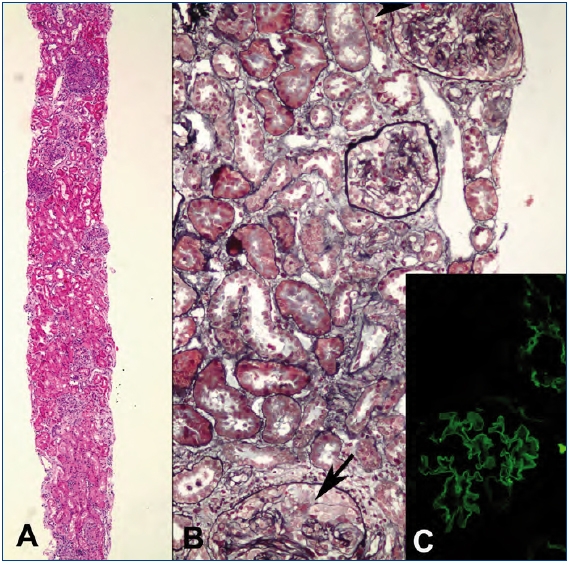
    <p><font face="Verdana" size="2">A 23-years-old non-smoker university student male patient presented with minimal bilateral edema in lower extremities that was present for two weeks. He had no gross hematuria, hemoptysis or other pulmonary symptoms. His past medical history was unremarkable. Laboratory evaluation revealed 7200mg/day proteinuria with normal renal functions (serum creatinine: 1mg/dL). Serum albumin level was 4g/dL. Urinalysis showed 3+ proteinuria with microscopic hematuria. Anti-nuclear and anti-double-stranded DNA antibodies, HIV, hepatitis B and hepatitis C serologies were negative. Complement levels were normal. Renal ultrasonography was normal. Renal biopsy was consistent with anti-GBM antibody disease with diffuse linear IgG staining along the GBM, diffuse endocapillary proliferation and cellular/fibrocellular crescent formation in 40% of glomeruli (<a href="#f1">Figure 1</a>). Numerous glomeruli showed segmental scarring. As soon as the diagnosis was confirmed with positive anti-GBM antibody in serum, plasmapheresis and immunosuppressive treatment was started. Fourteen plasmapheresis sessions were performed until antibodies disappeared. After three days of intravenous pulse methylprednisolone treatment (500mg/day), he was maintained on oral prednisolone (started with 1mg/kg/day and tapered slowly) and monthly intravenous 750mg cyclophosphamide infusions. After twelve intravenous cyclophosphamide treatments, serum creatinine was 1.3mg/dL, albumin was 3.1g/dL and 24-h protein excretion was 4g/day. Thereafter he was maintained on low dose prednisolone (5mg/day) and azathioprine (100mg/day) combination. However under this treatment his renal functions deteriorated and a second biopsy had to be performed after 18 months when creatinine level increased to 2mg/dL and proteinuria to 6g/day. Although serum anti-GBM antibody and ANCA were negative at that time, histomorphologic examination demonstrated ongoing active disease with crescents, linear immunofluorescent staining for IgG on GBM's and significant chronic injury (<a href="#f2">Figure 2</a>). Pulse methylprednisolone followed by oral prednisolone, cyclosporine and mycophenolate mofetil could not prevent further deterioration of renal functions. Furthermore he suffered from a herpes-zoster infection and had to struggle with intracranial abscess caused by actinomyces. Immunosuppressive treatment was stopped and regular hemodialysis treatment was started on the 27<sup>th</sup> month after first diagnosis.</font></p>
    <p align=center><font face="Verdana" size="2"><a name="f1"><img src="/img/revistas/nefrologia/v34n5/carta11_figure1.jpg"></a>    <br><b>Figure 1.</b> First renal biopsy from the patient.    <br>Large glomeruli are notable with minimal tubulointerstitial alteration (panel A)    <br>Higher power shows hypercellular glomeruli with crescents (arrow) and fibrinoid necrosis (arrow-head) (panel B).    <br>Lineer IgG staining along glomerular basement membranes on immunofluorescence (panel C)    <br>(A: H&amp;E x 40; B: PAMS x 200; C: Immunofluorescence, FITC conjugated anti-IgG Ab x 200).</font></p>
    <p>&nbsp;</p>
    ]]></body>
<body><![CDATA[<p align=center><font face="Verdana" size="2"><a name="f2"><img src="/img/revistas/nefrologia/v34n5/carta11_figure2.jpg"></a>    <br><b>Figure 2.</b> Second kidney biopsy from the patient.    <br>Significant chronic injury with numerous globally sclerotic glomeruli and interstitial fibrosis/tubular atrophy (panel A).    <br>Some glomeruli retain crescents showing ongoing activity (panel B).    <br>(A: PAMS x 200; B: Masson's trichrome x 200).</font></p>
    <p>&nbsp;</p>
    <p><font face="Verdana" size="2">This patient with anti-GBM antibody disease presented with nephrotic range proteinuria with normal renal functions. In spite of normal renal function at presentation, ESRD could not be prevented with intensive treatment.</font></p>
    <p><font face="Verdana" size="2">The first interesting point about the patient is the clinical and laboratory data at the time of diagnosis. He had an unusual presentation with normal renal function and absence of pulmonary symptoms, and the indication of the renal biopsy was nephrotic range proteinuria. Isolated nephrotic syndrome is not a classical feature of anti-GBM antibody disease although it may occasionally accompany disturbed renal function. The cause of nephrotic syndrome in these patients may be a co-existing glomerulopathy which is membranous glomerulonephritis in most of the cases.<sup>2</sup> Minimal change disease,<sup>3</sup> IgA nephropathy<sup>4</sup> or membranoproliferative glomerulonephritis<sup>5</sup> may also be associated with anti-GBM antibody disease. There was no accompanying glomerular pathology in this patient based on light microscopic and immunofluorescence studies. Although electron microscopy could not be performed, unresponsiveness of the proteinuria to the steroid and cyclophosphamide decreases the possibility of accompanying minimal change disease.</font></p>
    <p><font face="Verdana" size="2">Another interesting point of this case is the progressive course of the disease despite normal renal function at the beginning. It is known that prognosis of this disease is intimately dependent on the initial creatinine level.<sup>6</sup> Patients with anti-GBM antibody disease with normal renal function at presentation uniformly showed good renal prognosis.<sup>7</sup> This patient had progressive deterioration in renal functions despite intensive immunosuppressive treatment.</font></p>
    <p><font face="Verdana" size="2">Unusual presentation and course in this patient is difficult to explain. Several hypotheses have been proposed for atypical presentations in anti-GBM antibody disease. The disease is classically characterized by circulating autoantibodies against non-collageneous domain of alpha-3 chain of type-IV collagen.<sup>8</sup> It has been suggested that presence of antibodies against non-collagenous domains of alpha-1 and alpha-4 chains of type-IV collagen may result in differing presentations of anti-GBM antibody disease.<sup>9</sup> Another possible mechanism to explain the atypical presentation of anti-GBM antibody disease is involvement by the different IgG subclasses. It was shown that anti-GBM antibody is most likely IgG1 or IgG4, and only IgG1 can activate complement.<sup>10</sup></font></p>
    ]]></body>
<body><![CDATA[<p><font face="Verdana" size="2">In conclusion anti-GBM antibody disease may present with normal renal functions and nephrotic range proteinuria and appropriate treatment may not prevent ESRD in these patients.</font></p>
    <p>&nbsp;</p>
    <p><font face="Verdana" size="2"><b>Conflict of interest</b></font></p>
    <p><font face="Verdana" size="2">The authors declare that they have no conflicts of interest related to the contents of this article.</font></p>
    <p>&nbsp;</p>
    <p align=right><font face="Verdana" size="2"><b>Tolga Yildirim<sup>1</sup>, Dilek Ertoy-Baydar<sup>2</sup>, Ercan Turkmen<sup>1</sup>, Rahmi Yilmaz<sup>1</sup> and Yunus Erdem<sup>1</sup></b>    <br><sup>1</sup>Department of Nephrology. Faculty of Medicine. Hacettepe University. Ankara (Turkey)    <br><sup>2</sup>Department of Pathology. Faculty of Medicine. Hacettepe University. Ankara (Turkey)</font></p>
    <p>&nbsp;</p>
    <p><font face="Verdana" size="2"><b>Referencias Bibliográficas</b></font></p>
    ]]></body>
<body><![CDATA[<!-- ref --><p><font face="Verdana" size="2">1. McLeish KR, Yum MN, Luft FC. Rapidly progressive glomerulonephritis in adults: clinical and histologic correlations. Clin Nephrol 1978;10(2):43-50.    &nbsp;&nbsp;&nbsp;&nbsp;&nbsp;&nbsp;&nbsp;&nbsp;[&#160;<a href="javascript:void(0);" onclick="javascript: window.open('/scielo.php?script=sci_nlinks&ref=3296549&pid=S0211-6995201400050002600001&lng=','','width=640,height=500,resizable=yes,scrollbars=1,menubar=yes,');">Links</a>&#160;]<!-- end-ref --></font></p>    <!-- ref --><p><font face="Verdana" size="2">2. Troxell ML, Saxena AB, Kambham N. Concurrent anti-glomerular basement membrane disease and membranous glomerulonephritis: a case report and literature review. Clin Nephrol 2006;66(2):120-7.    &nbsp;&nbsp;&nbsp;&nbsp;&nbsp;&nbsp;&nbsp;&nbsp;[&#160;<a href="javascript:void(0);" onclick="javascript: window.open('/scielo.php?script=sci_nlinks&ref=3296551&pid=S0211-6995201400050002600002&lng=','','width=640,height=500,resizable=yes,scrollbars=1,menubar=yes,');">Links</a>&#160;]<!-- end-ref --></font></p>    <!-- ref --><p><font face="Verdana" size="2">3. Okafor CC, Balogun RA, Bourne DT, Alhussain TO, Abdel-Rahman EM. An unusual case of anti-glomerular basement membrane disease presenting with nephrotic syndrome. Int Urol Nephrol 2011;43(4):1249-53.    &nbsp;&nbsp;&nbsp;&nbsp;&nbsp;&nbsp;&nbsp;&nbsp;[&#160;<a href="javascript:void(0);" onclick="javascript: window.open('/scielo.php?script=sci_nlinks&ref=3296553&pid=S0211-6995201400050002600003&lng=','','width=640,height=500,resizable=yes,scrollbars=1,menubar=yes,');">Links</a>&#160;]<!-- end-ref --></font></p>    <!-- ref --><p><font face="Verdana" size="2">4. Trpkov K, Abdulkareem F, Jim K, Solez K. Recurrence of anti-GBM antibody disease twelve years after transplantation associated with de novo IgA nephropathy. Clin Nephrol 1998;49(2):124-8.    &nbsp;&nbsp;&nbsp;&nbsp;&nbsp;&nbsp;&nbsp;&nbsp;[&#160;<a href="javascript:void(0);" onclick="javascript: window.open('/scielo.php?script=sci_nlinks&ref=3296555&pid=S0211-6995201400050002600004&lng=','','width=640,height=500,resizable=yes,scrollbars=1,menubar=yes,');">Links</a>&#160;]<!-- end-ref --></font></p>    <!-- ref --><p><font face="Verdana" size="2">5. Deodhar HA, Marshall RJ, Sivathondan Y, Barnes JN. Recurrence of Goodpasture's syndrome associated with mesangiocapillary glomerulonephritis. Nephrol Dial Transplant 1994;9(1):72-5.    &nbsp;&nbsp;&nbsp;&nbsp;&nbsp;&nbsp;&nbsp;&nbsp;[&#160;<a href="javascript:void(0);" onclick="javascript: window.open('/scielo.php?script=sci_nlinks&ref=3296557&pid=S0211-6995201400050002600005&lng=','','width=640,height=500,resizable=yes,scrollbars=1,menubar=yes,');">Links</a>&#160;]<!-- end-ref --></font></p>    ]]></body>
<body><![CDATA[<!-- ref --><p><font face="Verdana" size="2">6. Levy JB, Turner AN, Rees AJ, Pusey CD. Long-term outcome of anti-glomerular basement membrane antibody disease treated with plasma exchange and immunosuppression. Ann Intern Med 2001;134(11):1033-42.    &nbsp;&nbsp;&nbsp;&nbsp;&nbsp;&nbsp;&nbsp;&nbsp;[&#160;<a href="javascript:void(0);" onclick="javascript: window.open('/scielo.php?script=sci_nlinks&ref=3296559&pid=S0211-6995201400050002600006&lng=','','width=640,height=500,resizable=yes,scrollbars=1,menubar=yes,');">Links</a>&#160;]<!-- end-ref --></font></p>    <!-- ref --><p><font face="Verdana" size="2">7. Ang C, Savige J, Dawborn J, Miach P, Heale W, Clarke B, et al. Anti-glomerular basement membrane (GBM)-antibody-mediated disease with normal renal function. Nephrol Dial Transplant 1998;13(4):935-9.    &nbsp;&nbsp;&nbsp;&nbsp;&nbsp;&nbsp;&nbsp;&nbsp;[&#160;<a href="javascript:void(0);" onclick="javascript: window.open('/scielo.php?script=sci_nlinks&ref=3296561&pid=S0211-6995201400050002600007&lng=','','width=640,height=500,resizable=yes,scrollbars=1,menubar=yes,');">Links</a>&#160;]<!-- end-ref --></font></p>    <!-- ref --><p><font face="Verdana" size="2">8. Kalluri R, Wilson CB, Weber M, Gunwar S, Chonko AM, Neilson EG, et al. Identification of the alpha 3 chain of type IV collagen as the common autoantigen in antibasement membrane disease and Goodpasture syndrome. J Am Soc Nephrol 1995;6(4):1178-85.    &nbsp;&nbsp;&nbsp;&nbsp;&nbsp;&nbsp;&nbsp;&nbsp;[&#160;<a href="javascript:void(0);" onclick="javascript: window.open('/scielo.php?script=sci_nlinks&ref=3296563&pid=S0211-6995201400050002600008&lng=','','width=640,height=500,resizable=yes,scrollbars=1,menubar=yes,');">Links</a>&#160;]<!-- end-ref --></font></p>    <!-- ref --><p><font face="Verdana" size="2">9. Hellmark T, Segelmark M, Unger C, Burkhardt H, Saus J, Wieslander J. Identification of a clinically relevant immunodominant region of collagen IV in Goodpasture disease. Kidney Int 1999;55(3):936-44.    &nbsp;&nbsp;&nbsp;&nbsp;&nbsp;&nbsp;&nbsp;&nbsp;[&#160;<a href="javascript:void(0);" onclick="javascript: window.open('/scielo.php?script=sci_nlinks&ref=3296565&pid=S0211-6995201400050002600009&lng=','','width=640,height=500,resizable=yes,scrollbars=1,menubar=yes,');">Links</a>&#160;]<!-- end-ref --></font></p>    <!-- ref --><p><font face="Verdana" size="2">10. Hellmark T, Brunmark C, Trojnar J, Wieslander J. Epitope mapping of anti-glomerular basement membrane (GBM) antibodies with synthetic peptides. Clin Exp Immunol 1996;105(3):504-10.    &nbsp;&nbsp;&nbsp;&nbsp;&nbsp;&nbsp;&nbsp;&nbsp;[&#160;<a href="javascript:void(0);" onclick="javascript: window.open('/scielo.php?script=sci_nlinks&ref=3296567&pid=S0211-6995201400050002600010&lng=','','width=640,height=500,resizable=yes,scrollbars=1,menubar=yes,');">Links</a>&#160;]<!-- end-ref --></font></p>
    ]]></body>
<body><![CDATA[<p>&nbsp;</p>
    <p>&nbsp;</p>
    <p><font face="Verdana" size="2"><a href="#top"><img border="0" src="/img/revistas/nefrologia/v34n5/seta.gif" width="15" height="17"></a><a name="bajo"></a><b>Correspondence:</b>    <br>Tolga Yildirim    <br>Department of Nephrology    <br>Faculty of Medicine    <br>Hacettepe University    <br>Hacettepe 
Üniveristesi T&#305;p Fak&uuml;ltesi Nefroloji Klini i S&#305;hhiye Ankara    <br>06100, Ankara, Turkey    <br>
<a href="mailto:tolga.yildirim@hacettepe.edu.tr">tolga.yildirim@hacettepe.edu.tr</a>    ]]></body>
<body><![CDATA[<br>
<a href="mailto:tolgaylr@gmail.com">tolgaylr@gmail.com</a></font></p>
     ]]></body><back>
<ref-list>
<ref id="B1">
<label>1</label><nlm-citation citation-type="journal">
<person-group person-group-type="author">
<name>
<surname><![CDATA[McLeish]]></surname>
<given-names><![CDATA[KR]]></given-names>
</name>
<name>
<surname><![CDATA[Yum]]></surname>
<given-names><![CDATA[MN]]></given-names>
</name>
<name>
<surname><![CDATA[Luft]]></surname>
<given-names><![CDATA[FC]]></given-names>
</name>
</person-group>
<article-title xml:lang="en"><![CDATA[Rapidly progressive glomerulonephritis in adults: clinical and histologic correlations]]></article-title>
<source><![CDATA[Clin Nephrol]]></source>
<year>1978</year>
<volume>10</volume>
<numero>2</numero>
<issue>2</issue>
<page-range>43-50</page-range></nlm-citation>
</ref>
<ref id="B2">
<label>2</label><nlm-citation citation-type="journal">
<person-group person-group-type="author">
<name>
<surname><![CDATA[Troxell]]></surname>
<given-names><![CDATA[ML]]></given-names>
</name>
<name>
<surname><![CDATA[Saxena]]></surname>
<given-names><![CDATA[AB]]></given-names>
</name>
<name>
<surname><![CDATA[Kambham]]></surname>
<given-names><![CDATA[N]]></given-names>
</name>
</person-group>
<article-title xml:lang="en"><![CDATA[Concurrent anti-glomerular basement membrane disease and membranous glomerulonephritis: a case report and literature review]]></article-title>
<source><![CDATA[Clin Nephrol]]></source>
<year>2006</year>
<volume>66</volume>
<numero>2</numero>
<issue>2</issue>
<page-range>120-7</page-range></nlm-citation>
</ref>
<ref id="B3">
<label>3</label><nlm-citation citation-type="journal">
<person-group person-group-type="author">
<name>
<surname><![CDATA[Okafor]]></surname>
<given-names><![CDATA[CC]]></given-names>
</name>
<name>
<surname><![CDATA[Balogun]]></surname>
<given-names><![CDATA[RA]]></given-names>
</name>
<name>
<surname><![CDATA[Bourne]]></surname>
<given-names><![CDATA[DT]]></given-names>
</name>
<name>
<surname><![CDATA[Alhussain]]></surname>
<given-names><![CDATA[TO]]></given-names>
</name>
<name>
<surname><![CDATA[Abdel-Rahman]]></surname>
<given-names><![CDATA[EM]]></given-names>
</name>
</person-group>
<article-title xml:lang="en"><![CDATA[An unusual case of anti-glomerular basement membrane disease presenting with nephrotic syndrome]]></article-title>
<source><![CDATA[Int Urol Nephrol]]></source>
<year>2011</year>
<volume>43</volume>
<numero>4</numero>
<issue>4</issue>
<page-range>1249-53</page-range></nlm-citation>
</ref>
<ref id="B4">
<label>4</label><nlm-citation citation-type="journal">
<person-group person-group-type="author">
<name>
<surname><![CDATA[Trpkov]]></surname>
<given-names><![CDATA[K]]></given-names>
</name>
<name>
<surname><![CDATA[Abdulkareem]]></surname>
<given-names><![CDATA[F]]></given-names>
</name>
<name>
<surname><![CDATA[Jim]]></surname>
<given-names><![CDATA[K]]></given-names>
</name>
<name>
<surname><![CDATA[Solez]]></surname>
<given-names><![CDATA[K]]></given-names>
</name>
</person-group>
<article-title xml:lang="en"><![CDATA[Recurrence of anti-GBM antibody disease twelve years after transplantation associated with de novo IgA nephropathy]]></article-title>
<source><![CDATA[Clin Nephrol]]></source>
<year>1998</year>
<volume>49</volume>
<numero>2</numero>
<issue>2</issue>
<page-range>124-8</page-range></nlm-citation>
</ref>
<ref id="B5">
<label>5</label><nlm-citation citation-type="journal">
<person-group person-group-type="author">
<name>
<surname><![CDATA[Deodhar]]></surname>
<given-names><![CDATA[HA]]></given-names>
</name>
<name>
<surname><![CDATA[Marshall]]></surname>
<given-names><![CDATA[RJ]]></given-names>
</name>
<name>
<surname><![CDATA[Sivathondan]]></surname>
<given-names><![CDATA[Y]]></given-names>
</name>
<name>
<surname><![CDATA[Barnes]]></surname>
<given-names><![CDATA[JN]]></given-names>
</name>
</person-group>
<article-title xml:lang="en"><![CDATA[Recurrence of Goodpasture's syndrome associated with mesangiocapillary glomerulonephritis]]></article-title>
<source><![CDATA[Nephrol Dial Transplant]]></source>
<year>1994</year>
<volume>9</volume>
<numero>1</numero>
<issue>1</issue>
<page-range>72-5</page-range></nlm-citation>
</ref>
<ref id="B6">
<label>6</label><nlm-citation citation-type="journal">
<person-group person-group-type="author">
<name>
<surname><![CDATA[Levy]]></surname>
<given-names><![CDATA[JB]]></given-names>
</name>
<name>
<surname><![CDATA[Turner]]></surname>
<given-names><![CDATA[AN]]></given-names>
</name>
<name>
<surname><![CDATA[Rees]]></surname>
<given-names><![CDATA[AJ]]></given-names>
</name>
<name>
<surname><![CDATA[Pusey]]></surname>
<given-names><![CDATA[CD]]></given-names>
</name>
</person-group>
<article-title xml:lang="en"><![CDATA[Long-term outcome of anti-glomerular basement membrane antibody disease treated with plasma exchange and immunosuppression]]></article-title>
<source><![CDATA[Ann Intern Med]]></source>
<year>2001</year>
<volume>134</volume>
<numero>11</numero>
<issue>11</issue>
<page-range>1033-42</page-range></nlm-citation>
</ref>
<ref id="B7">
<label>7</label><nlm-citation citation-type="journal">
<person-group person-group-type="author">
<name>
<surname><![CDATA[Ang]]></surname>
<given-names><![CDATA[C]]></given-names>
</name>
<name>
<surname><![CDATA[Savige]]></surname>
<given-names><![CDATA[J]]></given-names>
</name>
<name>
<surname><![CDATA[Dawborn]]></surname>
<given-names><![CDATA[J]]></given-names>
</name>
<name>
<surname><![CDATA[Miach]]></surname>
<given-names><![CDATA[P]]></given-names>
</name>
<name>
<surname><![CDATA[Heale]]></surname>
<given-names><![CDATA[W]]></given-names>
</name>
<name>
<surname><![CDATA[Clarke]]></surname>
<given-names><![CDATA[B]]></given-names>
</name>
</person-group>
<article-title xml:lang="en"><![CDATA[Anti-glomerular basement membrane (GBM)-antibody-mediated disease with normal renal function]]></article-title>
<source><![CDATA[Nephrol Dial Transplant]]></source>
<year>1998</year>
<volume>13</volume>
<numero>4</numero>
<issue>4</issue>
<page-range>935-9</page-range></nlm-citation>
</ref>
<ref id="B8">
<label>8</label><nlm-citation citation-type="journal">
<person-group person-group-type="author">
<name>
<surname><![CDATA[Kalluri]]></surname>
<given-names><![CDATA[R]]></given-names>
</name>
<name>
<surname><![CDATA[Wilson]]></surname>
<given-names><![CDATA[CB]]></given-names>
</name>
<name>
<surname><![CDATA[Weber]]></surname>
<given-names><![CDATA[M]]></given-names>
</name>
<name>
<surname><![CDATA[Gunwar]]></surname>
<given-names><![CDATA[S]]></given-names>
</name>
<name>
<surname><![CDATA[Chonko]]></surname>
<given-names><![CDATA[AM]]></given-names>
</name>
<name>
<surname><![CDATA[Neilson]]></surname>
<given-names><![CDATA[EG]]></given-names>
</name>
</person-group>
<article-title xml:lang="en"><![CDATA[Identification of the alpha 3 chain of type IV collagen as the common autoantigen in antibasement membrane disease and Goodpasture syndrome]]></article-title>
<source><![CDATA[J Am Soc Nephrol]]></source>
<year>1995</year>
<volume>6</volume>
<numero>4</numero>
<issue>4</issue>
<page-range>1178-85</page-range></nlm-citation>
</ref>
<ref id="B9">
<label>9</label><nlm-citation citation-type="journal">
<person-group person-group-type="author">
<name>
<surname><![CDATA[Hellmark]]></surname>
<given-names><![CDATA[T]]></given-names>
</name>
<name>
<surname><![CDATA[Segelmark]]></surname>
<given-names><![CDATA[M]]></given-names>
</name>
<name>
<surname><![CDATA[Unger]]></surname>
<given-names><![CDATA[C]]></given-names>
</name>
<name>
<surname><![CDATA[Burkhardt]]></surname>
<given-names><![CDATA[H]]></given-names>
</name>
<name>
<surname><![CDATA[Saus]]></surname>
<given-names><![CDATA[J]]></given-names>
</name>
<name>
<surname><![CDATA[Wieslander]]></surname>
<given-names><![CDATA[J]]></given-names>
</name>
</person-group>
<article-title xml:lang="en"><![CDATA[Identification of a clinically relevant immunodominant region of collagen IV in Goodpasture disease]]></article-title>
<source><![CDATA[Kidney Int]]></source>
<year>1999</year>
<volume>55</volume>
<numero>3</numero>
<issue>3</issue>
<page-range>936-44</page-range></nlm-citation>
</ref>
<ref id="B10">
<label>10</label><nlm-citation citation-type="journal">
<person-group person-group-type="author">
<name>
<surname><![CDATA[Hellmark]]></surname>
<given-names><![CDATA[T]]></given-names>
</name>
<name>
<surname><![CDATA[Brunmark]]></surname>
<given-names><![CDATA[C]]></given-names>
</name>
<name>
<surname><![CDATA[Trojnar]]></surname>
<given-names><![CDATA[J]]></given-names>
</name>
<name>
<surname><![CDATA[Wieslander]]></surname>
<given-names><![CDATA[J]]></given-names>
</name>
</person-group>
<article-title xml:lang="en"><![CDATA[Epitope mapping of anti-glomerular basement membrane (GBM) antibodies with synthetic peptides]]></article-title>
<source><![CDATA[Clin Exp Immunol]]></source>
<year>1996</year>
<volume>105</volume>
<numero>3</numero>
<issue>3</issue>
<page-range>504-10</page-range></nlm-citation>
</ref>
</ref-list>
</back>
</article>