<?xml version="1.0" encoding="ISO-8859-1"?><article xmlns:mml="http://www.w3.org/1998/Math/MathML" xmlns:xlink="http://www.w3.org/1999/xlink" xmlns:xsi="http://www.w3.org/2001/XMLSchema-instance">
<front>
<journal-meta>
<journal-id>0211-9536</journal-id>
<journal-title><![CDATA[Dynamis]]></journal-title>
<abbrev-journal-title><![CDATA[Dynamis]]></abbrev-journal-title>
<issn>0211-9536</issn>
<publisher>
<publisher-name><![CDATA[Universidad de Granada]]></publisher-name>
</publisher>
</journal-meta>
<article-meta>
<article-id>S0211-95362014000200002</article-id>
<article-id pub-id-type="doi">10.4321/S0211-95362014000200002</article-id>
<title-group>
<article-title xml:lang="en"><![CDATA[She will give birth easily: therapeutic approaches to childbirth in 1st millennium BCE cuneiform sources]]></article-title>
</title-group>
<contrib-group>
<contrib contrib-type="author">
<name>
<surname><![CDATA[Couto-Ferreira]]></surname>
<given-names><![CDATA[M. Erica]]></given-names>
</name>
<xref ref-type="aff" rid="A01"/>
</contrib>
</contrib-group>
<aff id="A01">
<institution><![CDATA[,Universität Heidelberg Karl Jaspers Centre for Advanced Transcultural Studies Cluster of Excellence Asia and Europe in a Global Context]]></institution>
<addr-line><![CDATA[ ]]></addr-line>
</aff>
<pub-date pub-type="pub">
<day>00</day>
<month>00</month>
<year>2014</year>
</pub-date>
<pub-date pub-type="epub">
<day>00</day>
<month>00</month>
<year>2014</year>
</pub-date>
<volume>34</volume>
<numero>2</numero>
<fpage>289</fpage>
<lpage>315</lpage>
<copyright-statement/>
<copyright-year/>
<self-uri xlink:href="http://scielo.isciii.es/scielo.php?script=sci_arttext&amp;pid=S0211-95362014000200002&amp;lng=en&amp;nrm=iso"></self-uri><self-uri xlink:href="http://scielo.isciii.es/scielo.php?script=sci_abstract&amp;pid=S0211-95362014000200002&amp;lng=en&amp;nrm=iso"></self-uri><self-uri xlink:href="http://scielo.isciii.es/scielo.php?script=sci_pdf&amp;pid=S0211-95362014000200002&amp;lng=en&amp;nrm=iso"></self-uri><abstract abstract-type="short" xml:lang="en"><p><![CDATA[This article offers, in the first place, an overview on women's healthcare in relation to childbirth in ancient Mesopotamia, as an introduction that helps to evaluate the meaning of the 7th century Assur text BAM 248 within therapeutic cuneiform texts on childbirth. We proceed to analyse the variety of therapeutic approaches to childbirth present in BAM 248, which brings together various healing devices to help a woman give birth quickly and safely. We analyse the text in its entirety as an example of intersection between different medical approaches to childbirth, given the number of differences in the complexity of remedies, in the materia medica employed, in the methods of preparation and application, even in the technical knowledge required and also, most probably, in the social origin and/or use of the remedies in question.]]></p></abstract>
<kwd-group>
<kwd lng="en"><![CDATA[childbirth]]></kwd>
<kwd lng="en"><![CDATA[women's healthcare]]></kwd>
<kwd lng="en"><![CDATA[Ancient Mesopotamia]]></kwd>
<kwd lng="en"><![CDATA[incantations and ritual performance]]></kwd>
<kwd lng="en"><![CDATA[therapy]]></kwd>
<kwd lng="es"><![CDATA[parto]]></kwd>
<kwd lng="es"><![CDATA[salud femenina]]></kwd>
<kwd lng="es"><![CDATA[Mesopotamia antigua]]></kwd>
<kwd lng="es"><![CDATA[encantamientos y rituales]]></kwd>
<kwd lng="es"><![CDATA[terapéutica]]></kwd>
</kwd-group>
</article-meta>
</front><body><![CDATA[ <p>&nbsp;</p>     <p>&nbsp;</p>     <p><font face="Verdana" size="4"><b>She will give birth easily: therapeutic approaches to childbirth in 1st millennium BCE cuneiform sources</b></font></p>     <p>&nbsp;</p>     <p>&nbsp;</p>     <p><font face="Verdana" size="2"><b>M. Erica Couto-Ferreira</b></font></p>     <p><font face="Verdana" size="2">Cluster of Excellence "Asia and Europe in a Global Context", Karl Jaspers Centre for Advanced Transcultural Studies, Universit&auml;t Heidelberg    <br><a href="mailto:couto-ferreira@asia-europe-uni-heidelberg.de">couto-ferreira@asia-europe-uni-heidelberg.de</a></font></p>     <p>&nbsp;</p>     <p>&nbsp;</p> <hr size="1">    ]]></body>
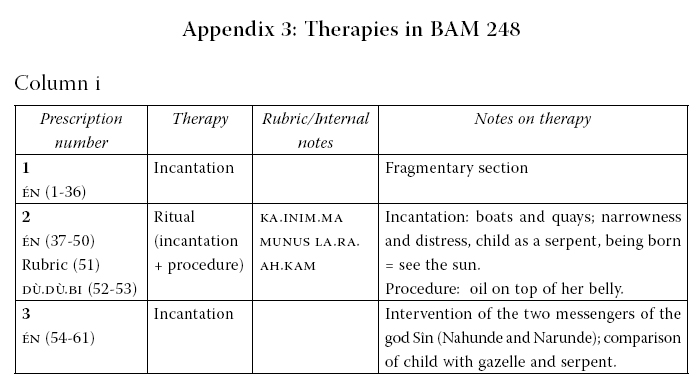
<body><![CDATA[<p><font face="Verdana" size="2"><b>ABSTRACT</b></font></p>     <p><font face="Verdana" size="2">This article offers, in the first place, an overview on women's healthcare in relation to childbirth in ancient Mesopotamia, as an introduction that helps to evaluate the meaning of the 7th century Assur text BAM 248 within therapeutic cuneiform texts on childbirth. We proceed to analyse the variety of therapeutic approaches to childbirth present in BAM 248, which brings together various healing devices to help a woman give birth quickly and safely. We analyse the text in its entirety as an example of intersection between different medical approaches to childbirth, given the number of differences in the complexity of remedies, in the materia medica employed, in the methods of preparation and application, even in the technical knowledge required and also, most probably, in the social origin and/or use of the remedies in question.</font></p>     <p><font face="Verdana" size="2"><b>Key words:</b> childbirth, women's healthcare, Ancient Mesopotamia, incantations and ritual performance, therapy.</font></p>     <p><font face="Verdana" size="2"><b>Palabras clave:</b> parto, salud femenina, Mesopotamia antigua, encantamientos y rituales, terap&eacute;utica.</font></p> <hr size="1">     <p>&nbsp;</p>     <p><font face="Verdana" size="2"><b>1. Conceptualizing women's healthcare in ancient Mesopotamia: an introduction</b></font></p>     <p><font face="Verdana" size="2">Texts dealing with complaints affecting women's healthcare, especially in relation to childbirth, are found among the first written evidence of healing in ancient Mesopotamia. From the second half of the 3rd millennium on until the end of the 1st millennium BCE we find them attested in major archaeological sites. There are but few therapeutic examples outside the field of reproduction and genitalia-related diseases where women are specifically mentioned<a id="footnote-6405-1-backlink" href="#footnote-6405-1"><sup>1</sup></a>.</font></p>     <p><font face="Verdana" size="2">Therapeutic texts make use of the generic term NA, LÚ/<i>aw&#299;lu</i>, <i>am&#275;lu</i> "man" to describe pathologies, while the term munus/<i>sinni&#353;tu</i> "woman" makes its appearance in those cases where ailments specifically related to female genital problems and procreation in a wide sense are involved. In learned cuneiform sources, therefore, reproduction is perceived as the realm where women are in need of particular care. That cuneiform texts lack any manifest theoretical imprint is a feature that has frequently been emphasized in academic literature, but even then, systemisation and theoretical considerations can be effectively expressed through other channels. Texts allow us to get a grasp on how the female body was envisioned in relation to its reproductive capacities in the long run. Going through the major female health problems treated in cuneiform texts, we can ascertain that they relate to the treatment of infertility, miscarriage, vaginal bleeding, indispositions during pregnancy, childbirth, and postpartum.</font></p>     <p><font face="Verdana" size="2">The section in the collection of remedies BAM 381 iii 17-36<a id="footnote-6405-2-backlink" href="#footnote-6405-2"><sup>2</sup></a> show, together with its duplicate BAM 380: 25-41, this thematic pattern in an illuminating way (<a href="#a1">appendix 1</a>). Coming from Babylon, this text follows the traits common to cuneiform herbals, namely: (a) the name of the plant; (b) the complaint it treats; and (c) preparation and application, with the contents being arranged according to (b)<a id="footnote-6405-3-backlink" href="#footnote-6405-3"><sup>3</sup></a>. The section here transliterated and translated in <a href="#a1">Appendix 1</a> gathers a number of plants useful to treat female complaints, which are arranged following what was considered to be the female reproductive path and its main health dangers. It starts with plants for acquiring or taking the seed (<i>atkam</i> and <i>kamantu</i> plants); followed by <i>materia medica</i> to induce pregnancy (<i>imhur-l&#299;m</i>, <i>ankin&#363;tu</i>, <i>haluppu</i>); to deal with problems during pregnancy (<i>puquttu</i> and <i>ma&#353;takal</i> in a treatment against <i>nah&#353;&#257;tu</i>); to assist the mother in difficult labour (<i>li&#353;&#257;n kalbi</i>, <i>kar&#257;n &#353;&#275;libi</i>, <i>at&#257;'i&#353;u</i>); and, finally, to treat post-partum conditions (<i>arantu</i>, A&#352;<a id="footnote-6405-4-backlink" href="#footnote-6405-4"><sup>4</sup></a> seed, <i>nabraqqu</i>, <i>at&#257;'i&#353;u</i><sup>?</sup> to treat <i>&#353;alputtu</i>).</font></p>     <p>&nbsp;</p>     ]]></body>
<body><![CDATA[<p align="center"><font face="Verdana" size="2"><a name="a1"><img src="/img/revistas/dyn/v34n2/02_dossier2_app1.jpg"></a></font></p>     <p>&nbsp;</p>     <p><font face="Verdana" size="2">Both texts provide, therefore, an overview on: (a) those health conditions associated with women or that were considered specifically female in Mesopotamia, which, in this case, are clearly related to reproduction; (b) the phases of reproduction (taking the seed, pregnancy, giving birth, postpartum); (c) the most usual problems present in each phase of reproduction. However, it must be noted that other evidence from the cuneiform material deals with other kinds of ailments affecting women that, even when they closely relate to female anatomy, are not necessarily (or not explicitly) linked to the reproductive cycle. Within this context, text BAM 248 allows to explore historical issues linked to women's healthcare, childbirth practices, and transmission of written medical knowledge in antiquity. BAM 248 not only demonstrates the variety of healing approaches and techniques available in ancient Mesopotamia to aid the labouring mother, but it also constitutes an enlightening example of learned ways of transmission and codification of knowledge converging under the sphere of the discipline of <i>&#257;&#353;ip&#363;tu</i>. This cuneiform tablet also challenges the issue of nature of medical knowledge the elites had access to, as well as calling into question previous considerations regarding which practitioners had access to the textual record, and how they put into practice the therapies reported in it.</font></p>     <p>&nbsp;</p>     <p><font face="Verdana" size="2"><b>2. (Difficult) Childbirth in healing cuneiform sources</b></font></p>     <p><font face="Verdana" size="2">Pregnancy and childbirth have represented, until quite recent times, a danger for both mother and child in the Western world, and it is still so among many human groups and communities. The terror of pregnancy, as well as the consciousness of the dangers it involved, are also represented in different types of cuneiform sources. The physiognomic series "If a woman has a big head" (<i>&#353;umma sinni&#353;tu qaqqada rab&#257;t</i>), for example, interprets the presence of certain physical traits in women as foretellers of death when pregnant or while giving birth<a id="footnote-6405-5-backlink" href="#footnote-6405-5"><sup>5</sup></a>; while similar features, when present in the pregnant woman, can also portend a most tragic development of facts, as the diagnostic and prognostic series show<a id="footnote-6405-6-backlink" href="#footnote-6405-6"><sup>6</sup></a>. Perhaps the most powerful accounts of the dangers of childbirth are found in these two examples we report here. The first fragment pertains to a Middle Assyrian incantation aiming at helping a woman in childbirth that depicts her as slowly approaching death:</font></p>     <blockquote>     <p><font face="Verdana" size="2">"The (birthing) mother is surrounded by the dust(s) of death,</font></p>     <p><font face="Verdana" size="2">Like a chariot, she is surrounded by the dust(s) of battle,</font></p>     <p><font face="Verdana" size="2">Like a plough, she is surrounded by the dust(s) of woods,</font></p>     ]]></body>
<body><![CDATA[<p><font face="Verdana" size="2">Like a fighting warrior, she is fighting in her blood.</font></p>     <p><font face="Verdana" size="2">Weakened, her eyes don't see, her lips are covered,</font></p>     <p><font face="Verdana" size="2">She doesn't open (them) the fate of death and the fate of silence, her eyes (...)"<a id="footnote-6405-7-backlink" href="#footnote-6405-7"><sup>7</sup></a>.</font></p> </blockquote>     <p><font face="Verdana" size="2">The second text we will touch upon refers to the "Elegy in memory of a woman"<a id="footnote-6405-8-backlink" href="#footnote-6405-8"><sup>8</sup></a>. This Neo-Assyrian composition laments the premature death of a woman during childbirth through a rather heartbreaking language. Some of the images used, such as that which compares the dead woman to a wrecked ship (obv. 1-3), recalls a well-known trope of childbirth incantations, that is, that of the boat loaded with precious goods, which is equated with the mother in labour (or the foetus in the act of being born), that makes its way to the harbour. This device effectively brings into the discourse the echoes of a textual knowledge on childbirth which is used to express failure and final death through the image of the woman as a shipwreck:</font></p>     <blockquote>     <p><font face="Verdana" size="2">"Why are you thrown in middle of the river like a boat?</font></p>     <p><font face="Verdana" size="2">Your boat's beams broken; your ropes cut off;</font></p>     <p><font face="Verdana" size="2">Your face veiled, you cross the river of the Inner City?'</font></p>     <p><font face="Verdana" size="2">'How could I not be thrown; how could my ropes not be cut off?</font></p>     <p><font face="Verdana" size="2">On the day I carried fruit, how happy I was!</font></p>     ]]></body>
<body><![CDATA[<p><font face="Verdana" size="2">Happy was I, happy my husband.</font></p>     <p><font face="Verdana" size="2">On the day of my labour pains, my face became dark.</font></p>     <p><font face="Verdana" size="2">On the day I gave birth, my eyes had an unhealthy appearance.</font></p>     <p><font face="Verdana" size="2">My hands (literally fists) were opened (in supplication), as I prayed to B&#275;let-il&#299;:</font></p>     <p><font face="Verdana" size="2">You are the mother of those who give birth, save my life!</font></p>     <p><font face="Verdana" size="2">(...)</font></p>     <p><font face="Verdana" size="2">&#091;Ever since&#093; those days, (when) I was with my husband,</font></p>     <p><font face="Verdana" size="2">(as) I lived with him, who was my lover,</font></p>     <p><font face="Verdana" size="2">Death crept stealthily in my bed.</font></p>     <p><font face="Verdana" size="2">It brought me out of my home,</font></p>     ]]></body>
<body><![CDATA[<p><font face="Verdana" size="2">It separated me from my lover,</font></p>     <p><font face="Verdana" size="2">(And) set my feet toward a land from which I shall not return" (obv. 1-rev. 4-9).</font></p> </blockquote>     <p><font face="Verdana" size="2"><i><b>2.1. Terminology</b></i></font></p>     <p><font face="Verdana" size="2">Turning to the references to difficult childbirth in therapeutic texts, we find a number of expressions that allude to it. Older texts tend to simply use the expression MUNUS Ù.TU.DA.KAM = <i>sinni&#353;tu ullad</i>, <i>sinni&#353;tu</i> (<i>w</i>)<i>&#257;littu</i> "(for) a woman (that) is giving birth". On the other hand, MUNUS LA.RA.A(H.KAM)/<i>mu&#353;ap&#353;iqtu</i><a id="footnote-6405-9-backlink" href="#footnote-6405-9"><sup>9</sup></a> "woman with difficulties in giving birth, woman in dire straits", as well as the cognate <i>&#353;up&#353;uqtu</i><a id="footnote-6405-10-backlink" href="#footnote-6405-10"><sup>10</sup></a>, add the notion of a problematic childbirth. The root *<i>p&#353;q</i> the Akkadian term <i>mu&#353;ap&#353;iqtu</i> derives from implies the notion, in fact, of narrowness.</font></p>     <p><font face="Verdana" size="2">An explanatory text from Nineveh comments upon the term MUNUS LA.RA.AH as follows:</font></p>     <blockquote>     <p><font face="Verdana" size="2">&#091;MUNUS LA.RA.AH&#093; =  MUNUS<sup>!</sup> <i>ha-a-a-al-t&uacute;</i>, &#091;...&#093; = &#091;MUN&#093;US <i>&#353;&aacute; hi-lu-&#353;&aacute; dan-nu </i>"&#091;woman with difficulties in giving birth&#093;, woman in childbirth, woman whose birth pangs are great"<a id="footnote-6405-11-backlink" href="#footnote-6405-11"><sup>11</sup></a>.</font></p> </blockquote>     <p><font face="Verdana" size="2">However, other terms can also be employed. The wish for an easy unproblematic childbirth in therapeutic texts is expressed through forms such as <i>arhi&#353;</i> Ù.TU (<i>ullad</i>) "she will give birth quickly" or the more generic SI.SÁ/<i>e&#353;&#275;ru</i> "to go straight, to proceed well, to move forwards"<a id="footnote-6405-12-backlink" href="#footnote-6405-12"><sup>12</sup></a>.</font></p>     <p><font face="Verdana" size="2">Rubrics in childbirth therapeutic texts usually bear, therefore, the titles ka-inim-ma munus &ugrave;-tu-da-kam "recitation for a woman giving birth", KA.INIM.MA MUNUS LA.RA.A(H).KAM "recitation for a woman having a difficult childbirth", KA.INIM.MA ÉN <i>mu&#353;ap&#353;iqti</i> (KUB IV 13: 13') "recitation (of) incantation of a woman in dire straits", and the like.</font></p>     <p><font face="Verdana" size="2"><i><b>2.2. Difficult childbirth and therapy</b></i></font></p>     ]]></body>
<body><![CDATA[<p><font face="Verdana" size="2">The critical moment of birth as well as difficult childbirth are represented in ritual texts and incantations through a number of tropes that tend to emphasize the state of the foetus within the mother's body (<a href="#a2">appendix 2</a>). In the oldest cuneiform evidences on childbirth, we already encounter the foetus pictured as being trapped, knotted, bonded, in fetters, or locked within a body whose door or bolt can't be opened. The very act of giving birth, therefore, is expressed through performative utterances that emphasize the acts of unknotting knots, loosening the limbs, and breaking the seals that keep the child enclosed. Examples of this that predate BAM 248 are:</font></p>     <p>&nbsp;</p>     <p align="center"><font face="Verdana" size="2"><a name="a2"><img src="/img/revistas/dyn/v34n2/02_dossier2_app2.jpg"></a></font></p>     <p>&nbsp;</p>     <blockquote>     <p><font face="Verdana" size="2">"He unties the knots</font></p>     <p><font face="Verdana" size="2">That have him (i.e. the baby) chained,</font></p>     <p><font face="Verdana" size="2">He prepares the road for him,</font></p>     <p><font face="Verdana" size="2">He opens the route for him"<a id="footnote-6405-13-backlink" href="#footnote-6405-13"><sup>13</sup></a>.</font></p>     <p><font face="Verdana" size="2">"Gi-Sen, the servant of the god S&#238;n, she has a hard time (in) birth; the baby is stuck, the baby is stuck; in order to finish life, the bolt is fastened, the gate (is fastened?) against the suckling kid"<a id="footnote-6405-14-backlink" href="#footnote-6405-14"><sup>14</sup></a>.</font></p> </blockquote>     ]]></body>
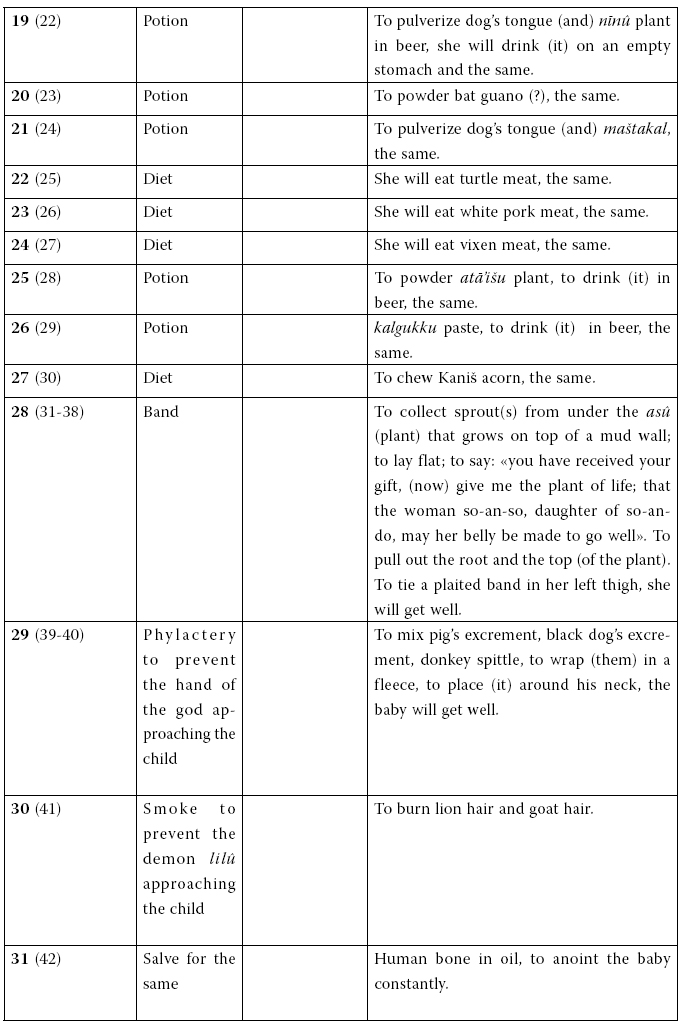
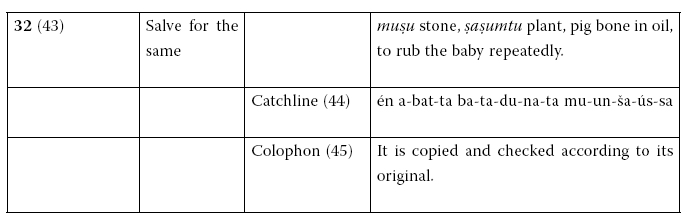
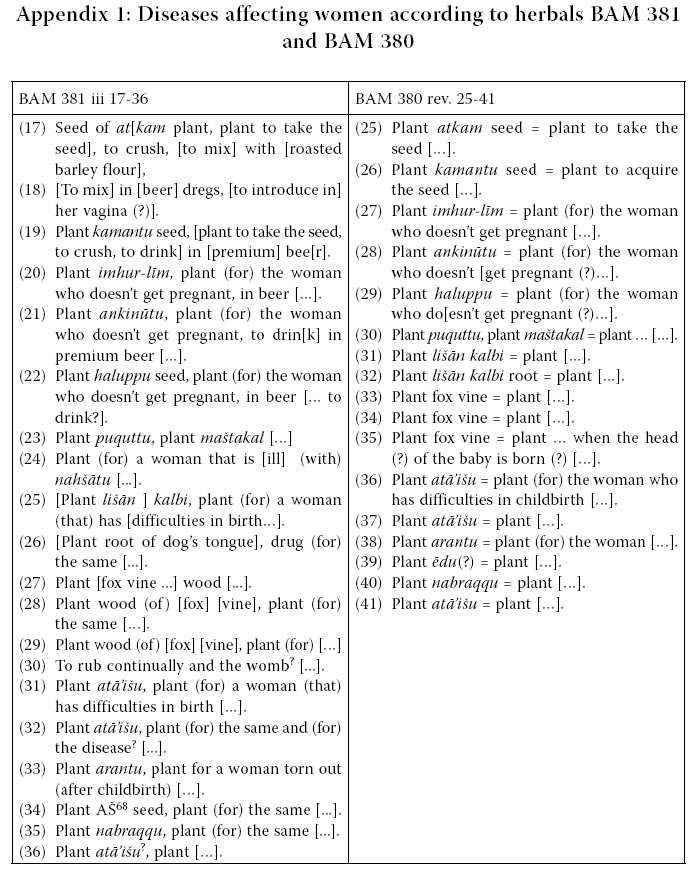
<body><![CDATA[<p><font face="Verdana" size="2">As we mentioned above when talking about the "Elegy in memory of a woman", a boat burdened with a precious load that deploys its sails and navigates towards the "quay of life"<a id="footnote-6405-15-backlink" href="#footnote-6405-15"><sup>15</sup></a> recurrently appears in childbirth incantations. The boat may very well refer to the foetus that, still in its watery element, begins to move towards the birth canal. A different interpretation proposes that the boat would represent the birthing mother guiding her foetus, the precious load, through the waters of birth<a id="footnote-6405-16-backlink" href="#footnote-6405-16"><sup>16</sup></a>.</font></p>     <p><font face="Verdana" size="2">Another frequent trope in childbirth incantations regards the <i>historiola</i> of the cow and the Moon-God, which describes the "antecedents", namely the sexual encounter and impregnation that provides an origin to the present situation of childbirth. The Moon-God S&#238;n falls in love with a cow, he mounts her and she gets pregnant; as she experiences difficulties and pain in giving birth, the god S&#238;n sends two protective spirits to help her; she finally gives birth to a calf. The aim of the <i>historiola</i> is stated at the end of the incantation: as the cow of S&#238;n gave birth without further difficulties, so the woman in dire straits may give birth to her baby. Incantations of the cow of S&#238;n, or birth incantations containing references to cows and cattle pens, are already attested during the second millennium, not only within Mesopotamia<a id="footnote-6405-17-backlink" href="#footnote-6405-17"><sup>17</sup></a> but also in periphery areas such as Ugarit and Anatolia<a id="footnote-6405-18-backlink" href="#footnote-6405-18"><sup>18</sup></a>, and even constitute the object of hermeneutical re-elaborations in late commentaries<a id="footnote-6405-19-backlink" href="#footnote-6405-19"><sup>19</sup></a>.</font></p>     <p><font face="Verdana" size="2">These three tropes (opening of doors, sailing of boats, cow of S&#238;n) we find in second millennium evidences, together with some other images we have synthesized in <a href="#a2">Appendix 2</a>, make their appearance in the healing procedures recorded in the tablet under analysis.</font></p>     <p>&nbsp;</p>     <p><font face="Verdana" size="2"><b>3. The text BAM 248</b></font></p>     <p><font face="Verdana" size="2">The text VAT 8869 (from now on, BAM 248)<a id="footnote-6405-20-backlink" href="#footnote-6405-20"><sup>20</sup></a> dates from the Neo-Assyrian period, more specifically from some point between the 8th and the 7th century BCE, and was excavated in the city of Assur, in the area commonly known as the "House of the incantation priest"<a id="footnote-6405-21-backlink" href="#footnote-6405-21"><sup>21</sup></a>. It was found as part of a larger collection of tablets whose contents are mainly related to healing and ritual. BAM 248 exemplifies the persistence of written traditions and motifs regarding childbirth. This four-column tablet, whose obverse is badly damaged, gathers different treatments to help a woman with difficulties in giving birth. The text takes up older sources and motifs whose origin can be traced back to the Neo-Sumerian and Old Babylonian incantations and rituals. Even though it has been widely studied, translated and republished, this has been made mainly in relation to the incantations and ritual elements of the performance it contains, frequently leaving aside pharmacological prescriptions.</font></p>     <p><font face="Verdana" size="2">The relevance of this text derives from its comprehensive nature, since it gathers together different therapeutic approaches to ease childbirth, as well as a small final section containing remedies to protect the newborn child<a id="footnote-6405-22-backlink" href="#footnote-6405-22"><sup>22</sup></a> (<a href="#a3">appendix 3</a>). Some of them were known from textual sources of the previous periods and show patterns of textual transmission; while others seem to have been added anew (how "new" this material is, however, remains to be seen). The result is a collection of very different medical techniques to deal with the same complaint. The contents are practical in nature, based on instructions to prepare or perform specific remedies and without including theoretical thoughts.</font></p>     <p>&nbsp;</p>     <p align="center"><font face="Verdana" size="2"><a name="a3"><img src="/img/revistas/dyn/v34n2/02_dossier2_app3a.jpg"></a></font></p>     <p align="center"><font face="Verdana" size="2"><img src="/img/revistas/dyn/v34n2/02_dossier2_app3b.jpg"></font></p>     ]]></body>
<body><![CDATA[<p align="center"><font face="Verdana" size="2"><img src="/img/revistas/dyn/v34n2/02_dossier2_app3c.jpg"></font></p>     <p align="center"><font face="Verdana" size="2"><img src="/img/revistas/dyn/v34n2/02_dossier2_app3d.jpg"></font></p>     <p align="center"><font face="Verdana" size="2"><img src="/img/revistas/dyn/v34n2/02_dossier2_app3e.jpg"></font></p>     <p>&nbsp;</p>     <p><font face="Verdana" size="2"><i><b>3.1. Rituals in BAM 248</b></i></font></p>     <p><font face="Verdana" size="2">The greater part of the tablet is constituted by rituals<a id="footnote-6405-23-backlink" href="#footnote-6405-23"><sup>23</sup></a>, and by incantations alone, that is, recitations whose procedural part is not made explicit or remains unclear within the economy of the whole text<a id="footnote-6405-24-backlink" href="#footnote-6405-24"><sup>24</sup></a>. The procedures or <i>agenda</i> that go together with the recitations in the ritual devices usually reflect and follow these images in the <i>materia medica</i> and the application methods employed. Most of the procedures, on the other hand, make use of fatty substances that are smeared on the belly of the woman in labour<a id="footnote-6405-25-backlink" href="#footnote-6405-25"><sup>25</sup></a>. Let's analyse prescription number 5 as an example. The incantation section in BAM 248 ii 70-iii 1-5 reads:</font></p>     <blockquote>     <p><font face="Verdana" size="2">"Like the rain (lit. drop from heaven), he doesn't ...</font></p>     <p><font face="Verdana" size="2">Like (one) who falls off the wall, he doesn't turn back.</font></p>     <p><font face="Verdana" size="2">Like a leaking pipe, &#091;her waters&#093; don't remain (inside).</font></p>     ]]></body>
<body><![CDATA[<p><font face="Verdana" size="2">Incantation of Asalluhi, secret of &#091;Marduk?&#093;.</font></p>     <p><font face="Verdana" size="2">This (is) reliable of Ea ..., incantation of Mami &#091;...&#093;</font></p>     <p><font face="Verdana" size="2">(The goddess) Nisaba gave (it) in order to keep the womb in order".</font></p> </blockquote>     <p><font face="Verdana" size="2">This matches the procedure and vice versa:</font></p>     <blockquote>     <p><font face="Verdana" size="2">"Its procedure. Stone of rain (lit. drop of heaven), dust of the revetment of a wall (that) has fallen,</font></p>     <p><font face="Verdana" size="2">Dust of a leaking pipe, you will mix (these) in oil from a bowl, from top</font></p>     <p><font face="Verdana" size="2">Downwards you will rub her and this woman will recover" (BAM 248 iii 7-9)<a id="footnote-6405-26-backlink" href="#footnote-6405-26"><sup>26</sup></a>.</font></p> </blockquote>     <p><font face="Verdana" size="2">On similar grounds, <i>materia medica</i> related to doors and crossing places is used in a different ritual contained in the tablet (BAM 248 iii 46-53). These substances invoke the image of the pregnant mother as a closed space whose door must be wide-open and its threshold trespassed:</font></p>     <blockquote>     ]]></body>
<body><![CDATA[<p><font face="Verdana" size="2">"Its procedure: dust of a crossroad, dust of the first threshold,</font></p>     <p><font face="Verdana" size="2">Dust of a box from the top and bottom,</font></p>     <p><font face="Verdana" size="2">Dust of the box of a door, a thick reed,</font></p>     <p><font face="Verdana" size="2">The tip and bottom you will trim,</font></p>     <p><font face="Verdana" size="2">You will mix these (kinds of) dust, you will throw them into oil,</font></p>     <p><font face="Verdana" size="2">You will recite the incantation seven times over this content (lit. inside),</font></p>     <p><font face="Verdana" size="2">You will fill the thick reed and on the top of her protruding belly</font></p>     <p><font face="Verdana" size="2">From top downwards you will rub".</font></p> </blockquote>     <p><font face="Verdana" size="2"><b><i>3.2. Other therapeutic approaches in BAM 248</i></b></font></p>     <p><font face="Verdana" size="2">Together with these traditions, the fourth column of the tablet lists other remedies of quite a different nature, to be used in helping to ease the process of giving birth. Remedies 12 to 20 are individual prescriptions separated by rulings and characterized mainly by the use of <i>simplicia</i> and two- and three-plant-based remedies applied as potions, ointments, or bands. The section BAM 248 iv 24-38, although similar in aim and form of treatment, differs from the previous section by the absence of rulings separating the different prescriptions. This element, together with the peculiar treatment described in BAM 248 iv 31-38, which specifies how to collect and apply the <i>as&#251;</i> plant and that includes a sort of recitation in the form of an address to the plant itself, suggest the use of a different textual source in the composition of this fragment with regard to that employed for the case of remedies 12 to 20. The remedy section is closed by the inclusion of remedies to protect the newborn against the entities "hand of the god" and the (demon) <i>lil&#251;</i> (remedies 29 to 32). In this case, as with the section BAM 248 iv 24-38, prescriptions are also not separated by rulings.</font></p>     ]]></body>
<body><![CDATA[<p><font face="Verdana" size="2"><i>3.2.1. The potions in BAM 248</i></font></p>     <p><font face="Verdana" size="2">The seven potions of the text make use of a limited number of <i>materia medica</i>, being mostly plants, but also including a few other substances, apparently of animal origin<a id="footnote-6405-27-backlink" href="#footnote-6405-27"><sup>27</sup></a>. The reduced number of substances employed suggests a common, rather affordable type of remedy that was perhaps taken from a widespread popular knowledge and incorporated into learned written forms of knowledge. When confronted with the rituals in columns i to iii in the tablet, which would require not only the intervention of the <i>&#257;&#353;ipu</i> or <i>ma&#353;ma&#353;&#353;u</i><a id="footnote-6405-28-backlink" href="#footnote-6405-28"><sup>28</sup></a>, but also the use of substances such as different types of dust collected from a number of places, many of these other recipes appear to be more accessible.</font></p>     <p><font face="Verdana" size="2">Let's have a look at these potions in more detail. The <i>materia medica</i> prescribed is usually to be crushed or grounded and administered in beer or oil. For the case of BAM 248, quantities are not specified. Recipe number 12 prescribes <i>ma&#353;takal</i><a id="footnote-6405-29-backlink" href="#footnote-6405-29"><sup>29</sup></a> plant and <i>tappinnu</i> flour (a kind of second quality flour)<a id="footnote-6405-30-backlink" href="#footnote-6405-30"><sup>30</sup></a> in oil and/or beer<a id="footnote-6405-31-backlink" href="#footnote-6405-31"><sup>31</sup></a>. The <sup>&uacute;</sup>IN.NU.U&#352;/<i>ma&#353;takal</i> appears in a number of therapeutic contexts and ritual performances regarding the counteracting of witchcraft and transgression, as well as in cleaning activities. In fact, the menacing power of witchcraft over women's healthcare is often explicitly stated in the cuneiform material<a id="footnote-6405-32-backlink" href="#footnote-6405-32"><sup>32</sup></a>, and its use in our text may also be related to this fact<a id="footnote-6405-33-backlink" href="#footnote-6405-33"><sup>33</sup></a>.</font></p>     <p><font face="Verdana" size="2">Another interesting feature alludes to the use of the same <i>materia medica</i> in different prescriptions, which are mentioned alone or differently combined with other substances. Prescription number 18 gives two alternative remedies in the same line: pulverized fox vine (<sup>gi&#353;</sup>GE&#352;TIN KA<sub>5</sub>.A)<a id="footnote-6405-34-backlink" href="#footnote-6405-34"><sup>34</sup></a> to be drunk in beer on an empty stomach; or dog's tongue (<sup>&uacute;</sup>EME UR.GI<sub>7</sub>)<a id="footnote-6405-35-backlink" href="#footnote-6405-35"><sup>35</sup></a>, prepared and administered in the same way. These two plants, which appear again in potion number 13, are also included as <i>materia medica</i> used to treat problems during childbirth in the herbals above-mentioned (see <a href="#a1">Appendix 1</a>): BAM 381 iii 25-26 and BAM 380 rev. 31-32 "dog's tongue"; BAM 381 iii 27-29 and BAM 380 rev. 33-35 "fox vine". In the same way, powdered kur.kur/<i>at&#257;'i&#353;u</i><a id="footnote-6405-36-backlink" href="#footnote-6405-36"><sup>36</sup></a> plant drunk in beer (prescription 25) is the same remedy included in the herbals BAM 381 iii 31-32 and BAM 380 rev. 36-37.</font></p>     <p><font face="Verdana" size="2">Recipe number 13 increases the number of substances employed. For the same diagnosis as that in recipe 12, a combination of fox vine, dog's tongue plant, and <i>tuhlam</i> (?) plant<a id="footnote-6405-37-backlink" href="#footnote-6405-37"><sup>37</sup></a> smashed together in a <i>lahannu</i> vessel filled with old beer is prescribed, specifying that it might be drunk on an empty stomach. Since <i>lahannu</i><a id="footnote-6405-38-backlink" href="#footnote-6405-38"><sup>38</sup></a> seems to refer to a type of bottle or container of a rather small size, in this context it could be indicating a measure. Recipe 19 prescribed dog's tongue and <i>n</i>&#299;<i>n&#251;</i> plant (<sup>&uacute;</sup>KUR.RA<sup>sar</sup>)<a id="footnote-6405-39-backlink" href="#footnote-6405-39"><sup>39</sup></a>, while recipe 21 employs dog's tongue plant and <i>ma&#353;takal</i>. In both cases the <i>materia medica</i> is to be pulverized and drunk with beer, on an empty stomach.</font></p>     <p><font face="Verdana" size="2">All in all, the substances of vegetable origin employed in the preparation of these concoctions are rather limited in number, but various combinations of these substances increase the potential number of potions available for easing birth.</font></p>     <p><font face="Verdana" size="2">Two potions employ animal-based products. Remedy 14 makes use of excrement of a wall lizard (?)<a id="footnote-6405-40-backlink" href="#footnote-6405-40"><sup>40</sup></a> drunk in beer on an empty stomach. A spotted wall lizard (&#091;EME.D&#093;IR  IZ.ZI GÚN.A) is prescribed in another text on women's healthcare from Assur aiming at "dropping the foetus"<a id="footnote-6405-41-backlink" href="#footnote-6405-41"><sup>41</sup></a>. It may be hypothesized, therefore, that the substance is used in both cases because of its properties as expellant.</font></p>     <p><font face="Verdana" size="2">Prescription 20 offers some interpretative problems. The smashed U<sub>5</sub>(HU.SI) NÍG.IB<sup>mu&#353;en</sup>/<i>rikibti arqabi</i> that is prescribed has been usually translated in medical contexts as "bat guano"<a id="footnote-6405-42-backlink" href="#footnote-6405-42"><sup>42</sup></a>, an interpretation that was taken after Miquel Civil<a id="footnote-6405-43-backlink" href="#footnote-6405-43"><sup>43</sup></a>. The meaning of the term <i>rikibtu</i>, however, is far from clear, since it pertains to the semantic field of sexual intercourse more than to scatological vocabulary, and it might also be referring to "bat seed/semen" or to ""thumb" of a bat" (the nail or thorn at the top of the wing).</font></p>     <p><font face="Verdana" size="2">Just one potion (number 26) employs a kind of mineral paste or earth named <sup>IM</sup>KAL.GUG/ <i>kalgukku</i><a id="footnote-6405-44-backlink" href="#footnote-6405-44"><sup>44</sup></a>, which is frequently used in medicine in general and in the treatment of conditions affecting women in particular.</font></p>     <p><font face="Verdana" size="2">Cuneiform texts, and especially those of a technical nature as the prescriptions we have commented on so far, tend to be succinct and therefore avoid giving too much detail on aspects of dosage, preparation, and administration. However, we sometimes find relevant information in documentary sources. In the following Neo-Assyrian letter (SAA X 336: 1-rev. 4)<a id="footnote-6405-45-backlink" href="#footnote-6405-45"><sup>45</sup></a>, information on the usual procedure on how to administrate a potion is given:</font></p>     ]]></body>
<body><![CDATA[<blockquote>     <p><font face="Verdana" size="2">"Like any potion that my lord drinks, you put three drops into the libation bowl with the tip of a stylus and drink it before the meal (i.e. on an empty stomach). The water wherein it is mixed should be .... (terms difficult to translate follow)".</font></p> </blockquote>     <p><font face="Verdana" size="2"><i>3.2.2. Ointments and salves</i></font></p>     <p><font face="Verdana" size="2">A number of remedies (15-17) involve the application of <i>materia medica</i> in oil or other fatty substances, which are usually smeared on the belly. This technique is also used in the complex rituals above mentioned, being attested from the Old Babylonian texts on childbirth.</font></p>     <p><font face="Verdana" size="2">In remedy 15, dust of a dog's crossing-place(?)/paw<a id="footnote-6405-46-backlink" href="#footnote-6405-46"><sup>46</sup></a> should be smashed in oil and smeared on the belly; while remedy 16 prescribes the crushed nest of a SIM.MAH<sup>mu&#353;en</sup>/<i>sinuntu</i> bird<a id="footnote-6405-47-backlink" href="#footnote-6405-47"><sup>47</sup></a> applied in the same way. Although the <i>sinuntu</i> nest is seldom attested in medical contexts, it is interesting to note its use, on the one hand, in a remedy against witchcraft that combines, among other substances, <sup>ú</sup>GE&#352;TIN.KA<sub>5</sub>.A, <sup>ú</sup>IN.NU.U&#352; and <sup>ú</sup>KUR.KUR, all of them plants attested in BAM 248<a id="footnote-6405-48-backlink" href="#footnote-6405-48"><sup>48</sup></a>. On the other, the nest of the <i>sinuntu</i> bird from the North, crushed and mixed in oil, is used in a ritual to calm down a child<a id="footnote-6405-49-backlink" href="#footnote-6405-49"><sup>49</sup></a>.</font></p>     <p><font face="Verdana" size="2">The last salve (number 17) refers to the use of pulverized root of male <sup>gi&#353;</sup>NAM.TAR/<i>pill&#251;</i><a id="footnote-6405-50-backlink" href="#footnote-6405-50"><sup>50</sup></a> plant of the North in oil, which is then applied on the patient's belly seven times from top to bottom.</font></p>     <p><font face="Verdana" size="2"><i>3.2.3. Dietetic prescriptions</i></font></p>     <p><font face="Verdana" size="2">We here use the term "dietetic" to allude to the prescription or forbidding of consuming certain foods in cases of health infirmities. It shouldn't be mistaken, therefore, with the application of complex dietetic therapeutic systems as that exposed in the Hippocratic books, for example.</font></p>     <p><font face="Verdana" size="2">In BAM 248, meat of turtle<a id="footnote-6405-51-backlink" href="#footnote-6405-51"><sup>51</sup></a> (remedy 22), white pork<a id="footnote-6405-52-backlink" href="#footnote-6405-52"><sup>52</sup></a> (remedy 23) and vixen<a id="footnote-6405-53-backlink" href="#footnote-6405-53"><sup>53</sup></a> (remedy 24) are prescribed to the parturient. It is interesting to note that the fox and vixen<a id="footnote-6405-54-backlink" href="#footnote-6405-54"><sup>54</sup></a> reappear in the <i>materia medica</i>. While analysing the potions included in BAM 248, we have already talked about the use of the plant "fox vine", which shares with the present line the writing KA<sub>5</sub>.A. It might therefore be argued that fox-related <i>materia medica</i> was considered to be effective to prompt childbirth, even though it is hard to say whether this effectiveness must be related to qualities that are associated with foxes in proverbs, fables and literary compositions in general. We could also be dealing with a term ("vixen meat") alluding to a substance of vegetal origin that, because of its nomenclature (UZU/<i>&#353;&#299;ru</i> "flesh, meat"), could have been included within the "dietetic" section.</font></p>     <p><font face="Verdana" size="2">The last remedy regarding food consumption corresponds to line BAM 248 iv 30, where <i>all&#257;nkani&#353;</i> or Kani&#353; nut<a id="footnote-6405-55-backlink" href="#footnote-6405-55"><sup>55</sup></a> is prescribed. The patient should chew it in her mouth to be able to give birth fast. This product seems to have been used in the treatment of medical conditions involving "constriction" (<i>hiniqtu</i>), in the sense of helping to expel what is stuck within the body.</font></p>     ]]></body>
<body><![CDATA[<p><font face="Verdana" size="2">The produce <i>all&#257;nkani&#353;</i> seems to have been a rather exotic and prestigious food that was imported from Anatolia through Kani&#353;, the area which gave the name to the fruit, into Northern Mesopotamia. On the other hand, turtle and pork seem also to have been rather valuable foodstuffs. As a consequence, we may be dealing here with remedies stemming from and being used by the elites. This, however, constitutes just a hypothesis, since our data on the accessibility to certain food products by the population are still rather poor.</font></p>     <p><font face="Verdana" size="2"><i>3.2.4. A peculiar band</i></font></p>     <p><font face="Verdana" size="2">Remedy 28 is placed in BAM 248 following the "dietetic" prescriptions without being graphically separated from them. It gives thorough instructions on how to gather the plant <i>as&#251;</i> so that its effectiveness is fully preserved, and includes a recitation that is formulated as a kind of dialogue with the plant itself<a id="footnote-6405-56-backlink" href="#footnote-6405-56"><sup>56</sup></a>. It offers an unusual procedure that is but seldom attested in cuneiform texts, since no mention to the divine connections of the plant is made, suggesting a more direct and perhaps popular approach:</font></p>     <blockquote>     <p><font face="Verdana" size="2">"If the same, you will collect sprout(s) from under the (plant of) myrtle</font></p>     <p><font face="Verdana" size="2">That comes out in the top of a mud wall; you will lay flat</font></p>     <p><font face="Verdana" size="2">And so you will speak, you will say:</font></p>     <p><font face="Verdana" size="2">"You have received your gift; (now) give me the plant of life.</font></p>     <p><font face="Verdana" size="2">That the woman so-an-so, daughter of so-an-do, may her belly be made to go well".</font></p>     <p><font face="Verdana" size="2">This you should say, its root and its top you will pull out,</font></p>     ]]></body>
<body><![CDATA[<p><font face="Verdana" size="2">You won't look at your back (i.e. you won't turn back), you will speak with no man. You will tie a plaited band in her left thigh and she will get well"<a id="footnote-6405-57-backlink" href="#footnote-6405-57"><sup>57</sup></a>.</font></p> </blockquote>     <p><font face="Verdana" size="2">The practice of root-cutting and plant harvesting for healing purposes has been better explored in the case of classical Greek and Latin sources. Theophrastus (371-287 BCE) in his <i>Enquiry into Plants</i> reports the activities of the Greek druggists (<i>pharmacopolai</i>) and root-cutters (<i>rhizotomoi</i>) and gives information on the procedures followed and the measures taken by these professional figures in the harvesting of healing plants, with some of them recalling observations similar to those in cuneiform texts<a id="footnote-6405-58-backlink" href="#footnote-6405-58"><sup>58</sup></a>. More than Theophrastus' opinions on the efficacy and sensibleness of these practices, however, what seems relevant here is his report on the specific ways of plant gathering regarding time, procedures, and prophylactic measures to be taken by the professional, and that provide food for thought to analyse both our particular case and the parallels in ancient healing practices in a broad sense.</font></p>     <p><font face="Verdana" size="2">A passage from Pliny's <i>Historia Naturalis</i> on the virtues of the stomatice, arteriace or panchrestos ("good for all work"), useful to treat catamenia, echoes remedy 28 in the use of a branch that has not touched the ground (the reference in our text to the <i>as&#251;</i> growing in the top of a wall could very well allude to this fact); as well as in the attachment of the <i>materia medica</i> in the upper (Pliny) or lower (BAM 248) part of the body, depending on whether the aim is to keep something up (e.g. blood or menses) or make something go down (e.g. the newborn):</font></p>     <blockquote>     <p><font face="Verdana" size="2">"Similar virtues are attributed to a branch just beginning to bear, broken off at full moon, provided also it has not touched the ground: this branch, it is said, attached to the arm, is peculiarly efficacious for the suppression of the catamenia when in excess. The same effect is produced, it is said, when the woman herself pulls it off, whatever time it may happen to be, care being taken not to let it touch the ground, and to wear it attached to the body" (HN &#167; 23.71; cfr. HN &#167; 20.3 on the elaterium)".</font></p> </blockquote>     <p><font face="Verdana" size="2">The healing technique of binding or attaching bands and strings with stones, metals and vegetable substances to different body parts is well known in cuneiform literature and, for the present case, in remedies regarding women's healthcare<a id="footnote-6405-59-backlink" href="#footnote-6405-59"><sup>59</sup></a>. Even though the specific medical properties of substances used in healing are but rarely specified, and in spite of the absence of an explicit theoretical thought in cuneiform sources in general, putting the evidence together seems to help getting insight on the rationale of certain forms of therapy. It might be argued, therefore, that the <i>as&#251;</i> plant collected in this particular way (a specimen from the top of a wall, gathered while a recitation is said, etc) and applied to the thigh, that is, to the lower side of the body, would probably be conceived as a device capable of attracting the child towards the ground so as to facilitate childbirth.</font></p>     <p>&nbsp;</p>     <p><font face="Verdana" size="2"><b>4. Childbirth, therapy, and agency: some conclusions</b></font></p>     <p><font face="Verdana" size="2">The text BAM 248 exemplifies very well the kind of historic questions and methodological drawbacks that scholars working with cuneiform sources have to face. In this tablet, various healing techniques and approaches to deal with difficult childbirth are brought under the sphere of action of the <i>&#257;&#353;ipu</i>, at least when it comes to textual codification and transmission. It is interesting to note the considerable variety in terms of techniques and degree of complexity in the therapies presented. We may advance the question, therefore, of how this collection of remedies took shape and through what channels these different healing devices came to be incorporated within the practice of Neo-Assyrian <i>&#257;&#353;ip&#363;tu</i> knowledge.</font></p>     <p><font face="Verdana" size="2">The texts being discussed emerged from the learned elites. They pose the question, therefore, of the significance of these remedies in terms of therapeutic availability and implementation at a large scale. Having been copied, compiled, gathered and studied in most cases by scribes, sages, and informed practitioners<a id="footnote-6405-60-backlink" href="#footnote-6405-60"><sup>60</sup></a>, we should consider them to be examples of the medical practice the elites had access to. On the other hand, it might be argued that the therapies gathered could have been taken from a hypothetical variety of practical and intellectual levels. In fact, it is interesting to note the considerable variety in terms of techniques and degree of complexity of therapies present in BAM 248.</font></p>     ]]></body>
<body><![CDATA[<p><font face="Verdana" size="2">If we follow the thread of learned medical evidence, we get the picture of a predominantly male professional circle that would have intervened in all matters of female infirmities, while the specific and more technical tasks of the experience of childbirth would have been undertaken by the midwife. This, of course, is a vision strongly mediated by the written sources we must rely on. The interaction between or the possibility to have access to the expertise of a diversity of professionals, practitioners, and skilled people of various backgrounds, training and sphere of influence was probably more lively than the sources let us ascertain. The following passage from our text, however formulaic it might be<a id="footnote-6405-61-backlink" href="#footnote-6405-61"><sup>61</sup></a>, suggests a division of activities in attendance at the birth. While the <i>&#257;&#353;ipu</i> eases or opens the way of the child through ritual performance, it would be the duty of the midwife (<i>&#353;abs&#363;tu</i>) to attend the final stage of childbirth:</font></p>     <blockquote>     <p><font face="Verdana" size="2">"Like Geme-Suen gave birth normally, may the young woman with difficulties in childbirth give birth. The midwife (should) not be delayed<a id="footnote-6405-62-backlink" href="#footnote-6405-62"><sup>62</sup></a>, let the pregnant woman go well" (BAM 248 iii 33-35)<a id="footnote-6405-63-backlink" href="#footnote-6405-63"><sup>63</sup></a>".</font></p> </blockquote>     <p><font face="Verdana" size="2">We have but poor data regarding the activities of midwives, female healers, and attendants to childbirth at our disposal in comparison with the evidences we have for the male professionals who compiled written remedies to ease birth<a id="footnote-6405-64-backlink" href="#footnote-6405-64"><sup>64</sup></a>. Midwifery is mainly attested in documentary sources, where midwives appear acting mainly as witnesses, owners of land, or participants in economic transactions. All the cuneiform texts we have concerning childbirth, when coming from well-documented archaeological contexts or when bearing colophons, report a male sphere of production. Writing doesn't necessarily imply, though, that all the remedies quoted originally pertained to or derived exclusively from the "professional programme" of the <i>&#257;&#353;ipu</i> (or the <i>as&#251;</i>)<a id="footnote-6405-65-backlink" href="#footnote-6405-65"><sup>65</sup></a>. The problem remains, therefore, how to verify the popular, learned, or "other" origin of a remedy; and, most importantly, to determine the degree of actual social implementation of the remedies recorded in written form. We have seen how a great deal of the contents in BAM 248 allude to a well-documented healing background that can be traced back at least to Old Babylonian written evidences, and which are based in ritual performances that would have required the intervention of the <i>&#257;&#353;ipu</i>, not only because of their relative complexity, but most importantly, because of the status he held as representative and guardian of the healing knowledge of divine origin<a id="footnote-6405-66-backlink" href="#footnote-6405-66"><sup>66</sup></a>. Those remedies in the fourth column of the tablet, on the other hand, make use of <i>simplicia</i> applied in potions and salves, and of dietetic advice that might have been available in common, although probably well-to-do, households. In the case of the peculiar band we have analysed in &#167; 4.3, another therapeutic approach is given. Two traits, the absence of any mention of a divine figure, which are attested in other incantations and recitations involving the use of plants in ritual contexts lead by the cultic performer, on the one hand; together with the direct address to the <i>as&#251;</i> plant, on the other, suggest differences in their origin and practical background. The <i>&#257;&#353;ipu</i> might have used this wide range of therapies for reference, but it seems that their diversity and variable difficulty responds to different origins, degrees of accessibility, etc.</font></p>     <p><font face="Verdana" size="2">These therapies swing between theory and practice, between the mere written form and the reflection of contemporary healing techniques. These type of collections or compilations of remedies may also show different uses: they sometimes were made to respond to specific circumstances and needs<a id="footnote-6405-67-backlink" href="#footnote-6405-67"><sup>67</sup></a>. A text originally compiled to respond to a particular need could very well have transcended the immediate use to become a reference work for copying, studying, exchange, etc. Whether the hypothetical original text behind BAM 248 could have served this purpose is, however, still a matter of further research.</font></p>     <p>&nbsp;</p>     <p><font face="Verdana" size="2"><b>References</b></font></p>     <!-- ref --><p><font face="Verdana" size="2"><a id="footnote-6405-1" href="#footnote-6405-1-backlink">1</a>. Couto-Ferreira, M. Erica. It is the same for a man and a woman: melancholy and lovesickness in ancient Mesopotamia. Quaderni di Studi Indo-Mediterranei. 2010; 3: 21-39.    &nbsp;&nbsp;&nbsp;&nbsp;&nbsp;&nbsp;&nbsp;&nbsp;[&#160;<a href="javascript:void(0);" onclick="javascript: window.open('/scielo.php?script=sci_nlinks&ref=1740538&pid=S0211-9536201400020000200001&lng=','','width=640,height=500,resizable=yes,scrollbars=1,menubar=yes,');">Links</a>&#160;]<!-- end-ref --></font></p>    <!-- ref --><p><font face="Verdana" size="2"><a id="footnote-6405-2" href="#footnote-6405-2-backlink">2</a>. The text was dated from the Middle Babylonian period by Köcher, Franz. Die babylonisch-assyrische Medizin in Texten und Untersuchungen Vol. 4. Berlin: De Gruyter; 1971, p. xxvi;    &nbsp;&nbsp;&nbsp;&nbsp;&nbsp;&nbsp;&nbsp;&nbsp;[&#160;<a href="javascript:void(0);" onclick="javascript: window.open('/scielo.php?script=sci_nlinks&ref=1740540&pid=S0211-9536201400020000200002&lng=','','width=640,height=500,resizable=yes,scrollbars=1,menubar=yes,');">Links</a>&#160;]<!-- end-ref --><!-- ref --> and from the Neo-Babylonian, specifically from the 6th century BCE, by Peders&eacute;n, Olof. Archive und Bibliotheken in Babylon. Die Tontafeln der Grabung Robert Koldeweys 1899-1917. SDV: Saarbrücken; 2005, p. 281.    &nbsp;&nbsp;&nbsp;&nbsp;&nbsp;&nbsp;&nbsp;&nbsp;[&#160;<a href="javascript:void(0);" onclick="javascript: window.open('/scielo.php?script=sci_nlinks&ref=1740541&pid=S0211-9536201400020000200003&lng=','','width=640,height=500,resizable=yes,scrollbars=1,menubar=yes,');">Links</a>&#160;]<!-- end-ref --><!-- ref --> Köcher, Franz. Die babylonisch-assyrische Medizin in Texten und Untersuchungen Vol. 1. Berlin: De Gruyter; 1963, text 1 i 18-20,    &nbsp;&nbsp;&nbsp;&nbsp;&nbsp;&nbsp;&nbsp;&nbsp;[&#160;<a href="javascript:void(0);" onclick="javascript: window.open('/scielo.php?script=sci_nlinks&ref=1740542&pid=S0211-9536201400020000200004&lng=','','width=640,height=500,resizable=yes,scrollbars=1,menubar=yes,');">Links</a>&#160;]<!-- end-ref --> a similar text from Assur, duplicates just two lines. Cfr. BAM 379 iii 9, 14, with a different arrangement where, for a due plant, all its medical applications are given.</font></p>    <p><font face="Verdana" size="2"><a id="footnote-6405-3" href="#footnote-6405-3-backlink">3</a>. Most herbals give these three pieces of information in three columns separated by vertical rulings that run parallel to each other. BAM 381, however, provides all the data in single lines.</font></p>    <p><font face="Verdana" size="2"><a id="footnote-6405-4" href="#footnote-6405-4-backlink">4</a>. Perhaps the <i>&#275;du</i> (?) plant.</font></p>    <!-- ref --><p><font face="Verdana" size="2"><a id="footnote-6405-5" href="#footnote-6405-5-backlink">5</a>. For the most recent edition of the series, see Böck, Barbara. Die babylonisch-assyrische Morphoskopie. Wien: Institut für Orientalistik der Universit&auml;t Wien; 2000.    &nbsp;&nbsp;&nbsp;&nbsp;&nbsp;&nbsp;&nbsp;&nbsp;[&#160;<a href="javascript:void(0);" onclick="javascript: window.open('/scielo.php?script=sci_nlinks&ref=1740546&pid=S0211-9536201400020000200005&lng=','','width=640,height=500,resizable=yes,scrollbars=1,menubar=yes,');">Links</a>&#160;]<!-- end-ref --><!-- ref --> For an analysis, see Couto-Ferreira, M. Erica. 'Si una mujer tiene la cabeza grande': fisionom&iacute;a y car&aacute;cter femenino en un texto asiriobabil&oacute;nico. Asclepio. 2008; 60 (1): 19-36,    &nbsp;&nbsp;&nbsp;&nbsp;&nbsp;&nbsp;&nbsp;&nbsp;[&#160;<a href="javascript:void(0);" onclick="javascript: window.open('/scielo.php?script=sci_nlinks&ref=1740547&pid=S0211-9536201400020000200006&lng=','','width=640,height=500,resizable=yes,scrollbars=1,menubar=yes,');">Links</a>&#160;]<!-- end-ref --> with previous bibliography.</font></p>    <!-- ref --><p><font face="Verdana" size="2"><a id="footnote-6405-6" href="#footnote-6405-6-backlink">6</a>. Labat, Ren&eacute;. Traite&#769; akkadien de diagnostics et pronostics me&#769;dicaux. Paris: Acade&#769;mie internationale d'histoire de sciences; 1951,    &nbsp;&nbsp;&nbsp;&nbsp;&nbsp;&nbsp;&nbsp;&nbsp;[&#160;<a href="javascript:void(0);" onclick="javascript: window.open('/scielo.php?script=sci_nlinks&ref=1740549&pid=S0211-9536201400020000200007&lng=','','width=640,height=500,resizable=yes,scrollbars=1,menubar=yes,');">Links</a>&#160;]<!-- end-ref --> for examples of omens on whether the child will live or die.</font></p>    ]]></body>
<body><![CDATA[<!-- ref --><p><font face="Verdana" size="2"><a id="footnote-6405-7" href="#footnote-6405-7-backlink">7</a>. My own translation after Lambert, Wilfred G. A Middle Assyrian Medical Text. Iraq. 1969; 31: 28-39, lines 37-42.    &nbsp;&nbsp;&nbsp;&nbsp;&nbsp;&nbsp;&nbsp;&nbsp;[&#160;<a href="javascript:void(0);" onclick="javascript: window.open('/scielo.php?script=sci_nlinks&ref=1740551&pid=S0211-9536201400020000200008&lng=','','width=640,height=500,resizable=yes,scrollbars=1,menubar=yes,');">Links</a>&#160;]<!-- end-ref --></font></p>    <!-- ref --><p><font face="Verdana" size="2"><a id="footnote-6405-8" href="#footnote-6405-8-backlink">8</a>. Published by Livingstone, Alasdair. Court poetry and literary miscellanea. Helsinki: University Press; 1989, p. 37-39, text 15.    &nbsp;&nbsp;&nbsp;&nbsp;&nbsp;&nbsp;&nbsp;&nbsp;[&#160;<a href="javascript:void(0);" onclick="javascript: window.open('/scielo.php?script=sci_nlinks&ref=1740553&pid=S0211-9536201400020000200009&lng=','','width=640,height=500,resizable=yes,scrollbars=1,menubar=yes,');">Links</a>&#160;]<!-- end-ref --></font></p>    <!-- ref --><p><font face="Verdana" size="2"><a id="footnote-6405-9" href="#footnote-6405-9-backlink">9</a>. But note LA.RA.AH = <i>pu&#353;qu</i> "distress, straits" in CAD P sub <i>pu&#353;qu</i>, p. 543-545. According to Stol, Marten. Birth in Babylonia and the Bible: its Mediterranean setting. Styx; Groningen; 2000, p. 123, n. 83,    &nbsp;&nbsp;&nbsp;&nbsp;&nbsp;&nbsp;&nbsp;&nbsp;[&#160;<a href="javascript:void(0);" onclick="javascript: window.open('/scielo.php?script=sci_nlinks&ref=1740555&pid=S0211-9536201400020000200010&lng=','','width=640,height=500,resizable=yes,scrollbars=1,menubar=yes,');">Links</a>&#160;]<!-- end-ref --> LA.RA.AH would be a loanword from the Akkadian expression <i>l&#257; aruhtu</i> "slow (lit. not fast)".</font></p>    <!-- ref --><p><font face="Verdana" size="2"><a id="footnote-6405-10" href="#footnote-6405-10-backlink">10</a>. The Assyrian Dictionary of the University of Chicago (from now on, CAD). Chicago: Oriental Institute; 1956-2010, &#352;/3 <i>sub</i><i>&#353;up&#353;uqu</i>, p. 327 "narrow,    &nbsp;&nbsp;&nbsp;&nbsp;&nbsp;&nbsp;&nbsp;&nbsp;[&#160;<a href="javascript:void(0);" onclick="javascript: window.open('/scielo.php?script=sci_nlinks&ref=1740557&pid=S0211-9536201400020000200011&lng=','','width=640,height=500,resizable=yes,scrollbars=1,menubar=yes,');">Links</a>&#160;]<!-- end-ref --> strait; painful, distressed". Cfr. <i>pa&#353;&#257;qu</i> &#352; or &#352;t: "to be in difficulties", "to suffer severe exertion", often applied to a woman in labour.</font></p>    <!-- ref --><p><font face="Verdana" size="2"><a id="footnote-6405-11" href="#footnote-6405-11-backlink">11</a>. Thompson, Reginald Campbell. Cuneiform texts from Babylonian tablets in the British Museum. Vol. 18. Trustees of the British Museum: London; 1904, text 45 rev. 4-5 (K 4192).    &nbsp;&nbsp;&nbsp;&nbsp;&nbsp;&nbsp;&nbsp;&nbsp;[&#160;<a href="javascript:void(0);" onclick="javascript: window.open('/scielo.php?script=sci_nlinks&ref=1740559&pid=S0211-9536201400020000200012&lng=','','width=640,height=500,resizable=yes,scrollbars=1,menubar=yes,');">Links</a>&#160;]<!-- end-ref --></font></p>    ]]></body>
<body><![CDATA[<!-- ref --><p><font face="Verdana" size="2"><a id="footnote-6405-12" href="#footnote-6405-12-backlink">12</a>. BAM 248 ii 35. Forms of <i>e&#353;&#275;ru</i> are also employed in remedies to prevent miscarriage in order to allude to the successful and unproblematic course of the event. See also Couto-Ferreira, M. Erica. The river, the oven, the garden: Female body and fertility in a late Babylonian ritual text. In: Ambos, Claus; Verderame, Lorenzo, eds. Approaching rituals in ancient cultures. Questioni di rito: rituali come fonte di conoscenza delle religione e delle concezioni del mondo nelle culture antiche. Proceedings of the conference, November 28-30, 2011, Roma. Rome: Fabrizio Serra; 2013, p. 97-116.    &nbsp;&nbsp;&nbsp;&nbsp;&nbsp;&nbsp;&nbsp;&nbsp;[&#160;<a href="javascript:void(0);" onclick="javascript: window.open('/scielo.php?script=sci_nlinks&ref=1740561&pid=S0211-9536201400020000200013&lng=','','width=640,height=500,resizable=yes,scrollbars=1,menubar=yes,');">Links</a>&#160;]<!-- end-ref --></font></p>    <!-- ref --><p><font face="Verdana" size="2"><a id="footnote-6405-13" href="#footnote-6405-13-backlink">13</a>. van Dijk, Jan; Hussey, Mary I.; Götze, Albrecht. Early Mesopotamian incantations and rituals. New Haven: Yale University Press, 1985 (from now on, YOS 11), text 86, lines 12-14.    &nbsp;&nbsp;&nbsp;&nbsp;&nbsp;&nbsp;&nbsp;&nbsp;[&#160;<a href="javascript:void(0);" onclick="javascript: window.open('/scielo.php?script=sci_nlinks&ref=1740563&pid=S0211-9536201400020000200014&lng=','','width=640,height=500,resizable=yes,scrollbars=1,menubar=yes,');">Links</a>&#160;]<!-- end-ref --><!-- ref --> The English translation here provided follows that of van Dijk, Jan. Une incantation accompagnant la naissance de l'homme. Orientalia. 1973; 42: 502-507.    &nbsp;&nbsp;&nbsp;&nbsp;&nbsp;&nbsp;&nbsp;&nbsp;[&#160;<a href="javascript:void(0);" onclick="javascript: window.open('/scielo.php?script=sci_nlinks&ref=1740564&pid=S0211-9536201400020000200015&lng=','','width=640,height=500,resizable=yes,scrollbars=1,menubar=yes,');">Links</a>&#160;]<!-- end-ref --> This is an incantation from the Old Babylonian period.</font></p>    <p><font face="Verdana" size="2"><a id="footnote-6405-14" href="#footnote-6405-14-backlink">14</a>. This Middle Assyrian incantation was published by Lambert, n. 7.</font></p>    <p><font face="Verdana" size="2"><a id="footnote-6405-15" href="#footnote-6405-15-backlink">15</a>. kar <i>&#353;ul-me</i>, KAR TI.LA.</font></p>    <!-- ref --><p><font face="Verdana" size="2"><a id="footnote-6405-16" href="#footnote-6405-16-backlink">16</a>. Van Dijk, Jan. Une variante du th&egrave;me de l'esclave de la lune. Orientalia. 1972; 41: 341-342, with n. 9.    &nbsp;&nbsp;&nbsp;&nbsp;&nbsp;&nbsp;&nbsp;&nbsp;[&#160;<a href="javascript:void(0);" onclick="javascript: window.open('/scielo.php?script=sci_nlinks&ref=1740568&pid=S0211-9536201400020000200016&lng=','','width=640,height=500,resizable=yes,scrollbars=1,menubar=yes,');">Links</a>&#160;]<!-- end-ref --></font></p>    <!-- ref --><p><font face="Verdana" size="2"><a id="footnote-6405-17" href="#footnote-6405-17-backlink">17</a>. Lambert, Wilfred G. A Middle Assyrian tablet of incantations. In: H. G. Güterbock, ed. Studies in honor of Benno Landsberger on his seventy-fifth birthday, april 21, 1965. Chicago: University of Chicago Press; 1965, p. 283-288;    &nbsp;&nbsp;&nbsp;&nbsp;&nbsp;&nbsp;&nbsp;&nbsp;[&#160;<a href="javascript:void(0);" onclick="javascript: window.open('/scielo.php?script=sci_nlinks&ref=1740570&pid=S0211-9536201400020000200017&lng=','','width=640,height=500,resizable=yes,scrollbars=1,menubar=yes,');">Links</a>&#160;]<!-- end-ref --> Lambert, n. 7.</font></p>    <!-- ref --><p><font face="Verdana" size="2"><a id="footnote-6405-18" href="#footnote-6405-18-backlink">18</a>. Ugarit: Arnaud, Daniel. Corpus de textes de Biblioth&egrave;que de Ras Shamra-Ougarit (1936-2000) en sum&eacute;rien, babylonien et assyrien. Sabadell: Ausa; 2007: 75-77, nr. 20 and 245.    &nbsp;&nbsp;&nbsp;&nbsp;&nbsp;&nbsp;&nbsp;&nbsp;[&#160;<a href="javascript:void(0);" onclick="javascript: window.open('/scielo.php?script=sci_nlinks&ref=1740572&pid=S0211-9536201400020000200018&lng=','','width=640,height=500,resizable=yes,scrollbars=1,menubar=yes,');">Links</a>&#160;]<!-- end-ref --><!-- ref --> Boghazköy: Weidner, Ernst F. Bilinguen, mythologische Texte, medizinische Texte, Omina. Berlin: Akademie-Verlag, text 13 (from now on, KUB IV 13).    &nbsp;&nbsp;&nbsp;&nbsp;&nbsp;&nbsp;&nbsp;&nbsp;[&#160;<a href="javascript:void(0);" onclick="javascript: window.open('/scielo.php?script=sci_nlinks&ref=1740573&pid=S0211-9536201400020000200019&lng=','','width=640,height=500,resizable=yes,scrollbars=1,menubar=yes,');">Links</a>&#160;]<!-- end-ref --></font></p>    <!-- ref --><p><font face="Verdana" size="2"><a id="footnote-6405-19" href="#footnote-6405-19-backlink">19</a>. Civil, Miquel. Medical commentaries from Nippur. Journal of Near Eastern Studies. 1974; 33 (3): 329-338.    &nbsp;&nbsp;&nbsp;&nbsp;&nbsp;&nbsp;&nbsp;&nbsp;[&#160;<a href="javascript:void(0);" onclick="javascript: window.open('/scielo.php?script=sci_nlinks&ref=1740575&pid=S0211-9536201400020000200020&lng=','','width=640,height=500,resizable=yes,scrollbars=1,menubar=yes,');">Links</a>&#160;]<!-- end-ref --></font></p>    <!-- ref --><p><font face="Verdana" size="2"><a id="footnote-6405-20" href="#footnote-6405-20-backlink">20</a>. The text was first published by Ebeling, Erich. Keilschrifttexte aus Assur religiösen Inhalts. Leipzig: Hinrichs; 1915-1923, text 196;    &nbsp;&nbsp;&nbsp;&nbsp;&nbsp;&nbsp;&nbsp;&nbsp;[&#160;<a href="javascript:void(0);" onclick="javascript: window.open('/scielo.php?script=sci_nlinks&ref=1740577&pid=S0211-9536201400020000200021&lng=','','width=640,height=500,resizable=yes,scrollbars=1,menubar=yes,');">Links</a>&#160;]<!-- end-ref --><!-- ref --> and Ebeling, Erich, Aus dem Tagewerk eines assyrischen Zauberpriesters. Mitteilungen der altoreintalischen Gesellschaft. 1931; 5 (3): 4-8.    &nbsp;&nbsp;&nbsp;&nbsp;&nbsp;&nbsp;&nbsp;&nbsp;[&#160;<a href="javascript:void(0);" onclick="javascript: window.open('/scielo.php?script=sci_nlinks&ref=1740578&pid=S0211-9536201400020000200022&lng=','','width=640,height=500,resizable=yes,scrollbars=1,menubar=yes,');">Links</a>&#160;]<!-- end-ref --><!-- ref --> Successive studies on specific elements of the text were published by Veldhuis, Niek. The new Assyrian compendium for a woman in childbirth. Acta sumerologica. 1989; 11: 239-260;    &nbsp;&nbsp;&nbsp;&nbsp;&nbsp;&nbsp;&nbsp;&nbsp;[&#160;<a href="javascript:void(0);" onclick="javascript: window.open('/scielo.php?script=sci_nlinks&ref=1740579&pid=S0211-9536201400020000200023&lng=','','width=640,height=500,resizable=yes,scrollbars=1,menubar=yes,');">Links</a>&#160;]<!-- end-ref --><!-- ref --> Veldhuis, Niek, A Cow of Sin. Groningen: Styx Publications, 1991.    &nbsp;&nbsp;&nbsp;&nbsp;&nbsp;&nbsp;&nbsp;&nbsp;[&#160;<a href="javascript:void(0);" onclick="javascript: window.open('/scielo.php?script=sci_nlinks&ref=1740580&pid=S0211-9536201400020000200024&lng=','','width=640,height=500,resizable=yes,scrollbars=1,menubar=yes,');">Links</a>&#160;]<!-- end-ref --><!-- ref --> A new handcopy was published by Köcher, Franz. <i>Die babylonisch-assyrische Medizin in Texten und Untersuchungen Vol. 3</i>. Berlin: De Gruyter; 1964, text 248.    &nbsp;&nbsp;&nbsp;&nbsp;&nbsp;&nbsp;&nbsp;&nbsp;[&#160;<a href="javascript:void(0);" onclick="javascript: window.open('/scielo.php?script=sci_nlinks&ref=1740581&pid=S0211-9536201400020000200025&lng=','','width=640,height=500,resizable=yes,scrollbars=1,menubar=yes,');">Links</a>&#160;]<!-- end-ref --><!-- ref --> Cfr. duplicate from Nineveh AMT 67,1, edited by Meloni, Gerardo. Testi assiri del British Museum. Rivista degli Studi Orientali. 1911-1912; 4: 559-571.    &nbsp;&nbsp;&nbsp;&nbsp;&nbsp;&nbsp;&nbsp;&nbsp;[&#160;<a href="javascript:void(0);" onclick="javascript: window.open('/scielo.php?script=sci_nlinks&ref=1740582&pid=S0211-9536201400020000200026&lng=','','width=640,height=500,resizable=yes,scrollbars=1,menubar=yes,');">Links</a>&#160;]<!-- end-ref --></font></p>    <!-- ref --><p><font face="Verdana" size="2"><a id="footnote-6405-21" href="#footnote-6405-21-backlink">21</a>. See Peders&eacute;n, Olof. Archives and libraries in the City of Assur/2. Uppsala: Almqvist &amp; Wiksell; 1986, p. 41-76.    &nbsp;&nbsp;&nbsp;&nbsp;&nbsp;&nbsp;&nbsp;&nbsp;[&#160;<a href="javascript:void(0);" onclick="javascript: window.open('/scielo.php?script=sci_nlinks&ref=1740584&pid=S0211-9536201400020000200027&lng=','','width=640,height=500,resizable=yes,scrollbars=1,menubar=yes,');">Links</a>&#160;]<!-- end-ref --><!-- ref --> Maul, Stefan M. Die Tontafelbibliothek aus dem sogennanten "Haus des Beschwörungspriest". In: Maul, Stefan M., ed. Assur-Forschungen: Arbeiten aus der Forschungsstelle "Edition literarischer Keilschrifttexte aus Assur" der Heidelberger Akademie der Wissenschaften. Harrassowitz: Wiesbaden; 2010, p. 189-228,    &nbsp;&nbsp;&nbsp;&nbsp;&nbsp;&nbsp;&nbsp;&nbsp;[&#160;<a href="javascript:void(0);" onclick="javascript: window.open('/scielo.php?script=sci_nlinks&ref=1740585&pid=S0211-9536201400020000200028&lng=','','width=640,height=500,resizable=yes,scrollbars=1,menubar=yes,');">Links</a>&#160;]<!-- end-ref --> with previous bibliography.</font></p>    <!-- ref --><p><font face="Verdana" size="2"><a id="footnote-6405-22" href="#footnote-6405-22-backlink">22</a>. Farber, Walter. Schlaf, Kindchen, schlaf! Mesopotamisch Baby-Beschwörung und -Rituale. Winona Lake: Eisenbrauns; 1989, p. 124-127.    &nbsp;&nbsp;&nbsp;&nbsp;&nbsp;&nbsp;&nbsp;&nbsp;[&#160;<a href="javascript:void(0);" onclick="javascript: window.open('/scielo.php?script=sci_nlinks&ref=1740587&pid=S0211-9536201400020000200029&lng=','','width=640,height=500,resizable=yes,scrollbars=1,menubar=yes,');">Links</a>&#160;]<!-- end-ref --></font></p>    <p><font face="Verdana" size="2"><a id="footnote-6405-23" href="#footnote-6405-23-backlink">23</a>. See Couto-Ferreira, n. 12.</font></p>    <p><font face="Verdana" size="2"><a id="footnote-6405-24" href="#footnote-6405-24-backlink">24</a>. See Appendix 2, prescriptions nr. 3, 6, 8 and <i>passim</i>. Remedies have been numbered following the tablet layout and content distribution, based on horizontal rulings and introductory markers.</font></p>    ]]></body>
<body><![CDATA[<!-- ref --><p><font face="Verdana" size="2"><a id="footnote-6405-25" href="#footnote-6405-25-backlink">25</a>. The rubbing of fatty or oily substances is common to all of them, but with some variants: the text John Rylands Library, Box 24 E6 (24) prescribes the use of grease and ghee to be smeared on the eyes, mouth, head and vulva, in Wilcke, Claus. Sumerische literarische Texte. Archiv für Orientforschung. 1973; 24: 1-18;    &nbsp;&nbsp;&nbsp;&nbsp;&nbsp;&nbsp;&nbsp;&nbsp;[&#160;<a href="javascript:void(0);" onclick="javascript: window.open('/scielo.php?script=sci_nlinks&ref=1740591&pid=S0211-9536201400020000200030&lng=','','width=640,height=500,resizable=yes,scrollbars=1,menubar=yes,');">Links</a>&#160;]<!-- end-ref --><!-- ref --> cfr. van Dijk, Jean. Incantations accompagnant la naissance de l'homme. Orientalia. 1975; 44: 70,    &nbsp;&nbsp;&nbsp;&nbsp;&nbsp;&nbsp;&nbsp;&nbsp;[&#160;<a href="javascript:void(0);" onclick="javascript: window.open('/scielo.php?script=sci_nlinks&ref=1740592&pid=S0211-9536201400020000200031&lng=','','width=640,height=500,resizable=yes,scrollbars=1,menubar=yes,');">Links</a>&#160;]<!-- end-ref --><!-- ref --> n. 48; reed and ghee, carnelian and lapis lazuli are used in E 47.190, as quoted in Farber, Gertrud. Another Old babylonian childbirth incantation. Journal of Near Eastern Studies. 1984; 43: 314, 6'-7'.    &nbsp;&nbsp;&nbsp;&nbsp;&nbsp;&nbsp;&nbsp;&nbsp;[&#160;<a href="javascript:void(0);" onclick="javascript: window.open('/scielo.php?script=sci_nlinks&ref=1740593&pid=S0211-9536201400020000200032&lng=','','width=640,height=500,resizable=yes,scrollbars=1,menubar=yes,');">Links</a>&#160;]<!-- end-ref --> Cfr. first part of the procedure with BAM 248 ii 68-69; BAM 248 ii 70-iii 2; BAM 248 iii 46-53.</font></p>    <p><font face="Verdana" size="2"><a id="footnote-6405-26" href="#footnote-6405-26-backlink">26</a>. Cfr. translation in Stol, n. 9, 65.</font></p>    <p><font face="Verdana" size="2"><a id="footnote-6405-27" href="#footnote-6405-27-backlink">27</a>. The problem of plant-name identification has already been noted in a number of Assyriological studies. Terms such as "excrement of a wall lizard" may be folk names or perhaps "Deckname" for specific plants, but this is still an object of discussion. With regard to the rationale behind the use of specific <i>materia medica</i>, most cases are unclear; some other, however, reveal more clearly the cultural and semantic meaning behind: see, for example, the associations between womb and oven in a healing ritual in Couto-Ferreira, n. 12.</font></p>    <p><font face="Verdana" size="2"><a id="footnote-6405-28" href="#footnote-6405-28-backlink">28</a>. Generally speaking, the <i>&#257;&#353;ipu</i> or <i>ma&#353;ma&#353;&#353;u</i> can be understood as a ritual performer who could also play a relevant role as scholar and adviser. The complexities of this professional figure, however, will be dealt with elsewhere.</font></p>    <p><font face="Verdana" size="2"><a id="footnote-6405-29" href="#footnote-6405-29-backlink">29</a>. CAD M/2 s.v., p. 391-392 for other textual examples.</font></p>    <p><font face="Verdana" size="2"><a id="footnote-6405-30" href="#footnote-6405-30-backlink">30</a>. CAD T s.v., p. 182-183, esp. examples in b) and c). It can be used in rituals and medical therapies in general.</font></p>    <p><font face="Verdana" size="2"><a id="footnote-6405-31" href="#footnote-6405-31-backlink">31</a>. It is unclear whether this procedure corresponds to the agenda of the incantation in BAM 248 iii 10, since it is not introduced by &eacute;n.</font></p>    ]]></body>
<body><![CDATA[<!-- ref --><p><font face="Verdana" size="2"><a id="footnote-6405-32" href="#footnote-6405-32-backlink">32</a>. Abusch, Tzvi; Schwemer, Daniel. Corpus of Mesopotamian anti-witchcraft rituals. Leiden: Brill; 2011, p. 13.    &nbsp;&nbsp;&nbsp;&nbsp;&nbsp;&nbsp;&nbsp;&nbsp;[&#160;<a href="javascript:void(0);" onclick="javascript: window.open('/scielo.php?script=sci_nlinks&ref=1740601&pid=S0211-9536201400020000200033&lng=','','width=640,height=500,resizable=yes,scrollbars=1,menubar=yes,');">Links</a>&#160;]<!-- end-ref --></font></p>    <p><font face="Verdana" size="2"><a id="footnote-6405-33" href="#footnote-6405-33-backlink">33</a>. Note its use to treat internal diseases affecting the lungs and the belly, which are body parts often affected by witchcraft through the ingestion of bewitched food and drink. Abusch; Schwemer, n. 32, p. 239-243, and <i>passim</i>.</font></p>    <!-- ref --><p><font face="Verdana" size="2"><a id="footnote-6405-34" href="#footnote-6405-34-backlink">34</a>. CAD K sub <i>kar&#257;n &#353;&#275;libi</i>, p. 201-202. For the use of this plant in treatments for vaginal bleeding, see Steinert, Ulrike. K. 263+10934, A tablet with recipes against the abnormal flow of a woman's blood. Sudhoffs Archiv: Zeitschrift für Wissenschaftsgeschichte. 2012; 96 (1): 79.    &nbsp;&nbsp;&nbsp;&nbsp;&nbsp;&nbsp;&nbsp;&nbsp;[&#160;<a href="javascript:void(0);" onclick="javascript: window.open('/scielo.php?script=sci_nlinks&ref=1740604&pid=S0211-9536201400020000200034&lng=','','width=640,height=500,resizable=yes,scrollbars=1,menubar=yes,');">Links</a>&#160;]<!-- end-ref --></font></p>    <p><font face="Verdana" size="2"><a id="footnote-6405-35" href="#footnote-6405-35-backlink">35</a>. <sup>(&uacute;)</sup>EME UR.GI<sub>7</sub>/<i>li&#353;&#257;n kalbi</i> in CAD L s.v., p. 209. This plant is frequently used in medical therapies of all sorts.</font></p>    <p><font face="Verdana" size="2"><a id="footnote-6405-36" href="#footnote-6405-36-backlink">36</a>. CAD A/2 s.v., p. 480-481.</font></p>    <p><font face="Verdana" size="2"><a id="footnote-6405-37" href="#footnote-6405-37-backlink">37</a>. The duplicate AMT 67,1 iv 5 has the variant <sup>ú</sup>IN.NU.U&#352;/<i>ma&#353;takal</i>. For <i>tuhlam</i>, see CAD T sub <i>tuhlu</i>, p. 454-455.</font></p>    <p><font face="Verdana" size="2"><a id="footnote-6405-38" href="#footnote-6405-38-backlink">38</a>. CAD L s.v., p. 39-40.</font></p>    <p><font face="Verdana" size="2"><a id="footnote-6405-39" href="#footnote-6405-39-backlink">39</a>. CAD N/2 s.v., p. 241.</font></p>    ]]></body>
<body><![CDATA[<p><font face="Verdana" size="2"><a id="footnote-6405-40" href="#footnote-6405-40-backlink">40</a>. &#352;E<sub>10</sub> EME.DIR <i>&#353;&aacute;</i> IZ.ZI; see CAD s.v. A, p. 254-256, "lizard; a fish". &#352;E<sub>10</sub> EME.DIR is also employed in ocular treatments.</font></p>    <p><font face="Verdana" size="2"><a id="footnote-6405-41" href="#footnote-6405-41-backlink">41</a>. BAM 246: 2. This has been interpreted as an abortifacient, according to Stol, n. 9, p. 55.</font></p>    <p><font face="Verdana" size="2"><a id="footnote-6405-42" href="#footnote-6405-42-backlink">42</a>. CAD R sub <i>rikibtu</i>, p. 344-345 "sexual intercourse, mounting; pollination; scat (?) of a stag, guano (of bat)".</font></p>    <!-- ref --><p><font face="Verdana" size="2"><a id="footnote-6405-43" href="#footnote-6405-43-backlink">43</a>. For all the different interpretations of the term, see Civil, Miquel. On Some Terms for "Bat" in Mesopotamia. Aula Orientalis. 1984; 2 (1): 5-9.    &nbsp;&nbsp;&nbsp;&nbsp;&nbsp;&nbsp;&nbsp;&nbsp;[&#160;<a href="javascript:void(0);" onclick="javascript: window.open('/scielo.php?script=sci_nlinks&ref=1740614&pid=S0211-9536201400020000200035&lng=','','width=640,height=500,resizable=yes,scrollbars=1,menubar=yes,');">Links</a>&#160;]<!-- end-ref --></font></p>    <p><font face="Verdana" size="2"><a id="footnote-6405-44" href="#footnote-6405-44-backlink">44</a>. CAD K s.v., p. 73.</font></p>    <!-- ref --><p><font face="Verdana" size="2"><a id="footnote-6405-45" href="#footnote-6405-45-backlink">45</a>. Parpola, Simo. Letters from Assyrian and Babylonian Scholars. Helsinki University Press: Helsinki; 1993.    &nbsp;&nbsp;&nbsp;&nbsp;&nbsp;&nbsp;&nbsp;&nbsp;[&#160;<a href="javascript:void(0);" onclick="javascript: window.open('/scielo.php?script=sci_nlinks&ref=1740617&pid=S0211-9536201400020000200036&lng=','','width=640,height=500,resizable=yes,scrollbars=1,menubar=yes,');">Links</a>&#160;]<!-- end-ref --></font></p>    <p><font face="Verdana" size="2"><a id="footnote-6405-46" href="#footnote-6405-46-backlink">46</a>. SAHAR <i>n&eacute;-bil-ti</i> UR.GI<sub>7</sub> (<i>eper n&#275;bilti kalbi</i>). See <i>n&#275;bertu</i> "the other side (of a river, etc.); crossing" in CAD N/2 s.v., p. 145. Its use in this childbirth context might be dictated by associations with of this particular <i>materia medica</i> with movement and the act of crossing. However, the evidence is inconclusive.</font></p>    <p><font face="Verdana" size="2"><a id="footnote-6405-47" href="#footnote-6405-47-backlink">47</a>. CAD S sub <i>sinuntu</i>, p. 295-296 "swallow".</font></p>    ]]></body>
<body><![CDATA[<p><font face="Verdana" size="2"><a id="footnote-6405-48" href="#footnote-6405-48-backlink">48</a>. See BAM 449, in Abusch; Schwemer, n. 32, p. 410, line 64.</font></p>    <p><font face="Verdana" size="2"><a id="footnote-6405-49" href="#footnote-6405-49-backlink">49</a>. The relevant line is reconstructed. Farber, n. 22, p. 42-43, lines 43-44 for full edition of the text.</font></p>    <p><font face="Verdana" size="2"><a id="footnote-6405-50" href="#footnote-6405-50-backlink">50</a>. CAD P sub <i>pill&#251;</i>, p. 376-377: BAM 1 iv 2; the male variant is commonly cited in medical cuneiform texts dealing with snake bite, toothache, sore anus, etc.</font></p>    <!-- ref --><p><font face="Verdana" size="2"><a id="footnote-6405-51" href="#footnote-6405-51-backlink">51</a>. UZU NÍG.BÚN.NA<sup>ku6</sup>/<i>&#353;&#299;r &#353;elepp&#363;ti</i> or <i>&#352;eleppi</i>. CAD &#352;/2 sub <i>&#353;elepp&#251;</i>, p. 271-272; the shell is used in healing procedures. See Owen, David. Of birds, eggs and turtles. Zeitschrift für Assyriologie und Vorderasiatische Archäologie. 1981; 71(1): 29-47 for consumption of turtle meat and eggs in the Ur III period.    &nbsp;&nbsp;&nbsp;&nbsp;&nbsp;&nbsp;&nbsp;&nbsp;[&#160;<a href="javascript:void(0);" onclick="javascript: window.open('/scielo.php?script=sci_nlinks&ref=1740624&pid=S0211-9536201400020000200037&lng=','','width=640,height=500,resizable=yes,scrollbars=1,menubar=yes,');">Links</a>&#160;]<!-- end-ref --></font></p>    <p><font face="Verdana" size="2"><a id="footnote-6405-52" href="#footnote-6405-52-backlink">52</a>. UZU &#352;AH BABBAR/<i>&#353;</i>&#299;r &#353;ah&#238; pes&#238;</i>. CAD &#352;/1 sub <i>&#353;ah&#251;</i>, p. 102-105. Lion, Brigitte; Michel, C&eacute;cile. Eds. De la domestication au tabou. Le cas des suid&eacute;s dans le Proche-Orient ancien. De Boccard: Paris; 2006.</font></p>    <p><font face="Verdana" size="2"><a id="footnote-6405-53" href="#footnote-6405-53-backlink">53</a>. UZU <sup>munus</sup>KA<sub>5</sub>.A/<i>&#353;</i>&#299;<i>r &#353;&#275;leb&#363;ti</i>. This term is seldom attested and presents obvious interpretative problems. It is mostly mentioned in medical commentary texts in correspondence with the expression TÚG.NIG.DARA<sub>4</sub>.&#352;U.LÁL, which literally means "soiled rag".</font></p>    <p><font face="Verdana" size="2"><a id="footnote-6405-54" href="#footnote-6405-54-backlink">54</a>. See CAD &#352; sub <i>&#353;&#275;lebu</i>, p. 268-270 "fox; a star; a fish; a bird or locust" for the use of parts of the animal in medical contexts; CAD &#352; sub <i>&#353;&#275;leb&#363;tu</i>, p. 270 "vixen".</font></p>    <!-- ref --><p><font face="Verdana" size="2"><a id="footnote-6405-55" href="#footnote-6405-55-backlink">55</a>. See Sturm, Thomas. all&#257;n&#363; - Haselnüsse als Delikatesse im k&#257;rum-zeitlichen Handel von Anatolien nach Nordmesopotamien (ca. 1930-1730 v.Chr.). Altorientalische Forschungen. 2008; 35 (2): 296-311 for evidences in the first quarter of the second millennium BCE.    &nbsp;&nbsp;&nbsp;&nbsp;&nbsp;&nbsp;&nbsp;&nbsp;[&#160;<a href="javascript:void(0);" onclick="javascript: window.open('/scielo.php?script=sci_nlinks&ref=1740629&pid=S0211-9536201400020000200038&lng=','','width=640,height=500,resizable=yes,scrollbars=1,menubar=yes,');">Links</a>&#160;]<!-- end-ref --></font></p>    ]]></body>
<body><![CDATA[<!-- ref --><p><font face="Verdana" size="2"><a id="footnote-6405-56" href="#footnote-6405-56-backlink">56</a>. Cfr. with other incantations involving the praise of plants used in rituals, as in SpTU 248, see Couto-Ferreira, n. 12; Cunningham, Graham. Deliver me from evil. Mesopotamian incantations 2500-1500 BC. Rome: Editrice Pontificio Istituto Biblico; 1997, p. 27-30, 80-83, 116-117.    &nbsp;&nbsp;&nbsp;&nbsp;&nbsp;&nbsp;&nbsp;&nbsp;[&#160;<a href="javascript:void(0);" onclick="javascript: window.open('/scielo.php?script=sci_nlinks&ref=1740631&pid=S0211-9536201400020000200039&lng=','','width=640,height=500,resizable=yes,scrollbars=1,menubar=yes,');">Links</a>&#160;]<!-- end-ref --></font></p>    <!-- ref --><p><font face="Verdana" size="2"><a id="footnote-6405-57" href="#footnote-6405-57-backlink">57</a>. For a discussion on plants that includes the present passage, see Reiner, Erica. Astral magic in Babylonia. Philadelphia: American Philosophical Society; 1995, p. 25-43.    &nbsp;&nbsp;&nbsp;&nbsp;&nbsp;&nbsp;&nbsp;&nbsp;[&#160;<a href="javascript:void(0);" onclick="javascript: window.open('/scielo.php?script=sci_nlinks&ref=1740633&pid=S0211-9536201400020000200040&lng=','','width=640,height=500,resizable=yes,scrollbars=1,menubar=yes,');">Links</a>&#160;]<!-- end-ref --><!-- ref --> For a broader debate on the topic, see Delatte, Armand. Herbarius: recherches sur le c&eacute;r&eacute;monial usit&eacute; chez les anciens pour la cueillette des simples et des plantes magiques. Paris: Les Belles Lettres; 1936.    &nbsp;&nbsp;&nbsp;&nbsp;&nbsp;&nbsp;&nbsp;&nbsp;[&#160;<a href="javascript:void(0);" onclick="javascript: window.open('/scielo.php?script=sci_nlinks&ref=1740634&pid=S0211-9536201400020000200041&lng=','','width=640,height=500,resizable=yes,scrollbars=1,menubar=yes,');">Links</a>&#160;]<!-- end-ref --></font></p>    <p><font face="Verdana" size="2"><a id="footnote-6405-58" href="#footnote-6405-58-backlink">58</a>. See Theophrastus, Enquiry into plants, IV viii 4-6.</font></p>    <!-- ref --><p><font face="Verdana" size="2"><a id="footnote-6405-59" href="#footnote-6405-59-backlink">59</a>. Schuster-Brandis, Anais. Steine als Schutz- und Heilmittel. Untersuchung zu ihrer Verwendung in der Beschwörungskunst Mesopotamiens im 1. Jt. vor Chr. Münster: Ugarit-Verlag; 2008, p. 149-150,    &nbsp;&nbsp;&nbsp;&nbsp;&nbsp;&nbsp;&nbsp;&nbsp;[&#160;<a href="javascript:void(0);" onclick="javascript: window.open('/scielo.php?script=sci_nlinks&ref=1740637&pid=S0211-9536201400020000200042&lng=','','width=640,height=500,resizable=yes,scrollbars=1,menubar=yes,');">Links</a>&#160;]<!-- end-ref --> chains 163-169 with previous bibliography.</font></p>    <p><font face="Verdana" size="2"><a id="footnote-6405-60" href="#footnote-6405-60-backlink">60</a>. For an emblematic letter reporting the copy and use of medical texts, see the Neo-Assyrian SAA X 321 on nosebleed, in Parpola, n. 45.</font></p>    <p><font face="Verdana" size="2"><a id="footnote-6405-61" href="#footnote-6405-61-backlink">61</a>. Note its duplicate in AMT 67,1 iii 23'-25'.</font></p>    ]]></body>
<body><![CDATA[<p><font face="Verdana" size="2"><a id="footnote-6405-62" href="#footnote-6405-62-backlink">62</a>. The verbal form used is <i>ik-ka-li</i>. See CAD sub <i>kal&#251;</i>, p. 95-104 "be held back, delayed".</font></p>    <!-- ref --><p><font face="Verdana" size="2"><a id="footnote-6405-63" href="#footnote-6405-63-backlink">63</a>. Reiner, Erica, Babylonian Birth Prognoses. Zeitschrif für Assyriologie und vorderasiatische Archäologie. 1982; 72: 134, rev. 6'.    &nbsp;&nbsp;&nbsp;&nbsp;&nbsp;&nbsp;&nbsp;&nbsp;[&#160;<a href="javascript:void(0);" onclick="javascript: window.open('/scielo.php?script=sci_nlinks&ref=1740642&pid=S0211-9536201400020000200043&lng=','','width=640,height=500,resizable=yes,scrollbars=1,menubar=yes,');">Links</a>&#160;]<!-- end-ref --></font></p>    <p><font face="Verdana" size="2"><a id="footnote-6405-64" href="#footnote-6405-64-backlink">64</a>. For an overview, see Stol, n. 9.</font></p>    <p><font face="Verdana" size="2"><a id="footnote-6405-65" href="#footnote-6405-65-backlink">65</a>. For a discussion on these two healing figures both from a historical and historiographical viewpoint, see my forthcoming Couto-Ferreira, M. Erica. A historical approach to healing in ancient Mesopotamia.</font></p>    <p><font face="Verdana" size="2"><a id="footnote-6405-66" href="#footnote-6405-66-backlink">66</a>. This historical hypothesis is determined by the origin of the evidence we have, which stems from the upper social groups that mainly acted close to the political powers. Similar or at least comparable childbirth rituals may very well have been put into practice by local practitioners non attested in the written evidences, within families, among neighbours, etc. Unfortunately our sources keep silent about this.</font></p>    <!-- ref --><p><font face="Verdana" size="2"><a id="footnote-6405-67" href="#footnote-6405-67-backlink">67</a>. Verderame, Lorenzo. Means of substitution: the use of figurines, animals, and human beings as substitutes in Assyrian rituals. In: Ambos, Claus; Verderame, Lorenzo, eds. Approaching rituals in ancient cultures. Questioni di rito: rituali come fonte di conoscenza delle religione e delle concezioni del mondo nelle culture antiche. Proceedings of the conference, November 28-30, 2011, Roma. Rome: Fabrizio Serra; 2013, p. 301-323.    &nbsp;&nbsp;&nbsp;&nbsp;&nbsp;&nbsp;&nbsp;&nbsp;[&#160;<a href="javascript:void(0);" onclick="javascript: window.open('/scielo.php?script=sci_nlinks&ref=1740647&pid=S0211-9536201400020000200044&lng=','','width=640,height=500,resizable=yes,scrollbars=1,menubar=yes,');">Links</a>&#160;]<!-- end-ref --></font></p>    <p><font face="Verdana" size="2">68. Plant <i>&#275;du</i> (?).</font></p>    <!-- ref --><p><font face="Verdana" size="2">69. Sum.: ka-ke&#353;da du<sub>8</sub>, in Borger, Rykle. Einige Texte religiösen Inhalts. Orientalia. 1985; 54: 17, lines 29-30.    &nbsp;&nbsp;&nbsp;&nbsp;&nbsp;&nbsp;&nbsp;&nbsp;[&#160;<a href="javascript:void(0);" onclick="javascript: window.open('/scielo.php?script=sci_nlinks&ref=1740650&pid=S0211-9536201400020000200045&lng=','','width=640,height=500,resizable=yes,scrollbars=1,menubar=yes,');">Links</a>&#160;]<!-- end-ref --></font></p>    <p><font face="Verdana" size="2">70. Sum.: &#353;utul<sub>x</sub>-gim he-dar-dar, in YOS 11,85: 25.</font></p>    <p><font face="Verdana" size="2">71. <i>kuss&#257;</i>, in YOS 11, 86: 8. See CAD K sub <i>kas&#251;</i>, p. 250 "to bind, join, tie".</font></p>    <p><font face="Verdana" size="2">72. <i>kussur&#363;tim</i> in YOS 11, 86: 13. See CAD K, sub <i>kas&#257;ru</i>, p. 257-263 "to tie".</font></p>    <p><font face="Verdana" size="2">73. <i>kakka</i>, in Lambert, n. 7, p. 31, line 48.</font></p>    <p><font face="Verdana" size="2">74. DUR <i>&#353;a</i> <sup>GI&#352;</sup>MÁ, DUR <i>&#353;a</i> <sup>GI&#352;</sup>MÁ.GUR<sub>8</sub>, in BAM 248 ii 51-52. See CAD T sub <i>turru</i> A, p. 164-165 "yarn, wire, string"; R sub <i>riksu</i>, p. 347-355 "band, bond, joint".</font></p>    <p><font face="Verdana" size="2">75. <i>maks&#251;</i>, in YOS 11, 86: 12-13.</font></p>    <p><font face="Verdana" size="2">76. Forms of <i>pat&#257;ru</i> are used in YOS 11, 86: 12, 23; Borger, n. 66, p. 17, lines 29-30; BAM 248 ii 66. See CAD P s.v., p. 286-303. The verb <i>pa&#353;&#257;ru</i> is also employed in BAM 248 ii 54, 67. See CAD P s.v., p. 236-245.</font></p>    <!-- ref --><p><font face="Verdana" size="2">77. <sup>GI&#352;</sup>SAG.KUL/<i>sikk&#363;ru</i>, in van Dijk, J., ed. Nicht-kanonische Beschwörungen und sonstige literarische Texte. Akademie-Verlag: Berlin; 1971 (from now on, VS 17), text 34, line 23;    &nbsp;&nbsp;&nbsp;&nbsp;&nbsp;&nbsp;&nbsp;&nbsp;[&#160;<a href="javascript:void(0);" onclick="javascript: window.open('/scielo.php?script=sci_nlinks&ref=1740659&pid=S0211-9536201400020000200046&lng=','','width=640,height=500,resizable=yes,scrollbars=1,menubar=yes,');">Links</a>&#160;]<!-- end-ref --> YOS 11, 86: 23; Lambert, n. 7, p. 31, obv. 35. See CAD S sub <i>sikk&#363;ru</i>, p. 256-259.</font></p>    ]]></body>
<body><![CDATA[<p><font face="Verdana" size="2">78. <i>&#353;igaru</i>, in YOS 11, 86: 21. See CAD &#352;/2 s.v., pp. 408-411 "part of a lock; neck stocks".</font></p>    <p><font face="Verdana" size="2">79. k&aacute;/<i>b&#257;bu</i>, in Lambert, n. 7, p. 31, obv. 36; BAM 248 ii 65.</font></p>    <p><font face="Verdana" size="2">80. <i>t&#363;dam</i> + <i>&#353;ak&#257;nu</i> , in YOS 11, 86: 14. CAD T sub <i>t&#363;du</i>, p. 121-122.</font></p>    <p><font face="Verdana" size="2">81. <i>pad&#257;nam</i> + <i>pet&#251;</i>, in YOS 11, 86: 15. CAD P sub <i>pad&#257;nu</i>, p. 2-5 "path".</font></p>    <!-- ref --><p><font face="Verdana" size="2">82. VS 17, 33: 11-12; UM 29-15-367: 12-13, 28-30 in van Dijk, n. 25, p. 55, 62; AUAM 73.3094 in Cohen, Mark E. Literary texts from the Andrews University Archaeological Museum. Revue d'Assyriologie et d'Arch&eacute;ologie Orientale. 1976; 70: 136, lines 1-23.    &nbsp;&nbsp;&nbsp;&nbsp;&nbsp;&nbsp;&nbsp;&nbsp;[&#160;<a href="javascript:void(0);" onclick="javascript: window.open('/scielo.php?script=sci_nlinks&ref=1740665&pid=S0211-9536201400020000200047&lng=','','width=640,height=500,resizable=yes,scrollbars=1,menubar=yes,');">Links</a>&#160;]<!-- end-ref --></font></p>    <p><font face="Verdana" size="2">83. YOS 11,85: 1-15; Farber, n. 25, p. 313-314, lines 1-6; AUAM 73.3094 in Cohen, n. 82, p. 134-139.</font></p>    <p><font face="Verdana" size="2">84. <sup>gi&#353;</sup>MÁ, <sup>gi&#353;</sup>MÁ.GUR<sub>8</sub> , in BAM 248 i 44-45, 47-48, 62-63.</font></p>    <p><font face="Verdana" size="2">85. UM 29-15-367: 2-3; VS 17,33: 1-3, in van Dijk, n. 25, p. 53, 62.</font></p>    <p><font face="Verdana" size="2">86. Lambert, n. 7, p. 31, obv. 53-55.</font></p>    ]]></body>
<body><![CDATA[<p><font face="Verdana" size="2">87. Lambert, n. 17, p. 286, lines 30-31; Lambert, n. 7, p. 31, obv. 59-60; BAM 248 iii 36, 40; VS 17,34: 13, in van Dijk, n. 16, p. 344.</font></p>    <p><font face="Verdana" size="2">88. Sum.: g&uacute; ki ba-ni-in-gar, in VS 17,33: 8; van Dijk, n. 25, p. 62.</font></p>    <p><font face="Verdana" size="2">89. Lambert, n. 7, p. 31, lines 57-58; BAM 248 iii 21-24.</font></p>    <p><font face="Verdana" size="2">90. YOS 11, 85: 29, in van Dijk, n. 25, p. 67.</font></p>    <p><font face="Verdana" size="2">91. YOS 11, 86: 9-10, in van Dijk, n. 13, p. 503.</font></p>    <p><font face="Verdana" size="2">92. Lambert, n. 7, p. 31, rev. 49.</font></p>    <p><font face="Verdana" size="2">93. VS 17,33: 19, in van Dijk, n. 25, p. 63; BAM 248 ii 70, iii 2.</font></p>    <p><font face="Verdana" size="2">94. Forms of <i>maq&#257;tu</i> are used. VS 17,34: 18, in van Dijk, n. 16, p. 344; Lambert, n. 17, p. 286, line 33; BAM 248 iii 1.</font></p>    <p><font face="Verdana" size="2">95. Sum.: dug-&uacute;tul-tur-&lt;gim&gt; he-du<sub>8</sub>-du<sub>8</sub>, in YOS 11,85: 26.</font></p>    <p><font face="Verdana" size="2">96. Sum.: dug-gaz-za-gim h&eacute;-(em-ma)-gaz-gaz, in UM 29-15-367: 45.</font></p>    ]]></body>
<body><![CDATA[<p><font face="Verdana" size="2">97. Lambert, n. 7, p. 31, obv. 37.</font></p>    <p><font face="Verdana" size="2">98. KAR <i>mu-ti</i>, in BAM 248 i 62.</font></p>    <p><font face="Verdana" size="2">99. BAM 248 ii 46. See CAD M/2 sub <i>meh&#251;</i> A, p. 5-6.</font></p>    <p><font face="Verdana" size="2">100. Lambert, n. 7, p. 31, rev. 47. See CAD T sub <i>t&#275;&#353;&#251;</i>, p. 375-377.</font></p>     <p>&nbsp;</p>     <p>&nbsp;</p>     <p><font face="Verdana" size="2">Fecha de recepci&oacute;n: 4 de enero de 2013    <br>Fecha de aceptaci&oacute;n: 7 de febrero de 2013</font></p>      ]]></body><back>
<ref-list>
<ref id="B1">
<nlm-citation citation-type="journal">
<person-group person-group-type="author">
<name>
<surname><![CDATA[Couto-Ferreira,]]></surname>
<given-names><![CDATA[M]]></given-names>
</name>
</person-group>
<article-title xml:lang="en"><![CDATA[Erica. It is the same for a man and a woman: melancholy and lovesickness in ancient Mesopotamia]]></article-title>
<source><![CDATA[Quaderni di Studi Indo-Mediterranei.]]></source>
<year>2010</year>
<volume>3</volume>
<page-range>21-39</page-range></nlm-citation>
</ref>
<ref id="B2">
<nlm-citation citation-type="book">
<person-group person-group-type="author">
<name>
<surname><![CDATA[Köcher]]></surname>
<given-names><![CDATA[Franz]]></given-names>
</name>
</person-group>
<source><![CDATA[Die babylonisch-assyrische Medizin in Texten und Untersuchungen]]></source>
<year>1971</year>
<volume>4</volume>
<page-range>xxvi</page-range><publisher-loc><![CDATA[Berlin ]]></publisher-loc>
<publisher-name><![CDATA[De Gruyter]]></publisher-name>
</nlm-citation>
</ref>
<ref id="B3">
<nlm-citation citation-type="book">
<person-group person-group-type="author">
<name>
<surname><![CDATA[Pedersén]]></surname>
<given-names><![CDATA[Olof]]></given-names>
</name>
</person-group>
<source><![CDATA[Archive und Bibliotheken in Babylon: Die Tontafeln der Grabung Robert Koldeweys 1899-1917]]></source>
<year>2005</year>
<page-range>281</page-range><publisher-loc><![CDATA[Saarbrücken ]]></publisher-loc>
<publisher-name><![CDATA[SDV]]></publisher-name>
</nlm-citation>
</ref>
<ref id="B4">
<nlm-citation citation-type="book">
<person-group person-group-type="author">
<name>
<surname><![CDATA[Köcher]]></surname>
<given-names><![CDATA[Franz]]></given-names>
</name>
</person-group>
<source><![CDATA[Die babylonisch-assyrische Medizin in Texten und Untersuchungen]]></source>
<year>1963</year>
<volume>1</volume>
<page-range>18-20</page-range><publisher-loc><![CDATA[Berlin ]]></publisher-loc>
<publisher-name><![CDATA[De Gruyter]]></publisher-name>
</nlm-citation>
</ref>
<ref id="B5">
<nlm-citation citation-type="book">
<person-group person-group-type="author">
<name>
<surname><![CDATA[Böck]]></surname>
<given-names><![CDATA[Barbara]]></given-names>
</name>
</person-group>
<source><![CDATA[Die babylonisch-assyrische Morphoskopie]]></source>
<year>2000</year>
<publisher-loc><![CDATA[Wien ]]></publisher-loc>
<publisher-name><![CDATA[Institut für Orientalistik der Universität Wien]]></publisher-name>
</nlm-citation>
</ref>
<ref id="B6">
<nlm-citation citation-type="journal">
<person-group person-group-type="author">
<name>
<surname><![CDATA[Couto-Ferreira,]]></surname>
<given-names><![CDATA[M]]></given-names>
</name>
</person-group>
<article-title xml:lang="es"><![CDATA[Erica. 'Si una mujer tiene la cabeza grande': fisionomía y carácter femenino en un texto asiriobabilónico]]></article-title>
<source><![CDATA[Asclepio.]]></source>
<year>2008</year>
<volume>60</volume>
<numero>1</numero>
<issue>1</issue>
<page-range>19-36</page-range></nlm-citation>
</ref>
<ref id="B7">
<nlm-citation citation-type="book">
<person-group person-group-type="author">
<name>
<surname><![CDATA[Labat]]></surname>
<given-names><![CDATA[René]]></given-names>
</name>
</person-group>
<source><![CDATA[Traite&#769; akkadien de diagnostics et pronostics me&#769;dicaux]]></source>
<year>1951</year>
<publisher-loc><![CDATA[Paris ]]></publisher-loc>
<publisher-name><![CDATA[Acade&#769;mie internationale d'histoire de sciences]]></publisher-name>
</nlm-citation>
</ref>
<ref id="B8">
<nlm-citation citation-type="journal">
<person-group person-group-type="author">
<name>
<surname><![CDATA[Lambert]]></surname>
<given-names><![CDATA[Wilfred G]]></given-names>
</name>
</person-group>
<article-title xml:lang="en"><![CDATA[A Middle Assyrian Medical Text]]></article-title>
<source><![CDATA[Iraq.]]></source>
<year>1969</year>
<volume>31</volume>
<page-range>28-39, lines 37-42</page-range></nlm-citation>
</ref>
<ref id="B9">
<nlm-citation citation-type="book">
<person-group person-group-type="author">
<name>
<surname><![CDATA[Livingstone]]></surname>
<given-names><![CDATA[Alasdair]]></given-names>
</name>
</person-group>
<source><![CDATA[Court poetry and literary miscellanea]]></source>
<year>1989</year>
<page-range>37-39</page-range><publisher-loc><![CDATA[Helsinki ]]></publisher-loc>
<publisher-name><![CDATA[University Press]]></publisher-name>
</nlm-citation>
</ref>
<ref id="B10">
<nlm-citation citation-type="book">
<person-group person-group-type="author">
<name>
<surname><![CDATA[Stol]]></surname>
<given-names><![CDATA[Marten]]></given-names>
</name>
</person-group>
<source><![CDATA[Birth in Babylonia and the Bible: its Mediterranean setting]]></source>
<year>2000</year>
<page-range>123</page-range><publisher-loc><![CDATA[Styx ]]></publisher-loc>
<publisher-name><![CDATA[Groningen]]></publisher-name>
</nlm-citation>
</ref>
<ref id="B11">
<nlm-citation citation-type="book">
<collab>University of Chicago</collab>
<source><![CDATA[The Assyrian Dictionary]]></source>
<year></year>
<page-range>327</page-range><publisher-loc><![CDATA[Chicago ]]></publisher-loc>
<publisher-name><![CDATA[Oriental Institute]]></publisher-name>
</nlm-citation>
</ref>
<ref id="B12">
<nlm-citation citation-type="book">
<person-group person-group-type="author">
<name>
<surname><![CDATA[Thompson]]></surname>
<given-names><![CDATA[Reginald Campbell]]></given-names>
</name>
</person-group>
<source><![CDATA[Cuneiform texts from Babylonian tablets in the British Museum]]></source>
<year>1904</year>
<volume>18</volume>
<publisher-loc><![CDATA[London ]]></publisher-loc>
<publisher-name><![CDATA[Trustees of the British Museum]]></publisher-name>
</nlm-citation>
</ref>
<ref id="B13">
<nlm-citation citation-type="book">
<person-group person-group-type="author">
<name>
<surname><![CDATA[Couto-Ferreira]]></surname>
<given-names><![CDATA[M. Erica]]></given-names>
</name>
</person-group>
<article-title xml:lang="en"><![CDATA[The river, the oven, the garden: Female body and fertility in a late Babylonian ritual text]]></article-title>
<person-group person-group-type="editor">
<name>
<surname><![CDATA[Ambos]]></surname>
<given-names><![CDATA[Claus]]></given-names>
</name>
<name>
<surname><![CDATA[Verderame]]></surname>
<given-names><![CDATA[Lorenzo]]></given-names>
</name>
</person-group>
<source><![CDATA[Approaching rituals in ancient cultures: Questioni di rito: rituali come fonte di conoscenza delle religione e delle concezioni del mondo nelle culture antiche]]></source>
<year>2013</year>
<page-range>97-116</page-range><publisher-loc><![CDATA[Rome ]]></publisher-loc>
<publisher-name><![CDATA[Fabrizio Serra]]></publisher-name>
</nlm-citation>
</ref>
<ref id="B14">
<nlm-citation citation-type="book">
<person-group person-group-type="author">
<name>
<surname><![CDATA[van Dijk]]></surname>
<given-names><![CDATA[Jan]]></given-names>
</name>
<name>
<surname><![CDATA[Hussey]]></surname>
<given-names><![CDATA[Mary I.]]></given-names>
</name>
<name>
<surname><![CDATA[Götze]]></surname>
<given-names><![CDATA[Albrecht]]></given-names>
</name>
</person-group>
<source><![CDATA[Early Mesopotamian incantations and rituals]]></source>
<year>1985</year>
<publisher-loc><![CDATA[New Haven ]]></publisher-loc>
<publisher-name><![CDATA[Yale University Press]]></publisher-name>
</nlm-citation>
</ref>
<ref id="B15">
<nlm-citation citation-type="journal">
<person-group person-group-type="author">
<name>
<surname><![CDATA[van Dijk]]></surname>
<given-names><![CDATA[,Jan]]></given-names>
</name>
</person-group>
<article-title xml:lang="en"><![CDATA[Une incantation accompagnant la naissance de l'homme]]></article-title>
<source><![CDATA[Orientalia.]]></source>
<year>1973</year>
<volume>42</volume>
<page-range>502-507</page-range></nlm-citation>
</ref>
<ref id="B16">
<nlm-citation citation-type="journal">
<person-group person-group-type="author">
<name>
<surname><![CDATA[Van Dijk]]></surname>
<given-names><![CDATA[Jan]]></given-names>
</name>
</person-group>
<article-title xml:lang="fr"><![CDATA[Une variante du thème de l'esclave de la lune]]></article-title>
<source><![CDATA[Orientalia.]]></source>
<year>1972</year>
<volume>41</volume>
<page-range>341-342</page-range></nlm-citation>
</ref>
<ref id="B17">
<nlm-citation citation-type="book">
<person-group person-group-type="author">
<name>
<surname><![CDATA[Lambert]]></surname>
<given-names><![CDATA[Wilfred G.]]></given-names>
</name>
</person-group>
<article-title xml:lang="en"><![CDATA[A Middle Assyrian tablet of incantations]]></article-title>
<person-group person-group-type="editor">
<name>
<surname><![CDATA[Güterbock]]></surname>
<given-names><![CDATA[H. G.]]></given-names>
</name>
</person-group>
<source><![CDATA[Studies in honor of Benno Landsberger on his seventy-fifth birthday]]></source>
<year>apri</year>
<month>l </month>
<day>21</day>
<page-range>283-288</page-range><publisher-loc><![CDATA[Chicago ]]></publisher-loc>
<publisher-name><![CDATA[University of Chicago Press]]></publisher-name>
</nlm-citation>
</ref>
<ref id="B18">
<nlm-citation citation-type="book">
<person-group person-group-type="author">
<name>
<surname><![CDATA[Arnaud]]></surname>
<given-names><![CDATA[Daniel]]></given-names>
</name>
</person-group>
<source><![CDATA[Corpus de textes de Bibliothèque de Ras Shamra-Ougarit (1936-2000) en sumérien, babylonien et assyrien]]></source>
<year>2007</year>
<page-range>75-77</page-range><publisher-loc><![CDATA[Sabadell ]]></publisher-loc>
<publisher-name><![CDATA[Ausa]]></publisher-name>
</nlm-citation>
</ref>
<ref id="B19">
<nlm-citation citation-type="book">
<person-group person-group-type="author">
<name>
<surname><![CDATA[Weidner]]></surname>
<given-names><![CDATA[Ernst F.]]></given-names>
</name>
</person-group>
<source><![CDATA[Bilinguen, mythologische Texte, medizinische Texte, Omina]]></source>
<year></year>
<publisher-loc><![CDATA[Berlin ]]></publisher-loc>
<publisher-name><![CDATA[Akademie-Verlag]]></publisher-name>
</nlm-citation>
</ref>
<ref id="B20">
<nlm-citation citation-type="journal">
<person-group person-group-type="author">
<name>
<surname><![CDATA[Civil]]></surname>
<given-names><![CDATA[Miquel]]></given-names>
</name>
</person-group>
<article-title xml:lang="en"><![CDATA[Medical commentaries from Nippur]]></article-title>
<source><![CDATA[Journal of Near Eastern Studies.]]></source>
<year>1974</year>
<volume>33</volume>
<numero>3</numero>
<issue>3</issue>
<page-range>329-338</page-range></nlm-citation>
</ref>
<ref id="B21">
<nlm-citation citation-type="book">
<person-group person-group-type="author">
<name>
<surname><![CDATA[Ebeling]]></surname>
<given-names><![CDATA[Erich]]></given-names>
</name>
</person-group>
<source><![CDATA[Keilschrifttexte aus Assur religiösen Inhalts]]></source>
<year>1915</year>
<month>-1</month>
<day>92</day>
<publisher-loc><![CDATA[Leipzig ]]></publisher-loc>
<publisher-name><![CDATA[Hinrichs]]></publisher-name>
</nlm-citation>
</ref>
<ref id="B22">
<nlm-citation citation-type="journal">
<person-group person-group-type="author">
<name>
<surname><![CDATA[Ebeling]]></surname>
<given-names><![CDATA[Erich]]></given-names>
</name>
</person-group>
<article-title xml:lang="de"><![CDATA[Aus dem Tagewerk eines assyrischen Zauberpriesters]]></article-title>
<source><![CDATA[Mitteilungen der altoreintalischen Gesellschaft]]></source>
<year>1931</year>
<volume>5</volume>
<numero>3</numero>
<issue>3</issue>
<page-range>4-8</page-range></nlm-citation>
</ref>
<ref id="B23">
<nlm-citation citation-type="journal">
<person-group person-group-type="author">
<name>
<surname><![CDATA[Veldhuis]]></surname>
<given-names><![CDATA[Niek]]></given-names>
</name>
</person-group>
<article-title xml:lang="en"><![CDATA[The new Assyrian compendium for a woman in childbirth]]></article-title>
<source><![CDATA[Acta sumerologica]]></source>
<year>1989</year>
<volume>11</volume>
<page-range>239-260</page-range></nlm-citation>
</ref>
<ref id="B24">
<nlm-citation citation-type="book">
<person-group person-group-type="author">
<name>
<surname><![CDATA[Veldhuis]]></surname>
<given-names><![CDATA[Niek]]></given-names>
</name>
</person-group>
<source><![CDATA[A Cow of Sin]]></source>
<year>1991</year>
<publisher-loc><![CDATA[Groningen ]]></publisher-loc>
<publisher-name><![CDATA[Styx Publications]]></publisher-name>
</nlm-citation>
</ref>
<ref id="B25">
<nlm-citation citation-type="book">
<person-group person-group-type="author">
<name>
<surname><![CDATA[Köcher]]></surname>
<given-names><![CDATA[Franz]]></given-names>
</name>
</person-group>
<source><![CDATA[Die babylonisch-assyrische Medizin in Texten und Untersuchungen]]></source>
<year>1964</year>
<volume>3</volume>
<publisher-loc><![CDATA[Berlin ]]></publisher-loc>
<publisher-name><![CDATA[De Gruyter]]></publisher-name>
</nlm-citation>
</ref>
<ref id="B26">
<nlm-citation citation-type="journal">
<person-group person-group-type="author">
<name>
<surname><![CDATA[Meloni]]></surname>
<given-names><![CDATA[Gerardo]]></given-names>
</name>
</person-group>
<article-title xml:lang="it"><![CDATA[Testi assiri del British Museum]]></article-title>
<source><![CDATA[Rivista degli Studi Orientali]]></source>
<year>1911</year>
<month>-1</month>
<day>91</day>
<volume>4</volume>
<page-range>559-571</page-range></nlm-citation>
</ref>
<ref id="B27">
<nlm-citation citation-type="book">
<person-group person-group-type="author">
<name>
<surname><![CDATA[Pedersén]]></surname>
<given-names><![CDATA[Olof]]></given-names>
</name>
</person-group>
<source><![CDATA[Archives and libraries in the City of Assur/2]]></source>
<year>1986</year>
<page-range>41-76</page-range><publisher-loc><![CDATA[Uppsala ]]></publisher-loc>
<publisher-name><![CDATA[Almqvist & Wiksell]]></publisher-name>
</nlm-citation>
</ref>
<ref id="B28">
<nlm-citation citation-type="book">
<person-group person-group-type="author">
<name>
<surname><![CDATA[Maul]]></surname>
<given-names><![CDATA[Stefan M.]]></given-names>
</name>
</person-group>
<article-title xml:lang="de"><![CDATA[Die Tontafelbibliothek aus dem sogennanten "Haus des Beschwörungspriest"]]></article-title>
<person-group person-group-type="editor">
<name>
<surname><![CDATA[Maul]]></surname>
<given-names><![CDATA[Stefan M.]]></given-names>
</name>
</person-group>
<source><![CDATA[Assur-Forschungen: Arbeiten aus der Forschungsstelle "Edition literarischer Keilschrifttexte aus Assur" der Heidelberger Akademie der Wissenschaften]]></source>
<year>2010</year>
<page-range>189-228</page-range><publisher-loc><![CDATA[Harrassowitz ]]></publisher-loc>
<publisher-name><![CDATA[Wiesbaden]]></publisher-name>
</nlm-citation>
</ref>
<ref id="B29">
<nlm-citation citation-type="book">
<person-group person-group-type="author">
<name>
<surname><![CDATA[Farber]]></surname>
<given-names><![CDATA[Walter]]></given-names>
</name>
</person-group>
<source><![CDATA[Schlaf, Kindchen, schlaf!: Mesopotamisch Baby-Beschwörung und -Rituale]]></source>
<year>1989</year>
<page-range>124-127</page-range><publisher-loc><![CDATA[Winona Lake ]]></publisher-loc>
<publisher-name><![CDATA[Eisenbrauns]]></publisher-name>
</nlm-citation>
</ref>
<ref id="B30">
<nlm-citation citation-type="journal">
<person-group person-group-type="author">
<name>
<surname><![CDATA[Wilcke]]></surname>
<given-names><![CDATA[Claus]]></given-names>
</name>
</person-group>
<article-title xml:lang="de"><![CDATA[Sumerische literarische Texte]]></article-title>
<source><![CDATA[Archiv für Orientforschung.]]></source>
<year>1973</year>
<volume>24</volume>
<page-range>1-18</page-range></nlm-citation>
</ref>
<ref id="B31">
<nlm-citation citation-type="journal">
<person-group person-group-type="author">
<name>
<surname><![CDATA[van Dijk]]></surname>
<given-names><![CDATA[Jean]]></given-names>
</name>
</person-group>
<article-title xml:lang="en"><![CDATA[Incantations accompagnant la naissance de l'homme]]></article-title>
<source><![CDATA[Orientalia.]]></source>
<year>1975</year>
<volume>44</volume>
<page-range>70</page-range></nlm-citation>
</ref>
<ref id="B32">
<nlm-citation citation-type="journal">
<person-group person-group-type="author">
<name>
<surname><![CDATA[Farber]]></surname>
<given-names><![CDATA[Gertrud]]></given-names>
</name>
</person-group>
<article-title xml:lang="en"><![CDATA[Another Old babylonian childbirth incantation]]></article-title>
<source><![CDATA[Journal of Near Eastern Studies]]></source>
<year>1984</year>
<volume>43</volume>
<page-range>314, 6'-7'</page-range></nlm-citation>
</ref>
<ref id="B33">
<nlm-citation citation-type="book">
<person-group person-group-type="author">
<name>
<surname><![CDATA[Abusch]]></surname>
<given-names><![CDATA[Tzvi]]></given-names>
</name>
<name>
<surname><![CDATA[Schwemer]]></surname>
<given-names><![CDATA[Daniel]]></given-names>
</name>
</person-group>
<source><![CDATA[Corpus of Mesopotamian anti-witchcraft rituals]]></source>
<year>2011</year>
<page-range>13</page-range><publisher-loc><![CDATA[Leiden ]]></publisher-loc>
<publisher-name><![CDATA[Brill]]></publisher-name>
</nlm-citation>
</ref>
<ref id="B34">
<nlm-citation citation-type="journal">
<person-group person-group-type="author">
<name>
<surname><![CDATA[Steinert]]></surname>
<given-names><![CDATA[Ulrike]]></given-names>
</name>
</person-group>
<article-title xml:lang="en"><![CDATA[K. 263+10934, A tablet with recipes against the abnormal flow of a woman's blood]]></article-title>
<source><![CDATA[Sudhoffs Archiv: Zeitschrift für Wissenschaftsgeschichte.]]></source>
<year>2012</year>
<volume>96</volume>
<numero>1</numero>
<issue>1</issue>
<page-range>79</page-range></nlm-citation>
</ref>
<ref id="B35">
<nlm-citation citation-type="journal">
<person-group person-group-type="author">
<name>
<surname><![CDATA[Civil]]></surname>
<given-names><![CDATA[Miquel]]></given-names>
</name>
</person-group>
<article-title xml:lang="en"><![CDATA[On Some Terms for "Bat" in Mesopotamia]]></article-title>
<source><![CDATA[Aula Orientalis.]]></source>
<year>1984</year>
<volume>2</volume>
<numero>1</numero>
<issue>1</issue>
<page-range>5-9</page-range></nlm-citation>
</ref>
<ref id="B36">
<nlm-citation citation-type="book">
<person-group person-group-type="author">
<name>
<surname><![CDATA[Parpola]]></surname>
<given-names><![CDATA[Simo]]></given-names>
</name>
</person-group>
<source><![CDATA[Letters from Assyrian and Babylonian Scholars]]></source>
<year>1993</year>
<publisher-loc><![CDATA[Helsinki ]]></publisher-loc>
<publisher-name><![CDATA[Helsinki University Press]]></publisher-name>
</nlm-citation>
</ref>
<ref id="B37">
<nlm-citation citation-type="journal">
<person-group person-group-type="author">
<name>
<surname><![CDATA[Owen]]></surname>
<given-names><![CDATA[David]]></given-names>
</name>
</person-group>
<article-title xml:lang="en"><![CDATA[Of birds, eggs and turtles]]></article-title>
<source><![CDATA[Zeitschrift für Assyriologie und Vorderasiatische Archäologie]]></source>
<year>1981</year>
<volume>71</volume>
<numero>1</numero>
<issue>1</issue>
<page-range>29-47</page-range></nlm-citation>
</ref>
<ref id="B38">
<nlm-citation citation-type="journal">
<person-group person-group-type="author">
<name>
<surname><![CDATA[Sturm]]></surname>
<given-names><![CDATA[Thomas]]></given-names>
</name>
</person-group>
<article-title xml:lang="zz"><![CDATA[all&#257;n&#363; - Haselnüsse als Delikatesse im k&#257;rum-zeitlichen Handel von Anatolien nach Nordmesopotamien (ca. 1930-1730 v.Chr.).]]></article-title>
<source><![CDATA[Altorientalische Forschungen.]]></source>
<year>2008</year>
<volume>35</volume>
<numero>2</numero>
<issue>2</issue>
<page-range>296-311</page-range></nlm-citation>
</ref>
<ref id="B39">
<nlm-citation citation-type="book">
<person-group person-group-type="author">
<name>
<surname><![CDATA[Cunningham]]></surname>
<given-names><![CDATA[Graham]]></given-names>
</name>
</person-group>
<source><![CDATA[Deliver me from evil: Mesopotamian incantations 2500-1500 BC]]></source>
<year>1997</year>
<page-range>27-30, 80-83, 116-117</page-range><publisher-loc><![CDATA[Rome ]]></publisher-loc>
<publisher-name><![CDATA[Editrice Pontificio Istituto Biblico]]></publisher-name>
</nlm-citation>
</ref>
<ref id="B40">
<nlm-citation citation-type="book">
<person-group person-group-type="author">
<name>
<surname><![CDATA[Reiner]]></surname>
<given-names><![CDATA[Erica]]></given-names>
</name>
</person-group>
<source><![CDATA[Astral magic in Babylonia]]></source>
<year>1995</year>
<page-range>25-43</page-range><publisher-loc><![CDATA[Philadelphia ]]></publisher-loc>
<publisher-name><![CDATA[American Philosophical Society]]></publisher-name>
</nlm-citation>
</ref>
<ref id="B41">
<nlm-citation citation-type="book">
<person-group person-group-type="author">
<name>
<surname><![CDATA[Delatte]]></surname>
<given-names><![CDATA[Armand]]></given-names>
</name>
</person-group>
<source><![CDATA[Herbarius: recherches sur le cérémonial usité chez les anciens pour la cueillette des simples et des plantes magiques]]></source>
<year>1936</year>
<publisher-loc><![CDATA[Paris ]]></publisher-loc>
<publisher-name><![CDATA[Les Belles Lettres]]></publisher-name>
</nlm-citation>
</ref>
<ref id="B42">
<nlm-citation citation-type="book">
<person-group person-group-type="author">
<name>
<surname><![CDATA[Schuster-Brandis]]></surname>
<given-names><![CDATA[Anais]]></given-names>
</name>
</person-group>
<source><![CDATA[Steine als Schutz- und Heilmittel: Untersuchung zu ihrer Verwendung in der Beschwörungskunst Mesopotamiens im 1. Jt. vor Chr]]></source>
<year>2008</year>
<page-range>149-150</page-range><publisher-loc><![CDATA[Münster ]]></publisher-loc>
<publisher-name><![CDATA[Ugarit-Verlag]]></publisher-name>
</nlm-citation>
</ref>
<ref id="B43">
<nlm-citation citation-type="">
<person-group person-group-type="author">
<name>
<surname><![CDATA[Reiner]]></surname>
<given-names><![CDATA[Erica]]></given-names>
</name>
</person-group>
<source><![CDATA[Babylonian Birth Prognoses: Zeitschrif für Assyriologie und vorderasiatische Archäologie]]></source>
<year>1982</year>
<volume>72</volume>
<page-range>134</page-range></nlm-citation>
</ref>
<ref id="B44">
<nlm-citation citation-type="book">
<person-group person-group-type="author">
<name>
<surname><![CDATA[Verderame]]></surname>
<given-names><![CDATA[Lorenzo]]></given-names>
</name>
</person-group>
<article-title xml:lang="en"><![CDATA[Means of substitution: the use of figurines, animals, and human beings as substitutes in Assyrian rituals]]></article-title>
<person-group person-group-type="editor">
<name>
<surname><![CDATA[Ambos]]></surname>
<given-names><![CDATA[Claus]]></given-names>
</name>
<name>
<surname><![CDATA[Verderame]]></surname>
<given-names><![CDATA[Lorenzo]]></given-names>
</name>
</person-group>
<source><![CDATA[Approaching rituals in ancient cultures]]></source>
<year>2013</year>
<page-range>301-323</page-range><publisher-loc><![CDATA[Rome ]]></publisher-loc>
<publisher-name><![CDATA[Fabrizio Serra]]></publisher-name>
</nlm-citation>
</ref>
<ref id="B45">
<nlm-citation citation-type="journal">
<person-group person-group-type="author">
<name>
<surname><![CDATA[Borger]]></surname>
<given-names><![CDATA[Rykle]]></given-names>
</name>
</person-group>
<article-title xml:lang="de"><![CDATA[Einige Texte religiösen Inhalts]]></article-title>
<source><![CDATA[Orientalia.]]></source>
<year>1985</year>
<volume>54</volume>
<page-range>17, lines 29-30</page-range></nlm-citation>
</ref>
<ref id="B46">
<nlm-citation citation-type="book">
<person-group person-group-type="author">
<name>
<surname><![CDATA[van Dijk]]></surname>
<given-names><![CDATA[J.]]></given-names>
</name>
</person-group>
<source><![CDATA[Nicht-kanonische Beschwörungen und sonstige literarische Texte]]></source>
<year>1971</year>
<publisher-loc><![CDATA[Berlin ]]></publisher-loc>
<publisher-name><![CDATA[Akademie-Verlag]]></publisher-name>
</nlm-citation>
</ref>
<ref id="B47">
<nlm-citation citation-type="journal">
<person-group person-group-type="author">
<name>
<surname><![CDATA[Cohen]]></surname>
<given-names><![CDATA[Mark E]]></given-names>
</name>
</person-group>
<article-title xml:lang="en"><![CDATA[Literary texts from the Andrews University Archaeological Museum]]></article-title>
<source><![CDATA[Revue d'Assyriologie et d'Archéologie Orientale]]></source>
<year>1976</year>
<volume>70</volume>
<page-range>136, lines 1-23</page-range></nlm-citation>
</ref>
</ref-list>
</back>
</article>