<?xml version="1.0" encoding="ISO-8859-1"?><article xmlns:mml="http://www.w3.org/1998/Math/MathML" xmlns:xlink="http://www.w3.org/1999/xlink" xmlns:xsi="http://www.w3.org/2001/XMLSchema-instance">
<front>
<journal-meta>
<journal-id>0212-1611</journal-id>
<journal-title><![CDATA[Nutrición Hospitalaria]]></journal-title>
<abbrev-journal-title><![CDATA[Nutr. Hosp.]]></abbrev-journal-title>
<issn>0212-1611</issn>
<publisher>
<publisher-name><![CDATA[Grupo Arán]]></publisher-name>
</publisher>
</journal-meta>
<article-meta>
<article-id>S0212-16112004000200005</article-id>
<title-group>
<article-title xml:lang="en"><![CDATA[Nutritional risk and status assessment in surgical patients: a challenge amidst plenty]]></article-title>
<article-title xml:lang="es"><![CDATA[Evaluación del riesgo y del estado nutricional de los pacientes quirúrgicos: un problema entre otros muchos]]></article-title>
</title-group>
<contrib-group>
<contrib contrib-type="author">
<name>
<surname><![CDATA[Mourão]]></surname>
<given-names><![CDATA[F.]]></given-names>
</name>
</contrib>
<contrib contrib-type="author">
<name>
<surname><![CDATA[Amado]]></surname>
<given-names><![CDATA[D.]]></given-names>
</name>
</contrib>
<contrib contrib-type="author">
<name>
<surname><![CDATA[Ravasco]]></surname>
<given-names><![CDATA[P.]]></given-names>
</name>
<xref ref-type="aff" rid="A01"/>
</contrib>
<contrib contrib-type="author">
<name>
<surname><![CDATA[Marqués Vidal]]></surname>
<given-names><![CDATA[P.]]></given-names>
</name>
<xref ref-type="aff" rid="A01"/>
</contrib>
<contrib contrib-type="author">
<name>
<surname><![CDATA[Camilo]]></surname>
<given-names><![CDATA[M. E.]]></given-names>
</name>
<xref ref-type="aff" rid="A01"/>
</contrib>
</contrib-group>
<aff id="A01">
<institution><![CDATA[,University of Lisbon Faculty of Medicine Institute of Molecular Medicine]]></institution>
<addr-line><![CDATA[ ]]></addr-line>
<country>Portugal</country>
</aff>
<pub-date pub-type="pub">
<day>00</day>
<month>03</month>
<year>2004</year>
</pub-date>
<pub-date pub-type="epub">
<day>00</day>
<month>03</month>
<year>2004</year>
</pub-date>
<volume>19</volume>
<numero>2</numero>
<fpage>83</fpage>
<lpage>88</lpage>
<copyright-statement/>
<copyright-year/>
<self-uri xlink:href="http://scielo.isciii.es/scielo.php?script=sci_arttext&amp;pid=S0212-16112004000200005&amp;lng=en&amp;nrm=iso"></self-uri><self-uri xlink:href="http://scielo.isciii.es/scielo.php?script=sci_abstract&amp;pid=S0212-16112004000200005&amp;lng=en&amp;nrm=iso"></self-uri><self-uri xlink:href="http://scielo.isciii.es/scielo.php?script=sci_pdf&amp;pid=S0212-16112004000200005&amp;lng=en&amp;nrm=iso"></self-uri><abstract abstract-type="short" xml:lang="en"><p><![CDATA[Background and Aims: No gold standard exists for nutritional screening/assessment. This cross-sectional study aimed to collect/use a comprehensive set of clinical, anthropometric, functional data, explore interrelations, and derive a feasible/sensitive/specific method to assess nutritional risk and status in hospital practice. Patients and Methods: 100 surgical patients were evaluated, 49M:51F, 55 ± 18.9(18-88) years. Nutritional risk assessment: Kondrup’s Nutritional Risk Assessment, BAPEN's Malnutrition Screening Tool, Nutrition Screening Initiative, Admission Nutritional Screening Tool. Nutritional status: anthropometry categorised by Body Mass Index and McWhirter & Pennington criteria, recent weight loss 10%, dynamometry, Subjective Global Assessment. Results: There was a strong agreement between all nutritional risk (k = 0.69-0.89, p <0.05) and between all nutritional assessment methods (k = 0.51- 0.88, p &#8804; 0.05) except for dynamometry. Weight loss 10% was the only method that agreed with all tools (k = 0.86-0.94, p &#8804; 0.05), and was thereafter used as the standard. Kondrup’s Nutritional Risk Assessment and Admission Nutritional Screening Tool were unspecific but highly sensitive (&#8805; 95%). Subjective Global Assessment was highly sensitive (100%) and specific (69%), and was the only method with a significant Youden value (0.7). Conclusions: Kondrup’s Nutritional Risk Assessment and Admission Nutritional Screening Tool emerged as sensitive screening methods; the former is simpler to use, Kondrup’s Nutritional Risk Assessment has been devised to direct nutritional intervention. Recent unintentional weight loss 10% is a simple method whereas Subjective Global Assessment identified high-risk/undernourished patients.]]></p></abstract>
<abstract abstract-type="short" xml:lang="es"><p><![CDATA[Fundamento y objetivos: no hay ninguna referencia para el cribado o la evaluación nutricional. En este estudio transversal se trató de recoger o utilizar un conjunto amplio de datos clínicos, antropométricos y funcionales; explorar las interrelaciones y obtener un método factible, sensible y específico para medir el riesgo y el estado nutricional en la práctica hospitalaria. Pacientes y métodos: se evaluó a 100 pacientes quirúrgicos, 49 varones y 51 mujeres, 55 ± 18,9 (18-88) años. Evaluación del riesgo nutricional: evaluación del riesgo nutricional de Kondrup, instrumento de cribado de la malnutrición de BAPEN, iniciativa para el cribado nutricional, instrumento para el cribado nutricional al ingreso. Estado nutricional: la antropometría se clasificó según el índice de masa corporal y los criterios de McWhirter y Pennington, el adelgazamiento reciente 10%, la dinamometría, y la evaluación general subjetiva. Resultados: se observó una gran concordancia entre todos los métodos de evaluación del riesgo nutricional (&#954; = 0,69-0,89, p <0,05) y entre todos los m&#953;todos de evaluaci&#963;n nutricional (&#954; = 0,51-0,88, p &#8804; 0,05), salvo la dinamometría. El adelgazamiento 10% fue el único método que coincidió con todos los instrumentos (&#954; = 0,86-0,94, p &#8804; 0,05) y, por tanto, se utilizó como referencia. El instrumento de evaluación del riesgo nutricional de Kondrup y el del cribado de la nutrición en el momento del ingreso resultaron inespecíficos pero muy sensibles (&#8805; 95%). La evaluación subjetiva general resultó muy sensible (100%) y específica (69%) y fue el único método con un valor significativo de Youden (0,7). Conclusiones: la evaluación del riesgo nutricional de Kondrup y el instrumento de cribado nutricional durante el ingreso resultaron métodos sensibles para el cribado; el primero resulta más sencillo; la evaluación del riesgo nutricional de Kondrup se ha diseñado para dirigir la intervención nutricional. El adelgazamiento reciente no intencionado 10% supone un método sencillo, mientras que la evaluación subjetiva general permitió identificar a los pacientes de alto riesgo o desnutridos.]]></p></abstract>
<kwd-group>
<kwd lng="en"><![CDATA[Malnutrition]]></kwd>
<kwd lng="en"><![CDATA[Nutritional risk]]></kwd>
<kwd lng="en"><![CDATA[Nutritional status]]></kwd>
<kwd lng="en"><![CDATA[Screening]]></kwd>
<kwd lng="en"><![CDATA[Surgical patients]]></kwd>
<kwd lng="en"><![CDATA[Hospital]]></kwd>
<kwd lng="es"><![CDATA[Malnutrición]]></kwd>
<kwd lng="es"><![CDATA[Riesgo nutricional]]></kwd>
<kwd lng="es"><![CDATA[Estado nutricional]]></kwd>
<kwd lng="es"><![CDATA[Cribado]]></kwd>
<kwd lng="es"><![CDATA[Pacientes quirúrgicos]]></kwd>
<kwd lng="es"><![CDATA[Hospital]]></kwd>
</kwd-group>
</article-meta>
</front><body><![CDATA[ <p><font size="4"><b>Original</b></font></p>     <p><b><font size=5>Nutritional risk and status assessment in surgical patients: a challenge    <br> amidst plenty</font></b></p>     <p><font size="3">F. Mourão*, D. Amado*, P. Ravasco, P. Marqués Vidal y M. E. Camilo</font></p>     <p><i><font size="2">* Undergraduate medical students supervised by the Centre of Nutrition          and Metabolism, Institute of Molecular Medicine,    <br> Faculty of Medicine,          University of Lisbon, Portugal.</font></i></p>     <p>&nbsp;</p>     <div align="center">       <center>   <table border="0" width="100%">     <tr>       <td width="48%" valign="top">     <p><b>Abstract</b></p>     ]]></body>
<body><![CDATA[<p><b><i>Background and Aims</i>: No gold standard exists for nutritional screening/assessment.          This cross-sectional study aimed to collect/use a comprehensive set of clinical, anthropometric, functional data, explore interrelations, and          derive a feasible/sensitive/specific method to assess nutritional risk          and status in hospital practice. <i> Patients and Methods</i>: 100 surgical patients          were evaluated, 49M:51F, 55 ± 18.9(18-88) years. Nutritional risk assessment:          Kondrup’s Nutritional Risk Assessment, BAPEN's Malnutrition Screening Tool, Nutrition Screening Initiative, Admission Nutritional Screening Tool. Nutritional status: anthropometry categorised by Body Mass Index          and McWhirter & Pennington criteria, recent weight loss > 10%, dynamometry,          Subjective Global Assessment. <i>Results</i>: There was a strong agreement between          all nutritional risk (k = 0.69-0.89, p < 0.05) and between all nutritional          assessment methods (k = 0.51- 0.88, p <font size="2"> &#8804;</font> 0.05) except for dynamometry.          Weight loss > 10% was the only method that agreed with all tools (k =          0.86-0.94, p <font size="2"> &#8804;</font> 0.05), and was thereafter used as the standard. Kondrup’s          Nutritional Risk Assessment and Admission Nutritional Screening Tool were          unspecific but highly sensitive (<font size="2">&#8805;</font> 95%). Subjective Global Assessment          was highly sensitive (100%) and specific (69%), and was the only method          with a significant Youden value (0.7). <i> Conclusions</i>: Kondrup’s Nutritional          Risk Assessment and Admission Nutritional Screening Tool emerged as sensitive          screening methods; the former is simpler to use, Kondrup’s Nutritional          Risk Assessment has been devised to direct nutritional intervention. Recent          unintentional weight loss > 10% is a simple method whereas Subjective          Global Assessment identified high-risk/undernourished patients.</b></p>       </center>     <p align="right">(<i>Nutr Hosp</i>  2004, 19:83-88<i>)</i></p>            <p align="left">Key words: <i> Malnutrition. Nutritional risk. Nutritional status. Screening.          Surgical patients. Hospital.</i></p>     </td>         <center>     <td width="4%"></td>     <td width="48%">          <p align="center"><b>EVALUACIÓN DEL RIESGO Y DEL ESTADO&nbsp;    <br>  NUTRICIONAL DE LOS PACIENTES&nbsp;    <br>      QUIRÚRGICOS:          UN PROBLEMA ENTRE&nbsp;    <br>  OTROS MUCHOS</b></p>           <p><b>Resumen</b></p>     <p><b><i>Fundamento y objetivos</i>: no hay ninguna referencia para el cribado          o la evaluación nutricional. En este estudio transversal se trató de recoger          o utilizar un conjunto amplio de datos clínicos, antropométricos y funcionales;          explorar las interrelaciones y obtener un método factible, sensible y          específico para medir el riesgo y el estado nutricional en la práctica          hospitalaria. <i> Pacientes y métodos</i>: se evaluó a 100 pacientes quirúrgicos,          49 varones y 51 mujeres, 55 ± 18,9 (18-88) años. Evaluación del riesgo          nutricional: evaluación del riesgo nutricional de Kondrup, instrumento          de cribado de la malnutrición de BAPEN, iniciativa para el cribado nutricional,          instrumento para el cribado nutricional al ingreso. Estado nutricional:          la antropometría se clasificó según el índice de masa corporal y los criterios          de McWhirter y Pennington, el adelgazamiento reciente > 10%, la dinamometría,          y la evaluación general subjetiva. <i>Resultados</i>: se observó una gran concordancia          entre todos los métodos de evaluación del riesgo nutricional (&#954; = 0,69-0,89,          p < 0,05) y entre todos los métodos de evaluación nutricional (&#954; = 0,51-0,88,          p <font size="2"> &#8804;</font>  0,05), salvo la dinamometría. El adelgazamiento > 10% fue el único          método que coincidió con todos los instrumentos (&#954; = 0,86-0,94, p <font size="2">&#8804;</font> 0,05)          y, por tanto, se utilizó como referencia. El instrumento de evaluación          del riesgo nutricional de Kondrup y el del cribado de la nutrición en          el momento del ingreso resultaron inespecíficos pero muy sensibles (<font size="2">&#8805;</font>           95%). La evaluación subjetiva general resultó muy sensible (100%) y específica          (69%) y fue el único método con un valor significativo de Youden (0,7).       <i>Conclusiones</i>: la evaluación del riesgo nutricional de Kondrup y el instrumento          de cribado nutricional durante el ingreso resultaron métodos sensibles          para el cribado; el primero resulta más sencillo; la evaluación del riesgo          nutricional de Kondrup se ha diseñado para dirigir la intervención nutricional.          El adelgazamiento reciente no intencionado > 10% supone un método sencillo,          mientras que la evaluación subjetiva general permitió identificar a los          pacientes de alto riesgo o desnutridos.</b></p>     </center>     ]]></body>
<body><![CDATA[<p align="right">(<i>Nutr Hosp </i> 2004, 19:83-88<i>)</i> </p>           <p align="left">Palabras clave: <i> Malnutrición. Riesgo nutricional. Estado nutricional.          Cribado. Pacientes quirúrgicos. Hospital.</i></p>     </td>   </tr>   </table> </div> <hr width="48%" align="left">     <p align="left"><font size="2"><b>Correspondence</b>: Paula Ravasco.&nbsp;    <br>         Centre of Nutrition and Metabolism, Faculty of Medicine,&nbsp;    <br>  University of          Lisbon.&nbsp;    <br>         Avenida Prof. Egas Moniz. - 1649-028 Lisbon - Portugal.&nbsp;    <br>      Tel.: +351217985187.          Fax: +351217985142.&nbsp;    <br>  e-mail: <a href="mailto:p.ravasco@fm.ul.pt">p.ravasco@fm.ul.pt</a></font></p>     <p align="left"><font size="2">Recibido: 14-VIII-2003.    <br>Aceptado: 29-XII-2003.</font></p>     ]]></body>
<body><![CDATA[<p align="left">&nbsp;</p>     <p align="left"><b>Introduction</b></p>     <p align="left">Malnutrition comprises any over or under-nutrition disorder enticing          changes in body composition and functional capacity<sup>1, 2</sup>. Disease-associated          malnutrition usually refers to undernutrition, a syndrome that worsens          patients’ well-being and prognosis, bearing increased overall costs<sup>1,       3</sup>. Hospital undernutrition, although recognised as of clinical significance,          still remains widely undiagnosed/underestimated<sup>4, 5</sup>; nevertheless, the          prevalence of malnutrition depends upon the criteria used since nutritional          status can be defined by multiple ways<sup>6, 7</sup>.</p>           <p align="left">The lack of consensus on a reliable nutritional assessment method drives          away most attempts to integrate nutrition evaluation in routine patient          care; there were already too many nutritional status assessment tools          only recently to include nutritional risk <i>screening</i>. In theory,          nutritional screening would be simple to use and allow early detection          of patients who require and/or benefit from timely and cost-effective          nutritional intervention<sup> 8</sup>; others consider          nutritional risk screening as the first step to identify patients to be          referred to full nutritional assessment and intervention planning<sup>          9</sup>. Both approaches have limitations and so far no attempt          has been made to compare their performance in the same cohort of patients.          Therefore, the goal of this cross-sectional study in surgical patients          was to test a comprehensive set of nutritional risk and status parameters,          in order to assess their utility by exploring their interrelationships,          and to propose thereafter a feasible and sensitive method to assess nutritional          risk and status in hospital routine practice.</p>           <p align="left"><b>Materials and methods</b></p>           <p align="left"><i>Study population</i></p>           <p align="left">This cross-sectional study, approved by the Hospital Ethics Committee          according to the 1996 Helsinki Ethics Declaration, was carried out from          December 1999 until August 2000 at a 60 beds General Surgical Department          in a tertiary University Hospital in Lisbon, Portugal. During this period,          all consecutive newly admitted adult patients (<font size="2">&#8805;</font> 18 years of age) were          eligible, those aged <font size="2">&#8805;</font>  65 years were defined as       elderly<sup>10</sup>. Exclusion criteria          included: coma, bedridden, intermediate and intensive care patients or          unable to give informed consent; patients whose surgery took place before          nutritional assessments were not included. The assessment of both nutritional          risk and nutritional status was always performed within three days of          hospital admission, depending on the availability of the investigators          (FM and DA), 2 trained and supervised medical students who collected all          data, the core of their Clinical Research elective.</p>           <p align="left"><i>Nutritional risk assessment </i></p>           <p align="left">Nutritional risk was evaluated by Kondrup’s Nutritional Risk Assessment          tool (NRA)<sup>11</sup>, BAPEN’s Malnutrition Screening tool (MST)<sup>7</sup>, Nutrition Screening          Initiative (NSI) <sup> 12</sup> and by the Admission Nutrition Screening tool       (ANST)<sup>13</sup>.          Kondrup’s NRA has been developed as an evidence-based screening method          whereby every patient is evaluated according to recent nutritional changes          and disease severity reaching a grade from 1 (slight risk) to <font size="2">&#8805;</font>        3 (severe          risk). BAPEN’s MST combines body mass index (BMI) and percentage of weight          loss over the previous 6 months; nutritional risk is categorised as severe,          moderate or low. NSI is based on nutritional factors, e.g number of meals,          diet composition, weight changes, nutritional intake and its impediments,          and several other parameters related to diagnosis, oral diseases, financial          limitations and drug therapy; the score attributed to each item is then          summed-up allowing for the categorisation as high, moderate or low nutritional          risk. The ANST is based upon the patients’ diagnosis or changes in nutritional          intake or weight; patients are then categorised as at-risk or non-risk          patients.</p>           <p align="left"><i>Nutritional status assessment</i></p>           ]]></body>
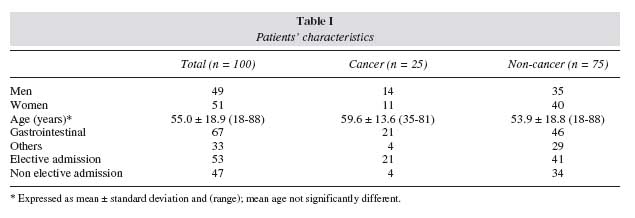
<body><![CDATA[<p align="left"><i>Anthropometry</i> Height was measured in the standing position using          a stadiometer and weight was measured with a Seca<sup>®</sup>          floor scale and rounded to the nearest 0.5 kg. Unintentional % weight          loss was calculated by comparison with the patient&acute;s usual reported          weight and classified as severe if &gt;10% in the six months prior to          hospital admission. Height and weight were used to calculate Body Mass          Index (BMI: weight (kg)/height (m)<sup>2</sup>), classified          as malnutrition when &lt; 20 kg/m<sup>2</sup>, normal 20-25          kg/m<sup>2</sup>, over-weight 25-30 kg/m<sup>2</sup>          and obese &gt; 30 kg/m<sup>2</sup>  <sup>14</sup>. Triceps skinfold          thickness (TSF in mm) was measured with a skinfold caliper (John Bull,          London, UK) at the back of the non-dominant arm, at the midpoint between          the tip of the acromial process of the scapula and the olecranon process          of the ulna determined with a nonstretchable flexible tape. The fold was          held in position while TSF was measured with the caliper placed on the          skin just below the fingers lifting up the fat fold; 3 measurements were          taken and the average recorded. Mid-arm circumference (MAC in cm) was          measured using a non-stretchable flexible tape, perpendicular to the long          axis of the arm, at the same site and position as TSF; care was taken          not to pinch or gap the tape and measurements were taken in triplicate          to the nearest 0.1 cm. Individual values were scored according to reference          tables standardised for age and sex<sup>15</sup>. Patients          anthropometric data were assembled to catego-rise nutritional status as          obesity/overweight, well-nourished, mild, moderate or severe malnutrition          according to McWhirter &amp; Pennington criteria<sup>4</sup>.</p>           <p align="left"><i>Subjective Global Assessment</i> (SGA) relies on symptoms, reported          weight loss, changes in diet in-take, and physical examination to categorise          nutritional status as adequate, moderate or severe malnutrition<sup>16</sup>.</p>           <p align="left"><i>Functional status</i> was evaluated with a Jamar<sup>® </sup>hand          grip dynamometer (Irvington, New York); patients were asked to grip the          dynamometer thrice with their non-dominant hand, the average of the 3          measurements was recorded and compared to age and sex standardised tables          values provided by the manufacturer; a grip strength below 85% of the          reference was considered as malnutrition<sup>4</sup>.</p>           <p align="left"><i>Statistical analysis</i></p>           <p align="left">Data were analysed using SPSS 10.0 (SPSS Inc, USA) statistical software.          Categorical data were expressed as number of patients and (percentage);          continuous data were expressed as mean ± standard deviation and range.          Comparisons were made using &#967;<sup>2</sup> test, Student’s t-test or non-parametric          tests as appropriate. Concordance analysis was performed using Kappa coefficient.          The Youden value, a parameter that aggregates sensitivity and specificity,          was calculated to rank diagnostic tests from –1 (the worst) to 1 (the          best). Spearman non-parametric correlations were used to assess relationships.          Statistical significance was determined for p < 0.05.</p>           <p align="left"><b>Results</b></p>           <p align="left"><i>Patients’ characteristics</i></p>           <p align="left">The study cohort comprised 100 patients, 51 women: 49 men, mean age 55.0          ± 18.9 (range: 18-88, 35 elderly) years, </p>           <p align="center">&nbsp; <a href="#t1"> table I</a>. </p>           <p align="center"><a name="t1"><img src="/img/nh/v19n2/05/5_tabla1.jpg" width="635" height="218"></a></p> 	      ]]></body>
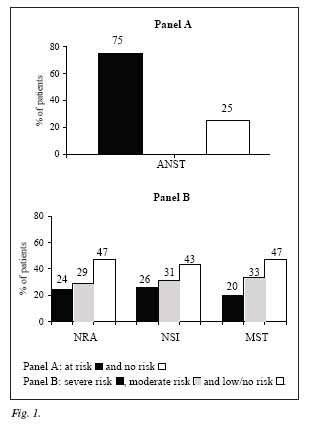
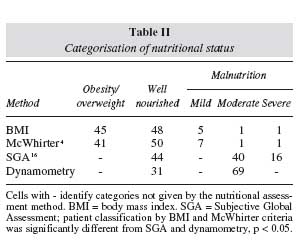
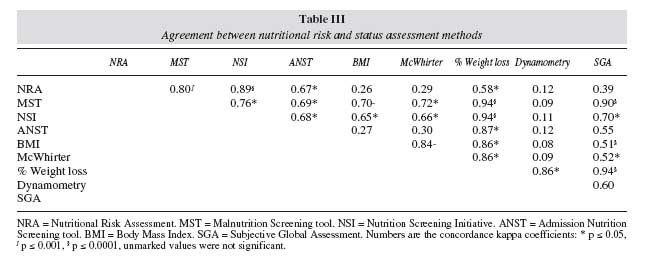
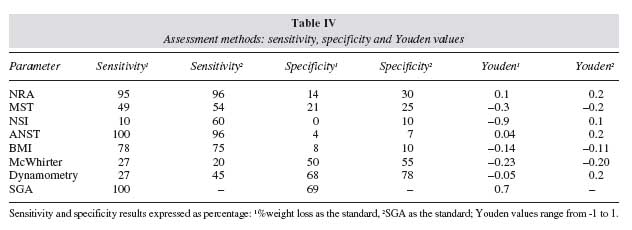
<body><![CDATA[<p align="left"><i>Nutritional risk</i></p> 	      <p align="left">Risk categories are shown in <a href="#f1"> figure 1</a>. Univariate concordance analysis          between all nutritional risk methods, dividing patients into at-risk or          non-risk, showed an agreement between all screening methods, k = 0.69-0.89,          p &lt; 0.05; when NRA, NSI and MST divided patients in high, moderate          or low risk, concordance was significantly higher (k = 0.87-0.93, p &lt;          &nbsp;0.002). For every method, patients with cancer, <font size="2"> &#8805;</font> 65 years old          or reporting &gt; 10% weight loss in the previous six months were at nutritional          risk, p = 0.001.</p> 		    <p align="center"><a name="f1"><img src="/img/nh/v19n2/05/5_figura1.jpg" width="319" height="430"></a></p>           <p align="left"><i>Nutritional status</i></p>           <p align="left">At admission, 58% of patients referred an involuntary weight loss of          9 ± 5 (range: 2-27) kg over the previous six months, representing &gt;          10% of their body weight in 21% of patients and &gt; 5% and &lt; 9% in          25%. Weight loss was greater and duration of weight loss was longer in          cancer patients (13 ± 5, range: 9-35), p = 0.004.</p>           <p align="left">Patients&acute; nutritional status according to the remaining four assessment          methods is shown in <a href="#t2"> table II</a>. Results display a diversity of categories          which are method specific; those relying on anthropometric data are the          only able to detect overweight/obese patients, categories absent in SGA          where clinical variables are dominant, hence shifting the prevalence towards          moderate to severe malnutrition. When analysing the subcategories: well-nourished,          mild, moderate or severe malnutrition, BMI and McWhirter displayed a similar          pattern and significantly different from the SGA categorisation, p = 0.01.          SGA and dynamometry showed a similar distribution pattern.</p>     <p align="center"><a name="t2"><img src="/img/nh/v19n2/05/5_tabla2.jpg" width="305" height="243"></a></p>           <p align="left">Malnutrition was prevalent in cancer patients and in the elderly, p =          0.02; the latter showed a lower handgrip strength, p = 0.04. </p>           <p align="left"><i>Concordance between nutritional risk and status assessment methods</i></p>           <p align="left"><a href="#t3">Table III</a> illustrates the concordance analysis between all methods;       <i>screening</i>          tools were categorised as at-risk and non-risk and status assessment tools          as malnourished and adequate. Agreement between nutritional risk methods          was consistently significant, k = 0.69-0.89, p < 0.05. Concordance amongst          nutritional assessment methods exhibited a broader range (k = 0.51-0.88,          p <font size="2"> &#8804;</font> 0.05), e.g. BMI and SGA agreed with all but dynamometry. Recent weight          loss > 10% was the only method that showed concordance with all nutritional          risk and status assessment methods (k = 0.86- 0.94, p <font size="2"> &#8804;</font> 0.05). We further          performed an age-adjusted sensitivity and specificity analysis and calculated          the Youden value for each assessment method (<a href="#t4">table IV</a>). Because this is          a comparative analysis of 1 or more methods Vs a standard, % weight loss          was flagged as the method with consistently superior ability to detect          mild to extreme nutritional changes, hence to effectively identify patients          at nutritional risk or already malnourished. NRA and ANST were just highly          sensitive, while SGA was highly sensitive and specific; furthermore, SGA          was the only method with a significant Youden value, thus revealing a          strong capacity to effectively detect patients both at high nutritional          risk and malnutrition. In order to value the clinical variables comprised          in some of the screening methods and given the excellent sensitivity and          specificity of SGA, further analysis was performed using SGA as the standard,          NRA and ANST maintained their high sensitivity while dynamometry specificity          improved, <a href="#t4"> table IV</a>.</p>           ]]></body>
<body><![CDATA[<p align="center"><a name="t3"><img src="/img/nh/v19n2/05/5_tabla3.jpg" width="649" height="266"></a></p>           <p align="center"><a name="t4"><img src="/img/nh/v19n2/05/5_tabla4.jpg" width="632" height="230"></a></p>           <p align="left"><b>Discussion</b></p>           <p align="left">Lack of education is a key factor for lack of nutritional care<sup>          7,17</sup>; hence the context in which this study using different          methods was devised and conducted by medical students in order to raise          awareness and skills. </p>           <p align="left"><i>Nutritional risk</i>. An appropriate patient-centred nutrition care          process requires a series of steps with feedback loops; nutritional <i>screening</i>          should first identify those patients who are at nutritional risk or who          may be malnourished and that should then undergo a full nutritional assessment<sup>9,18</sup>.          The importance of nutritional risk <i>screening</i> is consensual, numerous          and increasing methods are at hand and yet they are seldom put into practice<sup>19</sup>.          This study compares results obtained in surgical patients with 4 methods          of different complexity and structure, devised in different ways for different          purposes. At a first glance their performance in detecting patients at          risk of undernutrition was remarkably similar, varying from 75% for ANST13          to 53-57% for the others<sup>7, 11, 12</sup>. The higher prevalence with ANST, highly          sensitive but non-specific, is likely to ensue from its extremely simple          structure devised to be used by nurses in busy wards <sup>13</sup>. The analysis          of our results confirms the validity of ANST to identify patients at-risk          for undernutrition, whereas the other 3 tools were able to further recognise          the existence of poor nutritional status, thus stressing their higher          potential value. Despite the high concordance between those 3 other methods,          NRA, NSI and MST, only Kondrup’s NRA proved to be highly sensitive still          non-specific, and seemingly appropriate to screen disease related undernutrition          in hospitalised patients and to set up boundaries for nutritional       intervention<sup>8</sup>.   </p>            <p align="left"><i>Nutritional status</i>. Accurate nutritional assessments lack age-appropriate          standards and variations in the published prevalence or incidence of malnutrition          is influenced by the assessment and classification criteria<sup>6</sup>;          in the present study, the prevalence of malnutrition ranged from 7% (BMI)          to 69% (dynamo-metry). Clinical evaluation remains the most widely used          method<sup> 9</sup>; it has become almost a dogma that          unintentional weight loss &gt; 10% of pre-illness weight, or in the previous          3-6 months, is a dynamic parameter of nutritional status able to screen          and identify significant nutritional changes<sup>20</sup>.          Our analyses corroborated its superior performance as well as its ability          to detect mild to extreme nutritional changes; hence, weight loss was          the best indicator of nutritional deterioration and should be used to          identify patients at nutritional risk or with recent onset undernutrition<sup>9,21</sup>.   </p>            <p align="left">In addition to weight loss, 4 different methods were compared; in this          group of non-oedematous patients, nutritional status classification was          similar when categorised by BMI or McWhirter & Pennington criteria; the          prevalence of malnutrition was then 7-9%, while most patients were classified          as well nourished or overweight similary to recent reports 22. Regardless          of their limitations, methods relying on anthropometry are needed to classify          overnutrition or extreme undernutrition. Conversely, SGA classified 56%          of patients as malnourished, reaching 69% by dynamometry; the latter did          not agree or correlate with any other parameter, but a trend was found          between dynamometry and Kondrup’s NRA (p = 0.06), suggesting that patients          at nutritional risk may already have reduced functional capacity; likewise,          NRA had a strong concordance with weight loss. SGA combining weight, functional          status, and nutritional intake changes16, showed its high sensitivity          and specificity indicating a very high performance and a strong capacity          to effectively detect patients both at high nutritional risk and undernutrition.</p>           <p align="left">In conclusion, Kondrup’s NRA emerged as the most sensitive tool to screen          nutritional risk in hospitalised patients. The high prevalence of undernutrition          (. 58%) in newly admitted surgical patients depended upon the method and          criteria used (7-69%); BMI still provides useful information. Recent unintentional          weight loss > 10% is a simple method whereas SGA allowed a valid overall          nutritional status evaluation. Our results suggest that NRA screening          in combination with SGA might optimise outcome-driven nutritional management,          to be further validated in larger prospective studies; it certainly would          make decisions easier if a gold standard did exist.</p>           <p align="left"><b>Acknowledgements</b></p>           <p align="left">The Centre of Nutrition and Metabolism is partially funded by a grant          from the &quot;Fundação para a Ciência e Tecnologia &quot;(RUN 437).</p>            ]]></body>
<body><![CDATA[<p align="left"><b>References</b></p>            <!-- ref --><p align="left">1. &quot;King Fund Centre: A positive approach to nutrition as treatment.          London: King&quot; Fund Centre, 1992.&nbsp;&nbsp;&nbsp;&nbsp;&nbsp;&nbsp;&nbsp;&nbsp;[&#160;<a href="javascript:void(0);" onclick="javascript: window.open('/scielo.php?script=sci_nlinks&ref=3445865&pid=S0212-1611200400020000500001&lng=','','width=640,height=500,resizable=yes,scrollbars=1,menubar=yes,');">Links</a>&#160;]<!-- end-ref --><!-- ref --><p align="left">2. Kelly I, Tessier S, Cahill A: Still hungry in the hospital: identifying          malnutrition in acute hospital admissions. <i>Q J Med, </i>2000, 93:93-98.&nbsp;&nbsp;&nbsp;&nbsp;&nbsp;&nbsp;&nbsp;&nbsp;[&#160;<a href="javascript:void(0);" onclick="javascript: window.open('/scielo.php?script=sci_nlinks&ref=3445866&pid=S0212-1611200400020000500002&lng=','','width=640,height=500,resizable=yes,scrollbars=1,menubar=yes,');">Links</a>&#160;]<!-- end-ref --><!-- ref --><p align="left">3. Green CJ: Existence, causes and consequences of disease-related malnutrition          in the hospital and the community, and clinical and financial benefits          of nutritional intervention. <i>Clin Nutr,</i> 1999, 18:3-28.&nbsp;&nbsp;&nbsp;&nbsp;&nbsp;&nbsp;&nbsp;&nbsp;[&#160;<a href="javascript:void(0);" onclick="javascript: window.open('/scielo.php?script=sci_nlinks&ref=3445867&pid=S0212-1611200400020000500003&lng=','','width=640,height=500,resizable=yes,scrollbars=1,menubar=yes,');">Links</a>&#160;]<!-- end-ref --><!-- ref --><p align="left">4. McWhirter JP and Pennington CR: Incidence and recognition of malnutrition          in hospital. <i>BMJ,</i> 1994, 308:945-948.&nbsp;&nbsp;&nbsp;&nbsp;&nbsp;&nbsp;&nbsp;&nbsp;[&#160;<a href="javascript:void(0);" onclick="javascript: window.open('/scielo.php?script=sci_nlinks&ref=3445868&pid=S0212-1611200400020000500004&lng=','','width=640,height=500,resizable=yes,scrollbars=1,menubar=yes,');">Links</a>&#160;]<!-- end-ref --><!-- ref --><p align="left">5. Edington J, Boorman J, Durrant ER, et al.: Prevalence of malnutrition          on admission to four hospitals in England. <i>Clin Nutr, </i>2000, 19:191-195.&nbsp;&nbsp;&nbsp;&nbsp;&nbsp;&nbsp;&nbsp;&nbsp;[&#160;<a href="javascript:void(0);" onclick="javascript: window.open('/scielo.php?script=sci_nlinks&ref=3445869&pid=S0212-1611200400020000500005&lng=','','width=640,height=500,resizable=yes,scrollbars=1,menubar=yes,');">Links</a>&#160;]<!-- end-ref --><!-- ref --><p align="left">6. Heymsfield SB, Tighe A and Wang Z-M: Nutritional assessment by anthropometric          and biochemical methods. In: Shils ME, Olson JA, Shike M, eds. Modern          nutrition in health and disease. 8th ed. Malvern: Lea and          Febiger; 1994, 812-841.&nbsp;&nbsp;&nbsp;&nbsp;&nbsp;&nbsp;&nbsp;&nbsp;[&#160;<a href="javascript:void(0);" onclick="javascript: window.open('/scielo.php?script=sci_nlinks&ref=3445870&pid=S0212-1611200400020000500006&lng=','','width=640,height=500,resizable=yes,scrollbars=1,menubar=yes,');">Links</a>&#160;]<!-- end-ref --><!-- ref --><p align="left">7. BAPEN-Malnutrition Advisory Group: Guidelines for detection and management          of malnutrition. Essex: BAPEN; 2000.&nbsp;&nbsp;&nbsp;&nbsp;&nbsp;&nbsp;&nbsp;&nbsp;[&#160;<a href="javascript:void(0);" onclick="javascript: window.open('/scielo.php?script=sci_nlinks&ref=3445871&pid=S0212-1611200400020000500007&lng=','','width=640,height=500,resizable=yes,scrollbars=1,menubar=yes,');">Links</a>&#160;]<!-- end-ref --><!-- ref --><p align="left">8. Kondrup J, Johansen N, Plum L, et al.: Incidence of nutritional risk          and causes of inadequate nutritional care in hospitals. <i>Clin Nutr,</i>          2002, 21:461-468.&nbsp;&nbsp;&nbsp;&nbsp;&nbsp;&nbsp;&nbsp;&nbsp;[&#160;<a href="javascript:void(0);" onclick="javascript: window.open('/scielo.php?script=sci_nlinks&ref=3445872&pid=S0212-1611200400020000500008&lng=','','width=640,height=500,resizable=yes,scrollbars=1,menubar=yes,');">Links</a>&#160;]<!-- end-ref --><!-- ref --><p align="left">9. ASPEN Board of Directors: Guidelines for the use of parenteral and          enteral nutrition in adult and pediatric patients. <i>JPEN, </i>2002,          26 (Supl):9SA-11SA.&nbsp;&nbsp;&nbsp;&nbsp;&nbsp;&nbsp;&nbsp;&nbsp;[&#160;<a href="javascript:void(0);" onclick="javascript: window.open('/scielo.php?script=sci_nlinks&ref=3445873&pid=S0212-1611200400020000500009&lng=','','width=640,height=500,resizable=yes,scrollbars=1,menubar=yes,');">Links</a>&#160;]<!-- end-ref --><!-- ref --><p align="left">10. Casimiro C, García de Lorenzo A and Usan L: Evaluation of nutritional          risk in ambulatory elderly patients. <i>Nutr Hosp, </i>2001, 16:97-103.&nbsp;&nbsp;&nbsp;&nbsp;&nbsp;&nbsp;&nbsp;&nbsp;[&#160;<a href="javascript:void(0);" onclick="javascript: window.open('/scielo.php?script=sci_nlinks&ref=3445874&pid=S0212-1611200400020000500010&lng=','','width=640,height=500,resizable=yes,scrollbars=1,menubar=yes,');">Links</a>&#160;]<!-- end-ref --><!-- ref --><p align="left">11. Kondrup J, Rasmussen HH, Hamberg O, Stanga Z and an <i>ad hoc</i>          ESPEN Working Group: Nutritional Risk Screening (NRS 2002): a new method          based on an analysis of controlled clinical trials. <i>Clin Nutr,</i>          2003, 22:321-336.&nbsp;&nbsp;&nbsp;&nbsp;&nbsp;&nbsp;&nbsp;&nbsp;[&#160;<a href="javascript:void(0);" onclick="javascript: window.open('/scielo.php?script=sci_nlinks&ref=3445875&pid=S0212-1611200400020000500011&lng=','','width=640,height=500,resizable=yes,scrollbars=1,menubar=yes,');">Links</a>&#160;]<!-- end-ref --><!-- ref --><p align="left">12. Chernoff R: Nutrition monitoring and research studies: Nutrition Screening          Initiative. In: Berdanier C, ed. Handbook of nutrition and food. Boca          Raton, FL: CRC Press; 2002, 463-476.&nbsp;&nbsp;&nbsp;&nbsp;&nbsp;&nbsp;&nbsp;&nbsp;[&#160;<a href="javascript:void(0);" onclick="javascript: window.open('/scielo.php?script=sci_nlinks&ref=3445876&pid=S0212-1611200400020000500012&lng=','','width=640,height=500,resizable=yes,scrollbars=1,menubar=yes,');">Links</a>&#160;]<!-- end-ref --><!-- ref --><p align="left">13. Kovacevich DS, Boney AR, Braunschweig CL, Pérez A and Stevens M: Nutrition          risk classifications: a reproducible and valid tool for nurses. <i>Nutr          Clin Pract,</i> 1997, 12:20-25.&nbsp;&nbsp;&nbsp;&nbsp;&nbsp;&nbsp;&nbsp;&nbsp;[&#160;<a href="javascript:void(0);" onclick="javascript: window.open('/scielo.php?script=sci_nlinks&ref=3445877&pid=S0212-1611200400020000500013&lng=','','width=640,height=500,resizable=yes,scrollbars=1,menubar=yes,');">Links</a>&#160;]<!-- end-ref --><!-- ref --><p align="left">14. Garrow JS: Treat obesity seriously. Edinburgh: Churchill Livingstone,          1981.&nbsp;&nbsp;&nbsp;&nbsp;&nbsp;&nbsp;&nbsp;&nbsp;[&#160;<a href="javascript:void(0);" onclick="javascript: window.open('/scielo.php?script=sci_nlinks&ref=3445878&pid=S0212-1611200400020000500014&lng=','','width=640,height=500,resizable=yes,scrollbars=1,menubar=yes,');">Links</a>&#160;]<!-- end-ref --><!-- ref --><p align="left">15. Frisancho AR: New norms of upper limb fat and muscle areas for assessment          of nutritional status. <i>Am J Clin Nutr,</i> 1981, 34:2540-2545.&nbsp;&nbsp;&nbsp;&nbsp;&nbsp;&nbsp;&nbsp;&nbsp;[&#160;<a href="javascript:void(0);" onclick="javascript: window.open('/scielo.php?script=sci_nlinks&ref=3445879&pid=S0212-1611200400020000500015&lng=','','width=640,height=500,resizable=yes,scrollbars=1,menubar=yes,');">Links</a>&#160;]<!-- end-ref --><!-- ref --><p align="left">16. Detsky A, McLaughlin JR, Baker JP, et al.: What is subjective global          assessment of nutritional status? <i>JPEN,</i> 1987, 11:8-13.&nbsp;&nbsp;&nbsp;&nbsp;&nbsp;&nbsp;&nbsp;&nbsp;[&#160;<a href="javascript:void(0);" onclick="javascript: window.open('/scielo.php?script=sci_nlinks&ref=3445880&pid=S0212-1611200400020000500016&lng=','','width=640,height=500,resizable=yes,scrollbars=1,menubar=yes,');">Links</a>&#160;]<!-- end-ref --><!-- ref --><p align="left">17. Council of Europe: Food and nutritional care in hospitals: how to          prevent undernutrition. Report and recommendations of the Committee of          Experts on Nutrition, Food Safety and Consumer Protection. Strasbourg:          Council of Europe Publishing, 2002.&nbsp;&nbsp;&nbsp;&nbsp;&nbsp;&nbsp;&nbsp;&nbsp;[&#160;<a href="javascript:void(0);" onclick="javascript: window.open('/scielo.php?script=sci_nlinks&ref=3445881&pid=S0212-1611200400020000500017&lng=','','width=640,height=500,resizable=yes,scrollbars=1,menubar=yes,');">Links</a>&#160;]<!-- end-ref --><!-- ref --><p align="left">18. American Society of Parenteral and Enteral Nutrition Board of Directors          and Task Force on Standards for Specialized Nutrition Support for Hospitalized          Adult Patients: Russell MAM, Brewer C, Rogers J, Seidner D. Standards          for Specialized Nutrition Support: Adult Hospitalized Patients. <i>Nutr          Clin Pract, </i>2002, 17:384-391.&nbsp;&nbsp;&nbsp;&nbsp;&nbsp;&nbsp;&nbsp;&nbsp;&nbsp;[&#160;<a href="javascript:void(0);" onclick="javascript: window.open('/scielo.php?script=sci_nlinks&ref=3445882&pid=S0212-1611200400020000500018&lng=','','width=640,height=500,resizable=yes,scrollbars=1,menubar=yes,');">Links</a>&#160;]<!-- end-ref --><!-- ref --><p align="left">19. Chernoff R: Normal aging,          nutritional assessment, and clinical practice. <i>Nutr Clin Pract,</i>          2003, 18:12-20.&nbsp;&nbsp;&nbsp;&nbsp;&nbsp;&nbsp;&nbsp;&nbsp;[&#160;<a href="javascript:void(0);" onclick="javascript: window.open('/scielo.php?script=sci_nlinks&ref=3445883&pid=S0212-1611200400020000500019&lng=','','width=640,height=500,resizable=yes,scrollbars=1,menubar=yes,');">Links</a>&#160;]<!-- end-ref --><!-- ref --><p align="left">20. Hill G: The clinical assessment of adult patients with protein energy          malnutrition. <i>Nutr Clin Prac,</i> 1995, 10:129-130.&nbsp;&nbsp;&nbsp;&nbsp;&nbsp;&nbsp;&nbsp;&nbsp;[&#160;<a href="javascript:void(0);" onclick="javascript: window.open('/scielo.php?script=sci_nlinks&ref=3445884&pid=S0212-1611200400020000500020&lng=','','width=640,height=500,resizable=yes,scrollbars=1,menubar=yes,');">Links</a>&#160;]<!-- end-ref --><!-- ref --><p align="left">21. Klein S, Kinney J, Jeejeebhoy K, et al.: Nutrition support in clinical          practice: review of published data and recommendations for future research          directions. <i>Am J Clin Nutr, </i>1997, 66:683-706.&nbsp;&nbsp;&nbsp;&nbsp;&nbsp;&nbsp;&nbsp;&nbsp;[&#160;<a href="javascript:void(0);" onclick="javascript: window.open('/scielo.php?script=sci_nlinks&ref=3445885&pid=S0212-1611200400020000500021&lng=','','width=640,height=500,resizable=yes,scrollbars=1,menubar=yes,');">Links</a>&#160;]<!-- end-ref --><!-- ref --><p align="left">22. Prentice A and Jebb S: Beyond body mass index. <i>Obes Rev, </i>2001,          2:141-147.&nbsp;&nbsp;&nbsp;&nbsp;&nbsp;&nbsp;&nbsp;&nbsp;[&#160;<a href="javascript:void(0);" onclick="javascript: window.open('/scielo.php?script=sci_nlinks&ref=3445886&pid=S0212-1611200400020000500022&lng=','','width=640,height=500,resizable=yes,scrollbars=1,menubar=yes,');">Links</a>&#160;]<!-- end-ref --> ]]></body><back>
<ref-list>
<ref id="B1">
<label>1</label><nlm-citation citation-type="book">
<collab>King Fund Centre</collab>
<source><![CDATA[A positive approach to nutrition as treatment]]></source>
<year>1992</year>
<publisher-loc><![CDATA[London ]]></publisher-loc>
<publisher-name><![CDATA[King" Fund Centre]]></publisher-name>
</nlm-citation>
</ref>
<ref id="B2">
<label>2</label><nlm-citation citation-type="journal">
<person-group person-group-type="author">
<name>
<surname><![CDATA[Kelly]]></surname>
<given-names><![CDATA[I]]></given-names>
</name>
<name>
<surname><![CDATA[Tessier]]></surname>
<given-names><![CDATA[S]]></given-names>
</name>
<name>
<surname><![CDATA[Cahill]]></surname>
<given-names><![CDATA[A]]></given-names>
</name>
</person-group>
<article-title xml:lang="en"><![CDATA[Still hungry in the hospital: identifying malnutrition in acute hospital admissions]]></article-title>
<source><![CDATA[Q J Med]]></source>
<year>2000</year>
<volume>93</volume>
<page-range>93-98</page-range></nlm-citation>
</ref>
<ref id="B3">
<label>3</label><nlm-citation citation-type="journal">
<person-group person-group-type="author">
<name>
<surname><![CDATA[Green]]></surname>
<given-names><![CDATA[CJ]]></given-names>
</name>
</person-group>
<article-title xml:lang="en"><![CDATA[Existence, causes and consequences of disease-related malnutrition in the hospital and the community, and clinical and financial benefits of nutritional intervention]]></article-title>
<source><![CDATA[Clin Nutr]]></source>
<year>1999</year>
<volume>18</volume>
<page-range>3-28</page-range></nlm-citation>
</ref>
<ref id="B4">
<label>4</label><nlm-citation citation-type="journal">
<person-group person-group-type="author">
<name>
<surname><![CDATA[McWhirter]]></surname>
<given-names><![CDATA[JP]]></given-names>
</name>
<name>
<surname><![CDATA[Pennington]]></surname>
<given-names><![CDATA[CR]]></given-names>
</name>
</person-group>
<article-title xml:lang="en"><![CDATA[Incidence and recognition of malnutrition in hospital]]></article-title>
<source><![CDATA[BMJ]]></source>
<year>1994</year>
<volume>308</volume>
<page-range>945-948</page-range></nlm-citation>
</ref>
<ref id="B5">
<label>5</label><nlm-citation citation-type="journal">
<person-group person-group-type="author">
<name>
<surname><![CDATA[Edington]]></surname>
<given-names><![CDATA[J]]></given-names>
</name>
<name>
<surname><![CDATA[Boorman]]></surname>
<given-names><![CDATA[J]]></given-names>
</name>
<name>
<surname><![CDATA[Durrant]]></surname>
<given-names><![CDATA[ER]]></given-names>
</name>
</person-group>
<article-title xml:lang="en"><![CDATA[Prevalence of malnutrition on admission to four hospitals in England]]></article-title>
<source><![CDATA[Clin Nutr]]></source>
<year>2000</year>
<volume>19</volume>
<page-range>191-195</page-range></nlm-citation>
</ref>
<ref id="B6">
<label>6</label><nlm-citation citation-type="book">
<person-group person-group-type="author">
<name>
<surname><![CDATA[Heymsfield]]></surname>
<given-names><![CDATA[SB]]></given-names>
</name>
<name>
<surname><![CDATA[Tighe]]></surname>
<given-names><![CDATA[A]]></given-names>
</name>
<name>
<surname><![CDATA[Wang]]></surname>
<given-names><![CDATA[Z-M]]></given-names>
</name>
</person-group>
<article-title xml:lang="en"><![CDATA[Nutritional assessment by anthropometric and biochemical methods]]></article-title>
<person-group person-group-type="editor">
<name>
<surname><![CDATA[Shils]]></surname>
<given-names><![CDATA[ME]]></given-names>
</name>
<name>
<surname><![CDATA[Olson]]></surname>
<given-names><![CDATA[JA]]></given-names>
</name>
<name>
<surname><![CDATA[Shike]]></surname>
<given-names><![CDATA[M]]></given-names>
</name>
</person-group>
<source><![CDATA[Modern nutrition in health and disease]]></source>
<year>1994</year>
<edition>8</edition>
<page-range>812-841</page-range><publisher-loc><![CDATA[Malvern ]]></publisher-loc>
<publisher-name><![CDATA[Lea and Febiger]]></publisher-name>
</nlm-citation>
</ref>
<ref id="B7">
<label>7</label><nlm-citation citation-type="book">
<collab>BAPEN-Malnutrition Advisory Group</collab>
<source><![CDATA[Guidelines for detection and management of malnutrition]]></source>
<year>2000</year>
<publisher-loc><![CDATA[Essex ]]></publisher-loc>
<publisher-name><![CDATA[BAPEN]]></publisher-name>
</nlm-citation>
</ref>
<ref id="B8">
<label>8</label><nlm-citation citation-type="journal">
<person-group person-group-type="author">
<name>
<surname><![CDATA[Kondrup]]></surname>
<given-names><![CDATA[J]]></given-names>
</name>
<name>
<surname><![CDATA[Johansen]]></surname>
<given-names><![CDATA[N]]></given-names>
</name>
<name>
<surname><![CDATA[Plum]]></surname>
<given-names><![CDATA[L]]></given-names>
</name>
</person-group>
<article-title xml:lang="en"><![CDATA[Incidence of nutritional risk and causes of inadequate nutritional care in hospitals]]></article-title>
<source><![CDATA[Clin Nutr]]></source>
<year>2002</year>
<volume>21</volume>
<page-range>461-468</page-range></nlm-citation>
</ref>
<ref id="B9">
<label>9</label><nlm-citation citation-type="journal">
<collab>ASPEN Board of Directors</collab>
<article-title xml:lang="en"><![CDATA[Guidelines for the use of parenteral and enteral nutrition in adult and pediatric patients]]></article-title>
<source><![CDATA[JPEN]]></source>
<year>2002</year>
<volume>26</volume>
<page-range>9SA-11SA</page-range></nlm-citation>
</ref>
<ref id="B10">
<label>10</label><nlm-citation citation-type="journal">
<person-group person-group-type="author">
<name>
<surname><![CDATA[Casimiro]]></surname>
<given-names><![CDATA[C]]></given-names>
</name>
<name>
<surname><![CDATA[García de Lorenzo]]></surname>
<given-names><![CDATA[A]]></given-names>
</name>
<name>
<surname><![CDATA[Usan]]></surname>
<given-names><![CDATA[L]]></given-names>
</name>
</person-group>
<article-title xml:lang="en"><![CDATA[Evaluation of nutritional risk in ambulatory elderly patients]]></article-title>
<source><![CDATA[Nutr Hosp]]></source>
<year>2001</year>
<volume>16</volume>
<page-range>97-103</page-range></nlm-citation>
</ref>
<ref id="B11">
<label>11</label><nlm-citation citation-type="journal">
<person-group person-group-type="author">
<name>
<surname><![CDATA[Kondrup]]></surname>
<given-names><![CDATA[J]]></given-names>
</name>
<name>
<surname><![CDATA[Rasmussen]]></surname>
<given-names><![CDATA[HH]]></given-names>
</name>
<name>
<surname><![CDATA[Hamberg]]></surname>
<given-names><![CDATA[O]]></given-names>
</name>
<name>
<surname><![CDATA[Stanga]]></surname>
<given-names><![CDATA[Z]]></given-names>
</name>
</person-group>
<collab>ESPEN Working Group</collab>
<article-title xml:lang="en"><![CDATA[Nutritional Risk Screening (NRS 2002): a new method based on an analysis of controlled clinical trials]]></article-title>
<source><![CDATA[Clin Nutr]]></source>
<year>2003</year>
<volume>22</volume>
<page-range>321-336</page-range></nlm-citation>
</ref>
<ref id="B12">
<label>12</label><nlm-citation citation-type="book">
<person-group person-group-type="author">
<name>
<surname><![CDATA[Chernoff]]></surname>
<given-names><![CDATA[R]]></given-names>
</name>
</person-group>
<article-title xml:lang="en"><![CDATA[Nutrition monitoring and research studies: Nutrition Screening Initiative]]></article-title>
<person-group person-group-type="editor">
<name>
<surname><![CDATA[Berdanier]]></surname>
<given-names><![CDATA[C]]></given-names>
</name>
</person-group>
<source><![CDATA[Handbook of nutrition and food]]></source>
<year>2002</year>
<page-range>463-476</page-range><publisher-loc><![CDATA[Boca Raton^eFL FL]]></publisher-loc>
<publisher-name><![CDATA[CRC Press]]></publisher-name>
</nlm-citation>
</ref>
<ref id="B13">
<label>13</label><nlm-citation citation-type="journal">
<person-group person-group-type="author">
<name>
<surname><![CDATA[Kovacevich]]></surname>
<given-names><![CDATA[DS]]></given-names>
</name>
<name>
<surname><![CDATA[Boney]]></surname>
<given-names><![CDATA[AR]]></given-names>
</name>
<name>
<surname><![CDATA[Braunschweig]]></surname>
<given-names><![CDATA[CL]]></given-names>
</name>
<name>
<surname><![CDATA[Pérez]]></surname>
<given-names><![CDATA[A]]></given-names>
</name>
<name>
<surname><![CDATA[Stevens]]></surname>
<given-names><![CDATA[M]]></given-names>
</name>
</person-group>
<article-title xml:lang="en"><![CDATA[Nutrition risk classifications: a reproducible and valid tool for nurses]]></article-title>
<source><![CDATA[Nutr Clin Pract]]></source>
<year>1997</year>
<volume>12</volume>
<page-range>20-25</page-range></nlm-citation>
</ref>
<ref id="B14">
<label>14</label><nlm-citation citation-type="book">
<person-group person-group-type="author">
<name>
<surname><![CDATA[Garrow]]></surname>
<given-names><![CDATA[JS]]></given-names>
</name>
</person-group>
<source><![CDATA[Treat obesity seriously]]></source>
<year>1981</year>
<publisher-loc><![CDATA[Edinburgh ]]></publisher-loc>
<publisher-name><![CDATA[Churchill Livingstone]]></publisher-name>
</nlm-citation>
</ref>
<ref id="B15">
<label>15</label><nlm-citation citation-type="journal">
<person-group person-group-type="author">
<name>
<surname><![CDATA[Frisancho]]></surname>
<given-names><![CDATA[AR]]></given-names>
</name>
</person-group>
<article-title xml:lang="en"><![CDATA[New norms of upper limb fat and muscle areas for assessment of nutritional status]]></article-title>
<source><![CDATA[Am J Clin Nutr]]></source>
<year>1981</year>
<volume>34</volume>
<page-range>2540-2545</page-range></nlm-citation>
</ref>
<ref id="B16">
<label>16</label><nlm-citation citation-type="journal">
<person-group person-group-type="author">
<name>
<surname><![CDATA[Detsky]]></surname>
<given-names><![CDATA[A]]></given-names>
</name>
<name>
<surname><![CDATA[McLaughlin]]></surname>
<given-names><![CDATA[JR]]></given-names>
</name>
<name>
<surname><![CDATA[Baker]]></surname>
<given-names><![CDATA[JP]]></given-names>
</name>
</person-group>
<article-title xml:lang="en"><![CDATA[What is subjective global assessment of nutritional status?]]></article-title>
<source><![CDATA[JPEN]]></source>
<year>1987</year>
<page-range>11:8-13</page-range></nlm-citation>
</ref>
<ref id="B17">
<label>17</label><nlm-citation citation-type="book">
<collab>Council of Europe</collab>
<article-title xml:lang="en"><![CDATA[Food and nutritional care in hospitals: how to prevent undernutrition]]></article-title>
<source><![CDATA[Report and recommendations of the Committee of Experts on Nutrition, Food Safety and Consumer Protection]]></source>
<year>2002</year>
<publisher-loc><![CDATA[Strasbourg ]]></publisher-loc>
<publisher-name><![CDATA[Council of Europe Publishing]]></publisher-name>
</nlm-citation>
</ref>
<ref id="B18">
<label>18</label><nlm-citation citation-type="journal">
<person-group person-group-type="author">
<name>
<surname><![CDATA[Russell]]></surname>
<given-names><![CDATA[MAM]]></given-names>
</name>
<name>
<surname><![CDATA[Brewer]]></surname>
<given-names><![CDATA[C]]></given-names>
</name>
<name>
<surname><![CDATA[Rogers]]></surname>
<given-names><![CDATA[J]]></given-names>
</name>
<name>
<surname><![CDATA[Seidner]]></surname>
<given-names><![CDATA[D]]></given-names>
</name>
</person-group>
<collab>American Society of Parenteral and Enteral Nutrition Board of Directors and Task Force on Standards for Specialized Nutrition Support for Hospitalized Adult Patients</collab>
<article-title xml:lang="en"><![CDATA[Standards for Specialized Nutrition Support: Adult Hospitalized Patients]]></article-title>
<source><![CDATA[Nutr Clin Pract]]></source>
<year>2002</year>
<volume>17</volume>
<page-range>384-391</page-range></nlm-citation>
</ref>
<ref id="B19">
<label>19</label><nlm-citation citation-type="journal">
<person-group person-group-type="author">
<name>
<surname><![CDATA[Chernoff]]></surname>
<given-names><![CDATA[R]]></given-names>
</name>
</person-group>
<article-title xml:lang="en"><![CDATA[Normal aging, nutritional assessment, and clinical practice]]></article-title>
<source><![CDATA[Nutr Clin Pract]]></source>
<year>2003</year>
<volume>18</volume>
<page-range>12-20</page-range></nlm-citation>
</ref>
<ref id="B20">
<label>20</label><nlm-citation citation-type="journal">
<person-group person-group-type="author">
<name>
<surname><![CDATA[Hill]]></surname>
<given-names><![CDATA[G]]></given-names>
</name>
</person-group>
<article-title xml:lang="en"><![CDATA[The clinical assessment of adult patients with protein energy malnutrition]]></article-title>
<source><![CDATA[Nutr Clin Prac]]></source>
<year>1995</year>
<volume>10</volume>
<page-range>129-130</page-range></nlm-citation>
</ref>
<ref id="B21">
<label>21</label><nlm-citation citation-type="journal">
<person-group person-group-type="author">
<name>
<surname><![CDATA[Klein]]></surname>
<given-names><![CDATA[S]]></given-names>
</name>
<name>
<surname><![CDATA[Kinney]]></surname>
<given-names><![CDATA[J]]></given-names>
</name>
<name>
<surname><![CDATA[Jeejeebhoy]]></surname>
<given-names><![CDATA[K]]></given-names>
</name>
</person-group>
<article-title xml:lang="en"><![CDATA[Nutrition support in clinical practice: review of published data and recommendations for future research directions]]></article-title>
<source><![CDATA[Am J Clin Nutr]]></source>
<year>1997</year>
<volume>66</volume>
<page-range>683-706</page-range></nlm-citation>
</ref>
<ref id="B22">
<label>22</label><nlm-citation citation-type="journal">
<person-group person-group-type="author">
<name>
<surname><![CDATA[Prentice]]></surname>
<given-names><![CDATA[A]]></given-names>
</name>
<name>
<surname><![CDATA[Jebb]]></surname>
<given-names><![CDATA[S]]></given-names>
</name>
</person-group>
<article-title xml:lang="en"><![CDATA[Beyond body mass index]]></article-title>
<source><![CDATA[Obes Rev]]></source>
<year>2001</year>
<volume>2</volume>
<page-range>141-147</page-range></nlm-citation>
</ref>
</ref-list>
</back>
</article>