<?xml version="1.0" encoding="ISO-8859-1"?><article xmlns:mml="http://www.w3.org/1998/Math/MathML" xmlns:xlink="http://www.w3.org/1999/xlink" xmlns:xsi="http://www.w3.org/2001/XMLSchema-instance">
<front>
<journal-meta>
<journal-id>0212-1611</journal-id>
<journal-title><![CDATA[Nutrición Hospitalaria]]></journal-title>
<abbrev-journal-title><![CDATA[Nutr. Hosp.]]></abbrev-journal-title>
<issn>0212-1611</issn>
<publisher>
<publisher-name><![CDATA[Grupo Arán]]></publisher-name>
</publisher>
</journal-meta>
<article-meta>
<article-id>S0212-16112004000200006</article-id>
<title-group>
<article-title xml:lang="en"><![CDATA[Pre-and postoperative nutritional evaluation in patients with chagasic megaesophagus]]></article-title>
<article-title xml:lang="es"><![CDATA[Evaluación nutricional pre y postoperatoriade los pacientes con megaesófago por enfermedad de Chagas]]></article-title>
</title-group>
<contrib-group>
<contrib contrib-type="author">
<name>
<surname><![CDATA[Penhavel]]></surname>
<given-names><![CDATA[F. A. S.]]></given-names>
</name>
<xref ref-type="aff" rid="A01"/>
</contrib>
<contrib contrib-type="author">
<name>
<surname><![CDATA[Waitzberg]]></surname>
<given-names><![CDATA[D. L.]]></given-names>
</name>
<xref ref-type="aff" rid="A02"/>
</contrib>
<contrib contrib-type="author">
<name>
<surname><![CDATA[Trevenzol]]></surname>
<given-names><![CDATA[H. P.]]></given-names>
</name>
<xref ref-type="aff" rid="A01"/>
</contrib>
<contrib contrib-type="author">
<name>
<surname><![CDATA[Alves]]></surname>
<given-names><![CDATA[L.]]></given-names>
</name>
<xref ref-type="aff" rid="A01"/>
</contrib>
<contrib contrib-type="author">
<name>
<surname><![CDATA[Zilberstein]]></surname>
<given-names><![CDATA[B.]]></given-names>
</name>
<xref ref-type="aff" rid="A02"/>
</contrib>
<contrib contrib-type="author">
<name>
<surname><![CDATA[Gama-Rodrigues]]></surname>
<given-names><![CDATA[J.]]></given-names>
</name>
<xref ref-type="aff" rid="A02"/>
</contrib>
</contrib-group>
<aff id="A01">
<institution><![CDATA[,Federal University of Goiás School of Medicine Discipline of General Surgery]]></institution>
<addr-line><![CDATA[ ]]></addr-line>
</aff>
<aff id="A02">
<institution><![CDATA[,School of Medicine University of São Paulo LIM 35 Discipline of Digestive Surgery]]></institution>
<addr-line><![CDATA[ ]]></addr-line>
</aff>
<pub-date pub-type="pub">
<day>00</day>
<month>03</month>
<year>2004</year>
</pub-date>
<pub-date pub-type="epub">
<day>00</day>
<month>03</month>
<year>2004</year>
</pub-date>
<volume>19</volume>
<numero>2</numero>
<fpage>89</fpage>
<lpage>94</lpage>
<copyright-statement/>
<copyright-year/>
<self-uri xlink:href="http://scielo.isciii.es/scielo.php?script=sci_arttext&amp;pid=S0212-16112004000200006&amp;lng=en&amp;nrm=iso"></self-uri><self-uri xlink:href="http://scielo.isciii.es/scielo.php?script=sci_abstract&amp;pid=S0212-16112004000200006&amp;lng=en&amp;nrm=iso"></self-uri><self-uri xlink:href="http://scielo.isciii.es/scielo.php?script=sci_pdf&amp;pid=S0212-16112004000200006&amp;lng=en&amp;nrm=iso"></self-uri><abstract abstract-type="short" xml:lang="en"><p><![CDATA[Chagasic megaesophagus is a chronic disease that courses with progressive dysphagia, regurgitation and protein-calorie malnutrition. Advanced or recurrent megaesophagus can be treated with Serra Dória’s operation (cardioplasty, partial gastrectomy and gastrojejunal Roux-en-Y anastomosis). A nutritional evaluation was performed on 27 patients (mean age 58 ± 10 years) with chagasic megaesophagus at admission and after postoperative day 90. The nutritional state was assessed through global subjective nutritional evaluation (GSNE), anthropometry and laboratorial exams, besides the analysis of alimentary intake. In the preoperative period, GSNE pointed to malnutrition in 2/3 patients, while the anthropometric and laboratorial evaluation revealed that over 60% of the patients had protein-calorie malnutrition of the marasmic type. The preoperative nutritional state as evaluated by GSNE did not correlate with complications or postoperative mortality. The postoperative evaluation showed an increase in the intake of proteins, recovery in the body mass index and a reduction in the hemoglobin levels of the peripheral blood.]]></p></abstract>
<abstract abstract-type="short" xml:lang="es"><p><![CDATA[El megaesófago debido a la enfermedad de Chagas es una enfermedad crónica que cursa con disfagia progresiva, regurgitación y malnutrición proteínico-calórica. El megaesófago en fase avanzada recidivante se puede tratar con la operación de Serra Doria (cardioplastia, gastrectomía parcial y anastomosis gastroyeyunal Souxen- Y). Se efectuó una evaluación nutricional de 27 pacientes (promedio de edad de 58 ± 10 años) con megaesófago por enfermedad de Chagas durante el ingreso así como a los 90 días del postoperatorio. El estado nutricional se examinó a través de la evaluación nutricional subjetiva general (GSNE), la antropometría y los datos de laboratorio, aparte del análisis del aporte alimentario. Durante el preoperatorio, la GSNE delató una malnutrición de 2/3 de los pacientes, mientras que la evaluación antropométrica y de laboratorio reveló que más del 60% de los enfermos sufrían una malnutrición proteínico- calórica de tipo marásmico. El estado nutricional preoperatorio, a juzgar por la GSNE, no se correlacionó con las complicaciones ni con la mortalidad postoperatoria. La evolución postoperatoria reveló un aumento del aporte de proteínas, una recuperación del índice de masa corporal y un descenso de los valores de hemoglobina en la sangre periférica.]]></p></abstract>
<kwd-group>
<kwd lng="en"><![CDATA[Esophagic achalasia/surgery]]></kwd>
<kwd lng="en"><![CDATA[Chagas’ disease/ etiology]]></kwd>
<kwd lng="en"><![CDATA[Nutritional evaluation]]></kwd>
<kwd lng="en"><![CDATA[Nutritional disturbance/ diagnosis]]></kwd>
<kwd lng="en"><![CDATA[Anthropometry/methods]]></kwd>
<kwd lng="en"><![CDATA[Preoperative care]]></kwd>
<kwd lng="en"><![CDATA[Postoperative period. Morbidity]]></kwd>
<kwd lng="en"><![CDATA[Gastrectomy/adverse effects]]></kwd>
<kwd lng="en"><![CDATA[Follow-up]]></kwd>
<kwd lng="es"><![CDATA[Acalasia esofágica/cirugía esofágica]]></kwd>
<kwd lng="es"><![CDATA[Enfermedad de Chagas/etiología]]></kwd>
<kwd lng="es"><![CDATA[Evaluación nutricional]]></kwd>
<kwd lng="es"><![CDATA[Alteración nutricional/diagnóstico]]></kwd>
<kwd lng="es"><![CDATA[Métodos antropométricos]]></kwd>
<kwd lng="es"><![CDATA[Tratamiento preoperatorio]]></kwd>
<kwd lng="es"><![CDATA[Período postoperatorio]]></kwd>
<kwd lng="es"><![CDATA[Morbilidad]]></kwd>
<kwd lng="es"><![CDATA[Gastrectomía/reacciones adversas]]></kwd>
<kwd lng="es"><![CDATA[Seguimiento]]></kwd>
</kwd-group>
</article-meta>
</front><body><![CDATA[ <p><font size="4"><b>Original</b></font></p>     <p><b><font size=5>Pre-and postoperative nutritional evaluation in patients with chagasic    <br> megaesophagus</font></b></p>     <p><font size="3">F. A. S. Penhavel*; D. L. Waitzberg**; H. P. Trevenzol*; L. Alves*;          B. Zilberstein**; J. Gama-Rodrigues**</font></p>     <p><i><font size="2">* Dept. of Surgery - Discipline of General Surgery - School of Medicine,          Federal University of Goiás. ** Dept. of    <br> Gastroenterology - Discipline          of Digestive Surgery, LIM 35, School of Medicine University of São Paulo.</font></i></p>      <p>&nbsp;</p>     <div align="center">       <center>   <table border="0" width="100%">     <tr>       <td width="48%" valign="top">       <p><b>Abstract</b> </p>           ]]></body>
<body><![CDATA[<p><b>Chagasic megaesophagus is a chronic disease that courses with progressive       dysphagia, regurgitation and protein-calorie malnutrition. Advanced or          recurrent megaesophagus can be treated with Serra Dória’s operation (cardioplasty,          partial gastrectomy and gastrojejunal Roux-en-Y anastomosis).</b></p>           <p><b>A nutritional          evaluation was performed on 27 patients (mean age 58 ± 10 years) with          chagasic megaesophagus at admission and after postoperative day 90. The          nutritional state was assessed through global subjective nutritional evaluation       (GSNE), anthropometry and laboratorial exams, besides the analysis of          alimentary intake.</b></p>           <p><b>In the preoperative period, GSNE pointed to malnutrition          in 2/3 patients, while the anthropometric and laboratorial evaluation          revealed that over 60% of the patients had protein-calorie malnutrition          of the marasmic type.</b></p>           <p><b>The preoperative nutritional state as evaluated          by GSNE did not correlate with complications or postoperative mortality.</b></p>           <p><b>The postoperative evaluation showed an increase in the intake of       proteins,          recovery in the body mass index and a reduction in the hemoglobin levels          of the peripheral blood.</b></p>       </center>           <p align="right">(<i>Nutr Hosp </i> 2004, 19:89-94<i>)</i> </p>           <p align="left">Key words: <i> Esophagic achalasia/surgery. Chagas’       disease/ etiology.          Nutritional evaluation. Nutritional disturbance/ diagnosis.       Anthropometry/methods.          Preoperative care. Postoperative period. Morbidity. Gastrectomy/adverse       effects. Follow-up</i>.</p>           <center>           <p>&nbsp;</center></td>       <td width="4%"></td>       <td width="48%">          <p align="center"><b>EVALUACIÓN NUTRICIONAL PRE Y&nbsp;    ]]></body>
<body><![CDATA[<br>  POSTOPERATORIA DE LOS PACIENTES&nbsp;    <br>  CON MEGAESÓFAGO          POR ENFERMEDAD&nbsp;    <br>  DE CHAGAS</b></p>           <p><b>Resumen</b></p>           <p><b>El megaesófago debido a la enfermedad de Chagas es una enfermedad          crónica que cursa con disfagia progresiva, regurgitación y malnutrición       proteínico-calórica. El megaesófago en fase avanzada recidivante se puede          tratar con la operación de Serra Doria (cardioplastia, gastrectomía parcial          y anastomosis gastroyeyunal Souxen- Y).</b></p>           <p><b>Se efectuó una evaluación nutricional          de 27 pacientes (promedio de edad de 58 ± 10 años) con megaesófago por          enfermedad de Chagas durante el ingreso así como a los 90 días del postoperatorio.          El estado nutricional se examinó a través de la evaluación nutricional          subjetiva general (GSNE), la antropometría y los datos de laboratorio,          aparte del análisis del aporte alimentario.</b></p>           <p><b>Durante el preoperatorio,          la GSNE delató una malnutrición de 2/3 de los pacientes, mientras que          la evaluación antropométrica y de laboratorio reveló que más del 60% de          los enfermos sufrían una malnutrición proteínico- calórica de tipo       marásmico.</b></p>           <p><b>El estado nutricional preoperatorio, a juzgar por la GSNE, no se correlacionó          con las complicaciones ni con la mortalidad postoperatoria.</b></p>           <p><b>La evolución          postoperatoria reveló un aumento del aporte de proteínas, una recuperación          del índice de masa corporal y un descenso de los valores de hemoglobina          en la sangre periférica.&nbsp;</b></p>           <p align="right"> (<i>Nutr Hosp </i> 2004, 19:89-94<i>)</i> </p>           ]]></body>
<body><![CDATA[<p align="left">Palabras clave: <i> Acalasia esofágica/cirugía esofágica. Enfermedad de          Chagas/etiología. Evaluación nutricional. Alteración nutricional/diagnóstico.          Métodos antropométricos. Tratamiento preoperatorio. Período postoperatorio.          Morbilidad. Gastrectomía/reacciones adversas. Seguimiento</i>.</p>     </td>   </tr>   </table> </div> <hr width="48%" align="left">         <p align="left"><font size="2"><b>Correspondence</b>: FASP Hospital das Clínicas.    <br>     Departamento de Cirurgia da FM/UFG.&nbsp;    <br>  1ª         Avenida, s/n.&nbsp;    <br>  Setor Leste Universitário, Goiânia, Goiás,&nbsp;    <br>  CEP 74605-020 (Brazil).</font></p>         <p align="left"><font size="2">Recibido: 18-IX-2003.    <br>Aceptado: 20-X-2003.</font></p>         <p align="left">&nbsp;</p>         <p align="left"><b>Introduction</b></p>         ]]></body>
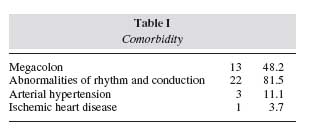
<body><![CDATA[<p align="left">Acquired megaesophagus is a chronic disease that courses with progressive          dysphagia, regurgitation and malnutrition. The regurgitation is associated          to the degree of dilation and involvement of the esophagus<sup>1</sup>.</p>           <p align="left">It is worth          bearing in mind that patients with chagasic megaesophagus develop abilities          (when feeding) over the years of the disease, which protect them from          precocious inanition.</p>           <p align="left">Patients with advanced megaesophagus and recurrent          megaesophagus are commonly treated by major surgical interventions. Although          malnutrition is frequent in these patients, few studies have determined          its incidence and gravity, as well as its effects on the postoperative          morbidity and mortality.</p>           <p align="left">In the city of Goiás, one of the operations practiced          to treat advanced chagasic megaesophagus is the Serra Doria operation,          which consists of cardioplasty associated to partial gastrectomy and gastrojejunal       Roux-en-Y anastomosis.</p>           <p align="left">It is not known how the Serra Dória operation interferes          in the patients’ postoperative nutritional state.</p>           <p align="left">In the present study,          on a group of patients with Group IV megaesophagus and recurrent megaesophagus          that were candidates for the surgical intervention using the Serra Doria          technique, the preoperative nutritional state was evaluated and its influence          as a factor of surgical risk together with the postoperative nutritional          modifications that occurred in the medium term</p>           <p align="left"><b>Patients and methods</b></p>           <p align="left"> In a period of 18 months, 27 adult patients were included in the study,          after informed consent. The inclusion criteria were: age over 18 years;          radiologic confirmation of megaesophagus (Group IV or recurrent); and          serological diagnosis of Chagas’ disease<sup>2</sup>.</p>           <p align="left"> The exclusion criteria were:          decompensation in myocardiopathy; nephropathy; hepatobiliary disease and          diabetes.</p>           <p align="left"> Megaesophagus is frequently associated with other morbid conditions,          especially those due to Chagas’ disease (<a href="#t1">table I</a>).</p>           ]]></body>
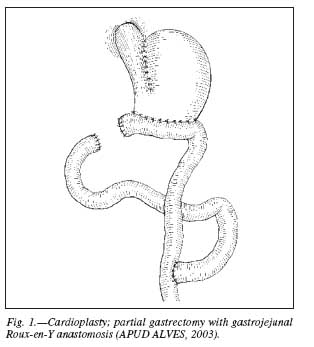
<body><![CDATA[<p align="left"> The mean age of the          population studied was 58 ± 10 years (range, 38 - 80). Twenty patients          were male and seven were female. Twenty patients had group IV megaesophagus          and seven recurrent megaesophagus.</p>           <p align="center"><a name="t1"><img src="/img/nh/v19n2/06/6_tabla1.jpg" width="310" height="137"></a></p>                <p align="left">Eighteen patients were reevaluated after postoperative day          90.</p>                <p align="left">The technical systemization of the Serra Dória operation included          cardioplasty by lateral gastroesophageal anastomosis, associated to partial          gastrectomy with gastrojejunal Roux-en-Y anastomosis<sup>3</sup>, <a href="#f1"> figura            1</a>.</p> 		     <p align="center"><a name="f1"><img src="/img/nh/v19n2/06/6_figura1.jpg" width="314" height="347"></a></p>           <p align="left"><b>Nutritional evaluation</b> </p>           <p align="left">The patients’ nutritional state was evaluated by the technique          of Global Subjective Nutritional Evaluation (GSNE)<sup>5</sup> and anthropometric          measurements and laboratory methods adopted by Blackburn <i> et al</i>. (1977)       <sup>6</sup>, including: recent loss of weight; weight/ height ratio; triceps skin          fold (TSF), arm muscle circumference (AMC); serum albumin level, serum          transferrin level, hematocrit and hemoglobin. Besides these parameters,          the serum iron level and ferritin were measured and the body mass index          was calculated (BMI)<sup>7</sup>.</p>           <p align="left">The measurement of caloric intake was obtained          by recording alimentary ingestion for three consecutive days<sup>8</sup>. The theoretical          applications were determined by Harris Benedict equation.</p>           <p align="left">The preoperative          nutritional evaluation was performed on hospital admission. GSNE preceded          any objective method of evaluation.</p>           <p align="left">The patients were operated by day          5 after admission. The postoperative was accompanied until the discharge          or death by an observer that had not been informed of any results from          the preoperative nutritional evaluation. The postoperative intercurrent          diseases were registered according to previous definitions <sup>9</sup>.</p>           ]]></body>
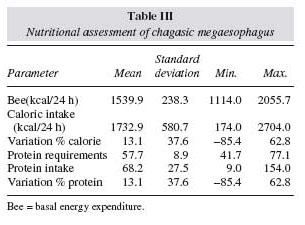
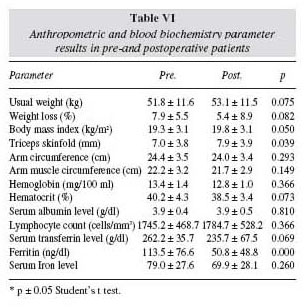
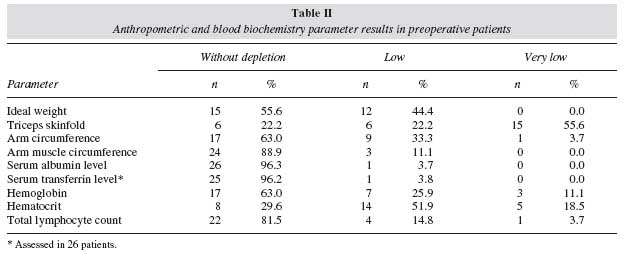
<body><![CDATA[<p align="left">The postoperative nutritional evaluation took place in the          out-patient clinic after postoperative day 90 and according to the same          protocol as the preoperative evaluation.</p>           <p align="left"><i>Statistical analysis </i></p>           <p align="left">Fisher’s exact test, Wilcoxon test and Student’s t test          —for paired data— were applied when appropriate. Probability values of          p <font size="2"> &#8804;</font> 0.05 were considered statistically significant.</p>           <p align="left"><i>Results </i></p>           <p align="left">The preoperative global subjective nutritional evaluation          demonstrated that nine patients (33.3%) were classified as well nourished,          eleven (40.7%) as moderately undernourished; and seven (25.9%) as seriously       undernourished.</p>           <p align="left">The body mass index was under 19 kg/m2 in seventeen (63%)          of the patients. Weight loss in the recent past was greater than 10% in          seven (26.9%) of the patients in the preoperative.</p>           <p align="left">The classification          of the patients in the preoperative, according to the frequency of alterations          in the anthropometric and laboratorial variables, is given in <a href="#t2"> table       II</a>.</p>           <p align="left">The anthropometric variable, with greatest frequently of depletion, was          TSF, in 77.8% of the patients; while that with the lowest frequency was          AMC, in 11.1% of the patients.</p>           <p align="left">Albumin and transferrin levels were found          to be unaffected in 96.3% of the patients.</p>           <p align="left">In the preoperative period,          the dietary evaluation demonstrated that the caloric and protein intake          were higher than the theoretical needs calculated using the Harris Benedict          equation (<a href="#t3">table III</a>).</p>           ]]></body>
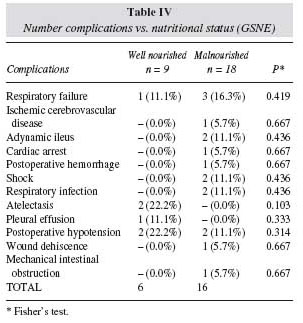
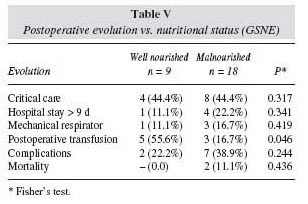
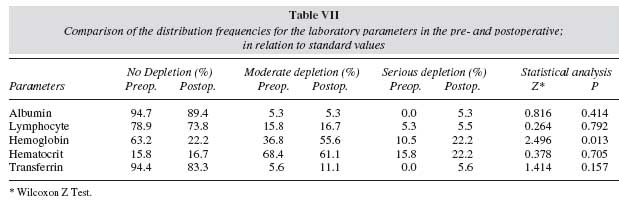
<body><![CDATA[<p align="left">Regurgitation, when occurring on a daily basis and          for more than fifteen days, was considered to be a contributory factor          for malnutrition in the preoperative period.</p>           <p align="center"><a name="t2"><img src="/img/nh/v19n2/06/6_tabla2.jpg" width="629" height="254"></a></p> 	      <p align="center"><a name="t3"><img src="/img/nh/v19n2/06/6_tabla3.jpg" width="305" height="225"></a></p>           <p align="left">The overall incidence of complications was 33.3%. the association          between preoperative nutritional classification (GSNE) and complications          and surgical mortality was not significant (<a href="#t4">tables IV</a> and <a href="#t5">V</a>).</p>           <p align="left">The postoperative          follow-up demonstrated that there was an increase in TSF, BMI, and reduction          of hemoglobin (<a href="#t6">tables VI</a> and <a href="#t7">VII</a>).</p>           <p align="left">The postoperative dietary evaluation          demonstrated an increased protein intake (<a href="#t8">table VIII</a>) in comparison to          the preoperative period.</p>         <p align="center"><a name="t4"><img src="/img/nh/v19n2/06/6_tabla4.jpg" width="303" height="323"></a></p> 	    <p align="center"><a name="t5"><img src="/img/nh/v19n2/06/6_tabla5.jpg" width="308" height="204"></a></p> 	    <p align="center"><a name="t6"><img src="/img/nh/v19n2/06/6_tabla6.jpg" width="305" height="308"></a></p> 	    <p align="center"><a name="t7"><img src="/img/nh/v19n2/06/6_tabla7.jpg" width="619" height="206"></a></p>        ]]></body>
<body><![CDATA[<p align="center"><a name="t8"><img src="/img/nh/v19n2/06/6_tabla8.jpg" width="307" height="217"></a></p> 	      <p align="left"><i>Discussion</i></p>           <p align="left"> Chagasic patients can present alterations of the digestive          system, grouped together under the denomination “digestive alterations          of Chagas’ disease” 10. Of these, megaesophagus and megacolon are the          most frequent and the latter was present in 48.2% of the patients of this          study.</p>           <p align="left"> Cardiac disturbances, identified by the electrocardiogram, are frequent          in chagasic patients and have a negative effect on their survival 11.          In this sample of patients, 81% presented arrhythmia and/or disturbances          in the cardiac conduction.</p>           <p align="left"> In Chagas’ disease, the interval between acute infection and onset of          the digestive symptomatology is very variable. When considering the frequency          of the disease in relation to age group, an “aging” of the chagasic population          with digestive forms of the disease has been observed in recent years.          This is principally due to the prophylactic measures that have been preventing          the appearance of new cases<sup>1</sup>. In the present study, 44.5% of the patients          were over 60 years of age.</p>           <p align="left"> Preoperative GSNE identified malnutrition in 2/3 of the patients —a higher          frequency than that reported by other authors.</p>           <p align="left"> Detsky et al<sup>5</sup> determined malnutrition through preoperative GSNE in 31%          of candidates for gastrointestinal surgery.</p>          <p align="left">Waitzberg et al<sup>12</sup> diagnosed hospital malnutrition,          through GSNE - a frequency of 48.1% in a sample composed of 4.000 clinical          and surgical patients. </p>           <p align="left">In the present study among patients with chagasic megaesophagus, the          malnutrition determined by anthropometric measurements and by laboratory          exams, was the marasmic form, with a reduction in the body mass due to          loss of fat, while body proteins were maintained.</p>           <p align="left">The pattern of ponderal alteration we observed suggested chronic loss          -considering the disproportion between the frequencies of alterations          in the body mass measurements and the weight loss in the present past.          This was considered serious, in one fourth of the patients. </p>           ]]></body>
<body><![CDATA[<p align="left">Marasmic malnutrition was also observed among patients with chagasic          megacolon (without associated dysphagia) and this was attributed to deficient          dietary intake<sup>13</sup>. </p>           <p align="left">In adults, marasmus is characterized by: reduced anthropometric measurements          and maintenance of the visceral proteins; insufficient alimentary intake;          and, commonly, without complication of the disease&acute;s metabolic          response<sup>14</sup>. </p>           <p align="left">In the present study, an adaptation was observed between the values of          protein-calorie intake and the estimated energy expenditure -as          much in the pre- as in the postoperative period.</p>           <p align="left">Regurgitation, when daily and for more than 15 days, was considered a          contributory factor for preoperative malnutrition; however the total intake          was not a reliable indicator in this evaluation period. </p>           <p align="left">In the present sample, albumin and transferrin remained unaffected in          96.3% of the patients in the pre-operative and presented no statistically          significant differences in the values observed in the postoperative. </p>           <p align="left">In the postoperative, iron deficiency was detected in 30% of the patients;          and hemoglobin suffered a statistically significant reduction (p &lt;          0.05). It is known that transferrin levels can increase with a serious          deficiency of iron and anemia<sup>15,16</sup>. Under these          conditions, as observed in the postoperative, the method suffers limitations          as a marker for the state of the visceral proteins. </p>           <p align="left">Malnutrition, identified by various methodologies, is associated with          greater morbidity and postoperative mortality<sup>17-19</sup>.          As an independent variable, diagnosed by GSNE, it is associated with a          higher frequency of infectious or noninfectious complications and mortality<sup>19</sup>.        </p>           <p align="left">In the present study there was no association between malnutrition (GSNE)          and complication and postoperative mortality. No other variable that could          be adopted as a criterion of postoperative course -such as postoperative          hospital stay, time in an intensive care unit or under mechanical ventilation-          was correlated with preoperative malnutrition. </p>           <p align="left">Our attention was called to the fact that patients over 60 years of age          presented greater morbidity.</p>           <p align="left">Studies that look for an association between modification of the nutritional          state and postoperative course suffer criticism in relation to the size          of the sample, diversity of the patients and rates of complications associated          with a given procedure<sup>5</sup>. </p>           ]]></body>
<body><![CDATA[<p align="left">Furthermore, it is recognized that GSNE predicts complications of nutritional          basis and, also, represents an index of disease, even before indicating          malnutrition<sup>5,20</sup>. </p>           <p align="left">In the postoperative, of this work, the complications present in 1/3          of the patients, were predominantly noninfectious. It has been reported          that vital functions dependent on the metabolism of protein, which include          immunocompetence, are relatively preserved in marasmus and that the albumin          rates are important markers of malnutrition, with clinical significance,          irrespective of the body weight<sup>14</sup>. </p>           <p align="left">Chronic malnutrition prevailed in our patients which together with other          factors -such as: maintenance of the visceral proteins; reduced          number of complications inherent to the operation; sample size; patients&acute;          age and associated diseases- are known to interfere in postoperative          results and in the prognostic capacity of GSNE. </p>           <p align="left">With the re-establishment of alimentary traffic, 16 patients (88.9%),          referred to a subjective improvement in the alimentary intake. Measurement          of this variable in the postoperative detected a significant increase          in protein intake, when compared to preoperative levels. </p>           <p align="left">The Serra Dória operation, on the other hand, enabled a partial recovery          in the medium term of the nutritional state in terms of body fat.</p>           <p align="left"><b>References</b></p>           <!-- ref --><p align="left">1. Vaz MGM: Contribuição ao estudo clínico, radiológico e endoscópico          do megaesôfago chagásico. Goiânia, 1991. Dissertação (Mestrado) - Instituto          de Patologia Tropical e Saúde Pública, Universidade Federal de Goiás.&nbsp;&nbsp;&nbsp;&nbsp;&nbsp;&nbsp;&nbsp;&nbsp;[&#160;<a href="javascript:void(0);" onclick="javascript: window.open('/scielo.php?script=sci_nlinks&ref=3466889&pid=S0212-1611200400020000600001&lng=','','width=640,height=500,resizable=yes,scrollbars=1,menubar=yes,');">Links</a>&#160;]<!-- end-ref --><!-- ref --><p align="left">2. Luquetti AO: Evolution of knowledge on the etiological diagnosis of          chagasic infection. <i>Mem Inst Oswaldo Cruz,</i> 1999, 94:283-284.&nbsp;&nbsp;&nbsp;&nbsp;&nbsp;&nbsp;&nbsp;&nbsp;[&#160;<a href="javascript:void(0);" onclick="javascript: window.open('/scielo.php?script=sci_nlinks&ref=3466890&pid=S0212-1611200400020000600002&lng=','','width=640,height=500,resizable=yes,scrollbars=1,menubar=yes,');">Links</a>&#160;]<!-- end-ref --><!-- ref --><p align="left">3. Dória OBS: Tratamento cirúrgico do megaesôfago operação de Serra Dória.          <i>Rev Goiana Med,</i> 1973, 19:185-93.&nbsp;&nbsp;&nbsp;&nbsp;&nbsp;&nbsp;&nbsp;&nbsp;[&#160;<a href="javascript:void(0);" onclick="javascript: window.open('/scielo.php?script=sci_nlinks&ref=3466891&pid=S0212-1611200400020000600003&lng=','','width=640,height=500,resizable=yes,scrollbars=1,menubar=yes,');">Links</a>&#160;]<!-- end-ref --><!-- ref --><p align="left">4. Alves L: Operação de Serra Dória no tratamento do megaesôfago avançado:          resultados imediatos. São Paulo, 2003. Dissertação (Mestrado). Faculdade          de Medicina da Universidade de São Paulo.&nbsp;&nbsp;&nbsp;&nbsp;&nbsp;&nbsp;&nbsp;&nbsp;[&#160;<a href="javascript:void(0);" onclick="javascript: window.open('/scielo.php?script=sci_nlinks&ref=3466892&pid=S0212-1611200400020000600004&lng=','','width=640,height=500,resizable=yes,scrollbars=1,menubar=yes,');">Links</a>&#160;]<!-- end-ref --><!-- ref --><p align="left">5. Detsky AS, Baker JP, O&acute;Rourke K, Johnston N, Whitwell J, Mendelson          RA and Jeejeebhoy KN: Predicting nutrition associated complications for          patients undergoing gastrointestinal surgery. <i>JPEN J Parenter Enteral          Nut,</i> 1987a, 11:440-446.&nbsp;&nbsp;&nbsp;&nbsp;&nbsp;&nbsp;&nbsp;&nbsp;[&#160;<a href="javascript:void(0);" onclick="javascript: window.open('/scielo.php?script=sci_nlinks&ref=3466893&pid=S0212-1611200400020000600005&lng=','','width=640,height=500,resizable=yes,scrollbars=1,menubar=yes,');">Links</a>&#160;]<!-- end-ref --><!-- ref --><p align="left">6. Blackburn GL, Bistrian BR, Maini BS, Schlamm HT and Smith MF: Nutritional          and metabolic assessment of the hospitalized patients. <i>JPEN J Parenter          Enteral Nutr,</i> 1977, 1:11-22.&nbsp;&nbsp;&nbsp;&nbsp;&nbsp;&nbsp;&nbsp;&nbsp;[&#160;<a href="javascript:void(0);" onclick="javascript: window.open('/scielo.php?script=sci_nlinks&ref=3466894&pid=S0212-1611200400020000600006&lng=','','width=640,height=500,resizable=yes,scrollbars=1,menubar=yes,');">Links</a>&#160;]<!-- end-ref --><!-- ref --><p align="left">7. Nightingale JMD, Walsh N, Bullock ME and Wicks AC: Three simple methods          of detecting malnutrition on medical wards. <i>JR Soc Med,</i> 1996, 89:114-118.&nbsp;&nbsp;&nbsp;&nbsp;&nbsp;&nbsp;&nbsp;&nbsp;[&#160;<a href="javascript:void(0);" onclick="javascript: window.open('/scielo.php?script=sci_nlinks&ref=3466895&pid=S0212-1611200400020000600007&lng=','','width=640,height=500,resizable=yes,scrollbars=1,menubar=yes,');">Links</a>&#160;]<!-- end-ref --><!-- ref --><p align="left">8. Barrett-Connor E: Nutrition epidemiology: how do we know, what they          ate. <i>Am J Clin Nutr,</i> 1991, 54:1825-1875.&nbsp;&nbsp;&nbsp;&nbsp;&nbsp;&nbsp;&nbsp;&nbsp;[&#160;<a href="javascript:void(0);" onclick="javascript: window.open('/scielo.php?script=sci_nlinks&ref=3466896&pid=S0212-1611200400020000600008&lng=','','width=640,height=500,resizable=yes,scrollbars=1,menubar=yes,');">Links</a>&#160;]<!-- end-ref --><!-- ref --><p align="left">9. Buzby GP, Mullen JL, Matthews DC, Hobbs CL and Rosato EF: Prognostic          nutritional index in gastrointestinal surgery. <i>Am J Surg,</i> 1980,          139:160-167&nbsp;&nbsp;&nbsp;&nbsp;&nbsp;&nbsp;&nbsp;&nbsp;[&#160;<a href="javascript:void(0);" onclick="javascript: window.open('/scielo.php?script=sci_nlinks&ref=3466897&pid=S0212-1611200400020000600009&lng=','','width=640,height=500,resizable=yes,scrollbars=1,menubar=yes,');">Links</a>&#160;]<!-- end-ref --><!-- ref --><p align="left">10. Rezende JM: Forma digestiva da moléstia de Chagas. <i>Rev Goiana Med,</i>          1959, 5:193-227.&nbsp;&nbsp;&nbsp;&nbsp;&nbsp;&nbsp;&nbsp;&nbsp;[&#160;<a href="javascript:void(0);" onclick="javascript: window.open('/scielo.php?script=sci_nlinks&ref=3466898&pid=S0212-1611200400020000600010&lng=','','width=640,height=500,resizable=yes,scrollbars=1,menubar=yes,');">Links</a>&#160;]<!-- end-ref --><!-- ref --><p align="left">11. Porto CC: Eletrocardiograma no prognóstico e evolução da doença de          chagas. <i>Arq Bras Cardiol,</i> 1964, 17:313-346.&nbsp;&nbsp;&nbsp;&nbsp;&nbsp;&nbsp;&nbsp;&nbsp;[&#160;<a href="javascript:void(0);" onclick="javascript: window.open('/scielo.php?script=sci_nlinks&ref=3466899&pid=S0212-1611200400020000600011&lng=','','width=640,height=500,resizable=yes,scrollbars=1,menubar=yes,');">Links</a>&#160;]<!-- end-ref --><!-- ref --><p align="left">12. Waitzberg DL, Caiafa WT and Correia MITD: Hospital malnutrition. The          brazilian nutritional survey (IBRANUTRI): A study of 4.000 patients. <i>Nutrition,</i>          2001, 17:573-580.&nbsp;&nbsp;&nbsp;&nbsp;&nbsp;&nbsp;&nbsp;&nbsp;[&#160;<a href="javascript:void(0);" onclick="javascript: window.open('/scielo.php?script=sci_nlinks&ref=3466900&pid=S0212-1611200400020000600012&lng=','','width=640,height=500,resizable=yes,scrollbars=1,menubar=yes,');">Links</a>&#160;]<!-- end-ref --><!-- ref --><p align="left">13. Vieira MJF, Gama-Rodrigues JJ, Habr-Gama A, Faintuch J, Waitzberg          DL and Pinotti HW: Preoperative assessment in cases of adult megacolon          suffering from moderate malnutrition. <i>Nutrition,</i> 1996, 2:491-495.&nbsp;&nbsp;&nbsp;&nbsp;&nbsp;&nbsp;&nbsp;&nbsp;[&#160;<a href="javascript:void(0);" onclick="javascript: window.open('/scielo.php?script=sci_nlinks&ref=3466901&pid=S0212-1611200400020000600013&lng=','','width=640,height=500,resizable=yes,scrollbars=1,menubar=yes,');">Links</a>&#160;]<!-- end-ref --><!-- ref --><p align="left">14. Bistrian BR, Sherman M, Blackburn GL, Marshall R and Shaw C: Cellular          immunity in adults marasmus. <i>Arch Intern Med,</i> 1977, 137:1408-1411.&nbsp;&nbsp;&nbsp;&nbsp;&nbsp;&nbsp;&nbsp;&nbsp;[&#160;<a href="javascript:void(0);" onclick="javascript: window.open('/scielo.php?script=sci_nlinks&ref=3466902&pid=S0212-1611200400020000600014&lng=','','width=640,height=500,resizable=yes,scrollbars=1,menubar=yes,');">Links</a>&#160;]<!-- end-ref --><!-- ref --><p align="left">15. Young GA, Chem C and Hill GL: Assessment of protein caloric malnutrition          in surgical patients from plasma proteins and anthropometric measurements.          <i>Am J Clin Nutr,</i> 1978, 31:429-35.&nbsp;&nbsp;&nbsp;&nbsp;&nbsp;&nbsp;&nbsp;&nbsp;[&#160;<a href="javascript:void(0);" onclick="javascript: window.open('/scielo.php?script=sci_nlinks&ref=3466903&pid=S0212-1611200400020000600015&lng=','','width=640,height=500,resizable=yes,scrollbars=1,menubar=yes,');">Links</a>&#160;]<!-- end-ref --><!-- ref --><p align="left">16. Shenkin A and Steele LW: Clinical and laboratory assessment of nutritional          status. <i>Proc Nutr Soc,</i> 1978, 37:95-103.&nbsp;&nbsp;&nbsp;&nbsp;&nbsp;&nbsp;&nbsp;&nbsp;[&#160;<a href="javascript:void(0);" onclick="javascript: window.open('/scielo.php?script=sci_nlinks&ref=3466904&pid=S0212-1611200400020000600016&lng=','','width=640,height=500,resizable=yes,scrollbars=1,menubar=yes,');">Links</a>&#160;]<!-- end-ref --><!-- ref --><p align="left">17. Seltzer MH, Slown BA, Cataldi-Betcher EL, Fileti C and Gerson N: Instant          nutritional assessment: absolute weight loss and surgical mortality. <i>JPEN          J Parenter Enteral Nutr,</i> 1982, 6: 218-21.&nbsp;&nbsp;&nbsp;&nbsp;&nbsp;&nbsp;&nbsp;&nbsp;[&#160;<a href="javascript:void(0);" onclick="javascript: window.open('/scielo.php?script=sci_nlinks&ref=3466905&pid=S0212-1611200400020000600017&lng=','','width=640,height=500,resizable=yes,scrollbars=1,menubar=yes,');">Links</a>&#160;]<!-- end-ref --><!-- ref --><p align="left">18. Bozzetti F, Migliavacca S, Gallus G, Radaelli G, Scotti A, Bonalumi          MG, Ammatuna M, Sequeira C and Terno G: &quot;Nutritional&quot; markers          as prognostic indicators of postoperative sepsis in cancer patients. <i>JPEN          J Parenter Enteral Nutr,</i> 9: 464-470.&nbsp;&nbsp;&nbsp;&nbsp;&nbsp;&nbsp;&nbsp;&nbsp;[&#160;<a href="javascript:void(0);" onclick="javascript: window.open('/scielo.php?script=sci_nlinks&ref=3466906&pid=S0212-1611200400020000600018&lng=','','width=640,height=500,resizable=yes,scrollbars=1,menubar=yes,');">Links</a>&#160;]<!-- end-ref --><!-- ref --><p align="left">19. Correia MITD and Waitzberg DL: The impact of malnutrition on morbidity,          mortality, length of hospital stay and costs evaluated through a multivariate          model analysis. <i>Clin Nutr,</i> 22: 235-239.&nbsp;&nbsp;&nbsp;&nbsp;&nbsp;&nbsp;&nbsp;&nbsp;[&#160;<a href="javascript:void(0);" onclick="javascript: window.open('/scielo.php?script=sci_nlinks&ref=3466907&pid=S0212-1611200400020000600019&lng=','','width=640,height=500,resizable=yes,scrollbars=1,menubar=yes,');">Links</a>&#160;]<!-- end-ref --><!-- ref --><p align="left">20. Jeejeebhoy KN, Detsky AS and Baker JP: Assessment of nutritional status.          <i>JPEN J Parenter Enteral Nutr,</i> 1990, 14:1935-1965. &nbsp;&nbsp;&nbsp;&nbsp;&nbsp;&nbsp;&nbsp;&nbsp;[&#160;<a href="javascript:void(0);" onclick="javascript: window.open('/scielo.php?script=sci_nlinks&ref=3466908&pid=S0212-1611200400020000600020&lng=','','width=640,height=500,resizable=yes,scrollbars=1,menubar=yes,');">Links</a>&#160;]<!-- end-ref --> ]]></body><back>
<ref-list>
<ref id="B1">
<label>1</label><nlm-citation citation-type="">
<person-group person-group-type="author">
<name>
<surname><![CDATA[Vaz]]></surname>
<given-names><![CDATA[MGM]]></given-names>
</name>
</person-group>
<source><![CDATA[Contribuição ao estudo clínico, radiológico e endoscópico do megaesôfago chagásico]]></source>
<year>1991</year>
<publisher-loc><![CDATA[Goiânia ]]></publisher-loc>
</nlm-citation>
</ref>
<ref id="B2">
<label>2</label><nlm-citation citation-type="journal">
<person-group person-group-type="author">
<name>
<surname><![CDATA[Luquetti]]></surname>
<given-names><![CDATA[AO]]></given-names>
</name>
</person-group>
<article-title xml:lang="en"><![CDATA[Evolution of knowledge on the etiological diagnosis of chagasic infection]]></article-title>
<source><![CDATA[Mem Inst Oswaldo Cruz]]></source>
<year>1999</year>
<volume>94</volume>
<page-range>283-284</page-range></nlm-citation>
</ref>
<ref id="B3">
<label>3</label><nlm-citation citation-type="journal">
<person-group person-group-type="author">
<name>
<surname><![CDATA[Dória]]></surname>
<given-names><![CDATA[OBS]]></given-names>
</name>
</person-group>
<article-title xml:lang="pt"><![CDATA[Tratamento cirúrgico do megaesôfago operação de Serra Dória]]></article-title>
<source><![CDATA[Rev Goiana Med]]></source>
<year>1973</year>
<volume>19</volume>
<page-range>185-93</page-range></nlm-citation>
</ref>
<ref id="B4">
<label>4</label><nlm-citation citation-type="">
<person-group person-group-type="author">
<name>
<surname><![CDATA[Alves]]></surname>
<given-names><![CDATA[L]]></given-names>
</name>
</person-group>
<source><![CDATA[Operação de Serra Dória no tratamento do megaesôfago avançado: resultados imediatos]]></source>
<year>2003</year>
<publisher-loc><![CDATA[São Paulo ]]></publisher-loc>
</nlm-citation>
</ref>
<ref id="B5">
<label>5</label><nlm-citation citation-type="journal">
<person-group person-group-type="author">
<name>
<surname><![CDATA[Detsky]]></surname>
<given-names><![CDATA[AS]]></given-names>
</name>
<name>
<surname><![CDATA[Baker]]></surname>
<given-names><![CDATA[JP]]></given-names>
</name>
<name>
<surname><![CDATA[O&acute;Rourke]]></surname>
<given-names><![CDATA[K]]></given-names>
</name>
<name>
<surname><![CDATA[Johnston]]></surname>
<given-names><![CDATA[N]]></given-names>
</name>
<name>
<surname><![CDATA[Whitwell]]></surname>
<given-names><![CDATA[J]]></given-names>
</name>
<name>
<surname><![CDATA[Mendelson]]></surname>
<given-names><![CDATA[RA]]></given-names>
</name>
<name>
<surname><![CDATA[Jeejeebhoy]]></surname>
<given-names><![CDATA[KN]]></given-names>
</name>
</person-group>
<article-title xml:lang="en"><![CDATA[Predicting nutrition associated complications for patients undergoing gastrointestinal surgery]]></article-title>
<source><![CDATA[JPEN J Parenter Enteral Nut]]></source>
<year>1987</year>
<volume>11</volume>
<page-range>440-446</page-range></nlm-citation>
</ref>
<ref id="B6">
<label>6</label><nlm-citation citation-type="journal">
<person-group person-group-type="author">
<name>
<surname><![CDATA[Blackburn]]></surname>
<given-names><![CDATA[GL]]></given-names>
</name>
<name>
<surname><![CDATA[Bistrian]]></surname>
<given-names><![CDATA[BR]]></given-names>
</name>
<name>
<surname><![CDATA[Maini]]></surname>
<given-names><![CDATA[BS]]></given-names>
</name>
<name>
<surname><![CDATA[Schlamm]]></surname>
<given-names><![CDATA[HT]]></given-names>
</name>
<name>
<surname><![CDATA[Smith]]></surname>
<given-names><![CDATA[MF]]></given-names>
</name>
</person-group>
<source><![CDATA[JPEN J Parenter Enteral Nutr]]></source>
<year>1977</year>
<volume>1</volume>
<page-range>11-22</page-range></nlm-citation>
</ref>
<ref id="B7">
<label>7</label><nlm-citation citation-type="journal">
<person-group person-group-type="author">
<name>
<surname><![CDATA[Nightingale]]></surname>
<given-names><![CDATA[JMD]]></given-names>
</name>
<name>
<surname><![CDATA[Walsh]]></surname>
<given-names><![CDATA[N]]></given-names>
</name>
<name>
<surname><![CDATA[Bullock]]></surname>
<given-names><![CDATA[ME]]></given-names>
</name>
<name>
<surname><![CDATA[Wicks]]></surname>
<given-names><![CDATA[AC]]></given-names>
</name>
</person-group>
<article-title xml:lang="en"><![CDATA[Three simple methods of detecting malnutrition on medical wards]]></article-title>
<source><![CDATA[JR Soc Med]]></source>
<year>1996</year>
<volume>89</volume>
<page-range>114-118</page-range></nlm-citation>
</ref>
<ref id="B8">
<label>8</label><nlm-citation citation-type="journal">
<person-group person-group-type="author">
<name>
<surname><![CDATA[Barrett-Connor]]></surname>
<given-names><![CDATA[E]]></given-names>
</name>
</person-group>
<article-title xml:lang="en"><![CDATA[Nutrition epidemiology: how do we know, what they ate]]></article-title>
<source><![CDATA[Am J Clin Nutr]]></source>
<year>1991</year>
<volume>54</volume>
<page-range>1825-1875</page-range></nlm-citation>
</ref>
<ref id="B9">
<label>9</label><nlm-citation citation-type="journal">
<person-group person-group-type="author">
<name>
<surname><![CDATA[Buzby]]></surname>
<given-names><![CDATA[GP]]></given-names>
</name>
<name>
<surname><![CDATA[Mullen]]></surname>
<given-names><![CDATA[JL]]></given-names>
</name>
<name>
<surname><![CDATA[Matthews]]></surname>
<given-names><![CDATA[DC]]></given-names>
</name>
<name>
<surname><![CDATA[Hobbs]]></surname>
<given-names><![CDATA[CL]]></given-names>
</name>
<name>
<surname><![CDATA[Rosato]]></surname>
<given-names><![CDATA[EF]]></given-names>
</name>
</person-group>
<article-title xml:lang="en"><![CDATA[Prognostic nutritional index in gastrointestinal surgery]]></article-title>
<source><![CDATA[Am J Surg]]></source>
<year>1980</year>
<volume>139</volume>
<page-range>160-167</page-range></nlm-citation>
</ref>
<ref id="B10">
<label>10</label><nlm-citation citation-type="journal">
<person-group person-group-type="author">
<name>
<surname><![CDATA[Rezende]]></surname>
<given-names><![CDATA[JM]]></given-names>
</name>
</person-group>
<article-title xml:lang="es"><![CDATA[Forma digestiva da moléstia de Chagas]]></article-title>
<source><![CDATA[Rev Goiana Med]]></source>
<year>1959</year>
<volume>5</volume>
<page-range>193-227</page-range></nlm-citation>
</ref>
<ref id="B11">
<label>11</label><nlm-citation citation-type="journal">
<person-group person-group-type="author">
<name>
<surname><![CDATA[Porto]]></surname>
<given-names><![CDATA[CC]]></given-names>
</name>
</person-group>
<article-title xml:lang="pt"><![CDATA[Eletrocardiograma no prognóstico e evolução da doença de chagas]]></article-title>
<source><![CDATA[Arq Bras Cardiol]]></source>
<year>1964</year>
<volume>17</volume>
<page-range>313-346</page-range></nlm-citation>
</ref>
<ref id="B12">
<label>12</label><nlm-citation citation-type="journal">
<person-group person-group-type="author">
<name>
<surname><![CDATA[Waitzberg]]></surname>
<given-names><![CDATA[DL]]></given-names>
</name>
<name>
<surname><![CDATA[Caiafa]]></surname>
<given-names><![CDATA[WT]]></given-names>
</name>
<name>
<surname><![CDATA[Correia]]></surname>
<given-names><![CDATA[MITD]]></given-names>
</name>
</person-group>
<article-title xml:lang="en"><![CDATA[Hospital malnutrition. The brazilian nutritional survey (IBRANUTRI): A study of 4.000 patients]]></article-title>
<source><![CDATA[Nutrition]]></source>
<year>2001</year>
<volume>17</volume>
<page-range>573-580</page-range></nlm-citation>
</ref>
<ref id="B13">
<label>13</label><nlm-citation citation-type="journal">
<person-group person-group-type="author">
<name>
<surname><![CDATA[Vieira]]></surname>
<given-names><![CDATA[MJF]]></given-names>
</name>
<name>
<surname><![CDATA[Gama-Rodrigues]]></surname>
<given-names><![CDATA[JJ]]></given-names>
</name>
<name>
<surname><![CDATA[Habr-Gama]]></surname>
<given-names><![CDATA[A]]></given-names>
</name>
<name>
<surname><![CDATA[Faintuch]]></surname>
<given-names><![CDATA[J]]></given-names>
</name>
<name>
<surname><![CDATA[Waitzberg]]></surname>
<given-names><![CDATA[DL]]></given-names>
</name>
<name>
<surname><![CDATA[Pinotti]]></surname>
<given-names><![CDATA[HW]]></given-names>
</name>
</person-group>
<article-title xml:lang="en"><![CDATA[Preoperative assessment in cases of adult megacolon suffering from moderate malnutrition]]></article-title>
<source><![CDATA[Nutrition]]></source>
<year>1996</year>
<volume>2</volume>
<page-range>491-495</page-range></nlm-citation>
</ref>
<ref id="B14">
<label>14</label><nlm-citation citation-type="journal">
<person-group person-group-type="author">
<name>
<surname><![CDATA[Bistrian]]></surname>
<given-names><![CDATA[BR]]></given-names>
</name>
<name>
<surname><![CDATA[Sherman]]></surname>
<given-names><![CDATA[M]]></given-names>
</name>
<name>
<surname><![CDATA[Blackburn]]></surname>
<given-names><![CDATA[GL]]></given-names>
</name>
<name>
<surname><![CDATA[Marshall]]></surname>
<given-names><![CDATA[R]]></given-names>
</name>
<name>
<surname><![CDATA[Shaw]]></surname>
<given-names><![CDATA[C]]></given-names>
</name>
</person-group>
<article-title xml:lang="en"><![CDATA[Cellular immunity in adults marasmus]]></article-title>
<source><![CDATA[Arch Intern Med]]></source>
<year>1977</year>
<volume>137</volume>
<page-range>1408-1411</page-range></nlm-citation>
</ref>
<ref id="B15">
<label>15</label><nlm-citation citation-type="journal">
<person-group person-group-type="author">
<name>
<surname><![CDATA[Young]]></surname>
<given-names><![CDATA[GA]]></given-names>
</name>
<name>
<surname><![CDATA[Chem]]></surname>
<given-names><![CDATA[C]]></given-names>
</name>
<name>
<surname><![CDATA[Hill]]></surname>
<given-names><![CDATA[GL]]></given-names>
</name>
</person-group>
<article-title xml:lang="en"><![CDATA[Assessment of protein caloric malnutrition in surgical patients from plasma proteins and anthropometric measurements]]></article-title>
<source><![CDATA[Am J Clin Nutr]]></source>
<year>1978</year>
<volume>31</volume>
<page-range>429-35</page-range></nlm-citation>
</ref>
<ref id="B16">
<label>16</label><nlm-citation citation-type="journal">
<person-group person-group-type="author">
<name>
<surname><![CDATA[Shenkin]]></surname>
<given-names><![CDATA[A]]></given-names>
</name>
<name>
<surname><![CDATA[Steele]]></surname>
<given-names><![CDATA[LW]]></given-names>
</name>
</person-group>
<article-title xml:lang="en"><![CDATA[Clinical and laboratory assessment of nutritional status]]></article-title>
<source><![CDATA[Proc Nutr Soc]]></source>
<year>1978</year>
<volume>37</volume>
<page-range>95-103</page-range></nlm-citation>
</ref>
<ref id="B17">
<label>17</label><nlm-citation citation-type="journal">
<person-group person-group-type="author">
<name>
<surname><![CDATA[Seltzer]]></surname>
<given-names><![CDATA[MH]]></given-names>
</name>
<name>
<surname><![CDATA[Slown]]></surname>
<given-names><![CDATA[BA]]></given-names>
</name>
<name>
<surname><![CDATA[Cataldi-Betcher]]></surname>
<given-names><![CDATA[EL]]></given-names>
</name>
<name>
<surname><![CDATA[Fileti]]></surname>
<given-names><![CDATA[C]]></given-names>
</name>
<name>
<surname><![CDATA[Gerson]]></surname>
<given-names><![CDATA[N]]></given-names>
</name>
</person-group>
<article-title xml:lang="en"><![CDATA[Instant nutritional assessment: absolute weight loss and surgical mortality]]></article-title>
<source><![CDATA[JPEN J Parenter Enteral Nutr]]></source>
<year>1982</year>
<volume>6</volume>
<page-range>218-21</page-range></nlm-citation>
</ref>
<ref id="B18">
<label>18</label><nlm-citation citation-type="journal">
<person-group person-group-type="author">
<name>
<surname><![CDATA[Bozzetti]]></surname>
<given-names><![CDATA[F]]></given-names>
</name>
<name>
<surname><![CDATA[Migliavacca]]></surname>
<given-names><![CDATA[S]]></given-names>
</name>
<name>
<surname><![CDATA[Gallus]]></surname>
<given-names><![CDATA[G]]></given-names>
</name>
<name>
<surname><![CDATA[Radaelli]]></surname>
<given-names><![CDATA[G]]></given-names>
</name>
<name>
<surname><![CDATA[Scotti]]></surname>
<given-names><![CDATA[A]]></given-names>
</name>
<name>
<surname><![CDATA[Bonalumi]]></surname>
<given-names><![CDATA[MG]]></given-names>
</name>
<name>
<surname><![CDATA[Ammatuna]]></surname>
<given-names><![CDATA[M]]></given-names>
</name>
<name>
<surname><![CDATA[Sequeira]]></surname>
<given-names><![CDATA[C]]></given-names>
</name>
<name>
<surname><![CDATA[Terno]]></surname>
<given-names><![CDATA[G]]></given-names>
</name>
</person-group>
<article-title xml:lang="en"><![CDATA[Nutritional" markers as prognostic indicators of postoperative sepsis in cancer patients]]></article-title>
<source><![CDATA[JPEN J Parenter Enteral Nutr]]></source>
<year></year>
<volume>9</volume>
<page-range>464-470</page-range></nlm-citation>
</ref>
<ref id="B19">
<label>19</label><nlm-citation citation-type="journal">
<person-group person-group-type="author">
<name>
<surname><![CDATA[Correia]]></surname>
<given-names><![CDATA[MITD]]></given-names>
</name>
<name>
<surname><![CDATA[Waitzberg]]></surname>
<given-names><![CDATA[DL]]></given-names>
</name>
</person-group>
<article-title xml:lang="en"><![CDATA[The impact of malnutrition on morbidity, mortality, length of hospital stay and costs evaluated through a multivariate model analysis]]></article-title>
<source><![CDATA[Clin Nutr]]></source>
<year></year>
<volume>22</volume>
<page-range>235-239</page-range></nlm-citation>
</ref>
<ref id="B20">
<label>20</label><nlm-citation citation-type="journal">
<person-group person-group-type="author">
<name>
<surname><![CDATA[Jeejeebhoy]]></surname>
<given-names><![CDATA[KN]]></given-names>
</name>
<name>
<surname><![CDATA[Detsky]]></surname>
<given-names><![CDATA[AS]]></given-names>
</name>
<name>
<surname><![CDATA[Baker]]></surname>
<given-names><![CDATA[JP]]></given-names>
</name>
</person-group>
<article-title xml:lang="en"><![CDATA[Assessment of nutritional status]]></article-title>
<source><![CDATA[JPEN J Parenter Enteral Nutr]]></source>
<year>1990</year>
<volume>14</volume>
<page-range>1935-1965</page-range></nlm-citation>
</ref>
</ref-list>
</back>
</article>