<?xml version="1.0" encoding="ISO-8859-1"?><article xmlns:mml="http://www.w3.org/1998/Math/MathML" xmlns:xlink="http://www.w3.org/1999/xlink" xmlns:xsi="http://www.w3.org/2001/XMLSchema-instance">
<front>
<journal-meta>
<journal-id>0212-1611</journal-id>
<journal-title><![CDATA[Nutrición Hospitalaria]]></journal-title>
<abbrev-journal-title><![CDATA[Nutr. Hosp.]]></abbrev-journal-title>
<issn>0212-1611</issn>
<publisher>
<publisher-name><![CDATA[Grupo Arán]]></publisher-name>
</publisher>
</journal-meta>
<article-meta>
<article-id>S0212-16112004000600003</article-id>
<title-group>
<article-title xml:lang="en"><![CDATA[Immunonutrition in clinical practice: what is the current evidence?]]></article-title>
<article-title xml:lang="es"><![CDATA[Inmunonutrición en la práctica clínica: ¿cuál es la evidencia actual?]]></article-title>
</title-group>
<contrib-group>
<contrib contrib-type="author">
<name>
<surname><![CDATA[Heys]]></surname>
<given-names><![CDATA[S. D.]]></given-names>
</name>
<xref ref-type="aff" rid="A01"/>
</contrib>
<contrib contrib-type="author">
<name>
<surname><![CDATA[Schofield]]></surname>
<given-names><![CDATA[A. C.]]></given-names>
</name>
</contrib>
<contrib contrib-type="author">
<name>
<surname><![CDATA[Wahle]]></surname>
<given-names><![CDATA[K. W. J.]]></given-names>
</name>
</contrib>
</contrib-group>
<aff id="A01">
<institution><![CDATA[,University of Aberdeen Medical School Department of Surgery]]></institution>
<addr-line><![CDATA[Foresterhill ]]></addr-line>
</aff>
<pub-date pub-type="pub">
<day>00</day>
<month>11</month>
<year>2004</year>
</pub-date>
<pub-date pub-type="epub">
<day>00</day>
<month>11</month>
<year>2004</year>
</pub-date>
<volume>19</volume>
<numero>6</numero>
<fpage>325</fpage>
<lpage>332</lpage>
<copyright-statement/>
<copyright-year/>
<self-uri xlink:href="http://scielo.isciii.es/scielo.php?script=sci_arttext&amp;pid=S0212-16112004000600003&amp;lng=en&amp;nrm=iso"></self-uri><self-uri xlink:href="http://scielo.isciii.es/scielo.php?script=sci_abstract&amp;pid=S0212-16112004000600003&amp;lng=en&amp;nrm=iso"></self-uri><self-uri xlink:href="http://scielo.isciii.es/scielo.php?script=sci_pdf&amp;pid=S0212-16112004000600003&amp;lng=en&amp;nrm=iso"></self-uri><abstract abstract-type="short" xml:lang="en"><p><![CDATA[The clinical trials of immunonutrition that we have undertaken have often been small, single centre studies. They have often been of limited statistical power and have often included patients with a variety of underlying disease states and at different points in the disease process. Three meta-analysis and a consensus statement in conjunction with a systematic review, have been performed in an attempt to overcome many of these limitations and understand further the clinical place for immunonutrition. However, there are still many questions regarding the place of immunonutrition in clinical practice that we still do not understand or have definitive answers to. For example, do we really know what is the optimal combination of nutrients and in what quantities they should be provided? Do we understand any potential interactions that might occur between these nutrients? What is the effect of the patients nutritional state? When and for how long should immunonutrition provided? What is the impact of the patients´ underlying disease process and how does this interact with the provision of immunonutrition? At the present time whilst there is some indication and evidence as to which patients might benefit most, and as to those who may not benefit or even suffer detrimental effects from immunonutrition, we still can not answer these questions with any definitive authority. It is essential now that we undertake large well designed, well controlled multicentre studies with adequate statistical power to answer these questions. The indications are that immunonutrition has the potential to help patients but its place must be more clearly defined before its widespread acceptance into clinical practice is based on sound scientific evidence.]]></p></abstract>
<abstract abstract-type="short" xml:lang="es"><p><![CDATA[Los ensayos clínicos sobre inmunonutrición que se han realizado han sido en general pequeños y unicéntricos. Su poder estadístico se ha visto limitado y con frecuencia se han incluido pacientes con situaciones patológicas subyacentes múltiples y en diferentes puntos del proceso de la enfermedad. Se han realizado tres meta-análisis y una valoración de consenso, junto con una visión sistemática en un intento de superar muchas de las limitaciones y para entender mejor las situación clínica de la inmunonutrición. Sin embargo, hay todavía gran número de incógnitas en relación con el papel de la immunonutrición en la práctica clínica, que todavía no entendemos y para los que no tenemos contestaciones definitivas. Por ejemplo, ¿conocemos en realidad cuál es la combinación óptima de nutrientes y qué cantidades deben ser administradas? ¿Entendemos las interacciones potenciales que pudieran suceder entre estos nutrientes? ¿Cuál es el efecto sobre el estado nutritivo del paciente? ¿Cuándo y durante cuánto tiempo debe ser administrada inmunonutrición? ¿Cuál es el impacto de la enfermedad subyacente y cómo interactúa ésta con la de immunonutrición? En el momento actual, hay alguna indicación y evidencia en relación con los pacientes que se benefician más y en relación con cuales no se benefician o incluso puedan sufrir efectos detrimentales de la immunonutrición, pero aún no podemos responder a estas preguntas con una autoridad definitiva. Es esencial que se lleven a cabo estudios multicéntricos controlados, bien diseñados con poder estadístico adecuado para responder a estas preguntas. La inmunonutrición tiene potencial para ayudar a los pacientes pero su lugar deberá ser clarificado aún más antes de su aceptación universal en la práctica clínica basada sobre una evidencia científica sólida.]]></p></abstract>
<kwd-group>
<kwd lng="en"><![CDATA[Clinical trials]]></kwd>
<kwd lng="en"><![CDATA[Immunonutrition]]></kwd>
<kwd lng="es"><![CDATA[Ensayos clínicos]]></kwd>
<kwd lng="es"><![CDATA[Inmunonutrición]]></kwd>
</kwd-group>
</article-meta>
</front><body><![CDATA[ <P><B><font size="4">Original</font></B></P>     <P><B><font size=5>Immunonutrition in clinical practice: what is the current evidence?</font></B></P>     <P>S. D. Heys, A. C. Schofield and K. W. J. Wahle</P>     <P><I><font size="2">Department of Surgery. University of Aberdeen. Medical School.  Foresterhill. Aberdeen and the Robert Gordon University.    <br> Aberdeen. Scotland.  AB25 2ZD, UK.</font></I></P>     <P>&nbsp;</P> <table border="0" width="100%">   <tr>     <td width="48%" valign="top">     <P><B>Abstract</B></P>     <P><B>The clinical trials of immunonutrition that we have undertaken have often  been small, single centre studies. They have often been of limited statistical  power and have often included patients with a variety of underlying disease  states and at different points in the disease process. Three meta-analysis and a  consensus statement in conjunction with a systematic review, have been performed  in an attempt to overcome many of these limitations and understand further the  clinical place for immunonutrition. However, there are still many questions  regarding the place of immunonutrition in clinical practice that we still do not  understand or have definitive answers to.    <br> For example, do we really know what is the optimal combination of  nutrients and in what quantities they should be provided? Do we understand any  potential interactions that might occur between these nutrients? What is the  effect of the patients nutritional state? When and for how long should  immunonutrition provided? What is the impact of the patients´ underlying disease  process and how does this interact with the provision of immunonutrition?    <br> At the present time whilst there is some indication and evidence as to  which patients might benefit most, and as to those who may not benefit or even  suffer detrimental effects from immunonutrition, we still can not answer these  questions with any definitive authority. It is essential now that we undertake  large well designed, well controlled multicentre studies with adequate  statistical power to answer these questions. The indications are that  immunonutrition has the potential to help patients but its place must be more  clearly defined before its widespread acceptance into clinical practice is based  on sound scientific evidence.</B></P>     ]]></body>
<body><![CDATA[<P align="right">(<I>Nutr Hosp </I>2004, 19:325-332)</P>     <P>Key words:<I> Clinical trials. Immunonutrition.</I></P>           <p>&nbsp;</td>     <td width="4%" valign="top"></td>     <td width="48%" valign="top">           <p align="center"><B>INMUNONUTRICIÓN EN LA PRÁCTICA CLÍNICA: ¿CUÁL ES LA EVIDENCIA  ACTUAL?</B></p>     <P><B>Resumen</B></P>     <P><B>Los ensayos clínicos sobre inmunonutrición que se han realizado han sido  en general pequeños y unicéntricos. Su poder estadístico se ha visto limitado y  con frecuencia se han incluido pacientes con situaciones patológicas subyacentes  múltiples y en diferentes puntos del proceso de la enfermedad. Se han realizado  tres meta-análisis y una valoración de consenso, junto con una visión  sistemática en un intento de superar muchas de las limitaciones y para entender  mejor las situación clínica de la inmunonutrición. Sin embargo, hay todavía gran  número de incógnitas en relación con el papel de la immunonutrición en la  práctica clínica, que todavía no entendemos y para los que no tenemos  contestaciones definitivas.    <br> Por ejemplo, ¿conocemos en realidad cuál es la combinación óptima de  nutrientes y qué cantidades deben ser administradas? ¿Entendemos las  interacciones potenciales que pudieran suceder entre estos nutrientes? ¿Cuál es  el efecto sobre el estado nutritivo del paciente? ¿Cuándo y durante cuánto  tiempo debe ser administrada inmunonutrición? ¿Cuál es el impacto de la  enfermedad subyacente y cómo interactúa ésta con la de immunonutrición?    <br> En el momento actual, hay alguna indicación y evidencia en relación con  los pacientes que se benefician más y en relación con cuales no se benefician o  incluso puedan sufrir efectos detrimentales de la immunonutrición, pero aún no  podemos responder a estas preguntas con una autoridad definitiva. Es esencial  que se lleven a cabo estudios multicéntricos controlados, bien diseñados con  poder estadístico adecuado para responder a estas preguntas. La inmunonutrición  tiene potencial para ayudar a los pacientes pero su lugar deberá ser clarificado  aún más antes de su aceptación universal en la práctica clínica basada sobre una  evidencia científica sólida.</B></P>     <P align="right">(<I>Nutr Hosp </I>2004, 19:325-332)</P>     <P>Palabras clave:<I> Ensayos clínicos. Inmunonutrición.</I></P>     </td>   </tr> </table> <hr width="48%" align="left">     ]]></body>
<body><![CDATA[<P><font size="2"><B>Correspondence: </B>Steven D Heys MD, PhD, FRCS (Eng, Glas, Ed)    <br> Professor  of Surgical Oncology.    <br> Department of Surgery.    <br> University of Aberdeen.    <br> Medical School.    <br> Foresterhill.    <br> E-mail: <a href="mailto:s.d.heys@abdn.ac.uk">s.d.heys@abdn.ac.uk</a></font></P>     <P><font size="2">Recibido: 2-VIII-2004.    <br> Aceptado: 10-IX-2004.</font></P>     <P>&nbsp;</P>     ]]></body>
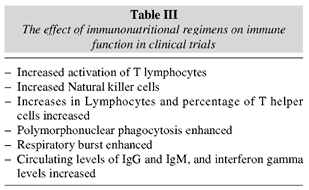
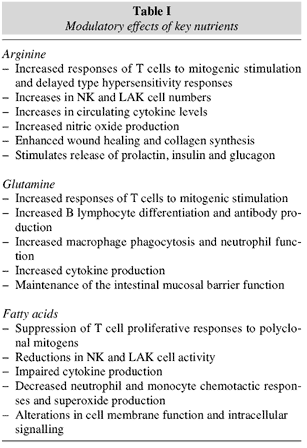
<body><![CDATA[<P><B>Introduction</B></P>     <P>For the last 30 years, interest has focused on the effects of loss of body  weight in patients with a variety of disease states, but particularly in those  with severe and critical illnesses. The impairments of immune function and organ  function that occur in these patients who have lost body weight have been well  recognised for many years<SUP>1</SUP>. The correlation between  between loss of body weight and morbidity and mortality in patients undergoing  surgery has also been well documented previously<sup>2,3</sup>.  Therefore, in view of thes many randomised trials have been undertaken to  determine what impact nutritional supplementation, given enterally or  parenterally, might have on both the incidence of complications and mortality in  patients undergoing surgery or in those who have sustained a critical illness.</P>     <P>Although many studies have been undertaken, the results have often been  difficult to interpret for various reasons. For example, different patient  populations, differing nutritional interventions and for variable periods of  time in the pre-operative, post-operative and perioperative periods, have all  been studied. In trying to understand the role of nutritional support more  clearly meta-analyses and detailed analyses have been undertaken in attempt to  overcome some of these limitations of the studies<SUP>4-6</SUP>.  The most recent meta-analyses have suggested that such an approach can reduce  the risk of post-operative complications in patients undergoing major surgery.  However, any effect on mortality has been more difficult to demonstrate and, in  fact, the evidence suggests that there is no reduction in mortality, in contrast  to that in morbidity<SUP>4-6</SUP>. </P>     <P>It is important to remember that such approaches to nutritional support have  really focused on the provision of nitrogen and calories, together with other  essential nutrients, to replace or supplement what it is expected to be a  patient´s normal oral intake, with or without considering the additional  metabolic demands placed on the patient by their underlying illness. However,  the recent developments in nutritional science have allowed a more full  appreciation and understanding of the roles and function of a variety of  nutrients. This knowledge is not only what is necessary to maintain health and  organ function, but also what can happen if nutrients are given in amounts in  excess of what was recognised previously as that being required for the  maintenance of bodily function and homeostasis.</P>     <P>Certain key nutrients, if provided in excess of what is their normal daily  requirement will effect a modulation of immune, inflammatory and metabolic  pathways. The term "nutritional pharmacology" has been used to describe this  approach. When nutrients are used specifically to modulate the immune system,  although this is clearly interlinked with inflammatory and metabolic pathways,  it is termed "immunonutrition"<sup>7,8</sup>. Many nutrients will  modify these processes but in this regard, most interest has focussed on amino  acids such as arginine and glutamine, fatty acids, ribo-nucleotides and certain  trace elements. These individual nutrients have been discussed extensively  elsewhere<SUP>7-15</SUP> and will not be further discussed  individually in this paper. Some of the key actions of these nutrients on the  immune system are listed in <a href="#t1"> table I</a>. </P>     <p align=center><a name="t1"><img src="/img/nh/v19n6/original1/original1_tabla1.gif" width=307 height=448></a></p>     <P>    <br> It is not surprising that preliminary trials have been carried out to  determine if any of these nutrients themselves can have clinically beneficial  effects. However, at the present time, there is no evidence to support the use  of any of these as single nutrients in clinical practice, perhaps with the  exception of glutamine<SUP>16</SUP>. A recent meta-analysis of 14  clinical trials of glutamine supplementation which has been given to critically  ill, or "surgical" patients, has suggested that there might be beneficial  effects. The results showed that patients receiving glutamine supplementation  had a reduction in their risks of developing an infectious complication and in  the group of "surgical" patients there was a significant reduction in the length  of their hospital stay<SUP>17</SUP>.</P>     <P>The most interesting results, however, have come from the clinical trials  where combinations of these key nutrients have been combined together as  commercially available immunonutritional regimens and which are for the enteral  route. Most commonly, Impact<sup>®</sup> and  Immunaid<SUP>®</SUP> have been evaluated. The key nutrients  provided focused on arginine, glutamine, n-3 essential fatty acids and  ribonucleic acid, but in differing compositions and quantities in the different  formulations that are available (<a href="#t2">table II</a>). The evidence base for the rationale  of the composition of these immunonutritional regimens is unclear and the  optimal combination and quantities for each of the nutrients is debatable.  Perhaps, the 30g per day of arginine has some scientific basis in that a dose  response study had indicated previously that this had a greater effect than did  lower doses<SUP>18</SUP>. However, as regards other nutrients,  the value of combinations when compared with single nutrients, the potential  interactions between nutrients, and potential synergistic or antagonistic  effects, there is even less evidence for their use in their current way.</P>     <p align=center><a name="t2"><img src="/img/nh/v19n6/original1/original1_tabla2.gif" width=305 height=246></a></p>     ]]></body>
<body><![CDATA[<P>    <br> Despite these considerations regarding the role of each individual nutrient,  initial studies compared the effects of these combination of immunonutrients  against readily available nutritional regimens which were commonly used in  clinical practice<sup>19,20</sup>. Although the amounts of  nitrogen and calories were usually comparable between the formulations, it was  the composition of specific nutrients that differed. </P>     <P>These immunonutritional combinations did modulate immune function in ways  that would be expected to be beneficial. The provision of immunonutritional  regimens resulted in enhancements of a variety of immune functions, particularly  lymphocyte responses to mitogenic stimulation, phenotypic analyses suggesting  enhanced lymphocyte sub-set numbers and functionally beneficial types of  lymphocytes, in addition to increased levels of circulating  antibodies<SUP>19-22</SUP>. These key effects reported from these studies are summarised in <a href="#t3"> table III</a>. These  results from these immunological studies were encouraging but the vital question  regarding immunonutrition for use in clinical practice must be whether or not  these changes in immunological parameters will translate into a better clinical  outcome for patients.</P>     <p align=center><a name="t3"><img src="/img/nh/v19n6/original1/original1_tabla3.gif" width=309 height=190></a></p>     <P><B>    <br> Clinical trials of immunonutrition in patients</B></P>     <P>A series of randomised clinical trials have been undertaken to evaluate the  role of these immunonutritional regimens in a variety of clinical settings. Most  commonly patients undergoing surgery for upper gastrointestinal cancer, patients  with sepsis and critical illness and patients who have sustained major burns,  have been studied and the results from these trials have bee reported in detail  previously<SUP>20,22-44</SUP>.</P>     <P>Although the patient groups that have been studied have differed, the  end-points of these trials have been comparable. In terms of morbidity, a key  outcome measure has been the incidence of infectious complications that occur in  these patients. Also, other outcomes that have been evaluated commonly in many  of the trials, have included the effects on hospital stay, intensive care unit  stay and patient mortality. Nevertheless, interpretation of the results is  difficult because of the many variable features in each of these trials,  particularly regarding patient type and immunonutritional provision. For  example, the underlying pathophysio-logical states, the baseline nutritional  status, the type and quantity of immunonutrition provided and the timing of  provision of immunonutrition are all important factors which have the potential  to affect the results of each trial. </P>     <P><B>Meta-analysis of clinical trials of immunonutrition which have evaluated  clinical outcomes</B></P>     <P>In an attempt to further understand what effects immunonutrition has on  clincial outcome, three meta-analyses<SUP>45-47</SUP> and a more  recent systematic review<SUP>48 </SUP>and consensus statement  have been reported during the last five years. These analyses have examined the  published trials in some depth and try to draw some conclusions that can be  applied to clinical practice. </P>     ]]></body>
<body><![CDATA[<P>In 1999, the first meta-analysis reported the results from 1,009 patients who  had participated in eleven clinical trials<SUP>45</SUP>. The  underlying pathological states that these patients had were frequently different  but the patients could be categorised as falling into two broad groups; those  undergoing surgery for upper gastrointestinal cancer and those patients who were  critically ill for a variety of other reasons including trauma, sepsis and major  burns. Although there were differences in the methodological qulaity of the  studies, three of these 11 trials had a difference in the nutritional intake of  the experimental and control groups of patients. There was an increased intake  of nitrogen in the immunonutrition groups when compared with the control groups  and clearly this may have affected the outcomes of the trials.</P>     <P>Nevertheless, when these trials were analysed together, there did appear to  be clinical benefits in those patients who received immunonutrition. In  particular, immunonutrition was associated with a reduction in the risks of  developing an infectious complication (defined as intra-abdominal abscess, major  wound infection, septicaemia, pneumonia). The magnitude of this effect was  substantial, with the relative risk being reduced to 0.47 (95%CI 0.32-0.70) by  the use of immunonutrition. A sub-group analysis also examined separately at  those patients with gastrointestinal cancer, but not including those with  critical illness. Again, there was a significant reduction in infectious  complications in patients receiving immunonutrition (relative risk 0.47, 95%CI:  0.30-0.73). Another benefit to acrue in these patients from immunonutrition was  that their length of stay in hospital was also reduced. Although this was only  by 2.5 days (95% CI, -4.0 to -1.0 days), nevertheless, there is a potential  financial saving which may also be important<SUP>45</SUP>.</P>     <P>Did the provision of immunonutrition have any effect on mortality in these  patients? Of the 11 studies, only seven of these reported effects on mortality.  The overall realative risk in patients receiving immunonutrition was 1.77 (95%  CI, 1.00 to 1.32)<SUP>45</SUP> . Although this was higher in  these patients it was not statistically significant. Furthermore, there were no  deaths in either the experimental or control groups in four of the trials and  only one showed a signficant difference, with there being an increase in  patients receiving immunonutrition. Closer examination of this latter study  revealed that there had been a randomisation error with an increased number of  patients with higher APACHE II scores in the immunonutrition group. It should  also be remembered that the patients in this study were those with sepsis or a  systemic inflammatory response syndrome and the potential significance and  importance of this with respect to immunonutrition will be highlighted  later.</P>     <P>As reports of more trials of immunonutrition began to appear in the  literature it wasn´t surprising that an update of the first meta-analysis were  published<SUP>46</SUP>. As an interm step, Beale et  al<SUP>46</SUP> then included four more trials to give a total of  15 then available for statistical analysis. The results were compared to those  previously reported<SUP>45</SUP> in that immunonutrition was  associated with a reduction in infectious complications by approximately one  half, but there was no significant effect on  mortality<SUP>46</SUP>.</P>     <P>More importantly, by 2001, a total of 22 randomised controlled trials of  2,419 patients were suitable for another more detailed,  examination<SUP>47</SUP>. The trials had included patients who  had either undergone elective surgery or who were criticaly ill, which was  defined as being cared for in a "critical care environment". The immunonutrition  given to patients had to include at least two of the four most commonly used  immuno-enhancing nutrients (arginine, glutamine, n-3 fatty acids or  nucleotides). There were also a large enough number of studies to be able to  carry out subsequent sub-group analyses which compared the methodologically  better studies with the remainder, and also compared those trials where patients  received immunonutritional regimens which had higher arginine contents with the  others who did not.</P>     <P>When considering the resuts of this analysis in terms of all trials together  and the effect on infectious complications, similar effects as noted before  emerged<SUP>47</SUP>. In the 18 trials where inectious  complications were reported, patients receiving immunonutition had less  infectious complications (pneumonia, wound infections, intra-abdominal  abscesses, urinary tract infection, intravenous line sepsis). Their relative  risk of infectious complications was 0.66 (95% CI, 0.54 to 0.80). Furthermore,  the provision of immunonutrition was also associated with a reduction in their  length of stay in hospital by some 3 days (95% CI, -5.6 to -1.0 days) from the  17 trials where this was reported. As observed previously, when mortality was  exmained there was no difference between those patients receiving  immuno-nutrition or those in the control groups (Relative risk 1.10,  95% CI, 0.93 to 1.31) (see <a href="#t4"> table IV</a>). </P>     <p align=center><a name="t4"><img src="/img/nh/v19n6/original1/original1_tabla4.gif" width=305 height=175></a></p>     <P>    <br> An important sub-group analysis separated out and examined those patients who  had a critical illness and then compared them with those who had undergone  elective surgery. Here, a different picture emerged because in the critically  ill patients there was no reduction in infectious complications associated with  the provision of immunonutrition (RR, 0.96, 95% CI, 0.77 to  1.20)<SUP>47</SUP>. In contrast, there was a significant  reduction in infectious complications in the elective surgical patients who were  given immunonutrition (RR, 0.53, CI, 0.42 to 0.68). Interestingly, in  both groups of patients there was a significant reduction in hospital stay which  was of comparable length between the two groups, but there was no effect on  mortality in either type of patients<SUP>47</SUP>.</P>     <P>Perhaps the most interesting and thought-provoking data to emerge from this  meta-analysis was the effect of immunonutrition on mortality. As already  discussed, there was no effect on mortality overall, or in the sub-groups of  patients with critical illness or those in the elective surgery group. However,  when the patients who had received immunonutritional formulations with higher  arginine contents were examined then a different picture emerged. The relative  risk of mortality was 2.13 (95%CI, 1.08-4.21) in patients receiving a higher  arginine content type of immunonutrition. In contrast, patients with lower  arginine immunonutritional regimens had a relative risk of death of 1.03 (95%CI,  0.75-1.41). Furthermore, this former group of patients also had a reduction in  risk of infections complications and a shorter hospital stay than did patients  in the latter group (see <a href="#t4"> table IV</a>)<SUP>47</SUP>.</P>     ]]></body>
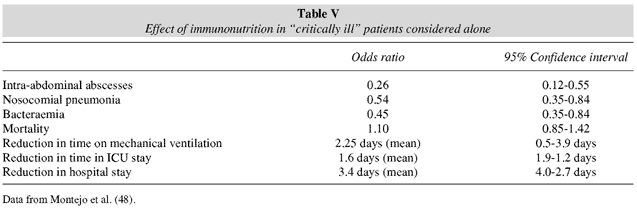
<body><![CDATA[<P>The other major subgroup analysis which was of those studies with the better  methodological designs and performance. Again, of some concern was that the  mortality analysis from these studies gave a relative risk of 1.46 (95%CI,  1.01-2.11). Whilst these results are of some concern, it is important to  remember that they are from a subgroup analysis with all the attendent  statistical limitations. Nevertheless, as discussed previously, it is important  to consider the implications of this further and this will be discussed later in  this paper.</P>     <P><B>Further understanding of the effect of the patients underlying disease  state on clinical outcomes</B></P>     <P>In trying to take the understanding of the role and potential for  immunonutrition to affect the clinical outcomes from the treatment of critically  ill patients, most recent systematic review analysed the results from 26  clinical trials of enteral immunonutrition<SUP>48</SUP>. However, the results from this analysis were then subjected to review by a  panel of experts. These experts then considered the appropriateness of these  results for clinical practice and made recommendations for the use of  immunonutrition. The general overall results from this analysis are shown In <a href="#t5">  table V</a>, but patients receiving immunonutrition had reductions in infection  rates, intra-abdominal abscesses, nosocomial pneumonia and bacteraemia.  Furthermore, these patients also had reductions in their length of time in  hospital, length of stay in the intensive care unit and length of time for which  they required mechanical ventilation but there was no effect on  mortality<SUP>48</SUP>.</P>     <p align=center><a name="t5"><img src="/img/nh/v19n6/original1/original1_tabla5.gif" width=637 height=209></a></p>     <P>    <br> These authors then attempted to answer five questions which were thought to  be of major importance for clincial practice and with respect to certain  categories and subgroups of patients categorised according to their underlying  pathology. Their findings and interpretations are summarised below: </P>     <P>In response to the question as to what effect of immunonutrition had on  nosocomial infection in critically ill patients, then there was a reduction in  patients undergoing elective surgery (bacteraemias, intra-abdominal abscesses)  but no effect on wound infection or nosocomial pneumonia. In addition, in  patients who had sustained a major burn, there was a reduction in the incidence  of nosocomial pneumonia.</P>     <P>The effect of immunonutrition in reducing hospital stay times was beneficial  in the patients who were undergoing surgery and intensive care unit stay was  also reduced in both patients who had undergone surgery and those who had  sustained a major trauma. The authors also concluded that there was no  convincing effect of immunonutrition on the incidence of multiple organ  dysfunction or adult respiratory distress syndrome, and no effect on in-patient  mortality. Finally, there was no evidence to answer the question as to the  effect of immunonutrition on reduction of the financial costs in patients with  critical illness<SUP>48</SUP>. </P>     <P><B>Importance of timing of the provision of immunonutrition</B></P>     <P>An important consideration when examining these clinical trials is what  effect the timing of the provision immunonutrition might have on clinical  outcome. This might be extremely important in determining what clinical outcomes  may occur in such patients. Immunonutrition differs from conventional  nutritional support in that it is not just simply the provision of nutrients,  nitrogen, calories etc., to patients who are either not able to take in  nutrients normally or who are malnourished. That is, immunonutrition is not  designed or intended to maintain "normal" metabolic processes or to cause an  anabolic response in a patients. It is conceptually and fundamentally a  different approach to nutritional provision in the surgical or critically ill  patient. Immunonutrition is a provision of nutrients with the specific aim of  modulating the immune, metabolic and inflammatory processes and it could be  considered, therefore, to be a "pharmacological" intervention.</P>     ]]></body>
<body><![CDATA[<P>This point regarding the potential importance of timing of the provision of  immunonutrition has been developed in key studies reported by Braga et  al<SUP>41</SUP> in patients undergoing surgery for colorectal  cancer. A large, randomised, controlled study of such patients evaluated the  clinical effects of immunonutrition (Impact<SUP>®</SUP>) when it  was given perioperatively, including the pre- and post-operative periods.  Overall, immuno-nutrition provision resulted in a reduction in post-operative  complications and patients had a reduction in their length of stay in hospital.  These effects also had a tangible benefit in terms of a reduction in the  financial costs of treatment associated with the provision of  immunonutrition<SUP>42,49</SUP>.</P>     <P>A post-hoc analysis was also carried out subsequently to determine if there  was any affect on outcome which could be attributed to the timing of the  provision of the immunonutritional intervention. Interestingly, this indicated  that the provision of nutrients pre-operatively was probably as good as  administration in the whole of the peri-operative period in terms of effects on  clinical outcomes. Clearly, subgroup analyses do have limitations in the  validity of the conclusions that can be drawn from them, but they do allow the  generation of a hypothesis for future testing. </P>     <P>To answer this question definitively as to whether immunonutrition given in  the pre-operative period is as effective as that given in both the pre- and  postoperative patients, Braga et al<SUP>50</SUP> undertook  another large clinical trial. This study was designed not only to look at  clinical outcomes but also to examine carefully what effects there were on basic  physiological functions. More than 200 patients with colorectal cancer  undergoing surgical resection were randomised to one of four experimental  groups; this was either (i) to receive pre-operative immunonutrition for 5 days,  (ii) pre-operative immunonutrition but then continued for 5 days  post-operatively (jejunal infusion), (iii) oral in-take of a standard  isonitrogenous, isocaloric formula for 5 days period to surgery, and (iv) a  group of patients who were treated conventionally with no supplementation before  or after surgery.</P>     <P>It was demonstrated in this study that those patients receiving  immunonutrition in either the pre-operative period and the peri-operative  period, had improved immunological functions, better gut oxygenation and  microperfusion than did the patients who were not receiving  immunonutrition<SUP>50</SUP>. This may have an important clinical  relevance in these patients undergoing intestinal resections because of the  adverse effects on the healing of gastrointestinal anastomosis that occurs with  inadequate oxygenation. In fact, there was almost a halving of the anastomotic  leak rate in those patients who received peri-operative or pre-operative  immunonutrition when compared with the other patients (although this was not  statistically significant)<SUP>50</SUP>.</P>     <P><B>Is the provusion of immunonutrition appropriate for all patients?</B></P>     <P>The previously discussed data suggests that there are clinical benefits to be  gained by providing immunonutrition to patients undergoing elective surgery for  gastrointestinal tract cancers. However, not all patients may benefit,  particularly those with critical illness and there is also a concern that there  may be a potential for harm in some patients<SUP>51-53</SUP>. In  particular concern has focussed on the role and effects of of argi-nine as a  componant of immunonutrition. This is because it was the studies using the  immunonutritional regimens that patients had an increased  mortality<SUP>47</SUP>. In trying to understand this further,  perhaps the precursor role of arginine for nitric oxide (NO) synthesis via the  nitric oxide synthase (NOS) enzyme system provides a reason as to why there may  be some concern. During inflammatory conditions there is an increased production  of NO via the inducible (iNOS) enzyme system. One of the key effects of NO is to  cause a vasodilatation, which can be substantial, and indeed has be shown to be  of therapeutic benefit in patients with hypertension, claudication and coronary  artery disease<SUP>54,55</SUP>.</P>     <P>Is it possible that this resultant vasodilatation might have harmful effects  in patients who are critically ill? It is certainly a possibility because  experimental clinical studies has shown that an intravenous bolus injection of  arginine can have marked effects in patients with  sepsis<SUP>56</SUP>. This bolus administration of arginine  effected a large reduction in the patients mean blood pressure with concomitant  reductions in systemic and pulmonary vascular resistances, together with an  increased cardiac index. However, within ten minutes of the arginine bolus  having been given, these effects had reversed and returned to the pre-treatment  indices for the patients<SUP>56</SUP>.</P>     <P>There are also other effects of arginine which could be potentially harmful  to critically ill patients. For example, NO can affect cellular oxygen  consumption and utilisation, possibly by inhibiting the mitochondrial enzymes  that are key to the process of electron transfer<SUP>57</SUP>. In  the clinical situation there is evidence to support this possibility. The  partial pressure of oxygen in skeletal muscle has been shown to increase with  increasing severity of sepsis in critically ill patients which is in proportion  to the severity of sepsis which patients are  experiencing<SUP>58</SUP>. Whilst this is important  circumstantial evidence for a block in oxygen utilisation, in animal studies  there is more direct evidence. Reduced levels of the cytochrome c enzyme systems  have been documented in an animal model of sepsis<SUP>59  </SUP>and furthermore, this reduction was proportional to the degree of  the sepsis and septic shock<SUP>59</SUP>.</P>     <P>NO is also important in the critically ill patient because it is essential in  the physiological situation for the maintenance of the gut-mucosal barrier and  for ensuring that its functions are optimal<SUP>60</SUP>. As  already discussed, in inflammatory states where there is an increased iNOS  system, then the administration of arginine can result in the production of  large amounts of NO with resultant damage to the intestinal mucosa. If this  occurs there will be a failure of the gut-barrier function with ensuing  translocation of bacteria and endotoxin and their adverse effects on critically  ill patients.</P>     <P>Given these issues regarding arginine that may give rise to some concerns, is  there any more clinical evidence that might support these being clinically  relevant effects? Certainly, the last meta-analysis<SUP>47</SUP>  suggested that high arginine-containing diets did have a higher mortality but  this was a subgroup analysis. Of interest in this respect is the interim  analysis of a recent study which was reported by Bertolini et  al<SUP>61</SUP>. Included in this trial were 39 patients with  severe sepsis or septic shock who were randomised to receive either  immunonutrition enterally (Impact<SUP>®</SUP>) or total  parenteral nutrition (TPN). There was a significant difference in mortality  between the two groups of patients; 44.4% in the immunonutrition group but  only 14.3% in the group receiving TPN<SUP>61</SUP>. Whilst there  may be other reasons for this difference, it may well be related to the arginine  content and clearly requires further investigation.</P>     ]]></body>
<body><![CDATA[<P>Whilst the focus on immunonutrients has centred on arginine, it is also  important to consider other immunonutrients in relationship to the patients  underlying and dynamic pathophysiological changes, especially in those patients  with sepsis. Initially these patients experience an inflammatory response.  However, as the sepsis process continues this may be super-ceded by an  anti-inflammatory response which may be of even greater  magnitude<SUP>62</SUP>. Although the mechanisms of this remain to  be fully clarified it appears that the balance of cytokines produced by Th1 and  Th2 cells is crucially important in this "switch"<SUP>63</SUP>.  The result of this is that there may be an immunosuppressive state in these  patients<SUP>62</SUP> which would then be expected to result in  an increased susceptibility of these patients to developing infectious  complications.</P>     <P>Taking this into consideration, it is clear that inflammation and sepsis are  constantly changing and dynamic states which may at different times have an  enhanced inflammatory phase and a second phase where there is impaired  inflammation and immunity. Therefore, immunonutrition with immunoenhancing  nutrients may not be appropriate to give to all patients because the underlying  and dynamic physiological changes are different. Indeed, in those patients in  whom there is immunosuppression then immune enhancement is appropriate. In  contrast, in those patients in an inflammatory phase, immunonutrition with  immunoinhibitory nutrients may be theoretically more appropriate. This needs to  be considered further and in much detail if we are to understand further these  potential benefits of immunonutrition.</P>     <P><B>References</B></P>     <!-- ref --><P>1. Heys SD, Simpson WG, Eremin O: Surgical Nutrition. In: Emergency surgery  and critical care. A companion to specialist surgical practice. Ed  Paterson-Brown S, WB Saunders Co, 1997, pp 55-120.&nbsp;&nbsp;&nbsp;&nbsp;&nbsp;&nbsp;&nbsp;&nbsp;[&#160;<a href="javascript:void(0);" onclick="javascript: window.open('/scielo.php?script=sci_nlinks&ref=3451862&pid=S0212-1611200400060000300001&lng=','','width=640,height=500,resizable=yes,scrollbars=1,menubar=yes,');">Links</a>&#160;]<!-- end-ref --><!-- ref --> 2. Studley HO:  Percentage of weight loss. A basic indicator of surgical risk in patients with  chronic peptic ulcer. <I>JAMA</I> 1936, 106:458-460.    &nbsp;&nbsp;&nbsp;&nbsp;&nbsp;&nbsp;&nbsp;&nbsp;[&#160;<a href="javascript:void(0);" onclick="javascript: window.open('/scielo.php?script=sci_nlinks&ref=3451863&pid=S0212-1611200400060000300002&lng=','','width=640,height=500,resizable=yes,scrollbars=1,menubar=yes,');">Links</a>&#160;]<!-- end-ref --><!-- ref --><p>3. Detsky AS,  Baker JP, O'Rourke K et al.: Predictting nutrition-associated complications for  patients undergoing gastrointestinal surgery JPEN Journal of Parenteral and  Enteral Nutrition 1987, 11:440-446.&nbsp;&nbsp;&nbsp;&nbsp;&nbsp;&nbsp;&nbsp;&nbsp;[&#160;<a href="javascript:void(0);" onclick="javascript: window.open('/scielo.php?script=sci_nlinks&ref=3451864&pid=S0212-1611200400060000300003&lng=','','width=640,height=500,resizable=yes,scrollbars=1,menubar=yes,');">Links</a>&#160;]<!-- end-ref --><!-- ref --><p>4. Heys SD, Walker LG, Eremin O:  The value of peri-operative nutrition in the sick patient. <I>Proc Nutr Soc</I>  1997, 56:443-457.&nbsp;&nbsp;&nbsp;&nbsp;&nbsp;&nbsp;&nbsp;&nbsp;[&#160;<a href="javascript:void(0);" onclick="javascript: window.open('/scielo.php?script=sci_nlinks&ref=3451865&pid=S0212-1611200400060000300004&lng=','','width=640,height=500,resizable=yes,scrollbars=1,menubar=yes,');">Links</a>&#160;]<!-- end-ref --><!-- ref --><p>5. Heyland DK, Cook DJ, Guyatt GH: Enteral nutrition  in the critically ill patient: a critical review of the evidence. <I>Int Care  Med</I> 1993, 19:435-442.&nbsp;&nbsp;&nbsp;&nbsp;&nbsp;&nbsp;&nbsp;&nbsp;[&#160;<a href="javascript:void(0);" onclick="javascript: window.open('/scielo.php?script=sci_nlinks&ref=3451866&pid=S0212-1611200400060000300005&lng=','','width=640,height=500,resizable=yes,scrollbars=1,menubar=yes,');">Links</a>&#160;]<!-- end-ref --><!-- ref --><p>6. Heyland DK, Montalvo M, MacDonald S,  Keefe L, Su XY, Drover JW: Total parenteral nutrition in the surgical patient: a  meta-analysis. <I>J Canad Chir</I> 2001, 44:102-111.&nbsp;&nbsp;&nbsp;&nbsp;&nbsp;&nbsp;&nbsp;&nbsp;[&#160;<a href="javascript:void(0);" onclick="javascript: window.open('/scielo.php?script=sci_nlinks&ref=3451867&pid=S0212-1611200400060000300006&lng=','','width=640,height=500,resizable=yes,scrollbars=1,menubar=yes,');">Links</a>&#160;]<!-- end-ref --><!-- ref --><p>7. Heys SD, Gough  DB, Khan L, Eremin O: Nutritional pharmacology and malignant disease: a  therapeutic modality in patients with cancer? <I>Br J Surg</I> 1996, 83:608-619.&nbsp;&nbsp;&nbsp;&nbsp;&nbsp;&nbsp;&nbsp;&nbsp;[&#160;<a href="javascript:void(0);" onclick="javascript: window.open('/scielo.php?script=sci_nlinks&ref=3451868&pid=S0212-1611200400060000300007&lng=','','width=640,height=500,resizable=yes,scrollbars=1,menubar=yes,');">Links</a>&#160;]<!-- end-ref --><!-- ref --><p>8. Kirk H, Heys SD: Immunonutrition. <I>Br J Surg</I> 2003,  90:1459-1460.    &nbsp;&nbsp;&nbsp;&nbsp;&nbsp;&nbsp;&nbsp;&nbsp;[&#160;<a href="javascript:void(0);" onclick="javascript: window.open('/scielo.php?script=sci_nlinks&ref=3451869&pid=S0212-1611200400060000300008&lng=','','width=640,height=500,resizable=yes,scrollbars=1,menubar=yes,');">Links</a>&#160;]<!-- end-ref --><!-- ref --> 9. Brittenden J, Heys SD, Eremin O: Immunological  properties of L-arginine. In: Eremin O ed. L-arginine: biological aspects and  clinical characteristics. Austin: RG Landes Co; 1997, pp. 27-77.&nbsp;&nbsp;&nbsp;&nbsp;&nbsp;&nbsp;&nbsp;&nbsp;[&#160;<a href="javascript:void(0);" onclick="javascript: window.open('/scielo.php?script=sci_nlinks&ref=3451870&pid=S0212-1611200400060000300009&lng=','','width=640,height=500,resizable=yes,scrollbars=1,menubar=yes,');">Links</a>&#160;]<!-- end-ref --><!-- ref --><p>10.  Barbul A, Lazarou SA, Efron DT et al.: Arginine enhances wound healing and  lymphocyte immune responses in humans. <I>Surgery</I> 1990, 108:331-337.&nbsp;&nbsp;&nbsp;&nbsp;&nbsp;&nbsp;&nbsp;&nbsp;[&#160;<a href="javascript:void(0);" onclick="javascript: window.open('/scielo.php?script=sci_nlinks&ref=3451871&pid=S0212-1611200400060000300010&lng=','','width=640,height=500,resizable=yes,scrollbars=1,menubar=yes,');">Links</a>&#160;]<!-- end-ref --><!-- ref --><p>11. Brittenden J, Park KG, Heys SD et al.: L-arginine stimulates host  defences in patients with breast cancer. <I>Surgery</I> 1994, 115:205-212.&nbsp;&nbsp;&nbsp;&nbsp;&nbsp;&nbsp;&nbsp;&nbsp;[&#160;<a href="javascript:void(0);" onclick="javascript: window.open('/scielo.php?script=sci_nlinks&ref=3451872&pid=S0212-1611200400060000300011&lng=','','width=640,height=500,resizable=yes,scrollbars=1,menubar=yes,');">Links</a>&#160;]<!-- end-ref --><!-- ref --><p>12. Calder PC, Newsholme P: Glutamine and the immune system. In:  Nutrition and Immune Function, eds Calder PC, Field CJ, Gill HS. Oxon: CABI  publishing; 2002, pp. 57-92.&nbsp;&nbsp;&nbsp;&nbsp;&nbsp;&nbsp;&nbsp;&nbsp;[&#160;<a href="javascript:void(0);" onclick="javascript: window.open('/scielo.php?script=sci_nlinks&ref=3451873&pid=S0212-1611200400060000300012&lng=','','width=640,height=500,resizable=yes,scrollbars=1,menubar=yes,');">Links</a>&#160;]<!-- end-ref --><!-- ref --><p>13. Purasiri P, Ashby J, Heys SD, Eremin  O: Effect of essential fatty acids on circulating T cell subsets in patients  with colorectal cancer. <I>Cancer Immunol Immunother </I>1994, 39:217-222.&nbsp;&nbsp;&nbsp;&nbsp;&nbsp;&nbsp;&nbsp;&nbsp;[&#160;<a href="javascript:void(0);" onclick="javascript: window.open('/scielo.php?script=sci_nlinks&ref=3451874&pid=S0212-1611200400060000300013&lng=','','width=640,height=500,resizable=yes,scrollbars=1,menubar=yes,');">Links</a>&#160;]<!-- end-ref --><!-- ref --><p>14. Purasiri P, McKechnie A, Heys SD, Eremin O: Modulation<I> in vitro  </I>of human natural cytotoxicity, lymphocyte proliferative response to mitogens  and cytokine production by essential fatty acids. <I>Immunology</I> 1997,  92:166-172.&nbsp;&nbsp;&nbsp;&nbsp;&nbsp;&nbsp;&nbsp;&nbsp;[&#160;<a href="javascript:void(0);" onclick="javascript: window.open('/scielo.php?script=sci_nlinks&ref=3451875&pid=S0212-1611200400060000300014&lng=','','width=640,height=500,resizable=yes,scrollbars=1,menubar=yes,');">Links</a>&#160;]<!-- end-ref --><!-- ref --><p>15. Khan AL, Heys SD, Eremin O: Synthetic  polyribonucleotides: current role and potential use in oncological practice.  <I>Eur J Surg Oncol</I> 1995, 21:224-227.&nbsp;&nbsp;&nbsp;&nbsp;&nbsp;&nbsp;&nbsp;&nbsp;[&#160;<a href="javascript:void(0);" onclick="javascript: window.open('/scielo.php?script=sci_nlinks&ref=3451876&pid=S0212-1611200400060000300015&lng=','','width=640,height=500,resizable=yes,scrollbars=1,menubar=yes,');">Links</a>&#160;]<!-- end-ref --><!-- ref --><p>16. Heys SD and Ashkanani F:  Glutamine. <I>Br J Surg </I>1999, 86:289-290.&nbsp;&nbsp;&nbsp;&nbsp;&nbsp;&nbsp;&nbsp;&nbsp;[&#160;<a href="javascript:void(0);" onclick="javascript: window.open('/scielo.php?script=sci_nlinks&ref=3451877&pid=S0212-1611200400060000300016&lng=','','width=640,height=500,resizable=yes,scrollbars=1,menubar=yes,');">Links</a>&#160;]<!-- end-ref --><!-- ref --><p>17. Novak F, Heyland DK,  Avenell A, Drover JW, Su X: Gluta-mine supplementation in serious illness: a  systematic review of the evidence. <I>Crit Care Med</I> 2002, 30:2022-9.&nbsp;&nbsp;&nbsp;&nbsp;&nbsp;&nbsp;&nbsp;&nbsp;[&#160;<a href="javascript:void(0);" onclick="javascript: window.open('/scielo.php?script=sci_nlinks&ref=3451878&pid=S0212-1611200400060000300017&lng=','','width=640,height=500,resizable=yes,scrollbars=1,menubar=yes,');">Links</a>&#160;]<!-- end-ref --><!-- ref --><p>18. Elsair J, Poey J, Isaad J et al.: Effect of arginine chlorhydrate  on nitrogen balance during the three days following surgery in man.  <I>Biomedicine </I>1978, 29:312-317.&nbsp;&nbsp;&nbsp;&nbsp;&nbsp;&nbsp;&nbsp;&nbsp;[&#160;<a href="javascript:void(0);" onclick="javascript: window.open('/scielo.php?script=sci_nlinks&ref=3451879&pid=S0212-1611200400060000300018&lng=','','width=640,height=500,resizable=yes,scrollbars=1,menubar=yes,');">Links</a>&#160;]<!-- end-ref --><!-- ref --><p>19. Cerra FB, Lehman S,  Lonstantinides N et al.: Effect of enteral nutrition on<I> in vitro </I>tests of  immune function in ICU patients. A preliminary report. <I>Nutrition</I> 1990,  6:84-87.&nbsp;&nbsp;&nbsp;&nbsp;&nbsp;&nbsp;&nbsp;&nbsp;[&#160;<a href="javascript:void(0);" onclick="javascript: window.open('/scielo.php?script=sci_nlinks&ref=3451880&pid=S0212-1611200400060000300019&lng=','','width=640,height=500,resizable=yes,scrollbars=1,menubar=yes,');">Links</a>&#160;]<!-- end-ref --><!-- ref --><p>20. Daly JM, Lieberman MD, Goldfine J et al.: Enteral  nutrition with supplemental arginine, RNA and omega-3 fatty acids after  operation: immunologic, metabolic and clinical outcome. <I>Surgery</I> 1992,  112:56-67.&nbsp;&nbsp;&nbsp;&nbsp;&nbsp;&nbsp;&nbsp;&nbsp;[&#160;<a href="javascript:void(0);" onclick="javascript: window.open('/scielo.php?script=sci_nlinks&ref=3451881&pid=S0212-1611200400060000300020&lng=','','width=640,height=500,resizable=yes,scrollbars=1,menubar=yes,');">Links</a>&#160;]<!-- end-ref --><!-- ref --><p>21. Cerra FB, Lehmann S, Konstantinides N et al.: Improvement in  immune function in ICU patients by enteral nutrition supplemented with arginine,  RNA, and menhaden oil is independent of nitrogen balance. <I>Nutrition</I> 1991,  7:193-199.&nbsp;&nbsp;&nbsp;&nbsp;&nbsp;&nbsp;&nbsp;&nbsp;[&#160;<a href="javascript:void(0);" onclick="javascript: window.open('/scielo.php?script=sci_nlinks&ref=3451882&pid=S0212-1611200400060000300021&lng=','','width=640,height=500,resizable=yes,scrollbars=1,menubar=yes,');">Links</a>&#160;]<!-- end-ref --><!-- ref --><p>22. Gottschlich MM, Jenkins M, Warden GD et al.:  Differential effects of three enteral dietary regimens on selected outcome  variables in burn patients.<I> JPEN J Parenter Enteral Nutr </I>1990,  14:225-236.&nbsp;&nbsp;&nbsp;&nbsp;&nbsp;&nbsp;&nbsp;&nbsp;[&#160;<a href="javascript:void(0);" onclick="javascript: window.open('/scielo.php?script=sci_nlinks&ref=3451883&pid=S0212-1611200400060000300022&lng=','','width=640,height=500,resizable=yes,scrollbars=1,menubar=yes,');">Links</a>&#160;]<!-- end-ref --><!-- ref --><p>23. Kemen M, Senkal M, Homan H-H et al.: Early  postoperative enteral nutrition with arginine-n-3 fatty acids and ribonucleic  acid-supplemented diet <I>versus</I> placebo in cancer patients: an immunologic  evaluation of Impact. <I>Crit Care Med</I> 1995, 23:652-659.&nbsp;&nbsp;&nbsp;&nbsp;&nbsp;&nbsp;&nbsp;&nbsp;[&#160;<a href="javascript:void(0);" onclick="javascript: window.open('/scielo.php?script=sci_nlinks&ref=3451884&pid=S0212-1611200400060000300023&lng=','','width=640,height=500,resizable=yes,scrollbars=1,menubar=yes,');">Links</a>&#160;]<!-- end-ref --><!-- ref --><p>24. Moore  FA, Moore EE, Kudsk KA et al.: Clinical benefits of an immune-enhancing diet for  early postinjury enteral feeding. <I>J Trauma</I> 1994, 37:607-615.&nbsp;&nbsp;&nbsp;&nbsp;&nbsp;&nbsp;&nbsp;&nbsp;[&#160;<a href="javascript:void(0);" onclick="javascript: window.open('/scielo.php?script=sci_nlinks&ref=3451885&pid=S0212-1611200400060000300024&lng=','','width=640,height=500,resizable=yes,scrollbars=1,menubar=yes,');">Links</a>&#160;]<!-- end-ref --><!-- ref --><p>25. Brown RO, Hunt H, Mowatt-Larssen CA, Wojtysiak SL, Henningfield  MF, Kudsk KA: Comparison of specialized and standard enteral formyulas in trauma  patients. <I>Pharmacotherapy</I> 1994, 14:314-320.&nbsp;&nbsp;&nbsp;&nbsp;&nbsp;&nbsp;&nbsp;&nbsp;[&#160;<a href="javascript:void(0);" onclick="javascript: window.open('/scielo.php?script=sci_nlinks&ref=3451886&pid=S0212-1611200400060000300025&lng=','','width=640,height=500,resizable=yes,scrollbars=1,menubar=yes,');">Links</a>&#160;]<!-- end-ref --><!-- ref --><p>26. Bower RH, Cerra  FB, Bershadsky B et al.: Early enteral administration of a formula (Impact)  supplemented with arginine, nucleotides, and fish oil in intensive care unit  patients: results of a multicenter, prospective, randomized clinical trial.  <I>Crit Care Med</I> 1995, 23:436-449.&nbsp;&nbsp;&nbsp;&nbsp;&nbsp;&nbsp;&nbsp;&nbsp;[&#160;<a href="javascript:void(0);" onclick="javascript: window.open('/scielo.php?script=sci_nlinks&ref=3451887&pid=S0212-1611200400060000300026&lng=','','width=640,height=500,resizable=yes,scrollbars=1,menubar=yes,');">Links</a>&#160;]<!-- end-ref --><!-- ref --><p>27. Braga M, Vignali A,  Gianotti L, Cestari A, Profili M, Di Carlo V: Benefits of early postoperative  enteral feeding in cancer patients.<I> Infusionsther Transfusions Med</I> 1995,  22:280-284.&nbsp;&nbsp;&nbsp;&nbsp;&nbsp;&nbsp;&nbsp;&nbsp;[&#160;<a href="javascript:void(0);" onclick="javascript: window.open('/scielo.php?script=sci_nlinks&ref=3451888&pid=S0212-1611200400060000300027&lng=','','width=640,height=500,resizable=yes,scrollbars=1,menubar=yes,');">Links</a>&#160;]<!-- end-ref --><!-- ref --><p>28. Daly JM, Weintraub F, Shou J, Rosato EF, Lucia M:  Enteral nutrition during multimodality therapy in upper gastrointestinal cancer  patients. <I>Ann Surg</I> 1995, 221:327-338.&nbsp;&nbsp;&nbsp;&nbsp;&nbsp;&nbsp;&nbsp;&nbsp;[&#160;<a href="javascript:void(0);" onclick="javascript: window.open('/scielo.php?script=sci_nlinks&ref=3451889&pid=S0212-1611200400060000300028&lng=','','width=640,height=500,resizable=yes,scrollbars=1,menubar=yes,');">Links</a>&#160;]<!-- end-ref --><!-- ref --><p>29. Kudsk KA, Minard G,  Croce MA et al.: A randomized trial of isonitrogenous enteral diets after severe  trauma. An immune-enhancing diet reduces septic complications. <I>Ann Surg  </I>1996, 224:531-543.&nbsp;&nbsp;&nbsp;&nbsp;&nbsp;&nbsp;&nbsp;&nbsp;[&#160;<a href="javascript:void(0);" onclick="javascript: window.open('/scielo.php?script=sci_nlinks&ref=3451890&pid=S0212-1611200400060000300029&lng=','','width=640,height=500,resizable=yes,scrollbars=1,menubar=yes,');">Links</a>&#160;]<!-- end-ref --><!-- ref --><p>30. Schilling J, Vranjes N, Fierz W et al.:  Clinical outcome and immunology of postoperative arginine, omega-3 fatty acids,  and nucleotide-enriched enteral feeding: a randomised prospective comparison  with standard enteral and low calorie/low fat IV solutions. <I>Nutrition</I>  1996, 12:423-429.&nbsp;&nbsp;&nbsp;&nbsp;&nbsp;&nbsp;&nbsp;&nbsp;[&#160;<a href="javascript:void(0);" onclick="javascript: window.open('/scielo.php?script=sci_nlinks&ref=3451891&pid=S0212-1611200400060000300030&lng=','','width=640,height=500,resizable=yes,scrollbars=1,menubar=yes,');">Links</a>&#160;]<!-- end-ref --><!-- ref --><p>31. Braga M, Vignalli A, Gianotti L, Cestari A,  Profili M, Carlo VD: Immune and nutirtional effects of early enteral nutrition  after major abdominal operations. <I>Eur J Surg </I>1996, 162:105-112.&nbsp;&nbsp;&nbsp;&nbsp;&nbsp;&nbsp;&nbsp;&nbsp;[&#160;<a href="javascript:void(0);" onclick="javascript: window.open('/scielo.php?script=sci_nlinks&ref=3451892&pid=S0212-1611200400060000300031&lng=','','width=640,height=500,resizable=yes,scrollbars=1,menubar=yes,');">Links</a>&#160;]<!-- end-ref --><!-- ref --><p>32. Gianotti L, Braga M, Vignali A et al.: Effect of route of delivery  and formulation of postoperative nutritional support in patients undergoing  major operations for malignant neoplasms. <I>Arch Surg</I> 1997, 132:1222-1229.&nbsp;&nbsp;&nbsp;&nbsp;&nbsp;&nbsp;&nbsp;&nbsp;[&#160;<a href="javascript:void(0);" onclick="javascript: window.open('/scielo.php?script=sci_nlinks&ref=3451893&pid=S0212-1611200400060000300032&lng=','','width=640,height=500,resizable=yes,scrollbars=1,menubar=yes,');">Links</a>&#160;]<!-- end-ref --><!-- ref --><p>33. Engel JM, Menges T, Neuhauser C, Schaefer B, Hempeklmann G:  Effects of various feeding regimens in multipe trau<I>ma patients on septic  complications and immune parameters. Anasthesiol Intensivmed Notfallmed  Schmerzther</I> 1997, 32:234-239.&nbsp;&nbsp;&nbsp;&nbsp;&nbsp;&nbsp;&nbsp;&nbsp;[&#160;<a href="javascript:void(0);" onclick="javascript: window.open('/scielo.php?script=sci_nlinks&ref=3451894&pid=S0212-1611200400060000300033&lng=','','width=640,height=500,resizable=yes,scrollbars=1,menubar=yes,');">Links</a>&#160;]<!-- end-ref --><!-- ref --><p>34. Rodrigo CM, Garcia PJ: The  effect of the composition of the enteral nutrition on infection in the critical  patient. <I>Nutr Hosp </I>1997, 12:80-84.&nbsp;&nbsp;&nbsp;&nbsp;&nbsp;&nbsp;&nbsp;&nbsp;[&#160;<a href="javascript:void(0);" onclick="javascript: window.open('/scielo.php?script=sci_nlinks&ref=3451895&pid=S0212-1611200400060000300034&lng=','','width=640,height=500,resizable=yes,scrollbars=1,menubar=yes,');">Links</a>&#160;]<!-- end-ref --><!-- ref --><p>35. Saffle JR, Wiebke G,  Jennings K, Morris SE, Barton RG: Randomized trial of immune-enhancing enteral  nutrition in burn patients. <I>J Trauma </I>1997, 42:793-802.&nbsp;&nbsp;&nbsp;&nbsp;&nbsp;&nbsp;&nbsp;&nbsp;[&#160;<a href="javascript:void(0);" onclick="javascript: window.open('/scielo.php?script=sci_nlinks&ref=3451896&pid=S0212-1611200400060000300035&lng=','','width=640,height=500,resizable=yes,scrollbars=1,menubar=yes,');">Links</a>&#160;]<!-- end-ref --><!-- ref --><p>36.  Mendez C, Jurkovich GJ, Garcia I, Davis D, Parker A, Maier RV: Effects of an  immune-enhancing diet in critically injured patients. <I>J Trauma</I> 1997,  42:933-942.&nbsp;&nbsp;&nbsp;&nbsp;&nbsp;&nbsp;&nbsp;&nbsp;[&#160;<a href="javascript:void(0);" onclick="javascript: window.open('/scielo.php?script=sci_nlinks&ref=3451897&pid=S0212-1611200400060000300036&lng=','','width=640,height=500,resizable=yes,scrollbars=1,menubar=yes,');">Links</a>&#160;]<!-- end-ref --><!-- ref --><p>37. Senkal M, Mumme A, Eickhoff U et al.: Early  postoperative enteral immunonutrition: clinical outcome and cost-comparison  analysis in surgical patients. <I>Crit Care Med</I> 1997, 25:1489-1496.&nbsp;&nbsp;&nbsp;&nbsp;&nbsp;&nbsp;&nbsp;&nbsp;[&#160;<a href="javascript:void(0);" onclick="javascript: window.open('/scielo.php?script=sci_nlinks&ref=3451898&pid=S0212-1611200400060000300037&lng=','','width=640,height=500,resizable=yes,scrollbars=1,menubar=yes,');">Links</a>&#160;]<!-- end-ref --><!-- ref --><p>38. Braga M, Gianotti L, Vignali A, Cestari A, Bisagni P, Di Carlo V:  Artificial nutrition after major abdominal surgery: Impact of route of  administration and composition of the diet. <I>Crit Care Med</I> 1998, 26:24-30.&nbsp;&nbsp;&nbsp;&nbsp;&nbsp;&nbsp;&nbsp;&nbsp;[&#160;<a href="javascript:void(0);" onclick="javascript: window.open('/scielo.php?script=sci_nlinks&ref=3451899&pid=S0212-1611200400060000300038&lng=','','width=640,height=500,resizable=yes,scrollbars=1,menubar=yes,');">Links</a>&#160;]<!-- end-ref --><!-- ref --><p>39. Weinmann A, Bastian L, Bischoff WE et al.: Influence of argi-nine,  omega-3 fatty acids and nucleotide supplemented enteral nutrition support on  systemic inflammatory response syndrome and multiple organ failure in patients  with severe trauma. <I>Nutrition</I> 1998, 14:165-172.&nbsp;&nbsp;&nbsp;&nbsp;&nbsp;&nbsp;&nbsp;&nbsp;[&#160;<a href="javascript:void(0);" onclick="javascript: window.open('/scielo.php?script=sci_nlinks&ref=3451900&pid=S0212-1611200400060000300039&lng=','','width=640,height=500,resizable=yes,scrollbars=1,menubar=yes,');">Links</a>&#160;]<!-- end-ref --><!-- ref --><p>40. Atkinson S,  Sieffert E, Bihari D for the Guys Hospital Intensive Care Group: A prospective,  randomized, double-blind, controlled clinical trial of enteral immunonutrition  in the critically ill. <I>Crit Care Med</I> 1998, 26:1164-1172.&nbsp;&nbsp;&nbsp;&nbsp;&nbsp;&nbsp;&nbsp;&nbsp;[&#160;<a href="javascript:void(0);" onclick="javascript: window.open('/scielo.php?script=sci_nlinks&ref=3451901&pid=S0212-1611200400060000300040&lng=','','width=640,height=500,resizable=yes,scrollbars=1,menubar=yes,');">Links</a>&#160;]<!-- end-ref --><!-- ref --><p>41. Braga M, Gianotti L, Radaelli G et al.: Perioperative  immuno-nutrition in patients undergoing cancer surgery: results of a randomized  double-blind phase 3 trial. <I>Arch Surg</I> 1999, 134:428-433.&nbsp;&nbsp;&nbsp;&nbsp;&nbsp;&nbsp;&nbsp;&nbsp;[&#160;<a href="javascript:void(0);" onclick="javascript: window.open('/scielo.php?script=sci_nlinks&ref=3451902&pid=S0212-1611200400060000300041&lng=','','width=640,height=500,resizable=yes,scrollbars=1,menubar=yes,');">Links</a>&#160;]<!-- end-ref --><!-- ref --><p>42.  Senkal M, Zumtobel V, Bauer KH et al.: Outcome and cost-effectiveness of  perioperative enteral immunonutrition in patients undergoing elective upper  gastrointestinal tract surgery: a prospective randomized study. <I>Arch Surg</I>  1999, 134:1309-1316.&nbsp;&nbsp;&nbsp;&nbsp;&nbsp;&nbsp;&nbsp;&nbsp;[&#160;<a href="javascript:void(0);" onclick="javascript: window.open('/scielo.php?script=sci_nlinks&ref=3451903&pid=S0212-1611200400060000300042&lng=','','width=640,height=500,resizable=yes,scrollbars=1,menubar=yes,');">Links</a>&#160;]<!-- end-ref --><!-- ref --><p>43. Snyderman CH, Kachman K, Molseed L et al.:  Reduced postoperative infections with an immune-enhancing nutritional  supplement. <I>Laryngoscope</I> 1999, 109:915-921.&nbsp;&nbsp;&nbsp;&nbsp;&nbsp;&nbsp;&nbsp;&nbsp;[&#160;<a href="javascript:void(0);" onclick="javascript: window.open('/scielo.php?script=sci_nlinks&ref=3451904&pid=S0212-1611200400060000300043&lng=','','width=640,height=500,resizable=yes,scrollbars=1,menubar=yes,');">Links</a>&#160;]<!-- end-ref --><!-- ref --><p>44. Galban C,  Montejo JC, Mesejo A et al.: An immune-enhancing enteral diet reduces mortality  rate and episodes of bacteremia in septic intensive care unit patients. <I>Crit  Care Med </I>2000, 28:643-648.&nbsp;&nbsp;&nbsp;&nbsp;&nbsp;&nbsp;&nbsp;&nbsp;[&#160;<a href="javascript:void(0);" onclick="javascript: window.open('/scielo.php?script=sci_nlinks&ref=3451905&pid=S0212-1611200400060000300044&lng=','','width=640,height=500,resizable=yes,scrollbars=1,menubar=yes,');">Links</a>&#160;]<!-- end-ref --><!-- ref --><p>45. Heys SD, Walker LG, Smith I, Eremin  O: Enteral nutritional supplementation with key nutrients in patients with  critical illness and cancer: a meta-analysis of randomized controlled clinical  trials.<I> Ann Surg </I>1999, 229:467-477.&nbsp;&nbsp;&nbsp;&nbsp;&nbsp;&nbsp;&nbsp;&nbsp;[&#160;<a href="javascript:void(0);" onclick="javascript: window.open('/scielo.php?script=sci_nlinks&ref=3451906&pid=S0212-1611200400060000300045&lng=','','width=640,height=500,resizable=yes,scrollbars=1,menubar=yes,');">Links</a>&#160;]<!-- end-ref --><!-- ref --><p>46. Beale RJ, Bryg D,  Bihari DJ: Immunonutrition in the critically ill: A systematic review of  clincial outcome.<I> Crit Care Med </I>1999, 27:2799-2805.&nbsp;&nbsp;&nbsp;&nbsp;&nbsp;&nbsp;&nbsp;&nbsp;[&#160;<a href="javascript:void(0);" onclick="javascript: window.open('/scielo.php?script=sci_nlinks&ref=3451907&pid=S0212-1611200400060000300046&lng=','','width=640,height=500,resizable=yes,scrollbars=1,menubar=yes,');">Links</a>&#160;]<!-- end-ref --><!-- ref --><p>47. Heyland  DK, Novak F, Drover JW et al.: Should immunonutrition become routine in  critically ill patients? A systematic review of the evidence. <I>JAMA</I> 2001,  286:944-953.&nbsp;&nbsp;&nbsp;&nbsp;&nbsp;&nbsp;&nbsp;&nbsp;[&#160;<a href="javascript:void(0);" onclick="javascript: window.open('/scielo.php?script=sci_nlinks&ref=3451908&pid=S0212-1611200400060000300047&lng=','','width=640,height=500,resizable=yes,scrollbars=1,menubar=yes,');">Links</a>&#160;]<!-- end-ref --><!-- ref --><p>48. Montejo JC, Zarazaga A, Lopez-Martinez J:  Immnonutrition in the intensive care unit. A systematic review and consensus  statement. <I>Clin Nutr </I>2003, 22:221-233.&nbsp;&nbsp;&nbsp;&nbsp;&nbsp;&nbsp;&nbsp;&nbsp;[&#160;<a href="javascript:void(0);" onclick="javascript: window.open('/scielo.php?script=sci_nlinks&ref=3451909&pid=S0212-1611200400060000300048&lng=','','width=640,height=500,resizable=yes,scrollbars=1,menubar=yes,');">Links</a>&#160;]<!-- end-ref --><!-- ref --><p>49. Gianotti L, Braga M,  Frei A, Greiner R, Di Carlo V: Health care resources consumed to treat  postoperative infections: cost saving by perioperative immunonutrition.<I>  Shock</I> 2000, 14:325-330.&nbsp;&nbsp;&nbsp;&nbsp;&nbsp;&nbsp;&nbsp;&nbsp;[&#160;<a href="javascript:void(0);" onclick="javascript: window.open('/scielo.php?script=sci_nlinks&ref=3451910&pid=S0212-1611200400060000300049&lng=','','width=640,height=500,resizable=yes,scrollbars=1,menubar=yes,');">Links</a>&#160;]<!-- end-ref --><!-- ref --><p>50. Braga M, Gianotti L, Vignali A, Di  Carlo V: Preoperative oral arginine and n-3 fatty acid supplementation improves  the immunometabolic host response and outcome after colorectal re-section for  cancer. <I>Surgery</I> 2002, 132:805-814.&nbsp;&nbsp;&nbsp;&nbsp;&nbsp;&nbsp;&nbsp;&nbsp;[&#160;<a href="javascript:void(0);" onclick="javascript: window.open('/scielo.php?script=sci_nlinks&ref=3451911&pid=S0212-1611200400060000300050&lng=','','width=640,height=500,resizable=yes,scrollbars=1,menubar=yes,');">Links</a>&#160;]<!-- end-ref --><!-- ref --><p>51. Heys SD: Immunonutrition  in critical illness. <I>Nutrition</I> 2001, 17:57-58.&nbsp;&nbsp;&nbsp;&nbsp;&nbsp;&nbsp;&nbsp;&nbsp;[&#160;<a href="javascript:void(0);" onclick="javascript: window.open('/scielo.php?script=sci_nlinks&ref=3451912&pid=S0212-1611200400060000300051&lng=','','width=640,height=500,resizable=yes,scrollbars=1,menubar=yes,');">Links</a>&#160;]<!-- end-ref --><!-- ref --><p>52. Heyland DK,  Samis A: Does immunonutrition in patients with sepsis do more harm than good?  <I>Int Care Med </I>2003, 29:669-671.&nbsp;&nbsp;&nbsp;&nbsp;&nbsp;&nbsp;&nbsp;&nbsp;[&#160;<a href="javascript:void(0);" onclick="javascript: window.open('/scielo.php?script=sci_nlinks&ref=3451913&pid=S0212-1611200400060000300052&lng=','','width=640,height=500,resizable=yes,scrollbars=1,menubar=yes,');">Links</a>&#160;]<!-- end-ref --><!-- ref --><p>53. Dent DL, Heyland DK, Levy H  et al.: Immunonutrition may increase mortality in critically ill patients with  pneumonia: results of a randomized trial. <I>Crit Care Med</I> 2003, 30:A17.    &nbsp;&nbsp;&nbsp;&nbsp;&nbsp;&nbsp;&nbsp;&nbsp;[&#160;<a href="javascript:void(0);" onclick="javascript: window.open('/scielo.php?script=sci_nlinks&ref=3451914&pid=S0212-1611200400060000300053&lng=','','width=640,height=500,resizable=yes,scrollbars=1,menubar=yes,');">Links</a>&#160;]<!-- end-ref --><!-- ref --> 54. Basu HN, Liepa GU: Arginine: a clinical perspective. <I>Nutr Clin  Pract</I> 2002, 17:218-225.&nbsp;&nbsp;&nbsp;&nbsp;&nbsp;&nbsp;&nbsp;&nbsp;[&#160;<a href="javascript:void(0);" onclick="javascript: window.open('/scielo.php?script=sci_nlinks&ref=3451915&pid=S0212-1611200400060000300054&lng=','','width=640,height=500,resizable=yes,scrollbars=1,menubar=yes,');">Links</a>&#160;]<!-- end-ref --><!-- ref --><p>55. Kelly BS, Alexander JW, Dreyer D et  al.: Oral arginine improves blood pressure in renal transplant and haemodialysis  patients. <I>JPEN</I> 2001, 25:194-202.&nbsp;&nbsp;&nbsp;&nbsp;&nbsp;&nbsp;&nbsp;&nbsp;[&#160;<a href="javascript:void(0);" onclick="javascript: window.open('/scielo.php?script=sci_nlinks&ref=3451916&pid=S0212-1611200400060000300055&lng=','','width=640,height=500,resizable=yes,scrollbars=1,menubar=yes,');">Links</a>&#160;]<!-- end-ref --><!-- ref --><p>56. Lorente JA, Landin L, De  Pablo R et al.: L-arginine pathway in sepsis syndrome. <I>Crit Care Med  </I>1993, 21:1287-1295.&nbsp;&nbsp;&nbsp;&nbsp;&nbsp;&nbsp;&nbsp;&nbsp;[&#160;<a href="javascript:void(0);" onclick="javascript: window.open('/scielo.php?script=sci_nlinks&ref=3451917&pid=S0212-1611200400060000300056&lng=','','width=640,height=500,resizable=yes,scrollbars=1,menubar=yes,');">Links</a>&#160;]<!-- end-ref --><!-- ref --><p>57. Boveris A, Costa L, Cadenas E, Poderoso  JJ: Regulation of mitochondrial respiration by adenosine diphosphate, oxygen,  and nitric oxide. <I>Methods Enzymol</I> 1999, 301:188-198.&nbsp;&nbsp;&nbsp;&nbsp;&nbsp;&nbsp;&nbsp;&nbsp;[&#160;<a href="javascript:void(0);" onclick="javascript: window.open('/scielo.php?script=sci_nlinks&ref=3451918&pid=S0212-1611200400060000300057&lng=','','width=640,height=500,resizable=yes,scrollbars=1,menubar=yes,');">Links</a>&#160;]<!-- end-ref --><!-- ref --><p>58.  Boekstegers P, Weidenhofer S, Kapsner T, Werden K: Skeletal muscle partial  pressure of oxygen in patients with sepsis. <I>Crit Care Med</I> 1994,  22:640-650.&nbsp;&nbsp;&nbsp;&nbsp;&nbsp;&nbsp;&nbsp;&nbsp;[&#160;<a href="javascript:void(0);" onclick="javascript: window.open('/scielo.php?script=sci_nlinks&ref=3451919&pid=S0212-1611200400060000300058&lng=','','width=640,height=500,resizable=yes,scrollbars=1,menubar=yes,');">Links</a>&#160;]<!-- end-ref --><!-- ref --><p>59. Gellerich FN, Trumbeckaite S, Hertel K et al.: Impaired  energy metabolism in hearts of septic baboons: diminished activities of Complex  I and Complex II of the mitochondrial respiratory chain. <I>Shock</I> 1999,  11:336-341.&nbsp;&nbsp;&nbsp;&nbsp;&nbsp;&nbsp;&nbsp;&nbsp;[&#160;<a href="javascript:void(0);" onclick="javascript: window.open('/scielo.php?script=sci_nlinks&ref=3451920&pid=S0212-1611200400060000300059&lng=','','width=640,height=500,resizable=yes,scrollbars=1,menubar=yes,');">Links</a>&#160;]<!-- end-ref --><!-- ref --><p>60. Kubes P: Ischemia-reperfusion in feline small  intestine: a role for nitric oxide. <I>Am J Physiol </I>1993, 264:G143-G149.&nbsp;&nbsp;&nbsp;&nbsp;&nbsp;&nbsp;&nbsp;&nbsp;[&#160;<a href="javascript:void(0);" onclick="javascript: window.open('/scielo.php?script=sci_nlinks&ref=3451921&pid=S0212-1611200400060000300060&lng=','','width=640,height=500,resizable=yes,scrollbars=1,menubar=yes,');">Links</a>&#160;]<!-- end-ref --><!-- ref --><p>61. Bertolini G, Iapichino G, Radrizzani D et al.: Early enteral  immunonutrition in patients with severe sepsis: results of an interim analysis  of a randomized multicentre clinical trial. <I>Clin Nutr</I> 2003, 29:834-840.&nbsp;&nbsp;&nbsp;&nbsp;&nbsp;&nbsp;&nbsp;&nbsp;[&#160;<a href="javascript:void(0);" onclick="javascript: window.open('/scielo.php?script=sci_nlinks&ref=3451922&pid=S0212-1611200400060000300061&lng=','','width=640,height=500,resizable=yes,scrollbars=1,menubar=yes,');">Links</a>&#160;]<!-- end-ref --><!-- ref --><p>62. Oberholzer A, Oberholzer C, Moldawer LL: Sepsis syndrome:  understand the role of innate and acquired immunity. <I>Shock </I>2001,  16:83-96.&nbsp;&nbsp;&nbsp;&nbsp;&nbsp;&nbsp;&nbsp;&nbsp;[&#160;<a href="javascript:void(0);" onclick="javascript: window.open('/scielo.php?script=sci_nlinks&ref=3451923&pid=S0212-1611200400060000300062&lng=','','width=640,height=500,resizable=yes,scrollbars=1,menubar=yes,');">Links</a>&#160;]<!-- end-ref --><!-- ref --><p>63. Abbas AK, Murphy KM, Sher A: Functional diversity of  helper T lymphocytes. <I>Nature</I> 1996, 383:787-793.&nbsp;&nbsp;&nbsp;&nbsp;&nbsp;&nbsp;&nbsp;&nbsp;[&#160;<a href="javascript:void(0);" onclick="javascript: window.open('/scielo.php?script=sci_nlinks&ref=3451924&pid=S0212-1611200400060000300063&lng=','','width=640,height=500,resizable=yes,scrollbars=1,menubar=yes,');">Links</a>&#160;]<!-- end-ref --> ]]></body><back>
<ref-list>
<ref id="B1">
<label>1</label><nlm-citation citation-type="book">
<person-group person-group-type="author">
<name>
<surname><![CDATA[Heys]]></surname>
<given-names><![CDATA[SD]]></given-names>
</name>
<name>
<surname><![CDATA[Simpson]]></surname>
<given-names><![CDATA[WG]]></given-names>
</name>
<name>
<surname><![CDATA[Eremin]]></surname>
<given-names><![CDATA[O]]></given-names>
</name>
</person-group>
<article-title xml:lang="en"><![CDATA[Surgical Nutrition]]></article-title>
<source><![CDATA[Emergency surgery and critical care: A companion to specialist surgical practice]]></source>
<year>1997</year>
<page-range>55-120</page-range><publisher-name><![CDATA[Ed Paterson-Brown SWB Saunders Co]]></publisher-name>
</nlm-citation>
</ref>
<ref id="B2">
<label>2</label><nlm-citation citation-type="journal">
<person-group person-group-type="author">
<name>
<surname><![CDATA[Studley]]></surname>
<given-names><![CDATA[HO]]></given-names>
</name>
</person-group>
<article-title xml:lang="en"><![CDATA[Percentage of weight loss: A basic indicator of surgical risk in patients with chronic peptic ulcer]]></article-title>
<source><![CDATA[JAMA]]></source>
<year>1936</year>
<volume>106</volume>
<page-range>458-460</page-range></nlm-citation>
</ref>
<ref id="B3">
<label>3</label><nlm-citation citation-type="journal">
<person-group person-group-type="author">
<name>
<surname><![CDATA[Detsky]]></surname>
<given-names><![CDATA[AS]]></given-names>
</name>
<name>
<surname><![CDATA[Baker]]></surname>
<given-names><![CDATA[JP]]></given-names>
</name>
<name>
<surname><![CDATA[O'Rourke]]></surname>
<given-names><![CDATA[K]]></given-names>
</name>
</person-group>
<article-title xml:lang="en"><![CDATA[Predictting nutrition-associated complications for patients undergoing gastrointestinal surgery]]></article-title>
<source><![CDATA[JPEN Journal of Parenteral and Enteral Nutrition]]></source>
<year>1987</year>
<volume>11</volume>
<page-range>440-446</page-range></nlm-citation>
</ref>
<ref id="B4">
<label>4</label><nlm-citation citation-type="journal">
<person-group person-group-type="author">
<name>
<surname><![CDATA[Heys]]></surname>
<given-names><![CDATA[SD]]></given-names>
</name>
<name>
<surname><![CDATA[Walker]]></surname>
<given-names><![CDATA[LG]]></given-names>
</name>
<name>
<surname><![CDATA[Eremin]]></surname>
<given-names><![CDATA[O]]></given-names>
</name>
</person-group>
<article-title xml:lang="en"><![CDATA[The value of peri-operative nutrition in the sick patient]]></article-title>
<source><![CDATA[Proc Nutr Soc]]></source>
<year>1997</year>
<volume>56</volume>
<page-range>443-457</page-range></nlm-citation>
</ref>
<ref id="B5">
<label>5</label><nlm-citation citation-type="journal">
<person-group person-group-type="author">
<name>
<surname><![CDATA[Heyland]]></surname>
<given-names><![CDATA[DK]]></given-names>
</name>
<name>
<surname><![CDATA[Cook]]></surname>
<given-names><![CDATA[DJ]]></given-names>
</name>
<name>
<surname><![CDATA[Guyatt]]></surname>
<given-names><![CDATA[GH]]></given-names>
</name>
</person-group>
<article-title xml:lang="en"><![CDATA[Enteral nutrition in the critically ill patient: a critical review of the evidence]]></article-title>
<source><![CDATA[Int Care Med]]></source>
<year>1993</year>
<volume>19</volume>
<page-range>435-442</page-range></nlm-citation>
</ref>
<ref id="B6">
<label>6</label><nlm-citation citation-type="journal">
<person-group person-group-type="author">
<name>
<surname><![CDATA[Heyland]]></surname>
<given-names><![CDATA[DK]]></given-names>
</name>
<name>
<surname><![CDATA[Montalvo]]></surname>
<given-names><![CDATA[M]]></given-names>
</name>
<name>
<surname><![CDATA[MacDonald]]></surname>
<given-names><![CDATA[S]]></given-names>
</name>
<name>
<surname><![CDATA[Keefe]]></surname>
<given-names><![CDATA[L]]></given-names>
</name>
<name>
<surname><![CDATA[Su]]></surname>
<given-names><![CDATA[XY]]></given-names>
</name>
<name>
<surname><![CDATA[Drover]]></surname>
<given-names><![CDATA[JW]]></given-names>
</name>
</person-group>
<article-title xml:lang="en"><![CDATA[Total parenteral nutrition in the surgical patient: a meta-analysis]]></article-title>
<source><![CDATA[J Canad Chir]]></source>
<year>2001</year>
<volume>44</volume>
<page-range>102-111</page-range></nlm-citation>
</ref>
<ref id="B7">
<label>7</label><nlm-citation citation-type="journal">
<person-group person-group-type="author">
<name>
<surname><![CDATA[Heys]]></surname>
<given-names><![CDATA[SD]]></given-names>
</name>
<name>
<surname><![CDATA[Gough]]></surname>
<given-names><![CDATA[DB]]></given-names>
</name>
<name>
<surname><![CDATA[Khan]]></surname>
<given-names><![CDATA[L]]></given-names>
</name>
<name>
<surname><![CDATA[Eremin]]></surname>
<given-names><![CDATA[O]]></given-names>
</name>
</person-group>
<article-title xml:lang="en"><![CDATA[Nutritional pharmacology and malignant disease: a therapeutic modality in patients with cancer?]]></article-title>
<source><![CDATA[Br J Surg]]></source>
<year>1996</year>
<volume>83</volume>
<page-range>608-619</page-range></nlm-citation>
</ref>
<ref id="B8">
<label>8</label><nlm-citation citation-type="journal">
<person-group person-group-type="author">
<name>
<surname><![CDATA[Kirk]]></surname>
<given-names><![CDATA[H]]></given-names>
</name>
<name>
<surname><![CDATA[Heys]]></surname>
<given-names><![CDATA[SD]]></given-names>
</name>
</person-group>
<article-title xml:lang="en"><![CDATA[Immunonutrition]]></article-title>
<source><![CDATA[Br J Surg]]></source>
<year>2003</year>
<volume>90</volume>
<page-range>1459-1460</page-range></nlm-citation>
</ref>
<ref id="B9">
<label>9</label><nlm-citation citation-type="book">
<person-group person-group-type="author">
<name>
<surname><![CDATA[Brittenden]]></surname>
<given-names><![CDATA[J]]></given-names>
</name>
<name>
<surname><![CDATA[Heys]]></surname>
<given-names><![CDATA[SD]]></given-names>
</name>
<name>
<surname><![CDATA[Eremin]]></surname>
<given-names><![CDATA[O]]></given-names>
</name>
</person-group>
<article-title xml:lang="en"><![CDATA[Immunological properties of L-arginine]]></article-title>
<person-group person-group-type="editor">
<name>
<surname><![CDATA[Eremin]]></surname>
<given-names><![CDATA[O]]></given-names>
</name>
</person-group>
<source><![CDATA[L-arginine: biological aspects and clinical characteristics]]></source>
<year>1997</year>
<page-range>27-77</page-range><publisher-loc><![CDATA[Austin ]]></publisher-loc>
<publisher-name><![CDATA[RG Landes Co]]></publisher-name>
</nlm-citation>
</ref>
<ref id="B10">
<label>10</label><nlm-citation citation-type="journal">
<person-group person-group-type="author">
<name>
<surname><![CDATA[Barbul]]></surname>
<given-names><![CDATA[A]]></given-names>
</name>
<name>
<surname><![CDATA[Lazarou]]></surname>
<given-names><![CDATA[SA]]></given-names>
</name>
<name>
<surname><![CDATA[Efron]]></surname>
<given-names><![CDATA[DT]]></given-names>
</name>
</person-group>
<article-title xml:lang="en"><![CDATA[Arginine enhances wound healing and lymphocyte immune responses in humans]]></article-title>
<source><![CDATA[Surgery]]></source>
<year>1990</year>
<volume>108</volume>
<page-range>331-337</page-range></nlm-citation>
</ref>
<ref id="B11">
<label>11</label><nlm-citation citation-type="journal">
<person-group person-group-type="author">
<name>
<surname><![CDATA[Brittenden]]></surname>
<given-names><![CDATA[J]]></given-names>
</name>
<name>
<surname><![CDATA[Park]]></surname>
<given-names><![CDATA[KG]]></given-names>
</name>
<name>
<surname><![CDATA[Heys]]></surname>
<given-names><![CDATA[SD]]></given-names>
</name>
</person-group>
<article-title xml:lang="en"><![CDATA[L-arginine stimulates host defences in patients with breast cancer]]></article-title>
<source><![CDATA[Surgery]]></source>
<year>1994</year>
<volume>115</volume>
<page-range>205-212</page-range></nlm-citation>
</ref>
<ref id="B12">
<label>12</label><nlm-citation citation-type="book">
<person-group person-group-type="author">
<name>
<surname><![CDATA[Calder]]></surname>
<given-names><![CDATA[PC]]></given-names>
</name>
<name>
<surname><![CDATA[Newsholme]]></surname>
<given-names><![CDATA[P]]></given-names>
</name>
</person-group>
<article-title xml:lang="en"><![CDATA[Glutamine and the immune system]]></article-title>
<person-group person-group-type="editor">
<name>
<surname><![CDATA[Calder]]></surname>
<given-names><![CDATA[PC]]></given-names>
</name>
<name>
<surname><![CDATA[Field]]></surname>
<given-names><![CDATA[CJ]]></given-names>
</name>
<name>
<surname><![CDATA[Gill]]></surname>
<given-names><![CDATA[HS]]></given-names>
</name>
</person-group>
<source><![CDATA[Nutrition and Immune Function]]></source>
<year>2002</year>
<page-range>57-92</page-range><publisher-loc><![CDATA[Oxon ]]></publisher-loc>
<publisher-name><![CDATA[CABI publishing]]></publisher-name>
</nlm-citation>
</ref>
<ref id="B13">
<label>13</label><nlm-citation citation-type="journal">
<person-group person-group-type="author">
<name>
<surname><![CDATA[Purasiri]]></surname>
<given-names><![CDATA[P]]></given-names>
</name>
<name>
<surname><![CDATA[Ashby]]></surname>
<given-names><![CDATA[J]]></given-names>
</name>
<name>
<surname><![CDATA[Heys]]></surname>
<given-names><![CDATA[SD]]></given-names>
</name>
<name>
<surname><![CDATA[Eremin]]></surname>
<given-names><![CDATA[O]]></given-names>
</name>
</person-group>
<article-title xml:lang="en"><![CDATA[Effect of essential fatty acids on circulating T cell subsets in patients with colorectal cancer]]></article-title>
<source><![CDATA[Cancer Immunol Immunother]]></source>
<year>1994</year>
<volume>39</volume>
<page-range>217-222</page-range></nlm-citation>
</ref>
<ref id="B14">
<label>14</label><nlm-citation citation-type="journal">
<person-group person-group-type="author">
<name>
<surname><![CDATA[Purasiri]]></surname>
<given-names><![CDATA[P]]></given-names>
</name>
<name>
<surname><![CDATA[McKechnie]]></surname>
<given-names><![CDATA[A]]></given-names>
</name>
<name>
<surname><![CDATA[Heys]]></surname>
<given-names><![CDATA[SD]]></given-names>
</name>
<name>
<surname><![CDATA[Eremin]]></surname>
<given-names><![CDATA[O]]></given-names>
</name>
</person-group>
<article-title xml:lang="en"><![CDATA[Modulation in vitro of human natural cytotoxicity, lymphocyte proliferative response to mitogens and cytokine production by essential fatty acids]]></article-title>
<source><![CDATA[Immunology]]></source>
<year>1997</year>
<volume>92</volume>
<page-range>166-172</page-range></nlm-citation>
</ref>
<ref id="B15">
<label>15</label><nlm-citation citation-type="journal">
<person-group person-group-type="author">
<name>
<surname><![CDATA[Khan]]></surname>
<given-names><![CDATA[AL]]></given-names>
</name>
<name>
<surname><![CDATA[Heys]]></surname>
<given-names><![CDATA[SD]]></given-names>
</name>
<name>
<surname><![CDATA[Eremin]]></surname>
<given-names><![CDATA[O]]></given-names>
</name>
</person-group>
<article-title xml:lang="en"><![CDATA[Synthetic polyribonucleotides: current role and potential use in oncological practice]]></article-title>
<source><![CDATA[Eur J Surg Oncol]]></source>
<year>1995</year>
<volume>21</volume>
<page-range>224-227</page-range></nlm-citation>
</ref>
<ref id="B16">
<label>16</label><nlm-citation citation-type="journal">
<person-group person-group-type="author">
<name>
<surname><![CDATA[Heys]]></surname>
<given-names><![CDATA[SD]]></given-names>
</name>
<name>
<surname><![CDATA[Ashkanani]]></surname>
<given-names><![CDATA[F]]></given-names>
</name>
</person-group>
<article-title xml:lang="en"><![CDATA[Glutamine]]></article-title>
<source><![CDATA[Br J Surg]]></source>
<year>1999</year>
<volume>86</volume>
<page-range>289-290</page-range></nlm-citation>
</ref>
<ref id="B17">
<label>17</label><nlm-citation citation-type="journal">
<person-group person-group-type="author">
<name>
<surname><![CDATA[Novak]]></surname>
<given-names><![CDATA[F]]></given-names>
</name>
<name>
<surname><![CDATA[Heyland]]></surname>
<given-names><![CDATA[DK]]></given-names>
</name>
<name>
<surname><![CDATA[Avenell]]></surname>
<given-names><![CDATA[A]]></given-names>
</name>
<name>
<surname><![CDATA[Drover]]></surname>
<given-names><![CDATA[JW]]></given-names>
</name>
<name>
<surname><![CDATA[Su]]></surname>
<given-names><![CDATA[X]]></given-names>
</name>
</person-group>
<article-title xml:lang="en"><![CDATA[Gluta-mine supplementation in serious illness: a systematic review of the evidence]]></article-title>
<source><![CDATA[Crit Care Med]]></source>
<year>2002</year>
<volume>30</volume>
<page-range>2022-9</page-range></nlm-citation>
</ref>
<ref id="B18">
<label>18</label><nlm-citation citation-type="journal">
<person-group person-group-type="author">
<name>
<surname><![CDATA[Elsair]]></surname>
<given-names><![CDATA[J]]></given-names>
</name>
<name>
<surname><![CDATA[Poey]]></surname>
<given-names><![CDATA[J]]></given-names>
</name>
<name>
<surname><![CDATA[Isaad]]></surname>
<given-names><![CDATA[J]]></given-names>
</name>
</person-group>
<article-title xml:lang="en"><![CDATA[Effect of arginine chlorhydrate on nitrogen balance during the three days following surgery in man]]></article-title>
<source><![CDATA[Biomedicine]]></source>
<year>1978</year>
<volume>29</volume>
<page-range>312-317</page-range></nlm-citation>
</ref>
<ref id="B19">
<label>19</label><nlm-citation citation-type="journal">
<person-group person-group-type="author">
<name>
<surname><![CDATA[Cerra]]></surname>
<given-names><![CDATA[FB]]></given-names>
</name>
<name>
<surname><![CDATA[Lehman]]></surname>
<given-names><![CDATA[S]]></given-names>
</name>
<name>
<surname><![CDATA[Lonstantinides]]></surname>
<given-names><![CDATA[N]]></given-names>
</name>
</person-group>
<article-title xml:lang="en"><![CDATA[Effect of enteral nutrition on in vitro tests of immune function in ICU patients: A preliminary report]]></article-title>
<source><![CDATA[Nutrition]]></source>
<year>1990</year>
<volume>6</volume>
<page-range>84-87</page-range></nlm-citation>
</ref>
<ref id="B20">
<label>20</label><nlm-citation citation-type="journal">
<person-group person-group-type="author">
<name>
<surname><![CDATA[Daly]]></surname>
<given-names><![CDATA[JM]]></given-names>
</name>
<name>
<surname><![CDATA[Lieberman]]></surname>
<given-names><![CDATA[MD]]></given-names>
</name>
<name>
<surname><![CDATA[Goldfine]]></surname>
<given-names><![CDATA[J]]></given-names>
</name>
</person-group>
<article-title xml:lang="en"><![CDATA[Enteral nutrition with supplemental arginine, RNA and omega-3 fatty acids after operation: immunologic, metabolic and clinical outcome]]></article-title>
<source><![CDATA[Surgery]]></source>
<year>1992</year>
<volume>112</volume>
<page-range>56-67</page-range></nlm-citation>
</ref>
<ref id="B21">
<label>21</label><nlm-citation citation-type="journal">
<person-group person-group-type="author">
<name>
<surname><![CDATA[Cerra]]></surname>
<given-names><![CDATA[FB]]></given-names>
</name>
<name>
<surname><![CDATA[Lehmann]]></surname>
<given-names><![CDATA[S]]></given-names>
</name>
<name>
<surname><![CDATA[Konstantinides]]></surname>
<given-names><![CDATA[N]]></given-names>
</name>
</person-group>
<article-title xml:lang="en"><![CDATA[Improvement in immune function in ICU patients by enteral nutrition supplemented with arginine, RNA, and menhaden oil is independent of nitrogen balance]]></article-title>
<source><![CDATA[Nutrition]]></source>
<year>1991</year>
<volume>7</volume>
<page-range>193-199</page-range></nlm-citation>
</ref>
<ref id="B22">
<label>22</label><nlm-citation citation-type="journal">
<person-group person-group-type="author">
<name>
<surname><![CDATA[Gottschlich]]></surname>
<given-names><![CDATA[MM]]></given-names>
</name>
<name>
<surname><![CDATA[Jenkins]]></surname>
<given-names><![CDATA[M]]></given-names>
</name>
<name>
<surname><![CDATA[Warden]]></surname>
<given-names><![CDATA[GD]]></given-names>
</name>
</person-group>
<article-title xml:lang="en"><![CDATA[Differential effects of three enteral dietary regimens on selected outcome variables in burn patients]]></article-title>
<source><![CDATA[JPEN J Parenter Enteral Nutr]]></source>
<year>1990</year>
<volume>14</volume>
<page-range>225-236</page-range></nlm-citation>
</ref>
<ref id="B23">
<label>23</label><nlm-citation citation-type="journal">
<person-group person-group-type="author">
<name>
<surname><![CDATA[Kemen]]></surname>
<given-names><![CDATA[M]]></given-names>
</name>
<name>
<surname><![CDATA[Senkal]]></surname>
<given-names><![CDATA[M]]></given-names>
</name>
<name>
<surname><![CDATA[Homan]]></surname>
<given-names><![CDATA[H-H]]></given-names>
</name>
</person-group>
<article-title xml:lang="en"><![CDATA[Early postoperative enteral nutrition with arginine-n-3 fatty acids and ribonucleic acid-supplemented diet versus placebo in cancer patients: an immunologic evaluation of Impact]]></article-title>
<source><![CDATA[Crit Care Med]]></source>
<year>1995</year>
<volume>23</volume>
<page-range>652-659</page-range></nlm-citation>
</ref>
<ref id="B24">
<label>24</label><nlm-citation citation-type="journal">
<person-group person-group-type="author">
<name>
<surname><![CDATA[Moore]]></surname>
<given-names><![CDATA[FA]]></given-names>
</name>
<name>
<surname><![CDATA[Moore]]></surname>
<given-names><![CDATA[EE]]></given-names>
</name>
<name>
<surname><![CDATA[Kudsk]]></surname>
<given-names><![CDATA[KA]]></given-names>
</name>
</person-group>
<article-title xml:lang="en"><![CDATA[Clinical benefits of an immune-enhancing diet for early postinjury enteral feeding]]></article-title>
<source><![CDATA[J Trauma]]></source>
<year>1994</year>
<volume>37</volume>
<page-range>607-615</page-range></nlm-citation>
</ref>
<ref id="B25">
<label>25</label><nlm-citation citation-type="journal">
<person-group person-group-type="author">
<name>
<surname><![CDATA[Brown]]></surname>
<given-names><![CDATA[RO]]></given-names>
</name>
<name>
<surname><![CDATA[Hunt]]></surname>
<given-names><![CDATA[H]]></given-names>
</name>
<name>
<surname><![CDATA[Mowatt-Larssen]]></surname>
<given-names><![CDATA[CA]]></given-names>
</name>
<name>
<surname><![CDATA[Wojtysiak]]></surname>
<given-names><![CDATA[SL]]></given-names>
</name>
<name>
<surname><![CDATA[Henningfield]]></surname>
<given-names><![CDATA[MF]]></given-names>
</name>
<name>
<surname><![CDATA[Kudsk]]></surname>
<given-names><![CDATA[KA]]></given-names>
</name>
</person-group>
<article-title xml:lang="en"><![CDATA[Comparison of specialized and standard enteral formyulas in trauma patients]]></article-title>
<source><![CDATA[Pharmacotherapy]]></source>
<year>1994</year>
<volume>14</volume>
<page-range>314-320</page-range></nlm-citation>
</ref>
<ref id="B26">
<label>26</label><nlm-citation citation-type="journal">
<person-group person-group-type="author">
<name>
<surname><![CDATA[Bower]]></surname>
<given-names><![CDATA[RH]]></given-names>
</name>
<name>
<surname><![CDATA[Cerra]]></surname>
<given-names><![CDATA[FB]]></given-names>
</name>
<name>
<surname><![CDATA[Bershadsky]]></surname>
<given-names><![CDATA[B]]></given-names>
</name>
</person-group>
<article-title xml:lang="en"><![CDATA[Early enteral administration of a formula (Impact) supplemented with arginine, nucleotides, and fish oil in intensive care unit patients: results of a multicenter, prospective, randomized clinical trial]]></article-title>
<source><![CDATA[Crit Care Med]]></source>
<year>1995</year>
<volume>23</volume>
<page-range>436-449</page-range></nlm-citation>
</ref>
<ref id="B27">
<label>27</label><nlm-citation citation-type="journal">
<person-group person-group-type="author">
<name>
<surname><![CDATA[Braga]]></surname>
<given-names><![CDATA[M]]></given-names>
</name>
<name>
<surname><![CDATA[Vignali]]></surname>
<given-names><![CDATA[A]]></given-names>
</name>
<name>
<surname><![CDATA[Gianotti]]></surname>
<given-names><![CDATA[L]]></given-names>
</name>
<name>
<surname><![CDATA[Cestari]]></surname>
<given-names><![CDATA[A]]></given-names>
</name>
<name>
<surname><![CDATA[Profili]]></surname>
<given-names><![CDATA[M]]></given-names>
</name>
<name>
<surname><![CDATA[Di Carlo]]></surname>
<given-names><![CDATA[V]]></given-names>
</name>
</person-group>
<article-title xml:lang="en"><![CDATA[Benefits of early postoperative enteral feeding in cancer patients]]></article-title>
<source><![CDATA[Infusionsther Transfusions Med]]></source>
<year>1995</year>
<volume>22</volume>
<page-range>280-284</page-range></nlm-citation>
</ref>
<ref id="B28">
<label>28</label><nlm-citation citation-type="journal">
<person-group person-group-type="author">
<name>
<surname><![CDATA[Daly]]></surname>
<given-names><![CDATA[JM]]></given-names>
</name>
<name>
<surname><![CDATA[Weintraub]]></surname>
<given-names><![CDATA[F]]></given-names>
</name>
<name>
<surname><![CDATA[Shou]]></surname>
<given-names><![CDATA[J]]></given-names>
</name>
<name>
<surname><![CDATA[Rosato]]></surname>
<given-names><![CDATA[EF]]></given-names>
</name>
<name>
<surname><![CDATA[Lucia]]></surname>
<given-names><![CDATA[M]]></given-names>
</name>
</person-group>
<article-title xml:lang="en"><![CDATA[Enteral nutrition during multimodality therapy in upper gastrointestinal cancer patients]]></article-title>
<source><![CDATA[Ann Surg]]></source>
<year>1995</year>
<volume>221</volume>
<page-range>327-338</page-range></nlm-citation>
</ref>
<ref id="B29">
<label>29</label><nlm-citation citation-type="journal">
<person-group person-group-type="author">
<name>
<surname><![CDATA[Kudsk]]></surname>
<given-names><![CDATA[KA]]></given-names>
</name>
<name>
<surname><![CDATA[Minard]]></surname>
<given-names><![CDATA[G]]></given-names>
</name>
<name>
<surname><![CDATA[Croce]]></surname>
<given-names><![CDATA[MA]]></given-names>
</name>
</person-group>
<article-title xml:lang="en"><![CDATA[A randomized trial of isonitrogenous enteral diets after severe trauma: An immune-enhancing diet reduces septic complications]]></article-title>
<source><![CDATA[Ann Surg]]></source>
<year>1996</year>
<volume>224</volume>
<page-range>531-543</page-range></nlm-citation>
</ref>
<ref id="B30">
<label>30</label><nlm-citation citation-type="journal">
<person-group person-group-type="author">
<name>
<surname><![CDATA[Schilling]]></surname>
<given-names><![CDATA[J]]></given-names>
</name>
<name>
<surname><![CDATA[Vranjes]]></surname>
<given-names><![CDATA[N]]></given-names>
</name>
<name>
<surname><![CDATA[Fierz]]></surname>
<given-names><![CDATA[W]]></given-names>
</name>
</person-group>
<article-title xml:lang="en"><![CDATA[Clinical outcome and immunology of postoperative arginine, omega-3 fatty acids, and nucleotide-enriched enteral feeding: a randomised prospective comparison with standard enteral and low calorie/low fat IV solutions]]></article-title>
<source><![CDATA[Nutrition]]></source>
<year>1996</year>
<volume>12</volume>
<page-range>423-429</page-range></nlm-citation>
</ref>
<ref id="B31">
<label>31</label><nlm-citation citation-type="journal">
<person-group person-group-type="author">
<name>
<surname><![CDATA[Braga]]></surname>
<given-names><![CDATA[M]]></given-names>
</name>
<name>
<surname><![CDATA[Vignalli]]></surname>
<given-names><![CDATA[A]]></given-names>
</name>
<name>
<surname><![CDATA[Gianotti]]></surname>
<given-names><![CDATA[L]]></given-names>
</name>
<name>
<surname><![CDATA[Cestari]]></surname>
<given-names><![CDATA[A]]></given-names>
</name>
<name>
<surname><![CDATA[Profili]]></surname>
<given-names><![CDATA[M]]></given-names>
</name>
<name>
<surname><![CDATA[Carlo]]></surname>
<given-names><![CDATA[VD]]></given-names>
</name>
</person-group>
<article-title xml:lang="en"><![CDATA[Immune and nutirtional effects of early enteral nutrition after major abdominal operations]]></article-title>
<source><![CDATA[Eur J Surg]]></source>
<year>1996</year>
<volume>162</volume>
<page-range>105-112</page-range></nlm-citation>
</ref>
<ref id="B32">
<label>32</label><nlm-citation citation-type="journal">
<person-group person-group-type="author">
<name>
<surname><![CDATA[Gianotti]]></surname>
<given-names><![CDATA[L]]></given-names>
</name>
<name>
<surname><![CDATA[Braga]]></surname>
<given-names><![CDATA[M]]></given-names>
</name>
<name>
<surname><![CDATA[Vignali]]></surname>
<given-names><![CDATA[A]]></given-names>
</name>
</person-group>
<article-title xml:lang="en"><![CDATA[Effect of route of delivery and formulation of postoperative nutritional support in patients undergoing major operations for malignant neoplasms]]></article-title>
<source><![CDATA[Arch Surg]]></source>
<year>1997</year>
<volume>132</volume>
<page-range>1222-1229</page-range></nlm-citation>
</ref>
<ref id="B33">
<label>33</label><nlm-citation citation-type="journal">
<person-group person-group-type="author">
<name>
<surname><![CDATA[Engel]]></surname>
<given-names><![CDATA[JM]]></given-names>
</name>
<name>
<surname><![CDATA[Menges]]></surname>
<given-names><![CDATA[T]]></given-names>
</name>
<name>
<surname><![CDATA[Neuhauser]]></surname>
<given-names><![CDATA[C]]></given-names>
</name>
<name>
<surname><![CDATA[Schaefer]]></surname>
<given-names><![CDATA[B]]></given-names>
</name>
<name>
<surname><![CDATA[Hempeklmann]]></surname>
<given-names><![CDATA[G]]></given-names>
</name>
</person-group>
<article-title xml:lang="en"><![CDATA[Effects of various feeding regimens in multipe trauma patients on septic complications and immune parameters]]></article-title>
<source><![CDATA[Anasthesiol Intensivmed Notfallmed Schmerzther]]></source>
<year>1997</year>
<volume>32</volume>
<page-range>234-239</page-range></nlm-citation>
</ref>
<ref id="B34">
<label>34</label><nlm-citation citation-type="journal">
<person-group person-group-type="author">
<name>
<surname><![CDATA[Rodrigo]]></surname>
<given-names><![CDATA[CM]]></given-names>
</name>
<name>
<surname><![CDATA[Garcia]]></surname>
<given-names><![CDATA[PJ]]></given-names>
</name>
</person-group>
<article-title xml:lang="en"><![CDATA[The effect of the composition of the enteral nutrition on infection in the critical patient]]></article-title>
<source><![CDATA[Nutr Hosp]]></source>
<year>1997</year>
<volume>12</volume>
<page-range>80-84</page-range></nlm-citation>
</ref>
<ref id="B35">
<label>35</label><nlm-citation citation-type="journal">
<person-group person-group-type="author">
<name>
<surname><![CDATA[Saffle]]></surname>
<given-names><![CDATA[JR]]></given-names>
</name>
<name>
<surname><![CDATA[Wiebke]]></surname>
<given-names><![CDATA[G]]></given-names>
</name>
<name>
<surname><![CDATA[Jennings]]></surname>
<given-names><![CDATA[K]]></given-names>
</name>
<name>
<surname><![CDATA[Morris]]></surname>
<given-names><![CDATA[SE]]></given-names>
</name>
<name>
<surname><![CDATA[Barton]]></surname>
<given-names><![CDATA[RG]]></given-names>
</name>
</person-group>
<article-title xml:lang="en"><![CDATA[Randomized trial of immune-enhancing enteral nutrition in burn patients]]></article-title>
<source><![CDATA[J Trauma]]></source>
<year>1997</year>
<volume>42</volume>
<page-range>793-802</page-range></nlm-citation>
</ref>
<ref id="B36">
<label>36</label><nlm-citation citation-type="journal">
<person-group person-group-type="author">
<name>
<surname><![CDATA[Mendez]]></surname>
<given-names><![CDATA[C]]></given-names>
</name>
<name>
<surname><![CDATA[Jurkovich]]></surname>
<given-names><![CDATA[GJ]]></given-names>
</name>
<name>
<surname><![CDATA[Garcia]]></surname>
<given-names><![CDATA[I]]></given-names>
</name>
<name>
<surname><![CDATA[Davis]]></surname>
<given-names><![CDATA[D]]></given-names>
</name>
<name>
<surname><![CDATA[Parker]]></surname>
<given-names><![CDATA[A]]></given-names>
</name>
<name>
<surname><![CDATA[Maier]]></surname>
<given-names><![CDATA[RV]]></given-names>
</name>
</person-group>
<article-title xml:lang="en"><![CDATA[Effects of an immune-enhancing diet in critically injured patients]]></article-title>
<source><![CDATA[J Trauma]]></source>
<year>1997</year>
<volume>42</volume>
<page-range>933-942</page-range></nlm-citation>
</ref>
<ref id="B37">
<label>37</label><nlm-citation citation-type="journal">
<person-group person-group-type="author">
<name>
<surname><![CDATA[Senkal]]></surname>
<given-names><![CDATA[M]]></given-names>
</name>
<name>
<surname><![CDATA[Mumme]]></surname>
<given-names><![CDATA[A]]></given-names>
</name>
<name>
<surname><![CDATA[Eickhoff]]></surname>
<given-names><![CDATA[U]]></given-names>
</name>
</person-group>
<article-title xml:lang="en"><![CDATA[Early postoperative enteral immunonutrition: clinical outcome and cost-comparison analysis in surgical patients]]></article-title>
<source><![CDATA[Crit Care Med]]></source>
<year>1997</year>
<volume>25</volume>
<page-range>1489-1496</page-range></nlm-citation>
</ref>
<ref id="B38">
<label>38</label><nlm-citation citation-type="journal">
<person-group person-group-type="author">
<name>
<surname><![CDATA[Braga]]></surname>
<given-names><![CDATA[M]]></given-names>
</name>
<name>
<surname><![CDATA[Gianotti]]></surname>
<given-names><![CDATA[L]]></given-names>
</name>
<name>
<surname><![CDATA[Vignali]]></surname>
<given-names><![CDATA[A]]></given-names>
</name>
<name>
<surname><![CDATA[Cestari]]></surname>
<given-names><![CDATA[A]]></given-names>
</name>
<name>
<surname><![CDATA[Bisagni]]></surname>
<given-names><![CDATA[P]]></given-names>
</name>
<name>
<surname><![CDATA[Di Carlo]]></surname>
<given-names><![CDATA[V]]></given-names>
</name>
</person-group>
<article-title xml:lang="en"><![CDATA[Artificial nutrition after major abdominal surgery: Impact of route of administration and composition of the diet]]></article-title>
<source><![CDATA[Crit Care Med]]></source>
<year>1998</year>
<volume>26</volume>
<page-range>24-30</page-range></nlm-citation>
</ref>
<ref id="B39">
<label>39</label><nlm-citation citation-type="journal">
<person-group person-group-type="author">
<name>
<surname><![CDATA[Weinmann]]></surname>
<given-names><![CDATA[A]]></given-names>
</name>
<name>
<surname><![CDATA[Bastian]]></surname>
<given-names><![CDATA[L]]></given-names>
</name>
<name>
<surname><![CDATA[Bischoff]]></surname>
<given-names><![CDATA[WE]]></given-names>
</name>
</person-group>
<article-title xml:lang="en"><![CDATA[Influence of argi-nine, omega-3 fatty acids and nucleotide supplemented enteral nutrition support on systemic inflammatory response syndrome and multiple organ failure in patients with severe trauma]]></article-title>
<source><![CDATA[Nutrition]]></source>
<year>1998</year>
<volume>14</volume>
<page-range>165-172</page-range></nlm-citation>
</ref>
<ref id="B40">
<label>40</label><nlm-citation citation-type="journal">
<person-group person-group-type="author">
<name>
<surname><![CDATA[Atkinson]]></surname>
<given-names><![CDATA[S]]></given-names>
</name>
<name>
<surname><![CDATA[Sieffert]]></surname>
<given-names><![CDATA[E]]></given-names>
</name>
<name>
<surname><![CDATA[Bihari]]></surname>
<given-names><![CDATA[D]]></given-names>
</name>
</person-group>
<article-title xml:lang="en"><![CDATA[for the Guys Hospital Intensive Care Group: A prospective, randomized, double-blind, controlled clinical trial of enteral immunonutrition in the critically ill]]></article-title>
<source><![CDATA[Crit Care Med]]></source>
<year>1998</year>
<volume>26</volume>
<page-range>1164-1172</page-range></nlm-citation>
</ref>
<ref id="B41">
<label>41</label><nlm-citation citation-type="journal">
<person-group person-group-type="author">
<name>
<surname><![CDATA[Braga]]></surname>
<given-names><![CDATA[M]]></given-names>
</name>
<name>
<surname><![CDATA[Gianotti]]></surname>
<given-names><![CDATA[L]]></given-names>
</name>
<name>
<surname><![CDATA[Radaelli]]></surname>
<given-names><![CDATA[G]]></given-names>
</name>
</person-group>
<article-title xml:lang="en"><![CDATA[Perioperative immuno-nutrition in patients undergoing cancer surgery: results of a randomized double-blind phase 3 trial]]></article-title>
<source><![CDATA[Arch Surg]]></source>
<year>1999</year>
<volume>134</volume>
<page-range>428-433</page-range></nlm-citation>
</ref>
<ref id="B42">
<label>42</label><nlm-citation citation-type="journal">
<person-group person-group-type="author">
<name>
<surname><![CDATA[Senkal]]></surname>
<given-names><![CDATA[M]]></given-names>
</name>
<name>
<surname><![CDATA[Zumtobel]]></surname>
<given-names><![CDATA[V]]></given-names>
</name>
<name>
<surname><![CDATA[Bauer]]></surname>
<given-names><![CDATA[KH]]></given-names>
</name>
</person-group>
<article-title xml:lang="en"><![CDATA[Outcome and cost-effectiveness of perioperative enteral immunonutrition in patients undergoing elective upper gastrointestinal tract surgery: a prospective randomized study]]></article-title>
<source><![CDATA[Arch Surg]]></source>
<year>1999</year>
<volume>134</volume>
<page-range>1309-1316</page-range></nlm-citation>
</ref>
<ref id="B43">
<label>43</label><nlm-citation citation-type="journal">
<person-group person-group-type="author">
<name>
<surname><![CDATA[Snyderman]]></surname>
<given-names><![CDATA[CH]]></given-names>
</name>
<name>
<surname><![CDATA[Kachman]]></surname>
<given-names><![CDATA[K]]></given-names>
</name>
<name>
<surname><![CDATA[Molseed]]></surname>
<given-names><![CDATA[L]]></given-names>
</name>
</person-group>
<article-title xml:lang="en"><![CDATA[Reduced postoperative infections with an immune-enhancing nutritional supplement]]></article-title>
<source><![CDATA[Laryngoscope]]></source>
<year>1999</year>
<volume>109</volume>
<page-range>915-921</page-range></nlm-citation>
</ref>
<ref id="B44">
<label>44</label><nlm-citation citation-type="journal">
<person-group person-group-type="author">
<name>
<surname><![CDATA[Galban]]></surname>
<given-names><![CDATA[C]]></given-names>
</name>
<name>
<surname><![CDATA[Montejo]]></surname>
<given-names><![CDATA[JC]]></given-names>
</name>
<name>
<surname><![CDATA[Mesejo]]></surname>
<given-names><![CDATA[A]]></given-names>
</name>
</person-group>
<article-title xml:lang="en"><![CDATA[An immune-enhancing enteral diet reduces mortality rate and episodes of bacteremia in septic intensive care unit patients]]></article-title>
<source><![CDATA[Crit Care Med]]></source>
<year>2000</year>
<volume>28</volume>
<page-range>643-648</page-range></nlm-citation>
</ref>
<ref id="B45">
<label>45</label><nlm-citation citation-type="journal">
<person-group person-group-type="author">
<name>
<surname><![CDATA[Heys]]></surname>
<given-names><![CDATA[SD]]></given-names>
</name>
<name>
<surname><![CDATA[Walker]]></surname>
<given-names><![CDATA[LG]]></given-names>
</name>
<name>
<surname><![CDATA[Smith]]></surname>
<given-names><![CDATA[I]]></given-names>
</name>
<name>
<surname><![CDATA[Eremin]]></surname>
<given-names><![CDATA[O]]></given-names>
</name>
</person-group>
<article-title xml:lang="en"><![CDATA[Enteral nutritional supplementation with key nutrients in patients with critical illness and cancer: a meta-analysis of randomized controlled clinical trials]]></article-title>
<source><![CDATA[Ann Surg]]></source>
<year>1999</year>
<volume>229</volume>
<page-range>467-477</page-range></nlm-citation>
</ref>
<ref id="B46">
<label>46</label><nlm-citation citation-type="journal">
<person-group person-group-type="author">
<name>
<surname><![CDATA[Beale]]></surname>
<given-names><![CDATA[RJ]]></given-names>
</name>
<name>
<surname><![CDATA[Bryg]]></surname>
<given-names><![CDATA[D]]></given-names>
</name>
<name>
<surname><![CDATA[Bihari]]></surname>
<given-names><![CDATA[DJ]]></given-names>
</name>
</person-group>
<article-title xml:lang="en"><![CDATA[Immunonutrition in the critically ill: A systematic review of clincial outcome]]></article-title>
<source><![CDATA[Crit Care Med]]></source>
<year>1999</year>
<volume>27</volume>
<page-range>2799-2805</page-range></nlm-citation>
</ref>
<ref id="B47">
<label>47</label><nlm-citation citation-type="journal">
<person-group person-group-type="author">
<name>
<surname><![CDATA[Heyland]]></surname>
<given-names><![CDATA[DK]]></given-names>
</name>
<name>
<surname><![CDATA[Novak]]></surname>
<given-names><![CDATA[F]]></given-names>
</name>
<name>
<surname><![CDATA[Drover]]></surname>
<given-names><![CDATA[JW]]></given-names>
</name>
</person-group>
<article-title xml:lang="en"><![CDATA[Should immunonutrition become routine in critically ill patients?: A systematic review of the evidence]]></article-title>
<source><![CDATA[JAMA]]></source>
<year>2001</year>
<volume>286</volume>
<page-range>944-953</page-range></nlm-citation>
</ref>
<ref id="B48">
<label>48</label><nlm-citation citation-type="journal">
<person-group person-group-type="author">
<name>
<surname><![CDATA[Montejo]]></surname>
<given-names><![CDATA[JC]]></given-names>
</name>
<name>
<surname><![CDATA[Zarazaga]]></surname>
<given-names><![CDATA[A]]></given-names>
</name>
<name>
<surname><![CDATA[Lopez-Martinez]]></surname>
<given-names><![CDATA[J]]></given-names>
</name>
</person-group>
<article-title xml:lang="en"><![CDATA[Immnonutrition in the intensive care unit: A systematic review and consensus statement]]></article-title>
<source><![CDATA[Clin Nutr]]></source>
<year>2003</year>
<volume>22</volume>
<page-range>221-233</page-range></nlm-citation>
</ref>
<ref id="B49">
<label>49</label><nlm-citation citation-type="journal">
<person-group person-group-type="author">
<name>
<surname><![CDATA[Gianotti]]></surname>
<given-names><![CDATA[L]]></given-names>
</name>
<name>
<surname><![CDATA[Braga]]></surname>
<given-names><![CDATA[M]]></given-names>
</name>
<name>
<surname><![CDATA[Frei]]></surname>
<given-names><![CDATA[A]]></given-names>
</name>
<name>
<surname><![CDATA[Greiner]]></surname>
<given-names><![CDATA[R]]></given-names>
</name>
<name>
<surname><![CDATA[Di Carlo]]></surname>
<given-names><![CDATA[V]]></given-names>
</name>
</person-group>
<article-title xml:lang="en"><![CDATA[Health care resources consumed to treat postoperative infections: cost saving by perioperative immunonutrition]]></article-title>
<source><![CDATA[Shock]]></source>
<year>2000</year>
<volume>14</volume>
<page-range>325-330</page-range></nlm-citation>
</ref>
<ref id="B50">
<label>50</label><nlm-citation citation-type="journal">
<person-group person-group-type="author">
<name>
<surname><![CDATA[Braga]]></surname>
<given-names><![CDATA[M]]></given-names>
</name>
<name>
<surname><![CDATA[Gianotti]]></surname>
<given-names><![CDATA[L]]></given-names>
</name>
<name>
<surname><![CDATA[Vignali]]></surname>
<given-names><![CDATA[A]]></given-names>
</name>
<name>
<surname><![CDATA[Di Carlo]]></surname>
<given-names><![CDATA[V]]></given-names>
</name>
</person-group>
<article-title xml:lang="en"><![CDATA[Preoperative oral arginine and n-3 fatty acid supplementation improves the immunometabolic host response and outcome after colorectal re-section for cancer]]></article-title>
<source><![CDATA[Surgery]]></source>
<year>2002</year>
<volume>132</volume>
<page-range>805-814</page-range></nlm-citation>
</ref>
<ref id="B51">
<label>51</label><nlm-citation citation-type="journal">
<person-group person-group-type="author">
<name>
<surname><![CDATA[Heys]]></surname>
<given-names><![CDATA[SD]]></given-names>
</name>
</person-group>
<article-title xml:lang="en"><![CDATA[Immunonutrition in critical illness]]></article-title>
<source><![CDATA[Nutrition]]></source>
<year>2001</year>
<volume>17</volume>
<page-range>57-58</page-range></nlm-citation>
</ref>
<ref id="B52">
<label>52</label><nlm-citation citation-type="journal">
<person-group person-group-type="author">
<name>
<surname><![CDATA[Heyland]]></surname>
<given-names><![CDATA[DK]]></given-names>
</name>
<name>
<surname><![CDATA[Samis]]></surname>
<given-names><![CDATA[A]]></given-names>
</name>
</person-group>
<article-title xml:lang="en"><![CDATA[Does immunonutrition in patients with sepsis do more harm than good?]]></article-title>
<source><![CDATA[Int Care Med]]></source>
<year>2003</year>
<volume>29</volume>
<page-range>669-671</page-range></nlm-citation>
</ref>
<ref id="B53">
<label>53</label><nlm-citation citation-type="journal">
<person-group person-group-type="author">
<name>
<surname><![CDATA[Dent]]></surname>
<given-names><![CDATA[DL]]></given-names>
</name>
<name>
<surname><![CDATA[Heyland]]></surname>
<given-names><![CDATA[DK]]></given-names>
</name>
<name>
<surname><![CDATA[Levy]]></surname>
<given-names><![CDATA[H]]></given-names>
</name>
</person-group>
<article-title xml:lang="en"><![CDATA[Immunonutrition may increase mortality in critically ill patients with pneumonia: results of a randomized trial]]></article-title>
<source><![CDATA[Crit Care Med]]></source>
<year>2003</year>
<volume>30</volume>
<page-range>A17</page-range></nlm-citation>
</ref>
<ref id="B54">
<label>54</label><nlm-citation citation-type="journal">
<person-group person-group-type="author">
<name>
<surname><![CDATA[Basu]]></surname>
<given-names><![CDATA[HN]]></given-names>
</name>
<name>
<surname><![CDATA[Liepa]]></surname>
<given-names><![CDATA[GU]]></given-names>
</name>
</person-group>
<article-title xml:lang="en"><![CDATA[Arginine: a clinical perspective]]></article-title>
<source><![CDATA[Nutr Clin Pract]]></source>
<year>2002</year>
<volume>17</volume>
<page-range>218-225</page-range></nlm-citation>
</ref>
<ref id="B55">
<label>55</label><nlm-citation citation-type="journal">
<person-group person-group-type="author">
<name>
<surname><![CDATA[Kelly]]></surname>
<given-names><![CDATA[BS]]></given-names>
</name>
<name>
<surname><![CDATA[Alexander]]></surname>
<given-names><![CDATA[JW]]></given-names>
</name>
<name>
<surname><![CDATA[Dreyer]]></surname>
<given-names><![CDATA[D]]></given-names>
</name>
</person-group>
<article-title xml:lang="en"><![CDATA[Oral arginine improves blood pressure in renal transplant and haemodialysis patients]]></article-title>
<source><![CDATA[JPEN]]></source>
<year>2001</year>
<volume>25</volume>
<page-range>194-202</page-range></nlm-citation>
</ref>
<ref id="B56">
<label>56</label><nlm-citation citation-type="journal">
<person-group person-group-type="author">
<name>
<surname><![CDATA[Lorente]]></surname>
<given-names><![CDATA[JA]]></given-names>
</name>
<name>
<surname><![CDATA[Landin]]></surname>
<given-names><![CDATA[L]]></given-names>
</name>
<name>
<surname><![CDATA[De Pablo]]></surname>
<given-names><![CDATA[R]]></given-names>
</name>
</person-group>
<article-title xml:lang="en"><![CDATA[L-arginine pathway in sepsis syndrome]]></article-title>
<source><![CDATA[Crit Care Med]]></source>
<year>1993</year>
<volume>21</volume>
<page-range>1287-1295</page-range></nlm-citation>
</ref>
<ref id="B57">
<label>57</label><nlm-citation citation-type="journal">
<person-group person-group-type="author">
<name>
<surname><![CDATA[Boveris]]></surname>
<given-names><![CDATA[A]]></given-names>
</name>
<name>
<surname><![CDATA[Costa]]></surname>
<given-names><![CDATA[L]]></given-names>
</name>
<name>
<surname><![CDATA[Cadenas]]></surname>
<given-names><![CDATA[E]]></given-names>
</name>
<name>
<surname><![CDATA[Poderoso]]></surname>
<given-names><![CDATA[JJ]]></given-names>
</name>
</person-group>
<article-title xml:lang="en"><![CDATA[Regulation of mitochondrial respiration by adenosine diphosphate, oxygen, and nitric oxide]]></article-title>
<source><![CDATA[Methods Enzymol]]></source>
<year>1999</year>
<volume>301</volume>
<page-range>188-198</page-range></nlm-citation>
</ref>
<ref id="B58">
<label>58</label><nlm-citation citation-type="journal">
<person-group person-group-type="author">
<name>
<surname><![CDATA[Boekstegers]]></surname>
<given-names><![CDATA[P]]></given-names>
</name>
<name>
<surname><![CDATA[Weidenhofer]]></surname>
<given-names><![CDATA[S]]></given-names>
</name>
<name>
<surname><![CDATA[Kapsner]]></surname>
<given-names><![CDATA[T]]></given-names>
</name>
<name>
<surname><![CDATA[Werden]]></surname>
<given-names><![CDATA[K]]></given-names>
</name>
</person-group>
<article-title xml:lang="en"><![CDATA[Skeletal muscle partial pressure of oxygen in patients with sepsis]]></article-title>
<source><![CDATA[Crit Care Med]]></source>
<year>1994</year>
<volume>22</volume>
<page-range>640-650</page-range></nlm-citation>
</ref>
<ref id="B59">
<label>59</label><nlm-citation citation-type="journal">
<person-group person-group-type="author">
<name>
<surname><![CDATA[Gellerich]]></surname>
<given-names><![CDATA[FN]]></given-names>
</name>
<name>
<surname><![CDATA[Trumbeckaite]]></surname>
<given-names><![CDATA[S]]></given-names>
</name>
<name>
<surname><![CDATA[Hertel]]></surname>
<given-names><![CDATA[K]]></given-names>
</name>
</person-group>
<article-title xml:lang="en"><![CDATA[Impaired energy metabolism in hearts of septic baboons: diminished activities of Complex I and Complex II of the mitochondrial respiratory chain]]></article-title>
<source><![CDATA[Shock]]></source>
<year>1999</year>
<volume>11</volume>
<page-range>336-341</page-range></nlm-citation>
</ref>
<ref id="B60">
<label>60</label><nlm-citation citation-type="journal">
<person-group person-group-type="author">
<name>
<surname><![CDATA[Kubes]]></surname>
<given-names><![CDATA[P]]></given-names>
</name>
</person-group>
<article-title xml:lang="en"><![CDATA[Ischemia-reperfusion in feline small intestine: a role for nitric oxide]]></article-title>
<source><![CDATA[Am J Physiol]]></source>
<year>1993</year>
<volume>264</volume>
<page-range>G143-G149</page-range></nlm-citation>
</ref>
<ref id="B61">
<label>61</label><nlm-citation citation-type="journal">
<person-group person-group-type="author">
<name>
<surname><![CDATA[Bertolini]]></surname>
<given-names><![CDATA[G]]></given-names>
</name>
<name>
<surname><![CDATA[Iapichino]]></surname>
<given-names><![CDATA[G]]></given-names>
</name>
<name>
<surname><![CDATA[Radrizzani]]></surname>
<given-names><![CDATA[D]]></given-names>
</name>
</person-group>
<article-title xml:lang="en"><![CDATA[Early enteral immunonutrition in patients with severe sepsis: results of an interim analysis of a randomized multicentre clinical trial]]></article-title>
<source><![CDATA[Clin Nutr]]></source>
<year>2003</year>
<volume>29</volume>
<page-range>834-840</page-range></nlm-citation>
</ref>
<ref id="B62">
<label>62</label><nlm-citation citation-type="journal">
<person-group person-group-type="author">
<name>
<surname><![CDATA[Oberholzer]]></surname>
<given-names><![CDATA[A]]></given-names>
</name>
<name>
<surname><![CDATA[Oberholzer]]></surname>
<given-names><![CDATA[C]]></given-names>
</name>
<name>
<surname><![CDATA[Moldawer]]></surname>
<given-names><![CDATA[LL]]></given-names>
</name>
</person-group>
<article-title xml:lang="en"><![CDATA[Sepsis syndrome: understand the role of innate and acquired immunity]]></article-title>
<source><![CDATA[Shock]]></source>
<year>2001</year>
<volume>16</volume>
<page-range>83-96</page-range></nlm-citation>
</ref>
<ref id="B63">
<label>63</label><nlm-citation citation-type="journal">
<person-group person-group-type="author">
<name>
<surname><![CDATA[Abbas]]></surname>
<given-names><![CDATA[AK]]></given-names>
</name>
<name>
<surname><![CDATA[Murphy]]></surname>
<given-names><![CDATA[KM]]></given-names>
</name>
<name>
<surname><![CDATA[Sher]]></surname>
<given-names><![CDATA[A]]></given-names>
</name>
</person-group>
<article-title xml:lang="en"><![CDATA[Functional diversity of helper T lymphocytes]]></article-title>
<source><![CDATA[Nature]]></source>
<year>1996</year>
<volume>383</volume>
<page-range>787-793</page-range></nlm-citation>
</ref>
</ref-list>
</back>
</article>